الفلسفة السقراطية
Socrates
Σωκράτης
نحو 469 ق.م – 399 ق.مشخصية موثّقة تاريخيًا
فيلسوف أثيني (نحو 469–399 ق.م) لم يكتب شيئًا، وغيّر مسار الفلسفة حين جعل السؤال عن كيف ينبغي للمرء أن يعيش موضوعَها الأساسي. كان يحاور الناس في الأغورا، ممتحنًا كلَّ من ظنّ أنه يعلم، من غير أن يتقاضى أجرًا. اتُّهم بالمروق عن الدين وإفساد الشباب، فحُكم عليه بالإعدام وشرب الشوكران. ونعرفه من خلال أفلاطون وكسينوفون وأريستوفانيس وأرسطو، وصورُهم له لا تتطابق: تلك هي «المسألة السقراطية».
- مؤلَّفًا
- 31مؤلَّفًا
- طبعة
- 104طبعة
- اقتباسًا
- 9اقتباسًا
- مقطع فيديو
- 13مقطع فيديو
- صورة
- 9صورة
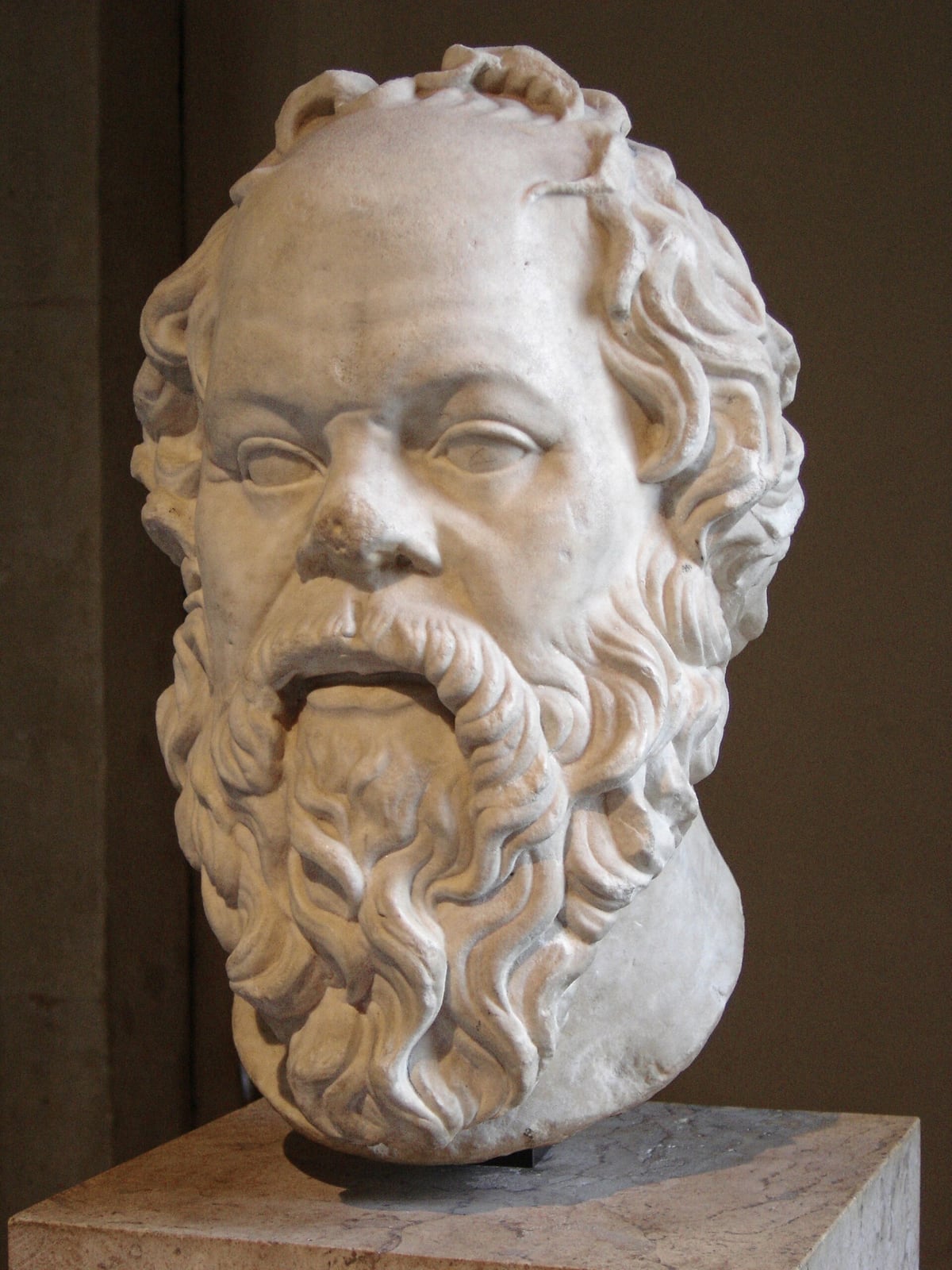
Busto de Sócrates (Louvre) · Public domain
بكلماته
«The unexamined life is not worth living.»Platón, Apología 38a. Griego: ed. Burnet (OCT); inglés: Benjamin Jowett (1892); español: traducción propia. Son palabras que Platón atribuye a Sócrates.

فكرته المحورية
Elenchus (Socratic refutation): The *elenchus*—"test", "refutation"—is the procedure Plato's early dialogues attribute to Socrates.
السيرة
5 دقيقة قراءة
ترجمة مُعانة من الأصل الإسباني، بانتظار مراجعة مترجم من أهل اللغة.
الرجل الذي لم يكتب شيئًا
لم يترك سقراط سطرًا واحدًا مكتوبًا. فكلّ ما نعرفه عنه يأتينا من غيره: من محاورات تلميذه أفلاطون، ومن الكتابات السقراطية لكسينوفون، ومن ملهاة أريستوفانيس التي سخرت منه في حياته، ومن الأخبار التي جمعها أرسطو — المولود بعد وفاته بخمس عشرة سنة — في الأكاديمية، ومن المصنَّف المتأخر لديوجانس اللائرتي في القرن الثالث الميلادي. وهذه الشهادات لا تتّفق. فسقراط أريستوفانيس دجّالٌ يتأمّل في السُّحب ويعلّم كيف تُكسَب الدعاوى الجائرة؛ وسقراط كسينوفون واعظٌ أخلاقي رصين يُسدي لأصدقائه النصائح الحسنة؛ وسقراط أفلاطون مفكّرٌ لا يُضاهى عمقًا، يغدو في المحاورات المتأخرة لسانَ حالِ مذاهب لم يقل بها على الأرجح قط.
وتُعرف هذه الهوّة بين المصادر بـ«المسألة السقراطية». وقد صاغها فريدريش شلايرماخر عام 1818 حين تساءل: ماذا كان سقراط حتى يرسمه أفلاطون وكسينوفون على النحو الذي رسماه به؟ ومنذ ذلك الحين وثق بعضهم بكسينوفون لرصانته الظاهرة؛ وأعاد آخرون، مثل غريغوري فلاستوس، بناء سقراط التاريخي انطلاقًا من محاورات أفلاطون الأولى؛ وشدّد غيرهم، مثل أولوف غيغون وتشارلز كان، على أن «الأحاديث السقراطية» كانت جنسًا أدبيًا مارسه عدد من التلاميذ، ولم يكن أيٌّ منهم يقصد إلى تدوين محضر. وما يلي يميّز، قدرَ الإمكان، بين ما تشترك فيه المصادر وما ينفرد به كلٌّ منها.
ألوبيكي
وُلد في أثينا نحو عام 469 ق.م — ويجعل ديوجانس اللائرتي، متّبعًا تأريخ أبولودوروس، مولده في السنة الرابعة من الأولمبياد السابع والسبعين — في ديم ألوبيكي من قبيلة أنطيوخيس. كان أبوه سوفرونيسكوس نحّاتًا للحجر أو مَثّالًا، وكانت أمه فايناريتي قابلة، وهي مهنة سيجعلها سقراط نفسه في محاورة «ثياتيتوس» صورةً لمنهجه. وتزوّج متأخرًا من زانثيبي، فأنجب منها ثلاثة أبناء — لامبروكليس وسوفرونيسكوس ومنكسينوس؛ وينسب إليه أرسطو، فيما ينقله ديوجانس، زوجةً ثانية هي ميرتو، وهو خبر يعدّه النقّاد مشكوكًا فيه.
نشأ في أثينا بريكليس، في الجيل الذي شهد ارتفاع البارثينون وازدهار التراجيديا والسفسطائية والبحث في الطبيعة. ويجعله أفلاطون يحاور في شبابه بارمنيدس وزينون، وهو لقاء أدبي على الأرجح، ويصوّره في صباه مُقبلًا على طبيعيات أناكساغوراس، ثم عازفًا عنها لأنه لم يجد فيها جوابًا عن السؤال عن الخير.
الجندي والمواطن
خدم جنديًا من المشاة الثقيلة (هوبليتًا)، وهو ما يفترض شيئًا من اليسر في شبابه. وقاتل في بوتيدايا (432–430 ق.م)، حيث أنقذ — بحسب الرواية التي يضعها أفلاطون على لسان ألقبيادس في «المأدبة» — حياةَ ألقبيادس، واحتمل الشتاء حافيَ القدمين؛ وفي الانسحاب من ديليون (424 ق.م)، حيث أثار رباطةُ جأشه إعجابَ القادة؛ وفي أمفيبوليس (422 ق.م). ويذكّر «الدفاع» بهذه الحملات الثلاث دليلًا على أنه لم يتخلَّ قط عن الموقع الذي أُسند إليه.
ولم يتولَّ إلا منصبًا عامًا واحدًا، وبالقرعة. ففي عام 406 ق.م، بصفته عضوًا في المجلس أثناء بريتانية قبيلته، عارض محاكمة القادة المنتصرين في معركة أرغينوساي جملةً، خلافًا للقانون، وقد اتُّهموا بأنهم لم ينتشلوا الغرقى. وبعد عامين، في ظل حكم الأقلية المعروف بـ«الثلاثين»، تلقّى مع أربعة آخرين أمرًا باعتقال ليون السلاميني لإعدامه، فانصرف إلى بيته. ويتّفق أفلاطون وكسينوفون على الواقعتين كلتيهما.
السؤال حِرفةً
كانت حرفته المحاورة. يمارسها في الأغورا وفي ساحات الرياضة وفي بيوت أصدقائه، بلا أجر — خلافًا للسفسطائيين الذين كثيرًا ما خلط الناس بينه وبينهم — وفي فقرٍ يصفه «الدفاع» بأنه مُدقِع. واشتهر بدمامته: أنفٌ أفطس، وعينان جاحظتان، وهيئة سيلينوس. وبحسب «الدفاع»، سأل صديقه خايرفون في دلفي إن كان ثمة من هو أحكم منه، فأجابت الكاهنة البيثية بالنفي؛ فحار سقراط، وراح يمتحن السياسيين والشعراء والصنّاع، فانتهى إلى أن ميزته الوحيدة هي أنه لا يظنّ أنه يعلم ما لا يعلم. ومنذ ذلك الحين فهم امتحانه للآخرين خدمةً للإله.
وكان ذلك الامتحان — الـإلنخوس — يقوم على طلب تعريفٍ للشجاعة أو التقوى أو العدالة، ثم انتزاع موافقة المحاور على قضايا أخرى، ثم إظهار أن التعريف الأول لا يتّسق معها. وينسب إليه أرسطو إسهامين: الاستدلالات الاستقرائية، والبحث عن التعريفات الكلّية، مطبَّقَين على المسائل الأخلاقية، من غير أن يفصل تلك الكلّيات عن الأشياء كما سيفعل أفلاطون بالمُثُل. وكان سقراط يتحدّث كذلك عن علامة إلهية، هي الدايمونيون الخاص به، صوتٌ كان منذ طفولته يثنيه عن بعض الأفعال ولم يدفعه قط إلى فعل شيء.
السُّحب
في عام 423 ق.م عرض أريستوفانيس ملهاة «السُّحب»، وفيها سقراطٌ معلَّقٌ في سلّة يدير «دارًا للتفكير» تُدرَس فيها الظواهر السماوية، ويُستبدَل فيها زيوس بالدوّامات، ويُعلَّم فيها القول الجائر. وجاءت الملهاة في المرتبة الثالثة، لكن الصورة الساخرة بقيت: ففي «الدفاع» يعدّ سقراط من «متّهميه الأوائل» أولئك الذين أشاعوا تلك الصورة، ويسمّي الشاعر الهزلي باسمه صراحةً. وكانت صلته بألقبيادس، الذي خان أثينا، وبكريتياس، أشدّ الثلاثين تطرّفًا، مما ثقُل عليه كذلك.
المحاكمة
في ربيع عام 399 ق.م اتّهمه ميليتوس، يسانده أنيتوس وليكون، بأنه لا يعترف بآلهة المدينة، وبأنه يُدخل آلهة جديدة، وبأنه يُفسد الشباب، وطالب بعقوبة الإعدام. ولمّا كان عفو عام 403 يحول دون الملاحقة على الجرائم السياسية السابقة، صيغ الاتهام بعبارات دينية. وأمام هيئة محلّفين من نحو خمسمئة مواطن، دافع سقراط عن نفسه بلا توسّل ولا دموع. وأُدين بفارقٍ يقارب ستين صوتًا، كما يُستفاد من «الدفاع» الأفلاطوني؛ ولمّا دُعي إلى اقتراح عقوبة بديلة، اقترح أولًا أن يُعال على نفقة الدولة في البريتانيون، ثم غرامةً قدرها ثلاثون مينا يضمنها أفلاطون وكريتون وكريتوبولوس وأبولودوروس. فصوّت المحلّفون للإعدام.
وأُرجئ تنفيذ الحكم نحو ثلاثين يومًا لأن السفينة المقدّسة المُرسَلة إلى ديلوس لم تكن قد عادت، ولم يكن يجوز للمدينة أن تُعدم أحدًا في غيابها. وعرض عليه كريتون الفرار، فأبى سقراط: ففي المحاورة التي تحمل اسم كريتون، تذكّره قوانين أثينا بأنه عاش سبعين عامًا في حمايتها، وأنه لا يجوز له أن يردّ الظلم بظلم.
الموت
يروي «فيدون» اليوم الأخير. لم يكن أفلاطون حاضرًا — «أفلاطون، فيما أظن، كان مريضًا»، يقول الراوي — والمحاورة، التي تدور حول براهين خلود النفس، عملٌ فنّي ومذهبي أكثر منها محضرًا. وعند الأصيل اغتسل سقراط، وودّع امرأته وأبناءه، وشرب السمّ — الشوكران، بحسب التحديد المتوارث — ومشى حتى أحسّ بثقلٍ في ساقيه. ولمّا أخذ البرد يصعد نحو قلبه، كشف عن وجهه وقال لكريتون إنهم مدينون لأسكليبيوس بديك، وألّا ينسوا أداءه. وكانت تلك، بحسب فيدون، آخر كلماته.
ما بقي
نشأت من حلقته مدارس متناحرة: أكاديمية أفلاطون، والكلبيون الذين انتسبوا إلى أنتيستينيس، والقورينائيون أتباع أريستيبوس، والميغاريون أتباع إقليدس. واتّخذه الرواقيون مثالًا للحكيم، ولا يكفّ إبكتيتوس عن الاستشهاد به. وفي العصر الحديث خصّص كيركغور أطروحته للسخرية السقراطية (1841)، وجعل منه نيتشه عَرَضًا من أعراض الانحطاط (1889)، وثبّت جاك لوي دافيد عام 1787 صورة موته الهادئ. ويبقى، في التقليد الغربي، صورةَ الفيلسوف الذي آثر الموت على أن يكفّ عن فحص الحياة.
المصادر: Platón. Platonis Opera, ed. John Burnet, 5 vols. Oxford University Press (Oxford Classical Texts), 1900–1907; tomo I (Eutifrón, Apología, Critón, Fedón) consultado en la edición digital del Perseus Digital Library (Tufts University). · Plato. The Dialogues of Plato, trad. Benjamin Jowett, 3.ª ed., 5 vols. Clarendon Press, Oxford, 1892 (Project Gutenberg, n.º 1656 Apology, 1657 Crito, 1658 Phaedo y otros). · Platón. Obras completas, trad. Patricio de Azcárate, 11 vols. Medina y Navarro, Madrid, 1871–1872 (edición digital en Filosofía en español). · Jenofonte. Memorables (Recuerdos de Sócrates), Apología de Sócrates, Banquete y Económico. Texto griego: Xenophontis opera omnia, ed. E. C. Marchant, vol. 2, 2.ª ed., Clarendon Press, Oxford, 1921 (Perseus); trad. inglesa de H. G. Dakyns, The Works of Xenophon, Macmillan, Londres, 1890–1897 (Project Gutenberg). · Aristófanes. Las nubes (Νεφέλαι), representada en 423 a. C.; trad. inglesa de W. J. Hickie, The Comedies of Aristophanes, Bohn's Classical Library, Londres, 1853 (Project Gutenberg n.º 2562).
الخط الزمني
الحياة عامًا بعد عام
كل نقطة حدث موثّق. انقر لتقرأه مع مصدره ودرجة اليقين فيه.
نحو 469 ق.مأقل من عامAlopece (Atenas)
Birth
Born in the deme of Alopece, son of the stonemason Sophroniscus and the midwife Phaenarete. Diogenes Laertius (II 44), following Apollodorus, gives the fourth year of the 77th Olympiad (469/468 BCE); Wikidata records 470. Years BCE are expressed as negative numbers.
مرجَّحDiógenes Laercio. Vidas y opiniones de los filósofos ilustres, libro II, 18–47 (Sócrates), s. III d. C. Trad. inglesa de C. D. Yonge, Bohn, Londres, 1853 (Project Gutenberg n.º 57342); trad. española de José Ortiz y Sanz, Madrid, 1792 (Wikisource).
بعد وفاته
- نحو 395 ق.مThe "Socratic discourses"
- نحو 387 ق.مFounding of the Academy
- 1787David's Death of Socrates
- 1818Schleiermacher poses the "Socratic problem"
- 1841Kierkegaard on irony
نحو 469 ق.م · أقل من عام
Birth
Born in the deme of Alopece, son of the stonemason Sophroniscus and the midwife Phaenarete. Diogenes Laertius (II 44), following Apollodorus, gives the fourth year of the 77th Olympiad (469/468 BCE); Wikidata records 470. Years BCE are expressed as negative numbers.
مرجَّح
نحو 432 ق.م · 37 عامًا
The Potidaea campaign
Serves as a hoplite at the siege of Potidaea (432–430 BCE). In the Symposium (219e–220e) Alcibiades says Socrates saved his life and endured the winter barefoot.
مرجَّح
424 ق.م · 45 عامًا
The retreat from Delium
Takes part in the Athenian defeat at Delium; the Laches (181b) and the Symposium (221a–b) praise his composure during the retreat.
مرجَّح
423 ق.م · 46 عامًا
Aristophanes' Clouds
Aristophanes stages the Clouds at the City Dionysia, caricaturing Socrates as a teacher of speculative physics and unscrupulous rhetoric. It comes third; the surviving text is a later revision that was never staged.
موثّق
422 ق.م · 47 عامًا
Amphipolis
Last military campaign attributed to him in the Apology (28e).
مرجَّح
406 ق.م · 63 عامًا
The Arginusae trial
As a member of the Council, during the prytany of the tribe Antiochis, he opposes trying the generals of Arginusae en bloc, against the law (Apology 32b; Xenophon, Hellenica I 7.15).
موثّق
404 ق.م · 65 عامًا
Leon of Salamis
Under the Thirty Tyrants he refuses the order to arrest Leon of Salamis for execution (Apology 32c–d; Xenophon, Memorabilia IV 4.3).
موثّق
403 ق.م · 66 عامًا
Democratic restoration and amnesty
Fall of the Thirty. The amnesty forbids prosecution for earlier political offences, which partly explains the religious framing of the 399 charge.
موثّق
399 ق.م · 70 عامًا
Trial
Meletus, Anytus and Lycon accuse him of impiety and of corrupting the youth. He is convicted by about sixty votes before a jury of some five hundred citizens and sentenced to death.
موثّق
399 ق.م · 70 عامًا
Death
After some thirty days' wait for the return of the Delian ship, he drinks the poison in prison, surrounded by his friends (Phaedo 116a–118a; Xenophon, Memorabilia IV 8.2).
موثّق
نحو 395 ق.م
The "Socratic discourses"
Plato, Xenophon, Aeschines of Sphettus, Antisthenes, Phaedo and others write dialogues with Socrates as protagonist; Aristotle (Poetics 1447b) treats them as a genre of their own. Except for Plato's and Xenophon's, almost all survive only in fragments.
موثّق
نحو 387 ق.م
Founding of the Academy
Plato founds his school in the grove of Academus; the dialogues read there will fix the image of Socrates for posterity.
مرجَّح
1787
David's Death of Socrates
Jacques-Louis David shows at the Salon the painting that fixes the modern image of Socrates' death, now in the Metropolitan Museum, New York.
موثّق
1818
Schleiermacher poses the "Socratic problem"
In "Über den Werth des Sokrates als Philosophen" Schleiermacher asks how to reconcile Plato's and Xenophon's portraits: the critical question of the historical Socrates is born.
موثّق
1841
Kierkegaard on irony
Søren Kierkegaard defends his dissertation On the Concept of Irony with Continual Reference to Socrates.
موثّق
المؤلَّفات
المؤلَّفات الأساسية
المؤلَّفات التي لا يُفهم إرثه من دونها.
تعليم شفهي مدوَّن · نحو 395 ق.م
Apology of Socrates
Ἀπολογία Σωκράτους
Socrates' defence speech before the Athenian court in 399 BCE, in three parts: the defence against the "first accusers" and against Meletus; the counter-proposal of a penalty after the verdict; and closing words to the jurors. It contains the account of the Delphic oracle, the image of the gadfly that rouses the city, the statement that he will obey the god rather than the Athenians and the dictum that the unexamined life is not worth living. It is the main source for reconstructing the trial and Socrates' understanding of himself.
6 طبعات
تعليم شفهي مدوَّن · نحو 395 ق.م
Crito
Κρίτων
In prison, at dawn, his old friend Crito tells Socrates that the ship from Delos is about to arrive and offers him an escape, already arranged and paid for. Socrates examines whether it is just to flee: one must not answer an injustice with another, and the personified Laws of Athens remind him that for seventy years he has accepted living under them. It is the classic text on the obligation to obey the law and one of the first arguments about the compact between citizen and city.
6 طبعات

تعليم شفهي مدوَّن · نحو 385 ق.م
Phaedo
Φαίδων
Account of Socrates' last day, told by Phaedo of Elis to Echecrates at Phlius. Socrates talks with the Thebans Simmias and Cebes, who had frequented Pythagoreans, about why the philosopher does not fear death, and sets out four arguments for the immortality of the soul and a myth about the fate of souls. The dialogue closes with the death scene: the bath, the farewell to his family, the cup of poison and the last words to Crito about the cock owed to Asclepius (118a).
6 طبعات

مجموعة لاحقة · نحو 371 ق.م
Memorabilia (Memoirs of Socrates)
Ἀπομνημονεύματα
Four books that begin by refuting one by one the charges of impiety and corruption of the young, and go on to dozens of short conversations: Socrates advises his son Lamprocles to be patient with Xanthippe, talks with the sophist Antiphon about poverty, with Aristippus about self-mastery, with craftsmen and generals about their trades. It is the portrait of a practical and pious teacher and the second great source on Socrates alongside Plato.
4 طبعات
جميع مؤلَّفاته (31)
Euthyphro
395
Symposium
380
Socrates
Laches
The Conscious LibraryLaches
390
Socrates
Charmides
The Conscious LibraryCharmides
390
Socrates
Lysis
The Conscious LibraryLysis
390

Protagoras
385

Gorgias
385

Meno
385
Socrates
Ion
The Conscious LibraryIon
395
Socrates
Lesser Hippias
The Conscious LibraryLesser Hippias
395
Socrates
Euthydemus
The Conscious LibraryEuthydemus
385

Theaetetus
369
Phaedrus
370

Republic
375
Socrates
Greater Hippias
The Conscious LibraryGreater Hippias
390
Socrates
First Alcibiades
The Conscious LibraryFirst Alcibiades
360
Socrates
Parmenides
The Conscious LibraryParmenides
365
Socrates
Other dialogues of the Platonic corpus featuring Socrates
The Conscious LibraryOther dialogues of the Platonic corpus featuring Socrates
360
Apology of Socrates (Xenophon)
380
Symposium (Xenophon)
380
Oeconomicus (The Estate Manager)
362

The Clouds (Aristophanes)
423
Socrates
Aristotle's testimonies on Socrates
The Conscious LibraryAristotle's testimonies on Socrates
340

Life of Socrates (Diogenes Laertius, Lives II 18–47)
230
الأقوال
أقوال محدَّدة الموضع في مؤلَّف بعينه. كل منها يحمل مصدره ودرجة الثقة به.
The unexamined life is not worth living.ὁ δὲ ἀνεξέταστος βίος οὐ βιωτὸς ἀνθρώπῳ
متحقَّق منهPlatón, Apología 38a. Griego: ed. Burnet (OCT); inglés: Benjamin Jowett (1892); español: traducción propia. Son palabras que Platón atribuye a Sócrates.
أقوال منحولة أو مختلَف في نسبتها (5)
«I know that I know nothing.»
The formula appears in no ancient text about Socrates. It is a later simplification of Apology 21d, where Socrates says something more precise: that he does not think he knows what he does not know. In Plato Socrates claims to know some things (for instance, that doing wrong is bad, Apology 29b).
«Know thyself.»
It is one of the maxims inscribed at the temple of Apollo at Delphi, older than Socrates and ascribed in antiquity to several of the Seven Sages. Socrates quotes and discusses it (Phaedrus 229e, Charmides 164d), but it is not his.
«There is only one good, knowledge, and one evil, ignorance.»
Only Diogenes Laertius (II 31) transmits it, more than six centuries later and without naming a source. It sums up Socratic intellectualism as a slogan, but it is not found in Plato or Xenophon.
«Education is the kindling of a flame, not the filling of a vessel.»
Attributed to Socrates online, it comes from Plutarch, On Listening (Moralia 48c), who says the mind is not a vessel to be filled but kindling to be set alight. Plutarch lived five centuries later.
«The "triple filter test": before you tell me something, is it true, is it good, is it useful?»
A moralising anecdote circulating in self-help books and chain emails since the late twentieth century. It has no ancient source.
الكلمات الأخيرة
رواية لاحقة عن شهود
«"Crito, we owe a cock to Asclepius. Pay it and do not neglect it."»ὦ Κρίτων, ἔφη, τῷ Ἀσκληπιῷ ὀφείλομεν ἀλεκτρυόνα· ἀλλὰ ἀπόδοτε καὶ μὴ ἀμελήσητε.
Plato, Phaedo 118a. According to the narrator, Phaedo of Elis, he spoke them when the chill of the poison had reached his abdomen: he uncovered his face and said these words, "which were his last". Crito answered that it would be done and asked whether he had anything else to say; Socrates no longer replied. The testimony is literary and second-hand—Plato states in the same dialogue (59b) that he was ill and absent—hence its classification as a witness account transmitted by another. The Greek verb is plural, "we owe": Jowett translates "I owe", Azcárate "debemos un gallo a Esculapio". Asclepius was the god of healing, to whom a cock was offered after recovery. The sentence has been interpreted in many ways: Nietzsche saw in it the confession that life is a disease; Georges Dumézil (1984), thanks for the cure of a false opinion; others, an outstanding vow for Plato's illness or a simple act of piety. Xenophon transmits no last words.
المصدر: Platón. Platonis Opera, ed. John Burnet, 5 vols. Oxford University Press (Oxford Classical Texts), 1900–1907; tomo I (Eutifrón, Apología, Critón, Fedón) consultado en la edición digital del Perseus Digital Library (Tufts University).
اسأل
بماذا يجيب أثره
اثنا عشر سؤالًا كبيرًا من أسئلة الإنسانية، وما تتيح نصوصه الإجابة به عنها، مع المراجع. ولا نقوّله ما لم يقل أبدًا.
ما المطلق؟ هل الله موجود؟
A god who entrusts him with a mission and warns him by a sign
إله شخصييقوله صراحةً
Socrates wrote nothing; his relation to the divine is known through Plato and Xenophon, who agree on the essentials. In Plato's Apology he speaks of “the god” of Delphi as someone who has assigned him a post in the city and whom he will obey rather than the Athenians, and he describes a divine sign, a voice that since childhood turns him away from what he should not do. Xenophon, in the Memorabilia, attributes to him an argument from design: eyes, eyelids or affection for offspring show the work of a wise craftsman who loves living beings, and the gods care for humans and see everything. It is a personal dealing with the divine, though Socrates avoids speculating about its nature.
قارن هذا السؤال مع معلّمين آخرينمن أنا؟ هل توجد ذات حقيقية؟
What we are is the soul, and caring for it matters above all
روح مخلوقة خالدةيُستنتج من تعاليمه
In Plato's Apology Socrates sums up his life in an exhortation: not to care for the body or for wealth before the soul, so that it may become as good as possible. The Alcibiades I, of disputed authenticity, draws the conclusion that the human being is his soul, and the Delphic command to know oneself becomes a lifelong task. On immortality, the Socrates of the Apology is cautious and leaves two possibilities open; the arguments of the Phaedo are already Plato's elaboration. Xenophon, for his part, attributes to him the idea that the soul is what in the human shares in the divine. The core attributable to Socrates is that the true self is the soul.
قارن هذا السؤال مع معلّمين آخرينلماذا نتألّم؟
Nobody does wrong knowingly: evil is ignorance and harms the soul
الجهل بما نحن عليهيُستنتج من تعاليمه
Plato's dialogues attribute to Socrates two theses that together answer the question. First: no one errs willingly; whoever does wrong does so because he takes for good what is not, so that evil is a form of ignorance. Second: the greatest harm is not to suffer injustice but to commit it, because it spoils the only thing that matters, the soul; hence he would rather suffer it than commit it. Thus his reproach to the Athenians in the Apology: they care for wealth, fame and honours and not for the soul or for truth. The suffering that truly counts arises from not knowing oneself and confusing the goods of the body with one's own good.
قارن هذا السؤال مع معلّمين آخرينماذا يحدث بعد الموت؟
Either a dreamless sleep or a journey: in either case, not an evil
صمت أو تحفّظيقوله صراحةً
In Plato's Apology, already condemned, Socrates reasons that fearing death is thinking one knows what one does not know. He proposes two possibilities: either death is being nothing and feeling nothing, like a dreamless sleep, which would be a gain; or it is a migration of the soul to another place, where he could converse with poets and heroes of the past, which would be an immense good. To the good man, he concludes, no evil befalls in life or after death. His last words to the court leave the question open: who goes to the better lot, nobody knows but the god. The proofs of immortality in the Phaedo are already Plato's.
قارن هذا السؤال مع معلّمين آخرينكيف يُبلَغ التحرّر أو الخلاص؟
Examining oneself and others: an unexamined life is not worth living
بالمعرفة المباشرةيقوله صراحةً
Socrates promises no salvation, but his whole life is a method for making the soul better. In Plato's Apology he says that the greatest good for a man is to converse every day about virtue and to examine himself and others, and that an unexamined life is not worth living. The instrument is refutation: questioning until the interlocutor discovers that he does not know what he thought he knew, the first step to truly seeking it. If virtue is knowledge, as Aristotle attributes to him, knowing oneself — in the Delphic sense — is the way to become good. His own death, accepted without committing injustice, appears in the dialogues as proof of that freedom.
قارن هذا السؤال مع معلّمين آخرينهل نحتاج إلى معلّم؟
He does not teach: like a midwife, he delivers what the other carries
المعلّم في الداخليقوله صراحةً
Plato's Socrates rejects the title of teacher: in the Apology he states that he has never been anyone's teacher nor charged for conversation. In the Theaetetus he describes himself as a midwife: barren of wisdom himself, he helps others give birth to what they carried within and to tell whether it is true or false offspring; what they find they learn not from him but from themselves. His own guidance was inner: a divine sign that turned him away from certain actions. The Meno adds the Platonic theory of recollection, by which seeking and learning are remembering. The outer teacher only asks; truth lies in the soul of the seeker.
قارن هذا السؤال مع معلّمين آخرينهل العالم حقيقي؟
A world arranged by provident gods, though physics does not occupy him
خلقٌ صالح وحقيقييُستنتج من تعاليمه
The sources agree that Socrates turned away from the investigation of nature. Aristotle states that he dealt with moral questions and not with nature as a whole; Xenophon says he did not discuss how the cosmos came about and considered those who did so foolish. In Plato's Apology he denies knowing anything of what lies beneath the earth or in the sky. But when he speaks of the world he does so in terms of providence: in the Memorabilia he argues that the arrangement of the organs and the beauty of the universe reveal a wise craftsman who cares for living beings, and that the gods have ordered the cosmos for the benefit of humans.
قارن هذا السؤال مع معلّمين آخرينما الحب؟
He claims to know only love: the desire that improves the beloved
الشوق والوصاليُستنتج من تعاليمه
The man who claimed to know nothing declared himself expert in one thing alone: love. So Plato has him say in the Symposium and the Lysis. In the Symposium Socrates sets out what, he says, Diotima taught him: Eros is the desire to possess the good for ever and to beget in beauty, and it leads by degrees from beautiful bodies to Beauty itself. The Alcibiades of Aeschines of Sphettus, another Socratic, presents his love for the young man as a force that, by divine gift, could make him better without teaching him anything. Xenophon adds conversations on friendship. Socratic love is longing for the good that raises both lover and beloved.
قارن هذا السؤال مع معلّمين آخرينهل نحن أحرار أم أن كل شيء مقدَّر؟
The god assigned him a post, and he answers for how he holds it
القدر والمسؤوليةيُستنتج من تعاليمه
Socrates does not discuss the theoretical problem of freedom, but his life, as Plato and Xenophon tell it, is ordered by a charge. In the Apology he interprets the Delphic oracle as a mission: the god has set him beside the city like a gadfly, and abandoning that post for fear of death would be like deserting in battle. The divine sign turns him away from certain actions and, significantly, did not stop him on the day of the trial. At the same time, responsibility is fully his: in the Crito he chooses not to flee because committing injustice is never permitted. The thesis that nobody errs willingly, however, complicates any reading in terms of free will.
قارن هذا السؤال مع معلّمين آخرينلماذا نتأمّل أو نصلّي؟
Asking the gods for the good, unspecified, and to be beautiful within
الطقس وتهذيب الذاتيقوله صراحةً
The sources show a Socrates pious in the ways of his city. Xenophon relates that he sacrificed at home and at the public altars, consulted divination and asked the gods simply for good things, since they know best what is fitting; modest sacrifices from someone with little please them no less than great ones. In Plato's Phaedrus, at the end of the conversation, he prays to Pan and the gods of the place to grant him to be beautiful within and that what is outside be in friendship with what is within. Plato also relates that at Potidaea he stood absorbed in thought from dawn to the following dawn.
قارن هذا السؤال مع معلّمين آخرينهل يستطيع العقل أن يعرف الحقيقة القصوى؟
He knows he does not know: he tests the god's word by reason
الإيمان والعقل يتعاونانيقوله صراحةً
Plato's Apology relates how Socrates received the reply of the Delphic oracle — no one was wiser than he — and, instead of simply accepting it, set out to examine it by questioning politicians, poets and craftsmen. He concluded that his wisdom lay in not thinking he knew what he did not know, and that human wisdom is worth little or nothing: the truly wise one is the god. Reason, exercised in dialogue, does not reach a final science of the ultimate, but it purges false opinions and guides life; divine signs and dreams complete that limited knowledge. Aristotle credits him with the search for universal definitions and inductive arguments.
قارن هذا السؤال مع معلّمين آخرينالانسحاب من العالم أم تغييره؟
True politics is making the citizens' souls better
الثورة داخليةيقوله صراحةً
Socrates did not withdraw from Athens: he spent his life in the agora, served as a hoplite and fulfilled his public offices, opposing the majority and the Thirty when justice required it. But, according to Plato's Apology, he abstained from active politics because his divine sign prevented him and because whoever truly fights for justice does not survive long in it. His task was another: to urge each citizen, in private, to care for the soul before wealth. In the Gorgias he claims to be one of the few Athenians practising the true political art, because he seeks his fellow citizens' good and not their pleasure. Changing the city begins with changing souls.
قارن هذا السؤال مع معلّمين آخرين
التقارب والتوتّر
التقارب والتوتّر
محسوبة سؤالًا سؤالًا انطلاقًا من مواقفه. وسبب كل اتفاق أو اختلاف يظهر بالنقر.
يقترب في تفكيره من
Augustine of Hippo
يتّفقان في: ما المطلق؟ هل الله موجود؟ · من أنا؟ هل توجد ذات حقيقية؟ · هل نحتاج إلى معلّم؟
Thomas à Kempis
يتّفقان في: ما المطلق؟ هل الله موجود؟ · من أنا؟ هل توجد ذات حقيقية؟ · هل نحتاج إلى معلّم؟
Carl Gustav Jung
يتّفقان في: لماذا نتألّم؟ · ماذا يحدث بعد الموت؟ · هل نحتاج إلى معلّم؟
Hildegard of Bingen
يتّفقان في: ما المطلق؟ هل الله موجود؟ · من أنا؟ هل توجد ذات حقيقية؟ · هل العالم حقيقي؟
يبتعد في تفكيره عن

Dōgen
يختلفان في: ما المطلق؟ هل الله موجود؟ · من أنا؟ هل توجد ذات حقيقية؟
Tsongkhapa
يختلفان في: ما المطلق؟ هل الله موجود؟ · من أنا؟ هل توجد ذات حقيقية؟
Śāntideva
يختلفان في: ما المطلق؟ هل الله موجود؟ · من أنا؟ هل توجد ذات حقيقية؟
Siddhartha Gautama, the Buddha
يختلفان في: ما المطلق؟ هل الله موجود؟ · من أنا؟ هل توجد ذات حقيقية؟
حكايات وروايات
حكايات وروايات
شهادةantes del 431 a. C. (incierto)
The Delphic oracle
أصل الرواية: Plato, Apology 20e–23b, where Socrates calls Chaerephon's brother as witness, Chaerephon being dead. Xenophon (Apology 14) gives a different version: the oracle supposedly said no one was more free, just or sensible than Socrates. Some scholars doubt the consultation took place; others accept it because it appears in a speech delivered before hundreds of Athenians.
شهادة432–424 a. C.
Potidaea and Delium
أصل الرواية: Plato, Symposium 219e–221c; the Laches (181b) confirms the conduct at Delium through the general Laches. It is a literary testimony in a character's mouth, but it agrees with the Apology (28e) on the three campaigns. The Aristophanes quotation comes from the Clouds (362).
موثّق406–404 a. C.
The Arginusae generals and Leon of Salamis
أصل الرواية: Plato, Apology 32b–e; Xenophon, Hellenica I 7.14–15 and Memorabilia I 1.18 and IV 4.2–3. It is one of the few episodes in Socrates' life attested by two independent authors and by a historian narrating the events apart from Socrates.
مختلَف فيه423 a. C.
Socrates stands up in the theatre
أصل الرواية: Aelian, Varia Historia II 13 (2nd–3rd century CE). There is no contemporary testimony. Plutarch (On the Education of Children 14) attributes a similar reaction to Socrates when mocked by comedy. The story of a bribe to Aristophanes is incompatible with the chronology.
المصدر: Eliano, Claudio. Historias curiosas (Varia historia) II 13, s. II–III d. C. Trad. esp. de Juan Manuel Cortés Copete, Gredos, Madrid, 2006.
لا يمكن التحقق منهs. V a. C. (tradicional)
Xanthippe and the water
أصل الرواية: Diogenes Laertius II 36–37 (3rd century CE); the image of the difficult wife is already in Xenophon, Symposium 2.10, where Antisthenes calls her "the most intolerable of women", and Memorabilia II 2. The bucket scene appears only in late sources and belongs to a repertoire of jokes about philosophers; it inspired many Baroque paintings.
شهادة401 a. C.
Xenophon asks for advice
أصل الرواية: Xenophon, Anabasis III 1.4–7, in which the author himself narrates the episode. It is the only surviving autobiographical testimony of a private conversation with Socrates.
التعاليم
التعاليم
المفاهيم التي ينتظم بها فكره، مشروحة في سياقها.
Elenchus (Socratic refutation)elenchos
The method of Plato's "aporetic" dialogues (Euthyphro, Laches, Charmides, Lysis); Aristotle links it to the search for universal definitions.
المصدر: Vlastos, Gregory. Socrates, Ironist and Moral Philosopher. Cambridge University Press / Cornell University Press, Cambridge e Ithaca, 1991.
Socratic ironyironia-socratica
A character trait attributed to Socrates by Plato, Xenophon and Aristotle; a central category of later rhetoric and philosophy.
المصدر: Vlastos, Gregory. Socrates, Ironist and Moral Philosopher. Cambridge University Press / Cornell University Press, Cambridge e Ithaca, 1991.
The daimonion (the divine sign)daimonion
The religious element in Socrates' figure, central to the impiety charge of 399 BCE.
No one does wrong willingly (moral intellectualism)nadie-obra-mal-voluntariamente
The core of Socratic ethics in the Protagoras, the Gorgias and the Meno.
Care of the soulcuidado-del-alma
The ethical programme of the Apology and the First Alcibiades; the basis of the ancient idea of philosophy as spiritual exercise.
Maieuticsmayeutica
An image from the Theaetetus, associated with the Meno and Platonic recollection.
مقاطع الفيديو
مقاطع الفيديو
تسجيلات ومقابلات وأفلام وثائقية. تُشغَّل مقاطع الفيديو من YouTube؛ ولا تُستضاف هنا.
2. Socratic Citizenship: Plato's Apology
محاضرة· EN· 2008· 46 min
YaleCoursesالقناة الرسمية
3. Socratic Citizenship: Plato's Crito
محاضرة· EN· 2008· 47 min
YaleCoursesالقناة الرسمية
Ancient Philosophies as a Way of Life: Socrates
محاضرة· EN· 2012· 61 min
Stanfordالقناة الرسمية
Bettany Hughes | Socrates and his Athens
محاضرة· EN· 2021· 61 min
The Ramsay Centre for Western Civilisationالقناة الرسمية
PBS Broadcast - The Trial of Socrates
فيلم وثائقي· EN· 2025· 58 min
National Hellenic Museumالقناة الرسمية
Paul Woodruff, "In Socrates' Footsteps: A Better Model for Virtue Ethics."
محاضرة· EN· 2020· 85 min
International Society for Socratic Studiesالقناة الرسمية
Socrates & Plato's Philosophy - Myles Burnyeat & Bryan Magee (1987)
مقابلة· EN· 1987· 44 min
Philosophy Overdose
Conferencia de Francesc Casadesús: 'Sócrates y sus enemigos'
محاضرة· ES· 2022· 63 min
Fundación BBVAالقناة الرسمية
Carlos Fernández Liria "Sócrates y el problema de la democracia"
محاضرة· ES· 2021· 55 min
G.I. UCM: Metafísica, Crítica y Políticaالقناة الرسمية
«Apología de Sócrates» | Notas a Platón (3/27)
تحليل· ES· 2020· 107 min
Ernesto Castroالقناة الرسمية
El juicio a Sócrates: ¿Por qué Atenas mató a su hombre más sabio? - H. Grecia #48
محاضرة· ES· 2024· 40 min
Darío Sánchez Vendraminiالقناة الرسمية
Portrait de Socrate | Cours méthodiques et populaires de philosophie
محاضرة· FR· 2014· 98 min
Bibliothèque nationale de France BnFالقناة الرسمية
Geschichte der Philosophie (2): Von Sokrates zu Platon, Prof. Dr. Torsten Wilholt
محاضرة· DE· 2013· 88 min
InstPhilالقناة الرسمية
المعرض
المعرض
صور بترخيص متحقَّق منه. كل منها تحتفظ بمؤلّفها ونسبتها.
المخطوطات
المخطوطات
شواهد مخطوطة ونصوص قديمة، مع جهة حفظها وشروط الاطّلاع عليها.
GRC · Minúscula griega · Diálogos compuestos c. 399–347 a. C.; copia de 895
Codex Oxoniensis Clarkianus 39 («Clarke Plato», B)
- الشاهد المحفوظ
- Códice de pergamino de 418 folios, copiado por Juan el Calígrafo para Aretas de Patras
- جهة الحفظ
- Bodleian Library, Oxford · MS. E. D. Clarke 39
- الرقمنة
- medieval.bodleian.ox.ac.uk/catalog/manuscript_40…
العلاقات
العلاقات
تأثيرات وتلمذة وتقارب في الأفكار. تُميَّز العلاقة الموثّقة عن التشابه المستخلَص بالتحليل.
معلّم
Plato frequented Socrates in his youth, attended the trial (Apology 34a, 38b) and made him the protagonist of almost all his dialogues.
علاقة موثّقة
معلّم
Jenofonte
A pupil in his youth; he wrote the Memorabilia, the Apology, the Symposium and the Oeconomicus, and recounts in the Anabasis how he asked him for advice.
علاقة موثّقة
معلّم
Antístenes
A follower of Socrates present at his death (Phaedo 59b); founder of the tradition that would lead to Cynicism.
علاقة موثّقة
معاصر لـ
Aristófanes
He caricatured him in the Clouds (423 BCE); Plato seats them together in the Symposium.
علاقة موثّقة
أثّر في
He never knew him, but in the Metaphysics credits him with induction and universal definition and discusses his moral intellectualism in the Nicomachean Ethics.
علاقة موثّقة
أثّر في
A pupil of Antisthenes according to Diogenes Laertius (VI 21); Plato allegedly called him "a Socrates gone mad" (VI 54).
علاقة موثّقة
أثّر في
According to Diogenes Laertius (VII 2–3), he became a philosopher after reading the second book of Xenophon's Memorabilia in Athens.
علاقة موثّقة
أثّر في
The Discourses recorded by Arrian hold up Socrates as the constant model of the philosophical life.
علاقة موثّقة
التقى بـ
Plato narrates a meeting between a very young Socrates and the aged Parmenides in the dialogue Parmenides; it is almost certainly a literary fiction.
تشابه مستخلَص بالتحليل
أفكار قريبة من
The speakers of the Phaedo, Simmias and Cebes, had frequented the Pythagorean Philolaus; the immortality of the soul and the philosophical life as purification bring Plato's Socrates close to the Pythagorean tradition.
تشابه مستخلَص بالتحليل
أفكار قريبة من
Oral teachers known through their disciples, centred on virtue and self-examination; Karl Jaspers grouped them among the "paradigmatic individuals".
تشابه مستخلَص بالتحليل
أفكار قريبة من
Neither wrote anything, both were executed by the authority of their city and their figure reaches us through disciples who disagree; the comparison has been a commonplace since the Christian apologists.
تشابه مستخلَص بالتحليل
المصادر
المصادر
المراجع والفهارس التي رُوجعت لهذه الصفحة.
- Wikidata, entidad Q913 «Socrates» (276 enlaces entre wikis; P31=Q5). Registra nacimiento en 470 a. C. (precisión: año) y muerte en 399 a. C. (15 de febrero o mayo, fechas sin base antigua); lugar de nacimiento Alopece y Atenas.
- Platón. Platonis Opera, ed. John Burnet, 5 vols. Oxford University Press (Oxford Classical Texts), 1900–1907; tomo I (Eutifrón, Apología, Critón, Fedón) consultado en la edición digital del Perseus Digital Library (Tufts University).
- Plato. The Dialogues of Plato, trad. Benjamin Jowett, 3.ª ed., 5 vols. Clarendon Press, Oxford, 1892 (Project Gutenberg, n.º 1656 Apology, 1657 Crito, 1658 Phaedo y otros).
- Platón. Obras completas, trad. Patricio de Azcárate, 11 vols. Medina y Navarro, Madrid, 1871–1872 (edición digital en Filosofía en español).
- Jenofonte. Memorables (Recuerdos de Sócrates), Apología de Sócrates, Banquete y Económico. Texto griego: Xenophontis opera omnia, ed. E. C. Marchant, vol. 2, 2.ª ed., Clarendon Press, Oxford, 1921 (Perseus); trad. inglesa de H. G. Dakyns, The Works of Xenophon, Macmillan, Londres, 1890–1897 (Project Gutenberg).
- Aristófanes. Las nubes (Νεφέλαι), representada en 423 a. C.; trad. inglesa de W. J. Hickie, The Comedies of Aristophanes, Bohn's Classical Library, Londres, 1853 (Project Gutenberg n.º 2562).
- Aristóteles. Metafísica A 6, 987b1–4, y M 4, 1078b17–32; Poética 1, 1447b11. Trad. inglesa de W. D. Ross (Oxford, 1908; Internet Classics Archive, MIT); trad. española de Patricio de Azcárate, Obras de Aristóteles, vol. 10, Madrid, 1875.
- Diógenes Laercio. Vidas y opiniones de los filósofos ilustres, libro II, 18–47 (Sócrates), s. III d. C. Trad. inglesa de C. D. Yonge, Bohn, Londres, 1853 (Project Gutenberg n.º 57342); trad. española de José Ortiz y Sanz, Madrid, 1792 (Wikisource).
- Guthrie, W. K. C. A History of Greek Philosophy, vol. III: The Fifth-Century Enlightenment, parte 2: Socrates. Cambridge University Press, Cambridge, 1969 (publicado aparte como Socrates, 1971; trad. esp. Historia de la filosofía griega, vol. III, Gredos).
- Vlastos, Gregory. Socrates, Ironist and Moral Philosopher. Cambridge University Press / Cornell University Press, Cambridge e Ithaca, 1991.
- Nails, Debra y Monoson, S. Sara. «Socrates». The Stanford Encyclopedia of Philosophy, ed. Edward N. Zalta; primera publicación 2005, revisión sustancial del 26 de mayo de 2022.
- Kahn, Charles H. Plato and the Socratic Dialogue: The Philosophical Use of a Literary Form. Cambridge University Press, Cambridge, 1996.
- Brickhouse, Thomas C. y Smith, Nicholas D. (eds.). The Trial and Execution of Socrates: Sources and Controversies. Oxford University Press, Nueva York, 2002.
- Waterfield, Robin. Why Socrates Died: Dispelling the Myths. Faber and Faber / W. W. Norton, Londres y Nueva York, 2009.
- «Socrates», Wikipedia en inglés, y «Sócrates», Wikipedia en español (consultadas para contrastar datos y bibliografía; texto propio).
- Giannantoni, Gabriele (ed.). Socratis et Socraticorum Reliquiae, 4 vols. Bibliopolis, Nápoles, 1990 (fragmentos de Esquines de Esfeto, Antístenes y demás socráticos).
- Eliano, Claudio. Historias curiosas (Varia historia) II 13, s. II–III d. C. Trad. esp. de Juan Manuel Cortés Copete, Gredos, Madrid, 2006.
- The Metropolitan Museum of Art. Jacques-Louis David, «The Death of Socrates» (1787), n.º de inventario 31.45.
- Bodleian Libraries, Universidad de Oxford. MS. E. D. Clarke 39 («Clarke Plato»), códice de las tetralogías I–VI de Platón copiado en 895 por Juan el Calígrafo para Aretas. A Catalogue of Western Manuscripts at the Bodleian Libraries.
- Open Library (Internet Archive): ediciones de Platón, Jenofonte, Aristófanes y Diógenes Laercio verificadas por ISBN.
- صاحب الحقوق
- Textos antiguos en dominio público; cada traducción y edición crítica pertenece a su traductor o editorial
في انتظار التأكيد
ما لم تتمكّن هذه الصفحة من حسمه بعد. نفضّل أن نقول ذلك على أن نملأ الفراغ.
- Fecha de nacimiento: se adopta 469 a. C. (Apolodoro en Diógenes Laercio II 44; Nails y Monoson); Wikidata da 470. Las fechas de muerte de Wikidata (15 de febrero o 1 de mayo de 399) no tienen base antigua: solo se sabe que fue en primavera, unos treinta días después del juicio.
- Ediciones españolas con ISBN verificado de Gorgias, Menón, Eutidemo, Teeteto, Parménides y Alcibíades I (Gredos, Diálogos II y V; Alianza): no localizadas en Open Library en esta sesión.
- «Las nubes» en español: solo se ha verificado la edición de Ediciones Clásicas (1999) sin traductor identificado; falta la de Gredos (Comedias I) con ISBN y contenido comprobados.
- Traducción española de dominio público de las Memorables y el Banquete de Jenofonte (p. ej., Diego Gracián, s. XVI): no localizada en línea con URL estable.
- Programas de afiliación: ninguno verificado (Gredos, Alianza, Penguin, Hackett). Lista vacía.
- Año de los vídeos: es el de la grabación cuando la descripción lo indica y, si no, el de publicación en YouTube.
بُحث بتاريخ 2026-10-25