Aristotelianism
Aristotle
Ἀριστοτέλης · أرسطوطاليس
384 BCE – 322 BCEHistorically documented person
Greek philosopher and scientist (384–322 BCE), Plato's student for twenty years, tutor to Alexander the Great and founder of the Lyceum in Athens. He created formal logic, organised knowledge into disciplines and left treatises on physics, biology, psychology, metaphysics, ethics, politics, rhetoric and poetics that dominated Greek, Arabic, Jewish and Christian philosophy for two millennia. His idea of the contemplative life as the highest form of happiness remains a central reference.
- works
- 67works
- editions
- 245editions
- quotes
- 18quotes
- videos
- 15videos
- images
- 9images
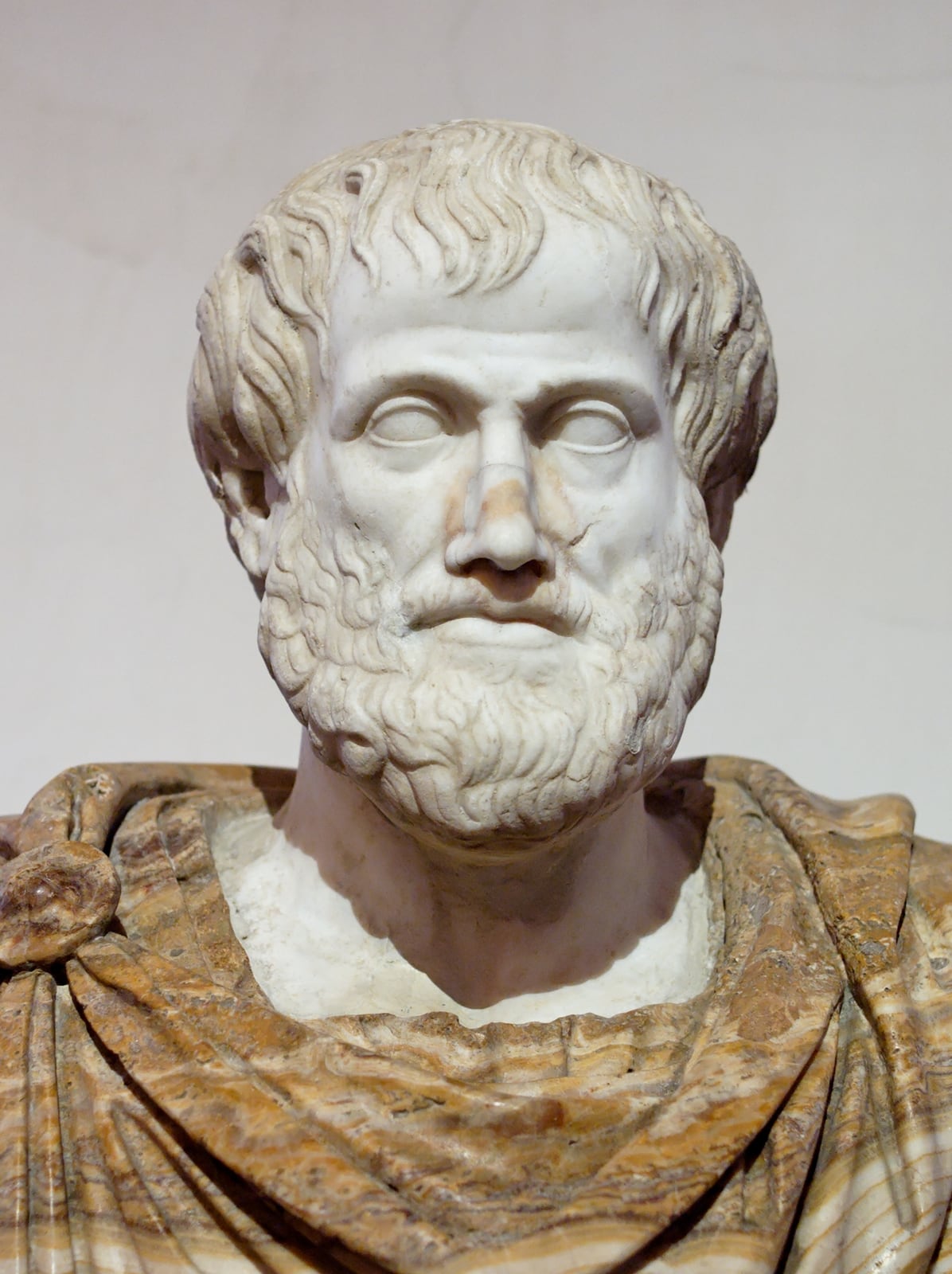
Busto de Aristóteles (Museo Nacional Romano, Palazzo Altemps) · Public domain
In their words
«“All men by nature desire to know.”»Metafísica I (A) 1, 980a21. Inglés: trad. de W. D. Ross (Oxford, 1908); español: trad. propia del griego.

Their central idea
Substance (ousia): For Aristotle, “being” is said in many ways, but all of them refer to a first one: substance.
See in context
Biography
6 min read
A physician's son on the Macedonian frontier
Aristotle was born in 384 BCE at Stagira, a small Greek city in Chalcidice on the northern coast of the Aegean. His father, Nicomachus, was physician and friend to King Amyntas III of Macedon, and the family claimed descent from Asclepius through Machaon; his mother, Phaestis, came from Chalcis in Euboea. Both died while he was still a boy, and his guardianship passed to Proxenus of Atarneus, whom the philosopher would remember in his will by commissioning a statue in his memory. That childhood among physicians and courtiers explains, in the view of many scholars, two features of his life: a passion for observing living things and a bond with the Macedonian royal house that would end up deciding his fate.
It should be said at the outset that almost everything we know about his life comes from late sources. The fullest biography is that of Diogenes Laertius, written in the third century CE on the basis of Hellenistic authors such as Hermippus and Apollodorus; to it we must add the Lives composed by the Neoplatonic commentators, more devout than critical, and a hostile tradition that portrayed him as vain and a flatterer of kings. Modern scholarship, since Ingemar Düring, carefully separates the chronological data, which are probably reliable, from the anecdotes.
Twenty years in the Academy
At seventeen, around 367 BCE, he came to Athens and entered Plato's Academy, where he remained for twenty years, until his teacher's death. He was a student, a researcher and soon a teacher of rhetoric. In this period he wrote dialogues for a wide readership — the Gryllus, the Eudemus, the Protrepticus, On Philosophy — whose prose Cicero would admire as “a river of gold”; only fragments remain. The first versions of his logical writings probably also date from these years.
His relationship with Plato was that of a disciple who argues. Diogenes Laertius records a remark attributed to the master: Aristotle had kicked him “as colts kick out at the mother who bore them.” His critique of the theory of Forms runs through the Metaphysics and the Nicomachean Ethics, where he admits that it is painful to refute friends, but that piety requires us to honour truth above them. Werner Jaeger proposed in 1923 to read his work as a progressive departure from Platonism; today that chronology is thought too neat, but the tension he identified remains real.
Asia Minor, Lesbos and the Macedonian court
After Plato's death in 348/347 BCE, with the Academy in the hands of his nephew Speusippus, Aristotle left Athens. He settled at Assos in the Troad under the protection of Hermias, ruler of Atarneus, to whom he was bound by close friendship, and married Pythias, Hermias's niece and adopted daughter; they had a daughter of the same name. Around 345/344 he moved to Mytilene on Lesbos, where he worked with Theophrastus, a native of Eresus. The many references to the lagoon of Pyrrha in the History of Animals have led scholars to place much of his observation of fish, molluscs and birds there.
In 343/342 Philip II summoned him to Macedonia to educate his son Alexander, then thirteen years old. According to Plutarch, the lessons were given in the sanctuary of the Nymphs at Mieza, and the prince kept all his life a copy of the Iliad corrected by his teacher. Aristotle obtained the rebuilding of Stagira, which the Macedonians had razed. Around 341 Hermias was treacherously captured by the Persians and executed; Aristotle dedicated to him a hymn to Virtue and an epigram for his statue at Delphi that would later cost him dearly.
The Lyceum
In 335/334, shortly after Alexander came to the throne, he returned to Athens. As a resident alien he could not own land, so he taught at the Lyceum, a public gymnasium sacred to Apollo Lykeios, whose covered walks — the peripatos — gave the school its name of Peripatetic. There he gathered a library and organised collective research without precedent: the collection of one hundred and fifty-eight constitutions of Greek cities, the list of victors at the Pythian Games, prepared with his kinsman Callisthenes, and a mass of zoological and botanical observations.
The treatises we possess are not books polished for the public but teaching materials revised again and again: logic, physics, psychology, biology, metaphysics, ethics, politics, rhetoric and poetics. That character explains their density, their repetitions and their astonishing range. In Athens Pythias died; Aristotle then lived with Herpyllis of Stagira, with whom he had a son, Nicomachus. His relationship with Alexander cooled after the death of Callisthenes, accused of conspiring against the king in 327.
Chalcis, the will and the fate of the books
Alexander's death in Babylon in June 323 unleashed an anti-Macedonian wave in Athens. The hierophant Eurymedon charged Aristotle with impiety, using the hymn to Hermias as a pretext, and the philosopher withdrew to Chalcis, to his mother's family house. An ancient tradition attributes to him the remark that he would not allow the Athenians to sin twice against philosophy, an allusion to Socrates. He died there in 322, aged sixty-two or sixty-three, a natural death according to Apollodorus's chronology; the story that he drank aconite, which Diogenes Laertius takes from Eumelus, deserves no credit.
Diogenes Laertius copied his will, one of the most moving personal documents of antiquity. It names Antipater as executor, commends Herpyllis and his children to the care of his friends, frees several slaves, forbids the sale of those who had served him, and asks that, wherever he is buried, the bones of Pythias be laid beside him, as she herself had wished.
According to Strabo and Plutarch, his library passed to Theophrastus and from him to Neleus of Scepsis, whose heirs hid it in a cellar; a collector, Apellicon of Teos, bought it, and Sulla carried it to Rome after taking Athens in 86 BCE. There Andronicus of Rhodes is said to have edited the treatises in the order in which, essentially, we still read them. Scholars dispute how far the story can be trusted, but the present corpus does derive from an edition of the first century BCE.
Two millennia as a teacher
No philosopher has had so long a posterity. The Greek commentators, from Alexander of Aphrodisias to the Neoplatonists of Athens and Alexandria, made his logic the gateway to all philosophy, though Plotinus attacked his categories sharply. In the ninth century his works were translated into Arabic in Baghdad; al-Farabi was called “the Second Teacher”, Avicenna rebuilt his metaphysics and Averroes earned the title of “the Commentator”. Al-Ghazali fought the philosophers who followed him, and Maimonides held him to be the summit of human understanding as regards the sublunary world.
From Toledo in the twelfth century, and through William of Moerbeke's translations in the thirteenth, his work entered the Latin universities. For Thomas Aquinas he was simply “the Philosopher”, and Dante placed him in Limbo as “the master of those who know”. The scientific revolution overturned his physics, but his biology endured: in 1882 Darwin wrote that Linnaeus and Cuvier, his two gods, were “mere school-boys” beside old Aristotle.
The Berlin Academy edition directed by Immanuel Bekker from 1831 fixed the numbering by page, column and line by which he is still cited — Metaphysics 980a21 — and in 1891 a British Museum papyrus restored the Constitution of the Athenians. In the twentieth century his ethics of virtue returned to the centre of moral debate. To the reader of a library of consciousness, Aristotle offers something less obvious than a spiritual doctrine: the conviction that the highest life is the contemplative one, the life of an intellect that knows itself, and that it is reached by patiently educating the habits of every day.
Sources: Cicerón. Académicos II (Lúculo), 119: «veniet flumen orationis aureum fundens Aristoteles». · Diógenes Laercio. Vidas de los filósofos ilustres, libro V, 1–35 («Aristóteles»). Trad. inglesa de R. D. Hicks, Lives of Eminent Philosophers, vol. I, Loeb Classical Library 184. Londres: Heinemann, 1925 (texto en Wikisource). · Natali, Carlo. Aristotle: His Life and School. Ed. D. S. Hutchinson. Princeton: Princeton University Press, 2013. · Düring, Ingemar. Aristotle in the Ancient Biographical Tradition. Göteborg: Acta Universitatis Gothoburgensis, 1957. · Barnes, Jonathan (ed.). The Complete Works of Aristotle: The Revised Oxford Translation. 2 vols. Princeton: Princeton University Press (Bollingen Series LXXI.2), 1984.
Timeline
A life, year by year
Each point is a documented event. Click to read it, with its source and degree of certainty.
384 BCEage 0Estagira (Calcídica)
Birth at Stagira
Aristotle is born, son of the physician Nicomachus and of Phaestis. Apollodorus, quoted by Diogenes Laertius, dates the birth to the first year of the 99th Olympiad (384/383 BCE).
DocumentedDiógenes Laercio. Vidas de los filósofos ilustres, libro V, 1–35 («Aristóteles»). Trad. inglesa de R. D. Hicks, Lives of Eminent Philosophers, vol. I, Loeb Classical Library 184. Londres: Heinemann, 1925 (texto en Wikisource).
After their death
- 86 BCEThe library reaches Rome
- I century BCEAndronicus of Rhodes's edition
- IX centuryTranslations into Arabic
- 1255Aristotle in the University of Paris curriculum
- 1495Aldus Manutius's editio princeps
- 1831Bekker's edition
- 1891The Constitution of the Athenians reappears
384 BCE · age 0
Birth at Stagira
Aristotle is born, son of the physician Nicomachus and of Phaestis. Apollodorus, quoted by Diogenes Laertius, dates the birth to the first year of the 99th Olympiad (384/383 BCE).
Documented
c. 370 BCE
Orphaned, in the care of Proxenus
His parents having died while he was still a child, he passes into the care of Proxenus of Atarneus. The detail comes from the late Lives; the will confirms the bond by commissioning a statue of Proxenus.
Probable
367 BCE · age 17
Entry into Plato's Academy
At seventeen he comes to Athens and enters the Academy, where he will remain for twenty years as student, researcher and teacher.
Documented
c. 360 BCE
The public dialogues
He writes dialogues and exhortations for a wide readership — Gryllus, Eudemus, Protrepticus, On Philosophy — now lost except for fragments.
Probable
347 BCE · age 37
Plato's death and departure from Athens
After Plato's death and Speusippus's election as head of the Academy, he leaves Athens and settles at Assos with Hermias of Atarneus.
Documented
c. 346 BCE
Marriage to Pythias
He marries Pythias, Hermias's niece and adopted daughter; they will have a daughter of the same name.
Probable
345 BCE
Lesbos and biological research
In the archonship of Eubulus (345/344) he moves to Mytilene. With Theophrastus he studies the fauna of the lagoon of Pyrrha, the basis of much of his zoological work.
Documented
343 BCE · age 41
Tutor to Alexander
Philip II summons him to Macedonia to educate the thirteen-year-old Alexander. According to Plutarch, the lessons take place in the sanctuary of the Nymphs at Mieza.
Documented
c. 341 BCE
Execution of Hermias; the hymn to Virtue
Hermias is treacherously captured by the Persians and executed. Aristotle composes in his honour a hymn to Virtue and an epigram for his statue at Delphi, both preserved by Diogenes Laertius.
Documented
335 BCE · age 49
Foundation of the Lyceum
He returns to Athens (335/334) and teaches in the gymnasium of the Lyceum for thirteen years. His followers will be called Peripatetics.
Documented
c. 330 BCE
The 158 constitutions and the Pythian list
He directs the collection of the constitutions of 158 cities and, with Callisthenes, the list of victors at the Pythian Games, honoured by Delphi with an inscription.
Documented
327 BCE
Death of Callisthenes
Callisthenes, Aristotle's kinsman and historian of the expedition, dies accused of conspiring against Alexander; ancient sources place here the cooling between the king and his former teacher.
Probable
323 BCE · age 61
Charge of impiety and retreat to Chalcis
After Alexander's death, the hierophant Eurymedon charges him with impiety over the hymn to Hermias. He withdraws to Chalcis in Euboea, to his mother's family house.
Documented
322 BCE · age 62
Death at Chalcis
He dies at Chalcis aged sixty-two or sixty-three, a natural death according to Apollodorus, in the same year as Demosthenes. His will is preserved by Diogenes Laertius.
Documented
86 BCE
The library reaches Rome
According to Strabo and Plutarch, Sulla carries off to Rome the library of Apellicon of Teos, which contained the manuscripts of Aristotle and Theophrastus.
Disputed
I century BCE
Andronicus of Rhodes's edition
Andronicus of Rhodes arranges and edits the school treatises in the first century BCE; the corpus we possess derives from his edition.
Probable
IX century
Translations into Arabic
In the ninth century the Baghdad translators, among them Hunayn ibn Ishaq and his son Ishaq, render most of the corpus into Arabic, the foundation of falsafa.
Documented
1255
Aristotle in the University of Paris curriculum
A 1255 statute of the Paris Faculty of Arts places practically all the known works of Aristotle on the curriculum, after decades of prohibitions.
Documented
1495
Aldus Manutius's editio princeps
Aldus Manutius prints in Venice (1495–1498) the first edition of Aristotle's Greek text, in five volumes.
Documented
1831
Bekker's edition
The Prussian Academy publishes Immanuel Bekker's edition, whose pagination (for example, 980a21) remains the universal system of reference.
Documented
1891
The Constitution of the Athenians reappears
Frederic Kenyon publishes, from a papyrus acquired by the British Museum, the Constitution of the Athenians, lost since antiquity.
Documented
Works
Essential works
The works without which their legacy cannot be understood.
Written work
Metaphysics
Τὰ μετὰ τὰ φυσικά
The work in which Aristotle seeks “first science”: the study of being qua being, of the highest causes and principles and of divine substance. It opens with the famous sentence “all men by nature desire to know” and with a history of earlier philosophy read as a progressive discovery of the four causes. Book B sets out the puzzles; Γ defends the principle of non-contradiction; Δ is a philosophical lexicon; Z, H and Θ, the core, examine substance, form, matter, actuality and potentiality; Λ culminates in the first unmoved mover, “thinking of thinking”; M and N criticise the Platonic theory of Forms and numbers. No work has influenced Western, Islamic and Jewish metaphysics more.
6 editions · amazon.com

Written work
Nicomachean Ethics
Ἠθικὰ Νικομάχεια
The most influential work of ethics in history. It starts from the question of the highest human good, which everyone calls happiness, and defines it as an activity of the soul in accordance with virtue over a complete life. It explains ethical virtue as habit and as a mean chosen according to right reason, analyses courage, temperance, liberality, magnanimity and justice, distinguishes the intellectual virtues — with practical wisdom at their centre —, studies incontinence and pleasure, and devotes two admirable books to friendship. Book X concludes that the happiest life is the contemplative one, in which a human being lives according to what is divine in him, and leads into the Politics.
4 editions · amazon.com

Written work
Politics
Πολιτικά
A continuation of the Ethics: if happiness is the end of the individual, the city is the community that makes it possible. Book I holds that the human being is by nature a political animal, endowed with speech, and studies the household, economics and — in pages unacceptable today — natural slavery. Book II criticises Plato's Republic and the constitutions of Sparta, Crete and Carthage; book III defines the citizen and classifies regimes into correct (monarchy, aristocracy, polity) and deviant (tyranny, oligarchy, democracy); books IV–VI, based on the 158 constitutions collected at the Lyceum, analyse the causes of revolutions and praise the mixed regime resting on the middle classes; books VII–VIII describe the ideal city and its education.
4 editions · amazon.com

Written work
Poetics
Περὶ ποιητικῆς
The founding text of Western literary theory. It conceives poetry as imitation (mimesis) of human actions, natural to human beings and a source of knowledge and pleasure, and claims it is more philosophical than history because it speaks of the universal. It defines tragedy as the imitation of a serious and complete action which, through pity and fear, accomplishes the purification (katharsis) of such emotions, and analyses its six parts, with the plot as the “soul” of the work, reversal, recognition and the tragic error (hamartia). Rediscovered in the Renaissance, it dictated the rules of classical drama for centuries.
5 editions · amazon.com
Complete works (67)

Categories
On Interpretation (De interpretatione)
Prior Analytics

Posterior Analytics
Topics

Sophistical Refutations

Physics

On the Heavens (De caelo)
On Generation and Corruption

Meteorology (Meteorologica)
On the Cosmos (De mundo)

On the Soul (De anima)
On Sense and the Sensible
On Memory and Recollection
On Sleep and Waking
On Dreams
On Divination in Sleep
On Length and Shortness of Life
On Youth and Old Age, On Life and Death
On Respiration
On Breath (De spiritu)
History of Animals (Historia animalium)

Parts of Animals
Movement of Animals (De motu animalium)
Quotations
Quotations located in a specific work. Each carries its provenance and its level of confidence.
“All men by nature desire to know.”Πάντες ἄνθρωποι τοῦ εἰδέναι ὀρέγονται φύσει.
VerifiedMetafísica I (A) 1, 980a21. Inglés: trad. de W. D. Ross (Oxford, 1908); español: trad. propia del griego.
Apocryphal quotes or disputed attributions (3)
«“We are what we repeatedly do. Excellence, then, is not an act, but a habit.”»
Not Aristotle's: it is a paraphrase by Will Durant in The Story of Philosophy (1926), chapter on Aristotle, summarising in his own words the doctrine of Nicomachean Ethics II 1 on virtue as habit. The sentence circulates as if it were a direct quotation.
«“Amicus Plato, sed magis amica veritas” (“Plato is a friend, but truth is a greater friend”).»
The idea is in Nicomachean Ethics I 6, 1096a16, but the Latin formula is not his. An ancient Life of Aristotle attributed to Ammonius transmits it as “Socrates is a friend, but truth is a greater friend”; Roger Bacon uses it with Socrates, Newton writes “amicus Plato, amicus Aristoteles, magis amica veritas”, and the version with Plato appears in Don Quixote.
«“It is the mark of an educated mind to be able to entertain a thought without accepting it.”»
It is found in no work of Aristotle. It appears attributed to him in American books from 1959 (Lowell L. Bennion, Religion and the Pursuit of Truth) and seems a distortion of Nicomachean Ethics I 3, 1094b23–25, which says that an educated person looks for as much precision in each subject as its nature admits.
Last words
There are no verifiable records of their last words.
No reliable final sentence survives. The nearest thing to last words is his will, copied by Diogenes Laertius (V 11–16): it opens “All will be well; but, in case anything should happen, Aristotle has made these dispositions”, and closes with the instruction to lay the bones of Pythias beside him and to set up statues of Zeus and Athena the Saviours at Stagira. Contradictory accounts of his death circulated: a natural death at sixty-three (Apollodorus, accepted by Diogenes Laertius), poisoning with aconite (Eumelus, rejected by Diogenes himself) and, in late authors, the legend that he threw himself into the strait of Euripus because he could not explain its currents, with no basis in the early sources. The remark about not letting Athens “sin twice against philosophy” belongs to his departure from Athens, not to his deathbed.
Source: Diógenes Laercio. Vidas de los filósofos ilustres, libro V, 1–35 («Aristóteles»). Trad. inglesa de R. D. Hicks, Lives of Eminent Philosophers, vol. I, Loeb Classical Library 184. Londres: Heinemann, 1925 (texto en Wikisource).
Ask
What their work answers
Twelve great human questions and what their texts allow us to answer, with references. We never put words in their mouth.
What is the Absolute? Does God exist?
A first unmoved mover that is thought thinking itself
An impersonal AbsoluteStated explicitly
Aristotle reaches God through physics and metaphysics, not revelation. If there is eternal motion, there must be a first mover that moves without being moved; in book Lambda of the Metaphysics this mover is pure actuality, without matter, and moves as the beloved moves, by attraction. Its life is the best: it is thought, and since the most excellent can only think itself, it is thought of thought. Aristotle calls it god and an eternal living being, but it does not create the world, which is eternal, nor know individuals nor answer prayer. It is an absolute that is faceless intelligence, final cause of everything, closer to a principle than to someone.
Compare this question with other teachersWho am I? Is there a true self?
The soul is the body's form; character is forged by habit and friendship
A self cultivated in relationshipStated explicitly
Aristotle rejects both Plato's separate soul and the atomists' materialism. In On the Soul he defines it as the form, the first actuality of a natural body that has life potentially: it makes no sense to ask whether soul and body are one, any more than to ask it of the wax and its shape. What we call character is not given: virtues are acquired by habit, becoming just by doing just acts. And the human being, by nature a political animal, is fulfilled only in the city and in friendship: the friend is another self. Only intellect, which in an obscure passage he calls separable, immortal and eternal, escapes this embodied form.
Compare this question with other teachersWhy do we suffer?
Happiness depends on virtue, but also on fortune and the city
Social and moral disorderInferred from their doctrine
Aristotle does not ask about suffering in general but about why a life fails. His answer has several layers. The main one is vice: an ill-formed character, which does not feel pleasure and pain at the right things, lives in conflict with itself, and in book IX he describes the wicked man as someone who flees from himself. But virtue is not enough: happiness also needs external goods, and great misfortunes like Priam's can ruin it, though the good man bears them nobly. And since we are political animals, a badly ordered city and a bad education deform their citizens. Pain comes from disorder of character, from fortune and from the community.
Compare this question with other teachersWhat happens after death?
The soul dies with the body; perhaps only intellect is immortal
Silence or reserveInferred from their doctrine
If the soul is the form of the living body, as On the Soul maintains, it cannot exist without it, just as shape does not exist without wax; Aristotle describes no destiny of the individual soul after death. The exception is a brief and obscure passage: the intellect that makes all things is separable, impassive and unmixed, and it alone is immortal and eternal, though “we do not remember”. Since antiquity it has been debated whether that intellect is personal, common to all humans or even divine. The Ethics treats death as the most fearful of evils because it is an end, and the courageous man is the one who faces it nobly. About the beyond, Aristotle keeps his reserve.
Compare this question with other teachersHow is liberation or salvation attained?
Happiness is activity of the soul according to virtue, culminating in contemplation
Through virtue and harmonyStated explicitly
Aristotle seeks no exit from the world but the accomplished life within it. The Nicomachean Ethics defines happiness as activity of the soul in accordance with virtue over a complete life: one swallow does not make a spring. Moral virtues are acquired by habit and consist in a mean determined by practical reason; friendship and the city are their natural setting. In book X he adds that the highest activity is contemplation, because it is that of intellect, the most divine thing in us, and urges us to make ourselves immortal as far as possible. There is no grace or sudden illumination: there is cultivated excellence that makes a human happy insofar as one can be.
Compare this question with other teachersIs a teacher necessary?
Virtues are learned through good habits, laws and educators
Helpful but not indispensableStated explicitly
Aristotle, who spent twenty years in the Academy and later founded the Lyceum, gives great weight to education but does not make it initiatory transmission. Moral virtues are acquired by habit, so it matters a great deal, or rather everything, to be habituated one way or another from youth. For this good educators and good laws are needed, and the Ethics ends by passing to the Politics precisely because the legislator is the great educator. But nobody can be virtuous for another: we become just by doing just acts. And in theoretical knowledge, loyalty to the teacher yields to truth: both being dear, piety requires preferring truth, he says when criticising Plato.
Compare this question with other teachersIs the world real?
An eternal nature, in motion, that does nothing in vain
Natural order in transformationStated explicitly
Aristotle is the defender par excellence of the reality of the sensible world. Against Parmenides, he explains change through potentiality and actuality; against Plato, he places forms in things themselves. Nature is a principle of motion and rest in what possesses it, and acts for an end: it does nothing in vain. The cosmos is eternal, without beginning or end, with a heaven of perfect circular motion and a sublunary region of ceaseless generation and corruption. Even the humblest animals deserve study, because in all natural things there is something marvellous. The world is real, ordered and changing, and knowing it is the task of science.
Compare this question with other teachersWhat is love?
Perfect friendship is wishing the other's good for their own sake
Ordered benevolenceStated explicitly
Aristotle devotes two books of the Nicomachean Ethics to friendship (philia), which he considers necessary for life: no one would choose to live without friends even with all other goods. He distinguishes three kinds by their motive — utility, pleasure and the good — and only the last is perfect and lasting: that of good people who wish the friend's good for the friend's sake. The friend is another self, and right self-love, that of one who loves the best in himself, is its foundation. Friendship has its degrees and proportions: that of parents and children, of spouses, of fellow citizens. It is an ordered goodwill that begins in the household and sustains the city.
Compare this question with other teachersAre we free, or is everything determined?
It is in our power to be virtuous and also to be vicious
Real free willStated explicitly
In book III of the Nicomachean Ethics Aristotle analyses the voluntary and the involuntary to delimit responsibility. Involuntary are acts forced from outside or done through ignorance of the circumstances; the others have their principle in the agent. Deliberate choice (prohairesis) bears on what depends on us, and it follows that virtue and vice are in our power: where it is up to us to act, it is also up to us not to act. Even character, once formed, is our responsibility, because we formed it by our acts. In On Interpretation he further argues that future contingents are not already settled.
Compare this question with other teachersWhy meditate or pray?
Contemplation is the highest and happiest activity
Seeing reality as it isStated explicitly
Aristotle does not speak of prayer in a personal sense; his god hears no supplications. But he places at the summit of human life an activity that has something of what other traditions call meditation: contemplation (theoria). In book X of the Nicomachean Ethics he describes it as the activity of intellect, the most divine thing in us; it is the most continuous, the most pleasant, the most self-sufficient, the only one loved for its own sake, and in it a human lives according to what is divine in him. Its object is truth: causes, principles, the eternal. To contemplate is to see what is as it is, with no other end than seeing it.
Compare this question with other teachersCan reason know the ultimate?
All humans by nature desire to know, up to the first causes
Study and learningStated explicitly
The Metaphysics opens by stating that all humans by nature desire to know, and that philosophy was born of wonder. For Aristotle reason can know the ultimate: wisdom is the science of first causes and principles, and it culminates in theology, the study of the first mover. The way is long and gradual: from sensation to memory, from memory to experience, from experience to art and science; first principles are grasped by intellect through induction. None of this is received by revelation: it is learned by inquiry, gathering the opinions of predecessors and examining their puzzles. Knowledge of the divine is the highest fruit of study.
Compare this question with other teachersWithdraw from the world or transform it?
Man is a political animal: the good life is realised in the city
Order societyStated explicitly
For Aristotle the human being is by nature a political animal, and whoever cannot live in community or does not need it is either a beast or a god. The city exists for the sake of living well, and its good is greater and more complete than the individual's; that is why ethics leads into politics and legislation. Aristotle studied one hundred and fifty-eight constitutions and discussed in the Politics which regime is best. At the same time, in book X of the Ethics he places the contemplative life, the most divine and happiest, above the political life. But even the contemplative, as a human, lives among others and chooses to act in accordance with virtue.
Compare this question with other teachers
Affinities & tensions
Affinities and tensions
Calculated question by question from their positions. The reason for each agreement or clash, on click.
Thinks most like
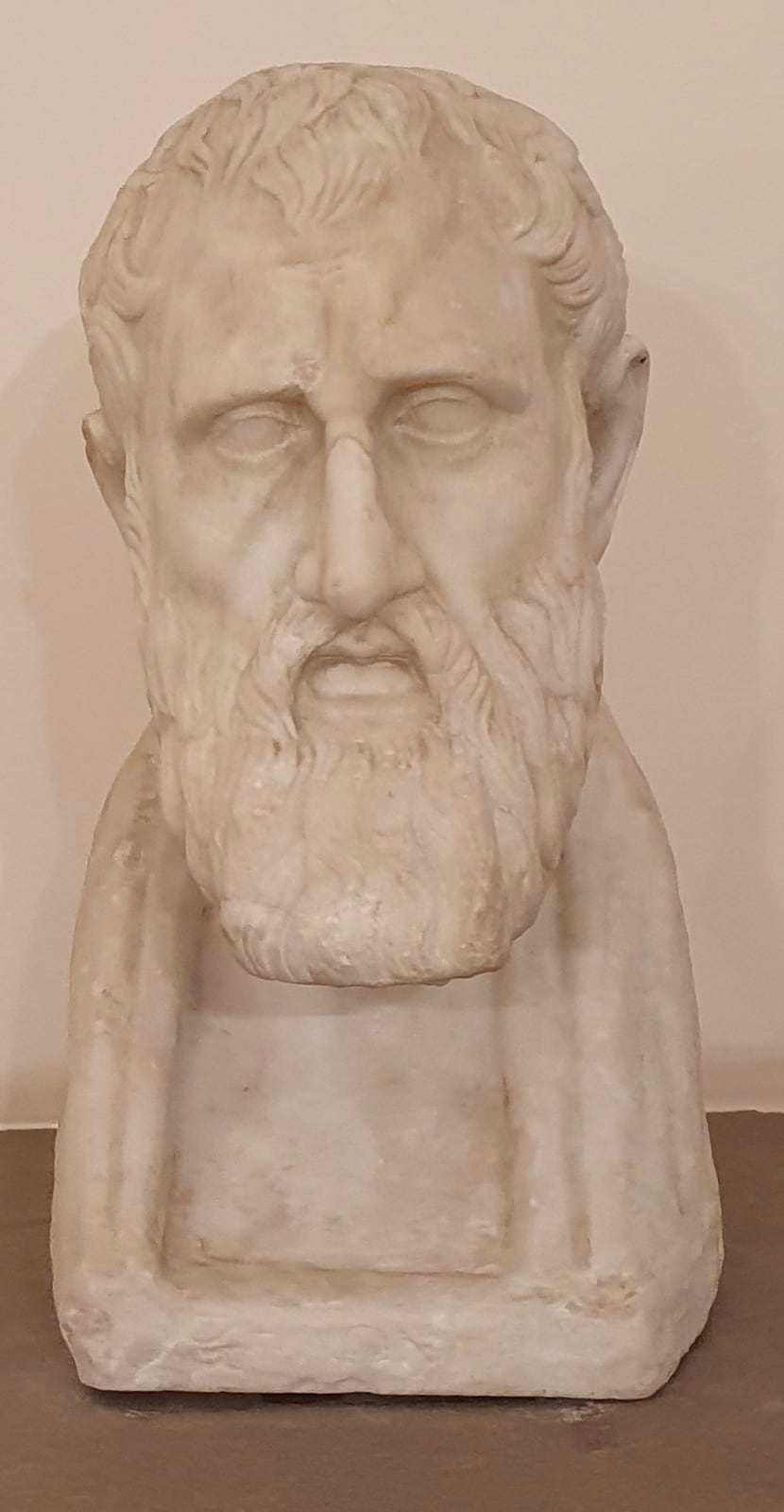
Zeno of Citium
They agree on: What is the Absolute? Does God exist? · Who am I? Is there a true self? · Why do we suffer?
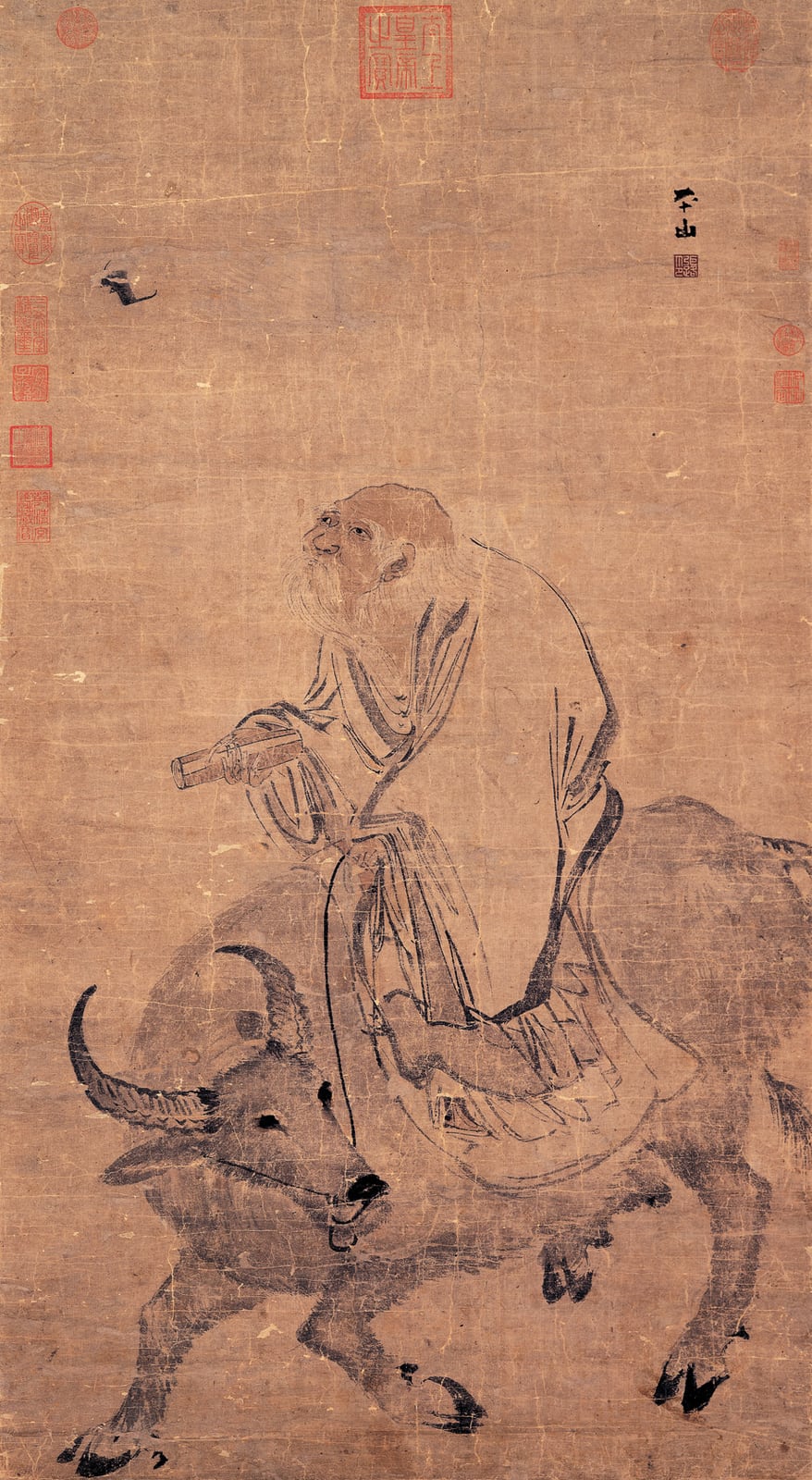
Laozi
They agree on: Why do we suffer? · What happens after death? · How is liberation or salvation attained?
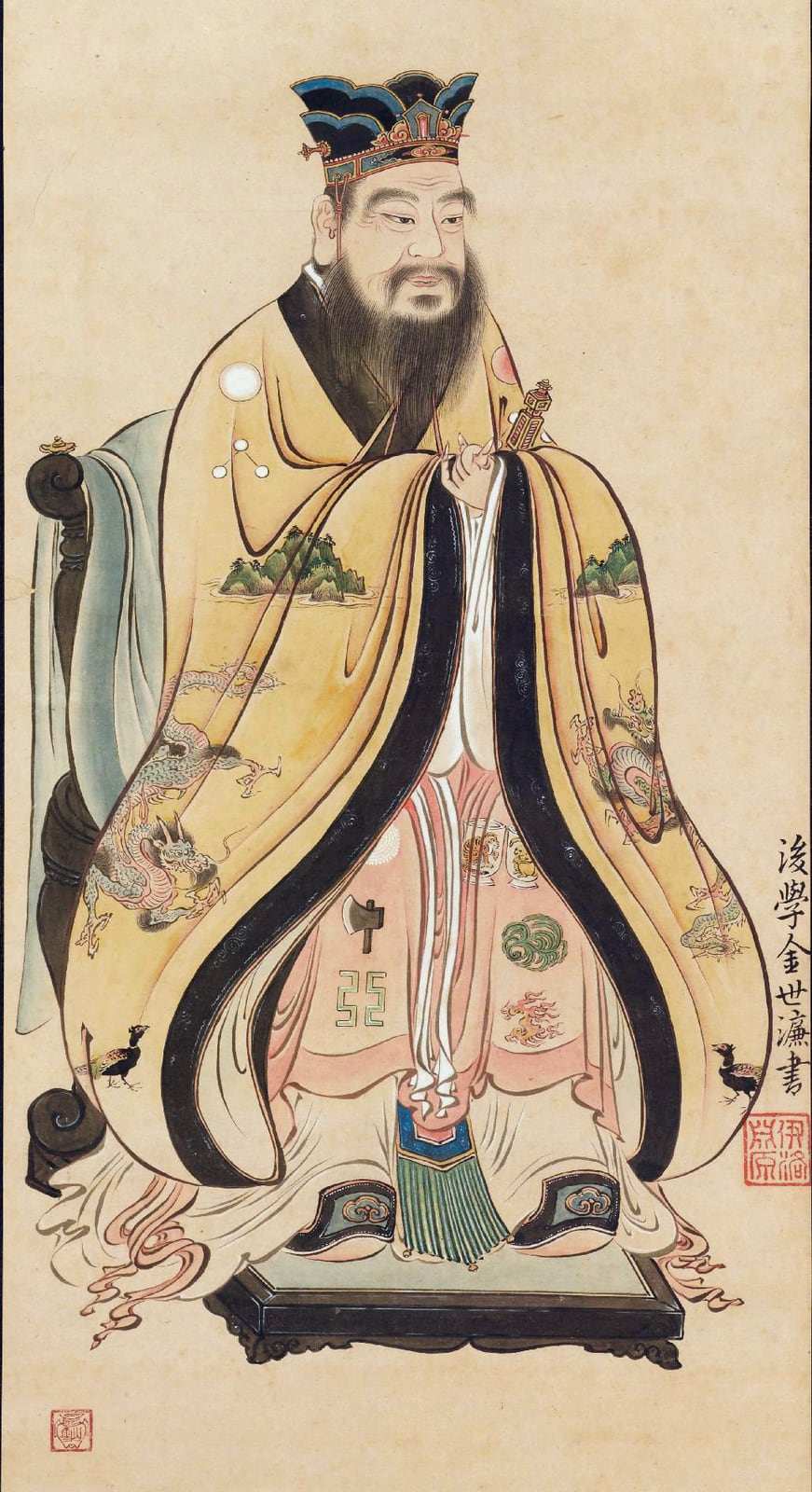
Confucius
They agree on: Who am I? Is there a true self? · Why do we suffer? · What happens after death?
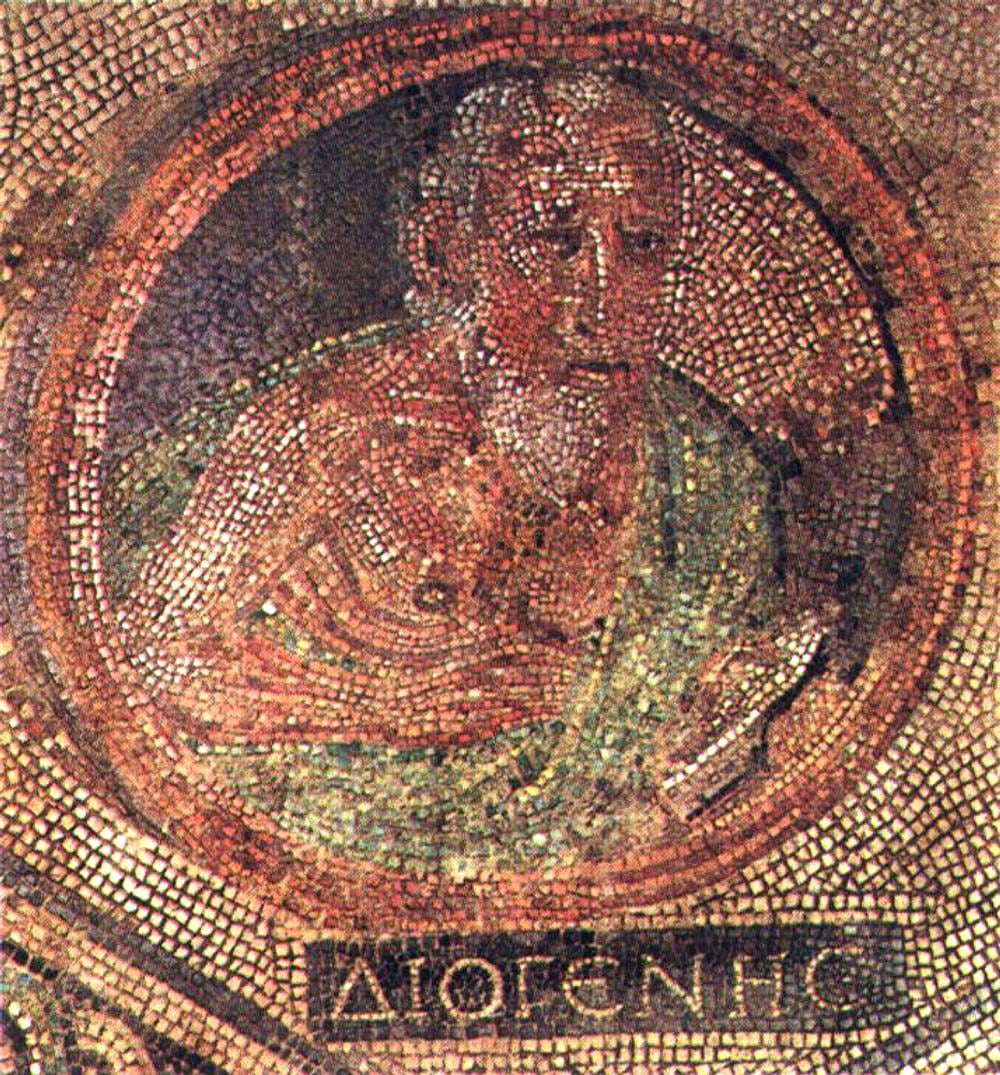
Diogenes of Sinope
They agree on: What happens after death? · Is a teacher necessary? · Is the world real?
Thinks most unlike
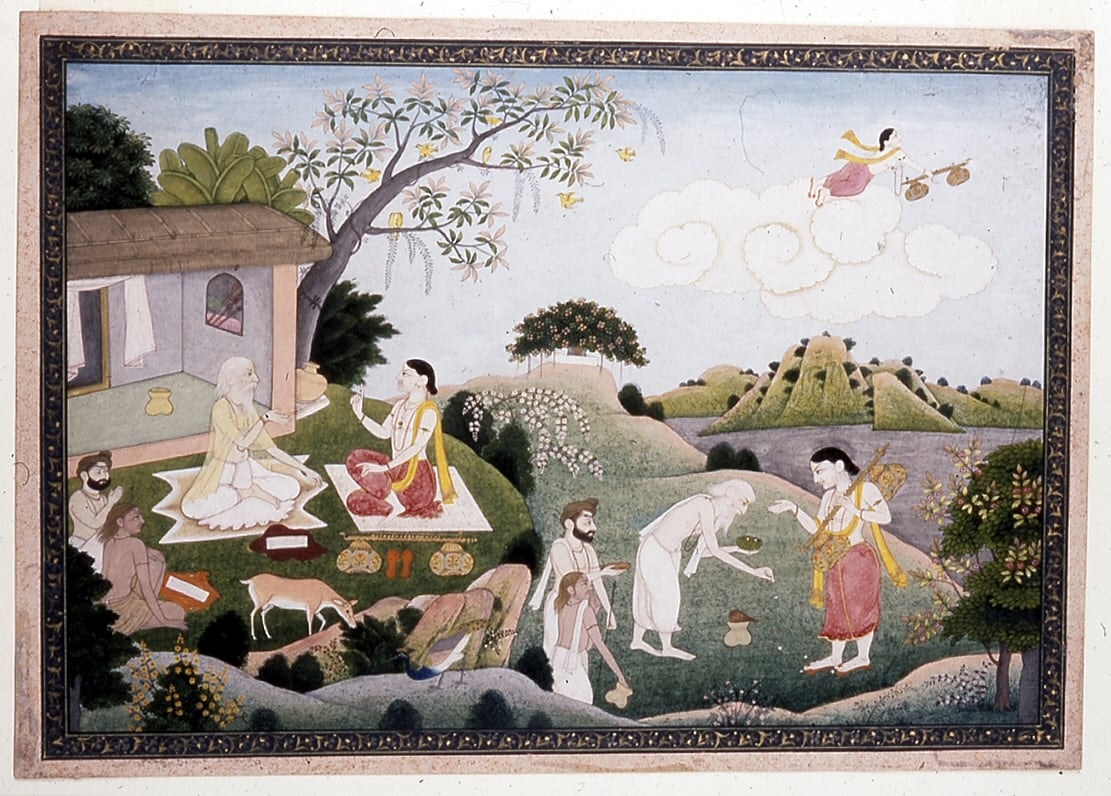
Narada
They clash on: What is the Absolute? Does God exist? · Why do we suffer? · How is liberation or salvation attained?
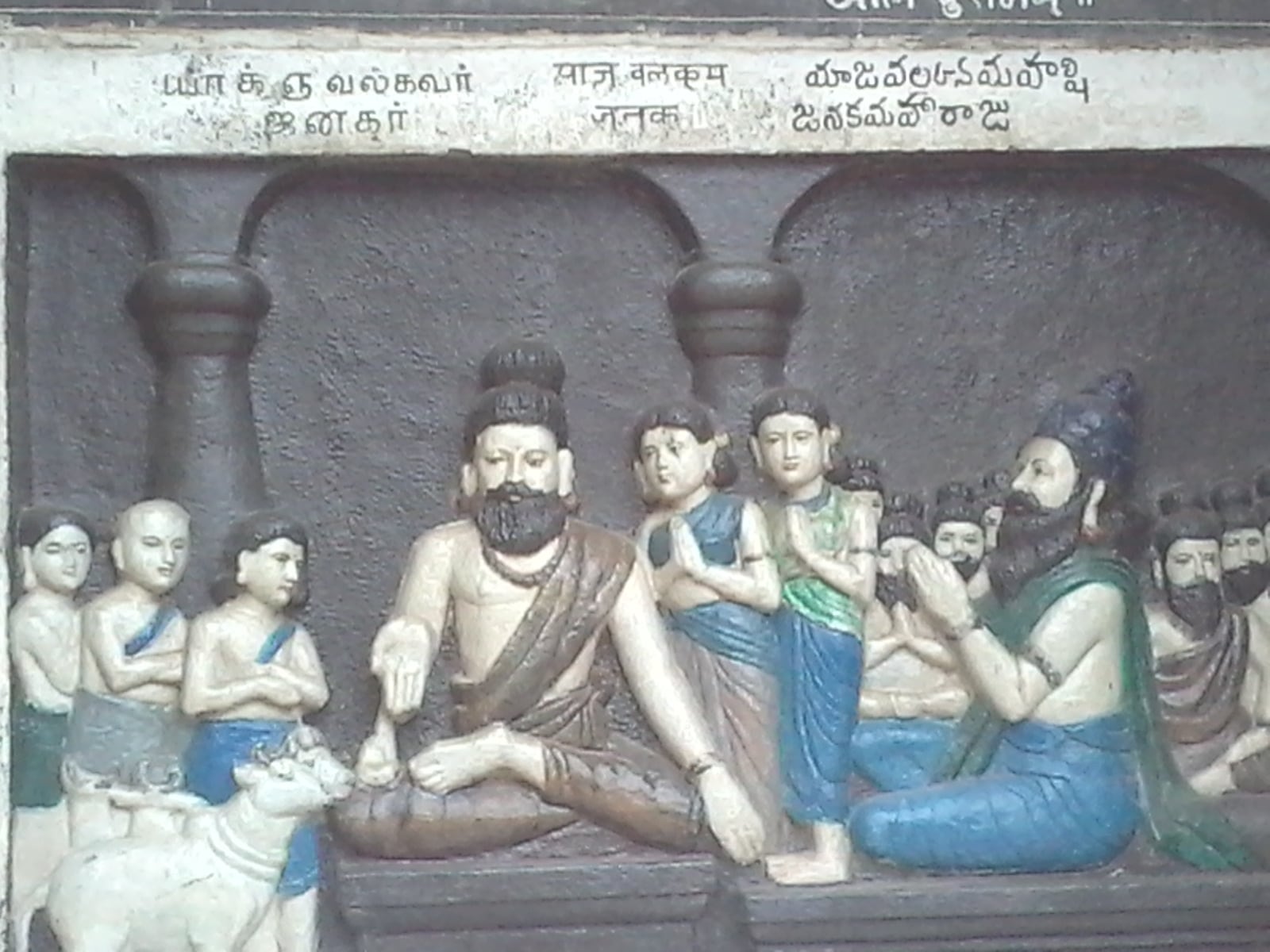
Yajnavalkya
They clash on: What is the Absolute? Does God exist? · Who am I? Is there a true self? · Why do we suffer?
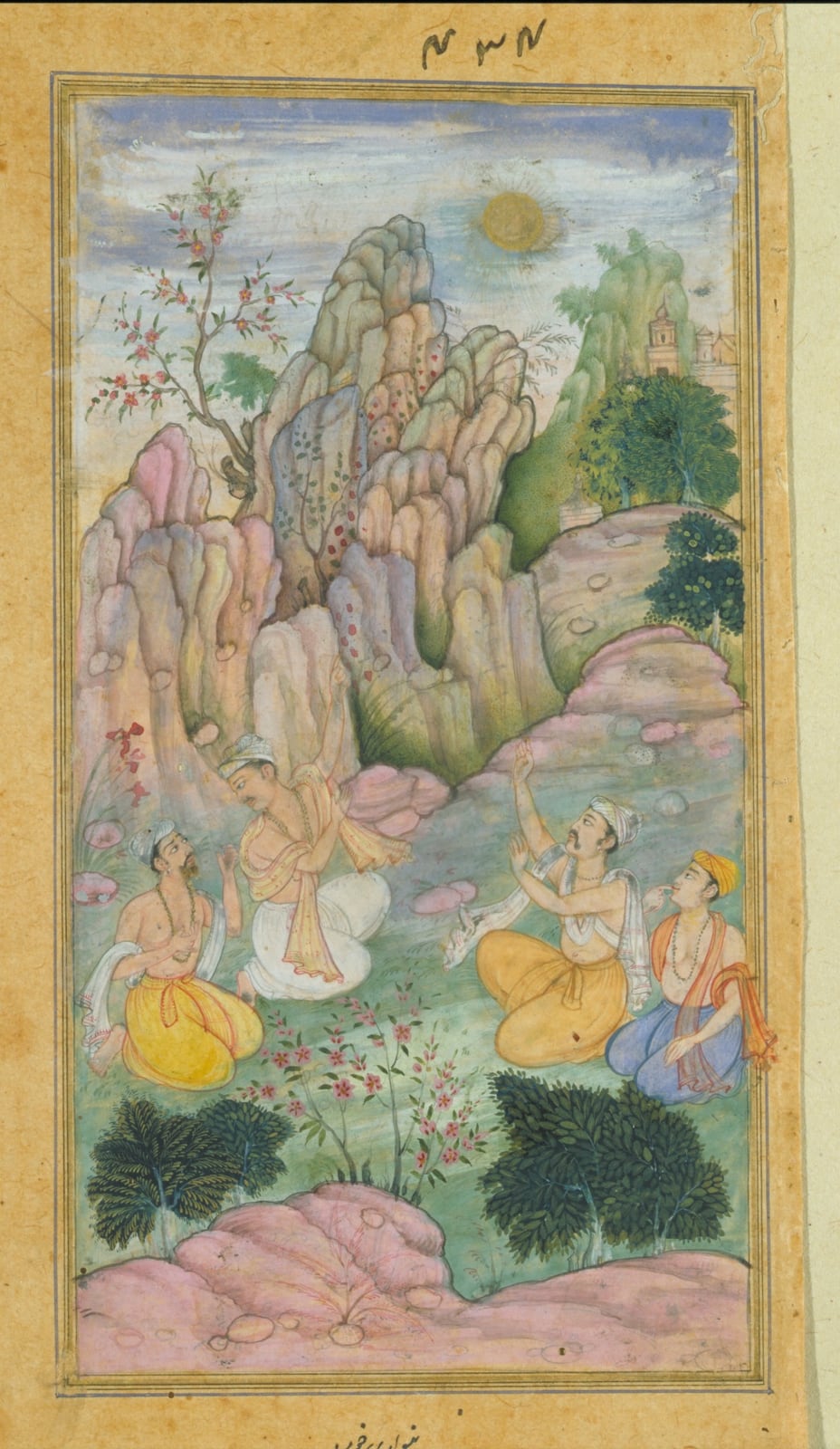
Vyasa
They clash on: What is the Absolute? Does God exist? · Who am I? Is there a true self? · Why do we suffer?
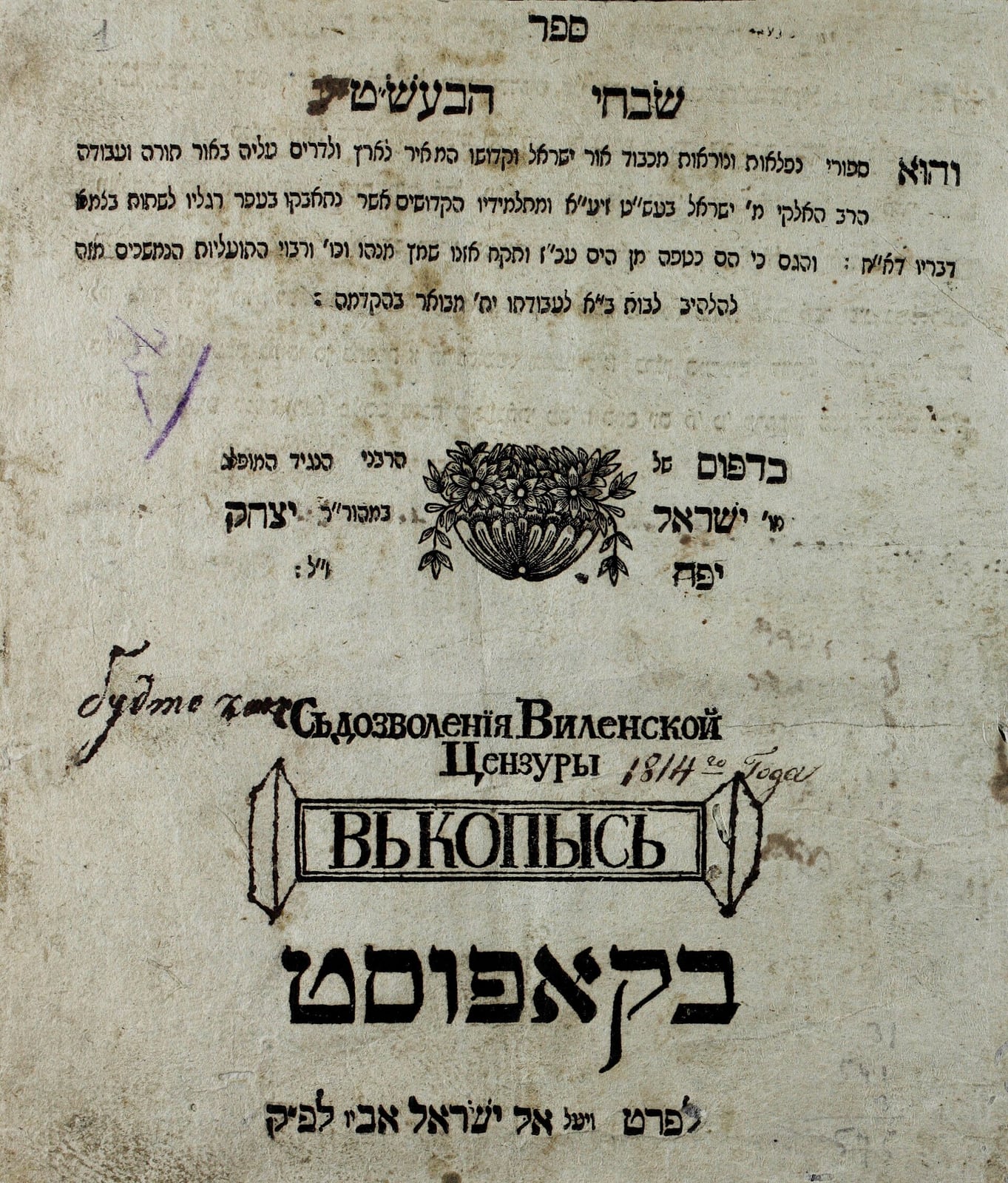
Baal Shem Tov
They clash on: What is the Absolute? Does God exist? · Who am I? Is there a true self? · Why do we suffer?
Anecdotes and stories
Anecdotes and stories
Oral traditionc. 367–347 a. C.
The colt that kicked its mother
Origin of the story: The colt remark is in Diogenes Laertius V 2 (“they say Plato said”); the nicknames “reader” and “mind” come from the Neoplatonic Lives (Vita Marciana and related texts), collected by Düring (1957). None is contemporary.
Testimony343/342–340 a. C.
Alexander's tutor at Mieza
Origin of the story: Plutarch, Life of Alexander 7–8 (late first century CE). The exchange of letters he quotes is almost certainly a later composition; the stay at Mieza and the teacher-pupil relationship are well attested.
Documentedc. 341 y 323 a. C.
A hymn for an executed friend
Origin of the story: Diogenes Laertius V 5–8 transmits the hymn, the epigram and the charge; Athenaeus (Deipnosophists XV 696a–697b) also preserves the hymn and part of the ancient debate about its religious character.
Oral tradition323 a. C.
“I will not let Athens sin twice against philosophy”
Origin of the story: The remark is recorded by Aelian (Varia Historia III 36) and the Neoplatonic Lives, several centuries later. Diogenes Laertius documents the charge and the retreat to Chalcis, but not the remark; handbooks cite it as traditional.
Source: Eliano. Historias curiosas (Varia historia) III, 36; Aulo Gelio. Noches áticas XIII, 5 y XX, 5.
Documented322 a. C.
The will of Chalcis
Origin of the story: Diogenes Laertius V 11–16, who states that he found the document. Most specialists (Düring, Natali) consider it substantially authentic; Arabic versions of the will also exist.
Oral traditionc. 323–322 a. C.
The wine of Lesbos
Origin of the story: Aulus Gellius, Attic Nights XIII 5 (second century CE), with no known earlier source. That Theophrastus succeeded Aristotle is documented; the wine scene is a late anecdote.
Source: Eliano. Historias curiosas (Varia historia) III, 36; Aulo Gelio. Noches áticas XIII, 5 y XX, 5.
Disputedc. 287–40 a. C.
The books in the cellar
Origin of the story: Strabo, Geography XIII 1, 54, and Plutarch, Life of Sulla 26. Modern scholars accept the library's journey to Rome and Andronicus's edition but doubt that the treatises were unknown for two centuries: there are signs that copies circulated.
Source: Estrabón. Geografía XIII, 1, 54; y Plutarco, Vida de Sila, 26 (sobre la biblioteca de Aristóteles y Teofrasto, Neleo de Escepsis, Apelicón y Andrónico de Rodas).
Documentedc. 330 a. C. (redacción de la Ética nicomáquea)
Plato is a friend, but truth is a greater friend
Origin of the story: The passage is Nicomachean Ethics I 6, 1096a11–17 (documented). The Latin formula “Amicus Plato, sed magis amica veritas” is later: the Life attributed to Ammonius, Roger Bacon (Opus maius I 7), Newton (Quaestiones quaedam philosophicae, c. 1664) and Cervantes mark its spread.
Teachings
Teachings
The notions that structure their thought, explained in context.
Substance (ousia)ousia
Aristotle's answer to the question about being raised by Parmenides and Plato; the basis of scholastic, Arabic and modern ontology.
Matter and form, potentiality and actualityhilemorfismo
A solution to the puzzles about change inherited from Parmenides; the basis of Aristotelian psychology and of the scholastic theory of the soul as the form of the body.
The four causescuatro-causas
Physics II and Metaphysics A; the framework of natural science until the seventeenth century.
The unmoved movermotor-inmovil
The philosophical theology of Physics VIII and Metaphysics Λ; the point of contact between Greek philosophy and monotheistic theology.
The soul as the form of the bodypsyche
The psychology of On the Soul and the Parva naturalia; the origin of the medieval dispute over the agent intellect.
Happiness (eudaimonia) and the contemplative lifeeudaimonia
The core of both Ethics; an inspiration for the contemplative ideal in later philosophy and mysticism.
Virtue as a meantermino-medio
Books II–VI of the Nicomachean Ethics; the basis of virtue ethics.
Syllogism and logicsilogismo
The Organon (“instrument”), the name the commentators gave to the logical treatises.
Videos
Videos
Recordings, interviews and documentaries. Videos play from YouTube; they are not hosted here.
Aristotle
Lecture· EN· 2021· 44 min
Gresham CollegeOfficial channel
Aristotle's Lyceum - Edith Hall
Lecture· EN· 2019· 49 min
Gresham CollegeOfficial channel
Armand Marie Leroi, "The Lagoon: how Aristotle invented science"
Lecture· EN· 2018· 57 min
British School at AthensOfficial channel
7. The Mixed Regime and the Rule of Law: Aristotle's Politics, I, III
Lecture· EN· 2008· 44 min
YaleCoursesOfficial channel
8. The Mixed Regime and the Rule of Law: Aristotle's Politics, IV
Lecture· EN· 2008· 48 min
YaleCoursesOfficial channel
9. The Mixed Regime and the Rule of Law: Aristotle's Politics, VII
Lecture· EN· 2008· 46 min
YaleCoursesOfficial channel
Justice: What's The Right Thing To Do? Episode 10: "THE GOOD CITIZEN"
Lecture· EN· 2009· 55 min
Harvard UniversityOfficial channel
Edith Hall • Aristotle and the Future of the Human Race
Lecture· EN· 2023· 81 min
Wolf Humanities CenterOfficial channel
Aristotle & Virtue Theory: Crash Course Philosophy #38
Analysis· EN· 2016· 9 min
CrashCourseOfficial channel
Aristóteles | Por Darío Sztajnszrajber
Lecture· ES· 2016· 153 min
Facultad LibreOfficial channel
Mentira la verdad IV: Aristóteles, Metafísica - Canal Encuentro
Documentary· ES· 2016· 28 min
Canal EncuentroOfficial channel
7ª - 8ª Introducción a la Filosofía de Aristóteles
Lecture· ES· 2022· 157 min
Fundación Universitaria EspañolaOfficial channel
Aristóteles: el discípulo díscolo de Platón | Introduc. Seminario | Filosofía Clásica | Ginés Marco
Lecture· ES· 2023· 72 min
Ateneo Mercantil de ValenciaOfficial channel
Aristóteles, Galeno y Avicena en la Escuela de Traductores de Toledo | Mariano Gómez Aranda
Lecture· ES· 2023· 61 min
Fundación Juan MarchOfficial channel
Aristóteles, ¿el primer ecologista?
Watch on YouTube
This video cannot be embedded; it opens on YouTube.
Aristóteles, ¿el primer ecologista?
Documentary· ES· 2025· 25 min
UNEDOfficial channel
Gallery
Gallery
Images with verified licences. Each keeps its authorship and attribution.
Manuscripts
Manuscripts
Manuscript witnesses and ancient texts, with their custodian and conditions of access.
GRC · Griego (minúscula) · s. IV a. C.
Κατηγορίαι κ.ἄ. (Ὄργανον)
- Surviving witness
- Códice fechado en el año 954
- Custodian
- Biblioteca Nazionale Marciana, Venecia · Gr. 201
- Digitisation
- commons.wikimedia.org/wiki/File:Aristotle,_Categ…
GRC · Griego (minúscula) · s. IV a. C.
Τὰ μετὰ τὰ φυσικά
- Surviving witness
- Códice copiado entre 1311 y 1321
- Custodian
- Biblioteca Apostolica Vaticana · Vat. gr. 256
- Digitisation
- commons.wikimedia.org/wiki/File:Aristotle,_Metap…
GRC · Griego (minúscula) · s. IV a. C.
Ἀριστοτέλους ἔργα (miscelánea)
- Surviving witness
- Manuscrito de 1457 con miniatura de Aristóteles (fol. 8v)
- Custodian
- Österreichische Nationalbibliothek, Viena · Cod. phil. gr. 64
- Digitisation
- commons.wikimedia.org/wiki/File:Aristotle,_Vienn…
GRC · Griego (cursiva sobre papiro) · c. 330–322 a. C.
Ἀθηναίων πολιτεία
- Surviving witness
- Papiro egipcio de finales del siglo I d. C., escrito en el reverso de unas cuentas agrícolas
- Custodian
- British Library, Londres · Papyrus 131
- Digitisation
- www.bl.uk/manuscripts/FullDisplay.aspx?ref=Papyr…
Connections
Connections
Influences, discipleships and affinities. Documented relations are distinguished from similarities identified by analysis.
Disciple of
He was Plato's student in the Academy for twenty years (c. 367–347 BCE) and his most influential critic: he rejected the separation of the Forms but kept the primacy of form and of knowledge of the universal.
Documented relation
Influenced by
He never met him (Socrates died in 399), but knew him through Plato and discusses him in the Metaphysics (A 6, M 4), crediting him with the search for universal definitions and inductive arguments, and in the Ethics, where he criticises his thesis that no one does wrong knowingly.
Documented relation
Disagreed with
Book I of the Physics answers the Eleatic denial of change with the notions of subject, privation and form, and of potentiality and actuality.
Documented relation
Disagreed with
In Metaphysics Γ he argues against those who, following Heraclitus, seem to deny the principle of non-contradiction; in Parts of Animals I 5 he recalls with appreciation his saying “here too there are gods”.
Documented relation
Disagreed with
He discusses him often in the Physics, On the Soul and On Generation and Corruption; he criticises his explanation of living beings by chance combinations.
Documented relation
Disagreed with
In Metaphysics A 5 he expounds and criticises the Pythagorean doctrine that the principles of numbers are the principles of all things; he also wrote a lost treatise on the Pythagoreans.
Documented relation
Contemporary of
Diogenes Laertius (V 18) records an anecdotal encounter between the two over some dried figs; the episode's historicity is doubtful.
Documented relation
Influenced
Plotinus integrated Aristotelian concepts into his system — actuality and potentiality, the intellect thinking itself — and devoted treatises VI 1–3 of the Enneads to criticising the doctrine of the categories.
Documented relation
Influenced
In the Confessions (IV 16) he relates that he read and understood on his own, at about twenty, Aristotle's Categories in Latin translation, and that they did him little good in thinking about God.
Documented relation
Disagreed with
The Incoherence of the Philosophers attacks the falasifa who followed Aristotle through al-Farabi and Avicenna, naming him explicitly as the source of their errors, although al-Ghazali accepted and spread Aristotelian logic.
Documented relation
Influenced
The Guide of the Perplexed relies on Aristotelian physics and metaphysics and holds that what Aristotle says about the sublunary world is true, while rejecting his thesis of the eternity of the world.
Documented relation
Ideas akin to
Indirect relation: Ibn Arabi knew the Aristotelian vocabulary (form, matter, intellect) through falsafa and transformed it in a mystical key; there is no record that he discussed Aristotle's texts.
Similarity identified by analysis
Influenced
As a Dominican master at Paris, Eckhart worked within scholastic Aristotelianism and frequently cites On the Soul and the Metaphysics, particularly the doctrine of the intellect. A general relation, with no specific source recorded in this entry.
Similarity identified by analysis
Disagreed with
The appendix to part one of Spinoza's Ethics rejects final causes, a pillar of Aristotelian physics, as an anthropomorphic prejudice.
Documented relation
Ideas akin to
A parallel often drawn by comparative philosophy: virtue as cultivated habit and the Aristotelian mean are compared with the Confucian doctrine of the mean. There was no historical contact.
Similarity identified by analysis
Ideas akin to
Siddhartha Gautama, the Buddha
A thematic parallel: the ethics of the mean and the Buddhist “middle way” between asceticism and pleasure; the underlying conceptions are very different and there was no contact.
Similarity identified by analysis
Contemporary of
Epicurus (b. 341 BCE) belongs to the following generation; his atomist physics and his ethics of pleasure developed in polemic with the Platonic and Peripatetic tradition.
Similarity identified by analysis
Linked from other profiles
- Plotinus · Influenced by
- Socrates · Influenced
- Heraclitus · Influenced
- Marcus Aurelius · Ideas akin to
- Epicurus · Disagreed with
- Zeno of Citium · Contemporary of
- Empedocles · Influenced
- Diogenes of Sinope · Contemporary of
- Epictetus · Ideas akin to
- Maimonides · Influenced by
- Al-Ghazali · Disagreed with
- Parmenides · Influenced
- Pythagoras · Influenced
- Plato · Teacher of
Sources
Sources
Bibliography and catalogues consulted for this profile.
- Cicerón. Académicos II (Lúculo), 119: «veniet flumen orationis aureum fundens Aristoteles».
- Wikimedia Commons: metadatos y licencias de las imágenes, verificados por la API imageinfo el 25 de octubre de 2026.
- Diógenes Laercio. Vidas de los filósofos ilustres, libro V, 1–35 («Aristóteles»). Trad. inglesa de R. D. Hicks, Lives of Eminent Philosophers, vol. I, Loeb Classical Library 184. Londres: Heinemann, 1925 (texto en Wikisource).
- Shields, Christopher. «Aristotle». Stanford Encyclopedia of Philosophy, ed. Edward N. Zalta (revisión de 2020).
- «Aristotle», Wikipedia en inglés, y «Aristóteles», Wikipedia en español (consultadas para hechos verificables y bibliografía; texto propio).
- Natali, Carlo. Aristotle: His Life and School. Ed. D. S. Hutchinson. Princeton: Princeton University Press, 2013.
- Düring, Ingemar. Aristotle in the Ancient Biographical Tradition. Göteborg: Acta Universitatis Gothoburgensis, 1957.
- Barnes, Jonathan (ed.). The Complete Works of Aristotle: The Revised Oxford Translation. 2 vols. Princeton: Princeton University Press (Bollingen Series LXXI.2), 1984.
- Plutarco. Vida de Alejandro, 7–8. Trad. inglesa de Bernadotte Perrin, Plutarch's Lives, vol. VII, Loeb Classical Library 99. Cambridge (Mass.): Harvard University Press, 1919.
- Estrabón. Geografía XIII, 1, 54; y Plutarco, Vida de Sila, 26 (sobre la biblioteca de Aristóteles y Teofrasto, Neleo de Escepsis, Apelicón y Andrónico de Rodas).
- Wikidata, «Aristotle» (Q868).
- Bekker, Immanuel (ed.). Aristotelis Opera, edidit Academia Regia Borussica. 5 vols. Berlín: G. Reimer, 1831–1870 (vols. I–II, texto griego, 1831).
- Open Library (Internet Archive): registros de edición e ISBN de la Biblioteca Clásica Gredos, la Loeb Classical Library (Harvard University Press) y Princeton University Press consultados el 25 de octubre de 2026.
- Eliano. Historias curiosas (Varia historia) III, 36; Aulo Gelio. Noches áticas XIII, 5 y XX, 5.
- Jaeger, Werner. Aristoteles: Grundlegung einer Geschichte seiner Entwicklung. Berlín: Weidmann, 1923 (trad. esp.: Aristóteles. Bases para la historia de su desarrollo intelectual. México: Fondo de Cultura Económica, 1946).
- Leroi, Armand Marie. The Lagoon: How Aristotle Invented Science. Londres: Bloomsbury, 2014.
- Kenyon, Frederic G. (ed.). Aristotle on the Constitution of Athens. Londres: British Museum, 1891 (editio princeps del Papiro 131 de la British Library).
- Project Gutenberg (catálogo vía Gutendex) e Internet Classics Archive del MIT (traducciones de Oxford y otras), consultados el 25 de octubre de 2026.
- Azcárate, Patricio de (trad.). Obras de Aristóteles. 10 vols. Madrid: Medina y Navarro, 1873–1875 (digitalización parcial en el Proyecto Filosofía en español y facsímiles completos en Wikimedia Commons).
- Darwin, Charles. Carta a William Ogle, 22 de febrero de 1882. Darwin Correspondence Project, DCP-LETT-13697.
- Moraux, Paul. Les listes anciennes des ouvrages d'Aristote. Lovaina: Éditions Universitaires, 1951.
- Kraye, Jill; Ryan, W. F.; Schmitt, C. B. (eds.). Pseudo-Aristotle in the Middle Ages: The Theology and Other Texts. Londres: The Warburg Institute, 1986.
- Rose, Valentin (ed.). Aristotelis qui ferebantur librorum fragmenta. Leipzig: Teubner, 1886; y Gigon, Olof (ed.). Aristotelis Opera III: Librorum deperditorum fragmenta. Berlín: De Gruyter, 1987.
- Hutchinson, D. S.; Johnson, Monte Ransome. «Authenticating Aristotle's Protrepticus». Oxford Studies in Ancient Philosophy 29 (2005): 193–294.
- Maimónides. Guía de perplejos II, 22 (trad. inglesa de Shlomo Pines, The Guide of the Perplexed, Chicago: University of Chicago Press, 1963); y carta a Samuel ibn Tibón (1199) sobre los libros de Aristóteles.
- al-Ghazali. Tahafut al-falasifa (La incoherencia de los filósofos), introducción. Trad. inglesa de Michael E. Marmura, The Incoherence of the Philosophers. Provo: Brigham Young University Press, 2000.
- Agustín de Hipona. Confesiones IV, 16, 28–29 (lectura de las Categorías de Aristóteles hacia los veinte años).
- Plotino. Enéadas VI, 1–3 («Sobre los géneros del ser»), con la crítica de las categorías aristotélicas. Trad. inglesa de A. H. Armstrong, Loeb Classical Library 445. Cambridge (Mass.): Harvard University Press, 1988.
- YouTube: verificación de cada vídeo mediante el servicio oEmbed, 25 de octubre de 2026.
- Spinoza, Baruch. Ethica ordine geometrico demonstrata (1677), parte I, apéndice (crítica de las causas finales).
- Wikiquote en inglés, «Aristotle», secciones «Disputed» y «Misattributed» (atribuciones dudosas y falsas, con sus fuentes).
- Rights holder
- Los textos griegos de Aristóteles son de dominio público. Las traducciones y ediciones modernas pertenecen a sus traductores y editoriales: Editorial Gredos (Biblioteca Clásica Gredos, hoy en RBA Libros), Harvard University Press (Loeb Classical Library), Princeton University Press (The Complete Works of Aristotle, ed. Barnes), Oxford University Press (Oxford Classical Texts y Clarendon Aristotle Series), Alianza Editorial, Abada y otras.
Pending confirmation
What this profile has not yet been able to settle. We would rather say so than fill it in.
- Ediciones en español con ISBN no localizadas en catálogo para los opúsculos espurios Sobre el mundo, Sobre el aliento, Sobre los colores, Sobre las cosas audibles, Sobre las plantas, Relatos maravillosos, Situación y nombres de los vientos y Sobre Meliso, Jenófanes y Gorgias, ni para la Teología de Aristóteles; tampoco ediciones inglesas con ISBN del Libro de las causas y del Secreto de los secretos.
- ISBN de la Política en la Biblioteca Clásica Gredos n.º 116 (1988) no visto en Open Library: se ha registrado la reedición de Gredos de 2022 con la misma traducción. Falta también el ISBN de History of Animals VII–X (Loeb 439, Balme).
- Los años de primera edición de los volúmenes Loeb y de la Biblioteca Clásica Gredos proceden de la bibliografía general; los ISBN corresponden a las reimpresiones registradas en Open Library. Confirmar con los catálogos de las editoriales.
- Gredos 2020, «Poética. Magna Moralia» (ISBN 9788424939151): confirmar qué traductor firma cada obra (el registro cita a Teresa Martínez Manzano y Leonardo Martínez Dupla).
- Tomo V de las Obras de Aristóteles de Azcárate («Psicología: Opúsculos»): confirmar qué tratados de los Parva naturalia contiene antes de enlazarlo a cada uno por separado; hoy solo se enlaza a Acerca del sentido y lo sensible.
- Derechos de las traducciones de Oxford en la UE: verificar las fechas de muerte de A. J. Jenkinson, W. A. Pickard-Cambridge, R. P. Hardie, E. W. Webster, G. R. T. Ross y J. Solomon. En EE. UU. todas son de dominio público por ser anteriores a 1931, salvo la de Acerca del alma de J. A. Smith (1931), que lo será el 1 de enero de 2027.
- Traductor de la Ética nicomáquea de Project Gutenberg n.º 8438 (edición Everyman de 1911): el ebook no lo nombra; identificarlo en la edición impresa.
- Catálogo antiguo de obras (Diógenes Laercio V 22–27, unos ciento cincuenta títulos, y las listas de Hesiquio y de Ptolomeo el Árabe estudiadas por Moraux): se han registrado las obras perdidas principales y mejor documentadas, no todos los títulos de la lista.
- Manuscritos: añadir el Parisinus graecus 1741 (Poética y Retórica, s. X), el Vindobonensis phil. gr. 100 (s. IX, Física, Del cielo, Metafísica) y el Parisinus gr. 1853 (s. X) con sus digitalizaciones oficiales (Gallica, ÖNB), no verificadas en esta pasada; tampoco se ha verificado la digitalización íntegra del Vat. gr. 256 en DigiVatLib.
- Wikidata registra como fecha de muerte el 7 de marzo del 322 a. C. sin fuente primaria localizada; se mantiene solo el año.
- Vídeos: el programa de la UNED «Aristóteles, ¿el primer ecologista?» no permite inserción (oEmbed 401). No se ha encontrado un documental de televisión pública española dedicado íntegramente a Aristóteles en un canal oficial.
- Imagen descartada: «Stagira, an ancient Greek city, birth place of Aristotle.jpg» (CC BY-SA 4.0) por metadatos de fecha anómalos (2026-06-16); revisar antes de usarla. No hay retrato de Aristóteles anterior a la copia romana del tipo de Lisipo.
- Sin programa de afiliación verificado ni web oficial: Aristóteles no tiene titular de derechos; las editoriales citadas no se han comprobado como programas de afiliados.
Researched on 2026-10-25