Presocratic philosophy
Parmenides
Παρμενίδης ὁ Ἐλεάτης
c. 515 BCE – ?Historically documented person
Philosopher of Elea in Magna Graecia (born around 515 BCE), author of a hexameter poem of which some hundred and sixty lines survive. In it a goddess teaches that only "what is" can be thought and said, and that it is unborn, imperishable, one and unmoving; the second part sets out the opinions of mortals. Founder of the Eleatic school, teacher of Zeno and, by tradition, lawgiver of his city, his argument shaped all later philosophy.
- works
- 5works
- editions
- 22editions
- quotes
- 14quotes
- videos
- 12videos
- images
- 5images
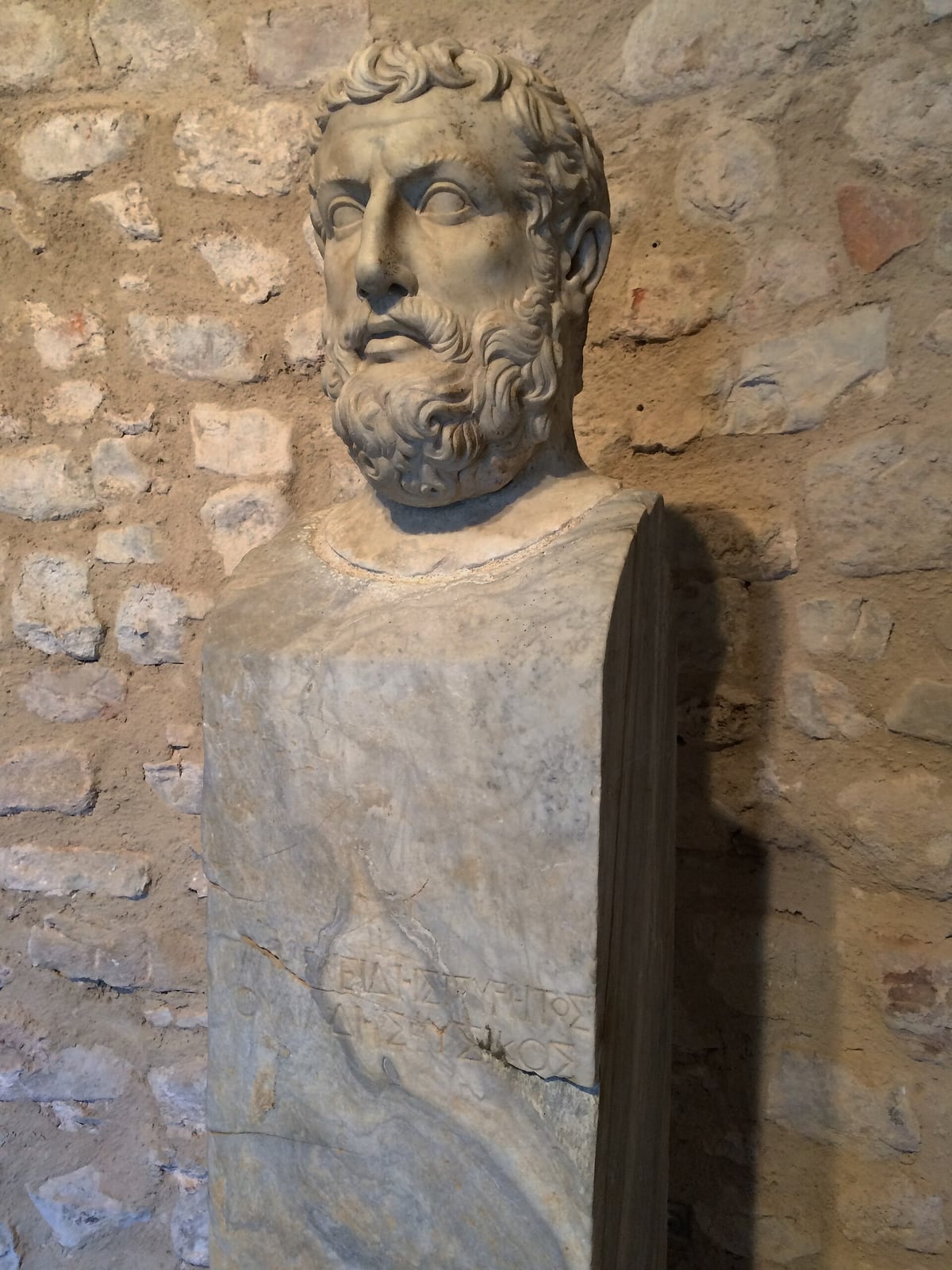
Cabeza identificada con Parménides (Velia) · CC BY-SA 4.0
In their words
«Meet it is that thou shouldst learn all things, as well the unshaken heart of well-rounded truth, as the opinions of mortals in which is no true belief at all.»DK 28 B1.28–30, en Sexto Empírico, Contra los matemáticos VII 111, y Simplicio, Comentario al Sobre el cielo 557. Griego: Diels-Kranz; inglés: John Burnet, Early Greek Philosophy (1908); español: traducción propia.

Their central idea
What is (to eon): The poem turns on a single word, the Greek verb *esti*, "is", often without an expressed subject.
See in context
Biography
5 min read
The poem of a single path
Parmenides wrote a single poem in hexameters, the verse of Homer and Hesiod, of which some hundred and sixty lines survive thanks to quotations by Sextus Empiricus, Simplicius, Proclus, Plutarch and others. It is the first text of Greek philosophy that argues step by step, and the first to ask what it means to say that something "is". Plato, who called him "venerable and awesome", devoted a dialogue to him and presented the break with his doctrine as "parricide"; Aristotle discussed his theses at the start of the Physics. All later natural philosophy, from Empedocles to the atomists, can be read as a response to his denial of coming-to-be and perishing.
Elea
Elea—Hyele to its founders, Velia to the Romans—was a young colony on the Tyrrhenian coast, south of Posidonia. It had been founded around 540 BCE by Phocaeans fleeing the Persian advance in Ionia, as Herodotus tells. Diogenes Laertius makes Parmenides the son of Pyres, of a noble and wealthy family, and, following Apollodorus, places his prime in the 69th Olympiad (504–501 BCE), which would give a birth around 540. Plato, by contrast, relates in the Parmenides that the philosopher visited Athens at about sixty-five, when Socrates was very young, which would place his birth around 515. Burnet suspected that Apollodorus had made his floruit coincide with the foundation of Elea; many scholars prefer the Platonic chronology, though the dialogue's scene is probably a literary fiction; Burnet, who took it as historical, was among the few who defended it.
Teachers, pupils and laws
The ancients gave him several teachers. Aristotle records that he was said to be a pupil of Xenophanes, the poet-philosopher who criticised Homer's gods and who also lived in the Greek West; Theophrastus linked him with Anaximander. Sotion, more specific, said that a poor but noble Pythagorean, Ameinias son of Diochaitas, led him to the quiet life of study, and that at his death Parmenides built him a hero-shrine. Speusippus, Plato's nephew, stated that he gave his city laws, and Plutarch adds that Elea's magistrates swore every year to abide by them; Strabo credits the city's good government to Parmenides and Zeno, his most famous pupil.
In 1962 the excavations at Velia brought to light a headless herm of the first century CE inscribed "Parmenides, son of Pyres, Ouliades, natural philosopher". Other inscriptions from the same building honour physicians with the title Ouliades, which refers to Apollo Oulios, the healer. The find suggests that, centuries later, a medical school at Elea claimed Parmenides as its forebear. Peter Kingsley has proposed seeing him as an iatromantis, a healer-priest who practised incubation, and reading the poem as the account of a visionary experience; the hypothesis is suggestive but rests on no direct evidence, and most scholars regard it as speculative.
The journey
The poem opens with a journey. A youth is carried in a chariot by wise mares, guided by the daughters of the Sun, who have left the house of Night; the axles shriek in the wheel-naves. They reach the gates of the paths of Night and Day, whose keys are kept by avenging Justice; the maidens persuade her and the gates swing open. On the other side a nameless goddess takes the youth by the right hand and announces that he must learn everything: "the unshaken heart of well-rounded truth" and the opinions of mortals, in which there is no true belief. Sextus Empiricus, who preserves this proem, read it as an allegory of knowledge; Walter Burkert saw in it a descent to the underworld, and others an initiation.
The way of truth
The goddess teaches that there are only two conceivable ways of inquiry: that "it is" and cannot not be, and that "it is not" and must not be. The second is impassable, for what is not can be neither known nor said; "for the same thing is for thinking and for being" (B3). Mortals, however, wander along a third track: "two-headed", without judgement, they believe that being and not-being are the same and not the same. The long fragment 8, which Simplicius copied out in the sixth century because, he says, the book had become rare, deduces the "signs" of what is: it is unborn and imperishable, for it cannot come from what is not; it is whole, single, unmoving and complete; "it neither was nor will be, since it is now, all together, one, continuous"; and it is bounded on every side, like the mass of a well-rounded sphere.
What exactly "what is" is remains disputed. On the traditional interpretation Parmenides denies the plurality and change of the world; G. E. L. Owen read it as a thesis about whatever can be an object of thought; Alexander Mourelatos and Charles Kahn stressed the predicative and veridical sense of the Greek verb; John Palmer has defended a "generous monism", on which Parmenides describes what necessarily is without denying that other things exist.
The way of opinion
Having closed his "trustworthy account", the goddess sets out the "deceptive order" of mortal opinions: a world built from two forms, light or ethereal fire and dense night, of which few lines survive. They speak of celestial rings, of a divinity who steers all things and devised Eros first of the gods, of the moon shining "with borrowed light" and always looking towards the sun's rays, of the formation of the embryo and of thought according to the mixture of the limbs. Parmenides was credited with recognising that the morning and evening stars are one and that the earth is spherical, though the same reports are told of Pythagoras. Why a goddess teaches in detail a cosmology she declares false is one of the poem's riddles.
The legacy of Elea
Zeno, his pupil, defended the doctrine with paradoxes exposing the absurdities of plurality and motion; Melissus of Samos reformulated it in prose. Empedocles, Anaxagoras, Leucippus and Democritus accepted that nothing comes from nothing or is annihilated, and explained change as the mixing and separating of unchanging elements. Plato, in the Sophist, had to "lay hands on father Parmenides" to make sense of not-being as otherness. Nothing is known of his death. His poem, lost as a book, survived in the Neoplatonic commentaries and is today one of the most studied texts of antiquity.
Sources: Diógenes Laercio. Vidas y opiniones de los filósofos ilustres IX 21–23 (Parménides), 25 (Zenón) y 24 (Meliso), s. III d. C. Trad. inglesa de C. D. Yonge, Bohn, Londres, 1853 (Project Gutenberg n.º 57342); trad. inglesa de R. D. Hicks, Loeb, 1925 (Wikisource). · Diels, Hermann y Kranz, Walther. Die Fragmente der Vorsokratiker, 6.ª ed. Weidmann, Berlín, 1951–1952, cap. 28 (Parmenides), A (testimonios) y B 1–19. Texto griego consultado en la transcripción de Wikisource en griego («Περί φύσεως (Παρμενίδης)»). · Kirk, G. S., Raven, J. E. y Schofield, M. The Presocratic Philosophers, 2.ª ed. Cambridge University Press, 1983, cap. VIII (Parmenides of Elea). Trad. esp. de Jesús García Fernández, Gredos, 1987. · Burnet, John. Early Greek Philosophy, 2.ª ed. A. and C. Black, Londres, 1908, cap. IV (Parmenides of Elea), §§ 84–97 (Project Gutenberg n.º 67097). · Coxon, A. H. The Fragments of Parmenides: A Critical Text with Introduction and Translation, the Ancient Testimonia and a Commentary. Van Gorcum, Assen, 1986; ed. revisada por Richard McKirahan, Parmenides Publishing, Las Vegas, 2009.
Timeline
A life, year by year
Each point is a documented event. Click to read it, with its source and degree of certainty.
c. 540 BCEElea (Hyele), Campania
Foundation of Elea
Phocaeans fleeing the Persian advance found Hyele on the Tyrrhenian coast after the battle of Alalia (Herodotus I 163–167). Years BCE are expressed as negative numbers.
ProbableHeródoto. Historias I 163–167 (los focenses y la fundación de Hyele/Elea), s. V a. C. Trad. inglesa de G. C. Macaulay, Macmillan, Londres, 1890 (Project Gutenberg n.º 2707).
c. 540 BCE
Foundation of Elea
Phocaeans fleeing the Persian advance found Hyele on the Tyrrhenian coast after the battle of Alalia (Herodotus I 163–167). Years BCE are expressed as negative numbers.
Probable
c. 515 BCE · age 0
Birth
Born in Elea, son of Pyres, of a noble and wealthy family. The date is inferred from Plato (Parmenides 127b); Apollodorus' chronology would place his birth around 540.
Probable
c. 504 BCE
Floruit according to Apollodorus
Diogenes Laertius (IX 23) places his prime in the 69th Olympiad (504–501 BCE), the same as Heraclitus'.
Tradition
c. 490 BCE
Ameinias and the contemplative life
According to Sotion (in Diogenes Laertius IX 21), the Pythagorean Ameinias turns him to the life of study; at his death Parmenides dedicates a hero-shrine to him. Date unknown.
Tradition
c. 480 BCE
Composition of the poem
He composes his hexameter poem, traditionally called On Nature. The date is an estimate; the poem seems to respond to Heraclitus and precedes Empedocles and Zeno.
Disputed
c. 470 BCE
Lawgiver of Elea
Speusippus (in Diogenes Laertius IX 23) and Plutarch (Against Colotes 1126a) credit him with Elea's laws, which magistrates swore each year to obey. Date unknown.
Tradition
c. 450 BCE · age 65
Visit to Athens with Zeno
According to Plato's Parmenides (127a–c), he attends the Great Panathenaea with Zeno, stays in the Ceramicus and converses with a very young Socrates. The meeting is probably a literary fiction; Athenaeus (XI 505f) already doubted it.
Disputed
c. 370 BCE
Plato writes the Parmenides and the Sophist
Plato makes Parmenides the protagonist of a dialogue and, in the Sophist (241d), presents the critique of his thesis on not-being as "parricide".
Probable
c. 530
Simplicius copies fragment 8
In his commentary on Aristotle's Physics, Simplicius transcribes long passages of the poem "because of the rarity of the book" (In Phys. 144.25). Without him the way of truth would be unknown.
Documented
1897
Diels's Parmenides Lehrgedicht
Hermann Diels publishes the critical edition of the poem with German translation, the basis of the DK 28 numbering.
Documented
1962
Discovery of the Velia herm
Excavations bring to light a headless herm of the 1st century CE inscribed «Παρμενείδης Πύρητος Οὐλιάδης φυσικός», alongside others dedicated to Ouliad physicians.
Documented
1965
Tarán's edition
Leonardo Tarán publishes Parmenides: A Text with Translation, Commentary and Critical Essays, one of the standard twentieth-century editions.
Documented
Works
Essential works
The works without which their legacy cannot be understood.
Written work · c. 480 BCE
On Nature (poem)
Περὶ φύσεως (título convencional)
A didactic poem in dactylic hexameters, divided into a proem and two parts. In the proem (B1) a youth travels by chariot to the gates of Night and Day and is received by a goddess who promises to teach him the truth and the opinions of mortals. The way of truth (B2–B8.49) argues that only "what is" can be thought and said, and deduces that it is unborn, imperishable, one, continuous, unmoving and like a sphere. The way of opinion (B8.50–B19) sets out a cosmology of two principles, light and night, with theories of the stars, the moon, generation and thought. It is the founding text of Western ontology.
18 editions · amazon.es
Written work · c. 480 BCE
Way of Truth (B2–B8.49)
Ἀλήθεια (DK 28 B2–B8.49)
The goddess's central teaching. It presents two ways of inquiry—"is" and "is not"—, rules out the second because what is not can be neither thought nor said, and censures the "two-headed" mortals who confuse being and not-being. In B8 it deduces the properties of what is: unborn and imperishable, whole and single, unmoving, without past or future, continuous, bounded and like a well-rounded sphere. It is the first extended deductive argument in Greek philosophy.
4 editions
Quotations
Quotations located in a specific work. Each carries its provenance and its level of confidence.
Meet it is that thou shouldst learn all things, as well the unshaken heart of well-rounded truth, as the opinions of mortals in which is no true belief at all.χρεὼ δέ σε πάντα πυθέσθαι / ἠμὲν Ἀληθείης εὐκυκλέος ἀτρεμὲς ἦτορ / ἠδὲ βροτῶν δόξας, ταῖς οὐκ ἔνι πίστις ἀληθής.
VerifiedDK 28 B1.28–30, en Sexto Empírico, Contra los matemáticos VII 111, y Simplicio, Comentario al Sobre el cielo 557. Griego: Diels-Kranz; inglés: John Burnet, Early Greek Philosophy (1908); español: traducción propia.
Apocryphal quotes or disputed attributions (4)
«Nothing comes from nothing (ex nihilo nihil fit).»
The idea is in B8.7–10, but the Latin formula is not his: it comes from Lucretius (I 150, "nil posse creari de nilo") and scholasticism. It is ascribed to him through textbook summary.
«Being is and non-being is not.»
A textbook formula condensing B2 and B6, but not found as such in the poem. Parmenides says "is" with no expressed subject, and the nominalised "Being" is a later interpretation.
«Change is an illusion.»
A modern paraphrase. The poem says that coming to be, perishing, changing place and colour are "names" mortals have given believing them true (B8.38–41); it does not speak of illusion.
«If the one is not, nothing is.»
The conclusion of Plato's dialogue Parmenides (166c), spoken by the character Parmenides. It is a Platonic construction, not a quotation from the historical philosopher.
Last words
There are no verifiable records of their last words.
No record of his last words or of the circumstances of his death survives.
Ask
What their work answers
Twelve great human questions and what their texts allow us to answer, with references. We never put words in their mouth.
What is the Absolute? Does God exist?
What is: one, ungenerated, imperishable and complete like a sphere
An impersonal AbsoluteInferred from their doctrine
Parmenides does not speak of God in the Way of Truth. What his poem presents as ultimate is “what is”: that which cannot not be, which is neither born nor perishes, which is all at once, one and continuous, and complete on every side like the bulk of a well-rounded sphere. It is held within its limits by Justice and Necessity, divine figures that in the poem function almost as names of logical law. The revelation itself is spoken by a nameless goddess who welcomes the youth in the proem. What the text allows us to affirm is an absolute without personal features, accessible only to thought, from which all genesis, change and plurality are excluded.
Compare this question with other teachersWho am I? Is there a true self?
The poem does not treat the self: only being and thinking
Did not address it
The surviving fragments of Parmenides contain no doctrine of the self or of the individual soul. The Way of Truth deals with “what is” and its relation to thought — the same is thinking and being, says B3 — but this thinking is not presented as the consciousness of a subject. In the Way of Opinion, B16 explains that the mind of humans depends on the mixture of their limbs at each moment, a physical psychology the goddess herself has labelled the opinion of mortals. The figure of the youth brought before the goddess in the proem is narrative. Readings that see in B3 an identity between consciousness and being belong to the later tradition.
Compare this question with other teachersWhy do we suffer?
The poem deals with mortals' error, not their pain
Did not address it
Parmenides does not ask why we suffer. What his poem diagnoses is something else: the straying of “two-headed” mortals, who know nothing, wander deaf and blind, and take being and not-being as the same and not the same (B6). That error is cognitive, not moral or existential, and the remedy the goddess offers is to judge by reason and not be carried along by the habit of the senses (B7). Neither the Way of Truth nor the remains of the Way of Opinion, devoted to cosmology and physiology, treat human pain as a problem. Attributing a doctrine of suffering to him would be inventing it.
Compare this question with other teachersWhat happens after death?
What is is neither born nor dies; the poem ignores the individual
Did not address it
The fragments of Parmenides do not deal with what happens to the person after death. The Way of Truth holds that what is is ungenerated and imperishable, because from what is not nothing can come and into it nothing can go; Justice does not loosen her fetters to let it be born or perish. But that argument concerns being as such, not the individual soul, and applying it to the soul would be an extrapolation. The Way of Opinion, which contains the cosmology, mentions a divinity that governs birth and the union of the sexes, but the surviving remains say nothing of a destiny after death.
Compare this question with other teachersHow is liberation or salvation attained?
A journey from night to light to learn well-rounded truth
Through direct knowledgeInferred from their doctrine
Parmenides' proem narrates a journey: mares carry the youth, “the man who knows”, along the road of the goddess; the daughters of the Sun leave the halls of Night and open for him the gates guarded by Justice. There the goddess promises to teach him everything: both the unshaken heart of well-rounded truth and the opinions of mortals, in which there is no true belief. The rest of the poem is that teaching, and its condition is to judge by reason and not by the unseeing eye or the echoing ear. If one can speak of liberation in Parmenides, it is that of thought leaving the path of mortals.
Compare this question with other teachersIs a teacher necessary?
A goddess teaches, but asks that her proof be judged by reason
Helpful but not indispensableInferred from their doctrine
Parmenides' poem takes the form of teaching: a nameless goddess welcomes the youth, takes his right hand and promises to teach him the truth and the opinions of mortals. It might seem a revelation accepted on authority. Yet the goddess asks for no faith: she urges him not to be carried by the habit of the senses and to judge by reason the much-contested refutation she sets before him (B7). The divine guide opens the way, but assent depends on the disciple's reasoning. The fragments say nothing of human teachers; tradition makes Parmenides a pupil of Xenophanes and of the Pythagorean Ameinias, and teacher of Zeno of Elea.
Compare this question with other teachersIs the world real?
Only what is is; the world of mortals is name and opinion
Appearance over the one realityStated explicitly
The Way of Truth proves that what is can neither come to be nor perish, nor move, nor be divided, because that would mean admitting what is not. It follows that the world the senses perceive — birth, death, change of place, alteration of colour — consists of names mortals have laid down trusting them to be true. Yet the goddess does not simply dismiss that world: in the second part of the poem she sets out a complete cosmology, based on light and night, so that no mortal may outstrip him in knowledge, although she warns that its arrangement is deceptive. The world has the consistency of appearance; only what is is fully real.
Compare this question with other teachersWhat is love?
Eros appears only in the cosmogony, as the first of the gods
Did not address it
Parmenides does not treat love as a human experience or as a path. In the Way of Opinion, devoted to the cosmology of mortals, a divinity who governs all things drives the union of female and male (B12), and of her it is said that she devised Eros, first of all the gods (B13), a line Plato quotes in the Symposium. It is a cosmogonic force explaining generation, not a doctrine of love as a bond between persons or as longing for the divine. Moreover, the goddess presents that whole section of the poem as the opinion of mortals. On love in an ethical or mystical sense, Parmenides is silent.
Compare this question with other teachersAre we free, or is everything determined?
Necessity binds being, but the poem says nothing of human action
Did not address it
In Parmenides' poem Necessity and Justice appear often, but not as forces governing human life. In the Way of Truth mighty Necessity holds what is in the bonds of the limit, and Justice does not loosen her fetters to let it come to be or perish: they are figures of the immutability of being. In the cosmology, Necessity binds the heaven to hold the limits of the stars (B10). None of the fragments asks whether humans choose their acts or whether everything is determined. Ancient tradition made Parmenides lawgiver of Elea, but his laws do not survive. On this question he is silent.
Compare this question with other teachersWhy meditate or pray?
The proem's journey is no method of prayer or meditation
Did not address it
The fragments of Parmenides contain no teachings on prayer or meditative practices. The proem narrates a chariot journey to a goddess and is full of religious imagery — the daughters of the Sun, Justice holding the keys, the gates of the paths of Night and Day —, but its function in the poem is to introduce a teaching that must be judged by reason. A recent line of interpretation, represented by Peter Kingsley, has linked Parmenides with Apollo's healer-priests at Elea and with incubation practices; it rests on inscriptions found at Velia, not on the poem. Attributing a doctrine of prayer to him would go beyond the texts.
Compare this question with other teachersCan reason know the ultimate?
A goddess reveals the truth, but demands it be judged by reason alone
Faith and reason help each otherInferred from their doctrine
Parmenides is at once the thinker of revelation and the founder of deductive argument. His poem puts the truth in the mouth of a goddess, reached by a journey far from the paths of men; but what the goddess teaches is rigorous reasoning, and her watchword is not to be carried by the habit of the senses but to judge by reason the refutation she proposes. For Parmenides thought does reach the ultimate: thinking and being are the same, and what is not cannot be thought or said. Divine revelation and reason do not compete: the first provides the frame, the second the proof; the senses are relegated to opinion.
Compare this question with other teachersWithdraw from the world or transform it?
The poem does not treat social life; tradition made him a lawgiver
Did not address it
The fragments of Parmenides' poem contain no reflection on how to live among humans, whether to withdraw or act in the city. The proem's journey takes the youth far from the paths of men, but that distance is one of knowledge, not a programme of life. Reports of his public life come from other sources: Speusippus, according to Diogenes Laertius, said he gave laws to his fellow citizens of Elea, and Plutarch adds that magistrates swore each year to observe them. If so, Parmenides would have been an active citizen; but his laws do not survive and cannot be connected with his doctrine. On this question his work is silent.
Compare this question with other teachers
Affinities & tensions
Affinities and tensions
Calculated question by question from their positions. The reason for each agreement or clash, on click.
Thinks most like
Ashtavakra
They agree on: What is the Absolute? Does God exist? · How is liberation or salvation attained? · Is a teacher necessary?
Vasishtha
They agree on: What is the Absolute? Does God exist? · How is liberation or salvation attained? · Is a teacher necessary?
Leo Tolstoy
They agree on: What is the Absolute? Does God exist? · Is a teacher necessary? · Can reason know the ultimate?
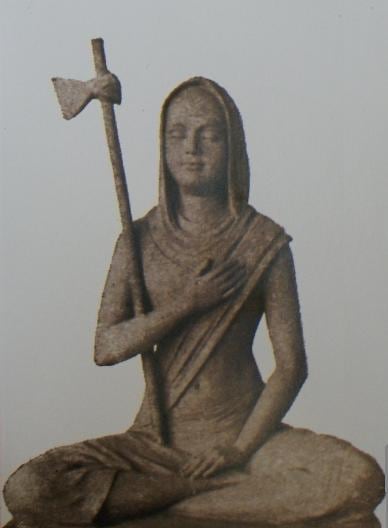
Gaudapada
They agree on: What is the Absolute? Does God exist? · How is liberation or salvation attained? · Is the world real?


Anecdotes and stories
Anecdotes and stories
Disputedc. 500–490 a. C. (incierto)
Ameinias' shrine
Origin of the story: Diogenes Laertius IX 21, quoting Sotion of Alexandria (2nd century BCE). There is no other source. Burnet (Early Greek Philosophy, § 84) considers it plausible.
Testimonys. V a. C.
The magistrates' oath
Origin of the story: Speusippus in Diogenes Laertius IX 23; Plutarch, Against Colotes 1126a–b; Strabo VI 1.1. The three sources are independent of one another, though none is contemporary.
Source: Plutarco. Contra Colotes 1126a–b; Estrabón, Geografía VI 1.1; Espeusipo citado por Diógenes Laercio IX 23.
Disputedc. 450 a. C.
The meeting with the young Socrates
Origin of the story: Plato, Parmenides 127a–c; Theaetetus 183e; Sophist 217c. Athenaeus, Deipnosophists XI 505f, considers it anachronistic. It is a literary testimony without independent confirmation.
Documenteds. I d. C. (inscripción); 1962 (hallazgo)
"Parmenides, son of Pyres, Ouliades, natural philosopher"
Origin of the story: Packard Humanities Institute, inscription no. 301222 (Apollo 2, 1962, 125–136; SEG 38.1020). Reading "Ouliades" as the title of a medical school is the most widespread interpretation; Peter Kingsley developed it into his hypothesis of Parmenides the healer.
Disputeds. V a. C.
The evening star and the morning star
Origin of the story: Diogenes Laertius IX 21 and 23 (Theophrastus, Favorinus); VIII 14 and 48 ascribe the same to Pythagoras. Fragments B14 and B15 are transmitted by Plutarch.
Documentedc. 530 d. C.
Simplicius and the rarity of the book
Origin of the story: Simplicius, Commentary on Aristotle's Physics 144.25–28 (ed. Diels, 1882). The commentator himself states his motive.
Source: Simplicio. In Aristotelis Physicorum libros commentaria, ed. Hermann Diels, Commentaria in Aristotelem Graeca IX, Reimer, Berlín, 1882, pp. 144–146 (transcripción de B8 «por la rareza del libro»).
Teachings
Teachings
The notions that structure their thought, explained in context.
What is (to eon)lo-que-es
The core of the way of truth (B2, B6, B8).
The two ways of inquirylas-dos-vias
Fragments B2, B6, B7 and B8.1–2.
Source: Mourelatos, Alexander P. D. The Route of Parmenides. Yale University Press, New Haven, 1970 (ed. revisada, Parmenides Publishing, 2008); y Palmer, John, Parmenides and Presocratic Philosophy, Oxford University Press, 2009.
Thinking and beingpensar-y-ser
Fragments B3 and B8.34–36; reception in Plotinus (Enneads V 1, 8).
Truth (aletheia) and opinion (doxa)verdad-y-opinion
Fragments B1.28–32, B8.50–61, B9–B19.
Source: Kirk, G. S., Raven, J. E. y Schofield, M. The Presocratic Philosophers, 2.ª ed. Cambridge University Press, 1983, cap. VIII (Parmenides of Elea). Trad. esp. de Jesús García Fernández, Gredos, 1987.
The well-rounded sphereesfera
Fragment B8.42–49.
The journey of the proemel-viaje-del-proemio
Fragment B1; testimony of Sextus Empiricus (Against the Mathematicians VII 111–114).
Source: Sexto Empírico. Contra los matemáticos VII 111–114 (cita y alegoría del proemio, B1.1–30). Trad. inglesa de R. G. Bury, Loeb Classical Library, 1935.
Videos
Videos
Recordings, interviews and documentaries. Videos play from YouTube; they are not hosted here.
Parmenides: Pre-Socratic Philosophy
Lecture· EN· 2022· 47 min
Philosophy Overdose
The Eleatic Monists (Parmenides & Zeno)
Lecture· EN· 2017· 73 min
Adam RosenfeldOfficial channel
Parmenides of Elea | Being and Non-Being | Philosophy Core Concepts
Analysis· EN· 2019· 14 min
Gregory B. Sadler - That Philosophy GuyOfficial channel
4. All is One: Parmenides & Zeno on Being and Nothingness
Lecture· EN· 2014· 46 min
Mark ThorsbyOfficial channel
Parmenides of Elea
Lecture· EN· 2021· 30 min
Michael WiitalaOfficial channel
Gadamer on Parmenides & the Birth of Philosophy
Interview· DE· 2021· 8 min
Philosophy Overdose
Parménides de Elea
Documentary· ES· 2017· 28 min
UNEDOfficial channel
Conferencia José Luis Díaz Arroyo "Parménides"
Lecture· ES· 2018· 135 min
Hercritia-Cátedra de Hermenéutica CríticaOfficial channel
Parménides | Historia de la filosofía (6/61)
Lecture· ES· 2017· 80 min
Ernesto CastroOfficial channel
Filosofía más allá de la academia. Ciclo de filosofía antigua. Parménides y Heráclito
Lecture· ES· 2022· 88 min
Universidad Nacional Abierta y a Distancia UNADOfficial channel
Le Parménide historique et le «Parménide» de Platon — Francesco Fronterotta
Lecture· FR· 2019· 94 min
Andrea Cirla
Parménide avec Lambros Couloubaritsis
Interview· FR· 2016· 44 min
Résonance[s]
Gallery
Gallery
Images with verified licences. Each keeps its authorship and attribution.
Connections
Connections
Influences, discipleships and affinities. Documented relations are distinguished from similarities identified by analysis.
Disciple of
Jenófanes
Aristotle (Metaphysics A 5) records that he "is said" to have been his pupil, and Diogenes Laertius states it; the relationship is traditional and disputed.
Similarity identified by analysis
Influenced by
According to Sotion, it was the Pythagorean Ameinias who led him to the life of study; the link with Pythagoreanism is indirect.
Similarity identified by analysis
Contemporary of
Contemporaries; many read in B6 ("two-headed mortals… for whom the path of all things turns back on itself") a polemical allusion to Heraclitus.
Similarity identified by analysis
Teacher of
Zenón de Elea
His pupil and, according to Plato, his beloved; he defended his doctrine with the paradoxes against plurality and motion.
Documented relation
Teacher of
Meliso de Samos
Diogenes Laertius (IX 24) makes him a pupil of Parmenides; he reformulated the Eleatic thesis in prose, with what is as infinite.
Documented relation
Influenced
Theophrastus, quoted by Diogenes Laertius (VIII 55), calls him an "emulator and imitator" of Parmenides in his poems; Empedocles accepts that nothing comes to be or perishes.
Documented relation
Met
Plato narrates a meeting in Athens around 450 BCE (Parmenides 127a–c; Theaetetus 183e; Sophist 217c); many consider it fictitious, though Burnet accepted it as historical.
Similarity identified by analysis
Influenced
He devotes the dialogue Parmenides to him and, in the Sophist, presents his own theory of not-being as "parricide" against him.
Documented relation
Influenced
He discusses the Eleatic thesis at the start of the Physics (I 2–3) and in the Metaphysics (A 5), and explains the pluralists as a response to it.
Documented relation
Influenced
In the Enneads (V 1, 8) he quotes B3 and presents Parmenides as a forerunner of the identity of Intellect and being.
Documented relation
Ideas akin to
The affirmation of a single reality, unborn and unchanging, against apparent multiplicity has led to comparisons between the way of truth and Advaita Vedanta; there is no historical contact.
Similarity identified by analysis
Sources
Sources
Bibliography and catalogues consulted for this profile.
- Wikidata, entidad Q125551 «Parmenides» (112 enlaces entre wikis; P31=Q5). Registra nacimiento en 515 a. C. y muerte en 470 a. C. (esta última incompatible con la cronología platónica) y Elea como lugar de nacimiento.
- Diógenes Laercio. Vidas y opiniones de los filósofos ilustres IX 21–23 (Parménides), 25 (Zenón) y 24 (Meliso), s. III d. C. Trad. inglesa de C. D. Yonge, Bohn, Londres, 1853 (Project Gutenberg n.º 57342); trad. inglesa de R. D. Hicks, Loeb, 1925 (Wikisource).
- Diels, Hermann y Kranz, Walther. Die Fragmente der Vorsokratiker, 6.ª ed. Weidmann, Berlín, 1951–1952, cap. 28 (Parmenides), A (testimonios) y B 1–19. Texto griego consultado en la transcripción de Wikisource en griego («Περί φύσεως (Παρμενίδης)»).
- Kirk, G. S., Raven, J. E. y Schofield, M. The Presocratic Philosophers, 2.ª ed. Cambridge University Press, 1983, cap. VIII (Parmenides of Elea). Trad. esp. de Jesús García Fernández, Gredos, 1987.
- Palmer, John. «Parmenides». The Stanford Encyclopedia of Philosophy, ed. Edward N. Zalta y Uri Nodelman; primera publicación el 8 de febrero de 2008, revisión sustancial del 4 de marzo de 2025.
- Burnet, John. Early Greek Philosophy, 2.ª ed. A. and C. Black, Londres, 1908, cap. IV (Parmenides of Elea), §§ 84–97 (Project Gutenberg n.º 67097).
- Coxon, A. H. The Fragments of Parmenides: A Critical Text with Introduction and Translation, the Ancient Testimonia and a Commentary. Van Gorcum, Assen, 1986; ed. revisada por Richard McKirahan, Parmenides Publishing, Las Vegas, 2009.
- Laks, André y Most, Glenn W. (eds. y trads.). Early Greek Philosophy, vol. V: Western Greek Thinkers, Part 2. Loeb Classical Library 528, Harvard University Press, 2016.
- Graham, Daniel W. (ed. y trad.). The Texts of Early Greek Philosophy, 2 vols. Cambridge University Press, 2010.
- Eggers Lan, Conrado y otros (introd., trad. y notas). Los filósofos presocráticos I. Biblioteca Clásica Gredos 12, Gredos, Madrid, 1978.
- Platón. Parménides 127a–128b; Teeteto 183e–184a; Sofista 237a, 241d–242a; Banquete 178b. Trad. inglesa de Benjamin Jowett, The Dialogues of Plato, 3.ª ed., Clarendon Press, Oxford, 1892 (Project Gutenberg n.º 1687, Parmenides).
- Aristóteles. Metafísica A 5, 986b18–987a2; Física I 2–3, 184b–187a; Sobre la generación y la corrupción I 8, 325a. Trad. inglesa de W. D. Ross y R. P. Hardie (Internet Classics Archive, MIT).
- Simplicio. In Aristotelis Physicorum libros commentaria, ed. Hermann Diels, Commentaria in Aristotelem Graeca IX, Reimer, Berlín, 1882, pp. 144–146 (transcripción de B8 «por la rareza del libro»).
- Sexto Empírico. Contra los matemáticos VII 111–114 (cita y alegoría del proemio, B1.1–30). Trad. inglesa de R. G. Bury, Loeb Classical Library, 1935.
- Packard Humanities Institute, Searchable Greek Inscriptions, n.º 301222: herma acéfala de mármol blanco de Velia, s. I d. C., «Παρμενείδης Πύρητος Οὐλιάδης φυσικός»; primera publicación en Apollo 2 (1962) 125–136; SEG 38.1020 y 53.1114.
- Kingsley, Peter. In the Dark Places of Wisdom. Golden Sufi Center, Inverness (California), 1999.
- Plutarco. Contra Colotes 1126a–b; Estrabón, Geografía VI 1.1; Espeusipo citado por Diógenes Laercio IX 23.
- Cordero, Néstor Luis. Siendo, se es. La tesis de Parménides. Biblos, Buenos Aires, 2005.
- Tarán, Leonardo. Parmenides: A Text with Translation, Commentary and Critical Essays. Princeton University Press, Princeton, 1965.
- Gallop, David. Parmenides of Elea: Fragments. A Text and Translation with an Introduction. University of Toronto Press (Phoenix, suppl. vol. 18), Toronto, 1984.
- Davidson, Thomas. «The Fragments of Parmenides». Journal of Speculative Philosophy, 4 (1870); separata, E. P. Gray, St. Louis, 1869 (Wikisource).
- Fairbanks, Arthur (ed. y trad.). The First Philosophers of Greece. Kegan Paul, Trench, Trübner, Londres, 1898 (Project Gutenberg n.º 78670).
- «Parmenides», Wikipedia en inglés, y «Parménides», Wikipedia en español (consultadas para contrastar datos y bibliografía; texto propio).
- Open Library (Internet Archive): ediciones del poema de Parménides verificadas por ISBN.
- Heródoto. Historias I 163–167 (los focenses y la fundación de Hyele/Elea), s. V a. C. Trad. inglesa de G. C. Macaulay, Macmillan, Londres, 1890 (Project Gutenberg n.º 2707).
- Bernabé, Alberto (ed. y trad.) y Pérez de Tudela, Jorge (introd., notas y comentarios). Parménides. Poema. Fragmentos y tradición textual, epílogo de Néstor-Luis Cordero. Istmo (Fundamentos), Madrid, 2007.
- Mourelatos, Alexander P. D. The Route of Parmenides. Yale University Press, New Haven, 1970 (ed. revisada, Parmenides Publishing, 2008); y Palmer, John, Parmenides and Presocratic Philosophy, Oxford University Press, 2009.
- Owen, G. E. L. «Eleatic Questions». The Classical Quarterly, 10 (1960), pp. 84–102.
- Plotino. Enéadas V 1, 8 (Parménides y la identidad de pensar y ser). Trad. inglesa de Stephen MacKenna, 1917–1930.
- Rights holder
- Textos antiguos en dominio público; cada traducción y edición crítica pertenece a su traductor o editorial
Pending confirmation
What this profile has not yet been able to settle. We would rather say so than fill it in.
- Muerte: no hay ningún dato antiguo sobre su fecha o lugar; Wikidata da 470 a. C., incompatible con la visita a Atenas a los 65 años que narra Platón. Se deja como «unknown».
- Nacimiento: se adopta c. 515 a. C. (Platón, Parménides 127b; Wikidata); la cronología de Apolodoro (madurez en 504–501) lo situaría hacia el 540.
- Edición de Akal (Básica de Bolsillo, 2008): traductor no verificado en catálogo. Tarán (Princeton, 1965): ISBN no verificado.
- Traducción española de dominio público del poema: no localizada en línea con URL estable.
- Manuscritos: el poema depende de los códices de Simplicio y Sexto Empírico; falta identificar signaturas y digitalizaciones fiables.
- Programas de afiliación: ninguno verificado. Lista vacía.
- Año de los vídeos: el de la grabación cuando la descripción lo indica y, si no, el de publicación en YouTube.
Researched on 2026-10-25