Hinduism · Yoga · Advaita Vedanta · Vedic tradition
Vasishtha
वसिष्ठ · Vasiṣṭha · योगवासिष्ठ
Legendary figure
Vedic sage to whom tradition ascribes the seventh book of the Ṛgveda, composed by a family of poet-priests in the second half of the second millennium BCE. In the hymns he appears beside King Sudās at the Battle of the Ten Kings; in the Rāmāyaṇa he is chaplain to the dynasty of Ayodhyā, rival of Viśvāmitra and teacher of Rāma, and in the Mahābhārata the great-grandfather of Vyāsa. The Vasiṣṭha Dharmasūtra and the Yoga Vāsiṣṭha, a medieval Vedāntic dialogue reworked from the Kashmiri Mokṣopāya, bear his name. He is not a documented person but a lineage and a legendary figure.
- works
- 10works
- editions
- 15editions
- quotes
- 6quotes
- videos
- 13videos
- images
- 9images
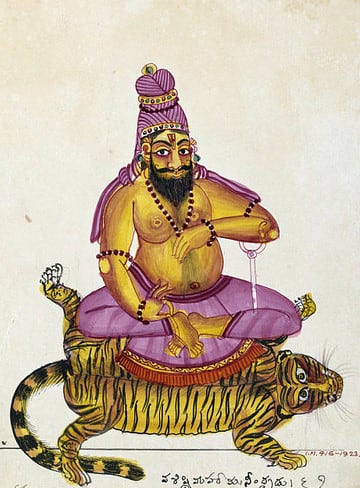
Maharishi Vasiṣṭha sentado sobre una piel de tigre · Public domain
In their words
«Free us from sins committed by our fathers, from those wherein we have ourselves offended. O King, loose, like a thief who feeds the cattle, as from the cord a calf, set free Vasistha.»Ṛgveda 7.86.5; trad. inglesa de R. T. H. Griffith (1896, dominio público); versión española del investigador

Their central idea
The world as a projection of the mind: The Yoga Vāsiṣṭha maintains that the whole universe is a creation of the mind (manas) or of consciousness (cit), comparable to a dream or an imagined city: it exists while it is thought and ceases to exist when thought is stilled.
See in context
Biography
5 min read
A name that runs through three thousand years
Few figures of Sanskrit literature reappear in as many strata as Vasiṣṭha. He is the poet-priest to whom tradition ascribes the seventh book of the Ṛgveda, the chaplain of the solar dynasty of Ayodhyā in the Rāmāyaṇa, the rival of Viśvāmitra, the great-grandfather of Vyāsa in the Mahābhārata, one of the stars of the Great Bear and, by the Middle Ages, the master who instructs Rāma in the Yoga Vāsiṣṭha. No document allows us to speak of a historical individual beyond the Vedic hymns: the name designates both a lineage of priests —the Vasiṣṭhas, a Brahmin gotra that still exists— and a legendary sage counted among the seven ṛṣis of the sky. The dates that can be given are those of the texts, never of the person.
The poet of the seventh book
Books II to VII of the Ṛgveda, the so-called "family books", gather the collections of different clans of poets. The seventh, with 104 hymns, is ascribed to Vasiṣṭha Maitrāvaruṇi and his descendants, and is one of the oldest cores of the corpus, composed in the Panjab in the second half of the second millennium BCE according to the most widely accepted dating. It contains hymns to Agni, Indra and the Dawn and, above all, a series addressed to Varuṇa (7.86–89) of unusually personal tone: the poet asks what fault he has committed and begs the god to loose him "as from the cord a calf". Hymn 7.33 tells of Vasiṣṭha's birth: son of Mitra and Varuṇa through their desire for the nymph Urvaśī, born from a seed gathered in a pitcher from which Agastya also came forth. Such genealogies cannot be verified; what they do document is how a priestly family that claimed divine origin saw itself.
Sudās and the Battle of the Ten Kings
Hymns 7.18, 7.33 and 7.83 celebrate the victory of Sudās, king of the Tṛtsu-Bharatas, over a coalition of ten kings by the river Paruṣṇī, the present-day Ravi. The Vasiṣṭhas claim the credit: Indra, they say, heard their prayer and gave the Tṛtsus "ample room and freedom". Michael Witzel has read these hymns as the reflection of a real event of the middle Vedic period, the rise of the Bharatas who would eventually give India its name, and has noted that the third book, that of Viśvāmitra, also knows Sudās. This is probably the origin of the rivalry between the two priestly families that the epics would turn into one of their great themes.
The rivalry with Viśvāmitra
The Rāmāyaṇa dramatises that memory. In the Bālakāṇḍa, King Viśvāmitra visits Vasiṣṭha's hermitage and is feasted thanks to Śabalā, the cow of plenty; the king wants to take her away, the cow brings forth armies, and the warrior's power breaks against the Brahmin's, until Viśvāmitra renounces his throne and undertakes millennia of austerities to be acknowledged as a brahmarṣi. The Mahābhārata adds the darkest episode: King Kalmāṣapāda, turned into a demon, devours Śakti, Vasiṣṭha's eldest son; the sage tries to take his own life and the rivers refuse to drown him; only the voice of his grandson Parāśara, reciting the Veda from his mother's womb, gives him back the will to live. Parāśara will be the father of Vyāsa.
Chaplain of the Ikṣvākus and teacher of Rāma
In the epic, Vasiṣṭha is the hereditary purohita of the kings of Ayodhyā: he performs Daśaratha's rites, educates the princes, sends for Bharata after the king's death and, in the forest of Citrakūṭa, reminds Rāma of the custom that obliges the first-born to reign. His wife Arundhatī became the model of conjugal fidelity; her name is given to the small star Alcor, beside Mizar, Vasiṣṭha's star in the Great Bear, which wedding rites point out to the bride. Bühler already observed in 1882 that the prestige of this Vasiṣṭha, "a redoubtable champion of Brahmanism", explains why so many works were placed under his name.
The Yoga Vāsiṣṭha
The most influential work bearing his name is the Yoga Vāsiṣṭha or Mahārāmāyaṇa, an immense dialogue —some thirty thousand verses according to tradition— divided into six books. The young Rāma returns from a pilgrimage sunk in disenchantment; Viśvāmitra arrives at court and Vasiṣṭha undertakes his instruction, set within a chain of narrative frames whose narrator is Vālmīki. Its doctrine is a radical idealism: the world is a projection of the mind, and the consciousness that dreams it can awaken while still alive (jīvanmukti). It teaches through memorable tales —Līlā, King Lavaṇa, the Brahmin Gādhi, Queen Cūḍālā— and with a singular insistence on human effort over fate. Proposed dates have ranged from the sixth to the fourteenth century; Walter Slaje and Jürgen Hanneder have shown that the text is a Vedāntic reworking of an earlier Kashmiri work, the Mokṣopāya, of around the tenth century. There is also an abridgement, the Laghu Yoga Vāsiṣṭha, ascribed to Gauḍa Abhinanda, and a Persian translation made at the Mughal court, whose illustrated manuscript of 1602 is preserved in Dublin.
Law, yoga, phonetics and astronomy
The name was also a seal of authority. The Vasiṣṭha Dharmasūtra, one of the four surviving prose treatises on dharma, is for Bühler the last remnant of a lost Vedic school and for Patrick Olivelle the latest of the group, with later additions; the text itself invokes Vasiṣṭha three times and ends with a salutation "to the son of Mitra and Varuṇa and of Urvaśī". His name is also borne by a Vasiṣṭha Saṃhitā on yoga, a Vasiṣṭha Smṛti, a treatise on Vedic phonetics (Vāsiṣṭhī Śikṣā), another on archery (Dhanurveda Saṃhitā) and an astronomical system, the Vasiṣṭha Siddhānta, summarised by Varāhamihira in the sixth century. None can be ascribed to a person: the attribution tells us which authority was being invoked.
What can be affirmed
The historian can maintain that in the Vedic period there existed a family of poets and priests who called themselves Vasiṣṭha, who composed or transmitted the seventh book of the Ṛgveda and who were tied to the court of Sudās. Everything else —the birth from the pitcher, the wondrous cow, the death of the hundred sons, the teaching of Rāma— belongs to a literary tradition that went on being written for more than two thousand years and made Vasiṣṭha the very figure of the wise Brahmin: serene before force, faithful to the word and teacher of kings.
Sources: Jamison, Stephanie W., y Joel P. Brereton (trads.). The Rigveda: The Earliest Religious Poetry of India. 3 vols. Nueva York: Oxford University Press, 2014. Introducción general e introducción al libro VII. · Griffith, Ralph T. H. (trad.). The Hymns of the Rigveda. 2.ª ed. Benarés: E. J. Lazarus, 1896–1897. Libro VII (himnos 18, 33, 59, 83, 86–89), texto en Wikisource. · Goldman, Robert P. (trad. e introd.). The Rāmāyaṇa of Vālmīki: An Epic of Ancient India. Vol. I: Bālakāṇḍa. Princeton: Princeton University Press, 1984 (episodio de Vasiṣṭha y Viśvāmitra, sargas 50–64 de la edición crítica). · Mitra, Vihari-Lala (trad.). The Yoga-Vásishtha Mahárámáyana of Válmiki. 4 vols. en 7 partes. Calcuta: Bonnerjee & Co., 1891–1899. Edición digital en Project Gutenberg (n.º 71326 y siguientes). · Slaje, Walter. Vom Mokṣopāya-Śāstra zum Yogavāsiṣṭha-Mahārāmāyaṇa. Philologische Untersuchungen zur Entwicklungs- und Überlieferungsgeschichte eines indischen Lehrwerks mit Anspruch auf Heilsrelevanz. Viena: Verlag der Österreichischen Akademie der Wissenschaften, 1994.
Timeline
A life, year by year
Each point is a documented event. Click to read it, with its source and degree of certainty.
c. 1300 BCE – 1000 BCEPanyab (Sapta Sindhu)
The hymns of the seventh book of the Ṛgveda
Composition, by the priestly family of the Vasiṣṭhas, of the 104 hymns of maṇḍala VII, one of the 'family books' that form the ancient core of the Ṛgveda. The range is that of the composition of the corpus, not of a person.
ProbableJamison, Stephanie W., y Joel P. Brereton (trads.). The Rigveda: The Earliest Religious Poetry of India. 3 vols. Nueva York: Oxford University Press, 2014. Introducción general e introducción al libro VII.
c. 1300 BCE – 1000 BCE
The hymns of the seventh book of the Ṛgveda
Composition, by the priestly family of the Vasiṣṭhas, of the 104 hymns of maṇḍala VII, one of the 'family books' that form the ancient core of the Ṛgveda. The range is that of the composition of the corpus, not of a person.
Probable
c. 1200 BCE
The Battle of the Ten Kings
Hymns 7.18, 7.33 and 7.83 celebrate the victory of King Sudās of the Tṛtsu-Bharatas over a coalition of ten kings and ascribe Indra's favour to the prayer of the Vasiṣṭhas. Witzel interprets it as a real event of the Vedic period; the date is approximate.
Disputed
c. 500 BCE – 300
Vasiṣṭha in the Rāmāyaṇa
In the Rāmāyaṇa, whose composition spans centuries (the Bālakāṇḍa and the Uttarakāṇḍa are late strata), Vasiṣṭha is Daśaratha's purohita, the teacher of the princes and the protagonist of the conflict with Viśvāmitra over the cow Śabalā.
Probable
c. 300 BCE – 300
Vasiṣṭha in the Mahābhārata
The Ādiparvan narrates the death of Śakti at the hands of King Kalmāṣapāda, Vasiṣṭha's attempts at suicide frustrated by the rivers Vipāśā and Śatadru, and the birth of his grandson Parāśara, father of Vyāsa.
Tradition
c. 100 BCE – 100
The Vasiṣṭha Dharmasūtra
Redaction of the treatise on dharma that bears his name, the latest of the four surviving dharmasūtras according to Olivelle, with later additions. The range is approximate.
Disputed
c. 950
The Mokṣopāya
Composition in Kashmir of the Mokṣopāya, the dialogue between Vasiṣṭha and Rāma that Slaje and Hanneder have identified as the basis of the Yoga Vāsiṣṭha.
Probable
c. 1100 – 1400
The Vedāntic version: the Yoga Vāsiṣṭha
Reworking of the Mokṣopāya in a Vedāntic key and spread of the Yoga Vāsiṣṭha or Mahārāmāyaṇa, together with the abridgement ascribed to Gauḍa Abhinanda (Laghu Yoga Vāsiṣṭha). The dates are still debated.
Disputed
1602
The illustrated Jūg Bāsisht
For Prince Salīm, the future emperor Jahāngīr, an illustrated copy of the Persian translation of the Yoga Vāsiṣṭha is completed at Allahabad, with paintings by Bishan Das and others; it is now in the Chester Beatty Library, Dublin.
Documented
1882
Bühler translates the Vasiṣṭha Dharmasūtra
Georg Bühler publishes the English translation of the Vasiṣṭha Dharmasūtra in volume 14 of the Sacred Books of the East.
Documented
1891 – 1899
Vihari-Lala Mitra's translation
The first complete English translation of the Yoga Vāsiṣṭha, in four volumes, by Vihari-Lala Mitra, appears in Calcutta.
Documented
1896
Griffith publishes the Ṛgveda in English
Second edition of Ralph T. H. Griffith's The Hymns of the Rigveda, the complete public-domain English translation in which Vasiṣṭha's hymns are read today.
Documented
Works
Essential works
The works without which their legacy cannot be understood.
Later compilation · c. 1200 BCE
Ṛgveda, Book VII (hymns of the Vasiṣṭhas)
ऋग्वेद, सप्तमं मण्डलम् (Ṛgveda, saptamaṃ maṇḍalam)
The 104 hymns of the seventh book of the Ṛgveda, one of the 'family books'. They include hymns to Agni, Indra, Uṣas, the Maruts and Mitra-Varuṇa; the chronicle of the Battle of the Ten Kings (7.18, 7.33, 7.83); the account of Vasiṣṭha's birth (7.33); the confessional hymns to Varuṇa (7.86–89); the mantra to Tryambaka (7.59.12), still recited as the 'mahāmṛtyuñjaya', and the hymn of the frogs (7.103). It is one of the oldest strata of Indian literature.
4 editions

Traditional attribution · c. 1100
Yoga Vāsiṣṭha (Mahārāmāyaṇa)
योगवासिष्ठ (Yogavāsiṣṭha), también महारामायण (Mahārāmāyaṇa), आर्षरामायण, वासिष्ठरामायण
A dialogue of some thirty thousand verses, according to tradition, in six books (prakaraṇa): Vairāgya (Rāma's disenchantment), Mumukṣu (the seeker of liberation), Utpatti (creation), Sthiti (persistence), Upaśama (quiescence) and Nirvāṇa (extinction). Vasiṣṭha teaches Rāma that the world is a projection of the mind and that liberation is possible in life, through dozens of nested tales —Līlā, Lavaṇa, Gādhi, Cūḍālā and Śikhidhvaja, the crow Bhuśuṇḍa— and a constant defence of human effort (pauruṣa) against fate.
6 editions

Traditional attribution · c. 100 BCE
Vasiṣṭha Dharmasūtra (The Sacred Law of Vasiṣṭha)
वासिष्ठधर्मसूत्र / वासिष्ठधर्मशास्त्र (Vāsiṣṭha Dharmasūtra / Dharmaśāstra)
A prose manual with interspersed verses, in thirty chapters, on the rules of conduct: the sources of dharma, the four social classes, the stages of life (student, householder, hermit, ascetic), purity, women, inheritance, adoption, lawful interest on loans, the king and penances. It ends with a chapter of maxims and a salutation to Vasiṣṭha, 'son of Mitra and Varuṇa and of Urvaśī'.
3 editions
Complete works (10)
Vasishtha
Mokṣopāya ('The Means to Liberation')
The Conscious LibraryMokṣopāya ('The Means to Liberation')
950

Laghu Yoga Vāsiṣṭha (The Shorter Yoga Vāsiṣṭha)
Vasishtha
Vasiṣṭha Saṃhitā (Yoga section)
The Conscious LibraryVasiṣṭha Saṃhitā (Yoga section)
Vasishtha
Vasiṣṭha Smṛti
The Conscious LibraryVasiṣṭha Smṛti
Vasishtha
Vāsiṣṭhī Śikṣā (treatise on Vedic phonetics)
The Conscious LibraryVāsiṣṭhī Śikṣā (treatise on Vedic phonetics)
Vasishtha
Vasiṣṭha's Dhanurveda Saṃhitā (treatise on archery)
The Conscious LibraryVasiṣṭha's Dhanurveda Saṃhitā (treatise on archery)
Vasishtha
Vasiṣṭha Siddhānta (astronomical system)
The Conscious LibraryVasiṣṭha Siddhānta (astronomical system)
Quotations
Quotations located in a specific work. Each carries its provenance and its level of confidence.
Free us from sins committed by our fathers, from those wherein we have ourselves offended. O King, loose, like a thief who feeds the cattle, as from the cord a calf, set free Vasistha.áva drugdhā́ni pítryā sṛjā nó, áva yā́ vayáṃ cakṛmā́ tanū́bhiḥ / áva rājan paśutṛ́paṃ ná tāyúṃ sṛjā́ vatsáṃ ná dā́mno vásiṣṭham
VerifiedṚgveda 7.86.5; trad. inglesa de R. T. H. Griffith (1896, dominio público); versión española del investigador
Last words
There are no verifiable records of their last words.
There is no record of his death or of any last words. Vasiṣṭha is a lineage name and a legendary figure; tradition places him among the seven sages who dwell as stars in the Great Bear.
Source: Jamison, Stephanie W., y Joel P. Brereton (trads.). The Rigveda: The Earliest Religious Poetry of India. 3 vols. Nueva York: Oxford University Press, 2014. Introducción general e introducción al libro VII.
Ask
What their work answers
Twelve great human questions and what their texts allow us to answer, with references. We never put words in their mouth.
What is the Absolute? Does God exist?
The only reality is pure consciousness; the universe is its imagining
An impersonal AbsoluteStated explicitly
In the Yoga Vāsiṣṭha, Vasiṣṭha teaches Rāma that the ultimate is brahman, pure consciousness (cit) without form, beginning or second. Worlds, bodies and the gods themselves appear in that consciousness like the images of a dream or an imagined city, and have no substance other than it. The work's stories —Līlā, who traverses her husband's successive lives within the space of a single room; King Lavaṇa, who lives a whole existence as an outcaste in an instant— serve to dissolve the solidity of what is taken to be real. Brahmā, Viṣṇu and Śiva appear in the text, but as figures within that consciousness, not as its ground. The question of a creator God is thus absorbed into another: what is the consciousness that represents the world to itself.
Compare this question with other teachersWho am I? Is there a true self?
The suffering self is a product of the mind; the Self is pure consciousness
The Self is the AbsoluteStated explicitly
In the Yoga Vāsiṣṭha, Vasiṣṭha distinguishes between the ego (ahaṃkāra), which arises when consciousness thinks itself to be a particular body and mind, and the Self, which is unbounded consciousness (cit) itself. The ego has no more reality than a dream: it arises with accumulated impressions and desires (vāsanā) and dissolves when they are extinguished. What remains is not nothingness, but the consciousness that always was, identical with brahman. The work does not present this identity as a dogma, but as the result of an enquiry: Rāma must examine who it is that suffers until he finds that he cannot find him. Whoever understands this is liberated while living (jīvanmukta), and goes on acting in the world without identifying with any of it.
Compare this question with other teachersWhy do we suffer?
We suffer because the mind takes as real the world it imagines
Ignorance of what we areStated explicitly
The Yoga Vāsiṣṭha opens with Rāma's despondency: back from a pilgrimage, the young prince stops eating and acting, because he has seen the transience of youth, wealth and the body, and the thirst (tṛṣṇā) that is never quenched. Vasiṣṭha does not deny that diagnosis, but takes it deeper. Suffering arises because consciousness identifies with a body and a mind and takes as solid the world the mind itself projects, like someone suffering within a dream. What sustains that identification are accumulated impressions and desires (vāsanā). That is why the remedy is not to flee the world, but to understand its nature: when the vāsanās are extinguished and the mind grows still, suffering loses the ground it stood on.
Compare this question with other teachersWhat happens after death?
Death is a change of dream; consciousness is neither born nor dies
What I am is never born and never diesStated explicitly
In the Yoga Vāsiṣṭha, death interrupts nothing essential. The story of Līlā shows it: at the death of her husband Padma, the queen discovers that he goes on living, in the same instant and within the space of her own chamber, the life of King Vidūratha, who in turn dies and finds himself again in another world. For Vasiṣṭha, what we call dying is the mind, laden with its impressions (vāsanā), ceasing to represent one body and beginning to represent another, like passing from one dream to the next. As long as those impressions persist, the round of births continues. But consciousness itself, which is brahman, is neither born nor dies; whoever recognises it is liberated while still living and has nowhere to go.
Compare this question with other teachersHow is liberation or salvation attained?
Enquiry, sustained by one's own effort, liberates in this life
Through direct knowledgeStated explicitly
For the Vasiṣṭha of the Yoga Vāsiṣṭha, liberation results from knowledge gained through enquiry (vicāra): examining who I am, what the world is and where suffering arises, until impressions and desires (vāsanā) are extinguished and the mind grows still. It is not a gift nor the fruit of a rite, and it demands personal effort (pauruṣa): Vasiṣṭha holds that what is called fate is nothing but past action, and that present effort can overcome it as the stronger ram overcomes the weaker. The work describes seven stages of knowledge, from the wish for the good to a state with no trace of duality. Its ideal is the one liberated while living (jīvanmukta): not someone who abandons the world, but someone who lives in it without bonds.
Compare this question with other teachersIs a teacher necessary?
The teacher and the texts guide; one's own understanding liberates
Helpful but not indispensableStated explicitly
The Yoga Vāsiṣṭha takes the form of a teaching: Vasiṣṭha, teacher of the royal house, instructs Rāma for days before the court. But the text stresses that neither the teacher nor the scriptures suffice without the disciple's own understanding. Vasiṣṭha even says that reasonable words should be accepted even if spoken by a child, and that what does not accord with reason should be discarded like straw even if Brahmā himself had said it. His praise of personal effort (pauruṣa) points the same way: fate saves no one, and neither does the mere presence of a sage. The teacher awakens, reasons and offers stories that make one see; the disciple must enquire for himself until the teaching becomes his own evidence.
Compare this question with other teachersIs the world real?
The world is like a dream: it exists while the mind thinks it
Appearance over the one realityStated explicitly
The central thesis of the Yoga Vāsiṣṭha is that the entire universe is a creation of the mind (manas) or of consciousness (cit), comparable to a dream, an imagined city or the sky that looks blue without being so. It exists while it is thought and ceases to exist when thought grows still. Vasiṣṭha demonstrates this with stories of worlds within worlds: Līlā visits, within the space of a room, lives that last for years, and King Lavaṇa lives in an instant an entire existence as an outcaste, which he later finds confirmed in a real village. Time and space thus lose their solidity. The world is nothing in itself, but neither is it an absolute nothing: it is consciousness appearing to itself in forms.
Compare this question with other teachersWhat is love?
The Yoga Vāsiṣṭha does not make love a path; the hymns seek divine friendship
Did not address it
The Yoga Vāsiṣṭha has no doctrine of love. Its affective vocabulary revolves around attachment (rāga) and thirst (tṛṣṇā), which it treats as bonds, and its ideal is the one liberated while living, who acts with equanimity and without aversion to anyone. The story of Cūḍālā and Śikhidhvaja, in which an awakened queen patiently guides her husband to liberation and both return to rule together, shows a bond in the service of awakening, but the text does not raise it to a theory. The closest thing to love in the work ascribed to Vasiṣṭha lies in another place and age: in Ṛgveda VII, the poet ponders in his own heart how he may again be united with Varuṇa and find him gracious (7.86.2), and recalls an ancient friendship with the god.
Compare this question with other teachersAre we free, or is everything determined?
Fate is past action; present effort can overcome it
Karma and choiceStated explicitly
One of the most characteristic theses of the Yoga Vāsiṣṭha is the primacy of human effort (pauruṣa) over fate (daiva). In the opening chapters of the book of the seeker, Vasiṣṭha holds that what is called fate is not an external force, but the subject's own past action. Fate and effort, he says, contend with each other like two rams of unequal strength, in which the mightier overcomes the other, and present effort, well directed, can prevail. Fatalism is the excuse of the lazy. The thesis is striking in a work that also holds that the world is a mental projection: the effort it demands is, above all, that of the enquiry that leads to recognising the illusory nature of one's bonds.
Compare this question with other teachersWhy meditate or pray?
Enquire who I am until the mind comes to rest in its source
Returning to the source of the IStated explicitly
The Yoga Vāsiṣṭha makes enquiry (vicāra) its central practice: asking who I am, what this world is and where suffering arises, until the mind, deprived of the objects with which it identified, comes to rest in the consciousness from which it arises. Vasiṣṭha recognises two means of stilling the mind's agitation: yoga, understood as mastery of the breath, and knowledge; and although he devotes stories to the first —that of the immortal crow Bhusuṇḍa, who lives through control of the breath—, he prefers the second. Meditation does not mean withdrawing from life, but seeing through it: the one liberated while living meditates while ruling, conversing or fighting, because he no longer takes as real what the mind projects.
Compare this question with other teachersCan reason know the ultimate?
Reasoning guides to the threshold; the mind is extinguished in crossing it
The ultimate lies beyond the mindStated explicitly
Few Indian works grant reasoning as much value as the Yoga Vāsiṣṭha. Vasiṣṭha even says that reasonable words (yukti) should be accepted even if spoken by a child, and that what does not accord with reason must be discarded like straw even if Brahmā himself had said it. His stories work as arguments that dismantle the solidity of time and space. But reasoning is not the goal: it is the instrument of an enquiry that ends when the mind itself is extinguished (manonāśa). The ultimate is not a true thought about consciousness, but the objectless consciousness that remains when thinking ceases. Reason, well used, leads beyond itself.
Compare this question with other teachersWithdraw from the world or transform it?
Rāma must not withdraw: the one liberated in life rules without bonds
Contemplation in actionStated explicitly
The whole Yoga Vāsiṣṭha answers a temptation to withdraw. Rāma, disillusioned with the world, wants to abandon his princely duties, and Viśvāmitra needs him to protect a sacrifice. Vasiṣṭha's teaching does not invite him to renounce, but to understand: whoever has seen the nature of the world can go on acting in it without identifying with anything. That is the one liberated while living (jīvanmukta). The work illustrates this with kings: Janaka attains knowledge on hearing the song of some sages and goes on reigning; Queen Cūḍālā, awakened, guides her husband Śikhidhvaja, who had withdrawn to the forest, and both return to rule. Liberation lies not in the place where one lives, but in the manner of being there.
Compare this question with other teachers
Affinities & tensions
Affinities and tensions
Calculated question by question from their positions. The reason for each agreement or clash, on click.
Thinks most like
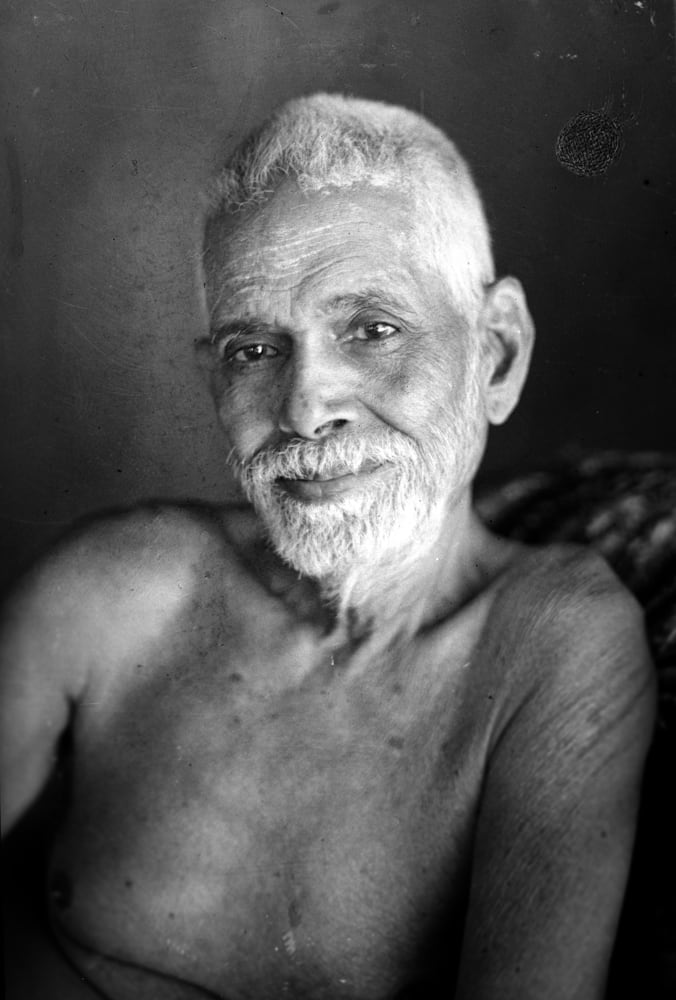
Ramana Maharshi
They agree on: What is the Absolute? Does God exist? · Is the world real? · Who am I? Is there a true self?
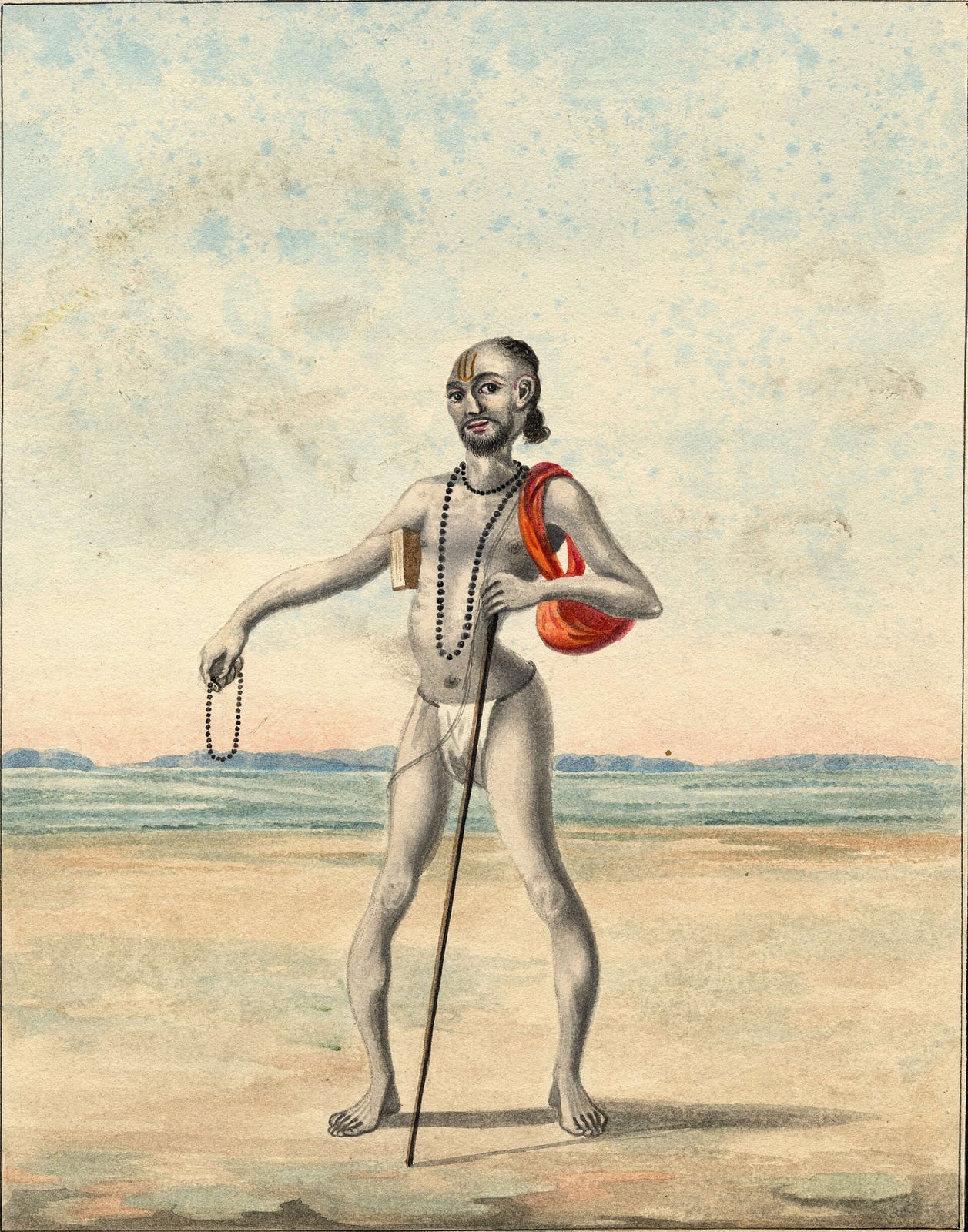
Ashtavakra
They agree on: What is the Absolute? Does God exist? · Who am I? Is there a true self? · Why do we suffer?
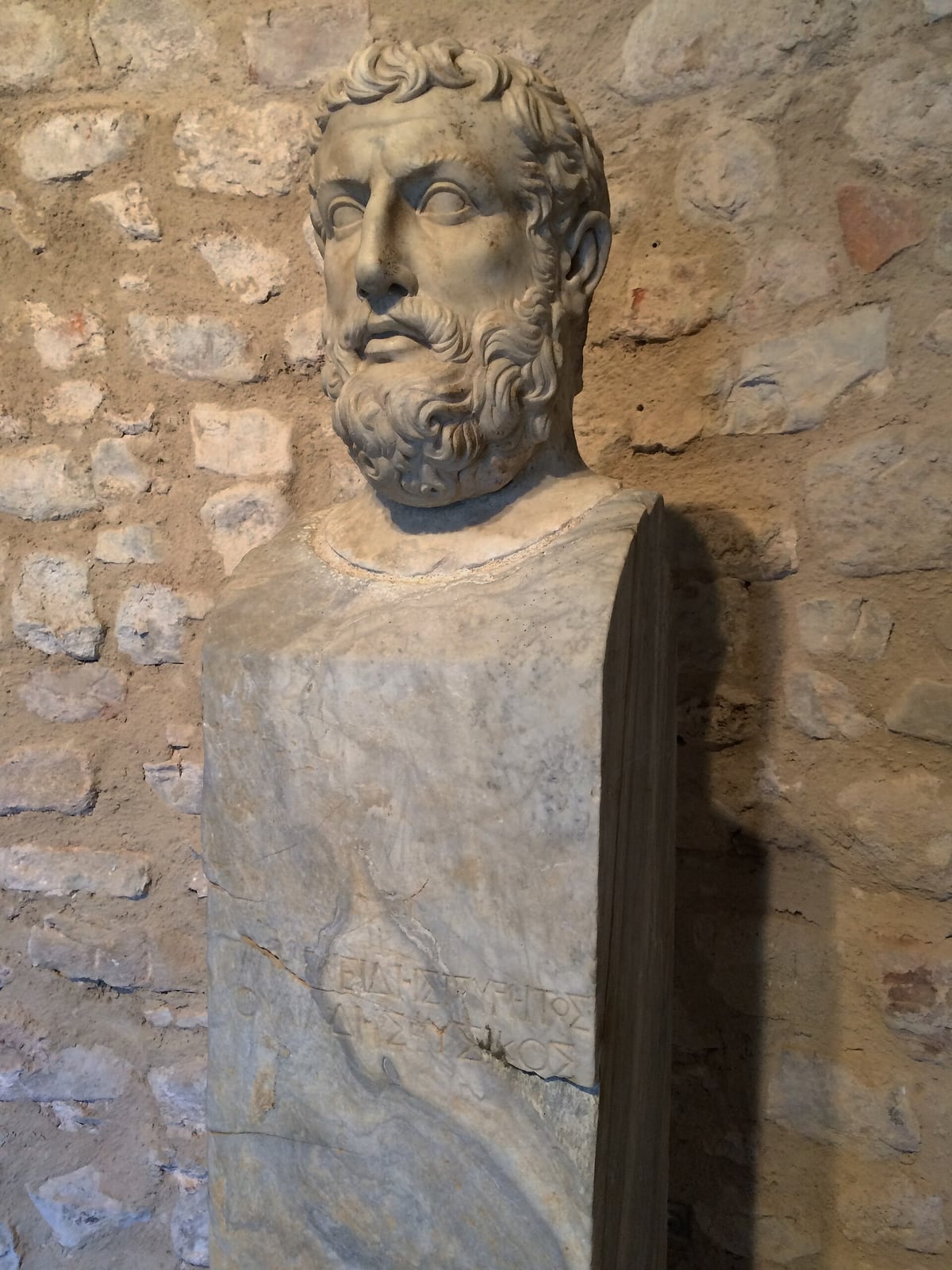
Parmenides
They agree on: What is the Absolute? Does God exist? · How is liberation or salvation attained? · Is a teacher necessary?
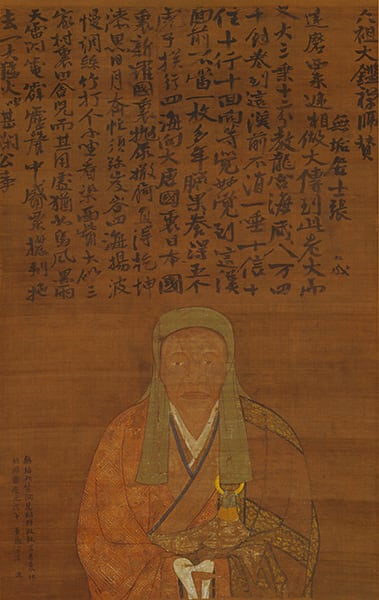
Huineng
They agree on: What is the Absolute? Does God exist? · Who am I? Is there a true self? · Why do we suffer?
Thinks most unlike
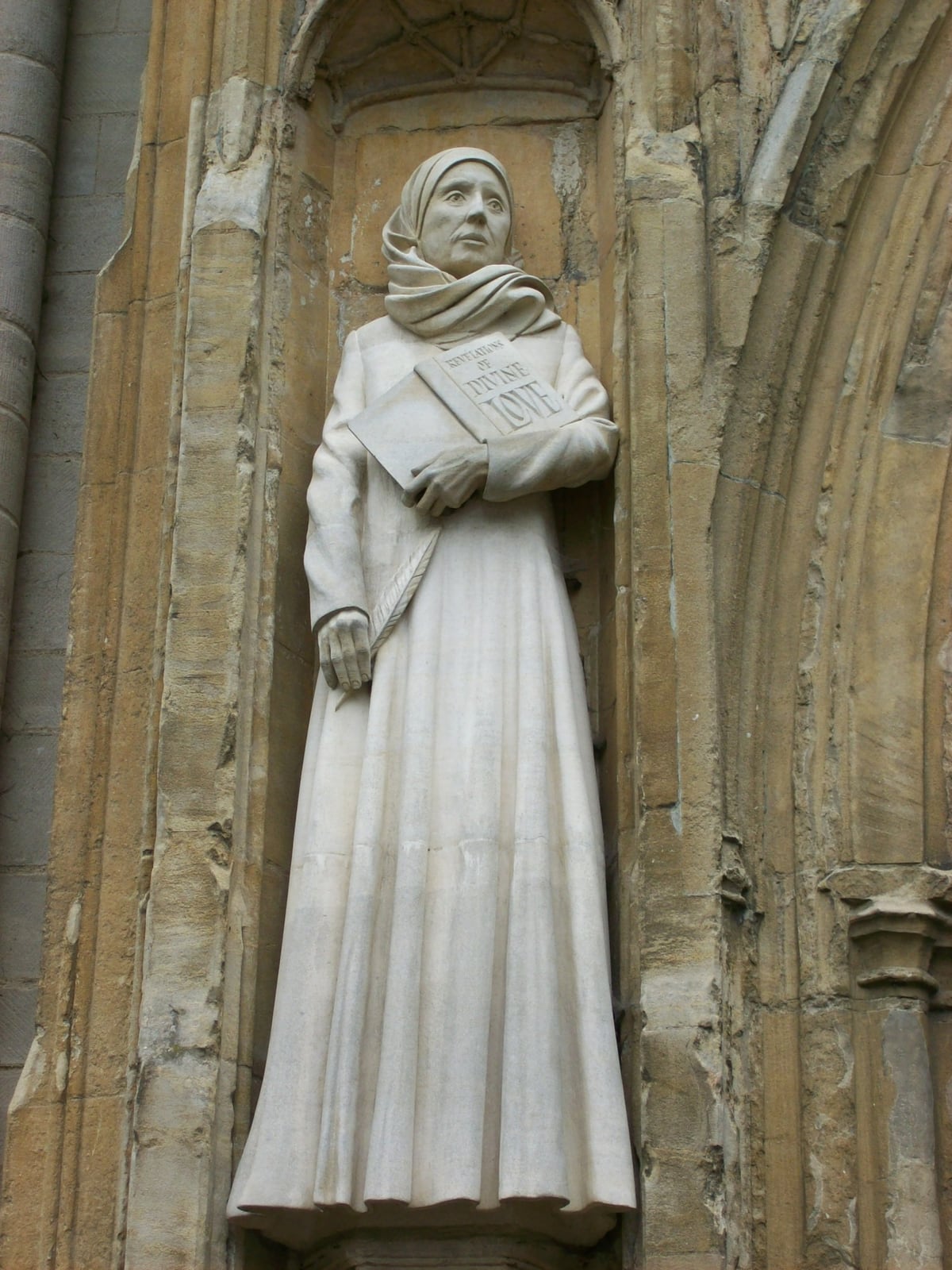
Julian of Norwich
They clash on: Who am I? Is there a true self? · Is the world real?
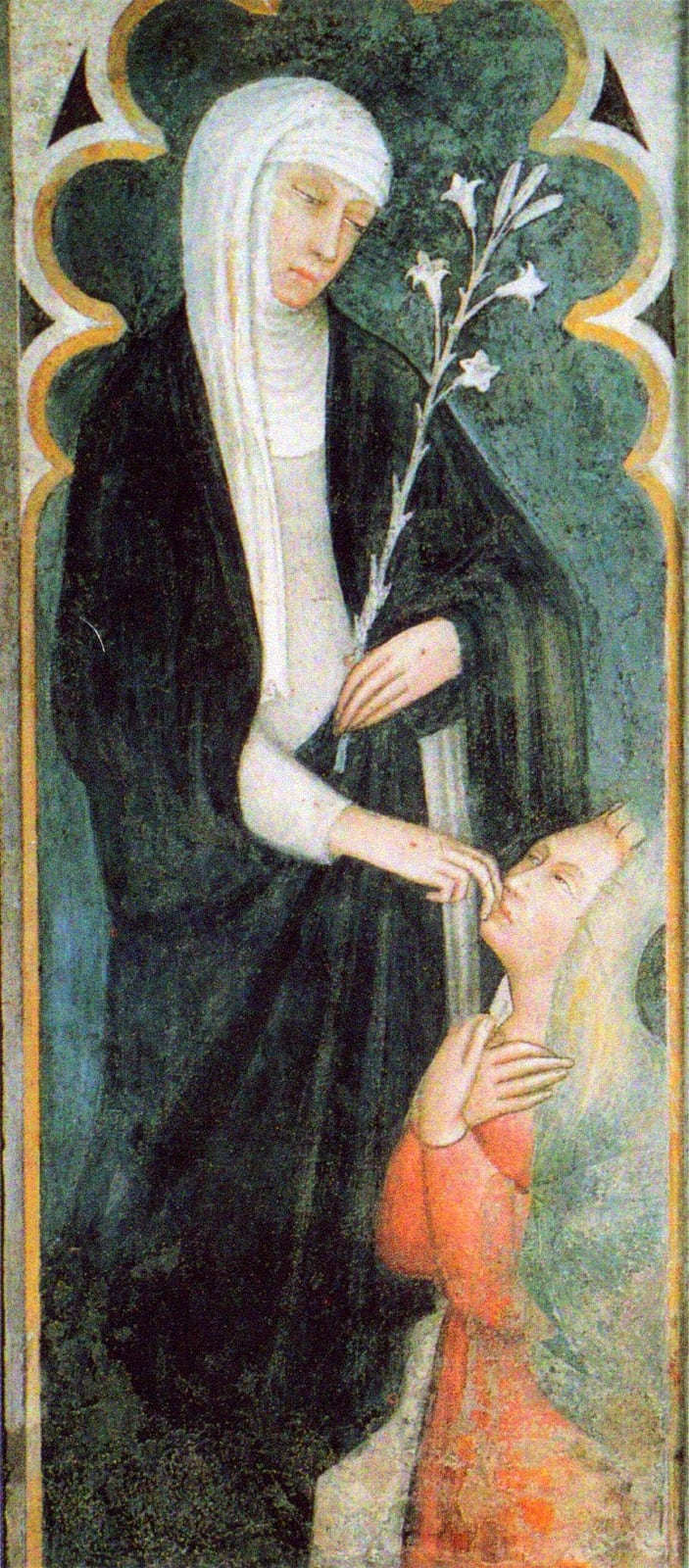
Catherine of Siena
They clash on: Who am I? Is there a true self? · Is the world real?
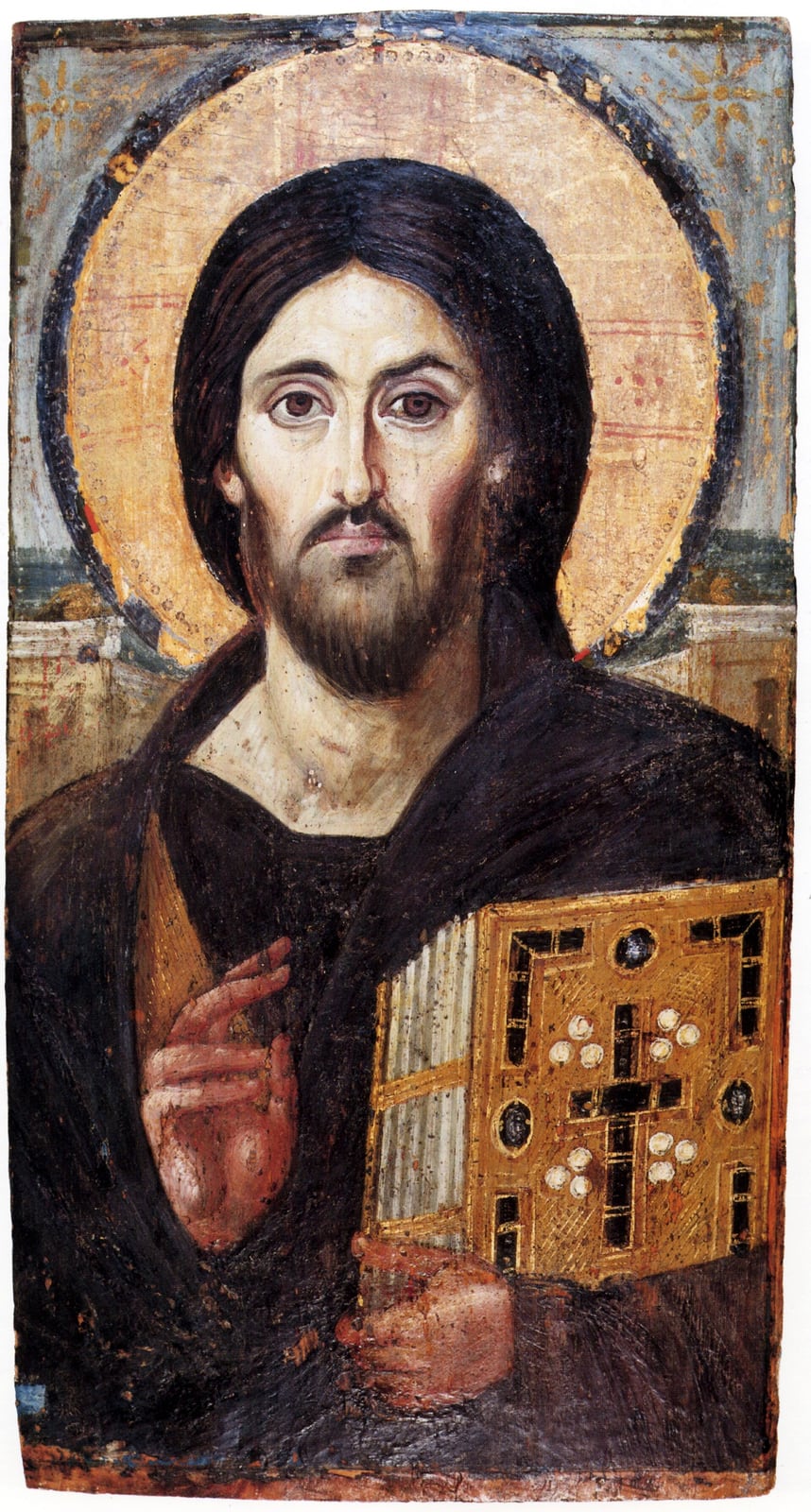
Jesus of Nazareth
They clash on: Is the world real? · Who am I? Is there a true self?

Francis of Assisi
They clash on: Who am I? Is there a true self? · Is the world real?
Anecdotes and stories
Anecdotes and stories
Oral traditionperiodo védico
Born from a pitcher
Origin of the story: Ṛgveda 7.33.9–13 (Griffith's translation, Wikisource), from Vedic oral transmission. The Vasiṣṭha Dharmasūtra (30.11) preserves the same genealogy in its final salutation.
Oral traditionperiodo védico
'Set Vasiṣṭha free like a calf'
Origin of the story: Ṛgveda 7.86 (Griffith's translation). The attribution to Vasiṣṭha comes from the anukramaṇī and from the hymn itself, which names him in verse 5.
Hagiographic accountrelato épico
The cow of plenty
Origin of the story: Rāmāyaṇa, Bālakāṇḍa, sargas 50–55 of the critical edition (Goldman's translation, 1984). The Mahābhārata (Ādiparvan) tells a version in which the cow is called Nandinī. It is epic legend with no verifiable historical basis, though it probably remembers the real rivalry of two priestly families.
Source: Goldman, Robert P. (trad. e introd.). The Rāmāyaṇa of Vālmīki: An Epic of Ancient India. Vol. I: Bālakāṇḍa. Princeton: Princeton University Press, 1984 (episodio de Vasiṣṭha y Viśvāmitra, sargas 50–64 de la edición crítica).
Hagiographic accountrelato épico
The rivers that would not drown him
Origin of the story: Mahābhārata, Ādiparvan (Caitraratha), in K. M. Ganguli's translation, sections CLXXVIII–CLXXIX. It is an epic aetiology of the names of the rivers Beas (Vipāśā) and Sutlej (Śatadru), with no historical basis.
Hagiographic accountYoga Vāsiṣṭha (s. X–XIV)
The queen who taught her husband
Origin of the story: A didactic tale from book VI (Nirvāṇa-prakaraṇa, first half) of the Yoga Vāsiṣṭha, put in Vasiṣṭha's mouth (Mitra's translation, 1891–1899). It is a parable, not an event: the work presents it as an example.
Oral traditiontradición ritual
Arundhatī, the star shown to the bride
Origin of the story: Astronomical and ritual tradition recorded in the gṛhyasūtras (wedding rites) and in the Mahābhārata (episode of Agni and the wives of the ṛṣis); summary after the bibliography cited in s14. It is not a historical fact about Vasiṣṭha but a documented practice around his figure.
Teachings
Teachings
The notions that structure their thought, explained in context.
The world as a projection of the mindmundo-como-mente
Central doctrine of the Yoga Vāsiṣṭha and the Mokṣopāya.
Source: Hanneder, Jürgen. Studies on the Mokṣopāya. Wiesbaden: Harrassowitz, 2006 (Abhandlungen für die Kunde des Morgenlandes 58).
Purohita (royal chaplain)purohita
Vedic and epic society; relation between Brahmins and kings.
Source: Witzel, Michael. «Rigvedic History: Poets, Chieftains and Polities». En George Erdosy (ed.), The Indo-Aryans of Ancient South Asia: Language, Material Culture and Ethnicity. Berlín y Nueva York: Walter de Gruyter, 1995, pp. 307–352.
Saptarṣi (the seven sages)saptarshi
Mythology, astronomy and Brahmin kinship.
Pauruṣa (human effort versus fate)paurusha
Yoga Vāsiṣṭha, Mumukṣu-prakaraṇa, chaps. IV–IX.
Jīvanmukti (liberation while living)jivanmukti
Yoga Vāsiṣṭha and later Vedāntic tradition.
Dharma in the dharmasūtrasdharma
Brahmin normative literature (3rd c. BCE–1st c. CE).
Source: Olivelle, Patrick (trad.). Dharmasūtras: The Law Codes of Āpastamba, Gautama, Baudhāyana, and Vasiṣṭha. Oxford: Oxford University Press (Oxford World's Classics), 1999. Introducción, sobre la fecha y la composición del Vasiṣṭha Dharmasūtra.
Videos
Videos
Recordings, interviews and documentaries. Videos play from YouTube; they are not hosted here.
Dream, Reality, and Love in Yoga Vasistha | Prof. Arindam Chakrabarti
Lecture· EN· 2019· 96 min
Vedanta Society of New YorkOfficial channel
Inside the Dream of Vasistha | Prof. Sthaneshwar Timalsina
Lecture· EN· 2026· 62 min
Vedanta Society of New YorkOfficial channel
On Freedom and Fatalism: The Yogavasistha and Arthur Schopenhauer | Dr. Aleksandar Uskokov
Lecture· EN· 2026· 85 min
Vedanta Society of New YorkOfficial channel
Swami Sarvapriyananda - The Serene Light of the Yoga Vasistha
Lecture· EN· 2025· 51 min
Theosophical Society in England & WalesOfficial channel
Elizabeth Crofts - The teaching on Liberation in The Yoga Vasistha
Lecture· EN· 2025· 56 min
Theosophical Society in England & WalesOfficial channel
Sampoorna Yoga Vasishtha | सत्र 1 | स्वामी अभेदानन्द
Lecture· HI· 2025· 89 min
Chinmaya Mission South AfricaOfficial channel
Dashrajna War of the Rigveda - The First Epochal War of India
Lecture· EN· 2021· 33 min
Bhandarkar Oriental Research InstituteOfficial channel
Bharat Ek Khoj | Episode-3 | The Vedic People and The Rigveda
Documentary· HI· 1988· 52 min
Prasar Bharati ArchivesOfficial channel
Introduction to the Rig Veda and Upanishads | Kendall Sharp | First Friday Lecture
Lecture· EN· 2024· 78 min
The University of Chicago Graham SchoolOfficial channel
Introduction to the Rig Veda | Swami Tattwamayananda
Lecture· EN· 2022· 77 min
Vedanta Society of New YorkOfficial channel
Vedic Chanting | Vedamu | Rig Veda | Samhitapatha | Mandala 7 (7.1.1–7.67.10)
Third-party recording· SA· 2023· 134 min
Vedamu org
Complete Rigveda Recitation - Part 28; Mandala 7 Sookta 1 to Mandala 7 Sookta 20
Third-party recording· SA· 2021· 44 min
Vedokhilo Dharmamoolam
Yoga Vasishtha: La enseñanza de la no dualidad | Introducción al retiro
Lecture· ES· 2023· 8 min
Advaitavidya Vídeos
Gallery
Gallery
Images with verified licences. Each keeps its authorship and attribution.
Manuscripts
Manuscripts
Manuscript witnesses and ancient texts, with their custodian and conditions of access.
FA · Nastaʿlīq (persa) · Copia terminada en Allahabad en 1602
Jūg Bāsisht (traducción persa del Yoga Vāsiṣṭha), copia ilustrada
- Surviving witness
- Manuscrito ilustrado de 1602
- Custodian
- Chester Beatty Library, Dublín · In 05
Connections
Connections
Influences, discipleships and affinities. Documented relations are distinguished from similarities identified by analysis.
Family of
According to the Mahābhārata, Vyāsa is the son of Parāśara, grandson of Śakti and great-grandson of Vasiṣṭha. It is a textual genealogy, not a historical one.
Documented relation
Contemporary of
In the Rāmāyaṇa both are contemporaries of Rāma; the Yoga Vāsiṣṭha puts its teachings in Vasiṣṭha's mouth and the narration in Vālmīki's. A literary relationship.
Documented relation
Ideas akin to
The Yoga Vāsiṣṭha was read as an Advaita Vedānta text because of its doctrine of the world as an appearance of consciousness; there is no documented relation between the work and Śaṅkara.
Similarity identified by analysis
Ideas akin to
Affinity between the Yoga Vāsiṣṭha's thesis (the world as the mind's dream) and the non-origination of the Māṇḍūkya-kārikā.
Similarity identified by analysis
Ideas akin to
The enquiry and liberation in life of the Yoga Vāsiṣṭha come close to Ramana's teaching; the affinity is doctrinal.
Similarity identified by analysis
Ideas akin to
The Vasiṣṭha Saṃhitā sets out an eight-limbed yoga related to that of the Yogasūtras; there is no documented relation between the figures.
Similarity identified by analysis
Ideas akin to
Both are Vedic sages to whom treatises on dharma and texts on yoga and knowledge are ascribed alike.
Similarity identified by analysis
Ideas akin to
The Yoga Vāsiṣṭha's exaltation of human effort (pauruṣa) matches the tone of Vivekananda's Vedāntic preaching; no documented link is recorded in this entry.
Similarity identified by analysis
Linked from other profiles
Sources
Sources
Bibliography and catalogues consulted for this profile.
- Jamison, Stephanie W., y Joel P. Brereton (trads.). The Rigveda: The Earliest Religious Poetry of India. 3 vols. Nueva York: Oxford University Press, 2014. Introducción general e introducción al libro VII.
- Wikidata, «Vasiṣṭha», QID Q241900 (sabio de la India antigua; LCCN n85108214; GND 139310479; BnF 10636717x).
- Griffith, Ralph T. H. (trad.). The Hymns of the Rigveda. 2.ª ed. Benarés: E. J. Lazarus, 1896–1897. Libro VII (himnos 18, 33, 59, 83, 86–89), texto en Wikisource.
- Witzel, Michael. «Rigvedic History: Poets, Chieftains and Polities». En George Erdosy (ed.), The Indo-Aryans of Ancient South Asia: Language, Material Culture and Ethnicity. Berlín y Nueva York: Walter de Gruyter, 1995, pp. 307–352.
- Goldman, Robert P. (trad. e introd.). The Rāmāyaṇa of Vālmīki: An Epic of Ancient India. Vol. I: Bālakāṇḍa. Princeton: Princeton University Press, 1984 (episodio de Vasiṣṭha y Viśvāmitra, sargas 50–64 de la edición crítica).
- Mitra, Vihari-Lala (trad.). The Yoga-Vásishtha Mahárámáyana of Válmiki. 4 vols. en 7 partes. Calcuta: Bonnerjee & Co., 1891–1899. Edición digital en Project Gutenberg (n.º 71326 y siguientes).
- Slaje, Walter. Vom Mokṣopāya-Śāstra zum Yogavāsiṣṭha-Mahārāmāyaṇa. Philologische Untersuchungen zur Entwicklungs- und Überlieferungsgeschichte eines indischen Lehrwerks mit Anspruch auf Heilsrelevanz. Viena: Verlag der Österreichischen Akademie der Wissenschaften, 1994.
- Hanneder, Jürgen. Studies on the Mokṣopāya. Wiesbaden: Harrassowitz, 2006 (Abhandlungen für die Kunde des Morgenlandes 58).
- Chapple, Christopher. «Introduction». En Swami Venkatesananda (trad.), The Concise Yoga Vāsiṣṭha. Albany: State University of New York Press, 1984 (resumen de las dataciones propuestas, del s. VI al XIV).
- Olivelle, Patrick (trad.). Dharmasūtras: The Law Codes of Āpastamba, Gautama, Baudhāyana, and Vasiṣṭha. Oxford: Oxford University Press (Oxford World's Classics), 1999. Introducción, sobre la fecha y la composición del Vasiṣṭha Dharmasūtra.
- Bühler, Georg (trad.). The Sacred Laws of the Âryas as Taught in the Schools of Âpastamba, Gautama, Vâsishtha, and Baudhâyana. Part II: Vâsishtha and Baudhâyana. Oxford: Clarendon Press, 1882 (Sacred Books of the East 14). Introducción a Vasiṣṭha, pp. ix–xxviii; cap. XXX.
- Ganguli, Kisari Mohan (trad.). The Mahabharata of Krishna-Dwaipayana Vyasa. Calcuta: Bharata Press / P. C. Roy, 1883–1896. Ādi Parva (Caitraratha Parva), secciones CLXXIV–CLXXXIII (Vasiṣṭha, Viśvāmitra, Kalmāṣapāda y el nacimiento de Parāśara). Project Gutenberg n.º 15474.
- Leach, Linda York. Mughal and Other Indian Paintings from the Chester Beatty Library. 2 vols. Londres: Scorpion Cavendish, 1995 (el Jūg Bāsisht ilustrado para el príncipe Salīm, Allahabad, 1602, CBL In 05).
- Wikipedia (inglés), «Vasishtha», con sus referencias sobre Arundhatī, el saptarṣi y las obras atribuidas.
- Wikisource en sánscrito: «वासिष्ठधर्मशास्त्रम्» (texto del Vasiṣṭha Dharmasūtra) y relación de textos atribuidos a Vasiṣṭha (Vasiṣṭha Smṛti, Vāsiṣṭhī Śikṣā, Vasiṣṭha Dhanurveda Saṃhitā).
- Wikisource en sánscrito: «योगवासिष्ठः» y «लघुयोगवासिष्ठः» (texto sánscrito por libros y cantos).
- Rights holder
- Textos sánscritos de dominio público. Traducciones con derechos propios: Oxford University Press (Jamison y Brereton; Olivelle), Penguin Classics (Doniger), State University of New York Press y Timeless Books (Venkatesananda), Theosophical Publishing House (Aiyer, reimpr.), Collège de France (Chenet). Son de dominio público las de Griffith (1896), Bühler (1882) y, en EE. UU., Mitra (1891–1899).
Pending confirmation
What this profile has not yet been able to settle. We would rather say so than fill it in.
- Fechas: no hay nacimiento ni muerte; la línea de tiempo usa las fechas de los textos. La horquilla del Vasiṣṭha Dharmasūtra (c. 100 a. C.–100 d. C.) es aproximada: precisar con la introducción de Olivelle (1999/2000).
- Yoga Vāsiṣṭha: precisar con Slaje (1994) y Hanneder (2006) la fecha de la reelaboración vedántica y la del Laghu Yoga Vāsiṣṭha de Gauḍa Abhinanda.
- Sala de lectura: la traducción de Mitra queda con caution por desconocerse la fecha de muerte del traductor; buscar una autoridad bibliográfica (VIAF, Biblioteca Nacional de la India) que la fije. La traducción de K. N. Aiyer del Laghu Yoga Vāsiṣṭha (1896) también tiene traductor de fecha de muerte no verificada; no se ha registrado.
- Ediciones: no se han encontrado en Open Library ediciones en español con ISBN del Yoga Vāsiṣṭha ni del Ṛgveda completo; buscar las de Kairós, Trotta o Siruela, y ediciones en alemán e italiano.
- Obras atribuidas menores (Vasiṣṭha Saṃhitā, Vasiṣṭha Smṛti, Vāsiṣṭhī Śikṣā, Dhanurveda Saṃhitā, Vasiṣṭha Siddhānta): faltan ediciones con ISBN (p. ej., la de Kaivalyadhama de la Vasiṣṭha Saṃhitā) y fuente académica propia para cada una.
- Imagen y manuscrito: localizar la URL del visor digital de la Chester Beatty Library para el Jūg Bāsisht (In 05).
Researched on 2026-10-26