Christianity · Christian mysticism · Catholicism
Catherine of Siena
1347 – 1380Historically documented person
Sienese mystic, writer and public figure (1347–1380), a Dominican tertiary. A dyer's daughter without schooling, she gathered a 'family' of disciples, tended plague victims and the condemned, mediated between Florence and the papacy and urged Gregory XI to return from Avignon to Rome. She dictated the Dialogue of Divine Providence, some 380 letters to popes, kings, mercenaries and ordinary people, and twenty-six prayers, which make her one of the great prose writers of Italian. She died in Rome at thirty-three. She is a Doctor of the Church (1970) and co-patroness of Italy and of Europe.
- works
- 9works
- editions
- 17editions
- quotes
- 7quotes
- videos
- 13videos
- images
- 6images
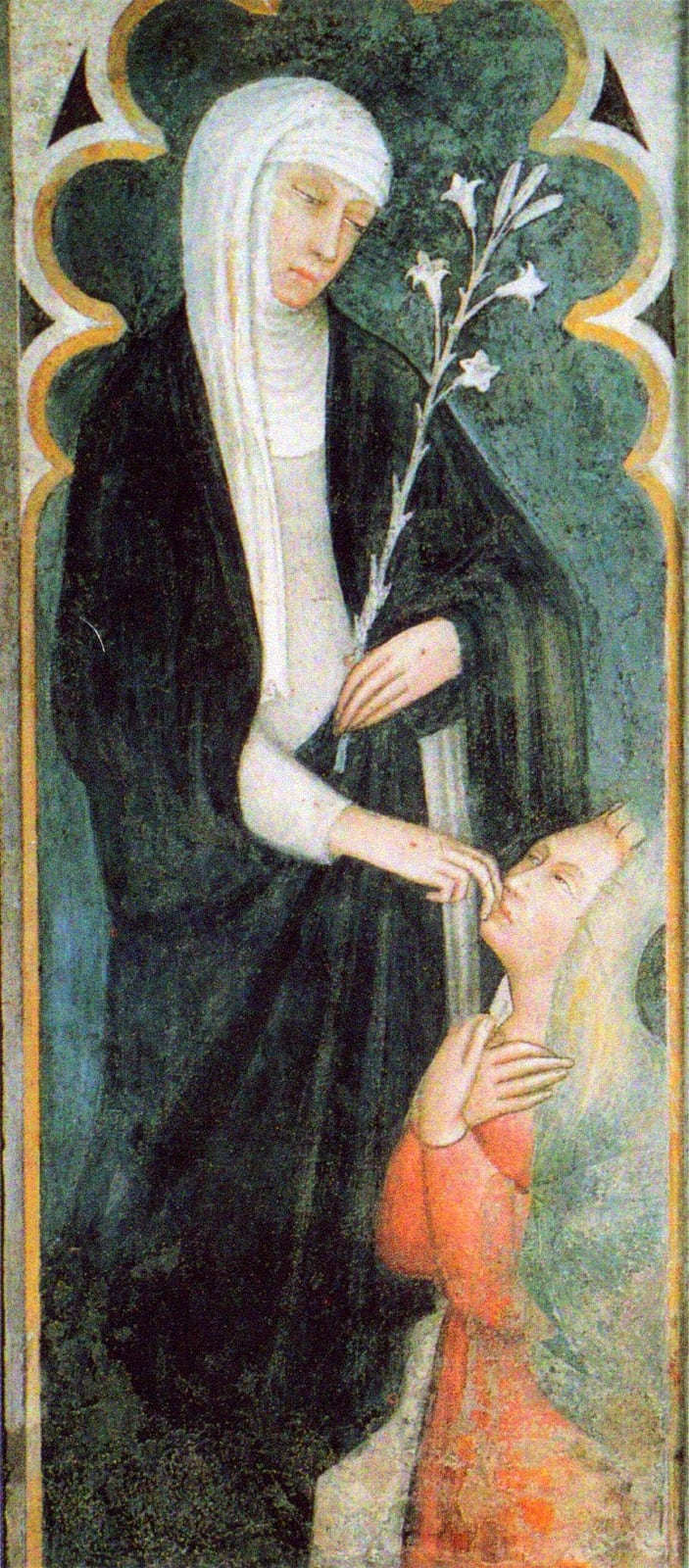
Santa Catalina, por Andrea Vanni (San Domenico, Siena) · Public domain
In their words
«You, eternal Trinity, are a deep sea: the more I enter you, the more I find, and the more I find, the more I seek you.»Diálogo, ed. Fiorilli (1912), cap. CLXVII

Their central idea
The cell of self-knowledge: The Dialogue begins with a soul 'accustomed to dwell in the cell of self-knowledge'.
See in context
Biography
5 min read
The dyer's daughter
Caterina di Jacopo di Benincasa was born in Siena on 25 March 1347, the feast of the Annunciation, together with a twin, Giovanna, who died soon afterwards. She was the twenty-third or twenty-fourth child of Jacopo Benincasa, a wool dyer, and Lapa di Puccio de' Piacenti, in a house in the Fontebranda quarter, beside the dyers' vats and in the shadow of the Dominican church of San Domenico. A year later the Black Death carried off nearly half the city. Almost everything we know of her childhood comes from the Legenda maior written between 1385 and 1395 by her confessor, Raymond of Capua, to promote her canonisation, and it must be read for what it is: a carefully constructed hagiography.
According to that tradition, at about six she saw Christ above the roof of San Domenico, and at seven she made a vow of virginity. When her family tried to marry her off, after the death of her sister Bonaventura in 1362, she cut off her hair; they then made her the household drudge until her father let her live in her own way. Around 1364 or 1365 she obtained, not without resistance, the habit of the mantellate, the Dominican penitent women who lived at home rather than in a convent, usually widows. She spent about three years almost shut up in her room, in prayer and fasting, and learned to read.
The espousal and the family
On the last day of the Carnival of 1367, according to Raymond, Christ took her as his bride with a ring only she could see, and asked her to leave her cell to serve others. An active life in the city then began: she nursed the sick at the hospital of Santa Maria della Scala and in their homes, tended lepers, gave away what there was in her father's house. In 1370 she went through an experience her disciples called her 'mystical death'. Around her formed a bella brigata, the 'family': Dominican friars, hermits, young noblemen like Stefano Maconi, poets like Neri di Landoccio Pagliaresi, women of the city. They called her mamma. That a young, unlettered laywoman should spiritually direct priests and theologians aroused suspicion; in 1374 the Dominican general chapter, meeting in Florence, examined her and assigned Raymond of Capua as her director.
The politics of blood
From 1374 her letters were addressed more and more to the powerful. She asked for three things: the pope's return from Avignon to Rome, the reform of the clergy and a crusade that would reconcile Christians by turning their arms against the Turks. In 1375 she accompanied to his execution Niccolò di Toldo, a young Perugian condemned for words against the government of Siena, and received his head in her hands; she tells it in a letter to Raymond of rare intensity. On 1 April of that year, in Pisa, she received according to her witnesses the stigmata, invisible during her life at her own request. She wrote to the English condottiere John Hawkwood urging him to take his army East.
When Florence, at war with the papacy, was placed under interdict, Catherine offered herself as mediator and in June 1376 travelled to Avignon. The Florentines disowned her, but she used the occasion to press Gregory XI (whom she called babbo, daddy) to return to Rome. Gregory left Avignon in September 1376 and entered Rome in January 1377. Historians debate how much Catherine weighed in a decision the pope had been maturing; what is beyond doubt is that a woman of twenty-nine, holding no office, spoke as an equal to the most powerful court in Europe.
The book
In 1377 she withdrew to the Rocca d'Orcia, in the Sienese countryside, to reconcile feuding noble families; there, according to one of her letters, she learned to write on her own. The following year, back in Florence as the pope's envoy, she nearly died in the Ciompi tumult of June 1378. Back in Siena, between late 1377 and October 1378 she dictated to her secretaries, often in ecstasy according to them, the Book of Divine Doctrine, later known as the Dialogue: a colloquy between the soul and God the Father on self-knowledge, the bridge that is Christ, tears, providence, obedience and the reform of the Church.
The schism
In September 1378 the French cardinals, dissatisfied with Urban VI, elected an antipope, Clement VII, and the Great Western Schism began. Catherine sided with Urban without hesitation, and he summoned her to Rome. She arrived in November 1378 with some twenty disciples and never left the city again. From there she wrote to the kings of France and Hungary, to Queen Joanna of Naples, to the dissident cardinals and to the Italian cities, and prayed aloud before the pope and the curia. Her last prayers were taken down by her secretaries in those months.
Thirty-three years
She barely ate. During Lent 1380 she walked every day to St Peter's. At the end of January she collapsed after a vision in which she felt the ship of the Church laid on her shoulders, and on 26 February she could no longer get up. She died in Rome on 29 April 1380, aged thirty-three, surrounded by her spiritual family. Her disciple Barduccio Canigiani described her agony in a letter. She was buried in Santa Maria sopra Minerva; her head was taken to Siena in 1384.
The saint of Italy
Raymond of Capua, master general of the Dominicans, and Tommaso Caffarini built her cult: the Legenda maior, the Libellus de supplemento and the Venice process of 1411–1416. The Sienese pope Pius II canonised her in 1461. Her letters, printed at Bologna in 1492 and by Aldus Manutius in Venice in 1500, made her a classic of the language; Pius XII declared her patroness of Italy with Francis of Assisi in 1939, Paul VI a Doctor of the Church on 4 October 1970, a week after Teresa of Ávila, and John Paul II co-patroness of Europe in 1999. Present-day scholarship has patiently separated the woman from the legend: what remains is a laywoman who, without office or Latin, thought of faith as fire and of politics as the soul's responsibility.
Sources: Raimundo de Capua. Legenda maior sive Legenda admirabilis virginis Catherine de Senis. Ed. Silvia Nocentini. Florencia: SISMEL – Edizioni del Galluzzo, 2013. Trad. inglesa de Conleth Kearns, The Life of Catherine of Siena. Wilmington: Michael Glazier, 1980. · Caterina da Siena. Il Dialogo della divina provvidenza ovvero Libro della divina dottrina. Ed. Giuliana Cavallini. Roma: Edizioni Cateriniane, 1968 (2.ª ed., Siena: Cantagalli, 1995). · Caterina da Siena. Libro della divina dottrina volgarmente detto Dialogo della divina provvidenza. Ed. Matilde Fiorilli. Scrittori d'Italia. Bari: Laterza, 1912 (Project Gutenberg n.º 26961). · Noffke, Suzanne (trad. y ed.). The Letters of Catherine of Siena. 4 vols. Tempe: Arizona Center for Medieval and Renaissance Studies, 2000–2008. · Tommaseo, Niccolò (ed.). Le lettere di S. Caterina da Siena. 4 vols. Florencia: G. Barbèra, 1860; reed. ampliada por Piero Misciattelli, 6 vols., Siena: Giuntini-Bentivoglio, 1913–1922.
Timeline
A life, year by year
Each point is a documented event. Click to read it, with its source and degree of certainty.
March 25, 1347age 0Siena (Fontebranda)
Birth
Born with a twin, Giovanna, daughter of Jacopo Benincasa, a dyer, and Lapa di Puccio de' Piacenti.
DocumentedRaimundo de Capua. Legenda maior sive Legenda admirabilis virginis Catherine de Senis. Ed. Silvia Nocentini. Florencia: SISMEL – Edizioni del Galluzzo, 2013. Trad. inglesa de Conleth Kearns, The Life of Catherine of Siena. Wilmington: Michael Glazier, 1980.
After their death
- c. 1385 – 1395The Legenda maior
- c. 1411 – 1416The Processo Castellano
- June 29, 1461Canonisation
- 1500The Aldine edition of the letters
- 1939Patroness of Italy
- October 4, 1970Doctor of the Church
- October 1, 1999Co-patroness of Europe
March 25, 1347 · age 0
Birth
Born with a twin, Giovanna, daughter of Jacopo Benincasa, a dyer, and Lapa di Puccio de' Piacenti.
Documented
c. 1353 · age 6
The first vision
According to Raymond of Capua, she sees Christ above the church of San Domenico; the following year she vows virginity.
Tradition
c. 1362 · age 15
Refusal of marriage
After the death of her sister Bonaventura she resists marriage plans and cuts off her hair.
Tradition
c. 1364 – 1365 · age 17
Habit of the mantellate
She joins the Dominican penitent women (mantellate), who live in their own homes.
Probable
1367 · age 20
Mystical espousal
On the last day of Carnival, according to Raymond, she receives a ring visible only to her and leaves her seclusion to serve the sick.
Tradition
May 1374 · age 27
Examined by the Dominican general chapter
She appears before the order's general chapter, which assigns Raymond of Capua as her confessor. In the summer she tends plague victims in Siena.
Documented
April 1, 1375 · age 28
The stigmata
In the church of Santa Cristina she receives, according to her witnesses, the stigmata, invisible during her lifetime.
Tradition
1375 · age 28
The execution of Niccolò di Toldo
She accompanies a young condemned man to the scaffold and receives his head; she narrates it in a letter to Raymond of Capua.
Documented
June 1376 · age 29
Embassy to Avignon
She travels to the papal court as Florence's mediator and urges Gregory XI to return to Rome; the pope leaves in September.
Documented
1377 · age 30
Peacemaking and learning to write
Stay at the Salimbeni castle to reconcile families; according to her letter to Raymond, she learns to write there. She founds the monastery of Belcaro.
Documented
June 1378 · age 31
The Ciompi tumult
Urban VI's envoy for peace with Florence, she narrowly escapes a mob seeking to kill her.
Documented
October 1378 · age 31
The Dialogue completed
She finishes dictating the Book of Divine Doctrine to her secretaries.
Documented
November 1378 · age 31
In Rome, in the service of Urban VI
Summoned by the pope after the outbreak of the Western Schism, she settles in Rome with her disciples.
Documented
April 29, 1380 · age 33
Death
She dies after months of exhaustion, accompanied by her disciples. Barduccio Canigiani narrates her agony.
Documented
c. 1385 – 1395
The Legenda maior
Raymond of Capua writes Catherine's official life.
Documented
c. 1411 – 1416
The Processo Castellano
In Venice testimonies about her holiness are gathered, promoted by Tommaso Caffarini.
Documented
June 29, 1461
Canonisation
She is canonised by the Sienese pope Pius II.
Documented
1500
The Aldine edition of the letters
Aldus Manutius prints Catherine's Epistole devotissime.
Documented
1939
Patroness of Italy
Pius XII proclaims her principal patroness of Italy together with Francis of Assisi.
Documented
October 4, 1970
Doctor of the Church
Paul VI proclaims her a Doctor of the Church, a week after Teresa of Ávila.
Documented
October 1, 1999
Co-patroness of Europe
John Paul II proclaims her co-patroness of Europe with Bridget of Sweden and Teresa Benedicta of the Cross (motu proprio Spes aedificandi).
Documented
Works
Essential works
The works without which their legacy cannot be understood.
Written work · 1378
The Dialogue (Book of Divine Doctrine)
Libro della divina dottrina (Dialogo della divina provvidenza)
A book dictated by Catherine to her secretaries between late 1377 and October 1378. It opens with a soul that, 'dwelling in the cell of self-knowledge', addresses four petitions to God (for herself, for the reform of the Church, for the world and for a particular case) and the Father answers in a long colloquy. Its great images are the bridge that is Christ, with its three steps (the feet, the side, the mouth), stretched over the river of the world; the doctrine of tears; providence; obedience; and the reform of the Church's ministers, the 'mystical body'. It closes with a prayer to the Trinity as a 'deep sea'. Since Girolamo Gigli (1707) it has usually been divided into treatises (on discretion, prayer, providence and obedience). It is one of the summits of fourteenth-century Italian prose.
7 editions · amazon.com

Correspondence · c. 1370
Letters
Lettere (Epistolario)
Some 380 letters dictated between c. 1370 and 1380 (381 according to the most widely cited count; editions range between 373 and 383), addressed to two popes, cardinals, kings and queens, condottieri, city governments, friars, nuns, disciples, her mother and anonymous people. Almost all begin with the formula 'In the name of Jesus Christ crucified and of sweet Mary' and end with 'Sweet Jesus, Jesus love'. They mix spiritual doctrine and concrete politics: the pope's return to Rome, peace with Florence, the crusade, the defence of Urban VI in the schism. Among them stand out the letters to Gregory XI, whom she calls babbo, the letter to Raymond on the execution of Niccolò di Toldo and the one recounting her experience of January 1380. Their vigour and imagery make them a monument of Italian prose.
5 editions · amazon.com

Recorded oral teaching · c. 1376
Prayers
Orazioni
Twenty-six prayers spoken aloud by Catherine, almost always in ecstasy after communion, and transcribed by her secretaries between 1376 and 1380, most of them in Rome during the schism. They are prayers to the Trinity, to Christ and to the 'eternal Godhead', of a lyrical intensity culminating in the identification of God's nature with fire and in intercession for the Church and her disciples. They show the final Catherine, consumed by the Church's crisis.
2 editions · amazon.com
Complete works (9)

Raymond of Capua's Legenda maior
1385
Catherine of Siena
Tommaso Caffarini's Supplement to the Legend
The Conscious LibraryTommaso Caffarini's Supplement to the Legend
1412
Catherine of Siena
Tommaso Caffarini's Legenda minor
The Conscious LibraryTommaso Caffarini's Legenda minor
1414
Catherine of Siena
The Processo Castellano
The Conscious LibraryThe Processo Castellano
1411
Catherine of Siena
The Miracles of Catherine, by an Anonymous Florentine
The Conscious LibraryThe Miracles of Catherine, by an Anonymous Florentine
1374
Catherine of Siena
Barduccio Canigiani's Letter on Catherine's Death
The Conscious LibraryBarduccio Canigiani's Letter on Catherine's Death
1380
Quotations
Quotations located in a specific work. Each carries its provenance and its level of confidence.
You, eternal Trinity, are a deep sea: the more I enter you, the more I find, and the more I find, the more I seek you.Tu, Trinitá etterna, se' uno mare profondo, che quanto piú c'entro tanto piú truovo, e quanto piú truovo piú cerco di te.
VerifiedDiálogo, ed. Fiorilli (1912), cap. CLXVII
Apocryphal quotes or disputed attributions (1)
«Be who God meant you to be and you will set the world on fire.»
A widespread modern version of the sentence in the letter to Stefano Maconi ('If you are what you ought to be, you will set fire to all Italy'). The original speaks of Italy and of duty, not of the world or personal identity and became popular in twentieth-century anthologies and Catholic youth gatherings.
Last words
Later account by witnesses
«Father, into your hands I commend my soul and my spirit.»Padre, nelle tue mani raccomando l'anima e lo spirito mio.
According to the letter of her secretary Barduccio Canigiani, present at her agony, Catherine died in Rome on Sunday 29 April 1380, at the hour of Sext, after blessing her disciples and praying: 'You, Lord, call me, and I come to you, not through my merits but through your mercy alone, which I ask of you by virtue of your Blood'; she cried out several times 'Blood, blood!' and, following Christ's example, finally said: 'Father, into your hands I commend my soul and my spirit'. The Italian wording follows the tradition of Barduccio's text; the version consulted is Thorold's English translation (1907).
Source: Canigiani, Barduccio. Carta sobre el tránsito de Catalina, dirigida a sor Caterina Petriboni (1380). Trad. inglesa en Algar Thorold, The Dialogue of the Seraphic Virgin Catherine of Siena… together with an account of her death by an eye-witness. Londres: Kegan Paul, 1907.
Ask
What their work answers
Twelve great human questions and what their texts allow us to answer, with references. We never put words in their mouth.
What is the Absolute? Does God exist?
God is the eternal Trinity, a deep sea, mad with love
A personal GodStated explicitly
In The Dialogue, Catherine of Siena hears and transcribes the voice of a God who speaks to the soul in the first person: the eternal Father who explains, rebukes, promises and answers her petitions. This God is the first Truth and is, above all, love that precedes the creature: in the Dialogue's closing prayer she confesses that God loved her before she existed, «mad» for his creature. The closing prayer of the Dialogue calls the eternal Trinity a deep sea in which the more one enters the more one finds, and the more one finds the more one seeks. The Absolute is therefore personal, Trinitarian and inexhaustible: someone with whom one converses and whose knowledge never closes.
Compare this question with other teachersWho am I? Is there a true self?
The soul is an image of the Trinity, known in the cell of self
A created, immortal soulStated explicitly
For Catherine of Siena, the soul is a creature made in the image of the Trinity: in The Dialogue she thanks God for giving it memory to hold his benefits, intellect to know and will to love. Self-knowledge is indispensable, and the book sets it out from its first page as dwelling in the «cell of self-knowledge». But this knowledge has two faces: the soul discovers itself as something that of itself is not, since it has received everything, and in that same cell it knows God's goodness, which love follows. The true self is therefore a created, immortal soul whose being depends on the love that created it.
Compare this question with other teachersWhy do we suffer?
The root of every evil is self-love that turns away from God
Separation from GodStated explicitly
In The Dialogue, Catherine of Siena places in God's mouth a constant diagnosis: the root of all evils is sensual self-love, which makes the human being love itself apart from God. Whoever broke the road through sin drowns in the river of the world, and that is why God laid down the bridge of his Son. But not all suffering is punishment: the pains of this life, borne with patience and with desire for God, purify and make satisfaction, because what gives them value is not the pain itself but the infinite desire with which it is suffered. Pain separates when it springs from self-love and unites when it becomes charity.
Compare this question with other teachersWhat happens after death?
At death each soul sees what it chose and receives what it loved
Eternal life and resurrectionStated explicitly
In The Dialogue, God explains to Catherine of Siena how the just, sinners and those who have lived in intermediate states die. At the moment of death, each soul sees clearly what it has loved: the just man dies in peace, because his will is united to God's and the devil finds nothing of his own in him; one who dies in self-love judges himself before being judged. Eternal blessedness is seeing God face to face and rejoicing in the good of the other blessed through charity. The letter of Barduccio Canigiani recounts her own death in Rome in 1380, amid prayers for the Church.
Compare this question with other teachersHow is liberation or salvation attained?
One climbs the bridge that is Christ by three steps of love
Through devotion and surrenderStated explicitly
The central image of The Dialogue is the bridge: the road between heaven and earth, broken by sin, has been rebuilt in the Son, and whoever wishes to be saved must climb it. One climbs by three steps, which are the body of the crucified Christ: the feet, representing affection stripped of self-love; the open side, where the soul discovers the secret of the heart; and the mouth, where it finds peace. The engine of the ascent is love: holy desire, kindled by the blood of Christ, which Catherine invokes ceaselessly in her letters. Grace is the foundation, but the way is a loving surrender proved in service to one's neighbour.
Compare this question with other teachersIs a teacher necessary?
Obedience to the Church, the confessor and truth known in the cell
Community and traditionStated explicitly
Catherine of Siena was at once disciple and teacher. A laywoman of the Dominican Order of Penance, she submitted to confessors such as Raymond of Capua and called the pope, in her letters, the «sweet Christ on earth», to be obeyed even if he were a devil incarnate. But around her formed a famiglia of disciples, clerics and laypeople, who called her «mamma», and her letters are an immense work of spiritual direction. The Dialogue devotes a long section to obedience, the key that opens heaven. For Catherine one learns within the body of the Church, in a living community, but every soul must also dwell in the cell of self-knowledge.
Compare this question with other teachersIs the world real?
Everything was made out of love and to serve humankind
A good and real creationInferred from their doctrine
Catherine of Siena does not develop a cosmology, but The Dialogue presents creation as the work of love: God created the human being moved by the fire of his charity, and all things were made to serve him, so that he might serve God. The world is good in itself; what makes it dangerous is the disordered use that self-love makes of it. Hence Catherine's image of the river: the world, when loved for its own sake, is a stormy river in which those who do not cross by the bridge drown. Created things should be held without attachment, as on loan. Real, good and dangerous at once: such is creation for her.
Compare this question with other teachersWhat is love?
We cannot be useful to God: love is returned to him in our neighbour
Love of God and neighbourStated explicitly
Catherine of Siena places in God's mouth, in The Dialogue, a precise reason for love of neighbour: God loved us first and without self-interest, and we cannot return that love in the same way, because we cannot be useful to him; that is why he has set our neighbour beside us, so that we may do for him what we cannot do for God. Every virtue is proved and exercised through one's neighbour, and every sin reaches him. Love springs from knowledge of self and of God's goodness, and has its model in the Christ «mad with love» who gave himself to the point of blood. Catherine lived it by tending the sick and the condemned and working for peace in Italy.
Compare this question with other teachersAre we free, or is everything determined?
No one can force the will: neither the devil nor any creature
Real free willStated explicitly
In The Dialogue, Catherine of Siena attributes to God a repeated assertion: the human being was created free, and neither the devil nor any creature can force his will to sin unless he consents. Temptations may besiege it, but the will is like a city whose gate opens only from within. That freedom is the condition of merit and responsibility: each person is saved or lost according to what his will loves. God's providence, to which she devotes a long section of the book, orders everything for the soul's salvation, but respects the freedom he himself gave. Free will and providence coexist without cancelling each other out.
Compare this question with other teachersWhy meditate or pray?
Prayer is holy desire: a continual dialogue with God
Friendship with GodStated explicitly
Catherine of Siena's main work is, literally, a prayer turned into dialogue: the soul asks and God answers. The Dialogue describes prayer as a path running from vocal to mental prayer, and from this to a continual prayer that is holy desire, present in every work done for love. Prayer is born in the cell of self-knowledge, where the soul recognises itself as creature and discovers God's goodness; and it flows into petition for others, for the Church and for the world. Her Prayers, taken down by her disciples as she spoke in ecstasy, show that bold familiarity with the eternal Father.
Compare this question with other teachersCan reason know the ultimate?
The eye of the intellect sees through the pupil of faith
Faith and reason help each otherStated explicitly
Catherine of Siena learned to read late and never studied theology, but in The Dialogue the intellect holds a central place: it is the eye of the soul, and its pupil is faith. Without that light the intellect is darkened by self-love; with it, it knows the truth of God and of itself. Hence in The Dialogue God explains that there are learned men who, without charity, understand Scripture less than the simple enlightened by grace, and that many unlettered saints received from him the knowledge of truth. Reason is not opposed to faith, but sees well only when faith illuminates it and love purifies it. In 1970 she was proclaimed a doctor of the Church.
Compare this question with other teachersWithdraw from the world or transform it?
If you are what you should be, you will set all Italy on fire
Engage with the worldStated explicitly
Catherine of Siena spent three years in seclusion in her family home, and from that solitude went forth into the most intense public life known to any woman of her century. She nursed plague victims and accompanied men condemned to death; she mediated between Florence and the papacy; she wrote to popes, kings, cardinals and condottieri, and went to Avignon to urge Gregory XI to return the see to Rome, which happened in 1377. In a letter to her disciple Stefano Maconi she writes that, if they were what they ought to be, they would set all Italy on fire. For her, the charity born in the inner cell is proved in service to one's neighbour and the Church.
Compare this question with other teachers
Affinities & tensions
Affinities and tensions
Calculated question by question from their positions. The reason for each agreement or clash, on click.
Thinks most like

Julian of Norwich
They agree on: What is the Absolute? Does God exist? · Who am I? Is there a true self? · Why do we suffer?

Francis of Assisi
They agree on: What is the Absolute? Does God exist? · Who am I? Is there a true self? · Why do we suffer?
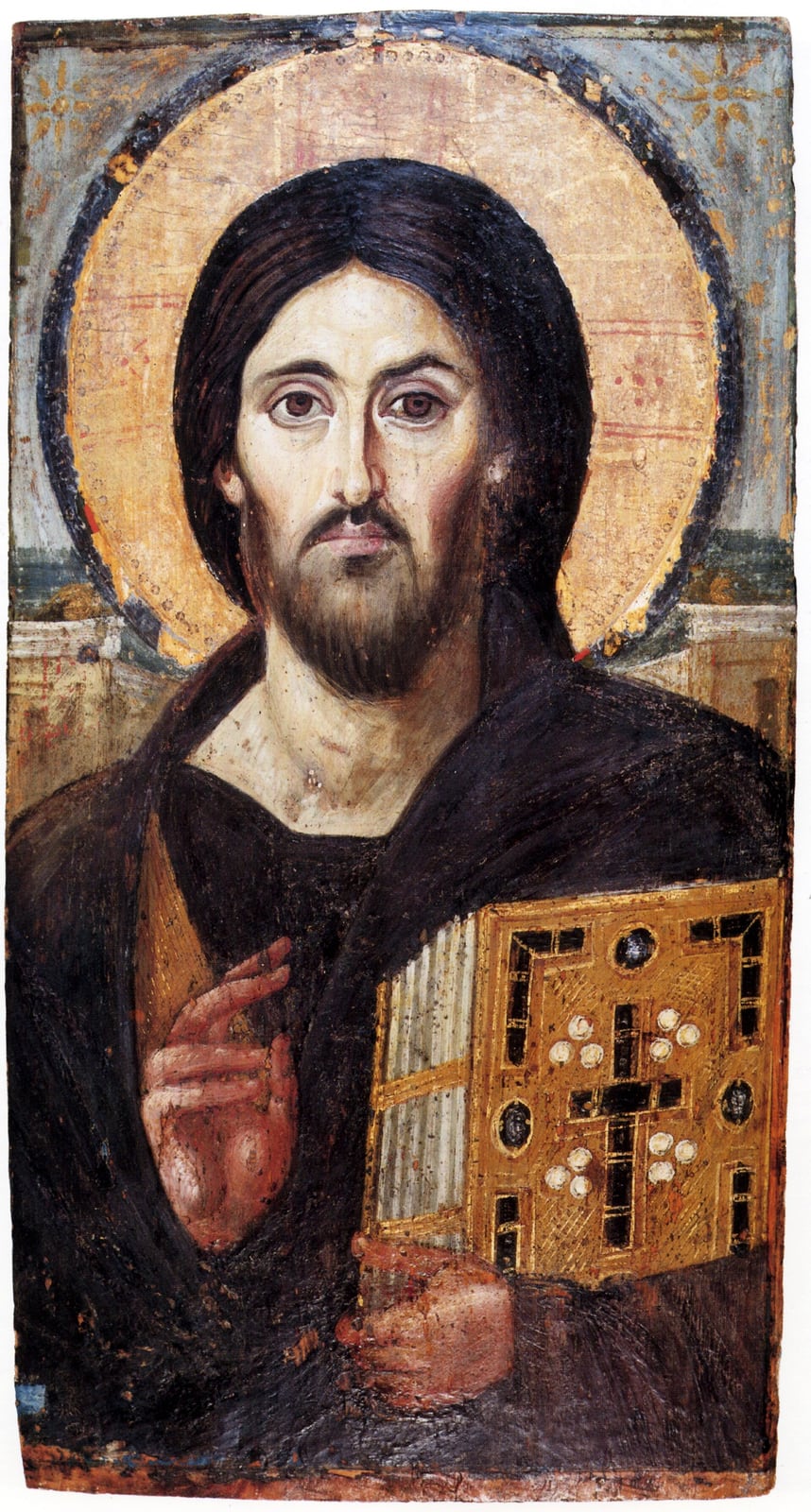
Jesus of Nazareth
They agree on: What is the Absolute? Does God exist? · Is the world real? · Who am I? Is there a true self?
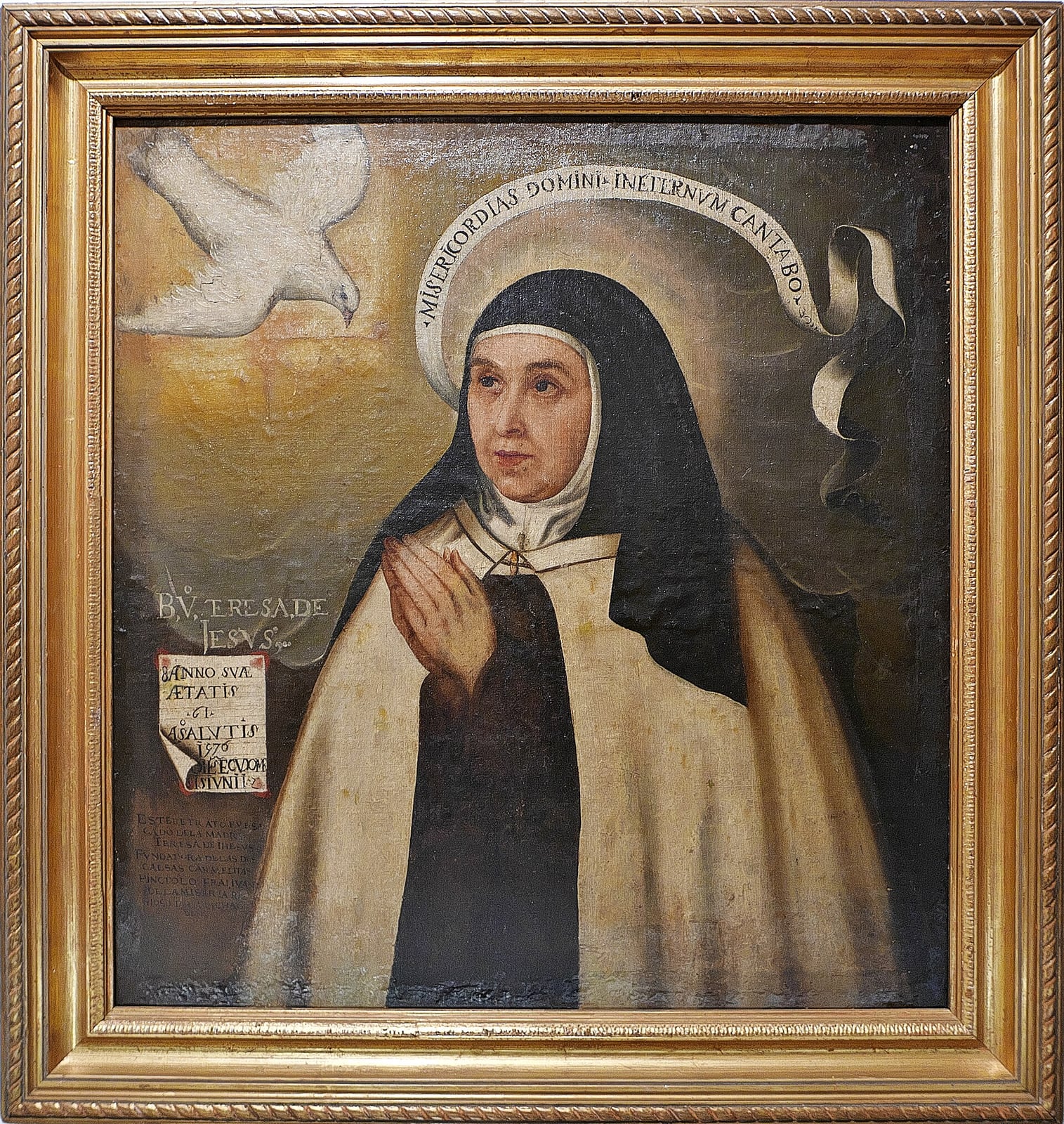
Teresa of Ávila
They agree on: What is the Absolute? Does God exist? · Who am I? Is there a true self? · Why do we suffer?
Thinks most unlike

Patañjali
They clash on: What is the Absolute? Does God exist? · Who am I? Is there a true self? · What happens after death?

Pema Chödrön
They clash on: What is the Absolute? Does God exist? · Who am I? Is there a true self? · What happens after death?

Nāgārjuna
They clash on: What is the Absolute? Does God exist? · Who am I? Is there a true self? · What happens after death?

Dōgen
They clash on: What is the Absolute? Does God exist? · Who am I? Is there a true self? · What happens after death?
Anecdotes and stories
Anecdotes and stories
Hagiographic accountc. 1353
The vision above San Domenico
Origin of the story: Raymond of Capua, Legenda maior I.2, from the account he says he heard from Catherine herself and her family.
Source: Raimundo de Capua. Legenda maior sive Legenda admirabilis virginis Catherine de Senis. Ed. Silvia Nocentini. Florencia: SISMEL – Edizioni del Galluzzo, 2013. Trad. inglesa de Conleth Kearns, The Life of Catherine of Siena. Wilmington: Michael Glazier, 1980.
Documented1375
The head of Niccolò di Toldo
Origin of the story: Catherine's letter to Raymond of Capua (no. 273 in Tommaseo's numbering). It is the only account of the event and comes from the protagonist.
Source: Noffke, Suzanne (trad. y ed.). The Letters of Catherine of Siena. 4 vols. Tempe: Arizona Center for Medieval and Renaissance Studies, 2000–2008.
Testimonyoctubre de 1377
Learning to write
Origin of the story: Letter to Raymond of Capua (no. 272 in Tommaseo's numbering); the miraculous interpretation comes from Raymond and Caffarini.
Source: Noffke, Suzanne (trad. y ed.). The Letters of Catherine of Siena. 4 vols. Tempe: Arizona Center for Medieval and Renaissance Studies, 2000–2008.
Documented1376
'My sweet babbo'
Origin of the story: Letters to Gregory XI preserved in the correspondence (Scudder, 1905; Noffke, 2000–2008); historical assessment in Luongo (2006) and Vauchez (2015).
Testimonyenero–febrero de 1380
The ship of the Church on her shoulders
Origin of the story: Letter to Raymond of Capua of February 1380 (no. 373 in Tommaseo's numbering) and Barduccio Canigiani's letter.
Source: Noffke, Suzanne (trad. y ed.). The Letters of Catherine of Siena. 4 vols. Tempe: Arizona Center for Medieval and Renaissance Studies, 2000–2008.
Oral tradition1384
The head that turned to roses
Origin of the story: The translation of the head to Siena is documented; the story of the roses is a late Sienese tradition without support in fourteenth-century sources.
Source: Vauchez, André. Catherine de Sienne: vie et passions. París: Éditions du Cerf, 2015.
Teachings
Teachings
The notions that structure their thought, explained in context.
The cell of self-knowledgecelda-del-conocimiento-de-si
The Augustinian legacy of knowledge of God and of self, transmitted through Dominican preaching.
Source: Caterina da Siena. Il Dialogo della divina provvidenza ovvero Libro della divina dottrina. Ed. Giuliana Cavallini. Roma: Edizioni Cateriniane, 1968 (2.ª ed., Siena: Cantagalli, 1995).
Christ the bridgeel-puente
Tradition of the degrees of love (Bernard of Clairvaux) and the theology of Christ's mediation.
Source: Caterina da Siena. Il Dialogo della divina provvidenza ovvero Libro della divina dottrina. Ed. Giuliana Cavallini. Roma: Edizioni Cateriniane, 1968 (2.ª ed., Siena: Cantagalli, 1995).
The bloodla-sangre
The piety of the passion in fourteenth-century Italy and Dominican sacramental theology.
Source: Noffke, Suzanne (trad. y ed.). The Letters of Catherine of Siena. 4 vols. Tempe: Arizona Center for Medieval and Renaissance Studies, 2000–2008.
The doctrine of tearsdoctrina-de-las-lagrimas
The monastic tradition of the gift of tears, from Cassian and Gregory the Great.
Source: Noffke, Suzanne (trad.). Catherine of Siena: The Dialogue. Classics of Western Spirituality. Nueva York: Paulist Press, 1980.
The mystical body and the reform of the Churchcuerpo-mistico
Crisis of the Avignon papacy and of the Great Schism (1378).
Source: Luongo, F. Thomas. The Saintly Politics of Catherine of Siena. Ithaca: Cornell University Press, 2006.
God as fire and 'mad with love'fuego-de-amor
Medieval bridal mysticism and the tradition of the excessus amoris.
Source: Caterina da Siena. Il Dialogo della divina provvidenza ovvero Libro della divina dottrina. Ed. Giuliana Cavallini. Roma: Edizioni Cateriniane, 1968 (2.ª ed., Siena: Cantagalli, 1995).
Videos
Videos
Recordings, interviews and documentaries. Videos play from YouTube; they are not hosted here.
Catherine of Siena as Woman of the Word: 'It is Silence that Kills the World'
Lecture· EN· 2015· 53 min
McGrath Institute for Church LifeOfficial channel
Sister Barbara Reid, O.P. - St. Catherine of Siena Lecture
Lecture· EN· 2017· 60 min
Providence CollegeOfficial channel
St. Catherine of Siena Lecture - Dr. Perry Cahall
Lecture· EN· 2015· 47 min
Ohio Dominican UniversityOfficial channel
The Apostle of the Blood of Christ: St. Catherine of Siena
Documentary· EN· 2024· 58 min
Bishop Robert BarronOfficial channel
André Vauchez - Santa Caterina da Siena
Lecture· IT· 2019· 46 min
Festival del MedioevoOfficial channel
La tradizione delle lettere di Caterina da Siena: status quaestionis e prospettive di ricerca
Lecture· IT· 2022· 34 min
DUSIC - Università di ParmaOfficial channel
Santa Caterina - prima lezione
Lecture· IT· 2022· 84 min
Arcidiocesi di SienaOfficial channel
Lezioni di storia a Trieste, 'I volti del potere': Caterina da Siena secondo Muzzarelli
Lecture· IT· 2020· 73 min
Il PiccoloOfficial channel
Camino a la CELDA INTERIOR - Doctrina de Santa Catalina de Siena
Lecture· ES· 2024· 75 min
fraynelson
SANTA CATALINA DE SIENA: biografía [Al encuentro de Dios Padre con S. Catalina de Siena, 09 de 12]
Lecture· ES· 2025· 78 min
fraynelson
Santa Catalina de Siena IV - Cisma de Occidente, muerte y canonización
Lecture· ES· 2021· 39 min
Dominicos EspañaOfficial channel
Catherine de Sienne ou la conduite du monde - partie 1/2
Documentary· FR· 2018· 67 min
KTO TVOfficial channel
Sainte Catherine de Sienne
Documentary· FR· 2019· 52 min
KTO TVOfficial channel
Gallery
Gallery
Images with verified licences. Each keeps its authorship and attribution.
Connections
Connections
Influences, discipleships and affinities. Documented relations are distinguished from similarities identified by analysis.
Influenced by
Her whole spirituality revolves around Christ crucified: her letters begin 'in the name of Jesus Christ crucified' and the Dialogue presents Christ as the bridge between God and the world.
Documented relation
Ideas akin to
Pius XII proclaimed them together principal patrons of Italy in 1939. They share identification with the passion (both stigmatised according to their hagiographers) and the preaching of peace; Catherine, a Dominican, shows no particular devotion to Francis in her writings.
Similarity identified by analysis
Ideas akin to
The first two women proclaimed Doctors of the Church, a week apart (27 September and 4 October 1970). Both combined mysticism and reform, and wrote without Latin learning.
Similarity identified by analysis
Ideas akin to
Her anthropology of memory, understanding and will as the image of the Trinity (Dialogue, ch. XIII) and her theme of self-knowledge come from the Augustinian tradition, mediated by Dominican preaching; no direct reading is documented.
Similarity identified by analysis
Contemporary of
Exact contemporaries, both laywomen without Latin learning who left a theology in the vernacular; they never had contact.
Similarity identified by analysis
Ideas akin to
Like Hildegard two centuries earlier, Catherine wrote to popes and the powerful with prophetic authority and denounced clerical corruption; both are Doctors of the Church. No documented relation.
Similarity identified by analysis
Ideas akin to
Both belong to the Dominican family and share the idea of a self-knowledge that issues in God, but Catherine is narrative, affective and ecclesial where Eckhart is speculative. No documented relation.
Similarity identified by analysis
Linked from other profiles
Sources
Sources
Bibliography and catalogues consulted for this profile.
- Wikidata, Q229190 «Catalina de Siena / Catherine of Siena» (P31=Q5; 83 enlaces entre wikis; P569 1347-03-25, P570 1380-04-29).
- Raimundo de Capua. Legenda maior sive Legenda admirabilis virginis Catherine de Senis. Ed. Silvia Nocentini. Florencia: SISMEL – Edizioni del Galluzzo, 2013. Trad. inglesa de Conleth Kearns, The Life of Catherine of Siena. Wilmington: Michael Glazier, 1980.
- Caterina da Siena. Il Dialogo della divina provvidenza ovvero Libro della divina dottrina. Ed. Giuliana Cavallini. Roma: Edizioni Cateriniane, 1968 (2.ª ed., Siena: Cantagalli, 1995).
- Caterina da Siena. Libro della divina dottrina volgarmente detto Dialogo della divina provvidenza. Ed. Matilde Fiorilli. Scrittori d'Italia. Bari: Laterza, 1912 (Project Gutenberg n.º 26961).
- Noffke, Suzanne (trad. y ed.). The Letters of Catherine of Siena. 4 vols. Tempe: Arizona Center for Medieval and Renaissance Studies, 2000–2008.
- Tommaseo, Niccolò (ed.). Le lettere di S. Caterina da Siena. 4 vols. Florencia: G. Barbèra, 1860; reed. ampliada por Piero Misciattelli, 6 vols., Siena: Giuntini-Bentivoglio, 1913–1922.
- Noffke, Suzanne (ed. y trad.). The Prayers of Catherine of Siena. Nueva York: Paulist Press, 1983.
- Vauchez, André. Catherine de Sienne: vie et passions. París: Éditions du Cerf, 2015.
- Luongo, F. Thomas. The Saintly Politics of Catherine of Siena. Ithaca: Cornell University Press, 2006.
- Benedicto XVI. Audiencia general del 24 de noviembre de 2010: Santa Catalina de Siena. Libreria Editrice Vaticana.
- Juan Pablo II. Motu proprio Spes aedificandi, proclamación de las copatronas de Europa (1 de octubre de 1999). Libreria Editrice Vaticana.
- Noffke, Suzanne (trad.). Catherine of Siena: The Dialogue. Classics of Western Spirituality. Nueva York: Paulist Press, 1980.
- Tommaso Caffarini. Libellus de supplemento: legende prolixe virginis beate Catherine de Senis. Ed. Giuliana Cavallini e Imelda Foralosso. Roma: Edizioni Cateriniane, 1974.
- Laurent, M.-H. (ed.). Il Processo Castellano. Fontes vitae S. Catharinae Senensis historici IX. Milán: Fratelli Bocca, 1942.
- Scudder, Vida D. (trad. y ed.). Saint Catherine of Siena as Seen in Her Letters. Londres: J. M. Dent / Nueva York: E. P. Dutton, 1905 (Project Gutenberg n.º 7403).
- Thorold, Algar (trad.). The Dialogue of the Seraphic Virgin Catherine of Siena. Londres: Kegan Paul, Trench, Trübner & Co., 1896 (nueva ed. abreviada, 1907).
- Salvador y Conde, José (intr. y trad.). Obras de Santa Catalina de Siena: El Diálogo, Oraciones y Soliloquios. Madrid: Biblioteca de Autores Cristianos, 1991.
- Open Library (Internet Archive), registros de edición consultados por ISBN para las ediciones listadas.
- Wikisource en italiano: Caterina da Siena, Libro della divina dottrina (ed. Fiorilli, 1912) y Le lettere di S. Caterina da Siena (ed. Misciattelli, 1922).
- Gardner, Edmund G. Saint Catherine of Siena: A Study in the Religion, Literature and History of the Fourteenth Century in Italy. Londres: J. M. Dent, 1907.
- Canigiani, Barduccio. Carta sobre el tránsito de Catalina, dirigida a sor Caterina Petriboni (1380). Trad. inglesa en Algar Thorold, The Dialogue of the Seraphic Virgin Catherine of Siena… together with an account of her death by an eye-witness. Londres: Kegan Paul, 1907.
- Anónimo florentino. I Miracoli di Caterina di Iacopo da Siena di anonimo fiorentino. Ed. Francesco Valli. Fontes vitae S. Catharinae Senensis historici IV. Siena: R. Università di Siena, 1936.
- Associazione Internazionale dei Caterinati (Siena).
- Rights holder
- Dominio público (obra del siglo XIV). Las ediciones críticas, traducciones y aparatos modernos (Cantagalli, Edizioni Cateriniane, BAC, Paulist Press, ACMRS, Studio Domenicano…) están sujetos a los derechos de sus editores. El Centro Nazionale di Studi Cateriniani (Roma) y la Associazione Internazionale dei Caterinati (Siena) promueven su estudio y su culto.
- Official site
- www.caterinati.org/
Pending confirmation
What this profile has not yet been able to settle. We would rather say so than fill it in.
- Localizar en catálogo los principales manuscritos del Diálogo y del epistolario (Siena, Biblioteca Comunale degli Intronati; Roma, Biblioteca Casanatense; Florencia, Biblioteca Nazionale) con sus signaturas: no se han registrado manuscritos para no aportar signaturas sin verificar.
- Confirmar el número de cartas según la edición crítica en curso (Antonio Volpato, Centro Nazionale di Studi Cateriniani): las cifras habituales oscilan entre 373 y 383.
- Verificar la redacción italiana exacta de la carta a Stefano Maconi («Se sarete quello che dovete essere…»), aquí marcada como «probable», contra la edición Misciattelli.
- Localizar ISBN de la edición crítica de Cavallini del Diálogo (Cantagalli, 1995), de Le Orazioni (1978) y de la Legenda maior de Nocentini (SISMEL, 2013).
- Ediciones españolas de las cartas y de la Leyenda de Raimundo de Capua con ISBN: no localizadas en Open Library.
- Buscar una traducción española de dominio público del Diálogo con texto completo en línea (hay traducciones de los siglos XVI–XVIII en bibliotecas digitales, sin OCR utilizable).
- Revisar la calidad del OCR de los textos de Internet Archive (Thorold 1896 y 1907; Hamilton 1862).
- La edición de Thorold de 1907 (reading_texts, lettera-di-barduccio) reúne la carta de Barduccio con una versión abreviada del Diálogo: queda con caution hasta extraer solo la carta.
- Programas de afiliación: ninguno verificado.
Researched on 2026-10-25