Christianity · Christian mysticism · Catholicism
Julian of Norwich
c. 1342 – c. 1416Historically documented person
English anchoress and writer (c. 1342–after 1416). In May 1373, gravely ill, she received sixteen visions of Christ's passion and of God's love, which she recounted in two versions: a Short Text and, after decades of meditation, a Long Text, the Revelations of Divine Love, the earliest surviving book in English written by a woman. She lived enclosed beside the church of St Julian in Norwich. Her theology of trust ('all shall be well'), of a God without wrath and of the motherhood of Christ has made her a classic author.
- works
- 3works
- editions
- 14editions
- quotes
- 8quotes
- videos
- 13videos
- images
- 5images
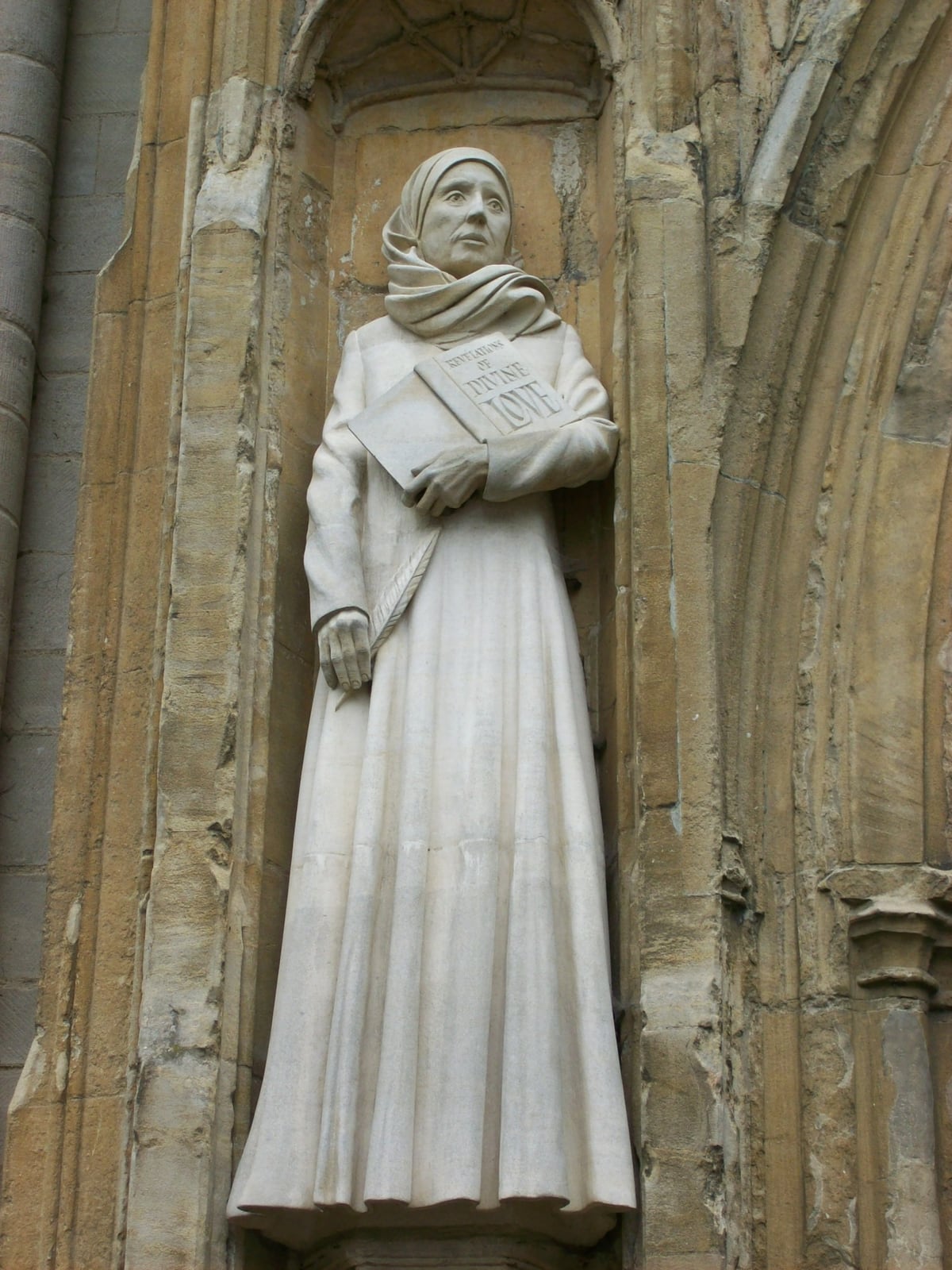
Estatua de Juliana en la fachada oeste de la catedral de Norwich (David Holgate) · CC0
In their words
«It behoved that there should be sin; but all shall be well, and all shall be well, and all manner of thing shall be well.»Texto largo según la versión modernizada del Sloane 2499 de Grace Warrack (1901), cap. 27 (decimotercera mostración)
Their central idea
'All shall be well': behovely sin: In the thirteenth showing Julian asks why God in his wisdom did not prevent sin, which, she thinks, would have left everything well.
See in context
Biography
5 min read
A woman without a name of her own
Of the author of the earliest surviving book in English written by a woman we know neither her baptismal name, nor her parents' names, nor her exact birthplace. We call her Julian because that is what wills and copyists call her, and because she lived enclosed beside the church of St Julian at Conisford, in Norwich; she may have taken the name of the church's patron saint, as other recluses did. What we know for certain she tells us herself: that in May 1373, when she was 'thirty winters and a half' old, she received a series of visions during an illness that brought her to the edge of death. From this it follows that she was born towards the end of 1342.
Norwich was then one of the most populous cities in England, a centre of the wool trade with dozens of parish churches, houses of all four mendicant orders and a Benedictine cathedral priory. Julian's youth coincided with the Black Death, which struck the city in 1349 and returned in the following decades, with the Hundred Years' War and, in 1381, with the Peasants' Revolt, harshly suppressed in Norfolk by Bishop Henry Despenser. None of this appears explicitly in her book, but many readers have heard in her insistence that 'all shall be well' an answer to a wounded world.
The three gifts and the illness
Julian relates that as a young woman she had asked God for three graces: a vivid recollection of Christ's passion, as if she had stood at the foot of the cross with Mary Magdalene; a grave bodily illness at the age of thirty; and three 'wounds': true contrition, compassion and longing for God. The first two requests she forgot; the third she always kept. At thirty and a half she fell ill. For three days and three nights her condition worsened, she received the last rites, and her mother, among others, watched over her. The parish priest set a crucifix before her and told her to look on the image of her Maker and Saviour and take comfort. Her sight darkened except around the cross.
Sixteen showings
Then, on 8 or 13 May 1373 (the manuscripts differ), she saw the crown of thorns bleed, and with that vision began a series of sixteen 'showings': fifteen between four in the morning and mid-afternoon, and the last one the following night. They combine images of the passion of extraordinary physical realism (blood falling like raindrops from the eaves, the face drying and changing colour), inner words and 'ghostly sights' without images. In one of them she sees in the palm of her hand something the size of a hazelnut: 'it is all that is made', and it lasts because God loves it. Once recovered, she told a religious that she had 'raved', and at once repented of having denied what she had seen; that night she suffered the assault of a fiendish vision and received the last showing, which confirmed the earlier ones.
Two books
Soon afterwards she wrote a first account, known today as the Short Text, narrating the visions and their most immediate sense. For decades she went on meditating on them. She says that 'fifteen years after and more' she received the answer to her question about the meaning of it all: 'Love was his meaning'. Twenty years after the visions, less three months, she understood the example of the lord and the servant, a parable she had left out of the first account. The result is the Long Text, eighty-six chapters that turn the experience into a theology: sin, which is 'behovely' and yet has no substance; a God in whom she sees no wrath; the motherhood of Christ; prayer that 'ones the soul to God'. Nicholas Watson has proposed moving the writing of the Short Text into the 1380s and extending that of the Long Text well into the fifteenth century.
The anchoress of St Julian's
We do not know when she was enclosed in the cell attached to the church of St Julian, which belonged to the Benedictine nunnery of Carrow. The first documentary mention dates from 1394: the will of Roger Reed, rector of St Michael Coslany, leaves her two shillings. Further bequests follow in 1404, 1415 and 1416, the last from Isabel Ufford, Countess of Suffolk. An anchoress lived for life in one or two rooms, with a window onto the church to follow Mass and another onto the street to counsel those who came, and one or two servants saw to her needs. It has been suggested that she had earlier been a nun at Carrow, or a widow and mother, given the precision with which she writes about the rearing of children; both are conjectures.
Margery Kempe at the window
Around 1413 she was visited by Margery Kempe, the turbulent mystic of King's Lynn, who came to ask whether her tears and revelations came from God. The Book of Margery Kempe, dictated some twenty years later, recalls that 'Dame Julian' listened to her for several days and advised her to obey God, to trust in his goodness and not to be troubled by others' unbelief, because whoever always doubts is like the wave of the sea. It is the only portrait of Julian by someone who knew her. In that same year of 1413, according to the rubric of the Short Text manuscript, its author was still alive; her death, after 1416, left no documentary trace.
A fragile transmission
The Short Text survives in a single manuscript copied in the mid-fifteenth century, the so-called Amherst manuscript (British Library, Add. MS 37790). The Long Text reached us thanks to the English Benedictine nuns exiled at Cambrai and Paris in the seventeenth century, who copied and kept it: from that milieu come the Paris manuscript (Bibliothèque nationale de France, Fonds anglais 40) and Sloane 2499 and 3705 in the British Library. The Benedictine Serenus Cressy printed it in 1670. Grace Warrack's edition of 1901 restored it to readers, and the critical edition by Edmund Colledge and James Walsh (1978) established the text of both versions.
The theologian of trust
The twentieth century turned her into a classic. T. S. Eliot closed 'Little Gidding', the last of his Four Quartets, with her words on behovely sin and on all being well; the Church of England commemorates her on 8 May, and Benedict XVI devoted a general audience to her in 2010. The church of St Julian, destroyed by German bombing in 1942, was rebuilt with a cell that now receives pilgrims. Beyond the labels she has been given (feminist, universalist, ecological) there remains a voice that called itself 'a simple, unlettered creature' and wrote with a theological precision rare in her century, holding at once to the Church's teaching and to a vision of God in which she found no wrath.
Sources: Colledge, Edmund, y James Walsh (eds.). A Book of Showings to the Anchoress Julian of Norwich. 2 vols. Studies and Texts 35. Toronto: Pontifical Institute of Mediaeval Studies, 1978. · Watson, Nicholas, y Jacqueline Jenkins (eds.). The Writings of Julian of Norwich: A Vision Showed to a Devout Woman and A Revelation of Love. University Park: Pennsylvania State University Press / Turnhout: Brepols, 2006. · Warrack, Grace (ed.). Revelations of Divine Love Recorded by Julian, Anchoress at Norwich, Anno Domini 1373. Londres: Methuen, 1901 (Project Gutenberg n.º 52958). · Windeatt, Barry (trad. e intr.). Julian of Norwich: Revelations of Divine Love. Oxford World's Classics. Oxford: Oxford University Press, 2015. · The Book of Margery Kempe. Ed. Sanford Brown Meech y Hope Emily Allen. Early English Text Society, o.s. 212. Londres: Oxford University Press, 1940, cap. 18.
Timeline
A life, year by year
Each point is a documented event. Click to read it, with its source and degree of certainty.
c. 1342age 0Probablemente Norwich o Norfolk
Birth
Date inferred from her own statement that she was 'thirty winters and a half' old in May 1373 (Long Text, ch. 3). Her baptismal name and family are unknown.
ProbableColledge, Edmund, y James Walsh (eds.). A Book of Showings to the Anchoress Julian of Norwich. 2 vols. Studies and Texts 35. Toronto: Pontifical Institute of Mediaeval Studies, 1978.
After their death
- c. 1450The Amherst manuscript is copied
- 1670First printed edition
- 1901Grace Warrack's edition
- June 1942St Julian's church destroyed
- 1978Critical edition
- December 1, 2010Benedict XVI's audience
c. 1342 · age 0
Birth
Date inferred from her own statement that she was 'thirty winters and a half' old in May 1373 (Long Text, ch. 3). Her baptismal name and family are unknown.
Probable
1349 · age 7
The Black Death in Norwich
The epidemic decimates the city; new waves in 1361–1362 and 1369. The context of her childhood.
Documented
May 1373 · age 30
The sixteen showings
Gravely ill, she receives fifteen visions between early morning and afternoon and the sixteenth the following night. The manuscripts give 8 or 13 May.
Documented
c. 1380 – 1388 · age 38
The Short Text
Writing of the first account of the visions; the traditional date (soon after 1373) was challenged by Nicholas Watson, who places it in the 1380s.
Disputed
c. 1388 · age 45
'Love was his meaning'
'Fifteen years after and more' she receives the understanding that closes the book: love is the meaning of all the showings (Long Text, ch. 86).
Documented
c. 1393 · age 50
The example of the lord and the servant
'Twenty years after the time of the showing, save three months' she understands the parable of the lord and the servant (Long Text, ch. 51), the core of the Long Text.
Documented
March 1394 · age 51
First mention as an anchoress
The will of Roger Reed, rector of St Michael Coslany, leaves two shillings to 'Julian anakorite'.
Documented
1404 · age 61
Bequest of Thomas Emund
A chantry priest of Aylsham leaves a bequest to the anchoress of St Julian's and to her servant Sara.
Documented
c. 1413 · age 70
Margery Kempe's visit
Margery Kempe consults her over several days about her experiences (Book of Margery Kempe, ch. 18). The rubric of the Amherst manuscript states she was alive in 1413.
Documented
1416 · age 73
Last mention: the will of Isabel Ufford
The Countess of Suffolk leaves twenty shillings to 'Julian recluse a Norwich'. It is the last document mentioning her alive; the date of her death is unknown.
Documented
c. 1450
The Amherst manuscript is copied
A scribe copies the Short Text into an anthology of contemplative texts (British Library, Add. MS 37790), the only witness to that version.
Probable
1670
First printed edition
The Benedictine Serenus Cressy publishes XVI Revelations of Divine Love from a Long Text manuscript related to the Paris one.
Documented
1901
Grace Warrack's edition
Methuen publishes Grace Warrack's modernised version of Sloane 2499, which popularises the work.
Documented
June 1942
St Julian's church destroyed
German bombing destroys the church; it is rebuilt in 1953 with a chapel on the site of the cell.
Documented
1978
Critical edition
Edmund Colledge and James Walsh publish the critical edition of both versions (Pontifical Institute of Mediaeval Studies).
Documented
December 1, 2010
Benedict XVI's audience
Benedict XVI devotes his general audience catechesis to Julian.
Documented
Works
Essential works
The works without which their legacy cannot be understood.
Manuscript · c. 1385
The Short Text: A Vision Showed to a Devout Woman
A Vision Showed to a Devout Woman
The first version of the account of the visions of May 1373, in twenty-five chapters. It narrates the three gifts requested, the illness, the crucifix and the sixteen showings in a more personal and immediate tone than the long version: Julian presents herself as a woman and apologises for teaching ('Should I believe, because I am a woman, that I ought not to tell you of the goodness of God?'). It does not yet contain the example of the lord and the servant or the theology of Christ's motherhood. It is the earliest surviving English text known to be by a woman.
5 editions · amazon.com

Manuscript · c. 1393
The Long Text: Revelations of Divine Love
A Revelation of Love (Revelations of Divine Love)
A reworking of the same visions in eighty-six chapters, the fruit of twenty years or more of meditation. Besides expanding each showing, it adds theological chapters: the example of the lord and the servant (ch. 51), in which Adam and Christ are both the servant who falls in serving; the teaching that there is no wrath in God and that sin is 'behovely' but has no substance; the 'substance' and 'sensuality' of the soul; and the motherhood of Christ and of the Trinity (chs. 58–63). It closes with the answer received 'fifteen years after and more': 'Love was his meaning'. It is the major work of medieval English mysticism.
9 editions · amazon.com
Quotations
Quotations located in a specific work. Each carries its provenance and its level of confidence.
It behoved that there should be sin; but all shall be well, and all shall be well, and all manner of thing shall be well.VerifiedTexto largo según la versión modernizada del Sloane 2499 de Grace Warrack (1901), cap. 27 (decimotercera mostración)
Apocryphal quotes or disputed attributions (1)
«Be a gardener. Dig a ditch, toil and sweat, and turn the earth upside down…»
It circulates online and on devotional cards as a quotation from Julian. It does not appear in that form in either version: it is a free reworking of the image of the servant labouring as a gardener in the example of the lord and the servant (Long Text, ch. 51).
Last words
There are no verifiable records of their last words.
Neither the date nor the circumstances of her death are known. The last document mentioning her alive is the will of Isabel Ufford, Countess of Suffolk (1416); no source transmits final words.
Source: Tanner, Norman P. The Church in Late Medieval Norwich, 1370–1532. Studies and Texts 66. Toronto: Pontifical Institute of Mediaeval Studies, 1984 (testamentos de Norwich con legados a anacoretas).
Ask
What their work answers
Twelve great human questions and what their texts allow us to answer, with references. We never put words in their mouth.
What is the Absolute? Does God exist?
God is Trinitarian love, Father and also Mother
A personal GodStated explicitly
Julian of Norwich does not argue for God's existence: she describes what was «shown» to her in sixteen revelations during an illness in 1373. In them God is Trinity and is love: in the final chapter of the Long Text she sums up that the meaning of everything shown was love. This God is courteous, homely, rejoices in creatures and holds them in being, like the hazelnut that lasts because God loves it. Her most original contribution is to call God Mother with the same truth with which he is called Father, and to ascribe that motherhood especially to Christ, the second Person. The Absolute is for her a Thou who loves without wrath, whose love precedes creation and never lessens.
Compare this question with other teachersWho am I? Is there a true self?
Our substance is in God; our sensuality awaits union with it
A created, immortal soulStated explicitly
Julian of Norwich distinguishes in the human being the «substance», the highest part, which was never separated from God, and the «sensuality», the embodied, temporal life where sin and pain occur. In chapter 54 of the Long Text she states that she saw no difference between God and our substance, as if it were all God, and yet understood that our substance is a creature in God. In the parable of the lord and the servant (ch. 51), the soul's fall arises not from malice but from haste to serve. The true self is a created soul, loved forever and kept in God, which is reconciled with itself when substance and sensuality are united through Christ.
Compare this question with other teachersWhy do we suffer?
Sin was behovely, but all shall be well
Separation from GodStated explicitly
Julian of Norwich asked why, if God is love, he did not prevent sin, which is the cause of all pain. The answer shown to her is one of the most famous sentences of English mysticism: sin was behovely, but all shall be well, and all manner of thing shall be well. She did not see sin, because she believes it has no substance, and knew it only by the pain it causes. In the parable of the lord and the servant, the fall appears as the stumbling of a servant running to do his lord's will. Suffering arises from separation, but God does not look on it with wrath, and every pain will be turned to honour.
Compare this question with other teachersWhat happens after death?
A great deed at the end will make all things well
Eternal life and resurrectionStated explicitly
Julian of Norwich's revelations were born at the edge of death: she was thirty and a half, received the last rites, and the priest held a crucifix before her, before which the visions began. Her hope is the Church's: eternal life in God, joy and bliss. But she adds something of her own: in chapter 32 she is shown that there is a great deed that the Trinity will do on the last day, hidden from every creature, by which all shall be well. Julian acknowledges the tension with the Church's teaching on damnation and does not resolve it: she holds it in faith and in the promise that what is impossible for her is not so for God.
Compare this question with other teachersHow is liberation or salvation attained?
God is the ground of our beseeching
Through grace and loveStated explicitly
Julian of Norwich sees salvation as the work of God's love that precedes everything: in chapter 41 of the Long Text she is shown that God is the ground of our beseeching, that it is he who makes us desire and ask for what he wishes to give us. The human role is real but humble: to pray, to trust, not to despair of one's own sin, and to remain in the faith of the Church. In chapter 68 she receives the promise that the soul will not be overcome, though it be tossed and afflicted. Liberation consists in Christ, our Mother, restoring us to the union of substance and sensuality, and keeping us in a love that never withdraws.
Compare this question with other teachersIs a teacher necessary?
What was shown is received within the Church's common faith
Community and traditionInferred from their doctrine
Julian of Norwich does not raise the question of the spiritual teacher; she received her revelations directly and spent some twenty years meditating on them. But she refuses to make them a separate authority. In chapter 9 of the Long Text she declares that she is not good because of the visions, but only if she loves God more, and that what she saw she believes according to the teaching of Holy Church. In chapter 80 she sums up the three things by which a human being stands in this life: the use of natural reason, the common teaching of the Church and the inward working of the Holy Spirit. Her text, moreover, is addressed to all her «fellow Christians», not to disciples.
Compare this question with other teachersIs the world real?
All creation fits in a hazelnut and lasts because God loves it
A good and real creationStated explicitly
Julian of Norwich's best-known image answers this question. In the first revelation, God shows her in the palm of her hand a little thing, the size of a hazelnut, round as a ball, and she is told that it is all that is made. Julian marvels that it can last, for it seems that, in its littleness, it might suddenly fall into nothing; and she is answered that it lasts and ever shall because God loves it. In that vision she understands three things: that God made it, that God loves it and that God keeps it. The world is real, fragile and small before its Creator, and good because it is loved.
Compare this question with other teachersWhat is love?
Love was the meaning of everything shown
Love of God and neighbourStated explicitly
Julian of Norwich's Long Text ends with the answer to the question she had asked herself for fifteen years: what the Lord's meaning was in what he showed her. She was answered that it was love: who showed it to her, love; what he showed her, love; why he showed it, for love. Julian adds that she saw with certainty that God loved us before he made us and that this love has never diminished nor ever shall. Love is God's essence, and from it proceeds the love creatures have for one another: her text is addressed to all her fellow Christians, because what was shown was for all, and in loving them she sees the concrete form of loving God.
Compare this question with other teachersAre we free, or is everything determined?
God does all that is done; the how remains a secret
Did not address it
Julian of Norwich does not treat human freedom as a problem. What is shown to her points elsewhere: in the third revelation she sees God in a point and understands that he is in all things and does all that is done; nothing happens by chance, but by God's foreseeing wisdom. That raises for her the question of sin, which is no deed, and she resolves it by trusting that all that is done is well done. She neither denies human responsibility —she speaks of repentance, prayer and the fall— nor theorises about predestination: she leaves the how in God's secret, who in his time will make all things well.
Compare this question with other teachersWhy meditate or pray?
Prayer unites the soul to God, who is its ground
Friendship with GodStated explicitly
Julian of Norwich devotes several chapters of the Long Text to prayer. There she is told that God is the ground of beseeching: it is he who makes us desire what he wants to give, and so prayer is never in vain, even when it seems dry or fruitless. Prayer unites the soul to God: although the soul is always like God in nature, it is often unlike him through sin, and prayer makes it like him in will. She distinguishes beseeching, which asks, from contemplation, in which the soul can no longer ask but only behold and give thanks. The tone is one of homely trust: God is courteous and wants to be spoken to with the simplicity of a child with its mother.
Compare this question with other teachersCan reason know the ultimate?
Natural reason, the Church's teaching and the Spirit's work
Faith and reason help each otherStated explicitly
Julian of Norwich presents herself as an «unlettered creature», but her work shows great theological intelligence, and she gives reason an explicit place. In chapter 80 of the Long Text she lists the three things by which the human being stands in this life and by which God is honoured: the use of natural reason, the common teaching of Holy Church and the inward gracious working of the Holy Spirit, and adds that all three come from one God. The revelations do not replace reason: Julian spent twenty years meditating on them in order to understand them, and the Long Text is the fruit of that reflection. Reason helps; faith and grace complete.
Compare this question with other teachersWithdraw from the world or transform it?
An anchoress who writes for all her fellow Christians
Withdraw in order to findInferred from their doctrine
Julian of Norwich lived as an anchoress, enclosed in a cell attached to the church of Saint Julian in Norwich, from which she probably takes her name; wills of the period mention her as an anchorite in the early fifteenth century. Her form of life was thus the strictest withdrawal known to the medieval Church. But her work does not argue for enclosure or despise those who live in the world: she declares that what was shown is not only for her but for all her fellow Christians, and her theology of God's love addresses ordinary life, the falling and falling again of anyone. From the cell, the window opened onto the street.
Compare this question with other teachers
Affinities & tensions
Affinities and tensions
Calculated question by question from their positions. The reason for each agreement or clash, on click.
Thinks most like
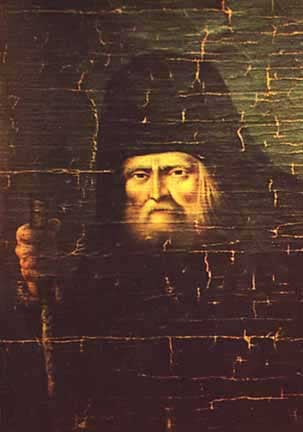
Seraphim of Sarov
They agree on: What is the Absolute? Does God exist? · Who am I? Is there a true self? · Why do we suffer?

Francis of Assisi
They agree on: What is the Absolute? Does God exist? · Who am I? Is there a true self? · Why do we suffer?
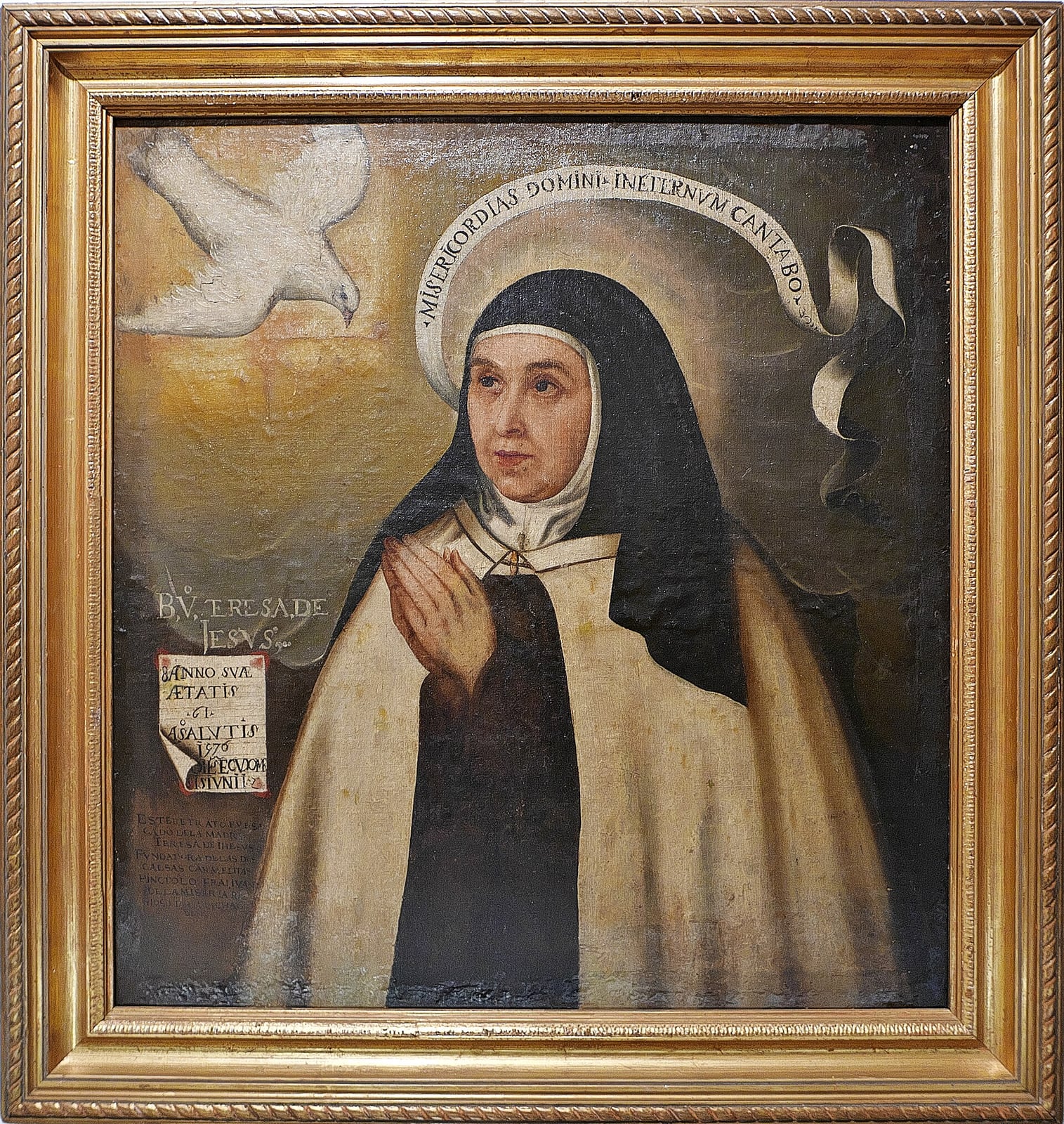
Teresa of Ávila
They agree on: What is the Absolute? Does God exist? · Who am I? Is there a true self? · Why do we suffer?
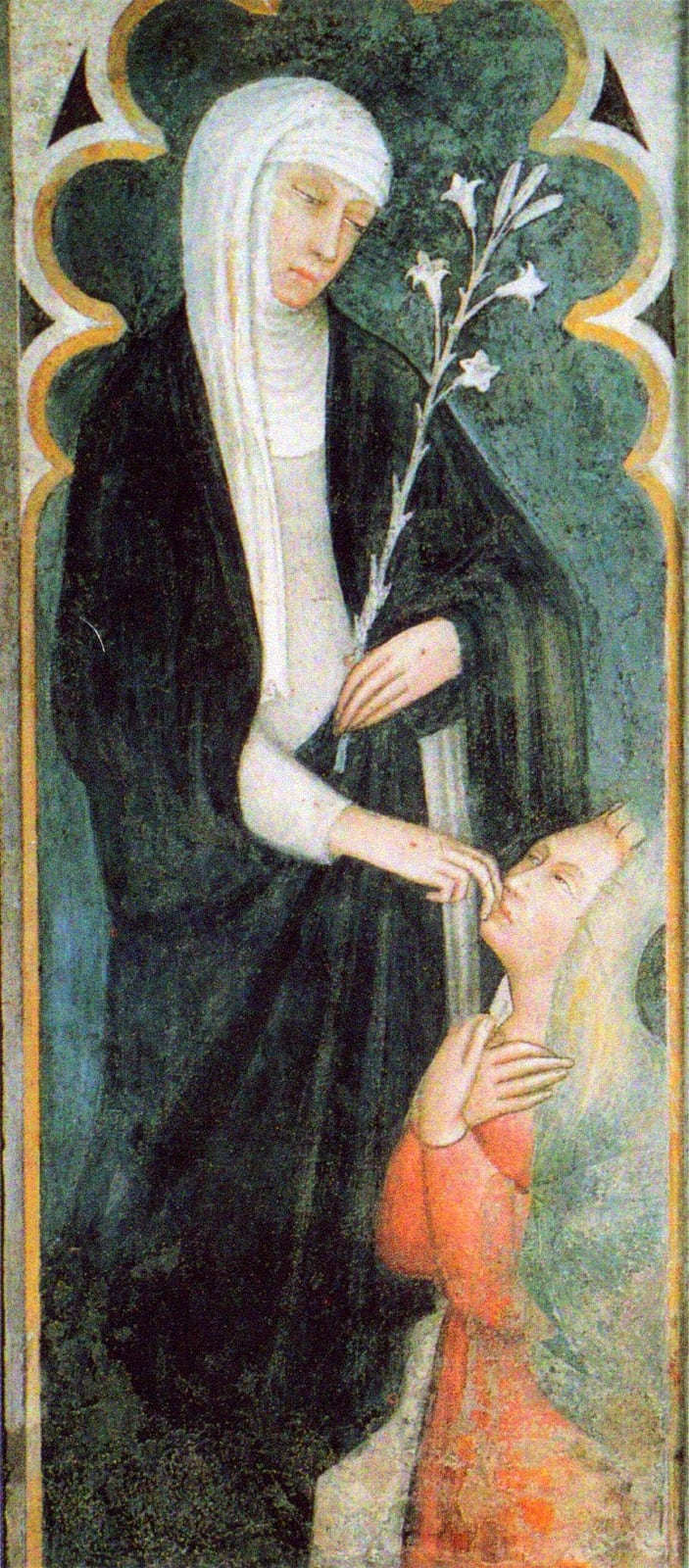
Catherine of Siena
They agree on: What is the Absolute? Does God exist? · Who am I? Is there a true self? · Why do we suffer?
Thinks most unlike

Pema Chödrön
They clash on: What is the Absolute? Does God exist? · Who am I? Is there a true self? · What happens after death?

Nāgārjuna
They clash on: What is the Absolute? Does God exist? · Who am I? Is there a true self? · What happens after death?
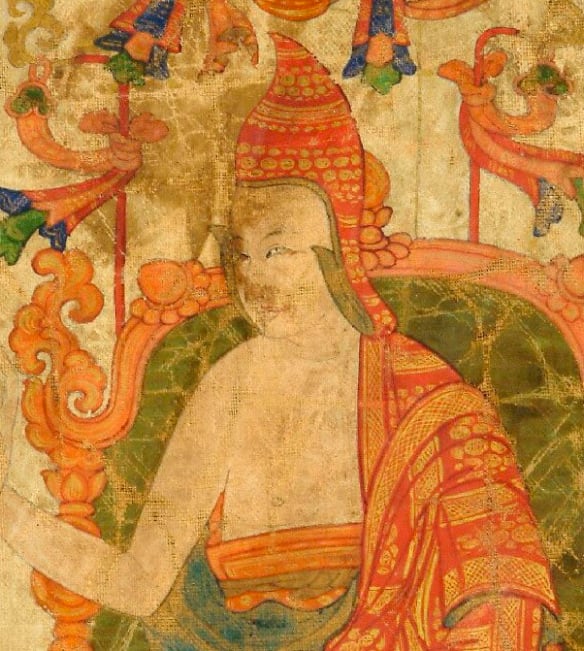
Śāntideva
They clash on: What is the Absolute? Does God exist? · Who am I? Is there a true self? · What happens after death?

Sadhguru
They clash on: Who am I? Is there a true self? · What happens after death? · Is the world real?
Anecdotes and stories
Anecdotes and stories
Testimonymayo de 1373
The parish priest's crucifix
Origin of the story: Julian's own account in the Short Text (chs. 2–3) and the Long Text (chs. 3–4).
Testimonymayo de 1373
'I said I had raved'
Origin of the story: Long Text, chs. 66–67; the episode also appears in the Short Text (chs. 21–22).
Documentedc. 1413
Margery Kempe at the cell window
Origin of the story: The Book of Margery Kempe, book I, ch. 18, dictated c. 1436–1438. The meeting is known only from this account.
Source: The Book of Margery Kempe. Ed. Sanford Brown Meech y Hope Emily Allen. Early English Text Society, o.s. 212. Londres: Oxford University Press, 1940, cap. 18.
Unverifiables. XX (tradición)
The anchoress's cat
Origin of the story: The rule comes from the Ancrene Wisse (part VIII). The attribution of a cat to Julian has no medieval source and spread with modern iconography.
Source: Jantzen, Grace M. Julian of Norwich: Mystic and Theologian. Londres: SPCK, 1987 (nueva ed. 2000).
Documenteds. XVII
The nuns of Cambrai
Origin of the story: Watson and Jenkins (2006) and Colledge and Walsh (1978) study the provenance of the Long Text manuscripts in the milieu of the Cambrai and Paris communities.
Source: Watson, Nicholas, y Jacqueline Jenkins (eds.). The Writings of Julian of Norwich: A Vision Showed to a Devout Woman and A Revelation of Love. University Park: Pennsylvania State University Press / Turnhout: Brepols, 2006.
Teachings
Teachings
The notions that structure their thought, explained in context.
'All shall be well': behovely sintodo-ira-bien
Late medieval debate on predestination and salvation, in the England of Wyclif and Langland.
Source: Colledge, Edmund, y James Walsh (eds.). A Book of Showings to the Anchoress Julian of Norwich. 2 vols. Studies and Texts 35. Toronto: Pontifical Institute of Mediaeval Studies, 1978.
A God without wrathdios-sin-ira
Contrast with fourteenth-century penitential preaching and with the image of judgement in scholastic theology.
Source: Jantzen, Grace M. Julian of Norwich: Mystic and Theologian. Londres: SPCK, 1987 (nueva ed. 2000).
The example of the lord and the servantsenor-y-siervo
Medieval multi-layered exegesis and the tradition of parable as a form of theological teaching.
Source: Watson, Nicholas, y Jacqueline Jenkins (eds.). The Writings of Julian of Norwich: A Vision Showed to a Devout Woman and A Revelation of Love. University Park: Pennsylvania State University Press / Turnhout: Brepols, 2006.
The motherhood of Christ and of Godmaternidad-de-cristo
Medieval tradition of Jesus as mother (Anselm, Bernard of Clairvaux, William of Saint-Thierry).
Source: Jantzen, Grace M. Julian of Norwich: Mystic and Theologian. Londres: SPCK, 1987 (nueva ed. 2000).
Substance and sensualitysustancia-y-sensualidad
Augustinian anthropology of the image and the English contemplative tradition (Hilton, The Cloud of Unknowing).
Source: Watson, Nicholas, y Jacqueline Jenkins (eds.). The Writings of Julian of Norwich: A Vision Showed to a Devout Woman and A Revelation of Love. University Park: Pennsylvania State University Press / Turnhout: Brepols, 2006.
The courtesy and homeliness of Godcortesia-de-dios
The courtly language of fourteenth-century England applied to theology.
Source: Windeatt, Barry (trad. e intr.). Julian of Norwich: Revelations of Divine Love. Oxford World's Classics. Oxford: Oxford University Press, 2015.
Videos
Videos
Recordings, interviews and documentaries. Videos play from YouTube; they are not hosted here.
2024 Julian Festival Lecture, Julian and the Trinity, Archbishop Rowan Williams
Lecture· EN· 2024· 89 min
Julian of NorwichOfficial channel
Julian of Norwich: mother, mystic, radical
Lecture· EN· 2023· 81 min
Jesus College, CambridgeOfficial channel
Julian of Norwich: Revelations of Divine Love - Robert Fruehwirth
Lecture· EN· 2016· 61 min
St Paul's CathedralOfficial channel
Prayer in the Teachings of Julian of Norwich: A Journey of Desire | Philip Sheldrake
Lecture· EN· 2019· 84 min
Oblate School of TheologyOfficial channel
How to Read Julian of Norwich / Ryan McAnnally-Linz
Lecture· EN· 2024· 54 min
Yale Center for Faith & CultureOfficial channel
Julian of Norwich and the English Mystics: A Lecture by Fr. Groeschel
Lecture· EN· 2019· 73 min
International Institute for Culture
Cecilia Twinch: Julian of Norwich: All manner of things shall be well
Lecture· EN· 2023· 42 min
Ibn 'Arabi SocietyOfficial channel
Revelations of Divine Love by Julian of NORWICH read by David Barnes | Full Audio Book
Third-party recording· EN· 2018· 441 min
LibriVox Audiobooks
3º clase - Javier Melloni sj expone sobre Juliana de Norwich, teóloga de su propia experiencia
Lecture· ES· 2022· 113 min
Fraternidad del Santo Nombre
Juliana de Norwich, Mística de la cortesía de Dios - El primer documental español
Documentary· ES· 2026· 15 min
Radio Monastero Interiore
El Papa dedica la audiencia general a Juliana de Norwich, mística inglesa
Third-party recording· ES· 2010· 3 min
ROME REPORTS en EspañolOfficial channel
Juliana de Norwich
Lecture· ES· 2026· 104 min
Cruzando Fronteras con Fernando Cordero sscc
Giuliana di Norwich, Mistica della cortesia di Dio - il primo documentario italiano
Documentary· IT· 2025· 16 min
Radio Monastero Interiore
Gallery
Gallery
Images with verified licences. Each keeps its authorship and attribution.
Manuscripts
Manuscripts
Manuscript witnesses and ancient texts, with their custodian and conditions of access.
ENM · Gótica cursiva inglesa (tipo no verificado) · Texto: c. 1373–1390; copia: c. 1435–1450
A Vision Showed to a Devout Woman (Texto breve), en antología contemplativa
- Surviving witness
- Único testimonio del Texto breve, dentro de una antología de textos contemplativos (Rolle, Ruusbroec, Suso, entre otros). La rúbrica afirma que la autora seguía viva en 1413.
- Custodian
- British Library, Londres · Add. MS 37790 (manuscrito Amherst)
ENM · Cursiva (tipo no verificado) · Copia de finales del s. XVI
Revelations of Divine Love (Texto largo), copia de París
- Surviving witness
- Texto largo completo con el explicit «Explicit liber revelationum Julyane anatorite Norwyche»; texto próximo al de la edición de Cressy (1670).
- Custodian
- Bibliothèque nationale de France, París · Fonds anglais 40
ENM · Cursiva del s. XVII · Mediados del s. XVII
Revelations of Divine Love (Texto largo), Sloane 2499
- Surviving witness
- Texto largo completo con ortografía arcaizante; base de las ediciones de Warrack (1901), Glasscoe (1976) y Crampton (1993).
- Custodian
- British Library, Londres · Sloane MS 2499
ENM · Cursiva del s. XVIII · S. XVIII
Revelations of Divine Love (Texto largo), Sloane 3705
- Surviving witness
- Copia tardía del Texto largo, con ortografía modernizada.
- Custodian
- British Library, Londres · Sloane MS 3705
ENM · Gótica cursiva inglesa (tipo no verificado) · c. 1500
Extractos del Texto largo (manuscrito de Westminster)
- Surviving witness
- Antología de pasajes del Texto largo junto a comentarios a los salmos; el testimonio más antiguo de esa versión.
- Custodian
- Westminster Cathedral Treasury, Londres · MS 4
Connections
Connections
Influences, discipleships and affinities. Documented relations are distinguished from similarities identified by analysis.
Influenced by
The sixteen showings centre on Christ's passion, which Julian had asked to behold 'as if she had been there', and her whole theology is built around him as servant, mother and saviour.
Documented relation
Ideas akin to
Julian works within the Augustinian horizon (fall, original sin, grace, God's image in the soul), but her vision of a God who does not blame departs from the rigour of the late Augustine. No direct reading is documented.
Similarity identified by analysis
Contemporary of
Exact contemporaries (Catherine was born in 1347 and Julian had her visions in 1373), both laywomen without Latin learning who dictated or wrote theology in the vernacular. There was no contact.
Similarity identified by analysis
Ideas akin to
Two women who wrote of their experience of God in domestic language and with a theological sharpness that exceeded their 'unlettered' status. Teresa did not know Julian's work.
Similarity identified by analysis
Ideas akin to
Both visionaries received visions in sickness and interpreted them over years; but Hildegard was an abbess, prophetic and cosmological, and Julian a recluse and introspective. No documented relation.
Similarity identified by analysis
Ideas akin to
Affective devotion to the suffering humanity of Christ, spread in fourteenth-century England by Franciscan spirituality, forms the background of her visions of the passion. No direct relation.
Similarity identified by analysis
Ideas akin to
Julian's 'substance' of the soul ever united to God recalls Eckhart's 'ground' of the soul, but her language is narrative and concrete, not speculative. There is no sign that she knew Rhineland mysticism.
Similarity identified by analysis
Linked from other profiles
Sources
Sources
Bibliography and catalogues consulted for this profile.
- Wikidata, Q236699 «Juliana de Norwich / Julian of Norwich» (P31=Q5; 45 enlaces entre wikis).
- Colledge, Edmund, y James Walsh (eds.). A Book of Showings to the Anchoress Julian of Norwich. 2 vols. Studies and Texts 35. Toronto: Pontifical Institute of Mediaeval Studies, 1978.
- Watson, Nicholas, y Jacqueline Jenkins (eds.). The Writings of Julian of Norwich: A Vision Showed to a Devout Woman and A Revelation of Love. University Park: Pennsylvania State University Press / Turnhout: Brepols, 2006.
- Warrack, Grace (ed.). Revelations of Divine Love Recorded by Julian, Anchoress at Norwich, Anno Domini 1373. Londres: Methuen, 1901 (Project Gutenberg n.º 52958).
- Windeatt, Barry (trad. e intr.). Julian of Norwich: Revelations of Divine Love. Oxford World's Classics. Oxford: Oxford University Press, 2015.
- The Book of Margery Kempe. Ed. Sanford Brown Meech y Hope Emily Allen. Early English Text Society, o.s. 212. Londres: Oxford University Press, 1940, cap. 18.
- Jantzen, Grace M. Julian of Norwich: Mystic and Theologian. Londres: SPCK, 1987 (nueva ed. 2000).
- Benedicto XVI. Audiencia general del 1 de diciembre de 2010: Juliana de Norwich. Libreria Editrice Vaticana.
- Spearing, Elizabeth (trad.), y A. C. Spearing (intr. y notas). Julian of Norwich: Revelations of Divine Love (Short Text and Long Text). Londres: Penguin Books, 1998.
- Watson, Nicholas. «The Composition of Julian of Norwich's Revelation of Love». Speculum 68, n.º 3 (1993), pp. 637–683.
- Ward, Benedicta. «Julian the Solitary». En Kenneth Leech y Benedicta Ward, Julian Reconsidered. Oxford: SLG Press, 1988.
- Glasscoe, Marion (ed.). Julian of Norwich: A Revelation of Love. Exeter Medieval English Texts. Exeter: University of Exeter, 1976 (ed. del Sloane 2499).
- Beer, Frances (ed.). Julian of Norwich's Revelations of Divine Love: The Shorter Version Ed. from B. L. Add. MS 37790. Heidelberg: Carl Winter, 1978.
- Open Library (Internet Archive), registros de edición consultados por ISBN para las ediciones listadas.
- Eliot, T. S. «Little Gidding» (1942), en Four Quartets. Londres: Faber & Faber, 1944, sección V.
- Tanner, Norman P. The Church in Late Medieval Norwich, 1370–1532. Studies and Texts 66. Toronto: Pontifical Institute of Mediaeval Studies, 1984 (testamentos de Norwich con legados a anacoretas).
- The Julian Shrine, St Julian's Church, Norwich: historia de la iglesia y de la celda reconstruida.
- Friends of Julian of Norwich (asociación que mantiene el Julian Centre y promueve su lectura).
- Holloway, Julia Bolton, Anna Maria Reynolds et al. (eds.). Julian of Norwich, Showing of Love: Extant Texts and Translation. Florencia: SISMEL – Edizioni del Galluzzo, 2001.
- Wikisource en inglés: Revelations of Divine Love (Grace Warrack, ed. de 1907), transcripción con subpáginas por capítulo.
- Rights holder
- Dominio público (obra del siglo XIV). Las ediciones críticas, traducciones y modernizaciones posteriores a 1955 (PIMS, Penn State, Penguin, Oxford, Paulist Press, Trotta…) están sujetas a los derechos de sus editores.
- Official site
- www.julianshrine.org/
Pending confirmation
What this profile has not yet been able to settle. We would rather say so than fill it in.
- Confirmar la fecha de muerte de Dundas Harford (n. 1858) para liberar su edición del Texto breve (1911) en la sala de lectura; hasta entonces queda con caution.
- Comprobar la calidad del OCR de la reimpresión de 1843 de la edición de Cressy en Internet Archive.
- Localizar el traductor de la edición española de Trotta (Libro de visiones y revelaciones, 2002; ISBN 9788481645590), que Open Library no registra, y buscar otras ediciones españolas con ISBN (Revelaciones del amor divino).
- Localizar ISBN de ediciones francesa, alemana e italiana: Open Library no devuelve registros fiables.
- Verificar si el manuscrito de París (BnF, Fonds anglais 40) y los Sloane 2499 y 3705 están digitalizados (Gallica; British Library Digitised Manuscripts, afectado por la caída del servicio de la BL desde 2023).
- Fijar con Colledge–Walsh y con Tanner (1984) las cuantías y fechas exactas de cada legado testamentario (Reed 1394, Emund 1404, Plumpton 1415, Ufford 1416).
- No hay traducción española de dominio público conocida; la sala de lectura queda solo en inglés.
- Programas de afiliación: ninguno verificado.
Researched on 2026-10-25