Buddhism · Mahayana · Zen / Chan
Huineng
惠能 / 慧能 · 六祖大鑒禪師 · 慧能 (Enō)
638 – 713Historicity debated
Chinese monk of the Tang dynasty, venerated as the sixth patriarch of Chan and founder of the “sudden awakening” school. Tradition presents him as an illiterate woodcutter who defeated his master's chief disciple with a poem and received Bodhidharma's robe; modern scholarship has shown that this biography was built by his follower Shenhui. The Platform Sūtra attributed to him is the founding work of Chan and Zen.
- works
- 11works
- editions
- 25editions
- quotes
- 8quotes
- videos
- 12videos
- images
- 5images
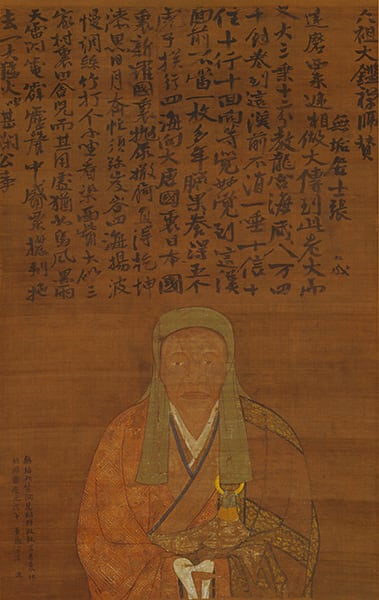
Daikan Zenji (Huineng), templo Shōfukuji · Public domain
In their words
«Among people there are northerners and southerners; in buddha-nature there is neither north nor south. A barbarian's body is not like Your Reverence's, but what difference is there in buddha-nature?»Sūtra de la plataforma, versión de Dunhuang, respuesta a Hongren (§3 de Yampolsky). Traducción propia del chino clásico.

Their central idea
Buddha-nature is equally present in everyone, regardless of origin, culture or learning: awakening is not a conquest but the recognition of what one already is.
See in context
Biography
5 min read
The patriarch who had to be invented
Few figures in Buddhism are as famous and as uncertain as Huineng, the “sixth patriarch” of Chan. Tradition knows almost everything about him: that he was an illiterate woodcutter from south China, that he awakened on hearing a line of the Diamond Sūtra, that he defeated his master's chief disciple with a poem and received Bodhidharma's robe at night. History, by contrast, knows very little: that there was a monk named Huineng, a disciple of the fifth patriarch Hongren, who taught at Caoxi in northern Canton and died in 713 with a rather regional reputation. Everything else was written later, and largely out of necessity: that of a school seeking a founder to the measure of its doctrine.
The life the sūtra tells
The canonical account is the autobiography that opens the Platform Sūtra. Huineng, surnamed Lu, was born in 638 in Xinzhou, in present-day Guangdong; his father, an official from Fanyang demoted and banished to the south, died early, and the boy supported his mother by selling firewood in the market of Nanhai. One day, delivering a bundle to an inn, he heard a customer recite the Diamond Sūtra and his mind “opened”. He thus learned that Hongren was teaching at Huangmei, travelled to him and, when the master scorned him as a “southern barbarian”, answered that people are from the north or the south, but buddha-nature is not. Hongren sent him to husk rice at the mill, far from the meditation hall, and there he spent eight months.
The poems on the wall
The central episode is a contest. Hongren asks his disciples for a poem showing their understanding, and promises the robe to whoever has it. Shenxiu, the most respected monk, writes at night on the corridor wall: the body is the tree of awakening, the mind a mirror on its stand; it must be wiped constantly so that no dust settles. Huineng, who cannot read, asks to have it read to him and dictates his reply. In the Dunhuang copy there are two stanzas, the first of which says that awakening has no tree, the mirror has no stand and, buddha-nature being always pure, there is nowhere for dust to settle. Only the editions of the tenth to thirteenth centuries put in his mouth the line everyone knows: “from the beginning there is not a single thing.” The difference is not minor: Zen's most quoted formula is not its oldest.
The robe and the flight
Hongren, the story goes, erases the poem to protect its author, comes to the mill at night, expounds the Diamond Sūtra to him and hands him the robe and bowl, signs of the transmission. He accompanies him to the river and advises him to flee. At the Dayu pass a former general, Huiming, overtakes him to seize the robe and cannot lift it from the ground; the later version adds that Huineng asked him what his original face was before thinking of good and evil. The later editions have him live fifteen years hidden among hunters, eating vegetables cooked in their meat pots, before appearing at the Faxing temple in Canton, where two monks were arguing whether the banner or the wind was moving: “neither the wind nor the banner; what moves is your mind.” The temple's master, Yinzong, is said to have ordained him then.
The sermon at Dafan
The text that made him famous presents itself as the transcript of a sermon at the Dafan temple in Shaozhou, before the prefect Wei Qu, monks, scholars and over a thousand listeners, recorded by his disciple Fahai. It teaches that awakening is sudden because one's own nature is already pure, that meditation and wisdom are one thing—like the lamp and its light—and that the method is summed up in no-thought, no-form and no-abiding: not suppressing thoughts, but not being caught in them. It also confers “formless precepts” and criticises seated meditation that amounts to not moving. Huineng died in 713 at the Guoen temple in his home town, aged seventy-six according to the sūtra, and his body was taken to Caoxi; the one venerated at the Nanhua temple as his mummy was already seen by the Jesuit Matteo Ricci in 1589.
Shenhui and the making of the sixth patriarch
Modern criticism began around 1930, when the philosopher Hu Shi found among the Dunhuang manuscripts the works of Shenhui (684–758), a monk who claimed to be Huineng's disciple. In 732, at a public assembly at Huatai, Shenhui accused the school of Shenxiu—the most powerful in the capital—of usurping the succession: Hongren's true heir was his own master, the unknown southerner, and the true teaching was the sudden, not the gradual. Hu Shi concluded that the Platform Sūtra itself was the work of Shenhui or his circle; the Dunhuang copy even contains a prophecy that, twenty years after the master's death, someone would risk his life to defend his doctrine, which is exactly what Shenhui did. Philip Yampolsky, who edited and translated the Dunhuang text in 1967, nuanced the thesis: the sūtra was composed around 780, from materials of diverse origin; Yanagida Seizan proposed that its compiler belonged to the Oxhead school, an idea John McRae adopted. McRae, in his studies of the Northern school and in Seeing through Zen, showed that the opposition between sudden and gradual was above all a polemical weapon, and formulated the rule by which Huineng is read today: it is not true, and therefore it is more important.
Three versions of one book
The Platform Sūtra is the only Chinese text by a master to receive the title jing, “sūtra”, reserved for the Buddha's word, and it never stopped growing. The oldest surviving copy, found at Dunhuang and now in the British Library, dates from the mid-ninth century and has some twelve thousand characters; other Dunhuang copies survive in China. In 967 the monk Huixin reorganised it into two fascicles and eleven sections, a version preserved in Japan; in 1056 Qisong prepared another, now lost; and in 1291 Zongbao published the one that would become canonical, of more than twenty thousand characters in ten chapters, with the episodes of the hunters, the banner and the original face. Morten Schlütter has shown that these enlargements answered the disputes of the Chan schools of the Song period. In the thirteenth century Dōgen rejected it as apocryphal; the Linji lineage, from which Hakuin's Zen descends, and the Caodong lineage, from which Dōgen's and Shunryu Suzuki's descends, still recognise in Huineng their common root.
Sources: Yampolsky, Philip B. (ed. y trad.). The Platform Sutra of the Sixth Patriarch: The Text of the Tun-huang Manuscript. Nueva York: Columbia University Press, 1967; reed. 2012 (ISBN 9780231159562). · McRae, John R. Seeing through Zen: Encounter, Transformation, and Genealogy in Chinese Chan Buddhism. Berkeley: University of California Press, 2003. ISBN 0520237986. · McRae, John R. (trad.). The Platform Sutra of the Sixth Patriarch, translated from the Chinese of Tsung-pao. Berkeley: Numata Center for Buddhist Translation and Research, 2000. ISBN 1886439133. · McRae, John R. The Northern School and the Formation of Early Ch'an Buddhism. Honolulu: University of Hawai'i Press (Kuroda Institute), 1986. · Schlütter, Morten y Stephen F. Teiser (eds.). Readings of the Platform Sūtra. Nueva York: Columbia University Press, 2012. ISBN 9780231158206.
Timeline
A life, year by year
Each point is a documented event. Click to read it, with its source and degree of certainty.
638age 0Xinzhou (Xinxing, Guangdong)
Birth in Xinzhou
Born in Xinzhou (Guangdong) into the Lu family; his father, an official from Fanyang, had been demoted and banished to the south.
TraditionWikisource en chino: 南宗頓教最上大乘摩訶般若波羅蜜經六祖惠能大師於韶州大梵寺施法壇經 (texto de la copia de Dunhuang, compilado por Fahai).
After their death
- 732Shenhui at Huatai
- c. 780Compilation of the Platform Sūtra
- 796The court recognises the Southern line
- c. 816Posthumous title Dajian
- 967Huixin's version
- 1291Zongbao's version
- 1589Matteo Ricci at the Nanhua temple
- 1930Hu Shi and modern criticism
- 1967Yampolsky's edition
638 · age 0
Birth in Xinzhou
Born in Xinzhou (Guangdong) into the Lu family; his father, an official from Fanyang, had been demoted and banished to the south.
Tradition
c. 661
Reaches Huangmei and meets Hongren
After hearing the Diamond Sūtra he travels to Mount Huangmei; Hongren sends him to the mill. Date inferred from traditional chronology.
Tradition
c. 661
Poem contest and transmission of the robe
He answers Shenxiu's poem, receives the robe at night and flees south.
Tradition
c. 676
Ordination at the Faxing temple
After years in hiding he appears in Canton during the wind-and-banner dispute and is ordained by Yinzong; Wang Wei's stele already mentions Yinzong.
Tradition
c. 677
Teaches at Caoxi
He settles at the Baolin temple (now Nanhua) at Caoxi, near Shaozhou, where he will teach until his death.
Probable
c. 700
The sermon at the Dafan temple
According to the sūtra, he preaches before prefect Wei Qu and over a thousand listeners; Fahai records the sermon. Date unknown.
Tradition
713 · age 76
Death at the Guoen temple
He dies on the third day of the eighth month of the second Xiantian year, aged seventy-six according to the sūtra; his body is taken to Caoxi.
Documented
732
Shenhui at Huatai
At a public assembly Shenhui proclaims Huineng sixth patriarch and attacks Shenxiu's school; the construction of the figure begins.
Documented
c. 780
Compilation of the Platform Sūtra
Date proposed by Yampolsky for the composition of the text preserved at Dunhuang.
Probable
796
The court recognises the Southern line
According to Zongmi, an imperial commission recognises the Southern school as the orthodox transmission and Shenhui as seventh patriarch.
Probable
c. 816
Posthumous title Dajian
Emperor Xianzong grants him the title Chan Master Dajian, “Great Mirror”; Liu Zongyuan composes the stele.
Probable
967
Huixin's version
Huixin reorganises the sūtra into two fascicles and eleven sections.
Documented
1291
Zongbao's version
Zongbao publishes the edition that will enter the Ming canon and become canonical.
Documented
1589
Matteo Ricci at the Nanhua temple
The Jesuit sees the mummified body venerated as Huineng's and describes it in his journals.
Documented
1930
Hu Shi and modern criticism
Hu Shi publishes Shenhui's works found at Dunhuang and attributes the Platform Sūtra to his circle.
Documented
1967
Yampolsky's edition
Philip Yampolsky publishes the Dunhuang text with translation and study; the same year Yanagida Seizan's study of early Chan histories appears.
Documented
Works
Essential works
The works without which their legacy cannot be understood.
Later compilation · c. 780
The Platform Sūtra of the Sixth Patriarch
六祖壇經 (Liuzu tanjing) · 六祖大師法寶壇經 (Liuzu dashi fabao tanjing) · título de Dunhuang: 南宗頓教最上大乘摩訶般若波羅蜜經六祖惠能大師於韶州大梵寺施法壇經
The master's autobiography (the woodcutter, the poem contest, the transmission of the robe), a sermon on wisdom (prajñā), the formless precepts, the unity of meditation and wisdom and the triple principle of no-thought, no-form and no-abiding, followed by dialogues with disciples and the account of his death. It is the only text by a Chinese master to bear the title of sūtra and the founding work of all later Chan and Zen.
13 editions · amazon.com
Manuscript · c. 780
Platform Sūtra: the Dunhuang version
南宗頓教最上大乘摩訶般若波羅蜜經六祖惠能大師於韶州大梵寺施法壇經一卷 (copia Stein 5475 y otras de Dunhuang)
Some twelve thousand characters in a single fascicle, without chapters (Suzuki and Yampolsky divided it into 57 sections). Huineng answers Shenxiu with two stanzas, not with the famous “from the beginning there is not a single thing”; the episodes of the hunters, the banner and the original face are missing. Its language is full of copying errors that scholars have had to correct.
3 editions · amazon.com
Huineng
Platform Sūtra: the Zongbao version (1291)
Critical edition · 1291
Platform Sūtra: the Zongbao version (1291)
六祖大師法寶壇經 (versión de Zongbao 宗寶, 1291; Taishō n.º 2008)
Ten chapters and over twenty thousand characters: it adds the fifteen years among hunters, the wind-and-banner episode, the question to Huiming about his original face and many dialogues with disciples. It is the basis of the first English translation (Wong Mou-lam, 1930) and of McRae's (2000).
3 editions · amazon.com
Complete works (11)
Huineng
Platform Sūtra: the Huixin version (967)
The Conscious LibraryPlatform Sūtra: the Huixin version (967)
967
Huineng
Platform Sūtra: the Qisong version (1056, lost)
The Conscious LibraryPlatform Sūtra: the Qisong version (1056, lost)
1056
Huineng
Commentary on the Diamond Sūtra (attributed)
The Conscious LibraryCommentary on the Diamond Sūtra (attributed)
Huineng
Treatise Determining the True and False about the Southern School (Shenhui)
The Conscious LibraryTreatise Determining the True and False about the Southern School (Shenhui)
732
Huineng
Stele for Chan Master Neng (Wang Wei)
The Conscious LibraryStele for Chan Master Neng (Wang Wei)
750

Seeing through Zen (John McRae)
2003

Inventing Hui-neng (John Jorgensen)
2005
Huineng
Readings of the Platform Sūtra (Schlütter and Teiser, eds.)
The Conscious LibraryReadings of the Platform Sūtra (Schlütter and Teiser, eds.)
2012
Quotations
Quotations located in a specific work. Each carries its provenance and its level of confidence.
Among people there are northerners and southerners; in buddha-nature there is neither north nor south. A barbarian's body is not like Your Reverence's, but what difference is there in buddha-nature?人即有南北,佛性即無南北;獵獠身與和尚不同,佛性有何差別?
VerifiedSūtra de la plataforma, versión de Dunhuang, respuesta a Hongren (§3 de Yampolsky). Traducción propia del chino clásico.
Essential ideas (editorial summary)
Out of respect for copyright, these ideas are summarised in our own words and are not presented as literal quotations.
- Buddha-nature is equally present in everyone, regardless of origin, culture or learning: awakening is not a conquest but the recognition of what one already is.
- Awakening is sudden because there is nothing to build: what gradual practice tries to polish is already pure; the degrees lie in people, not in the truth.
- Meditating is not blanking the mind nor staying motionless: it is not being caught in thoughts while thinking, not stopping at any form while perceiving.
- Meditation and wisdom are not two stages but the substance and function of the same thing, like the lamp and its light.
- The Pure Land, the Buddha and the precepts are not outside: if the mind is pure, the place where one stands is the Pure Land.
Apocryphal quotes or disputed attributions (1)
«From the beginning there is not a single thing.»
Huineng's most famous line does not appear in the oldest copy of the Platform Sūtra (Dunhuang, ninth century), where the third line says that buddha-nature is always pure; it appears in the Huixin (967) and Zongbao (1291) versions. It is not false as a text of the tradition, but it cannot safely be attributed to the historical Huineng.
Last words
Traditional attribution
«Stay well; now I take leave of you. When I am gone, do not weep after the fashion of the world… When I am gone, simply practise according to the Dharma and it will be as when I was alive; if I remained in the world and you disobeyed the teaching, there would be no use in my staying.»汝等好住,今共汝別。吾去以後,莫作世情悲泣……吾去以後,但依法修行,共吾在日一種;吾若在世,汝違教法,吾住無益。
Final words that the Dunhuang copy of the Platform Sūtra attributes to Huineng at the Guoen temple in Xinzhou, in the eighth month of the second Xiantian year (713), after reciting the “verse of true liberation in seeing the buddha of one's own nature”; the text adds that he died in the third watch of the night, aged seventy-six. It is an account composed decades later; the Zongbao version expands it. Translation by the researcher from the Chinese.
Source: Wikisource en chino: 南宗頓教最上大乘摩訶般若波羅蜜經六祖惠能大師於韶州大梵寺施法壇經 (texto de la copia de Dunhuang, compilado por Fahai).
Ask
What their work answers
Twelve great human questions and what their texts allow us to answer, with references. We never put words in their mouth.
What is the Absolute? Does God exist?
The buddha is in one's own nature, ever pure, not outside
An impersonal AbsoluteStated explicitly
The Platform Sūtra, which presents itself as Huineng's sermon recorded by his disciple Fahai but is a later compilation, locates the ultimate in each person's «own nature» (zixing). In the Dunhuang version it invites listeners to take refuge in the three bodies of the buddha within their own body: the buddha is not outside but in one's own nature, which is ever pure. No creator god appears, nor any being who governs the world; nor an Absolute that could be spoken of as an object, since one's own nature is seen, not defined. The most famous verse, in Zongbao's late version, sums it up by saying that from the beginning there is not a single thing.
Compare this question with other teachersWho am I? Is there a true self?
Seeing one's own nature is buddhahood: the original face, prior to good and evil
The Self is the AbsoluteStated explicitly
The Platform Sūtra turns on one formula: seeing one's own nature (jianxing) and attaining buddhahood. That nature does not distinguish between north and south, between a barbarian and an abbot, as Huineng answers Hongren in the Dunhuang version; it is complete in each person and ever pure. What is taken for the self, the one that clings to thoughts and forms, is the confusion that hides it: when one is confused, the buddha is a living being; when one awakens, the living being is buddha. Zongbao's late version condenses the question in the scene at the Dayu pass: without thinking of good or evil, at this very moment, what is your original face? The true self is not the ego but that awakened nature.
Compare this question with other teachersWhy do we suffer?
Confused, we are suffering beings; awakened, we are buddhas
Ignorance of what we areInferred from their doctrine
The Platform Sūtra does not develop a theory of suffering: it locates it in confusion (mi) about one's own nature. In the Dunhuang version, the difference between the ordinary being and the buddha is only one of confusion and awakening; one confused thought suffices to be an ordinary being and one awakened thought to be a buddha. Confusion consists in being caught in thoughts, in stopping at forms and in seeking outside what is within: a buddha, a Pure Land, merit. Hence the method is summed up in no-thought, no-form and no-abiding. We suffer because we do not know what we are and identify with what passes through the mind, not because there is anything to purify in a nature that is already pure.
Compare this question with other teachersWhat happens after death?
One's own nature is neither born nor dies; there is no reason to weep
What I am is never born and never diesStated explicitly
The Platform Sūtra narrates Huineng's farewell at its end. When he announces his death and some disciples weep, he rebukes them: if they knew where he was going, they would not weep; the nature of the Dharma has neither birth nor extinction, neither going nor coming. He leaves them a verse and asks that after his departure they hold no lamentations and wear no mourning, since that is not in accord with the teaching. Zongbao's version places the same theme at the beginning: on hearing the Diamond Sūtra, Huineng exclaims that one's own nature is pure from the origin and neither arises nor perishes. Death affects what is composed and dissolves; what the sermon invites one to see never began. The text does not dwell on rebirth, which it takes for granted for those who remain confused.
Compare this question with other teachersHow is liberation or salvation attained?
Sudden awakening: seeing one's own nature, with no degrees in the truth
Through direct knowledgeStated explicitly
The Platform Sūtra defends sudden awakening against gradual practice. In the verse contest that opens the story, Shenxiu compares the mind to a mirror that must be cleaned ceaselessly, and Huineng answers that buddha-nature is always pure: there is no dust to remove. What liberates is seeing one's own nature, and that happens all at once, because there is nothing to build; the degrees, says the sermon, lie in people, not in the teaching. Meditation and wisdom are one body: meditation is the substance of wisdom and wisdom the function of meditation. It is not a matter of emptying the mind, but of not being caught in thoughts while thinking.
Compare this question with other teachersIs a teacher necessary?
Confused, the master ferries us across; awakened, we cross alone
The teacher is withinStated explicitly
The Platform Sūtra acknowledges the role of the good spiritual friend and at the same time relativises it. The sermon explains that wisdom is in each person from the beginning; if someone cannot awaken by themselves, they should seek a great friend to show them the way to see their nature, but that friend only points to what is already within. Zongbao's version condenses this in the boat scene: when Hongren offers to row him across, Huineng replies that when one is in error the master ferries us to the other shore, and once awakened we cross alone. The story is also a legitimation: Huineng receives Hongren's robe, despite being an illiterate woodcutter, because he has seen his nature.
Compare this question with other teachersIs the world real?
The myriad phenomena are in one's own nature: not the wind, it is the mind
Manifestation of the divineStated explicitly
The Platform Sūtra states that the myriad phenomena are in one's own nature, as the sky contains the sun, moon and stars: the nature of mind is vast as space and embraces everything, good and bad, without clinging to anything. The world is not rejected or considered a deception; it is seen from the nature that contains it. Zongbao's version adds the scene at the Faxing temple, where two monks argue whether the wind or the banner is moving, and Huineng tells them that what moves is their mind. What we call the world depends on how the mind looks at it: confused, it scatters into things; awakened, it sees them arise from its own nature without stopping at them.
Compare this question with other teachersWhat is love?
Saving the countless beings of one's own mind: the vow is made within
Boundless compassionInferred from their doctrine
The Platform Sūtra incorporates the four great bodhisattva vows, the first of which is to save all beings, but gives them a characteristic twist. In the Dunhuang version, Huineng asks the assembly to make the vow to save the countless beings of one's own mind: confused, deceitful, evil or jealous ideas are the beings to be liberated, and each must be liberated by means of one's own nature. Compassion does not disappear, but becomes inseparable from awakening: whoever sees their nature also liberates others. Zongbao's version goes so far as to say that compassion is Avalokiteśvara and generous joy is Mahāsthāmaprāpta: the bodhisattvas are qualities of the mind, not external figures.
Compare this question with other teachersAre we free, or is everything determined?
He does not debate free will: confusion and awakening are decided in each thought
Did not address it
The Platform Sūtra does not raise the question of free will or determinism, and hardly deals with karma. What it says nearby is something else: the difference between confusion and awakening is decided in each thought. A confused thought makes one an ordinary being; the next, awakened, makes one a buddha. The practice of no-thought does not consist in suppressing thinking but in not being caught in any thought, so that the mind is not swept along by what arises. From this one can infer a form of freedom that is not choosing between alternatives but not being carried away. But it would be forcing the text to attribute to it a doctrine of will or destiny.
Compare this question with other teachersWhy meditate or pray?
Sitting motionless is not meditation: not stopping at any thought is
Meditation is not a techniqueStated explicitly
The Platform Sūtra criticises those who believe that meditating is sitting without moving and emptying the mind. According to the sermon, this practice turns meditation into one more form of attachment, and it recalls that Vimalakīrti rebuked Śāriputra for sitting in repose in the forest. Huineng redefines the terms: «sitting» means that no thoughts arise before any external object, and «meditation» means seeing one's own nature within without agitation. Meditation and wisdom are one body, like the lamp and its light. Practice is not a technique repeated to reach another state, but not being caught in thoughts while thinking, in any activity. External prayer does not save either: the Pure Land is in the pure mind.
Compare this question with other teachersCan reason know the ultimate?
An illiterate woodcutter sees his nature: truth does not depend on letters
The ultimate lies beyond the mindStated explicitly
The Platform Sūtra's story is itself an answer: Huineng, a woodcutter from the south who cannot read, hears the Diamond Sūtra recited and awakens; later he dictates his verse because he cannot write it, and surpasses the scholar Shenxiu. The sermon explains that wisdom is in each person from the beginning and that the sūtras are in one's own nature: whoever does not see it, though they recite, does not understand. Zongbao's version formulates it in the dialogue with the nun Wujinzang: the subtle meaning of the buddhas has nothing to do with letters. This does not mean rejecting the scriptures, which the sermon itself comments on; it means that understanding is a direct seeing, not a conclusion of thought.
Compare this question with other teachersWithdraw from the world or transform it?
One can practise at home: there is no need to be in a monastery
Contemplation in actionStated explicitly
The Platform Sūtra, preached according to the story before an assembly of monks, officials and laypeople, states that whoever wishes to practise can do so at home: it does not depend on being in a monastery. If one practises at home with an upright mind, one is like the people of the east who do good; if one is in the monastery without practising, one is like the people of the west with a crooked heart. The formless verse Huineng teaches the laity translates the path into ordinary life: gratitude to parents, respect between superiors and inferiors, patience, correction of one's own faults. The practice of no-thought is exercised in the midst of things, without stopping at them. Awakening does not require leaving the world but not being caught in it.
Compare this question with other teachers
Affinities & tensions
Affinities and tensions
Calculated question by question from their positions. The reason for each agreement or clash, on click.
Thinks most like
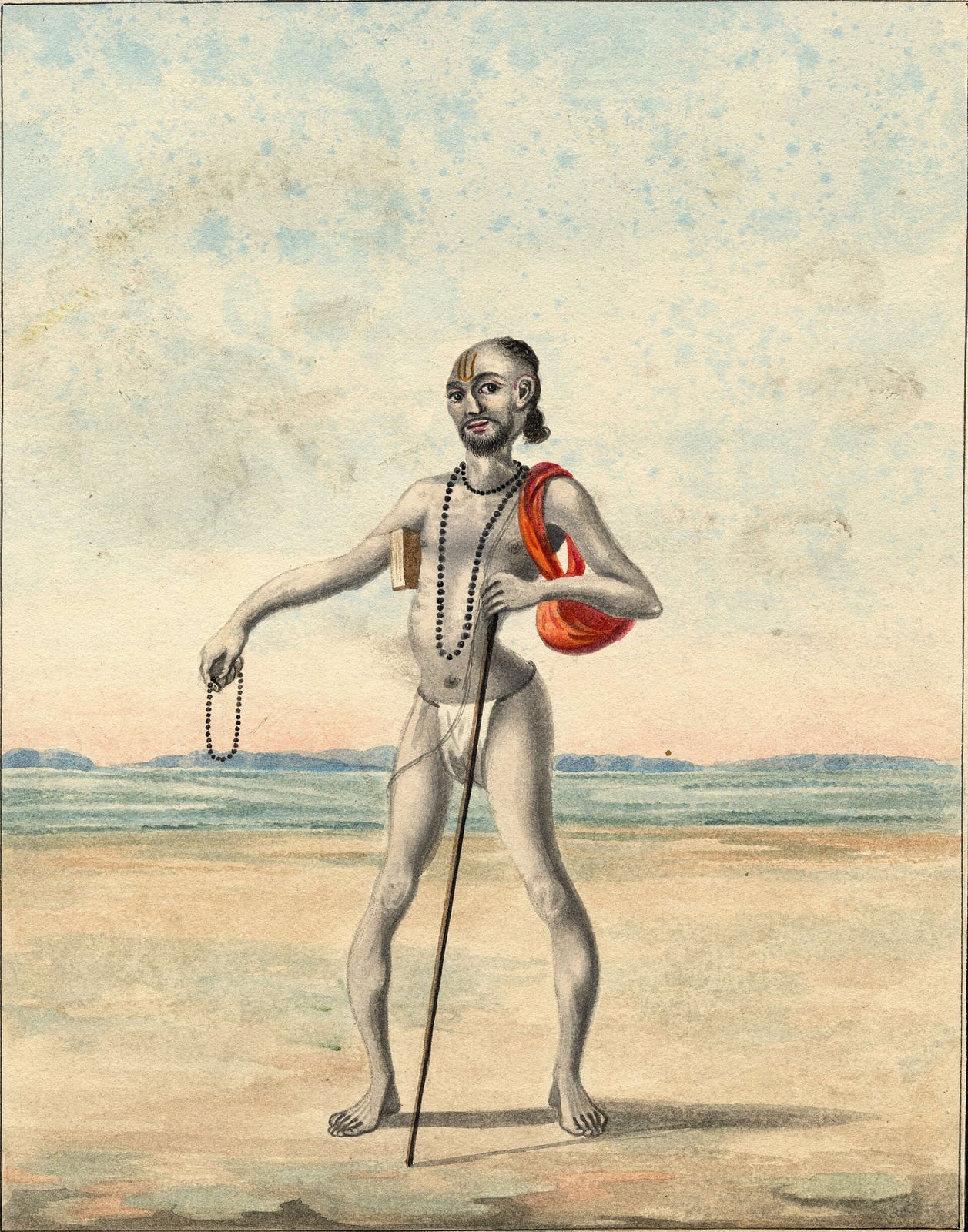
Ashtavakra
They agree on: What is the Absolute? Does God exist? · Who am I? Is there a true self? · Why do we suffer?
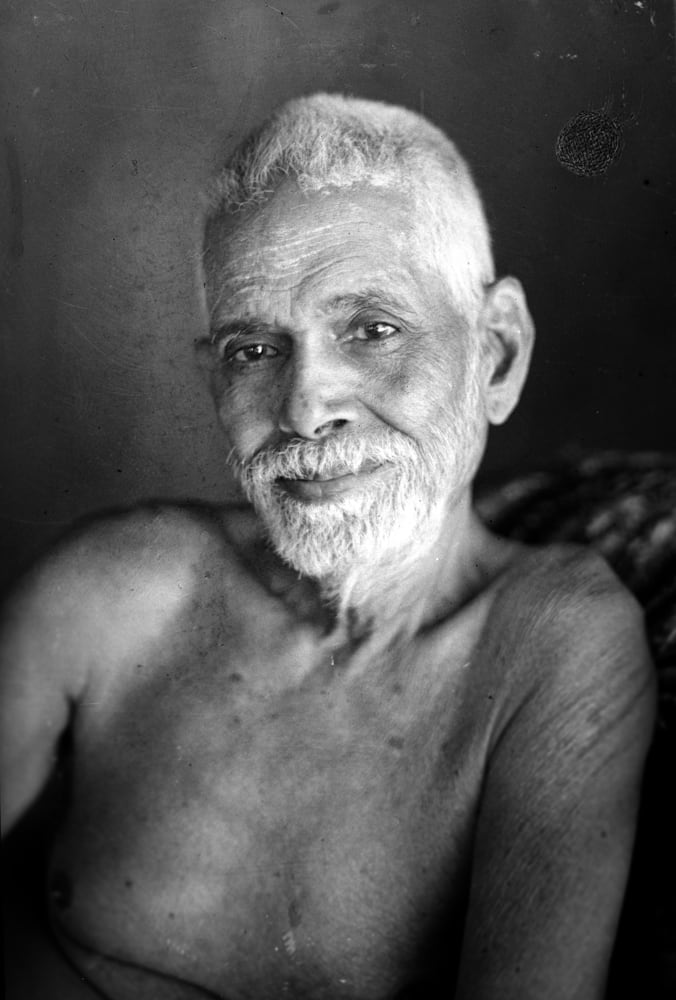
Ramana Maharshi
They agree on: What is the Absolute? Does God exist? · Who am I? Is there a true self? · Why do we suffer?
Uddalaka Aruni
They agree on: What is the Absolute? Does God exist? · Who am I? Is there a true self? · What happens after death?
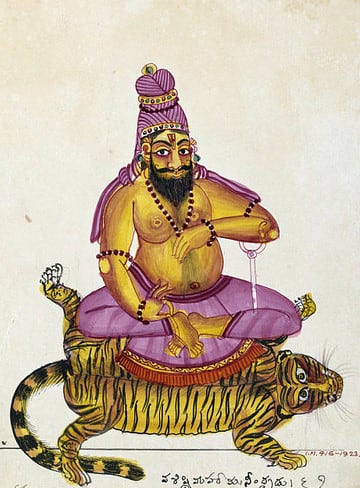
Vasishtha
They agree on: What is the Absolute? Does God exist? · Who am I? Is there a true self? · Why do we suffer?


Anecdotes and stories
Anecdotes and stories
Hagiographic accountc. 660
The woodcutter who heard the Diamond Sūtra
Origin of the story: Autobiography in the Platform Sūtra, already in the Dunhuang copy (ninth century); there is no independent testimony.
Hagiographic accountc. 661
The poem contest
Origin of the story: Autobiography in the Platform Sūtra, already in the Dunhuang copy (ninth century); there is no independent testimony.
Source: McRae, John R. Seeing through Zen: Encounter, Transformation, and Genealogy in Chinese Chan Buddhism. Berkeley: University of California Press, 2003. ISBN 0520237986.
Hagiographic accountc. 661
Three knocks on the mortar
Origin of the story: Only in the late versions of the Platform Sūtra (Huixin 967 and above all Zongbao 1291) and in Song-period case collections (Wumenguan, 1228); absent from the Dunhuang copy.
Source: Wikisource en chino: 六祖大師法寶壇經 (versión de Zongbao, 1291), con una página por capítulo.
Hagiographic accountc. 661
Huiming's original face
Origin of the story: Only in the late versions of the Platform Sūtra (Huixin 967 and above all Zongbao 1291) and in Song-period case collections (Wumenguan, 1228); absent from the Dunhuang copy.
Source: Wikisource en chino: 六祖大師法寶壇經 (versión de Zongbao, 1291), con una página por capítulo.
Hagiographic account676 (según la tradición)
The wind and the banner
Origin of the story: Only in the late versions of the Platform Sūtra (Huixin 967 and above all Zongbao 1291) and in Song-period case collections (Wumenguan, 1228); absent from the Dunhuang copy.
Source: Wikisource en chino: 六祖大師法寶壇經 (versión de Zongbao, 1291), con una página por capítulo.
Hagiographic accountc. 700
The three blows to Shenhui
Origin of the story: Dunhuang copy of the Platform Sūtra (§48–49 in Yampolsky); interpretation by Hu Shi (1930) and Yampolsky (1967).
Testimony1589
Matteo Ricci before the sixth patriarch's body
Origin of the story: Ricci's journals, published in Latin by Nicolas Trigault (1615) and translated by Gallagher (1953); study by Jorgensen (2005).
Source: Ricci, Matteo y Nicolas Trigault. China in the Sixteenth Century: The Journals of Matthew Ricci, 1583–1610. Trad. Louis J. Gallagher. Nueva York: Random House, 1953.
Teachings
Teachings
The notions that structure their thought, explained in context.
Sudden awakening (dunwu)dunwu
Controversy between the Northern and Southern schools (eighth century).
Source: McRae, John R. Seeing through Zen: Encounter, Transformation, and Genealogy in Chinese Chan Buddhism. Berkeley: University of California Press, 2003. ISBN 0520237986.
No-thought, no-form, no-abidingwunian
Platform Sūtra, section 17 of the Dunhuang copy.
Source: Yampolsky, Philip B. (ed. y trad.). The Platform Sutra of the Sixth Patriarch: The Text of the Tun-huang Manuscript. Nueva York: Columbia University Press, 1967; reed. 2012 (ISBN 9780231159562).
Unity of meditation and wisdom (dinghui)dinghui
A Chinese reinterpretation of the discipline-meditation-wisdom triad.
Seeing one's nature (jianxing)jianxing
Doctrine of buddha-nature (foxing) in Chan.
Source: Dōgen. Shōbōgenzō, fascículo «Shizen biku» (四禪比丘), en la recensión de doce fascículos; trad. inglesa en Nishijima, Gudo y Chodo Cross, Master Dogen's Shobogenzo, vol. 4, Windbell, 1999.
Formless precepts (wuxiang jie)wuxiang-jie
Mass lay ordinations in eighth- and ninth-century Chan.
Source: Yampolsky, Philip B. (ed. y trad.). The Platform Sutra of the Sixth Patriarch: The Text of the Tun-huang Manuscript. Nueva York: Columbia University Press, 1967; reed. 2012 (ISBN 9780231159562).
Transmission of the robe and patriarchal lineagechuanyi
Chan historiography (eighth to eleventh centuries).
Source: McRae, John R. Seeing through Zen: Encounter, Transformation, and Genealogy in Chinese Chan Buddhism. Berkeley: University of California Press, 2003. ISBN 0520237986.
Videos
Videos
Recordings, interviews and documentaries. Videos play from YouTube; they are not hosted here.
The Platform Sutra of Chan Buddhism - Jun Wang
Lecture· EN· 2018
Debashish Banerji
Sixth Patriarch's Dharma Jewel Platform Sutra (1) by Rev. Heng Sure from BRF2018
Lecture· EN· 2019
DharmaRealmLiveOfficial channel
Reflections from the Platform Sutra of the Sixth Patriarch - Ven. Dr Juewei
Lecture· EN· 2020
Buddhist Library
The Platform Sutra of the Sixth Patriarch L1
Lecture· EN
Khenpo Sodargye's TeachingsOfficial channel
SBZC with Bill Powell "The Platform Sutra" class #1
Lecture· EN· 2021
Santa Barbara Zen CenterOfficial channel
Class on the Platform Sutra
Lecture· EN
kansaszencenterOfficial channel
The Mind Has No Stand: Zen, Huineng, Teaching & Text
Analysis· EN· 2021
Eric Gerlach
Huineng - The 6th Chinese Ancestor of Zen Buddhism
Lecture· EN
Great Mountain Zen CenterOfficial channel
【六祖壇經的生活實踐】 主講:慧知法師
Lecture· ZH
VIBPS 溫哥華佛光山 Vancouver IBPSOfficial channel
慧知法師紐約佛學講座-《六祖壇經》的生活智慧
Lecture· ZH
FGS IBPS New YorkOfficial channel
佛教紀錄片:六祖惠能的最後一年 (智慧東方)
Documentary· ZH· 2017
佛弟子
¿Quién fue Hui Neng?
Third-party recording· ES
Cosas del Zen
Gallery
Gallery
Images with verified licences. Each keeps its authorship and attribution.
Manuscripts
Manuscripts
Manuscript witnesses and ancient texts, with their custodian and conditions of access.
ZH · Chino (escritura regular, copia manuscrita) · c. 780
南宗頓教最上大乘摩訶般若波羅蜜經六祖惠能大師於韶州大梵寺施法壇經
- Surviving witness
- Copia de hacia 830–860, la más antigua conocida, en formato de cuadernillo
- Custodian
- British Library (Londres) · Or.8210/S.5475
- Digitisation
- idp.bl.uk/…
ZH · Chino · c. 780
六祖壇經 (copia de Dunhuang)
- Surviving witness
- Segunda copia completa de Dunhuang, de mejor calidad textual
- Custodian
- Museo de Dunhuang · Dunbo 077
Connections
Connections
Influences, discipleships and affinities. Documented relations are distinguished from similarities identified by analysis.
Influenced by
The sūtra presents him as the sixth link of the lineage beginning with Bodhidharma and records his transmission verse.
Documented relation
Disciple of
Hongren (601–674), quinto patriarca
His teacher at Huangmei, according to all sources, including Wang Wei's stele.
Documented relation
Contemporary of
Shenxiu (c. 606–706)
Hongren's chief disciple and figure of the Northern school; the poem contest pitting them against each other is legendary.
Documented relation
Teacher of
Shenhui (684–758)
He proclaimed himself his disciple and was the architect of his fame; the Dunhuang copy includes him among his ten disciples.
Documented relation
Influenced
Heir of a Caodong lineage going back to Huineng; in the Shōbōgenzō (“Shizen biku”) he rejected the Platform Sūtra as apocryphal.
Documented relation
Influenced
His Rinzai lineage goes back to Huineng through Linji; the kenshō Hakuin demands is the sūtra's “seeing the nature”.
Similarity identified by analysis
Influenced
A Sōtō master, of Dōgen's lineage which goes back to Huineng.
Similarity identified by analysis
Influenced
His Vietnamese Lâm Tế (Linji) lineage goes back to Huineng.
Similarity identified by analysis
Influenced by
The sūtra's logic of emptiness—denying tree and mirror—extends the prajñāpāramitā and Madhyamaka; tradition counts Nāgārjuna among the Indian patriarchs.
Similarity identified by analysis
Contemporary of
Rough contemporaries at the two ends of Asia, both centred on the nature of mind and the wisdom of emptiness.
Similarity identified by analysis
Ideas akin to
The sūtra's valuing of flow, non-fixation and immediacy recalls Daoist themes; the influence is debated.
Similarity identified by analysis
Sources
Sources
Bibliography and catalogues consulted for this profile.
- Wikidata, «Huineng», QID Q345012 (VIAF 32007548; LCCN n50078883).
- Yampolsky, Philip B. (ed. y trad.). The Platform Sutra of the Sixth Patriarch: The Text of the Tun-huang Manuscript. Nueva York: Columbia University Press, 1967; reed. 2012 (ISBN 9780231159562).
- McRae, John R. Seeing through Zen: Encounter, Transformation, and Genealogy in Chinese Chan Buddhism. Berkeley: University of California Press, 2003. ISBN 0520237986.
- McRae, John R. (trad.). The Platform Sutra of the Sixth Patriarch, translated from the Chinese of Tsung-pao. Berkeley: Numata Center for Buddhist Translation and Research, 2000. ISBN 1886439133.
- McRae, John R. The Northern School and the Formation of Early Ch'an Buddhism. Honolulu: University of Hawai'i Press (Kuroda Institute), 1986.
- Schlütter, Morten y Stephen F. Teiser (eds.). Readings of the Platform Sūtra. Nueva York: Columbia University Press, 2012. ISBN 9780231158206.
- Jorgensen, John. Inventing Hui-neng, the Sixth Patriarch: Hagiography and Biography in Early Ch'an. Leiden: Brill (Sinica Leidensia 68), 2005. ISBN 9004145087.
- Thompson, John M. «Huineng (Hui-neng) (638–713)». Internet Encyclopedia of Philosophy.
- Hu Shi 胡適 (ed.). Shenhui heshang yiji 神會和尚遺集 (Obras conservadas del monje Shenhui). Shanghái: Yadong tushuguan, 1930.
- Wang Wei 王維. «Neng chanshi bei» 能禪師碑 (Estela del maestro de chan Neng), mediados del siglo VIII, recogida en el Quan Tang wen; inscripción encargada por Shenhui.
- Schlütter, Morten. «A Study in the Genealogy of the Platform Sūtra». Studies in Central and East Asian Religions 2 (1989): 53–114.
- Wong Mou-lam (trad.). Sutra Spoken by the Sixth Patriarch, Wei Lang, on the High Seat of the Gem of Law. Shanghái: Yu Ching Press, 1930.
- Wikisource en chino: 南宗頓教最上大乘摩訶般若波羅蜜經六祖惠能大師於韶州大梵寺施法壇經 (texto de la copia de Dunhuang, compilado por Fahai).
- Wikisource en chino: 六祖大師法寶壇經 (versión de Zongbao, 1291), con una página por capítulo.
- Huineng (atrib.), Fahai (comp.). 六祖壇經 (Liuzu tanjing), edición de la dinastía Ming colacionada por Deqing. Project Gutenberg, e-book n.º 23844, 2007.
- Ricci, Matteo y Nicolas Trigault. China in the Sixteenth Century: The Journals of Matthew Ricci, 1583–1610. Trad. Louis J. Gallagher. Nueva York: Random House, 1953.
- Dumoulin, Heinrich. Zen Buddhism: A History. Vol. 1: India and China. Nueva York: Macmillan, 1988.
- Red Pine (Bill Porter) (trad.). The Platform Sutra: The Zen Teaching of Hui-neng. Emeryville (CA): Shoemaker & Hoard, 2006. ISBN 9781593760861.
- Dōgen. Shōbōgenzō, fascículo «Shizen biku» (四禪比丘), en la recensión de doce fascículos; trad. inglesa en Nishijima, Gudo y Chodo Cross, Master Dogen's Shobogenzo, vol. 4, Windbell, 1999.
- Yanagida Seizan 柳田聖山. Shoki zenshū shisho no kenkyū 初期禅宗史書の研究. Kioto: Hōzōkan, 1967.
- Yanagida Seizan (ed.). Rokuso dangyō shohon shūsei 六祖壇經諸本集成. Kioto: Chūbun shuppansha, 1976.
- Chan, Wing-tsit (trad.). The Platform Scripture. Nueva York: St. John's University Press, 1963.
- Rights holder
- Texto chino original en dominio público. Traducciones modernas con derechos: Columbia University Press (Yampolsky), Numata Center/BDK (McRae), Counterpoint (Red Pine), Shambhala (Cleary; Price y Wong), Editorial Kairós (Laureano Ramírez), Edaf.
Pending confirmation
What this profile has not yet been able to settle. We would rather say so than fill it in.
- Traducción inglesa de Wong Mou-lam (Shanghái, Yu Ching Press, 1930): es de dominio público en EE. UU. (publicada en 1930, libre desde el 1 de enero de 2026), en la UE y en España (Wong Mou-lam, 1886–1934), pero no se ha localizado un escaneo con OCR limpio de la edición de 1930; las de Luzac (1944, 1953) y Shambhala llevan la revisión de Christmas Humphreys (m. 1983), protegida. Buscar en Internet Archive o HathiTrust la edición de 1930.
- Versión base de la traducción española de Laureano Ramírez (Kairós, 2010; hay ediciones anteriores) — comprobar si es la de Dunhuang o la de Zongbao.
- Signatura y digitalización de la copia del Museo de Dunhuang (Dunbo 077) y de la de Lüshun; no verificadas en un catálogo accesible.
- Fecha y circunstancias exactas del título póstumo (815/816) y de las estelas de Liu Zongyuan y Liu Yuxi: se han tomado de la bibliografía secundaria (Dumoulin), no de las fuentes.
- Vídeos en español: solo se ha encontrado material divulgativo breve; no hay conferencias académicas en español con canal solvente.
- Las ediciones francesas, alemanas e italianas del sūtra no se han cotejado en catálogo.
Researched on 2026-10-25