Buddhism · Mahayana · Zen / Chan
Bodhidharma
菩提達摩 · 菩提達磨 · 達磨 · 달마
Historicity debated
An Indian or Central Asian monk of the late fifth and early sixth centuries whom the Chan, Zen and Seon tradition venerates as its founder and first Chinese patriarch. Two early sources confirm that a meditation master of that name existed in northern China and taught 'wall contemplation' to Huike and Daoyu; almost everything else—Emperor Wu, the nine years facing the wall at Shaolin, Huike's arm, kung fu—is legend formed between the eighth and seventeenth centuries.
- works
- 10works
- editions
- 9editions
- quotes
- 5quotes
- videos
- 12videos
- images
- 7images
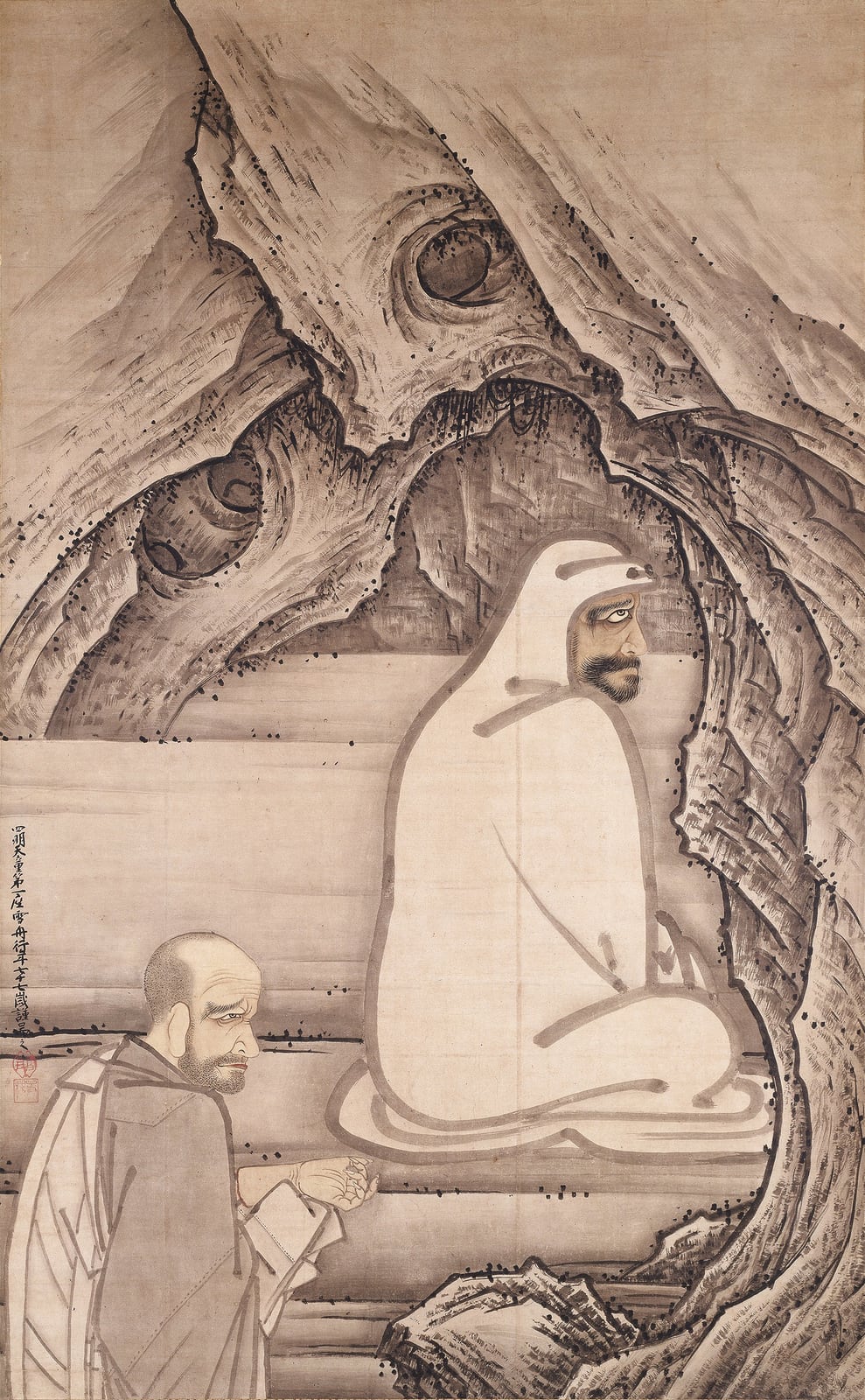
Huike ofrece su brazo a Bodhidharma, de Sesshū Tōyō (1496) · Public domain
In their words
«There are many paths for entering the Way, but in essence they are no more than two: entrance by principle and entrance by practice.»Tratado de las dos entradas y las cuatro prácticas, inicio (texto del Xinzuan Xu zangjing en Wikisource; traducción del investigador)

Their central idea
Wall contemplation (biguan): Biguan (壁觀) is the name Tanlin and Daoxuan give to the 'method of pacifying the mind' that Bodhidharma taught, and it is the oldest term associated with his meditation.
See in context
Biography
5 min read
A foreigner before the pagoda
The first time Bodhidharma's name appears in writing is not in a Zen text but in a nostalgic guide to the monasteries of Luoyang, capital of the Northern Wei, composed in 547 by the official Yang Xuanzhi when the city already lay in ruins. Describing the great pagoda of Yongning monastery, built in 516 and destroyed by fire in 534, Yang notes that a monk from the western regions named Bodhidharma, 'a barbarian from Persia', marvelled at its golden bells and declared that, at a hundred and fifty years of age and after travelling through every country, he had never seen anything like it; for days he stood before it with palms joined, chanting 'namo'. It is an almost contemporary testimony, but it says nothing of meditation or disciples.
The master of wall contemplation
The second source comes from within his circle. A disciple named Tanlin wrote a short preface to the Treatise on the Two Entrances and the Four Practices, and in 645 the monk-historian Daoxuan incorporated it, almost word for word, into his biography of Bodhidharma in the Continued Biographies of Eminent Monks. According to these texts, Bodhidharma was a brahmin from southern India—Tanlin says the third son of a king—who after 'crossing mountains and seas', reached the territory of the Song dynasty in southern China and later went north to the kingdom of the Wei, where he taught meditation. The doctrinal masters, then dominant, criticised him; only two young monks, Daoyu and Huike, followed him for four or five years.
What he taught them, according to Daoxuan, was a 'method of pacifying the mind': 'wall contemplation' (biguan), whose exact sense is debated—a mind as firm as a wall or meditation facing the wall—and the two entrances, of principle and of practice. He is also said to have entrusted them with the Laṅkāvatāra Sūtra in its four-fascicle version, with these words: 'I have observed the land of the Han and there is only this sūtra; if you practise it, you will save yourselves.' Daoxuan adds that Bodhidharma claimed to be over a hundred and fifty years old and that no one knew how he ended; in Huike's biography, however, he notes that he died on the banks of the Luo river.
The invention of a patriarch
For more than a century no one gave this master a special role. It was between the late seventh and early eighth centuries that the disciples of Hongren and Shenxiu, eager to give their meditation school a genealogy as noble as those of the doctrinal schools, traced a line of transmission beginning with Bodhidharma and passing through Huike, Sengcan, Daoxin and Hongren. The Record of the Transmission of the Dharma Treasure (c. 710) makes him 'first patriarch'; the Record of the Masters and Disciples of the Laṅkā (c. 713–716) still places Guṇabhadra, the sūtra's translator, before him. Later, Shenhui's polemic against the Northern School and the Platform Sūtra of the sixth patriarch, Huineng, adjusted the line to their own interests, and the Baolin zhuan (801) extended it backwards to make Bodhidharma the twenty-eighth Indian patriarch since the Buddha.
With the line came the episodes. From the eighth century onward appears the interview with Emperor Wu of the Liang, who asks how much merit he has gained by building temples and receives a 'none', and who, asking who stands before him, hears 'I do not know'. The Record of the Transmission of the Lamp of the Jingde era (1004) fixed the canonical version: the crossing of the Yangtze on a reed, the nine years of meditation facing the wall of a cave near Shaolin, Huike waiting in the snow and cutting off his arm to prove his sincerity, the dialogue in which the master 'pacifies' his mind, the transmission of robe and bowl, the six poisoning attempts, the tomb on Mount Xiong'er, and the traveller Song Yun who meets him in the Pamirs carrying a single sandal, when he was already believed buried.
None of these stories has a basis in the early sources, and some contradict them: according to Daoxuan, Huike lost his arm to bandits and bore the wound without complaint. As Bernard Faure has shown, the figure of Bodhidharma functioned as a 'textual paradigm': an empty place in which each generation of the school inscribed what it needed to say about itself.
The texts
Of the attributed work, only the Treatise on the Two Entrances and the Four Practices has a transmission going back to his circle. The Dunhuang manuscripts place it at the head of a larger compilation, the so-called 'Long Scroll', with sayings of seventh-century masters. The sermons now circulating under his name—the Bloodstream Sermon, the Wake-up Sermon, the Breakthrough Sermon—are later Chan works; the last is in fact Shenxiu's Treatise on Contemplating the Mind. The compilation that gathers them, the Six Gates of Shaoshi, dates from the Song period or later. Later still is his fame as founder of kung fu: the Sinew-Changing Classic, which presents him as a master of physical exercises, was written by a Daoist in the early seventeenth century.
From monk to icon
The result is one of the most reproduced figures in Asian art. In Japan, where he is called Daruma, Zen painters from Sesshū to Hakuin portrayed him with bulging eyes and a barbarian's beard; the armless, legless papier-mâché dolls that evoke his years of motionless meditation have become talismans of perseverance. The Chan, Zen, Seon and Thiền schools invoke him as the origin of the 'special transmission outside the scriptures' which, according to a Song-period formula, 'does not rely on words, points directly to the mind, and makes one see one's own nature and become a buddha'. What history allows us to affirm is much less: that around the year 500 a foreign monk taught an austere meditation in northern China, grounded in the Laṅkāvatāra, to a handful of disciples, and that from that handful came, by paths he could not have imagined, the tradition of Zen.
Sources: Yang Xuanzhi. Luoyang qielan ji (Memoria de los monasterios budistas de Luoyang), 547, cap. 1, «Monasterio de Yongning». Texto chino en Wikisource; trad. inglesa: Yi-t'ung Wang, A Record of Buddhist Monasteries in Lo-yang, Princeton University Press, 1984 (ISBN 9780691054032). · Daoxuan. Xu gaoseng zhuan (Continuación de las biografías de monjes eminentes), 645 (ampliada hasta 667), cap. 16: biografías de Bodhidharma y de Huike (Taishō 2060). Texto chino en Wikisource. · Tanlin (atrib.). Prefacio al «Tratado de las dos entradas y las cuatro prácticas» (菩提達磨大師略辨大乘入道四行觀), según el Xinzuan Xu zangjing. Texto chino en Wikisource. · Broughton, Jeffrey L. The Bodhidharma Anthology: The Earliest Records of Zen. Berkeley: University of California Press, 1999. ISBN 9780520219724. · McRae, John R. Seeing Through Zen: Encounter, Transformation, and Genealogy in Chinese Chan Buddhism. Berkeley: University of California Press, 2003. ISBN 9780520237988.
Timeline
A life, year by year
Each point is a documented event. Click to read it, with its source and degree of certainty.
470sChina meridional (territorio de los Song)
Arrival in China
According to Daoxuan he first reached the territory of the Song dynasty (420–479) in the south and later went north. Late tradition places it in 527, in Canton.
TraditionDaoxuan. Xu gaoseng zhuan (Continuación de las biografías de monjes eminentes), 645 (ampliada hasta 667), cap. 16: biografías de Bodhidharma y de Huike (Taishō 2060). Texto chino en Wikisource.
470s
Arrival in China
According to Daoxuan he first reached the territory of the Song dynasty (420–479) in the south and later went north. Late tradition places it in 527, in Canton.
Tradition
c. 520
Before the Yongning pagoda
Yang Xuanzhi describes him admiring the Yongning pagoda (built 516, burned 534) and claiming to be a hundred and fifty years old.
Documented
c. 520
Teaching Daoyu and Huike
He teaches wall contemplation and the two entrances to his two disciples for four or five years and gives Huike the Laṅkāvatāra.
Probable
527
Interview with Emperor Wu (legend)
The date tradition gives for the dialogue on merit with Emperor Wu of the Liang; the episode appears in the eighth century.
Tradition
c. 528
Nine years facing the wall (legend)
Late tradition places him meditating for nine years facing the wall of a cave near Shaolin.
Tradition
536
Death (traditional date)
Daoxuan only says that he died by the Luo river and that no one knew how he ended; 536 is the most widespread traditional date.
Tradition
547
First written mention
Yang Xuanzhi completes the Record of the Buddhist Monasteries of Luoyang, with the notice on Bodhidharma.
Documented
645
Daoxuan's biography
Daoxuan includes his biography and Huike's in the Continued Biographies of Eminent Monks.
Documented
c. 716
First patriarch
The chronicles of the meditation school (Chuan fabao ji, Lengqie shizi ji) make him the first patriarch of a line of transmission.
Documented
801
Twenty-eighth Indian patriarch
The Baolin zhuan extends the genealogy back to the Buddha and makes him the twenty-eighth Indian patriarch.
Documented
1004
The Transmission of the Lamp
The Jingde chuandeng lu fixes the canonical version of his legend.
Documented
1496
Sesshū paints Huike and Bodhidharma
Sesshū Tōyō paints the scene of Huike offering his arm.
Documented
1624
The Yijin jing
Date of the preface of the Sinew-Changing Classic, falsely attributed to Bodhidharma, the origin of his fame as founder of Shaolin kung fu.
Documented
Works
Essential works
The works without which their legacy cannot be understood.
Recorded oral teaching
Treatise on the Two Entrances and the Four Practices
二入四行論 (菩提達磨大師略辨大乘入道四行觀)
A short teaching that sums up the path in two 'entrances': entrance by principle (理入), which consists in deep faith that all beings share one true nature, hidden by the dust of thoughts, and in 'abiding firmly in wall contemplation'; and entrance by practice (行入), unfolded in four practices: accepting suffering as the fruit of past deeds, adapting to circumstances, seeking nothing, and acting in accord with the Dharma. It is the core of what can be attributed to Bodhidharma with any plausibility.
3 editions · amazon.com
Traditional attribution · XI century
The Bloodstream Sermon (Xuemai lun)
達磨大師血脈論
A question-and-answer dialogue that opens by stating that buddhas are transmitted 'from mind to mind, without relying on written words' and holds that seeking the buddha outside one's own nature is useless: 'whoever wishes to see the buddha must see his nature'. It already sets out the mature Chan doctrine of sudden awakening and the critique of external practices.
1 edition · amazon.com
Traditional attribution · XI century
The Wake-up Sermon (Wuxing lun)
達磨大師悟性論
A short treatise on awakening to one's own nature: enlightenment is reached not by accumulating merit or by study but by seeing that the mind itself is empty and free. Included in the Shaoshi liumen, it is among the texts most widely read in the West as 'words of Bodhidharma', thanks to Red Pine's translation.
1 edition · amazon.com
Complete works (10)
The 'Long Scroll': Dunhuang Compilation around the Two Entrances
700
The Breakthrough Sermon (Poxiang lun)
700
Bodhidharma
The Dharma Gate of Pacifying the Mind (Anxin famen)
The Conscious LibraryThe Dharma Gate of Pacifying the Mind (Anxin famen)
Bodhidharma
Verses on the Heart Sūtra (Xinjing song)
The Conscious LibraryVerses on the Heart Sūtra (Xinjing song)
Bodhidharma
The Six Gates of Shaoshi (Shaoshi liumen)
The Conscious LibraryThe Six Gates of Shaoshi (Shaoshi liumen)
Bodhidharma
Sinew-Changing Classic (Yijin jing)
The Conscious LibrarySinew-Changing Classic (Yijin jing)
1624
Bodhidharma
Marrow-Washing Classic (Xisui jing)
The Conscious LibraryMarrow-Washing Classic (Xisui jing)
1650
Quotations
Quotations located in a specific work. Each carries its provenance and its level of confidence.
There are many paths for entering the Way, but in essence they are no more than two: entrance by principle and entrance by practice.夫入道多途,要而言之,不出二種:一是理入、二是行入。
ProbableTratado de las dos entradas y las cuatro prácticas, inicio (texto del Xinzuan Xu zangjing en Wikisource; traducción del investigador)
Apocryphal quotes or disputed attributions (3)
«A special transmission outside the scriptures, not relying on words and letters, pointing directly to the human mind, seeing one's nature and becoming a buddha.»
A four-line formula (教外別傳,不立文字,直指人心,見性成佛) that tradition attributes to Bodhidharma. Its elements appear in Chan texts of the ninth and tenth centuries and the complete formula took shape in the Song period (eleventh–twelfth centuries); it is found in no sixth- or seventh-century source.
«The three realms arise together and return to a single mind. Buddhas before and after transmit from mind to mind, without relying on writing.»
Opening of the 'Bloodstream Sermon' (三界混起,同歸一心,前佛後佛,以心傳心,不立文字), a late-attributed text with ninth- and tenth-century Chan vocabulary; it was circulating by 1153.
«Vast emptiness, nothing holy.»
The reply (廓然無聖) legend puts in his mouth before Emperor Wu when the latter asks about the highest meaning of the holy truth. The dialogue appears in the eighth century and is fixed in the Jingde chuandeng lu (1004) and the Biyan lu (case 1); it has no support in the early sources.
Last words
Traditional attribution
«I came to this land originally to transmit the Dharma and save the deluded. One flower will open five petals, and the fruit will ripen of itself.»吾本來茲土,傳法救迷情。一華開五葉,結果自然成。
A transmission verse that the Jingde chuandeng lu (1004) attributes to Bodhidharma on taking leave of his disciples: after asking them what they had understood and telling them they had obtained his skin, his flesh, his bones and, in Huike's case, his marrow, he gives Huike the robe and the Laṅkāvatāra and recites these lines. The 'five petals' were read as a prophecy of the following five patriarchs or of the five houses of Chan. It is a composition of the late tradition; the early sources (Daoxuan) say no one knew how he ended.
Source: Daoyuan. Jingde chuandeng lu (Registro de la transmisión de la lámpara de la era Jingde), 1004, cap. 3 (Taishō 2076). CBETA.
Ask
What their work answers
Twelve great human questions and what their texts allow us to answer, with references. We never put words in their mouth.
What is the Absolute? Does God exist?
One and the same true nature in all beings, hidden by dust
An impersonal AbsoluteInferred from their doctrine
The only work with any chance of being his, the Treatise on the Two Entrances and Four Practices, does not speak of God. It speaks of a «principle» (li) and of a «true nature» that all living beings share and that is hidden only by the adventitious dust of deluded thoughts. Entering by principle means returning from the false to the true through wall contemplation, until silently according with it, without self or other, the ordinary person and the sage being equal. That nature is not someone: it does not know, will or relate to the creature. It is the common, formless ground that Chinese Buddhism called buddha-nature. The closest key is that of an impersonal Absolute, with the proviso that the text never calls it so.
Compare this question with other teachersWho am I? Is there a true self?
Beneath deluded thoughts, a shared true nature, without self or other
The Self is the AbsoluteInferred from their doctrine
The Treatise on the Two Entrances, the only work that can be traced to Bodhidharma's circle, does not speak of the self as a soul or a person. It speaks of a true nature that all living beings share and that the adventitious dust of deluded thoughts covers. Whoever abandons the false and returns to the true, steadfast in wall contemplation, is left «without self or other»: the ordinary person and the sage are equal. The text thus joins two statements that seem opposed. The particular self, with its gains and losses, is not what we are; what we are is that common nature, which belongs to no one. The fourth practice, in accord with the Dharma, adds that in the Dharma there is no self, because it is free of the stain of self.
Compare this question with other teachersWhy do we suffer?
To seek is to suffer; to seek nothing is peace
Craving and attachmentStated explicitly
The Treatise on the Two Entrances and Four Practices answers soberly. The third practice, «seeking nothing», starts from the fact that dwelling long in the three worlds is like living in a burning house: all that has a body suffers. Worldly people, deluded, attach themselves to one thing after another and call this seeking; the sage understands that all seeking brings suffering and that ceasing to seek brings joy. The first practice adds a karmic reading: present pain is the fruit of past deeds, committed over countless lives, and must be accepted without resentment. The second asks one to adapt to circumstances: gain and loss depend on them, and the mind that is not moved by the wind of joy silently accords with the Way.
Compare this question with other teachersWhat happens after death?
Present pain comes from past lives: it is accepted without resentment
Rebirth according to karmaInferred from their doctrine
The Treatise on the Two Entrances and Four Practices does not speak of what happens at death, but it takes rebirth for granted. The first practice, that of «requiting injury», asks the sufferer to consider that, over countless aeons, he has abandoned the essential for the incidental and wandered through all forms of existence, causing hatred and harm; what he suffers now is the ripened fruit of those deeds, not something imposed by heaven or men. This awareness of previous lives serves to accept pain without resentment. The third practice presents the three worlds as a burning house from which only ceasing to seek frees one. The framework is the common Buddhist one; the text adds no doctrine of its own about death.
Compare this question with other teachersHow is liberation or salvation attained?
Two entrances: by principle, contemplating the wall, and by four practices
Through disciplined practiceStated explicitly
The Treatise on the Two Entrances and Four Practices sums up the path in its first sentence: many are the ways, but in essence they are two, entrance by principle and entrance by practice. The first consists in trusting deeply that all beings share a true nature and remaining steadfast in wall contemplation until silently according with it. The second unfolds in four practices: accepting suffering as the fruit of past deeds, adapting to circumstances without letting gain or loss move the mind, seeking nothing, and acting in accord with the Dharma, practising the perfections without attachment. It is a sober programme, joining a vision and a daily discipline of the mind.
Compare this question with other teachersIs a teacher necessary?
He hands over a sūtra and a practice: «you yourselves will be saved»
Helpful but not indispensableInferred from their doctrine
The oldest sources present Bodhidharma as a master with few disciples, Huike and Daoyu among them, according to Tanlin's preface. But what they transmit of him is not the idea of dependence on the master. According to Daoxuan's biography of Huike, when he handed him the four-fascicle Laṅkāvatāra he told him that in the land of the Han there was only this sūtra and that, if they practised it, they themselves would be saved. The Treatise on the Two Entrances adds that, steadfast in wall contemplation, one no longer follows the letter of the teachings: access is inward. The master guides and hands over a text and a method; the work belongs to the disciple. The image of the patriarch transmitting awakening from mind to mind is later.
Compare this question with other teachersIs the world real?
Gain and loss depend on circumstances; forms are empty
A web of causes without substanceInferred from their doctrine
The Treatise on the Two Entrances sets out no cosmology, but it shows how it looks at the world. The second practice states that beings have no self and that all that happens to them, gain or loss, honour or disgrace, depends on circumstances: when these are exhausted, it disappears, and there is no reason to rejoice or grieve. The fourth practice calls Dharma the principle of the purity of nature, and says that in it all forms are empty, without stain or attachment, without this or that. The third adds the existential side: the three worlds are a burning house. The world thus appears as a web of conditions without substance, before which the practitioner remains unmoved, neither rejecting nor pursuing it.
Compare this question with other teachersWhat is love?
He does not define love; he practises the perfections for his own and others' benefit
Did not address it
The Treatise on the Two Entrances and Four Practices contains no reflection on love. The closest thing is in the fourth practice, acting in accord with the Dharma: whoever understands that in pure nature there is neither self nor other practises generosity without avarice towards one's body, life or goods, and offers it without attachment, to eliminate delusion, benefiting oneself and others. The other perfections are practised in the same way. The text presupposes the bodhisattva ideal of Chinese Buddhism, in which compassion is central, but its emphasis lies on purifying one's own mind and on equanimity in circumstances, not on the affective bond. Attributing a doctrine of love to it would be forcing it.
Compare this question with other teachersAre we free, or is everything determined?
What one suffers is the fruit of the past; how one receives it, a present decision
Karma and choiceStated explicitly
The first two practices of the Treatise on the Two Entrances formulate a very concrete ethics of karma. The first asks that, in the face of suffering, one consider it the ripened fruit of deeds committed in past lives, not something imposed by heaven or men, and accept it without complaint or resentment. The second adds that beings have no self and that everything, gain or loss, honour or disgrace, depends on circumstances, so that when these are exhausted it disappears. The past determines what comes; what remains in the practitioner's hands is not to be moved: the mind neither grows nor wanes, the wind of joy does not move it, and so it silently accords with the Way. Freedom lies in the response, not in the event.
Compare this question with other teachersWhy meditate or pray?
Contemplating the wall: returning from the false to the true nature
Returning to the source of the IInferred from their doctrine
The meditation associated with Bodhidharma in the oldest sources is wall contemplation (biguan), which Tanlin and Daoxuan present as his method for pacifying the mind. The Treatise on the Two Entrances places it within entrance by principle: whoever trusts that all beings share a true nature, hidden by deluded thoughts, abandons the false, returns to the true and remains steadfast, unmoving, without self or other, until silently according with the principle. The exact meaning of «wall» is debated: it may be the mind firm as a wall or literally sitting before one. What is clear is the direction: not observing phenomena one by one, but returning to the source that thoughts cover.
Compare this question with other teachersCan reason know the ultimate?
Steadfast before the wall, one no longer follows the letter of the teachings
The ultimate lies beyond the mindStated explicitly
The Treatise on the Two Entrances does not belittle the scriptures: entrance by principle begins by relying on them to trust in the true nature common to all beings. But the decisive step goes beyond them. Whoever remains steadfast in wall contemplation, without self or other, no longer follows the letter of the teachings, and silently accords with the principle. Ultimate understanding is neither conceptual nor discursive: it is a silent conformity. According to Daoxuan, Bodhidharma handed Huike a sūtra, the Laṅkāvatāra, as sufficient guidance for China, which shows that the written word had its place. Reason and text prepare; the ultimate is realised directly, in the silence of a mind that has stopped moving.
Compare this question with other teachersWithdraw from the world or transform it?
Seek nothing in a burning house; steadfast before the wall
Withdraw in order to findInferred from their doctrine
The Treatise on the Two Entrances proposes an attitude of distance towards the world. The third practice, seeking nothing, starts from the fact that the three worlds are a burning house in which all that has a body suffers; the sage, unlike deluded people, stops pursuing and clings to nothing. Wall contemplation requires remaining steadfast and unmoving. But the second practice qualifies this: it is not a matter of fleeing circumstances but of adapting to them without letting gain or loss move the mind, and the fourth asks one to practise generosity for one's own and others' benefit. Withdrawal is inward before it is geographical: detachment in the midst of what happens, rather than abandonment of the world.
Compare this question with other teachers
Affinities & tensions
Affinities and tensions
Calculated question by question from their positions. The reason for each agreement or clash, on click.
Thinks most like

Siddhartha Gautama, the Buddha
They agree on: Why do we suffer? · What happens after death? · How is liberation or salvation attained?
Sadhguru
They agree on: What is the Absolute? Does God exist? · Who am I? Is there a true self? · What happens after death?
Patañjali
They agree on: Who am I? Is there a true self? · What happens after death? · How is liberation or salvation attained?
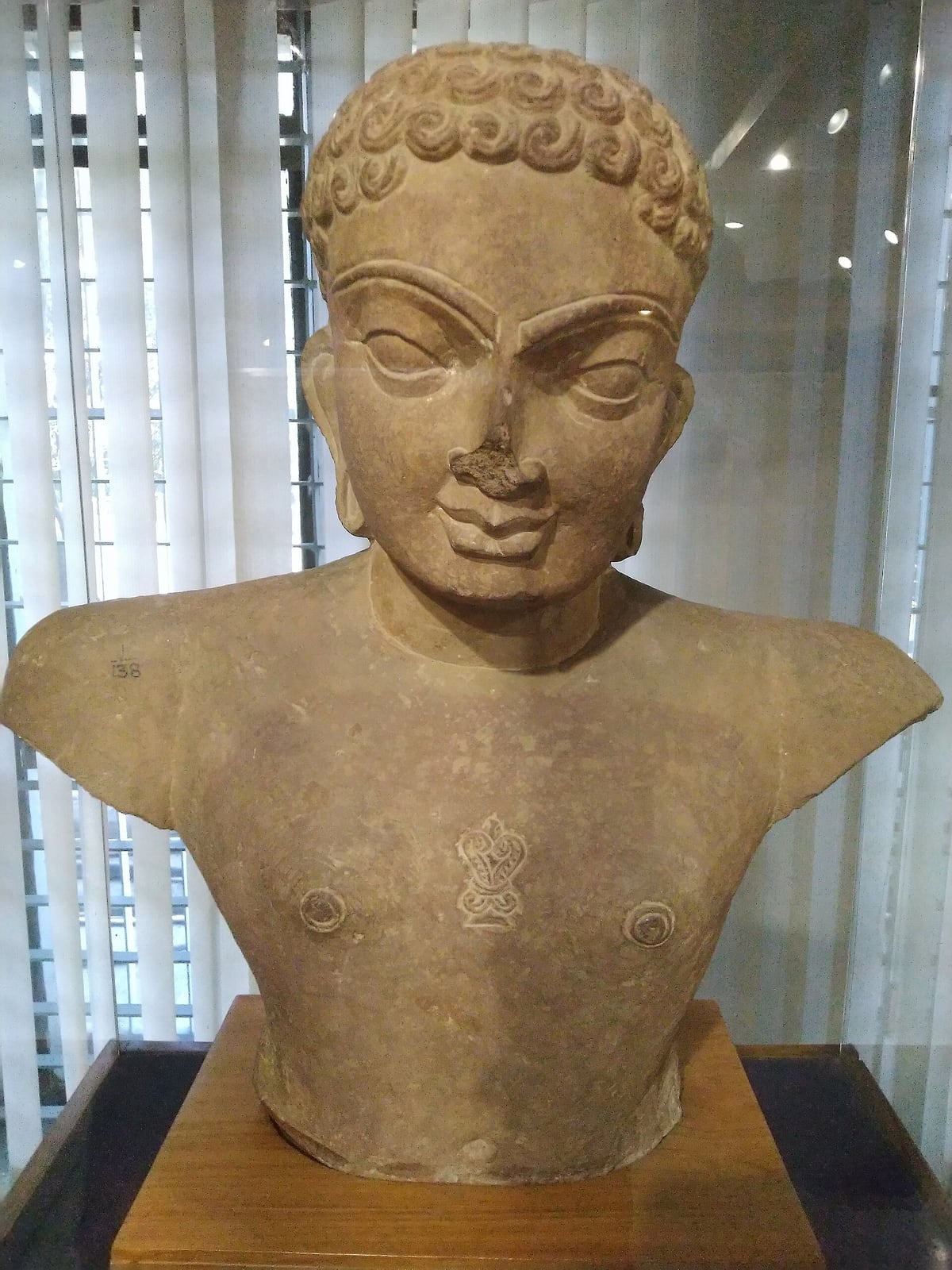
Mahāvīra
They agree on: What happens after death? · How is liberation or salvation attained? · Is a teacher necessary?
Thinks most unlike

Francis of Assisi
They clash on: Who am I? Is there a true self? · What happens after death?

Chaitanya Mahaprabhu
They clash on: Who am I? Is there a true self? · What happens after death?

Emanuel Swedenborg
They clash on: Who am I? Is there a true self? · What happens after death?

Theophan the Recluse
They clash on: Who am I? Is there a true self? · What happens after death?
Anecdotes and stories
Anecdotes and stories
Documentedc. 516–534
The monk who admired the pagoda
Origin of the story: Yang Xuanzhi, Luoyang qielan ji (547), ch. 1, entry on Yongning monastery (Chinese text on Wikisource). Some scholars doubt that the 'Persian' monk is the same Bodhidharma as Daoxuan's; most accept it.
Hagiographic account527 (fecha tradicional)
'I do not know'
Origin of the story: Earliest versions in texts from Shenhui's circle and in the Platform Sūtra (eighth century); canonical form in the Jingde chuandeng lu (1004), ch. 3, and the Biyan lu (1125), case 1. McRae and Faure analyse it as a creation of the school.
Disputeds. VI (narrado en el s. VIII y fijado en 1004)
Huike's arm
Origin of the story: Daoxuan, Xu gaoseng zhuan (645), ch. 16, biography of Huike: '遭賊斫臂' (bandits cut off his arm). The self-sacrifice version: eighth-century Chan texts and the Jingde chuandeng lu (1004), ch. 3.
Hagiographic accounts. VI (narrado desde el s. VIII)
Pacifying the mind
Origin of the story: Jingde chuandeng lu (1004), ch. 3; Wumen guan (1228), case 41. The term 安心 comes from Tanlin and Daoxuan.
Hagiographic accounts. VI (narrado desde el s. VIII)
The sandal of the Pamirs
Origin of the story: Jingde chuandeng lu (1004), ch. 3, and earlier Chan sources; the account of Song Yun's journey survives in the Luoyang qielan ji itself (ch. 5), with no mention of Bodhidharma. Faure (1986) analyses the borrowing of the Daoist motif.
Unverifiableleyenda formada desde 1624
The founder of kung fu
Origin of the story: Shahar, The Shaolin Monastery (2008), chapter on the Yijin jing. The attribution to Bodhidharma has no basis before the seventeenth century; today it circulates mostly through martial-arts cinema.
Source: Shahar, Meir. The Shaolin Monastery: History, Religion, and the Chinese Martial Arts. Honolulu: University of Hawai'i Press, 2008.
Teachings
Teachings
The notions that structure their thought, explained in context.
Wall contemplation (biguan)biguan
Early Chan meditation; reinterpreted in the Sōtō tradition (Dōgen).
The two entrances and the four practicesdos-entradas
Sixth-century Chinese Mahāyāna; buddha-nature (tathāgatagarbha) doctrine.
The Laṅkāvatāra Sūtralankavatara
Yogācāra and tathāgatagarbha; the earliest Chan school.
The lineage of patriarchslinaje-patriarcal
Chan historiography (Chuan fabao ji, Lengqie shizi ji, Baolin zhuan, Jingde chuandeng lu).
Source: McRae, John R. Seeing Through Zen: Encounter, Transformation, and Genealogy in Chinese Chan Buddhism. Berkeley: University of California Press, 2003. ISBN 9780520237988.
Transmission outside the scripturestransmision-fuera-escrituras
Song-period Chan; Japanese Zen.
Source: McRae, John R. Seeing Through Zen: Encounter, Transformation, and Genealogy in Chinese Chan Buddhism. Berkeley: University of California Press, 2003. ISBN 9780520237988.
Videos
Videos
Recordings, interviews and documentaries. Videos play from YouTube; they are not hosted here.
[Prof. Mario Poceski - Lecture 1] "The Story of Chan: History, Literature, Teachings and Practices"
Lecture· EN· 121 min
HKUCBSOfficial channel
CHAN BUDDHISM IN THE TANG DYNASTY / Dr. Alan Cole
Lecture· EN· 51 min
UArizona Center for Buddhist StudiesOfficial channel
Bodhidharma by Prof Charles Willemen
Lecture· EN· 60 min
Boon Litsavanh
A Monk I Bodhidharma I Documentary
Documentary· EN· 62 min
Doordarshan NationalOfficial channel
Bodhidharma: Founder of Zen, from India to Shaolin
Documentary· EN· 21 min
Biographics
What is Zen Buddhism?
Analysis· EN· 45 min
Let's Talk Religion
Red Pine: Travels, Hermits and Zen (Full Version)
Documentary· EN· 77 min
John Blofeld Documentary Project
Bodhidharma and the Two Entrances
Lecture· EN· 20 min
Thousand Harbours Zen
La Historia de Bodhidharma ~Sommer
Third-party recording· ES· 21 min
·SOMMER·
El Sermón del Despertar del Primer Patriarca Zen - Bodhidharma | Budismo Zen
Third-party recording· ES· 56 min
KarunaPura
Bodhidharma Sermones sobre el Zen
Third-party recording· ES· 87 min
Cosas del Zen
高僧傳奇 達摩祖師 第001集
Third-party recording· ZH· 23 min
十方法界基金會
Gallery
Gallery
Images with verified licences. Each keeps its authorship and attribution.
Manuscripts
Manuscripts
Manuscript witnesses and ancient texts, with their custodian and conditions of access.
ZH · Chino · Siglos VII–VIII
二入四行論長卷子 (manuscritos de Dunhuang)
- Surviving witness
- Varios manuscritos de Dunhuang, entre ellos copias de la colección Stein (British Library) y Pelliot (BnF), editados por Yanagida Seizan y traducidos por Broughton
- Custodian
- British Library (colección Stein) y Bibliothèque nationale de France (colección Pelliot)
Connections
Connections
Influences, discipleships and affinities. Documented relations are distinguished from similarities identified by analysis.
Met
Emperador Wu de los Liang (r. 502–549)
A legendary meeting, attested only from the eighth century.
Similarity identified by analysis
Ideas akin to
Shenxiu (m. 706)
The Breakthrough Sermon attributed to Bodhidharma is in fact Shenxiu's Guanxin lun.
Similarity identified by analysis
Influenced by
Siddhartha Gautama, the Buddha
According to the Chan genealogy fixed in the Baolin zhuan (801), twenty-eighth patriarch in the 'mind-to-mind' transmission begun by the Buddha; a legendary filiation.
Documented relation
Influenced by
In the Chan list of twenty-eight Indian patriarchs Nāgārjuna is the fourteenth; the filiation is a genealogical construction of the eighth and ninth centuries, not a historical relationship.
Documented relation
Influenced
The Platform Sūtra presents Huineng as sixth patriarch of the line beginning with Bodhidharma and attributes to him the dialogue with Emperor Wu on merit.
Documented relation
Influenced
Dōgen (1200–1253), founder of Japanese Sōtō Zen, placed himself in the line of transmission going back to Bodhidharma and wrote about him in the Shōbōgenzō; the Sōtō practice of sitting facing the wall recalls the legend of the nine years before the wall.
Documented relation
Ideas akin to
A parallel identified by the researcher: two masters of Indian origin, recognised founders of foreign traditions (Chan and Nyingma), whose biography is mostly later legend. In eighth-century Tibet Chan and Great Perfection teachings coexisted, as the Dunhuang manuscripts show.
Similarity identified by analysis
Teacher of
Dazu Huike (487–593)
His principal disciple according to Tanlin and Daoxuan, to whom he is said to have given the Laṅkāvatāra; second patriarch of Chan.
Documented relation
Teacher of
Daoyu
The other disciple mentioned by Tanlin and Daoxuan.
Documented relation
Teacher of
Tanlin
Author of the preface to the Treatise on the Two Entrances, in which he presents himself as a disciple.
Documented relation
Sources
Sources
Bibliography and catalogues consulted for this profile.
- Wikidata, «Bodhidharma», QID Q187172 (VIAF 29565694; LCCN n79095450).
- Yang Xuanzhi. Luoyang qielan ji (Memoria de los monasterios budistas de Luoyang), 547, cap. 1, «Monasterio de Yongning». Texto chino en Wikisource; trad. inglesa: Yi-t'ung Wang, A Record of Buddhist Monasteries in Lo-yang, Princeton University Press, 1984 (ISBN 9780691054032).
- Daoxuan. Xu gaoseng zhuan (Continuación de las biografías de monjes eminentes), 645 (ampliada hasta 667), cap. 16: biografías de Bodhidharma y de Huike (Taishō 2060). Texto chino en Wikisource.
- Tanlin (atrib.). Prefacio al «Tratado de las dos entradas y las cuatro prácticas» (菩提達磨大師略辨大乘入道四行觀), según el Xinzuan Xu zangjing. Texto chino en Wikisource.
- Broughton, Jeffrey L. The Bodhidharma Anthology: The Earliest Records of Zen. Berkeley: University of California Press, 1999. ISBN 9780520219724.
- McRae, John R. Seeing Through Zen: Encounter, Transformation, and Genealogy in Chinese Chan Buddhism. Berkeley: University of California Press, 2003. ISBN 9780520237988.
- Faure, Bernard. «Bodhidharma as Textual and Religious Paradigm». History of Religions 25.3 (1986): 187–198.
- Red Pine (Bill Porter), trad. The Zen Teaching of Bodhidharma. San Francisco: North Point Press, 1989 (1.ª ed. Empty Bowl, 1987). ISBN 9780865473997.
- Wikipedia (en). «Bodhidharma». Usada como índice de fuentes y bibliografía secundaria; contrastada con b2–b7.
- Dumoulin, Heinrich. Zen Buddhism: A History. Vol. 1: India and China. Nueva York: Macmillan, 1988; reed. Bloomington: World Wisdom, 2005.
- Daoyuan. Jingde chuandeng lu (Registro de la transmisión de la lámpara de la era Jingde), 1004, cap. 3 (Taishō 2076). CBETA.
- Yampolsky, Philip B. (trad.). The Platform Sutra of the Sixth Patriarch. Nueva York: Columbia University Press, 1967.
- Shahar, Meir. The Shaolin Monastery: History, Religion, and the Chinese Martial Arts. Honolulu: University of Hawai'i Press, 2008.
- CBETA. Shaoshi liumen (少室六門), Taishō vol. 48, n.º 2009.
- Wikimedia Commons, API imageinfo (licencia, autor, fecha y descripción de cada fichero de images[]).
- Open Library (Internet Archive). Registros de ISBN de cada edición citada en works[].
- YouTube: conferencias y documentales verificados por oEmbed el 2026-10-25 (detalle en videos[]).
- Ren Zhe. Prefacio al «Sermón de la línea de sangre» (達磨血脈論序), fechado en 1153 (紹興癸酉). Texto chino en Wikisource.
- Rights holder
- Los textos chinos (siglos VI–XVII) son de dominio público. Las traducciones tienen derechos propios: Red Pine / Farrar, Straus & Giroux (North Point Press), University of California Press (Broughton; McRae), Kier (versión española de Broughton), Princeton University Press (Yang Xuanzhi, trad. Wang).
Pending confirmation
What this profile has not yet been able to settle. We would rather say so than fill it in.
- Sala de lectura: los textos chinos están en Wikisource (cuatro registrados). No se ha encontrado una traducción inglesa o española de dominio público en los tres territorios: la de D. T. Suzuki (Manual of Zen Buddhism, 1935; m. 1966) y las posteriores tienen derechos. El Sermón del despertar (悟性論) no tiene página propia en Wikisource; solo está dentro del Shaoshi liumen.
- Ediciones españolas: solo se ha verificado con ISBN la Antología del Bodhidharma (Kier, 2003). Existen otras versiones españolas de los sermones (a partir de Red Pine) que no se han podido confirmar en catálogo.
- Fechas: ni el nacimiento ni la muerte tienen base documental; 536 es la fecha tradicional. Wikidata da 483 o 440 para el nacimiento y 540 para la muerte, sin fundamento en las fuentes antiguas.
- Las fuentes del siglo VIII (Chuan fabao ji, Lengqie shizi ji, textos de Shenhui) se citan a través de McRae (b6) y Faure (b7), no por lectura directa.
- Identidad del «monje persa» de Yang Xuanzhi con el Bodhidharma de Daoxuan: aceptada por la mayoría de los estudiosos, discutida por algunos.
- Manuscritos: no se han identificado las signaturas concretas de los manuscritos de Dunhuang del «Rollo largo» (Broughton las da en su introducción).
- Relación con Tsongkhapa: solo indirecta (crítica tibetana del «chan súbito» de Heshang Moheyan); se registra en la ficha de Tsongkhapa, no aquí.
Researched on 2026-10-25