Hinduism · Yoga · Bhakti · Advaita Vedanta
Swami Vivekananda
স্বামী বিবেকানন্দ · নরেন্দ্রনাথ দত্ত · स्वामी विवेकानन्द
1863 – 1902Historically documented person
Bengali monk, chief disciple of Ramakrishna and founder of the Ramakrishna Order and Mission. His address to the Chicago Parliament of Religions (1893) made him the first great interpreter of Hinduism to the West. In barely nine years of public teaching he formulated a practical Vedanta—the four yogas, the potential divinity of every soul, service to human beings as worship—that shaped modern yoga, Indian nationalism and interreligious dialogue. He died at thirty-nine.
- works
- 55works
- editions
- 113editions
- quotes
- 15quotes
- videos
- 12videos
- images
- 8images
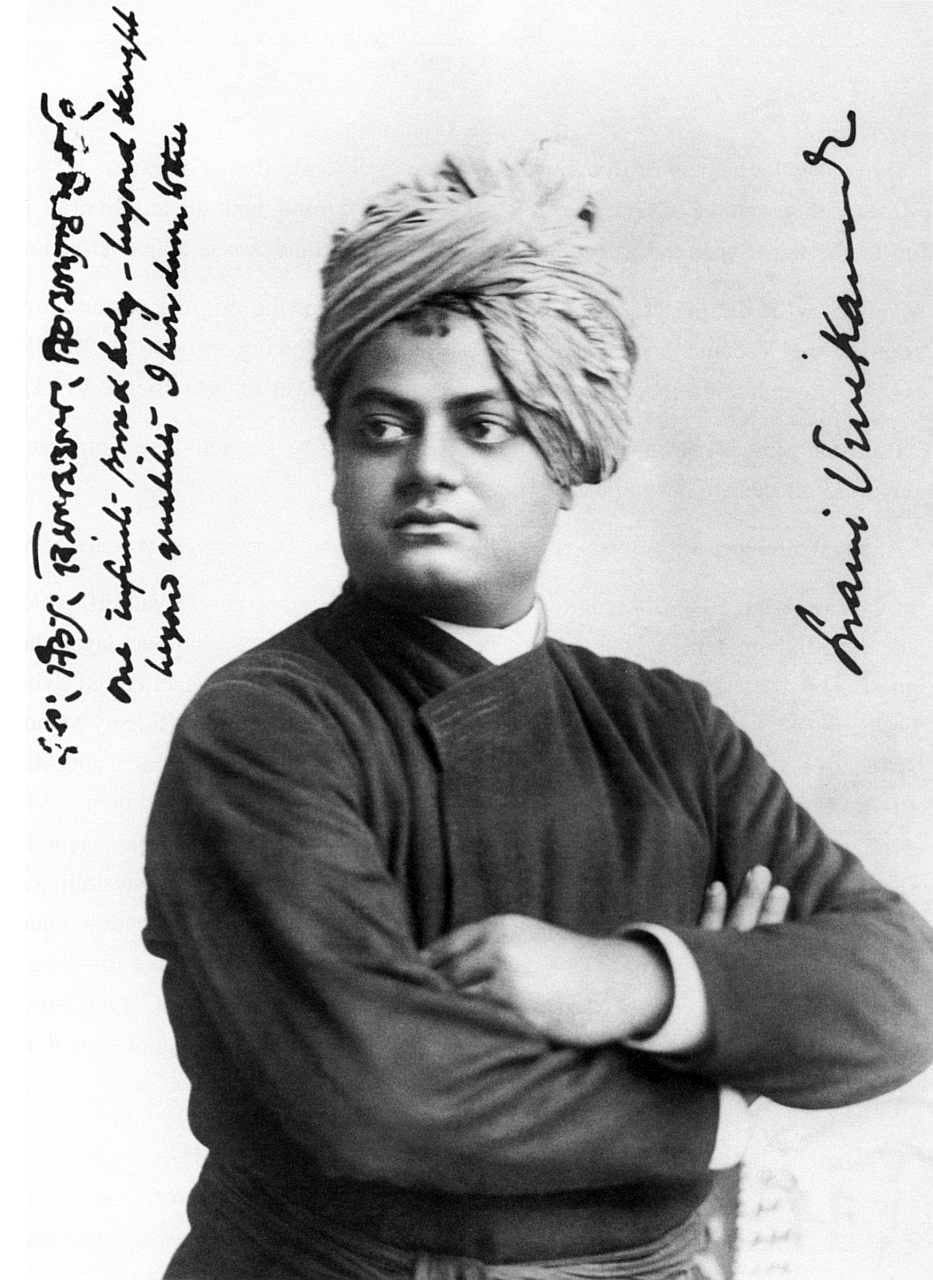
Swami Vivekananda en Chicago, septiembre de 1893 (con dedicatoria autógrafa) · Public domain
In their words
«Sisters and Brothers of America,»Discurso de bienvenida, Parlamento Mundial de las Religiones, Chicago, 11 de septiembre de 1893 (Complete Works, vol. 1, «Response to Welcome»)

Their central idea
The four yogas: Vivekananda organised Hindu spiritual practice into four paths corresponding to four temperaments: karma yoga, for the active, purifies through work done without attachment; bhakti yoga, for the emotional, transforms love into devotion to God; raja yoga, for the contemplative, controls the mind through concentration and meditation; jnana yoga, for the intellectual, attains freedom through discrimination between the real and the unreal.
See in context
Biography
5 min read
A young man from Calcutta who wanted proof
Narendranath Datta was born on 12 January 1863 in Calcutta, into a prosperous kayastha family of the Simla quarter. His father, Vishwanath Datta, was an attorney of the High Court, a man of cosmopolitan tastes and a reader of Persian poetry; his mother, Bhuvaneswari Devi, gave him the stories of the Ramayana and the Mahabharata. Narendra was a brilliant and irregular student: classical music, gymnastics, Western logic, Mill, Spencer and Hume at the General Assembly's Institution (now Scottish Church College), from which he graduated in 1884. Like many young men of the Bengali elite he frequented the Brahmo Samaj, the reform movement that had replaced idols with a rational theism. Sermons were not enough for him. According to the account he himself repeated years later, recorded by his biographers, he went around asking the religious teachers of Calcutta whether they had seen God. None said yes.
Dakshineswar
Towards the end of 1881 he met Ramakrishna, the ecstatic priest of the Kali temple at Dakshineswar on the Ganges. To the same question this almost unlettered man answered that he had, that he saw God as he saw Narendra, only more intensely. Their relationship, documented in Mahendranath Gupta's diaries (Sri Sri Ramakrishna Kathamrita), was for five years a contest between the disciple's scepticism and the master's certainty. Narendra mocked idolatry and the Advaita doctrine that "all is Brahman"; Ramakrishna treated him as one chosen. His father's sudden death in 1884 left the family ruined and brought him face to face with hunger; the story that, sent by Ramakrishna to ask the goddess for material relief, he could only ask her for discrimination and renunciation comes from the Order's tradition and should be read as such. When Ramakrishna died at Cossipore in August 1886, Narendra was already the centre of a small group of young men who, at the end of that year, formed a monastic community in a dilapidated house at Baranagar.
The wandering monk
Between 1888 and 1893 he crossed India on foot and by train under changing monastic names, sleeping in the palaces of maharajas and in the huts of outcastes. Those years—unevenly documented by letters and by testimonies collected decades later—gave him direct experience of rural poverty and of the degradation of caste that would feed his social criticism. In December 1892 he reached Kanyakumari, the southern tip of the subcontinent, and meditated on a rock off the coast; there, as he later wrote in his letters, he conceived the idea of seeking in the West the means to raise the masses of India. The name Vivekananda, "the bliss of discrimination", was settled shortly before the voyage, in the circle of the Maharaja of Khetri, who paid part of his passage.
Chicago, 1893
He reached Chicago in July 1893 with no credentials from any organisation. A Harvard professor of Greek, John Henry Wright, eased his way into the World's Parliament of Religions, held as part of the Columbian Exposition. On 11 September he opened his brief address with the words "Sisters and Brothers of America", which according to the reports gathered by John Henry Barrows drew a long ovation. In the following days he presented a Hinduism without caste or idols, centred on the divinity of the soul—"the Hindu refuses to call you sinners"—and on the harmony of all religions. The press made him the figure of the Parliament.
Teacher in the West
For more than three years he lectured in the United States and England. In 1894 he founded the Vedanta Society of New York; in the summer of 1895 he taught a small group at Thousand Island Park (the Inspired Talks); in London he met Margaret Noble, the future Sister Nivedita; in Oxford he visited Max Müller and in Kiel Paul Deussen. From those classes came the four books that fixed his system: Karma Yoga and Raja Yoga (1896), Bhakti Yoga and, posthumously, the lectures collected as Jnana Yoga. Raja Yoga, with its annotated translation of Patañjali's Yoga Sutras, was for decades the Western reader's gateway to yoga; the historian Elizabeth De Michelis regards it as the founding text of "modern yoga", with its psychological and experimental reading of meditation.
Returning to serve
In January 1897 he landed at Colombo and travelled through southern India to Almora amid huge receptions; the lectures of that journey, Lectures from Colombo to Almora, are the core of his message to Indians: strength, faith in oneself, education of the masses, unsparing criticism of untouchability and ritualism. On 1 May 1897 he founded in Calcutta the Ramakrishna Mission Association, which joined monastic life to social service; in December 1898 the monastery at Belur was consecrated, and in 1899 Advaita Ashrama at Mayavati. His formula, attributed in origin to Ramakrishna, was to serve human beings as God himself (shiva jnane jiva seva). In 1899–1900 he made a second journey to the West—California, New York, the Congress of the History of Religions in Paris—already gravely ill with diabetes and asthma.
Death at thirty-nine
He died at Belur Math on 4 July 1902, in the evening, during meditation, after a day his companions described as ordinary. He was thirty-nine; his disciples recalled that he had predicted he would not reach forty. He was cremated beside the Ganges, opposite the spot where his master's body had burned sixteen years earlier.
What is documented and what is transmitted
For Vivekananda we have an exceptional body of primary sources: lectures taken down in shorthand, letters, articles and conversations, gathered in the nine volumes of the Complete Works. The years of wandering and many episodes of his relationship with Ramakrishna, by contrast, are known mainly through the official biography by his disciples (1912–1918) and through late testimonies, with the hagiographic bias of the genre. Marie Louise Burke's research in the American press made it possible to reconstruct the American years precisely and to correct more than one legend. No sound recording of his voice survives: the recordings circulating as such are later readings.
Legacy
The Ramakrishna Order and Mission, headquartered at Belur, today run hundreds of centres, hospitals and schools. His reading of Vedanta—experience as the proof of religion, the unity of religions, Hinduism as a universal faith—has been criticised by scholars such as Anantanand Rambachan and Wilhelm Halbfass for projecting Western categories onto the tradition, and appropriated by Hindu nationalism in ways he did not foresee. Gandhi, Tagore, Aurobindo and Subhas Chandra Bose acknowledged his influence, and India celebrates his birthday as National Youth Day. Outside India, the arrival in the West of yoga, of Vedanta and of the very idea of a universal spirituality cannot be understood without him.
Sources: Vivekananda, Swami. The Complete Works of Swami Vivekananda. Mayavati Memorial Edition, 9 vols. Calcuta: Advaita Ashrama, 1907–1997 (vol. 9 añadido en 1997). · His Eastern and Western Disciples. The Life of Swami Vivekananda. 2 vols. Mayavati / Calcuta: Advaita Ashrama, 1912–1918; 6.ª ed. revisada, 1979–1981. · Nikhilananda, Swami. Vivekananda: A Biography. Nueva York: Ramakrishna-Vivekananda Center, 1953. · Burke, Marie Louise. Swami Vivekananda in the West: New Discoveries. 6 vols. Calcuta: Advaita Ashrama, 1983–1987 (1.ª ed. en un volumen, 1958). · Barrows, John Henry (ed.). The World's Parliament of Religions. 2 vols. Chicago: The Parliament Publishing Company, 1893.
Timeline
A life, year by year
Each point is a documented event. Click to read it, with its source and degree of certainty.
January 12, 1863age 0Calcuta
Birth of Narendranath Datta
Born at the family home in Gourmohan Mukherjee Street, son of the attorney Vishwanath Datta and Bhuvaneswari Devi.
DocumentedHis Eastern and Western Disciples. The Life of Swami Vivekananda. 2 vols. Mayavati / Calcuta: Advaita Ashrama, 1912–1918; 6.ª ed. revisada, 1979–1981.
After their death
- 1907First Complete Works
- 1984National Youth Day
January 12, 1863 · age 0
Birth of Narendranath Datta
Born at the family home in Gourmohan Mukherjee Street, son of the attorney Vishwanath Datta and Bhuvaneswari Devi.
Documented
1881 · age 18
First meeting with Ramakrishna
Ramakrishna hears him sing at Surendranath Mitra's house (November 1881, according to the official biography) and he soon visits Dakshineswar, where he asks whether he has seen God.
Probable
1884 · age 21
Degree and father's death
He graduates (B.A.) from Calcutta University. His father's sudden death leaves the family in debt and poverty.
Documented
August 16, 1886 · age 23
Death of Ramakrishna
Ramakrishna dies of throat cancer at the Cossipore garden house, where Narendra and other young men had nursed him for months.
Documented
December 1886 · age 23
Birth of the monastic community
The young disciples settle in a house at Baranagar—the Order's first monastery—and at Antpur on Christmas Eve take the vow of renunciation; formal ordination (viraja homa) follows early in 1887.
Documented
1888 – 1893 · age 25
Years of wandering
He travels India as a wandering monk until 1893, in contact with maharajas, pandits and peasants.
Documented
December 1892 · age 29
The rock at Kanyakumari
He meditates on a rock off Cape Comorin; in his letters he places there the decision to seek help for India's masses. The rock now holds the Vivekananda Rock Memorial (1970).
Documented
May 31, 1893 · age 30
Sails for America
He sails from Bombay via Ceylon, Singapore, Hong Kong, Japan and Vancouver, reaching Chicago at the end of July.
Documented
September 11, 1893 · age 30
Welcome address at the Parliament of Religions
'Sisters and Brothers of America.' Until 27 September he speaks several times, the 'Paper on Hinduism' (19 September) being the central text.
Documented
November 1894 · age 31
Vedanta Society of New York
He founds the first Vedanta society in the West, still active.
Documented
June 1895 · age 32
The Thousand Island Park talks
Seven weeks of teaching a small group of disciples; Sarah Ellen Waldo's notes will be published as Inspired Talks (1908).
Documented
November 1895 · age 32
Meeting Margaret Noble
The Irish educator, the future Sister Nivedita, hears him in a West End drawing room.
Documented
1896 · age 33
Raja Yoga, Karma Yoga and meetings with Max Müller and Deussen
Longmans publishes Raja Yoga in London; Karma Yoga and Bhakti Yoga appear. He visits Max Müller in Oxford (May) and Paul Deussen in Kiel (September).
Documented
January 15, 1897 · age 34
Triumphant return to India
He lands at Colombo and travels north to Calcutta and Almora; his speeches form Lectures from Colombo to Almora.
Documented
May 1, 1897 · age 34
Founding of the Ramakrishna Mission
He establishes the Ramakrishna Mission Association, joining monastic renunciation to social service.
Documented
December 9, 1898 · age 35
Consecration of Belur Math
He installs Ramakrishna's relics in the new monastery on the Ganges, the Order's headquarters.
Documented
June 20, 1899 – 1900 · age 36
Second journey to the West
He leaves with Turiyananda and Nivedita; teaches in New York and California (Shanti Ashrama) and in 1900 attends the Congress of the History of Religions in Paris.
Documented
July 4, 1902 · age 39
Death
He dies in the evening in his room, during meditation; the monks speak of mahasamadhi. He is cremated the next day on the bank of the Ganges.
Documented
1907
First Complete Works
Advaita Ashrama begins publishing the Complete Works (Mayavati Memorial Edition), which will reach nine volumes in 1997.
Documented
1984
National Youth Day
The Government of India declares 12 January, his birthday, National Youth Day (observed since 1985).
Documented
Works
Essential works
The works without which their legacy cannot be understood.
Published lectures · 1896
Raja Yoga
Raja Yoga, or Conquering the Internal Nature
The exposition of meditative yoga that most influenced the West for half a century. It presents raja yoga as an experimental science of the mind—posture, control of prana, withdrawal of the senses, concentration, meditation and samadhi—without prior faith. The second part translates and comments on Patañjali's aphorisms. Its language of energy, psychology and method, and its syncretism with notions of the time, were decisive in making yoga understood in the West as a universal technique; Elizabeth De Michelis regards it as the founding text of modern yoga.
8 editions · amazon.com

Published lectures · 1896
Karma Yoga
Karma-Yoga
The yoga of action: how work done without attachment to its fruits purifies the mind and leads to freedom. Drawing on the Bhagavad Gita, Vivekananda develops an ethic of duty relative to each person ('each is great in his own place'), the idea that in helping the world we help ourselves, and the ideal of work for work's sake. It is the doctrinal foundation of the Ramakrishna Mission and of social service as spiritual practice.
7 editions · amazon.com

Published lectures · c. 1896
Bhakti Yoga
Bhakti-Yoga
The path of love for God. Vivekananda defines bhakti as 'a real, genuine search after the Lord' that begins, continues and ends in love, and follows it from preparatory devotion—with symbols, images, names and the need for a teacher—to supreme devotion, in which lover, love and beloved merge. He defends image worship as a legitimate step against reformist critics and reconciles it with non-dual Vedanta.
6 editions · amazon.com

Published lectures · c. 1899
Jnana Yoga
Jnana-Yoga
The path of knowledge according to Advaita Vedanta: the necessity of religion, maya as a statement of facts rather than a theory, the personal and impersonal God, the unity of existence and the realisation of the Self. It is his most philosophical exposition: a defence of monism as the rational culmination of religion, in dialogue with the science and agnosticism of his time, and the basis of his thesis that all religions lead to the same unity.
8 editions · amazon.com
Complete works (55)
Swami Vivekananda
Chicago Addresses
The Conscious LibraryChicago Addresses
1893

The Complete Works
1907

Lectures from Colombo to Almora
1897

Inspired Talks
1908

My Master
1901
Swami Vivekananda
Letters
The Conscious LibraryLetters
1940

Practical Vedanta
1896

The Vedanta Philosophy (Harvard address)
1896
Swami Vivekananda
Memoirs of European Travel (Parivrajak)
The Conscious LibraryMemoirs of European Travel (Parivrajak)
1899
Swami Vivekananda
Modern India (Bartaman Bharat)
The Conscious LibraryModern India (Bartaman Bharat)
1899
Swami Vivekananda
The East and the West (Prachya o Paschatya)
The Conscious LibraryThe East and the West (Prachya o Paschatya)
1902
Swami Vivekananda
Poems
The Conscious LibraryPoems
1947

Talks with Swami Vivekananda
1902

Meditation and Its Methods
1976
Swami Vivekananda
Sangeet Kalpataru
The Conscious LibrarySangeet Kalpataru
1887
Swami Vivekananda
The Ideal of a Universal Religion
The Conscious LibraryThe Ideal of a Universal Religion
1896
Swami Vivekananda
The Real and the Apparent Man
The Conscious LibraryThe Real and the Apparent Man
1896
Swami Vivekananda
Vedanta Philosophy: Lecture on "The Atman"
The Conscious LibraryVedanta Philosophy: Lecture on "The Atman"
1896

Speeches and Writings of Swami Vivekananda: A Comprehensive Collection
1899
Swami Vivekananda
Christ, the Messenger
The Conscious LibraryChrist, the Messenger
1900
Swami Vivekananda
The Science and Philosophy of Religion
The Conscious LibraryThe Science and Philosophy of Religion
1908

Essentials of Hinduism
1919

Hinduism
1943

Religion of Love
1947
Quotations
Quotations located in a specific work. Each carries its provenance and its level of confidence.
Sisters and Brothers of America,VerifiedDiscurso de bienvenida, Parlamento Mundial de las Religiones, Chicago, 11 de septiembre de 1893 (Complete Works, vol. 1, «Response to Welcome»)
Apocryphal quotes or disputed attributions (3)
«'Talk to yourself once in a day, otherwise you may miss meeting an excellent person in this world.'»
It circulates massively on social media and posters under his name, but it does not appear in any of the nine volumes of the Complete Works (search of the full Wikisource text, 2026-10-23). Neither its style nor its vocabulary is Vivekananda's.
«'In a day, when you don't come across any problems – you can be sure that you are travelling in a wrong path.'»
Not located in the Complete Works (Wikisource search, 2026-10-23). It belongs to the self-help sayings attributed online without a source.
«The audio recordings circulating as 'the voice of Swami Vivekananda' delivering the Chicago address.»
No sound recording of Vivekananda survives. The recordings presented as his 'own voice' are modern readings; neither the Ramakrishna Order nor Marie Louise Burke's research on his American stay mentions any recording.
Last words
There are no verifiable records of their last words.
His disciples' official biography (The Life of Swami Vivekananda, 1912–1918) describes 4 July 1902 in detail—three hours of meditation in the morning, a Sanskrit grammar class, a walk, talk of a planned Vedic college—and says that around seven in the evening he withdrew to meditate and died at about nine; sources differ on the time (9:10 or 9:20). It records no words spoken at the moment of death. A remark he supposedly made that day, overheard by a brother monk, that only 'another Vivekananda' would understand what Vivekananda had done, circulates widely; it could not be checked against the primary source and is in any case not his last words.
Source: His Eastern and Western Disciples. The Life of Swami Vivekananda. 2 vols. Mayavati / Calcuta: Advaita Ashrama, 1912–1918; 6.ª ed. revisada, 1979–1981.
Ask
What their work answers
Twelve great human questions and what their texts allow us to answer, with references. We never put words in their mouth.
What is the Absolute? Does God exist?
The personal God is the Absolute as read by the human mind
Both personal and impersonalStated explicitly
Swami Vivekananda, disciple of Ramakrishna, defends Advaita Vedanta without disdaining devotion. In his Jnana Yoga lectures he holds that the only reality is the impersonal Brahman, existence, consciousness and bliss, and that the human soul is identical with it. In Bhakti Yoga, in the chapter on the philosophy of Ishvara, he explains that the personal God is that same Absolute as perceived by the human mind: not an illusion to be discarded but the highest reading of the Absolute available to one who still feels himself an individual. Hence his claim that dualism, qualified non-dualism and non-dualism are stages of one path. For Vivekananda, the divine has a face that is loved and a formless ground with which, ultimately, one is identified.
Compare this question with other teachersWho am I? Is there a true self?
Each soul is potentially divine; the real man is the infinite Atman
The Self is the AbsoluteStated explicitly
Swami Vivekananda distinguishes, in the lecture «The Real and the Apparent Man» collected in Jnana Yoga, between the limited individual we believe ourselves to be and the real man, the Atman, infinite, immortal and one with Brahman. The apparent man is a passing manifestation of that Atman through body and mind; everything that limits us belongs to the level of appearance. Hence his motto, which heads his exposition of Raja Yoga: each soul is potentially divine, and the goal is to manifest this divinity within by controlling nature, external and internal, through work, devotion, psychic control or philosophy. Vivekananda stresses the ethical consequences: if we are all the same Self, serving another is serving God. The true self is not a part of the Absolute but the Absolute itself.
Compare this question with other teachersWhy do we suffer?
Maya always mixes pleasure and pain; only the Atman is free of both
Ignorance of what we areStated explicitly
Swami Vivekananda treats suffering in his lectures on maya, collected in Jnana Yoga. Maya is not for him a theory of illusion but a statement of the contradiction in which we live: every pleasure drags its pain, every good its evil, and no worldly progress will remove that mixture, because it belongs to the nature of the relative world. Whoever seeks complete happiness in the finite is condemned to frustration. The root of suffering is ignorance of our true nature: we identify with body and mind, subject to contradiction, rather than with the Atman, which lies beyond it. Vivekananda does not draw indifference from this: in Karma Yoga he proposes working to relieve the pain of others without attachment to results, as a way of purifying oneself and of serving God in every being.
Compare this question with other teachersWhat happens after death?
The Atman is immortal; bodies change, are reborn and are finally known as illusory
What I am is never born and never diesStated explicitly
Vivekananda sets out the question of death from Vedanta in lectures such as «Immortality», included in Jnana Yoga. He denies that the soul is created or can die: what has a beginning has an end, and the Atman, which is Brahman, has none. On the relative plane he accepts reincarnation: the subtle mind, laden with impressions (samskaras), leaves the body and seeks another in accordance with its karma, and Vivekananda defends it as a more rational explanation of the differences between beings than the creation of new souls at each birth. But on the ultimate plane, that of non-duality, the soul never came and never went: the same infinite Self appears under names and forms. The goal is not an eternal life in a heaven, which would be another form of birth, but to recognise that one was never born.
Compare this question with other teachersHow is liberation or salvation attained?
Manifest the inner divinity through work, devotion, mental control or knowledge
Through disciplined practiceStated explicitly
Swami Vivekananda sums up his position in the preface to Raja Yoga: each soul is potentially divine and the goal is to manifest that divinity by controlling nature, external and internal, whether by work, by worship, by psychic control or by philosophy, by one, several or all of these means. The other elements of religion (doctrines, rites, books or temples) are secondary details. He devoted a book to each path: Karma Yoga, Bhakti Yoga, Raja Yoga and Jnana Yoga. His originality lies in presenting them as verifiable, almost experimental methods suited to different temperaments, and in joining them to service of others, whom he asked people to see as manifestations of the divine. The ultimate horizon is the Advaitic realisation of identity with Brahman.
Compare this question with other teachersIs a teacher necessary?
Spiritual impulse passes from soul to soul: a true guru is needed
IndispensableStated explicitly
In Bhakti Yoga, Swami Vivekananda devotes chapters to the need for a guru and to the qualities of the aspirant and the teacher. He holds that books alone do not awaken the soul: the spiritual impulse must come from another, already awakened soul, and the one who transmits it is the guru. He asks much of the teacher: he must know the spirit of the scriptures, be free from sin and not teach for money or fame. And he asks of the disciple purity, thirst for knowledge and perseverance. His own life illustrates this position: he attributed everything he was to his master Ramakrishna. At the same time, Vivekananda rejected credulity and asked that teaching be examined; the guru is necessary, but not just anyone is one.
Compare this question with other teachersIs the world real?
Maya is not a theory: it is a description of the world as it is
Appearance over the one realityStated explicitly
In the lectures collected in Jnana Yoga, Swami Vivekananda devotes several talks to maya and warns against understanding it as a claim that the world does not exist. Maya is, for him, a description of facts: the world is a contradictory mixture of good and evil, pleasure and pain, life and death, which cannot be resolved within itself. It is neither simply unreal nor real in the ultimate sense: it is the appearance the Absolute takes on through time, space and causality. Behind that appearance stands Brahman, the only reality, which is also the Self of each person. Hence his practical emphasis: seeing the divine in the beings one serves.
Compare this question with other teachersWhat is love?
Love for love's sake, without asking or fearing, leads to union
Longing and unionStated explicitly
Vivekananda devoted one of his four yogas to love. In Bhakti Yoga he defines devotion as the search for God through love and describes its culmination, supreme devotion (para-bhakti), through what he calls the triangle of love: love asks nothing in return, knows no fear and has no other object than love itself, which is its own ideal. He goes through the forms the relationship with God takes — as Father, as Mother, as friend, as beloved — and holds that all human love, even the most limited, is a reflection of divine love. At its height, the lover, love and the beloved become one, and devotion flows into the same non-duality that knowledge reaches. At the same time, Vivekananda joins love of God with service: to serve the human being is to serve God present in him.
Compare this question with other teachersAre we free, or is everything determined?
We are what our acts have made us, and we can remake ourselves
Karma and choiceStated explicitly
Vivekananda stresses human responsibility with almost programmatic vigour: in *Karma Yoga* (1896) he holds that each person is the sum of his past thoughts and actions, and therefore holds in his own hands what he will become. His critique of the fatalism of the India of his day is explicit: weakness, not destiny, is the cause of misery. But as a Vedantin he distinguishes levels. In his *Jnana Yoga* lectures he explains that the will, as a phenomenon of the world of *māyā*, is subject to cause and effect and is not free in an absolute sense; what is free is the Ātman, beyond the causal chain. Practice consists in using conditioned action to reach that freedom which does not depend on choosing.
Compare this question with other teachersWhy meditate or pray?
Concentrating the mind until the soul knows itself in samadhi
Returning to the source of the IStated explicitly
In *Raja Yoga* (1896), his commentary on Patañjali's *Yoga Sutras*, Vivekananda presents meditation as an experimental science: just as the chemist focuses his instruments on matter, the yogi focuses the mind on itself. His ladder runs from ethics and posture through breath control, withdrawal of the senses, concentration and meditation up to *samādhi*, a superconscious state in which the soul recognises itself as free and independent of nature. He does not deny the value of devotion, to which he devotes *Bhakti Yoga*, nor of selfless action, but for him the end of meditative practice is realisation of the Ātman, identical with Brahman, not petition to a separate God.
Compare this question with other teachersCan reason know the ultimate?
Religion must withstand reason's scrutiny and culminate in superconsciousness
Faith and reason help each otherStated explicitly
Vivekananda claims for religion the same rational scrutiny applied to science: in his lecture «Reason and Religion» he holds that a religion unable to defend itself before reason does not deserve to survive, and presents Vedānta as the most rational of doctrines. But in *Raja Yoga* (ch. 7, «Dhyāna and Samādhi») he sets out a scale of knowledge: instinct, reason and superconsciousness. Reason surpasses instinct but moves within a limited circle; beyond it is *samādhi*, in which truths are known that reason cannot reach, though they never contradict it. The statements of sages and scriptures, he insists, must be verified in one's own experience.
Compare this question with other teachersWithdraw from the world or transform it?
Serving the human being is worshipping God: a practical Vedanta
Engage with the worldStated explicitly
Swami Vivekananda, a renunciant monk, set out to bring Vedanta out of the forests and caves and into daily life. In his lectures on Practical Vedanta, delivered in London in 1896, he holds that the unity of all beings in the Ātman is not an idea for isolated contemplation but the foundation of an ethic of service: if God is in every human being, serving the poor, the sick or the ignorant is worshipping God. He takes up his master Ramakrishna's teaching of serving beings by seeing them as Shiva, and in 1897 founds the Ramakrishna Mission, which joins monastic life with hospitals, schools and relief in famines and epidemics. In Karma Yoga he presents selfless action as a path to liberation. He harshly criticised a religiosity concerned with rites while the people of India went hungry.
Compare this question with other teachers
Affinities & tensions
Affinities and tensions
Calculated question by question from their positions. The reason for each agreement or clash, on click.
Thinks most like
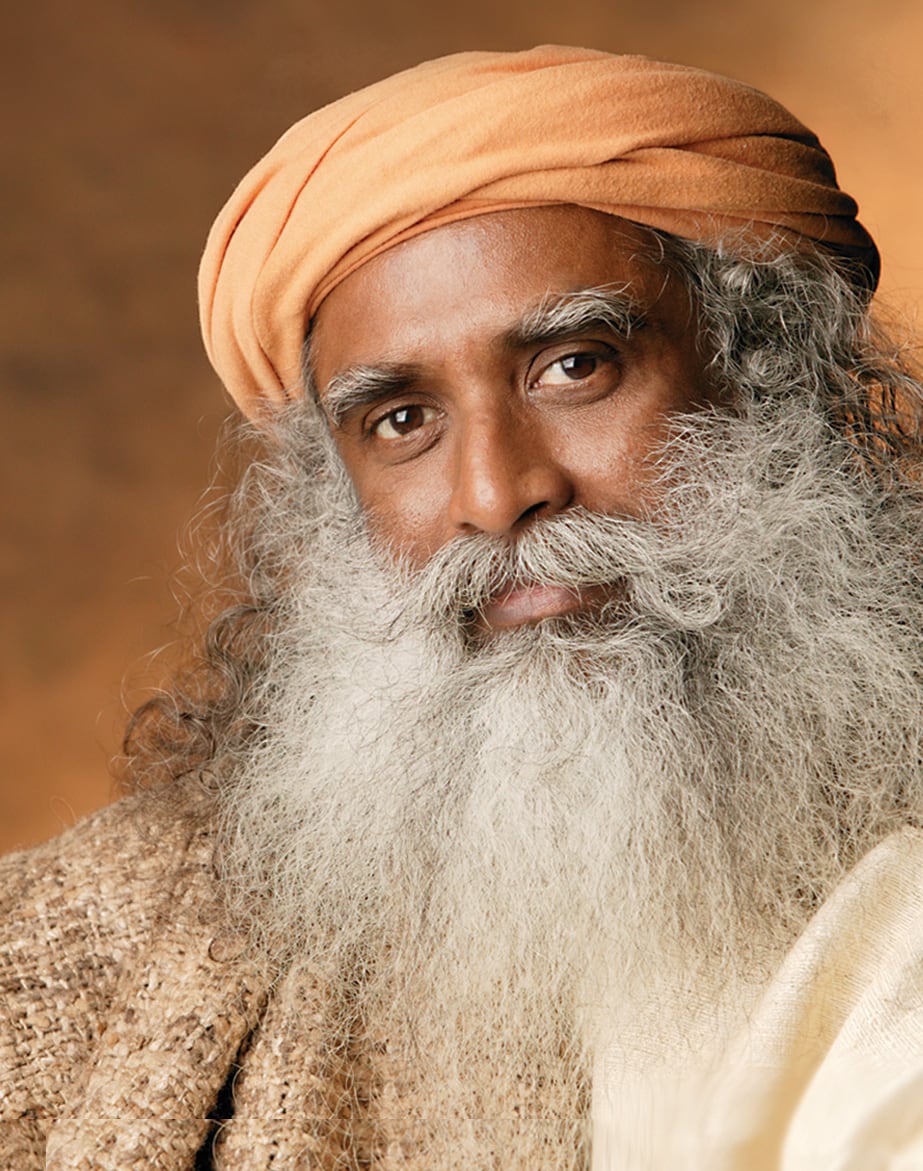
Sadhguru
They agree on: Who am I? Is there a true self? · How is liberation or salvation attained? · Is a teacher necessary?
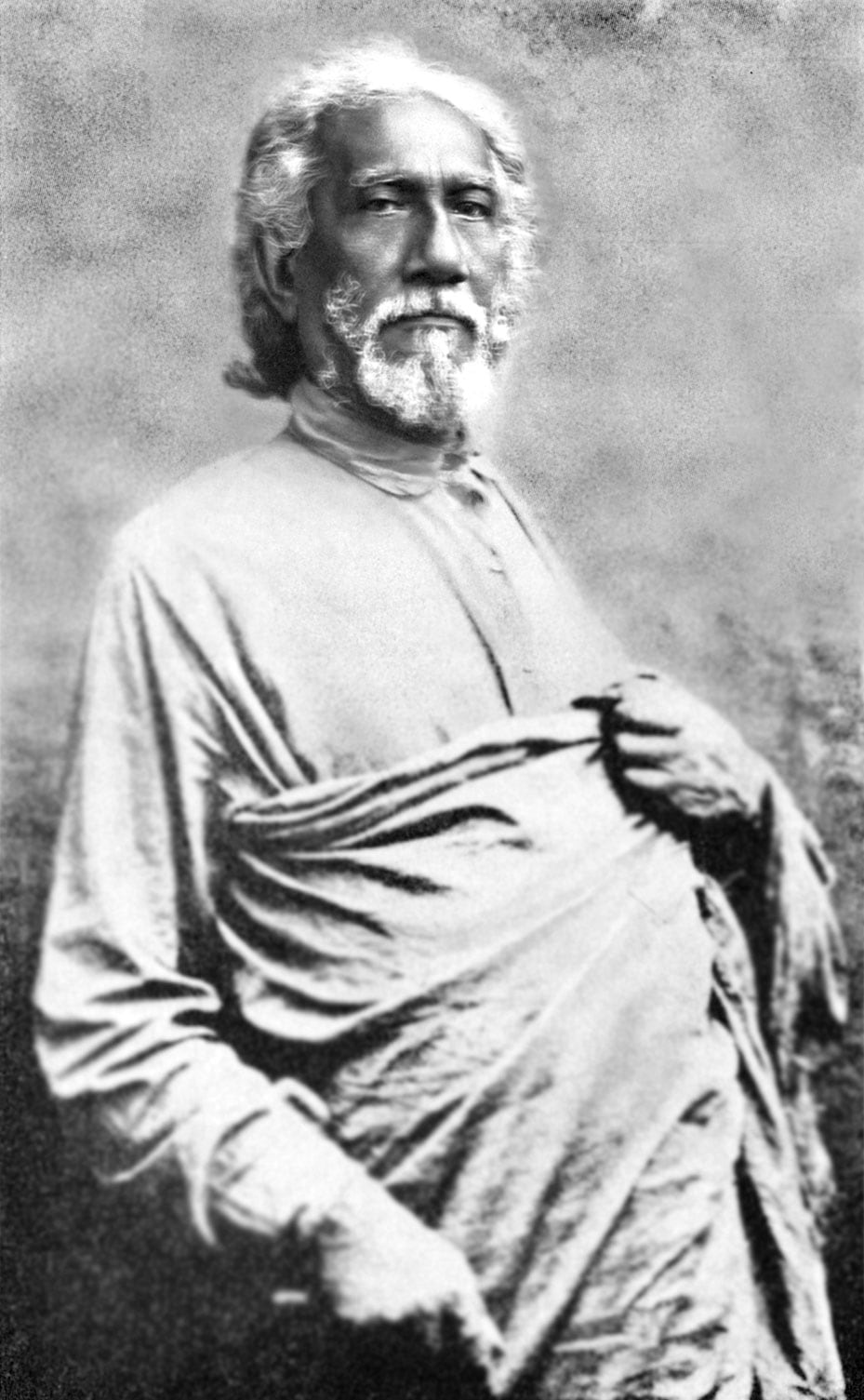
Sri Yukteswar
They agree on: Who am I? Is there a true self? · Why do we suffer? · How is liberation or salvation attained?
Uddalaka Aruni
They agree on: Who am I? Is there a true self? · What happens after death? · Is a teacher necessary?
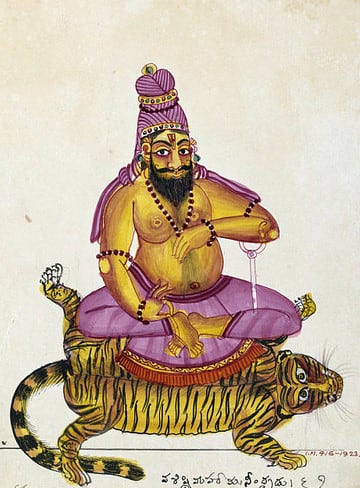
Vasishtha
They agree on: Who am I? Is there a true self? · Why do we suffer? · What happens after death?
Thinks most unlike

Francis of Assisi
They clash on: Who am I? Is there a true self? · Is the world real?
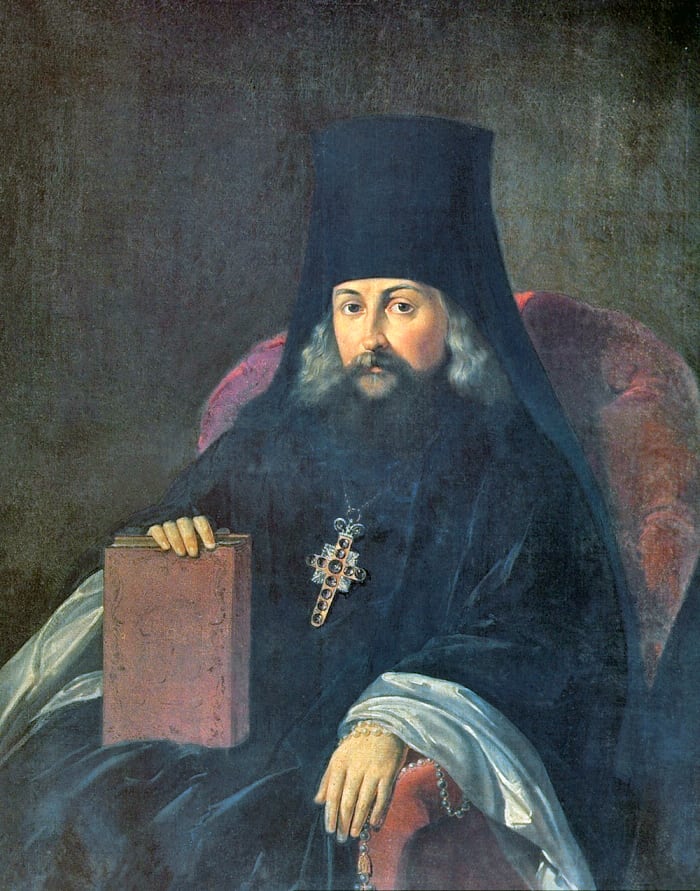
Ignatius Brianchaninov
They clash on: Who am I? Is there a true self? · Is the world real?

Theophan the Recluse
They clash on: Who am I? Is there a true self? · Is the world real?
Seraphim of Sarov
They clash on: Who am I? Is there a true self? · Is the world real?
They clash onApparent contradiction
Swami Vivekananda · Adi Shankara
The sage who renounces and the sage who serves: two readings of the same Advaita
Why: The contradiction is largely apparent. Shankara does not condemn action: he regards it as the purifying duty of those who do not yet know, and Vivekananda presents karma yoga precisely as a path of purification towards a knowledge that remains, for him, the summit. What changes is audience and era. Shankara writes for renunciants, in a scholastic dispute with those who combined ritual and knowledge; Vivekananda, who saw himself as heir to Advaita, speaks to a colonised and impoverished India and to a Western public, and turns service into worship of the divine in every being. A real difference of emphasis remains: in Shankara the liberated one ceases to act; in Vivekananda, he goes on serving.
They clash onFundamental disagreement
Swami Vivekananda · Annie Besant
Chicago, 1893: the wisdom of the hidden Masters versus a Vedanta to be verified
Why: The relationship is historical: both spoke at the 1893 Parliament of Religions in Chicago, which launched Vivekananda, and they later competed to represent India's wisdom before the West. Vivekananda publicly distanced himself from the Theosophical Society and its doctrine of the Mahatmas, which he regarded as foreign to the Vedantic tradition. The tension is not only one of rivalry: Besant inherits from Blavatsky a wisdom presented as hidden and revealed to initiates; Vivekananda, from Ramakrishna and Vedanta, a public teaching anyone can test through practice. Both wanted to reconcile religion and science; they differed over the place they left for secrecy.
They agree on
Swami Vivekananda · The 14th Dalai Lama (Tenzin Gyatso)
A religion that accepts examination: the monk of Chicago and the monk of Nalanda
Why: The convergence is explained by context: both present an Asian tradition before a West shaped by modern science and by the critique of religion, and both want to show that their tradition does not fear that examination. Each also draws on resources specific to his tradition: Vivekananda, on the experimental reading of yoga and on Vedanta; the Dalai Lama, on the logic and epistemology of Nalanda. They differ on the goal: for Vivekananda experience culminates in identity with Brahman; for the Dalai Lama, in the understanding of emptiness, which denies precisely a permanent Self. No relationship between them is documented.
Anecdotes and stories
Anecdotes and stories
Testimony1881–1882
'Have you seen God?'
Origin of the story: Vivekananda's own account transmitted by his disciples: The Life of Swami Vivekananda (1912–1918) and Nikhilananda, Vivekananda: A Biography (1953). Ramakrishna left his own version of the first meetings in the conversations recorded by M. in the Kathamrita.
Source: His Eastern and Western Disciples. The Life of Swami Vivekananda. 2 vols. Mayavati / Calcuta: Advaita Ashrama, 1912–1918; 6.ª ed. revisada, 1979–1981.
Hagiographic account1884–1885
The prayer before the goddess
Origin of the story: It comes from the disciples' biography (The Life…) and Swami Saradananda's Sri Ramakrishna Lilaprasanga (1909–1919), which present it as Vivekananda's own recollection. There is no independent contemporary testimony.
Source: His Eastern and Western Disciples. The Life of Swami Vivekananda. 2 vols. Mayavati / Calcuta: Advaita Ashrama, 1912–1918; 6.ª ed. revisada, 1979–1981.
Testimonyc. 1888–1890
'Face the brutes'
Origin of the story: Autobiographical account in the lecture 'What Is Religion?', Complete Works, vol. 1 (Lectures and Discourses). There are no witnesses; it is his own recollection used as a moral example.
DocumentedDiciembre de 1892
The rock at Kanyakumari
Origin of the story: The plan conceived at Kanyakumari is documented in his letter to Ramakrishnananda of 19 March 1894 (Complete Works, vol. 6). The swim and the length of the meditation come from the Order's oral tradition recorded in The Life…, with no direct testimony.
TestimonySeptiembre de 1893
The night in the freight car
Origin of the story: Account transmitted by the disciples' biography from Vivekananda's own recollections and those of the Hale family; Marie Louise Burke (Swami Vivekananda in the West: New Discoveries) checked the chronology against the Chicago press and confirms the Hales' role, though the details of the night rest on the protagonist's account.
Source: His Eastern and Western Disciples. The Life of Swami Vivekananda. 2 vols. Mayavati / Calcuta: Advaita Ashrama, 1912–1918; 6.ª ed. revisada, 1979–1981.
Oral tradition1891 o 1893
The singer of Khetri
Origin of the story: It comes from The Life of Swami Vivekananda, which attributes it to Vivekananda's own recollections; the date (first visit to Khetri in 1891 or that of 1893) and the singer's name vary between versions. No contemporary source.
Source: His Eastern and Western Disciples. The Life of Swami Vivekananda. 2 vols. Mayavati / Calcuta: Advaita Ashrama, 1912–1918; 6.ª ed. revisada, 1979–1981.
Teachings
Teachings
The notions that structure their thought, explained in context.
The four yogasfour-yogas
Karma Yoga, Raja Yoga, Bhakti Yoga and Jnana Yoga (1896–1907); Complete Works, vols. 1–3. On its role in modern yoga: De Michelis (2004).
Source: De Michelis, Elizabeth. A History of Modern Yoga: Patañjali and Western Esotericism. Londres / Nueva York: Continuum, 2004.
The potential divinity of the soulpotential-divinity
Raja Yoga (1896); 'Paper on Hinduism' (1893); writings on education collected in the Complete Works.
Practical Vedantapractical-vedanta
Practical Vedanta (London, 1896); Lectures from Colombo to Almora (1897). Critiques: Halbfass (1988), Rambachan (1994).
Source: Halbfass, Wilhelm. India and Europe: An Essay in Understanding. Albany: State University of New York Press, 1988.
Serving human beings as God (shiva jnane jiva seva)service-as-worship
Founding of the Ramakrishna Mission (1897); letters of 1894–1897; Lectures from Colombo to Almora.
Source: His Eastern and Western Disciples. The Life of Swami Vivekananda. 2 vols. Mayavati / Calcuta: Advaita Ashrama, 1912–1918; 6.ª ed. revisada, 1979–1981.
Universal acceptance of religionsharmony-of-religions
Chicago addresses (1893), especially 'Response to Welcome' and 'Address at the Final Session'; lectures on universal religion (Complete Works, vol. 2).
Maya as a statement of factsmaya-statement-of-facts
Jnana Yoga, lectures 'Maya and Illusion' and 'Maya and the Evolution of the Conception of God' (London, 1896; Complete Works, vol. 2).
Retreats
Retreats and centres
Places and gatherings linked to their teaching. We put you in touch with the organisers.
Belur, Howrah (junto a Calcuta), Bengala Occidental · India
Belur Math, headquarters of the Ramakrishna Order
Ramakrishna Math and Ramakrishna Mission
Belur Math, on the banks of the Ganges, is the headquarters of the Ramakrishna Order that Swami Vivekananda founded on his return from the West, and the place where he died in 1902. The grounds hold the Sri Ramakrishna temple, whose architecture Vivekananda conceived to bring together motifs from different religions, the temples of Sarada Devi and of Vivekananda himself, the room where he lived and a museum. The institution describes it as a place of pilgrimage for people of all faiths. It has a guest house for pilgrims, and its branch centres worldwide share the same spirit of service and study.
Kanyakumari, Tamil Nadu · India
Vivekananda Rock Memorial and Vivekananda Kendra, Kanyakumari
Vivekananda Rock Memorial & Vivekananda Kendra
At the southern tip of India, on a rock off Kanyakumari, Vivekananda meditated in December 1892 before setting out for the West; the Vivekananda Rock Memorial now stands there. Its sister organisation, Vivekananda Kendra, is based at Vivekanandapuram on the mainland and describes itself as a spiritually oriented service mission working in education, health and rural development. As well as receiving the pilgrims who visit the memorial, it runs residential yoga camps, certificate courses and spiritual retreats, taught mainly in English and Hindi, under the motto that they alone live who live for others.
Nueva York (Upper West Side) · Estados Unidos
Vedanta Society of New York
Vedanta Society of New York (Orden de Ramakrishna)
The Vedanta Society of New York is the first Vedanta society in the West: Swami Vivekananda founded it in 1894, during his first stay in the United States, and it belongs to the Ramakrishna Order. From its home on West 71st Street it offers Sunday lectures, weekday discussions on the Upanishads, the Bhagavad Gita and other texts, and daily vesper services. Its talks, particularly those of its current minister, are published openly as videos and podcasts, which has made it one of the most accessible sources for studying Advaita Vedanta in Vivekananda's line from anywhere in the world.
Videos
Videos
Recordings, interviews and documentaries. Videos play from YouTube; they are not hosted here.
Swami Vivekananda in Chicago 1893: A short film
Documentary· EN· 24 min
Ramakrishna Math & Ramakrishna Mission, Belur MathOfficial channel
Vivekananda By Vivekananda (película biográfica, versión inglesa)
Documentary· EN· 128 min
Sri Ramakrishna Math ChennaiOfficial channel
स्वामी विवेकानंद की आत्मकथा (Vivekananda Ki Atmakatha), versión hindi
Documentary· HI· 127 min
Sri Ramakrishna Math ChennaiOfficial channel
A Documentary on Swami Vivekananda's Swadesh Chetana
Documentary· EN· 38 min
Ramakrishna Math & Ramakrishna Mission, Belur MathOfficial channel
The Life and Message of Swami Vivekananda / स्वामी विवेकानंद का जीवन और संदेश
Documentary· EN· 71 min
Films DivisionOfficial channel
BELUR MATH: The heart of Ramakrishna Movement (documental completo)
Documentary· EN· 54 min
Ramakrishna Mission Ashrama, NarendrapurOfficial channel
Swami Ranganathananda – Swami Vivekananda at the World's Parliament of Religions in Chicago 1893
Lecture· EN· 40 min
Vedanta Video
Karma Yoga: The Path of Action (Part 1) | Swami Sarvapriyananda
Lecture· EN· 68 min
Vedanta Society of New YorkOfficial channel
Swami Vivekananda en Chicago, 1893 | Serie de Discursos Famosos | Audio en Español
Third-party recording· ES· 9 min
Moksha Life
Swami Vivekananda's 1893 Speech at the World's Parliament of Religions
Third-party recording· EN· 4 min
Satchidananda Ashram – Yogaville
Swami Vivekananda – Die vier Stufen des Yoga
Analysis· DE· 10 min
Neue Akropolis – Schule der Philosophie
Swami Vivekananda's Chicago Address | Chicago Addresses | English Speech
Watch on YouTube
This video cannot be embedded; it opens on YouTube.
Swami Vivekananda's Chicago Address | Chicago Addresses | English Speech
Third-party recording· EN· 4 min
Udbodhan – Ramakrishna Math BaghbazarOfficial channel
Gallery
Gallery
Images with verified licences. Each keeps its authorship and attribution.
Connections
Connections
Influences, discipleships and affinities. Documented relations are distinguished from similarities identified by analysis.
Disciple of
Chief disciple from 1881–82 until the master's death in 1886; organised his disciples into a monastic order and spread his message.
Documented relation
Influenced by
His jnana yoga starts from Shankara's Advaita, which he often quotes and discusses, while reinterpreting it in a practical, universalist key.
Documented relation
Influenced by
He translated and commented on the Yoga Sutras in the second part of Raja Yoga (1896).
Documented relation
Teacher of
Sister Nivedita (Margaret Noble)
He met her in London in 1895 and initiated her as a brahmacharini in Calcutta in 1898; she left the portrait The Master as I Saw Him (1910).
Documented relation
Influenced
Aurobindo wrote that during his imprisonment at Alipore (1908–09) he felt Vivekananda's presence guiding his meditation for a fortnight; they never met.
Documented relation
Contemporary of
Both spoke at the World's Parliament of Religions in Chicago (1893). Vivekananda later criticised the Theosophical Society in his 1897 speeches.
Documented relation
Ideas akin to
Two successive generations of Bengali monks who founded lasting organisations in the United States to teach yoga and Vedanta and presented meditation as a universal science. Similarity identified by the editors, with no personal relationship (Yogananda was nine when Vivekananda died).
Similarity identified by analysis
Ideas akin to
Both join Vedantic spirituality to India's national regeneration and conceive spiritual realisation as transforming life in the world.
Similarity identified by analysis
Linked from other profiles
- Annie Besant · Met
- Valmiki · Influenced
- Sri Aurobindo · Influenced by
- Adi Shankara · Influenced
- Helena Blavatsky · Disagreed with
- Dattatreya · Influenced
- Patañjali · Influenced
- Kapila · Influenced
- Nicholas Roerich · Influenced by
- Helena Roerich · Influenced by
- Ramakrishna · Teacher of
- Kahlil Gibran · Contemporary of
- Narada · Influenced
- Paramahansa Yogananda · Ideas akin to
- Sri Yukteswar · Contemporary of
- Vasishtha · Ideas akin to
- Vyasa · Influenced
- Ashtavakra · Influenced
- Sadhguru · Ideas akin to
Sources
Sources
Bibliography and catalogues consulted for this profile.
- Vivekananda, Swami. The Complete Works of Swami Vivekananda. Mayavati Memorial Edition, 9 vols. Calcuta: Advaita Ashrama, 1907–1997 (vol. 9 añadido en 1997).
- His Eastern and Western Disciples. The Life of Swami Vivekananda. 2 vols. Mayavati / Calcuta: Advaita Ashrama, 1912–1918; 6.ª ed. revisada, 1979–1981.
- Nikhilananda, Swami. Vivekananda: A Biography. Nueva York: Ramakrishna-Vivekananda Center, 1953.
- Burke, Marie Louise. Swami Vivekananda in the West: New Discoveries. 6 vols. Calcuta: Advaita Ashrama, 1983–1987 (1.ª ed. en un volumen, 1958).
- Barrows, John Henry (ed.). The World's Parliament of Religions. 2 vols. Chicago: The Parliament Publishing Company, 1893.
- De Michelis, Elizabeth. A History of Modern Yoga: Patañjali and Western Esotericism. Londres / Nueva York: Continuum, 2004.
- Wikidata, «Swami Vivekananda» (Q47478): nacimiento 12-01-1863, muerte 04-07-1902, 138 enlaces entre wikis.
- Gupta, Mahendranath («M.»). The Gospel of Sri Ramakrishna. Trad. de Swami Nikhilananda. Nueva York: Ramakrishna-Vivekananda Center, 1942 (original bengalí: Sri Sri Ramakrishna Kathamrita, 1902–1932).
- Sen, Amiya P. Swami Vivekananda. Nueva Delhi: Oxford University Press, 2000.
- Rambachan, Anantanand. The Limits of Scripture: Vivekananda's Reinterpretation of the Vedas. Honolulu: University of Hawaii Press, 1994.
- Nivedita, Sister (Margaret E. Noble). The Master as I Saw Him: Being Pages from the Life of the Swami Vivekananda. Londres / Nueva York: Longmans, Green and Co., 1910.
- Ramakrishna Math & Ramakrishna Mission, Belur Math. Sitio oficial (historia de la Orden, Swami Vivekananda).
- Advaita Ashrama (Mayavati), departamento de publicaciones de la Orden Ramakrishna. Sitio oficial y tienda en línea.
- Open Library, registros de ediciones de Swami Vivekananda (consultados por ISBN).
- Halbfass, Wilhelm. India and Europe: An Essay in Understanding. Albany: State University of New York Press, 1988.
- Wikimedia Commons, metadatos de licencia de las fotografías de Swami Vivekananda (API imageinfo).
- Vivekananda, Swami. Raja Yoga, or Conquering the Internal Nature. Londres / Nueva York: Longmans, Green and Co., 1896.
- Aurobindo, Sri. Sri Aurobindo on Himself and on the Mother. Pondicherry: Sri Aurobindo Ashram, 1953 (ed. ampliada en Collected Works, vol. 26, 1972).
- Rolland, Romain. La vie de Vivekananda et l'évangile universel. París: Stock, 1930.
- Wikipedia (en). «Swami Vivekananda», sección Works/Publications (lista de obras publicadas en vida y póstumas, con referencias a Chattopadhyaya 1999).
- Wikipedia (en), «National Youth Day (India)»: el Gobierno de la India declaró en 1984 el 12 de enero, aniversario del nacimiento de Vivekananda, Día Nacional de la Juventud, celebrado desde 1985; consultada el 2026-10-25.
- Ramakrishna Math & Ramakrishna Mission, Belur Math, «Fact Check and Clarifications»: la voz de Vivekananda se grabó un par de veces en vida, pero esas grabaciones no se han localizado; los vídeos que dicen contener su «voz original» son falsos. Consultada el 2026-10-25.
- Rights holder
- Dominio público (fallecido en 1902; toda su obra publicada antes de 1929 está en dominio público). Las traducciones, compilaciones y aparato editorial modernos pertenecen a sus editores, principalmente Advaita Ashrama (Ramakrishna Math, Belur), titular de la edición de referencia de las Complete Works.
- Official site
- belurmath.org/
Pending confirmation
What this profile has not yet been able to settle. We would rather say so than fill it in.
- Cotejar en The Life of Swami Vivekananda (ed. 1979-1981) la frase atribuida a Vivekananda el 4 de julio de 1902 sobre «otro Vivekananda» y quién la oyó (se suele citar a Swami Premananda).
- Hora exacta de la muerte (9:10 o 9:20 p. m.) y diagnóstico: las fuentes de la Orden difieren.
- Resuelto (2026-10-25): Fecha y editorial de la primera edición en libro de Jnana Yoga (conferencias de Londres, 1896): el prefacio de 1907 dice que apareció «varios años antes»; no localizada. → localizada la edición de 1902 (Nueva York, The Vedânta Society; Internet Archive vedaantaphilosop00viveuoft), añadida a las ediciones.
- Ediciones con ISBN en alemán, italiano y ruso de Raja Yoga y Jnana Yoga publicadas por editoriales establecidas: Open Library solo registra ediciones antiguas sin ISBN o autoediciones.
- Ediciones bengalíes de Udbodhan Karyalaya (Bani o Rachana, 10 vols.) con ISBN: no localizadas en Open Library.
- Los cuatro primeros títulos de Kier (Raja, Karma, Gnana, Bhakti) figuran sin año en algunos registros; confirmar en el catálogo de la editorial.
- Las fotografías subidas a Commons en 2025 por «RKM Archives» llevan licencia CC BY-SA 2.5 aunque son de 1886-1899 (dominio público por antigüedad): confirmar la procedencia del escaneo.
- Identificar al fotógrafo del retrato de Chicago de septiembre de 1893 (la ficha de Commons solo nombra al usuario que lo subió).
- Obras (2026-10-25): se añadieron 26 obras (libro de 1887, folletos de conferencias de 1896-1900 publicados en vida, colecciones de Natesan y antologías de la Orden Ramakrishna). Quedan fuera, por ser folletos sueltos o extractos ya incluidos en otras obras: Six Lessons on Raja Yoga, Work and Its Secret, Is Vedanta the Future Religion?, Immortality, Powers of the Mind, Personality Development, Thus Spake Vivekananda, Ramakrishna and His Message, My India the India Eternal, Para-Bhakti, Addresses on Bhakti-Yoga, la traducción de los Narada Bhakti Sutras y decenas de antologías en lenguas indias (Open Library registra unos 550 títulos bajo su nombre, mayoritariamente ediciones y selecciones).
- Sangeet Kalpataru (1887): localizar una edición (original bengalí o reimpresión moderna) con editorial y año; no figura en Open Library.
- Bhavbar Katha (ensayos bengalíes) y Pavhari Baba: confirmar si circularon como libros independientes antes de integrarse en The Complete Works.
- Fechas de primera edición de las antologías de la Orden (Thoughts on Vedanta, Realisation and Its Methods, Teachings, To the Youth of India, Our Women, etc.): las de Open Library pueden ser reimpresiones; se marcaron como aproximadas.
- Sala de lectura (2026-10-25): confirmar la fecha y el traductor de las versiones inglesas de Bartaman Bharat (Modern India), Prachya o Paschatya (The East and the West) y Parivrajak (Memoirs of European Travel) que transcribe Wikisource; mientras tanto van con caution.
- Sala de lectura: confirmar la primera publicación de «Is Vedanta the Future Religion?» (vol. 8 de las Complete Works); si es posterior a 1930, puede no ser dominio público en EE. UU. (va con caution).
- Sala de lectura: no se ha localizado ninguna traducción española de Vivekananda en dominio público (las de Kier y otras editoriales son modernas); solo se registran textos en inglés.
- Obras (2026-10-25): añadidas 11 (Para-Bhakti, Addresses on Bhakti-Yoga, Narada-Bhakti-Sutras, Work and Its Secret, The Powers of the Mind, Is Vedanta the Future Religion?, Ramakrishna and His Message, Thus Spake Vivekananda, Personality Development, My India: The India Eternal, Living at the Source). Siguen fuera Six Lessons on Raja Yoga e Immortality (sin edición independiente localizada en Open Library) y la biografía de Pavhari Baba (artículo sin edición independiente localizada).
Researched on 2026-10-23