Hinduism · Yoga · Tantra · Advaita Vedanta
Sri Aurobindo
শ্রীঅরবিন্দ · অরবিন্দ ঘোষ · श्री अरविन्द
1872 – 1950Historically documented person
Bengali philosopher, poet and yogi, educated in England, who moved from leading radical Indian nationalism to a life of retreat in Pondicherry. In the review Arya (1914–1921) and in an immense correspondence he formulated integral yoga: the evolution of consciousness from matter to mind and from mind to the supramental, and the transformation of life rather than flight from the world. His major works are The Life Divine, The Synthesis of Yoga, Essays on the Gita and the epic Savitri.
- works
- 65works
- editions
- 126editions
- quotes
- 8quotes
- videos
- 15videos
- images
- 7images
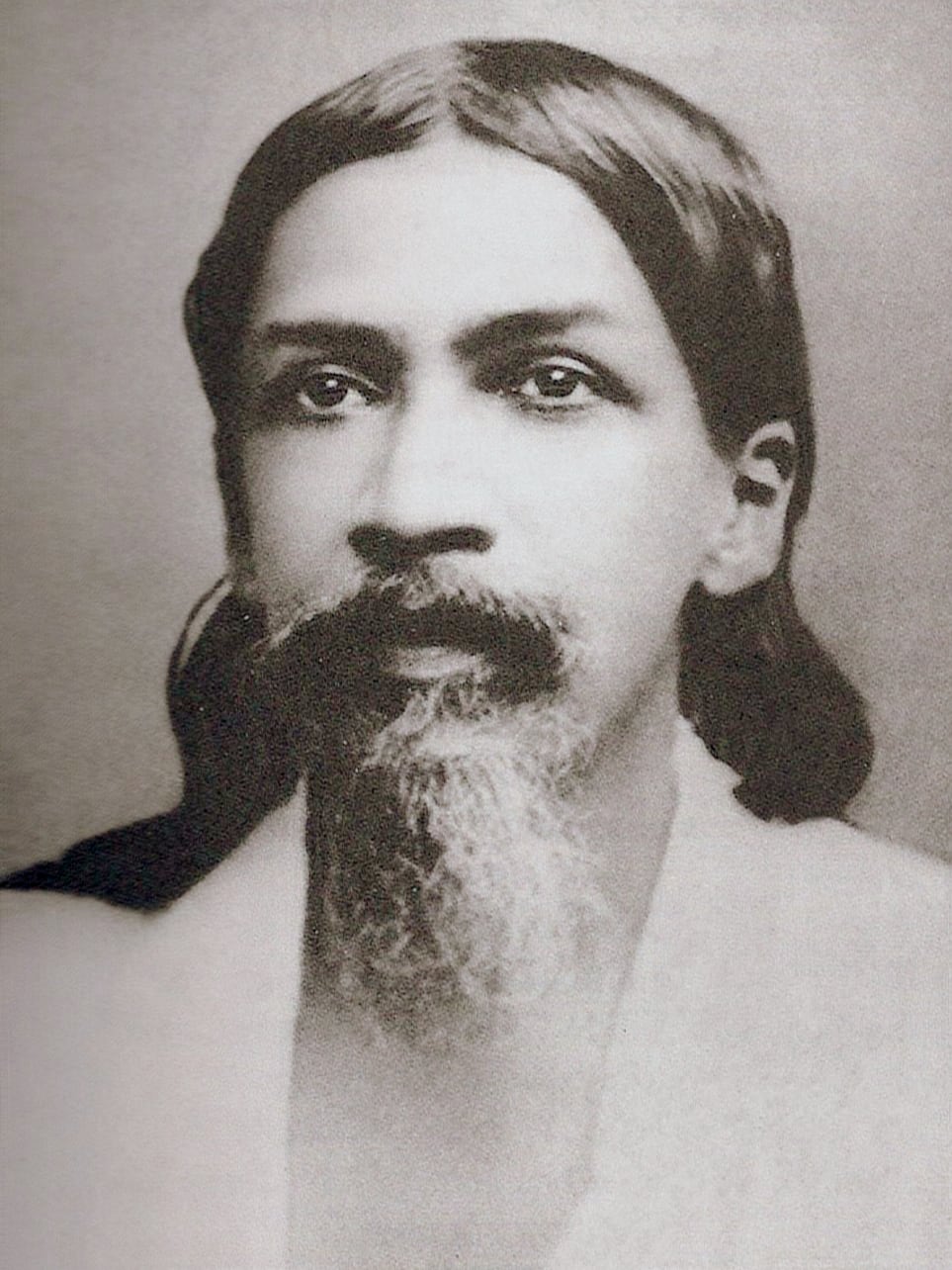
Sri Aurobindo hacia 1900 · Public domain
In their words
«The earliest preoccupation of man in his awakened thoughts and, as it seems, his inevitable and ultimate preoccupation,—for it survives the longest periods of scepticism and returns after every banishment,—is also the highest which his thought can envisage.»The Life Divine, libro I, cap. I («The Human Aspiration»); primera frase del libro (texto revisado de 1939, ed. de Nueva York 1951)

To begin, one work
The Life DivineTheir central idea
The Supermind (supramental): The Supermind is the central notion of his thought: a truth-consciousness (rita-chit) intermediate between the absolute Sachchidananda and mind, in which knowledge does not split into subject and object nor proceed by reasoning, but sees unity in diversity directly.
See in context
Biography
5 min read
A boy brought up to be English
Aurobindo Ghose was born in Calcutta on 15 August 1872, the third son of Krishna Dhun Ghose, an Edinburgh-trained doctor, Anglophile and unbeliever, and of Swarnalata Devi, daughter of the Brahmo reformer Rajnarayan Bose. His father wanted to make English gentlemen of his sons: after an Irish nuns’ school in Darjeeling, in 1879 he took them to England and left them in the care of a Congregationalist clergyman in Manchester, with instructions that they should have no dealings with Indians. Aurobindo went on to St Paul’s School in London and, on a scholarship, to King’s College, Cambridge, where he excelled in classics. He passed the Indian Civil Service examination, but in 1892 he failed to appear for the riding test and was disqualified; he later explained that he did not want to serve the British government. He returned to India in February 1893; his father had died shortly before on receiving false news that his son’s ship had sunk.
Baroda: the official and the conspirator
For thirteen years he served the Maharaja of Baroda as official, secretary and teacher—rising to vice-principal of Baroda College—while learning Bengali and Sanskrit and reading the Upanishads, the Gita and Kalidasa. In 1893 and 1894 he published in Bombay’s Indu Prakash an anonymous series, “New Lamps for Old”, accusing the Indian National Congress of servility. Behind the scenes he organised, with his brother Barindra, revolutionary groups in Bengal. In 1901 he married the fourteen-year-old Mrinalini Bose, to whom he wrote in 1905 a famous letter about his three “madnesses”: to give the country all he earned, to see God face to face, and to treat India as a mother. Around 1904 he began to practise breath control, and early in 1908, in Baroda, he followed for three days the instructions of a Maharashtrian yogi, Vishnu Bhaskar Lele, and experienced what he described as complete silence of the mind.
Bande Mataram
The partition of Bengal in 1905 took him to Calcutta. He was the first principal of the Bengal National College and, from 1906, the chief pen of the daily Bande Mataram, where he was among the first to call openly for complete independence and defended a passive resistance—boycott, national education, self-government—that did not rule out force. At the Surat Congress in December 1907 he led, with Bal Gangadhar Tilak, the so-called Extremist wing. On 2 May 1908, after the Muzaffarpur bombing, he was arrested as the alleged inspirer of the Maniktala conspiracy, the Alipore Bomb Case, and spent a year in custody, much of it in a solitary cell. There, he would say in the Uttarpara speech, he read the Gita and saw Vasudeva, Krishna, in the walls, the trees, the prisoners and the warders. Defended by Chittaranjan Das, he was acquitted on 6 May 1909.
Pondicherry and the Arya
On his release he published two weeklies, Karmayogin in English and Dharma in Bengali, but the police were preparing a new prosecution. In February 1910, obeying what he called an inner command, he took refuge in Chandernagore, and on 4 April he reached Pondicherry, French territory. He never returned to active politics. In March 1914 he met Mirra Alfassa, a Frenchwoman versed in occultism, and with her husband Paul Richard founded the monthly review Arya, which between August 1914 and January 1921 serialised almost all his major prose: The Life Divine, The Synthesis of Yoga, Essays on the Gita, The Secret of the Veda, The Human Cycle, The Ideal of Human Unity, The Future Poetry. At the same time he kept a diary of his practice, the Record of Yoga, which reveals a meticulous method and experiences only he could verify.
The ashram and the silence
Mirra Alfassa returned in 1920 to stay. On 24 November 1926, a date his followers regard as decisive, Aurobindo withdrew to his rooms and entrusted to her, whom he henceforth called the Mother, the direction of the group, which became the Sri Aurobindo Ashram. For twenty-four years he let himself be seen only a few times a year. He did, however, answer in writing, often at night and in the margins of his disciples’ notebooks: thousands of letters that now fill four volumes of Letters on Yoga. He revised The Life Divine for its book edition (1939–1940), wrote and rewrote Savitri, a blank-verse epic of some twenty-four thousand lines reworking an episode of the Mahabharata, and followed the course of the world closely: he supported the Allies against Hitler and the Cripps offer of 1942, and on 15 August 1947, Independence Day and his seventy-fifth birthday, issued a message lamenting partition.
An evolution of the spirit
His thought is a deliberate synthesis. It rejects both materialism, which denies the spirit, and ascetic renunciation, which holds the world to be illusion: spirit has involved itself in matter, and evolution unfolds it from life to mind and from mind to a higher consciousness, the supramental. Integral yoga seeks not to escape the world but to transform it, the body included. That horizon—a new consciousness on earth—explains the ambition of his work and also its weak point for the historian: many of his claims rest on experiences that cannot be checked from outside.
Death and memory
He died in Pondicherry at 1.26 a.m. on 5 December 1950, of uraemia, after telling his attendants that he was not using against the illness the spiritual force they attributed to him. According to the ashram, the body remained for more than a hundred hours without signs of decomposition; it was buried on 9 December in the courtyard of the main building. The Mother carried on his work and founded the city of Auroville in 1968. The thirty-seven-volume edition of his complete works and Peter Heehs’s critical biography, The Lives of Sri Aurobindo (2008), which some devotees received with indignation, now mark the two poles of his reception: the complete text and historical scrutiny, against a hagiography that presents him as an avatar.
Sources: Sri Aurobindo. Complete Works of Sri Aurobindo (CWSA). 37 vols. Pondicherry: Sri Aurobindo Ashram Publication Department, 1997–2025. Sustituye a la Sri Aurobindo Birth Centenary Library (SABCL, 30 vols., 1972). · Heehs, Peter. The Lives of Sri Aurobindo. Nueva York: Columbia University Press, 2008. · Sri Aurobindo. Autobiographical Notes and Other Writings of Historical Interest. CWSA 36. Pondicherry: Sri Aurobindo Ashram, 2006. · Purani, A. B. The Life of Sri Aurobindo. Pondicherry: Sri Aurobindo Ashram, 1958 (4.ª ed., 1978). · Nirodbaran. Twelve Years with Sri Aurobindo. Pondicherry: Sri Aurobindo Ashram, 1972.
Timeline
A life, year by year
Each point is a documented event. Click to read it, with its source and degree of certainty.
August 15, 1872age 0Calcuta
Birth
Aurobindo Ghose is born, third son of the physician Krishna Dhun Ghose and Swarnalata Devi.
DocumentedWikidata, «Aurobindo Ghosh» (Q192207): fechas y lugares, 99 enlaces entre wikis.
After their death
- February 28, 1968Founding of Auroville
- 1997Complete Works of Sri Aurobindo
- 2008The Lives of Sri Aurobindo
August 15, 1872 · age 0
Birth
Aurobindo Ghose is born, third son of the physician Krishna Dhun Ghose and Swarnalata Devi.
Documented
1879 · age 7
To England
His father takes him and his brothers to England; he lives with the Rev. W. H. Drewett in Manchester.
Documented
1890 · age 18
King’s College and the ICS examination
He enters King’s College on a scholarship and passes the written Indian Civil Service examination.
Documented
1892 · age 20
Disqualified from the civil service
He fails to appear for the riding test and is disqualified from the ICS.
Documented
February 1893 · age 20
Return to India
He lands at Bombay and enters the service of Baroda State. In August he begins “New Lamps for Old” in the Indu Prakash.
Documented
April 1901 · age 28
Marriage to Mrinalini Bose
He marries Mrinalini, daughter of Bhupal Chandra Bose; she will die in December 1918.
Documented
1906 · age 34
Bande Mataram and the National College
He settles in Calcutta, heads the Bengal National College and writes for the daily Bande Mataram.
Documented
December 1907 · age 35
The Surat split
At the Surat Congress he leads the radical nationalist wing with Tilak; the Congress splits.
Documented
January 1908 · age 35
Silence of mind with Lele
With the yogi Vishnu Bhaskar Lele he experiences the silent Brahman within three days.
Documented
May 2, 1908 · age 35
Arrest: the Alipore Bomb Case
Arrested after the Muzaffarpur bombing; he spends a year in Alipore jail.
Documented
May 30, 1909 · age 36
Acquittal and the Uttarpara speech
Acquitted on 6 May, on 30 May at Uttarpara he recounts his experiences in prison.
Documented
April 4, 1910 · age 37
Arrival in Pondicherry
After hiding in Chandernagore, he settles in French India and leaves politics.
Documented
March 29, 1914 · age 41
Meeting Mirra Alfassa
He meets Mirra and Paul Richard; on 15 August the first issue of Arya appears.
Documented
January 1921 · age 48
End of the Arya
The review ceases publication after six and a half years of monthly instalments.
Documented
November 24, 1926 · age 54
The “day of siddhi” and the withdrawal
He withdraws to his rooms; the Mother takes charge of the Sri Aurobindo Ashram.
Documented
1939 · age 67
The Life Divine in book form
The revised Life Divine appears (1939–1940), published by Arya Publishing House.
Documented
August 15, 1947 · age 75
Message of 15 August
On Indian Independence Day and his birthday he issues a message on India’s future, lamenting partition.
Documented
1950 · age 78
Publication of Savitri
The first part of Savitri is published (the other two in 1951).
Documented
December 5, 1950 · age 78
Death
He dies at 1.26 a.m.; he is buried on 9 December in the ashram courtyard.
Documented
February 28, 1968
Founding of Auroville
The Mother founds the experimental city inspired by his vision of human unity.
Documented
1997
Complete Works of Sri Aurobindo
The 37-volume edition begins, completed in 2025.
Documented
2008
The Lives of Sri Aurobindo
Peter Heehs publishes his critical biography, sparking a long controversy with parts of the ashram.
Documented
Works
Essential works
The works without which their legacy cannot be understood.
Written work · 1939
The Life Divine
His great metaphysical treatise. It starts from the human aspiration towards God, light, freedom and immortality, and reads it as the sign of an unfinished evolution: the Spirit (Sachchidananda) has involved itself in matter and emerges in it as life, mind and, in the future, supermind. It argues against materialism and against the illusionism of the Vedantins, analyses the Ignorance as partial knowledge rather than error, and culminates in the description of the “gnostic being” and of a divine life on earth. It is the philosophical basis of his whole yoga.
10 editions

Written work · 1948
The Synthesis of Yoga
The manual of his integral yoga. After an introduction on the conditions of the synthesis—where he cites Ramakrishna’s life as an example of passing through every path—, it studies in turn the yoga of divine works, of integral knowledge, of divine love and of self-perfection, which was to culminate in supramental transformation. It takes up the Gita, Tantra and Vedanta and reorders them around surrender to the divine Shakti. It is his most technical work and the most read by practitioners.
8 editions

Written work · 1922
Essays on the Gita
A reading of the Bhagavad Gita as a guide to active spirituality rather than a text of renunciation. Aurobindo seeks its “living message”: the union of knowledge, works and devotion, the sacrifice of action to the Lord, the doctrine of the avatar and, in the Second Series, that of the Purushottama, the supreme Being embracing personal and impersonal. Written in implicit dialogue with Tilak, Gandhi and Shankara, it is one of the most influential modern interpretations of the Gita.
5 editions

Written work · 1950
Savitri: A Legend and a Symbol
A blank-verse epic of some twenty-four thousand lines in twelve books that turns into symbol the Mahabharata episode in which Savitri overcomes Death to win back her husband Satyavan. King Aswapati journeys through the worlds of consciousness; Savitri, incarnation of the divine Mother, confronts Death in a metaphysical dialogue and obtains not only Satyavan’s life but the promise of a divine life on earth. Aurobindo regarded it as his main work and wrote it as mantric poetry.
6 editions
Complete works (65)

The Secret of the Veda
1956

Hymns to the Mystic Fire
1946

Isha Upanishad
1914

Kena and Other Upanishads
1915

The Human Cycle
1949
Sri Aurobindo
The Ideal of Human Unity
The Conscious LibraryThe Ideal of Human Unity
1919

War and Self-Determination
1920

The Future Poetry
1953
Sri Aurobindo
The Renaissance in India
The Conscious LibraryThe Renaissance in India
1920
Sri Aurobindo
A Defence of Indian Culture (The Foundations of Indian Culture)
The Conscious LibraryA Defence of Indian Culture (The Foundations of Indian Culture)
1953

The Problem of Rebirth
1952
Sri Aurobindo
Heraclitus
The Conscious LibraryHeraclitus
1941

The Mother
1928
Sri Aurobindo
Lights on Yoga
The Conscious LibraryLights on Yoga
1935

Bases of Yoga
1936
Sri Aurobindo
More Lights on Yoga
The Conscious LibraryMore Lights on Yoga
1948
Sri Aurobindo
The Riddle of This World
The Conscious LibraryThe Riddle of This World
1933

Letters on Yoga
1958

Letters on Himself and the Ashram
2011

Letters on Poetry and Art
2004

Thoughts and Glimpses
1920

Thoughts and Aphorisms
1958

Essays Divine and Human
1994
Sri Aurobindo
Essays in Philosophy and Yoga
The Conscious LibraryEssays in Philosophy and Yoga
1998
Quotations
Quotations located in a specific work. Each carries its provenance and its level of confidence.
The earliest preoccupation of man in his awakened thoughts and, as it seems, his inevitable and ultimate preoccupation,—for it survives the longest periods of scepticism and returns after every banishment,—is also the highest which his thought can envisage.VerifiedThe Life Divine, libro I, cap. I («The Human Aspiration»); primera frase del libro (texto revisado de 1939, ed. de Nueva York 1951)
Last words
Later account by witnesses
«“No.” … “Can’t explain; you won’t understand.”»No. … Can’t explain; you won’t understand.
No farewell sentence survives. The last words recorded by his attendants are from the day before, 4 December 1950: asked by Nirodbaran whether he was using his spiritual force to rid himself of the illness, he said no, and when pressed added that he could not explain and that they would not understand. Versions differ in the wording of the question (Nirodbaran, Twelve Years with Sri Aurobindo; Amal Kiran recalls “Aren’t you using your Yogic force on yourself?”). He died at 1.26 a.m. on 5 December. The Mother later stated that he had told her he was leaving the body on purpose; this is second-hand testimony.
Source: Nirodbaran. Twelve Years with Sri Aurobindo. Pondicherry: Sri Aurobindo Ashram, 1972.
Ask
What their work answers
Twelve great human questions and what their texts allow us to answer, with references. We never put words in their mouth.
What is the Absolute? Does God exist?
Sachchidananda is at once impersonal Being and divine Person
Both personal and impersonalStated explicitly
In The Life Divine Sri Aurobindo builds a metaphysics in which the Absolute is Sachchidananda, existence, consciousness-force and bliss, not merely a featureless silence. He rejects both the materialist denial and the ascetic refusal that declares illusory everything except the motionless Brahman. The Supreme is at once impersonal and personal: a limitless being and a conscious Ishvara who, through his Shakti, involves himself in matter and re-emerges through evolution. In his writings on the Mother he presents that Shakti as the consciousness and force of the Supreme, at once transcendent, universal and individual. For Aurobindo the personal God is no concession to human weakness, nor is the impersonal Absolute the last word: both are truths of a reality that exceeds and integrates them.
Compare this question with other teachersWho am I? Is there a true self?
The psychic being, a divine spark that grows from life to life
An evolving soulStated explicitly
Sri Aurobindo distinguishes several levels in the person. The ego is a provisional formation of nature, useful while ignorance lasts. Behind body, life and mind stands the psychic being, a spark of the Divine in the heart that grows and takes shape over many lives, assimilating the essence of each experience. Above it is the Jivatman, the central being, eternal and one with the Divine, which does not evolve but presides. In The Life Divine and in his Letters on Yoga he explains that the task of sadhana is to discover the psychic being, bring it forward and let it transform mind, life and body. The true self does not merely contemplate its origin: it takes part in the evolution of consciousness on earth.
Compare this question with other teachersWhy do we suffer?
Pain arises from separative consciousness, a stage in an evolution
Ignorance of what we areStated explicitly
In The Life Divine Sri Aurobindo devotes several chapters to the origin of falsehood, evil and suffering. His answer is that pain does not belong to the ultimate nature of things, which is bliss (ananda), but to the Ignorance: the consciousness that, emerging from inconscient matter, perceives itself as a separate ego and experiences the world as foreign and threatening. Suffering is the reaction of a limited being not yet able to receive with equanimity the touch of universal life. It is neither a punishment nor a mistake of the Creator but a condition of evolution, meant to disappear when consciousness opens to its source and is transformed. Hence he rejects both resignation and flight from the world.
Compare this question with other teachersWhat happens after death?
The psychic being is reborn to grow, not merely to pay debts
Rebirth according to karmaStated explicitly
In The Problem of Rebirth Sri Aurobindo accepts reincarnation but reinterprets it. He does not understand it as a punishment or a mechanical chain of moral causes, but as the means by which the psychic being grows and consciousness evolves on earth. After death the outer parts of the personality dissolve; the psychic being withdraws to its own world, assimilates the experience of the life and is born again when its development requires. Unlike the schools that seek to escape the cycle, Aurobindo does not see liberation as the end of rebirth: the goal is a divine life on earth, which even envisages the transformation of the body and the overcoming of physical death.
Compare this question with other teachersHow is liberation or salvation attained?
Aspiration from below, grace from above: surrender to the Mother
Through grace and loveStated explicitly
Sri Aurobindo proposes an integral yoga that seeks not merely individual liberation but the transformation of the whole nature. In The Synthesis of Yoga he integrates knowledge, works and devotion, and in The Mother he sums up practice in three movements: aspiration, rejection of what opposes the light, and surrender. But he insists that personal effort is not enough: only two powers can accomplish the work, a constant aspiration calling from below and a supreme grace answering from above. That grace acts through the divine Shakti, the Mother, to whom the disciple must open ever more. Liberation is the first step; the goal is to let the Divine do the yoga in oneself.
Compare this question with other teachersIs a teacher necessary?
The true guru is the Divine in the heart; the human guru helps
The teacher is withinStated explicitly
In the introduction to The Synthesis of Yoga Sri Aurobindo lists four aids to yoga: knowledge of the scriptures, persistent enthusiasm, the teacher and time. Of the teacher he says that the true guru is the Lord dwelling in the heart, the world-teacher, who guides the seeker even when the seeker does not know it. The human teacher is valuable when acting as a channel for that presence and teaching by example and influence more than by precept; he should not impose himself or create dependence. In practice, however, Aurobindo and the Mother acted as guides of the Pondicherry ashram, and in his letters he insists that the disciple must open to the Mother’s force.
Compare this question with other teachersIs the world real?
The world is real: Spirit involved in matter, now evolving
Manifestation of the divineStated explicitly
Sri Aurobindo expressly rejects the idea that the world is an illusion. In the first chapters of The Life Divine he examines two negations: the materialist’s, which denies Spirit, and the ascetic’s, which denies the world; he considers both partial truths. The universe is a real manifestation of Sachchidananda, which has involved itself in inconscient matter and emerges again, through evolution, as life, mind and, in the future, supermind. That evolution also passes through planes of consciousness, from matter up to spiritual levels. The world is not a mistake to escape from but the stage on which the Divine discovers itself and is called to be transformed.
Compare this question with other teachersWhat is love?
Divine love descends and transforms; Savitri sets it against death
Longing and unionStated explicitly
The third part of The Synthesis of Yoga is devoted to the yoga of divine love: Sri Aurobindo presents it as one of the great paths to the Supreme, in which the soul turns to the Divine with all its emotions and discovers that He is the Beloved in all beings. Human love, mixed with desire and ego, is for him a still obscure form of a force that comes from the Divine. In Savitri, his epic poem, the heroine’s love defies Death to restore Satyavan to life, a symbol of a spiritual love able to overcome the law of mortality. Love is not merely longing for union: it is a force that transforms life.
Compare this question with other teachersAre we free, or is everything determined?
Lower nature is determined; freedom lies in the Spirit
We are machines until we awakenStated explicitly
In the Essays on the Gita Sri Aurobindo devotes a chapter to the determinism of nature. Following the Gita, he holds that on the level of lower nature all acts are performed by the qualities (gunas) of prakriti, and that the ego which thinks itself free is only an instrument of those forces; its supposed freedom is that of choosing among already conditioned impulses. True freedom exists, but on another level: in the Purusha, the spiritual being, which can awaken to itself, rise above the qualities and become a conscious instrument of the divine Will. One who is freed does not stop acting, but stops being moved by blind nature.
Compare this question with other teachersWhy meditate or pray?
Go within, find the psychic being and open upward
Returning to the source of the IStated explicitly
Sri Aurobindo proposes no single technique: in The Synthesis of Yoga he states that all life is yoga. But in his Letters on Yoga he gives concrete guidance for meditation: quieten the mind, concentrate in the heart to discover the psychic being, the inner divine presence, or above the head to open to the higher consciousness, and offer up whatever arises. The aim is not only silence but for that silence to allow the descent of a force that transforms nature. He distinguishes meditation, which works with ideas, from contemplation and concentration, and warns against tense effort. To meditate is to return to the inner source so that it may act in life.
Compare this question with other teachersCan reason know the ultimate?
Reason is an intermediate instrument; above it lie intuition and supermind
The ultimate lies beyond the mindStated explicitly
Sri Aurobindo, educated at Cambridge and author of an extensive philosophical body of work, does not despise reason: in The Human Cycle he analyses its historical role as an agent of progress and critic of custom. But he holds that it is an intermediate instrument, unable on its own to reach ultimate truth, because it divides and works with concepts. Above the rational mind he describes a ladder of planes of consciousness: higher mind, illumined mind, intuition, overmind and, at the summit, supermind, a truth-consciousness that knows by identity. Spiritual experience completes what reason cannot, and reason then serves to order and communicate what has been experienced. His own work is an example of that use.
Compare this question with other teachersWithdraw from the world or transform it?
Without a change of consciousness, no social reform suffices
The revolution is innerStated explicitly
Sri Aurobindo was first a leader of radical Indian nationalism, imprisoned by the British in 1908. In prison he had spiritual experiences that led him in 1910 to withdraw to Pondicherry. He did not experience this as flight: in The Human Cycle and The Ideal of Human Unity he argues that political, economic or cultural revolutions fail if human consciousness does not change, and that humanity is heading towards a subjective and then a spiritual age. His yoga rejects both the asceticism that abandons the world and the activism that reforms it without transforming itself. The goal is a divine life on earth, which can only arise from a collective inner transformation.
Compare this question with other teachers
Affinities & tensions
Affinities and tensions
Calculated question by question from their positions. The reason for each agreement or clash, on click.
Thinks most like
Ramakrishna
They agree on: What is the Absolute? Does God exist? · What happens after death? · Is a teacher necessary?
Kahlil Gibran
They agree on: What is the Absolute? Does God exist? · Who am I? Is there a true self? · What happens after death?
Carl Gustav Jung
They agree on: Who am I? Is there a true self? · Why do we suffer? · Is a teacher necessary?
Eckhart Tolle
They agree on: Is a teacher necessary? · Is the world real? · Are we free, or is everything determined?


Anecdotes and stories
Anecdotes and stories
Documented1892
The riding test
Origin of the story: The facts are recorded in the Civil Service Commission files studied by Peter Heehs; the deliberate intent comes from Aurobindo’s own later statements (Autobiographical Notes, CWSA 36).
Source: Heehs, Peter. The Lives of Sri Aurobindo. Nueva York: Columbia University Press, 2008.
Testimonydiciembre de 1892 - febrero de 1893
The ship that did not sink
Origin of the story: Aurobindo tells it himself in his autobiographical notes and his biographers repeat it (Purani, Heehs); the detail of the father’s last words is family tradition.
Testimonyenero de 1908
Three days with Lele
Origin of the story: Aurobindo’s account in letters of the 1930s (CWSA 35) and in conversations noted by disciples; there is no testimony from Lele about the inner experience.
Source: Sri Aurobindo. Letters on Himself and the Ashram. CWSA 35. Pondicherry: Sri Aurobindo Ashram, 2011.
Testimony1908-1909
Vasudeva in Alipore jail
Origin of the story: Primary source: the Uttarpara speech (30 May 1909) and the Bengali account Kara-kahini; Vivekananda’s voice in letters of the 1930s (CWSA 35). They are the protagonist’s own testimony.
Testimonyfebrero-abril de 1910
The command to leave
Origin of the story: Aurobindo’s own account (Autobiographical Notes, CWSA 36) and that of witnesses from his Calcutta circle; police reports confirm the flight and the dates, not the voice.
Documented29-30 de marzo de 1914
“He whom we saw yesterday”
Origin of the story: The entry of 30 March 1914 appears in the Mother’s Prières et méditations (published 1932); the recognition of the figure of her visions comes from the Mother’s later conversations recorded at the ashram.
Source: La Mère (Mirra Alfassa). Prières et méditations. Pondicherry: Sri Aurobindo Ashram, 1932 (anotación del 30 de marzo de 1914).
Testimony5-9 de diciembre de 1950
The hundred hours
Origin of the story: It comes from ashram witnesses and statements by the Mother recorded in ashram publications; the existence and wording of the medical certificate are cited in those sources and have not been checked against an original.
Teachings
Teachings
The notions that structure their thought, explained in context.
The Supermind (supramental)supramental
Aurobindo links the term to the Vedic notion of rita (truth-order) and the vijnana of the Upanishads; historians stress its relation to nineteenth-century evolutionary theories.
Integral yoga (purna yoga)yoga-integral
Set out in The Synthesis of Yoga and the Letters on Yoga; Aurobindo distinguished it from all earlier yogas, which he regarded as stages or fragments of a possible synthesis.
Involution and evolutioninvolucion-y-evolucion
Developed in The Life Divine; it has been compared with Teilhard de Chardin, Bergson and Whitehead, without demonstrated direct influence.
The psychic beingser-psiquico
Explained above all in the Letters on Yoga and The Life Divine; the Mother made it the axis of her educational teaching.
Source: Sri Aurobindo. Letters on Himself and the Ashram. CWSA 35. Pondicherry: Sri Aurobindo Ashram, 2011.
The ladder of mind: from higher mind to overmindplanos-de-la-mente
Set out in The Life Divine (Book II) and in the letters on poetry, where he applies it to the quality of inspiration.
Surrender to the divine Motherentrega-a-la-madre
Set out in The Mother (1928) and in the letters on the Mother (CWSA 32).
Videos
Videos
Recordings, interviews and documentaries. Videos play from YouTube; they are not hosted here.
Rare Footage of Sri Aurobindo’s Mahasamadhi (5 December 1950)
Original recording· 1950· 7 min
Overman Foundation
The Mother on Sri Aurobindo’s Mahasamadhi, 5th Dec 1950
Original recording· EN· 12 min
Arvind T Akki Sri Aurobindo Ashram, Pondicherry
Sri Aurobindo: A Life Divine [a 1993 film]
Documentary· EN· 1993· 21 min
AuroMaa
THE TRANSFORMATION - A documentary film on Sri Aurobindo
Documentary· EN· 54 min
Sri Aurobindo SocietyOfficial channel
नया जन्म | Naya Janma | The Transformation (versión hindi)
Documentary· HI· 54 min
Sri Aurobindo
Journey To The Life Divine — Part I
Documentary· EN· 104 min
Sri Aurobindo AshramOfficial channel
Sri Aurobindo: An Indian Mystic Who Worked for Human Unity
Documentary· EN· 49 min
Sri Aurobindo Ashram Delhi BranchOfficial channel
Film: “Sri Aurobindo Ghose: The Beginning of Spiritual Journey”
Documentary· EN· 2022· 38 min
Consulado General de la India en Hamburgo (congendiahamburg)Official channel
The Mother reads Savitri by Sri Aurobindo: Book 01 Canto 01
Original recording· EN· 23 min
AuroMaa
Sri Aurobindo’s Uttarpara Speech
Lecture· EN· 32 min
Savitri Bhavan Auroville
Dr. Alok Pandey on Sri Aurobindo’s The Life Divine
Lecture· EN· 60 min
Savitri Bhavan Auroville
Sri Aurobindo’s Savitri - Theme, Structure and Message (Part 1 of 3)
Lecture· EN· 108 min
Debashish Banerji
Conversation with Peter Heehs - History, Spirituality, and Sri Aurobindo
Interview· EN· 45 min
Academia Surge
Vicente Merlo - La conciencia y la evolución espiritual en Sri Aurobindo
Lecture· ES· 61 min
Taller de Espiritualidad
¿Es Sri Aurobindo uno de los místicos más grandes de todos los tiempos? Un día con… Vicente Merlo
Interview· ES· 58 min
Siglantana editorial
Gallery
Gallery
Images with verified licences. Each keeps its authorship and attribution.
Connections
Connections
Influences, discipleships and affinities. Documented relations are distinguished from similarities identified by analysis.
Teacher of
La Madre (Mirra Alfassa)
He met her on 29 March 1914 and from 1920 she was his spiritual collaborator; he regarded her as an incarnation of the divine Mother and in 1926 entrusted her with the direction of the ashram, which she continued to lead after his death.
Documented relation
Influenced by
He wrote that in Alipore jail he heard for a fortnight Vivekananda’s voice guiding him in meditation; they never met in life.
Documented relation
Influenced by
In the introduction to The Synthesis of Yoga he presents Ramakrishna’s life as an example of a spiritual capacity running through all the disciplines and prefiguring the synthesis.
Documented relation
Disciple of
Vishnu Bhaskar Lele
Maharashtrian yogi with whom he experienced silence of mind in January 1908; his only outer guide, briefly.
Documented relation
Met
Bal Gangadhar Tilak
Companion in the radical wing of Congress; he presided with him over the Nationalist meeting at Surat (1907) and devoted an essay to him in 1918.
Documented relation
Influenced by
Bankim Chandra Chattopadhyay
He devoted essays to him in 1894 and 1907 and translated part of his novel Anandamath, source of the hymn Bande Mataram that named his daily.
Documented relation
Met
Rabindranath Tagore
Tagore dedicated the poem “Namaskar” to him in 1907 and visited him in Pondicherry in 1928.
Documented relation
Met
Sister Nivedita (Margaret Noble)
He worked with her in the Bengal nationalist circles from 1902; after his departure for Chandernagore in 1910 she took charge of Karmayogin.
Documented relation
Disagreed with
In The Life Divine he criticises the “illusionism” (mayavada) of Shankara’s Advaita, which holds the world unreal, while acknowledging the truth of the experience of the silent Brahman.
Documented relation
Ideas akin to
He devoted the study Heraclitus (Arya, 1916–1917) to him, comparing his doctrine of fire and becoming with that of the Vedic rishis.
Documented relation
Contemporary of
Contemporaries in South India; some disciples (such as T. V. Kapali Sastri) frequented both. There is no record of a meeting. Relationship noted by the editors.
Similarity identified by analysis
Ideas akin to
Two Bengalis who presented yoga as a science of the evolution of consciousness and whose work found a wide echo in the West. Similarity identified by the editors; no meeting is recorded.
Similarity identified by analysis
Contemporary of
Contemporaries with teachings opposed in method: Krishnamurti rejected all spiritual authority and every system; Aurobindo built one. No personal relationship is recorded.
Similarity identified by analysis
Contemporary of
Bengali contemporaries of the independence generation; there is no record that they met.
Similarity identified by analysis
Ideas akin to
Both conceived evolution as an ascent of consciousness towards a spiritual culmination; the comparison is common in the literature, without documented mutual influence.
Similarity identified by analysis
Linked from other profiles
- Annie Besant · Contemporary of
- Ramana Maharshi · Contemporary of
- Swami Vivekananda · Influenced
- Swami Vivekananda · Ideas akin to
- Pierre Teilhard de Chardin · Ideas akin to
- Helena Blavatsky · Ideas akin to
- Anandamayi Ma · Contemporary of
- Ramakrishna · Influenced
- Paramahansa Yogananda · Contemporary of
- Vyasa · Ideas akin to
Sources
Sources
Bibliography and catalogues consulted for this profile.
- Sri Aurobindo. Complete Works of Sri Aurobindo (CWSA). 37 vols. Pondicherry: Sri Aurobindo Ashram Publication Department, 1997–2025. Sustituye a la Sri Aurobindo Birth Centenary Library (SABCL, 30 vols., 1972).
- Heehs, Peter. The Lives of Sri Aurobindo. Nueva York: Columbia University Press, 2008.
- Sri Aurobindo. Autobiographical Notes and Other Writings of Historical Interest. CWSA 36. Pondicherry: Sri Aurobindo Ashram, 2006.
- Purani, A. B. The Life of Sri Aurobindo. Pondicherry: Sri Aurobindo Ashram, 1958 (4.ª ed., 1978).
- Nirodbaran. Twelve Years with Sri Aurobindo. Pondicherry: Sri Aurobindo Ashram, 1972.
- Satprem. Sri Aurobindo ou l’aventure de la conscience. París: Buchet-Chastel, 1964 (trad. inglesa de Luc Venet, 1984).
- Wikidata, «Aurobindo Ghosh» (Q192207): fechas y lugares, 99 enlaces entre wikis.
- Wikipedia en inglés, «Sri Aurobindo» (cronología política, Alipore, Arya, ashram y ediciones).
- Wikimedia Commons, «Category:Sri Aurobindo» y ficheros asociados (metadatos y licencias consultados por API).
- Heehs, Peter. Sri Aurobindo: A Brief Biography. Delhi: Oxford University Press, 1989.
- Sri Aurobindo. «Uttarpara Speech» (30 de mayo de 1909), Karmayogin, 19 de junio de 1909. CWSA 8. Texto en Wikisource.
- SABDA (distribuidora del Sri Aurobindo Ashram), catálogo de las Complete Works y de las ediciones sueltas.
- Wikipedia en inglés, «Savitri: A Legend and a Symbol» (composición 1916–1950, edición 1950–1951).
- Deshpande, R. Y. «Sri Aurobindo’s Withdrawal — 5 December 1950». Overman Foundation (relato de los últimos días a partir de Nirodbaran, Champaklal y la Madre).
- «Yogic Sadhan». Sri Aurobindo: Archives and Research 10, n.º 1 (abril de 1986): texto de la edición de 1920 y notas sobre su origen en escritura automática.
- Sri Aurobindo. Record of Yoga. CWSA 10–11. Pondicherry: Sri Aurobindo Ashram, 2001.
- Sri Aurobindo. Essays on the Gita (First Series). Madrás: V. Ramaswamy Sastrulu & Sons, 1922. Texto parcial en Wikisource.
- Sri Aurobindo. The Life Divine. Nueva York: The Sri Aurobindo Library, 1949–1951 (texto de la edición revisada de 1939–1940). Copia digital en Internet Archive.
- Sri Aurobindo. Letters on Himself and the Ashram. CWSA 35. Pondicherry: Sri Aurobindo Ashram, 2011.
- Sri Aurobindo. The Mother. Calcuta: Arya Publishing House, 1928 (reimpr. 1937–1949). Copia digital en Internet Archive.
- La Mère (Mirra Alfassa). Prières et méditations. Pondicherry: Sri Aurobindo Ashram, 1932 (anotación del 30 de marzo de 1914).
- Rights holder
- Sri Aurobindo Ashram Trust (Pondicherry), que reivindica los derechos de todos sus textos. Situación por territorios: Aurobindo murió en 1950, por lo que su obra es de dominio público en la UE desde 2021 (70 años) y en la India desde 2011 (60 años); en España (80 años para autores fallecidos antes de 1987) no lo será hasta el 1 de enero de 2031; en EE. UU. solo lo publicado antes de 1931 es seguro dominio público. Las ediciones de la CWSA, con aparato y textos inéditos, tienen derechos propios.
- Official site
- www.sriaurobindoashram.org/
Pending confirmation
What this profile has not yet been able to settle. We would rather say so than fill it in.
- Ediciones españolas con ISBN de Ensayos sobre la Gita, Savitri, El ciclo humano, El ideal de la unidad humana, La Madre, Bases del yoga y Cartas sobre el yoga: no localizadas en Open Library (Google Books sin cuota). Revisar catálogos de Kier, Plaza & Janés, Obelisco y del Centro Sri Aurobindo de Barcelona.
- Comprobar la autoría de «La aventura de la consciencia» (Obelisco, 1993, ISBN 9788477200857): Open Library la atribuye a Aurobindo, pero el título corresponde al libro de Satprem.
- Fechas y editoriales de las primeras ediciones de Thoughts and Glimpses (c. 1920), War and Self-Determination (1920), Love and Death (1921), Ahana and Other Poems (1915), Heraclitus (1941) y The Ideal of the Karmayogin.
- Año de la primera compilación titulada Letters on Yoga (se da 1958, aproximado).
- Fecha exacta del primer libro de Satprem (se da 1964) y existencia de una traducción española íntegra con ISBN.
- Cotejar el certificado médico del doctor Barbet (diciembre de 1950) con un original o con una publicación del ashram que lo reproduzca.
- Precisar el barco (y la fecha) cuya noticia falsa de naufragio recibió su padre en 1892.
- Imagen: localizar en Commons un retrato de la etapa de Pondicherry con licencia libre verificada (las fotos de Henri Cartier-Bresson de 1950 están protegidas).
- Sala de lectura: todos los textos llevan caution por la regla española (libres desde 2031). Buscar transcripciones completas de Essays on the Gita y de los artículos de Arya.
Researched on 2026-10-25