Christianity · Christian mysticism · Catholicism
Pierre Teilhard de Chardin
1881 – 1955Historically documented person
French Jesuit, geologist and palaeontologist (1881–1955) who took part in the study of Peking Man and spent twenty years doing research in China. He sought to unite the theory of evolution with Christian faith: in The Human Phenomenon he describes a universe rising toward greater complexity and consciousness, forming a 'noosphere' and converging on an Omega Point he identifies with Christ. Rome forbade him to publish his philosophical works, which appeared after his death and had enormous influence, together with The Divine Milieu and The Mass on the World.
- works
- 31works
- editions
- 39editions
- quotes
- 8quotes
- videos
- 12videos
- images
- 9images
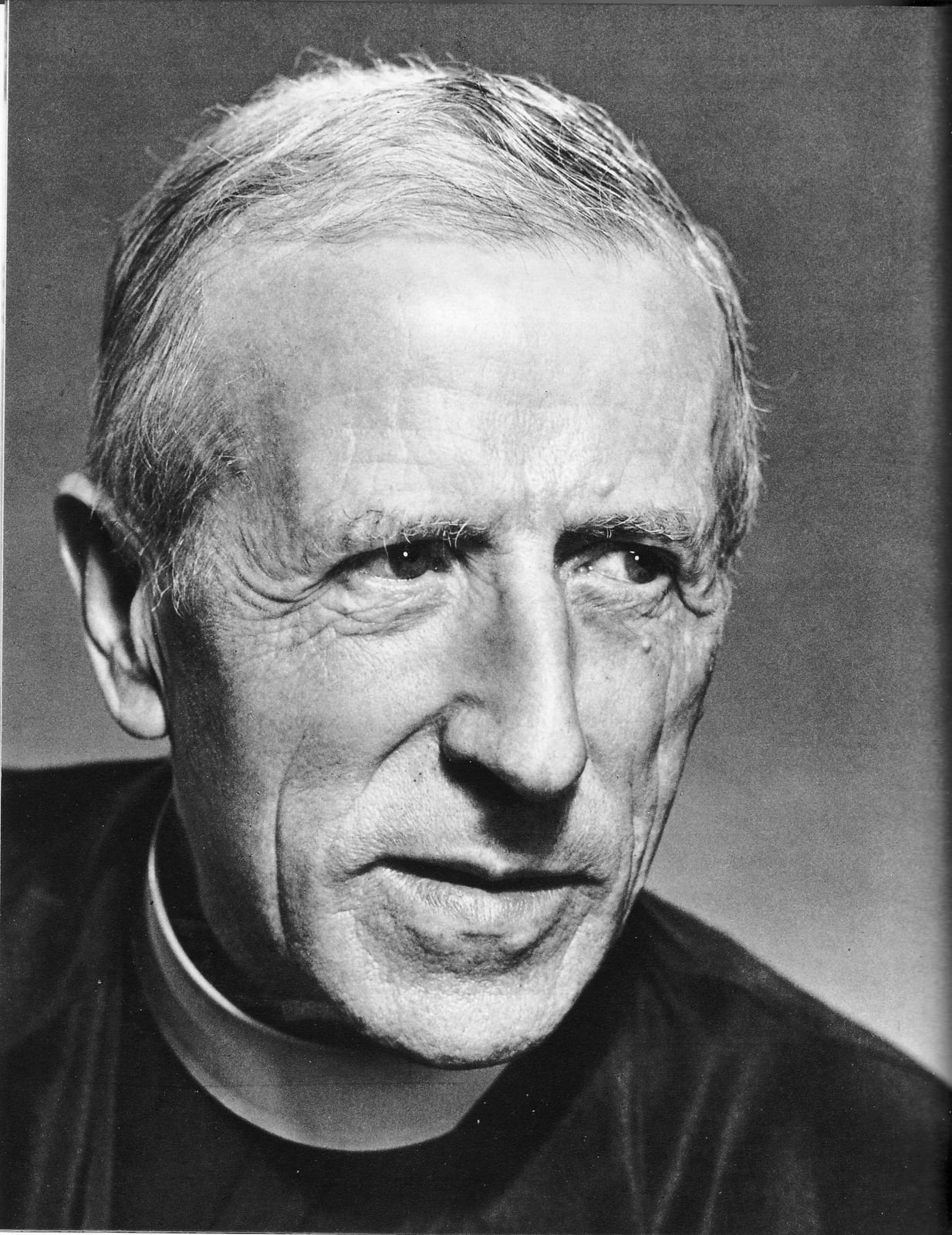
Pierre Teilhard de Chardin en 1955 · CC BY-SA 3.0
In their words
«To see. One could say that the whole of Life lies in that, if not finally, at least essentially.»Le Phénomène humain, prólogo «Voir»

To begin, one work
The Human Phenomenon (The Phenomenon of Man)Their central idea
Evolution is not merely a biological fact but the movement of the whole universe: matter arranges itself into ever more complex and, at the same time, ever more conscious structures. Teilhard formulates this as the law of complexity-consciousness and takes it as the thread of all cosmic history.
See in context
Biography
4 min read
A boy and his "iron God"
Marie-Joseph Pierre Teilhard de Chardin was born on 1 May 1881 at the château of Sarcenat, in Orcines near Clermont-Ferrand, the fourth of eleven children of Emmanuel Teilhard de Chardin, an archivist and amateur naturalist, and Berthe-Adèle de Dompierre d'Hornoy, a great-grandniece of Voltaire. From his father he inherited a passion for stones and insects; from his mother, an ardent piety centred on the Sacred Heart. In The Heart of Matter, written near the end of his life, he recalled that at six or seven he secretly worshipped his "iron God" —a plough pin, the head of a bolt, shell splinters— because nothing seemed harder or more lasting: 'consistence', he writes, was for him the fundamental attribute of Being, and he was already seeking the unalterable at the heart of matter.
A Jesuit in exile
He studied at the Jesuit college of Mongré, at Villefranche-sur-Saône, and in March 1899 entered the Society of Jesus's novitiate at Aix-en-Provence. The anti-congregation laws of 1901 forced the French Jesuits into exile, and Teilhard completed his philosophical training on the island of Jersey, where geology became a vocation. From 1905 to 1908 he taught physics and chemistry at the Holy Family college in Cairo, and from 1908 to 1912 he studied theology at Ore Place, Hastings, where he read Henri Bergson's Creative Evolution. He was ordained priest on 24 August 1911.
War, an encounter with the absolute
From 1912 to 1914 he trained in palaeontology at the National Museum of Natural History in Paris under Marcellin Boule. In 1913 he spent a few days at the Piltdown excavations, later revealed as a hoax. Mobilised in December 1914, he served as a stretcher-bearer in a regiment of Moroccan riflemen at Ypres, Verdun and the Chemin des Dames and was awarded the Médaille militaire and the Legion of Honour. In the trenches he wrote his first essays —Cosmic Life (1916), The Mystical Milieu, The Spiritual Power of Matter (1919)— and a correspondence with his cousin Marguerite Teillard-Chambon that shows his thought being born. He took his solemn vows on 26 May 1918.
From the Institut Catholique to China
A doctor of science of the Sorbonne in 1922 with a thesis on the mammals of the French Lower Eocene, he taught geology at the Institut Catholique in Paris. In 1923 he travelled to Tianjin to join the Jesuit Émile Licent; in the Ordos desert, with neither bread nor wine to celebrate, he wrote The Mass on the World. A private note on original sin, circulated without his permission, prompted Rome to intervene: in 1925 he was removed from teaching and in 1926 he returned to China, which would be his base for twenty years. There he wrote The Divine Milieu (1926–1927), whose publication was refused.
Asia's geologist
As adviser to the Cenozoic Research Laboratory in Peking he took part in the excavations at Zhoukoudian, where in 1929 Pei Wenzhong found the skull of Sinanthropus, "Peking Man"; Teilhard established the geology of the site and, with Henri Breuil, the presence of tools and fire. He joined Citroën's Croisière jaune (1931–1932), travelled the Yangtze, India, Burma and Java, and drew up a general geological map of China. His hundreds of scientific papers, collected in eleven volumes, placed him among the great geologists of the continent. In Peking he formed an intense and chaste friendship with the sculptor Lucile Swan, documented in a long correspondence.
The Human Phenomenon
Between 1938 and 1940, in Peking, he wrote his major work, The Human Phenomenon: a reading of evolution as a rise in complexity and consciousness which, after the biosphere, generates the "noosphere" and converges on a pole of personal unity, the Omega Point, which he identifies with the cosmic Christ. Held in China during the Second World War, he founded the Institute of Geobiology with Pierre Leroy. Back in Paris in 1946 he enjoyed growing prestige, but Rome forbade him to publish philosophical works, renewed in 1948 its refusal to print The Human Phenomenon and prevented him from accepting a chair at the Collège de France. In 1950 he was elected to the Academy of Sciences.
New York and an Easter death
In 1951 he settled in New York, attached to the Wenner-Gren Foundation, from where he travelled twice to South Africa to study the australopithecines. He kept writing: The Heart of Matter (1950) and The Christic (1955) are his spiritual testament. According to several witnesses, he had expressed the wish to die on Resurrection Sunday. He died of a heart attack on Easter Sunday, 10 April 1955, in New York, and was buried in the cemetery of the Jesuit novitiate of Saint Andrew-on-Hudson, beside the Hudson River.
A work that came to light afterwards
Before his death he had entrusted his manuscripts to his secretary, Jeanne Mortier, to get round the ban on publication, which did not extend to a dead man's unpublished papers. The Human Phenomenon appeared from Seuil in 1955 and the Œuvres ran to thirteen volumes. Its influence was immense in the 1960s; the Holy Office responded in 1962 with a monitum warning of ambiguities and errors in his writings, never formally withdrawn. Scientists such as Peter Medawar attacked his language harshly, while theologians such as Henri de Lubac defended him. Benedict XVI evoked his "great vision" in 2009 and Francis cited him in Laudato si' (2015). His figure remains poised between mysticism and science: an obedient Jesuit who never stopped thinking.
Sources: Cuénot, Claude. Pierre Teilhard de Chardin: les grandes étapes de son évolution. Paris: Plon, 1958. · Speaight, Robert. Teilhard de Chardin: A Biography. London: Collins, 1967. · King, Ursula. Spirit of Fire: The Life and Vision of Teilhard de Chardin. Maryknoll (N.Y.): Orbis Books, 1996 (ed. revisada, 2015). · Teilhard de Chardin, Pierre. Le Phénomène humain. Paris: Éditions du Seuil, 1955 (Œuvres, t. I). Texto en Wikisource. · Teilhard de Chardin, Pierre. Le Milieu divin. Paris: Éditions du Seuil, 1957 (Œuvres, t. IV). Texto en Wikisource.
Timeline
A life, year by year
Each point is a documented event. Click to read it, with its source and degree of certainty.
May 1, 1881age 0Sarcenat, Orcines
Birth
Fourth of eleven children of Emmanuel Teilhard de Chardin and Berthe-Adèle de Dompierre d'Hornoy.
DocumentedWikipedia en inglés, «Pierre Teilhard de Chardin» (consultada para fechas y trayectoria, contrastada con las demás fuentes).
After their death
- June 30, 1962Monitum of the Holy Office
- May 24, 2015Laudato si'
May 1, 1881 · age 0
Birth
Fourth of eleven children of Emmanuel Teilhard de Chardin and Berthe-Adèle de Dompierre d'Hornoy.
Documented
March 1899 · age 17
Jesuit novice
He enters the Society of Jesus's novitiate.
Documented
c. 1902
Exile in Jersey
With the Jesuits expelled from France, he studies philosophy in Jersey and becomes passionate about the island's geology.
Documented
1905
Teacher in Cairo
He teaches physics and chemistry at the Holy Family college (1905–1908).
Documented
August 24, 1911 · age 30
Ordination
Ordained priest at the end of his theology studies at Ore Place.
Documented
1913
Piltdown excavations
He spends a few days at the Piltdown excavations with Charles Dawson; 'Piltdown Man' was exposed as a hoax in 1953.
Documented
December 1914
Stretcher-bearer in the Great War
Mobilised as a stretcher-bearer in a regiment of Moroccan riflemen; Médaille militaire and Legion of Honour.
Documented
1916
Cosmic Life
He writes his first essay, the core of all his later work.
Documented
May 26, 1918
Solemn vows
During military leave he takes his final vows as a Jesuit.
Documented
1922
Doctorate in science
He defends at the Sorbonne his thesis on the mammals of the French Lower Eocene.
Documented
1923
The Mass on the World
On his first Chinese expedition, with no bread or wine to celebrate, he writes the offering of 'the whole Earth'.
Documented
April 1926
Exile in China
Removed from teaching in Paris over a note on original sin, he returns to China; he writes The Divine Milieu (1926–1927).
Documented
December 1929
Peking Man
Pei Wenzhong finds the skull of Sinanthropus; Teilhard is the site's geologist.
Documented
1931
Croisière jaune
He takes part as a scientist in the Citroën expedition across Central Asia (1931–1932).
Documented
1938
The Human Phenomenon
He writes his major work (1938–1940); Rome refuses permission to publish it.
Documented
1946
Return to France
After the war he returns to Paris, where his thought circulates in typescript copies.
Documented
1950
Academy of Sciences
Elected to the Academy of Sciences; he writes The Heart of Matter.
Documented
1951
New York
He settles in New York, attached to the Wenner-Gren Foundation; he travels to South Africa in 1951 and 1953.
Documented
April 10, 1955 · age 73
Death on Easter Sunday
He dies of a heart attack; he is buried in the cemetery of the Saint Andrew-on-Hudson novitiate.
Documented
November 1955
Publication of The Human Phenomenon
Éditions du Seuil publishes the first volume of his Works, made possible because he had bequeathed his manuscripts to Jeanne Mortier.
Documented
June 30, 1962
Monitum of the Holy Office
A warning to bishops and superiors about ambiguities and doctrinal errors in his works.
Documented
May 24, 2015
Laudato si'
Pope Francis cites his contribution in the encyclical on integral ecology (no. 83, note 53).
Documented
Works
Essential works
The works without which their legacy cannot be understood.
Posthumous work · 1955
The Human Phenomenon (The Phenomenon of Man)
Le Phénomène humain
His major work, presented as a 'purely phenomenological' essay. It covers Before Life (matter and its 'within'), Life (the biosphere and the law of complexity-consciousness), Thought (the threshold of reflection and the noosphere) and Survival, in which humanity, compressed on the closed surface of the planet, converges toward a personal centre, the Omega Point. An epilogue on the 'Christian phenomenon' identifies that centre with Christ. Its visionary prose fascinated millions of readers and exasperated scientists such as Peter Medawar.
6 editions

Posthumous work · 1957
The Divine Milieu
Le Milieu divin. Essai de vie intérieure
A treatise on spirituality for Christians living in the world. The first part shows the 'divinisation of activities': all human work, brought to perfection, collaborates in the consummation of the world in Christ, because God waits 'at the tip of my pen, my pick, my paintbrush'. The second deals with the 'divinisation of passivities' —what is undergone, diminishment, death—, and the third describes the 'divine milieu', the presence of Christ that envelops everything. It is his most widely read book as a spiritual guide.
5 editions

Posthumous work · 1923
The Mass on the World
La Messe sur le Monde
A prayer in the form of a cosmic Mass: with neither bread, wine nor altar, the priest offers 'on the altar of the whole Earth' the labour and suffering of the world, and asks that the consecration reach the entire universe. Its parts —the offering, fire over the world, fire in the world, communion, prayer— distil his mysticism of matter and his intuition of the cosmic Christ.
3 editions
Posthumous work · 1976
The Heart of Matter
Le Cœur de la Matière
A spiritual autobiography in three parts —the cosmic, the human, the christic— telling how the child fascinated by his 'iron God' came to discover the convergence of the universe and the personal 'heart' that draws it. Together with The Christic, written a month before his death, it is the final synthesis of his vision and the best biographical gateway to his thought.
2 editions
Complete works (31)
Pierre Teilhard de Chardin
The Christic
The Conscious LibraryThe Christic
1955
Hymn of the Universe
1961

The Appearance of Man
1956

The Vision of the Past
1957
Pierre Teilhard de Chardin
Man's Place in Nature
The Conscious LibraryMan's Place in Nature
1956
The Future of Man
1959

Human Energy
1962

Activation of Energy
1963

Science and Christ
1965

Christianity and Evolution (How I Believe)
1969

Toward the Future
1973

Writings in Time of War
1965
Pierre Teilhard de Chardin
Cosmic Life
The Conscious LibraryCosmic Life
1916
Pierre Teilhard de Chardin
The Spiritual Power of Matter
The Conscious LibraryThe Spiritual Power of Matter
1919
Pierre Teilhard de Chardin
My Universe
The Conscious LibraryMy Universe
1924

The Spirit of the Earth
1931
Pierre Teilhard de Chardin
The Phenomenon of Spirituality
The Conscious LibraryThe Phenomenon of Spirituality
1937

Note on Some Possible Historical Representations of Original Sin
1922
Pierre Teilhard de Chardin
The Mammals of the French Lower Eocene and their Deposits
The Conscious LibraryThe Mammals of the French Lower Eocene and their Deposits
1922

Early Man in China
1941
Pierre Teilhard de Chardin
The Scientific Work
The Conscious LibraryThe Scientific Work
1971

The Making of a Mind
1961

Letters from a Traveller
1956
Pierre Teilhard de Chardin
Letters from Egypt and from Hastings and Paris
The Conscious LibraryLetters from Egypt and from Hastings and Paris
1963
Quotations
Quotations located in a specific work. Each carries its provenance and its level of confidence.
To see. One could say that the whole of Life lies in that, if not finally, at least essentially.Voir. On pourrait dire que toute la Vie est là, — sinon finalement, du moins essentiellement.
VerifiedLe Phénomène humain, prólogo «Voir»
Essential ideas (editorial summary)
Out of respect for copyright, these ideas are summarised in our own words and are not presented as literal quotations.
- Evolution is not merely a biological fact but the movement of the whole universe: matter arranges itself into ever more complex and, at the same time, ever more conscious structures. Teilhard formulates this as the law of complexity-consciousness and takes it as the thread of all cosmic history.
- Every being has a 'without', what science measures, and a 'within', a degree of interiority or psychism, minute in atoms and greatest in human beings; without admitting that within, he says, the appearance of thought cannot be understood.
- With human beings evolution crosses a threshold: reflection, knowing that one knows. From then on evolution continues above all at the cultural and collective level, and the Earth is covered with a thinking layer, the noosphere, which grows denser as humanity communicates and unifies.
- The convergence of humanity does not lead to a depersonalised collective but to a union that differentiates: the more persons unite, the more personal they become. This process points to a supreme centre, personal and already existing, which Teilhard calls the Omega Point.
- For the believer, the Omega Point is the risen Christ: the cosmic Christ of the Pauline letters, in whom all things hold together, drawing evolution from ahead. The history of the cosmos is thus a christogenesis.
- Human work, research and technology do not lead away from God: brought to their perfection, they are collaboration in the consummation of the world. Likewise, what is undergone —illness, diminishment, death— can be taken up as communion. These are the two faces, active and passive, of his spirituality.
- Love is the energy that unites beings by what is most intimate in them; Teilhard speaks of the 'amorisation' of the universe and predicts that one day humanity will learn to harness that energy as it once harnessed fire.
Apocryphal quotes or disputed attributions (1)
«'We are not human beings having a spiritual experience; we are spiritual beings having a human experience.'»
It is the most widely circulated saying under his name and it appears in none of his published writings. It was popularised in American self-help literature of the 1990s, without a source; some also attribute it to G. I. Gurdjieff or Wayne Dyer. It matches neither his vocabulary nor his thought, which does not oppose spirit and human experience.
Last words
There are no verifiable records of their last words.
No reliable record of his last words survives. He died of a heart attack on the afternoon of Easter Sunday, 10 April 1955, at friends' home in New York, after attending Mass that morning. Several sources hand down, in differing versions and without precise documentary citation, that shortly before he had expressed the wish to die on the day of the Resurrection. The last thing in his hand that survives is the Journal page of Holy Thursday, 7 April 1955, which sums up his creed in two articles: the cosmos is centred and 'Christ is its centre' (published in Le Cœur de la Matière).
Source: Teilhard de Chardin, Pierre. Le Cœur de la Matière (incluye Le Christique y la última página del Diario, 1955). Paris: Éditions du Seuil, 1976 (Œuvres, t. XIII). Texto en Wikisource.
Ask
What their work answers
Twelve great human questions and what their texts allow us to answer, with references. We never put words in their mouth.
What is the Absolute? Does God exist?
God is the personal Omega toward which evolution converges
A personal GodStated explicitly
Teilhard de Chardin thinks of God from evolution. In The Human Phenomenon, the law of complexity-consciousness leads the universe to converge on an Omega point, which cannot be an abstraction: it must be already actual, transcendent and personal, because only a personal centre can unite persons without dissolving them. His faith identifies this Omega with the cosmic Christ, in whom all things are recapitulated: in How I Believe he sums up his journey as faith in the world, in Spirit, in immortality and in personality. The Divine Milieu describes this God present in all matter and in every action. The Absolute is for him hyper-personal: more a person, not less, than the human.
Compare this question with other teachersWho am I? Is there a true self?
To be more is to be more united: union differentiates the person
A self cultivated in relationshipStated explicitly
Teilhard de Chardin thinks of the self within evolution. In The Human Phenomenon, reflective consciousness appears when the universe, growing more complex, centres upon itself: the human being is evolution become conscious of itself. But that personal centre is not perfected by isolating itself, but by uniting: «to be more is to be more united» sums up the work, and its law is that true union does not confuse, it differentiates. The person is fulfilled in a process of centration, decentration in the other and super-centration in God. The self is not a closed substance, but a growing centre whose fullness lies in the convergence of all in Omega.
Compare this question with other teachersWhy do we suffer?
Evil is the statistical price of a world in evolution
Karma and the soul's learningStated explicitly
Teilhard de Chardin places evil within evolution. In the appendix to The Human Phenomenon on the place and part of evil, he explains that a universe advancing by trial and error toward unity inevitably produces disorder, failure, decomposition, loneliness and anguish: evil is the statistical by-product of a creation under way. The Divine Milieu adds the other half: the «passivities of diminishment» —illness, old age, death— can be taken up in communion with God, who does not will them for themselves but transforms them. Suffering is the cost of growth and can become an energy of union.
Compare this question with other teachersWhat happens after death?
Death is the final diminishment, in which God takes us
Eternal life and resurrectionStated explicitly
Teilhard de Chardin believes in personal immortality and thinks of it on a cosmic scale. In The Human Phenomenon he argues that a universe that has produced consciousness cannot end in nothingness: evolution requires the irreversibility of the personal, which is preserved and consummated in Omega. In The Divine Milieu, death is the last and most radical of the passivities of diminishment, the one that strips us of everything; and his prayer asks that, at that moment, it be God who, from within, detaches us from ourselves in order to take us into him. Individual death is set within a collective consummation: humanity as a whole maturing toward its encounter with Christ.
Compare this question with other teachersHow is liberation or salvation attained?
God divinises both our activities and our passivities
Through grace and loveInferred from their doctrine
Teilhard de Chardin does not conceive salvation as flight from the world, but as the divinisation of everything human. The Divine Milieu distinguishes two sides: activities, in which the human being cooperates with creation and, with right intention, builds something that Christ gathers up; and passivities, of growth and of diminishment, in which God acts upon us. Both, lived in communion, unite us to God. Salvation is personal and collective at once: all of humanity, converging on Omega, prepares the fullness of Christ. Human effort counts, but what divinises is God's presence in all things, received in faith.
Compare this question with other teachersIs a teacher necessary?
Leaving the current of Catholicism would be a biological error
Community and traditionStated explicitly
Teilhard de Chardin suffered for decades the censorship of his Jesuit superiors and of Rome: he was removed from teaching in Paris and forbidden to publish his philosophical and religious works, which appeared only after his death. Even so, he refused to leave the order or the Church. In the text «On my attitude toward the official Church», collected in The Heart of Matter, he justified this with a characteristic formula: it would be for him a biological error to break away from the religious current of Catholicism, because it is in that living trunk that Christian consciousness continues to grow. He claims no personal teacher, but belonging to an evolving organism, with its tensions, which he hopes will eventually take up his vision.
Compare this question with other teachersIs the world real?
For one who knows how to see, nothing here below is profane
Manifestation of the divineStated explicitly
Teilhard de Chardin loves matter as the place of the divine. In The Divine Milieu he states that, by virtue of creation and still more of the incarnation, nothing here below is profane for one who knows how to see; God is found at the tip of the pen, the pick, the paintbrush or the needle. The world is neither a static backdrop nor an illusion: it is a cosmogenesis, a process of increasing complexity which, in The Human Phenomenon, moves toward consciousness and unity. In The Mass on the World, celebrated without an altar in the Ordos desert, he offers to God the labour and suffering of the whole Earth. The world is the divine becoming visible, on its way toward Christ.
Compare this question with other teachersWhat is love?
Love is the energy uniting beings toward Omega
Longing and unionStated explicitly
Teilhard de Chardin gives love a cosmic reach. In The Human Phenomenon he holds that love, in its biological reality, is the affinity of one being for another, present in rudimentary form throughout matter and fully conscious in the human being; it is the only force capable of uniting beings so that they complete one another without destruction, because it takes hold of them by what is deepest in them. Humanity will only be able to converge if it learns to love beyond its immediate circle, and that is possible only if there exists a loving and lovable centre toward which everything tends: Omega, which he identifies with Christ. Love is the energy that drives evolution toward its consummation.
Compare this question with other teachersAre we free, or is everything determined?
Freedom grows with consciousness: evolution passes into our hands
Real free willStated explicitly
Teilhard de Chardin sees freedom as a fruit of evolution. In The Human Phenomenon, as matter grows more complex, interiority grows, and with reflective thought appears a being capable of foreseeing, choosing and orienting itself: evolution, which advanced by groping, becomes conscious of itself and passes partly into human hands. Hence his insistence on the collective responsibility to build the Earth and on the «zest for living», without which humanity might refuse to go forward. Convergence toward Omega is no mechanical fate: it requires that human freedoms consent to unite. Providence acts through that freedom, not in its place.
Compare this question with other teachersWhy meditate or pray?
Offer on the altar of the Earth the labour and pain of the world
Ritual and self-cultivationStated explicitly
Teilhard de Chardin's most famous prayer was born from the impossibility of celebrating: in 1923, in the Ordos desert, with no bread, no wine and no altar, he composed The Mass on the World, in which he offers to God, on the altar of the whole Earth, the labour and suffering of the world. The liturgy expands to cosmic scale: the consecration reaches matter, which becomes the body of Christ. The Divine Milieu proposes a prayer united to action: purity of intention turns every work into communion, and daily faithfulness is the way of entering into contact with God. To meditate is to learn to see the divine in all things.
Compare this question with other teachersCan reason know the ultimate?
Science and faith converge in seeing the whole phenomenon
Faith and reason help each otherStated explicitly
Teilhard de Chardin was a palaeontologist and a Jesuit, and sought to unite both vocations. The Human Phenomenon presents itself as a scientific work, neither theological nor metaphysical: an attempt to see the whole human phenomenon, consciousness included, within evolution. That gaze leads, by extrapolation from the facts, to the hypothesis of an Omega point; Christian faith recognises Christ in that Omega. In Science and Christ and How I Believe he argues that scientific research, carried through to the end, does not lead away from God but raises the questions that revelation answers. Reason prepares and faith consummates, without either absorbing the other.
Compare this question with other teachersWithdraw from the world or transform it?
Building the Earth is cooperating in God's work
Engage with the worldStated explicitly
Teilhard de Chardin rejects the spirituality that sees the world as an obstacle. In The Divine Milieu he holds that human effort —research, work, technology, art— is not indifferent to salvation: through right intention, every work contributes to the world's consummation in Christ, and nothing that is built is lost. In The Spirit of the Earth and the essays collected in The Future of Man he calls humanity to become aware of its unity and to build the Earth, joining forces across nations and races. The Christian must not flee the world, but be the first to work for its progress, knowing that it is ordered to something greater.
Compare this question with other teachers
Affinities & tensions
Affinities and tensions
Calculated question by question from their positions. The reason for each agreement or clash, on click.
Thinks most like
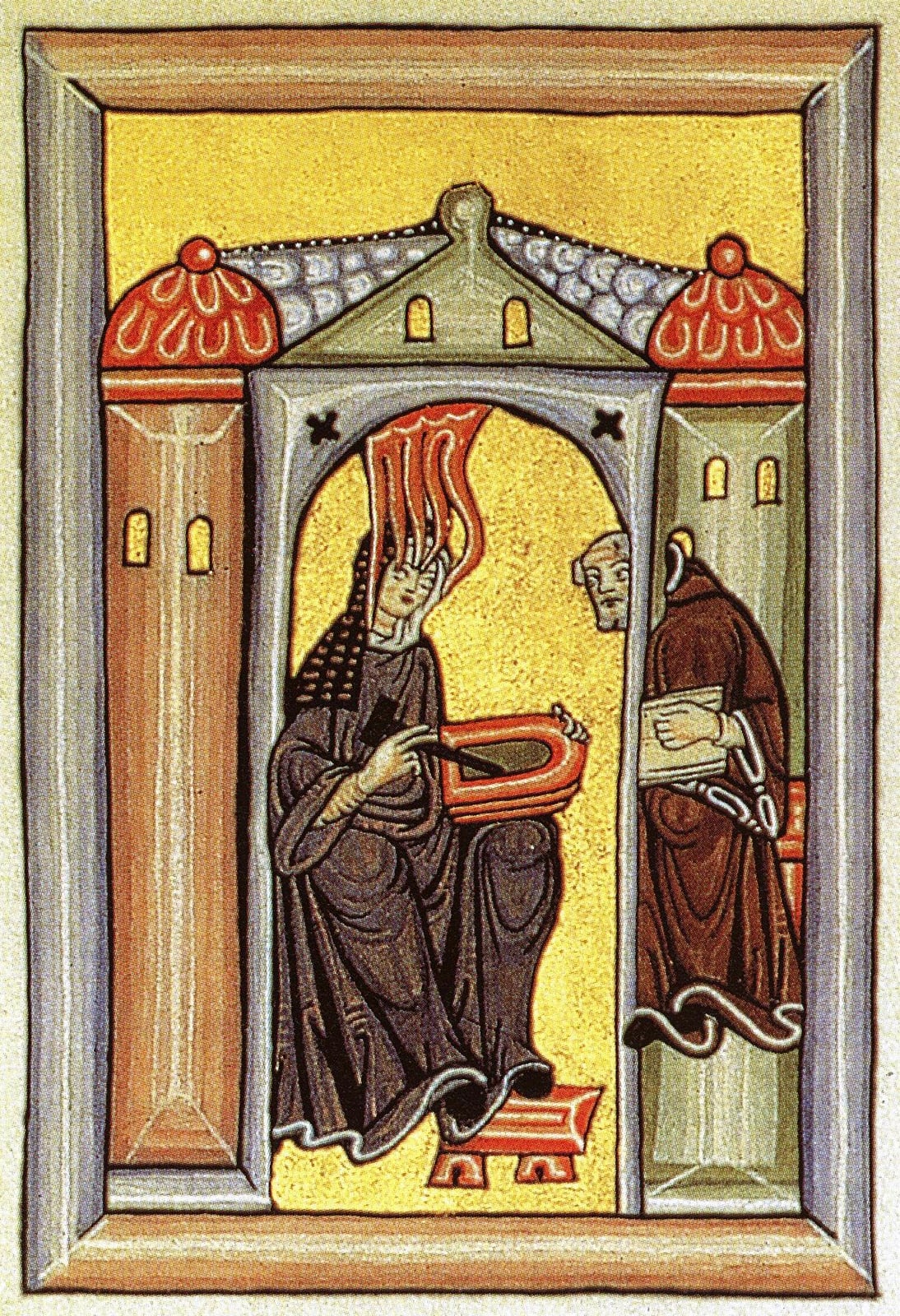
Hildegard of Bingen
They agree on: What is the Absolute? Does God exist? · What happens after death? · How is liberation or salvation attained?
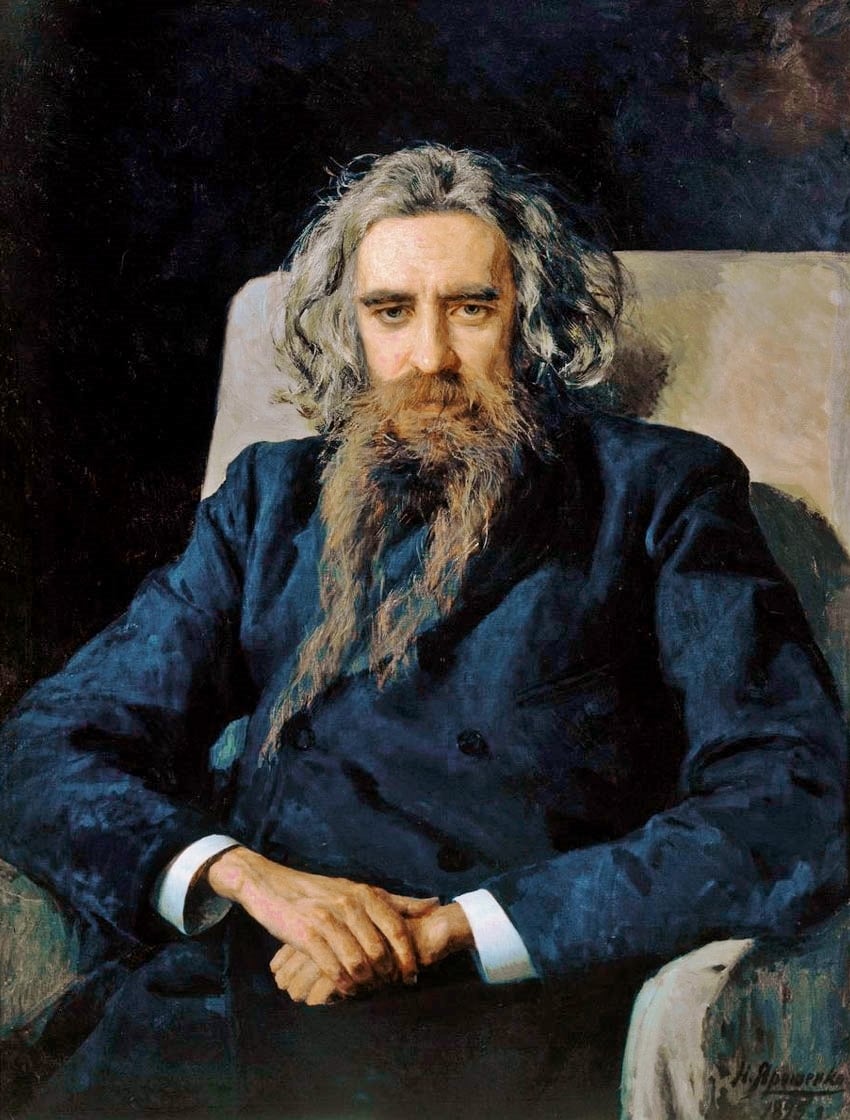
Vladimir Solovyov
They agree on: What happens after death? · How is liberation or salvation attained? · Is a teacher necessary?
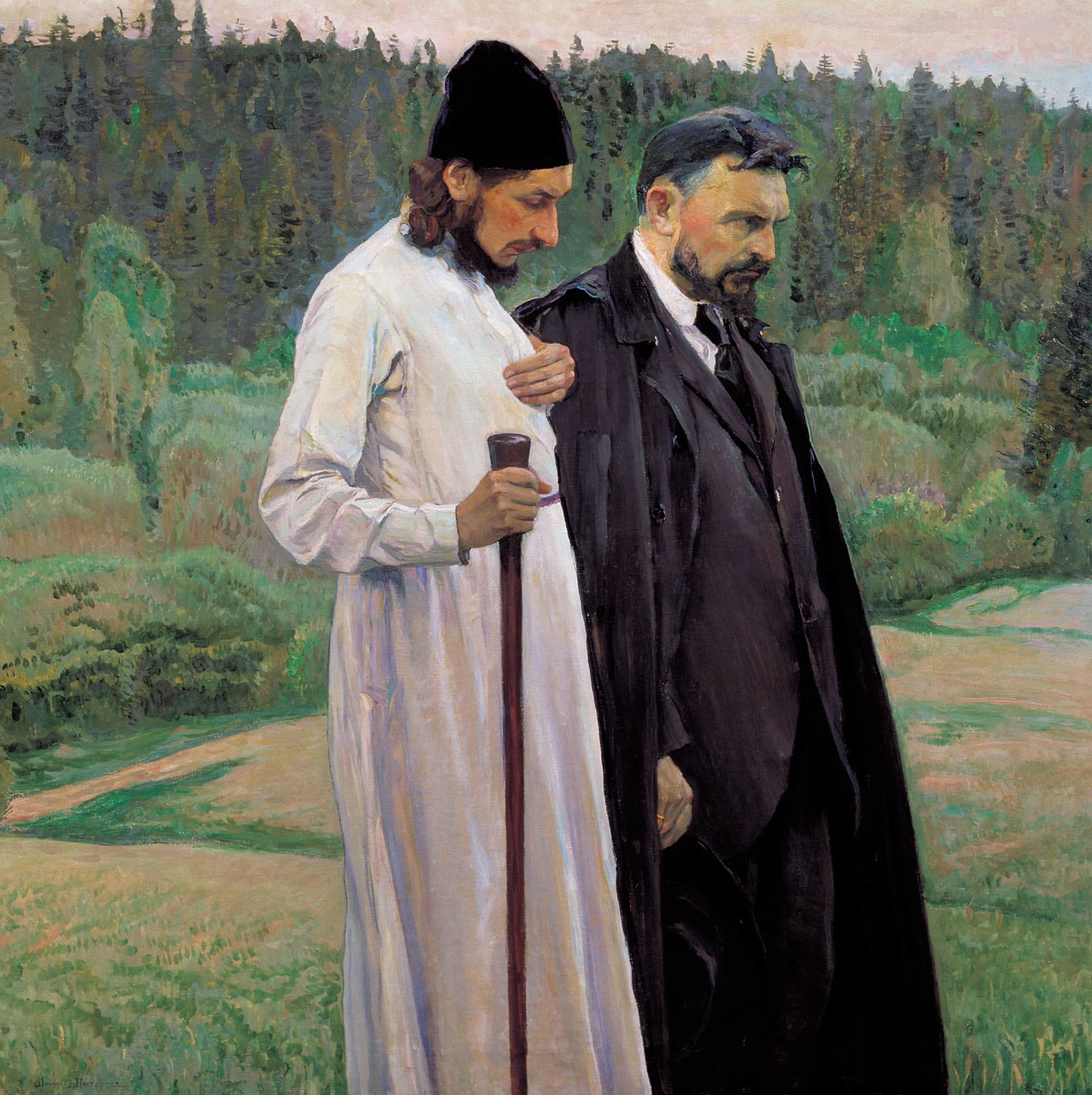
Pavel Florensky
They agree on: What is the Absolute? Does God exist? · Who am I? Is there a true self? · What happens after death?
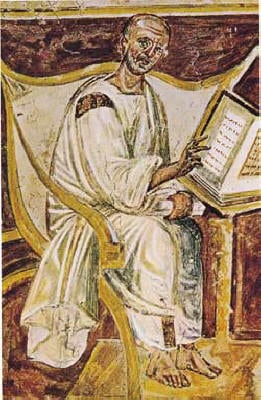
Augustine of Hippo
They agree on: What is the Absolute? Does God exist? · What happens after death? · How is liberation or salvation attained?
Thinks most unlike
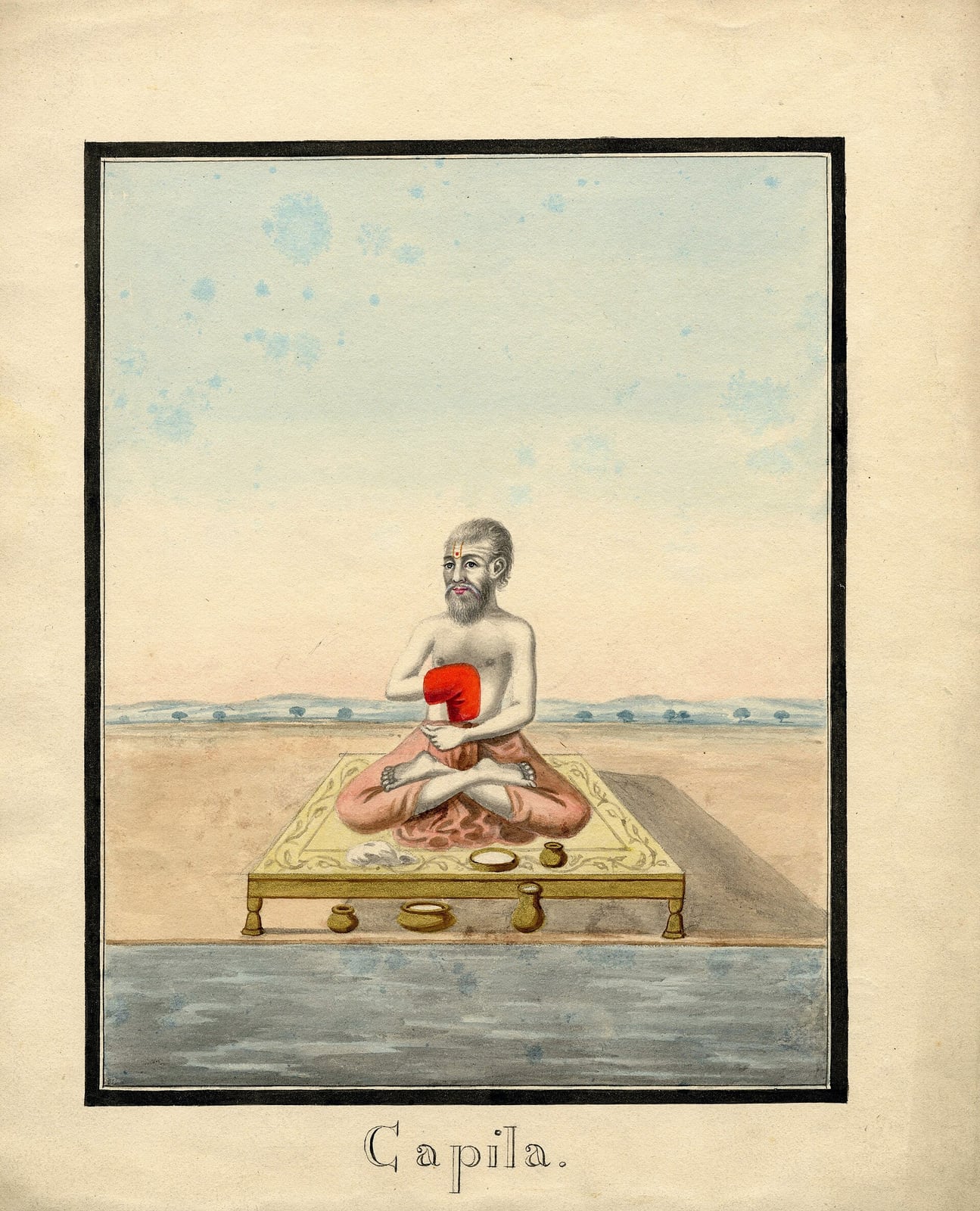
Kapila
They clash on: What is the Absolute? Does God exist? · What happens after death?

Patañjali
They clash on: What is the Absolute? Does God exist? · What happens after death?

Pema Chödrön
They clash on: What is the Absolute? Does God exist? · What happens after death?

Nāgārjuna
They clash on: What is the Absolute? Does God exist? · What happens after death?
Anecdotes and stories
Anecdotes and stories
Testimonyc. 1887–1888
The 'iron God'
Origin of the story: His own account in Le Cœur de la Matière (1950), part I, 'Le Cosmique'.
Documented1914–1919
The stretcher-bearer of Verdun
Origin of the story: Letters from the front published in Genèse d'une pensée (1961); decorations and postings according to the biographies and Wikipedia (s11).
Testimony1923
The Mass in the Ordos desert
Origin of the story: The text itself places the scene 'in the steppes of Asia'; the dating to Ordos, 1923, comes from the edition of Hymne de l'Univers and the travel letters.
Disputed1913 / 1980
The shadow of Piltdown
Origin of the story: The accusation was made in Gould (Natural History, 1980); its general rejection is summarised by Wikipedia (s11).
Source: Gould, Stephen Jay. «The Piltdown Conspiracy». Natural History 89, n.º 8 (1980): 8–28.
Documented1929–1931
The Zhoukoudian skull
Origin of the story: Facts from the history of palaeoanthropology recorded in Wikipedia and in his own articles in L'Apparition de l'Homme ('La découverte du Sinanthrope').
Testimony1920s–1955
A biological blunder
Origin of the story: Text collected in Le Cœur de la Matière (1976), pp. 133–137.
Testimony1955
To die at Easter
Origin of the story: It circulates in the biographies (Cuénot, King) in differing versions; the original testimony has not been checked.
Source: King, Ursula. Spirit of Fire: The Life and Vision of Teilhard de Chardin. Maryknoll (N.Y.): Orbis Books, 1996 (ed. revisada, 2015).
Teachings
Teachings
The notions that structure their thought, explained in context.
Law of complexity-consciousnesscomplejidad-conciencia
The guiding thread of The Human Phenomenon (1938–1940).
Noospherenoosfera
A term coined around 1922–1925; central in The Human Phenomenon and The Future of Man.
Omega Pointpunto-omega
Introduced in The Human Phenomenon (book IV, 'Survival').
The cosmic Christ and christogenesiscristo-cosmico
Present from 1916; formulated on the last page of the Journal (1955): 'Christ is the centre of the Cosmos'.
The divine milieu: activities and passivitiesmedio-divino
Written in 1926–1927; his most widely read text as a spiritual guide.
Hominisation and the threshold of reflectionhominizacion
A theme of La Vision du Passé, The Human Zoological Group and book III of The Human Phenomenon.
Videos
Videos
Recordings, interviews and documentaries. Videos play from YouTube; they are not hosted here.
Portrait en 1981 de Teilhard de Chardin, théologien et paléontologue
Documentary· FR· 28 min
Radio-Canada ArchivesOfficial channel
Teilhard de Chardin
Documentary· FR· 52 min
KTO TV
L'Unité créatrice du monde - Pierre Teilhard de Chardin
Watch on YouTube
This video cannot be embedded; it opens on YouTube.
L'Unité créatrice du monde - Pierre Teilhard de Chardin
Documentary· FR· 52 min
KTO TV
Le Centre Teilhard-de-Chardin : un lieu de dialogue entre sciences et spiritualité
Documentary· FR· 9 min
KTO TV
Teilhard et la Chine, un documentaire de Benoît Vermander
Documentary· FR· 44 min
Benoît Vermander Videos
Ilia Delio / Why Science and Religion Need Each Other: Teilhard de Chardin's Deep Catholicity
Lecture· EN· 61 min
College of the Holy CrossOfficial channel
Ilia Delio: Teilhard's Evolution and the Body of Christ
Lecture· EN· 48 min
Centre for Catholic Studies, Durham UniversityOfficial channel
Ilia Delio: "Teilhard de Chardin and World Religions"
Lecture· EN· 100 min
Yale Forum on Religion and EcologyOfficial channel
Annual Teilhard de Chardin, S.J. Lecture feat. Sr. Ilia Delio
Lecture· EN· 90 min
Hank Center for the Catholic Intellectual HeritageOfficial channel
Teilhard de Chardin, entre el cielo y el suelo: Testimonios para la Iglesia del futuro
Lecture· ES· 68 min
Centro Loyola - Loiola ZentroaOfficial channel
Teilhard de Chardin | Ciclo Los viernes de la evolución
Lecture· ES· 146 min
El Colegio Nacional (México)Official channel
Ringvorlesung: Pierre Teilhard de Chardin
Lecture· DE· 69 min
CTS Berlin
Gallery
Gallery
Images with verified licences. Each keeps its authorship and attribution.
Manuscripts
Manuscripts
Manuscript witnesses and ancient texts, with their custodian and conditions of access.
FR · Latin · 1932–1955
Teilhard de Chardin Manuscripts (cartas a Lucile Swan y otras colecciones)
- Surviving witness
- 205 cartas a Lucile Swan, 77 cartas a un sacerdote biólogo francés (1938–1952) y documentos de su etapa china
- Custodian
- Booth Family Center for Special Collections, Georgetown University Library (Washington)
- Digitisation
- guides.library.georgetown.edu/teilhard-de-chardi…
Connections
Connections
Influences, discipleships and affinities. Documented relations are distinguished from similarities identified by analysis.
Influenced by
A Jesuit from 1899, formed by the Spiritual Exercises; his search for God 'in all things' of matter extends Ignatian spirituality.
Documented relation
Influenced by
The risen Christ, read through Saint Paul, is the centre of his vision: Omega and centre of the cosmos.
Documented relation
Ideas akin to
Both, contemporaries with no known contact, interpreted evolution as the rise of consciousness toward divine fulfilment (Aurobindo's Supermind, Teilhard's Omega Point); the comparison is common in comparative religion.
Similarity identified by analysis
Ideas akin to
Soloviov's vision of a cosmic process culminating in Godmanhood has been compared with Teilhardian christogenesis.
Similarity identified by analysis
Contemporary of
A French contemporary engaging with Catholicism from an opposite position: Weil focused on affliction and necessity, Teilhard on convergence and progress. There is no record that they met.
Similarity identified by analysis
Ideas akin to
Franciscan cosmic fraternity and Teilhard's 'Hymn to Matter' share a mysticism of creation; Pope Francis, who took his name from the saint, cites Teilhard in Laudato si'.
Similarity identified by analysis
Linked from other profiles
Sources
Sources
Bibliography and catalogues consulted for this profile.
- Wikidata, «Pierre Teilhard de Chardin» (Q189564); orden religiosa: Compañía de Jesús (P611 = Q36380).
- Cuénot, Claude. Pierre Teilhard de Chardin: les grandes étapes de son évolution. Paris: Plon, 1958.
- Speaight, Robert. Teilhard de Chardin: A Biography. London: Collins, 1967.
- King, Ursula. Spirit of Fire: The Life and Vision of Teilhard de Chardin. Maryknoll (N.Y.): Orbis Books, 1996 (ed. revisada, 2015).
- Teilhard de Chardin, Pierre. Le Phénomène humain. Paris: Éditions du Seuil, 1955 (Œuvres, t. I). Texto en Wikisource.
- Teilhard de Chardin, Pierre. Le Milieu divin. Paris: Éditions du Seuil, 1957 (Œuvres, t. IV). Texto en Wikisource.
- Teilhard de Chardin, Pierre. Hymne de l'Univers (incluye La Messe sur le Monde, 1923). Paris: Éditions du Seuil, 1961. Texto en Wikisource.
- Teilhard de Chardin, Pierre. Le Cœur de la Matière (incluye Le Christique y la última página del Diario, 1955). Paris: Éditions du Seuil, 1976 (Œuvres, t. XIII). Texto en Wikisource.
- Teilhard de Chardin, Pierre. Écrits du temps de la guerre (1916–1919). Paris: Grasset, 1965; Seuil, 1976 (Œuvres, t. XII). Texto en Wikisource.
- Teilhard de Chardin, Pierre. Genèse d'une pensée: lettres 1914–1919. Ed. Alice Teillard-Chambon y Max Henri Begouën. Paris: Grasset, 1961. Texto en Wikisource.
- Wikipedia en inglés, «Pierre Teilhard de Chardin» (consultada para fechas y trayectoria, contrastada con las demás fuentes).
- Wikisource en francés, «Auteur:Pierre Teilhard de Chardin» (relación de las Œuvres de Seuil, 1955–1976, y de la correspondencia).
- Suprema Sagrada Congregación del Santo Oficio. Monitum sobre los escritos del P. Pierre Teilhard de Chardin, 30 de junio de 1962. Acta Apostolicae Sedis 54 (1962), p. 526.
- Francisco. Carta encíclica Laudato si' sobre el cuidado de la casa común, 24 de mayo de 2015, n.º 83 y nota 53.
- Teilhard de Chardin, Pierre, y Lucile Swan. The Letters of Teilhard de Chardin and Lucile Swan. Ed. Thomas M. King y Mary Wood Gilbert. Washington: Georgetown University Press, 1993. ISBN 9780878405220.
- Open Library, registros de edición consultados por ISBN (obras de Pierre Teilhard de Chardin).
- Teilhard de Chardin, Pierre. Comment je crois. Paris: Éditions du Seuil, 1969 (Œuvres, t. X). Texto en Wikisource.
- Teilhard de Chardin, Pierre. Science et Christ. Paris: Éditions du Seuil, 1965 (Œuvres, t. IX). Texto en Wikisource.
- Medawar, Peter B. Reseña de The Phenomenon of Man. Mind 70, n.º 277 (1961): 99–106.
- Gould, Stephen Jay. «The Piltdown Conspiracy». Natural History 89, n.º 8 (1980): 8–28.
- Rights holder
- Éditions du Seuil (Œuvres) y los derechohabientes de la Fondation Teilhard de Chardin; dominio público en la UE desde 2026, no en España (2036) ni en EE. UU. Traducciones con derechos propios (Trotta, Sussex Academic Press, HarperCollins, etc.).
Pending confirmation
What this profile has not yet been able to settle. We would rather say so than fill it in.
- Últimas palabras: localizar el testimonio de primera mano (Pierre Leroy, Cuénot o la familia) sobre la tarde del 10 de abril de 1955 y sobre el deseo de morir en Pascua, con su formulación exacta.
- Derechos: todas las entradas de reading_texts llevan caution (España hasta 2036; EE. UU. 95 años desde la publicación póstuma). La tesis de 1921–1922 será plenamente de dominio público en 2036.
- Comprobar si la Wikisource francesa ofrece páginas «Texte entier» para Le Phénomène humain y Le Milieu divin; ahora se registran las páginas índice con subpáginas.
- Verificar la autoría y licencia de las fotografías TeilhardP 1947 y 1955 en Commons (autor desconocido con licencia CC BY-SA).
- Localizar ISBN de ediciones actuales en español de El fenómeno humano y El porvenir del hombre (Taurus), y de ediciones en italiano (Queriniana, Il Saggiatore) y alemán de El medio divino.
- Sitio oficial: no se ha verificado la web de la Fondation Teilhard de Chardin ni de la Association des Amis de Pierre Teilhard de Chardin; se deja official_site en null.
- Localizar el fondo principal de manuscritos de los ensayos (depositados por Jeanne Mortier y la Fondation Teilhard de Chardin) y sus signaturas; solo se ha verificado la guía de Georgetown.
- Programas de afiliación: ninguno verificado.
Researched on 2026-10-25