Contemporary non-duality · Secular contemplative
Eckhart Tolle
1948 –LivingHistorically documented person
German-born spiritual teacher and author (b. 1948), based in Vancouver. After a depression he experienced as an awakening in 1977, he spent years in silence in London before teaching. The Power of Now (1997) and A New Earth (2005), boosted by Oprah Winfrey, made him the most widely read spiritual author of his time. He teaches presence in the current moment and disidentification from thought, belonging to no religion.
- works
- 39works
- editions
- 52editions
- quotes
- 3quotes
- videos
- 14videos
- images
- 2images
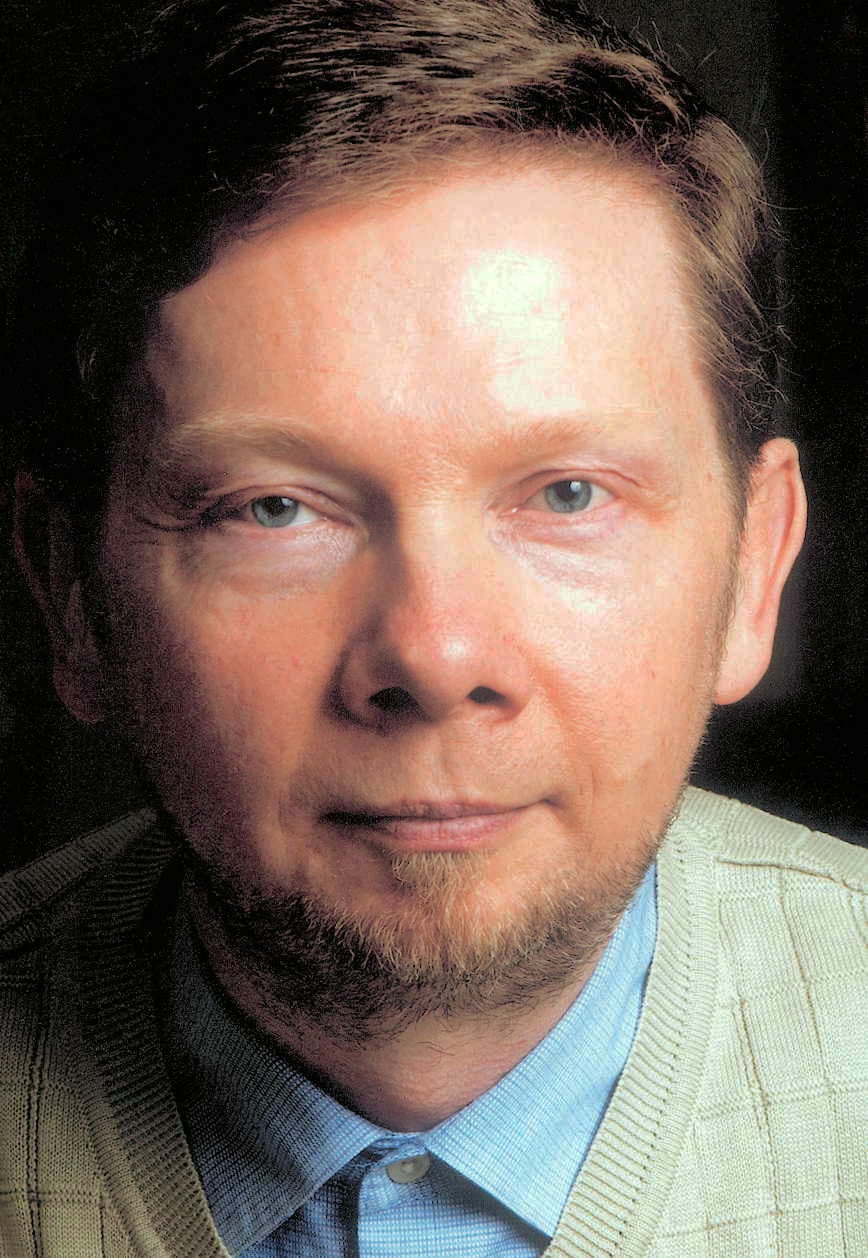
Eckhart Tolle · CC BY-SA 3.0
In their words
«You are not your mind.»The Power of Now (1997), título del capítulo 1

Their central idea
Psychological suffering comes from identifying with thought: the inner voice that comments, judges and anticipates is not who one is, and simply watching it begins the release.
See in context
Biography
4 min read
A child of the Ruhr who refused school
Ulrich Leonard Tölle was born on 16 February 1948 in Lünen, a small industrial town north of Dortmund in the British zone of post-war Germany. He grew up among still-visible ruins and in a household he has described as unhappy; his parents quarrelled often and eventually separated. At thirteen he went to live with his father in Spain, where he spent the rest of his adolescence. There he made an unusual choice: he refused formal schooling between the ages of thirteen and twenty-two, teaching himself languages, literature and astronomy with the help of some private lessons.
His first encounter with spirituality came at about fifteen, when he was given the books of the German mystic Joseph Anton Schneiderfranken, known as Bô Yin Râ. He has acknowledged that they marked him, although at the time he did not know what to do with them.
London, depression and the night of 1977
At nineteen he moved to England. For three years he taught German and Spanish at a London language school, then studied at the University of London, and in 1977 began postgraduate research at the University of Cambridge. Inwardly, though, he lived with an anguish that would not lift: long spells of anxiety and a depression he calls almost unbearable.
One night in 1977, shortly after turning twenty-nine, he woke with a despair sharper than ever. By his own account, which opens his first book, a sentence imposed itself — he could no longer live with himself — and with it a question: who is the "I" that cannot live with the "self"? He says he felt drawn into a void and that, waking the next morning, everything was at peace. He walked out into London and found everything miraculous, even the traffic. He later understood that night as the collapse of the mind-made self, the self trapped between an unsatisfying past and a feared future.
What followed was not a career but a long pause. He abandoned the doctorate and spent nearly two years sitting on benches in Russell Square, central London, in what he describes as a state of deep bliss, watching the world go by. He stayed with friends, lived for spells in a Buddhist monastery and at times slept rough on Hampstead Heath. His family thought him irresponsible, even mad.
From quiet counsellor to world author
Former Cambridge acquaintances began seeking him out with questions. Without intending to, he became a counsellor and gradually a spiritual teacher of small groups. In those years he changed his first name to Eckhart. Accounts differ: some see it as homage to Meister Eckhart, the Rhineland mystic; he himself said in 2012 that he had dreamed of the name on the cover of a book he knew to be his own, and that soon afterwards a friend called him by it for no apparent reason.
After a period in Glastonbury, England's small capital of alternative living, and several trips to the west coast of North America, he settled in Vancouver, Canada, in 1995, where he met Kim Eng, his partner ever since and a fellow teacher.
In 1997 a tiny Vancouver press, Namaste Publishing, brought out The Power of Now in a run of about three thousand copies. Written as a sequence of questions and answers, the book passed from hand to hand until New World Library reissued it on a large scale in 1999. In 2000 Oprah Winfrey recommended it in her magazine; that summer it entered The New York Times bestseller list, reaching number one two years later. By 2008 it had been translated into more than thirty languages.
Then came Stillness Speaks (2003), an almost aphoristic distillation of his teaching, and A New Earth (2005), which widens the lens from the individual to humanity: the ego as a collective dysfunction and the awakening of consciousness as the way out. When Winfrey chose it for her book club in January 2008, 3.5 million copies shipped in four weeks. The chapter-by-chapter webinars they recorded together were accessed tens of millions of times, and The New York Times called him the most popular spiritual author in the United States.
What he teaches
Tolle's teaching is deliberately simple and belongs to no religion. He holds that psychological suffering comes from identifying with thought — the incessant voice that comments, compares and fears; that the only real moment is the present; and that watching the mind, rather than being swept along by it, opens a space of stillness he calls presence. He coined the term "pain-body" for the accumulated emotional residue that reawakens and feeds on conflict. He draws freely on Zen Buddhism, Vedanta, Sufism and the Christian mystics, and quotes the Gospels often.
Reception and legacy
His success has divided critics. Some praise his gift for saying in plain words what contemplative traditions said in code; the Franciscan theologian Richard Rohr credits him with returning many Christians to their own mysticism. Others fault him for a lack of originality, for mixing pseudo-science with borrowed traditions or, from evangelical theology, for a view incompatible with the Christian distinction between God and humankind. Commentators have also noted the gap between his stated refusal to build "a heavy commercial structure" and the wide range of products sold on his website.
In 2009 he shared a stage with the Dalai Lama at the Vancouver Peace Summit. He has published illustrated books — Guardians of Being, with Patrick McDonnell — and a children's story, Milton's Secret, filmed in 2016. In 2022 the rapper Kendrick Lamar presented him as his guide on the album Mr. Morale & the Big Steppers, with Tolle's voice on several tracks. In January 2025 Oprah Winfrey chose A New Earth for her club a second time, the only book ever selected twice. He continues to teach from British Columbia through retreats, online gatherings and his foundation.
Sources: Tolle, Eckhart. The Power of Now: A Guide to Spiritual Enlightenment. Vancouver: Namaste Publishing, 1997 (introducción autobiográfica).
Timeline
A life, year by year
Each point is a documented event. Click to read it, with its source and degree of certainty.
February 16, 1948age 0Lünen (Alemania)
Birth
Ulrich Leonard Tölle is born in Lünen, north of Dortmund, in the British occupation zone.
Documented«Eckhart Tolle», Wikipedia en inglés (consultada para hechos verificables; texto propio).
February 16, 1948 · age 0
Birth
Ulrich Leonard Tölle is born in Lünen, north of Dortmund, in the British occupation zone.
Documented
1961 · age 13
To Spain with his father
After his parents separate he moves to Spain with his father and refuses formal schooling until twenty-two.
Documented
1963 · age 15
The books of Bô Yin Râ
He is given the books of the German mystic Joseph Anton Schneiderfranken, which he says influenced him deeply.
Probable
1967 · age 19
Language teacher in London
He moves to England and teaches German and Spanish for three years at a language school, then studies at the University of London.
Probable
1977 · age 29
The night of transformation
He begins postgraduate study at Cambridge. One night, in deep depression, he experiences what he describes as the collapse of the mental self; he abandons his studies.
Documented
1978 · age 30
The benches of Russell Square
He spends about two years on the benches of Russell Square in deep peace, sleeping at friends', in a Buddhist monastery or rough on Hampstead Heath.
Documented
1982 · age 34
Counsellor and teacher
Former acquaintances consult him; he begins working as a counsellor and teacher of small groups and takes the name Eckhart. He later lives in Glastonbury.
Probable
1995 · age 47
Settles in Vancouver
He settles in British Columbia, where he meets Kim Eng, his partner and collaborator.
Documented
1997 · age 49
The Power of Now
Namaste Publishing brings out his first book in a small run; New World Library reissues it widely in 1999.
Documented
2000 · age 52
Oprah's recommendation
Oprah Winfrey recommends The Power of Now in her magazine; in August it enters The New York Times bestseller list, which it tops in 2002.
Documented
2003 · age 55
Stillness Speaks
He publishes his second book, a brief distillation of his teaching.
Documented
2005 · age 57
A New Earth
Dutton publishes A New Earth, on the collective ego and the awakening of consciousness.
Documented
January 2008 · age 60
The book club and the webinars with Oprah
Oprah picks A New Earth for her club; 3.5 million copies in four weeks and a webinar series accessed tens of millions of times.
Documented
September 2009 · age 61
Peace Summit with the Dalai Lama
He shares the stage with the Dalai Lama at the Vancouver Peace Summit. Publishes Guardians of Being with Patrick McDonnell.
Documented
2011 · age 63
First on the Watkins list
Watkins magazine ranks him first in its inaugural list of the 100 most spiritually influential living people.
Documented
2016 · age 68
Milton's Secret on film
His children's story is filmed with Donald Sutherland and Michelle Rodriguez.
Documented
2022 · age 74
Kendrick Lamar
The album Mr. Morale & the Big Steppers presents him as the rapper's spiritual guide, with his voice on several tracks.
Documented
January 2025 · age 76
Back in Oprah's club
Oprah chooses A New Earth again, the only book ever selected twice in the club's history.
Documented
Works
Essential works
The works without which their legacy cannot be understood.
Written work · 1997
The Power of Now
The Power of Now: A Guide to Spiritual Enlightenment
His first and most read book: a guide in question-and-answer form for stepping out of identification with the mind and living in the present moment. It explains the pain-body, acceptance of the now and presence, and since 1999 has been translated into over thirty languages.
7 editions · amazon.com

Written work · 2003
Stillness Speaks
Tolle's second book, made of short texts, almost aphorisms, grouped in ten chapters on inner silence, thought, the body, nature, relationships and death. It seeks to transmit stillness rather than explain it, and is read slowly, like a meditation book.
2 editions · amazon.com

Written work · 2005
A New Earth
A New Earth: Awakening to Your Life's Purpose
Widens his teaching from the individual to humanity: it describes the ego as a collective dysfunction expressed in violence and greed, and presents the awakening of consciousness as the species' next step. Chosen twice by Oprah Winfrey's book club (2008 and 2025).
5 editions · amazon.com
Complete works (39)

Practicing the Power of Now
2001

Oneness with All Life
2008

Milton's Secret
2008

Guardians of Being
2009

Findhorn Retreat
2006

Peace in the Present Moment
2010

The Power of Now Journal
2019

Living the Liberated Life and Dealing with the Pain-Body
2001

The Realization of Being
2001

Even the Sun Will Die
2002

Realizing the Power of Now
2003

Entering the Now
2003

Gateways to Now
2003

The Flowering of Human Consciousness
2004

Through the Open Door to the Vastness of Your True Being
2005

In the Presence of a Great Mystery
2006

Touching the Eternal: India Retreat
2007

The Art of Presence
2007

Finding Your Life's Purpose
2015
Eckhart Tolle
Breitenbush 01: The "Rains" Retreat — The Journey Home
The Conscious LibraryBreitenbush 01: The "Rains" Retreat — The Journey Home
2001

Know That "I Am"
2002

May the Mind Be the Servant of Awareness
2002
Eckhart Tolle
The Journey into Yourself
The Conscious LibraryThe Journey into Yourself
2003

Practicing Presence: A Guide for the Spiritual Teacher and Health Practitioner
2004
Quotations
Quotations located in a specific work. Each carries its provenance and its level of confidence.
You are not your mind.VerifiedThe Power of Now (1997), título del capítulo 1
Essential ideas (editorial summary)
Out of respect for copyright, these ideas are summarised in our own words and are not presented as literal quotations.
- Psychological suffering comes from identifying with thought: the inner voice that comments, judges and anticipates is not who one is, and simply watching it begins the release.
- The present is the only real moment; past and future exist only as thought. Fully accepting the now is not resignation but ceasing inner resistance to it.
- The pain-body is the accumulation of old painful emotion that reawakens and feeds on conflict; seeing it arise with attention removes its power.
- The ego is not only a personal problem: it is a collective dysfunction of humanity, expressed in violence, greed and the destruction of the planet.
- Inner stillness is not achieved but discovered by allowing space between thoughts; in that space is presence, which is consciousness itself.
- A life's primary purpose is inner — being awake in what one does; the outer purpose, what one does, is secondary and changes.
Ask
What their work answers
Twelve great human questions and what their texts allow us to answer, with references. We never put words in their mouth.
What is the Absolute? Does God exist?
He prefers to speak of Being: the one formless life beyond forms
An impersonal AbsoluteStated explicitly
Eckhart Tolle does not deny God, but he distrusts the word. In the first chapter of The Power of Now he explains that the term God has been emptied by centuries of misuse, associated with a separate, often male, entity placed outside; he proposes instead to speak of Being, the one eternal life underlying the countless forms subject to birth and death. That Being is not an object of knowledge or belief: it is felt as one's own presence when the mind grows quiet. In A New Earth he keeps the same approach: the divine is not someone judging from outside but formless consciousness recognising itself in the human being. His language is therefore that of an impersonal absolute, though immediate and inward.
Compare this question with other teachersWho am I? Is there a true self?
You are not your thoughts: the ego is identification with mind
The ego is a construction of thoughtStated explicitly
Eckhart Tolle defines the ego as identification with the mind: with thoughts, emotions, personal history and the forms by which the self reinforces itself, such as possessions, opinions or the victim role. In A New Earth (2005) he devotes whole chapters to describing its structure and its need to compare, be right and feel separate. The key of his teaching is that simply observing thought is enough to stop identifying with it: the one who observes is not what is observed. Unlike Krishnamurti, Tolle does affirm a deeper identity, formless presence or awareness, which he calls Being and which is recognised when the mind falls silent. His practical emphasis, however, is on unmasking the ego as a mental construction, and on the claim that seeing it is already the beginning of liberation.
Compare this question with other teachersWhy do we suffer?
Suffering needs time: it cannot survive in the now
Thought and psychological timeStated explicitly
Eckhart Tolle locates the origin of suffering in the mind living in psychological time: the past, from which it draws identity and grievances, and the future, onto which it projects its salvation or its fear. In the opening chapters of The Power of Now he holds that almost all human pain is unnecessary, created by mental resistance to what is, and that suffering cannot survive in full presence to the moment. He adds the notion of the pain-body: a field of accumulated emotional energy, personal and collective, which reactivates periodically and feeds on thoughts and conflict; in A New Earth he devotes a whole chapter to it. The remedy is not to analyse the story of pain but to observe it without identifying with it and to accept the present moment, which, he says, cuts off the supply that keeps it alive.
Compare this question with other teachersWhat happens after death?
The opposite of death is birth; life has no opposite
What I am is never born and never diesStated explicitly
Eckhart Tolle distinguishes between form, which is born and dies, and the life or consciousness expressed in it, which has no opposite. What dissolves at death is form and the mental identity built upon it; what one essentially is, conscious presence, neither begins nor ends. That is why, he holds, the death of a loved one or the nearness of one's own can open a door: when one stops resisting the loss of form, a space of peace appears that does not depend on it. In Stillness Speaks he devotes a chapter to death and the eternal, and in The Power of Now he presents surrender to what is as a way of dying before dying. Tolle avoids describing states after death; what he affirms is the timelessness of what we are, accessible now.
Compare this question with other teachersHow is liberation or salvation attained?
Awakening is not in time: it is presence, ceasing to identify with the mind
No method: total attentionStated explicitly
Eckhart Tolle holds in The Power of Now that suffering arises from identification with the mind and with psychological time, that is, with the continuous projection into past and future. Liberation is not a future state conquered through progressive effort, because seeking it in time reinforces the very mechanism that prevents it: it can only happen now. It consists in being aware of thoughts without identifying with them, in «watching the thinker», and in accepting what is in the present moment. In A New Earth he extends this idea to a collective scale: the ego is a structure of identification with form, and awakening is the emergence of a consciousness that recognises itself beyond that form.
Compare this question with other teachersIs a teacher necessary?
The teacher's words are signposts; what matters is presence within oneself
The teacher is withinInferred from their doctrine
In the introduction to The Power of Now, Eckhart Tolle recounts that his inner transformation happened without a teacher, after a personal crisis, and that he later recognised in various traditions what had happened to him. Consistently, he presents his own books and talks as pointers: words are signposts pointing to something that is not a word, and readers should attend to what the words awaken in them rather than to their conceptual content. The true teacher would be presence itself, the state of consciousness that recognises itself. He does not deny that the company of someone present helps, but avoids presenting himself as a guru and demands neither membership nor devotion.
Compare this question with other teachersIs the world real?
The unmanifested expresses itself in form; the universe awakens to itself
Manifestation of the divineInferred from their doctrine
Eckhart Tolle does not consider the world an illusion. In The Power of Now he distinguishes between the manifested, the world of forms, and the unmanifested, the formless source from which they arise, accessed through portals such as silence, space or attention to the inner body. What is illusory is not form but identification with it: the ego, which takes itself to be one form among forms. In A New Earth he holds that the purpose of the universe is for consciousness to awaken in form, and that each thing, a flower or a stone, can be recognised as an expression of that consciousness. The world is thus the realm in which the formless recognises itself.
Compare this question with other teachersWhat is love?
To love is to recognise oneself in the other beyond form and ego
What appears when the self ceasesStated explicitly
Eckhart Tolle separates true love from the relationships the ego calls love. In the chapter on relationships in The Power of Now he describes the love-hate relationship: need, attachment and the search in the other for what is lacking in oneself, which turn love into addiction and soon alternate with resentment and conflict. Real love, he holds, is not an emotion or something obtained from another person: it is the recognition of oneself in the other, of the same presence or consciousness beyond form. It appears when one is present and does not project the mind's past and expectations onto the other. In A New Earth he adds that this recognition extends to all beings and to nature, and that a relationship can become a spiritual practice if it is used to become conscious of the ego.
Compare this question with other teachersAre we free, or is everything determined?
While the mind runs on automatic there is no choice; presence makes it possible
We are machines until we awakenInferred from their doctrine
Tolle describes the ordinary human being as identified with a mind that thinks compulsively and with a «pain-body» that reacts through inherited patterns. In that state, he holds in *The Power of Now*, what look like decisions are conditioned reactions: the unconscious person does not choose but repeats. Hence his advice towards someone who harms us is to understand that they could not have acted otherwise from their level of consciousness. True choice appears with presence, when one becomes the observer of the mind and stops being dragged along by it. In *A New Earth* he extends this to humanity: collective consciousness runs in a dysfunctional egoic mode from which only an awakening can free it.
Compare this question with other teachersWhy meditate or pray?
Stepping out of compulsive thinking into the now, where stillness arises
Being presentStated explicitly
Tolle is the reference for this key. In *The Power of Now* (1997) he holds that most human suffering comes from identification with a mind that thinks ceaselessly and lives in the past or the future. Practice does not consist in a formal method, although he offers exercises —watching the thinker, feeling the inner body, attending to the gaps between thoughts—, but in returning again and again to the present moment, the only thing that exists. When attention leaves thought, a conscious stillness arises that he identifies with one's own being. In *A New Earth* (2005) he adds that this presence also transforms everyday action, which stops serving the ego.
Compare this question with other teachersCan reason know the ultimate?
You are not your mind: being is known in stillness, not in thought
The ultimate lies beyond the mindStated explicitly
The first chapter of *The Power of Now* is titled «You Are Not Your Mind», and it sums up his stance: thought is a useful instrument, but identification with it is the great human dysfunction, and through it one does not reach what Tolle calls Being. Words and concepts, he insists, are signposts pointing to reality, not reality itself, and most religious disputes arise from confusing the one with the other. True knowledge arises when the mind falls quiet and a space of awareness appears in which thought is observed. In *A New Earth* he puts it as the shift from a consciousness centred on thought to one centred on presence, not as a new doctrine.
Compare this question with other teachersWithdraw from the world or transform it?
A new world is born of a new consciousness, not of new ideologies
The revolution is innerStated explicitly
Eckhart Tolle holds in A New Earth that humanity faces a choice: either it transforms its consciousness or it destroys itself. Wars, exploitation and the ecological crisis are, for him, collective manifestations of the ego, identification with a mind that feels separate and threatened; that is why solutions that do not touch this root — new ideologies, systems or struggles against an enemy — end up reproducing the same pattern. The change that matters is the flowering of consciousness in individuals. He does not advise abandoning the world: in the last chapter he describes «awakened doing», action springing from presence, in three modalities — acceptance, enjoyment and enthusiasm — and speaks of people whose role is to hold a frequency of consciousness amid ordinary life. Outward action is valid if it flows from presence and not from the ego.
Compare this question with other teachers
Affinities & tensions
Affinities and tensions
Calculated question by question from their positions. The reason for each agreement or clash, on click.
Thinks most like
Osho
They agree on: What is the Absolute? Does God exist? · Who am I? Is there a true self? · Why do we suffer?
Alan Watts
They agree on: What is the Absolute? Does God exist? · Why do we suffer? · What happens after death?
- BKByron Katie
Byron Katie
They agree on: What is the Absolute? Does God exist? · Who am I? Is there a true self? · Why do we suffer?
Dattatreya
They agree on: What is the Absolute? Does God exist? · What happens after death? · Is a teacher necessary?



They agree on
Eckhart Tolle · Ramana Maharshi
You are not what you think: the shift of the subject on the hill and in the now
Why: The affinity has a contextual explanation: Tolle writes in a contemporary Western milieu that had received Advaita, among other sources, through Ramana and his popularisers, and he adopts a vocabulary without scriptures or gods. The differences are of register and audience. Ramana speaks from the Vedantic tradition, with an explicit metaphysical horizon, since the Self is identical with the Absolute, and with a very precise question-method; Tolle addresses readers without religious training, stresses the now and the inner body, and extends the diagnosis to a collective scale. One asks who; the other asks one to be present. Both point to the same shift of the subject.
They agree on
Eckhart Tolle · P. D. Ouspensky
Waking from automatic pilot: self-remembering and the power of now
Why: There is no documented relationship between them, although the vocabulary of awakening and automatic pilot found in contemporary spirituality owes much to the Fourth Way. The affinity has clear limits. Self-remembering demands effort, a deliberate division of attention and a system of group work, and its goal is to form a permanent self that does not yet exist; Tolle's presence is presented as something not manufactured or reached in time but recognised as one's own being. Ouspensky writes for a school with discipline and hierarchy; Tolle, for individual readers without a tradition. They agree on the first step, not on the path or the goal.
They agree on
Eckhart Tolle · Jiddu Krishnamurti
Suffering needs time: thought projecting past and future
Why: No relationship between them is documented in this library, although Tolle writes in a milieu that knew Krishnamurti's work well, published and circulated for decades. The differences are real. Krishnamurti rejects any metaphysics of a true Being, which he considers another projection of thought, and any exercise, which he considers a method; Tolle affirms a presence or formless consciousness he calls Being, proposes concrete exercises such as feeling the inner body and adds the notion of the pain-body. Krishnamurti speaks harshly of conditioning and revolution; Tolle, in a tone of accompaniment. They agree on the diagnosis of psychological time, not on what they find on the other side.
They clash onApparent contradiction
Eckhart Tolle · Adi Shankara
Is the world an illusion? Superimposition on Brahman or form in which consciousness awakens
Why: The contradiction is largely apparent: both distinguish two levels, a formless source and a world dependent on it, and both locate the error in the subject who confuses the levels, ignorance in Shankara, identification in Tolle. Vocabulary separates them more than structure: maya sounds like negation to a modern reader, although in Shankara it does not amount to a subjective dream. A real difference of evaluation remains. For Shankara multiplicity has no purpose and vanishes for one who knows; for Tolle, along a line closer to manifestation than to illusion, form is the place where consciousness recognises itself, and the universe has an evolutionary meaning.
Anecdotes and stories
Anecdotes and stories
Testimony1977
The night he could not live with himself
Origin of the story: Autobiographical account in the introduction to The Power of Now (1997) and later interviews.
Source: Tolle, Eckhart. The Power of Now: A Guide to Spiritual Enlightenment. Vancouver: Namaste Publishing, 1997 (introducción autobiográfica).
Testimony1977–1979
Two years on a bench in Russell Square
Origin of the story: Tolle's own testimony from interviews, summarised in the Wikipedia biography; no independent sources.
Source: «Eckhart Tolle», Wikipedia en inglés (consultada para hechos verificables; texto propio).
Disputed1980s
A name seen in a dream
Origin of the story: Two versions: the homage (attributed by others) and the dream (2012 interview cited by Wikipedia).
Source: «Eckhart Tolle», Wikipedia en inglés (consultada para hechos verificables; texto propio).
Documented2008
Eleven million people in one class
Origin of the story: Figures published in the press and collected by Wikipedia.
Source: «Eckhart Tolle», Wikipedia en inglés (consultada para hechos verificables; texto propio).
Teachings
Teachings
The notions that structure their thought, explained in context.
Pain-bodycuerpo-del-dolor
Developed in The Power of Now (ch. 2) and expanded in A New Earth (chs. 5 and 6).
Source: Tolle, Eckhart. The Power of Now: A Guide to Spiritual Enlightenment. Vancouver: Namaste Publishing, 1997 (introducción autobiográfica).
Presencepresencia
Central concept of The Power of Now and Stillness Speaks.
Source: Tolle, Eckhart. The Power of Now: A Guide to Spiritual Enlightenment. Vancouver: Namaste Publishing, 1997 (introducción autobiográfica).
Retreats
Retreats and centres
Places and gatherings linked to their teaching. We put you in touch with the organisers.
En línea · Internacional
Eckhart Tolle: membership community and online courses
Eckhart Teachings
Besides his public gatherings, Eckhart Tolle runs a private online membership community which, according to his website, includes quarterly live teachings, monthly video practices and access to more than four hundred hours of recorded teachings, with a free seven-day trial. His shop also offers online courses. It is the most continuous way to follow his teaching from home, with a regular rhythm of practice rather than a one-off event. As in his books, the emphasis is on attention to the present moment and on observing the mind without identifying with it.
Sede variable (retiros recientes en Whistler, Canadá) y en línea · Internacional
Eckhart Tolle: retreats, events and livestreams
Eckhart Teachings
Eckhart Tolle, author of The Power of Now, teaches mainly through public gatherings: multi-day in-person retreats, weekend intensives and evening talks in different cities. His official website publishes the calendar, and many of these events can also be followed live online, so those who cannot get a seat in the hall can take part remotely. The content centres on presence, observing thought and accepting the present moment, without affiliation to any religion. In-person places tend to sell out, so it is worth checking well in advance.
Videos
Videos
Recordings, interviews and documentaries. Videos play from YouTube; they are not hosted here.
Eckhart Tolle: “A New Earth” | Oprah’s Book Club
Interview· EN· 2025· 53 min
OprahOfficial channel
Eckhart Tolle: Author of 'A New Earth' | Super Soul Sunday S8E9 | Full Episode
Interview· EN· 42 min
OWNOfficial channel
Understanding the Pain-Body | A Special 3 Part Compilation from Eckhart Tolle
Lecture· EN· 40 min
Eckhart TolleOfficial channel
Why You Don’t Need to Fear Death | Eckhart Tolle Foundation
Lecture· EN· 2026· 11 min
Eckhart TolleOfficial channel
What being awake actually means
Lecture· EN· 2026· 10 min
Eckhart TolleOfficial channel
Eckhart Tolle Reveals the Secret to Fulfillment Through Stillness and Action
Lecture· EN· 95 min
Eckhart TolleOfficial channel
Eckhart Tolle interview with host Nina Rhodes 1998
Interview· EN· 1998· 27 min
Craig Delahunt
Eckhart Tolle at the Omega Institute 2001, Session 2
Lecture· EN· 2001· 73 min
Namaste PublishingOfficial channel
Eckhart Tolle — Reality Is Beyond Thought
Lecture· EN· 87 min
Namaste PublishingOfficial channel
Eckhart Tolle on The Hour with George Stroumboulopoulos
Interview· EN· 2009· 13 min
Strombo
Eckhart Tolle and Tami Simon | Conscious Manifestation and The Present Moment
Interview· EN· 2019· 27 min
Sounds TrueOfficial channel
Eckhart Tolle on Finding Your Identity, Meaning & Purpose in Life
Interview· EN· 2024· 90 min
Tony Robbins
Eckhart Tolle: Spirituelles Erwachen, das wahre Selbst und die Überwindung des Egos
Interview· DE· 2024· 81 min
Laura Malina Seiler
Eckhart Tolle: El 99 % de las Personas MANIFIESTA de Forma Incorrecta (Así Puedes Solucionarlo)
Interview· ES· 2026· 95 min
Lewis Howes Español
Gallery
Gallery
Images with verified licences. Each keeps its authorship and attribution.
Connections
Connections
Influences, discipleships and affinities. Documented relations are distinguished from similarities identified by analysis.
Ideas akin to
The question 'who is this I?' of his 1977 night matches Ramana's self-enquiry.
Similarity identified by analysis
Met
The 14th Dalai Lama (Tenzin Gyatso)
They shared the stage at the Vancouver Peace Summit (September 2009).
Documented relation
Ideas akin to
Choiceless observation of thought and the rejection of spiritual authority bring the two teachings close; Tolle names him among his references.
Similarity identified by analysis
Sources
Sources
Bibliography and catalogues consulted for this profile.
- «Eckhart Tolle», Wikipedia en inglés (consultada para hechos verificables; texto propio).
- Eckhart Tolle — web oficial (biografía, libros y enseñanzas).
- Open Library: obras y ediciones de Eckhart Tolle.
- Tolle, Eckhart. The Power of Now: A Guide to Spiritual Enlightenment. Vancouver: Namaste Publishing, 1997 (introducción autobiográfica).
- Goodreads: ediciones por idioma de las obras de Eckhart Tolle.
- Wikidata Q60137 (Eckhart Tolle).
- Sounds True, fichas de producto de los programas de audio de Eckhart Tolle (At the Source of Being, The Illusion of Time, The Secret of Happiness, Entering the Now, Discovering the Essential Self, Journeys into Stillness, Eckhart Tolle Learning Intensive, Beyond the Thinking Mind).
- Rights holder
- Eckhart Tolle / Eckhart Teachings Inc.
- Official site
- eckharttolle.com
Pending confirmation
What this profile has not yet been able to settle. We would rather say so than fill it in.
- Localizar capítulo y página de las citas marcadas como «probable» en una edición impresa de The Power of Now.
- Ediciones en español de «Milton's Secret», «Oneness with All Life» y de las enseñanzas en audio: no verificadas en catálogo.
- Fecha exacta del cambio de nombre a Eckhart y del traslado a Glastonbury.
- Obra (2026-10-25): cotejada con Wikipedia (en) y Open Library; todos los libros están registrados. Se añadieron 16 programas de audio/vídeo con ISBN y la recopilación alemana Lebendige Beziehungen JETZT! (2013). Quedan fuera, sin ISBN confirmado o por no ser obras: Companion to the Power of Now (casete de Namaste, 2001, contenido sin confirmar), Meditations on the Now: 365 Inspirational Selections from The Power of Now (Hodder & Stoughton, ISBN 9780340919682, año no fiable en el catálogo), The Eckhart Tolle Audio Collection (Sounds True, 2002, reúne programas ya registrados), barajas de cartas (Power of Now Meditation Deck, 2003; Stillness Speaks Inspiration Deck, 2004) y calendarios. El catálogo de audio de Sounds True y Eckhart Teachings es más amplio: Discovering the Essential Self, Journeys into Stillness, Eckhart Tolle Learning Intensive, Beyond the Thinking Mind, Intelligence Beyond the Mind y otros retiros grabados están por registrar con su ISBN. Los prólogos a libros ajenos (Steve Taylor, Peter Russell, Michael Brown, Kim Eng) no son obras suyas.
- Vídeos (2026-10-25): no existe en YouTube ninguna charla o entrevista oficial de Tolle en español; el único vídeo en castellano registrado es un doblaje del canal en español de Lewis Howes.
Researched on 2026-10-25