Hinduism · Tantra · Bhakti · Advaita Vedanta
Anandamayi Ma
আনন্দময়ী মা · নির্মলা সুন্দরী · आनन्दमयी माँ
1896 – 1982Historically documented person
Bengali mystic with no schooling and no human teacher, who initiated herself in 1922 and for half a century travelled across India surrounded by devotees who saw in her a manifestation of the Goddess. She did not write: her words, spoken in Bengali and often in wordplay, were recorded by others in Sad Vani, Matri Vani and the diaries of Gurupriya Devi. Yogananda, Gandhi, Krishnamurti, the Nehru family and the Mother of Pondicherry all met her.
- works
- 22works
- editions
- 32editions
- quotes
- 8quotes
- videos
- 14videos
- images
- 7images
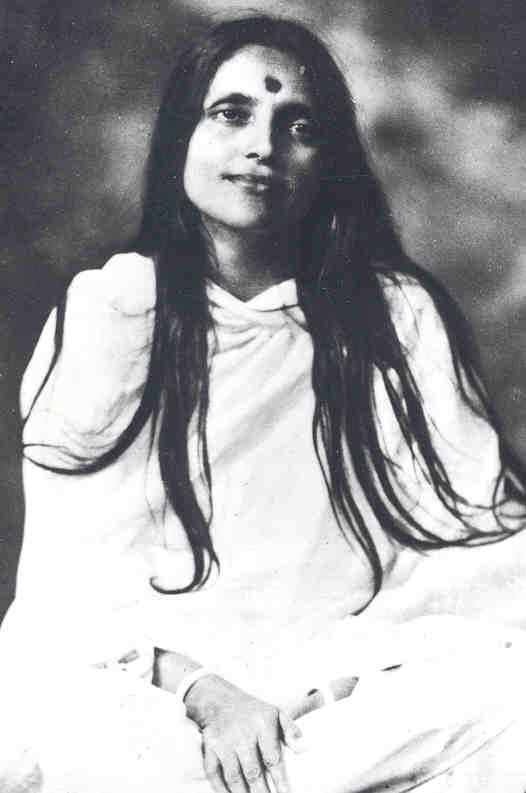
Anandamayi Ma joven · Public domain
In their words
«My consciousness has never associated itself with this temporary body. Before I came on this earth, Father, ‘I was the same.’ As a little girl, ‘I was the same.’»Palabras dirigidas a Yogananda en Calcuta (1935), en la versión inglesa de Autobiography of a Yogi, cap. 45
Their central idea
Seeking the realisation of God is every human being’s supreme calling; other obligations are secondary, though they should not be abandoned but carried out as service.
See in context
Biography
5 min read
Nirmala of Kheora
Nirmala Sundari was born on 30 April 1896 in Kheora, a village in the Tripura district of East Bengal—now Bangladesh—, daughter of Bipin Bihari Bhattacharya, a poor Brahmin and singer of Vaishnava hymns, and of Mokshada Sundari Devi, who in old age would take the vows of renunciation. She went to school for only a few months. What is told of her childhood—the ecstasy of a two-year-old on hearing devotional songs, a luminous being worshipping her when she was ten months old—comes from her devotees’ chronology and from what she herself recounted decades later, and belongs to the hagiographic register. In February 1909, aged twelve years and ten months, she was married to Ramani Mohan Chakrabarti of Bikrampur, whom she would later call Bholanath.
A wife who was not one
She lived for five years with her brother-in-law’s family and around 1914 joined her husband at Ashtagram. The marriage was never consummated: according to the account she gave Yogananda in 1935, the first time her husband touched her with desire he received a shock like lightning, and from then on he treated her as his guide. Neighbours spoke of hysteria; he defended her to her parents. At Bajitpur, between 1918 and 1924, her states became continuous: yogic postures that, she said, the body assumed by itself, incessant repetition of the divine name, songs and trances. On the full-moon night of August 1922 she gave herself initiation, explaining later that as teacher she revealed the mantra and as disciple she accepted it. A long period of silence followed, and at the end of that year she initiated her own husband.
Dhaka: the bliss-permeated Mother
In 1924 Bholanath was appointed manager of the Nawab of Dhaka’s gardens at Shahbag, and there devotees began to come. One of them, Jyotish Chandra Ray, a senior official everyone called Bhaiji, gave her in 1925 the name Anandamayi Ma, “the bliss-permeated Mother”. In 1926 came Adarini Mukherjee, who as Gurupriya Devi would accompany her until her death and keep for decades a diary of her life. In Dhaka she was called the living Kali, and in 1929 her followers built her first ashram at Ramna, beside the Kali temple. She refused to be called a guru, prepared no discourses and spoke of herself as “this body” or “this little girl”.
The wanderer
In 1932 she left Dhaka with Bholanath and Bhaiji for no declared destination and settled in Dehradun, at the foot of the Himalaya. From then on she had no fixed residence: for half a century she travelled across India, from ashram to ashram and house to house, according to what she called her kheyal, a spontaneous impulse her devotees took for divine will. Kamala Nehru visited her from 1933 and, through her, the Nehru family; Indira Gandhi would be a frequent visitor. Bholanath died at Kishenpur in May 1938. Paramahansa Yogananda met her in Calcutta in December 1935 and portrayed her in his Autobiography of a Yogi; Gandhi received her at Sevagram in 1942. Around 1948 she spoke in Delhi with Jiddu Krishnamurti, gently reproaching him that by denying gurus he became the guru of those who listened to him, and in 1952 she visited the Mother of the Sri Aurobindo Ashram in Pondicherry.
Words recorded by others
Anandamayi Ma wrote nothing. She spoke in Bengali, often with almost untranslatable wordplay, and her sentences were noted down by others: Bhaiji gathered the first ones in Sad Vani (1935); Gurupriya Devi kept her diary from 1925; the Austrian Blanca Schlamm, Atmananda, who met her in 1943, translated Matri Vani and Words of Sri Anandamayi Ma into English, and the journal Ananda Varta published her dialogues from the 1950s. It is a choral body of work, filtered through the affection and memory of her devotees, and must be read as such. Her teaching repeats that seeking God is the only human vocation, that every path is legitimate and that she had none of her own, and proposes a simple discipline: a fixed time each day for contemplation, repetition of the divine name, and service.
The kheyal
Witnesses agree in describing a presence rather than a doctrine. Anandamayi Ma kept no schedules or plans: she said she acted according to her kheyal, a Bengali word meaning something like a whim or sudden impulse, which her devotees understood as the divine will expressing itself in her without deliberation. So she would leave a place at midnight, give up a visit prepared for months, or appear where no one expected her. She spoke of herself in the third person and refused to play the teacher: she answered questions, sang, joked and recommended to each the practice of their own tradition. To those who asked who she was she replied, according to her chroniclers, that she was the same as she had always been and also whatever each person thought she was.
An orthodox saint
Her figure brings together traits that are hard to reconcile. She welcomed Muslims, Christians and foreigners, yet her ashrams kept the Brahmanical rules of ritual purity, which also governed the meals of non-Hindu visitors; for years she herself ate only from her attendants’ hands, as Yogananda observed. Lisa Lassell Hallstrom, author of the main academic study, places this tension at the centre of her role: an unschooled woman who moved with absolute freedom and who at the same time upheld the orthodoxy of the monks and scholars around her, such as the Sanskritist Gopinath Kaviraj. The healings, bilocations and predictions her followers attributed to her belong to devotional testimony and have not been verified.
Death and cult
She died at about eight in the evening of 27 August 1982 in her Kishenpur ashram in Dehradun. Two days later her body was buried—not cremated, as befits renunciant saints—in the courtyard of the Kankhal ashram near Haridwar, in the presence of Prime Minister Indira Gandhi. Her samadhi is now a place of pilgrimage, and the anthropologist Orianne Aymard has studied how her devotees go on relating to her as if she were present. The Shree Shree Anandamayee Sangha maintains her ashrams in Varanasi, Kankhal, Vrindavan, Dehradun and other cities.
Sources: Bhaiji (Jyotish Chandra Ray). Sad Vani: A Collection of the Teachings of Sri Anandamayi Ma (original bengalí, 1935). Trad. inglesa de Atmananda. Varanasi / Calcuta: Shree Shree Anandamayee Charitable Society, 1973 (reimpr. 1975). · Gurupriya Devi. Sri Sri Ma Anandamayi (diarios, original bengalí desde 1925). Trad. inglesa, vols. 1–9 y ss. Calcuta: Shree Shree Anandamayee Charitable Society, 1984–1996. · Hallstrom, Lisa Lassell. Mother of Bliss: Ānandamayī Mā (1896–1982). Nueva York: Oxford University Press, 1999. · Lipski, Alexander. Life and Teaching of Śrī Ānandamayī Mā. Delhi: Motilal Banarsidass, 1977. · Mukerji, Bithika. From the Life of Sri Anandamayi Ma. Varanasi: Shree Shree Anandamayee Sangha, 1970; y The Most Gracious Presence, Sri Ma Anandamayi, 3 vols., 2009–2014.
Timeline
A life, year by year
Each point is a documented event. Click to read it, with its source and degree of certainty.
April 30, 1896age 0Kheora
Birth of Nirmala Sundari
Born at her maternal great-grandparents’ house, daughter of Bipin Bihari Bhattacharya and Mokshada Sundari Devi.
Documentedanandamayi.org (sitio de devotos vinculado a la Shree Shree Anandamayee Sangha): «Life History» 1896–1982, cronología año por año, y páginas «Meeting with Saints and Mahatmas».
After their death
- 2014When a Goddess Dies
April 30, 1896 · age 0
Birth of Nirmala Sundari
Born at her maternal great-grandparents’ house, daughter of Bipin Bihari Bhattacharya and Mokshada Sundari Devi.
Documented
February 1909 · age 12
Marriage to Ramani Mohan Chakrabarti
Married at twelve years and ten months; her husband will be Bholanath. Marriage never consummated.
Documented
c. 1914 · age 18
With her husband at Ashtagram
She joins Ramani Mohan; first states of absorption in public.
Probable
1918 · age 22
The Bajitpur years
Period of spontaneous sadhana: postures, repetition of the divine name, trances (1918–1924).
Tradition
August 1922 · age 26
Self-initiation
On the full moon of August she initiates herself; a long silence follows.
Tradition
1924 · age 28
Shahbag
Bholanath is appointed manager of the Nawab’s gardens; the first devotees arrive, among them Bhaiji.
Documented
1925 · age 29
The name Anandamayi
Bhaiji calls her Anandamayi Ma, “the bliss-permeated Mother”.
Documented
1926 · age 30
Gurupriya Devi arrives
She meets Adarini Mukherjee (Gurupriya Devi), her companion and chronicler for more than fifty years.
Documented
April 13, 1929 · age 32
First ashram at Ramna
She enters the land bought for the Ramna ashram, beside the Kali temple.
Documented
June 1932 · age 36
Departure from Dhaka
She leaves Bengal with Bholanath and Bhaiji and settles at Raipur, Dehradun. Half a century of wandering begins.
Documented
July 1933 · age 37
Kamala Nehru
Jawaharlal Nehru’s mother and wife visit her for the first time.
Documented
December 1935 · age 39
Meeting with Yogananda
Paramahansa Yogananda visits her at Bhowanipur and invites her to his Ranchi school.
Documented
May 6, 1938 · age 42
Death of Bholanath
Her husband dies at the Kishenpur ashram.
Documented
February 1942 · age 45
Meeting with Gandhi
After Jamnalal Bajaj’s death, she visits Gandhi at Sevagram.
Documented
1943 · age 47
Atmananda arrives
She meets the Austrian Blanca Schlamm, future translator of her words into English.
Documented
January 1947 · age 50
Gayatri Mahayajna
A three-year uninterrupted rite begins at the Varanasi ashram, concluded in January 1950.
Documented
c. 1948 · age 52
Conversation with Krishnamurti
They meet in Kitty Shiva Rao’s garden and discuss the need for a guru.
Probable
November 3, 1952 · age 56
Meeting with the Mother of Pondicherry
On her southern tour she visits Mirra Alfassa at the Sri Aurobindo Ashram and Ramana Maharshi’s ashram at Tiruvannamalai.
Documented
1959 · age 63
Arnaud Desjardins’s film
The French filmmaker films her for French television, making her known in Europe.
Documented
August 27, 1982 · age 86
Death
She dies at about eight in the evening at her Dehradun ashram.
Documented
August 29, 1982
Samadhi at Kankhal
Her body is entombed at the Kankhal ashram in the presence of Indira Gandhi.
Documented
2014
When a Goddess Dies
Orianne Aymard publishes her study of the worship of Anandamayi Ma after her death.
Documented
Works
Essential works
The works without which their legacy cannot be understood.
Anandamayi Ma
Sad Vani (true words)
Later compilation · 1935
Sad Vani (true words)
সদ্বাণী (Sad Vani)
Short sayings arranged by theme: the search for God as life’s only goal, repetition of the divine name, surrender, the company of saints, duty done without attachment. It records the teaching of the Dhaka years with the closeness of a daily witness and the devotion of one who saw in her the divine Mother. It is the earliest source for her words.
2 editions · amazon.com
Anandamayi Ma
Matri Vani (words of the Mother)
Later compilation · 1963
Matri Vani (words of the Mother)
Matri Vani
Personal advice turned into general teaching: how to live in the world without losing sight of God, how to face the death of a loved one, illness or doubt, why to set aside a time each day for contemplation. The tone is intimate and practical rather than doctrinal. It is her most translated work and the one that best conveys her way of addressing each person.
3 editions · amazon.es
Anandamayi Ma
Sri Sri Ma Anandamayi (Gurupriya Devi’s diaries)
Later compilation · c. 1925
Sri Sri Ma Anandamayi (Gurupriya Devi’s diaries)
শ্রীশ্রীমা আনন্দময়ী (Sri Sri Ma Anandamayi)
The most detailed source for her life: dates, places, people, dialogues and episodes—from the first years in Dhaka to the decades of wandering—noted almost daily by a constant witness. It includes, for example, the account of the meeting with Gandhi at Wardha in 1942. Its documentary value coexists with the devotional perspective of its author.
1 edition · amazon.es
Anandamayi Ma
Mother as Revealed to Me (Matri Darshan)
Later compilation
Mother as Revealed to Me (Matri Darshan)
মাতৃদর্শন (Matri Darshan)
Spiritual diary of Bhaiji’s relationship with Anandamayi Ma from 1924 until his death, with his interpretation of her gestures and words. It contains, among other things, the hymn that came from her lips in 1929 on leaving the Ramna ashram, only partly transcribed. It is an essential source for the Dhaka years.
2 editions · amazon.com
Complete works (22)
Anandamayi Ma
Words of Sri Anandamayi Ma
The Conscious LibraryWords of Sri Anandamayi Ma
1961
Anandamayi Ma
Ananda Varta (journal)
The Conscious LibraryAnanda Varta (journal)
1952
Anandamayi Ma
Mother Reveals Herself
The Conscious LibraryMother Reveals Herself
2014
Anandamayi Ma
Svakriya Svarasamrita
The Conscious LibrarySvakriya Svarasamrita
Anandamayi Ma
In Association with Sri Sri Ma Anandamayi
The Conscious LibraryIn Association with Sri Sri Ma Anandamayi
1986
Anandamayi Ma
Vangmayee Ma (the Mother as word)
The Conscious LibraryVangmayee Ma (the Mother as word)
2024
Anandamayi Ma
Ma in Her Words
The Conscious LibraryMa in Her Words
Anandamayi Ma
Amar Vani (immortal words)
The Conscious LibraryAmar Vani (immortal words)
1968
Anandamayi Ma
The Teaching of Ma Ananda Moyi
The Conscious LibraryThe Teaching of Ma Ananda Moyi
1974

Pearls of Light
1995

Death Must Die (Atmananda’s diaries)
2000

Mother of Bliss (Lisa Lassell Hallstrom)
1999

Life and Teaching of Sri Anandamayi Ma (Alexander Lipski)
1977

Life and Teachings of Sri Ma Anandamayi (Bithika Mukerji)
1998

My Days with Sri Ma Anandamayi (Bithika Mukerji)
2002

Anandamayi: Her Life and Wisdom (Richard Lannoy)
1996

Encountering Bliss (Melita Maschmann)
2002

When a Goddess Dies (Orianne Aymard)
2014
Quotations
Quotations located in a specific work. Each carries its provenance and its level of confidence.
My consciousness has never associated itself with this temporary body. Before I came on this earth, Father, ‘I was the same.’ As a little girl, ‘I was the same.’VerifiedPalabras dirigidas a Yogananda en Calcuta (1935), en la versión inglesa de Autobiography of a Yogi, cap. 45
Essential ideas (editorial summary)
Out of respect for copyright, these ideas are summarised in our own words and are not presented as literal quotations.
- Seeking the realisation of God is every human being’s supreme calling; other obligations are secondary, though they should not be abandoned but carried out as service.
- There is no single path: each person advances according to their innate nature, and every sincere path leads to the same end. She said she had no path of her own.
- One should set aside each day, morning and evening, a fixed time for contemplation, just as working hours are kept; with habit, contemplation becomes part of one’s nature.
- All suffering arises from perceiving duality; whoever finds the One in everything and everyone puts an end to pain.
- Everyone is right from their own standpoint: faced with doctrinal disputes, she invited people to see the point from which the other speaks.
Last words
There are no verifiable records of their last words.
No recorded final sentence is known. In her last months, already ill, she spoke little; the Sangha’s chronicles note that she died at about eight in the evening of 27 August 1982 at Kishenpur (Dehradun), without recording any farewell words.
Source: anandamayi.org (sitio de devotos vinculado a la Shree Shree Anandamayee Sangha): «Life History» 1896–1982, cronología año por año, y páginas «Meeting with Saints and Mahatmas».
Ask
What their work answers
Twelve great human questions and what their texts allow us to answer, with references. We never put words in their mouth.
What is the Absolute? Does God exist?
There is nothing but Him: with form and without, all is God
Both personal and impersonalStated explicitly
Anandamayi Ma set out no system, but her words, gathered by devotees in Matri Vani and Sad Vani, return again and again to one claim: there is nothing but Him alone, and everyone and everything are but a form of God. That One can be worshipped with form, as Krishna, Shiva or the Mother, or sought as the attributeless Self, and she refused to rank the two ways: with form and without form are the same, seen from different places. To those who asked about her religion she answered that she was also Christian, Muslim, or whatever they wished. For Anandamayi the existence of God is not proved: it is all there is, and the human task is to recognise it.
Compare this question with other teachersWho am I? Is there a true self?
‘I was the same’: consciousness was never tied to the body
The Self is the AbsoluteStated explicitly
Anandamayi Ma spoke of herself as ‘this body’, never as ‘I’, and her devotees took this as a sign that she did not identify with the person. To Yogananda she declared that her consciousness had never associated itself with the transient body and that before birth, as a girl and as an adult she had been the same. To those who listened she put the same question: the self that identifies with a name, a family and a history is not what one is, and discovering one’s own nature is discovering God, for there is nothing but Him. That is why she recommended both remembrance of the Name and enquiry: both lead to recognising the one Self that appears in every form.
Compare this question with other teachersWhy do we suffer?
All suffering comes from seeing duality where there is only One
Ignorance of what we areStated explicitly
In the words gathered by her devotees, Anandamayi Ma explains that all suffering arises from perceiving duality: from feeling separate from others and from God, and from seeking outside what one believes to be missing. Whoever finds the One in everything and everyone puts an end to pain, because there is no longer another who threatens nor anything to lose. At the same time she welcomed those who came with concrete sorrows, the death of a child or illness, and told them that suffering is also a way in which God calls his creature to himself. She neither denied pain nor idealised it: she placed it in a horizon where the only lasting cure is to recognise the Self.
Compare this question with other teachersWhat happens after death?
The body dies; what is does not come or go
What I am is never born and never diesStated explicitly
Anandamayi Ma said of herself that before coming to earth, as a child and in maturity, she had been the same, and that her consciousness had never associated itself with the transient body. She invited her devotees to look at death from there: what dies is the body, and the Self is neither born nor dies. At the same time she spoke naturally of successive lives and of the value of practice for the hereafter: one of her recorded sayings contrasts the earthly pension, which ends with life, with the divine pension, which continues long after death. Realisation consists in knowing oneself already, now, beyond birth and death.
Compare this question with other teachersHow is liberation or salvation attained?
Every sincere path leads to Him; the Name, always
Through devotion and surrenderStated explicitly
Anandamayi Ma said she had no path of her own and accepted that each person advance according to their nature: through knowledge, meditation, action or devotion, every sincere path leads to the same end. Yet what she most often recommended was constant remembrance of God, above all through repetition of the Name (nama japa), and setting aside a fixed time each day for contemplation. She organised annual weeks of intensive discipline (samyam saptah) with fasting, silence and meditation. For her, seeking God-realisation is the supreme calling of the human being, and grace accompanies whoever seeks it steadily. What matters is never to stop seeking.
Compare this question with other teachersIs a teacher necessary?
Whoever denies the guru becomes guru to those who believe him
IndispensableStated explicitly
Anandamayi Ma had no human teacher: according to her biographers she initiated herself in 1922 and went through the practices of many traditions alone. Even so, she defended the need for a guru for others. One of her recorded sayings puts it ironically: when someone says no guru and no practice are needed, they automatically become the guru of those who accept their view. For her the true guru is not an individual but God himself manifesting as teacher when the seeker is ready, and he can come through a person, a book or an event. But that encounter is necessary, and the disciple must obey with trust.
Compare this question with other teachersIs the world real?
Everyone and everything is but a form of God
Manifestation of the divineStated explicitly
Anandamayi Ma’s answer is consistent with her central statement: there is nothing but Him alone, and everyone and everything are but a form of God. For her the world is not an illusion to be despised but the way the One shows itself; hence she asked people to serve others as forms of the divine and to carry out daily duties as an offering. At the same time she recalled that what appears changes and passes, and that whoever clings to forms without seeing what is in them suffers. The world’s reality therefore depends on how it is seen: as something separate it is transient; recognised as a form of God, it is He himself.
Compare this question with other teachersWhat is love?
To love God is to love Him in every form, for He alone exists
Longing and unionInferred from their doctrine
Anandamayi Ma lived in an atmosphere of intense devotion: her biographers describe states of ecstasy during kirtan and a motherly tenderness towards all who approached her. In her words, true love is directed to God, and all human love, if pure, reflects that longing. Since He alone exists, loving God does not take one away from others: it includes them, because each person is a form of Him. Hence she asked people to fulfil their duties with love and serve without expecting reward. She warned, however, against attachment, which confuses love with possession of a passing form. Longing for God is, for her, the supreme calling of the human being.
Compare this question with other teachersAre we free, or is everything determined?
All happens by His will; while you think you are the doer, strive
There is no doerStated explicitly
Anandamayi Ma explained her own way of acting through the word kheyal: a spontaneous impulse that came not from a personal decision but from the divine will. Her devotees learned that there was no point asking her to make plans: whatever had to happen would happen. For her, ultimately, the only doer is God. But she did not apply that view to others as an excuse for passivity. She asked those who felt themselves authors of their acts to strive, to fulfil their duties seriously and to practise every day, because as long as there is a sense of being a doer there is also responsibility. True freedom consists in surrendering the will until only His remains.
Compare this question with other teachersWhy meditate or pray?
A fixed time each day to remember God, until it becomes natural
Friendship with GodStated explicitly
Anandamayi Ma asked everyone, lay and monastic, to set aside each day, morning and evening, a fixed time for contemplation, with the same punctuality with which working hours are kept; with habit, she said, contemplation becomes part of one’s nature. She especially recommended repetition of God’s Name (nama japa) and devotional singing, without excluding silent meditation or enquiry. The aim was not to attain experiences but to keep the remembrance of God in every activity, until there is no moment when He is absent. To pray is to live in God’s company, even if the mind does not yet fully know it.
Compare this question with other teachersCan reason know the ultimate?
Each is right from their own standpoint; Truth lies beyond
The ultimate lies beyond the mindInferred from their doctrine
Anandamayi Ma received philosophers, scholars and sceptics, and answered their questions briefly, often with paradoxes. In the face of doctrinal disputes she invited people to look at the point from which the other speaks: everyone is right from their own standpoint. This attitude was not relativism but recognition that the intellect grasps only partial aspects of a Truth that exceeds it. For her, what is reached by thinking remains within the mind; God-realisation is something else, a knowing in which there is no subject separate from object. Reason can orient and purify, but the ultimate is revealed when the mind is stilled and surrendered.
Compare this question with other teachersWithdraw from the world or transform it?
Fulfil each day’s duties with love, step by step towards God
Contemplation in actionStated explicitly
Anandamayi Ma did not ask most of her devotees to leave family or work. One of her recorded sayings sums it up: with seriousness, love and goodwill, fulfil the duties of each day and try to rise step by step. Seeking God is the supreme calling, but other obligations are not abandoned: they are carried out as service, seeing in each person a form of the divine. She asked people to set aside fixed times for contemplation within the day and to regard work as an offering. She herself lived in constant movement across India, surrounded by people, and her ashrams supported schools, hospitals and relief work.
Compare this question with other teachers
Affinities & tensions
Affinities and tensions
Calculated question by question from their positions. The reason for each agreement or clash, on click.
Thinks most like
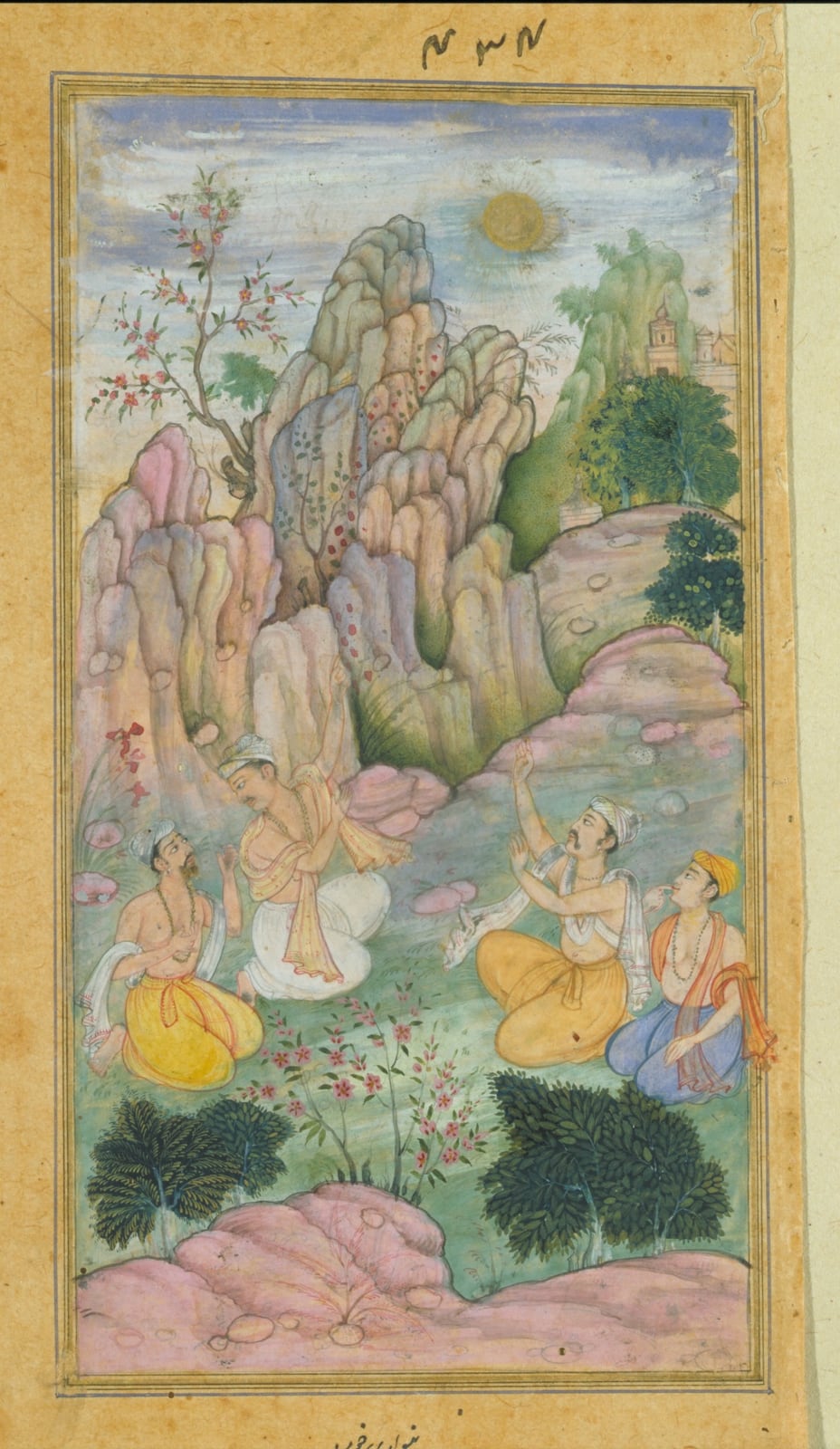
Vyasa
They agree on: What is the Absolute? Does God exist? · Who am I? Is there a true self? · What happens after death?
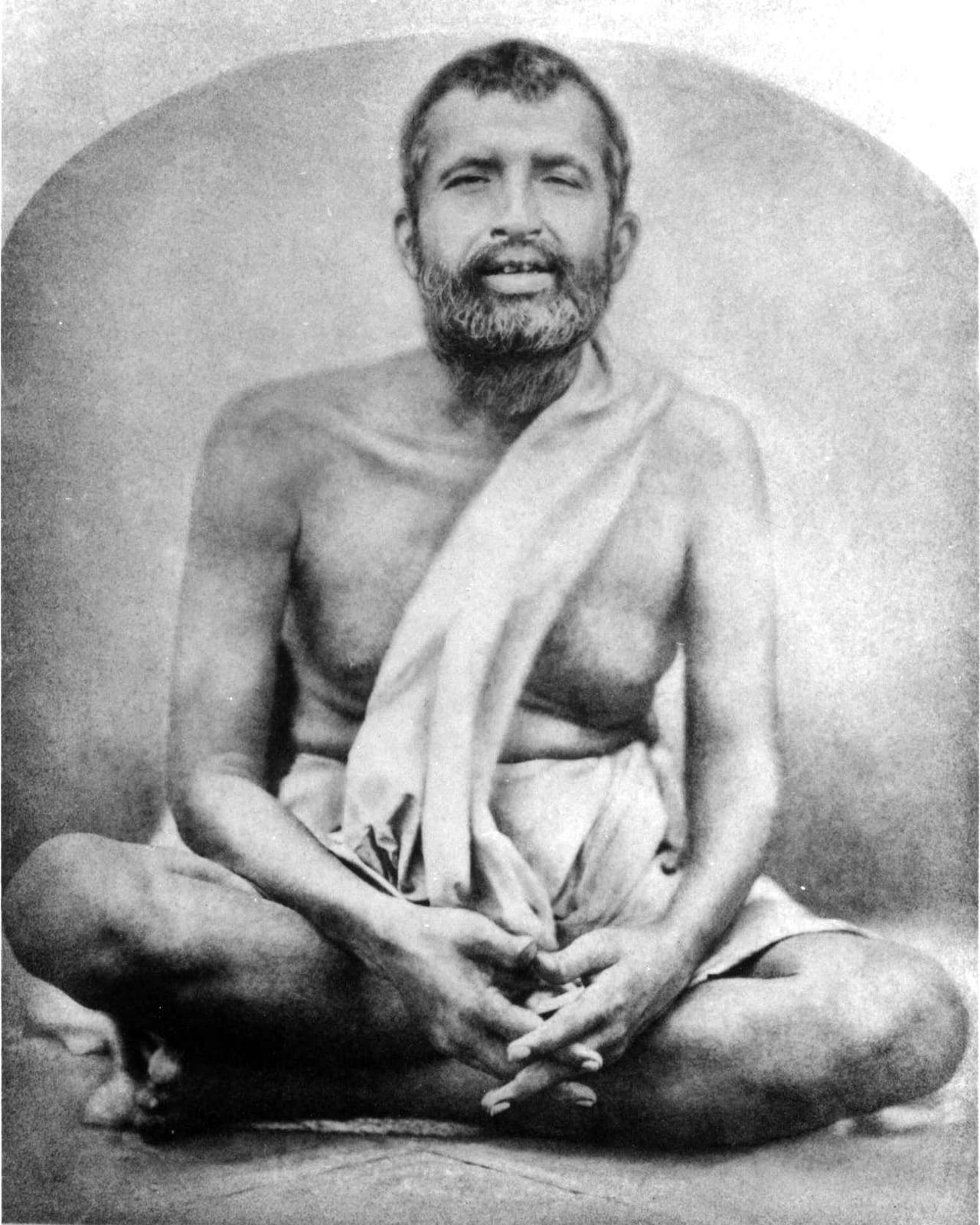
Ramakrishna
They agree on: What is the Absolute? Does God exist? · Who am I? Is there a true self? · How is liberation or salvation attained?
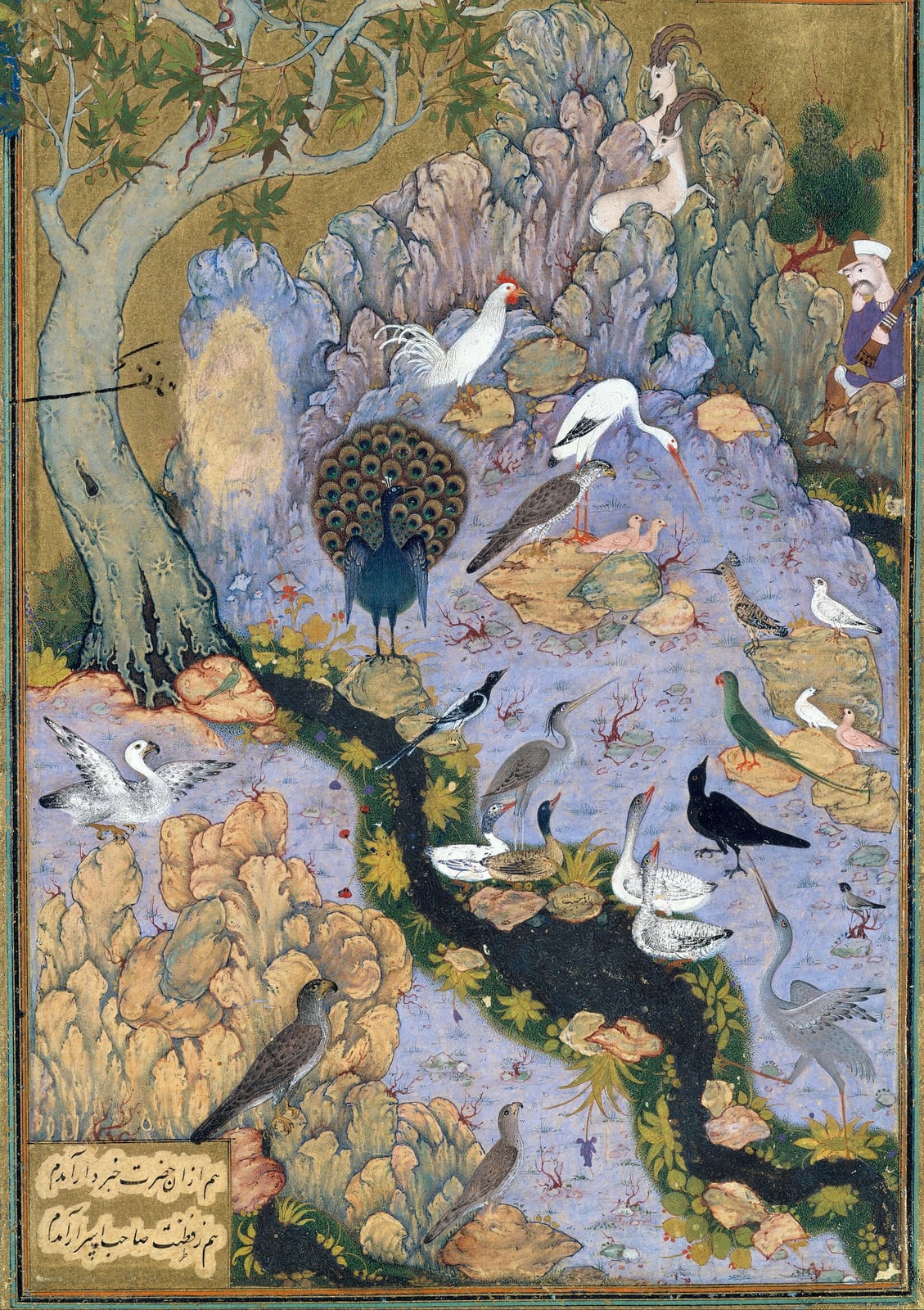
Attar
They agree on: What is the Absolute? Does God exist? · Who am I? Is there a true self? · Is a teacher necessary?
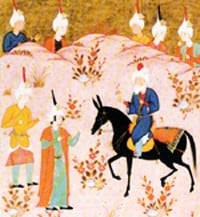
Ibn Arabi
They agree on: What is the Absolute? Does God exist? · Who am I? Is there a true self? · Is the world real?



Anecdotes and stories
Anecdotes and stories
Testimonyagosto de 1922
Teacher and disciple
Origin of the story: Known from what she herself told years later, recorded by Bhaiji and in Mother Reveals Herself; there were no witnesses to the ceremony.
Source: Hallstrom, Lisa Lassell. Mother of Bliss: Ānandamayī Mā (1896–1982). Nueva York: Oxford University Press, 1999.
Testimonydiciembre de 1935
“I was the same”
Origin of the story: Yogananda’s account in Autobiography of a Yogi (1946), ch. 45; the date comes from the Sangha’s chronology. Her words are known in Yogananda’s English version.
Testimonyc. 1948
The guru of those who deny gurus
Origin of the story: Two concordant versions: Atmananda’s diary (Death Must Die), recording what Anandamayi Ma told, and Pupul Jayakar’s biography of Krishnamurti (1986). The date is inferred from a conversation of November 1948 recorded by Amulya Kumar Datta Gupta.
Source: Atmananda. Death Must Die: A Western Woman’s Life-Long Spiritual Quest in India with Shree Anandamayee Ma, ed. Ram Alexander. Varanasi: Indica Books, 2000.
Testimony3 de noviembre de 1952
The rose and the chocolate
Origin of the story: Account by devotees present recorded in Anandamayee: The Universal Mother and, in Anandamayi’s own version, in Ananda Varta (vol. VII, no. 4, 1960); both reproduced by anandamayi.org.
Documentedfebrero de 1942
Eight hours at Sevagram
Origin of the story: Entry of 20 February 1942 in Gurupriya Devi’s diaries (vol. 10 of the English translation) and a devotee’s recollection, both reproduced by anandamayi.org.
Source: Gurupriya Devi. Sri Sri Ma Anandamayi (diarios, original bengalí desde 1925). Trad. inglesa, vols. 1–9 y ss. Calcuta: Shree Shree Anandamayee Charitable Society, 1984–1996.
Testimonyc. 1925
The name
Origin of the story: It comes from Bhaiji’s testimony (Mother as Revealed to Me) and the Sangha’s chronology, which places the episode at Siddheswari in 1925.
Source: Bhaiji (Jyotish Chandra Ray). Mother as Revealed to Me (orig. bengalí Matri Darshan). Trad. de G. Das Gupta. Varanasi: Shree Shree Anandamayee Sangha, 2004.
Teachings
Teachings
The notions that structure their thought, explained in context.
Kheyalkheyal
Analysed by Hallstrom (1999) and by Anil Ganguli in Anandamayi Ma’s Inscrutable Kheyal (1980).
Source: Hallstrom, Lisa Lassell. Mother of Bliss: Ānandamayī Mā (1896–1982). Nueva York: Oxford University Press, 1999.
“This body”: speaking without egoeste-cuerpo
Attested in all the sources (Yogananda, Bhaiji, Gurupriya Devi, Atmananda).
All pathstodos-los-caminos
Comparable to Ramakrishna’s teaching on the plurality of paths, though no direct influence is documented.
Source: Hallstrom, Lisa Lassell. Mother of Bliss: Ānandamayī Mā (1896–1982). Nueva York: Oxford University Press, 1999.
The divine name and the fixed timenama-japa
Rooted in the Bengali tradition of nama-japa (Chaitanya) and in the Tantric practice of mantra.
Source: Matri Vani: From the Wisdom of Sri Anandamayi Ma, vol. I (cartas recogidas por Gurupriya Devi, trad. de Atmananda, pról. de Gopinath Kaviraj). Varanasi: Shree Shree Anandamayee Sangha, 1963; vol. II (selección de Sister Uma), Calcuta, 1977.
Samyam Saptah: the week of disciplinesamyam-saptah
Described in the Sangha’s chronology and in Ananda Varta; the twenty-fifth was held in 1974.
Videos
Videos
Recordings, interviews and documentaries. Videos play from YouTube; they are not hosted here.
Ma Anandamayi is present at a sacred thread ceremony at Tarapeeth in 1936
Original recording· 1936· 8 min
SriRam108
Yogananda visits Anandamayi Ma
Original recording· 1935· 1 min
Heart is Thy Name, O Lord
Ma Anandamayi, vidéo 1959 par Arnaud Desjardins
Documentary· FR· 1959· 10 min
Silence Within
Ma Anandamayi 1959 (subtítulos en español)
Documentary· ES· 1959· 10 min
CanalGanges
A compilation of cine film clips of Ma Anandamayi from 1956-1981
Original recording· 76 min
SriRam108
Ma Anandamayi talks at Suktal in 1961 (English subtitles)
Original recording· BN· 1961· 21 min
SriRam108
Ma Anandamayi at the samyam saptah at Rama Tirtha Mission, Dehra Dun, in 1974
Original recording· 1974· 27 min
SriRam108
Questions and answers by Sri Ma Anandamayi at Nadiad in 1978 - No 1
Original recording· 1978· 12 min
SriRam108
Ma & Me: The Anandamayi Ma Documentary
Documentary· EN· 2019· 94 min
Ma Documentary
ANANDAMAYI MA (Documental subtitulado en español)
Documentary· ES· 94 min
Anandamayi Ma
Arnaud Desjardins talks about his experiences with Ma Anandamayi
Interview· FR· 33 min
SriRam108
ANANDAMAYI MA 1 (Recuerdos de Arnaud Desjardins), subtitulado en español
Interview· ES
CanalGanges
The Life of Sri Ma Anandamayi, as narrated by Bithika Mukerjee
Lecture· EN· 43 min
SriRam108
साधना की 10 अवस्थाएँ | सद् वाणी - भाग 4 | श्री आनंदमयी माँ सत्संग
Lecture· HI· 72 min
MA Sharanam
Gallery
Gallery
Images with verified licences. Each keeps its authorship and attribution.
Connections
Connections
Influences, discipleships and affinities. Documented relations are distinguished from similarities identified by analysis.
Met
They met in Calcutta in December 1935; he devoted chapter 45 of Autobiography of a Yogi to her and she visited his Ranchi school.
Documented relation
Met
They talked around 1948 in Delhi, at Kitty Shiva Rao’s house, about the need for a guru; Atmananda and Pupul Jayakar both recount it.
Documented relation
Met
La Madre (Mirra Alfassa)
Meeting at the Sri Aurobindo Ashram, Pondicherry, on 3 November 1952.
Documented relation
Contemporary of
Bengali contemporaries; they never met. She visited his ashram in 1952, two years after his death.
Similarity identified by analysis
Contemporary of
They never met in life; on her 1952 tour she visited Ramana’s ashram at Tiruvannamalai, two years after his death.
Documented relation
Met
Mahatma Gandhi
She visited him at Sevagram in February 1942 and in 1946 attended one of his prayer meetings in Delhi at his request.
Documented relation
Family of
Bholanath (Ramani Mohan Chakrabarti)
Her husband from 1909, in an unconsummated marriage; he received initiation from her in 1922 and died in 1938.
Documented relation
Teacher of
Bhaiji (Jyotish Chandra Ray)
One of the first devotees; he gave her the name Anandamayi and compiled Sad Vani and Matri Darshan.
Documented relation
Teacher of
Gurupriya Devi
Companion from 1926 and author of the diaries that are the main chronicle of her life.
Documented relation
Teacher of
Gopinath Kaviraj
The great Banaras Sanskritist frequented her from 1928 and wrote the foreword to Matri Vani.
Documented relation
Ideas akin to
Bengali mystics of frequent ecstasies, with no writings of their own, who taught the legitimacy of all paths. Similarity identified by the editors; no personal relationship.
Similarity identified by analysis
Ideas akin to
Her insistence on the divine name and kirtan continues the Bengali Vaishnava devotion of Chaitanya, in whose tradition her father sang. Relationship noted by the editors.
Similarity identified by analysis
Linked from other profiles
Sources
Sources
Bibliography and catalogues consulted for this profile.
- Bhaiji (Jyotish Chandra Ray). Sad Vani: A Collection of the Teachings of Sri Anandamayi Ma (original bengalí, 1935). Trad. inglesa de Atmananda. Varanasi / Calcuta: Shree Shree Anandamayee Charitable Society, 1973 (reimpr. 1975).
- Gurupriya Devi. Sri Sri Ma Anandamayi (diarios, original bengalí desde 1925). Trad. inglesa, vols. 1–9 y ss. Calcuta: Shree Shree Anandamayee Charitable Society, 1984–1996.
- Hallstrom, Lisa Lassell. Mother of Bliss: Ānandamayī Mā (1896–1982). Nueva York: Oxford University Press, 1999.
- Lipski, Alexander. Life and Teaching of Śrī Ānandamayī Mā. Delhi: Motilal Banarsidass, 1977.
- Mukerji, Bithika. From the Life of Sri Anandamayi Ma. Varanasi: Shree Shree Anandamayee Sangha, 1970; y The Most Gracious Presence, Sri Ma Anandamayi, 3 vols., 2009–2014.
- Yogananda, Paramahansa. Autobiography of a Yogi. Nueva York: The Philosophical Library, 1946, cap. 45 («The Bengali “Joy-Permeated” Mother»). Texto de 1946 en Project Gutenberg (n.º 7452).
- Wikidata, «Anandamayi Ma» (Q433594): fechas y lugares, 38 enlaces entre wikis.
- Wikipedia en inglés, «Anandamayi Ma».
- anandamayi.org (sitio de devotos vinculado a la Shree Shree Anandamayee Sangha): «Life History» 1896–1982, cronología año por año, y páginas «Meeting with Saints and Mahatmas».
- Aymard, Orianne. When a Goddess Dies: Worshipping Ma Anandamayi after Her Death. Nueva York: Oxford University Press, 2014.
- Atmananda. Death Must Die: A Western Woman’s Life-Long Spiritual Quest in India with Shree Anandamayee Ma, ed. Ram Alexander. Varanasi: Indica Books, 2000.
- Jayakar, Pupul. J. Krishnamurti: A Biography. San Francisco: Harper & Row, 1986 (sobre el encuentro en casa de Kitty Shiva Rao, Delhi).
- Matri Vani: From the Wisdom of Sri Anandamayi Ma, vol. I (cartas recogidas por Gurupriya Devi, trad. de Atmananda, pról. de Gopinath Kaviraj). Varanasi: Shree Shree Anandamayee Sangha, 1963; vol. II (selección de Sister Uma), Calcuta, 1977.
- Lannoy, Richard. Anandamayi: Her Life and Wisdom. Shaftesbury: Element, 1996.
- Wikimedia Commons: fotografías de Anandamayi Ma y de sus ashrams (metadatos y licencias consultados por API).
- Shree Shree Anandamayee Sangha, catálogo de publicaciones (bookshop) con fechas, compiladores y traductores.
- Bhaiji (Jyotish Chandra Ray). Mother as Revealed to Me (orig. bengalí Matri Darshan). Trad. de G. Das Gupta. Varanasi: Shree Shree Anandamayee Sangha, 2004.
- Maschmann, Melita. Encountering Bliss: My Journey through India with Anandamayi Ma. Trad. de S. B. Shrotri. Delhi: Motilal Banarsidass, 2002.
- Rights holder
- Anandamayi Ma murió en 1982; sus palabras se conocen en recopilaciones cuyos derechos pertenecen a la Shree Shree Anandamayee Sangha (Varanasi/Kankhal), a la Shree Shree Anandamayee Charitable Society (Calcuta) y a los compiladores y traductores (Bhaiji, Gurupriya Devi, Atmananda). Ningún texto suyo es de dominio público en la UE, España o EE. UU.
- Official site
- www.shreeshreeanandamayeesangha.org/
Pending confirmation
What this profile has not yet been able to settle. We would rather say so than fill it in.
- Sala de lectura: ningún texto de Anandamayi Ma (m. 1982) ni de sus compiladores es de dominio público; no se registra reading_texts. La única fuente libre en EE. UU. es el capítulo 45 de Autobiography of a Yogi (Gutenberg), que pertenece a la ficha de Yogananda.
- ISBN de las ediciones de la Sangha (Sad Vani, Matri Vani, Words, diarios de Gurupriya Devi): no figuran en Open Library.
- Ediciones españolas: ISBN de Palabras de la Madre (Advaitavidya, 2024), de La Madre según me fue revelada y de la traducción de Lannoy; identificar el libro con ISBN 9788497773249 («Vida y enseñanzas de Sri Anandamayi Ma», editorial desconocida en Open Library).
- Confirmar si Worte der Glückseligen Mutter (Mangalam, 1986) es la versión alemana de Words of Sri Anandamayi Ma, y el original de Leben und Weisheit der Glückseligen Mutter (Ed. Maitri, 1995).
- Año y título bengalí exactos de Matri Darshan (Bhaiji) y fecha de muerte de Bhaiji (las fuentes oscilan entre 1937 y 1938).
- Citas tomadas de anandamayi.org (respuesta al periodista irlandés, «pensión divina», encuentro con la Madre) marcadas como probables: localizar la página exacta en Matri Vani, Ananda Varta o las biografías de Bithika Mukerji.
- Último mensaje o palabras finales: revisar los diarios de Gurupriya Devi y las crónicas de 1982 por si se registró alguna frase.
- Imágenes: localizar en Commons fotografías de madurez con licencia libre verificada; las de los años cuarenta a ochenta suelen tener derechos de la Sangha o de fotógrafos identificados.
Researched on 2026-10-25