Presocratic philosophy · Pythagoreanism
Pythagoras
Πυθαγόρης · Πυθαγόρας ὁ Σάμιος
c. 570 BCE – c. 495 BCEHistorically documented person
Greek sage born on Samos around 570 BCE who founded in Croton, in southern Italy, a community of disciples bound by a way of life, belief in the transmigration of souls and, according to tradition, the study of number and harmony. He left no writings. We know him through brief testimonies of contemporaries and through biographies written eight centuries later that made him a divine man: separating fact from legend is the first problem of his history.
- works
- 12works
- editions
- 31editions
- quotes
- 6quotes
- videos
- 11videos
- images
- 8images
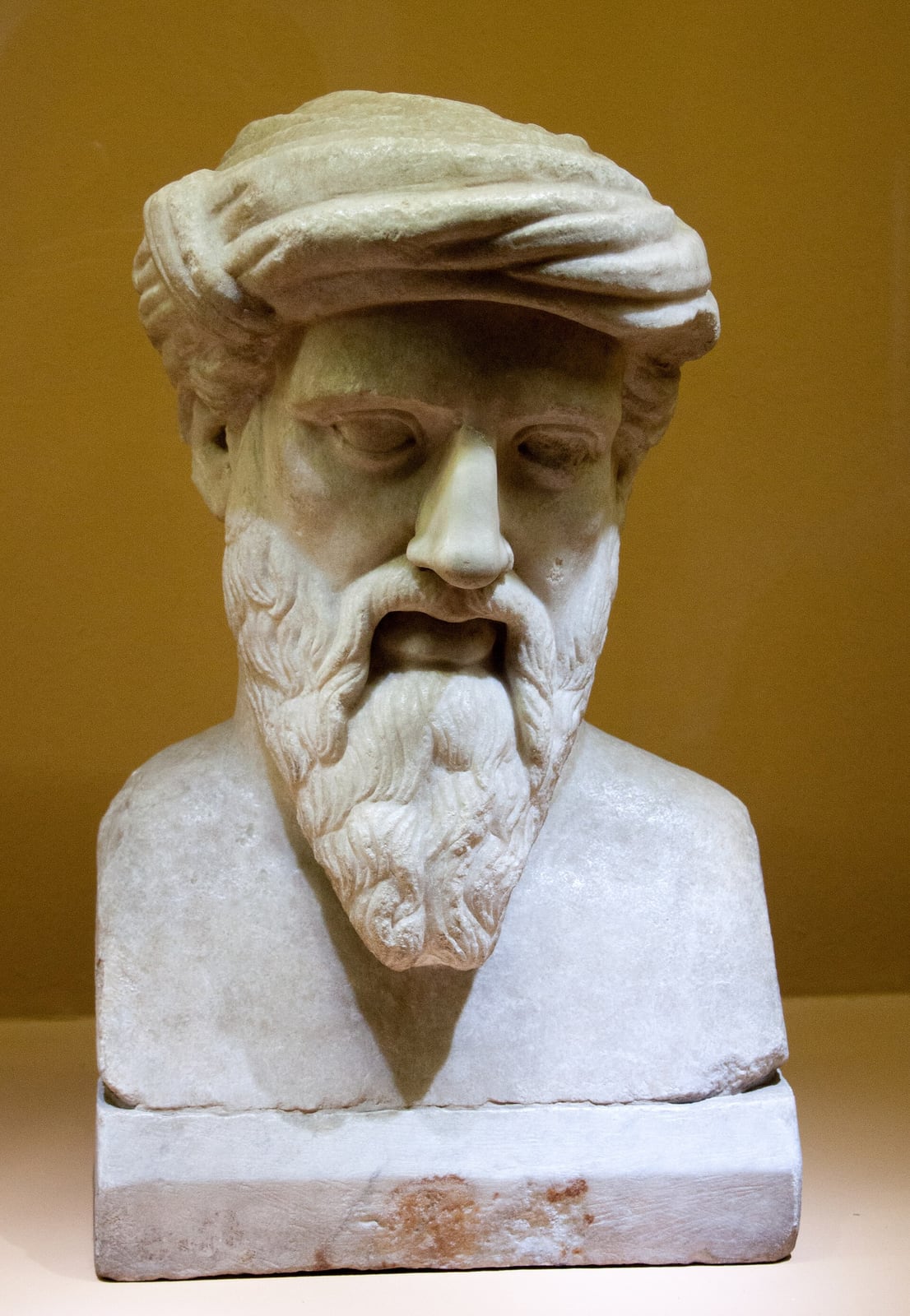
Busto de Pitágoras (Museos Capitolinos) · Public domain
In their words
«No, by him who gave our race the tetraktys, the fount holding the roots of ever-flowing nature.»Juramento de los pitagóricos por Pitágoras, citado por Porfirio, Vida de Pitágoras 20 (ed. Nauck), Aecio y Sexto Empírico; los Versos de oro (47–48) contienen una variante. Es un juramento de los discípulos, no palabras de Pitágoras. Traducciones propias.

Their central idea
Metempsychosis (transmigration of souls): It is the doctrine that can most securely be attributed to Pythagoras, because it is already attested by Xenophanes, his contemporary, and shortly after by Herodotus, Ion of Chios and Empedocles.
See in context
Biography
5 min read
A name without works
Pythagoras left no writings, or at least none reached the next generation: the first Pythagorean book on record is Philolaus', more than half a century after his death. What we know of him comes from three very uneven layers of testimony. The first consists of brief allusions by contemporaries or near-contemporaries—Xenophanes, Heraclitus, Ion of Chios, Empedocles, Herodotus—who present him as a sage of extraordinary learning with a doctrine about the soul. The second comprises the reports of Aristotle and his pupils Aristoxenus and Dicaearchus in the fourth century BCE, who were already working with conflicting traditions. The third consists of the great biographies by Diogenes Laertius, Porphyry and Iamblichus, written eight to nine hundred years after his death, when Pythagoras had become a divine man.
Separating fact from legend is therefore the first problem of any biography. Walter Burkert argued in 1962 that the historical Pythagoras was above all a religious teacher, closer to a shaman than to a mathematician, and that Pythagorean science begins with Philolaus and Archytas; Leonid Zhmud has argued, by contrast, that he and his first followers already did mathematics. Aristotle, tellingly, hardly ever speaks of Pythagoras, but of "the so-called Pythagoreans".
Samos
He was born on Samos around 570 BCE, the son of Mnesarchus, whom Herodotus and Heraclitus name and later tradition makes a gem-engraver. Aristoxenus relates that he left the island at forty to escape the tyranny of Polycrates, which allows his birth to be placed around that date. The late biographers credit him with teachers—Pherecydes of Syros, Anaximander, Thales—and long journeys of study to Egypt, Babylon, Phoenicia and even India. The journey to Egypt already appears in Isocrates in the fourth century BCE; the others are in all likelihood later constructions meant to give his wisdom an Eastern origin.
Croton
Around 530 BCE he settled in Croton, an Achaean colony in southern Italy. According to Dicaearchus, quoted by Porphyry, his presence and speech made such an impression that the council of elders asked him to address the young men, the children and the women. A community of men and women formed around him—among them Theano, whom tradition makes his wife or his pupil—bound by a common way of life, with rules of conduct, silence and, according to some, shared property. The community acquired considerable political weight in Croton and other cities of Magna Graecia; tradition links it to the war in which Croton destroyed Sybaris in 510 BCE.
What his contemporaries said
The oldest testimonies are as brief as they are revealing. Xenophanes of Colophon mocks him in a few lines: seeing a dog being beaten, Pythagoras asked them to stop because he had recognised in its yelps the soul of a friend. Heraclitus mentions him twice with contempt: as an example of how amassing knowledge does not teach understanding, and as the man who practised inquiry most of all and thereby fashioned a wisdom of his own, "much learning, bad artistry". Herodotus calls him "not the weakest of the Greek sages" and suggests he took the doctrine of transmigration from Egypt. All agree on two features: uncommon learning and belief in a soul that survives and passes from one body to another.
The Pythagorean way of life
Plato, in the Republic, says that Pythagoras was loved for having bequeathed a way of life, still called Pythagorean in his day. That way of life was handed down in akousmata, brief oral maxims: what is wisest (number), what is most just (to sacrifice), what must not be done (eat beans, stir the fire with a knife, step over a balance). Many look like archaic religious taboos; later tradition read them as symbols. The sources disagree about his diet: some ascribe to him a strict vegetarianism linked to transmigration; Aristoxenus maintained that he ate meat except that of the plough-ox and the ram. The late sources divide his followers into acusmatici, faithful to the maxims, and mathematici, devoted to science, a division that probably reflects later disputes.
Number and harmony
Aristotle ascribes to the Pythagoreans the thesis that the principles of numbers are the principles of all things, and explains it by the discovery that musical concords correspond to simple numerical ratios: the octave to 2:1, the fifth to 3:2, the fourth to 4:3. Hence the veneration of the tetraktys, the first four numbers whose sum is ten, by which the Pythagoreans swore, and the idea that the heavenly bodies produce a harmony. The theorem that bears his name was known to Babylonian mathematicians more than a thousand years earlier, and its attribution to Pythagoras appears late, in Hellenistic and Roman authors; how much of Pythagorean mathematics goes back to the founder is one of the most debated questions in the history of science.
The end
Towards the end of his life a revolt broke out in Croton led by Cylon, an aristocrat whom, according to Aristoxenus, Pythagoras had refused as a pupil. Pythagoras withdrew to Metapontum, where he died around 495 BCE; centuries later Cicero visited the house and the seat attributed to him there. The accounts of his death contradict each other: some say he perished when Milo's house in Croton was set on fire; others that his pursuers caught him at a bean field he refused to cross; Dicaearchus, that he starved to death in the temple of the Muses at Metapontum. Around the middle of the fifth century the Pythagorean meeting-houses were burnt in several Italian cities, and the survivors dispersed.
The legend
Since Aristotle's time marvels had circulated: the golden thigh, his simultaneous presence in Croton and Metapontum, the river that greeted him by name. The Neopythagoreans of the imperial period and the Neoplatonists made him a divine man, a son of Apollo according to some, and attributed to him the Golden Verses and a whole library of apocryphal writings. Plato owes to him the immortality of the soul and confidence in mathematics as a path to reality; Copernicus invoked the Pythagoreans to defend the motion of the Earth, and Kepler sought the harmony of the heavens. Few figures have been so influential while so little is known of them.
Sources: Diógenes Laercio. Vidas y opiniones de los filósofos ilustres, libro VIII, 1–50 (Pitágoras), s. III d. C. Trad. inglesa de C. D. Yonge, Bohn, Londres, 1853 (Project Gutenberg n.º 57342). · Porfirio. Vida de Pitágoras (Πυθαγόρου βίος), c. 270–300 d. C.; texto griego de A. Nauck, Porphyrii philosophi Platonici opuscula selecta, 2.ª ed., Teubner, Leipzig, 1886 (Wikisource en griego). Recoge fragmentos de Aristóxeno, Dicearco, Nicómaco y Antonio Diógenes. · Jámblico. Sobre la vida pitagórica (De vita Pythagorica), c. 300 d. C.; ed. L. Deubner, Teubner, Leipzig, 1937. Trad. inglesa de Thomas Taylor, Londres, 1818 (Project Gutenberg n.º 63300), y de John Dillon y Jackson Hershbell, Scholars Press, Atlanta, 1991. · Burkert, Walter. Lore and Science in Ancient Pythagoreanism, trad. Edwin L. Minar Jr. Harvard University Press, Cambridge (Mass.), 1972 (orig.: Weisheit und Wissenschaft, Hans Carl, Núremberg, 1962). · Riedweg, Christoph. Pythagoras: His Life, Teaching, and Influence, trad. Steven Rendall. Cornell University Press, Ithaca, 2005 (orig.: Pythagoras. Leben, Lehre, Nachwirkung, C. H. Beck, Múnich, 2002).
Timeline
A life, year by year
Each point is a documented event. Click to read it, with its source and degree of certainty.
c. 570 BCEage 0Samos
Birth
Born on Samos, son of Mnesarchus. The date is inferred from Aristoxenus' report that he left the island at forty, under Polycrates; Wikidata records proposals between 582 and 550 BCE. Years BCE are expressed as negative numbers.
ProbablePorfirio. Vida de Pitágoras (Πυθαγόρου βίος), c. 270–300 d. C.; texto griego de A. Nauck, Porphyrii philosophi Platonici opuscula selecta, 2.ª ed., Teubner, Leipzig, 1886 (Wikisource en griego). Recoge fragmentos de Aristóxeno, Dicearco, Nicómaco y Antonio Diógenes.
After their death
- c. 450 BCEBurning of the Pythagorean houses
- c. 420 BCEPhilolaus, the first Pythagorean book
- c. 388 BCEPlato and Archytas
- c. 300 BCEIamblichus writes On the Pythagorean Life
- 1543Copernicus invokes the Pythagoreans
- 1619Kepler, Harmonices mundi
c. 570 BCE · age 0
Birth
Born on Samos, son of Mnesarchus. The date is inferred from Aristoxenus' report that he left the island at forty, under Polycrates; Wikidata records proposals between 582 and 550 BCE. Years BCE are expressed as negative numbers.
Probable
c. 550 BCE
Journeys of study
Isocrates (Busiris 28) is the first to mention a journey to Egypt; the late biographers add Phoenicia, Babylon, the Persian magi and India, and teachers such as Pherecydes and Thales. None of it can be verified.
Tradition
c. 538 BCE
Tyranny of Polycrates
Polycrates seizes power on Samos (c. 538–522 BCE); according to Aristoxenus, Pythagoras emigrates to escape his tyranny.
Documented
c. 530 BCE · age 40
Arrival in Croton
He settles in Croton where, according to Dicaearchus, he addresses the council, the young men, the children and the women, and founds a community of disciples of both sexes.
Probable
510 BCE
Destruction of Sybaris
Croton, led by the athlete Milo, destroys Sybaris. Late sources (Diodorus, Iamblichus) give Pythagoras a role in the decision to go to war.
Disputed
c. 505 BCE
Cylon's revolt
The aristocrat Cylon leads a revolt against the Pythagoreans. The chronology is very uncertain: some sources place it in Pythagoras' lifetime, others conflate it with the persecutions of the mid-fifth century.
Disputed
c. 495 BCE · age 75
Death
He dies at Metapontum, according to the most accepted version; other sources have him die in Croton or Sicily. Cicero (De finibus V 4) visited the spot pointed out there as his house.
Probable
c. 450 BCE
Burning of the Pythagorean houses
Polybius (II 39) relates that the Pythagorean meeting-places were burnt in the cities of Magna Graecia, causing great political upheaval; the survivors scatter across Greece.
Documented
c. 420 BCE
Philolaus, the first Pythagorean book
Philolaus of Croton writes the first Pythagorean treatise of which authentic fragments survive, on the limited, the unlimited and harmony.
Probable
c. 388 BCE
Plato and Archytas
Plato travels to Italy and Sicily and befriends the Pythagorean Archytas of Tarentum, mathematician and statesman; the Pythagorean imprint is visible in the Phaedo, the Gorgias and the Timaeus.
Probable
c. 300 BCE
Iamblichus writes On the Pythagorean Life
The Neoplatonist Iamblichus composes the longest biography of Pythagoras, as the first book of an encyclopedia of Pythagoreanism; shortly before, Porphyry had written his Life of Pythagoras.
Documented
1543
Copernicus invokes the Pythagoreans
In the preface to De revolutionibus orbium coelestium, Copernicus cites the Pythagoreans Philolaus, Ecphantus and Hicetas as precedents for the Earth's motion.
Documented
1619
Kepler, Harmonices mundi
Johannes Kepler publishes The Harmony of the World, seeking the musical proportions of planetary motions in a modern reformulation of the harmony of the spheres.
Documented
Works
Essential works
The works without which their legacy cannot be understood.
Traditional attribution · c. 300 BCE
Golden Verses
Χρυσᾶ ἔπη
Seventy-one lines of moral and religious precepts: honour the gods, the heroes and one's parents; choose the virtuous as a friend; master the belly, sleep, desire and anger; respect oneself above all; examine each night what was done during the day. The final section promises whoever perseveres knowledge of the nature of gods and men and, on leaving the body, the condition of an immortal god. The Neoplatonist Hierocles of Alexandria (5th century) wrote a commentary on it, and in the modern age it was one of the most translated Greek texts.
5 editions
Recorded oral teaching · c. 500 BCE
Akousmata and symbola
ἀκούσματα / σύμβολα
According to Iamblichus they fell into three classes: what something is ("what are the isles of the blessed? The sun and the moon"), what is most such ("what is wisest? Number"), what must be done or avoided ("do not eat beans", "do not stir the fire with a knife", "do not step over a balance", "put on the right shoe first"). Many look like archaic ritual taboos; from the fourth century BCE they were interpreted as moral symbols: stirring the fire with a knife would mean provoking the anger of someone already irritated.
2 editions

Academic study · c. 300
On the Pythagorean Life (Iamblichus)
Περὶ τοῦ Πυθαγορικοῦ βίου
The first book of a ten-book work on Pythagoreanism. It narrates the birth, the journeys, the arrival in Croton and the speeches to youths, elders and women, describes life in the community—the five-year silence, the testing of candidates, friendship, diet, music as medicine for the soul—, lists the miracles, recounts Cylon's conspiracy and closes with a catalogue of Pythagoreans: 218 men and 17 women. It is the longest surviving source on Pythagoras.
5 editions
Academic study · c. 280
Life of Pythagoras (Porphyry)
Πυθαγόρου βίος
It covers the origin, education, arrival in Italy, the marvels (the Daunian she-bear, the fish, the greeting of the river Caucasus, the simultaneous presence in Metapontum and Tauromenium), the teaching through symbols, Pythagorean friendship and Cylon's conspiracy, naming its sources: Aristoxenus, Dicaearchus, Nicomachus, Neanthes, Antonius Diogenes. Its Greek text survives almost complete.
4 editions
Complete works (12)

Life of Pythagoras (Diogenes Laertius, Lives VIII 1–50)
230
Testimonies of his contemporaries (Xenophanes, Heraclitus, Empedocles, Ion of Chios, Herodotus)
450
Pythagoras
Aristotle's testimonies on the Pythagoreans
The Conscious LibraryAristotle's testimonies on the Pythagoreans
340
Sacred Discourse (Hieros logos)
300
Pythagoras
Books on Education, Politics and Nature
The Conscious LibraryBooks on Education, Politics and Nature
300
Pythagoras
Letters of Pythagoras
The Conscious LibraryLetters of Pythagoras
100
Pseudo-Pythagorean writings
200

Fragments of Philolaus of Croton
420
Quotations
Quotations located in a specific work. Each carries its provenance and its level of confidence.
Stop, do not beat it: it is the soul of a friend; I recognised it when I heard its voice.παῦσαι μηδὲ ῥάπιζ᾽, ἐπεὶ ἦ φίλου ἀνέρος ἐστὶν ψυχή, τὴν ἔγνων φθεγξαμένης ἀίων.
ProbableJenófanes, fragmento DK 21 B 7, transmitido por Diógenes Laercio VIII 36. Son palabras que Jenófanes, contemporáneo de Pitágoras, le atribuye en tono satírico; traducciones propias.
Apocryphal quotes or disputed attributions (4)
«All is number.»
The formula appears in no ancient source as a saying of Pythagoras. It summarises Aristotle's account of the doctrine of "the so-called Pythagoreans" (Metaphysics A 5–6), according to which things are numbers or imitate numbers; the thesis probably comes from Philolaus, not from the founder.
«Educate the children and it will not be necessary to punish the men.»
It circulates online and in quotation books attributed to Pythagoras with no reference to any ancient text. It does not appear in Diogenes Laertius, Porphyry, Iamblichus or the collections of Pythagorean sayings in Stobaeus.
«As long as man continues to be the ruthless destroyer of lower living beings, he will never know health or peace.»
A modern quotation spread in vegetarian circles. The idea of kinship among all living beings is indeed Pythagorean (Porphyry, Life of Pythagoras 19), and Ovid puts a long plea against eating meat in Pythagoras' mouth (Metamorphoses XV 60–478), but this sentence is in no ancient text.
«Listen, and you will become wise; the beginning of wisdom is silence.»
A modern variant of the discipline of silence that Iamblichus (Pythagorean Life 72) and other late biographers attribute to the Pythagorean community (the *echemythia*, a five-year silence for novices). It is not a literal quotation from any ancient source.
Last words
Contradictory versions
«"Better to be caught than to trample the beans, and better to be slain than to speak."»There is no reliable testimony. Diogenes Laertius (VIII 39) reports, from unnamed sources ("some say"), that Pythagoras, fleeing the fire at Milo's house in Croton, stopped at a field of beans and said these words before his pursuers killed him. On the same page he gives other incompatible versions: Dicaearchus claims he took refuge in the temple of the Muses at Metapontum and starved to death after forty days; Heraclides Lembus, that he let himself starve at Metapontum because he no longer wished to live; Hermippus, that he died in a war between Acragas and Syracuse, again skirting a field of beans. The bean story seems built on the Pythagorean prohibition against eating them. Neither Porphyry nor Iamblichus gives him any last words.
Source: Diógenes Laercio. Vidas y opiniones de los filósofos ilustres, libro VIII, 1–50 (Pitágoras), s. III d. C. Trad. inglesa de C. D. Yonge, Bohn, Londres, 1853 (Project Gutenberg n.º 57342).
Ask
What their work answers
Twelve great human questions and what their texts allow us to answer, with references. We never put words in their mouth.
What is the Absolute? Does God exist?
The Pythagorean tradition places the principle of all things in number and harmony
An impersonal AbsoluteInferred from their doctrine
Pythagoras wrote nothing, and what is attributed to him about the divine reaches us in layers. Aristotle, who no longer distinguishes the master from his school, speaks of “the so-called Pythagoreans” and credits them with the thesis that the principles of numbers are the principles of all beings and that the whole heaven is harmony and number. Philolaus of Croton, the first Pythagorean with surviving fragments, makes harmony what binds the unlimited and the limiting. The late Lives by Porphyry and Iamblichus add a Pythagoras devoted to Apollo and revered as a divine being, and the oath by the tetractys shows that number was an object of cult. What can prudently be affirmed is an ordering mathematical principle, not a God who knows and loves the creature.
Compare this question with other teachersWho am I? Is there a true self?
An immortal soul that passes from body to body, animal ones included
An evolving soulStated explicitly
This is the doctrine that the oldest testimonies attribute to Pythagoras with greatest confidence. Xenophanes, his contemporary, mocks him by telling how, seeing a puppy being beaten, he asked them to stop because he had recognised the soul of a friend in its cries. Dicaearchus, a pupil of Aristotle, summarises according to Porphyry what he taught at Croton: that the soul is immortal, that it changes into other kinds of living beings, that what happens happens again in cycles, and that all animate beings are kin. The self is thus a soul passing through many lives; later tradition added that Pythagoras remembered his former existences.
Compare this question with other teachersWhy do we suffer?
The soul atones in the body and is purified from life to life
Karma and the soul's learningInferred from their doctrine
No text by Pythagoras explains why we suffer, and about him there are only testimonies. The Pythagorean tradition, however, links suffering with the soul's destiny. Philolaus invokes “the ancient theologians and seers” to say that the soul is yoked to the body as a punishment and buried in it as in a tomb; transmigration, the master's best-attested doctrine, makes each life a consequence of earlier ones. Hence the Pythagorean way of life — abstinences, silence, daily review, music — conceived as purification. Pain does not appear as absurd: it is the state of a fallen soul that, with discipline, can free itself from the cycle.
Compare this question with other teachersWhat happens after death?
The immortal soul is reborn in other living beings, in recurring cycles
Rebirth according to karmaStated explicitly
Transmigration is the oldest and best-attested doctrine attributed to Pythagoras. Xenophanes, his contemporary, already mocks it; Dicaearchus, in the fourth century BC, summarises it according to Porphyry: the soul is immortal, passes into other kinds of living beings, what has happened happens again in cycles, and nothing is absolutely new. Heraclides of Pontus adds, according to Diogenes Laertius, that Pythagoras remembered having been Aethalides, Euphorbus and others. Herodotus, without naming him, speaks of Greeks who took from Egypt the idea that the soul passes through all animals before returning to a human body. Death is not an end but a step within a cycle.
Compare this question with other teachersHow is liberation or salvation attained?
A way of life: silence, abstinences, music, study and daily review
Through disciplined practiceInferred from their doctrine
Plato, in the Republic, remembers Pythagoras not for his science but for having bequeathed to his followers a way of life that still in his day set them apart. The much later Lives by Porphyry and Iamblichus describe that regime: years of silence for novices, dietary precepts, goods held in common, music to order the soul, study of mathematics and astronomy, and an examination of conscience each night that the Golden Verses, a late poem, formulate in three questions. If transmigration is the problem, the methodical purification of body and soul is the way. It is neither grace nor a single insight, but a sustained discipline.
Compare this question with other teachersIs a teacher necessary?
A brotherhood with common goods, degrees of initiation and the master's word
Community and traditionInferred from their doctrine
Tradition presents Pythagoras as the founder of a community rather than as a teacher of scattered disciples. According to Timaeus, cited by Diogenes Laertius, he was the first to say that friends hold all things in common, and his followers pooled their goods. The late Lives describe a period of testing and silence, and two grades of members: the “acousmatics”, who received precepts without demonstration, and the “mathematicians”, who studied their reasons. The founder's authority was immense: the formula “he said it” settled disputes, according to Cicero, and the Pythagoreans swore by him. The way is travelled within the community, with its precepts, its common life and its reserved teaching.
Compare this question with other teachersIs the world real?
A kosmos: a beautiful order governed by number and harmony
Natural order in transformationInferred from their doctrine
Tradition credits Pythagoras with being the first to call the whole universe “kosmos”, at once order and adornment, and Aristotle attributes to the Pythagoreans the idea that the whole heaven is harmony and number. The stories about the harmony of the spheres and the musical ratios found in the intervals of the octave, fifth and fourth belong to the same intuition: the world is real and ordered by numerical relations that the mind can discover. Philolaus, the best-documented Pythagorean, holds that everything known has number and that without it nothing could be thought or known. The world is not illusion: it is an order to be understood and attuned to.
Compare this question with other teachersWhat is love?
Among friends all is common: a friendship of all with all
Ordered benevolenceInferred from their doctrine
The key word of Pythagoreanism is not erotic love but friendship. Timaeus of Tauromenium, cited by Diogenes Laertius, credits Pythagoras with being the first to say that among friends all is common and that friendship is equality. Iamblichus, in his Pythagorean Life, describes a friendship of all with all: of gods with humans, of soul with body, of citizens with one another, of humans with animals. Anecdotes about loyalty among Pythagoreans, such as that of Damon and Phintias, became proverbial. The kinship of all living beings, a consequence of transmigration, extends that goodwill beyond the human, though always ordered by measure and harmony.
Compare this question with other teachersAre we free, or is everything determined?
The sources attribute to him no doctrine on freedom
Did not address it
None of the ancient testimonies about Pythagoras addresses the question of freedom and determinism, which was only formulated precisely in the Hellenistic period. What is attributed to him points in different directions without resolving them. Dicaearchus, according to Porphyry, has him say that what happens happens again in cycles and that nothing is absolutely new, which suggests a recurring order; transmigration and the regime of purification, by contrast, presuppose that conduct has consequences for the soul's destiny. Aristoxenus, a pupil of Aristotle, transmitted Pythagorean maxims about the part fortune plays in life, but without a theory of the will. Attributing a position to him would force the sources.
Compare this question with other teachersWhy meditate or pray?
Precepts, silence, music and daily review: life as rite
Ritual and self-cultivationInferred from their doctrine
The Pythagorean tradition does not separate prayer from conduct. The “acusmata”, short orally transmitted precepts, regulated everyday and ritual gestures: which foot to enter the temple with, what not to eat, how to sacrifice, not to speak of Pythagorean matters without light. The Lives by Iamblichus and Porphyry describe days that began with solitary walks in quiet places to calm the soul, continued with study and ended with a review of the day; music, with chosen songs and melodies, served to purify and balance the passions. The late Golden Verses ask one not to sleep without having gone over the day's actions three times. Practice is rite, study and daily conduct.
Compare this question with other teachersCan reason know the ultimate?
A doctrine reserved for initiates, in which number is the wisest thing
Esoteric knowledgeInferred from their doctrine
The Pythagorean tradition joins two traits that seldom go together: mathematical inquiry and secrecy. According to the acusma transmitted by Iamblichus, the wisest thing is number, and the school was held to be the cradle of Greek arithmetic, harmonics and astronomy. But that teaching was not offered to everyone: the Lives describe admission tests, years of silence and a distinction between those who received the precepts without demonstration and those who gained access to their reasons. The legend of Hippasus, punished for divulging a mathematical secret, illustrates that reserve. Reason can know the ultimate, but knowledge is passed on within a school, to those prepared to receive it.
Compare this question with other teachersWithdraw from the world or transform it?
A community that came to govern cities of Magna Graecia
Order societyInferred from their doctrine
The Pythagoreans did not withdraw from the world: their community had considerable political weight in southern Italy. According to the sources, Pythagoras arrived at Croton and delivered speeches to the young men, the magistrates, the children and the women, and Diogenes Laertius says he gave laws to the Greeks of Italy. His followers came to dominate the councils of several cities, until a revolt, led according to tradition by one Cylon, burned the house where they met and dispersed the school. The Pythagorean life combined a regime of personal purification with the aim of ordering the city according to harmony and friendship. Wisdom was to be reflected in government.
Compare this question with other teachers
Affinities & tensions
Affinities and tensions
Calculated question by question from their positions. The reason for each agreement or clash, on click.
Thinks most like
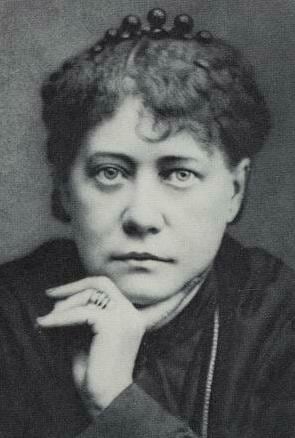
Helena Blavatsky
They agree on: What is the Absolute? Does God exist? · Who am I? Is there a true self? · Why do we suffer?
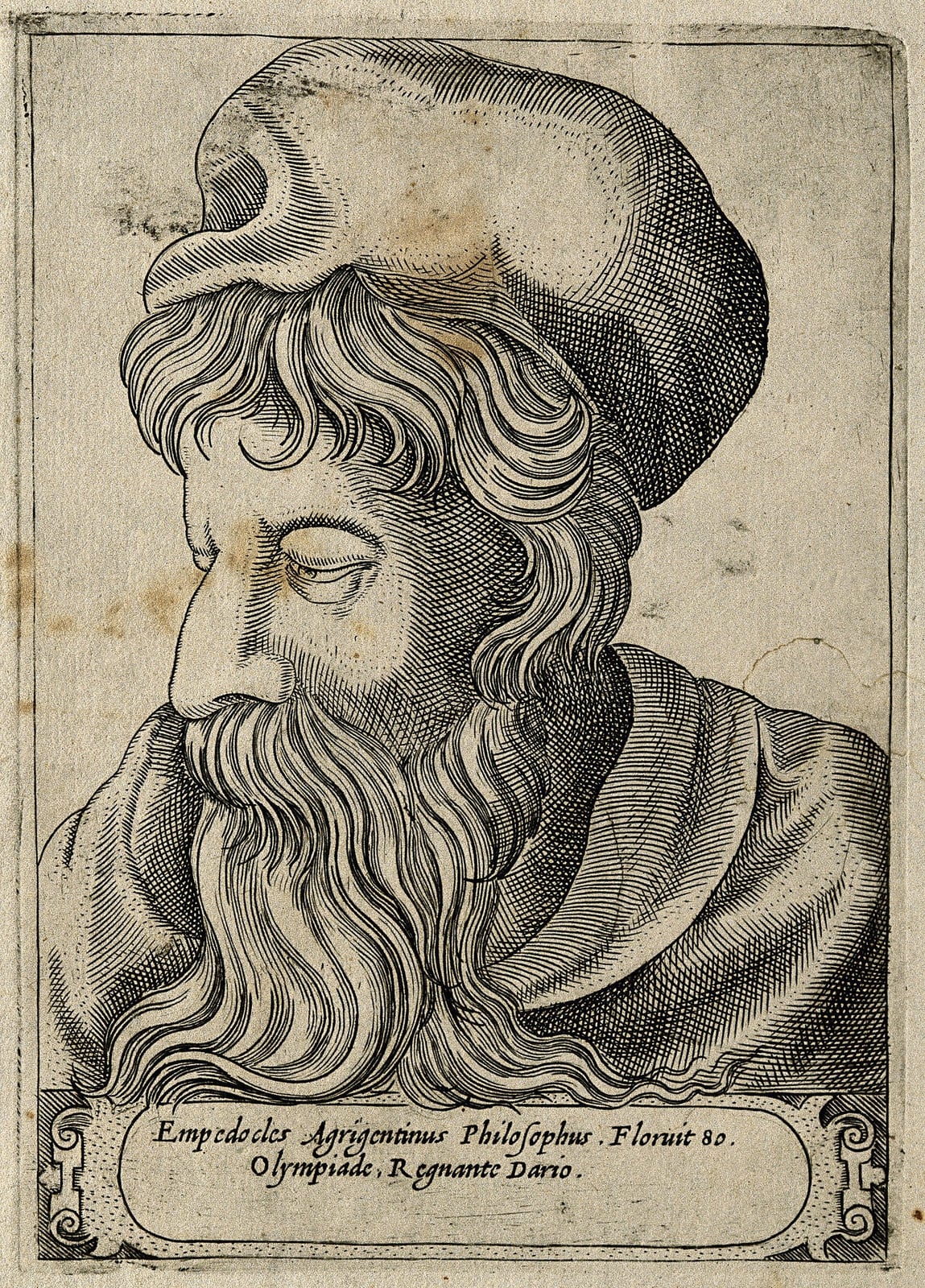
Empedocles
They agree on: What is the Absolute? Does God exist? · Who am I? Is there a true self? · What happens after death?
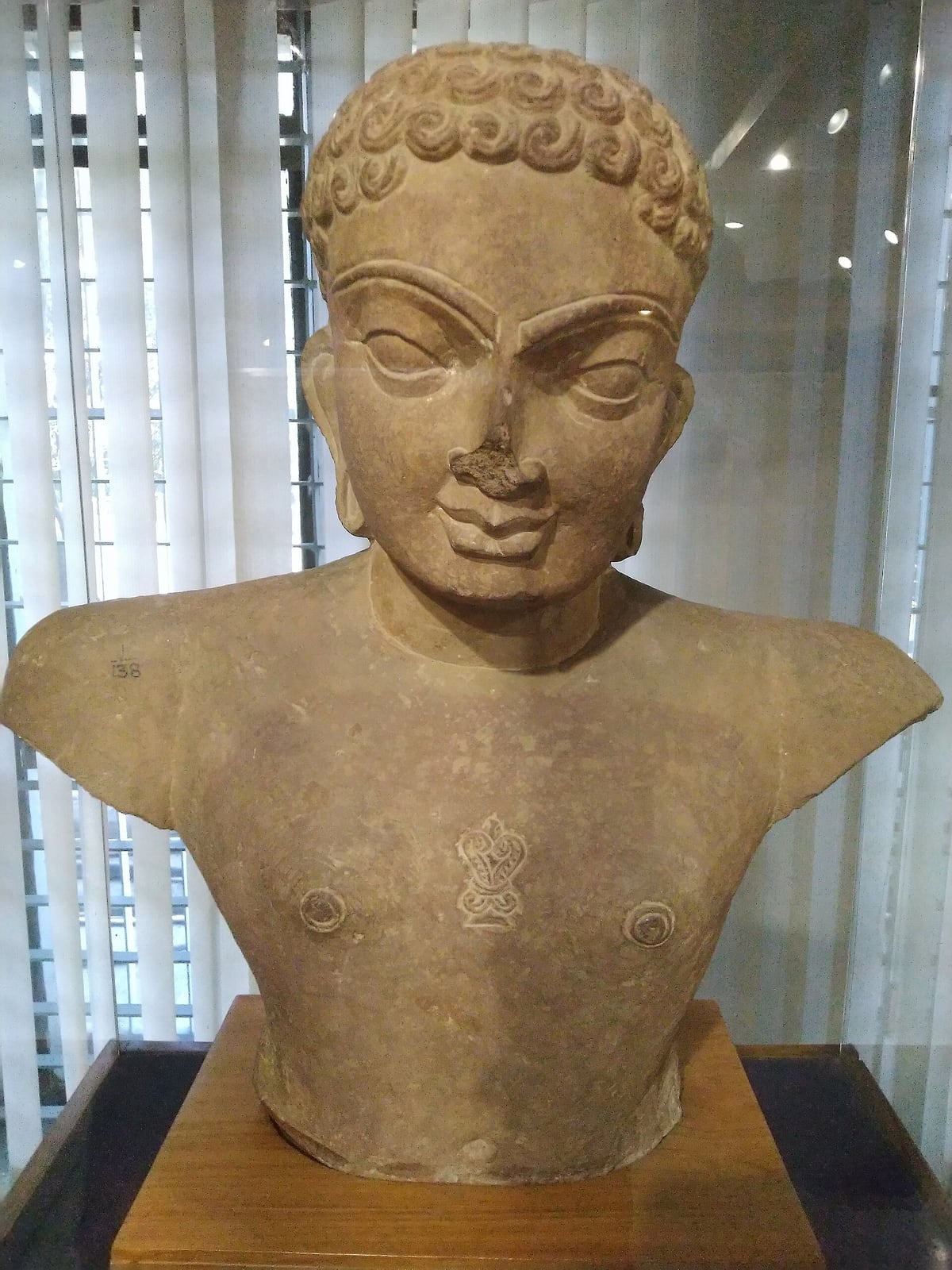
Mahāvīra
They agree on: Who am I? Is there a true self? · Why do we suffer? · What happens after death?
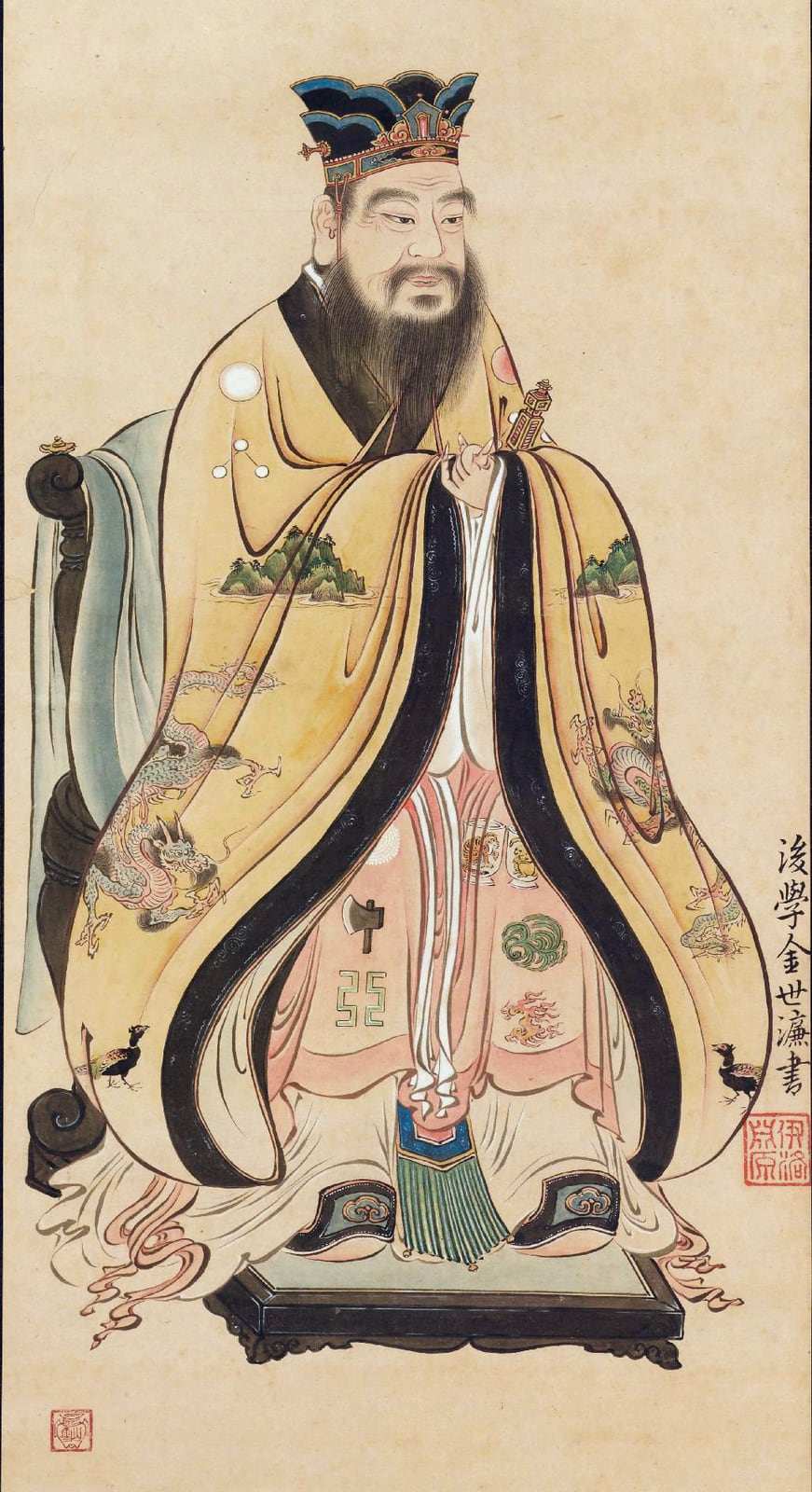
Confucius
They agree on: Is a teacher necessary? · Is the world real? · What is love?



Anecdotes and stories
Anecdotes and stories
Documenteds. VI a. C.
The beaten dog
Origin of the story: Xenophanes, DK 21 B 7, in Diogenes Laertius VIII 36. It is the oldest contemporary testimony about Pythagoras; the episode may be a satirical invention, but the doctrine it satirises is genuine.
Source: Diels, Hermann y Kranz, Walther. Die Fragmente der Vorsokratiker, 6.ª ed., Weidmann, Berlín, 1951–1952: cap. 14 (Pitágoras), 21 B 7 (Jenófanes), 22 B 40 y B 129 (Heráclito), 31 B 129 (Empédocles), 36 B 4 (Ion de Quíos).
Hagiographic accounts. VI a. C. (tradicional)
The golden thigh
Origin of the story: Aristotle, fragments of On the Pythagoreans (fr. 191 Rose), transmitted by Aelian (Varia Historia II 26 and IV 17) and Apollonius; expanded in Porphyry (VP 27–28) and Iamblichus (VP 134–136, 140). That Aristotle recorded them shows they were already circulating in the fourth century BCE; Burkert interprets them as traits of a shamanic type of sage.
Unverifiables. VI a. C. (tradicional)
The blacksmith's hammers
Origin of the story: Nicomachus of Gerasa, Manual of Harmonics 6 (2nd century CE), repeated by Iamblichus (VP 115–119) and Boethius (De institutione musica I 10–11). There is no source earlier than Nicomachus; the story is an aetiological legend about the discovery of musical ratios, which were probably found with the monochord.
Source: Nicómaco de Gerasa. Manual de armónica (Harmonikon encheiridion) 6, s. II d. C.; trad. inglesa de Flora R. Levin, The Manual of Harmonics of Nicomachus the Pythagorean, Phanes Press, Grand Rapids, 1994.
Disputeds. VI a. C. (tradicional)
The word "philosopher"
Origin of the story: Cicero, Tusculan Disputations V 3.8–10, and Diogenes Laertius I 12 and VIII 8, from a lost dialogue by Heraclides of Pontus (4th century BCE). Most scholars regard the anecdote as a projection of the Platonic Academy's contemplative ideal; the word "philosopher" appears earlier in Heraclitus, if fragment DK 22 B 35 is genuine.
Source: Cicerón. Disputaciones tusculanas V 3.8–10 (Pitágoras y la palabra «filósofo», según Heráclides Póntico) y Del supremo bien y del supremo mal (De finibus) V 2.4 (la casa de Metaponto), s. I a. C.
Hagiographic accountc. 530 a. C. (tradicional)
The fishes of Croton
Origin of the story: Porphyry, Life of Pythagoras 25, and Iamblichus, Pythagorean Life 36. It belongs to the miracle repertoire of the Neopythagorean Pythagoras; it has no basis in sources earlier than the imperial period.
Disputeds. VI a. C. (tradicional)
The descent to Hades
Origin of the story: Hermippus of Smyrna, in Diogenes Laertius VIII 41. Herodotus (IV 95) tells a very similar story of the Thracian Zalmoxis, whom he makes a slave of Pythagoras; Burkert sees in both the echo of rituals of death and return.
Teachings
Teachings
The notions that structure their thought, explained in context.
Metempsychosis (transmigration of souls)metempsicosis
A religious doctrine of the soul shared with Orphism and with Empedocles.
The Pythagorean way of life (bios pythagoreios)vida-pitagorica
A communal and religious way of life in archaic Magna Graecia, idealised by the Neoplatonic biographers.
Source: Platón. República X, 600a–b; trad. Benjamin Jowett, 1892 (Project Gutenberg n.º 1497).
Harmony and numberarmonia-y-numero
The core of the Pythagorean scientific tradition and of its influence on Plato (Timaeus) and modern cosmology.
The tetraktystetraktys
A sacred symbol of Pythagoreanism, the object of an oath.
Source: Burkert, Walter. Lore and Science in Ancient Pythagoreanism, trad. Edwin L. Minar Jr. Harvard University Press, Cambridge (Mass.), 1972 (orig.: Weisheit und Wissenschaft, Hans Carl, Núremberg, 1962).
The "Pythagorean theorem"teorema-de-pitagoras
A traditional, undocumented attribution of a much older mathematical result.
Source: Robson, Eleanor. «Words and Pictures: New Light on Plimpton 322». The American Mathematical Monthly, 109 (2), 2002, pp. 105–120 (la tablilla babilónica con ternas pitagóricas, c. 1800 a. C.); y Proclo, Comentario al primer libro de los Elementos de Euclides, 426 (la atribución del teorema).
Acusmatici and mathematiciakousmatikoi-mathematikoi
The division of Pythagoreanism after the founder, transmitted by Iamblichus (VP 81–89; On General Mathematical Science 76).
Videos
Videos
Recordings, interviews and documentaries. Videos play from YouTube; they are not hosted here.
Las vidas de Pitágoras: historia, filosofia y leyenda | David Hernández de la Fuente
Lecture· ES· 2016· 58 min
Fundación Juan MarchOfficial channel
PITÁGORAS: matemático, filósofo, político e iniciado en los misterios | David Hernández de la Fuente
Lecture· ES· 2022· 11 min
Encuentros EleusinosOfficial channel
Los Pitagóricos
Documentary· ES· 2018· 27 min
UNEDOfficial channel
Pitágoras | Historia de la filosofía (5/61)
Lecture· ES· 2017· 87 min
Ernesto CastroOfficial channel
El enigmático Pitágoras | María Dolores Muñoz Fernández
Lecture· ES· 2024· 97 min
Ateneo Mercantil de ValenciaOfficial channel
HoP 004 - The Man With The Golden Thigh - Pythagoras
Lecture· EN· 2020· 20 min
history of philosophy without any gaps
Pythagoras' Music of the Spheres
Lecture· EN· 2015· 75 min
The Menil CollectionOfficial channel
The Music of the Spheres: the connection between music and astronomy [Public Lecture Series]
Lecture· EN· 2020· 35 min
Cambridge University AstronomyOfficial channel
Met11 Pythagorean Philosophy
Lecture· EN· 2023· 38 min
Dr Adrian HeathcoteOfficial channel
PYTHAGORE (vers 580-495 av. J.-C.) : Les mystères d'Apollon – Une vie, une œuvre [1987]
Documentary· FR· 1987· 83 min
Rien ne veut rien dire
Pythagoras und die Pythagoreer
Lecture· DE· 2025· 8 min
Christian SpannagelOfficial channel
Gallery
Gallery
Images with verified licences. Each keeps its authorship and attribution.
Connections
Connections
Influences, discipleships and affinities. Documented relations are distinguished from similarities identified by analysis.
Influenced
Neoplatonism, through Porphyry and Iamblichus, pupils of his school, made Pythagoras the founder of true philosophy.
Documented relation
Disciple of
Ferécides de Siros
Ancient tradition (Aristoxenus, Diogenes Laertius VIII 2) makes Pythagoras a pupil of Pherecydes and says he nursed him in his last illness; it cannot be verified.
Similarity identified by analysis
Contemporary of
Jenófanes de Colofón
A slightly younger contemporary; he mocked his doctrine of transmigration in verse (DK 21 B 7).
Documented relation
Contemporary of
He names him twice with contempt (DK 22 B 40 and B 129), as an example of much learning without understanding.
Documented relation
Influenced
He shared the doctrine of transmigration; his praise of a man of superhuman knowledge (DK 31 B 129) referred, according to Timaeus and Porphyry, to Pythagoras.
Documented relation
Influenced
Filolao de Crotona
A Pythagorean of the later fifth century BCE, author of the first Pythagorean book, surviving in fragments.
Documented relation
Influenced
Aristotle (Metaphysics A 6) says Plato's philosophy followed the Pythagoreans in most respects; Plato associated with Archytas of Tarentum and praises the Pythagorean life in the Republic (600a–b).
Documented relation
Influenced
He wrote a lost treatise On the Pythagoreans and discussed their doctrine of number in the Metaphysics.
Documented relation
Ideas akin to
The Socrates of the Phaedo, talking with pupils of the Pythagorean Philolaus, defends the immortality of the soul and philosophy as purification.
Similarity identified by analysis
Ideas akin to
Siddhartha Gautama, the Buddha
Approximate contemporaries who taught rebirth and a discipline of life to escape it; there is no documented historical link, despite ancient speculation about Pythagoras travelling to India.
Similarity identified by analysis
Sources
Sources
Bibliography and catalogues consulted for this profile.
- Wikidata, entidad Q10261 «Pythagoras» (209 enlaces entre wikis; P31=Q5). Registra fechas de nacimiento entre 582 y 550 a. C. y de muerte entre 500 y 490 a. C.; lugar de muerte Metaponto.
- Diógenes Laercio. Vidas y opiniones de los filósofos ilustres, libro VIII, 1–50 (Pitágoras), s. III d. C. Trad. inglesa de C. D. Yonge, Bohn, Londres, 1853 (Project Gutenberg n.º 57342).
- Porfirio. Vida de Pitágoras (Πυθαγόρου βίος), c. 270–300 d. C.; texto griego de A. Nauck, Porphyrii philosophi Platonici opuscula selecta, 2.ª ed., Teubner, Leipzig, 1886 (Wikisource en griego). Recoge fragmentos de Aristóxeno, Dicearco, Nicómaco y Antonio Diógenes.
- Jámblico. Sobre la vida pitagórica (De vita Pythagorica), c. 300 d. C.; ed. L. Deubner, Teubner, Leipzig, 1937. Trad. inglesa de Thomas Taylor, Londres, 1818 (Project Gutenberg n.º 63300), y de John Dillon y Jackson Hershbell, Scholars Press, Atlanta, 1991.
- Huffman, Carl. «Pythagoras». The Stanford Encyclopedia of Philosophy, ed. Edward N. Zalta; primera publicación 2005, revisión sustancial del 5 de febrero de 2024.
- Burkert, Walter. Lore and Science in Ancient Pythagoreanism, trad. Edwin L. Minar Jr. Harvard University Press, Cambridge (Mass.), 1972 (orig.: Weisheit und Wissenschaft, Hans Carl, Núremberg, 1962).
- Riedweg, Christoph. Pythagoras: His Life, Teaching, and Influence, trad. Steven Rendall. Cornell University Press, Ithaca, 2005 (orig.: Pythagoras. Leben, Lehre, Nachwirkung, C. H. Beck, Múnich, 2002).
- Kahn, Charles H. Pythagoras and the Pythagoreans: A Brief History. Hackett, Indianápolis, 2001.
- Kirk, G. S., Raven, J. E. y Schofield, M. The Presocratic Philosophers: A Critical History with a Selection of Texts, 2.ª ed. Cambridge University Press, Cambridge, 1983, cap. VII (trad. esp. Los filósofos presocráticos, Gredos).
- Diels, Hermann y Kranz, Walther. Die Fragmente der Vorsokratiker, 6.ª ed., Weidmann, Berlín, 1951–1952: cap. 14 (Pitágoras), 21 B 7 (Jenófanes), 22 B 40 y B 129 (Heráclito), 31 B 129 (Empédocles), 36 B 4 (Ion de Quíos).
- Heródoto. Historias II 81, II 123 y IV 95, s. V a. C. Trad. inglesa de A. D. Godley (Loeb, 1920); texto en Perseus Digital Library.
- Aristóteles. Metafísica A 5, 985b23–986b8, y fragmentos de Sobre los pitagóricos (ed. W. D. Ross, Fragmenta selecta, Oxford, 1955). Trad. inglesa de W. D. Ross (1908; Internet Classics Archive, MIT); trad. española de Patricio de Azcárate (Madrid, 1875).
- Thom, Johan C. The Pythagorean Golden Verses: With Introduction and Commentary. E. J. Brill, Leiden, 1995 (Religions in the Graeco-Roman World, 123). ISBN 9789004101050.
- Zhmud, Leonid. Pythagoras and the Early Pythagoreans, trad. Kevin Windle y Rosh Ireland. Oxford University Press, Oxford, 2012.
- Huffman, Carl. «Pythagoreanism». The Stanford Encyclopedia of Philosophy, ed. Edward N. Zalta; primera publicación 2006, revisión sustancial del 5 de marzo de 2024.
- «Pythagoras», Wikipedia en inglés, y «Pitágoras», Wikipedia en español (consultadas para contrastar datos y bibliografía; texto propio).
- Hernández de la Fuente, David (ed. y trad.). Vidas de Pitágoras. Atalanta, Vilaür, 2011 (Diógenes Laercio, Porfirio, Jámblico, Focio y otros testimonios). ISBN 9788493846664.
- Nicómaco de Gerasa. Manual de armónica (Harmonikon encheiridion) 6, s. II d. C.; trad. inglesa de Flora R. Levin, The Manual of Harmonics of Nicomachus the Pythagorean, Phanes Press, Grand Rapids, 1994.
- Cicerón. Disputaciones tusculanas V 3.8–10 (Pitágoras y la palabra «filósofo», según Heráclides Póntico) y Del supremo bien y del supremo mal (De finibus) V 2.4 (la casa de Metaponto), s. I a. C.
- Platón. República X, 600a–b; trad. Benjamin Jowett, 1892 (Project Gutenberg n.º 1497).
- Polibio. Historias II 39, s. II a. C. Trad. inglesa de W. R. Paton (Loeb, 1922).
- Robson, Eleanor. «Words and Pictures: New Light on Plimpton 322». The American Mathematical Monthly, 109 (2), 2002, pp. 105–120 (la tablilla babilónica con ternas pitagóricas, c. 1800 a. C.); y Proclo, Comentario al primer libro de los Elementos de Euclides, 426 (la atribución del teorema).
- Open Library (Internet Archive): ediciones de Jámblico, Porfirio, Diógenes Laercio, los Versos de oro y estudios sobre Pitágoras verificadas por ISBN.
- Internet Archive: Sentencias de Teognis, de Phocylides, de Pitágoras y de otros sabios de la Grecia, trad. Enrique Ataide y Portugal, Oficina de Aznar, Madrid, 1802 (ejemplar de la Biblioteca de la Universidad de Sevilla); The Golden Verses of Pythagoras, trad. Nicholas Rowe, 1732.
- Rights holder
- Textos antiguos en dominio público; cada traducción y edición crítica pertenece a su traductor o editorial
Pending confirmation
What this profile has not yet been able to settle. We would rather say so than fill it in.
- Fechas: nacimiento c. 570 a. C. y muerte c. 495 a. C. son estimaciones a partir de Aristóxeno y Apolodoro; Wikidata recoge propuestas entre 582 y 550 (nacimiento) y entre 500 y 490 (muerte). El lugar de la muerte es contradictorio en las fuentes.
- Historicidad: se ha marcado «documented» porque su existencia está atestiguada por contemporáneos (Jenófanes, Heráclito); casi toda la biografía, en cambio, es tradición o leyenda, y así se indica hito a hito en la cronología.
- Manuscritos: no se ha verificado en esta sesión la tradición manuscrita de Jámblico, Porfirio ni los Versos de oro (signaturas y digitalizaciones); lista vacía.
- Traducciones españolas de dominio público de Jámblico, Porfirio y del libro VIII de Diógenes Laercio (Ortiz y Sanz, 1792): no localizadas con URL estable; en Wikisource solo está transcrito el tomo I de Ortiz y Sanz.
- Los «Versos de oro» de Wikisource en español no indican traductor ni fecha; no se han incluido por no poder asegurar su dominio público.
- Edición española con ISBN de los Versos de oro: no verificada en Open Library.
- Programas de afiliación: ninguno verificado (Gredos, Atalanta, Phanes, Brill). Lista vacía.
- Año de los vídeos: es el de la grabación cuando la descripción lo indica y, si no, el de publicación en YouTube.
Researched on 2026-10-25