Vorsokratische Philosophie
Parmenides
Παρμενίδης ὁ Ἐλεάτης
um 515 v. Chr. – ?Historisch belegte Person
Philosoph aus Elea in der Magna Graecia (geboren um 515 v. Chr.), Verfasser eines Gedichts in Hexametern, von dem rund hundertsechzig Verse erhalten sind. Darin lehrt eine Göttin, dass allein „das Seiende“ gedacht und gesagt werden kann und dass es ungeworden, unvergänglich, eins und unbewegt ist; der zweite Teil legt die Meinungen der Sterblichen dar. Begründer der eleatischen Schule, Lehrer Zenons und der Überlieferung nach Gesetzgeber seiner Stadt, prägte er mit seinem Argument die gesamte spätere Philosophie.
- Werke
- 5Werke
- Ausgaben
- 22Ausgaben
- Zitate
- 14Zitate
- Videos
- 12Videos
- Bilder
- 5Bilder
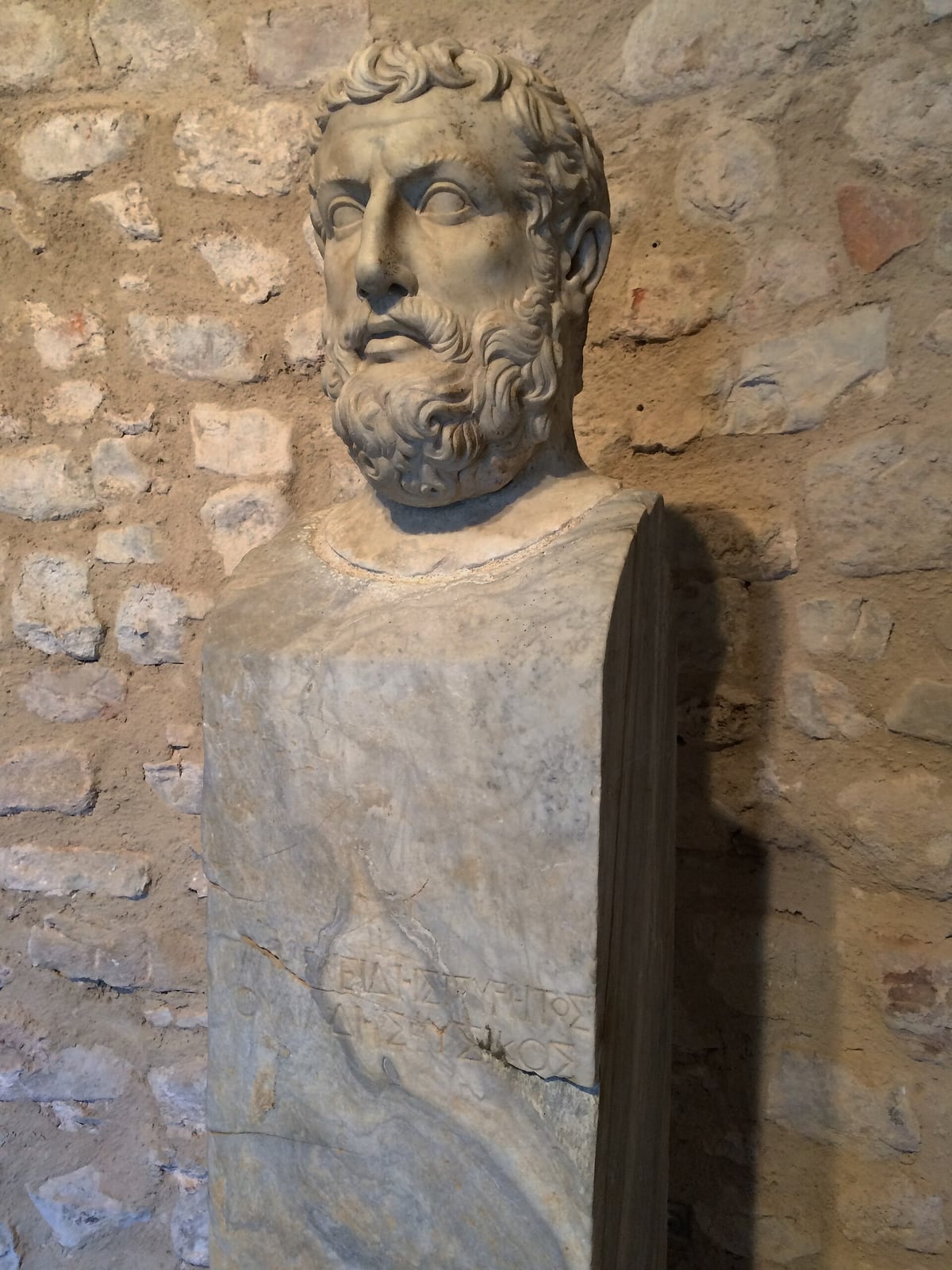
Cabeza identificada con Parménides (Velia) · CC BY-SA 4.0
In eigenen Worten
«Meet it is that thou shouldst learn all things, as well the unshaken heart of well-rounded truth, as the opinions of mortals in which is no true belief at all.»DK 28 B1.28–30, en Sexto Empírico, Contra los matemáticos VII 111, y Simplicio, Comentario al Sobre el cielo 557. Griego: Diels-Kranz; inglés: John Burnet, Early Greek Philosophy (1908); español: traducción propia.

Der zentrale Gedanke
What is (to eon): The poem turns on a single word, the Greek verb *esti*, "is", often without an expressed subject.
Im Zusammenhang sehen
Biografie
5 Min. Lesezeit
Unterstützte Übersetzung aus dem spanischen Original, Durchsicht durch einen muttersprachlichen Übersetzer ausstehend.
Das Gedicht vom einzigen Weg
Parmenides schrieb ein einziges Gedicht in Hexametern, dem Vers Homers und Hesiods, von dem dank der Zitate bei Sextus Empiricus, Simplikios, Proklos, Plutarch und anderen rund hundertsechzig Verse erhalten sind. Es ist der erste Text der griechischen Philosophie, der Schritt für Schritt argumentiert, und der erste, der fragt, was es heißt, von etwas zu sagen, es „ist“. Platon, der ihn „ehrwürdig und furchtbar zugleich“ nannte, widmete ihm einen Dialog und stellte den Bruch mit seiner Lehre als „Vatermord“ dar; Aristoteles erörterte seine Thesen am Beginn der Physik. Die gesamte spätere Naturphilosophie, von Empedokles bis zu den Atomisten, lässt sich als Antwort auf seine Leugnung von Entstehen und Vergehen lesen.
Elea
Elea – Hyele für seine Gründer, Velia für die Römer – war eine junge Kolonie an der tyrrhenischen Küste, südlich von Poseidonia. Gegründet hatten sie um 540 v. Chr. Phokaier, die vor dem Vordringen der Perser in Ionien flohen, wie Herodot berichtet. Diogenes Laertios macht Parmenides zum Sohn des Pyres aus vornehmer und reicher Familie und setzt seine Blütezeit, Apollodor folgend, in die 69. Olympiade (504–501 v. Chr.), was eine Geburt um 540 ergäbe. Platon dagegen erzählt im Parmenides, der Philosoph habe Athen mit etwa fünfundsechzig Jahren besucht, als Sokrates noch sehr jung war, was ihn um 515 geboren sein ließe. Burnet vermutete, Apollodor habe seine Akme mit der Gründung Eleas zusammenfallen lassen; viele Forscher ziehen die platonische Chronologie vor, auch wenn die Szene des Dialogs wahrscheinlich eine literarische Fiktion ist; Burnet, der sie für historisch hielt, gehörte zu den wenigen, die sie verteidigten.
Lehrer, Schüler und Gesetze
Die Antike schrieb ihm mehrere Lehrer zu. Aristoteles berichtet, er habe als Schüler des Xenophanes gegolten, jenes Dichterphilosophen, der die Götter Homers kritisierte und ebenfalls im griechischen Westen lebte; Theophrast brachte ihn mit Anaximander in Verbindung. Sotion wusste Genaueres: Ein armer, aber edler Pythagoreer, Ameinias, Sohn des Diochaitas, habe ihn zum ruhigen Leben des Studiums geführt, und Parmenides habe ihm nach seinem Tod ein Heroenheiligtum errichtet. Speusippos, Platons Neffe, behauptete, er habe seiner Stadt Gesetze gegeben, und Plutarch fügt hinzu, die Beamten Eleas hätten jedes Jahr geschworen, sich an sie zu halten; Strabon führt die gute Ordnung der Stadt auf Parmenides und Zenon zurück, seinen berühmtesten Schüler.
1962 brachten die Grabungen in Velia eine kopflose Herme aus dem 1. Jahrhundert n. Chr. ans Licht, mit der Inschrift „Parmenides, Sohn des Pyres, Uliades, Naturphilosoph“. Andere Inschriften desselben Gebäudes ehren Ärzte mit dem Titel Ouliades, der auf Apollon Oulios, den Heiler, verweist. Der Fund legt nahe, dass sich Jahrhunderte später eine Ärzteschule in Elea auf Parmenides berief. Peter Kingsley hat vorgeschlagen, in ihm einen iatromantis zu sehen, einen Heilpriester, der die Inkubation praktizierte, und das Gedicht als Bericht einer visionären Erfahrung zu lesen; die Hypothese ist anregend, stützt sich aber auf keine direkten Belege, und die meisten Fachleute halten sie für spekulativ.
Die Reise
Das Gedicht beginnt mit einer Reise. Ein junger Mann wird auf einem Wagen von verständigen Stuten gezogen, gelenkt von den Töchtern des Helios, die das Haus der Nacht verlassen haben; die Achsen kreischen in den Naben. Sie gelangen an das Tor der Pfade von Nacht und Tag, dessen Schlüssel die vielstrafende Dike verwahrt; die Mädchen überreden sie, und das Tor öffnet sich. Auf der anderen Seite ergreift eine namenlose Göttin den Jüngling bei der rechten Hand und kündigt ihm an, er solle alles erfahren: „der wohlgerundeten Wahrheit unerschütterliches Herz“ und die Meinungen der Sterblichen, denen keine wahre Verlässlichkeit innewohnt. Sextus Empiricus, der dieses Proömium bewahrt, las es als Allegorie der Erkenntnis; Walter Burkert sah darin einen Abstieg in die Unterwelt, andere eine Initiation.
Der Weg der Wahrheit
Die Göttin lehrt, es gebe nur zwei denkbare Wege der Forschung: dass „ist“ und Nichtsein unmöglich ist, und dass „nicht ist“ und Nichtsein notwendig ist. Der zweite ist ungangbar, denn das Nichtseiende lässt sich weder erkennen noch aussprechen; „denn dasselbe ist Denken und Sein“ (B3). Die Sterblichen jedoch irren auf einem dritten Pfad: „doppelköpfig“, urteilslos, halten sie Sein und Nichtsein für dasselbe und nicht dasselbe. Das lange Fragment 8, das Simplikios im 6. Jahrhundert abschrieb, weil das Buch, wie er sagt, selten geworden war, leitet die „Zeichen“ des Seienden ab: Es ist ungeworden und unvergänglich, denn aus dem Nichtseienden kann es nicht kommen; es ist ganz, einzig, unbewegt und vollendet; „es war nicht und wird nicht sein, da es jetzt zugleich ganz ist, eins, zusammenhängend“; und es ist allseits begrenzt, der Masse einer wohlgerundeten Kugel gleich.
Was genau „das Seiende“ ist, bleibt umstritten. Nach der traditionellen Deutung leugnet Parmenides die Vielheit und den Wandel der Welt; G. E. L. Owen las darin eine These über alles, was Gegenstand des Denkens sein kann; Alexander Mourelatos und Charles Kahn betonten den prädikativen und veritativen Sinn des griechischen Verbs; John Palmer hat einen „großzügigen Monismus“ vertreten, nach dem Parmenides beschreibt, was notwendig ist, ohne zu bestreiten, dass es anderes gibt.
Der Weg der Meinung
Nachdem sie ihre „verlässliche Rede“ beendet hat, legt die Göttin die „trügerische Ordnung“ der sterblichen Meinungen dar: eine Welt aus zwei Gestalten, dem Licht oder ätherischen Feuer und der dichten Nacht, von der wir nur wenige Verse besitzen. Die Rede ist von Himmelskränzen, von einer Gottheit, die alles lenkt und als ersten aller Götter Eros ersann, vom Mond, der „mit fremdem Licht“ leuchtet und stets nach den Strahlen der Sonne blickt, von der Bildung des Embryos und vom Denken, das der Mischung der Glieder folgt. Man schrieb Parmenides die Erkenntnis zu, dass Morgen- und Abendstern derselbe Himmelskörper sind und dass die Erde Kugelgestalt hat, obwohl dieselben Nachrichten auch über Pythagoras umlaufen. Warum eine Göttin ausführlich eine Kosmologie lehrt, die sie für falsch erklärt, gehört zu den Rätseln des Gedichts.
Das Erbe Eleas
Zenon, sein Schüler, verteidigte die Lehre mit Paradoxien, die die Ungereimtheiten der Vielheit und der Bewegung aufzeigten; Melissos von Samos fasste sie in Prosa neu. Empedokles, Anaxagoras, Leukipp und Demokrit akzeptierten, dass nichts aus dem Nichts entsteht oder sich in nichts auflöst, und erklärten den Wandel als Mischung und Trennung unveränderlicher Elemente. Platon musste im Sophistes „Hand an Vater Parmenides legen“, um dem Nichtseienden als Verschiedenheit einen Sinn zu geben. Über seinen Tod weiß man nichts. Sein Gedicht, als Buch verloren, überlebte in den neuplatonischen Kommentaren und gehört heute zu den meistuntersuchten Texten der Antike.
Quellen: Diógenes Laercio. Vidas y opiniones de los filósofos ilustres IX 21–23 (Parménides), 25 (Zenón) y 24 (Meliso), s. III d. C. Trad. inglesa de C. D. Yonge, Bohn, Londres, 1853 (Project Gutenberg n.º 57342); trad. inglesa de R. D. Hicks, Loeb, 1925 (Wikisource). · Diels, Hermann y Kranz, Walther. Die Fragmente der Vorsokratiker, 6.ª ed. Weidmann, Berlín, 1951–1952, cap. 28 (Parmenides), A (testimonios) y B 1–19. Texto griego consultado en la transcripción de Wikisource en griego («Περί φύσεως (Παρμενίδης)»). · Kirk, G. S., Raven, J. E. y Schofield, M. The Presocratic Philosophers, 2.ª ed. Cambridge University Press, 1983, cap. VIII (Parmenides of Elea). Trad. esp. de Jesús García Fernández, Gredos, 1987. · Burnet, John. Early Greek Philosophy, 2.ª ed. A. and C. Black, Londres, 1908, cap. IV (Parmenides of Elea), §§ 84–97 (Project Gutenberg n.º 67097). · Coxon, A. H. The Fragments of Parmenides: A Critical Text with Introduction and Translation, the Ancient Testimonia and a Commentary. Van Gorcum, Assen, 1986; ed. revisada por Richard McKirahan, Parmenides Publishing, Las Vegas, 2009.
Zeitleiste
Das Leben, Jahr für Jahr
Jeder Punkt ist ein belegtes Ereignis. Klicken Sie, um es mit Quelle und Grad der Gewissheit zu lesen.
um 540 v. Chr.Elea (Hyele), Campania
Foundation of Elea
Phocaeans fleeing the Persian advance found Hyele on the Tyrrhenian coast after the battle of Alalia (Herodotus I 163–167). Years BCE are expressed as negative numbers.
WahrscheinlichHeródoto. Historias I 163–167 (los focenses y la fundación de Hyele/Elea), s. V a. C. Trad. inglesa de G. C. Macaulay, Macmillan, Londres, 1890 (Project Gutenberg n.º 2707).
um 540 v. Chr.
Foundation of Elea
Phocaeans fleeing the Persian advance found Hyele on the Tyrrhenian coast after the battle of Alalia (Herodotus I 163–167). Years BCE are expressed as negative numbers.
Wahrscheinlich
um 515 v. Chr. · 0 Jahre
Birth
Born in Elea, son of Pyres, of a noble and wealthy family. The date is inferred from Plato (Parmenides 127b); Apollodorus' chronology would place his birth around 540.
Wahrscheinlich
um 504 v. Chr.
Floruit according to Apollodorus
Diogenes Laertius (IX 23) places his prime in the 69th Olympiad (504–501 BCE), the same as Heraclitus'.
Überlieferung
um 490 v. Chr.
Ameinias and the contemplative life
According to Sotion (in Diogenes Laertius IX 21), the Pythagorean Ameinias turns him to the life of study; at his death Parmenides dedicates a hero-shrine to him. Date unknown.
Überlieferung
um 480 v. Chr.
Composition of the poem
He composes his hexameter poem, traditionally called On Nature. The date is an estimate; the poem seems to respond to Heraclitus and precedes Empedocles and Zeno.
Umstritten
um 470 v. Chr.
Lawgiver of Elea
Speusippus (in Diogenes Laertius IX 23) and Plutarch (Against Colotes 1126a) credit him with Elea's laws, which magistrates swore each year to obey. Date unknown.
Überlieferung
um 450 v. Chr. · 65 Jahre
Visit to Athens with Zeno
According to Plato's Parmenides (127a–c), he attends the Great Panathenaea with Zeno, stays in the Ceramicus and converses with a very young Socrates. The meeting is probably a literary fiction; Athenaeus (XI 505f) already doubted it.
Umstritten
um 370 v. Chr.
Plato writes the Parmenides and the Sophist
Plato makes Parmenides the protagonist of a dialogue and, in the Sophist (241d), presents the critique of his thesis on not-being as "parricide".
Wahrscheinlich
um 530
Simplicius copies fragment 8
In his commentary on Aristotle's Physics, Simplicius transcribes long passages of the poem "because of the rarity of the book" (In Phys. 144.25). Without him the way of truth would be unknown.
Belegt
1897
Diels's Parmenides Lehrgedicht
Hermann Diels publishes the critical edition of the poem with German translation, the basis of the DK 28 numbering.
Belegt
1962
Discovery of the Velia herm
Excavations bring to light a headless herm of the 1st century CE inscribed «Παρμενείδης Πύρητος Οὐλιάδης φυσικός», alongside others dedicated to Ouliad physicians.
Belegt
1965
Tarán's edition
Leonardo Tarán publishes Parmenides: A Text with Translation, Commentary and Critical Essays, one of the standard twentieth-century editions.
Belegt
Werke
Grundlegende Werke
Die Werke, ohne die sich das Vermächtnis nicht verstehen lässt.
Schriftliches Werk · um 480 v. Chr.
On Nature (poem)
Περὶ φύσεως (título convencional)
A didactic poem in dactylic hexameters, divided into a proem and two parts. In the proem (B1) a youth travels by chariot to the gates of Night and Day and is received by a goddess who promises to teach him the truth and the opinions of mortals. The way of truth (B2–B8.49) argues that only "what is" can be thought and said, and deduces that it is unborn, imperishable, one, continuous, unmoving and like a sphere. The way of opinion (B8.50–B19) sets out a cosmology of two principles, light and night, with theories of the stars, the moon, generation and thought. It is the founding text of Western ontology.
18 Ausgaben · amazon.es

Schriftliches Werk · um 480 v. Chr.
Way of Truth (B2–B8.49)
Ἀλήθεια (DK 28 B2–B8.49)
The goddess's central teaching. It presents two ways of inquiry—"is" and "is not"—, rules out the second because what is not can be neither thought nor said, and censures the "two-headed" mortals who confuse being and not-being. In B8 it deduces the properties of what is: unborn and imperishable, whole and single, unmoving, without past or future, continuous, bounded and like a well-rounded sphere. It is the first extended deductive argument in Greek philosophy.
4 Ausgaben
Zitate
Zitate, die in einem bestimmten Werk nachgewiesen sind. Jedes trägt seine Herkunft und seinen Grad an Verlässlichkeit.
Meet it is that thou shouldst learn all things, as well the unshaken heart of well-rounded truth, as the opinions of mortals in which is no true belief at all.χρεὼ δέ σε πάντα πυθέσθαι / ἠμὲν Ἀληθείης εὐκυκλέος ἀτρεμὲς ἦτορ / ἠδὲ βροτῶν δόξας, ταῖς οὐκ ἔνι πίστις ἀληθής.
GeprüftDK 28 B1.28–30, en Sexto Empírico, Contra los matemáticos VII 111, y Simplicio, Comentario al Sobre el cielo 557. Griego: Diels-Kranz; inglés: John Burnet, Early Greek Philosophy (1908); español: traducción propia.
Apokryphe Zitate oder Zitate umstrittener Zuschreibung (4)
«Nothing comes from nothing (ex nihilo nihil fit).»
The idea is in B8.7–10, but the Latin formula is not his: it comes from Lucretius (I 150, "nil posse creari de nilo") and scholasticism. It is ascribed to him through textbook summary.
«Being is and non-being is not.»
A textbook formula condensing B2 and B6, but not found as such in the poem. Parmenides says "is" with no expressed subject, and the nominalised "Being" is a later interpretation.
«Change is an illusion.»
A modern paraphrase. The poem says that coming to be, perishing, changing place and colour are "names" mortals have given believing them true (B8.38–41); it does not speak of illusion.
«If the one is not, nothing is.»
The conclusion of Plato's dialogue Parmenides (166c), spoken by the character Parmenides. It is a Platonic construction, not a quotation from the historical philosopher.
Letzte Worte
Es gibt keine überprüfbaren Aufzeichnungen der letzten Worte.
No record of his last words or of the circumstances of his death survives.
Fragen
Was das Werk beantwortet
Zwölf große Fragen der Menschheit und was sich aus den Texten darauf antworten lässt, mit Belegen. Wir legen niemandem Worte in den Mund.
Was ist das Absolute? Gibt es Gott?
What is: one, ungenerated, imperishable and complete like a sphere
Ein unpersönliches AbsolutesAus der Lehre abgeleitet
Parmenides does not speak of God in the Way of Truth. What his poem presents as ultimate is “what is”: that which cannot not be, which is neither born nor perishes, which is all at once, one and continuous, and complete on every side like the bulk of a well-rounded sphere. It is held within its limits by Justice and Necessity, divine figures that in the poem function almost as names of logical law. The revelation itself is spoken by a nameless goddess who welcomes the youth in the proem. What the text allows us to affirm is an absolute without personal features, accessible only to thought, from which all genesis, change and plurality are excluded.
Diese Frage mit anderen Meistern vergleichenWer bin ich? Gibt es ein wahres Selbst?
The poem does not treat the self: only being and thinking
Nicht geäußert
The surviving fragments of Parmenides contain no doctrine of the self or of the individual soul. The Way of Truth deals with “what is” and its relation to thought — the same is thinking and being, says B3 — but this thinking is not presented as the consciousness of a subject. In the Way of Opinion, B16 explains that the mind of humans depends on the mixture of their limbs at each moment, a physical psychology the goddess herself has labelled the opinion of mortals. The figure of the youth brought before the goddess in the proem is narrative. Readings that see in B3 an identity between consciousness and being belong to the later tradition.
Diese Frage mit anderen Meistern vergleichenWarum leiden wir?
The poem deals with mortals' error, not their pain
Nicht geäußert
Parmenides does not ask why we suffer. What his poem diagnoses is something else: the straying of “two-headed” mortals, who know nothing, wander deaf and blind, and take being and not-being as the same and not the same (B6). That error is cognitive, not moral or existential, and the remedy the goddess offers is to judge by reason and not be carried along by the habit of the senses (B7). Neither the Way of Truth nor the remains of the Way of Opinion, devoted to cosmology and physiology, treat human pain as a problem. Attributing a doctrine of suffering to him would be inventing it.
Diese Frage mit anderen Meistern vergleichenWas geschieht nach dem Tod?
What is is neither born nor dies; the poem ignores the individual
Nicht geäußert
The fragments of Parmenides do not deal with what happens to the person after death. The Way of Truth holds that what is is ungenerated and imperishable, because from what is not nothing can come and into it nothing can go; Justice does not loosen her fetters to let it be born or perish. But that argument concerns being as such, not the individual soul, and applying it to the soul would be an extrapolation. The Way of Opinion, which contains the cosmology, mentions a divinity that governs birth and the union of the sexes, but the surviving remains say nothing of a destiny after death.
Diese Frage mit anderen Meistern vergleichenWie erlangt man Befreiung oder Erlösung?
A journey from night to light to learn well-rounded truth
Durch unmittelbare ErkenntnisAus der Lehre abgeleitet
Parmenides' proem narrates a journey: mares carry the youth, “the man who knows”, along the road of the goddess; the daughters of the Sun leave the halls of Night and open for him the gates guarded by Justice. There the goddess promises to teach him everything: both the unshaken heart of well-rounded truth and the opinions of mortals, in which there is no true belief. The rest of the poem is that teaching, and its condition is to judge by reason and not by the unseeing eye or the echoing ear. If one can speak of liberation in Parmenides, it is that of thought leaving the path of mortals.
Diese Frage mit anderen Meistern vergleichenBraucht es einen Lehrer?
A goddess teaches, but asks that her proof be judged by reason
Hilfreich, aber nicht unverzichtbarAus der Lehre abgeleitet
Parmenides' poem takes the form of teaching: a nameless goddess welcomes the youth, takes his right hand and promises to teach him the truth and the opinions of mortals. It might seem a revelation accepted on authority. Yet the goddess asks for no faith: she urges him not to be carried by the habit of the senses and to judge by reason the much-contested refutation she sets before him (B7). The divine guide opens the way, but assent depends on the disciple's reasoning. The fragments say nothing of human teachers; tradition makes Parmenides a pupil of Xenophanes and of the Pythagorean Ameinias, and teacher of Zeno of Elea.
Diese Frage mit anderen Meistern vergleichenIst die Welt wirklich?
Only what is is; the world of mortals is name and opinion
Erscheinung über der einen WirklichkeitAusdrücklich gesagt
The Way of Truth proves that what is can neither come to be nor perish, nor move, nor be divided, because that would mean admitting what is not. It follows that the world the senses perceive — birth, death, change of place, alteration of colour — consists of names mortals have laid down trusting them to be true. Yet the goddess does not simply dismiss that world: in the second part of the poem she sets out a complete cosmology, based on light and night, so that no mortal may outstrip him in knowledge, although she warns that its arrangement is deceptive. The world has the consistency of appearance; only what is is fully real.
Diese Frage mit anderen Meistern vergleichenWas ist Liebe?
Eros appears only in the cosmogony, as the first of the gods
Nicht geäußert
Parmenides does not treat love as a human experience or as a path. In the Way of Opinion, devoted to the cosmology of mortals, a divinity who governs all things drives the union of female and male (B12), and of her it is said that she devised Eros, first of all the gods (B13), a line Plato quotes in the Symposium. It is a cosmogonic force explaining generation, not a doctrine of love as a bond between persons or as longing for the divine. Moreover, the goddess presents that whole section of the poem as the opinion of mortals. On love in an ethical or mystical sense, Parmenides is silent.
Diese Frage mit anderen Meistern vergleichenSind wir frei, oder ist alles vorherbestimmt?
Necessity binds being, but the poem says nothing of human action
Nicht geäußert
In Parmenides' poem Necessity and Justice appear often, but not as forces governing human life. In the Way of Truth mighty Necessity holds what is in the bonds of the limit, and Justice does not loosen her fetters to let it come to be or perish: they are figures of the immutability of being. In the cosmology, Necessity binds the heaven to hold the limits of the stars (B10). None of the fragments asks whether humans choose their acts or whether everything is determined. Ancient tradition made Parmenides lawgiver of Elea, but his laws do not survive. On this question he is silent.
Diese Frage mit anderen Meistern vergleichenWozu meditieren oder beten?
The proem's journey is no method of prayer or meditation
Nicht geäußert
The fragments of Parmenides contain no teachings on prayer or meditative practices. The proem narrates a chariot journey to a goddess and is full of religious imagery — the daughters of the Sun, Justice holding the keys, the gates of the paths of Night and Day —, but its function in the poem is to introduce a teaching that must be judged by reason. A recent line of interpretation, represented by Peter Kingsley, has linked Parmenides with Apollo's healer-priests at Elea and with incubation practices; it rests on inscriptions found at Velia, not on the poem. Attributing a doctrine of prayer to him would go beyond the texts.
Diese Frage mit anderen Meistern vergleichenKann die Vernunft das Letzte erkennen?
A goddess reveals the truth, but demands it be judged by reason alone
Glaube und Vernunft helfen einanderAus der Lehre abgeleitet
Parmenides is at once the thinker of revelation and the founder of deductive argument. His poem puts the truth in the mouth of a goddess, reached by a journey far from the paths of men; but what the goddess teaches is rigorous reasoning, and her watchword is not to be carried by the habit of the senses but to judge by reason the refutation she proposes. For Parmenides thought does reach the ultimate: thinking and being are the same, and what is not cannot be thought or said. Divine revelation and reason do not compete: the first provides the frame, the second the proof; the senses are relegated to opinion.
Diese Frage mit anderen Meistern vergleichenSich von der Welt zurückziehen oder sie verwandeln?
The poem does not treat social life; tradition made him a lawgiver
Nicht geäußert
The fragments of Parmenides' poem contain no reflection on how to live among humans, whether to withdraw or act in the city. The proem's journey takes the youth far from the paths of men, but that distance is one of knowledge, not a programme of life. Reports of his public life come from other sources: Speusippus, according to Diogenes Laertius, said he gave laws to his fellow citizens of Elea, and Plutarch adds that magistrates swore each year to observe them. If so, Parmenides would have been an active citizen; but his laws do not survive and cannot be connected with his doctrine. On this question his work is silent.
Diese Frage mit anderen Meistern vergleichen
Affinitäten und Spannungen
Affinitäten und Spannungen
Frage für Frage aus den Positionen berechnet. Den Grund jeder Übereinstimmung und jedes Widerspruchs zeigt ein Klick.
Denkt ähnlich wie
Ashtavakra
Übereinstimmung bei: Was ist das Absolute? Gibt es Gott? · Wie erlangt man Befreiung oder Erlösung? · Braucht es einen Lehrer?
Vasishtha
Übereinstimmung bei: Was ist das Absolute? Gibt es Gott? · Wie erlangt man Befreiung oder Erlösung? · Braucht es einen Lehrer?
Leo Tolstoy
Übereinstimmung bei: Was ist das Absolute? Gibt es Gott? · Braucht es einen Lehrer? · Kann die Vernunft das Letzte erkennen?
Gaudapada
Übereinstimmung bei: Was ist das Absolute? Gibt es Gott? · Wie erlangt man Befreiung oder Erlösung? · Ist die Welt wirklich?


Anekdoten und Erzählungen
Anekdoten und Erzählungen
Umstrittenc. 500–490 a. C. (incierto)
Ameinias' shrine
Herkunft der Erzählung: Diogenes Laertius IX 21, quoting Sotion of Alexandria (2nd century BCE). There is no other source. Burnet (Early Greek Philosophy, § 84) considers it plausible.
Zeugniss. V a. C.
The magistrates' oath
Herkunft der Erzählung: Speusippus in Diogenes Laertius IX 23; Plutarch, Against Colotes 1126a–b; Strabo VI 1.1. The three sources are independent of one another, though none is contemporary.
Quelle: Plutarco. Contra Colotes 1126a–b; Estrabón, Geografía VI 1.1; Espeusipo citado por Diógenes Laercio IX 23.
Umstrittenc. 450 a. C.
The meeting with the young Socrates
Herkunft der Erzählung: Plato, Parmenides 127a–c; Theaetetus 183e; Sophist 217c. Athenaeus, Deipnosophists XI 505f, considers it anachronistic. It is a literary testimony without independent confirmation.
Belegts. I d. C. (inscripción); 1962 (hallazgo)
"Parmenides, son of Pyres, Ouliades, natural philosopher"
Herkunft der Erzählung: Packard Humanities Institute, inscription no. 301222 (Apollo 2, 1962, 125–136; SEG 38.1020). Reading "Ouliades" as the title of a medical school is the most widespread interpretation; Peter Kingsley developed it into his hypothesis of Parmenides the healer.
Umstrittens. V a. C.
The evening star and the morning star
Herkunft der Erzählung: Diogenes Laertius IX 21 and 23 (Theophrastus, Favorinus); VIII 14 and 48 ascribe the same to Pythagoras. Fragments B14 and B15 are transmitted by Plutarch.
Belegtc. 530 d. C.
Simplicius and the rarity of the book
Herkunft der Erzählung: Simplicius, Commentary on Aristotle's Physics 144.25–28 (ed. Diels, 1882). The commentator himself states his motive.
Quelle: Simplicio. In Aristotelis Physicorum libros commentaria, ed. Hermann Diels, Commentaria in Aristotelem Graeca IX, Reimer, Berlín, 1882, pp. 144–146 (transcripción de B8 «por la rareza del libro»).
Lehren
Lehren
Die Begriffe, die das Denken gliedern, in ihrem Zusammenhang erklärt.
What is (to eon)lo-que-es
The core of the way of truth (B2, B6, B8).
The two ways of inquirylas-dos-vias
Fragments B2, B6, B7 and B8.1–2.
Quelle: Mourelatos, Alexander P. D. The Route of Parmenides. Yale University Press, New Haven, 1970 (ed. revisada, Parmenides Publishing, 2008); y Palmer, John, Parmenides and Presocratic Philosophy, Oxford University Press, 2009.
Thinking and beingpensar-y-ser
Fragments B3 and B8.34–36; reception in Plotinus (Enneads V 1, 8).
Truth (aletheia) and opinion (doxa)verdad-y-opinion
Fragments B1.28–32, B8.50–61, B9–B19.
Quelle: Kirk, G. S., Raven, J. E. y Schofield, M. The Presocratic Philosophers, 2.ª ed. Cambridge University Press, 1983, cap. VIII (Parmenides of Elea). Trad. esp. de Jesús García Fernández, Gredos, 1987.
The well-rounded sphereesfera
Fragment B8.42–49.
The journey of the proemel-viaje-del-proemio
Fragment B1; testimony of Sextus Empiricus (Against the Mathematicians VII 111–114).
Quelle: Sexto Empírico. Contra los matemáticos VII 111–114 (cita y alegoría del proemio, B1.1–30). Trad. inglesa de R. G. Bury, Loeb Classical Library, 1935.
Videos
Videos
Aufnahmen, Gespräche und Dokumentarfilme. Die Videos werden von YouTube wiedergegeben; sie werden nicht hier gespeichert.
Parmenides: Pre-Socratic Philosophy
Vortrag· EN· 2022· 47 min
Philosophy Overdose
The Eleatic Monists (Parmenides & Zeno)
Vortrag· EN· 2017· 73 min
Adam RosenfeldOffizieller Kanal
Parmenides of Elea | Being and Non-Being | Philosophy Core Concepts
Analyse· EN· 2019· 14 min
Gregory B. Sadler - That Philosophy GuyOffizieller Kanal
4. All is One: Parmenides & Zeno on Being and Nothingness
Vortrag· EN· 2014· 46 min
Mark ThorsbyOffizieller Kanal
Parmenides of Elea
Vortrag· EN· 2021· 30 min
Michael WiitalaOffizieller Kanal
Gadamer on Parmenides & the Birth of Philosophy
Gespräch· DE· 2021· 8 min
Philosophy Overdose
Parménides de Elea
Dokumentarfilm· ES· 2017· 28 min
UNEDOffizieller Kanal
Conferencia José Luis Díaz Arroyo "Parménides"
Vortrag· ES· 2018· 135 min
Hercritia-Cátedra de Hermenéutica CríticaOffizieller Kanal
Parménides | Historia de la filosofía (6/61)
Vortrag· ES· 2017· 80 min
Ernesto CastroOffizieller Kanal
Filosofía más allá de la academia. Ciclo de filosofía antigua. Parménides y Heráclito
Vortrag· ES· 2022· 88 min
Universidad Nacional Abierta y a Distancia UNADOffizieller Kanal
Le Parménide historique et le «Parménide» de Platon — Francesco Fronterotta
Vortrag· FR· 2019· 94 min
Andrea Cirla
Parménide avec Lambros Couloubaritsis
Gespräch· FR· 2016· 44 min
Résonance[s]
Galerie
Galerie
Bilder mit geprüfter Lizenz. Jedes bewahrt seine Urheberschaft und seinen Herkunftsnachweis.
Beziehungen
Beziehungen
Einflüsse, Schülerschaften und Verwandtschaften. Die belegte Beziehung wird von der durch Analyse ermittelten Ähnlichkeit unterschieden.
Schüler von
Jenófanes
Aristotle (Metaphysics A 5) records that he "is said" to have been his pupil, and Diogenes Laertius states it; the relationship is traditional and disputed.
Durch Analyse ermittelte Ähnlichkeit
Beeinflusst von
According to Sotion, it was the Pythagorean Ameinias who led him to the life of study; the link with Pythagoreanism is indirect.
Durch Analyse ermittelte Ähnlichkeit
Zeitgenosse von
Contemporaries; many read in B6 ("two-headed mortals… for whom the path of all things turns back on itself") a polemical allusion to Heraclitus.
Durch Analyse ermittelte Ähnlichkeit
Lehrer von
Zenón de Elea
His pupil and, according to Plato, his beloved; he defended his doctrine with the paradoxes against plurality and motion.
Belegte Beziehung
Lehrer von
Meliso de Samos
Diogenes Laertius (IX 24) makes him a pupil of Parmenides; he reformulated the Eleatic thesis in prose, with what is as infinite.
Belegte Beziehung
Beeinflusste
Theophrastus, quoted by Diogenes Laertius (VIII 55), calls him an "emulator and imitator" of Parmenides in his poems; Empedocles accepts that nothing comes to be or perishes.
Belegte Beziehung
Begegnete
Plato narrates a meeting in Athens around 450 BCE (Parmenides 127a–c; Theaetetus 183e; Sophist 217c); many consider it fictitious, though Burnet accepted it as historical.
Durch Analyse ermittelte Ähnlichkeit
Beeinflusste
He devotes the dialogue Parmenides to him and, in the Sophist, presents his own theory of not-being as "parricide" against him.
Belegte Beziehung
Beeinflusste
He discusses the Eleatic thesis at the start of the Physics (I 2–3) and in the Metaphysics (A 5), and explains the pluralists as a response to it.
Belegte Beziehung
Beeinflusste
In the Enneads (V 1, 8) he quotes B3 and presents Parmenides as a forerunner of the identity of Intellect and being.
Belegte Beziehung
Verwandte Gedanken mit
The affirmation of a single reality, unborn and unchanging, against apparent multiplicity has led to comparisons between the way of truth and Advaita Vedanta; there is no historical contact.
Durch Analyse ermittelte Ähnlichkeit
Quellen
Quellen
Für diesen Eintrag herangezogene Bibliografie und Kataloge.
- Wikidata, entidad Q125551 «Parmenides» (112 enlaces entre wikis; P31=Q5). Registra nacimiento en 515 a. C. y muerte en 470 a. C. (esta última incompatible con la cronología platónica) y Elea como lugar de nacimiento.
- Diógenes Laercio. Vidas y opiniones de los filósofos ilustres IX 21–23 (Parménides), 25 (Zenón) y 24 (Meliso), s. III d. C. Trad. inglesa de C. D. Yonge, Bohn, Londres, 1853 (Project Gutenberg n.º 57342); trad. inglesa de R. D. Hicks, Loeb, 1925 (Wikisource).
- Diels, Hermann y Kranz, Walther. Die Fragmente der Vorsokratiker, 6.ª ed. Weidmann, Berlín, 1951–1952, cap. 28 (Parmenides), A (testimonios) y B 1–19. Texto griego consultado en la transcripción de Wikisource en griego («Περί φύσεως (Παρμενίδης)»).
- Kirk, G. S., Raven, J. E. y Schofield, M. The Presocratic Philosophers, 2.ª ed. Cambridge University Press, 1983, cap. VIII (Parmenides of Elea). Trad. esp. de Jesús García Fernández, Gredos, 1987.
- Palmer, John. «Parmenides». The Stanford Encyclopedia of Philosophy, ed. Edward N. Zalta y Uri Nodelman; primera publicación el 8 de febrero de 2008, revisión sustancial del 4 de marzo de 2025.
- Burnet, John. Early Greek Philosophy, 2.ª ed. A. and C. Black, Londres, 1908, cap. IV (Parmenides of Elea), §§ 84–97 (Project Gutenberg n.º 67097).
- Coxon, A. H. The Fragments of Parmenides: A Critical Text with Introduction and Translation, the Ancient Testimonia and a Commentary. Van Gorcum, Assen, 1986; ed. revisada por Richard McKirahan, Parmenides Publishing, Las Vegas, 2009.
- Laks, André y Most, Glenn W. (eds. y trads.). Early Greek Philosophy, vol. V: Western Greek Thinkers, Part 2. Loeb Classical Library 528, Harvard University Press, 2016.
- Graham, Daniel W. (ed. y trad.). The Texts of Early Greek Philosophy, 2 vols. Cambridge University Press, 2010.
- Eggers Lan, Conrado y otros (introd., trad. y notas). Los filósofos presocráticos I. Biblioteca Clásica Gredos 12, Gredos, Madrid, 1978.
- Platón. Parménides 127a–128b; Teeteto 183e–184a; Sofista 237a, 241d–242a; Banquete 178b. Trad. inglesa de Benjamin Jowett, The Dialogues of Plato, 3.ª ed., Clarendon Press, Oxford, 1892 (Project Gutenberg n.º 1687, Parmenides).
- Aristóteles. Metafísica A 5, 986b18–987a2; Física I 2–3, 184b–187a; Sobre la generación y la corrupción I 8, 325a. Trad. inglesa de W. D. Ross y R. P. Hardie (Internet Classics Archive, MIT).
- Simplicio. In Aristotelis Physicorum libros commentaria, ed. Hermann Diels, Commentaria in Aristotelem Graeca IX, Reimer, Berlín, 1882, pp. 144–146 (transcripción de B8 «por la rareza del libro»).
- Sexto Empírico. Contra los matemáticos VII 111–114 (cita y alegoría del proemio, B1.1–30). Trad. inglesa de R. G. Bury, Loeb Classical Library, 1935.
- Packard Humanities Institute, Searchable Greek Inscriptions, n.º 301222: herma acéfala de mármol blanco de Velia, s. I d. C., «Παρμενείδης Πύρητος Οὐλιάδης φυσικός»; primera publicación en Apollo 2 (1962) 125–136; SEG 38.1020 y 53.1114.
- Kingsley, Peter. In the Dark Places of Wisdom. Golden Sufi Center, Inverness (California), 1999.
- Plutarco. Contra Colotes 1126a–b; Estrabón, Geografía VI 1.1; Espeusipo citado por Diógenes Laercio IX 23.
- Cordero, Néstor Luis. Siendo, se es. La tesis de Parménides. Biblos, Buenos Aires, 2005.
- Tarán, Leonardo. Parmenides: A Text with Translation, Commentary and Critical Essays. Princeton University Press, Princeton, 1965.
- Gallop, David. Parmenides of Elea: Fragments. A Text and Translation with an Introduction. University of Toronto Press (Phoenix, suppl. vol. 18), Toronto, 1984.
- Davidson, Thomas. «The Fragments of Parmenides». Journal of Speculative Philosophy, 4 (1870); separata, E. P. Gray, St. Louis, 1869 (Wikisource).
- Fairbanks, Arthur (ed. y trad.). The First Philosophers of Greece. Kegan Paul, Trench, Trübner, Londres, 1898 (Project Gutenberg n.º 78670).
- «Parmenides», Wikipedia en inglés, y «Parménides», Wikipedia en español (consultadas para contrastar datos y bibliografía; texto propio).
- Open Library (Internet Archive): ediciones del poema de Parménides verificadas por ISBN.
- Heródoto. Historias I 163–167 (los focenses y la fundación de Hyele/Elea), s. V a. C. Trad. inglesa de G. C. Macaulay, Macmillan, Londres, 1890 (Project Gutenberg n.º 2707).
- Bernabé, Alberto (ed. y trad.) y Pérez de Tudela, Jorge (introd., notas y comentarios). Parménides. Poema. Fragmentos y tradición textual, epílogo de Néstor-Luis Cordero. Istmo (Fundamentos), Madrid, 2007.
- Mourelatos, Alexander P. D. The Route of Parmenides. Yale University Press, New Haven, 1970 (ed. revisada, Parmenides Publishing, 2008); y Palmer, John, Parmenides and Presocratic Philosophy, Oxford University Press, 2009.
- Owen, G. E. L. «Eleatic Questions». The Classical Quarterly, 10 (1960), pp. 84–102.
- Plotino. Enéadas V 1, 8 (Parménides y la identidad de pensar y ser). Trad. inglesa de Stephen MacKenna, 1917–1930.
- Rechteinhaber
- Textos antiguos en dominio público; cada traducción y edición crítica pertenece a su traductor o editorial
Bestätigung ausstehend
Was dieser Eintrag noch nicht klären konnte. Wir sagen es lieber, als es aufzufüllen.
- Muerte: no hay ningún dato antiguo sobre su fecha o lugar; Wikidata da 470 a. C., incompatible con la visita a Atenas a los 65 años que narra Platón. Se deja como «unknown».
- Nacimiento: se adopta c. 515 a. C. (Platón, Parménides 127b; Wikidata); la cronología de Apolodoro (madurez en 504–501) lo situaría hacia el 540.
- Edición de Akal (Básica de Bolsillo, 2008): traductor no verificado en catálogo. Tarán (Princeton, 1965): ISBN no verificado.
- Traducción española de dominio público del poema: no localizada en línea con URL estable.
- Manuscritos: el poema depende de los códices de Simplicio y Sexto Empírico; falta identificar signaturas y digitalizaciones fiables.
- Programas de afiliación: ninguno verificado. Lista vacía.
- Año de los vídeos: el de la grabación cuando la descripción lo indica y, si no, el de publicación en YouTube.
Recherchiert am 2026-10-25