الهندوسية · بهاكتي · التقليد الفيدي
Narada
नारद
شخصية أسطورية
حكيمٌ إلهي (ديفارشي) في التقليد الهندوسي، رسولٌ بين الآلهة والبشر وعازفٌ على الفينا. يظهر في «الريغفيدا»، و«أيتاريا براهمانا»، و«تشاندوغيا أوبانيشاد» (حواره مع ساناتكومارا)، و«المهابهاراتا»، و«الرامايانا» حيث يروي لفالميكي قصة راما، وفي البورانات التي جعلت منه مثال العابد المحبّ. تُنسب إليه «نارادا بهاكتي سوترا»، وهي من العصر الوسيط وتاريخها غير مؤكد، و«نارادا سمريتي»، وهي رسالةٌ قانونية من القرون الأولى للميلاد (القرنان الخامس والسادس بحسب أوليفيل) ينسبها النقد إلى مؤلفٍ آخر، فضلًا عن «نارادا بورانا» و«نارادا بانتشاراترا».
- مؤلَّفًا
- 12مؤلَّفًا
- طبعة
- 29طبعة
- اقتباسًا
- 7اقتباسًا
- مقطع فيديو
- 13مقطع فيديو
- صورة
- 8صورة
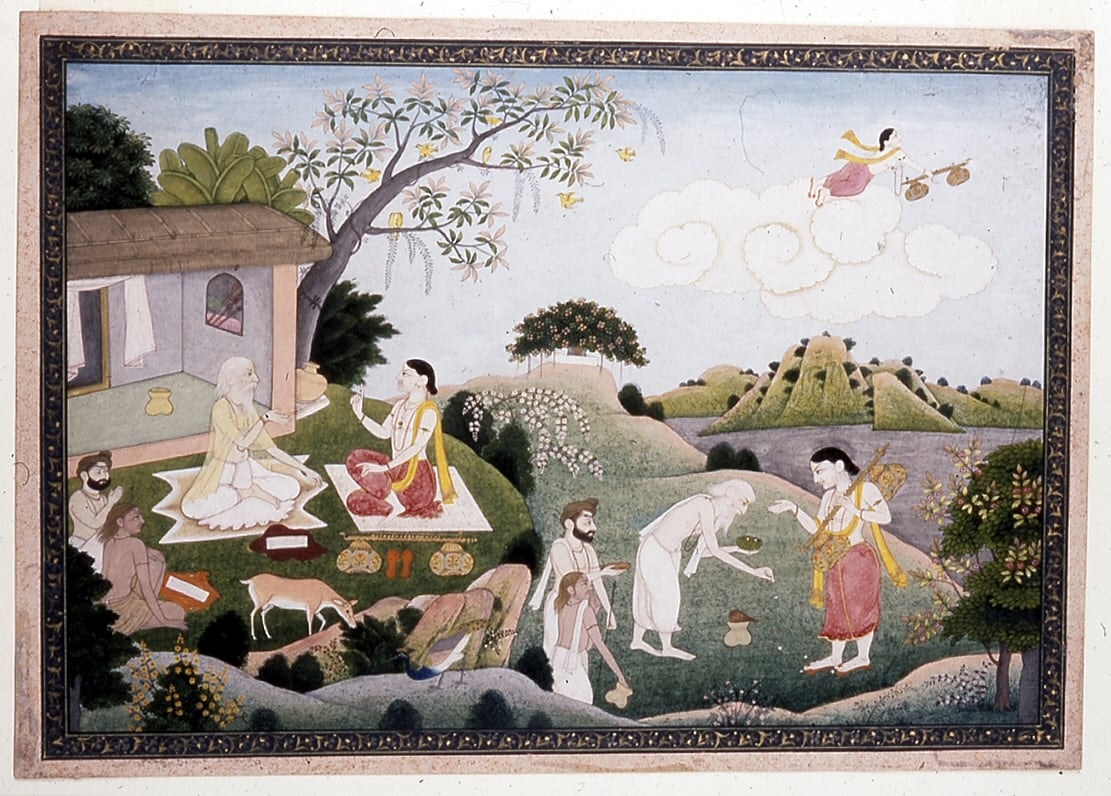
Nārada visita a Vālmīki · Public domain
بكلماته
«Sir, I am only a knower of mantras, not a knower of the Self.»Chāndogya Upaniṣad VII.1.3, palabras de Nārada a Sanatkumāra; sánscrito de Wikisource; traducciones del investigador.
فكرته المحورية
Parabhakti (supreme love): The Nārada Bhakti Sūtra defines devotion as “supreme love” (paramaprema) directed to God and immortal in nature.
السيرة
4 دقيقة قراءة
ترجمة مُعانة من الأصل الإسباني، بانتظار مراجعة مترجم من أهل اللغة.
الرسول بين العوالم
نارادا من أكثر شخصيات الأدب السنسكريتي حضورًا وأعصاها على الإمساك. يظهر في الأناشيد الفيدية، وفي الأوبانيشادات، وفي الملحمتين، وفي جلّ البورانات، ودائمًا في حركة: حكيمٌ إلهي (ديفارشي) يجوب العوالم الثلاثة بآلة الفينا، يحمل الأخبار من الآلهة إلى البشر ومن البشر إلى الآلهة، ويشير على الملوك، ويعلّم الشعراء، وكثيرًا ما يُشعل نزاعاتٍ تنتهي إلى خدمة تدبيرٍ أسمى. ليس شخصيةً تاريخية بأيِّ معنى قابلٍ للتحقق؛ إنه نمطٌ أدبي وديني ظلّ التقليد يُغنيه طوال ما يزيد على ألفي عام، واجتمعت تحت اسمه مؤلفاتٌ من عصورٍ وأجناسٍ شديدة التباين.
من النشيد الفيدي إلى الأوبانيشاد
تنسب القوائم التقليدية لمؤلفي «الريغفيدا» إلى نارادا من أسرة كانفا النشيدَ 8.13، وتنسب إليه مع بارفاتا النشيدين 9.104 و9.105 المخصّصين للسوما؛ وهي نسبةٌ متأخرة لا يصحّ أن تُقرأ معطياتٍ عن سيرته. وفي «أيتاريا براهمانا» يقيم نارادا وبارفاتا في بيت الملك هاريشتشاندرا الذي لم يُرزق ولدًا، فيجيبه نارادا في عشرة أبيات عن قيمة الابن وينصحه بأن ينذره لفارونا: وهكذا تبدأ قصة شوناهشيبا الشهيرة. وفي «تشاندوغيا أوبانيشاد» (الفصل السابع) يكون بطلَ واحدٍ من أجمل حوارات المتن: فالحكيم الذي أحاط بكل معارف عصره يمثل بين يدي ساناتكومارا ويعترف بأنه لا يعرف إلا الألفاظ — «أنا عارفٌ بالمانترا، لا بالذات» — وبأنه يتألم؛ فيقوده المعلّم درجةً درجة إلى اللامتناهي (بهومان)، الذي فيه وحده السعادة.
مستشار الملحمة
في «المهابهاراتا» نارادا هو الزائر الذي يقدم على بلاط الباندافا فيُخضع يودهيشثيرا لاستجوابٍ طويل في فنّ الحكم — بيت المال، والجيش، والوزراء، والقضاء، ورعاية الفلاحين — قبل أن يصف له قاعات مجالس الآلهة؛ وفي «شانتي بارفان» يرحل إلى الجزيرة البيضاء (شفيتادفيبا) ليشهد نارايانا، وهي حلقةٌ مركزية في «النارايانيا» وفي لاهوت البانتشاراترا. وفي «البهاغافاد غيتا» يقول كريشنا إنه من بين الحكماء الإلهيين نارادا. وفي «الرامايانا» يكون نارادا هو من يلخّص لفالميكي، حين سأله عن الإنسان الكامل في زمانه، قصةَ راما: وبحسب رواية القصيدة نفسها، وُلدت الملحمة كلها من ذلك الحوار.
العابد في البورانات
جعلت منه البورانات الفيشنوية مثالَ العابد المحبّ. فـ«بهاغافاتا بورانا» تنسب إليه حياةً سابقة كان فيها ابنًا لخادمةٍ سمع، وهو يخدم بعض الزهّاد، أحاديثهم عن فيشنو، فرأى الإله رؤيةً خاطفة؛ ثم وُلد من جديد ابنًا لبراهما، فراح يجوب الكون مرتّلًا الأسماء الإلهية. وهو الذي يجد فياسا مهمومًا بعد أن ألّف «المهابهاراتا»، فينصحه بأن يتغنّى بأمجاد كريشنا، وذلك هو الأصل التقليدي لـ«البهاغافاتا» نفسها؛ وهو الذي يعلّم براهلادا في رحم أمه، ويوجّه الطفل دهروفا إلى طريق زهده. غير أن النصوص ذاتها تحفظ نارادا متكبّرًا تسخر منه مايا فيشنو، أي وهمُه، وقد صوّره الخيال الشعبي حكيمًا متطفّلًا يزرع الشقاق بين الآلهة والملوك. وهذه الازدواجية جزءٌ من الشخصية.
حِكَم المحبة الإلهية
أكثر المؤلفات المنسوبة إليه قراءةً «نارادا بهاكتي سوترا»، وهي أربعٌ وثمانون حكمة في المحبة التعبّدية. تعرّف البهاكتي بأنها المحبة العليا لله، وتورد تعريفات باراشاريا وغارغا وشانديليا قبل أن تقدّم تعريفها الخاص — أن تُوقَف على الله الأعمال كلها، وأن يشتدّ الوجد بالقلق عند نسيانه — وتجعل من راعيات البقر (الغوبي) في فراجا مثالًا يُحتذى، وتقرّر أن المحبة أعلى من العمل والمعرفة واليوغا لأنها هي ثمرة نفسها، وتعلن أنها لا توصف، كالمذاق عند الأبكم. وتاريخها غير يقيني: فارتباطها بعبادة كريشنا يضعها في العصر الوسيط، ويرى غافن فلود أنها ربما تعود إلى القرن الثاني عشر. وكان راماكريشنا يوصي بالمحبة التي علّمها نارادا طريقًا خاصًّا بالعصر الحاضر، وقد ترجم فيفيكاناندا النص ترجمةً حرّة في أثناء سنواته في الولايات المتحدة.
اسمٌ لكتبٍ كثيرة
اجتمعت تحت سلطانه نصوصٌ شديدة الاختلاف في طبيعتها. فـ«نارادا سمريتي» أكثر رسائل الدارما طابعًا قانونيًا: تُعرض عن الشعائر والكفّارات لتقتصر على إجراءات التقاضي وعلى أبواب النزاع الثمانية عشر — الديون، والودائع، والعقود، والمواريث، والقذف. ويتراوح تاريخها، بحسب الباحثين، بين القرون الأولى من عصرنا والقرنين الخامس والسادس اللذين يقترحهما أوليفيل، ولا ينسبها النقد إلى حكيم الملحمة، بل إلى فقيهٍ احتمى باسمه. أما «نارادا بورانا» (أو «ناراديا») وصيغتها الصغرى «بريهان ناراديا» فمدينتان بعنوانهما لكون نارادا محاورًا فيهما؛ وتتناول «ناراديا شيكشا» علم الأصوات وموسيقى ترتيل «الساما فيدا»؛ و«سانغيتا ماكاراندا» الموسيقى؛ أما ما يُعرف بـ«نارادا بانتشاراترا» فمجموعٌ تعبّدي متأخر لم يعدّه أوتو شرادر من «السامهيتا» القديمة لمدرسة البانتشاراترا.
الموسيقيّ الأول
في المخيّلة الهندية نارادا هو قبل كل شيء موسيقيّ الآلهة: الحكيم الأبيض اللحية الذي يمشي حاملًا الفينا — المسمّاة في التقليد «ماهاتي» — مترنّمًا باسم نارايانا. وينسب إليه التقليد اختراع تلك الآلة، ويتصدّر اسمه رسائل في نظرية الموسيقى. وتُظهر الأيقونوغرافيا — المنمنمات المغولية والراجبوتية، ولوحات كانغرا، ودمى الوايانغ الجاوي حيث باتارا نارادا مستشار الآلهة — إلى أيّ مدى سافر الرسول. ويُحتفل بمولده (نارادا جايانتي) في شهر جييشثا، وتستحضره الصحافة الهندية أحيانًا، على سبيل الدعابة، بوصفه أول صحفي.
مرجعيةٌ عابرة
ليس لنارادا سيرة لأن وظيفته أن يكون عابرًا. فحيثما احتاجت حكايةٌ إلى خبرٍ أو نصيحةٍ أو دفعة، ظهر هو. وقد جعل التقليد من هذا التنقّل صورةً للروح العابدة التي لا تستقرّ في عالمٍ وتترنّم في العوالم كلها؛ أما النقد فيقرأ فيه أثرَ شخصيةٍ صاغتها أيدٍ كثيرة على مرّ القرون. وبين القراءتين تبقى السمة التي يشترك فيها مع كبار المعلّمين الأسطوريين في الهند: أن سلطته قائمةٌ في ما يُنسب إليه، لا في ما يمكن إثبات أنه فعله.
المصادر: Vivekananda, Swami. «Narada-Bhakti-Sutras (a free translation dictated by Swamiji in America)», en The Complete Works of Swami Vivekananda, vol. 6 (Notes of Class Talks and Lectures). Texto en Wikisource. · Sturdy, E. T. (trad.). Nârada Sûtra: An Inquiry into Love (Bhakti-jijnâsâ). Londres: Longmans, Green & Co., 1896. · Sinha, Nandalal (trad.). The Bhakti Sûtras of Nârada. Allahabad: Pāṇini Office (Sacred Books of the Hindus 7, parte 1); ejemplar digitalizado fechado en 1917. · Jolly, Julius (trad.). The Minor Law-Books, parte I: Nârada, Brihaspati. Oxford: Clarendon Press, 1889 (Sacred Books of the East 33). Introducción sobre la Nāradasmṛti. · Lariviere, Richard W. (ed. y trad.). The Nāradasmṛti. 2 partes. Filadelfia: Department of South Asia Regional Studies, University of Pennsylvania, 1989 (University of Pennsylvania Studies on South Asia 4–5); reimpr. Delhi: Motilal Banarsidass, 2003 (ISBN 9788120818040).
الخط الزمني
الحياة عامًا بعد عام
كل نقطة حدث موثّق. انقر لتقرأه مع مصدره ودرجة اليقين فيه.
القرن X ق.م
Nārada in the lists of Ṛgvedic poets
The Anukramaṇī ascribes hymn 8.13 to Nārada Kāṇva and, with Parvata, hymns 9.104 and 9.105. A traditional ascription later than the hymns themselves.
تقليدJamison, Stephanie W. y Joel P. Brereton (trads.). The Rigveda: The Earliest Religious Poetry of India. 3 vols. Nueva York: Oxford University Press, 2014. Introducciones a RV 8.13 y 9.104–105.
القرن X ق.م
Nārada in the lists of Ṛgvedic poets
The Anukramaṇī ascribes hymn 8.13 to Nārada Kāṇva and, with Parvata, hymns 9.104 and 9.105. A traditional ascription later than the hymns themselves.
تقليد
نحو 700 ق.م
Counsellor of Hariścandra (Aitareya Brāhmaṇa)
In the story of Śunaḥśepa (AB VII.13–14), Nārada answers King Hariścandra in ten stanzas on the worth of a son and advises him to ask Varuṇa for one. The text’s date is approximate (late Vedic period).
تقليد
القرن VI ق.م
Nārada before Sanatkumāra (Chāndogya Upaniṣad VII)
A dialogue in which Nārada, master of all learning, confesses that he knows only words and is led to the infinite (bhūman). The Upaniṣad’s date is approximate.
تقليد
نحو 200 ق.م – 400
The sage of the epic
The Mahābhārata presents him as Yudhiṣṭhira’s counsellor (Sabhāparvan 5) and the seer of Nārāyaṇa in Śvetadvīpa (Nārāyaṇīya); the Rāmāyaṇa, as the one who tells Vālmīki the story of Rāma. The epics took shape between c. 300 BCE and 400 CE.
مرجَّح
نحو 500
The Nārada Smṛti
A legal treatise devoted to procedure and the eighteen titles of litigation. Olivelle places it around the 5th–6th centuries; other scholars, in the first centuries CE. Scholars do not ascribe it to the sage of the epic.
مختلَف فيه
نحو 850
The Bṛhannāradīya Purāṇa
Hazra dates this upapurāṇa centred on devotion to Viṣṇu to around the 9th century; the major Nāradīya would be later, with parts earlier than the 11th century.
مختلَف فيه
نحو 900
Teacher of Vyāsa in the Bhāgavata Purāṇa
The Bhāgavata (I.4–6) gives him a previous life as the son of a maidservant and shows him advising Vyāsa to sing the glories of Kṛṣṇa. The Purāṇa’s date is debated (c. 9th–10th centuries).
مختلَف فيه
القرن XII
The Nārada Bhakti Sūtra
Composition of the 84 aphorisms on devotion ascribed to Nārada. Uncertain date; Flood considers it possibly twelfth-century.
مختلَف فيه
1865
Edition of the Nārada Pañcarātra
K. M. Banerjea publishes in Calcutta, in the Bibliotheca Indica, the Sanskrit text of the Jñānāmṛtasāra, known as the Nārada Pañcarātra.
موثّق
1889
Jolly translates the Nārada Smṛti
Julius Jolly publishes the English translation in the Sacred Books of the East (vol. 33).
موثّق
1896
First English translation of the Bhakti Sūtra
E. T. Sturdy publishes in London “Nârada Sûtra: An Inquiry into Love”.
موثّق
1989
Critical edition of the Nārada Smṛti
Richard W. Lariviere publishes the critical edition and annotated translation in Philadelphia.
موثّق
المؤلَّفات
المؤلَّفات الأساسية
المؤلَّفات التي لا يُفهم إرثه من دونها.

نسبة تقليدية · نحو 1150
Nārada Bhakti Sūtra (Nārada’s Aphorisms on Devotion)
नारदभक्तिसूत्र
Eighty-four aphorisms defining devotion (bhakti) as supreme love for God, immortal in nature. After quoting the definitions of Pārāśarya (worship), Garga (sacred stories) and Śāṇḍilya (delight in the Self), it gives Nārada’s own: to consecrate every act to God and to feel extreme anguish at forgetting Him, like the gopīs of Vraja. It holds that bhakti is superior to action, knowledge and yoga because it is its own fruit; teaches its means —renunciation, ceaseless worship, hearing and singing the divine qualities and, above all, the grace of great souls—; declares it ineffable, “like taste for a mute”; distinguishes secondary from supreme devotion and lists eleven forms of attachment to God.
12 طبعة

نسبة تقليدية · نحو 500
Nārada Smṛti (Nārada’s Treatise on Law)
नारदस्मृति
The only treatise on dharma devoted entirely to procedural and substantive law, without rules on rites or penances. After an introduction on procedure (the plaint, the answer, evidence, witnesses, documents and ordeals), it sets out the eighteen titles of litigation: debts, deposits, partnerships, resumption of gifts, service, wages, sale without ownership, non-delivery and rescission of purchase, conventions, boundary disputes, relations between husband and wife, inheritance, violence, verbal and physical assault, gambling and betting, and miscellaneous cases. It survives in two recensions; the shorter was commented on by Asahāya and revised by Kalyāṇabhaṭṭa.
6 طبعات
Narada
Nārada Purāṇa (Nāradīya Purāṇa)
مجموعة لاحقة · نحو 1000
Nārada Purāṇa (Nāradīya Purāṇa)
नारदपुराण (नारदीयपुराण)
A Vaiṣṇava Purāṇa in two parts: the first (125 chapters, in four sections) deals with devotion to Viṣṇu, the duties of classes and stages of life, rites and vows and the auxiliary sciences of the Veda, and devotes a chapter to summarising each of the eighteen major Purāṇas, which makes it a valuable document for their history; the second (82 chapters) includes the story of King Rukmāṅgada and long glorifications of pilgrimage places along the Ganges. It is distinguished from the shorter Bṛhannāradīya.
3 طبعات
جميع مؤلَّفاته (12)
Narada
Bṛhannāradīya Purāṇa
The Conscious LibraryBṛhannāradīya Purāṇa
850
Narada
Nārada Pañcarātra (Jñānāmṛtasāra Saṃhitā)
The Conscious LibraryNārada Pañcarātra (Jñānāmṛtasāra Saṃhitā)
Narada
Nāradīya Śikṣā
The Conscious LibraryNāradīya Śikṣā
Narada
Saṅgītamakaranda
The Conscious LibrarySaṅgītamakaranda
Narada
Ṛgvedic hymns ascribed to Nārada (8.13; 9.104–105)
The Conscious LibraryṚgvedic hymns ascribed to Nārada (8.13; 9.104–105)
1000
Narada
Nārada’s stanzas on the son (Aitareya Brāhmaṇa VII.13)
The Conscious LibraryNārada’s stanzas on the son (Aitareya Brāhmaṇa VII.13)
700
Narada
Nārada’s abridged Rāmāyaṇa (Rāmāyaṇa I.1)
The Conscious LibraryNārada’s abridged Rāmāyaṇa (Rāmāyaṇa I.1)
100
Narada
Nārada’s questionnaire on government (Mahābhārata, Sabhāparvan 5)
The Conscious LibraryNārada’s questionnaire on government (Mahābhārata, Sabhāparvan 5)
Narada
Nāradaparivrājaka Upaniṣad
The Conscious LibraryNāradaparivrājaka Upaniṣad
الأقوال
أقوال محدَّدة الموضع في مؤلَّف بعينه. كل منها يحمل مصدره ودرجة الثقة به.
Sir, I am only a knower of mantras, not a knower of the Self.so 'haṃ bhagavo mantravid evāsmi nātmavit
متحقَّق منهChāndogya Upaniṣad VII.1.3, palabras de Nārada a Sanatkumāra; sánscrito de Wikisource; traducciones del investigador.
أقوال منحولة أو مختلَف في نسبتها (1)
«“The best path to union with God is to follow the way of divine love as taught by Narada.”»
It circulates attributed to Ramakrishna without a specific reference. What is documented in the 1911 English Gospel is the idea —the devotion taught by Nārada is the path suited to this age—, not this literal sentence.
الكلمات الأخيرة
لا توجد سجلات يمكن التحقق منها لكلماته الأخيرة.
Nārada is a mythical figure to whom tradition ascribes no death: the texts present him as a divine sage who travels the worlds in every age. There are no last words to record.
اسأل
بماذا يجيب أثره
اثنا عشر سؤالًا كبيرًا من أسئلة الإنسانية، وما تتيح نصوصه الإجابة به عنها، مع المراجع. ولا نقوّله ما لم يقل أبدًا.
ما المطلق؟ هل الله موجود؟
God is the beloved Lord to whom every act is consecrated
إله شخصييقوله صراحةً
The Nārada Bhakti Sūtra does not discuss God's existence: it takes it for granted and deals with how to love him. It defines devotion as supreme love directed to him (sūtra 2) and its sign as the surrender of all acts to the Lord and extreme anguish at the slightest forgetting (sūtra 19). This God is personal: he has qualities that are heard and sung (sūtra 37), he grants grace (sūtra 40) and he can be loved as master, friend, child or lover (sūtra 82). The model it proposes is the cowherd women of Vraja, in love with Kṛṣṇa (sūtra 21). The text does not deny ultimate unity, for it goes so far as to say that between God and his own there is no difference (sūtra 41), but the Absolute is reached here as a relationship of love, not as an abstract principle.
قارن هذا السؤال مع معلّمين آخرينمن أنا؟ هل توجد ذات حقيقية؟
He does not theorise the self: he describes how love of God transforms it
لم يُبدِ رأيًا
The Nārada Bhakti Sūtra does not ask what the self is: its subject is devotion. It does describe what happens to one who attains it: he becomes perfect, immortal and satisfied (sūtra 4), ceases to desire, to grieve and to hate, and becomes intoxicated, still and delighting in himself (sūtra 6). The question appears more clearly elsewhere in the tradition, in the Chāndogya Upaniṣad, where Nārada is the disciple who confesses to Sanatkumāra that he knows the mantras but not the Self, and learns that the infinite is the ātman, the only source of happiness. But that passage presents him as a pupil, not as a teacher, and cannot be taken as his doctrine.
قارن هذا السؤال مع معلّمين آخرينلماذا نتألّم؟
Forgetting God hurts, and bad company multiplies the passions
الانفصال عن اللهيُستنتج من تعاليمه
The Nārada Bhakti Sūtra offers no theory of suffering, but one can be deduced from its doctrine. The sign of true love is to feel extreme anguish at the slightest forgetting of God (sūtra 19), and full devotion is described as a state in which one no longer desires, grieves or hates (sūtra 5): ordinary pain thus comes from living turned towards something else. The text also points to its mechanism: bad company arouses desire, anger, confusion, forgetfulness of the goal, loss of judgement and ruin; the passions, which at first are ripples, become an ocean (sūtras 43–45). In the Chāndogya Upaniṣad, Nārada comes to his teacher in sorrow and learns that there is no happiness in the small.
قارن هذا السؤال مع معلّمين آخرينماذا يحدث بعد الموت؟
The sūtra promises the immortality of love; it does not describe the beyond
لم يُبدِ رأيًا
The Nārada Bhakti Sūtra is not concerned with what happens after death. It says that devotion is immortal in nature (sūtra 3) and that one who attains it becomes perfect, immortal and satisfied (sūtra 4), but it does not clarify whether that immortality is a state of the soul after death, a life in God's presence, or the fullness that love already gives in this life, which is what the context suggests. Nor does it discuss rebirth, which the culture of its time took for granted. The Vaiṣṇava traditions that read it place the devotee, after death, in God's world and at his service; the Purāṇic stories about Nārada himself, who remembers a previous life, belong to legend, not to the sūtra.
قارن هذا السؤال مع معلّمين آخرينكيف يُبلَغ التحرّر أو الخلاص؟
Devotion surpasses action, knowledge and yoga: it is its own fruit
بالتعبّد والتسليميقوله صراحةً
The Nārada Bhakti Sūtra places devotion above the other paths: it is greater than action, knowledge and yoga (sūtra 25), because it is not a means to anything else but its own fruit (sūtras 26 and 30). It reviews the opinions of other teachers —that knowledge is its means, or that the two support each other— and concludes that devotion needs no other foundation. Its means are renunciation of objects and of company, unbroken worship and the hearing and singing of God's qualities (sūtras 35–37), but the principal one is the grace of great souls or a drop of divine grace (sūtra 38). The goal is neither a knowledge nor an absorption but love itself, which leaves the devotee satisfied and immortal.
قارن هذا السؤال مع معلّمين آخرينهل نحتاج إلى معلّم؟
The principal means is the company of great souls; flee bad company
الجماعة والتقليديقوله صراحةً
The Nārada Bhakti Sūtra speaks not of an individual guru but of the company of saints. It declares that the principal means of attaining devotion is the grace of great souls or a drop of divine grace (sūtra 38); that company is hard to obtain, unattainable by one's own effort and unfailing in its effects (sūtra 39), and is gained only by God's grace, since between him and his own there is no difference (sūtras 40–41). Hence the exhortation: seek that, seek that alone (sūtra 42). The reverse is equally sharp: bad company must always be avoided (sūtra 43). The text closes by invoking a long series of teachers of devotion, from the Kumāras and Vyāsa to Hanumān (sūtra 83), as guarantors of the tradition.
قارن هذا السؤال مع معلّمين آخرينهل العالم حقيقي؟
The world is not denied: it is offered to God with all it contains
تجلٍّ للإلهييُستنتج من تعاليمه
The Nārada Bhakti Sūtra has no cosmology, but neither does it treat the world as an illusion to escape from. It asks the devotee not to be troubled by worldly losses, since he has surrendered to God his own self, the world and the Veda (sūtra 61), and specifies that, once devotion is attained, activity in the world is not to be abandoned, but its fruit renounced (sūtra 62). The world is thus the field in which love is exercised and consecrated. The Purāṇic literature associated with Nārada and the Vaiṣṇava theology in which the sūtra is read complete the picture: the universe is the Lord's work and manifestation, real and dependent on him, and not an appearance superimposed on an impersonal absolute.
قارن هذا السؤال مع معلّمين آخرينما الحب؟
Intense love for God, inexpressible like taste for a mute
الشوق والوصاليقوله صراحةً
Love is the whole subject of the Nārada Bhakti Sūtra. It defines it as supreme love for God (sūtra 2), immortal in nature, and says it begins when all thoughts, words and deeds are surrendered to the Lord and the slightest forgetting brings extreme anguish (sūtra 19). Its nature is inexpressible: as the mute cannot say what he tastes, but his gestures betray it (sūtras 51–52). The model is the cowherd women of Vraja, who loved Kṛṣṇa without forgetting his greatness (sūtras 21–24). That love, though one, takes eleven forms, from servanthood and friendship to the love of a lover and the supreme pain of separation (sūtra 82). And it knows no human boundaries: among those who love thus there is no distinction of caste, learning, form or wealth (sūtra 72).
قارن هذا السؤال مع معلّمين آخرينهل نحن أحرار أم أن كل شيء مقدَّر؟
Keep acting, renounce the fruit and surrender everything to God
الكارما والاختياريُستنتج من تعاليمه
The Nārada Bhakti Sūtra does not pose the problem of determinism, but a position can be deduced from its counsels. The devotee goes on acting: once devotion is attained, activity in the world is not to be abandoned, but its fruit renounced (sūtra 62), and even once conviction is firm the rules of scripture must be respected (sūtras 12–13). What is decisive is a sustained choice: to consecrate all acts to God (sūtra 19) and to direct towards him even desire, anger and pride (sūtra 65). At the same time, the principal means does not depend on one's own effort: it is the grace of great souls or of God (sūtras 38–40). Human freedom is real, but its highest use is to surrender to another.
قارن هذا السؤال مع معلّمين آخرينلماذا نتأمّل أو نصلّي؟
Remembering unceasingly, hearing and singing the Beloved's qualities
صداقة مع اللهيُستنتج من تعاليمه
For the Nārada Bhakti Sūtra spiritual practice is a form of loving intercourse with God. Its means are unbroken worship (sūtra 36) and, even amid ordinary life, the hearing and singing of the Lord's qualities (sūtra 37). The mark of true love is constant remembrance: consecrating all acts to him and suffering at the slightest forgetting (sūtra 19). The relationship can take eleven forms, from service to friendship, filial affection, the love of a lover and total absorption (sūtra 82), and the devotee who surrenders thus does not do so to obtain anything: devotion is its own fruit. To pray is neither to ask nor to train, but to keep alive a personal relationship that fills the whole of existence.
قارن هذا السؤال مع معلّمين آخرينهل يستطيع العقل أن يعرف الحقيقة القصوى؟
One must not enter into disputes: love is not explained, it is tasted
الحقيقة القصوى وراء العقليقوله صراحةً
The Nārada Bhakti Sūtra relativises discursive knowledge in two ways. First, it places devotion above knowledge (sūtra 25) and, against those who hold that knowledge is its means, affirms that it is its own fruit (sūtras 28–30), like a king or a banquet, which are enjoyed not by knowing about them but by having them (sūtras 31–32). Second, it advises against dispute: one should not resort to argument, because it leads to excess and has no end (sūtras 74–75). The nature of love is inexpressible, like taste for a mute (sūtras 51–52). Study is not excluded —the texts that nourish devotion are recommended (sūtra 76)— but the ultimate is known by loving.
قارن هذا السؤال مع معلّمين آخرينالانسحاب من العالم أم تغييره؟
Not abandoning life in the world: renouncing the fruit and offering everything
التأمّل في الفعليقوله صراحةً
The Nārada Bhakti Sūtra expressly rejects withdrawal as a condition of devotion. Once devotion is attained, activity in the world is not to be abandoned, but its fruit renounced, and the means that sustain it are to be kept up (sūtra 62); the devotee should not be troubled by worldly losses, since he has surrendered to God his self, the world and the Veda (sūtra 61). What it asks is to transform motivation: to direct towards God even desire, anger and pride (sūtra 65). Ordinary life thus becomes the place of love. The renunciation the sūtra does demand is of bad company and of talk about women, wealth, unbelievers and enemies (sūtras 43 and 63).
قارن هذا السؤال مع معلّمين آخرين
التقارب والتوتّر
التقارب والتوتّر
محسوبة سؤالًا سؤالًا انطلاقًا من مواقفه. وسبب كل اتفاق أو اختلاف يظهر بالنقر.
يقترب في تفكيره من

Rabia al-Adawiyya
يتّفقان في: ما المطلق؟ هل الله موجود؟ · لماذا نتألّم؟ · كيف يُبلَغ التحرّر أو الخلاص؟
Rumi
يتّفقان في: ما المطلق؟ هل الله موجود؟ · لماذا نتألّم؟ · كيف يُبلَغ التحرّر أو الخلاص؟
Chaitanya Mahaprabhu
يتّفقان في: ما المطلق؟ هل الله موجود؟ · لماذا نتألّم؟ · كيف يُبلَغ التحرّر أو الخلاص؟

Al-Hallaj
يتّفقان في: ما المطلق؟ هل الله موجود؟ · لماذا نتألّم؟ · كيف يُبلَغ التحرّر أو الخلاص؟
يبتعد في تفكيره عن
حكايات وروايات
حكايات وروايات
تقليد شفهيperiodo upaniṣádico
“I know mantras, not the Self”
أصل الرواية: Chāndogya Upaniṣad VII.1–26, checked against the Sanskrit on Wikisource. A didactic dialogue in an early Upaniṣad; not a historical event but a teaching in narrative form. The translations of the sentences quoted are the researcher’s.
تقليد شفهيperiodo védico tardío
The childless king and the promise to Varuṇa
أصل الرواية: Aitareya Brāhmaṇa VII.13–18, checked in Martin Haug’s translation (1863; repr. 1922). The story was recited at the royal consecration (rājasūya). A ritual text, not a chronicle.
رواية من سِيَر القدّيسينtiempo legendario
Vālmīki asks about the perfect man
أصل الرواية: Rāmāyaṇa, Bālakāṇḍa, sargas 1–2 (critical ed.; trans. Robert P. Goldman, 1984). The first two sargas belong to the layers of the poem considered later; the story is an aetiology of poetry, not a historical event.
المصدر: Goldman, Robert P. (trad.). The Rāmāyaṇa of Vālmīki: An Epic of Ancient India, vol. I: Bālakāṇḍa. Princeton: Princeton University Press, 1984. Sarga 1–2 (Nārada narra a Vālmīki la historia de Rāma).
رواية من سِيَر القدّيسينtiempo mítico
The son of the maidservant
أصل الرواية: Bhāgavata Purāṇa I.4–6, a devotional text of debated date (c. 9th–10th centuries), checked in Burnouf’s French translation (1840). The scene works as a foundation story for the Bhāgavata itself.
رواية من سِيَر القدّيسينtiempo mítico
Kubera’s sons turned into trees
أصل الرواية: Bhāgavata Purāṇa X.10 (Sanskrit on Wikisource), taken up in Kṛṣṇaite iconography as the episode of the yamalārjuna trees. A devotional story with no historical basis.
تقليد شفهيtiempo mítico
The water Viṣṇu asked for
أصل الرواية: A Purāṇic story with many variants: in the Devī-Bhāgavata Purāṇa (book VI) Nārada is turned into a woman by bathing in a pond; the version with the village and the flood is the one popularised by Heinrich Zimmer (1946), who drew it from Purāṇic sources. Details (twelve years, half an hour) vary between versions; Zimmer’s is followed here.
المصدر: Zimmer, Heinrich. Myths and Symbols in Indian Art and Civilization, ed. Joseph Campbell. Nueva York: Pantheon Books, 1946 (Bollingen Series VI). Capítulo I, relato de Nārada y la māyā de Viṣṇu.
مختلَف فيهtradición medieval y moderna
The highwayman who became a poet
أصل الرواية: The highwayman legend is later than the Rāmāyaṇa. In the Adhyātma Rāmāyaṇa it is the seven sages (saptarṣi) who convert the highwayman; the figure of Nārada as initiator belongs to later popular versions. No ancient source supports it.
التعاليم
التعاليم
المفاهيم التي ينتظم بها فكره، مشروحة في سياقها.
Parabhakti (supreme love)para-bhakti
It is the central notion of the Vaiṣṇava theology of devotion, later developed by the schools of Rāmānuja, Madhva and Caitanya; the Nārada Bhakti Sūtra and the Śāṇḍilya Bhakti Sūtra are its two aphoristic manuals.
المصدر: Wikisource en sánscrito: «नारदभक्तिसूत्रम्» (Nārada Bhakti Sūtra, 84 aforismos).
Bhūman (the infinite)bhuman
It is one of the Upaniṣadic texts most quoted by Vedānta; the Brahmasūtra (I.3.8–9) discuss whether bhūman denotes breath or Brahman.
Mahatsaṅga (the company of great souls)mahat-sanga
The value placed on the company of the saintly (satsaṅga) is a feature common to Hindu devotional movements, from the Bhāgavata to the medieval poet-saints.
المصدر: Wikisource en sánscrito: «नारदभक्तिसूत्रम्» (Nārada Bhakti Sūtra, 84 aforismos).
The eleven forms of attachment to Godekadasha-asakti
The classification anticipates the theory of devotional sentiments (bhakti-rasa) systematised in the sixteenth century by Rūpa Gosvāmī, a disciple of Caitanya.
المصدر: Wikisource en sánscrito: «नारदभक्तिसूत्रम्» (Nārada Bhakti Sūtra, 84 aforismos).
Vyavahāra (litigation and its eighteen titles)vyavahara
It is the only dharmaśāstra that entirely excludes ritual and penance; scholars ascribe it to a jurist distinct from the sage of the epic.
المصدر: Lariviere, Richard W. (ed. y trad.). The Nāradasmṛti. 2 partes. Filadelfia: Department of South Asia Regional Studies, University of Pennsylvania, 1989 (University of Pennsylvania Studies on South Asia 4–5); reimpr. Delhi: Motilal Banarsidass, 2003 (ISBN 9788120818040).
Devarṣi (divine sage)devarshi
The category brings together a small group of figures in the Purāṇas; Nārada is the only one who became a recurring character throughout narrative literature.
مقاطع الفيديو
مقاطع الفيديو
تسجيلات ومقابلات وأفلام وثائقية. تُشغَّل مقاطع الفيديو من YouTube؛ ولا تُستضاف هنا.
“Learning from the Sage Narada” | Swami Sarvapriyananda
محاضرة· EN· 51 min
Ramakrishna Vedanta Society of North Texasالقناة الرسمية
Nārada Bhakti Sūtra 1/5 | Pravrajika Divyanandaprana
محاضرة· EN· 82 min
Ramakrishna Vedanta Society of North Texasالقناة الرسمية
Narada Bhakti Sutra by Swami Mitrananda | Day 1 | Narada Jayanthi 2021
محاضرة· EN· 43 min
Chinmaya Mission Chennaiالقناة الرسمية
Narada Bhakti Sutra | Day 1 | Swami Abhedananda
محاضرة· EN· 57 min
Chinmaya Mission South Africaالقناة الرسمية
The 3 Qualities Of Divine Love | Excerpts From Narad Bhakti Sutra Discourse By Gurudev
محاضرة· EN· 9 min
Gurudev Sri Sri Ravi Shankarالقناة الرسمية
2. Narada Bhakti Sutras || Swami Ishadhyanananda
المشاهدة على YouTube
لا يسمح هذا الفيديو بالتضمين؛ وسيُفتح على YouTube.
2. Narada Bhakti Sutras || Swami Ishadhyanananda
محاضرة· EN· 71 min
Vedanta Society of Sacramentoالقناة الرسمية
भक्त को संसार में कैसे जीना चाहिए? नारद भक्ति दर्शन - 21/37 (1990)
محاضرة· HI· 20 min
Jagadguru Shri Kripalu Ji Maharaj - Officialالقناة الرسمية
Narada Bhakti Sutram - 84 Sutrams - Recited by Smt. Vidhya Ramesh
تسجيل من طرف ثالث· SA· 12 min
Nivedita R
Swami Brahmarupananda - True Happiness, Sanatkumara’s instruction to Narada in the Chandogya Upanishad
محاضرة· EN· 80 min
Ramakrishna Vedanta Society of North Carolina (Vedanta NC)القناة الرسمية
Dialogue between Narada and Sanatkumar. Chandogya Upanishad Chapter 7. - Prof. Rambachan
محاضرة· EN· 75 min
Discourse on Hinduism
Sarga 1.1 - HOW did Narada DESCRIBE Shri Rama to Sage Valmiki! - #ValmikiRamayanam
تحليل· EN· 28 min
The Sanskrit Channel
Understanding the Dharma Shastras: A Conversation with Dr. Patrick Olivelle and Dr. Donald Davis
مقابلة· EN· 113 min
Meru Media
EPISODIO 5: EL PASADO DE UN SABIO - La historia de Narada Muni
تسجيل من طرف ثالث· ES· 11 min
Historias del Srimad Bhagavatam
المعرض
المعرض
صور بترخيص متحقَّق منه. كل منها تحتفظ بمؤلّفها ونسبتها.
العلاقات
العلاقات
تأثيرات وتلمذة وتقارب في الأفكار. تُميَّز العلاقة الموثّقة عن التشابه المستخلَص بالتحليل.
معلّم
According to the Bhāgavata Purāṇa (I.4–6), Nārada advises Vyāsa, dissatisfied after composing the Mahābhārata, to sing the glories of Kṛṣṇa; the Bhagavad Gītā (10.13) names them together among those who proclaimed God. A narrative relation within the tradition.
علاقة موثّقة
أثّر في
In the first sarga of the Rāmāyaṇa, Nārada tells Vālmīki the story of Rāma, the kernel from which the poem arises. The later legend making Nārada the initiator of the highwayman Ratnākara does not come from the Rāmāyaṇa.
علاقة موثّقة
أثّر في
Vivekananda dictated in the United States a free translation of the Nārada Bhakti Sūtra, included in volume 6 of his complete works.
علاقة موثّقة
أثّر في
Ramakrishna recommended the devotion “of the Rishi Narada” as the path suited to the present age, according to the 1911 English edition of the Gospel.
علاقة موثّقة
أفكار قريبة من
The Bhagavad Gītā (10.26) names in the same verse Nārada, foremost of divine sages, and Kapila, foremost of the perfected; the Mahābhārata presents Nārada as versed in Sāṃkhya.
تشابه مستخلَص بالتحليل
أفكار قريبة من
The Chāndogya Upaniṣad brings together, in consecutive chapters, Uddālaka’s teaching to Śvetaketu (VI) and Sanatkumāra’s to Nārada (VII): two paths to knowledge of the Self.
تشابه مستخلَص بالتحليل
أفكار قريبة من
The Nārada Smṛti and the Yājñavalkya Smṛti are the two great dharmaśāstras after Manu; Olivelle places Nārada’s after Yājñavalkya’s and regards it as the most specialised in law.
تشابه مستخلَص بالتحليل
أفكار قريبة من
Caitanya’s Gauḍīya school inherits the theology of devotion of the Bhāgavata, where Nārada is Vyāsa’s teacher, and its authors quote definitions of bhakti under the name Nārada Pañcarātra.
تشابه مستخلَص بالتحليل
أفكار قريبة من
Mīrābāī’s love for Kṛṣṇa, with its pain of separation, corresponds to the forms of attachment that the Nārada Bhakti Sūtra (82) recognises as full devotion, following the model of the gopīs.
تشابه مستخلَص بالتحليل
المصادر
المصادر
المراجع والفهارس التي رُوجعت لهذه الصفحة.
- Wikidata, «Narada» (santo de la clase celestial), QID Q844066; GND 118818422; VIAF 193295452.
- Wikisource en sánscrito: «नारदभक्तिसूत्रम्» (Nārada Bhakti Sūtra, 84 aforismos).
- Vivekananda, Swami. «Narada-Bhakti-Sutras (a free translation dictated by Swamiji in America)», en The Complete Works of Swami Vivekananda, vol. 6 (Notes of Class Talks and Lectures). Texto en Wikisource.
- Sturdy, E. T. (trad.). Nârada Sûtra: An Inquiry into Love (Bhakti-jijnâsâ). Londres: Longmans, Green & Co., 1896.
- Sinha, Nandalal (trad.). The Bhakti Sûtras of Nârada. Allahabad: Pāṇini Office (Sacred Books of the Hindus 7, parte 1); ejemplar digitalizado fechado en 1917.
- Jolly, Julius (trad.). The Minor Law-Books, parte I: Nârada, Brihaspati. Oxford: Clarendon Press, 1889 (Sacred Books of the East 33). Introducción sobre la Nāradasmṛti.
- Lariviere, Richard W. (ed. y trad.). The Nāradasmṛti. 2 partes. Filadelfia: Department of South Asia Regional Studies, University of Pennsylvania, 1989 (University of Pennsylvania Studies on South Asia 4–5); reimpr. Delhi: Motilal Banarsidass, 2003 (ISBN 9788120818040).
- Olivelle, Patrick. «Dharmaśāstra: A Textual History». En Timothy Lubin, Donald R. Davis Jr. y Jayanth K. Krishnan (eds.), Hinduism and Law: An Introduction. Cambridge: Cambridge University Press, 2010, pp. 28–57.
- Wikisource en sánscrito: «छान्दोग्योपनिषद्/अध्यायः ७» (Chāndogya Upaniṣad VII, diálogo de Nārada y Sanatkumāra).
- Goldman, Robert P. (trad.). The Rāmāyaṇa of Vālmīki: An Epic of Ancient India, vol. I: Bālakāṇḍa. Princeton: Princeton University Press, 1984. Sarga 1–2 (Nārada narra a Vālmīki la historia de Rāma).
- Burnouf, Eugène (trad.). Le Bhâgavata Purâna, ou Histoire poétique de Krĭchṇa, tome premier. París: Imprimerie royale, 1840. Libro I, caps. 4–6 (Nārada y Vyāsa; la vida anterior de Nārada).
- Arnold, Edwin (trad.). The Song Celestial, or Bhagavad-Gîtâ. Londres: Trübner, 1885. Capítulo X, versos 13 y 26. Project Gutenberg n.º 2388.
- M. [Mahendranath Gupta]. The Gospel of Sri Ramakrishna (According to M., a Son of the Lord and Disciple). Edición inglesa condensada del autor. Madrás: Ramakrishna Math, 1911.
- Rocher, Ludo. The Purāṇas. Wiesbaden: Otto Harrassowitz, 1986 (A History of Indian Literature II.3). Entradas sobre el Nāradīya y el Bṛhannāradīya.
- Tagare, Ganesh Vasudeo (trad.). The Nārada-Purāṇa. 5 vols. Delhi: Motilal Banarsidass, 1980–1982 (Ancient Indian Tradition and Mythology 15–19).
- Haug, Martin (trad.). The Aitareya Brahmanam of the Rigveda. Bombay, 1863; reimpr. Allahabad: Pāṇini Office, 1922. VII.13–14 (Hariścandra y Nārada).
- Schrader, F. Otto. Introduction to the Pāñcarātra and the Ahirbudhnya Saṃhitā. Madrás: Adyar Library, 1916.
- Flood, Gavin. An Introduction to Hinduism. Cambridge: Cambridge University Press, 1996 (capítulo sobre la devoción vaiṣṇava).
- Wikisource en sánscrito: «नारदीयशिक्षा» (Nāradīya Śikṣā).
- Telang, M. R. (ed.). Saṅgīta-makaranda of Nārada. Baroda: Central Library, 1920 (Gaekwad's Oriental Series 16).
- Zimmer, Heinrich. Myths and Symbols in Indian Art and Civilization, ed. Joseph Campbell. Nueva York: Pantheon Books, 1946 (Bollingen Series VI). Capítulo I, relato de Nārada y la māyā de Viṣṇu.
- Jamison, Stephanie W. y Joel P. Brereton (trads.). The Rigveda: The Earliest Religious Poetry of India. 3 vols. Nueva York: Oxford University Press, 2014. Introducciones a RV 8.13 y 9.104–105.
- van Buitenen, J. A. B. (trad.). The Mahābhārata, vol. 2: The Book of the Assembly Hall; The Book of the Forest. Chicago: University of Chicago Press, 1975 (Sabhāparvan 5–11); y The Mahābhārata, edición crítica, Śāntiparvan (Nārāyaṇīya), Poona: BORI, 1949–1966.
- Banerjea, K. M. (ed.). Śrī Nārada Pañcarātram: the Jñānāmṛtasāra Saṃhitā. Calcuta: Asiatic Society, 1865 (Bibliotheca Indica); trad. inglesa de Swami Vijnanananda, Allahabad, 1921 (Sacred Books of the Hindus 23).
- Wikisource en sánscrito: «नारदस्मृतिः» y «नारदपुराणम्» (textos sánscritos con subpáginas).
- Hazra, Rajendra Chandra. Studies in the Upapurāṇas, vol. I. Calcuta: Sanskrit College, 1958 (sobre el Bṛhannāradīya).
- Wikipedia en inglés, «Narada» (consultada para la iconografía, el culto, Nārada Jayantī y la imagen popular; contrastada con las fuentes primarias).
- Wereldmuseum Amsterdam (antiguo Tropenmuseum), marioneta de wayang golek «Batara Narada», inv. TM-4283-48; descripción en Wikimedia Commons.
- Wikisource en sánscrito: «श्रीमद्भागवतपुराणम्» (Bhāgavata Purāṇa; libros IV, VII y X para Dhruva, Prahlāda y los hijos de Kubera).
- Wikipedia en inglés, «Valmiki» (versiones de la leyenda del bandolero Ratnākara: los siete sabios en el Adhyātma Rāmāyaṇa, Nārada en los relatos populares).
- صاحب الحقوق
- Textos sánscritos en dominio público. Las traducciones de Vivekananda (m. 1902), Jolly (m. 1932), Haug (m. 1876) y Burnouf (m. 1852) son de dominio público; la de E. T. Sturdy (1896; m. 1957) solo lo es en EE. UU. Las ediciones modernas (Sri Ramakrishna Math, Vedanta Press, Bhaktivedanta Book Trust, Art of Living, Advaita Ashrama, Inner Traditions, Motilal Banarsidass, University of Pennsylvania) tienen derechos propios.
في انتظار التأكيد
ما لم تتمكّن هذه الصفحة من حسمه بعد. نفضّل أن نقول ذلك على أن نملأ الفراغ.
- Ediciones en español con ISBN del Nārada Bhakti Sūtra, de la Nārada Smṛti y del Nārada Purāṇa: no localizadas (Open Library sin resultados; Google Books devolvió error 429). Revisar BNE e Iberlibro.
- Comprobar en Flood (1996) la página exacta de la datación «posiblemente del siglo XII» del Nārada Bhakti Sūtra, tomada de una referencia secundaria.
- Comprobar la fecha de muerte de Nandalal Sinha y la fecha original (1911 o 1917) de su traducción en la serie Sacred Books of the Hindus.
- Verificar la referencia exacta de la versión de Zimmer del relato de la māyā (capítulo y fuente purāṇica que él cita).
- Localizar una edición con ISBN de la Nāradaparivrājaka Upaniṣad (p. ej., en las Saṃnyāsa Upaniṣads de Olivelle) y del Saṅgītamakaranda.
- Los vídeos no traen año de publicación en oEmbed; se dejó year en null. El vídeo de la Vedanta Society of Sacramento devuelve 401 (no insertable).
بُحث بتاريخ 2026-10-26