الهندوسية · اليوغا · التانترا · أدفايتا فيدانتا
Dattatreya
दत्तात्रेय
شخصية أسطورية
إلهٌ وأفاتارا ومعلّمٌ لليوغيين في الهندوسية، وهو بحسب الأسطورة ابن الحكيم أتري وأناسويا، يُجَلّ بوصفه التجسّد المشترك لبراهما وفيشنو وشيفا، والنموذج الأعلى للأفادهوتا، أي المتحرّر الذي يعيش فوق كل عُرف. تنسب إليه البورانات تعليم اليوغا للملك ألاركا، وتنسب إليه المطابقةُ التقليدية المعلّمين الأربعة والعشرين في «بهاغافاتا بورانا». ويُنسب إليه نصّا «أفادهوتا غيتا» و«داتاتريا يوغا شاسترا»، وهو المعلّم الأول لتقليد داتا ولطائفة النّاث.
- مؤلَّفًا
- 9مؤلَّفًا
- طبعة
- 28طبعة
- اقتباسًا
- 7اقتباسًا
- مقطع فيديو
- 14مقطع فيديو
- صورة
- 6صورة
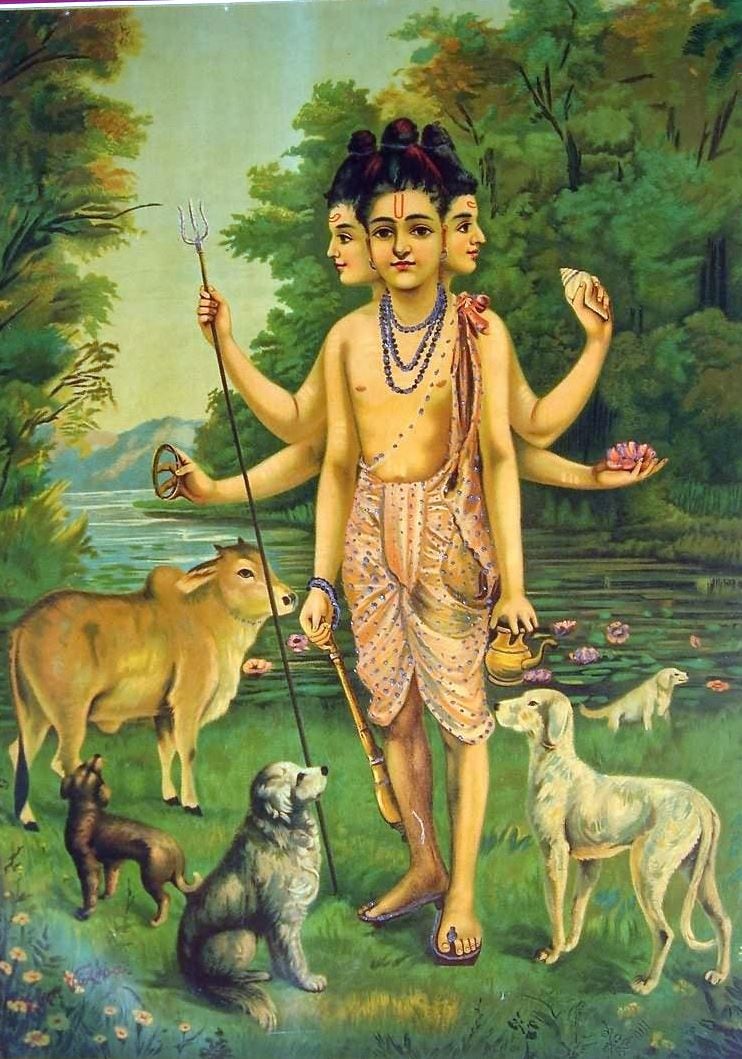
Dattātreya, cromolitografía de la Ravi Varma Press · Public domain
بكلماته
«That by which all this is filled, the Self by the Self in the Self: how shall I salute the formless, undivided, imperishable Śiva?»Avadhūta Gītā 1.2 (texto sánscrito de Wikisource); versiones del investigador

فكرته المحورية
The avadhūta: Avadhūta literally means "one who has shaken off": the renouncer who has rid himself of social, ritual and moral conventions because he no longer identifies with anything they regulate.
السيرة
4 دقيقة قراءة
ترجمة مُعانة من الأصل الإسباني، بانتظار مراجعة مترجم من أهل اللغة.
إلهٌ هو معلّم
يحتلّ داتاتريا مكانةً فريدة في الهندوسية: فهو في آنٍ واحد إلهٌ تُقام له العبادة، وأفاتارا (تجسّدٌ) لفيشنو، وهو عند كثيرٍ من المتعبّدين التجسّد المشترك لبراهما وفيشنو وشيفا، والنموذج الأعلى للمعلّم الجوّال الذي تجاوز كل عُرف، أي الأفادهوتا. ولا يتيح أيّ معطًى معاملته شخصًا تاريخيًا. فما هو موجودٌ سلسلةٌ طويلة من النصوص التي نسبت إليه، على مدى أكثر من ألف عام، ولاداتٍ ومآثر وتعاليم، وشبكةٌ من التقاليد الحيّة التي تجلّه بوصفه المعلّم (الغورو) الأول. والدراسة المرجعية، أي كتاب أنطونيو ريغوبولوس (1998)، تصفه تحديدًا بقدرته على التحوّل والاحتواء: «يوغيٌّ نحلة» يرتشف الرحيق من كل أزهار التراث.
ابن أتري وأناسويا
يُفسَّر اسمه بنسبه: «داتا»، أي «المُعطى»، و«آتريا»، أي «ابن أتري». تروي «ماركاندييا بورانا» (النشيدان 16–17 في ترجمة بارجيتر) أن أناسويا، زوجة الحكيم أتري، نالت من الآلهة منحةً لأنها شفعت لامرأةٍ وفيّة كانت قد أوقفت شروق الشمس؛ فوُلد لها ثلاثة أبناء هم أجزاءٌ من الآلهة الثلاثة الكبار: سوما من براهما، وداتاتريا من فيشنو، ودورفاسا من شيفا. وتعدّه «بهاغافاتا بورانا» التجسّد السادس للربّ، المولود لأتري بطلبٍ من أناسويا، وتذكر أنه علّم علم النفس لألاركا وبراهلادا وغيرهما (1.3.11). أما الصورة الشعبية للإله ذي الرؤوس الثلاثة، الذي يجمع الثالوث (التريمورتي) في جسدٍ واحد، فتطوّرٌ لاحق لهذا النسب.
يوغيّ البحيرة
تقدّمه أقدم الروايات يوغيًّا محيِّرًا. فـ«ماركاندييا بورانا» تحكي أنه، وقد أحاط به نسّاكٌ شبّان أبوا أن يفارقوه، غاص في بحيرةٍ زمنًا طويلًا ليتخلّص منهم؛ فلما ظلّوا ينتظرونه خرج من الماء ومعه امرأة، وشرب الخمر وأسلم نفسه للموسيقى، دون أن يدنّسه شيءٌ من ذلك، لأنه كان «سيّد اليوغيين». وإلى هذا المعلّم المستتر خلف سلوكٍ فاضح قصد الملكُ كارتافيريا أرجونا، فنال منه عطاياه. وتذكره «المهابهاراتا» في هذا الدور («آرانياكا بارفا» 115؛ «أنوشاسانا بارفا» 152–153 بحسب الترقيم النقدي): فبفضل داتاتريا صار لملك الهايهايا ألفُ ذراعٍ في القتال، وحكم الأرض بالعدل.
المعلّمون الأربعة والعشرون
جعلته تعليمتان شخصيةً من الطراز الأول. ففي «ماركاندييا بورانا» (الأناشيد 37–43) يلقّن داتاتريا الملكَ ألاركا، الذي أثقلته الحرب، عرضًا كاملًا لليوغا: النفس، والنَّفَس، والعوائق، ومقطع «أوم»، وعلامات الموت. وفي الكتاب الحادي عشر من «بهاغافاتا بورانا» (11.7–9) يشرح أفادهوتا شابٌّ لا اسم له للملك يادو أنه تتلمذ على أربعة وعشرين معلّمًا: الأرض، والهواء، والسماء، والماء، والنار، والقمر، والشمس، والحمامة، والأفعى العاصرة، والبحر، والفراشة الليلية، والنحلة، والفيل، وسارق العسل، والغزال، والسمكة، والمحظية بينغالا، والعُقاب النسّاري، والطفل، والفتاة، وصانع السهام، والحيّة، والعنكبوت، والدبّور. ولا يسمّيه النصّ داتاتريا؛ فالمطابقة تقليدية، وقد أخذ بها الشرّاح والتديّن الشعبي.
سيّد اليوغا والزاهدين
يظهر اسمه مبكرًا في أوبانيشادات الزهد: فـ«جابالا أوبانيشاد»، التي أُلّفت بين القرن الثالث ق.م والقرن الثالث للميلاد بحسب أوليفيل، تعدّه بين كبار النسّاك. ثم يصبح لاحقًا المعلّم الذي يلقّن تلميذه سانكريتي اليوغا ذات الأطراف الثمانية في «جابالادارشانا أوبانيشاد»، والذي يعرّف الأفادهوتا في «أفادهوتا أوبانيشاد»، التي أرّخها أوليفيل وشبروكهوف بنحو القرنين الرابع عشر والخامس عشر. أما «داتاتريا يوغا شاسترا»، التي أُلّفت نحو عام 1200 في جنوب الهند بحسب جيمس مالينسون، الذي نشر طبعتها النقدية عام 2024، فهي أول نصٍّ يجمع بين يوغا باتانجالي ذات الأطراف الثمانية والتقنيات الجسدية للهاثا يوغا، ويقدّم داتاتريا وهو يعلّمها لسانكريتي. ويجلّه يوغيّو النّاث بوصفه معلّمهم الأول؛ ويرى مالينسون أن هذا الانتساب متأخر، وأنه استحواذٌ يعود إلى نحو القرن الثامن عشر.
المؤلفات المنسوبة إليه
ينسب إليه التراث عدّة نصوص في اللاثنائية الجذرية. وأشهرها «أفادهوتا غيتا»، أي «نشيد المتحرّر»، في ثمانية فصول ونحو 289 بيتًا بحسب ريغوبولوس، الذي يرى أنها أُلّفت على الأرجح في الدكن، وأن فصلها الأخير أُضيف لاحقًا؛ ويضعها غرايمز وأبهاياناندا في نحو القرنين التاسع والعاشر. ويعلن بيتها الأخير أنها من صنع «داتاتريا، الأفادهوتا، الذي صورته الغبطة». وتصف «جيفانموكتا غيتا» المتحرّرَ في حياته. أما «تريبورا راهاسيا»، المنتمية إلى مدرسة الإلهة تريبورا والمؤلفة بين القرنين الحادي عشر والسابع عشر، فليست له: فالذي يرويها هو هاريتايانا لنارادا، لكنها تعرض التعليم الذي ألقاه داتاتريا على باراشوراما على جبل غاندهامادانا. ولا تصمد أيٌّ من هذه النسب تاريخيًا: إنها الطريقة التي يوقّع بها تراثٌ نصوصَه باسم معلّمه النموذجي.
تقليد داتا
منذ العصور الوسطى صار داتاتريا محورَ عبادةٍ خاصةٍ به في الدكن. فطائفة الماهانوبهافا تعدّه بين تجسّداتها الإلهية؛ وتقليد «غوروتشاريترا»، النصّ المكتوب بالماراثية لساراسفاتي غانغادهارا، يجلّ بوصفهما تجسّدين له شريبادا شريفالابها وناراسيمها ساراسفاتي، الذي يُعدّ مزاره في غاناغابور مقصدًا للحجّ، ويُحتفل بعيد داتاتريا، «داتا جايانتي»، في بدر شهر مارغاشيرشا. وأوسع صوره انتشارًا تُظهره بثلاثة رؤوس وستّ أذرع، تصحبه بقرةٌ وأربعة كلاب، يقرؤها التراث على أنها الأرض والفيدات الأربع؛ وبعض الصور القديمة، كتلك التي في بادامي أو نارايانبور، تجعل له رأسًا واحدًا.
قرّاء العصر الحديث
عبر الأفادهوتا أيضًا الفيدانتا الحديثة. فقد قرأ فيفيكاناندا وترجم مقاطع من «أفادهوتا غيتا» في أحاديثه في ثاوزند آيلاند بارك في يوليو/تموز 1895. وأجاب رامانا ماهارشي عام 1935 و. ي. إيفانز-وينتز بأن الأفادهوتا القديم كان له أكثر من أربعة وعشرين معلّمًا، بعضها جماد، لأن المعلّم هو من نتعلّم منه شيئًا. وكان نيسارغاداتا ماهاراج يشرح لزوّاره أن أول معلّمي سلسلته، سلسلة «المعلّمين التسعة» (نافنات)، كان بحسب الأسطورة الحكيمَ (الريشي) داتاتريا، وإن كان يضيف أن هؤلاء المعلّمين التسعة أسطوريون.
المصادر: Rigopoulos, Antonio. Dattātreya: The Immortal Guru, Yogin, and Avatāra. A Study of the Transformative and Inclusive Character of a Multi-faceted Hindu Deity. Albany: State University of New York Press, 1998. ISBN 9780791436967 (tapa dura), 9780791436950 (rústica). Las páginas citadas (43, 57, 77, 195–197, 227–228) se toman de las referencias de la Wikipedia en inglés; no se ha consultado el libro directamente. · Pargiter, F. Eden (trad.). The Mārkaṇḍeya Purāṇa. Calcuta: Asiatic Society (Bibliotheca Indica), 1888–1904; cantos XVI–XIX (nacimiento de Dattātreya, el lago, Kārtavīrya Arjuna) y XXXVII–XLIII (enseñanza a Alarka). · Mahābhārata: Āraṇyakaparvan 115 y Anuśāsanaparvan 91, 152–157 (numeración de la traducción de Ganguli; en la edición crítica, 3.115.12, 12.49.36–37, 13.152.5 y 13.153.12). Ganguli, Kisari Mohan (trad.). The Mahabharata of Krishna-Dwaipayana Vyasa. Calcuta: Pratap Chandra Roy, 1883–1896. · Mallinson, James (ed. y trad.). The Dattātreyayogaśāstra. Pondicherry: Institut Français de Pondichéry / École française d'Extrême-Orient, 2024 (Collection Indologie 162; Haṭha Yoga Series 5). ISBN 9782855392967 (EFEO), 9788184702552 (IFP). · Abhayananda, Swami (trad.). Dattatreya: Song of the Avadhut. Olympia (Washington): Atma Books, 1992, p. 10 (datación en los siglos IX–X). Con Grimes, John A. A Concise Dictionary of Indian Philosophy. Albany: SUNY Press, 1996, p. 110. Ambas citadas según la Wikipedia en inglés.
الخط الزمني
الحياة عامًا بعد عام
كل نقطة حدث موثّق. انقر لتقرأه مع مصدره ودرجة اليقين فيه.
القرن I
Earliest mentions: the Jābāla Upaniṣad
The Jābāla Upaniṣad, which Olivelle dates between the third century BCE and the third century CE, includes Dattātreya in its list of great renouncers. The year is only the midpoint of the range.
مرجَّحOlivelle, Patrick (trad.). The Saṃnyāsa Upaniṣads: Hindu Scriptures on Asceticism and Renunciation. Nueva York: Oxford University Press, 1992 (datación de la Jābāla y de la Avadhūta Upaniṣad, citadas según la Wikipedia en inglés). Texto sánscrito de la Avadhūtopaniṣad en Wikisource.
القرن I
Earliest mentions: the Jābāla Upaniṣad
The Jābāla Upaniṣad, which Olivelle dates between the third century BCE and the third century CE, includes Dattātreya in its list of great renouncers. The year is only the midpoint of the range.
مرجَّح
القرن III
Dattātreya in the Mahābhārata
The epic mentions him as the sage whose favour gave King Kārtavīrya Arjuna his thousand arms and his kingdom (Āraṇyakaparvan 115; Anuśāsanaparvan 152–153) and as an ancestor in the story of the origin of the śrāddha. The dates of composition of these passages are uncertain.
مرجَّح
القرن V
The cantos of the Mārkaṇḍeya Purāṇa
The Mārkaṇḍeya Purāṇa narrates his birth from Atri and Anasūyā, the episode of the lake, the boons to Kārtavīrya and the teaching of yoga to King Alarka. The dating of this part of the Purāṇa is much debated.
مختلَف فيه
القرن IX
The avadhūta of the Bhāgavata Purāṇa
The Bhāgavata Purāṇa, composed around the ninth or tenth century according to most specialists, counts him as the sixth avatāra (1.3.11) and narrates the dialogue between an unnamed avadhūta and King Yadu on the twenty-four teachers (11.7–9), which tradition ascribes to him.
مرجَّح
القرن X
Composition of the Avadhūta Gītā (hypothesis)
Grimes and Abhayananda place the poem around the ninth or tenth century; Rigopoulos believes it was probably composed in the Deccan and regards the eighth chapter as an addition.
مختلَف فيه
نحو 1200
The Dattātreyayogaśāstra
Around 1200, in South India according to Mallinson, the first treatise integrating eight-limbed yoga with the techniques of haṭhayoga is composed, placed in Dattātreya's mouth.
مرجَّح
القرن XIV
The Upaniṣads of Dattātreya
Olivelle and Sprockhoff date the Avadhūta Upaniṣad, in which Dattātreya defines the avadhūta for Sāṅkṛti, to around the fourteenth or fifteenth century; the Dattātreya Upaniṣad, tantric and sectarian, is considered of the same period.
مرجَّح
القرن XVII
Incorporation into the Nāth lineage (Mallinson's hypothesis)
According to Mallinson, Dattātreya was adopted as guru by the Nāth yogins around the eighteenth century, in a context of syncretism between Vaiṣṇavas and Śaivas; Rigopoulos presents him as the lineage's primordial guru.
مختلَف فيه
28 يوليو 1895
Vivekananda and the Avadhūta Gītā
At Thousand Island Park (New York), Vivekananda glosses and translates passages of the Avadhūta Gītā before his disciples; the notes of the talk were published as Inspired Talks.
موثّق
1904
Pargiter completes the Mārkaṇḍeya Purāṇa
F. Eden Pargiter completes in the Bibliotheca Indica the English translation of the Mārkaṇḍeya Purāṇa, with the cantos devoted to Dattātreya and Alarka.
موثّق
2 فبراير 1935
Ramana Maharshi and the twenty-four teachers
Before W. Y. Evans-Wentz, Ramana recalls that the ancient avadhūta had more than twenty-four teachers, some of them inanimate.
موثّق
1957
The Maharaja of Mysore's book
Jaya Chamarajendra Wadiyar publishes Dattātreya: The Way and the Goal, with a translation and commentary of the Jīvanmukta Gītā and the Avadhūta Gītā and a foreword by S. Radhakrishnan.
موثّق
1998
Rigopoulos's monograph
Antonio Rigopoulos publishes with SUNY Press the first comprehensive study of the figure and its transformations.
موثّق
2024
Critical edition of the Dattātreyayogaśāstra
James Mallinson publishes in Pondicherry (EFEO and IFP) the critical edition and annotated translation of the treatise.
موثّق
المؤلَّفات
المؤلَّفات الأساسية
المؤلَّفات التي لا يُفهم إرثه من دونها.
نسبة تقليدية · القرن X
Avadhūta Gītā (Song of the Liberated One)
अवधूतगीता (Avadhūtagītā)
A Sanskrit poem in eight chapters, of some 289 verses according to Rigopoulos, in which the liberated one speaks in the first person, recognising himself as identical with the formless Self. It opens by asking how one can salute what fills everything, denies any difference between self and world, teacher and disciple, castes and genders, and sings the state of "equal taste" (samarasa) and the "nectar of the natural" (sahaja). It has been an essential text for the Nāth yogins and for readers of modern Vedānta.
11 طبعة

نسبة تقليدية
Tripurā Rahasya (The Mystery of Tripurā)
त्रिपुरारहस्य (Tripurārahasya), también हारितायनसंहिता (Hāritāyanasaṃhitā)
A work in three sections, two of which survive: that of the goddess's greatness (Māhātmya) and that of knowledge (Jñāna), the latter in twenty-two chapters. Paraśurāma, after his defeat by Rāma and twelve years of worship of the goddess, recalls the words of the avadhūta Saṃvarta and goes to Dattātreya on Mount Gandhamādana. The teacher shows him, through stories such as that of Prince Hemacūḍa and his wife Hemalekhā, that consciousness alone is real and that the world is its reflection. Ramana Maharshi quoted it to his visitors, and his ashram published Munagala Venkataramiah's English translation.
5 طبعات
Dattatreya
Dattātreyayogaśāstra (Dattātreya's Treatise on Yoga)
نسبة تقليدية · نحو 1200
Dattātreyayogaśāstra (Dattātreya's Treatise on Yoga)
दत्तात्रेययोगशास्त्र (Dattātreyayogaśāstra)
A treatise of 193 verses that distinguishes four kinds of yoga (mantra, laya, haṭha and rāja) and devotes most of its exposition to haṭhayoga. It is the first text to combine Patañjali's eight-limbed yoga, which it ascribes to Yājñavalkya, with physical techniques: breath retentions, the inverted posture and ten practices later called mudrās, among them khecarī, mahāmudrā, jālandhara and vajrolī. The Haṭhapradīpikā borrows many of its verses.
4 طبعات
Dattatreya
The twenty-four teachers: dialogue of the avadhūta with Yadu (Bhāgavata Purāṇa 11.7–9)
نسبة تقليدية · القرن IX
The twenty-four teachers: dialogue of the avadhūta with Yadu (Bhāgavata Purāṇa 11.7–9)
भागवतपुराण ११.७–९ (Bhāgavatapurāṇa 11.7–9), अवधूत-यदु-संवाद
Kṛṣṇa tells Uddhava how King Yadu met a young brahmin avadhūta, wise and fearless, and asked him where his joy came from. The ascetic answers that he has learned from twenty-four teachers, from the earth to the wasp, and draws a lesson from each: the patience of the earth, the detachment of the air, the solitude of the girl whose bracelets jingled, the abandoned hope of the courtesan Piṅgalā. Some verses of this same eleventh book (11.11.29–31) coincide with the Avadhūta Gītā (8.2–4).
طبعة واحدة
جميع مؤلَّفاته (9)
Dattatreya
Jīvanmukta Gītā (Song of the One Liberated While Living)
The Conscious LibraryJīvanmukta Gītā (Song of the One Liberated While Living)
Dattatreya
Jābāladarśana Upaniṣad (Darśana Upaniṣad)
The Conscious LibraryJābāladarśana Upaniṣad (Darśana Upaniṣad)

Avadhūta Upaniṣad
1400
Dattatreya
The teaching of yoga to Alarka (Mārkaṇḍeya Purāṇa)
The Conscious LibraryThe teaching of yoga to Alarka (Mārkaṇḍeya Purāṇa)
Dattatreya
Dattātreya Tantra
The Conscious LibraryDattātreya Tantra
الأقوال
أقوال محدَّدة الموضع في مؤلَّف بعينه. كل منها يحمل مصدره ودرجة الثقة به.
That by which all this is filled, the Self by the Self in the Self: how shall I salute the formless, undivided, imperishable Śiva?येनेदं पूरितं सर्वमात्मनैवात्मनात्मनि। निराकारं कथं वन्दे ह्यभिन्नं शिवमव्ययम्॥
متحقَّق منهAvadhūta Gītā 1.2 (texto sánscrito de Wikisource); versiones del investigador
الكلمات الأخيرة
لا توجد سجلات يمكن التحقق منها لكلماته الأخيرة.
There are no last words: tradition regards Dattātreya as immortal (ciranjīvin) and present in his incarnations, and no text narrates his death.
اسأل
بماذا يجيب أثره
اثنا عشر سؤالًا كبيرًا من أسئلة الإنسانية، وما تتيح نصوصه الإجابة به عنها، مع المراجع. ولا نقوّله ما لم يقل أبدًا.
ما المطلق؟ هل الله موجود؟
All is filled by the Self: formless Śiva, undivided and imperishable
مطلق غير شخصييقوله صراحةً
The Avadhūta Gītā, which tradition places in Dattātreya's mouth, identifies the Absolute with the Self that fills everything and calls it Śiva, but in a strictly non-dual sense: from its second verse it asks how one could salute the formless, undivided and imperishable, when there is no one distinct to do the saluting. «All is brahman», the poem repeats, and there is neither a you nor an I. The Tripurā Rahasya, also attributed to his teaching, names that same ground as the goddess Tripurā and describes it as pure consciousness reflected in the world like a city in a mirror. In both texts the divine name does not designate a separate person governing from outside, but the consciousness that is the reality of all.
قارن هذا السؤال مع معلّمين آخرينمن أنا؟ هل توجد ذات حقيقية؟
You were neither born nor have died: the Self is Śiva, with no you or I
الذات هي المطلقيقوله صراحةً
The Avadhūta Gītā denies one by one the identifications by which we usually define ourselves: for the sage there is no good or bad act of mind, body or speech, for he is the nectar of knowledge, pure and beyond the senses; he was never born, has not died and has never had a body; nor is there, ultimately, a you and an I, so that disputes over lineage and caste are false. What remains is the Self, which the poem calls Śiva, the supreme reality. The Tripurā Rahasya, also attributed to his teaching, reaches the same point by enquiry: the self is the pure consciousness that illumines all states, and in it the world appears like an image in a mirror.
قارن هذا السؤال مع معلّمين آخرينلماذا نتألّم؟
Hope is the greatest suffering; expecting nothing, the greatest bliss
التعلّق والشهوةيقوله صراحةً
In the Bhāgavata Purāṇa, the avadhūta whom tradition identifies with Dattātreya explains to King Yadu what he has learnt from his twenty-four teachers, and almost every lesson concerns desire and attachment. The pigeon that loses its young and throws itself into the net shows the danger of binding affection; the moth that flies into the flame, that of the senses; and the courtesan Piṅgalā, who spends the night waiting for a client who never comes, discovers that hope is the greatest suffering and expecting nothing the greatest bliss, and then sleeps in peace (11.8.44). The Avadhūta Gītā states the same in another register: pain belongs to one who believes himself body and agent, and it dissolves in the nectar of the natural (sahaja).
قارن هذا السؤال مع معلّمين آخرينماذا يحدث بعد الموت؟
You were never born and have never died; you never had a body
ما أنا عليه لا يولد ولا يموتيقوله صراحةً
The Avadhūta Gītā answers with a formula that leaves no loophole: you were never born and have never died, you never had a body, and revelation proclaims in many ways that all is brahman. Death, like birth, belongs to the body and to the ideas of caste, lineage and action that the avadhūta has shaken off; the Self, which the poem calls Śiva, is imperishable and formless. The text's frame nonetheless keeps the belief in rebirth for others: its colophon promises that those who read or hear it will not be born again. Purāṇic tradition, for its part, makes Dattātreya one of the immortals who still roam the earth, which belongs to myth rather than doctrine.
قارن هذا السؤال مع معلّمين آخرينكيف يُبلَغ التحرّر أو الخلاص؟
To be liberated is to know oneself as Śiva; enquiry dissolves what yoga prepares
بالمعرفة المباشرةيقوله صراحةً
The texts attributed to Dattātreya do not speak with a single voice. The Avadhūta Gītā understands liberation as immediate knowledge: there is no good or bad act for one who knows himself as the nectar of knowledge, and the liberated one lives in sameness of taste (samarasa), in the natural state (sahaja) that need not be produced because it already is. The Tripurā Rahasya makes enquiry (vicāra) the direct cause of liberation, preceded by devotion to the goddess, which awakens the desire for freedom. The Dattātreyayogaśāstra, by contrast, sets out a path of practice: four yogas —mantra, laya, haṭha and rāja— leading to absorption (samādhi). The tradition's synthesis places practice at the service of knowledge, not the reverse.
قارن هذا السؤال مع معلّمين آخرينهل نحتاج إلى معلّم؟
Twenty-four teachers: everything teaches one who knows how to look
المعلّم في الداخليقوله صراحةً
The best-known teaching associated with Dattātreya is that of the twenty-four teachers, which the Bhāgavata Purāṇa places in the mouth of an avadhūta before King Yadu. The sage has had no human guru, but the earth, from which he learnt patience; the air, which passes among things without clinging; the sky, untouched by what it contains; the spider, which weaves its web and draws it back in; or the courtesan Piṅgalā, who discovered that hope is the greatest suffering. The lesson is twofold: anything can be a teacher to one who knows how to look, and whoever discerns is ultimately his own teacher. Paradoxically, later devotion has made Dattātreya the guru par excellence, source of lineages such as that of the Nāths.
قارن هذا السؤال مع معلّمين آخرينهل العالم حقيقي؟
The world is consciousness reflected, like a city in a mirror
تجلٍّ للإلهييُستنتج من تعاليمه
The texts attributed to Dattātreya waver between two readings of the world. The Avadhūta Gītā, strictly Advaitic in tone, reduces it to appearance: all is brahman and there is truly neither you nor I. The Tripurā Rahasya, close to Śaiva and Śākta non-dualism, prefers another image: the universe appears in consciousness like a city reflected in a mirror, inseparable from it and without existence of its own, yet not for that reason empty, because it is consciousness itself, the goddess Tripurā, that manifests. The terms the Avadhūta Gītā shares with the Nāth yogis, sameness of taste (samarasa) and the natural (sahaja), point the same way: a non-duality that does not separate the transcendent from the immanent.
قارن هذا السؤال مع معلّمين آخرينما الحب؟
Sameness of taste: when the boundary between self and other falls
ما يظهر حين تتوقّف الأنايُستنتج من تعاليمه
The texts attributed to Dattātreya do not treat love as such, but they describe a state that takes its place. The Avadhūta Gītā calls sameness of taste (samarasa) the experience in which everything has the same flavour because there is no longer any difference between self and other, between one's own body and another's: the avadhūta dwells happily in an empty house, purified by that sameness. Of love as a bond, by contrast, the Bhāgavata has the avadhūta of the twenty-four teachers speak with caution: the pigeon that throws itself into the net after its young teaches that binding affection leads to ruin. What remains when the self falls is not indifference but an identity with everything that needs to cling to nothing.
قارن هذا السؤال مع معلّمين آخرينهل نحن أحرار أم أن كل شيء مقدَّر؟
For the sage there is no good or bad act: he is pure knowledge
لا يوجد فاعليُستنتج من تعاليمه
The Avadhūta Gītā does not discuss free will, but its doctrine leaves it without a subject. The sage declares that for him there is no good or bad act of mind, nor of body, nor of speech, because he is the nectar of knowledge, pure and beyond the senses. If there is no self that acts, neither is there a destiny weighing on it: action and its fruits belong to the body and mind, which the avadhūta has shaken off. The ideal that follows is that of the liberated one who lives spontaneously, in the natural (sahaja), like the python of the Bhāgavata that is content with whatever comes. Freedom does not consist in choosing well, but in not mistaking oneself for the one who chooses.
قارن هذا السؤال مع معلّمين آخرينلماذا نتأمّل أو نصلّي؟
How can one salute the formless? Enquiry is returning to consciousness
العودة إلى منبع الأنايُستنتج من تعاليمه
Dattātreya's heritage gathers opposite attitudes to practice. From its second verse the Avadhūta Gītā asks how it could salute Śiva, formless and undivided, when it is that itself, and declares that, being Śiva, it has no one to bow to: dualistic worship and meditation are left behind. The Tripurā Rahasya, also attributed to his teaching, proposes an explicit path instead: enquiry (vicāra) into the nature of consciousness, which the work considers the direct cause of liberation and which earned the esteem of Ramana Maharshi. The Dattātreyayogaśāstra, finally, sets out the techniques of haṭhayoga. The common denominator is that every practice aims at recognising the consciousness one already is.
قارن هذا السؤال مع معلّمين آخرينهل يستطيع العقل أن يعرف الحقيقة القصوى؟
The nectar of knowledge lies beyond the senses and beyond words
الحقيقة القصوى وراء العقليُستنتج من تعاليمه
The Avadhūta Gītā presents itself as the song of one who has already left reasoning behind: the sage declares himself the nectar of knowledge, pure and beyond the senses, and denies one by one the categories by which the mind orders experience —you and I, caste and lineage, merit and demerit—. It invokes revelation («all is brahman») not as the premise of an argument but as confirmation of what is seen. The Tripurā Rahasya grants reason more: it makes enquiry (vicāra) the instrument of liberation and argues at length. But for it too, the consciousness sought cannot be an object of thought, because it is the light in which every thought appears.
قارن هذا السؤال مع معلّمين آخرينالانسحاب من العالم أم تغييره؟
The avadhūta shakes off caste, rite and convention, and wanders free
الانسحاب لكي نجديقوله صراحةً
Dattātreya is the model of the avadhūta, «the one who has shaken off» social, ritual and moral conventions because he no longer identifies with anything they regulate. The Avadhūta Gītā describes him beyond castes and stages of life, with no one to bow to, dwelling happily in an empty house; the avadhūta of the Bhāgavata wanders homeless, learning from the air, which passes among things without clinging, and from the python, which is content with whatever comes. There is no project here of transforming society: the liberated one detaches from it. But neither does he withdraw to seek anything, for he lacks nothing; his withdrawal is the consequence of freedom, not its means.
قارن هذا السؤال مع معلّمين آخرين
التقارب والتوتّر
التقارب والتوتّر
محسوبة سؤالًا سؤالًا انطلاقًا من مواقفه. وسبب كل اتفاق أو اختلاف يظهر بالنقر.
يقترب في تفكيره من
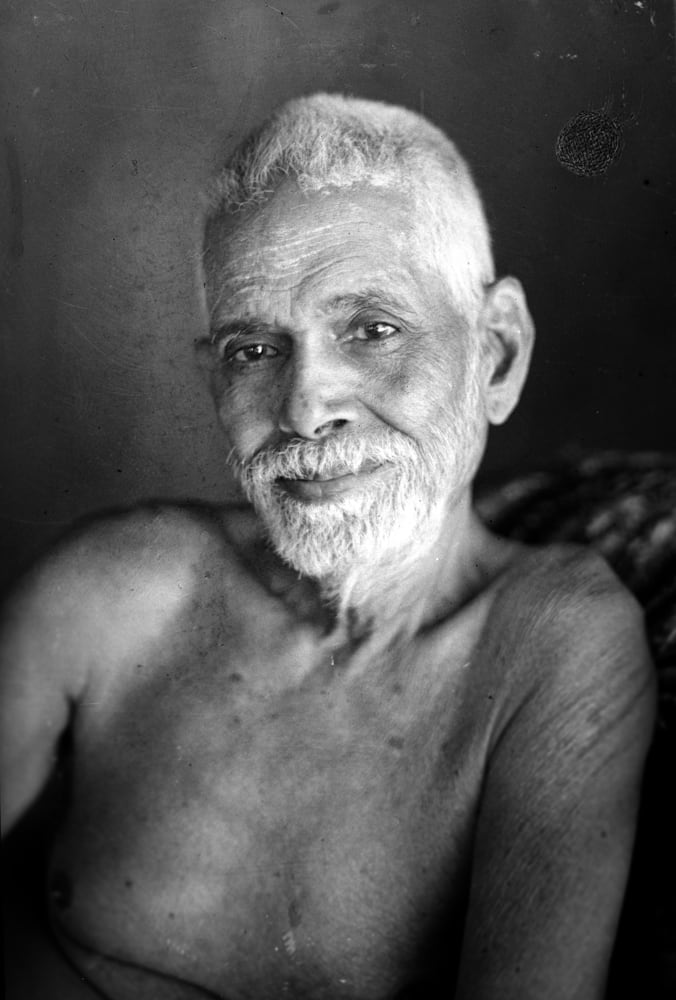
Ramana Maharshi
يتّفقان في: ما المطلق؟ هل الله موجود؟ · من أنا؟ هل توجد ذات حقيقية؟ · ماذا يحدث بعد الموت؟
Uddalaka Aruni
يتّفقان في: ما المطلق؟ هل الله موجود؟ · من أنا؟ هل توجد ذات حقيقية؟ · ماذا يحدث بعد الموت؟
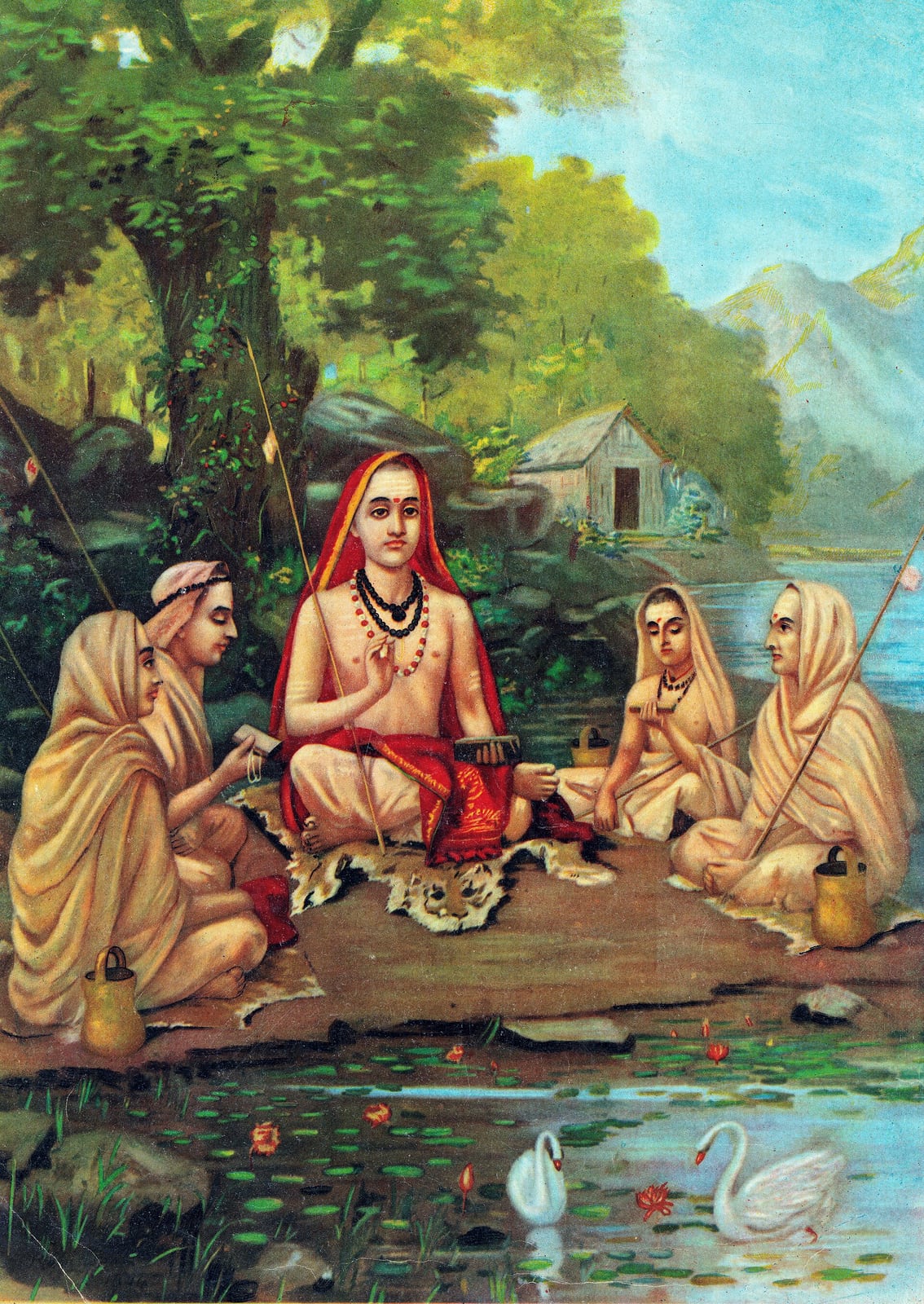
Adi Shankara
يتّفقان في: ما المطلق؟ هل الله موجود؟ · من أنا؟ هل توجد ذات حقيقية؟ · ماذا يحدث بعد الموت؟
Nisargadatta Maharaj
يتّفقان في: من أنا؟ هل توجد ذات حقيقية؟ · ماذا يحدث بعد الموت؟ · كيف يُبلَغ التحرّر أو الخلاص؟


حكايات وروايات
حكايات وروايات
رواية من سِيَر القدّيسينtiempo mítico
The three sons of Anasūyā
أصل الرواية: Mārkaṇḍeya Purāṇa, cantos XVI–XVII (Pargiter's translation, 1888–1904). In Pargiter the cursed brahmin is unnamed and the one who curses him is Māṇḍavya; other versions call him Kauśika. Variants of the birth appear in the Bhāgavata (4.1) and other Purāṇas.
رواية من سِيَر القدّيسينtiempo mítico
The yogin who hid in the lake
أصل الرواية: Mārkaṇḍeya Purāṇa, canto XVII (Pargiter's translation, pp. 100–101).
رواية من سِيَر القدّيسينtiempo mítico
The boons of Kārtavīrya Arjuna
أصل الرواية: Mahābhārata, Anuśāsanaparvan, section CLII of Ganguli's translation (dialogue of Pavana and Arjuna) and Āraṇyakaparvan 115; Mārkaṇḍeya Purāṇa, cantos XVIII–XIX (Pargiter's translation).
رواية من سِيَر القدّيسينtiempo mítico
The girl with the bracelets
أصل الرواية: Bhāgavata Purāṇa 11.9.5–10. The text does not name the avadhūta; the identification with Dattātreya is traditional.
رواية من سِيَر القدّيسينtiempo mítico
Piṅgalā, the courtesan who stopped waiting
أصل الرواية: Bhāgavata Purāṇa 11.8.22–44. Piṅgalā also appears in the Mahābhārata (Śāntiparvan) as an example of renouncing hope.
رواية من سِيَر القدّيسينtiempo mítico
Paraśurāma on Mount Gandhamādana
أصل الرواية: Tripurā Rahasya, Jñānakhaṇḍa, ch. 1 (vv. 23–57 in the Kaviraj and Khiste edition, Wikisource text), referring to the Māhātmyakhaṇḍa for the meeting with Saṃvarta.
شهادة1935
"The guru may be inanimate"
أصل الرواية: Talks with Sri Ramana Maharshi, talk 23, dated 2 February 1935; notes by Munagala Venkataramiah, published by Sri Ramanasramam in 1955.
التعاليم
التعاليم
المفاهيم التي ينتظم بها فكره، مشروحة في سياقها.
The avadhūtaavadhuta
The ideal belongs to the literature of renunciation (saṃnyāsa) and has parallels in the paramahaṃsa of the late Upaniṣads and in tantric and Nāth yogins.
The twenty-four teachersveinticuatro-gurus
Ramana Maharshi used this passage to explain that the guru is ultimately the Self; in the Datta tradition it is the core of the teaching on the teacher.
Equal taste (samarasa) and the natural (sahaja)samarasa
Sahaja and samarasa are also key terms of tantric Buddhism (the siddhas) and of Nāth and Sant poetry in North India.
Haṭhayoga and eight-limbed yogahatha-ashtanga
The Jābāladarśana Upaniṣad, also in Dattātreya's mouth, sets out eight-limbed yoga with ten restraints and ten observances.
The synthesis of the trimūrtitrimurti-sintesis
The fused trimūrti iconography is common in modern India, especially in Maharashtra, Karnataka and Gujarat.
مقاطع الفيديو
مقاطع الفيديو
تسجيلات ومقابلات وأفلام وثائقية. تُشغَّل مقاطع الفيديو من YouTube؛ ولا تُستضاف هنا.
Dattātreya: An Introduction | by Prof. Antonio Rigopoulos | Seminar Session 1
محاضرة· EN· 2025· 55 min
Let's Talk Tattva
YSP 37 James Mallinson | Dattātreya's Discourse on Yoga
مقابلة· EN· 2023· 51 min
Yogic Studiesالقناة الرسمية
Avadhūta Gītā Retreat | Session 1 | Swami Sarvapriyananda
محاضرة· EN· 2026· 51 min
Vedanta Society of New Yorkالقناة الرسمية
The Song of the Avadhoota I · Swami Sarvapriyananda (Class 1 of 3)
محاضرة· EN· 2026· 90 min
Vedanta Society of Southern Californiaالقناة الرسمية
Upanishad Ganga | Episode 25 | Guru! | Who Are Dattatreya's 24 Gurus? | Guru Tatva
فيلم وثائقي· HI· 2022· 23 min
ChinmayaChannelالقناة الرسمية
The Whole World is my Guru! | DattaGuru Special
تسجيل من طرف ثالث· HI· 2025· 10 min
ChinmayaChannelالقناة الرسمية
Tripura Rahasya (Ch-22) Talk 01 of 7 @ Prem Puri 2018 (English)
محاضرة· EN· 2018· 65 min
Anubhavananda Saraswati - Smiling Swamiالقناة الرسمية
How Dattatreya Made Parashuram His Disciple – Sadhguru
تسجيل من طرف ثالث· EN· 2019· 12 min
Sadhguruالقناة الرسمية
Dr. Robert Svoboda's Living with Reality Ep. 20: Dattatreya Story Time
محاضرة· EN· 2021· 48 min
Be Here Now Networkالقناة الرسمية
|| अवधूत - यदु संवाद (दत्तात्रयांचे २४ गुरु) || भाग- 01
محاضرة· MR· 2026· 50 min
Chaitanya Maharaj Deglurkar : Officialالقناة الرسمية
Ganagapur Dattatreya | Documentary Video | English
فيلم وثائقي· EN· 2021· 15 min
PrakhyatBhatt Pujari Ganagapur
Avadhuta Gita Capítulo 1
تسجيل من طرف ثالث· ES· 2021· 40 min
Silencio entre palabras
Avadhûta Gîtâ - I - Le Soi [Advaita Vedanta]
تسجيل من طرف ثالث· FR· 2022· 40 min
Le Vieux Sage
AVADHUTA GITA - Audiolibro completo
تسجيل من طرف ثالث· IT· 2023· 70 min
Nisargadatta Maharaj in italiano
المعرض
المعرض
صور بترخيص متحقَّق منه. كل منها تحتفظ بمؤلّفها ونسبتها.
العلاقات
العلاقات
تأثيرات وتلمذة وتقارب في الأفكار. تُميَّز العلاقة الموثّقة عن التشابه المستخلَص بالتحليل.
أثّر في
Nisargadatta explained that, according to legend, the first teacher of his lineage of the "nine masters" (Navnāth Sampradāya) was the ṛṣi Dattātreya, though he regarded those nine masters as mythological (I Am That, ch. 97).
علاقة موثّقة
أثّر في
Ramana cited the "ancient saint Avadhūta" of the twenty-four teachers (talk 23, 1935) and the Tripurā Rahasya (talks 314 and 616), the work that sets out Dattātreya's teaching to Paraśurāma.
علاقة موثّقة
أثّر في
Vivekananda glossed and translated passages of the Avadhūta Gītā in his talks at Thousand Island Park (28 July 1895).
علاقة موثّقة
أفكار قريبة من
The Dattātreyayogaśāstra integrates for the first time Patañjali's eight-limbed yoga with the techniques of haṭhayoga (Mallinson, 2024).
علاقة موثّقة
أفكار قريبة من
The Dattātreyayogaśāstra ascribes the teaching of eight-limbed yoga to Yājñavalkya; a yoga text (Yogayājñavalkya) also circulates under his name.
تشابه مستخلَص بالتحليل
أفكار قريبة من
Kapila and Dattātreya appear together in the Bhāgavata Purāṇa's list of avatāras (1.3.10–11), fifth and sixth, both as teachers of the science of the soul; the Dattātreyayogaśāstra ascribes haṭhayoga practices to Kapila.
تشابه مستخلَص بالتحليل
أفكار قريبة من
Tradition ascribes to Vyāsa the Mahābhārata and the Bhāgavata Purāṇa, the works that transmit the stories about Dattātreya and the avadhūta of the twenty-four teachers.
تشابه مستخلَص بالتحليل
أفكار قريبة من
In the Tripurā Rahasya, Haritāyana narrates to Nārada the teaching Dattātreya gave to Paraśurāma.
تشابه مستخلَص بالتحليل
أفكار قريبة من
The Avadhūta Gītā sets out a radical non-dualism akin to Śaṅkara's Advaita, though with a vocabulary (samarasa, sahaja) closer to tantric and Nāth traditions.
تشابه مستخلَص بالتحليل
أفكار قريبة من
The Avadhūta Gītā and the Aṣṭāvakra Gītā are often published together (Alexandra David-Néel translated them in one volume) because of their uncompromising non-dualism.
تشابه مستخلَص بالتحليل
أفكار قريبة من
Rigopoulos notes, according to the secondary literature, that the Avadhūta Gītā's ideas on attributeless brahman influenced Kabir's poetry; the relationship is not directly documented.
تشابه مستخلَص بالتحليل
مرتبط من صفحات أخرى
المصادر
المصادر
المراجع والفهارس التي رُوجعت لهذه الصفحة.
- Rigopoulos, Antonio. Dattātreya: The Immortal Guru, Yogin, and Avatāra. A Study of the Transformative and Inclusive Character of a Multi-faceted Hindu Deity. Albany: State University of New York Press, 1998. ISBN 9780791436967 (tapa dura), 9780791436950 (rústica). Las páginas citadas (43, 57, 77, 195–197, 227–228) se toman de las referencias de la Wikipedia en inglés; no se ha consultado el libro directamente.
- Pargiter, F. Eden (trad.). The Mārkaṇḍeya Purāṇa. Calcuta: Asiatic Society (Bibliotheca Indica), 1888–1904; cantos XVI–XIX (nacimiento de Dattātreya, el lago, Kārtavīrya Arjuna) y XXXVII–XLIII (enseñanza a Alarka).
- Bhāgavata Purāṇa 1.3.11 (Dattātreya, sexto avatāra) y 11.7.25–11.9 (el avadhūta y el rey Yadu: los veinticuatro maestros, lista en 11.7.33–35); texto sánscrito y traducción en Vedabase (Bhaktivedanta Book Trust).
- Mahābhārata: Āraṇyakaparvan 115 y Anuśāsanaparvan 91, 152–157 (numeración de la traducción de Ganguli; en la edición crítica, 3.115.12, 12.49.36–37, 13.152.5 y 13.153.12). Ganguli, Kisari Mohan (trad.). The Mahabharata of Krishna-Dwaipayana Vyasa. Calcuta: Pratap Chandra Roy, 1883–1896.
- Mallinson, James (ed. y trad.). The Dattātreyayogaśāstra. Pondicherry: Institut Français de Pondichéry / École française d'Extrême-Orient, 2024 (Collection Indologie 162; Haṭha Yoga Series 5). ISBN 9782855392967 (EFEO), 9788184702552 (IFP).
- Mallinson, James. «Nāth Sampradāya». En Knut A. Jacobsen et al. (eds.), Brill's Encyclopedia of Hinduism, vol. III. Leiden: Brill, 2011, pp. 407–428 (tesis de la incorporación tardía de Dattātreya al linaje nāth, pp. 407–411, citada según la Wikipedia en inglés).
- अवधूतगीता (Avadhūtagītā), texto sánscrito completo en ocho capítulos, Wikisource en sánscrito; colofón en 8.10.
- Abhayananda, Swami (trad.). Dattatreya: Song of the Avadhut. Olympia (Washington): Atma Books, 1992, p. 10 (datación en los siglos IX–X). Con Grimes, John A. A Concise Dictionary of Indian Philosophy. Albany: SUNY Press, 1996, p. 110. Ambas citadas según la Wikipedia en inglés.
- Olivelle, Patrick (trad.). The Saṃnyāsa Upaniṣads: Hindu Scriptures on Asceticism and Renunciation. Nueva York: Oxford University Press, 1992 (datación de la Jābāla y de la Avadhūta Upaniṣad, citadas según la Wikipedia en inglés). Texto sánscrito de la Avadhūtopaniṣad en Wikisource.
- जाबालदर्शनोपनिषत् (Jābāladarśanopaniṣad), texto sánscrito en diez khaṇḍa, Wikisource en sánscrito: Dattātreya enseña el yoga de ocho miembros a Sāṅkṛti (1.1–5).
- Tripurārahasya, Jñānakhaṇḍa, con la Tātparyadīpikā de Śrīnivāsa. Ed. Gopinath Kaviraj y Nārāyaṇa Śāstrī Khiste. Benarés: Government Sanskrit College, 1925–1933 (Princess of Wales Sarasvati Bhavana Texts 15); texto en Wikisource en sánscrito. Traducción inglesa: Munagala S. Venkataramiah (Swami Ramanananda Saraswathi), Tripura Rahasya or The Mystery beyond the Trinity, Tiruvannamalai, Sri Ramanasramam (ed. 2006, ISBN 9788188018291).
- Venkataramiah, Munagala (comp.). Talks with Sri Ramana Maharshi. Tiruvannamalai: Sri Ramanasramam, 1955; charla 23 (2 de febrero de 1935, preguntas de W. Y. Evans-Wentz) y charlas 314 y 616 (citas de la Tripurā Rahasya).
- Nisargadatta Maharaj. I Am That: Talks with Sri Nisargadatta Maharaj. Trad. Maurice Frydman, ed. Sudhakar S. Dikshit. Bombay: Chetana, 1973; cap. 97, «Mind and the World are not Separate».
- Vivekananda, Swami. Inspired Talks, «Sunday, July 28» (1895), en The Complete Works of Swami Vivekananda, vol. 7. Mayavati: Advaita Ashrama.
- Wikidata: «Dattatreya» (Q850805); «Avadhuta Gita» (Q790053); «Tripura Rahasya» (Q17036247); «Dattatreya Yoga Shastra» (Q104870312).
- Wadiyar, Jaya Chamarajendra. Dattātreya: The Way and the Goal. Introducción de S. Radhakrishnan. Londres: George Allen & Unwin, 1957 (traducción y comentario de la Jīvanmukta Gītā y la Avadhūta Gītā).
- जीवन्मुक्तगीता (Jīvanmuktagītā), texto sánscrito con el comentario de Jaya Chamarajendra Wadiyar, Wikisource en sánscrito; colofón: «compuesta por Śrī Dattātreya, león del vedānta».
- दत्तात्रेयोपनिषत् (Dattātreyopaniṣad), texto sánscrito, Wikisource en sánscrito.
- Hulin, Michel (trad.). La doctrine secrète de la déesse Tripurā: Tripurā Rahasya, section de la connaissance. París: Fayard, 1979 (Documents spirituels). ISBN 9782213008127.
- «Dattatreya», Wikipedia en inglés (consultada el 26-10-2026): síntesis de las tradiciones datta (Mahānubhāva, Gurucaritra, Navnāth), de la iconografía y de la Datta Jayantī, con referencias a Rigopoulos (1998), Bühnemann (1988) y Gopinatha Rao (1914). Fuente terciaria: se usa solo para datos de tradición.
- Open Library: Dattātreya Tantra, «Dattātreya viracita», con comentario hindi de Rudradeva Tripāṭhī. Delhi: Rañjana Pablikeśansa, 1995 (OL23606841W).
- صاحب الحقوق
- Textos sánscritos anónimos en dominio público. Las traducciones y ediciones modernas tienen derechos propios: SUNY Press (Rigopoulos), EFEO / Institut Français de Pondichéry (Mallinson), Sri Ramanasramam y World Wisdom (Tripurā Rahasya), Sri Ramakrishna Math y Advaita Ashrama (Avadhūta Gītā), Shanti Sadan (Shastri), Atma Books (Abhayananda), José J. de Olañeta, Luis Cárcamo, Éditions du Rocher, Fayard (Hulin), Oxford University Press (Olivelle).
في انتظار التأكيد
ما لم تتمكّن هذه الصفحة من حسمه بعد. نفضّل أن نقول ذلك على أن نملأ الفراغ.
- Fechas: Dattātreya es figura de la tradición, sin fechas; la línea de tiempo usa las de los textos, todas aproximadas y discutidas.
- Consultar directamente Rigopoulos (1998): las páginas citadas (43, 57, 77, 195–197, 227–228) proceden de las referencias de la Wikipedia en inglés.
- Confirmar en la edición de Mallinson (2024) la forma de diálogo con Sāṅkṛti y la relación con la Haṭhapradīpikā.
- Confirmar en Brill's Encyclopedia of Hinduism, vol. III (2011), las páginas de Mallinson sobre la incorporación de Dattātreya al linaje nāth (la Wikipedia cita «Mallinson 2012, pp. 407–411»).
- Avadhūta Gītā: la cifra de 289 versos es de Rigopoulos; la edición de Wikisource numera unos 280. Comparar con una edición impresa.
- Traducción de Shri Purohit Swami (Munshiram Manoharlal, 1979): es póstuma y no se ha encontrado en línea; en EE. UU. no es de dominio público (primera publicación en 1979). Un vendedor indica una 2.ª edición con ISBN 8121502451, no comprobada en catálogo.
- Traducción de Lala Kannoo Mal (Madrás, 1920): se desconoce la fecha de muerte del traductor; el escaneo del Digital Library of India (dli.ernet.214590) corresponde por error a otro libro. Buscar un escaneo válido.
- Dattātreya Tantra: comprobar contenido y forma (diálogo) en una edición crítica o un estudio; aquí se describe según las ediciones populares.
- Datta Saṃhitā: la tradición śrīvidyā menciona una «Dattasaṃhitā» perdida; no se registra hasta encontrar una fuente fiable.
- No se ha encontrado ninguna traducción española de la Tripurā Rahasya ni del Dattātreyayogaśāstra con ISBN.
- Sala de lectura: el Mārkaṇḍeya Purāṇa de Pargiter (dominio público) y la traducción de Ganguli contienen los relatos, pero en volúmenes que reúnen la obra entera; no se registran como lectura propia de Dattātreya.
- Vídeos: los del canal oficial de OSHO, de Sri M y otros sobre la Tripurā Rahasya no se han registrado por no ser oficiales o no estar verificados.
- Project Gutenberg no tiene ninguna edición de estas obras (búsqueda en gutenberg.org el 2026-10-26: «No records found»).
بُحث بتاريخ 2026-10-26