الهندوسية · بهاكتي · السيخية
Kabir
कबीर · कबीरदास · ਕਬੀਰ · کبیر
نحو 1440 – نحو 1518شخصية موثّقة تاريخيًا
شاعر ومتصوف من شمال الهند (نحو 1440–1518، أو 1398–1448 بحسب آخرين)، حائك من بنارس من أصل مسلم، ومن أعلام عبادة النيرغونا. أغانيه وأبياته المزدوجة، التي تناقلتها الألسنة ثم ثبّتتها ثلاثة تقاليد —«آدي غرانث» لدى السيخ، ومختارات الدادوبانثيين التي تنحدر منها «كبير غرانثاولي»، و«بيجك» لدى الكبيربانثيين—، تنتقد البراهمة والملالي على السواء. أما «القصائد المئة» التي ترجمها طاغور سنة 1915 فمعظمها مشكوك في نسبته إليه.
- مؤلَّفًا
- 6مؤلَّفًا
- طبعة
- 19طبعة
- اقتباسًا
- 8اقتباسًا
- مقطع فيديو
- 13مقطع فيديو
- صورة
- 7صورة
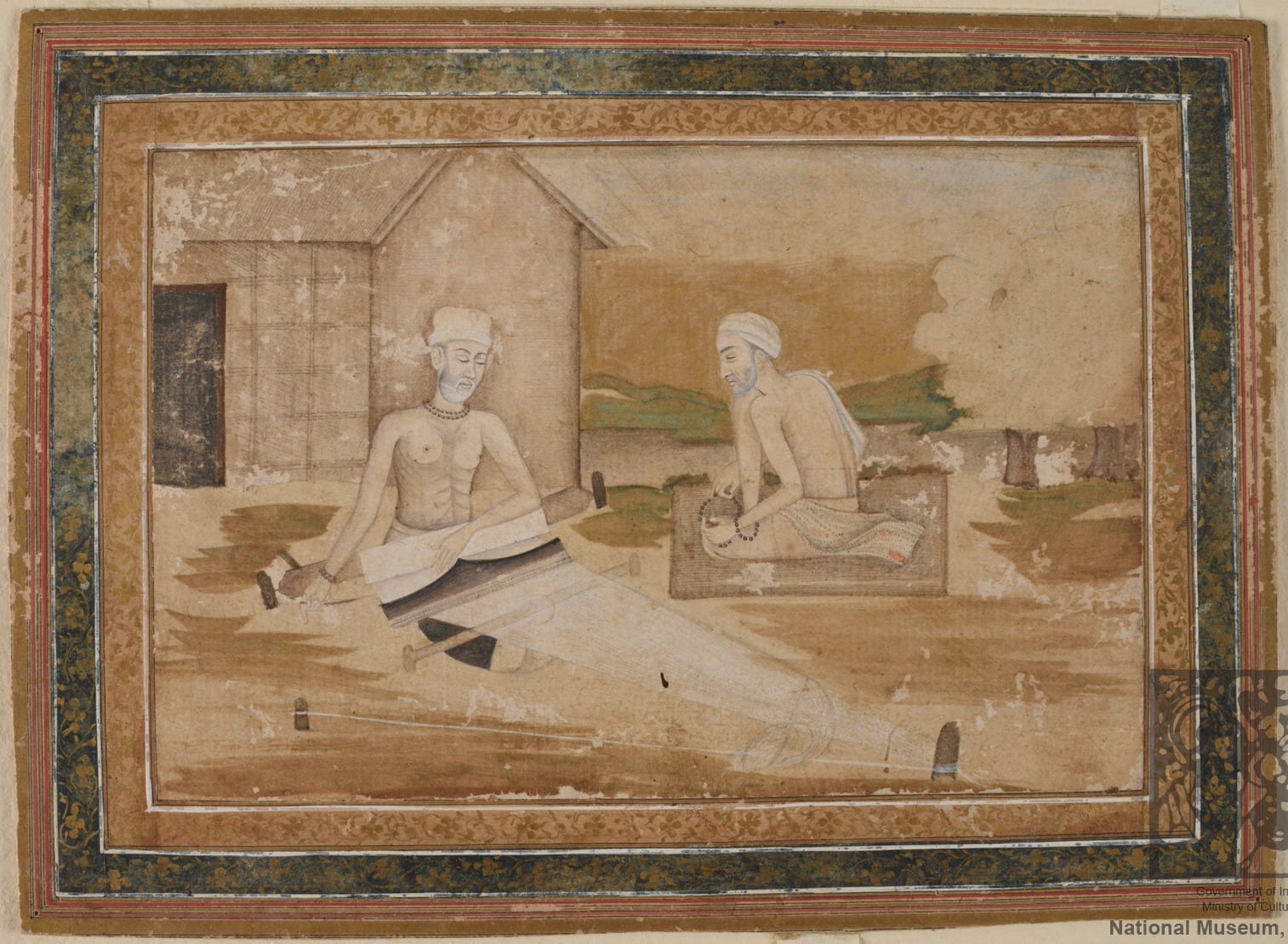
Kabir y Ravidas · Public domain
بكلماته
«If God be within the mosque, then to whom does this world belong? If Ram be within the image which you find upon your pilgrimage, then who is there to know what happens without?»Guru Granth Sahib, Prabhati, p. 1349 (texto gurmukhi según BaniDB); trad. española propia; versión inglesa de Tagore (*Songs of Kabir*, 1915, poema LXIX, uno de los seis que V. C. Mishra tiene por auténticos).

فكرته المحورية
Nirguna: the divine without attributes: Kabir's devotion is directed to a *nirguna* absolute, 'without qualities', which has no form, no incarnations and no image in temples.
السيرة
4 دقيقة قراءة
ترجمة مُعانة من الأصل الإسباني، بانتظار مراجعة مترجم من أهل اللغة.
حائك من بنارس
لا يمكن الجزم عن كبير، أكثر شعراء شمال الهند تردّدًا على الألسنة، إلا بأمرين اثنين، استنادًا إلى الأبيات التي تُنسب إليه بأوثق نسبة: أنه قضى معظم حياته في بنارس، فاراناسي اليوم، وأنه كان حائكًا، جُلاها، من طائفة دنيا المنزلة كانت أغلبيتها قد أسلمت في عصره. بل إن اسمه نفسه يشي بأصله المسلم، إذ «الكبير» من أسماء الله الحسنى. أما ما عدا ذلك، من والديه وشيخه وكراماته، فمن صنع التقاليد التي تنازعته بعد ذلك: فهو عند السيخ سلفٌ ممهّد لغورو ناناك، وعند المسلمين صوفي، وعند الهندوس عابد فيشنوي ذو نزعة كونية.
بل إن تواريخه نفسها ليست ثابتة. فتقليد الطائفة التي تحمل اسمه يجعل مولده سنة 1398 ووفاته سنة 1518، عن مئة وعشرين عامًا؛ وينقسم الباحثون بين من يرجّح، مثل ياروسلاف سترناد، الفترة 1398–1448، ومن يضع حياته، مع «الموسوعة البريطانية»، بين 1440 و1518. ويرى ديفيد لورنزن أنه توفي على الأرجح قرب التاريخ المأثور، أي 1518، في مَغْهَر قرب غوراكبور، كما يُجمع على ذلك تقليد الكبيربانثيين ووثيقة مغولية من سنة 1698–1699.
الأساطير
ملأت كتب المناقب هذا الفراغ. ففي إحداها أنه ابن أرملة برهمية تخلّت عنه، فالتقطه حائك مسلم يُدعى نيرو وزوجته نيما عند بركة لاهارتارا؛ وفي أخرى أنه ظهر على زهرة لوتس. وأشهرها تروي كيف استلقى الفتى، وهو يعلم أن معلّمًا هندوسيًّا لن يقبل مريدًا مسلمًا، على درجات الغانج حيث كان راماناندا يغتسل، فداسه المعلّم وهو ينزل وصاح: «رام، رام!»، فأعلن كبير أنه تلقّى بذلك تعويذة التلقين. وتصوّره أخرى ماثلًا للمحاكمة أمام السلطان سكندر لودي، ومنتصرًا على البراهمة والقضاة والتجار. وأقدم كتب المناقب، «كبير پرچئي» لأنانتاداس، يرجع إلى نحو سنة 1590، أي بعد وفاته بقرن تقريبًا.
وكانت إيفلين أندرهيل، في مقدمتها لترجمات طاغور سنة 1915، لا تزال تروي بوصفها حقائق محاكمته أمام سكندر لودي، التي أرّختها بسنة 1495، ووفاته سنة 1518. ونقلت أجمل الأساطير: حين مات الشاعر أراد مريدوه الهندوس إحراق جثمانه، وأراد المسلمون دفنه؛ فظهر لهم كبير وطلب منهم أن يرفعوا الكفن، فلم يجدوا تحته إلا كومة من الزهور اقتسموها بينهم. ولا يزال في مَغْهَر، على بُعد خطوات بعضهما من بعض، ضريح إسلامي وسمادهي هندوسي.
أما الأخبار التي لا تنتمي إلى أدب المناقب فشحيحة ومتأخرة. فأبو الفضل، مؤرخ أكبر، يذكر في أواخر القرن السادس عشر قبرين لكبير، أحدهما في بوري والآخر في راتانبور، دليلًا على أن أماكن عدة كانت تتنازعه منذ ذلك الحين. ويصفه «دبستان مذاهب»، وهو رسالة فارسية في الأديان من القرن السابع عشر، بأنه بيراغي، أي ناسك فيشنوي، من تلاميذ راماناندا؛ وهو بحسب المؤرخ عرفان حبيب أقدم نص يقدّم معلومات عن سيرته.
صوت كان يُغنّى
لم يكتب كبير، بل نظم وغنّى. وتتألف آثاره من بادات، وهي أغانٍ قصيرة تُؤدّى على مقام موسيقي، ومن ساكهيات، وهي أبيات مزدوجة أو «شهادات»، ومن رامينيات ذات طابع تعليمي، بلغة مختلطة من لغات شمال الهند يسمّيها النقاد سادهوكّري، أي لغة السادهو. وقد تداولت الألسنة والمخطوطات هذه الأبيات قرونًا، فتحوّلت في الطريق وتكاثرت، ونُسبت إلى اسمه قصائد نظمها معجبون به. ومن المتعذّر اليوم أن نقطع بأي الكلمات كلماته؛ غير أن ما يجمعها كلها صراحة خشنة ساخرة في وجه النفاق والغطرسة والشكلية الدينية.
وأقدم الشواهد المكتوبة متأخرة، ولم تصدر عن طائفته. فـپوتهيات غوينْدوال، وهي سابقة للكتاب المقدس السيخي جُمعت نحو 1570–1572، تضمّ خمسين من أغانيه، ومخطوطة فاتحبور المؤرخة في 1582 تضم خمس عشرة. ومن ثَمّ توزّعت آثاره على ثلاثة تقاليد إقليمية كبرى. فالتقليد السيخي ثبّتها في «آدي غرانث» الذي أتمّه غورو أرجن سنة 1604، وأبيات كبير فيه أكبر إسهام لمؤلف من خارج سلسلة الغورو، ومنها قسم يضم 243 شلوكًا. وجمعها تقليد الدادوبانثيين في راجستان في المختارات الكبرى المسماة «پانچ واني»، أي «الأصوات الخمسة»، حيث يأتي نصيب كبير في المرتبة الثانية من حيث الحجم بعد نصيب دادو نفسه، وهي أساس «كبير غرانثاولي» الحديثة. أما التقليد الشرقي، تقليد الكبيربانثيين في بنارس، فهو «بيجك»، الذي يُعدّ أقدم الصيغ وأصدقها، وإن كانت أقدم مخطوطاته الباقية لا تسبق مطلع القرن التاسع عشر، وقلّما تتطابق أبياته مع أبيات التقليدين الآخرين.
لا هندوسي ولا مسلم
لم يكن كبير موفّقًا بين الأديان، كما صوّره القرن العشرون، بل ناقدًا لا يرحم لكليهما على السواء. فالتلاوة بلا فهم عنده سواء أكانت أمام الفيدا أم أمام القرآن؛ والبرهمي والقاضي، والخيط المقدس والختان، والحج إلى بنارس والحج إلى مكة، كلها صور متوازية من الضلال. ولم يكن يعتدّ إلا بالوفاء للحقيقة الواحدة للحياة، التي كان يسمّيها الله ورام بلا تفريق، قاصدًا برام اسمًا من أسماء الإلهي لا بطل «رامايانا». وهذه الحقيقة المنزّهة عن الصفات، نيرغونا، تُطلب في الداخل: «ابحث في قلبك»، كما يقول أحد أناشيد «آدي غرانث»، «فهناك مقامه». ويفخر في نشيد آخر بأنه ترك بنارس، المدينة التي يُعتق فيها الموت صاحبه، ليموت في مَغْهَر، حيث كان الاعتقاد الشعبي يتوعّد بولادة جديدة سيئة.
الإرث
لم يؤسس كبير طائفة، لكن مريديه نظّموا شيئًا فشيئًا طائفة «كبير بانث» في القرن السادس عشر؛ وفي أواخر القرن السابع عشر كانت لها مراكز في شمال الهند كله، وأتباعها اليوم، وكثير منهم من الداليت، يُعدّون بالملايين. وقد جعله حضوره في «آدي غرانث» محاورًا لغورو ناناك، وإن ظل الباحثون يتجادلون في مدى تأثيره فيه. وعرّف به الغربَ سنة 1915 كتابُ «أغاني كبير» (Songs of Kabir)، وهو مئة قصيدة ترجمها رابندرانات طاغور بمعونة إيفلين أندرهيل عن المجموعة التي جمعها كشيتيموهان سين من الكتب ومن أفواه المنشدين الجوّالين. وصار الكتاب من الكلاسيكيات، غير أن ف. تش. ميشرا ذهب سنة 1987 إلى أن ست قصائد فقط من المئة صحيحة النسبة، وأن طاغور أسقط على كبير لاهوت عصره. وقد أعادت الترجمات النقدية لشارلوت فودفيل وليندا هيس وشوكديف سينغ، وحفلات المنشدين الشعبيين من أمثال براهلاد تيبانيا، إلى كبير صوته الخشن.
المصادر: Kabir. Songs of Kabir, trad. Rabindranath Tagore, introducción de Evelyn Underhill. Nueva York: Macmillan, 1915 (en Londres: One Hundred Poems of Kabir, India Society). Project Gutenberg n.º 6519.
الخط الزمني
الحياة عامًا بعد عام
كل نقطة حدث موثّق. انقر لتقرأه مع مصدره ودرجة اليقين فيه.
1398Benarés
Birth according to tradition
Kabirpanthi tradition places his birth in 1398 (full moon of *Jyeshtha*, Samvat 1455), which would make him a hundred and twenty at his death in 1518. Strnad accepts 1398 but moves his death to 1448.
تقليد«Kabir». Wikipedia en inglés (leyendas de nacimiento y persecución según Lorenzen; Dabestan-e Mazaheb; recensiones; crítica de V. C. Mishra, «Two Truths Are Told: Tagore's Kabir», en K. Schomer y W. H. McLeod (eds.), The Sants, 1987, pp. 167–180; Kabir Panth).
بعد وفاته
- نحو 1570 – 1572The Goindval pothis
- 1582Fatehpur manuscript
- نحو 1590First hagiography
- 1604Kabir in the Adi Granth
- نحو 1699Mughal document on the Magahar tomb
- 1910 – 1911Kshitimohan Sen's collection
- 1915Tagore's Songs of Kabir
- 1928Shyamsundar Das's Kabir Granthavali
- 1983Hess and Singh's Bijak
- 1987V. C. Mishra's critique of Tagore
1398
Birth according to tradition
Kabirpanthi tradition places his birth in 1398 (full moon of *Jyeshtha*, Samvat 1455), which would make him a hundred and twenty at his death in 1518. Strnad accepts 1398 but moves his death to 1448.
تقليد
نحو 1440 · أقل من عام
Birth according to much scholarship
The *Britannica* and other scholars place his birth around 1440 in Benares, into a family of Muslim weavers (*julaha*).
مرجَّح
نحو 1460 – 1518
Weaver and singer in Benares
He lives by his loom in Benares, married with a family according to the legends; he composes and sings *padas* and *sakhis* criticising Brahmins and mullahs alike. His relationship with Ramananda is the stuff of legend.
مرجَّح
نحو 1495
The trial before Sikandar Lodi (legend)
The hagiographies show him tried by Sultan Sikandar Lodi (r. 1489–1517) and banished from Benares; Underhill (1915) dated the episode to 1495, but there is no independent evidence.
مختلَف فيه
نحو 1518
Death at Magahar
He dies, according to the traditional date Lorenzen considers approximately correct, at Magahar near Gorakhpur. A hymn in the *Adi Granth* has Kabir say that he left Benares to die at Magahar.
مرجَّح
نحو 1570 – 1572
The Goindval pothis
The Sikh Goindval manuscripts, copies of an anthology assembled around 1570–1572, include fifty songs by Kabir: the oldest written witness to his work.
موثّق
1582
Fatehpur manuscript
The Fatehpur manuscript, mainly a collection of Surdas's songs, is the oldest dated manuscript containing poems by Kabir (fifteen).
موثّق
نحو 1590
First hagiography
Anantadas writes the *Kabir parachai*, the oldest hagiography; in 1712 Priyadas comments on the stanza about Kabir in Nabhadas's *Bhaktamal*.
موثّق
1604
Kabir in the Adi Granth
On 29 August Guru Arjan completes the *Adi Granth*, the first edition of the Sikh scripture, with a large number of Kabir's hymns and a section of 243 *shaloks* under his name.
موثّق
نحو 1699
Mughal document on the Magahar tomb
A document from Aurangzeb's reign (1698–1699) records the gift of a village for the upkeep of the Muslim tomb of 'Shah Kabir' at Magahar: the first documentary evidence of institutions linked to Kabir.
موثّق
1910 – 1911
Kshitimohan Sen's collection
Kshitimohan Sen publishes his four-part *Kabir* at Santiniketan (1910–1911), gathered from books, manuscripts and wandering singers; it will be the basis of Tagore's version.
موثّق
1915
Tagore's Songs of Kabir
Rabindranath Tagore publishes, with Evelyn Underhill, a hundred poems of Kabir in English (New York, Macmillan; in London, *One Hundred Poems of Kabir*). It becomes the West's Kabir.
موثّق
1928
Shyamsundar Das's Kabir Granthavali
Shyamsundar Das edits the *Kabir Granthavali* from manuscripts of the Rajasthani tradition, one of them bearing a date of 1504 that later scholarship does not accept as reliable.
موثّق
1983
Hess and Singh's Bijak
Linda Hess and Shukdev Singh publish their English translation of the *Bijak*, with essays and notes, a reference for modern Kabir studies.
موثّق
1987
V. C. Mishra's critique of Tagore
In *The Sants* (ed. Schomer and McLeod), V. C. Mishra argues that only six of Tagore's hundred poems (15, 32, 34, 35, 69 and 94) are authentic.
موثّق
المؤلَّفات
المؤلَّفات الأساسية
المؤلَّفات التي لا يُفهم إرثه من دونها.
مجموعة لاحقة
Bijak
बीजक (Bījak)
Scripture of the Kabirpanthis: didactic *ramainis*, *shabdas* (songs) and *sakhis* (couplets), plus some popular forms. It is the most polemical and disconcerting Kabir, that of the direct attacks on caste, rites and sacred books, and of the *ulatbansi*, 'upside-down language' riddles that jolt the listener's mind. Linda Hess and Shukdev Singh translated it in full in 1983, and their edition remains the English reference.
4 طبعات · amazon.com
Kabir
Kabir Granthavali
مجموعة لاحقة
Kabir Granthavali
कबीर ग्रंथावली (Kabīr granthāvalī)
A corpus of *sakhis* arranged by theme (*ang*), *padas* for singing and some *ramainis*, preserved by the followers of Dadu Dayal in Rajasthan. According to Hawley, the western Kabir is more devotional than the Punjabi one; in it Nath yogi influence, devotion to Ram and sant ethics coexist. Its couplets are the ones that have passed into everyday speech in northern India. Charlotte Vaudeville translated the *dohas* into French (1957) and English (1974).
5 طبعات · amazon.com

مجموعة لاحقة · 1604
Hymns and shaloks in the Guru Granth Sahib
ਭਗਤ ਕਬੀਰ ਜੀ ਕੀ ਬਾਣੀ — ਸ੍ਰੀ ਗੁਰੂ ਗ੍ਰੰਥ ਸਾਹਿਬ (Bāṇī Bhagat Kabīr jī kī)
Hymns (*shabad*) distributed through the ragas of the Sikh scripture (Gauri, Asa, Sorath, Bhairo, Prabhati and others) and, in the final section, the *Salok Bhagat Kabir* (243 couplets). Here appears a more earthly Kabir, the householder swept away by the intensity of love, and many of his best-known verses: seeking God in the heart and not in mosque or temple, mocking the fasts of Brahmins and Muslims, telling how he left Benares to die at Magahar. They are sung daily in gurdwaras.
طبعتان · amazon.com
Kabir
Songs of Kabir / One Hundred Poems of Kabir (Tagore's version)
نسبة تقليدية · 1915
Songs of Kabir / One Hundred Poems of Kabir (Tagore's version)
Songs of Kabir / One Hundred Poems of Kabir (versión de Tagore)
The book that made Kabir known in the West: a hundred poems in poetic prose about the God within man, the true master, the unstruck music (*anahad*), the inadequacy of words and the unity of all things. With Evelyn Underhill's introduction, which recounted the legends as facts, it was endlessly reprinted, retranslated into Spanish (Joaquín V. González, 1918), French (Henriette Mirabaud-Thorens and, in versions unpublished until 2012, André Gide) and many other languages, and it inspired Robert Bly's paraphrases. It is literature in its own right, but only a small part of it can be read as Kabir.
4 طبعات · amazon.fr

الأقوال
أقوال محدَّدة الموضع في مؤلَّف بعينه. كل منها يحمل مصدره ودرجة الثقة به.
If God be within the mosque, then to whom does this world belong? If Ram be within the image which you find upon your pilgrimage, then who is there to know what happens without?ਅਲਹੁ ਏਕੁ ਮਸੀਤਿ ਬਸਤੁ ਹੈ ਅਵਰੁ ਮੁਲਖੁ ਕਿਸੁ ਕੇਰਾ ॥ ਹਿੰਦੂ ਮੂਰਤਿ ਨਾਮ ਨਿਵਾਸੀ ਦੁਹ ਮਹਿ ਤਤੁ ਨ ਹੇਰਾ ॥
متحقَّق منهGuru Granth Sahib, Prabhati, p. 1349 (texto gurmukhi según BaniDB); trad. española propia; versión inglesa de Tagore (*Songs of Kabir*, 1915, poema LXIX, uno de los seis que V. C. Mishra tiene por auténticos).
أقوال منحولة أو مختلَف في نسبتها (2)
«O servant, where dost thou seek Me? Lo! I am beside thee. I am neither in temple nor in mosque: I am neither in Kaaba nor in Kailash.»
First poem of *Songs of Kabir* (Tagore, 1915), perhaps the most quoted 'Kabir' in the West. It comes from Kshitimohan Sen's collection and is not among the six V. C. Mishra regards as authentic: it may be the work of a later admirer imitating his style.
«Do not go to the garden of flowers! O Friend! go not there; In your body is the garden of flowers.»
Poem IV of *Songs of Kabir* (Tagore, 1915), widely circulated; like most of the selection, its attribution to Kabir is not proven according to Mishra's critique.
الكلمات الأخيرة
لا توجد سجلات يمكن التحقق منها لكلماته الأخيرة.
No attested last words survive. A hymn in the *Adi Granth* (Gauri, p. 326) has Kabir say that, having spent his life in Benares, 'at the time of death' he went to Magahar, and ends: 'Kabir died repeating the name of Ram'; it is poetry, not testimony. The legend of the flowers under the shroud comes from hagiography and is recorded by Underhill in 1915.
المصدر: Sri Guru Granth Sahib, bani de Bhagat Kabir (texto gurmukhi por página o *ang*: Gauri 326, Prabhati 1349–1350, Salok 1364–1377). BaniDB.
اسأل
بماذا يجيب أثره
اثنا عشر سؤالًا كبيرًا من أسئلة الإنسانية، وما تتيح نصوصه الإجابة به عنها، مع المراجع. ولا نقوّله ما لم يقل أبدًا.
ما المطلق؟ هل الله موجود؟
Ram without attributes: not in mosque or idol, but in the heart
ما لا يُسمّىيقوله صراحةً
Kabir calls the ultimate Ram, Hari or Allah, but insists that it is not the Rama of the avatars nor a God enclosed in a temple: it is nirguna, without attributes, and its story is ‘unspeakable’. In verses preserved in the Guru Granth Sahib he asks whose the rest of the world would be if Allah lived only in the mosque, and says he found the truth neither in the Hindu image nor in the Muslim rite; Hari and Allah dwell neither in the south nor in the west but deep in the heart. His language of paradox (ulatbansi) shows that ordinary thought cannot reach that One. And yet Kabir addresses it with a servant’s tenderness: the formless Lord is also the one with whom love cannot be broken.
قارن هذا السؤال مع معلّمين آخرينمن أنا؟ هل توجد ذات حقيقية؟
What you seek outside is within: search deep in the heart
الذات هي المطلقيُستنتج من تعاليمه
Kabir develops no doctrine of the soul, but his verses agree in turning the search inward: Hari and Allah dwell neither in the south nor in the west but deep in the heart, which is their abode. The tradition bearing his name abounds in images of the drop and the ocean, or of the deer that searches outside for the musk it carries within. The self that boasts of caste, learning or piety is for Kabir a mask that death tears off; what remains is the place where the Name dwells. His language oscillates between identity with the divine and the relation of a servant to his Lord, and never turns that tension into a system.
قارن هذا السؤال مع معلّمين آخرينلماذا نتألّم؟
Maya deceives, and separation from the Beloved burns
الانفصال عن اللهيُستنتج من تعاليمه
In Kabir’s verses suffering has two faces. One is maya, which he calls the great swindler: attachment to wealth, body, caste and rites, which makes one forget the Name and leaves the human being at the mercy of death. The other is viraha, the pain of separation from the Beloved, which Kabir describes as a snake living in the body or a fire that will not go out. This second pain is not merely an evil: it is the sign that the soul has woken to its absence, and the one who suffers it is closer to Ram than the one who feels satisfied. The death that terrifies the world, says one of his verses, fills his mind with joy.
قارن هذا السؤال مع معلّمين آخرينماذا يحدث بعد الموت؟
Dying while alive: the death that terrifies the world is his joy
الموت كل يوم عن المعلوميقوله صراحةً
Kabir speaks of death with unusual insistence and turns it upside down. In a verse of the Guru Granth Sahib he says that the death which terrifies the world fills his mind with joy, because only by dying is supreme bliss attained: the point is to die while living, for the ego to die before the body. His final gesture, according to tradition, was to go and die in Magahar, a place said to bring a bad rebirth, rather than in Benares, where dying guaranteed liberation; one of his verses recalls it. With this he denied that place or rite decide the soul’s fate. Kabir shares the belief in cycles of births, but his interest lies in the inner death that frees now.
قارن هذا السؤال مع معلّمين آخرينكيف يُبلَغ التحرّر أو الخلاص؟
The Name of Ram and the true master, not rituals
بالتعبّد والتسليميقوله صراحةً
Kabir rejects every external path to liberation: ablutions, fasts, pilgrimage, the study of the Vedas and the Qur’an, caste and the ascetic’s garb. Not even the place of death saves, as he showed by going to die in Magahar. What frees is the loving repetition of the Name of Ram (ram nam), received from the satguru, and the inner devotion that transforms the one who lives it. The tradition bearing his name also speaks of sahaj, a natural and spontaneous state, as opposed to the forced techniques of yoga. One of his most quoted verses offers itself in sacrifice for his own humble caste, in which he was able to repeat the Creator’s name: devotion knows no lineage.
قارن هذا السؤال مع معلّمين آخرينهل نحتاج إلى معلّم؟
The satguru opens the eyes; without him one cannot cross over
لا غنى عنهيقوله صراحةً
The satguru, the true master, holds a central place in Kabir’s verses. The section on the guru (gurudev ko ang) in the Rajasthani recension describes him as the one who opens the disciple’s eyes, shows him the infinite and gives him the word that frees. A much-quoted doha imagines guru and God standing before the disciple and asks to whom one should bow first, concluding: to the guru, for he has shown God. Kabir, who mercilessly criticises Brahmins, mullahs and ascetics, does not confuse that master with religious authority: the satguru is the one who transmits the experience of the Name. In some readings the true guru is the Word (shabad) itself.
قارن هذا السؤال مع معلّمين آخرينهل العالم حقيقي؟
The world is a passing market; only the Name endures
ظاهرٌ فوق الحقيقة الواحدةيُستنتج من تعاليمه
In Kabir’s verses the world is above all transient and deceptive. He compares it to a fair being taken down, to a dream, to a clay pot that breaks; maya, the great swindler, makes people cling to house, body and wealth as if they would last. Only the Name of Ram is real and endures. Yet the world is not sheer nothingness for Kabir: one of his verses in the Guru Granth Sahib states that the whole world sprang from a single light, so no one can be called good or bad by origin. What deceives is not the world’s existence but taking it for the ultimate.
قارن هذا السؤال مع معلّمين آخرينما الحب؟
Like the lotus leaf on water: a love that cannot break
الشوق والوصاليقوله صراحةً
Kabir makes love (prem) the centre of his path and sets it against book learning: according to a much-quoted doha, no one became wise by reading books, but whoever learns the few letters of the word love is wise. In a verse preserved in the Guru Granth Sahib he asks how the love between his Lord and him could ever break, and answers with an image: as the lotus leaf rests on the water, so He is his Lord and he his servant. That love is also made of separation and seeking, and in his verses the soul appears as a bride waiting for the Beloved. For Kabir love is not one feeling among others: it is the only key that opens Ram’s door.
قارن هذا السؤال مع معلّمين آخرينهل نحن أحرار أم أن كل شيء مقدَّر؟
He does not debate fate: all is Ram’s doing; the choice is love
لم يُبدِ رأيًا
The verses attributed to Kabir do not pose the philosophical problem of freedom and fate. On the one hand they repeat that everything happens by the Lord’s will and that human beings own nothing, not even their next breath. On the other they constantly challenge the listener to change: to give up hypocrisy, wake up before death comes and repeat the Name while there is still time. That constant exhortation presupposes that something depends on the hearer, but Kabir never reconciles the two claims or turns them into doctrine. His interest is not in explaining how the will works but in shaking it. It would strain the texts to attribute to him a theory of free will.
قارن هذا السؤال مع معلّمين آخرينلماذا نتأمّل أو نصلّي؟
Search your heart: there the unstruck music plays
العودة إلى منبع الأنايقوله صراحةً
Kabir scorns ritual prayer: he mocks the muezzin who shouts as if God were deaf and the Brahmin who tells his rosary beads while his mind wanders. What he proposes is turning inward: Hari and Allah live neither in the south nor in the west but deep in the heart, and it is there one must search. His practice is continuous remembrance of the Name (simran) and listening to the inner sound, the unstruck music (anahad) which in one of his verses plays by itself where rivers of light flow. Meditation is not a separate exercise but a natural state (sahaj) that accompanies the whole of life. To pray is to discover that what was sought was in the seeker.
قارن هذا السؤال مع معلّمين آخرينهل يستطيع العقل أن يعرف الحقيقة القصوى؟
No one became wise by reading books: the ultimate is known by loving
الحقيقة القصوى وراء العقليقوله صراحةً
Kabir, a low-caste weaver and probably illiterate, mocks the scholars who recite the Vedas and the qazi who quotes the Qur’an without knowing God. In his verses scriptures and theological debate are an obstacle when they replace experience: the pandit speaks of what he has not seen. His paradoxical language (ulatbansi), with impossible images such as the cow milking the calf or the river on fire, deliberately baffles the logical mind to point to what lies beyond it. The ultimate is known through direct experience, love and the grace of the true master. Kabir does not set faith against reason: he sets experience against empty talk.
قارن هذا السؤال مع معلّمين آخرينالانسحاب من العالم أم تغييره؟
Weaver and householder: the divine is not in the ascetic’s robe
التأمّل في الفعليقوله صراحةً
Kabir lived, according to tradition, as a weaver in Benares, married with children, and never took up the renunciant’s life. His verses mock the yogis who smear themselves with ash, grow their hair or pierce their ears, and the ascetics who flee to the forest thinking to find God there. For Kabir the divine is found neither in a place nor in a robe but in the heart, and can be remembered while working at the loom. His ideal of sahaj, the natural and spontaneous, rejects both worldliness and ostentatious renunciation. At the same time his critique of caste and religious hypocrisy had a social reach that his low-caste followers claimed.
قارن هذا السؤال مع معلّمين آخرين
التقارب والتوتّر
التقارب والتوتّر
محسوبة سؤالًا سؤالًا انطلاقًا من مواقفه. وسبب كل اتفاق أو اختلاف يظهر بالنقر.
يقترب في تفكيره من
Plotinus
يتّفقان في: ما المطلق؟ هل الله موجود؟ · من أنا؟ هل توجد ذات حقيقية؟ · لماذا نتألّم؟
Meher Baba
يتّفقان في: من أنا؟ هل توجد ذات حقيقية؟ · كيف يُبلَغ التحرّر أو الخلاص؟ · هل نحتاج إلى معلّم؟

Mirabai
يتّفقان في: لماذا نتألّم؟ · كيف يُبلَغ التحرّر أو الخلاص؟ · هل نحتاج إلى معلّم؟

Al-Hallaj
يتّفقان في: من أنا؟ هل توجد ذات حقيقية؟ · لماذا نتألّم؟ · كيف يُبلَغ التحرّر أو الخلاص؟



حكايات وروايات
حكايات وروايات
رواية من سِيَر القدّيسينs. XV (según la leyenda)
The child of the Lahartara pond
أصل الرواية: Legends from Hindu and Kabir Panth hagiographies, nearly a century later than his death (the oldest, Anantadas's *Kabir parachai*, c. 1590). The *Britannica* records the Brahmin widow; Wikipedia, the lotus and Niru and Nima. His name and trade point to a Muslim origin.
رواية من سِيَر القدّيسينs. XV (según la leyenda)
Initiated by a footstep
أصل الرواية: A hagiographic story told by Evelyn Underhill in her introduction to *Songs of Kabir* (1915). The *Dabestan-e mazaheb* (17th century) already calls him Ramananda's disciple; the *Britannica* allows for a strong influence from Ramananda, but the scene on the steps has no contemporary source.
رواية من سِيَر القدّيسينc. 1495 (según la leyenda)
Before Sultan Sikandar Lodi
أصل الرواية: A narrative cycle developed in Anantadas's *Kabir parachai* (c. 1590) and later hagiographies (Lorenzen, *Kabir Legends and Ananta-Das's Kabir Parachai*, 1991). Underhill (1915) presented it as fact; many scholars doubt its historicity for lack of independent evidence.
رواية من سِيَر القدّيسينc. 1518 (según la leyenda)
The flowers under the shroud
أصل الرواية: A hagiographic legend recorded by Underhill (1915). That he died at Magahar is unanimously held by Kabirpanthi tradition and by a Mughal document of 1698–1699 on the tomb of 'Shah Kabir' (Lorenzen, 2019); the *Adi Granth* itself contains a hymn about his move from Benares to Magahar to die.
موثّق1604
Guru Arjan takes Kabir into the Sikh scripture
أصل الرواية: Facts documented by the Sikh manuscripts themselves; dates according to the history of the *Adi Granth* and Strnad (2023) for the Goindval *pothis*. The count of *shaloks* checked against the BaniDB text (pp. 1364–1377).
موثّق1910–1915
How Tagore's Kabir was born
أصل الرواية: Preface and introduction of *Songs of Kabir* (1915) and the Wikipedia article on the book; V. C. Mishra's critique, 'Two Truths Are Told: Tagore's Kabir', in Schomer and McLeod (eds.), *The Sants* (1987), pp. 167–180, is cited at second hand.
التعاليم
التعاليم
المفاهيم التي ينتظم بها فكره، مشروحة في سياقها.
Nirguna: the divine without attributesnirguna
A feature shared by the *sants* of northern India (Ravidas, Dadu, Nanak) as opposed to *saguna* devotion to incarnate Krishna or Rama (Tulsidas, Surdas, Mirabai).
The Name: Ram, Allah, Hariram-nam
The practice of *nam-simran*, shared with the *sants* and central to Sikhism.
The true master (satguru)satguru
A concept common to the *sant* tradition and to Sikhism, where the guru acquires an institutional dimension.
Sahaj: the spontaneous and naturalsahaj
A term inherited from the tantric *siddhas* and the *nath* yogis, reinterpreted by the *sants*.
Ulatbansi: upside-down languageulatbansi
A genre related to the *sandhya-bhasha* of the Buddhist tantric *siddhas* and the *naths*.
مقاطع الفيديو
مقاطع الفيديو
تسجيلات ومقابلات وأفلام وثائقية. تُشغَّل مقاطع الفيديو من YouTube؛ ولا تُستضاف هنا.
Had Anhad: Journeys with Ram & Kabir
فيلم وثائقي· HI· 103 min
Ajab Shahar — Kabir Projectالقناة الرسمية
Kabira Khada Bazaar Mein: Journeys with Sacred & Secular Kabir
فيلم وثائقي· HI· 94 min
Ajab Shahar — Kabir Projectالقناة الرسمية
Chalo Hamara Des: Journeys with Kabir & Friends
فيلم وثائقي· EN· 97 min
Ajab Shahar — Kabir Projectالقناة الرسمية
Linda Hess introduces Kabir — Episode 3 of 'Chalo Hamara Des'
مقابلة· EN· 4 min
Ajab Shahar — Kabir Projectالقناة الرسمية
Kabir: Revisiting 'Bodies of Song', a talk by Prof. Linda Hess
محاضرة· EN· 2020· 97 min
Ulatbansi
Bodies of Song: The Legacy of Kabir — Linda Hess in conversation with Sanjoy K. Roy
مقابلة· EN· 41 min
JLF Internationalالقناة الرسمية
Understanding Kabir: Life, Philosophy and Poetry by Purushottam Agarwal (Module 1)
محاضرة· HI· 2026· 41 min
Jashn-e-Rekhtaالقناة الرسمية
Kabir Das | Documentary | Story of Kabir Das
فيلم وثائقي· HI· 26 min
Prasar Bharati Archivesالقناة الرسمية
'Kahaan Se Aaya Kahaan Jaaoge?' by Prahlad Tipanya
تسجيل من طرف ثالث· HI· 10 min
Ajab Shahar — Kabir Projectالقناة الرسمية
'Nirbhay Nirgun Gun Re' sings Pt. Kumar Gandharva
تسجيل من طرف ثالث· HI· 10 min
Ajab Shahar — Kabir Projectالقناة الرسمية
Salok Bhagat Kabir Ji — Bhai Maninder Singh Ji (Gurbani Kirtan)
تسجيل من طرف ثالث· PA· 21 min
Amrit Baani — Goyal Musicالقناة الرسمية
KABÎR — Une vie, une œuvre : le vagabond céleste (France Culture, 1991)
فيلم وثائقي· FR· 1991· 80 min
ÉCLAIR BRUT
Kabir: the poet, saint and weaver of Ancient India (full version)
فيلم وثائقي· EN· 2004· 29 min
Peter Steven Malakoffالقناة الرسمية
المعرض
المعرض
صور بترخيص متحقَّق منه. كل منها تحتفظ بمؤلّفها ونسبتها.
المخطوطات
المخطوطات
شواهد مخطوطة ونصوص قديمة، مع جهة حفظها وشروط الاطّلاع عليها.
PA · Gurmukhi · s. XV–XVI
Goindval pothis (Mohan pothis)
- الشاهد المحفوظ
- Dos manuscritos, copias de una antología reunida hacia 1570–1572, con cincuenta canciones de Kabir; solo uno lleva una fecha, equivalente a 1595
- جهة الحفظ
- Colección de los descendientes de Baba Mohan
HI · Devanagari · s. XV–XVI
Manuscrito de Fatehpur
- الشاهد المحفوظ
- Antología fechada en 1582 (Samvat 1639), sobre todo de canciones de Surdas: el manuscrito fechado más antiguo con poemas de Kabir
HI · Devanagari · s. XV–XVII
Panch-vani dadupanthi
- الشاهد المحفوظ
- Antologías manuscritas del siglo XVII de la secta de Dadu Dayal, en las que la *Kabir vani* es la segunda sección en extensión
- جهة الحفظ
- Diversas bibliotecas y monasterios dadupanthis de Rajastán
العلاقات
العلاقات
تأثيرات وتلمذة وتقارب في الأفكار. تُميَّز العلاقة الموثّقة عن التشابه المستخلَص بالتحليل.
أثّر في
Documented: Kabir's verses appear in the Goindval *pothis* (c. 1570) and in the *Adi Granth* (1604), where they dialogue with the gurus'. Disputed: W. H. McLeod places Nanak in Kabir's *sant* tradition and sees in him a reproduction of its fundamental doctrines; Surjit Singh Gandhi and J. S. Grewal deny it. No meeting between them is recorded; accounts of one are traditional.
علاقة موثّقة
أفكار قريبة من
Great voices of vernacular *bhakti* in northern India, partly contemporaries if Kabir died in 1518; but Mirabai sings to Krishna with form (*saguna*) and Kabir to the divine without attributes (*nirguna*). The Kabir Project has brought them together in its films.
تشابه مستخلَص بالتحليل
أفكار قريبة من
Vaudeville, Lorenzen and Adrián Muñoz relate Kabir's *nirguna* absolute to the Brahman of Advaita Vedanta, albeit with differences; Kabir scorns the Brahmanical learning Shankara embodies.
تشابه مستخلَص بالتحليل
أفكار قريبة من
The mysticism of love and separation brings them together, and Underhill (1915) assumed an influence from the Persian Sufi poets; scholars debate whether Sufism influenced the *sants* or whether both developed through mutual interaction.
تشابه مستخلَص بالتحليل
أفكار قريبة من
Both teach that what is sought lies within the seeker and distrust outward religion; no historical connection is known.
تشابه مستخلَص بالتحليل
أفكار قريبة من
Both aim their sharpest verses at outward religion (the ascetic, the preacher, the pandit and the mullah) in the name of inner sincerity.
تشابه مستخلَص بالتحليل
المصادر
المصادر
المراجع والفهارس التي رُوجعت لهذه الصفحة.
- Wikidata, Q312551 «Kabir» (P31=Q5; 85 enlaces entre wikis; P569 1398 y 1440; P570 1518; P19 Varanasi; P20 Maghar).
- The Editors of Encyclopaedia Britannica. «Kabir». Encyclopaedia Britannica (consultada en la copia de Wayback Machine de 2024).
- Lorenzen, David N. Reseña de Purnendu Ranjan, Kabirpanth till the end of the Medieval India (Chandigarh: Gyankosh, 2016). Kervan. International Journal of Afro-Asiatic Studies 23/1 (2019), pp. 261–263.
- Strnad, Jaroslav. «Kabīr's Pads». En Triveṇī: Texts of Three Literary Traditions in Early Modern Languages of North India. Osaka: Osaka University, 2023, pp. 61–128. DOI 10.18910/94760.
- Kabir. Songs of Kabir, trad. Rabindranath Tagore, introducción de Evelyn Underhill. Nueva York: Macmillan, 1915 (en Londres: One Hundred Poems of Kabir, India Society). Project Gutenberg n.º 6519.
- «Kabir». Wikipedia en inglés (leyendas de nacimiento y persecución según Lorenzen; Dabestan-e Mazaheb; recensiones; crítica de V. C. Mishra, «Two Truths Are Told: Tagore's Kabir», en K. Schomer y W. H. McLeod (eds.), The Sants, 1987, pp. 167–180; Kabir Panth).
- «Songs of Kabir». Wikipedia en inglés (fuentes de Tagore: colección de Kshitimohan Sen y traducción inédita de Ajit Kumar Chakravarty; autenticidad).
- Sri Guru Granth Sahib, bani de Bhagat Kabir (texto gurmukhi por página o *ang*: Gauri 326, Prabhati 1349–1350, Salok 1364–1377). BaniDB.
- «Guru Granth Sahib». Wikipedia en inglés (compilación del Adi Granth por Guru Arjan, completada el 29 de agosto de 1604; bhagats incluidos).
- صاحب الحقوق
- Dominio público (obra oral del siglo XV). Las traducciones de Tagore (1915) y Underhill son de dominio público; las ediciones críticas y traducciones modernas (Oxford University Press, Motilal Banarsidass, Penguin, NYRB, SUNY Press, Brill, Gallimard) están sujetas a los derechos de sus editores y traductores.
في انتظار التأكيد
ما لم تتمكّن هذه الصفحة من حسمه بعد. نفضّل أن نقول ذلك على أن نملأ الفراغ.
- Recuento exacto de los himnos (*shabad*) de Kabir en el Guru Granth Sahib por raga: solo se ha comprobado la sección de 243 *shaloks* (pp. 1364–1377); no se ha encontrado una fuente fiable para las cifras que circulan.
- Sala de lectura en español: la traducción de Joaquín V. González (1918, dominio público) solo se ha hallado en una adaptación de 2023 con notas de Luis Cárdenas Camus (archive.org, con derechos); buscar el texto de 1918.
- Sala de lectura en hindi: localizar una transcripción de las *Kabir Granthavali* de Shyamsundar Das (1928; Das m. 1945, dominio público en España desde 2026) o del *Bijak* en Wikisource hindi; la API de hi.wikisource no respondió.
- Confirmar la fecha de muerte de Ahmad Shah, traductor del *Bijak* (1917), para decidir si su texto entra en la sala de lectura.
- Leer directamente el ensayo de V. C. Mishra (Schomer y McLeod, *The Sants*, 1987, pp. 167–180) y la introducción de Hess y Singh al *Bijak*; aquí se citan de segunda mano a través de Wikipedia.
- Confirmar el ISBN de *Kabir: Ecstatic Poems* (Robert Bly, Beacon Press): el que da Wikipedia (9780807063804) corresponde en Open Library a otro libro.
- Vídeos en español: no se ha encontrado ninguno de un canal institucional.
- Confirmar los datos editoriales de la edición de Parasnath Tiwari (1961) y de la traducción francesa de Vaudeville (Pondichéry, 1957).
بُحث بتاريخ 2026-10-25