الإسلام · التصوف
Attar
فریدالدین ابوحامد محمد عطار نیشابوری · عطار
نحو 1145 – 1221شخصية موثّقة تاريخيًا
شاعر فارسي وكاتب في سير الأولياء (نيسابور، نحو 1145 – نحو 1221م)، عطّار بالمهنة ومن أعلام الشعر الصوفي. يروي «منطق الطير» رحلة الطيور عبر سبعة أودية حتى تكتشف أن السيمرغ هو هي نفسها؛ ويؤلف مع «إلهي نامه» و«مصيبت نامه» و«أسرار نامه» دورةً من المثنويات الصوفية، أما «تذكرة الأولياء» فهي الجامع الفارسي الكبير لسير الأولياء. وكثير من الآثار المتداولة باسمه لعطار آخر. وكان جلال الدين الرومي وريثه.
- مؤلَّفًا
- 29مؤلَّفًا
- طبعة
- 32طبعة
- اقتباسًا
- 6اقتباسًا
- مقطع فيديو
- 13مقطع فيديو
- صورة
- 8صورة
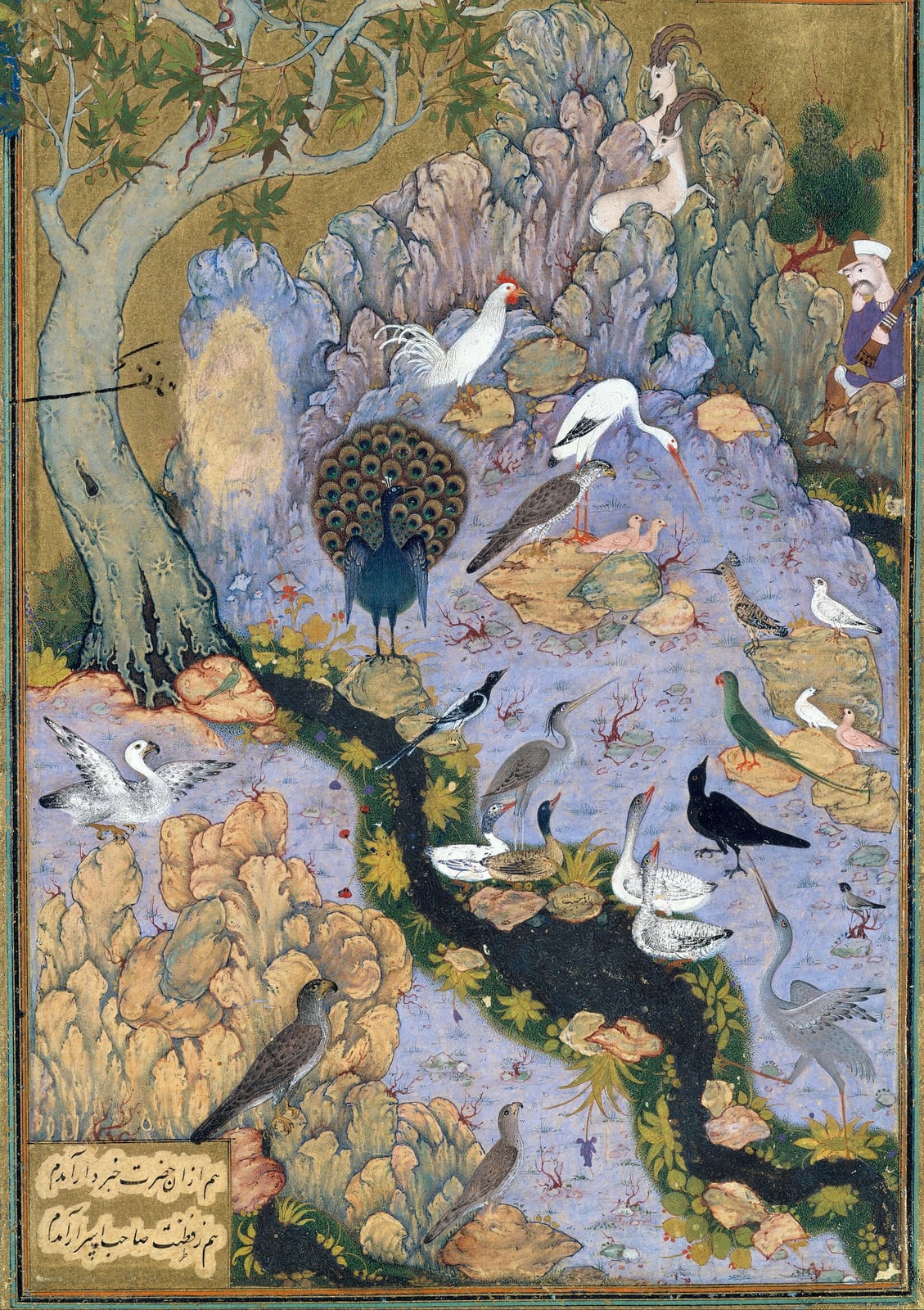
La asamblea de las aves · CC0
بكلماته
«Praise to the pure Creator of the soul, who gave the dust a soul and gave it faith.»Mantiq al-tayr, dístico inicial («Fi al-tawhid»), texto persa según Ganjoor; traducciones propias.

فكرته المحورية
The Simorgh and the thirty birds: The Simorgh is a fabulous bird of Iranian tradition, wise and benevolent, which in the *Shahnameh* raises the hero Zal.
السيرة
4 دقيقة قراءة
ترجمة مُعانة من الأصل الإسباني، بانتظار مراجعة مترجم من أهل اللغة.
عطّار نيسابور
وقّع أبو حامد محمد بن أبي بكر إبراهيم مؤلفاته باسمين: فريد الدين، أي «درّة الدين»، والعطّار، وهي حرفة من يبيع العطور والعقاقير والأدوية. عاش في نيسابور، حاضرة خراسان الكبرى، ولا يُعرف عن حياته على وجه اليقين إلا القليل. فلم يذكره من معاصريه سوى اثنين: صاحب المختارات محمد عوفي، الذي عدّه في شعراء العصر السلجوقي، والفيلسوف نصير الدين الطوسي، الذي زاره وهو طالب حين كان العطار قد بلغ الشيخوخة، وحدّث تلميذه ابن الفُوَطي بعد سنوات بأن فصاحته قد بهرته. أما الخبر التالي، وهو ما ورد في «تاريخ گزيده» لحمد الله المستوفي، فيعود إلى سنة 1330م.
ولا يقول شعره عنه إلا القليل، لكنه يقول شيئًا محددًا: أنه كان يمارس الصيدلة ويستقبل بنفسه عددًا كبيرًا من الزبائن، وأنه نظم «مصيبت نامه» و«إلهي نامه» وهو منصرف إلى عمله في دكانه. ولأنه لم يكن يتكسّب بالشعر، استطاع أن يزدري صنعة شاعر المديح في البلاط، وهي صنعة لم يتعاطها قط. ويؤكد برند راينرت أن حياته صيدلانيًّا وصوفيًّا لا يبدو أن الأسفار قطعتها، وأنه عاش في شيخوخته معتزلًا الناس؛ أما الرحلات الطويلة إلى مكة ودمشق والهند التي تنسبها إليه التراجم المتأخرة فمن نسج الأسطورة.
تواريخ غير مؤكدة
قدّر بديع الزمان فروزانفر أنه وُلد نحو سنة 540هـ (1145–1146م)؛ أما التاريخ الوحيد الذي يذكره العطار نفسه، وهو سنة 573هـ (1177م) بوصفها السنة التي أتمّ فيها «منطق الطير»، فيرد في بيت لا تتضمنه جميع المخطوطات. وأما وفاته، فالرأي الأشيع، الذي أخذ به فروزانفر وراينرت، أنه قُتل في المذبحة التي اجتاح بها المغول نيسابور في صفر سنة 618هـ، أي في نيسان/أبريل 1221م؛ ويذكّر هرمان لاندولت بأن سنة 1230م تظل احتمالًا قائمًا. وقد ظلت «الموسوعة البريطانية» في طبعة 1911، وفيّةً للمصادر المتأخرة، تمنحه مئة وعشر سنين من العمر، من 1119 إلى 1229م: وهو مثال على كيف تضخّمت صورته حين ذاع صيت مؤلفاته.
الأساطير
لم يكن العطار في حياته معروفًا يُذكر خارج نيسابور. ولم تُكتشف عظمته متصوفًا وقاصًّا إلا في القرن التاسع الهجري (الخامس عشر الميلادي)، وحينئذٍ زيّن جامي ودولتشاه السمرقندي سيرته بحكايات عجيبة. فبحسب دولتشاه، سأله درويش كان يتأمل دكانه كيف ينوي أن يموت وهو يخلّف وراءه كل هذه البضائع، فترك العطار دكانه وسلك طريق التصوف. وبحسب المؤلف نفسه، أسره جندي مغولي فرفض أن يبيعه بألف درهم، فلما عرض عليه آخر كيسًا من التبن قال له العطار: بِعني، فما أساوي أكثر من ذلك؛ فاستشاط الجندي غضبًا وقتله. وقد أثبت فروزانفر أن الشيوخ الذين نُسب إليهم، كنجم الدين كبرى وقطب الدين حيدر وغيرهما، من صنع الخيال؛ ولا يصحّ منها إلا صلته بمجد الدين البغدادي، الذي يذكر هو نفسه أنه لقيه، وربما نسبة أُويسية، باطنية، إلى أبي سعيد بن أبي الخير.
آثار تضخّمت مع شهرته
نسبت إليه الأسطورة من المؤلفات بعدد سور القرآن، وشغل تمييزُ الصحيح منها علماءَ الاختصاص قرنًا كاملًا. لاحظ هلموت ريتر اختلافات في الأسلوب والمذهب، فبعض هذه الآثار سنّي وبعضها شيعي، وظنّ في البداية أنها تعكس تطورًا في فكر الشاعر؛ ثم أثبت سعيد نفيسي سنة 1941 أن ذات النزعة الشيعية منها، مثل «مظهر العجائب» و«لسان الغيب»، لعطار آخر من أهل تون عاش في مشهد بعد نحو قرنين ونصف. وثمة مجموعة ثانية، على رأسها «جوهر الذات» وتدور حول شخصية الحلاج، ليست له هي الأخرى لأسباب أسلوبية، وإن ظل مؤلفها مجهولًا. ويعدّد العطار نفسه مؤلفاته في مقدماته: «الديوان»، و«أسرار نامه»، و«منطق الطير»، و«مصيبت نامه»، و«إلهي نامه»، و«جواهر نامه»، و«شرح القلب»، ويضيف أنه أتلف الأخيرين بيديه.
ويُضاف إلى هذه القائمة «مختار نامه»، وهو مختارات من رباعياته، و«تذكرة الأولياء»، أثره النثري الوحيد. وأكثر الحالات إثارة للجدل «خسرو نامه»، وهي قصة غرامية بلاطية تُعرف أيضًا باسم «گل وهرمز»: فقد عدّها راينرت صحيحة النسبة، بينما ذهب محمد رضا شفيعي كدكني إلى أنها منحولة متأخرة، وأن العنوان الذي كان العطار يشير به إلى أحد آثاره يعود في الحقيقة إلى «إلهي نامه»، وهي أطروحة يعدّها لاندولت ثابتة؛ ثم أعاد أوستن أومالي فتح المسألة سنة 2019 بمخطوطة مؤرخة في 1297م تنسبها إلى العطار.
المثنويات الصوفية الأربع
يتأمل «أسرار نامه»، الخالي من حكاية إطارية، في اثنين وعشرين مقالًا هبوطَ الروح وخلاصَها من أغلال العالم. أما «منطق الطير»، رائعته، فيأخذ عن «رسالة الطير» المنسوبة إلى الأخوين الغزالي مجمعَ الطيور التي تبحث عن ملك لها: بقيادة الهدهد تجتاز سبعة أودية، ولا يبلغ السيمرغ منها إلا ثلاثون طائرًا، فتكتشف أن السيمرغ هو هي نفسها، سي مرغ، أي «ثلاثون طائرًا» بالفارسية. ويتتبع «مصيبت نامه» سالكًا يسأل أربعين كائنًا، من جبريل إلى الأنبياء، حتى تخبره النفس الكلية بأن ما يطلبه كامن فيه. وفي «إلهي نامه» يجيب خليفةٌ عن رغبات أبنائه الستة الدنيوية، وهي ابنة ملك الجن والسحر وكأس جمشيد وماء الحياة وخاتم سليمان والكيمياء، كاشفًا عن معناها الباطن. وتقول الآثار الأربعة الشيء نفسه بأربع طرائق: غاية الإنسان كامنة فيه.
تذكرة الأولياء
تجمع «تذكرة الأولياء» سير مشايخ التصوف الأوائل وأقوالهم، من جعفر الصادق وأويس القرني والحسن البصري إلى الحلاج، الذي رأى فيه العطار من بلغ بالتصوف كماله. أما التراجم المتأخرة الواردة في بعض النسخ فليست له. ونادرًا ما يسمّي العطار مصادره، بل يعيد صياغة الأخبار على طريقته، فلا يُعتمد الكتاب كثيرًا تأريخًا لمن يترجم لهم، لكنه وثيقة نفيسة عن الوجدان الصوفي؛ وقد نقل فوق ذلك إلى الفارسية بأمانة بالغة الأقوال المروية بالعربية. ومنذ النصف الثاني من القرن السابع الهجري (الثالث عشر الميلادي) كثر قرّاؤه، وقد ترجم پافيه دو كورتيي إلى الفرنسية سنة 1889 نسخة قديمة منه بالتركية الشرقية مكتوبة بالخط الأويغوري.
الإرث
اتخذ جلال الدين الرومي لـ«المثنوي» وزنَ «منطق الطير»، وأعاد صياغة حكايات للعطار. وأرادت الرواية أكثر من ذلك: أن الشاعر الشيخ، حين رأى أسرة بهاء الدين ولد تمرّ بنيسابور، أهدى الصبي جلال الدين نسخة من «أسرار نامه». وقد فسّر ريتر هذه الأسطورة بأثر ذلك الكتاب في مقدمة «المثنوي»، فيما يعدّها فرانكلين لويس أسطورة خلافة روحية. ونقل علي شير نوائي «منطق الطير» إلى التركية الجغتائية، وشيّد الضريح في نيسابور، الذي جُدّد سنة 1940. وعرفته أوروبا عن طريق «پند نامه» الذي ترجمه سلفستر دو ساسي سنة 1819، وهو يُعدّ اليوم منحولًا، ثم عن طريق تحقيق غارسان دو تاسي لـ«منطق الطير» (1857) وترجمته (1863)، اللذين أثارا إعجاب إدوارد فيتزجيرالد حتى صاغه بتصرّف في «برلمان الطيور» (Bird-Parliament)، الذي لم يُنشر في حياته وصدر بعد وفاته سنة 1889.
المصادر: «Farīd ud-Dīn ʽAttār». Encyclopædia Britannica, 11.ª ed., vol. 10. Cambridge, 1910–1911 (resume los relatos de Dawlatshah sobre su conversión y su muerte). Texto en Wikisource. · FitzGerald, Edward. Letters and Literary Remains of Edward FitzGerald, ed. William Aldis Wright, vol. II. Londres: Macmillan, 1889 (incluye «Bird-Parliament» con la nota de E. B. Cowell sobre su génesis). · Attar, Farid al-Din. The Tadhkiratu 'l-awliya («Memoirs of the saints»), ed. Reynold A. Nicholson, con introducción de Mirza Muhammad Qazvini. 2 vols. Londres y Leiden: Luzac / Brill, 1905–1907 (Persian Historical Texts).
الخط الزمني
الحياة عامًا بعد عام
كل نقطة حدث موثّق. انقر لتقرأه مع مصدره ودرجة اليقين فيه.
نحو 1145أقل من عامNishapur
Birth in Nishapur
Abu Hamid Muhammad, son of Abu Bakr Ibrahim, is born. Foruzanfar calculates c. 540/1145–1146; the 1911 Britannica, following late sources, gave 1119.
مرجَّحReinert, Bernd. «ʿAṭṭār, Farīd-al-Dīn». Encyclopaedia Iranica, vol. III, fasc. 1, pp. 20–25. Publicado el 15-12-1987.
بعد وفاته
- 1297Oldest manuscript of the Khusraw-nama
- 1330Mustawfi's mention
- نحو 1486The legend is born
- 1819The Pand-nama in Europe
- 1857 – 1863Garcin de Tassy's edition
- 1905 – 1907Nicholson's edition of the Tadhkirat
- 1940Ilahi-nama edition and renovation of the mausoleum
- 1941Nafisi identifies the 'other Attar'
- 1984Davis and Darbandi translation
نحو 1145 · أقل من عام
Birth in Nishapur
Abu Hamid Muhammad, son of Abu Bakr Ibrahim, is born. Foruzanfar calculates c. 540/1145–1146; the 1911 Britannica, following late sources, gave 1119.
مرجَّح
نحو 1170 – 1221
Druggist and Sufi
He practises pharmacy in Nishapur and attends many customers; according to his prefaces, he composes the *Musibat-nama* and the *Ilahi-nama* in the shop. The legends of his conversion by a dervish date from the fifteenth century.
موثّق
1177
Date of the Mantiq al-tayr
A closing line of the *Mantiq al-tayr* dates its completion to 573/1177, but it is not found in all manuscripts.
مختلَف فيه
نحو 1209
Meeting with Majd al-Din Baghdadi
Attar says in the *Tadhkirat al-awliya* that he met Majd al-Din Baghdadi, disciple of Najm al-Din Kubra, who died around 1209; he is the only plausible master among those tradition ascribed to him.
مرجَّح
نحو 1215 – 1221
Visit of Nasir al-Din Tusi
The young Tusi visits the aged Attar in Nishapur (between 612/1215 and 618/1221, according to Foruzanfar) and praises his eloquence, as transmitted by his pupil Ibn al-Fuwati.
موثّق
أبريل 1221
Death in the Mongol sack of Nishapur
According to the most widespread opinion (Foruzanfar, Reinert), he dies violently in the massacre of Safar 618/April 1221; Landolt considers 1230 possible. The tale of the sack of straw is Dawlatshah's legend.
مرجَّح
1297
Oldest manuscript of the Khusraw-nama
A copy of 1297, now in the Bibliothèque nationale de France, already contains the romance and its preface under Attar's name: Austin O'Malley adduces it in 2019 against the forgery thesis.
موثّق
1330
Mustawfi's mention
Hamdallah Mustawfi mentions him in the *Tarikh-e guzida*, the third surviving notice after those of Awfi and Tusi.
موثّق
نحو 1486
The legend is born
In the fifteenth century his work is rediscovered; Jami (*Nafahat al-uns*, 1476–1478) and Dawlatshah (*Tadhkirat al-shu'ara*, 1486) embroider his life with tales of conversion, masters and death. Ali Shir Nava'i raises a mausoleum for him in Nishapur.
موثّق
1819
The Pand-nama in Europe
Silvestre de Sacy publishes in Paris the *Pend-Namèh, ou le Livre des conseils*, the first 'Attar' work translated in Europe; modern scholarship considers it apocryphal.
موثّق
1857 – 1863
Garcin de Tassy's edition
Joseph Garcin de Tassy edits the Persian text of the *Mantiq al-tayr* (1857) and publishes his French translation in 1863; Edward FitzGerald, delighted, composes his free version *Bird-Parliament* (1862, posthumous in 1889).
موثّق
1905 – 1907
Nicholson's edition of the Tadhkirat
Reynold A. Nicholson publishes in London and Leiden, with an introduction by Muhammad Qazvini, the edition of the *Tadhkirat al-awliya* (1905–1907).
موثّق
1940
Ilahi-nama edition and renovation of the mausoleum
Hellmut Ritter publishes the critical edition of the *Ilahi-nama* (Leipzig and Istanbul); the Nishapur mausoleum is fully renovated under Reza Shah.
موثّق
1941
Nafisi identifies the 'other Attar'
Sa'id Nafisi shows in his *Jostoju dar ahval o asar-e Farid al-Din Attar* that the Shi'ite works ascribed to Attar belong to a namesake from Tun who lived in Mashhad some two and a half centuries later.
موثّق
1984
Davis and Darbandi translation
Afkham Darbandi and Dick Davis publish *The Conference of the Birds* in Penguin Classics, the most widely read English verse version.
موثّق
المؤلَّفات
المؤلَّفات الأساسية
المؤلَّفات التي لا يُفهم إرثه من دونها.
مؤلَّف مكتوب · نحو 1177
Mantiq al-tayr (The Conference of the Birds)
منطقالطیر (Mantiq al-tayr), también مقامات الطیور (Maqamat al-tuyur)
A masnavi of several thousand couplets and Attar's masterpiece. The birds of the world gather to choose a king; the hoopoe, Solomon's messenger, proposes that they seek the Simorgh. Each bird excuses itself with a human weakness (the nightingale's love for the rose, the parrot's longing for immortality, the peacock's paradise) and the hoopoe answers with stories, among them that of Shaykh San'an in love with a Christian girl. Those who set out cross seven valleys: quest, love, knowledge, detachment, unity, bewilderment, and poverty and annihilation. Only thirty arrive, and they discover that the Simorgh is their own reflection: *si morgh*, 'thirty birds'. The frame story comes from the Ghazalis' *Risalat al-tayr*.
14 طبعة · amazon.com
Attar
Ilahi-nama (The Book of God)
مؤلَّف مكتوب
Ilahi-nama (The Book of God)
الهینامه (Ilahi-nama)
A masnavi of some 6,500 couplets with a frame story: a caliph asks his six sons what they desire, and each asks for something marvellous (the daughter of the king of the fairies, mastery of magic, Jamshid's world-reflecting cup, the water of life, Solomon's ring, alchemy). The father shows them that, taken literally, these wishes are absurd, but that understood inwardly they can be fulfilled: the princess is the purified soul, the cup is the mystic united with God, the elixir is the divine light that transforms everything. Hundreds of stories, from three to four hundred lines, illustrate the same message as the *Mantiq al-tayr*: what man seeks is within him.
3 طبعات · amazon.com

مؤلَّف مكتوب
Tadhkirat al-awliya (Memorial of God's Friends)
تذکرة الأولیاء (Tadhkirat al-awliya)
Attar's only prose work and the great Persian collection of saints' lives: some seventy biographies of masters of classical Sufism, from Ja'far al-Sadiq, Uways al-Qarani and Hasan of Basra to al-Hallaj, with their sayings and anecdotes, among them those of Rabi'a al-Adawiyya. Attar relies almost solely on written sources he rarely names and reworks the stories with a taste of his own, but he translates the Arabic sayings faithfully. The account of al-Hallaj's execution is its most famous page. Widely read since the thirteenth century, it also matters as a specimen of early Persian prose.
6 طبعات · amazon.com
جميع مؤلَّفاته (29)

Musibat-nama (The Book of Affliction)
Attar
Asrar-nama (The Book of Secrets)
The Conscious LibraryAsrar-nama (The Book of Secrets)

Divan
Attar
Mukhtar-nama (The Book of Selections)
The Conscious LibraryMukhtar-nama (The Book of Selections)
Attar
Khusraw-nama (Gol and Hormoz)
The Conscious LibraryKhusraw-nama (Gol and Hormoz)
Attar
Mi'raj-nama (Book of the Ascension)
The Conscious LibraryMi'raj-nama (Book of the Ascension)
Attar
Jumjuma-nama (Book of the Skull)
The Conscious LibraryJumjuma-nama (Book of the Skull)
Attar
Jawahir-nama (Book of Jewels)
The Conscious LibraryJawahir-nama (Book of Jewels)
Attar
Sharh al-qalb (Commentary on the Heart)
The Conscious LibrarySharh al-qalb (Commentary on the Heart)
Attar
Kashf al-asrar and Ma'rifat al-nafs
The Conscious LibraryKashf al-asrar and Ma'rifat al-nafs
Attar
Pand-nama (Book of Counsel)
The Conscious LibraryPand-nama (Book of Counsel)
Attar
Bulbul-nama (Book of the Nightingale)
The Conscious LibraryBulbul-nama (Book of the Nightingale)
Attar
Jawhar al-dhat (The Essence of Essence)
The Conscious LibraryJawhar al-dhat (The Essence of Essence)
Attar
Ushtur-nama (Book of the Camel)
The Conscious LibraryUshtur-nama (Book of the Camel)
Attar
Haylaj-nama
The Conscious LibraryHaylaj-nama
Attar
Mansur-nama
The Conscious LibraryMansur-nama
Attar
Bisar-nama (Book of the Headless)
The Conscious LibraryBisar-nama (Book of the Headless)
Attar
Mazhar al-aja'ib (Manifestation of Wonders)
The Conscious LibraryMazhar al-aja'ib (Manifestation of Wonders)
Attar
Lisan al-ghayb (The Tongue of the Unseen)
The Conscious LibraryLisan al-ghayb (The Tongue of the Unseen)
Attar
Waslat-nama (Book of Union)
The Conscious LibraryWaslat-nama (Book of Union)
Attar
Khayyat-nama (Book of the Tailor)
The Conscious LibraryKhayyat-nama (Book of the Tailor)
Attar
Kanz al-asrar (The Treasure of Secrets)
The Conscious LibraryKanz al-asrar (The Treasure of Secrets)
Attar
Miftah al-futuh (The Key of Openings)
The Conscious LibraryMiftah al-futuh (The Key of Openings)
Attar
Wasiyat-nama (Book of the Testament)
The Conscious LibraryWasiyat-nama (Book of the Testament)
الأقوال
أقوال محدَّدة الموضع في مؤلَّف بعينه. كل منها يحمل مصدره ودرجة الثقة به.
Praise to the pure Creator of the soul, who gave the dust a soul and gave it faith.آفرین جان آفرین پاک را / آن که جان بخشید و ایمان خاک را
متحقَّق منهMantiq al-tayr, dístico inicial («Fi al-tawhid»), texto persa según Ganjoor; traducciones propias.
أقوال منحولة أو مختلَف في نسبتها (2)
«Boundless praise to that pure God who gave faith to a handful of dust.»
Opening couplet of the *Pand-nama*, which imitates the beginning of the *Mantiq al-tayr*. Ritter considers it apocryphal: there is no trace of the work before the fifteenth century and its language is alien to Attar's, although it was the first work 'of his' translated in Europe (Silvestre de Sacy, 1819).
«Praise to the Creator of the soul and soul of the soul, who is both manifest and hidden.»
Opening of the *Mazhar al-aja'ib*, a fifteenth-century Shi'ite poem composed by the Attar of Tun and ascribed for centuries to Farid al-Din; Sa'id Nafisi showed in 1941 that it belongs to that late namesake.
الكلمات الأخيرة
نسبة تقليدية
«Sell me for the sack of straw, for I am worth no more.»Words put in his mouth by the legend transmitted by Dawlatshah of Samarkand (1486), more than two and a half centuries later: captured by a Mongol soldier, he is said to have refused to be sold for a thousand dirhams and then advised accepting a sack of straw (or fodder), which enraged the soldier, who killed him. It is a Sufi parable on the worth of the self, not a testimony; it is not even certain that he died in 1221.
المصدر: «Farīd ud-Dīn ʽAttār». Encyclopædia Britannica, 11.ª ed., vol. 10. Cambridge, 1910–1911 (resume los relatos de Dawlatshah sobre su conversión y su muerte). Texto en Wikisource.
اسأل
بماذا يجيب أثره
اثنا عشر سؤالًا كبيرًا من أسئلة الإنسانية، وما تتيح نصوصه الإجابة به عنها، مع المراجع. ولا نقوّله ما لم يقل أبدًا.
ما المطلق؟ هل الله موجود؟
The Creator praised is also the mirror where the seeker is lost
شخصي وغير شخصي معًايقوله صراحةً
Attar opens The Conference of the Birds by praising a personal Creator who gave soul to dust and granted it faith, and in the Memorial of the Saints he gathers prayers addressed to a Thou who answers. But the ending of the same poem shows another face of the divine. The Simurgh, the king the birds seek through seven valleys, turns out to be a mirror: the thirty birds who arrive — si murgh, in Persian — see that those thirty birds are the Simurgh, and the Presence explains to them, without tongue, that whoever arrives sees himself in it. Then they are lost in Him like a shadow in the sun. The Absolute is at once the King who is sought and entreated and the faceless unity in which the seeker is extinguished.
قارن هذا السؤال مع معلّمين آخرينمن أنا؟ هل توجد ذات حقيقية؟
The thirty birds discover that they are the Simurgh
الذات هي المطلقيقوله صراحةً
Attar's answer lies in the ending of The Conference of the Birds. Thousands of birds set out in search of their king, the Simurgh; only thirty survive the seven valleys. On arriving, they see that those thirty birds, si murgh in Persian, are the Simurgh, and the Presence tells them it is a mirror in which whoever arrives sees himself, soul and body. What the seeker finds at the end of the path is not a different object but his own reality in God. To get there one must cross the valley of poverty and annihilation (fana), where the self is consumed like the moth in the flame. The self being sought is not the one that sets out on the journey: it is the one that appears when that one has been extinguished.
قارن هذا السؤال مع معلّمين آخرينلماذا نتألّم؟
The soul's unrest is longing for the King; its pain is already the path
الانفصال عن اللهيقوله صراحةً
Attar wrote an entire book on affliction, the Musibat-nama: a restless wayfarer, guided by his master, questions angels, prophets, elements and creatures without anything calming his unrest, until he discovers that what he seeks lies in the ocean of the soul. The root of suffering is separation from the King: the birds of The Conference of the Birds live without a sovereign, scattered and busy with their attachments, and each makes an excuse not to set out. But Attar does not want to suppress this pain. The pain (dard) of the search is precious, because it is what sets one moving: whoever enters the valley of the quest meets a hundred hardships at every moment, and only through them advances. What is truly tragic is not to feel the lack.
قارن هذا السؤال مع معلّمين آخرينماذا يحدث بعد الموت؟
Dying to oneself in the valley of annihilation to subsist in God
الحياة الأبدية والقيامةيقوله صراحةً
Attar shares the eschatology of Islam, but his attention lies on another death: the one the seeker must pass through in life. The seventh valley of The Conference of the Birds is that of poverty and annihilation (fana), where the self is lost like a drop in the ocean or a moth in the flame; the poem adds that after this extinction the birds are returned to themselves and subsist in God. In the Memorial of the Saints he narrates the death of many masters as the culmination of their path, and his account of the execution of al-Hallaj is one of the most famous. Legend attributes to Attar himself a death at the hands of a Mongol soldier, with a last gesture of detachment, but it is a late account.
قارن هذا السؤال مع معلّمين آخرينكيف يُبلَغ التحرّر أو الخلاص؟
Crossing seven valleys with a guide: of thousands of birds, thirty arrive
بالممارسة المنضبطةيقوله صراحةً
The Conference of the Birds is an itinerary. The hoopoe announces to the birds that there are seven valleys on the way: the quest, love, knowledge, detachment, unity, bewilderment and, finally, poverty and annihilation; after that lies the King's court. Before setting out, each bird presents its excuse — the nightingale its rose, the hawk its king, the duck its water — and the hoopoe answers each with a story that dismantles its attachment. Liberation thus requires sustained effort, a guide and the progressive renunciation of all that holds one back. Many die on the way or give up; only thirty arrive. What they find at the end, however, is not a reward earned: it is their own annihilation in the Simurgh.
قارن هذا السؤال مع معلّمين آخرينهل نحتاج إلى معلّم؟
Without the hoopoe, no bird would have set out to seek the King
لا غنى عنهيقوله صراحةً
In The Conference of the Birds the birds do not set out on their own: they need the hoopoe, who knows the way, has been with Solomon and knows where the Simurgh lives. Before leaving they cast lots to choose a guide, and the lot falls on her; from then on they follow her, question her and confide their fears to her, and she answers each with a story. In The Book of Affliction the wayfarer also advances accompanied by a master who interprets what each creature tells him. For Attar, without a guide the soul gets lost in its excuses and in the dangers of the journey. The Memorial of the Saints is, at bottom, a gallery of masters whose lives and words serve as a guide to the reader.
قارن هذا السؤال مع معلّمين آخرينهل العالم حقيقي؟
All the birds are the shadow of the Simurgh
تجلٍّ للإلهييقوله صراحةً
In The Conference of the Birds the hoopoe tells that the Simurgh first manifested itself in China, at midnight, and let fall a feather; all the images and arts of the world arise from the attempt to reproduce it. Later she explains to the birds that when the Simurgh showed its face its shadow fell upon the earth, and from that shadow came the birds: each of them is a shadow of the King it seeks. The world, then, is neither illusion nor autonomous reality but manifestation: reflection, shadow or trace of a beauty that exceeds it. That is why it can lead the seeker to that beauty, and why it can also hold him back, when the shadow is mistaken for the one who casts it.
قارن هذا السؤال مع معلّمين آخرينما الحب؟
Love is a fire that burns reason: the valley of love
الشوق والوصاليقوله صراحةً
In The Conference of the Birds the second valley is that of love: whoever enters it must be all fire, and whoever is not cannot cross it. Love does not calculate, knows neither prudence nor reputation, and that is why Attar constantly sets it against reason, which stops at the threshold. His most famous story shows it to the point of scandal: Shaykh San'an, a venerated master, falls in love with a Christian girl, abandons his faith, tends pigs for her, and returns to Islam only through his disciples' intercession. The story does not approve of apostasy; it teaches that love drags one on to lose everything and that only such total detachment prepares for true Love, in which the lover is finally consumed.
قارن هذا السؤال مع معلّمين آخرينهل نحن أحرار أم أن كل شيء مقدَّر؟
No theory of freedom: in the valley of independence, all is God's
لم يُبدِ رأيًا
Attar does not address free will as a theological problem. His poems presuppose both the seeker's decision and God's sovereignty. The birds of The Conference of the Birds choose to set out or to stay, and each is responsible for its excuses; but in the fourth valley, that of independence (istighna), the hoopoe describes a God who needs nothing and no one, before whom a hundred worlds may burn without its mattering. And in the valley of unity everything is discovered to be one, so that the distinction between the one who acts and what happens fades away. Attar lets effort and absolute divine self-sufficiency coexist without trying to reconcile them in a doctrine.
قارن هذا السؤال مع معلّمين آخرينلماذا نتأمّل أو نصلّي؟
The prayer of the saints: intimate converse with God, without calculation
صداقة مع اللهيُستنتج من تعاليمه
Attar wrote no treatise on prayer, but his work is full of it. His masnavis open with praises and supplications to God, and the Memorial of the Saints gathers dozens of prayers of the Sufi masters, among them Rabia's famous one, which asks to be burned in hell if she worships from fear and not to be deprived of eternal beauty if she worships for God Himself. In the stories of his poems, the one who truly prays is often God's madman or the beggar, who speaks to the Lord with a frankness that would scandalise the pious. What Attar celebrates is that relationship without intermediaries or calculation, in which the soul addresses God as a Friend, with complaints, entreaties and love.
قارن هذا السؤال مع معلّمين آخرينهل يستطيع العقل أن يعرف الحقيقة القصوى؟
Reason stops at the threshold; love and bewilderment go on
الحقيقة القصوى وراء العقليقوله صراحةً
Attar insistently sets love against reason. In the valley of love of The Conference of the Birds reason has no place: love is fire and reason, smoke. In the valley of knowledge each traveller sees according to his capacity, and no knowledge is the same for all. Further on, in the valley of bewilderment (hayrat), the seeker no longer knows anything, not even whether he exists or not, whether he is inside or outside; it is a perplexity worth more than all certainties. The stories of God's madmen that fill his masnavis say the same with humour: the one who has lost his mind sometimes sees more than the sage. For Attar the ultimate is not thought: it is suffered and loved.
قارن هذا السؤال مع معلّمين آخرينالانسحاب من العالم أم تغييره؟
He wrote his poems in the pharmacy, among hundreds of patients
التأمّل في الفعليُستنتج من تعاليمه
Attar was neither a withdrawn ascetic nor the shaykh of an order, but a pharmacist of Nishapur. In the introduction to the Khusraw-nama he tells that he composed The Book of Affliction and The Divine Book in his pharmacy, where hundreds of patients consulted him every day. His doctrine, however, demands radical detachment: the birds of The Conference of the Birds must abandon wealth, affections and securities, and the fourth valley is that of independence from everything. Attar resolves the tension in a way characteristic of Persian Sufism: detachment is inward and does not require giving up one's trade. One can heal bodies, sell remedies and write verses while the heart travels the valleys of the path.
قارن هذا السؤال مع معلّمين آخرين
التقارب والتوتّر
التقارب والتوتّر
محسوبة سؤالًا سؤالًا انطلاقًا من مواقفه. وسبب كل اتفاق أو اختلاف يظهر بالنقر.
يقترب في تفكيره من
Ibn Arabi
يتّفقان في: ما المطلق؟ هل الله موجود؟ · من أنا؟ هل توجد ذات حقيقية؟ · لماذا نتألّم؟
Anandamayi Ma
يتّفقان في: ما المطلق؟ هل الله موجود؟ · من أنا؟ هل توجد ذات حقيقية؟ · هل نحتاج إلى معلّم؟
Al-Hallaj
يتّفقان في: من أنا؟ هل توجد ذات حقيقية؟ · لماذا نتألّم؟ · ماذا يحدث بعد الموت؟
Narada
يتّفقان في: لماذا نتألّم؟ · هل العالم حقيقي؟ · ما الحب؟



حكايات وروايات
حكايات وروايات
رواية من سِيَر القدّيسينs. XII (según la leyenda)
The dervish at the shop
أصل الرواية: A story transmitted by Dawlatshah of Samarkand (*Tadhkirat al-shu'ara*, 1486) and summarised by the 1911 *Britannica*; Reinert counts it among the initiation myths created in the fifteenth century. Attar's own work shows that he went on practising as a pharmacist while writing his poems.
رواية من سِيَر القدّيسين1221 (según la leyenda)
A thousand dirhams or a sack of straw
أصل الرواية: Dawlatshah (1486), summarised by the 1911 *Britannica*. That Attar died in the Nishapur massacre of 1221 is the most widespread opinion (Foruzanfar, Reinert), but Landolt allows for 1230; the details of the dialogue are legend.
رواية من سِيَر القدّيسينc. 1216 (según la leyenda)
The old poet and the boy Rumi
أصل الرواية: A tradition of the late anthologies. Hellmut Ritter explained it as a reflection of the *Asrar-nama*'s influence on the prologue of the *Masnavi* (Reinert), and Franklin Lewis (2000) considers it a succession myth, as summarised by Landolt. There is no contemporary source for the meeting.
شهادة1215–1221
Tusi visits the old druggist
أصل الرواية: Tusi's report transmitted by his pupil Ibn al-Fuwati (d. 1323); dates according to Foruzanfar's reckoning. Recorded by Reinert and Landolt.
موثّقs. XII–XIII
Poems written in the pharmacy
أصل الرواية: Attar's own statements in the *Asrar-nama* (p. 170 and vv. 3146–3151 of Gowharin's edition) and in the second preface of the *Khusraw-nama* (Ritter, 'Philologika X', 1939), recorded by Reinert. Should the *Khusraw-nama* not be his, as Shafi'i-Kadkani argues, this last point would lose support.
موثّقs. XII–XIII
Two books cast into the fire
أصل الرواية: Preface to the *Mukhtar-nama* (text in Ritter, 'Philologika X', pp. 147–153), cited by Reinert and Landolt.
التعاليم
التعاليم
المفاهيم التي ينتظم بها فكره، مشروحة في سياقها.
The Simorgh and the thirty birdssimurgh
It reworks the motif of the birds' journey to the king from the *Risalat al-tayr* of Avicenna and the Ghazalis.
The seven valleyshaft-vadi
It turns into an itinerary the stations (*maqamat*) and states (*ahwal*) of the Sufi manuals.
Love and reasonishq-o-aql
A common theme of Persian mysticism since Ahmad Ghazali and Sanai; Rumi inherited it from Attar.
Hayrat: bewildermenthayrat
A concept present in Islamic mysticism since Dhu'l-Nun and al-Junayd.
Faqr and fana: poverty and annihilationfana
Classical Sufi doctrine formulated by al-Junayd and Bayazid; in al-Hallaj, hero of the *Tadhkirat*, it reaches its extreme expression.
مقاطع الفيديو
مقاطع الفيديو
تسجيلات ومقابلات وأفلام وثائقية. تُشغَّل مقاطع الفيديو من YouTube؛ ولا تُستضاف هنا.
The Long Journey Home | Attar's «The Conference of the Birds» | Spotlight
تحليل· EN· 2022· 7 min
The Metالقناة الرسمية
Attar's «Conference of the Birds» — The Greatest Sufi Masterpiece?
تحليل· EN· 25 min
Let's Talk Religion
Life-changing power of Attar's Conference of the Birds
مقابلة· EN· 3 min
Sholeh Wolpéالقناة الرسمية
La quête de l'Autre : «Le cantique des oiseaux» d'Attâr par Leili Anvar
محاضرة· FR· 2014· 59 min
Résonance[s]
Et Dieu dans tout ça : «Le cantique des oiseaux» d'Attâr avec Leili Anvar
مقابلة· FR· 2012· 18 min
Résonance[s]
Leili Anvar présente le livre d'art Le Cantique des oiseaux sur Public Sénat
مقابلة· FR· 9 min
Éditions Diane de Selliersالقناة الرسمية
Lecture du Cantique des Oiseaux d'Attâr au Festival des Musiques Sacrées de Fès 2014
تسجيل من طرف ثالث· FR· 2014· 68 min
Transcordancias | Global Music Live
Philosophie et Littérature — Attar : La Conférence des Oiseaux (Jeudis Philo)
محاضرة· FR· 106 min
Ancrages Éditions
هفت شهر عشق عطار ۱ (Las siete ciudades del amor de Attar, 1)
محاضرة· FA· 26 min
Dr Elahi Ghomshei — canal oficialالقناة الرسمية
دکتر الهی قمشهای — آشنایی با عطار نیشابوری
محاضرة· FA· 2025· 39 min
Majalle-ye farhangi-honari-ye Attar
حکایت نوشیروان و پیرمرد | الهی نامه عطار نیشابوری
تسجيل من طرف ثالث· FA· 28 min
Rashid Kakavandالقناة الرسمية
مختارنامه | رباعیات عطار نیشابوری
تسجيل من طرف ثالث· FA· 2026· 24 min
Rashid Kakavandالقناة الرسمية
La conferencia de los pájaros — Farid ud-Din Attar
تحليل· ES· 2022· 3 min
Universidad Externado de Colombiaالقناة الرسمية
المعرض
المعرض
صور بترخيص متحقَّق منه. كل منها تحتفظ بمؤلّفها ونسبتها.
المخطوطات
المخطوطات
شواهد مخطوطة ونصوص قديمة، مع جهة حفظها وشروط الاطّلاع عليها.
FA · Nastaliq · c. 1177 (texto)
منطقالطیر (Mantiq al-tayr), manuscrito de Herat
- الشاهد المحفوظ
- Códice copiado en 892/1487 por Sultán Ali Mashhadi; pinturas timúridas y otras añadidas hacia 1600 por Habiballah de Saveh
- جهة الحفظ
- Metropolitan Museum of Art, Nueva York · 63.210
FA · Perso-árabe · s. XII–XIII
خسرونامه (Khusraw-nama), copia de 1297
- الشاهد المحفوظ
- Manuscrito fechado en 1297 que contiene el romance y su prólogo atribuido a Attar
- جهة الحفظ
- Bibliothèque nationale de France, París
CHG · Uigur · s. XIII (original persa)
تذکرة الأولیاء (Tadhkirat al-awliya), versión turca oriental en escritura uigur
- الشاهد المحفوظ
- Manuscrito de la Biblioteca Nacional de Francia traducido por Pavet de Courteille (*Tezkereh-i-Evliâ*, 1889-1890)
- جهة الحفظ
- Bibliothèque nationale de France, París
العلاقات
العلاقات
تأثيرات وتلمذة وتقارب في الأفكار. تُميَّز العلاقة الموثّقة عن التشابه المستخلَص بالتحليل.
أثّر في
Documented literary influence: Rumi adopted the metre of the *Mantiq al-tayr* for the *Masnavi* and reworked Attar's stories. By contrast, the meeting in Nishapur in which the aged Attar supposedly gave the *Asrar-nama* to the boy Rumi is a late legend: Ritter explained it by that work's influence on the prologue of the *Masnavi*, and Franklin Lewis considers it a succession myth (classification: hagiographic, no contemporary source).
علاقة موثّقة
تأثّر بـ
The frame story of the *Mantiq al-tayr* comes from the *Risalat al-tayr* ascribed to Ahmad Ghazali or to his brother Abu Hamid Muhammad al-Ghazali; Attar expanded and deepened the allegory.
علاقة موثّقة
تأثّر بـ
Attar closes the *Tadhkirat al-awliya* with the life and martyrdom of al-Hallaj, whom he regarded as the perfecter of Sufism; the apocryphal *Jawhar al-dhat* and other 'second group' works make him their central figure.
علاقة موثّقة
تأثّر بـ
Attar devotes a chapter of the *Tadhkirat al-awliya* to Rabi'a, the main source for many of her sayings and anecdotes in the Persian tradition, among them the prayer of disinterested love.
علاقة موثّقة
معاصر لـ
Contemporaries (Ibn Arabi was born in 1165 and Attar died around 1221), at the two ends of the Islamic world; no contact or mutual knowledge of their works is recorded.
علاقة موثّقة
أفكار قريبة من
Attar's *qalandari* ghazals, with their language of wine and the libertine, anticipate the figure of the *rend* that Hafez brought to its most refined form.
تشابه مستخلَص بالتحليل
أفكار قريبة من
Both teach that what is sought lies within the seeker and distrust outward religion; no historical connection is known.
تشابه مستخلَص بالتحليل
المصادر
المصادر
المراجع والفهارس التي رُوجعت لهذه الصفحة.
- Wikidata, Q194091 «Attar of Nishapur» (P31=Q5; 69 enlaces entre wikis; P569 1145-03; P570 1221-04-26; P1559 فَریدالدّین ابوحامِد محمّد عطّار نِیشابوری).
- Reinert, Bernd. «ʿAṭṭār, Farīd-al-Dīn». Encyclopaedia Iranica, vol. III, fasc. 1, pp. 20–25. Publicado el 15-12-1987.
- Landolt, Hermann. «Farid al-Din 'Attar». En Medieval Islamic Civilization: An Encyclopaedia. Nueva York: Routledge, 2006; versión publicada por The Institute of Ismaili Studies.
- O'Malley, Austin. «An Unexpected Romance: Reevaluating the Authorship of the Khosrow-nāma». Al-'Usur al-Wusta 27 (2019), pp. 201–232. DOI 10.7916/alusur.v27i1.6785.
- «Farīd ud-Dīn ʽAttār». Encyclopædia Britannica, 11.ª ed., vol. 10. Cambridge, 1910–1911 (resume los relatos de Dawlatshah sobre su conversión y su muerte). Texto en Wikisource.
- Attar. Obras en persa: Diván, Mantiq al-tayr, Ilahi-nama, Asrar-nama, Musibat-nama, Mujtar-nama, Tadhkirat al-awliya y obras atribuidas (Pand-nama, Bulbul-nama, Ushtur-nama, Yawhar al-dhat, Mazhar al-ayaib, Haylay-nama, Bisar-nama, Waslat-nama, Si fasl, Bayan al-irshad, Nuzhat al-ahbab, Jusraw-nama). Ganjoor.
- «Attar of Nishapur». Wikipedia en inglés (mausoleo de Navai y su renovación de 1940; recepción moderna).
- FitzGerald, Edward. Letters and Literary Remains of Edward FitzGerald, ed. William Aldis Wright, vol. II. Londres: Macmillan, 1889 (incluye «Bird-Parliament» con la nota de E. B. Cowell sobre su génesis).
- Attar, Farid al-Din. The Tadhkiratu 'l-awliya («Memoirs of the saints»), ed. Reynold A. Nicholson, con introducción de Mirza Muhammad Qazvini. 2 vols. Londres y Leiden: Luzac / Brill, 1905–1907 (Persian Historical Texts).
- صاحب الحقوق
- Dominio público (obra de los siglos XII–XIII). Las ediciones críticas (Shafii-Kadkani, Sukhan) y las traducciones modernas (Penguin, Norton, Islamic Texts Society, Paulist Press, Manchester University Press, Cerf, Diane de Selliers, Seuil, Fayard…) están sujetas a los derechos de sus editores y traductores.
في انتظار التأكيد
ما لم تتمكّن هذه الصفحة من حسمه بعد. نفضّل أن نقول ذلك على أن نملأ الفراغ.
- Sala de lectura en inglés: el *Bird-Parliament* de FitzGerald (dominio público) solo se ha encontrado dentro del vol. II de *Letters and Literary Remains* (archive.org/details/lettersliteraryr02fitziala, OCR limpio), que contiene otras obras; no se registra hasta hallar una página propia.
- Sala de lectura en francés: la traducción de Garcin de Tassy (1863) está en Internet Archive con un OCR inservible (texto francés leído como persa); buscar una transcripción limpia (Wikisource o Gallica en modo texto).
- No se ha encontrado traducción española del *Ilahi-nama*, del *Musibat-nama* ni del *Asrar-nama* en Open Library; confirmar traductor de las ediciones de Humanitas (2007), Troquel (1994) y de «72 santos sufíes» (Hastinapura, 2000), y si esta última procede del *Tadhkirat*.
- Localizar ISBN de las ediciones críticas de Shafii-Kadkani del *Ilahi-nama*, *Asrar-nama*, *Musibat-nama*, *Mujtar-nama* y *Tadhkirat* (Sukhan).
- Imagen: la miniatura de Hossein Behzad (1960) que usa Wikidata como retrato figura en Commons como dominio público por la ley iraní, pero el pintor murió en 1968; no se ha incluido por dudas sobre su situación en la UE.
- Verificar con la edición impresa (Shafii-Kadkani, introducción al *Ilahi-nama*) la tesis de que el *Jusraw-nama* citado por Attar es el *Ilahi-nama*; aquí se apoya en Landolt (2006). Leer el artículo de O'Malley (2019), del que solo se ha consultado el resumen.
- Comprobar el enlace de la ficha del Met (63.210) y la signatura del manuscrito de 1297 del *Jusraw-nama* en la BnF.
- Vídeos en español de canales institucionales: solo uno (Universidad Externado de Colombia); faltan documentales de televisiones públicas.
بُحث بتاريخ 2026-10-25