الإسلام · التصوف
Ibn Arabi
محيي الدين ابن عربي · أبو عبد الله محمد بن علي بن محمد ابن العربي الحاتمي الطائي · الشيخ الأكبر
1165 – 1240شخصية موثّقة تاريخيًا
صوفيّ وشاعر ومفكّر أندلسي (مرسية 560 هـ/1165 م – دمشق 638 هـ/1240 م)، لُقّب بـ«الشيخ الأكبر». تكوّن في إشبيلية الموحّدين، وغادر الأندلس سنة 1201، وجاب المشرق الإسلامي حتى استقرّ في دمشق. وقد أسّس عملاه الكبيران، «الفتوحات المكية»، موسوعةُ الكشف ذات آلاف الصفحات، و«فصوص الحكم»، في حكمة كل نبيّ، أعظمَ مدارس التصوّف النظري أثرًا؛ ويضمّ «ترجمان الأشواق» شعره الغزلي. ثم لُخّص فكره، لا بدقّة دائمًا، في عبارة «وحدة الوجود».
- مؤلَّفًا
- 30مؤلَّفًا
- طبعة
- 68طبعة
- اقتباسًا
- 5اقتباسًا
- مقطع فيديو
- 11مقطع فيديو
- صورة
- 7صورة
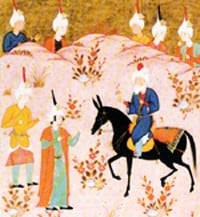
Ibn Arabi a caballo con dos discípulos (miniatura safaví) · Public domain
بكلماته
«لقد صار قلبي قابلاً كل صورةٍ / فمرعى لغزلانٍ وديرٌ لرهبانِ // وبيتٌ لأوثانٍ وكعبةُ طائفٍ / وألواحُ توراةٍ ومصحفُ قرآنِ // أدينُ بدينِ الحبِّ أنّى توجّهتْ / ركائبُه فالحبُّ ديني وإيماني»Tarjuman al-ashwaq, oda XI, vv. 13–15 (trad. Nicholson, 1911, pp. 66–67). En el comentario, el autor precisa que esa religión del amor es prerrogativa de los musulmanes, por ser Muhammad el amado de Dios.

فكرته المحورية
Oneness of being (wahdat al-wujud): The formula *wahdat al-wujud* does not appear as such in Ibn Arabi; it was coined by his interpreters and above all by his critics, among them Ibn Taymiyya, to designate his doctrine.
السيرة
4 دقيقة قراءة
ترجمة مُعانة من الأصل الإسباني، بانتظار مراجعة مترجم من أهل اللغة.
مُرسيّ في إشبيلية الموحّدين
وُلد أبو عبد الله محمد بن علي بن محمد ابن العربي الحاتمي الطائي في مُرسية في السابع عشر من رمضان سنة 560 هـ، الموافق 28 تموز/يوليو 1165 م. وكانت أسرته، العربيةُ النسب الذي يرتفع إلى قبيلة طيّئ وإلى حاتم الطائي مضربِ المثل في الجود، في خدمة الملك ابن مردنيش، «الملك الذئب» الذي كان يقاوم الموحّدين في شرق الأندلس. ولما سقطت مرسية سنة 1172 دخل الأب في خدمة المنتصرين، واستقرّت الأسرة في إشبيلية. وهناك نشأ الفتى نشأةَ أبناء رجال الدولة: القرآن والحديث والنحو والشعر، وشبابٌ دنيويّ، كما سيذكر هو نفسه، من صيدٍ ومنادمة، يلمّح إليه دون تفصيل.
ونحو سنة 1184، وهو في قرابة العشرين، دخل الطريق. وهو يردّ في «الفتوحات» توبته إلى رؤيا تجلّى له فيها عيسى وموسى ومحمد، ويسمّي عيسى شيخه الأول. وفي تلك السنوات عرف صوفية الأندلس الذين سيترك تراجمهم في كتابين ألّفهما في مكة، «روح القدس في مناصحة النفس» و«الدرة الفاخرة»: زهّادٌ وخبّازون وإسكافيون، وعجوزٌ من إشبيلية، فاطمة بنت المثنّى، كانت تضرب بالدفّ فرحًا لأن الله وهبها هذا المريد ولدًا. ومن هذه الحقبة أيضًا لقاؤه، كما رواه بنفسه، بابن رشد في قرطبة: فقد أراد الفيلسوف الكبير أن يرى الفتى الذي شاع أنه نال بالفتح والكشف ما يطلبه غيره بالنظر العقلي، فكان الحوار «نعم» و«لا»، فاصفرّ لون ابن رشد وأطرق مفكّرًا.
سنوات الترحال في المغرب
وبين 1193 و1200 تناوبت إقاماته في الأندلس مع رحلاته إلى المغرب: تونس وفاس ومراكش. وفي المريّة، سنة 1199، كتب في أحد عشر يومًا «مواقع النجوم»، وهو رسالة في منازل السلوك الباطني. وشهد في قرطبة عودة جثمان ابن رشد، الذي توفّي في مراكش سنة 1198، ودوّن صورةً صارت مشهورة: التابوت على أحد جانبي الدابة، وتآليف الفيلسوف على الجانب الآخر تعادله. وفي سنة 1200 أمرته رؤيا في مراكش بالرحيل إلى المشرق. وفي سنة 1201 توجّه إلى تونس، ولم يعد إلى الأندلس بعدها أبدًا.
مكة وبداية عملٍ هائل
وصل إلى مكة سنة 1202 بعد أن مرّ بتونس والقاهرة والخليل والقدس. وهناك بدأ «الفتوحات المكية»، التي يذكر أنها أُلقيت إليه من فتًى غامض لقيه عند الكعبة. وهناك أيضًا عرف العالِمَ الفارسي زاهر بن رستم وابنته النظام، الملقّبة «عين الشمس والبهاء»، الفتاةَ الجامعة بين الجمال الباهر والعلم والتقوى، التي سيتغنّى بها في قصائد «ترجمان الأشواق». ولما زعم بعد سنوات أحدُ فقهاء حلب أن تلك القصائد الغزلية ليست إلا تغزّلًا، كتب ابن عربي شرحًا عليها بيتًا بيتًا، «ذخائر الأعلاق»، ليبيّن أن كل ظبية وكل طلل في البادية وكل ناقة سائرة إنما تشير إلى حقائق إلهية.
سائحٌ في المشرق السلجوقي والأيوبي
ومنذ سنة 1204 صارت حياته سياحةً متّصلة: الموصل، حيث لبس الخرقة من يد مريدٍ للخضر؛ وقونية وملطية وسيواس في البلاط السلجوقي، حيث صادق مجد الدين إسحاق، الذي سيصير ابنه صدر الدين القونوي أكبرَ تلاميذه وشارحيه؛ والقاهرة، حيث رماه الفقهاء بالزندقة؛ ثم بغداد وحلب ومكة من جديد. وتقول الرواية إنه تزوّج أرملة مجد الدين وربّى صدر الدين كابنه؛ ولا يُعرف عن زوجاته وأولاده أكثر من ذلك، سوى اسم ابنه سعد الدين، الشاعر المولود في ملطية. وكان يكتب بلا انقطاع: فإجازته التي كتبها سنة 1234 تحصي نحو مئتين وتسعين مؤلَّفًا، ويجمع فهرس عثمان يحيى الحديث 846 عنوانًا منسوبًا إليه، كثيرٌ منها منحول أو مكرّر.
دمشق: «الفصوص» والخاتمة
ونحو سنة 1223 استقرّ في دمشق، في كنف أسرةٍ من القضاة، بني الزكي، والحاشية الأيوبية. وهناك، في العشر الأواخر من محرّم سنة 627 هـ (كانون الأول/ديسمبر 1229)، رأى النبيَّ ﷺ في المنام يناوله كتابًا ويأمره بإخراجه إلى الناس: وبذلك يقدّم هو نفسه أصلَ «فصوص الحكم»، سبعةً وعشرين فصًّا في الحكمة الخاصة بكل نبيّ، من آدم إلى محمد، صار أكثر نصوص التصوّف شرحًا وأشدّها إثارةً للجدل. وفي سنة 1231 أتمّ النسخة الأولى من «الفتوحات»، وفي سنة 1238 النسخة الثانية، التي تُحفظ نسختها بخطّ يده في سبعة وثلاثين مجلدًا في إسطنبول. وتوفّي في دمشق في ربيع الآخر سنة 638 هـ (16 تشرين الثاني/نوفمبر 1240 م) بين مريديه، ودُفن في حيّ الصالحية عند سفح جبل قاسيون. ولم تُحفظ له كلمات أخيرة.
أثرٌ لا ينقطع الجدل حوله
لُقّب بـ«الشيخ الأكبر» و«محيي الدين». وقد صاغ تلاميذه، وفي مقدّمتهم القونوي، فكره بلغة الفلسفة، وانتهت عبارة «وحدة الوجود»، التي لم يستعملها هو بلفظها مصطلحًا، إلى أن تلخّصه عند أنصاره وخصومه معًا. وحاربه ابن تيمية بشدّة؛ وبجّله العثمانيون، فأقام السلطان سليم الأول سنة 1517 الجامعَ والضريح اللذين لا يزالان يظلّلان قبره. ويسري أثره في التصوّف الفارسي والتركي والهندي على امتداد سبعة قرون. وفي أوروبا اكتشفه ميغيل أسين بلاثيوس، الذي قرأه في كتابه «الإسلام المُنصَّر» (El islam cristianizado، 1931) إلى جانب التصوّف المسيحي؛ وجعل منه هنري كوربان فيلسوفَ الخيال الخلّاق، وأعاده ميشيل شودكيفيتش وكلود عدّاس ووليام تشيتيك إلى سياقه الإسلامي والقرآني. وتذكره مرسية اليوم بوصفه أكثر أبنائها عالميةً.
الموثَّق والمرويّ
بخلاف كثير من الصوفية، أكثر ابن عربي الحديث عن نفسه: فكلّ ما يُعرف عن حياته تقريبًا مصدره كتبه هو، ولا سيّما «الفتوحات» و«روح القدس» ومقدّمات مؤلفاته. ولهذا الثراء ثمنه: فالوقائع مرويّة من داخل تجربته الكشفية، ولا يمكن دائمًا مقابلتها بغيرها. أما التراجم العربية اللاحقة، كترجمة المقّري في القرن السابع عشر، فتضيف كرامات ونبوءات بعد الوفاة هي من قبيل الأسطورة.
المصادر: Ibn al-Arabi. The Tarjumán al-Ashwáq: A Collection of Mystical Odes. Ed. y trad. de Reynold A. Nicholson. Oriental Translation Fund, New Series XX. Londres: Royal Asiatic Society, 1911. · Addas, Claude. Ibn ʿArabī ou la quête du Soufre Rouge. París: Gallimard, 1989. Trad. inglesa: Quest for the Red Sulphur: The Life of Ibn ʿArabī. Cambridge: Islamic Texts Society, 1993. · Chittick, William C. The Sufi Path of Knowledge: Ibn al-ʿArabi's Metaphysics of Imagination. Albany: State University of New York Press, 1989. · Corbin, Henry. L'imagination créatrice dans le soufisme d'Ibn ʿArabî. París: Flammarion, 1958 (trad. inglesa: Creative Imagination in the Sufism of Ibn ʿArabī, Princeton University Press, 1969); incluye la traducción del relato del encuentro con Averroes (Futuhat, ed. Bulaq, I, 153–154). · Nicholson, Reynold A. «Introduction» y prefacios traducidos, en The Tarjumán al-Ashwáq (1911), pp. 1–14.
الخط الزمني
الحياة عامًا بعد عام
كل نقطة حدث موثّق. انقر لتقرأه مع مصدره ودرجة اليقين فيه.
28 يوليو 1165أقل من عامMurcia
Birth
Born on 17 Ramadan 560 in the Murcia of Ibn Mardanish, into a family of officials of Arab lineage.
موثّقAddas, Claude. Ibn ʿArabī ou la quête du Soufre Rouge. París: Gallimard, 1989. Trad. inglesa: Quest for the Red Sulphur: The Life of Ibn ʿArabī. Cambridge: Islamic Texts Society, 1993.
بعد وفاته
- 1517Ottoman mausoleum
- 1931El islam cristianizado
28 يوليو 1165 · أقل من عام
Birth
Born on 17 Ramadan 560 in the Murcia of Ibn Mardanish, into a family of officials of Arab lineage.
موثّق
1172 · 7 أعوام
Move to Seville
After the Almohad conquest of Murcia, the family settles in Seville, where the father serves the new rulers.
موثّق
نحو 1180 · 15 عامًا
Meeting with Averroes
While still an adolescent, he converses with Ibn Rushd in Córdoba; he recounts it himself in the *Futuhat*.
موثّق
نحو 1184 · 19 عامًا
Entry into the Sufi path
Around 580 AH he abandons worldly life; he attributes his conversion to a vision of Jesus, Moses and Muhammad.
موثّق
نحو 1193 · 28 عامًا
Journeys in the Maghreb
First stays in Tunis and Fez; he frequents the disciples of Abu Madyan.
موثّق
1199 · 34 عامًا
Mawaqi al-nujum
In Almería he composes in eleven days *Mawaqi al-nujum*, a treatise on the stages of the spiritual path.
موثّق
1201 · 36 عامًا
Final departure from al-Andalus
After a vision in Marrakesh (1200) ordering him to set out for the East, he leaves the peninsula for ever.
موثّق
1202 · 37 عامًا
Arrival in Mecca; the Futuhat begins
He arrives in 598 AH; he meets Zahir ibn Rustam and his daughter Nizam and begins *al-Futuhat al-Makkiyya*.
موثّق
1203 · 38 عامًا
Ruh al-quds
He writes the *Ruh al-quds*, an epistle with portraits of his Andalusi masters.
موثّق
نحو 1204 · 39 عامًا
Travels in Iraq and Anatolia
In Mosul he receives the mantle of al-Khidr; in Anatolia he befriends Majd al-Din Ishaq, father of Sadr al-Din al-Qunawi.
مرجَّح
يناير 1215 · 49 عامًا
Tarjuman al-ashwaq and its commentary
He finishes the odes of the *Tarjuman* in Ramadan 611 (January 1215) and, in response to an Aleppan jurist's criticism, writes his commentary (*Dhakhair al-alaq*).
موثّق
نحو 1223 · 58 عامًا
Settlement in Damascus
He settles in Damascus under the protection of the Banu Zaki judges.
مرجَّح
ديسمبر 1229 · 64 عامًا
The vision of the Fusus al-hikam
In the last ten nights of Muharram 627 he dreams that the Prophet hands him the *Fusus al-hikam*.
موثّق
1234 · 69 عامًا
Licence to Sultan al-Muzaffar
He grants an *ijaza* to the Ayyubid prince al-Malik al-Muzaffar listing some 290 of his works.
موثّق
1238 · 73 عامًا
Second redaction of the Futuhat
He completes the second version of *al-Futuhat al-Makkiyya*, whose autograph in 37 volumes survives.
موثّق
16 نوفمبر 1240 · 75 عامًا
Death
He dies on 22 Rabi al-Thani 638 and is buried in Salihiyya, at the foot of Mount Qasiyun.
موثّق
1517
Ottoman mausoleum
After conquering Damascus, Selim I builds the mosque and mausoleum over his tomb.
موثّق
1931
El islam cristianizado
Miguel Asín Palacios publishes his study of Ibn Arabi, a starting point of Akbarian studies in the West.
موثّق
المؤلَّفات
المؤلَّفات الأساسية
المؤلَّفات التي لا يُفهم إرثه من دونها.
مؤلَّف مكتوب · 1238
الفتوحات المكية (al-Futuhat al-Makkiyya)
A monumental work of 560 chapters in six sections, gathering all of Ibn Arabi's knowledge: the metaphysics of the divine names, cosmology, the esoteric interpretation of worship (purification, prayer, fasting, pilgrimage), the stations and abodes of the spiritual path, the hierarchy of saints and eschatology, together with many autobiographical episodes and visions. The author states that he did not compose it by reflection but through "openings" or illuminations received. It is the main source for his biography and the reference work of the whole Akbarian school; only part has been translated into European languages.
7 طبعات · amazon.com

مؤلَّف مكتوب · نحو 1229
فصوص الحكم (Fusus al-hikam)
Twenty-seven chapters, each devoted to the "wisdom" of a prophet (from Adam to Muhammad, by way of Noah, Abraham, Moses, Jesus or Solomon), understood as a bezel in which a precious stone is set: an aspect of divine knowledge. It is his densest work and the one that concentrates his boldest theses on the relationship between God and the world, imagination, beliefs and the perfect human being. It was commented on more than a hundred times (al-Qunawi, al-Jandi, al-Qashani, al-Qaysari, Jami) and attacked with equal intensity, by Ibn Taymiyya among others.
9 طبعات · amazon.com

مؤلَّف مكتوب · 1215
ترجمان الأشواق (Tarjuman al-ashwaq)
A collection of love poetry in the tradition of the Arabic qasida: abandoned encampments, departing camels, gazelles and gardens, and a beloved inspired by Nizam, daughter of the Persian scholar with whom he studied in Mecca. Its famous ode XI proclaims a heart "capable of every form" and a "religion of love". The author's own commentary reads every image as a symbol of divine realities and is one of the keys to the Sufi hermeneutics of erotic language.
5 طبعات · amazon.com
جميع مؤلَّفاته (30)
Ibn Arabi
ذخائر الأعلاق شرح ترجمان الأشواق (Dhakhair al-alaq)
The Conscious Libraryذخائر الأعلاق شرح ترجمان الأشواق (Dhakhair al-alaq)
1215

روح القدس في مناصحة النفس (Ruh al-quds fi munasahat al-nafs)
1203
Ibn Arabi
مواقع النجوم (Mawaqi al-nujum)
The Conscious Libraryمواقع النجوم (Mawaqi al-nujum)
1199

مشاهد الأسرار القدسية (Mashahid al-asrar al-qudsiyya)
1194

كتاب التجليات (Kitab al-tajalliyat)
1205

رسالة الأحدية (Risalat al-ahadiyya)
Ibn Arabi
كتاب إنشاء الدوائر الإحاطية (Kitab insha' al-dawa'ir al-ihatiyya)
The Conscious Libraryكتاب إنشاء الدوائر الإحاطية (Kitab insha' al-dawa'ir al-ihatiyya)

التدبيرات الإلهية في إصلاح المملكة الإنسانية (al-Tadbirat al-ilahiyya fi islah al-mamlaka al-insaniyya)

كتاب الجلال والجمال (Kitab al-jalal wa-l-jamal)
كنه ما لا بد منه للمريد (Kunh ma la budda minhu li-l-murid)

حلية الأبدال (Hilyat al-abdal)
1203

رسالة الأنوار فيما يمنح صاحب الخلوة من الأسرار (Risalat al-anwar)
1205
Ibn Arabi
كتاب الإسرا إلى المقام الأسرى (Kitab al-isra' ila al-maqam al-asra)
The Conscious Libraryكتاب الإسرا إلى المقام الأسرى (Kitab al-isra' ila al-maqam al-asra)
1198

الدرة الفاخرة (al-Durra al-fakhira)

عنقاء مغرب في ختم الأولياء وشمس المغرب ('Anqa' mughrib)
1199

مشكاة الأنوار فيما روي عن الله سبحانه من الأخبار (Mishkat al-anwar)
1203

الاتحاد الكوني في حضرة الإشهاد العيني بمحضر التلميذ اليقيني (al-Ittihad al-kawni)

أوراد الأيام والليالي (Awrad al-ayyam wa-l-layali)

كتاب الإسفار عن نتائج الأسفار (Kitab al-isfar 'an nata'ij al-asfar)

كشف المعنى عن سر أسماء الله الحسنى (Kashf al-ma'na 'an sirr asma' Allah al-husna)
Ibn Arabi
الكوكب الدري في مناقب ذي النون المصري (al-Kawkab al-durri fi manaqib Dhi l-Nun al-Misri)
The Conscious Libraryالكوكب الدري في مناقب ذي النون المصري (al-Kawkab al-durri fi manaqib Dhi l-Nun al-Misri)

شجرة الكون (Shajarat al-kawn)
Ibn Arabi
كتاب الميم والواو والنون (Kitab al-mim wa-l-waw wa-l-nun)
The Conscious Libraryكتاب الميم والواو والنون (Kitab al-mim wa-l-waw wa-l-nun)
Ibn Arabi
الديوان الأكبر (al-Diwan al-akbar)
The Conscious Libraryالديوان الأكبر (al-Diwan al-akbar)
الأقوال
أقوال محدَّدة الموضع في مؤلَّف بعينه. كل منها يحمل مصدره ودرجة الثقة به.
لقد صار قلبي قابلاً كل صورةٍ / فمرعى لغزلانٍ وديرٌ لرهبانِ // وبيتٌ لأوثانٍ وكعبةُ طائفٍ / وألواحُ توراةٍ ومصحفُ قرآنِ // أدينُ بدينِ الحبِّ أنّى توجّهتْ / ركائبُه فالحبُّ ديني وإيمانيمتحقَّق منهTarjuman al-ashwaq, oda XI, vv. 13–15 (trad. Nicholson, 1911, pp. 66–67). En el comentario, el autor precisa que esa religión del amor es prerrogativa de los musulmanes, por ser Muhammad el amado de Dios.
أقوال منحولة أو مختلَف في نسبتها (2)
«"When the sin enters the shin, the tomb of Muhyi al-Din will appear."»
A coded prophecy that Ottoman tradition ascribes to Ibn Arabi, read as announcing that Selim (with *sin*) would enter Damascus (*Sham*, with *shin*) and restore his tomb, as he did in 1517. It comes from *al-Shajara al-numaniyya*, an apocalyptic work attributed to him without foundation; it appears in none of his authentic writings.
«"Whoever knows himself knows his Lord", presented as the central teaching of Ibn Arabi's *Treatise on Unity*.»
The saying is a hadith of earlier Sufi circulation, which Ibn Arabi comments on in other works; but the *Treatise on Unity* (*Risalat al-ahadiyya*), where it is developed in radical terms, is by Awhad al-Din Balyani, as Michel Chodkiewicz demonstrated.
الكلمات الأخيرة
لا توجد سجلات يمكن التحقق منها لكلماته الأخيرة.
No reliably attributed final sentence survives. The biographical sources fix the date (22 Rabi al-Thani 638) and place of his death, in the house of the judge Muhyi al-Din ibn al-Zaki in Damascus, and his burial in Salihiyya, but transmit no last words.
المصدر: Addas, Claude. Ibn ʿArabī ou la quête du Soufre Rouge. París: Gallimard, 1989. Trad. inglesa: Quest for the Red Sulphur: The Life of Ibn ʿArabī. Cambridge: Islamic Texts Society, 1993.
اسأل
بماذا يجيب أثره
اثنا عشر سؤالًا كبيرًا من أسئلة الإنسانية، وما تتيح نصوصه الإجابة به عنها، مع المراجع. ولا نقوّله ما لم يقل أبدًا.
ما المطلق؟ هل الله موجود؟
The Essence is unknowable; God makes Himself known through His Names
شخصي وغير شخصي معًايقوله صراحةً
Ibn Arabi distinguishes rigorously between the divine Essence (al-dhat) and the Divinity that relates to the world. Of the Essence nothing can be said or known: it is free of all relation and all attribute. Yet that same Reality manifests as Lord through His Names — the Merciful, the Wise, the Living — which need beings in order to become visible; in the chapter on Adam of the Fusus al-hikam, the human being is the mirror in which God contemplates His Names. This God loves, wishes to be known and turns to each according to their capacity, to the point that every believer worships the God their belief has shaped. The Absolute is both inaccessible ground and a face turned towards the creature; to confuse the two planes, or to separate one entirely from the other, is for him an error.
قارن هذا السؤال مع معلّمين آخرينمن أنا؟ هل توجد ذات حقيقية؟
Whoever knows himself knows his Lord: He and not He
الذات هي المطلقيقوله صراحةً
Ibn Arabi makes the traditional saying «whoever knows himself knows his Lord» an axis of his work. For him, the human being has no existence of its own: what exists in it is God's existence, manifested according to the predisposition of each creature, its immutable entity (ayn thabita) eternally present in divine knowledge. In the Fusus al-hikam, the chapter on Adam presents the complete human being (al-insan al-kamil) as the mirror in which Reality contemplates all its Names. To know oneself is to discover that the self, in itself, is nothing, and that its reality is that of the Real. Yet Ibn Arabi rejects fusion (ittihad) and incarnation (hulul): the servant remains servant. His formula is paradoxical: the creature is He and is not He.
قارن هذا السؤال مع معلّمين آخرينلماذا نتألّم؟
We suffer behind the veil; divine mercy precedes wrath
الانفصال عن اللهيُستنتج من تعاليمه
Ibn Arabi does not treat suffering as a separate theme, but his work allows an answer to be reconstructed. The human being suffers because it is veiled: it perceives the multiplicity of things and not the single Reality manifest in them, and believes itself separate from God when its very existence is that of the Real. At the same time, Ibn Arabi gives central place to the divine saying that God's mercy precedes His wrath, and to the Qur'anic verse stating that His mercy embraces all things. Hence his thesis, controversial among theologians, that even the punishment of hell will eventually become sweet for those who dwell there, playing on the closeness in Arabic between punishment (adhab) and sweetness (adhb). Pain is real but provisional; the ultimate is mercy.
قارن هذا السؤال مع معلّمين آخرينماذا يحدث بعد الموت؟
From the barzakh to the resurrection: and mercy finally reaches everyone
الحياة الأبدية والقيامةيقوله صراحةً
Ibn Arabi fully accepts Qur'anic eschatology — death, the intermediate state, bodily resurrection, judgement, paradise and hell — and interprets it through his metaphysics of imagination. After death the soul enters the barzakh, an intermediate world of images where deeds and beliefs take form; at the resurrection it receives a new body suited to the next life. His boldest feature is the primacy of mercy: relying on the verse according to which God's mercy embraces all things, he holds in the Futuhat and the Fusus that the punishment of the fire is not eternal in its pain. The damned will remain in their abode, but the torment (ʿadhāb) will eventually turn sweet (ʿadhb) for them. Death does not destroy the being's relationship with God; it reveals it, because every creature has always been a manifestation of His names.
قارن هذا السؤال مع معلّمين آخرينكيف يُبلَغ التحرّر أو الخلاص؟
Realising who one is means knowing one's Lord: knowledge by unveiling, not by reasoning
بالمعرفة المباشرةيقوله صراحةً
Ibn Arabi organises the path around the saying, transmitted in Sufi circles, that whoever knows himself knows his Lord. The goal is realisation (tahqiq): understanding by experience that every being is a manifestation of the divine Names and that the complete human being reflects the totality of those Names. That knowledge does not come from philosophical reasoning, to which he grants limited scope, but from unveiling (kashf), which God grants to whoever prepares through observance of the law, invocation, retreat and purification. Alongside this, Ibn Arabi holds that divine mercy embraces everything, which leads him to qualify the eternity of punishment in the hereafter.
قارن هذا السؤال مع معلّمين آخرينهل نحتاج إلى معلّم؟
The ordinary path passes through masters, but God can teach directly
مفيد لكنه ليس ضروريًايُستنتج من تعاليمه
Ibn Arabi had numerous teachers in al-Andalus and the Maghreb, to whom he devoted portraits in The Spirit of Holiness, and in The Meccan Revelations he deals in detail with the rules of courtesy (adab) governing the relationship between disciple and master. For most people, the path runs through a shaykh who knows the states and dangers of the way. Yet Ibn Arabi admits and claims another mode of transmission: that of someone instructed directly by God or by spiritual figures such as Khidr, from whom he claimed to have received investiture. The human teacher is therefore the usual and valuable channel, but not the exclusive one, because the true teacher of all knowledge is God.
قارن هذا السؤال مع معلّمين آخرينهل العالم حقيقي؟
The cosmos is the mirror in which God contemplates His Names
تجلٍّ للإلهييقوله صراحةً
Ibn Arabi conceives of the world as God's self-disclosure (tajalli). The first chapter of The Bezels of Wisdom, devoted to Adam, explains that God wished to see His Names in a being that would reflect them all: He created the cosmos like an unpolished mirror, and the human being was the polishing of that mirror. Everything that exists is thus a locus of manifestation of some divine Name. The world is neither God in His essence, which remains unknowable, nor an independent reality: it is «He and not He», and is renewed at every instant. Ibn Arabi therefore gives the world an intermediate status, comparable to imagination, real as reflection, without consistency of its own.
قارن هذا السؤال مع معلّمين آخرينما الحب؟
God loved to be known: love is the origin of the world and its return
الشوق والوصاليقوله صراحةً
Ibn Arabi makes love the very principle of creation. Relying on a saying attributed to God in the Sufi tradition — I was a hidden treasure and loved to be known — he explains that the world is born of divine love for self-manifestation, and that all created love is, at bottom, God's love for himself through creatures. No one loves anything but God, even when believing they love a particular person, because all beauty is his manifestation. In the chapter on love in the Futuhat he distinguishes divine, spiritual and natural love and describes their states. In the Tarjuman al-ashwaq, a collection of love poems inspired by the young Nizam, he declares that his heart has become capable of every form and that he follows the religion of love, wherever its caravans turn.
قارن هذا السؤال مع معلّمين آخرينهل نحن أحرار أم أن كل شيء مقدَّر؟
God gives only what each essence asks for: the secret of destiny
لا يوجد فاعليقوله صراحةً
Ibn Arabi addresses the question in the chapter of the *Fusus al-hikam* devoted to the prophet Uzayr, under the name «secret of destiny» (*sirr al-qadar*). His thesis is that the divine decree follows God's knowledge, and that this knowledge follows the known: the immutable essences (*aʿyān thābita*) of each thing, which by their own preparedness ask for what they will receive. No one is compelled except by what he himself is in God's knowledge. At the same time, the only real agent is God, acting through the forms of creatures. The consequence is not moral fatalism, since the revealed law still binds, but that the self who believes it decides on its own is a partial perspective on a single divine activity.
قارن هذا السؤال مع معلّمين آخرينلماذا نتأمّل أو نصلّي؟
Prayer is intimate conversation between God and his servant
صداقة مع اللهيقوله صراحةً
In the last chapter of the *Fusus al-hikam*, devoted to the Prophet Muhammad, Ibn Arabi interprets ritual prayer (*ṣalāt*) as *munājāt*, intimate conversation: drawing on the hadith that God has divided the prayer between Himself and His servant, he holds that in it God speaks and listens at once, and that the one who prays sees the One with whom he converses. Hence he calls it, following another hadith, the coolness of the Prophet's eyes. Alongside prescribed prayer he valued remembrance of God (*dhikr*) and retreat (*khalwa*), which he describes in the *Epistle of Lights*. The aim is not to leave the relationship but to worship God as if seeing Him, what tradition calls *iḥsān*, until recognising Him in every form.
قارن هذا السؤال مع معلّمين آخرينهل يستطيع العقل أن يعرف الحقيقة القصوى؟
Reason binds; divine unveiling grants the knowledge of secrets
الحقيقة القصوى وراء العقليقوله صراحةً
In the introduction to *The Meccan Openings* (*al-Futuhat al-makkiyya*), Ibn Arabi distinguishes three kinds of knowledge: that of the intellect, obtained by demonstration; that of states, reached only by tasting or experience; and that of secrets, which lies above the intellect and is granted by God to prophets and saints. He plays on the etymology of *ʿaql* (intellect), related to the hobble placed on a camel: reason binds and delimits, and so cannot encompass a God who is both transcendent and present in every form. In his letter to the theologian Fakhr al-Din al-Razi he advises him to leave speculation and seek the knowledge that comes from God through retreat and remembrance.
قارن هذا السؤال مع معلّمين آخرينالانسحاب من العالم أم تغييره؟
The highest is outwardly indistinguishable: he returns to live among creatures
التأمّل في الفعليُستنتج من تعاليمه
Ibn Arabi practised retreats (khalwa) and describes in the Futuhat the illuminations he received in them, but he does not make retreat the goal. In his spiritual hierarchy the highest rank belongs to the malamiyya, the «people of blame», who after attaining realisation return to ordinary life, without distinctive dress or visible wonders, and blend in with common people while their inner being remains with God. The spiritual journey, for him, has a return: the one who has ascended to God descends again towards creatures to serve and guide them. His own life was that of a traveller between al-Andalus, the Maghreb, Mecca, Anatolia and Damascus, in contact with masters, disciples and rulers, to whom he occasionally wrote advising them on how to govern. Contemplation and presence in the world are not opposed: the world is God's manifestation.
قارن هذا السؤال مع معلّمين آخرين
التقارب والتوتّر
التقارب والتوتّر
محسوبة سؤالًا سؤالًا انطلاقًا من مواقفه. وسبب كل اتفاق أو اختلاف يظهر بالنقر.
يقترب في تفكيره من
Attar
يتّفقان في: ما المطلق؟ هل الله موجود؟ · من أنا؟ هل توجد ذات حقيقية؟ · لماذا نتألّم؟

Al-Hallaj
يتّفقان في: من أنا؟ هل توجد ذات حقيقية؟ · لماذا نتألّم؟ · ماذا يحدث بعد الموت؟
Ramakrishna
يتّفقان في: ما المطلق؟ هل الله موجود؟ · من أنا؟ هل توجد ذات حقيقية؟ · لماذا نتألّم؟
Anandamayi Ma
يتّفقان في: ما المطلق؟ هل الله موجود؟ · من أنا؟ هل توجد ذات حقيقية؟ · هل العالم حقيقي؟



يتّفقان في
Ibn Arabi · Adi Shankara
Two metaphysics of unity, in Murcia and in Kerala
لماذا: The affinity comes from the same question pushed to its limit: how can there be multiplicity if the Absolute is one. Both answer with a doctrine of levels, empirical and ultimate truth in one, Essence and Names in the other, which allows them to keep worship and law without giving up unity. There is no historical relation between them, and the differences are serious: for Ibn Arabi the world is a self-revelation willed by a God who loves to be known, and the servant remains a servant; for Shankara the world is a superimposition due to ignorance, and the liberated one retains no distinction. One thinks a theophany; the other, an error that dissolves. They agree in structure, not in feeling.
يختلفان فيتناقض ظاهري
Ibn Arabi · Teresa of Ávila
Always a creature, or He and not He: two languages for a union without confusion
لماذا: The tension is apparent because they use different categories for a similar experience. Teresa writes under the scrutiny of the Inquisition and of her learned confessors, within a theology that distinguishes creator and creature at the level of being, and so she stresses the distinction every time she describes union. Ibn Arabi works with a metaphysics of the single existence and of the mirror, in which saying that the creature has no being of its own does not mean it is God in his Essence, which remains unknowable. She speaks of what the soul lives; he, of what being is. They agree in practice: knowing oneself and knowing God go together, and the goal is intimacy without confusion.
يتّفقان في
Ibn Arabi · Rumi
Love as the origin and return of the world: two summits of Sufism in the same century
لماذا: They share an era, a religious language and sources: the Qur'an, the sayings attributed to the Prophet and the Sufi tradition that made love the principal way. There was also an indirect link: Sadr al-Din al-Qunawi, Ibn Arabi's stepson and chief disciple, taught in Konya in the same years as Rumi, and the Mevlevi hagiographies present them on cordial terms; there is no evidence that Rumi read Ibn Arabi or that they met. The difference is one of register. Ibn Arabi elaborates a technical metaphysics of the divine Names and of manifestation; Rumi writes narrative and lyrical poetry, without a system, where love is an experience of separation and longing before it is doctrine.
يتّفقان في
Ibn Arabi · Hildegard of Bingen
The human being as mirror of the cosmos and of the divine
لماذا: There was no contact between the German abbess and the Andalusian mystic, contemporaries for only a few years. The affinity stems from a common inheritance: the ancient idea of the human being as microcosm, Greek and Neoplatonic in origin, which circulated both in Latin Europe and in the Islamic world, and a reading of creation as the language of God. The differences are substantive. Hildegard sharply maintains the distinction between Creator and creature and thinks of the harmony lost through sin and restored in Christ; Ibn Arabi says the world is He and not He, within a metaphysics of the single existence. She contemplates visions; he builds a theory of the Names.
حكايات وروايات
حكايات وروايات
شهادةc. 1180
"Yes" and "No": the meeting with Averroes
أصل الرواية: Autobiographical account in *al-Futuhat al-Makkiyya* (Bulaq ed., I, 153–154), translated by Corbin (1958). It is the only testimony of the meeting; Averroes does not mention it.
المصدر: Corbin, Henry. L'imagination créatrice dans le soufisme d'Ibn ʿArabî. París: Flammarion, 1958 (trad. inglesa: Creative Imagination in the Sufism of Ibn ʿArabī, Princeton University Press, 1969); incluye la traducción del relato del encuentro con Averroes (Futuhat, ed. Bulaq, I, 153–154).
شهادة1198–1199
The coffin and the books
أصل الرواية: *Al-Futuhat al-Makkiyya*, I, 154 (Bulaq ed.), following the account of the first meeting; translation in Corbin 1958.
المصدر: Corbin, Henry. L'imagination créatrice dans le soufisme d'Ibn ʿArabî. París: Flammarion, 1958 (trad. inglesa: Creative Imagination in the Sufism of Ibn ʿArabī, Princeton University Press, 1969); incluye la traducción del relato del encuentro con Averroes (Futuhat, ed. Bulaq, I, 153–154).
شهادةc. 1185–1190
Fatima of Seville, the old woman with the tambourine
أصل الرواية: *Ruh al-quds* and *al-Durra al-fakhira*, trans. Austin, Sufis of Andalusia (1971); Asín Palacios, Vidas de santones andaluces (1933).
المصدر: Ibn al-Arabi. Sufis of Andalusia: The Ruh al-quds and al-Durrat al-fakhirah. Trad. de R. W. J. Austin. Londres: Allen & Unwin, 1971; y Asín Palacios, Miguel. Vidas de santones andaluces. Madrid, 1933 (reed. Hiperión, 1981).
موثّق1202–1215
Nizam and the jurist of Aleppo
أصل الرواية: Prefaces to the first and third recensions of the *Tarjuman*, translated by Nicholson (1911, pp. 3–5).
شهادة1202
The youth beside the Kaaba
أصل الرواية: *Al-Futuhat al-Makkiyya*, ch. 1 (the author's visionary account); analysis in Addas 1989 and Corbin 1958.
المصدر: Addas, Claude. Ibn ʿArabī ou la quête du Soufre Rouge. París: Gallimard, 1989. Trad. inglesa: Quest for the Red Sulphur: The Life of Ibn ʿArabī. Cambridge: Islamic Texts Society, 1993.
شهادة1229
The vision of the Bezels
أصل الرواية: Preface to the *Fusus al-hikam* (Afifi ed., 1946; Austin trans., 1980).
المصدر: Ibn al-Arabi. Fusus al-hikam. Ed. Abu al-Ala Afifi. El Cairo, 1946. Trad. inglesa: R. W. J. Austin, The Bezels of Wisdom (Classics of Western Spirituality). Nueva York: Paulist Press, 1980.
لا يمكن التحقق منه1516–1517
Selim I and the hidden tomb
أصل الرواية: Ottoman tradition based on the apocryphal *al-Shajara al-numaniyya*; Addas and Chodkiewicz record it as legend.
المصدر: Addas, Claude. Ibn ʿArabī ou la quête du Soufre Rouge. París: Gallimard, 1989. Trad. inglesa: Quest for the Red Sulphur: The Life of Ibn ʿArabī. Cambridge: Islamic Texts Society, 1993.
التعاليم
التعاليم
المفاهيم التي ينتظم بها فكره، مشروحة في سياقها.
Oneness of being (wahdat al-wujud)wahdat-al-wujud
Doctrine systematised by al-Qunawi and debated for centuries (as against Ahmad Sirhindi's *wahdat al-shuhud*).
المصدر: Chittick, William C. The Sufi Path of Knowledge: Ibn al-ʿArabi's Metaphysics of Imagination. Albany: State University of New York Press, 1989.
The perfect human being (al-insan al-kamil)insan-kamil
Qur'anic anthropology and the hadith of the image; extended by Abd al-Karim al-Jili (d. c. 1408).
المصدر: Ibn al-Arabi. Fusus al-hikam. Ed. Abu al-Ala Afifi. El Cairo, 1946. Trad. inglesa: R. W. J. Austin, The Bezels of Wisdom (Classics of Western Spirituality). Nueva York: Paulist Press, 1980.
Imagination and isthmus (khayal, barzakh)khayal
A reworking of philosophical psychology (Avicenna) and of the Qur'anic eschatology of the *barzakh* (Qur'an 23:100).
المصدر: Corbin, Henry. L'imagination créatrice dans le soufisme d'Ibn ʿArabî. París: Flammarion, 1958 (trad. inglesa: Creative Imagination in the Sufism of Ibn ʿArabī, Princeton University Press, 1969); incluye la traducción del relato del encuentro con Averroes (Futuhat, ed. Bulaq, I, 153–154).
Theophany or divine self-disclosure (tajalli)tajalli
It develops the Qur'anic notion of God's signs in the world and in souls (Qur'an 41:53).
المصدر: Chittick, William C. The Sufi Path of Knowledge: Ibn al-ʿArabi's Metaphysics of Imagination. Albany: State University of New York Press, 1989.
Immutable entities (ayan thabita)ayan-thabita
It takes up and transforms debates of *Mutazili* theology on the "thingness" of the non-existent.
المصدر: Chittick, William C. The Sufi Path of Knowledge: Ibn al-ʿArabi's Metaphysics of Imagination. Albany: State University of New York Press, 1989.
The seal of the saints (khatm al-awliya)khatm-al-awliya
It develops ideas of al-Hakim al-Tirmidhi (9th c.) on the seal of sainthood.
المصدر: Chodkiewicz, Michel. Le Sceau des saints: prophétie et sainteté dans la doctrine d'Ibn ʿArabî. París: Gallimard, 1986. Trad. inglesa: The Seal of the Saints. Cambridge: Islamic Texts Society, 1993.
الخلوات
خلوات ومراكز
أماكن ولقاءات مرتبطة بتعليمه. نضعك على تواصل مع من ينظّمها.
Oxford (Reino Unido) y Berkeley (EE. UU.), y en línea · Reino Unido / Estados Unidos
Muhyiddin Ibn Arabi Society: symposia and courses
Muhyiddin Ibn Arabi Society
The Muhyiddin Ibn Arabi Society was founded in 1977 to promote understanding of the work of Ibn Arabi and his followers, and is represented by non-profit organisations in Oxford and Berkeley. Since 1982 it has published a peer-reviewed journal, since 1984 it has held conferences in the UK and the USA, with more than a hundred talks available as podcasts and videos, and it runs an education programme with courses. Since 2002 it has also been collecting copies of the historic manuscripts of his works. It is the reference institution for the rigorous study of the Shaykh al-Akbar.
Chisholme House (Escocia), Sutton Courtenay (Oxfordshire), Londres y en línea · Reino Unido
Beshara: Foundation course and Masnavi study
The Beshara Trust
Beshara is the educational offering of the Beshara Trust, a British charity founded in 1971. Its foundation course takes the metaphysics of Ibn Arabi as its starting point to explore what it means to know oneself and the world in the light of the Unity of Existence, combining an introductory weekend, fortnightly online sessions and an optional residential at Chisholme House in the Scottish Borders. It also runs study groups on Rumi's Masnavi and other texts of the Sufi tradition. It is funded by philanthropic donations and voluntary work, and bookings are made by contacting the trust.
مقاطع الفيديو
مقاطع الفيديو
تسجيلات ومقابلات وأفلام وثائقية. تُشغَّل مقاطع الفيديو من YouTube؛ ولا تُستضاف هنا.
Translation, Ibn al-ʿArabi, and the Islamic Past: William C. Chittick Keynote (2023 Conference)
محاضرة· EN· 2023· 91 min
Columbia University Department of Historyالقناة الرسمية
Eric Geoffroy: Some Aspects of "Supra-reason" in Ibn 'Arabi's Epistomology
محاضرة· EN· 61 min
Ibn 'Arabi Societyالقناة الرسمية
Pablo Beneito: Keys to Decipher Ibn ʻArabī's Manzil al-manāzil
محاضرة· EN· 55 min
Ibn 'Arabi Societyالقناة الرسمية
Ibn 'Arabi & The Unity of Being
تحليل· EN· 72 min
Let's Talk Religion
The Bezels of Wisdom - Ibn 'Arabi's Controversial Masterpiece
تحليل· EN· 94 min
Let's Talk Religion
La morada de la no-morada: el legado vivo de Ibn Arabi en su 850 aniversario
محاضرة· ES· 2015· 62 min
Casa Árabeالقناة الرسمية
La Visión De Ibn Arabi | Pablo Beneito
مقابلة· ES· 66 min
Psicología y Espiritualidad
Ibn 'Arabî: un saint, un penseur et un poète par Claude Addas
محاضرة· FR· 27 min
Conscience Soufie
Ibn ‘Arabî et sainteté en islam par Michel Chodkiewicz
محاضرة· FR· 26 min
Conscience Soufie
İbnü'l Arabi ve "Vahdet-i Vücud" | Düşüncenin Seyir Defteri | 16. Bölüm
فيلم وثائقي· TR· 51 min
TRT 2القناة الرسمية
بالهجري: ابن عربي
فيلم وثائقي· AR· 3 min
AlJazeera Arabic قناة الجزيرةالقناة الرسمية
المعرض
المعرض
صور بترخيص متحقَّق منه. كل منها تحتفظ بمؤلّفها ونسبتها.
المخطوطات
المخطوطات
شواهد مخطوطة ونصوص قديمة، مع جهة حفظها وشروط الاطّلاع عليها.
AR · Nasj · 1231–1238 (segunda redacción)
الفتوحات المكية (al-Futuhat al-Makkiyya), autógrafo de la segunda redacción
- الشاهد المحفوظ
- 37 volúmenes autógrafos, con certificados de lectura
- جهة الحفظ
- Museo de Arte Turco e Islámico (Türk ve İslam Eserleri Müzesi), Estambul · Evkaf Müzesi 1845–1881
AR · Nasj · 1229 (texto); c. 1232 (copia)
فصوص الحكم (Fusus al-hikam), copia de Sadr al-Din al-Qunawi
- الشاهد المحفوظ
- Códice con certificado de audición en presencia del autor
- جهة الحفظ
- Museo de Arte Turco e Islámico, Estambul · Evkaf Müzesi 1933
العلاقات
العلاقات
تأثيرات وتلمذة وتقارب في الأفكار. تُميَّز العلاقة الموثّقة عن التشابه المستخلَص بالتحليل.
معاصر لـ
Contemporaries with no documented meeting. The link is Sadr al-Din al-Qunawi, Ibn Arabi's stepson and chief disciple, who lived in Konya, knew Rumi and, according to Aflaki, was to lead his funeral prayer. The anecdote that Ibn Arabi saw the boy Rumi in Damascus is late.
علاقة موثّقة
تأثّر بـ
Ibn Arabi read and cites al-Ghazali, with whom he shares the critique of the limits of speculative reason, though he disagrees with him on points of metaphysics.
علاقة موثّقة
أفكار قريبة من
Asín Palacios proposed parallels between Andalusi and Carmelite mysticism (dark night, love and erotic symbolism). The hypothesis of direct influence is unproven.
تشابه مستخلَص بالتحليل
أفكار قريبة من
Convergences in the metaphysics of being and the relation between God and the soul, studied comparatively; no contact.
تشابه مستخلَص بالتحليل
أفكار قريبة من
Toshihiko Izutsu systematically compared Ibn Arabi's key concepts with those of Laozi and Zhuangzi in *Sufism and Taoism* (1983). An academic comparison, not influence.
تشابه مستخلَص بالتحليل
المصادر
المصادر
المراجع والفهارس التي رُوجعت لهذه الصفحة.
- Wikidata, Q46420 «Ibn Arabi» (P31=Q5; 89 enlaces entre wikis; P569 1165-07-28; P570 1240-11-16).
- Ibn al-Arabi. The Tarjumán al-Ashwáq: A Collection of Mystical Odes. Ed. y trad. de Reynold A. Nicholson. Oriental Translation Fund, New Series XX. Londres: Royal Asiatic Society, 1911.
- Addas, Claude. Ibn ʿArabī ou la quête du Soufre Rouge. París: Gallimard, 1989. Trad. inglesa: Quest for the Red Sulphur: The Life of Ibn ʿArabī. Cambridge: Islamic Texts Society, 1993.
- Chittick, William C. The Sufi Path of Knowledge: Ibn al-ʿArabi's Metaphysics of Imagination. Albany: State University of New York Press, 1989.
- Corbin, Henry. L'imagination créatrice dans le soufisme d'Ibn ʿArabî. París: Flammarion, 1958 (trad. inglesa: Creative Imagination in the Sufism of Ibn ʿArabī, Princeton University Press, 1969); incluye la traducción del relato del encuentro con Averroes (Futuhat, ed. Bulaq, I, 153–154).
- Nicholson, Reynold A. «Introduction» y prefacios traducidos, en The Tarjumán al-Ashwáq (1911), pp. 1–14.
- Ibn al-Arabi. Fusus al-hikam. Ed. Abu al-Ala Afifi. El Cairo, 1946. Trad. inglesa: R. W. J. Austin, The Bezels of Wisdom (Classics of Western Spirituality). Nueva York: Paulist Press, 1980.
- Asín Palacios, Miguel. El islam cristianizado: estudio del sufismo a través de las obras de Abenarabi de Murcia. Madrid: Plutarco, 1931 (reed. Hiperión, 1981).
- Chodkiewicz, Michel. Le Sceau des saints: prophétie et sainteté dans la doctrine d'Ibn ʿArabî. París: Gallimard, 1986. Trad. inglesa: The Seal of the Saints. Cambridge: Islamic Texts Society, 1993.
- Nicholson, Reynold A. The Mystics of Islam. Londres: G. Bell and Sons, 1914.
- Yahia, Osman. Histoire et classification de l'œuvre d'Ibn ʿArabî: étude critique. 2 vols. Damasco: Institut Français de Damas, 1964.
- Ibn al-Arabi. Sufis of Andalusia: The Ruh al-quds and al-Durrat al-fakhirah. Trad. de R. W. J. Austin. Londres: Allen & Unwin, 1971; y Asín Palacios, Miguel. Vidas de santones andaluces. Madrid, 1933 (reed. Hiperión, 1981).
- Muhyiddin Ibn ʿArabi Society (Oxford), recursos y catálogo de manuscritos (Ibn ʿArabi Digital Archive).
- Open Library, registros de ediciones de las obras de Ibn Arabi (Futuhat, Fusus, Tarjuman, Ruh al-quds, Mashahid al-asrar).
- Open Library, registros de ediciones y traducciones de los tratados menores de Ibn Arabi (Nyberg 1919; Anqa Publishing; Fons Vitae; Threshold; Éditions de l'Éclat; Éditions de l'Œuvre; Editora Regional de Murcia; Sirio), consultados el 2026-10-25.
- Chittick, William C. «Ibn ʿArabī». En Edward N. Zalta (ed.), The Stanford Encyclopedia of Philosophy. Primera publicación: 5 de agosto de 2008; revisión sustancial: 5 de diciembre de 2025.
- صاحب الحقوق
- Dominio público (obra del siglo XIII). Las ediciones críticas (Osman Yahia, Afifi) y las traducciones modernas (Siruela, Hiperión, Editora Regional de Murcia, Paulist Press, Pir Press, Albin Michel, Al-Bouraq, C. H. Beck…) están sujetas a los derechos de sus editores.
- الموقع الرسمي
- www.ibnarabisociety.org/
في انتظار التأكيد
ما لم تتمكّن هذه الصفحة من حسمه بعد. نفضّل أن نقول ذلك على أن نملأ الفراغ.
- Localizar ISBN de «El intérprete de los deseos» (trad. Carlos Varona, Editora Regional de Murcia, 2002) en el catálogo de la BNE o de la editorial.
- Comprobar el ISBN de «Contemplation of the Holy Mysteries» (Anqa, 2001) y de las ediciones árabes críticas (Osman Yahia; al-Mansub, Saná 2010).
- Verificar en el catálogo del Museo de Arte Turco e Islámico las signaturas Evkaf 1845–1881 (Futuhat) y Evkaf 1933 (Fusus).
- Identificar la obra de procedencia de la cita «Gnostics cannot impart their feelings…» (Nicholson, 1914) y el capítulo exacto de los Fusus de la cita sobre los credos.
- Cotejar el texto árabe del prefacio de los Fusus con la edición de Afifi (se ha transcrito sin verificación directa).
- Añadir ediciones en ruso (A. V. Smirnov), hindi y persa de los Fusus con ISBN verificado.
- Precisar la fecha y el lugar de redacción de *Mashahid al-asrar* y *Kitab al-tajalliyat*.
- Obra completa (2026-10-25): Osman Yahia (fuente i10) catalogó 846 títulos atribuidos, de los que unos 550 se conservan y buena parte son opúsculos o atribuciones dudosas. Se registran los tratados principales con edición o traducción real; quedan fuera, entre otros, Kitab al-fana' fi l-mushahada (trad. francesa de Michel Vâlsan, sin edición verificada en catálogo), Muhadarat al-abrar (atribución discutida), al-Diwan al-akbar, Naqsh al-fusus, Kitab al-'abadila, Kitab al-qurba, Kitab al-ahadiyya y las selecciones de capítulos de las Futuhat publicadas como libro (Traité de l'amour, L'alchimie du bonheur parfait, La profession de foi, Textos sobre la caballería espiritual). Catálogo completo: Yahia 1964 y el Ibn Arabi Digital Archive (MIAS, i12).
- Confirmar el traductor de The Four Pillars of Spiritual Transformation (Anqa, 2009) y de Divine Sayings (Anqa, 2005): Open Library no lo indica.
- Precisar la fecha de redacción de Insha' al-dawa'ir, al-Tadbirat al-ilahiyya, Kitab al-jalal wa-l-jamal y al-Ittihad al-kawni (Yahia 1964).
- Sala de lectura (2026-10-25): no se registran otras traducciones. «Wisdom of the Prophets» (Fusus, trad. sinóptica de Khaja Khan, Madrás 1928; archive.org in.ernet.dli.2015.217778) es libre en EE. UU., pero se desconoce la fecha de muerte del traductor, lleva prólogo de Louis Massignon (m. 1962) y el OCR es defectuoso. «Vidas de santones andaluces» (Asín Palacios, 1933) y las traducciones de «El islam cristianizado» (1931) son libres en España y la UE (Asín murió en 1944), pero no en EE. UU. hasta 2029 y 2027. Los textos árabes de la Futuhat y los Fusus no están en Wikisource árabe (solo refutaciones de Ibn Taymiyya).
- Obras (2026-10-25): añadidos al-Diwan al-akbar, Muhadarat al-abrar (atribuida), Tadhkirat al-khawass y la colección Rasaʾil Ibn al-ʿArabi; siguen fuera como obras propias Kitab al-ʿabadila, Kitab al-qurba (incluido en la colección Rasaʾil), Naqsh al-fusus y las antologías temáticas de la Futuhat (p. ej. «Textos sobre la caballería espiritual», Edaf 2006, ISBN 8441417431, sin traductor en catálogo).
- Vídeos: año de emisión de la cápsula de Al Jazeera («Bil-hijri: Ibn Arabi») no indicado; queda en null.
بُحث بتاريخ 2026-10-23