Ислам · Суфизм
Rumi
جلالالدین محمد بلخی رومی · مولانا · Mevlânâ Celâleddîn-i Rûmî
1207 – 1273Исторически документированная личность
Ханафитский законовед и проповедник (1207–1273), уроженец Хорасана, обосновавшийся в Конье, сельджукской столице Анатолии. В тридцать семь лет встреча с дервишем Шамсом Тебризи сделала его поэтом: «Диван Шамса» объединяет более трех тысяч газелей, написанных из отсутствия друга, а «Маснави», шесть книг историй с толкованиями, — великое дидактическое творение персидского суфизма. Его сын основал братство мевлеви — «кружащихся дервишей». Многие современные «цитаты Руми» не происходят из его сочинений.
- трудов
- 8трудов
- изданий
- 39изданий
- цитат
- 8цитат
- видео
- 10видео
- изображений
- 8изображений
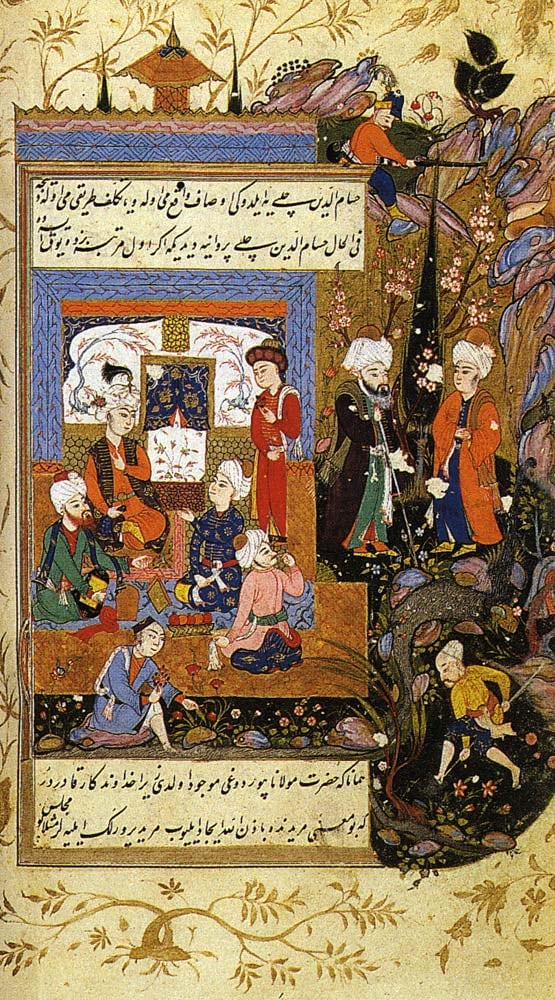
Rumi y su discípulo Husam al-Din Chelebi · Public domain
Своими словами
«Listen to the reed how it tells a tale, complaining of separations— Saying, "Ever since I was parted from the reed-bed, my lament hath caused man and woman to moan."»Masnavi, libro I, vv. 1–2 (trad. inglesa de Nicholson, 1926; texto persa según Ganjoor; la versión de Nicholson sigue una lectura que invierte «queja» y «relato»)

Главная мысль
Love (ishq): In Rumi love (*ishq*) is not one feeling among others but the force that moves the cosmos and the only knowledge capable of reaching God.
В контексте
Биография
4 мин чтения
Перевод с испанского оригинала, выполненный с помощью ИИ; ожидает проверки носителем языка.
Хорасанский мальчик на дороге на запад
Джалал ад-Дин Мухаммад родился, согласно дате, закрепленной преданием его собственного дома, 6 раби аль-авваля 604 года хиджры, то есть 30 сентября 1207 года. Позднейшая память сделала его уроженцем Балха, великого города Хорасана; исследование Франклина Льюиса показало, что семья жила тогда в Вахше — небольшом городе на берегу одноименной реки, на территории нынешнего Таджикистана, — где его отец служил проповедником и законоведом. Сам он вспоминает в своих беседах, что был в Самарканде во время осады его хорезмшахом, около 1212 года, и поэтому некоторые исследователи полагают, что он мог родиться на несколько лет раньше. Несомненна среда: персидский дом, суннитский, ханафитского толка, во главе которого стоял Баха ад-Дин Валад, проповедник пылкого нрава, чью духовную тетрадь, «Маариф», сын будет читать всю жизнь.
Около 1216 года семья покинула Хорасан. Мевлевийское предание объясняло отъезд ссорой с хорезмшахом или предчувствием монгольского нашествия, которое опустошит край в 1219–1221 годах; как бы то ни было, исход их спас. Совершив хадж в Мекку и побывав в Сирии, они осели в Анатолии — земле, которую персы называли Рум, то есть бывшей римской территорией; отсюда и прозвище, под которым его знает Запад. В Ларенде, нынешнем Карамане, молодой Джалал ад-Дин женился на Гаухар-хатун, там умерла его мать и родился его первый сын, Султан Валад (1226). Около 1229 года по приглашению окружения сельджукского султана Ала ад-Дина Кей-Кубада I Баха ад-Дин поселился в Конье, столице султаната. Он умер в феврале 1231 года, и его кафедру унаследовал двадцатитрехлетний сын.
Законовед и наставник в дисциплине
В 1232 году в Конью прибыл Бурхан ад-Дин Мухаккик Тирмизи, давний ученик отца. Около девяти лет он вел молодого человека путем суфийской аскезы — посты, сорокадневные затворы (чилла) — и, по источникам братства, отправил его завершить образование в медресе Алеппо и Дамаска. Когда около 1241 года Бурхан умер в Кайсери, Джалал ад-Дин был уже мауланой — «нашим господином»: он преподавал право, проповедовал в мечети и имел учеников. Сохранившиеся «Семь собраний» (Маджалис-и саб'а) его проповедей рисуют ученого проповедника, умеющего толковать хадис и коранический аят с помощью назидательных притч. Ничто еще не предвещает поэта.
Шамс Тебризи
29 ноября 1244 года в Конью пришел странствующий дервиш лет шестидесяти — Шамс ад-Дин Тебризи. Всё, что мы о нем знаем, происходит главным образом из его собственных «Макалат», изречений, записанных слушателями, и из трех источников братства: повествовательной поэмы Султана Валада (1291), послания Сипахсалара и — позднее и с куда большей долей легенды — «Манакиб аль-арифин» («Деяний познавших») Афляки, составленных между 1318 и 1353 годами. В главном они сходятся: встреча перевернула жизнь законоведа. Месяцами оба запирались для долгих бесед; оттесненные ученики роптали; в 1246 году Шамс ушел в Дамаск. Именно тогда Джалал ад-Дин начал писать стихи, слушать музыку и кружиться в сама, экстатическом слушании. Султан Валад вернул Шамса в 1247 году; вражда возобновилась, и в конце того же или в начале следующего года Шамс исчез навсегда. Афляки приводит версию об убийстве при соучастии Ала ад-Дина, второго сына Руми; Султан Валад говорит лишь об исчезновении, и современная наука считает убийство возможным, но не доказанным.
Руми дважды ездил в Дамаск на поиски. Вернулся он, по словам сына, зная, что искать его вовне не нужно: он нашел его в себе самом. Из этого отсутствия родился «Диван Шамса» (Диван-и Шамс) — более трех тысяч двухсот газелей и почти две тысячи рубаи, которые поэт часто подписывает именем утраченного друга или именем Хамуш — «Молчащий».
Золотых дел мастер, ученик и книга
Полнота, которую воплощал Шамс, перешла затем к почти неграмотному золотых дел мастеру с базара, Салах ад-Дину Заркубу, чья дочь вышла замуж за Султана Валада, а после его смерти в 1258 году — к Хусам ад-Дину Челеби, молодому человеку из семьи, связанной с ремесленными братствами. Именно Хусам попросил его написать дидактическую поэму на манер Санаи и Аттара, чтобы ученикам не приходилось читать других. Так около 1258–1261 годов родилась «Маснави-йи маънави» — «Поэма о скрытом смысле», или «Духовные двустишия»: около двадцати пяти тысяч шестисот бейтов в шести книгах, продиктованных Хусаму, который записывал их и читал вслух. После первой книги смерть жены Хусама прервала работу на два года; она возобновилась в 1263–1264 годах, и шестая книга осталась незавершенной, когда автор умер. «Маснави» — не трактат: это поток историй, перебивающих друг друга, — слон в темноте, купец и попугай, Моисей и пастух, — прокомментированных со свободой человека, думающего вслух. Рядом с ней сохранились также «Фихи ма фихи» («В нем то, что в нем») — застольные беседы, записанные учениками, — и около ста пятидесяти писем, многие из которых — ходатайства за людей, просивших его заступничества перед власть имущими.
Брачная ночь
Осенью 1273 года он заболел. Он умер в Конье на закате 17 декабря 1273 года (5 джумада ас-сани 672 года). Афляки описывает похороны, на которые вместе с мусульманами пришли христиане и иудеи города, и сохраняет выражение, которым братство с тех пор называло этот день: его брачная ночь, шаб-и арус, соединение с Возлюбленным. Его похоронили рядом с отцом, под тем, что потом станет зеленым куполом нынешнего музея Мевляны.
Что осталось и что ему приписывают
Султан Валад придал форму братству мевлеви, которое кодифицировало ритуальное кружение и распространилось по всему османскому миру, пока Турецкая Республика в 1925 году не закрыла суфийские ордены. В персидском мире «Маснави» стала самой комментируемой книгой после Корана; стих, который предание приписывает Джами, назвал ее «Кораном на персидском языке». Европа открыла ее благодаря Хаммер-Пургшталю и Фридриху Рюккерту, а серьезно изучила благодаря Рейнольду Николсону, который в 1925–1940 годах издал и перевел полный текст, а также Арберри и Аннемари Шиммель. В конце XX века вольные переложения Колмана Баркса сделали Руми самым продаваемым поэтом в Соединенных Штатах — ценой изгнания ислама из стихов, насквозь пропитанных Кораном. Многие фразы, гуляющие под его именем, не имеют опоры ни в одной рукописи. Прочитанный на своем языке, Руми — нечто иное: законовед, потерявший почву под ногами, богослов, обнаруживший, что любовь знает больше, чем объяснение любви, и поэт, превративший отсутствие в место присутствия.
Источники: Jalaluddin Rumi. The Mathnawi of Jalalu'ddin Rumi. Ed., trad. y comentario de Reynold A. Nicholson. E. J. W. Gibb Memorial, New Series IV, 8 vols. Londres: Luzac, 1925–1940 (vol. II: trad. libros I–II, 1926; vol. IV: trad. libros III–IV, 1930). · Lewis, Franklin D. Rumi: Past and Present, East and West. The Life, Teachings and Poetry of Jalal al-Din Rumi. Oxford: Oneworld, 2000 (ed. revisada 2008). · Lewis, Franklin D. Rumi: Past and Present, East and West. Oxford: Oneworld, 2000, caps. 1–7 (cronología de Baha al-Din Walad, Burhan al-Din, Shams y Husam al-Din; discusión de las fechas de nacimiento y de la desaparición de Shams). · Sultán Walad. Ibtida-nama (Walad-nama), 1291; y Faridun Sipahsalar, Risala dar ahwal-e Mawlana. Fuentes primarias de la cofradía, citadas a través de Lewis 2000 y Schimmel 1978. · Aflaki, Shams al-Din Ahmad. Manaqib al-arifin (1318–1353). Ed. Tahsin Yazıcı, Ankara: Türk Tarih Kurumu, 1959–1961. Trad. inglesa: John O'Kane, The Feats of the Knowers of God. Leiden: Brill, 2002.
Хронология
Жизнь год за годом
Каждая точка — документированное событие. Нажмите, чтобы прочитать о нём, с источником и степенью достоверности.
30 сентября 1207 г.0 летWajsh o Balj (Jorasán)
Birth
Jalal al-Din Muhammad is born, son of the preacher Baha al-Din Walad. The date (6 Rabi al-Awwal 604) is the order's tradition; Lewis places the family in Wakhsh rather than Balkh.
ВероятноLewis, Franklin D. Rumi: Past and Present, East and West. Oxford: Oneworld, 2000, caps. 1–7 (cronología de Baha al-Din Walad, Burhan al-Din, Shams y Husam al-Din; discusión de las fechas de nacimiento y de la desaparición de Shams).
После смерти
- 1291Sultan Walad organises the order
- 1925Closure of the orders
- 1925Nicholson publishes the critical *Masnavi*
30 сентября 1207 г. · 0 лет
Birth
Jalal al-Din Muhammad is born, son of the preacher Baha al-Din Walad. The date (6 Rabi al-Awwal 604) is the order's tradition; Lewis places the family in Wakhsh rather than Balkh.
Вероятно
ок. 1212 · 5 лет
In Samarkand during the siege
In *Fihi ma fihi* he recalls being in Samarkand when the Khwarazmshah besieged it.
Вероятно
ок. 1216 · 9 лет
The family's exodus
The family leaves Central Asia shortly before the Mongol invasion; pilgrimage to Mecca and passage through Syria.
Вероятно
ок. 1222 · 15 лет
Larende: marriage and first son
The family settles in Larende; Rumi marries Gowhar Khatun. In 1226 Sultan Walad, future organiser of the order, is born.
Вероятно
ок. 1229 · 22 года
Arrival in Konya
Baha al-Din Walad settles in the Seljuq capital under Ala al-Din Kayqubad I.
Вероятно
февраль 1231 г. · 24 года
Father's death; he inherits the chair
Baha al-Din Walad dies (February 1231). His son succeeds him as preacher and teacher.
Документировано
ок. 1232 · 25 лет
Discipleship under Burhan al-Din
Burhan al-Din Muhaqqiq Tirmidhi guides him for some nine years; studies in Aleppo and Damascus.
Вероятно
29 ноября 1244 г. · 37 лет
Meeting with Shams of Tabriz
Shams arrives in Konya (26 Jumada al-Akhira 642). The friendship that will turn the jurist into a poet begins.
Документировано
1246 · 38 лет
Shams's first departure
Faced with the disciples' hostility, Shams leaves for Damascus. Rumi begins composing poetry and practising *sama*.
Документировано
ок. 1247 · 40 лет
Disappearance of Shams
After his return, Shams vanishes for good (late 1247 or 1248). The murder theory comes from Aflaki and is unproven.
Оспаривается
ок. 1258 · 51 год
The *Masnavi* begins
With Salah al-Din Zarkub dead (1258), Husam al-Din Chelebi asks him for a didactic poem. He dictates the first book around 1258–1261.
Вероятно
ок. 1263 · 56 лет
The *Masnavi* resumed
After a two-year interruption, the second book is begun (662 AH), as its own prologue states.
Документировано
17 декабря 1273 г. · 66 лет
Death: the "wedding night"
He dies at sunset on 17 December (5 Jumada al-Akhira 672). The order commemorates the date as *shab-e arus*.
Документировано
1291
Sultan Walad organises the order
Sultan Walad composes his narrative poem (*Ibtidanama*) and gives institutional form to the Mevlevi order.
Документировано
1925
Closure of the orders
The Turkish Republic bans the Sufi orders; the Konya mausoleum opens as a museum in 1926–1927.
Документировано
1925
Nicholson publishes the critical *Masnavi*
Reynold A. Nicholson's complete edition, translation and commentary begins (1925–1940).
Документировано
Труды
Главные труды
Труды, без которых не понять это наследие.
Письменный труд · ок. 1273
Masnavi (Spiritual Couplets)
مثنوی معنوی (Masnavi-ye manavi)
A didactic poem of some 25,600 couplets in six books, written in the ramal metre of the *masnavis* of Sanai and Attar. It opens with the lament of the reed severed from the reed-bed, image of the soul far from its origin, and moves through linked stories (the king and the handmaiden, the merchant and the parrot, the elephant in the dark, Moses and the shepherd) which the narrator interrupts to comment on in the light of the Qur'an and hadith. It follows no systematic plan: it thinks by association, retraces its steps and leaves tales unfinished. Persian tradition called it "the Qur'an in the Persian tongue" and has commented on it without pause for seven centuries.
15 изданий · amazon.com

Письменный труд · ок. 1273
Divan of Shams of Tabriz
دیوان شمس تبریزی / کلیات شمس (Divan-e Shams-e Tabrizi; Divan-e kabir)
The great lyric collection: some 3,229 ghazals, forty-odd strophic poems and nearly two thousand quatrains in Foruzanfar's edition. Written out of Shams's absence and in his name, it is poetry meant to be sung, strongly rhythmic, with the vocabulary of the tavern, of wine and of the Beloved, swinging between the ecstasy of union and the tearing of separation. Alongside the summits of Persian mysticism it contains occasional poems, wordplay and verses in Arabic, Greek and Turkish. Many modern "translations" are very free paraphrases; for the demanding reader the versions of Nicholson (1898) and Arberry (1968–1979) remain the most faithful.
8 изданий · amazon.com

Записанное устное учение · ок. 1273
Fihi ma fihi (Discourses)
فیه ما فیه (Fihi ma fihi)
Table talk and answers to visitors' questions (among them the Seljuq minister Muin al-Din Parvana), in plain Persian prose with passages in Arabic. It is Rumi at his most conversational: he explains his parables, discusses theology, politics and the relation between master and disciple, and lets his humour show. It contains the famous passage on the one thing that must not be forgotten, the task for which the human being was sent into the world, and many parallels with the *Masnavi*.
7 изданий · amazon.com


Изречения
Изречения, найденные в конкретном труде. Каждое сопровождается указанием происхождения и степени надёжности.
Listen to the reed how it tells a tale, complaining of separations— Saying, "Ever since I was parted from the reed-bed, my lament hath caused man and woman to moan."بشنو این نی چون شکایت میکند / از جداییها حکایت میکند // کز نیستان تا مرا ببریدهاند / در نفیرم مرد و زن نالیدهاند
ПровереноMasnavi, libro I, vv. 1–2 (trad. inglesa de Nicholson, 1926; texto persa según Ganjoor; la versión de Nicholson sigue una lectura que invierte «queja» y «relato»)
Апокрифические изречения и изречения спорной атрибуции (6)
«Come, come, whoever you are; wanderer, idolater, worshipper of fire, come. Ours is not a caravan of despair; though you have broken your vows a hundred times, come again.»
The quatrain "Baz a, baz a…" (literally "return, return", in the Qur'anic sense of repentance) is displayed at the Mevlana Museum, but it does not appear in the early manuscripts of Rumi's quatrains and circulated earlier under the names of Abu Said Abul-Khayr or Baba Afzal Kashani.
«The wound is the place where the Light enters you.»
A viral line with no located counterpart in the *Masnavi*, the *Divan* or *Fihi ma fihi*. It comes from the circuit of free English versions and spreads without reference.
«Out beyond ideas of wrongdoing and rightdoing, there is a field. I'll meet you there.»
Coleman Barks's version (The Essential Rumi, 1995), rewriting an original about what lies beyond unbelief (*kufr*) and Islam: the religious context disappears in the paraphrase, as Rozina Ali points out.
«Yesterday I was clever, so I wanted to change the world. Today I am wise, so I am changing myself.»
No source in any work of Rumi; it appears on social media and in self-help books from the 2010s onward.
«What you seek is seeking you.»
Not located in the Persian corpus. It is sometimes presented as a summary of *Fihi ma fihi*, but corresponds to no identifiable passage.
«Raise your words, not voice. It is rain that grows flowers, not thunder.»
No located source; it circulates only in quote compilations.
Последние слова
Традиционная атрибуция
«Go, lay your head on the pillow and leave me alone; leave this ruined, night-wandering, love-stricken one.»رو سر بنه به بالین، تنها مرا رها کن / ترک من خراب شبگرد مبتلا کن
No last words attested by a witness survive. Mevlevi tradition, recorded by Aflaki, holds that ghazal 2039 of the *Divan* (Foruzanfar numbering) was the last he composed, addressed to Sultan Walad, who kept exhausted watch at his bedside; Aflaki also records several words of comfort to those close to him. The attribution of the ghazal to the deathbed cannot be verified.
Источник: Aflaki, Shams al-Din Ahmad. Manaqib al-arifin (1318–1353). Ed. Tahsin Yazıcı, Ankara: Türk Tarih Kurumu, 1959–1961. Trad. inglesa: John O'Kane, The Feats of the Knowers of God. Leiden: Brill, 2002.
Спросить
На что отвечают эти труды
Двенадцать великих вопросов человечества и то, что позволяют на них ответить эти тексты, со ссылками. Мы никогда не вкладываем слова в чужие уста.
Что такое Абсолют? Существует ли Бог?
God is the Beloved: someone who calls, loves and awaits the soul's return
Личный БогСказано прямо
Jalal al-Din Rumi writes within Sufi Islam and his God is the God of the Qur'an, one and creator, but he lives Him above all as the Beloved. The Masnavi opens with the lament of the reed flute torn from the reed bed, an image of the soul separated from its origin and longing to return; the whole work is a commentary on that separation and that longing. In the Divan of Shams of Tabriz, love for the master Shams merges with love for God, who is addressed in the second person, reproached for absence and celebrated in presence. This God loves first, draws, wounds and consoles: not a principle to be contemplated but someone with whom one converses. At the same time, Rumi insists that in union the lover vanishes and only the Beloved remains, which brings him close to the experience of unity.
Сравнить этот вопрос с другими учителямиКто я? Существует ли истинное «я»?
The soul comes from God and returns to Him after dying to its ego
Сотворённая бессмертная душаСказано прямо
For Rumi, the human being is a soul that came from God and is exiled in the world, like the reed torn from the reed bed with which the Masnavi opens. Following Sufi psychology, he distinguishes the lower ego (nafs), seat of desire, vanity and cunning, which he compares to wild beasts and to the donkey that must be tamed, from the spirit (ruh), which recognises its origin. In Book III of the Masnavi he describes the soul's ascent: it died as mineral and became plant, died as plant and became animal, died as animal and became human, and will yet die as human to rise beyond the angels. The true self is found by dying to the ego; in that extinction (fana) the soul does not vanish but returns to the Beloved from whom it came.
Сравнить этот вопрос с другими учителямиПочему мы страдаем?
Every lament is that of the reed torn from its reed bed
Отделённость от БогаСказано прямо
Rumi opens the Masnavi with a reed flute that laments: since it was torn from the reed bed, men and women have wept at its cry, and it seeks a breast torn by separation to tell the pain of longing. That is his diagnosis: human suffering is, at bottom, the homesickness of the soul separated from its origin, seeking in the world's objects what it will only find on returning. But pain is not only lack. In his verses the wound is also the opening through which grace enters; suffering breaks the ego's pride and awakens the longing that leads back. Rumi therefore celebrates burning, sorrow and searching as signs of spiritual life, and distrusts the comfort that lulls. Love turns what is bitter into sweetness.
Сравнить этот вопрос с другими учителямиЧто происходит после смерти?
Death is the wedding night: the soul's return to its Beloved
Вечная жизнь и воскресениеСказано прямо
Rumi thinks about death within Islam — resurrection, judgement, return to God — but lives it as an encounter. The Mevlevi tradition calls his death Şeb-i Arûs, «wedding night», because in his poems dying means rejoining the Beloved from whom the soul was separated, like the reed flute torn from the reed bed. In Book III of the Masnavi he describes an ascent: he died as a mineral and became a plant, died as a plant and became an animal, died as an animal and became a man; why fear, when nothing was ever lost by dying? — and he concludes that he will also leave the human condition to return to God, for to Him we return. Rumi also takes up the Sufi saying of dying before one dies: the extinction of the ego in life anticipates physical death and takes away its bitterness. For the lover, death is not an end but a door.
Сравнить этот вопрос с другими учителямиКак достигается освобождение или спасение?
Love is the path: the reed cut from its bed longs to return
Через преданность и предание себяСказано прямо
Rumi expresses the human condition in the eighteen verses that open the Masnavi: the reed flute laments because it was torn from the reed bed, and its complaint is that of the soul separated from its origin. What brings it back is not reasoning, which often appears as insufficient in his work, but love, a fire that consumes the lover and leads him to the extinction of self (fana) in the Beloved. For Rumi that love was kindled in his encounter with Shams of Tabriz and is cultivated through the relationship with the master, listening, music and the ritual dance practised by his circle. All of this belongs within Islamic life: law and prayer are the starting point, not an obstacle.
Сравнить этот вопрос с другими учителямиНужен ли учитель?
Without the master the path is lost; Shams was the fire that transformed him
НезаменимСказано прямо
Rumi lived the relationship with the master as the central event of his life: the encounter with Shams of Tabriz in 1244 turned a respected jurist and preacher into the poet of love, and his lyrical work bears Shams's name. In the Masnavi the need for a spiritual guide (pir) is a recurring theme: the disciple who wants the fruits of the path without bearing the master's discipline is ridiculed in the story of the man from Qazvin who asks for a lion tattoo and cannot bear the needle. For Rumi, the traveller without a guide goes astray, and surrender to the master is the means by which the lover learns to die to himself. After Shams, he transferred that relationship to successors.
Сравнить этот вопрос с другими учителямиРеален ли мир?
Forms are foam on an invisible sea: the world reflects the Beloved
Проявление божественногоСледует из учения
Rumi does not build a systematic metaphysics, but his poetry continually refers the forms of the world to a reality that exceeds them. Recurring images such as the sea and the foam, or the sun and its reflections, present creatures as passing appearances of a single source: the visible is real as sign and reflection, not as independent reality. The human error is to stop at form and forget meaning, to love the image without recognising where its beauty comes from. The Masnavi is built on this distinction between form (surat) and meaning (ma'na). At the same time, the world is the place where the separated soul learns to return through love.
Сравнить этот вопрос с другими учителямиЧто такое любовь?
Love is the lament of the reed longing to return to the reed bed
Тоска и соединениеСказано прямо
Rumi is perhaps the great poet of love as longing for union. The Masnavi opens with the complaint of the reed flute: ever since it was torn from the reed bed, its lament has made men and women weep, and all who are far from their origin seek the time of union. The fire that sounds in the flute, he says, is the fire of love. For Rumi love is the force that moves the cosmos and returns the soul to God; no reasoning can explain it, and in the same first book he calls it the astrolabe of divine mysteries. His encounter with Shams of Tabriz, to whom he dedicated the Divan-e Shams, turned the jurist into a poet: human love for the master becomes a mirror and path of divine love. The lover must be consumed, like the candle, until only the Beloved remains.
Сравнить этот вопрос с другими учителямиСвободны ли мы или всё предопределено?
Our shame proves that we choose: Rumi against fatalism
Подлинная свобода волиСказано прямо
The *Masnavi* returns again and again to the theological dispute between *jabr* (divine compulsion) and *ikhtiyār* (choice), and Rumi sides with responsibility. In Book I, the debate between the lion and the other beasts sets pure trust in God against effort, and the poem ends by vindicating the Prophet's saying: trust in God, but tie your camel's knee. In another passage of the same book he argues that our supplication shows our dependence on God, but our shame after doing wrong shows we could have acted otherwise. For Rumi the fatalist uses the divine will as an excuse; human freedom is real, even if it is a gift of God and is fulfilled in surrender to Him.
Сравнить этот вопрос с другими учителямиЗачем медитировать или молиться?
God looks at the heart, not the words: prayer as a lover's conversation
Дружба с БогомСказано прямо
In Book II of the *Masnavi*, Rumi tells the story of Moses and the shepherd: a shepherd offers to comb God's hair, wash his feet and bring him milk, and Moses rebukes him for blasphemy; then God reproaches Moses for separating a servant from Him, for He looks not at words or form but at the heart and its burning. Prayer, for Rumi, is above all a dialogue of love with the Beloved, born of the separated soul's longing, like the lament of the reed flute that opens the poem. Alongside ritual prayer, which he respected as jurist and preacher, the Mevlevi tradition links his name to the remembrance of God (*dhikr*) and to *samāʿ*, musical audition with whirling, as forms of that same intimacy.
Сравнить этот вопрос с другими учителямиМожет ли разум познать предельное?
The reasoners' leg is made of wood: love sees further
Предельное лежит за пределами умаСказано прямо
In the *Masnavi* Rumi distinguishes between the partial intellect (*ʿaql-i juzwī*), calculating and bound to appearances, and the universal intellect, which is divine light. He mocks the former with famous images: in Book I he says the leg of those who argue by proofs is wooden, and a wooden leg is very unsteady. Against it he sets love, which knows by union rather than demonstration, and the vision of the purified heart. He is not simply an anti-rationalist: he was a jurist and preacher trained in the religious sciences, and he values intelligence placed at the service of love. But access to God does not go through logic but through the seeker's transformation, which in his case came with the encounter with Shams of Tabriz.
Сравнить этот вопрос с другими учителямиУйти от мира или преобразить его?
Do not become a monk: the path is walked in the midst of people
Созерцание в действииСказано прямо
Rumi lived at the centre of urban life in Konya: he was a jurist and preacher, a family man, teacher of a large community and adviser to rulers. The conversations collected in Fihi ma fihi are largely addressed to Muʿin al-Din Parvana, the powerful Seljuk vizier, whom he urges to govern justly without attachment to power. In Book V of the Masnavi, the story of the peacock that plucks out its feathers to escape vanity serves him to reject monasticism: the point is not to mutilate oneself or flee, but to fight the ego amid temptations, since without them there is no virtue. The Mevlevi practice, with its whirling dance, likewise unites the inner and the visible. For Rumi contemplation does not require abandoning the world, but living in it with the heart turned towards the Beloved.
Сравнить этот вопрос с другими учителями
Созвучия и противоречия
Созвучия и противоречия
Рассчитаны вопрос за вопросом на основе позиций. Причина каждого совпадения или расхождения — по нажатию.
Ближе всего к
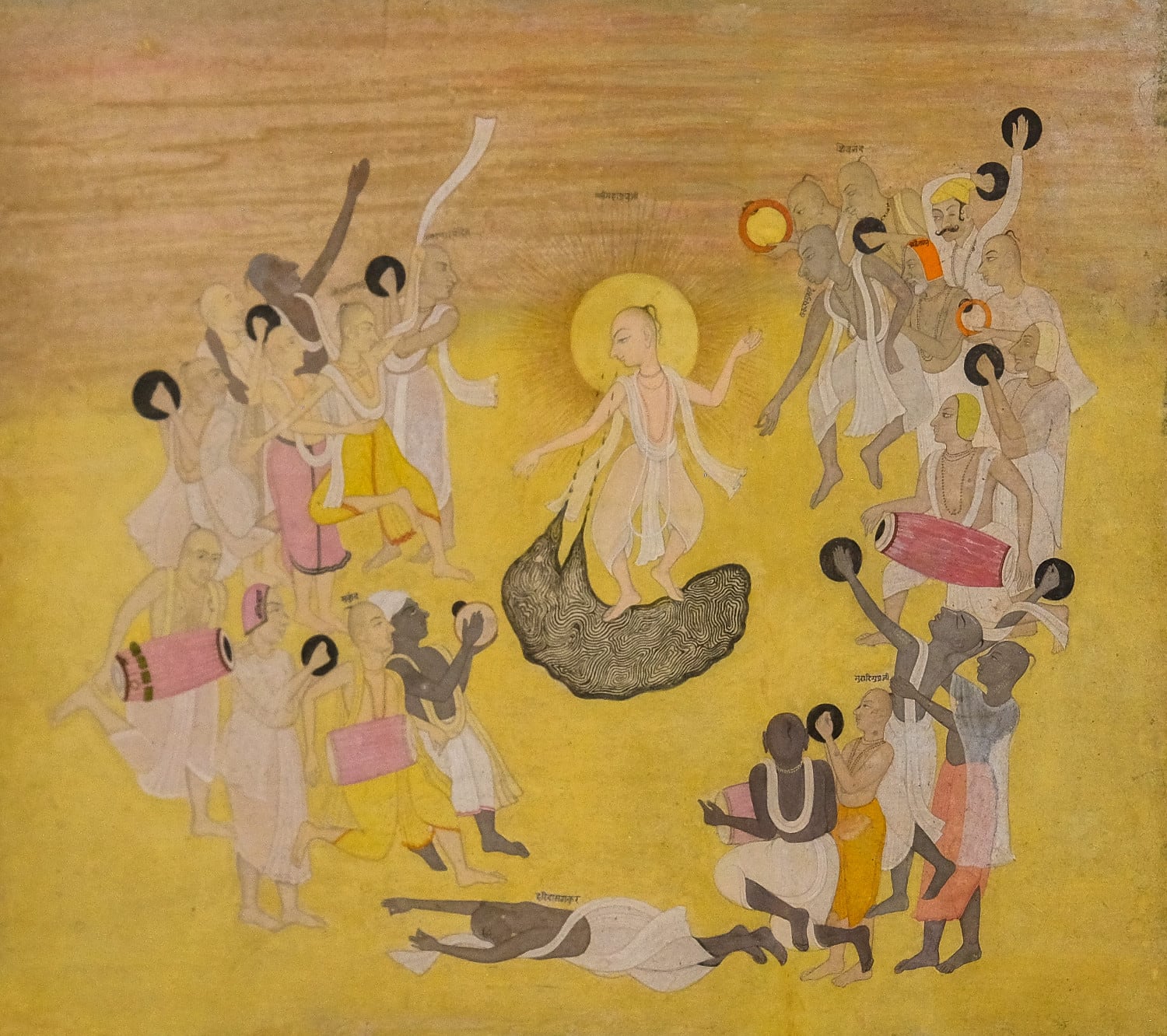
Chaitanya Mahaprabhu
Совпадают в вопросах: Что такое Абсолют? Существует ли Бог? · Кто я? Существует ли истинное «я»? · Почему мы страдаем?

Rabia al-Adawiyya
Совпадают в вопросах: Почему мы страдаем? · Что такое Абсолют? Существует ли Бог? · Что происходит после смерти?

Mirabai
Совпадают в вопросах: Что такое Абсолют? Существует ли Бог? · Почему мы страдаем? · Как достигается освобождение или спасение?
Hafez
Совпадают в вопросах: Что такое Абсолют? Существует ли Бог? · Кто я? Существует ли истинное «я»? · Почему мы страдаем?
Дальше всего от

Pema Chödrön
Расходятся в вопросах: Что такое Абсолют? Существует ли Бог? · Кто я? Существует ли истинное «я»? · Что происходит после смерти?

The 14th Dalai Lama (Tenzin Gyatso)
Расходятся в вопросах: Что такое Абсолют? Существует ли Бог? · Кто я? Существует ли истинное «я»? · Что происходит после смерти?
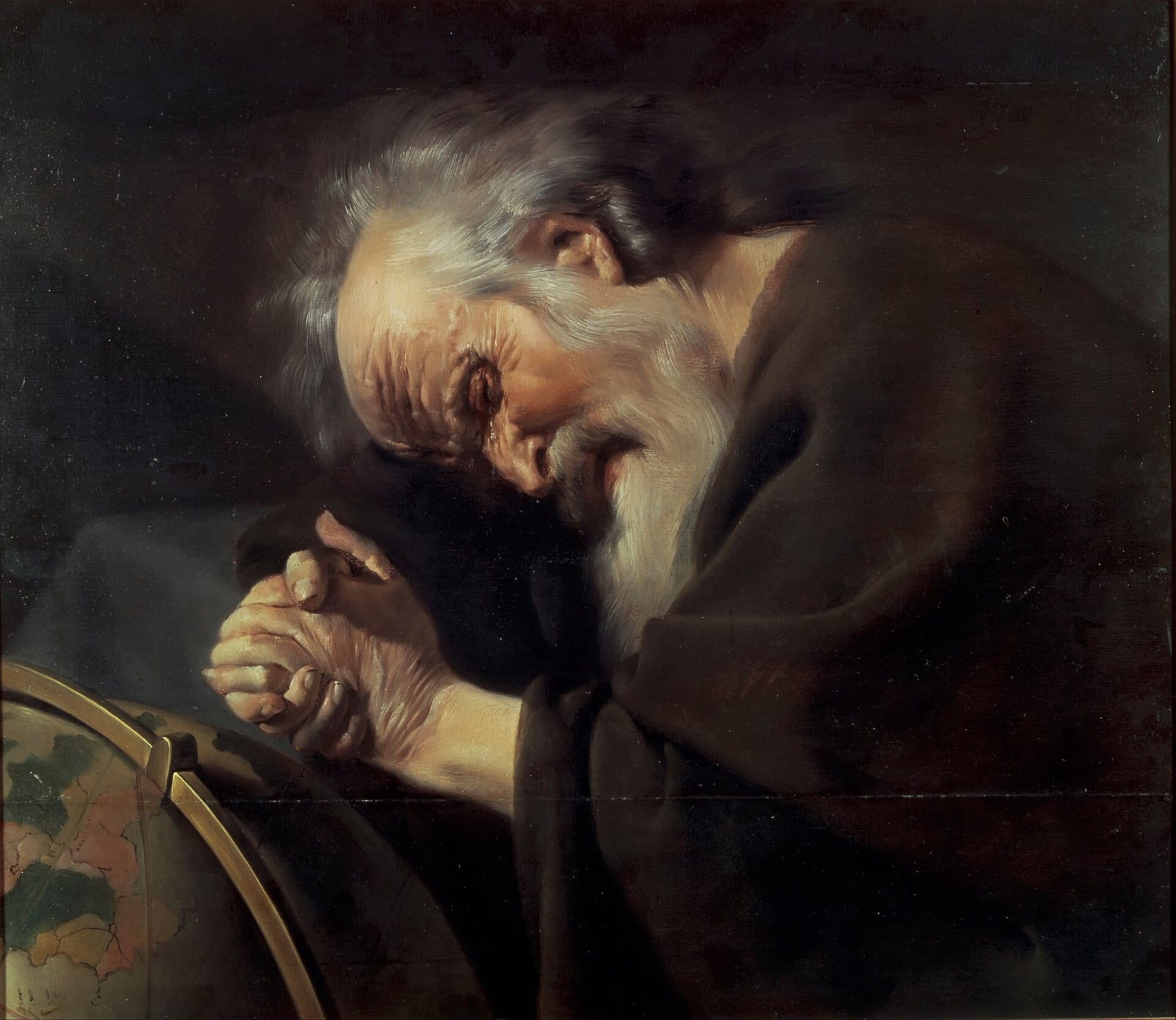
Heraclitus
Расходятся в вопросах: Кто я? Существует ли истинное «я»? · Нужен ли учитель?

Patañjali
Расходятся в вопросах: Что такое Абсолют? Существует ли Бог? · Кто я? Существует ли истинное «я»? · Что происходит после смерти?
Совпадают в вопросах
Rumi · Hildegard of Bingen
Love as the fire that moves the cosmos, and music as memory of the origin
Почему: There was no contact between the twelfth-century Rhineland abbess and the thirteenth-century poet of Konya, but they share a distant inheritance: the idea of a harmonious cosmos, Pythagorean and Neoplatonic in origin, which Latin Christianity and Persian Sufism received by different routes. Both also write in a symbolic and poetic register, not a scholastic one, where the image teaches more than the concept. The difference lies in emphasis: Hildegard sings love as the order that sustains a good creation and as the liturgy of the community; Rumi, as the wound and longing of the separated soul. In her love orders; in him, it consumes.
Расходятся в вопросахКажущееся противоречие
Rumi · Ramana Maharshi
The path of knowledge and the path of love: two ways ending in the same burning of the ego
Почему: The contradiction is apparent at the level of the path: both seek the dissolution of the ego and attribute it to something that exceeds the subject, the Beloved who draws in Rumi, the Self or grace in Ramana. The difference of language comes from their traditions: Persian Sufism expresses the way in terms of lover and Beloved; Advaita, in terms of knowledge of the Self. A metaphysical difference remains, however, that is not apparent: Rumi stays within the Islamic doctrine of creation, and the soul returns to a God who is not itself, while Ramana affirms that the Self is the Absolute. They agree on the how more than on the what.
Совпадают в вопросах
Rumi · Ibn Arabi
Love as the origin and return of the world: two summits of Sufism in the same century
Почему: They share an era, a religious language and sources: the Qur'an, the sayings attributed to the Prophet and the Sufi tradition that made love the principal way. There was also an indirect link: Sadr al-Din al-Qunawi, Ibn Arabi's stepson and chief disciple, taught in Konya in the same years as Rumi, and the Mevlevi hagiographies present them on cordial terms; there is no evidence that Rumi read Ibn Arabi or that they met. The difference is one of register. Ibn Arabi elaborates a technical metaphysics of the divine Names and of manifestation; Rumi writes narrative and lyrical poetry, without a system, where love is an experience of separation and longing before it is doctrine.
Расходятся в вопросахПринципиальное разногласие
Rumi · Annie Besant
He died as a mineral and became a plant: the soul's ascent, not reincarnation
Почему: The contradiction is real, although it is often presented as an affinity. Besant systematises a Theosophical doctrine that takes reincarnation and karma from Hinduism and Buddhism and combines them with a modern idea of the soul's evolution. Rumi writes in the thirteenth century within Islam, which affirms a single earthly life followed by resurrection; his verses on mineral, plant and animal refer to the Neoplatonic cosmology of the grades of being and to the Sufi saying about dying before death. Reading them as reincarnation, or as an anticipation of evolutionism, projects foreign categories onto the poem. Both see death as a passage and not an end; they differ over whether the passage repeats.
Совпадают в вопросах
Rumi · Teresa of Ávila
It is not a matter of thinking much: love knows more than reasoning
Почему: The affinity is comparative: there is no relation between the Castilian Carmelite and the poet of Konya. They converge because both speak from monotheistic traditions with a highly developed scholastic theology, Christian and Islamic, which reserved for mysticism a knowledge through love and experience that does not contradict theology but exceeds it. Both also write for readers who are not professional theologians: nuns in one case, disciples and listeners in the other. The difference lies in the form of that experience: Teresa lives it as friendship with a personal Christ and describes it with almost clinical precision; Rumi, as longing and fire, in poetic images.
Предания и рассказы
Предания и рассказы
Житийное повествование1244
The meeting with Shams and the question about Bayazid
Происхождение рассказа: Aflaki, *Manaqib al-arifin* (1318–1353); there are other versions of the first meeting. The one about books thrown into a pool comes from even later sources (Dawlatshah, 15th c.) and Lewis considers it legendary.
Источник: Aflaki, Shams al-Din Ahmad. Manaqib al-arifin (1318–1353). Ed. Tahsin Yazıcı, Ankara: Türk Tarih Kurumu, 1959–1961. Trad. inglesa: John O'Kane, The Feats of the Knowers of God. Leiden: Brill, 2002.
Не поддаётся проверке1244
The books in the pool
Происхождение рассказа: First recorded in sources of the 15th century and later (Dawlatshah Samarqandi, *Tadhkirat al-shuara*, 1487) and spread through Jami; Lewis classes it among legends with no basis in 13th-century sources.
Источник: Lewis, Franklin D. Rumi: Past and Present, East and West. The Life, Teachings and Poetry of Jalal al-Din Rumi. Oxford: Oneworld, 2000 (ed. revisada 2008).
Житийное повествованиеc. 1248
The goldsmiths' hammers
Происхождение рассказа: Aflaki, *Manaqib al-arifin*. The relationship with Salah al-Din and his position in the order are attested by Sultan Walad and by the ghazals Rumi addresses to him; the bazaar scene, only by Aflaki.
Источник: Aflaki, Shams al-Din Ahmad. Manaqib al-arifin (1318–1353). Ed. Tahsin Yazıcı, Ankara: Türk Tarih Kurumu, 1959–1961. Trad. inglesa: John O'Kane, The Feats of the Knowers of God. Leiden: Brill, 2002.
Житийное повествованиеc. 1258
The eighteen verses in the turban
Происхождение рассказа: Aflaki, *Manaqib al-arifin*; Husam's role is documented in the prologues to books II–VI of the *Masnavi* (Nicholson ed.).
Источник: Aflaki, Shams al-Din Ahmad. Manaqib al-arifin (1318–1353). Ed. Tahsin Yazıcı, Ankara: Türk Tarih Kurumu, 1959–1961. Trad. inglesa: John O'Kane, The Feats of the Knowers of God. Leiden: Brill, 2002.
Житийное повествование1273
A funeral of all religions
Происхождение рассказа: Aflaki, *Manaqib al-arifin*, chapter III; neither Sultan Walad nor Sipahsalar describes the participation of Christians and Jews in such detail.
Источник: Aflaki, Shams al-Din Ahmad. Manaqib al-arifin (1318–1353). Ed. Tahsin Yazıcı, Ankara: Türk Tarih Kurumu, 1959–1961. Trad. inglesa: John O'Kane, The Feats of the Knowers of God. Leiden: Brill, 2002.
Оспаривается1247–1248
The end of Shams: disappearance or murder?
Происхождение рассказа: Sultan Walad, *Ibtidanama* (1291): disappearance; Aflaki, *Manaqib al-arifin*: murder. Discussion in Lewis 2000, ch. 4.
Источник: Lewis, Franklin D. Rumi: Past and Present, East and West. Oxford: Oneworld, 2000, caps. 1–7 (cronología de Baha al-Din Walad, Burhan al-Din, Shams y Husam al-Din; discusión de las fechas de nacimiento y de la desaparición de Shams).
Не поддаётся проверкеc. 1216
Attar and the boy from Balkh
Происхождение рассказа: Dawlatshah Samarqandi (1487) and Jami, *Nafahat al-uns* (1478); Lewis treats it as legend.
Источник: Lewis, Franklin D. Rumi: Past and Present, East and West. The Life, Teachings and Poetry of Jalal al-Din Rumi. Oxford: Oneworld, 2000 (ed. revisada 2008).
Учение
Учение
Понятия, на которых строится мысль учителя, объяснённые в их контексте.
Love (ishq)ishq
It inherits the love mysticism of Ahmad Ghazali, Sanai and Attar, as opposed to the more intellectual path of Ibn Arabi's school.
Источник: Chittick, William C. The Sufi Path of Love: The Spiritual Teachings of Rumi. Albany: State University of New York Press, 1983.
Separation and longing for the origin (firaq)firaq
It takes up the Neoplatonic and Qur'anic theme of return ("to Him we shall return", Qur'an 2:156).
Mystical audition and turning (sama)sama
Debate on the lawfulness of *sama* since al-Ghazali (*Ihya*, book XVIII).
Источник: Lewis, Franklin D. Rumi: Past and Present, East and West. The Life, Teachings and Poetry of Jalal al-Din Rumi. Oxford: Oneworld, 2000 (ed. revisada 2008).
Dying before dying (fana)fana
Fana and baqa since al-Junayd and al-Qushayri; the scale of beings is of Aristotelian and Neoplatonic origin.
Silence (khamush)khamush
A topos of Persian apophatic mysticism; contrast between *qal* (word) and *hal* (state).
Источник: Schimmel, Annemarie. The Triumphal Sun: A Study of the Works of Jalaloddin Rumi. Londres: Fine Books / East-West Publications, 1978; Albany: SUNY Press, 1993.
Ретриты
Ретриты и центры
Места и встречи, связанные с этим учением. Мы свяжем вас с их организаторами.
Barons Court, Londres · Reino Unido
The Study Society, Colet House (London)
The Study Society
The Study Society was registered in 1951, four years after Ouspensky's death, at the initiative of his pupil Dr Francis Roles, to continue his work as a school of the Fourth Way. It is based at Colet House in west London, which presents itself as a spiritual gateway in the centre of the city. Its current programme brings together meditation, the Movements, study groups on the Masnavi and meetings devoted to Rumi, the dervish turning and a Sunday Advaita gathering. Its main website sometimes rejects automated requests; the Colet House site responds normally.
Chisholme House (Escocia), Sutton Courtenay (Oxfordshire), Londres y en línea · Reino Unido
Beshara: Foundation course and Masnavi study
The Beshara Trust
Beshara is the educational offering of the Beshara Trust, a British charity founded in 1971. Its foundation course takes the metaphysics of Ibn Arabi as its starting point to explore what it means to know oneself and the world in the light of the Unity of Existence, combining an introductory weekend, fortnightly online sessions and an optional residential at Chisholme House in the Scottish Borders. It also runs study groups on Rumi's Masnavi and other texts of the Sufi tradition. It is funded by philanthropic donations and voluntary work, and bookings are made by contacting the trust.
Centro Cultural Mevlana, Konya · Turquía
Şeb-i Arûs: commemoration of Rumi in Konya
Ministerio de Cultura y Turismo de Turquía
Şeb-i Arûs, the wedding night, is the name the Mevlevi tradition gives to Rumi's death on 17 December 1273, understood as his reunion with the Beloved. Every year, in the days leading up to that date, Konya holds the international commemoration ceremonies organised by the Ministry of Culture and Tourism, with concerts, lectures and performances of the sema, the whirling ceremony of the dervishes, in the hall of the Mevlana Cultural Centre. The cultural activities are free and the final ceremony on the 17th requires a ticket. It is the time of year when most pilgrims come to the city.
Konya (distrito de Karatay) · Turquía
Mevlana Museum: Rumi's mausoleum in Konya
Ministerio de Cultura y Turismo de Turquía (Mevlâna Müzesi)
The Mevlana Museum occupies the former lodge of the Mevlevi dervishes in Konya, built around the mausoleum of Jalal al-Din Rumi, constructed in 1274, a year after his death. Beneath the famous green dome lie Rumi, his father and other members of the order. The lodge was closed in 1925 under the law that abolished the Sufi orders and reopened the following year as a museum, now run by the Turkish Ministry of Culture. It holds manuscripts of the Masnavi, musical instruments and the dervishes' cells, and remains one of the most visited places of pilgrimage in the Islamic world.
Видео
Видео
Записи, интервью и документальные фильмы. Видео воспроизводятся с YouTube; здесь они не хранятся.
Franklin Lewis: Rumi's Poetic Theology of Love
Лекция· EN· 70 min
Theosophical Society
What Would Rumi Make of His Popularity in the Modern West? w/ William Chittick
Интервью· EN· 9 min
Rumi Center for Spirituality & the Arts
Rumi Lecture with Prof. Bilal Kuspinar | Bradford Literature Festival 2025
Лекция· EN· 2025· 70 min
Bradford Literature FestivalОфициальный канал
How to love, according to Rumi - Stephanie Honchell Smith
Разбор· EN· 6 min
TED-EdОфициальный канал
A Meditation on Rumi and the Power of Poetry | Leili Anvar | TED
Лекция· EN· 10 min
TEDОфициальный канал
Rumi - The Most Famous Sufi Poet in the World
Разбор· EN· 79 min
Let's Talk Religion
Masnavi-ye-Ma'navi of Rumi | مثنوی معنوی | Volume 1 Part 1 | Persian with English Translations
Запись третьих лиц· FA· 7 min
Sadai Salah
Mevlana Celaleddin-i Rumi / Belgesel - TRT Avaz
Документальный фильм· TR· 65 min
TRT AvazОфициальный канал
Sirus Shahnavaz - Rumi: El brillante sol del Sufismo
Лекция· ES· 61 min
EspacioRonda
The Mevlevi Sema Ceremony
Документальный фильм· EN· 2009
UNESCOОфициальный канал
Галерея
Галерея
Изображения с проверенной лицензией. Каждое сохраняет своё авторство и атрибуцию.
Рукописи
Рукописи
Рукописные свидетельства и древние тексты, с указанием хранителя и условий доступа.
FA · Nasj · c. 1258–1273 (texto); rayab de 677 / nov.–dic. de 1278 (copia)
مثنوی معنوی (Masnavi-ye manavi), copia de Konya
- Сохранившийся список
- Códice completo en seis libros, 50 × 32 cm, tinta, oro y color sobre papel
- Хранитель
- Museo Mevlana, Konya · Ms. 51
- Оцифровка
- artsandculture.google.com/asset/masnavi-s-first-…
FA · Nastaliq · c. 1460 (copia)
مثنوی (Masnavi), copia de Shiraz
- Сохранившийся список
- Códice iluminado con página inicial ornamentada
- Хранитель
- Bodleian Library, Oxford · MS. Elliott 251
- Оцифровка
- commons.wikimedia.org/wiki/File:Opening_page_of_…
FA · Nastaliq · 1073 H. / 1663 (copia)
مثنوی (Masnavi), códice ilustrado
- Сохранившийся список
- Códice ilustrado con miniaturas de las historias del *Masnavi*
- Хранитель
- Walters Art Museum, Baltimore · W.626
- Оцифровка
- art.thewalters.org/…
TR · Nasj / nastaliq otomano · c. 1590–1599 (copia ilustrada)
Tercüme-i Sevakib (traducción turca del Thawaqib al-manaqib, compendio de las Manaqib al-arifin de Aflaki)
- Сохранившийся список
- Códice ilustrado con miniaturas de la vida de Rumi y de sus sucesores
- Хранитель
- Morgan Library & Museum, Nueva York · MS M.466
- Оцифровка
- www.themorgan.org/…
Связи
Связи
Влияния, ученичество и близость взглядов. Документированная связь отличается от сходства, выявленного путём анализа.
Современник
Contemporaries; no meeting is recorded. The documented link is Sadr al-Din Qunawi, Ibn Arabi's stepson and chief disciple, who lived in Konya, knew Rumi and, according to Aflaki, was to lead his funeral prayer. The anecdote that Ibn Arabi saw the boy Rumi in Damascus walking behind his father is late and unverifiable.
Документированная связь
Испытал влияние
The *Masnavi* draws tales and arguments from the Ghazalian tradition (Abu Hamid and his brother Ahmad, the theorist of love); Nicholson's commentary notes many parallels with the *Ihya*.
Документированная связь
Идеи, близкие к
Mystical poetry in the vernacular, critique of formal religion, and the language of love and separation. No documented contact or influence.
Сходство, выявленное путём анализа
Идеи, близкие к
Approximate contemporaries (Eckhart was born c. 1260). They share the theme of the death of the self and silence before the divine; there was no contact.
Сходство, выявленное путём анализа
Упоминается в других статьях
- Kabir · Идеи, близкие к
- Attar · Повлиял на
- Jesus of Nazareth · Повлиял на
- Chaitanya Mahaprabhu · Идеи, близкие к
- Meher Baba · Идеи, близкие к
- Guru Nanak · Идеи, близкие к
- Rabia al-Adawiyya · Идеи, близкие к
- Al-Ghazali · Повлиял на
- Ibn Arabi · Современник
- Hafez · Идеи, близкие к
- Kahlil Gibran · Идеи, близкие к
- Al-Hallaj · Повлиял на
- Baal Shem Tov · Идеи, близкие к
Источники
Источники
Библиография и каталоги, использованные для этой статьи.
- Wikidata, Q43347 «Rumi» (P31=Q5; 160 enlaces entre wikis; P569 1207-09-30; P570 1273-12-17).
- Jalaluddin Rumi. The Mathnawi of Jalalu'ddin Rumi. Ed., trad. y comentario de Reynold A. Nicholson. E. J. W. Gibb Memorial, New Series IV, 8 vols. Londres: Luzac, 1925–1940 (vol. II: trad. libros I–II, 1926; vol. IV: trad. libros III–IV, 1930).
- Lewis, Franklin D. Rumi: Past and Present, East and West. The Life, Teachings and Poetry of Jalal al-Din Rumi. Oxford: Oneworld, 2000 (ed. revisada 2008).
- Lewis, Franklin D. Rumi: Past and Present, East and West. Oxford: Oneworld, 2000, caps. 1–7 (cronología de Baha al-Din Walad, Burhan al-Din, Shams y Husam al-Din; discusión de las fechas de nacimiento y de la desaparición de Shams).
- Sultán Walad. Ibtida-nama (Walad-nama), 1291; y Faridun Sipahsalar, Risala dar ahwal-e Mawlana. Fuentes primarias de la cofradía, citadas a través de Lewis 2000 y Schimmel 1978.
- Aflaki, Shams al-Din Ahmad. Manaqib al-arifin (1318–1353). Ed. Tahsin Yazıcı, Ankara: Türk Tarih Kurumu, 1959–1961. Trad. inglesa: John O'Kane, The Feats of the Knowers of God. Leiden: Brill, 2002.
- Schimmel, Annemarie. The Triumphal Sun: A Study of the Works of Jalaloddin Rumi. Londres: Fine Books / East-West Publications, 1978; Albany: SUNY Press, 1993.
- Chittick, William C. The Sufi Path of Love: The Spiritual Teachings of Rumi. Albany: State University of New York Press, 1983.
- Ali, Rozina. «The Erasure of Islam from the Poetry of Rumi». The New Yorker, 5 de enero de 2017.
- Nicholson, Reynold A. (ed. y trad.). Selected Poems from the Divani Shamsi Tabriz. Cambridge: Cambridge University Press, 1898.
- Ganjoor (گنجور), texto persa del Masnavi-ye manavi y del Divan-e Shams, edición digital.
- Gamard, Ibrahim. Dar al-Masnavi: «About Nicholson» (lista de los siete gazales de la selección de Nicholson —IV, VIII, XII, XVII, XXXI, XXXIII, XLIV— ausentes de los manuscritos más antiguos y omitidos por Arberry).
- Semazen.net, «Some popular pieces of false knowledge regarding Rumi and his works» (Kulliyat), sobre la cuarteta «Baz a, baz a…».
- Open Library, registros de ediciones de las obras de Rumi (Masnavi, Divan, Fihi ma fihi, Majalis-e sab'a, Maktubat).
- Правообладатель
- Dominio público (obra del siglo XIII). Las ediciones críticas (Nicholson/Gibb Memorial Trust; Foruzanfar) y las traducciones modernas (Oxford, Penguin, University of Chicago Press, Paidós, Hiperión, Éditions du Rocher, Albin Michel, Seuil…) están sujetas a los derechos de sus editores. Las versiones de Coleman Barks (HarperCollins) son paráfrasis con derechos vigentes.
Ожидает подтверждения
То, что в этой статье пока не удалось установить. Мы предпочитаем сказать об этом, а не заполнять пробел.
- Confirmar en Open Library/Google Books el traductor de «El Masnavi» (Edicomunicación, 1998) y de «Poemas sufíes» (Hiperión, 1988), y si se tradujeron directamente del persa.
- Localizar ISBN de la edición crítica de Foruzanfar del Divan (Kulliyat-e Shams) y de las ediciones de Subhani de Majalis-e sab'a y Maktubat.
- Buscar una traducción castellana completa y directa del persa del Masnavi con ISBN verificado (no localizada en Open Library).
- Verificar el idioma de la charla TED de Leili Anvar (iyabl4dlxbY).
- Confirmar con una fuente impresa la numeración exacta de los gazales 636, 1919 y 2039 en la edición de Foruzanfar (se ha usado la de Ganjoor).
- Comprobar los enlaces de las fichas de la Walters (W.626) y la Morgan (MS M.466): se enlaza el portal, no el ítem.
- Obras completas (2026-10-25): las obras de Rumi son cinco —Masnavi, Divan-e Shams (que incluye los cuartetos, registrados aparte como «rubaiyat»), Fihi ma fihi, Majalis-e sab'a y Maktubat— y están todas registradas. Se añaden como recopilaciones las dos antologías en inglés de mayor circulación (Barks 1995, Nicholson 1950); las demás antologías y versiones libres (Barks, Helminski, Harvey, Star) son ediciones de esas obras y no obras nuevas.
- Vídeos: añadido el de la UNESCO sobre el sema mevleví (diez en total); siguen faltando vídeos en francés, alemán y persa de canales institucionales verificables.
- Sala de lectura: el vol. VI de la traducción de Nicholson (libros V–VI, 1934; archive.org/details/in.ernet.dli.2015.285559) no se registra porque en EE. UU. podría seguir protegido hasta 2030 (restauración URAA); es dominio público en los países de 70 años post mortem. No se ha localizado ninguna traducción española de dominio público, ni una transcripción del Fihi ma fihi libre de derechos; el texto persa de Wikisource (fa) está troceado por relatos sin orden numérico y no se ha registrado.
Исследовано 2026-10-23