Иудаизм · Каббала
Baal Shem Tov
ישראל בן אליעזר · הבעל שם טוב (הבעש״ט) · דער בעל־שם־טובֿ
ок. 1700 – 1760Исторически документированная личность
Исраэль бен Элиэзер (ок. 1700–1760), прозванный Баал Шем Товом, или Бештом, — целитель и мистик из Подолья, которого хасидизм почитает своим основателем. Книг он не писал: кроме одного письма, его учение о прилеплении к Богу в каждом деянии, о радостной молитве и о присутствии Божественного во всём сотворённом дошло до нас через учеников. Налоговые реестры Меджибожа подтверждают, что он существовал; его легенду создала агиография 1815 года.
- трудов
- 16трудов
- изданий
- 29изданий
- цитат
- 8цитат
- видео
- 12видео
- изображений
- 8изображений
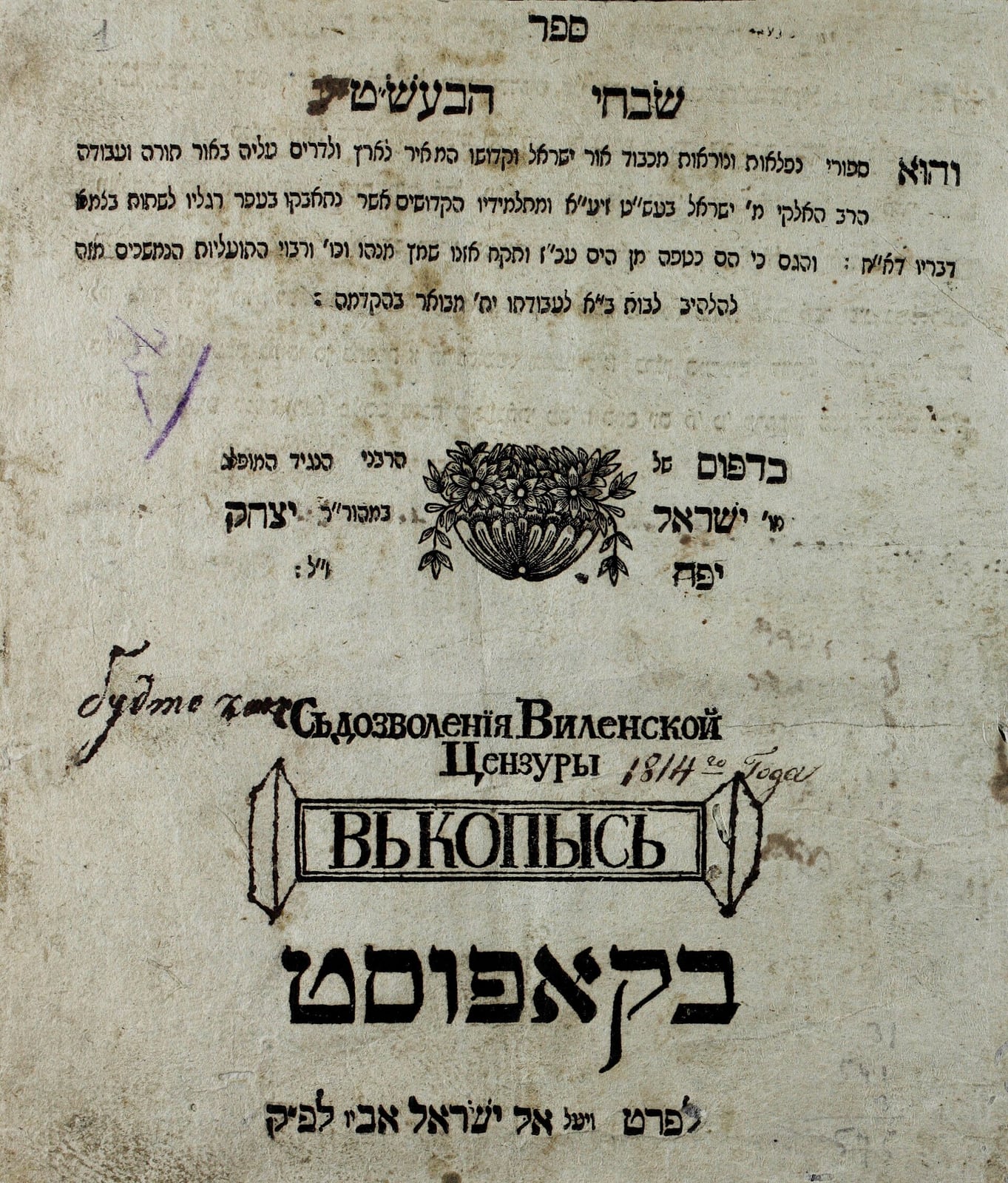
Portada de la primera edición de Shivhei ha-Besht (Kopys, 1814–1815) · Public domain
Своими словами
«When your teaching is publicised and revealed in the world, and your springs overflow outward.»Igeret ha-Kodesh, respuesta del Mesías al Besht (Ben Porat Yosef, Korets, 1781)
Baal Shem Tov
Igeret ha-Kodesh (Letter to Abraham Gershon of Kuty)
Для начала — одна книга
Igeret ha-Kodesh (Letter to Abraham Gershon of Kuty)Главная мысль
Devekut (cleaving to God): *Devekut*, from the Hebrew root "to cleave", designates in the kabbalistic tradition the union of thought with God, which earlier authors reserved for a few and for exceptional moments.
В контексте
Биография
4 мин чтения
Перевод с испанского оригинала, выполненный с помощью ИИ; ожидает проверки носителем языка.
Основатель без книги
Немногие фигуры изменили религиозную жизнь еврейства столь глубоко, оставив при этом так мало письменных следов. Исраэль бен Элиэзер, которого последователи называли Баал Шем Товом — «Владельцем Доброго Имени» — или, по инициалам, Бештом, не написал ни одного трактата. Всё, что мы о нём знаем, восходит к трём пластам весьма неравной ценности: к горстке польских административных документов и свидетельств современников, не принадлежавших к его кругу; к письму, написанному им самим и напечатанному через два десятилетия после его смерти; и к массе поучений и рассказов, которые его ученики и ученики его учеников записывали начиная с 1780 года. Исследования последних десятилетий, прежде всего работы Моше Росмана и Иммануэля Эткеса, научились разделять эти пласты: человека, засвидетельствованного документами, учителя, каким его запомнили ученики, и святого из легенды.
Тёмные годы
Он родился около 1700 года в пограничной полосе между Речью Посполитой и Молдавским княжеством. «Шивхей ха-Бешт» («Восхваления Бешта»), агиографический сборник, напечатанный в Копыси в 1814–1815 годах, помещает его отца Элиэзера «в стране Валахии, у границы»; позднейшая хасидская традиция, относящая рождение к 1698 году, называет подольскую деревню Окопы, но документальных подтверждений этому нет. Та же книга рассказывает, что родители произвели его на свет в глубокой старости, что он рано осиротел и его вырастила община; что он был помощником меламеда и синагогальным служкой, что вместе с женой Ханой, сестрой учёного Авраама Гершона из Кут, добывал глину в Карпатах и держал корчму.
Проверить эти подробности невозможно, и некоторые из них следуют узнаваемой агиографической схеме: скрытый праведник живёт среди простых людей, пока не пробьёт час откровения, или тайные писания загадочного Адама Баал Шема попадают ему в руки. Но они рисуют черту, которую документы подтверждают: Бешт вышел не из больших раввинских академий, а из мира скромных ремёсел, странствующих проповедников и народных целителей подольского пограничья.
Баал шем из Меджибожа
Баал шем в Восточной Европе XVIII века был признанным специалистом: он писал амулеты, изгонял бесов, назначал лекарства и охранял рожениц и детей с помощью божественных имён. Исраэль занимался этим ремеслом, о чём прямо говорит его прозвище. Первые надёжные упоминания показывают, что он был известен уже до 1738 года: Шломо Ицхак Гальперн вспоминал, что его отец, раввин Жванца, знался со «славным Исраэлем Баал Шемом». Около 1740 года он поселился в Меджибоже (польск. Międzybóż; ныне Хмельницкая область Украины), частновладельческом городе магнатов Чарторыйских. Налоговые реестры, найденные Росманом в архиве этого рода, помещают его в доме, принадлежавшем общине и освобождённом от податей, — сначала как «каббалиста», а в 1758 году как «Баал Шема доктора». Он не был бунтарём против общинной власти: это был религиозный специалист, которого содержала сама община.
Восхождение души
Единственный текст, почти наверняка вышедший из-под его пера, — письмо к шурину Аврааму Гершону из Кут, переселившемуся в Землю Израиля. В нём Бешт рассказывает, что в еврейский Новый год 1746 года он совершил, «как тебе известно», заклинание восхождения души, прошёл небесные чертоги и достиг чертога Мессии, у которого спросил, когда тот придёт. Ответ — когда твоё учение распространится и откроется миру и твои источники разольются вовне — стал миссионерским девизом хасидизма. Письмо повествует также о втором восхождении в Новый год 1749 года, о заступничестве во время эпидемии, о кровавых наветах в Заславе и других общинах и завершается наставлением о молитве: в каждой букве заключены миры, души и Божественность, и молящийся должен соединить с ними свою душу. Вручённое Яакову Йосефу из Полонного, чтобы тот доставил его в Палестину, письмо так и не дошло до адресата и было напечатано в 1781 году в конце книги «Бен порат Йосеф».
Святое братство
Эткес показал, что Бешт был одновременно магом, мистиком и вождём. Вокруг него собралось небольшое «святое братство» людей учёных — среди них были признанные раввины и проповедники, — принявших его харизматический авторитет: Яаков Йосеф ха-Коэн, раввин Шаргорода, а затем Полонного; Дов-Бер, проповедник (магид) из Межирича; Пинхас из Кореца; Нахман из Городенки. Организации он не создал: хасидизм как движение — с дворами, династиями и сетями приверженцев — сложился после его смерти, прежде всего при Дов-Бере и его учениках. Но именно в его фигуре выковалось убеждение, что святой человек способен заступаться за общину, возвышать души и низводить благословение, — то, что позднее станет учением о цадике.
Чему он учил
Его поучения доходят до нас только в чужом изложении. Яаков Йосеф приводит сотни из них с формулой «слышал от моего учителя» в книге «Толдот Яаков Йосеф» (1780) — первой напечатанной хасидской книге, а такие антологии, как «Цваат ха-Ривах» (1793) и «Кетер Шем Тов» (1794–1795), собрали их, смешав с поучениями Межиричского магида. Сквозь этот фильтр проступает связное ядро. Цель религиозной жизни — двекут, прилепление мысли к Богу в каждое мгновение, а не только в молитве или учении; поскольку «вся земля полна славы Его», Богу можно служить и за едой, и в работе, и в беседе, и даже посторонние мысли, осаждающие молящегося, можно возвысить к их корню. Радость — условие служения Богу, а печаль — главная ему помеха; аскеза постов и умерщвления плоти, распространённая среди благочестивых его времени, предстаёт в этих источниках опасным путём. Изречение, сохранённое в «Кетер Шем Тов», подытоживает эту духовную психологию: где мысль человека, там он весь.
Смерть и посмертная слава
Он умер в Меджибоже в первый день Шавуота 1760 года, 6 сивана 5520 года (21 мая по григорианскому календарю). «Шивхей ха-Бешт» содержит подробный рассказ о его последних часах, приписываемый свидетелям из его окружения. Ученики разнесли его имя по Подолью, Волыни и Галиции; в 1772 году раввинские власти Вильны отлучили хасидов от общины, и спор между хасидами и миснагидами на полвека определил еврейскую жизнь Восточной Европы. «Шивхей ха-Бешт» в 1815 году закрепили образ святого чудотворца; в XX веке Мартин Бубер пересказал его легенды для европейского читателя, а Гершом Шолем поместил его в историю еврейской мистики как зачинателя её «последней фазы». Сегодня его могила в Меджибоже — место паломничества, а спор об историческом Беште остаётся открытым.
Источники: Rosman, Moshe. Founder of Hasidism: A Quest for the Historical Ba'al Shem Tov. Berkeley: University of California Press, 1996; 2.ª ed. Oxford/Portland: Littman Library of Jewish Civilization, 2013. · Etkes, Immanuel. The Besht: Magician, Mystic, and Leader. Trad. Saadya Sternberg. Waltham (Mass.): Brandeis University Press, 2005 (original hebreo: Ba'al ha-Shem, Jerusalén, Merkaz Zalman Shazar, 2000). · Ben-Amos, Dan, y Jerome R. Mintz (trads. y eds.). In Praise of the Baal Shem Tov [Shivhei ha-Besht]: The Earliest Collection of Legends about the Founder of Hasidism. Bloomington: Indiana University Press, 1970 (reed. Northvale: Jason Aronson, 1993). · Biale, David; Assaf, David; Brown, Benjamin; Gellman, Uriel; Heilman, Samuel C.; Rosman, Moshe; Sagiv, Gadi; Wodziński, Marcin. Hasidism: A New History. Princeton: Princeton University Press, 2018. · Scholem, Gershom. Major Trends in Jewish Mysticism. Jerusalén: Schocken, 1941 (reed. Nueva York: Schocken, 1946 y ss.), «Ninth Lecture: Hasidism, the Latest Phase». Trad. esp.: Las grandes tendencias de la mística judía, Madrid, Siruela.
Хронология
Жизнь год за годом
Каждая точка — документированное событие. Нажмите, чтобы прочитать о нём, с источником и степенью достоверности.
ок. 17000 летFrontera podolio-moldava
Birth
Israel, son of Eliezer, is born on the border between Poland and Moldavia. Hasidic tradition gives 18 Elul 5458 (1698) and the village of Okopy; neither is attested in documents.
ПреданиеRosman, Moshe. Founder of Hasidism: A Quest for the Historical Ba'al Shem Tov. Berkeley: University of California Press, 1996; 2.ª ed. Oxford/Portland: Littman Library of Jewish Civilization, 2013.
После смерти
- 1772First bans on the Hasidim
- 1780First Hasidic book
- 1793 – 1795Tsava'at ha-Rivash and Keter Shem Tov
- 1815Shivhei ha-Besht
- 1908The legend according to Buber
- 1996The historical Besht
ок. 1700 · 0 лет
Birth
Israel, son of Eliezer, is born on the border between Poland and Moldavia. Hasidic tradition gives 18 Elul 5458 (1698) and the village of Okopy; neither is attested in documents.
Предание
1730-е · 30 лет
Years of humble trades
According to Shivhei ha-Besht he works as a teacher's assistant, beadle, clay-digger with his wife Hannah and tavern-keeper, living as a hidden saint until his "revelation". Hagiographic account, unverifiable.
Предание
ок. 1738 · 38 лет
First outside testimony
Before 1738, the year of his death, Rabbi Jacob Halpern of Zhvanets has dealings with "the renowned Israel Baal Shem", as his son Solomon Isaac Halpern, no Hasid, would recall.
Вероятно
ок. 1740 · 40 лет
Settles in Międzybóż
The records of this Czartoryski private town place him from 1740 in a tax-exempt community house, first described as a "kabbalist".
Документировано
сентябрь 1746 г. · 46 лет
The Rosh Hashanah ascent
On the New Year of 5507 he performs an "ascent of the soul" in which, according to his own letter, he reaches the palace of the Messiah and asks him when he will come.
Документировано
ок. 1747 · 47 лет
His brother-in-law emigrates to Palestine
Abraham Gershon of Kuty, his wife's brother and a student of Kabbalah, settles in the Land of Israel; he will be the addressee of the Besht's letter.
Вероятно
ок. 1750 · 50 лет
The letter to Gershon of Kuty
Having received a letter from his brother-in-law at the Luka fair of 5510, he replies with the account of his ascents of 1746 and 1749. He entrusts it to Jacob Joseph of Polonne, who never makes the journey.
Документировано
1758 · 58 лет
"Baal Shem doktor"
The Międzybóż tax inventory lists the "Baal Shem doktor" in a tax-exempt house.
Документировано
21 мая 1760 г. · 60 лет
Death on Shavuot
He dies on the first day of Shavuot 5520. Shivhei ha-Besht narrates his last hours according to witnesses from his circle.
Документировано
1772
First bans on the Hasidim
The rabbinic authorities of Vilna and Brody excommunicate the Hasidim: the quarrel with the mitnagdim begins.
Документировано
1780
First Hasidic book
Jacob Joseph of Polonne publishes Toledot Ya'akov Yosef, with hundreds of teachings introduced by "I heard from my master". In 1781, Ben Porat Yosef prints the Besht's letter.
Документировано
1793 – 1795
Tsava'at ha-Rivash and Keter Shem Tov
The anthologies Tsava'at ha-Rivash (1793) and Keter Shem Tov (Zolkiew, 1794–1795) are printed, mixing teachings of the Besht and the Maggid of Mezeritch.
Документировано
1815
Shivhei ha-Besht
Israel Jaffe prints in Kopys the tales collected by Dov Ber of Linits: the Besht's hagiography is born. Yiddish editions appear the same year.
Документировано
1908
The legend according to Buber
Martin Buber publishes Die Legende des Baalschem, which introduces the Besht to a non-Jewish European readership.
Документировано
1996
The historical Besht
Moshe Rosman publishes Founder of Hasidism, based on the Czartoryski archives: the Besht appears as a religious specialist integrated into the community.
Документировано
Труды
Главные труды
Труды, без которых не понять это наследие.
Baal Shem Tov
Igeret ha-Kodesh (Letter to Abraham Gershon of Kuty)
Переписка · ок. 1750
Igeret ha-Kodesh (Letter to Abraham Gershon of Kuty)
אגרת הקודש (אגרת הבעש״ט לר׳ גרשון מקוטוב)
Letter to his brother-in-law, who had emigrated to the Land of Israel, written shortly after 1750. It recounts the ascent of the soul on the New Year of 1746, in which the Besht reaches the palace of the Messiah and asks him when he will come ("when your teaching is publicised and your springs overflow outward"), a second ascent in 1749, his intercession during an epidemic and against ritual-murder accusations in Zasław and two other communities, and closes with instruction on prayer through the letters. It is the key document for his self-understanding as mystic and intercessor, and the origin of Hasidism's missionary drive.
3 издания

Позднейший сборник · 1793
Tsava'at ha-Rivash (The Testament of Rabbi Israel Baal Shem)
צוואת הריב״ש
Some hundred and forty short paragraphs on the inner life: equanimity before praise and contempt (*hishtavut*), constant cleaving to God (*devekut*), prayer in joy rather than in tears, the raising of stray thoughts, distrust of sadness and scruples, and moderate asceticism. It was one of the books the *mitnagdim* cited as proof of Hasidic heterodoxy, and at the same time one of the movement's most read manuals of piety. Jacob Immanuel Schochet's annotated edition (Kehot) traces the sources of each paragraph.
3 издания

Позднейший сборник · 1794
Keter Shem Tov (Crown of the Good Name)
כתר שם טוב
It is the first anthology devoted explicitly to the Besht's teachings. In two parts, it gathers comments on biblical verses and sayings on prayer, humility, the divine presence in all things and the relation between the righteous man and the people. Some of the most quoted maxims come from here, such as that a man is wholly where his thought is. The Kehot edition (*Keter Shem Tov ha-Shalem*), prepared by J. I. Schochet, corrects the text and adds sources and commentary.
3 издания

Позднейший сборник · 1815
Shivhei ha-Besht (In Praise of the Baal Shem Tov)
שבחי הבעש״ט
Some two hundred and fifty narratives that follow the Besht's life from the legend of his father, captive in a distant land, to his death on Shavuot 1760: the orphaned childhood, the years as a hidden saint, the revelation, the healings and exorcisms, the ascents of the soul, the encounters with disciples and opponents, the thwarted journey to the Land of Israel. Each tale usually states from whom the compiler heard it, which allows historians to reconstruct chains of transmission. The annotated English translation by Dan Ben-Amos and Jerome R. Mintz (1970) is the reference in that language.
5 изданий
Все труды (16)
Baal Shem Tov
Toledot Ya'akov Yosef
The Conscious LibraryToledot Ya'akov Yosef
1780
Baal Shem Tov
Ben Porat Yosef
The Conscious LibraryBen Porat Yosef
1781
Baal Shem Tov
Tsafnat Pa'neah
The Conscious LibraryTsafnat Pa'neah
1782
Baal Shem Tov
Ketonet Passim
The Conscious LibraryKetonet Passim
1866
Baal Shem Tov
Likkutim Yekarim (Precious Gleanings)
The Conscious LibraryLikkutim Yekarim (Precious Gleanings)
1792
Baal Shem Tov
Degel Mahaneh Efrayim
The Conscious LibraryDegel Mahaneh Efrayim
1810
Baal Shem Tov
Sefer Baal Shem Tov (The Book of the Baal Shem Tov)
The Conscious LibrarySefer Baal Shem Tov (The Book of the Baal Shem Tov)
1938
Baal Shem Tov
Kabbalistic commentary on Psalm 107 (attributed)
The Conscious LibraryKabbalistic commentary on Psalm 107 (attributed)
1804
Baal Shem Tov
Letters of the "Kherson genizah" (spurious)
The Conscious LibraryLetters of the "Kherson genizah" (spurious)
1918

Founder of Hasidism (Moshe Rosman)
1996
Baal Shem Tov
The Besht: Magician, Mystic, and Leader (Immanuel Etkes)
The Conscious LibraryThe Besht: Magician, Mystic, and Leader (Immanuel Etkes)
2000

The Circle of the Baal Shem Tov (Abraham J. Heschel)
1985
Изречения
Изречения, найденные в конкретном труде. Каждое сопровождается указанием происхождения и степени надёжности.
When your teaching is publicised and revealed in the world, and your springs overflow outward.בעת שיתפרסם למודך ויתגלה בעולם ויפוצו מעינותיך חוצה
ПровереноIgeret ha-Kodesh, respuesta del Mesías al Besht (Ben Porat Yosef, Korets, 1781)
Последние слова
Традиционная атрибуция
«I know that the clock has stopped, and I do not worry about myself, for I know for certain that I shall go out by this door and at once enter by another.»ידעתי שעמד הזייגר ואין אני דואג על עצמי כי יודע אני בבירור שאצא מפתח זה ותיכף אכנס בפתח אחר
Shivhei ha-Besht (Kopys, 1815), in the account of his death on Shavuot 1760, which the compiler says he heard from Rabbi Jacob of Międzybóż. After these words he is said to have asked those present to recite the psalm "May the pleasantness of the Lord" (Ps 90:17), to have taught his disciples about the upper worlds and to have expired covered with a sheet. It is second-hand testimony written down half a century later, within a hagiographic work.
Источник: Dov Ber ben Shmuel de Linits, Shivhei ha-Besht, Kopys, 1814–1815; texto hebreo de la edición de Kopys en Sefaria (dominio público).
Спросить
На что отвечают эти труды
Двенадцать великих вопросов человечества и то, что позволяют на них ответить эти тексты, со ссылками. Мы никогда не вкладываем слова в чужие уста.
Что такое Абсолют? Существует ли Бог?
The King one serves fills everything: in every letter there is divinity
И личный, и безличныйСказано прямо
The Baal Shem Tov wrote no books: apart from one letter, his teachings come to us through the homilies of his disciples, above all Jacob Joseph of Polonne, and through later anthologies. In those sources the God of Israel to whom one prays and to whom one cleaves (devekut) is at the same time the presence that fills everything, so that no place is empty of Him. In his own letter to his brother-in-law, instructing him on prayer, he states that in every letter there are worlds, souls and divinity. From Lurianic Kabbalah he takes the idea of divine sparks scattered in things, which man raises when he eats, works or prays with intention. God is thus the King served with joy and the vitality hidden in each thing: concealment exists only for one who cannot see Him.
Сравнить этот вопрос с другими учителямиКто я? Существует ли истинное «я»?
A soul that ascends, and a man is where his thought is
Сотворённая бессмертная душаСледует из учения
The Baal Shem Tov wrote no treatise on the soul; what we know of his view of the self comes through his letter and the sayings his disciples transmitted. In the letter to his brother-in-law he tells how his soul ascended, at the New Year of 1746, to the palace of the Messiah: the soul can leave the body and travel through the upper worlds. The anthologies record a maxim that shifts the centre of the person: wherever a man thinks with his thought, there he is entirely. The true self is the soul cleaving to God; the ego that compares itself and grows vain is a hindrance, which is why he warns that whoever serves with devotion must not think himself greater than his fellow, for he is a creature like the others, made to serve.
Сравнить этот вопрос с другими учителямиПочему мы страдаем?
Sadness distances from God; behind every concealment He is there
Отделённость от БогаСледует из учения
The teachings his disciples attribute to the Baal Shem Tov place the greatest evil not in outward misfortune but in the sadness that separates from God. Weeping, says the Testament of Rabbi Israel, is very bad, because the Creator is served with joy; only weeping for joy is good. Melancholy and scruples are traps that draw one away from cleaving to God (devekut). Suffering itself is not foreign to God: according to a teaching his disciples transmit, God hides behind the walls of misfortune like a king behind illusory walls, and whoever knows He is there dissolves the concealment. In his letter the Besht also appears as an intercessor in epidemics and persecutions: the community's pain calls for prayer, not resignation.
Сравнить этот вопрос с другими учителямиЧто происходит после смерти?
To go out by one door and at once enter by another
Вечная жизнь и воскресениеСледует из учения
The Baal Shem Tov left no written teaching on death; what is known comes through his letter and through tradition. In the letter to his brother-in-law he describes how, in his ascents of the soul, he saw souls of the living and the dead rising from world to world, and how he himself interceded for them: the life of the soul continues and can be helped. Hasidic tales, gathered in In Praise of the Baal Shem Tov, speak of souls returning in another body to repair what they left undone, according to the kabbalistic doctrine of transmigration. The same book narrates his death at Shavuot in 1760: he is said to have declared that he did not fear for himself, because he knew he would go out by one door and at once enter by another.
Сравнить этот вопрос с другими учителямиКак достигается освобождение или спасение?
Cleaving to God with joy in every act, the bodily included
Через преданность и предание себяСказано прямо
The teachings his disciples attribute to the Baal Shem Tov place at the centre cleaving to God (devekut), not as a state reserved for ascetics but as a constant orientation of the heart. It is reached through prayer made with joy, which is more acceptable than prayer made with weeping, through equanimity before praise and contempt, and through serving God in bodily things: eating, working, conversing with the intention of raising the divine sparks present in everything. The Besht discouraged excessive fasting and mortification, common in the pious circles of his time. Personal and collective redemption are linked: in his letter, the Messiah answers him that he will come when his teaching is spread abroad and his springs overflow outward.
Сравнить этот вопрос с другими учителямиНужен ли учитель?
The righteous man raises his generation; the people reach God through him
НезаменимСледует из учения
The Baal Shem Tov was master of a circle of disciples who ascribed singular authority to him, and later Hasidism made the righteous man (tsaddik) the centre of religious life. The teachings transmitted by Jacob Joseph of Polonne describe the relationship between «men of form», the sages who cleave to God, and «men of matter», the simple people, who are raised through them; the righteous man is responsible for his generation. According to the tradition recorded in Hasidic tales, the Besht himself had a heavenly master, the prophet Ahijah the Shilonite. His letter shows him interceding for entire communities. For the simple people, the way to God passed through closeness to a righteous man.
Сравнить этот вопрос с другими учителямиРеален ли мир?
No place is empty of God: divine sparks in all things
Проявление божественногоСказано прямо
The teachings transmitted by the Baal Shem Tov's disciples make the world the stage of divine presence: the whole earth is full of His glory, and no place is empty of Him. From Lurianic Kabbalah they take the idea that at creation sparks of holiness were scattered in things, and that man raises them when he uses the world with intention: when eating, trading, working or conversing. Hence the service of God in bodily things that marked nascent Hasidism. In his letter the Besht himself states that in every letter there are worlds, souls and divinity. The world is neither illusion nor obstacle but a garment of the divine: what conceals is the same as what reveals, for one who knows how to look.
Сравнить этот вопрос с другими учителямиЧто такое любовь?
To love God with joy and one's fellow without thinking oneself above him
Любовь к Богу и ближнемуСледует из учения
In the transmitted teachings of the Baal Shem Tov, love of God takes the form of joyful cleaving (devekut): serving Him with joy, in prayer and in every act. That love does not set the devout apart from others. The Testament of Rabbi Israel warns that whoever serves with devotion should not say in his heart that he is greater than his fellow, for he is one more creature, made for service. Hasidic tales present the Besht as someone who sought out the simple, the unlettered and sinners, and who valued the prayer of the unlearned man above learning without heart. Love for every Jew, which Hasidism made one of its marks, goes back in tradition to his figure.
Сравнить этот вопрос с другими учителямиСвободны ли мы или всё предопределено?
Nothing happens by chance: what one encounters is a task for him
Судьба и ответственностьСледует из учения
The teachings attributed to the Baal Shem Tov extend divine providence to everything: nothing a man sees or hears reaches him by chance, but so that he may learn something with which to serve God. That providence does not cancel choice: every encounter, every place one comes to and every object one touches contains sparks that only he can raise, and whether he does so depends on his intention. The Testament of Rabbi Israel teaches equanimity: to accept praise and contempt alike, because everything comes from God. Freedom does not consist in escaping destiny but in responding well to what it brings. Later tradition developed this idea as individual providence reaching even the leaf the wind stirs.
Сравнить этот вопрос с другими учителямиЗачем медитировать или молиться?
Praying with joy, with the whole body, cleaving to every letter
Дружба с БогомСказано прямо
Prayer is at the centre of the teachings the disciples attribute to the Baal Shem Tov. It must be done with joy, which makes it more acceptable than prayer with weeping, and with the whole body and all one's strength, so that the one who prays cleaves to God in every word. The Testament of Rabbi Israel describes it with a bold image taken from Kabbalah: prayer is union with the divine Presence (Shekhinah). The strange thoughts that assail the one praying are not simply rejected but raised to their root. In his letter the Besht himself advises his brother-in-law to concentrate his intention on the letters of each word, because in every letter there are worlds, souls and divinity.
Сравнить этот вопрос с другими учителямиМожет ли разум познать предельное?
The simple man's sincere prayer outweighs learning without fear of God
Предельное лежит за пределами умаСледует из учения
The Baal Shem Tov was not a first-rank Talmudic scholar nor did he claim to be, and the teachings his disciples transmit shift the centre of religious life from study to cleaving to God. Jacob Joseph of Polonne, in the books where he quotes his master, harshly criticises scholars who study out of pride or profession, without fear of God, and Hasidic tales present the Besht valuing the prayer of the simple man above casuistry. Torah study keeps its value, but it must be done with devotion, attending to the light of the letters more than to sharpness of reasoning. What unites with God is not the intellect that argues but the soul that cleaves.
Сравнить этот вопрос с другими учителямиУйти от мира или преобразить его?
Serving God in bodily things: eating, trading and speaking with intention
Созерцание в действииСказано прямо
The Baal Shem Tov lived in the world: he was a healer, a writer of amulets and a religious specialist in the community of Międzybóż, and his life was spent among people, not in isolation. The teachings his disciples attribute to him make that presence a doctrine: God is served also in bodily things, in food, trade, conversation and work, because in everything there are divine sparks to raise. That is why he discouraged the excessive fasting and mortification common among the pious of his time. His letter also shows him occupied with his people's troubles, interceding in epidemics and against blood-libel accusations. Cleaving to God does not require leaving the world but inhabiting it with another intention.
Сравнить этот вопрос с другими учителями
Созвучия и противоречия
Созвучия и противоречия
Рассчитаны вопрос за вопросом на основе позиций. Причина каждого совпадения или расхождения — по нажатию.
Ближе всего к
Rumi
Совпадают в вопросах: Кто я? Существует ли истинное «я»? · Почему мы страдаем? · Что происходит после смерти?

Chaitanya Mahaprabhu
Совпадают в вопросах: Кто я? Существует ли истинное «я»? · Почему мы страдаем? · Что происходит после смерти?
Hafez
Совпадают в вопросах: Кто я? Существует ли истинное «я»? · Почему мы страдаем? · Что происходит после смерти?
Attar
Совпадают в вопросах: Что такое Абсолют? Существует ли Бог? · Почему мы страдаем? · Что происходит после смерти?
Дальше всего от

Pema Chödrön
Расходятся в вопросах: Кто я? Существует ли истинное «я»? · Что происходит после смерти?

Epicurus
Расходятся в вопросах: Кто я? Существует ли истинное «я»? · Что происходит после смерти?

The 14th Dalai Lama (Tenzin Gyatso)
Расходятся в вопросах: Кто я? Существует ли истинное «я»? · Что происходит после смерти?

Jiddu Krishnamurti
Расходятся в вопросах: Как достигается освобождение или спасение? · Нужен ли учитель?
Предания и рассказы
Предания и рассказы
Свидетельство1746
The question to the Messiah
Происхождение рассказа: First-person account by the Besht himself in his letter to Abraham Gershon of Kuty, printed in 1781 in Ben Porat Yosef. What is documented is that the Besht wrote that he had this experience, not the experience itself; Etkes and Rosman read it as evidence of his self-understanding as a mystical intercessor.
Житийное повествованиеdécada de 1740–1750
The pipe and the weeping
Происхождение рассказа: Shivhei ha-Besht (Kopys, 1815), a tale the compiler Dov Ber of Linits says he heard from Jacob Joseph of Polonne himself and from Rabbi Gedaliah. Jacob Joseph's forced departure from Shargorod is accepted by historians; the details of the conversion are tradition.
Житийное повествованиеc. 1750
The shoes of Simhat Torah
Происхождение рассказа: Shivhei ha-Besht (Kopys, 1815). The chain of transmission is not stated. Baruch of Międzybóż (1753–1811), the Besht's grandson, is a historical figure.
Житийное повествование1760
The last lesson
Происхождение рассказа: Shivhei ha-Besht (Kopys, 1815), section on his death; the compiler says he heard it from Rabbi Jacob of Międzybóż, who later died in the Land of Israel, and cites Leib Kessler as witness to the soul's departure.
Документировано1740–1760
The "Baal Shem doktor" in the account books
Происхождение рассказа: Rosman, "Miedzyboz and Rabbi Israel Baal Shem Tov", Zion 52 (1987), and Founder of Hasidism (1996), based on the Czartoryski holdings in Kraków.
Не поддаётся проверкеsin fecha
The boy's whistle on Yom Kippur
Происхождение рассказа: It does not appear in the Kopys edition of Shivhei ha-Besht nor in the eighteenth-century anthologies consulted. It circulates in twentieth-century collections of Hasidic tales and in popular teaching, with variants (flute, whistle, the recited alphabet); we have not been able to trace its first printed appearance.
Источник: Ben-Amos, Dan, y Jerome R. Mintz (trads. y eds.). In Praise of the Baal Shem Tov [Shivhei ha-Besht]: The Earliest Collection of Legends about the Founder of Hasidism. Bloomington: Indiana University Press, 1970 (reed. Northvale: Jason Aronson, 1993).
Учение
Учение
Понятия, на которых строится мысль учителя, объяснённые в их контексте.
Devekut (cleaving to God)devekut
It takes up kabbalistic mysticism (Nahmanides, the Zohar, Safed Kabbalah) and redirects it toward everyday life.
Источник: Scholem, Gershom. Major Trends in Jewish Mysticism. Jerusalén: Schocken, 1941 (reed. Nueva York: Schocken, 1946 y ss.), «Ninth Lecture: Hasidism, the Latest Phase». Trad. esp.: Las grandes tendencias de la mística judía, Madrid, Siruela.
Worship through corporeality (avodah be-gashmiyut)avodah-be-gashmiyut
It develops the Lurianic doctrine of raising the sparks in an ethical and everyday direction.
Hishtavut (equanimity)hishtavut
It has precedents in the ethics of Bahya ibn Paquda and in Safed Kabbalah; in Hasidism it becomes a central virtue.
Raising of stray thoughtshaalat-mahshavot-zarot
Application of the Lurianic doctrine of sparks to the psychology of prayer.
Ascent of the soul (aliyat ha-neshamah)aliyat-ha-neshamah
It goes back to the mysticism of the palaces (hekhalot) and to practical Kabbalah; in the Besht it joins the figure of the intercessor.
Источник: Etkes, Immanuel. The Besht: Magician, Mystic, and Leader. Trad. Saadya Sternberg. Waltham (Mass.): Brandeis University Press, 2005 (original hebreo: Ba'al ha-Shem, Jerusalén, Merkaz Zalman Shazar, 2000).
Joy (simhah)simha
A reaction against the penitential and ascetic piety widespread after the Sabbatean crisis; it has roots in the Talmud ("the Presence does not rest amid sadness").
Видео
Видео
Записи, интервью и документальные фильмы. Видео воспроизводятся с YouTube; здесь они не хранятся.
ר' ישראל בעל שם טוב (הבעש"ט) וראשית החסידות
Лекция· HE· 73 min
Hebrew University of Jerusalem
Prof. Moshe Rosman on "Yisrael Ba'al Shem Tov and the Beginnings of Hasidism"
Лекция· EN· 78 min
Brooklyn College Judaic Studies Department
The Baal Shem Tov | An Introduction to Hasidism | Rabbi Dr. Nehemia Polen
Лекция· EN· 60 min
Beit Avi Chai
בעקבות הבעש"ט | שיעור 1 - דמותו המיתולוגית | פרופ' יונתן מאיר
Лекция· HE· 40 min
בית אבי חי (Beit Avi Chai)
בעקבות הבעש"ט | שיעור 2 - היסטוריה ותיאולוגיה | פרופ' יונתן מאיר
Лекция· HE· 44 min
בית אבי חי (Beit Avi Chai)
Who Was The Ba'al Shem Tov? Founder of Hasidism | Jewish History Lecture | Dr. Henry Abramson
Лекция· EN· 60 min
Henry Abramson
Prof. Marcin Wodziński | Understanding Hasidism: Theology, Tales, Charisma | 2026 Buber Lecture
Лекция· EN· 71 min
The Israel Academy of Sciences and HumanitiesОфициальный канал
Historical Atlas of Hasidism by Marcin Wodziński
Лекция· EN· 73 min
YIVO Institute for Jewish ResearchОфициальный канал
The Origins of Hasidic Judaism: The Ba'al Shem Tov | The Jewish Story | Unpacked
Документальный фильм· EN· 6 min
Unpacked
Fernando Carbonell - Baal Shem Tov, un precursor de nuestro tiempo
Лекция· ES· 56 min
EspacioRonda
JaZ"L: Las Vidas de los Sabios Asquenazi; 14 El Baal Shem Tov y el Jasidismo
Лекция· ES· 100 min
Rabino Rigoberto Manny Viñas
HEBRAICA - Cycle Histoire Juive - Roger Attali : Le Baal Shem Tov
Смотреть на YouTube
Это видео нельзя встроить; оно откроется на YouTube.
HEBRAICA - Cycle Histoire Juive - Roger Attali : Le Baal Shem Tov
Лекция· FR· 92 min
Association Hebraica
Галерея
Галерея
Изображения с проверенной лицензией. Каждое сохраняет своё авторство и атрибуцию.
Связи
Связи
Влияния, ученичество и близость взглядов. Документированная связь отличается от сходства, выявленного путём анализа.
Повлиял на
Buber retold the Besht's legends in German (*Die Legende des Baalschem*, 1908) and saw in Hasidism a model of dialogical religious life; his reading spread the figure of the Besht in Europe and was criticised by Scholem for its selectivity.
Документированная связь
Идеи, близкие к
Opposite poles of Jewish spirituality according to a frequent reading: the Aristotelian rationalism of the *Guide of the Perplexed* versus the Besht's affective mysticism. Both share, however, the pursuit of an intellectual or cleaving love of God as the end of religious life.
Сходство, выявленное путём анализа
Идеи, близкие к
The *hishtavut* (equanimity) of *Tsava'at ha-Rivash* and Eckhartian detachment (*Abgeschiedenheit*) propose an evenness of mind founded on union with God; there is no historical connection.
Сходство, выявленное путём анализа
Идеи, близкие к
Both embody a religiosity of joy, simplicity and closeness to the humble as opposed to learned or penitential piety, and both are known above all through collections of tales by their disciples.
Сходство, выявленное путём анализа
Идеи, близкие к
Song, dance and joyful ecstasy as forms of prayer link nascent Hasidism and the Mevlevi tradition; no contact between them is documented.
Сходство, выявленное путём анализа
Идеи, близкие к
Charismatic mystics without written works, known through the accounts of their circles, who valued the devotion of the heart above learning.
Сходство, выявленное путём анализа
Идеи, близкие к
The claim that "there is no place empty of Him" has led to talk of Hasidic panentheism; the comparison with Spinozan immanence is frequent in historiography, though the premises are very different.
Сходство, выявленное путём анализа
Упоминается в других статьях
Источники
Источники
Библиография и каталоги, использованные для этой статьи.
- Rosman, Moshe. Founder of Hasidism: A Quest for the Historical Ba'al Shem Tov. Berkeley: University of California Press, 1996; 2.ª ed. Oxford/Portland: Littman Library of Jewish Civilization, 2013.
- Etkes, Immanuel. The Besht: Magician, Mystic, and Leader. Trad. Saadya Sternberg. Waltham (Mass.): Brandeis University Press, 2005 (original hebreo: Ba'al ha-Shem, Jerusalén, Merkaz Zalman Shazar, 2000).
- Ben-Amos, Dan, y Jerome R. Mintz (trads. y eds.). In Praise of the Baal Shem Tov [Shivhei ha-Besht]: The Earliest Collection of Legends about the Founder of Hasidism. Bloomington: Indiana University Press, 1970 (reed. Northvale: Jason Aronson, 1993).
- Biale, David; Assaf, David; Brown, Benjamin; Gellman, Uriel; Heilman, Samuel C.; Rosman, Moshe; Sagiv, Gadi; Wodziński, Marcin. Hasidism: A New History. Princeton: Princeton University Press, 2018.
- Scholem, Gershom. Major Trends in Jewish Mysticism. Jerusalén: Schocken, 1941 (reed. Nueva York: Schocken, 1946 y ss.), «Ninth Lecture: Hasidism, the Latest Phase». Trad. esp.: Las grandes tendencias de la mística judía, Madrid, Siruela.
- Wikidata, Q319062: «Baal Shem Tov» (Israel ben Eliezer), 47 enlaces entre wikis.
- Israel Baal Shem Tov, Igeret ha-Kodesh (carta a Abraham Gershon de Kuty), impresa en Jacob Joseph de Polonne, Ben Porat Yosef, Korets, 1781; texto hebreo en Sefaria (ed. Eichen, Jerusalén, 2011).
- Tsava'at ha-Rivash (primera impresión 1793); texto hebreo de la edición de Varsovia, 1913, en Sefaria (dominio público).
- Keter Shem Tov, compilado por Aharon ha-Kohen de Apta, Zolkiew, 1794–1795; texto hebreo en Sefaria.
- Dov Ber ben Shmuel de Linits, Shivhei ha-Besht, Kopys, 1814–1815; texto hebreo de la edición de Kopys en Sefaria (dominio público).
- Kohler, Kaufmann, y Louis Ginzberg. «Ba'al Shem-Ṭob, Israel b. Eliezer». The Jewish Encyclopedia, vol. 2. Nueva York: Funk & Wagnalls, 1902.
- Idel, Moshe. Hasidism: Between Ecstasy and Magic. Albany: State University of New York Press, 1995.
- Schochet, Jacob Immanuel (trad. y notas). Tzava'at Harivash: The Testament of Rabbi Israel Baal Shem Tov. Brooklyn: Kehot Publication Society, 1998.
- Wikimedia Commons, categoría «Baal Shem Tov» y subcategorías (licencias leídas por la API imageinfo).
- Jacob Joseph ha-Kohen de Polonne, Toledot Ya'akov Yosef, Korets, 1780; texto hebreo en Sefaria.
- Buber, Martin. Die Legende des Baalschem. Fráncfort del Meno: Rütten & Loening, 1908 (trad. ingl. de Maurice Friedman, The Legend of the Baal-Shem, Nueva York, Harper, 1955).
- Sefaria, «Ba'al Shem Tov» (Sefer Baal Shem Tov, antología de Shimon Menahem Mendel Wodnik de Gowarczów, Łódź, 1938).
- Правообладатель
- Dominio público: la carta del Besht y las antologías de los siglos XVIII–XIX. Las traducciones y ediciones anotadas modernas (Kehot, Indiana University Press, Jason Aronson, BST Publishing) tienen derechos de sus editores y traductores.
Ожидает подтверждения
То, что в этой статье пока не удалось установить. Мы предпочитаем сказать об этом, а не заполнять пробел.
- Localizar ediciones españolas con ISBN de Tsava'at ha-Rivash, Keter Shem Tov y Shivhei ha-Besht (Open Library no registra ninguna; consultar el catálogo de Kehot Lubavitch Sudamericana y de la Biblioteca Nacional de España).
- Identificar al conferenciante del vídeo de la Universidad Hebrea (2qMI8RKtHgs): el título no lo indica.
- Verificar en Etkes (2005, cap. 2) la fecha exacta de redacción de la carta (la recepción de la carta de Gershon en la feria de Luka de 5510 da un término post quem de 1750) y la procedencia de la versión larga.
- Confirmar en catálogo la primera edición de Tsava'at ha-Rivash (1793): lugar de impresión (Zolkiew u Ostroh, según fuentes).
- Rastrear la primera aparición impresa del relato del muchacho que silba en Yom Kipur.
- Comprobar si el importador de la sala de lectura admite Sefaria (formato «other»); si no, sustituir por Wikisource hebreo o por los escaneos de la Biblioteca Nacional de Israel.
- Buscar vídeos de televisiones públicas (Kan, Arte) o del Museo ANU sobre el Besht y el jasidismo.
Исследовано 2026-10-25