Bouddhisme · Mahāyāna
Nāgārjuna
नागार्जुन · Nāgārjuna · ཀླུ་སྒྲུབ་ · 龍樹
v. 150 – v. 250Historicité débattue
Philosophe bouddhiste indien, fondateur de l'école Madhyamaka ou de la « voie du milieu ». Il vécut probablement entre 150 et 250 dans le sud de l'Inde, peut-être en relation avec la cour des Sātavāhana. Ses Stances du milieu par excellence soutiennent que rien ne possède de nature propre, puisque tout surgit en dépendance, et que cette vacuité est la voie du milieu enseignée par le Bouddha. Sa vie n'est connue que par des hagiographies, et l'on a réuni sous son nom les œuvres de plusieurs auteurs postérieurs, tantriques et alchimistes.
- œuvres
- 27œuvres
- éditions
- 32éditions
- citations
- 9citations
- vidéos
- 12vidéos
- images
- 6images

Nāgārjuna, de la serie de los patriarcas shingon de Tōji · Public domain
Dans ses propres mots
«I bow to the perfect Buddha, the best of speakers, who taught dependent origination —without cessation or arising, without annihilation or permanence, without unity or plurality, without coming or going—, the pacification of conceptual proliferation, the auspicious.»Mūlamadhyamakakārikā, estrofas de dedicatoria; texto sánscrito de la ed. de La Vallée Poussin (1903–1913); traducciones española e inglesa del investigador

Pour commencer, une œuvre
Fundamental Verses on the Middle WaySon idée centrale
Emptiness (śūnyatā): For Nāgārjuna, to say that something is empty means that it lacks intrinsic nature (svabhāva), not that it does not exist.
Le voir en contexte
Biographie
5 min de lecture
Traduction assistée à partir de l'original espagnol, en attente de relecture par un traducteur natif.
Le « second Bouddha »
Aucun penseur bouddhiste après le Bouddha lui-même n'a joui d'une autorité aussi étendue que Nāgārjuna. Les traditions du Tibet, de la Chine, de la Corée et du Japon le vénèrent comme le fondateur du Madhyamaka, l'« école de la voie du milieu », et l'appellent souvent le second Bouddha ; le zen le compte parmi ses patriarches indiens, et le bouddhisme ésotérique japonais parmi les siens. Son œuvre principale, les Stances du milieu par excellence (Mūlamadhyamakakārikā), est l'un des textes philosophiques les plus commentés d'Asie. Et pourtant, on ne sait presque rien de certain sur sa vie : Jan Westerhoff résume le consensus en disant qu'il vécut vers 150–250 de notre ère, probablement dans le sud de l'Inde, et que tout le reste exige un véritable travail de détective.
Ce que l'on peut savoir
Les indices les plus solides viennent de ses propres écrits. Deux des œuvres que la critique lui attribue avec le plus d'assurance, la Précieuse guirlande (Ratnāvalī) et la Lettre à un ami (Suhṛllekha), sont adressées à un roi, et la tradition identifie ce souverain à un monarque de la dynastie Sātavāhana, qui régna sur le Deccan et la côte de l'Andhra du Ier au IIIe siècle. Joseph Walser a précisé cette hypothèse : le roi serait probablement Yajña Śrī Sātakarṇi, de la fin du IIe siècle, et Nāgārjuna un moine d'une communauté conservatrice qui défendait, dans un milieu encore hostile, la légitimité des nouveaux sūtra du Grand Véhicule. Ian Mabbett a fait observer que cette reconstruction repose sur des identifications discutables, et la date demeure une fourchette, non une donnée. Le site de Nāgārjunakoṇḍa, en Andhra, porte son nom en vertu d'une tradition tardive, sans preuve archéologique qu'il y ait résidé.
Les vies légendaires
La biographie la plus ancienne, traduite ou composée en Chine par Kumārajīva vers 405, est déjà une hagiographie. Elle raconte que Nāgārjuna naquit dans une famille brahmanique du Sud, maîtrisa dès l'enfance les Veda et les sciences, et qu'avec trois amis il apprit un sortilège d'invisibilité pour s'introduire dans le palais royal ; ses amis périrent par l'épée et lui, sauvé de justesse, comprit que le désir est la racine de la souffrance et se fit moine. Il épuisa ensuite les sūtra de l'Inde, et un roi des nāga, les serpents du monde subaquatique, l'emmena dans son palais pour lui enseigner les sūtra du Grand Véhicule qu'on y gardait. À la fin, sachant qu'un maître rival ne souhaitait pas qu'il vécût davantage, il s'enferma dans une cellule et « se dépouilla de son corps comme une cigale de sa peau ». Le récit explique aussi son nom : il naquit sous un arbre arjuna et atteignit sa voie grâce aux nāga.
Deux siècles plus tard, le pèlerin Xuanzang recueillit dans le royaume de Kosala une autre version : Nāgārjuna avait donné au roi Sātavāhana un élixir qui liait leurs deux vies, et le prince héritier, impatient de régner, lui demanda sa tête ; le maître se la trancha avec un brin d'herbe sèche. La tradition tibétaine, systématisée par Bu ston en 1322, lui prête six cents ans de vie, la direction de l'université de Nālandā et la maîtrise de l'alchimie. Ces récits disent beaucoup du prestige de Nāgārjuna et rien de sûr sur sa vie.
Plusieurs Nāgārjuna
Une partie de ces légendes naît d'une confusion ancienne. Sous le nom de Nāgārjuna écrivirent, à des siècles différents, un maître tantrique du VIIe ou du VIIIe siècle, auteur de commentaires sur le Guhyasamāja et compté parmi les quatre-vingt-quatre mahāsiddha ; un alchimiste à qui l'on attribue le Rasaratnākara ; et un médecin auquel on assigne le Yogaśataka. La tradition les a fondus en une seule figure, longévive et prodigieuse. Christian Lindtner et David Seyfort Ruegg ont proposé des critères doctrinaux et stylistiques pour délimiter le corpus du philosophe, et Westerhoff rappelle que les noms prestigieux attiraient les œuvres nouvelles comme un aimant.
L'œuvre
Le noyau incontesté est un ensemble de traités argumentatifs en vers que la tradition tibétaine appelle le « corpus du raisonnement » : les Stances du milieu par excellence, en vingt-sept chapitres ; les Soixante-dix stances sur la vacuité ; les Soixante stances sur le raisonnement ; La Réfutation des objections (Vigrahavyāvartanī), avec son propre commentaire ; le Traité de la pulvérisation, dirigé contre les catégories de la logique Nyāya ; et la Précieuse guirlande. On lui attribue en outre des hymnes (stava), la Lettre à un ami, une anthologie de sūtra et plusieurs traités brefs. La grande encyclopédie que la tradition chinoise a placée sous son nom, le Traité de la grande vertu de sagesse traduit par Kumārajīva, est presque certainement l'œuvre d'un autre auteur : Étienne Lamotte, son traducteur, l'attribua à un moine du nord-ouest de l'Inde formé dans l'école Sarvāstivāda.
La pensée
Nāgārjuna ne propose pas une doctrine nouvelle : il radicalise une vieille intuition du Bouddha, la production conditionnée. Si tout ce qui existe surgit en dépendance de causes, de parties et de désignations, rien ne possède de nature propre (svabhāva) qui existerait par elle-même. Cette absence, il l'appelle vacuité (śūnyatā), et dans la stance la plus citée de son œuvre il affirme que la vacuité est la production conditionnée, une désignation conventionnelle et la voie du milieu. La vacuité n'est pas le néant : elle est ce qui rend possibles le changement, la causalité, la souffrance et la libération, qui seraient impossibles si les choses étaient des essences immuables. Pour le montrer, les Stances examinent la causalité, le mouvement, le temps, le soi, le karma et jusqu'au Bouddha et au nirvāṇa, et réduisent à l'absurde chaque théorie qui prétend les fixer.
La méthode repose sur la distinction de deux vérités : l'une conventionnelle, celle du monde et du langage, sans laquelle l'ultime ne peut être enseignée, et l'autre ultime, qui est la vacuité de toute nature propre. De là son affirmation qu'il n'existe aucune différence entre le cycle des existences et le nirvāṇa, et sa célèbre mise en garde : celui qui fait de la vacuité une opinion de plus est incurable. Dans la Vigrahavyāvartanī, il déclare ne soutenir aucune thèse, et ne pouvoir pour cette raison être réfuté ; les interprètes débattent encore de savoir s'il s'agit de scepticisme, d'une critique du langage ou d'une ontologie sans fondements.
L'héritage
Son disciple Āryadeva prolongea son œuvre, et en Inde les lectures de Buddhapālita, de Bhāviveka et de Candrakīrti donnèrent naissance aux branches que les Tibétains appelleraient Prāsaṅgika et Svātantrika. Kumārajīva traduisit en chinois les Stances avec un commentaire et jeta ainsi les bases de l'école des Trois Traités ; le zen le compte comme son quatorzième patriarche, et Dōgen lui consacra des pages du Shōbōgenzō. Au Tibet, Tsongkhapa fit de son commentaire des Stances le fondement de l'école gelug, et l'actuel dalaï-lama les enseigne régulièrement. Depuis la fin du XXe siècle, des philosophes analytiques comme Jay Garfield ou Westerhoff lui-même le lisent comme un interlocuteur de la métaphysique contemporaine.
Sources: Westerhoff, Jan. Nāgārjuna's Madhyamaka: A Philosophical Introduction. Nueva York: Oxford University Press, 2009. ISBN 9780195375213. · Walser, Joseph. Nāgārjuna in Context: Mahāyāna Buddhism and Early Indian Culture. Nueva York: Columbia University Press, 2005. ISBN 9780231131643. · Lindtner, Christian. Nagarjuniana: Studies in the Writings and Philosophy of Nāgārjuna. Copenhague: Akademisk Forlag, 1982 (Indiske Studier 4); reimpr. Delhi: Motilal Banarsidass, 1987. ISBN 9788750023852. · Ruegg, David Seyfort. The Literature of the Madhyamaka School of Philosophy in India. Wiesbaden: Otto Harrassowitz, 1981 (A History of Indian Literature VII, 1). · Beal, Samuel (trad.). Si-Yu-Ki: Buddhist Records of the Western World, translated from the Chinese of Hiuen Tsiang (A.D. 629). 2 vols. Londres: Trübner, 1884; vol. II, libro X (reino de Kiao-sa-lo / Kosala).
Chronologie
La vie, année après année
Chaque point est un événement documenté. Cliquez pour le lire, avec sa source et son degré de certitude.
v. 150Sur de la India
Birth (approximate date)
The usual scholarly range (150–250). Kumārajīva has him born into a brahmin family of southern India, under an arjuna tree.
ContestéWesterhoff, Jan. «Nāgārjuna». En Edward N. Zalta y Uri Nodelman (eds.), The Stanford Encyclopedia of Philosophy, primera publicación 10 de febrero de 2010; revisión sustancial 31 de mayo de 2026.
Après sa mort
- v. 405 – 409Kumārajīva: the biography and the translations
- v. 431The Letter to a Friend in Chinese
- v. 541The Vigrahavyāvartanī in Chinese
- v. 600 – 650Candrakīrti and the Prasannapadā
- v. 640Xuanzang records the Kosala legend
- 821The Tōji portrait
- 1241Dōgen and "Buddha-nature"
- 1322Bu ston's history
- 1407Tsongkhapa's Ocean of Reasoning
- 1903 – 1913La Vallée Poussin's edition
- 1944 – 1980Lamotte translates the Great Treatise
- 1982Lindtner's Nagarjuniana
v. 150
Birth (approximate date)
The usual scholarly range (150–250). Kumārajīva has him born into a brahmin family of southern India, under an arjuna tree.
Contesté
v. 175 – 200
The Precious Garland to a Sātavāhana king
He composes verse advice for a king whom Walser probably identifies with Yajña Śrī Sātakarṇi (late 2nd c.); the identification is disputed (Mabbett).
Probable
v. 190
The Fundamental Verses on the Middle Way
Composition of the Mūlamadhyamakakārikā, core of the corpus of reasoning and foundation of the Madhyamaka school. Date only approximate.
Probable
v. 250
Death (approximate date)
Kumārajīva says he shut himself in a cell and left his body; Xuanzang, that he cut off his own head with a blade of grass at a prince's request. No reliable data.
Contesté
v. 405 – 409
Kumārajīva: the biography and the translations
In Chang'an, Kumārajīva translates the Treatise on the Great Perfection of Wisdom (402–406), the Middle Treatise with Piṅgala's commentary (409), the Twelve Gate Treatise and the Biography of Nāgārjuna, which found the Chinese Three Treatise school.
Documenté
v. 431
The Letter to a Friend in Chinese
Guṇavarman translates the Suhṛllekha into Chinese (T1672); another version by Saṅghavarman follows in 434 (T1673).
Documenté
v. 541
The Vigrahavyāvartanī in Chinese
Vimokṣaprajñā and Gautama Prajñāruci translate The Dispeller of Disputes (T1631).
Documenté
v. 600 – 650
Candrakīrti and the Prasannapadā
Candrakīrti comments on the Verses in the Prasannapadā, the only commentary surviving in Sanskrit, and defends the reading the Tibetans will call Prāsaṅgika.
Probable
v. 640
Xuanzang records the Kosala legend
In his travel account Xuanzang narrates Nāgārjuna's friendship with King Sātavāhana, the elixir and his death at the prince's request.
Documenté
821
The Tōji portrait
Kūkai brings to Japan and has completed the series of portraits of the Shingon patriarchs, Nāgārjuna among them, preserved at the Tōji temple in Kyoto.
Documenté
1241
Dōgen and "Buddha-nature"
In the Busshō fascicle of the Shōbōgenzō, Dōgen comments on the Chan story in which Nāgārjuna manifests as the disc of the full moon.
Documenté
1322
Bu ston's history
Bu ston Rin chen grub fixes the Tibetan life of Nāgārjuna: six hundred years, Nālandā, the nāgas and alchemy.
Documenté
1407
Tsongkhapa's Ocean of Reasoning
Tsongkhapa composes his great commentary on the Verses, the basis of the Gelug reading of Madhyamaka.
Probable
1903 – 1913
La Vallée Poussin's edition
Louis de La Vallée Poussin publishes in Saint Petersburg the Sanskrit text of the Verses with the Prasannapadā (1903–1913), the basis of modern studies.
Documenté
1944 – 1980
Lamotte translates the Great Treatise
Étienne Lamotte begins the French translation of the Treatise on the Great Perfection of Wisdom (5 vols., 1944–1980) and questions its attribution to Nāgārjuna.
Documenté
1982
Lindtner's Nagarjuniana
Christian Lindtner publishes his study of the authenticity of the corpus, which with Ruegg (1981) delimits the philosopher's works.
Documenté
Œuvres
Œuvres essentielles
Les œuvres sans lesquelles on ne comprend pas son héritage.
Œuvre écrite · v. 190
Fundamental Verses on the Middle Way
मूलमध्यमककारिका (Mūlamadhyamakakārikā); tib. Dbu ma rtsa ba'i tshig le'ur byas pa shes rab; chin. 中論 Zhōnglùn
Some 450 verses in twenty-seven chapters examining one by one the fundamental concepts of Buddhist philosophy and of its rivals —conditions, motion, the senses, aggregates, elements, action, agent, time, the Tathāgata, the four noble truths, nirvāṇa— to show that none withstands analysis if it is assumed to have intrinsic nature. Chapter 24 identifies emptiness with dependent origination and the middle way, and chapter 25 denies any difference between saṃsāra and nirvāṇa. Commented on in India by Buddhapālita, Bhāviveka and Candrakīrti, in China by Piṅgala (via Kumārajīva) and in Tibet by Tsongkhapa, it is the base text of all Madhyamaka.
7 éditions

Œuvre écrite
The Dispeller of Disputes (Vigrahavyāvartanī)
विग्रहव्यावर्तनी (Vigrahavyāvartanī); tib. Rtsod pa bzlog pa; chin. 迴諍論 Huízhèng lùn
Seventy verses with a prose auto-commentary, preserved in Sanskrit, Tibetan and Chinese. Nāgārjuna sets out twenty objections from a Buddhist realist and a Nyāya logician —if everything is empty, so is your argument, which therefore proves nothing— and answers them: an empty statement can do its work as one magically created man stops another, and he defends no thesis that could be refuted. It also contains a critique of the means of valid knowledge of Indian epistemology.
3 éditions

Œuvre écrite
Precious Garland (Ratnāvalī)
रत्नावली (Ratnāvalī, Rājaparikathā-ratnamālā); tib. Rgyal po la gtam bya ba rin po che'i phreng ba; chin. 寶行王正論
Some five hundred verses in five chapters addressed to a king, probably a Sātavāhana. It combines the exposition of emptiness and of the bodhisattva path with concrete advice on government: generosity to the poor, hospitals and rest-houses, clemency towards prisoners, protection of the monastic community. It defends the authenticity of the Great Vehicle sūtras. Walser uses it as the main document for placing Nāgārjuna in his historical context.
2 éditions

Correspondance
Letter to a Friend (Suhṛllekha)
सुहृल्लेख (Suhṛllekha); tib. Bshes pa'i spring yig; chin. 龍樹菩薩為禪陀迦王說法要偈 / 勸發諸王要偈
A letter in some 123 verses to a royal friend, identified by tradition as a Sātavāhana (the Chinese title transcribes his name as 禪陀迦). It sums up Buddhist ethics for a layman —the six perfections, the precepts, guarding the senses—, describes the sufferings of the cycle of existences and the hells, and exhorts to the practice of the path. It is one of the most widely read texts of Tibetan Buddhism.
3 éditions
Toute son œuvre (27)

Seventy Verses on Emptiness
Nāgārjuna
Sixty Verses on Reasoning
The Conscious LibrarySixty Verses on Reasoning

Crushing the Categories (Vaidalyaprakaraṇa)
Nāgārjuna
Proof of Convention (lost)
The Conscious LibraryProof of Convention (lost)

The Four Hymns (Catuḥstava)

Verses on the Heart of Dependent Origination
Nāgārjuna
Compendium of Sūtras
The Conscious LibraryCompendium of Sūtras
Nāgārjuna
Treatise on the Requisites of Awakening
The Conscious LibraryTreatise on the Requisites of Awakening
Nāgārjuna
Commentary on the Awakening Mind
The Conscious LibraryCommentary on the Awakening Mind
Nāgārjuna
Treatise on the Great Perfection of Wisdom
The Conscious LibraryTreatise on the Great Perfection of Wisdom
Nāgārjuna
Commentary on the Ten Stages
The Conscious LibraryCommentary on the Ten Stages
Nāgārjuna
Twelve Gate Treatise
The Conscious LibraryTwelve Gate Treatise
Nāgārjuna
Akutobhayā ("Fearless" commentary on the Verses)
The Conscious LibraryAkutobhayā ("Fearless" commentary on the Verses)
Twenty Verses on the Great Vehicle
Nāgārjuna
Treatise of One Verse
The Conscious LibraryTreatise of One Verse
Nāgārjuna
Heart of Means Treatise
The Conscious LibraryHeart of Means Treatise
Nāgārjuna
Hymn to the Dharmadhātu
The Conscious LibraryHymn to the Dharmadhātu
Nāgārjuna
Treatise on Transition between Existences
The Conscious LibraryTreatise on Transition between Existences
Nāgārjuna
The Staff of Wisdom (maxims)
The Conscious LibraryThe Staff of Wisdom (maxims)
Nāgārjuna
Compendium of Doctrinal Terms
The Conscious LibraryCompendium of Doctrinal Terms
Nāgārjuna
The Five Stages (Pañcakrama)
The Conscious LibraryThe Five Stages (Pañcakrama)
Nāgārjuna
Rasaratnākara (alchemical treatise)
The Conscious LibraryRasaratnākara (alchemical treatise)
Nāgārjuna
Yogaśataka (a hundred medical formulas)
The Conscious LibraryYogaśataka (a hundred medical formulas)
Citations
Citations localisées dans une œuvre précise. Chacune porte sa provenance et son degré de fiabilité.
I bow to the perfect Buddha, the best of speakers, who taught dependent origination —without cessation or arising, without annihilation or permanence, without unity or plurality, without coming or going—, the pacification of conceptual proliferation, the auspicious.anirodham anutpādam anucchedam aśāśvatam / anekārtham anānārtham anāgamam anirgamam // yaḥ pratītyasamutpādaṃ prapañcopaśamaṃ śivam / deśayām āsa saṃbuddhas taṃ vande vadatāṃ varam //
VérifiéeMūlamadhyamakakārikā, estrofas de dedicatoria; texto sánscrito de la ed. de La Vallée Poussin (1903–1913); traducciones española e inglesa del investigador
Citations apocryphes ou d'attribution contestée (2)
«Everything is empty; therefore nothing exists.»
A nihilist summary circulating under his name which he expressly rejects: for Nāgārjuna emptiness is dependent origination, not non-existence (MMK 24.18), and the Verses fault both "it exists" and "it does not exist" (15.7–15.10). His opponents already ascribed this nihilism to him, and the Vigrahavyāvartanī answers it.
«Things derive their being and nature by mutual dependence and are nothing in themselves.»
A sentence widely spread on English quotation sites under his name and without reference. It is a modern paraphrase of the doctrine, not a translation of any verse that can be located in the corpus.
Dernières paroles
Versions contradictoires
«"Would it please you that I remain long in the world?"»汝樂我久住世不
There is no historical record of his last words, only incompatible hagiographic versions. In the Biography translated by Kumārajīva (c. 405, T2047), Nāgārjuna addresses this question to a Lesser Vehicle master who envied him; on his answer ("truly not"), he withdraws to a cell, and his disciples, forcing the door, find only the abandoned body "like a cicada's skin". Xuanzang (7th c.) relates instead that the crown prince of King Sātavāhana asked him for his head and that he cut it off with a blade of dry grass. The Tibetan tradition (Bu ston) records variants of this second version.
Source: Kumārajīva (trad.). Longshu pusa zhuan 龍樹菩薩傳 (Biografía del bodhisattva Nāgārjuna), c. 405. Taishō Shinshū Daizōkyō, vol. 50, n.º 2047; texto en Wikisource en chino.
Interroger
Ce que répond son œuvre
Douze grandes questions de l'humanité et ce que ses textes permettent d'y répondre, références à l'appui. Nous ne lui prêtons jamais de paroles.
Qu'est-ce que l'Absolu ? Dieu existe-t-il ?
Neither creator nor Absolute: all is empty because it arises dependently
Pas de Dieu créateurCela se déduit de sa doctrine
Nāgārjuna does not discuss the existence of God in the Fundamental Verses on the Middle Way, but his analysis leaves no room for a creator. The first verse of chapter 1 denies that anything arises from itself, from another, from both or without a cause: a god who produced the world would be an «other» cause endowed with its own nature, which is precisely what the treatise refutes. Nor does he replace God with an impersonal Absolute. Emptiness is not a background reality but the name of dependent origination (24.18), and of whoever turns it into a view he says that they are incurable (13.8). The ultimate, according to the dedication, is the stilling of conceptual proliferation. His work allows one to answer that liberation depends on no supreme being, but on understanding how things arise.
Comparer cette question avec d'autres maîtresQui suis-je ? Existe-t-il un vrai soi ?
Neither the self nor its negation has its own existence
Il n'y a pas de soi permanentIl le dit expressément
Chapter 18 of the Fundamental Verses on the Middle Way examines the self (ātman). If the self were identical with the aggregates, it would arise and cease with them; if it were different, it would lack the characteristics of the aggregates and could not be known. It is found neither way, and when the «I» and the «mine» cease, clinging ceases. But Nāgārjuna does not turn the absence of self into a metaphysical thesis: in 18.6 he recalls that the buddhas sometimes taught the self, sometimes non-self, and sometimes that there is neither self nor non-self, according to what each listener needed. The self exists only as a conventional designation dependent on the aggregates. In the Precious Garland he applies the same analysis to the person made of the six elements: apart from them, it is not found.
Comparer cette question avec d'autres maîtresPourquoi souffrons-nous ?
Karma and afflictions arise from conceptual construction; they cease in emptiness
Le désir et l'attachementIl le dit expressément
Nāgārjuna gives a precise genealogy of suffering in verse 18.5 of the Fundamental Verses: liberation comes with the end of karma and afflictions; karma and afflictions proceed from conceptual constructions; these from proliferation, and proliferation ceases in emptiness. Chapter 26 runs through the twelve links of dependent origination, where ignorance sets the formations in motion and clinging feeds rebirth. Chapter 12 adds that suffering is not made by oneself, nor by another, nor by both, nor without cause: it too lacks its own existence. We suffer because we cling to things as though they existed by themselves; clinging is the visible symptom of that underlying ignorance, and it disappears when one sees that nothing has such existence.
Comparer cette question avec d'autres maîtresQue se passe-t-il après la mort ?
One is reborn through karma, though no one with own-existence transmigrates
Renaissance selon le karmaIl le dit expressément
Nāgārjuna assumes the Buddhist framework of rebirth and defends it at the conventional level. In the Letter to a Friend he describes to the king the destinies of the hells, hungry ghosts and animals to urge him to right conduct, and in the Precious Garland he links the actions of this life to future births. But in the Fundamental Verses he subjects the same process to analysis: chapter 16 shows that, if there were a self or formations with their own existence, they could not transmigrate, and chapter 27 rejects both that the future self is identical to the present one and that it is different. Rebirth is a continuity of causes and effects without a traveller passing from one life to another. Liberation consists in that continuity ceasing to be fed.
Comparer cette question avec d'autres maîtresComment atteint-on la libération ou le salut ?
Liberation comes when conceptual proliferation ceases in emptiness
Par la connaissance directeIl le dit expressément
For Nāgārjuna, what liberates is understanding. Verse 18.5 of the Fundamental Verses formulates it as a chain: with the end of karma and afflictions comes liberation; these are born of conceptual constructions, which are born of proliferation, and proliferation ceases in emptiness. The instrument is analysis: examining causes, motion, self, time or nirvāṇa until one sees that nothing stands by itself. This knowledge is not one more thesis; emptiness is the relinquishing of all views (13.8). The Precious Garland and the Letter to a Friend, addressed to a king, complete the picture: generosity, ethics and patience prepare the ground, and wisdom cuts the root. Without the conventional the ultimate is not taught, and without the ultimate nirvāṇa is not attained (24.10).
Comparer cette question avec d'autres maîtresFaut-il un maître ?
He venerates the Buddha as teacher but develops no doctrine of the spiritual guide
Ne s'est pas prononcé
Nāgārjuna's securely attributed works do not deal with the relationship between master and disciple. What they do is place all teaching under the Buddha's authority. The Fundamental Verses open with a reverence to «the best of speakers», who taught dependent origination, and close with another to Gautama, who taught the good Dharma for abandoning all views. Chapter 24 explains that the buddhas' teaching rests on two truths and that without the conventional, that is, without words, teachers and texts, the ultimate is not taught. The Precious Garland and the Letter to a Friend also show his own practice as adviser to a king. From this one can infer that transmission matters, but not a theory of the master.
Comparer cette question avec d'autres maîtresLe monde est-il réel ?
Dependent origination we call emptiness: that is the middle way
Un réseau de causes sans substanceIl le dit expressément
Nāgārjuna's answer is the classic formulation of this stance. The Fundamental Verses begin by denying that anything arises from itself, from another, from both or without a cause (1.1), and culminate in 24.18: dependent origination we call emptiness, which is a dependent designation and is the middle way. The world is not unreal: it functions, produces effects, and karma and practice act within it. What it lacks is its own existence (svabhāva). Hence Nāgārjuna rejects both «it exists» and «it does not exist», as did the Buddha in the instruction to Kātyāyana (15.7). Conventional truth describes the world as it operates; ultimate truth shows that nothing in it stands alone. And nothing distinguishes saṃsāra from nirvāṇa (25.19): there is no other world behind this one.
Comparer cette question avec d'autres maîtresQu'est-ce que l'amour ?
Compassion and emptiness together: giving, caring and aspiring to the good of all
Une compassion sans limitesIl le dit expressément
The Fundamental Verses do not speak of love; the works addressed to a king do. The Precious Garland presents the bodhisattva path as a union of wisdom and compassion, and asks the sovereign for generosity towards the poor, the sick, travellers and prisoners, care for animals and a justice tempered by mercy. In its last chapter it proposes aspirations in which the practitioner wishes to be, for all beings, as useful as earth, water or air. Compassion does not contradict emptiness: precisely because beings suffer without knowing that nothing has its own existence, they deserve help, and the Letter to a Friend recommends cultivating love, compassion, joy and equanimity without limit. To love is to wish actively that all be freed from suffering.
Comparer cette question avec d'autres maîtresSommes-nous libres ou tout est-il déterminé ?
Agent and action depend on each other; neither exists by itself
Il n'y a pas d'agentIl le dit expressément
Chapter 8 of the Fundamental Verses examines agent and action and concludes that the agent depends on the action and the action on the agent; there is no other way to establish them (8.12). A doer with its own existence, prior to its acts and able to choose them from outside the web of conditions, does not hold up. This does not abolish responsibility. Chapter 17 defends the continuity of karma against those who think it incompatible with emptiness, and chapter 24 warns that it is whoever denies emptiness, not whoever affirms it, who destroys causality and practice. On the conventional level one acts and reaps fruits; on the ultimate, agents, acts and fruits are like a city of gandharvas, a mirage or a dream (17.33).
Comparer cette question avec d'autres maîtresPourquoi méditer ou prier ?
Meditating is analysing until conceptual proliferation is stilled
Voir la réalité telle qu'elle estCela se déduit de sa doctrine
Nāgārjuna wrote no meditation manuals, but his major work is itself a contemplative exercise. The Fundamental Verses examine causality, motion, the senses, the self, time and nirvāṇa itself, and in each chapter lead one to see that nothing stands by itself. This analysis does not seek to build a thesis but to still conceptual proliferation, which is how the dedication defines the auspicious. The Letter to a Friend, addressed to a king, also recommends the common practices: mindfulness of the body, meditation on impermanence and the four boundless abodes. Meditation serves, in short, to see things as they are, empty and dependent, and to stop clinging to them. Prayer hardly appears, except in the hymns of devotion to the Buddha.
Comparer cette question avec d'autres maîtresLa raison peut-elle connaître l'ultime ?
Reason undoes all views, its own included: I have no thesis
L'ultime est au-delà du mentalIl le dit expressément
Nāgārjuna is one of the most rigorous dialecticians in the history of philosophy, and he uses reason to show its own limits. The Fundamental Verses examine each concept, cause, motion, time, until it falls into contradiction, often through the tetralemma: neither is, nor is not, nor both, nor neither. In the Refutation of Objections he declares that he holds no thesis and that, therefore, no fault can be laid against him (29). Emptiness is the relinquishing of all views, and whoever makes it a view is incurable (13.8). But reason is not despised: without relying on the conventional the ultimate is not taught (24.10). It leads to the threshold; the ultimate is the stilling of conceptual proliferation, which no argument contains.
Comparer cette question avec d'autres maîtresSe retirer du monde ou le transformer ?
He advises a king: rule with compassion, care for the poor, the sick and prisoners
Ordonner la sociétéIl le dit expressément
Nāgārjuna was a monk and his philosophical work does not deal with politics, but two texts of accepted attribution are addressed to a sovereign, probably of the Sātavāhana dynasty. The Precious Garland devotes much of its fourth chapter to good government: it asks the king to found hospices, rest houses and wells along the roads, to attend to the blind, the sick, the poor and the destitute, to care for animals, to treat prisoners with clemency and to appoint upright and wise ministers. It warns him that a kingdom ruled against the Dharma is lost. The Letter to a Friend joins moral and spiritual counsel for a powerful layman. For Nāgārjuna, the wisdom of emptiness does not require abandoning the world: it is also realised in a just order.
Comparer cette question avec d'autres maîtres
Affinités et tensions
Affinités et tensions
Calculées question par question à partir de ses positions. La raison de chaque accord ou de chaque désaccord s'affiche d'un clic.
Pense comme
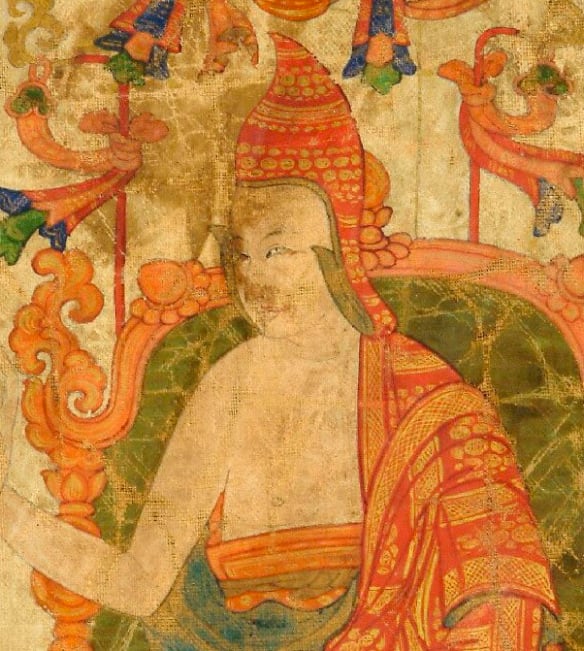
Śāntideva
Ils concordent sur: Qu'est-ce que l'Absolu ? Dieu existe-t-il ? · Qui suis-je ? Existe-t-il un vrai soi ? · Pourquoi souffrons-nous ?
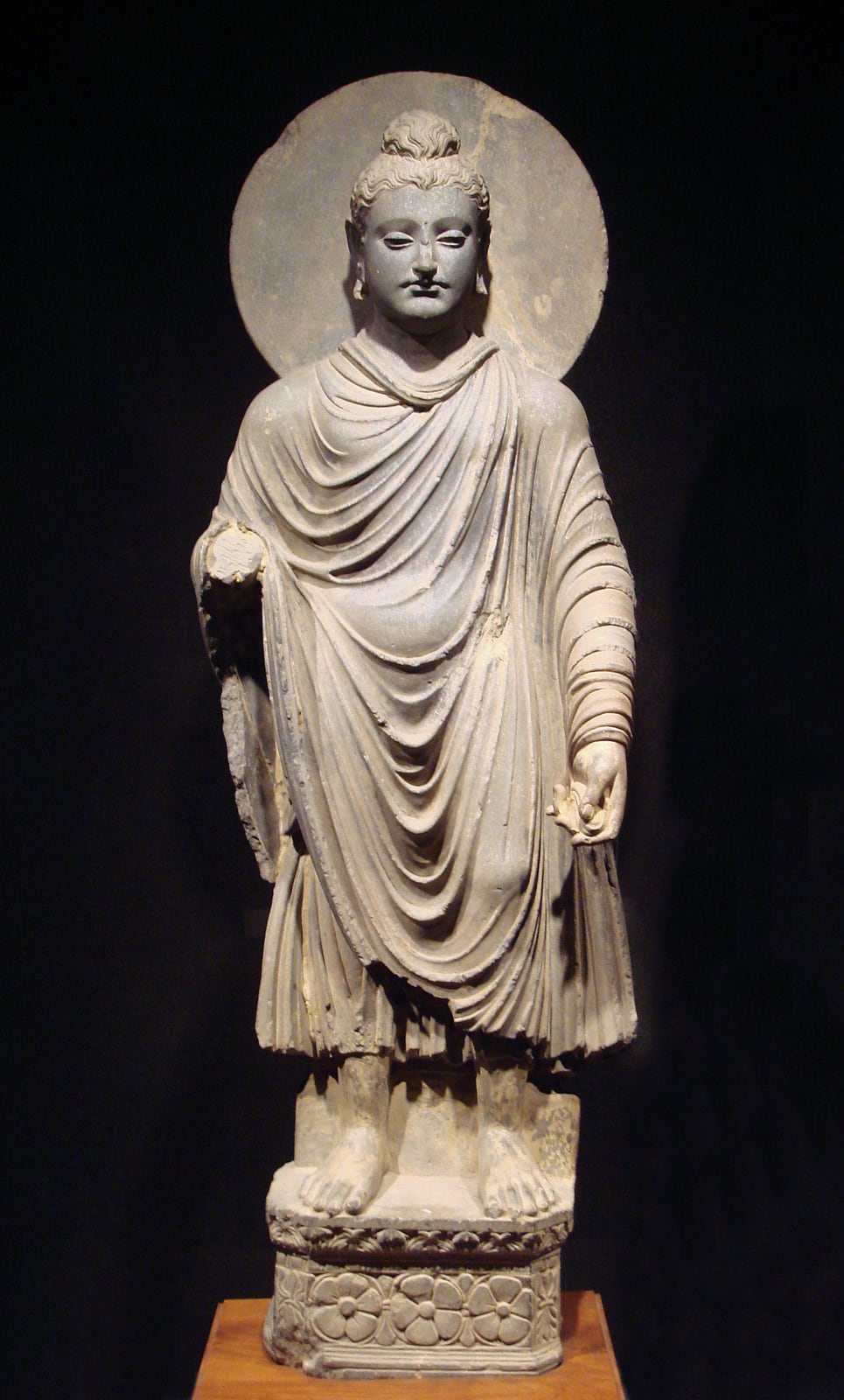
Siddhartha Gautama, the Buddha
Ils concordent sur: Qu'est-ce que l'Absolu ? Dieu existe-t-il ? · Qui suis-je ? Existe-t-il un vrai soi ? · Pourquoi souffrons-nous ?

Pema Chödrön
Ils concordent sur: Qu'est-ce que l'Absolu ? Dieu existe-t-il ? · Qui suis-je ? Existe-t-il un vrai soi ? · Pourquoi souffrons-nous ?
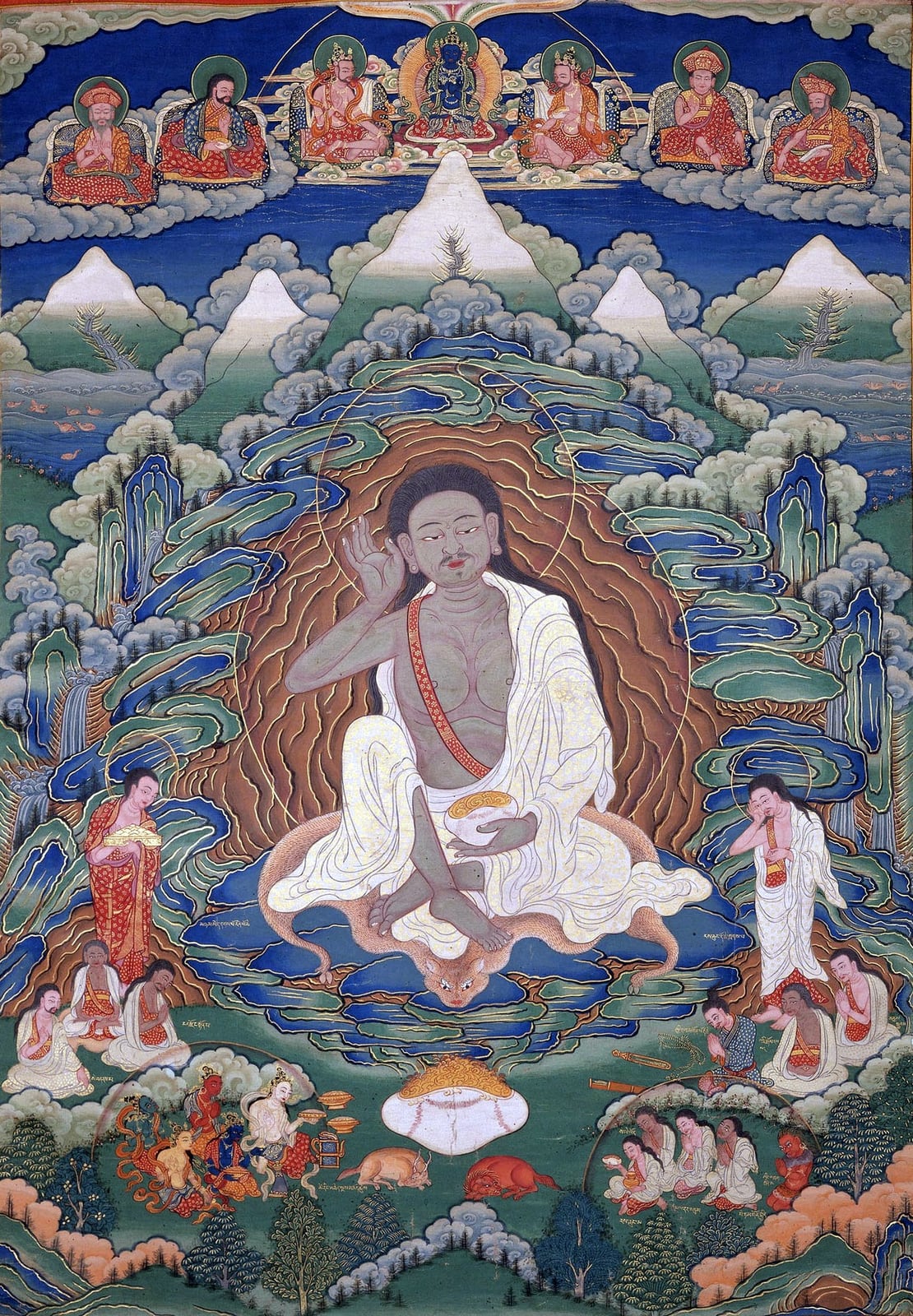
Milarepa
Ils concordent sur: Qu'est-ce que l'Absolu ? Dieu existe-t-il ? · Qui suis-je ? Existe-t-il un vrai soi ? · Que se passe-t-il après la mort ?
Pense autrement que

Francis of Assisi
Ils s'opposent sur: Qu'est-ce que l'Absolu ? Dieu existe-t-il ? · Qui suis-je ? Existe-t-il un vrai soi ? · Que se passe-t-il après la mort ?
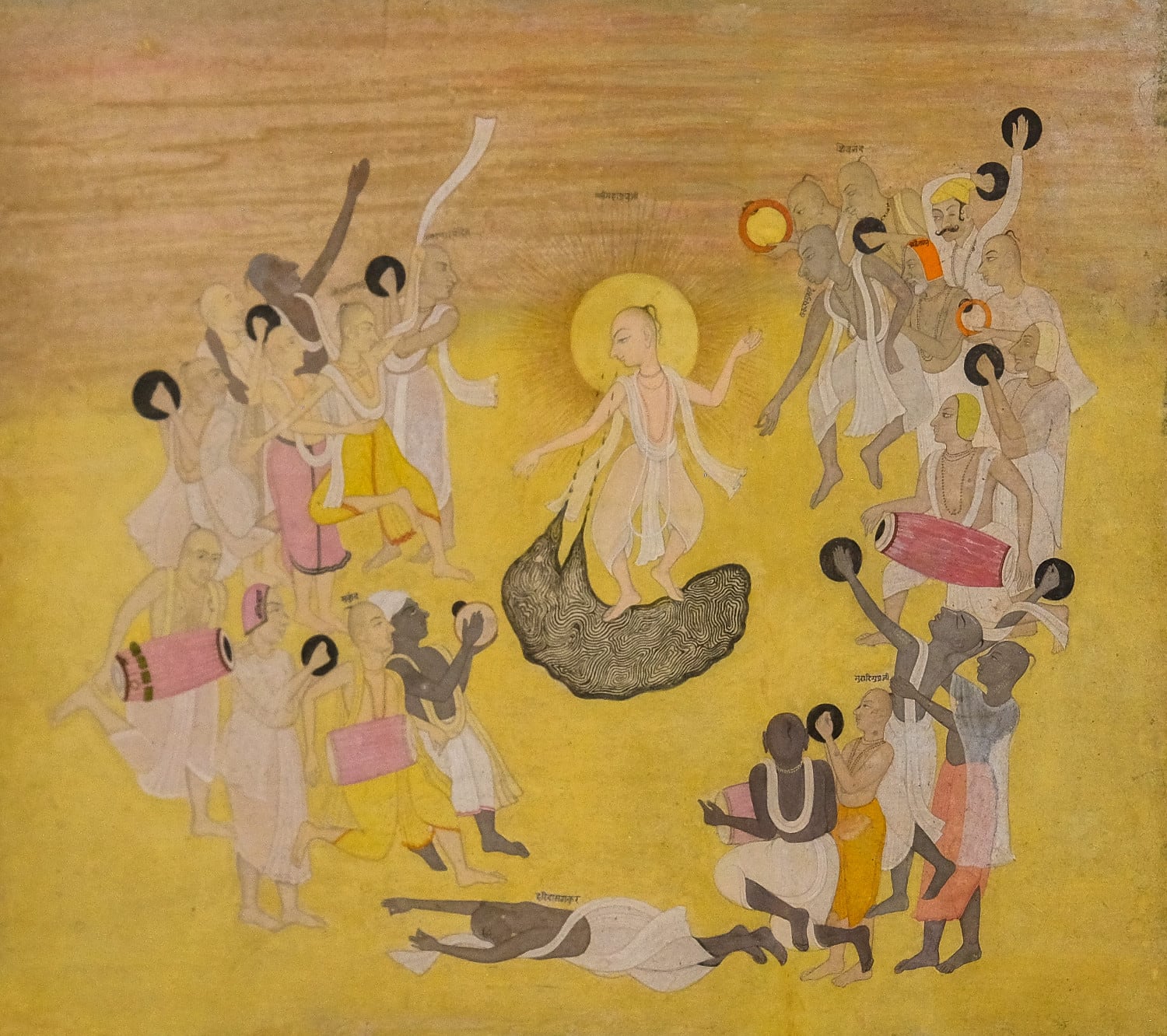
Chaitanya Mahaprabhu
Ils s'opposent sur: Qu'est-ce que l'Absolu ? Dieu existe-t-il ? · Qui suis-je ? Existe-t-il un vrai soi ? · Que se passe-t-il après la mort ?

Julian of Norwich
Ils s'opposent sur: Qu'est-ce que l'Absolu ? Dieu existe-t-il ? · Qui suis-je ? Existe-t-il un vrai soi ? · Que se passe-t-il après la mort ?

Rabia al-Adawiyya
Ils s'opposent sur: Qu'est-ce que l'Absolu ? Dieu existe-t-il ? · Que se passe-t-il après la mort ?
Anecdotes et récits
Anecdotes et récits
Récit hagiographiquejuventud (sin fecha)
The four invisible friends
Origine du récit: Biography of the bodhisattva Nāgārjuna translated by Kumārajīva (c. 405, T2047), the first of the surviving lives. An edifying conversion story without independent confirmation.
Récit hagiographiquesin fecha
The palace of the nāgas
Origine du récit: Kumārajīva's Biography (T2047) and, with the detail about the Prajñāpāramitā, Bu ston's history (1322). Walser reads the story as a legitimation of the new Mahāyāna sūtras, which critics accused of not being the Buddha's word.
Récit hagiographiquesin fecha
The red banner before the king
Origine du récit: Kumārajīva's Biography (T2047). It answers to a recurrent motif of Indian hagiographies: the king's conversion as a guarantee that a teaching has taken root. The relation with a king reflected in the Ratnāvalī and the Letter to a Friend is, by contrast, historically plausible (Walser).
Récit hagiographiquerelato recogido c. 640
A blade of grass
Origine du récit: Xuanzang's Da Tang Xiyu ji (646), book X, trans. Beal (1884). The Tibetan tradition records variants. No independent source confirms the death.
Source: Beal, Samuel (trad.). Si-Yu-Ki: Buddhist Records of the Western World, translated from the Chinese of Hiuen Tsiang (A.D. 629). 2 vols. Londres: Trübner, 1884; vol. II, libro X (reino de Kiao-sa-lo / Kosala).
Récit hagiographiquerelato chan; comentario de 1241
The disc of the full moon
Origine du récit: A story from the Chan genealogies of the patriarchs, recorded in the Jingde Transmission of the Lamp (1004) and commented on by Dōgen in the Shōbōgenzō. A lineage legend without historical basis.
Source: Dōgen. Shōbōgenzō, fascículo «Busshō» (La naturaleza de Buda), 1241. En Kazuaki Tanahashi (ed.), Treasury of the True Dharma Eye: Zen Master Dogen's Shobo Genzo. Boston: Shambhala, 2010.
Documentéfinales del s. II (probable)
Advice to a king
Origine du récit: Content of the Ratnāvalī (chs. 3–4) and of the Suhṛllekha; identification of the addressee according to Walser (2005), disputed by Mabbett (1998).
Source: Walser, Joseph. Nāgārjuna in Context: Mahāyāna Buddhism and Early Indian Culture. Nueva York: Columbia University Press, 2005. ISBN 9780231131643.
Enseignements
Enseignements
Les notions qui structurent sa pensée, expliquées dans leur contexte.
Emptiness (śūnyatā)sunyata
Mūlamadhyamakakārikā 13, 24; continues the Perfection of Wisdom literature.
Source: Westerhoff, Jan. Nāgārjuna's Madhyamaka: A Philosophical Introduction. Nueva York: Oxford University Press, 2009. ISBN 9780195375213.
Dependent origination (pratītyasamutpāda)pratityasamutpada
Dedication and chapters 1 and 26 of the Verses.
Source: Garfield, Jay L. (trad.). The Fundamental Wisdom of the Middle Way: Nāgārjuna's Mūlamadhyamakakārikā. Nueva York: Oxford University Press, 1995. ISBN 9780195093360.
Intrinsic nature (svabhāva) and its absencesvabhava
Mūlamadhyamakakārikā 15; polemic with Sarvāstivāda Abhidharma.
Source: Westerhoff, Jan. Nāgārjuna's Madhyamaka: A Philosophical Introduction. Nueva York: Oxford University Press, 2009. ISBN 9780195375213.
The two truths (satyadvaya)dos-verdades
Mūlamadhyamakakārikā 24.8–24.10; developed by Candrakīrti, Bhāviveka and Tsongkhapa.
Source: Siderits, Mark, y Shōryū Katsura (trads.). Nāgārjuna's Middle Way: Mūlamadhyamakakārikā. Boston: Wisdom Publications, 2013. ISBN 9781614290506.
The tetralemma (catuṣkoṭi)catuskoti
Mūlamadhyamakakārikā 1.1, 18.8, 22.11, 25.17–18.
Source: Garfield, Jay L. (trad.). The Fundamental Wisdom of the Middle Way: Nāgārjuna's Mūlamadhyamakakārikā. Nueva York: Oxford University Press, 1995. ISBN 9780195093360.
Holding no thesis (apratijñā)sin-tesis
Vigrahavyāvartanī 21–29, 59–64.
Source: Westerhoff, Jan (trad.). The Dispeller of Disputes: Nāgārjuna's Vigrahavyāvartanī. Nueva York: Oxford University Press, 2010. ISBN 9780199732692.
Nirvāṇa and saṃsāranirvana-samsara
Mūlamadhyamakakārikā 25.
Source: Siderits, Mark, y Shōryū Katsura (trads.). Nāgārjuna's Middle Way: Mūlamadhyamakakārikā. Boston: Wisdom Publications, 2013. ISBN 9781614290506.
Vidéos
Vidéos
Enregistrements, entretiens et documentaires. Les vidéos sont lues depuis YouTube ; elles ne sont pas hébergées ici.
HPI 47 - Jan Westerhoff on Nagarjuna
Entretien· EN· 37 min
history of philosophy without any gapsChaîne officielle
Madhyamaka & Methodology Symposium: Panel 2 (Jan Westerhoff, University of Durham)
Conférence· EN· 2010· 11 min
Smith College Buddhist StudiesChaîne officielle
A Conversation on Madhyamaka | Dr. David Higgins & Prof. Jan Westerhoff
Conférence· EN· 2026· 98 min
Rangjung Yeshe InstituteChaîne officielle
Episode 8, Jay Garfield On Nāgārjuna and Emptiness
Entretien· EN· 98 min
Thoughtology
Are all things empty? - Nagarjuna & The Buddhist Middle Way
Analyse· EN· 24 min
Let's Talk Religion
Nagarjuna's "Fundamental Wisdom" - Day 1
Conférence· EN· 2015· 196 min
Dalai Lama ArchiveChaîne officielle
Carlo Rovelli and Barry Kerzin: What is real? Nagarjuna's Middle Way.
Conférence· EN· 137 min
WithOut SpaceTime / QISS
Nagarjunakonda
Documentaire· EN· 16 min
Films DivisionChaîne officielle
THE SCULPTURE OF INDIA EPI 05 PROFUSION OF LIFE AMARAVATI AND NAGARJUNAKONDA
Documentaire· EN· 23 min
Prasar Bharati ArchivesChaîne officielle
CONFERENCIA JUAN ARNAU. LA CONCIENCIA VACÍA. 13/03/2023.
Conférence· ES· 2023· 65 min
ADÍA
Vacuidad y despertar en la filosofía de Nagarjuna
Conférence· ES· 2025· 56 min
Filosofía en la Red
Modernité de Nagarjuna
Conférence· FR· 2023· 133 min
Paris Zen
Galerie
Galerie
Images dont la licence a été vérifiée. Chacune conserve son auteur et son attribution.
Relations
Relations
Influences, filiations et affinités. On distingue la relation documentée de la similitude identifiée par analyse.
A influencé
Candrakīrti
Author of the Prasannapadā and the Madhyamakāvatāra, whose Prāsaṅgika reading prevailed in Tibet.
Relation documentée
A reçu l'influence de
Siddhartha Gautama, the Buddha
The Verses open with homage to the Buddha as teacher of dependent origination, and in 15.7 cite his instruction to Kātyāyana (Kaccānagotta Sutta) against "it exists" and "it does not exist".
Relation documentée
Maître de
Āryadeva
His principal disciple, author of the Four Hundred Verses (Catuḥśataka); the Chinese and Tibetan traditions present him as his direct successor.
Relation documentée
A influencé
Kumārajīva
He translated into Chinese the Verses, the Twelve Gate Treatise, the Great Treatise and his biography, and founded the Three Treatise school.
Relation documentée
A influencé
Bhāviveka
He commented on the Verses in the Prajñāpradīpa and brought the formal arguments of Dignāga's logic into Madhyamaka.
Relation documentée
A influencé
In the Bodhicaryāvatāra (5.106) he recommends studying the Sūtrasamuccaya "composed by the noble Nāgārjuna"; his ninth chapter is a Madhyamaka exposition.
Relation documentée
A influencé
His Ocean of Reasoning (1407) is the great Tibetan commentary on the Verses and the basis of the Gelug school.
Relation documentée
A influencé
In the "Busshō" fascicle of the Shōbōgenzō he comments on the story of Nāgārjuna manifested as a moon disc and reveres him as a patriarch of the lineage.
Relation documentée
A influencé
The 14th Dalai Lama (Tenzin Gyatso)
He regularly teaches the Fundamental Verses; for example, in New Delhi in March 2015 (official video in this entry).
Relation documentée
Idées proches de
The Advaita distinction between practical and ultimate reality recalls the two truths of Madhyamaka; theistic critics accused Advaita of being "crypto-Buddhism". Śaṅkara, however, argued against Buddhism and asserted an absolute that Nāgārjuna does not admit.
Similitude identifiée par analyse
Contemporain de
If Nāgārjuna lived around 150–250 and the Pātañjalayogaśāstra was composed around 325–425 (Maas), Patañjali is later; Woods (1914) noted that Nāgārjuna knew a school of yoga but does not mention Patañjali.
Similitude identifiée par analyse
Idées proches de
The Jain doctrine of the plurality of standpoints (anekāntavāda) and Nāgārjuna's four-cornered analysis (catuṣkoṭi) are often compared as Indian answers to the problem of absolute assertions; they rest, however, on opposite assumptions.
Similitude identifiée par analyse
Lié depuis d'autres fiches
- Siddhartha Gautama, the Buddha · A influencé
- Shinran · A reçu l'influence de
- The 14th Dalai Lama (Tenzin Gyatso) · A reçu l'influence de
- Bodhidharma · A reçu l'influence de
- Adi Shankara · Idées proches de
- Huineng · A reçu l'influence de
- Mahāvīra · Idées proches de
- Patañjali · Contemporain de
- Śāntideva · A reçu l'influence de
- Tsongkhapa · A reçu l'influence de
- Dōgen · A reçu l'influence de
Sources
Sources
Bibliographie et catalogues consultés pour cette fiche.
- Wikidata, «Nagarjuna», QID Q171195 (filósofo budista indio del siglo III); el homónimo Q3347300 corresponde a un Nāgārjuna del siglo X.
- Westerhoff, Jan. «Nāgārjuna». En Edward N. Zalta y Uri Nodelman (eds.), The Stanford Encyclopedia of Philosophy, primera publicación 10 de febrero de 2010; revisión sustancial 31 de mayo de 2026.
- Westerhoff, Jan. Nāgārjuna's Madhyamaka: A Philosophical Introduction. Nueva York: Oxford University Press, 2009. ISBN 9780195375213.
- Walser, Joseph. Nāgārjuna in Context: Mahāyāna Buddhism and Early Indian Culture. Nueva York: Columbia University Press, 2005. ISBN 9780231131643.
- Lindtner, Christian. Nagarjuniana: Studies in the Writings and Philosophy of Nāgārjuna. Copenhague: Akademisk Forlag, 1982 (Indiske Studier 4); reimpr. Delhi: Motilal Banarsidass, 1987. ISBN 9788750023852.
- Ruegg, David Seyfort. The Literature of the Madhyamaka School of Philosophy in India. Wiesbaden: Otto Harrassowitz, 1981 (A History of Indian Literature VII, 1).
- Mabbett, Ian. «The Problem of the Historical Nagarjuna Revisited». Journal of the American Oriental Society 118, n.º 3 (1998): 332–346.
- Kumārajīva (trad.). Longshu pusa zhuan 龍樹菩薩傳 (Biografía del bodhisattva Nāgārjuna), c. 405. Taishō Shinshū Daizōkyō, vol. 50, n.º 2047; texto en Wikisource en chino.
- Beal, Samuel (trad.). Si-Yu-Ki: Buddhist Records of the Western World, translated from the Chinese of Hiuen Tsiang (A.D. 629). 2 vols. Londres: Trübner, 1884; vol. II, libro X (reino de Kiao-sa-lo / Kosala).
- Obermiller, Eugène (trad.). History of Buddhism (Chos-ḥbyung) by Bu-ston. 2 partes. Heidelberg: Otto Harrassowitz, 1931–1932 (Materialien zur Kunde des Buddhismus 18–19).
- Garfield, Jay L. (trad.). The Fundamental Wisdom of the Middle Way: Nāgārjuna's Mūlamadhyamakakārikā. Nueva York: Oxford University Press, 1995. ISBN 9780195093360.
- Siderits, Mark, y Shōryū Katsura (trads.). Nāgārjuna's Middle Way: Mūlamadhyamakakārikā. Boston: Wisdom Publications, 2013. ISBN 9781614290506.
- La Vallée Poussin, Louis de (ed.). Mūlamadhyamakakārikās (Mādhyamikasūtras) de Nāgārjuna avec la Prasannapadā commentaire de Candrakīrti. San Petersburgo: Académie impériale des sciences, 1903–1913 (Bibliotheca Buddhica IV).
- Lamotte, Étienne (trad.). Le Traité de la grande vertu de sagesse de Nāgārjuna (Mahāprajñāpāramitāśāstra). 5 vols. Lovaina: Bureaux du Muséon / Institut orientaliste, 1944–1980.
- Westerhoff, Jan (trad.). The Dispeller of Disputes: Nāgārjuna's Vigrahavyāvartanī. Nueva York: Oxford University Press, 2010. ISBN 9780199732692.
- Arnau, Juan (trad.). Nāgārjuna. Fundamentos de la vía media. Madrid: Siruela, 2004. ISBN 9788478447626 (reed. Alianza Editorial, 2018, ISBN 9788491813071).
- Vélez de Cea, Abraham (trad.). Nāgārjuna. Versos sobre los fundamentos del camino medio (Mūlamadhyamakakārikā). Barcelona: Kairós, 2003. ISBN 9788472455450.
- Tsongkhapa. Ocean of Reasoning: A Great Commentary on Nāgārjuna's Mūlamadhyamakakārikā. Trad. Geshe Ngawang Samten y Jay L. Garfield. Nueva York: Oxford University Press, 2006. ISBN 9780195147339.
- Dōgen. Shōbōgenzō, fascículo «Busshō» (La naturaleza de Buda), 1241. En Kazuaki Tanahashi (ed.), Treasury of the True Dharma Eye: Zen Master Dogen's Shobo Genzo. Boston: Shambhala, 2010.
- Śāntideva. Bodhicaryāvatāra 5.105–106. Trad. Kate Crosby y Andrew Skilton, The Bodhicaryāvatāra. Oxford: Oxford University Press, 1995 (Oxford World's Classics).
- Hopkins, Jeffrey (trad.). Nāgārjuna's Precious Garland: Buddhist Advice for Living and Liberation. Ithaca: Snow Lion, 2007. ISBN 9781559392747.
- Wikimedia Commons, ficheros de imagen citados en images[] (licencias comprobadas por la API imageinfo el 2026-10-25).
- Open Library (openlibrary.org), fichas por ISBN y búsquedas por autor y título consultadas el 2026-10-25.
- Tola, Fernando, y Carmen Dragonetti (eds. y trads.). Nāgārjuna's Refutation of Logic (Nyāya): Vaidalyaprakaraṇa. Delhi: Motilal Banarsidass, 1995. ISBN 9788120809208.
- Westerhoff, Jan (trad.). Crushing the Categories (Vaidalyaprakaraṇa). Somerville: Wisdom Publications, 2018 (Treasury of the Buddhist Sciences). ISBN 9781949163001.
- Komito, David Ross. Nāgārjuna's «Seventy Stanzas»: A Buddhist Psychology of Emptiness. Ithaca: Snow Lion, 1987. ISBN 9780937938393.
- Lindtner, Christian (ed. y trad.). Master of Wisdom: Writings of the Buddhist Master Nāgārjuna. Berkeley: Dharma Publishing, 1986. ISBN 9780898001396.
- Kalupahana, David J. (ed. y trad.). Nāgārjuna: The Philosophy of the Middle Way. Albany: State University of New York Press, 1986. ISBN 9780887061493.
- Kangyur Rinpoche (comentario) y Padmakara Translation Group (trad.). Nagarjuna's Letter to a Friend, with Commentary by Kangyur Rinpoche. Ithaca: Snow Lion, 2005. ISBN 9781559392273.
- Taishō Shinshū Daizōkyō (ed. Takakusu Junjirō y Watanabe Kaigyoku, Tokio, 1924–1934), vols. 25–32 y 50; textos consultados en Wikisource en chino (zh.wikisource.org).
- Dalai Lama Archive. «Nagarjuna's "Fundamental Wisdom" - Day 1». Enseñanza en Nueva Delhi, 20 de marzo de 2015, organizada por la Foundation for Universal Responsibility.
- Ayant droit
- Textos originales en dominio público (siglos II–III y traducciones antiguas al chino y al tibetano). Las traducciones modernas tienen derechos propios: Siruela y Alianza Editorial (Juan Arnau), Kairós (Abraham Vélez de Cea), Oxford University Press (Garfield; Westerhoff; Tsongkhapa), Wisdom Publications (Siderits y Katsura; Westerhoff), Snow Lion / Shambhala (Hopkins; Padmakara; Komito), Dharma Publishing (Lindtner), SUNY Press (Kalupahana), Motilal Banarsidass (Tola y Dragonetti). La edición de La Vallée Poussin (1903–1913) es de dominio público.
En attente de confirmation
Ce que cette fiche n'a pas encore pu établir. Nous préférons le dire plutôt que de combler.
- Sala de lectura: no se ha encontrado ninguna traducción inglesa ni española de dominio público con texto limpio (la de Wenzel del Suhṛllekha, 1886, y la de Beal, 1892, no se localizaron en escaneo con OCR). La edición sánscrita de La Vallée Poussin (1903–1913) está en devanagari y no se ha comprobado su OCR. La segunda versión china del Suhṛllekha (勸發諸王要偈, Saṅghavarman) está en zh.wikisource pero no puede registrarse como texto separado de la misma obra sin duplicar la entrada.
- Ediciones: buscar ISBN de traducciones al español de la Ratnāvalī, la Carta a un amigo, la Śūnyatāsaptati y la Yuktiṣaṣṭikā (no localizadas en Open Library), y ediciones con ISBN en francés, alemán, italiano, ruso e hindi de las Estrofas. Google Books devolvió 429 (sin cuota).
- Comprobar en Beal (1884), vol. II, la paginación exacta del relato de Xuanzang sobre Nāgārjuna y el rey Sātavāhana.
- Confirmar las fechas de traducción china propuestas para el 壹輸盧迦論 y el 菩提資糧論 (se dan como aproximadas).
- La biografía de Kumārajīva (龍樹菩薩傳, T2047) no es obra de Nāgārjuna y no se registra en works[]; su texto está en zh.wikisource (fuente n8).
- Manuscritos: localizar en Commons imágenes con licencia libre de los manuscritos sánscritos de la Mūlamadhyamakakārikā (Ye Shaoyong 2011) o de la Ratnāvalī.
Recherche effectuée le 2026-10-25