Tantra · Bouddhisme · Mahāyāna · Bouddhisme tibétain
Milarepa
རྗེ་བཙུན་མི་ལ་རས་པ། · rje btsun mi la ras pa
v. 1052 – v. 1135Personne historiquement documentée
Yogi, ermite et poète tibétain du XIe siècle, figure fondatrice de la lignée kagyu. Selon son hagiographie, il vengea sa famille par la sorcellerie, expia ses crimes sous les épreuves de Marpa le Traducteur et atteignit l'éveil dans une vie de retraite au fond des grottes de l'Himalaya, vêtu d'une simple étoffe de coton et nourri d'orties. Ses « cent mille chants » de réalisation, fixés par Tsangnyön Heruka en 1488, forment le livre le plus aimé du Tibet.
- œuvres
- 7œuvres
- éditions
- 26éditions
- citations
- 3citations
- vidéos
- 11vidéos
- images
- 9images
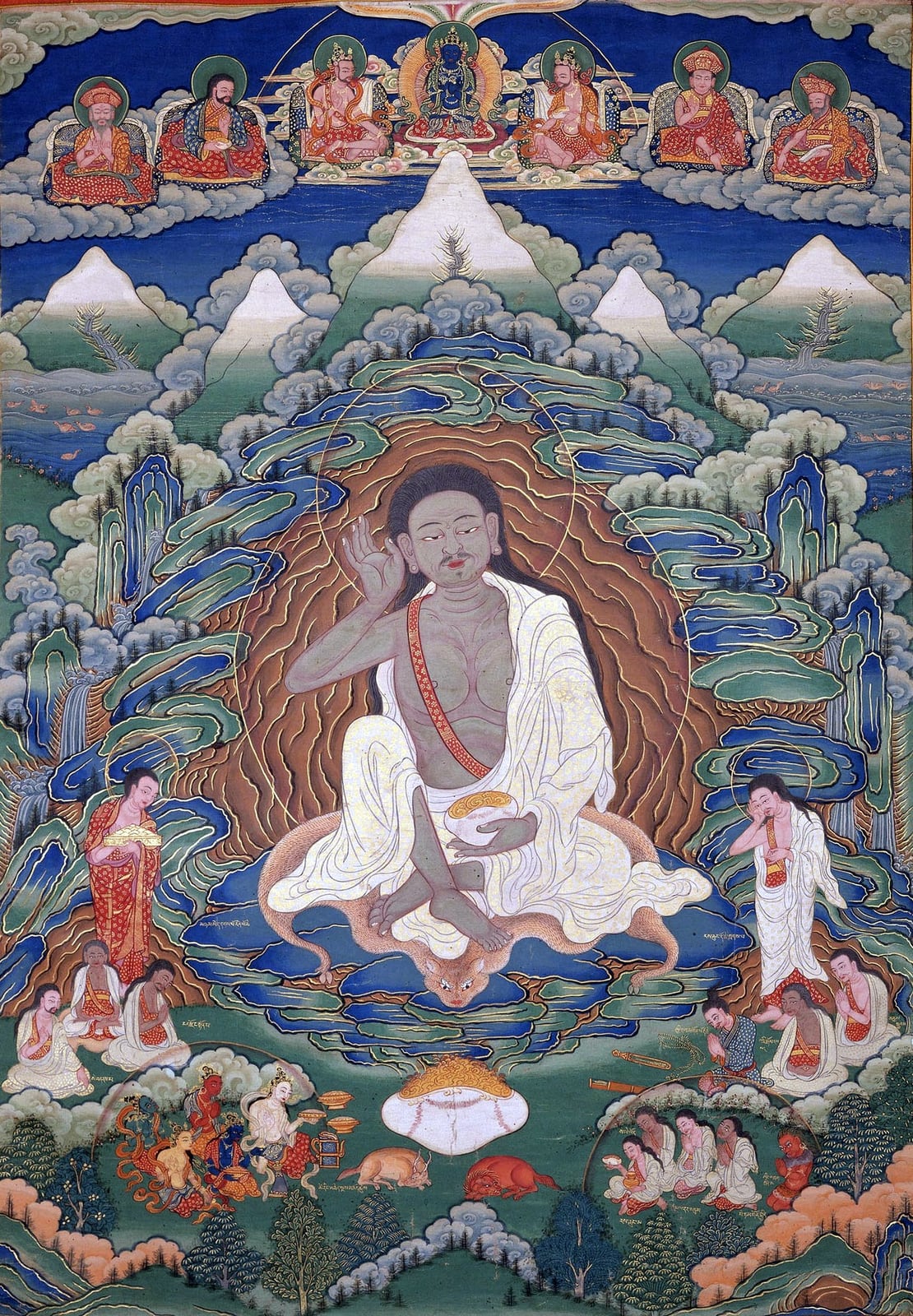
Tangka butanés de Milarepa, finales del s. XIX – principios del XX · Public domain
Dans ses propres mots
«Seeing this Life, one is freed from the eight worldly concerns. Hearing it, faith arises of itself. Recollecting it, entanglements are severed at the root.»Versos de cierre del Namthar; son palabras del compilador Tsangnyön Heruka sobre el libro, no de Milarepa, y así deben presentarse. Quintman (2010), pp. 233–234, citado en Quintman (2023)

Son idée centrale
A single human life, however grave the guilt, suffices to reach awakening: Milarepa's story exists to show that a killer can become a buddha “in one body and one lifetime”, the promise of the tantric path as against the aeons of the gradual path.
Le voir en contexte
Biographie
6 min de lecture
Traduction assistée à partir de l'original espagnol, en attente de relecture par un traducteur natif.
Ce que l'on sait et ce que l'on raconte
De Milarépa, le yogi le plus aimé du Tibet, on ne peut presque rien affirmer avec une certitude historique. Qu'il a existé, qu'il fut le disciple de Marpa le Traducteur et le maître de Gampopa, qu'il vécut en ermite dans les montagnes de la frontière népalaise et qu'il enseigna en chantant, toute la tradition l'admet et l'érudition moderne l'accepte. Mais la vie que tout le monde connaît — la vengeance, les tours, les orties, le poison — provient d'un seul livre, le namthar ou « libération complète » que composa en 1488 Tsangnyön Heruka, le « Fou du Tsang », trois siècles et demi après les faits, à partir de biographies plus anciennes aujourd'hui en partie retrouvées. Même les dates ne sont pas à l'abri : la tradition dominante retient 1052–1135 ; les érudits kagyu du XVIIIe siècle préféraient 1028–1111 ; bon nombre de chercheurs actuels, 1040–1123. Cette notice suit la chronologie du namthar et la désigne pour ce qu'elle est : une hagiographie, c'est-à-dire une vie écrite pour servir de modèle.
Le fils de Mila
Il naquit, selon ce récit, à Kya Ngatsa, dans la vallée de Gungthang, à l'extrémité sud-ouest du Tibet, dans une famille de marchands enrichis du clan Mila. Son père, Shérab Gyaltsen, le nomma Thöpaga, « celui qu'il fait bon entendre », parce que l'enfant chantait bien. Thöpaga avait sept ans à la mort de son père ; le testament confiait le domaine aux oncle et tante paternels jusqu'à la majorité de l'héritier, et ceux-ci se l'approprièrent. La veuve, Nyangtsa Kargyen, et ses deux enfants, Thöpaga et Péta, durent servir dans ce qui avait été leur maison. Quand le garçon eut quinze ans, la mère rassembla ce qui lui restait pour un banquet au cours duquel elle réclama publiquement l'héritage ; les oncle et tante l'humilièrent devant le village. Elle vendit alors son dernier champ pour envoyer son fils apprendre la sorcellerie.
Ce qui suit est la partie du récit que la tradition n'a jamais voulu adoucir : Thöpaga apprit, et ce qu'il apprit fonctionna. Pendant les noces du fils aîné de l'oncle, la maison s'effondra et trente-cinq personnes périrent ; l'oncle et la tante survécurent pour voir ce qu'ils avaient perdu. Quand le village voulut se venger, la mère en demanda davantage et le fils fit tomber la grêle sur les récoltes. Le namthar n'atténue pas les crimes parce qu'il en a besoin : le saint du Tibet est, avant toute chose, un assassin.
Marpa et les tours
Le remords vint lentement, sous la forme d'une peur de la mort et d'une renaissance dans les enfers. Thöpaga chercha un maître ; un lama de la Grande Perfection lui dit que son enseignement libérait sans effort, et le disciple, le prenant au mot, s'endormit. Le lama l'envoya alors au Lhodrak, auprès de Marpa Chökyi Lodrö, le traducteur qui s'était rendu trois fois en Inde pour en rapporter les enseignements de Nāropa. Marpa, homme de grand savoir et de mauvais caractère, sut en songe qui arrivait, mais le reçut comme un manœuvre : il lui fit construire une tour, la démolir, en construire une autre ailleurs, la démolir aussi, remettre chaque pierre à sa place, et enfin élever la tour à neuf étages de Sekhar Gutok, qui existe encore. Pendant ce temps, il lui refusait les initiations, le chassait à coups des cérémonies auxquelles assistaient d'autres disciples et le laissait le dos à vif. L'épouse de Marpa, Dagmema, eut pitié de lui et l'envoya avec une fausse lettre auprès d'un autre maître, Ngokpa ; quand la supercherie fut découverte, Marpa, en larmes, expliqua que chacune des épreuves était destinée à purifier un crime, que s'il les avait toutes accomplies Milarépa n'aurait plus eu besoin de renaître, et que ce qui restait, la méditation le purifierait. Il avait trente-huit ans lorsqu'il arriva au Lhodrak et quarante-quatre lorsqu'il en repartit, avec le nom d'initiation Zhépa Dorjé et les instructions de la chaleur intérieure, le toumo, et du Grand Sceau, le mahāmudrā.
Le vêtu de coton
Il revint à son village et trouva la maison en ruine et, à l'intérieur, les ossements de sa mère. Cette nuit-là, dit le texte, il comprit d'un coup l'impermanence qu'il étudiait depuis des années, et il partit dans les montagnes pour n'en plus revenir. Dans la grotte de Drakar Taso, la « Dent de cheval du rocher blanc », il médita des années entières sans autre nourriture que les orties qui poussaient à l'entrée, jusqu'à ce que sa peau devînt verte, et ses cheveux aussi ; quand sa sœur Péta le retrouva, elle crut voir un fantôme et lui reprocha une vie qui lui semblait pire que celle d'un mendiant. Milarépa lui répondit en chantant. La honte de Péta devant sa nudité, les voleurs qui entrent la nuit dans la grotte et n'y trouvent rien à voler, le lait caillé dont le yogi, par la force du toumo, n'a pas besoin : chaque épisode est un enseignement mis en scène. Vêtu seulement d'une étoffe de coton, il devint le répa, « le vêtu de coton », et c'est sous ce nom que l'Himalaya le connut.
À partir de là, la biographie se fait géographie : Lapchi, Chuwar, le mont Kailash — où, selon les Cent Mille Chants, il vainquit le prêtre bön Naro Bönchung dans un duel de pouvoirs en gagnant le sommet à cheval sur un rayon de soleil —, des grottes du Népal et du Tibet occidental que l'on visite encore. Il enseignait à quiconque s'approchait, bergers, chasseurs, démons, un guéshé érudit, et le faisait par des chants improvisés, les mgur, que la tradition réunit en un recueil de « cent mille ». Parmi ses disciples, deux marquèrent l'avenir : Réchungpa, le « fils du cœur », venu enfant et revenu de l'Inde avec les transmissions orales ; et Gampopa, le moine médecin formé dans l'école kadam, qui coula l'expérience du yogi dans le moule monastique et dont les élèves donnèrent naissance aux quatre grandes branches kagyu, parmi lesquelles celle des Karmapa.
Le poison et l'or
Il mourut, toujours selon le namthar, à quatre-vingt-quatre ans, à Chuwar, dans la vallée de Drin. Un guéshé envieux, Tsakpuwa, lui fit porter du lait caillé empoisonné par l'intermédiaire d'une concubine à qui il avait promis une turquoise ; Milarépa, qui le savait, le prit malgré tout parce que son heure était venue, et avant de mourir il fit éprouver au guéshé dans son propre corps la douleur qu'il avait causée, lui pardonna et le convertit. Il réunit ses disciples, leur donna ses dernières instructions — renoncer aux huit préoccupations mondaines, méditer dans la solitude — et leur annonça qu'il y avait de l'or sous le foyer. Quand ils le cherchèrent, ils trouvèrent un morceau d'étoffe, un couteau, un pain de sucre et un billet : que quiconque dirait que Milarépa avait possédé de l'or se remplisse la bouche d'excréments. Le corps, dit-on, disparut du bûcher, emporté par les ḍākinī, et les disciples se disputèrent des reliques qui n'existaient pas.
La fabrique d'un saint
Rien de tout cela n'est vérifiable, et l'intéressant est tout ce que l'on sait déjà de la manière dont cela fut construit. Les premières biographies furent écrites au XIIe siècle par des disciples directs comme Gampopa et Ngendzong Répa ; dans les siècles suivants, on les compila en cycles — les Douze grands disciples, le Trésor noir des Karmapa — qui enrichirent le récit de chants. Tsangnyön Heruka le réécrivit comme une biographie du Bouddha en clé tibétaine, le divisa en deux livres, la Vie et les Cent Mille Chants, et, chose décisive, les fit imprimer par xylographie à une époque où l'imprimerie était encore une nouveauté au Tibet central : d'où leur ubiquité. Les réimpressions de Gungthang de 1538, 1540 et 1550–1555 — conservées en partie à la Wellcome Collection et à la British Library — fixèrent en outre son image : assis, la main droite à l'oreille, chantant. Jacques Bacot le traduisit en français en 1925 et Evans-Wentz le publia en anglais en 1928 ; Garma C. C. Chang traduisit les chants en 1962, Lobsang Lhalungpa la vie en 1977, et Andrew Quintman, qui a reconstitué tout ce processus, la traduisit de nouveau en 2010. Ce qui demeure, au bout du compte, n'est pas une vie vérifiable mais quelque chose de plus rare : un modèle de vie que neuf siècles de lecteurs ont trouvé crédible.
Sources: Tsangnyön Heruka. The Life of Milarepa. Trad. Andrew Quintman; introducción de Donald S. Lopez Jr. Nueva York: Penguin Classics, 2010. ISBN 9780143106227. · Tsangnyön Heruka. The Life of Milarepa. Trad. Lobsang P. Lhalungpa. Nueva York: E. P. Dutton, 1977; Boston: Shambhala, 1985. ISBN 9780877732815. · Chang, Garma C. C. (trad. y anot.). The Hundred Thousand Songs of Milarepa. 2 vols. New Hyde Park (NY): University Books / Oriental Studies Foundation, 1962; reed. Boulder: Shambhala, 1977 y 1999 (ISBN 9781570624766). Vol. 1 digitalizado en Wikimedia Commons. · Quintman, Andrew. The Yogin and the Madman: Reading the Biographical Corpus of Tibet's Great Saint Milarepa. Nueva York: Columbia University Press, 2014. ISBN 9780231164153. · Evans-Wentz, W. Y. (ed.). Tibet's Great Yogī Milarepa: A Biography from the Tibetan. Trad. Lāma Kazi Dawa-Samdup. Londres: Oxford University Press, 1928. Digitalizado en Internet Archive.
Chronologie
La vie, année après année
Chaque point est un événement documenté. Cliquez pour le lire, avec sa source et son degré de certitude.
v. 10520 ansKya Ngatsa, Gungthang
Birth of Mila Thöpaga
According to the Namthar he is born in a water-dragon year to a prosperous family of the Mila clan; his father, Mila Sherab Gyaltsen, names him Thöpaga, “delightful to hear”. The dominant tradition says 1052; other sources give 1040 or 1028.
TraditionTsangnyön Heruka. The Life of Milarepa. Trad. Andrew Quintman; introducción de Donald S. Lopez Jr. Nueva York: Penguin Classics, 2010. ISBN 9780143106227.
Après sa mort
- 1488Tsangnyön Heruka composes the Namthar and the Mgur 'bum
- 1538 – 1555The earliest surviving reprints
- 1928Arrival in the West: Bacot (1925) and Evans-Wentz (1928)
- 1962Garma C. C. Chang translates the Hundred Thousand Songs
- 2010 – 2014Quintman: new translation and study of the biographical corpus
v. 1052 · 0 ans
Birth of Mila Thöpaga
According to the Namthar he is born in a water-dragon year to a prosperous family of the Mila clan; his father, Mila Sherab Gyaltsen, names him Thöpaga, “delightful to hear”. The dominant tradition says 1052; other sources give 1040 or 1028.
Tradition
v. 1059 · 7 ans
Death of his father and ruin of the family
His father dies leaving the estate in the care of the paternal uncle and aunt, who seize it and reduce the widow Nyangtsa Kargyen, Mila and his sister Peta to servitude.
Tradition
v. 1067 · 15 ans
Apprenticeship in sorcery and the revenge
At his mother's urging he learns black magic and the art of hail-casting; he brings down his uncle's house during a wedding, killing thirty-five people, and destroys the village harvest with hail.
Tradition
v. 1090 – 1096 · 38 ans
Marpa's disciple: the towers
Repentant, he seeks the Dharma; after a Dzogchen teacher who does him no good he reaches Marpa Chökyi Lodrö, who refuses to teach him and makes him build and tear down several stone towers before raising the nine-storey tower of Sekhar Gutok. Only then does he receive initiations and instructions (tummo, mahāmudrā, the oral transmissions).
Tradition
v. 1096 – 1108 · 44 ans
The retreat years
After returning to his village and finding his mother's bones, he withdraws to the cave of Drakar Taso (“White Rock Horse Tooth”), where he meditates for years living on nettles until his skin turns green. He then wanders the mountains as a repa, “cotton-clad one”, and attains realisation.
Tradition
v. 1110 · 58 ans
Meeting with Gampopa
The monk and physician Gampopa (1079–1153), trained in the Kadam school, becomes his chief disciple; from him the four great Kagyu branches will descend. Rechungpa (1085–1161), his “heart disciple”, has accompanied him since youth.
Tradition
v. 1135 · 84 ans
Death by poisoning
The Namthar relates that the envious geshe Tsakpuwa sent him poisoned curd through a concubine; Milarepa, knowing what he did, took it, gave his final teachings and died aged eighty-four. His testament revealed that the “gold” he claimed to keep was a scrap of cloth and a lump of sugar.
Tradition
1488
Tsangnyön Heruka composes the Namthar and the Mgur 'bum
The “Madman of Tsang” (1452–1507) fixes the canonical version of the life and songs from earlier biographies (Gampopa, Ngendzong Repa, the Twelve Great Disciples, the Black Treasury cycle) and has it woodblock-printed: the origin of the saint's universal fame.
Documenté
1538 – 1555
The earliest surviving reprints
Printing of the Namthar at Ron Wosel Puk (1538) under Tokden Chökyi Gyatso; of the Mgur 'bum at Lende Langpuk (1540, folio in the Wellcome Collection) and at Drakar Taso (1550–1555, folio in the British Library, OPB 19999a3), which fixes Milarepa's iconography with his hand to his ear.
Documenté
1928
Arrival in the West: Bacot (1925) and Evans-Wentz (1928)
Jacques Bacot publishes in French the first European translation of the Namthar; three years later Oxford University Press issues Kazi Dawa-Samdup's English version edited by W. Y. Evans-Wentz, which for half a century was Western readers' gateway.
Documenté
1962
Garma C. C. Chang translates the Hundred Thousand Songs
First complete translation of the Mgur 'bum into a Western language (University Books, 2 vols.), reissued by Shambhala in 1977 and 1999; the basis of nearly all versions into other languages until Christopher Stagg's new translation (2017).
Documenté
2010 – 2014
Quintman: new translation and study of the biographical corpus
Andrew Quintman publishes the Penguin Classics translation (2010) and The Yogin and the Madman (2014), the first systematic study of the biographies prior to Tsangnyön; with him the figure passes from devotional tale to the history of its own construction.
Documenté
Œuvres
Œuvres essentielles
Les œuvres sans lesquelles on ne comprend pas son héritage.
Attribution traditionnelle · 1488
The Life of Milarepa (Namthar)
རྗེ་བཙུན་མི་ལ་རས་པའི་རྣམ་ཐར། (rje btsun mi la ras pa'i rnam thar)
The canonical biography, divided into twelve chapters between “worldly deeds” (birth, ruin, revenge by sorcery) and “supreme deeds” (the trials with Marpa, the retreat at Drakar Taso, the teaching and the death by poison). Written as a life of the Buddha in a Tibetan key, it is at once a novel of formation, a practice manual and Tibet's most widely read book; its woodblock circulation from the late fifteenth century explains the figure's ubiquity.
10 éditions · amazon.fr
Toute son œuvre (7)

The Hundred Thousand Songs of Milarepa (Mgur 'bum)
1488

Drinking the Mountain Stream: Songs of Tibet's Beloved Saint
1978
Milarepa
Sixty Songs of Milarepa
The Conscious LibrarySixty Songs of Milarepa
1966

The Yogin and the Madman
2014
Milarepa
Milarepa: Lessons from the Life and Songs of Tibet's Great Yogi
The Conscious LibraryMilarepa: Lessons from the Life and Songs of Tibet's Great Yogi
2017
Milarepa
Miraculous Journey: Further Stories and Songs of Milarepa
The Conscious LibraryMiraculous Journey: Further Stories and Songs of Milarepa
1986
Citations
Citations localisées dans une œuvre précise. Chacune porte sa provenance et son degré de fiabilité.
Whoever says that Milarepa possessed gold, let him fill his mouth with excrement.(tibetano; traducción libre del investigador a partir de Lhalungpa 1977 y Quintman 2010)
ProbableNamthar (Tsangnyön Heruka, 1488), capítulo final («Nirvana»): la nota hallada bajo el hogar junto a un trozo de tela, un cuchillo y un terrón de azúcar, tras anunciar a los discípulos que allí había oro
Idées essentielles (résumé éditorial)
Par respect du droit d'auteur, ces idées sont résumées avec nos propres mots et ne sont pas présentées comme des citations littérales.
- A single human life, however grave the guilt, suffices to reach awakening: Milarepa's story exists to show that a killer can become a buddha “in one body and one lifetime”, the promise of the tantric path as against the aeons of the gradual path.
- The suffering imposed by the teacher is not cruelty but purification: each tower raised and razed for Marpa corresponds to a crime, and the devotion that endures the trial is the true initiation, prior to any ritual.
- Mountain solitude is the place of practice, not an escape: in the cave one finds what village, monastery and books do not give, and voluntary poverty—a cloth, a staff, nettles—is freedom, not lack.
- Death is certain and its hour uncertain; therefore every delay is a loss. The songs return again and again to impermanence not as consolation but as a goad: there is no time for the affairs of the world.
- Realisation is taught by singing: the improvised song (mgur) does not embellish doctrine, it embodies it, because what has been understood in the body comes out in verse and in plain speech, within reach of shepherds and hunters.
- Inner heat (tummo) and the Great Seal (mahāmudrā) are two faces of one experience: the body that needs no shelter and the mind that recognises its own nature; the cotton-clad repa in the snow is the visible proof of the invisible.
Citations apocryphes ou d'attribution contestée (3)
«My religion is to live and die without regret.»
Milarepa's most quoted sentence in the West, used as an epigraph by Shambhala and on countless pages, could not be located in that wording either in the Namthar (Lhalungpa, Quintman) or in the Mgur 'bum (Chang). It faithfully conveys the sense of his final teaching but is recorded as unverified.
«In the beginning nothing comes, in the middle nothing stays, at the end nothing goes.»
Circulates as a Milarepa song on the nature of mind; it could not be found in the Chang or Stagg translations. It may derive from genuine Mgur 'bum verses on the mind as “unborn, unabiding and unceasing”, reworded in popular literature.
«Hasten slowly and you shall soon arrive.»
Attributed to Milarepa in quotation anthologies; it is a variant of the Latin adage “festina lente”. Not found in any Tibetan source consulted.
Dernières paroles
Attribution traditionnelle
«Do as I have done: give up the eight worldly concerns, homeland and kin, and meditate in the solitude of the mountains until realisation is firm. That is my final instruction; I have no other.»Hagiographic, not historical. The final chapter of Tsangnyön Heruka's Namthar (1488) has Milarepa, at Chuwar and already poisoned, deliver a last discourse and a last song to his disciples: he asks them to give up worldly concerns and practise in solitude, and declares that his only possessions are his cotton robe, his staff and a cup; then he enters meditation and dies. What is offered here is a free rendering of the sense of that instruction, written by the researcher from the Lhalungpa and Quintman translations, not a literal quotation from either. The Namthar was composed three and a half centuries after the events on the basis of earlier biographies; there is no contemporary testimony.
Source: Tsangnyön Heruka. The Life of Milarepa. Trad. Andrew Quintman; introducción de Donald S. Lopez Jr. Nueva York: Penguin Classics, 2010. ISBN 9780143106227.
Interroger
Ce que répond son œuvre
Douze grandes questions de l'humanité et ce que ses textes permettent d'y répondre, références à l'appui. Nous ne lui prêtons jamais de paroles.
Qu'est-ce que l'Absolu ? Dieu existe-t-il ?
He seeks no creator: the ultimate is the nature of one's own mind
Pas de Dieu créateurCela se déduit de sa doctrine
In the sources on Milarepa — the biography (namthar) and the Hundred Thousand Songs compiled by Tsangnyön Heruka in the fifteenth century — the question of a creator God does not arise as a problem. The horizon is tantric Buddhism of the Kagyü school: what must be recognised is the nature of mind, empty and luminous, which the songs describe again and again as impossible to grasp with concepts, without centre or limit. The meditation deities and dakinis who people his songs are not creators of the world but presences and manifestations on the path, and in the logic of Mahamudra they do not exist apart from mind. Liberation depends not on the grace of a God but on practice in solitude, devotion to the master Marpa and direct recognition. His work therefore falls within the non-theistic field.
Comparer cette question avec d'autres maîtresQui suis-je ? Existe-t-il un vrai soi ?
Sought for, the self is not found: mind is empty and luminous
Il n'y a pas de soi permanentCela se déduit de sa doctrine
The songs attributed to Milarepa in Tsangnyön Heruka's compilation return again and again to the search for mind and self: examined, they are found neither inside nor outside, and have no shape, colour or location. What follows is not nothingness but the nature of mind according to the Mahamudra of the Kagyü school: empty of a substantial self and at the same time clear and aware. Attachment to a self, by contrast, is the root of the passions and of the cycle of rebirth that Milarepa's biography narrates starkly, from his youthful crimes to his purification. Spiritual work consists in recognising this absence of self in one's own experience, in solitude and under the master's guidance, until the idea of a solid self no longer governs one's life.
Comparer cette question avec d'autres maîtresPourquoi souffrons-nous ?
Evil done returns: his trials under Marpa purified a terrible karma
Le karma et l'apprentissage de l'âmeIl le dit expressément
Milarepa's biography is itself a lesson on the origin of suffering. According to the namthar compiled by Tsangnyön Heruka, as a young man, urged by his mother to take revenge on the relatives who had dispossessed them, he learned black magic and caused the deaths of many people. Remorse and fear of the karmic consequences of those acts led him to seek the dharma. His master Marpa subjected him to very harsh trials — building and tearing down stone towers again and again — which the tradition interprets as purification of that karma. In the songs, Milarepa insistently recalls impermanence, the imminence of death and the sufferings of samsara as reasons to practise without delay. Pain is the fruit of past acts and, at the same time, the spur that drives towards liberation.
Comparer cette question avec d'autres maîtresQue se passe-t-il après la mort ?
Fear of a bad rebirth drove him to liberation in a single life
Renaissance selon le karmaIl le dit expressément
In the Life of Milarepa, composed by Tsangnyön Heruka in the fifteenth century, rebirth according to karma is the engine of the whole narrative. Having caused deaths through black magic out of revenge, Milarepa is terrified at the prospect of rebirth in the hells, and that fear leads him to Marpa, to the trials of the tower and to years of solitary meditation. The songs of the tradition insist on impermanence: death comes without warning, the body is borrowed, and the only thing that accompanies the dead are their deeds; whoever does not practise now will be reborn dragged along by them. At the same time, the narrative presents Milarepa as proof that liberation is possible in a single life through Mahamudra and the yogas of Naropa, which include preparation for the intermediate state (bardo). For the realised yogi, dying is an occasion to recognise the nature of mind.
Comparer cette question avec d'autres maîtresComment atteint-on la libération ou le salut ?
Extreme purification under the master and years of solitary meditation: liberation in one lifetime
Par une pratique disciplinéeIl le dit expressément
According to the Life of Milarepa compiled by Tsangnyön Heruka in the fifteenth century, Milarepa's path begins with heavy negative karma (the killings committed through black magic) and passes through two phases. First, purification: his master Marpa makes him build and demolish towers for years before transmitting the instructions. Then meditation in high mountain caves, with extreme asceticism, until realisation. The biography thus presents liberation as possible in a single life for whoever combines the transmission of a lineage, faith in the master and uncompromising perseverance. The songs gathered in The Hundred Thousand Songs insist on the same: renounce worldly concerns and practise without delay in the face of the certainty of death.
Comparer cette question avec d'autres maîtresFaut-il un maître ?
Without Marpa and his transmission no liberation: faith in the guru sustains everything
IndispensableIl le dit expressément
The Life of Milarepa is, to a large extent, the story of a relationship of discipleship. After a first teacher who cannot help him, Milarepa is sent to Marpa the Translator, who for years subjects him to apparently arbitrary trials, such as building and demolishing towers, and withholds teaching. The hagiography presents those humiliations as the necessary purification of his bad karma, and Milarepa's unshakeable obedience and faith as the condition for receiving the lineage's instructions. Only with that transmission can he then meditate fruitfully in solitude. The work thus reflects the Vajrayana conception of the guru as the source of blessings and of the efficacy of practice: without him, the path does not open.
Comparer cette question avec d'autres maîtresLe monde est-il réel ?
Appearances are like a dream or a magical illusion: empty and luminous
Un réseau de causes sans substanceCela se déduit de sa doctrine
In the songs attributed to Milarepa, the nature of the world is approached from the meditative experience of the Mahamudra tradition. Appearances are compared to a dream, a mirage or a magical illusion: they appear vividly but lack inherent existence. That emptiness is not presented as nothingness but as inseparable from the clarity of mind: appearance and emptiness are a unity. For Milarepa the error is not that there are phenomena but clinging to them as solid and pursuing worldly occupations as though they were lasting. Impermanence and death, constant themes in his songs, show that nothing in the world can be held on to, and therefore invite practice.
Comparer cette question avec d'autres maîtresQu'est-ce que l'amour ?
Breaking the bonds of worldly affection so that compassion for all may arise
Une compassion sans limitesIl le dit expressément
The Life of Milarepa shows two kinds of love in tension. On the one hand, family affection: the love for his mother, which drove him to revenge, and that of his sister Peta, who visits him in the cave and reproaches him for his poverty. When he returns to his village and finds the house in ruins and his mother's bones, Milarepa experiences that attachment as a source of pain and decides to renounce everything. On the other hand, the songs present him cultivating bodhicitta, the mind of awakening that seeks to free all beings, as the root of practice: compassion towards beings, whom the Tibetan tradition teaches one to see as former mothers, replaces attachment to one's own. Towards his persecutors, such as the lama Tsakpuhwa who ends up poisoning him, the tradition credits him with compassion rather than resentment.
Comparer cette question avec d'autres maîtresSommes-nous libres ou tout est-il déterminé ?
The repentant murderer who purifies his karma in a single lifetime
Le karma et le choixIl le dit expressément
In Tibetan tradition Milarepa's life is the supreme example that karma conditions but does not condemn. According to the *Namthar*, the young Thöpaga learns black magic to avenge his mother and causes the death of dozens of people; terrified by the consequences of those acts, he seeks the Dharma. Marpa makes him build and tear down towers again and again, trials the tradition reads as purification of the evil committed, and only then gives him the instructions. Milarepa attains realisation in that same life through years of retreat. The story does not deny the law of karma —fear of its fruits is what moves him— but shows that present action, sustained with extreme effort, can change its course.
Comparer cette question avec d'autres maîtresPourquoi méditer ou prier ?
Meditating in the cave because death comes: recognising the nature of mind
Voir la réalité telle qu'elle estIl le dit expressément
According to the *Namthar* and the *Hundred Thousand Songs*, Milarepa's meditation has an explicit driver: awareness of impermanence and death, which makes any worldly occupation a waste of time. After receiving the instructions from Marpa, he withdraws for years to high caves, lives on nettles and practises inner heat (*tummo*) and meditation on the nature of mind, in the line the Kagyu tradition would call *mahāmudrā*. His songs to disciples and visitors insist on two ideas: everything compounded falls apart, and the mind, looked at directly, is empty and luminous. To meditate is to see reality as it is until that seeing becomes continuous.
Comparer cette question avec d'autres maîtresLa raison peut-elle connaître l'ultime ?
The cave yogi against the scholar: practice, not books
L'ultime est au-delà du mentalIl le dit expressément
Milarepa's tradition often contrasts the meditator's realisation with bookish learning. In the *Namthar*, one of the last episodes pits the yogi against the scholar Geshe Tsakpuhwa, who tries to humiliate him with questions of logic and doctrine and, envious of his prestige, ends up having him poisoned. The *Hundred Thousand Songs* contain several answers to monks and scholars in which Milarepa declares that he has forgotten the words of the texts because he has become familiar with their meaning, and that the nature of mind is reached not by reasoning but by direct experience received from the master and matured in meditation. The ultimate is not proven: it is recognised.
Comparer cette question avec d'autres maîtresSe retirer du monde ou le transformer ?
The cave and total renunciation, without house, goods or family
Se retirer pour trouverIl le dit expressément
Milarepa is the model of the solitary yogi in Tibetan Buddhism. According to his Life, after completing the trials imposed by Marpa he withdrew for years to Himalayan caves, living on nettles until his skin turned greenish, without possessions and declining the offers of marriage or a comfortable life made to him. When his sister Peta reproaches him for his poverty and asks him to live like decent people, he answers with songs that set the eight worldly concerns — gain and loss, pleasure and pain, praise and blame, fame and disrepute — against the freedom of the practitioner. The tradition presents this renunciation as the condition of awakening in a single life. Yet it is not a fruitless isolation: in his maturity Milarepa receives disciples, such as Gampopa and Rechungpa, and teaches in song to herders, hunters and villagers.
Comparer cette question avec d'autres maîtres
Affinités et tensions
Affinités et tensions
Calculées question par question à partir de ses positions. La raison de chaque accord ou de chaque désaccord s'affiche d'un clic.
Pense comme
Śāntideva
Ils concordent sur: Comment atteint-on la libération ou le salut ? · Qu'est-ce que l'Absolu ? Dieu existe-t-il ? · Qui suis-je ? Existe-t-il un vrai soi ?

Tsongkhapa
Ils concordent sur: Comment atteint-on la libération ou le salut ? · Qu'est-ce que l'Absolu ? Dieu existe-t-il ? · Qui suis-je ? Existe-t-il un vrai soi ?
Siddhartha Gautama, the Buddha
Ils concordent sur: Qu'est-ce que l'Absolu ? Dieu existe-t-il ? · Qui suis-je ? Existe-t-il un vrai soi ? · Que se passe-t-il après la mort ?

Dōgen
Ils concordent sur: Qu'est-ce que l'Absolu ? Dieu existe-t-il ? · Qui suis-je ? Existe-t-il un vrai soi ? · Que se passe-t-il après la mort ?
Pense autrement que

Francis of Assisi
Ils s'opposent sur: Qu'est-ce que l'Absolu ? Dieu existe-t-il ? · Qui suis-je ? Existe-t-il un vrai soi ? · Que se passe-t-il après la mort ?

Emanuel Swedenborg
Ils s'opposent sur: Qu'est-ce que l'Absolu ? Dieu existe-t-il ? · Qui suis-je ? Existe-t-il un vrai soi ? · Que se passe-t-il après la mort ?
Catherine of Siena
Ils s'opposent sur: Qu'est-ce que l'Absolu ? Dieu existe-t-il ? · Qui suis-je ? Existe-t-il un vrai soi ? · Que se passe-t-il après la mort ?

Meister Eckhart
Ils s'opposent sur: Qui suis-je ? Existe-t-il un vrai soi ? · Que se passe-t-il après la mort ? · Comment atteint-on la libération ou le salut ?
Ils s'opposent surContradiction apparente
Milarepa · The 14th Dalai Lama (Tenzin Gyatso)
Total obedience in the cave or critical discernment in the world: the guru in Tibet
Pourquoi: The contradiction is apparent for two reasons. The first is genre: the Life of Milarepa is a fifteenth-century hagiography composed to exalt the Kagyu lineage, and its portrait of the perfect disciple is not a manual for choosing a master; the Dalai Lama speaks in public teachings, before global audiences exposed to unscrupulous teachers. The second is stage: the Tibetan tradition itself asks that the master be examined before acceptance and fully trusted afterwards, so the Dalai Lama's advice precedes the moment the Life recounts. Withdrawal and engagement, for their part, answer to different vocations, and Milarepa himself ended up teaching herdsmen, hunters and villagers.
Ils concordent sur
Milarepa · Teresa of Ávila
Suffering that purifies: Marpa's towers and the trials of the sixth dwelling places
Pourquoi: The affinity is comparative: there is no relation between the eleventh-century Tibetan yogi and the sixteenth-century Castilian Carmelite. They converge because their traditions share an ascetic anthropology: the human being is bound by something that must be undone, and that undoing hurts. The explanation of pain, however, differs. In the Life of Milarepa suffering is the fruit of past actions and is exhausted through purification under a master; in Teresa it is participation in the cross of Christ and preparation for a union that God grants by grace. It should also be remembered that the Life is a fifteenth-century hagiography, whereas Teresa writes in the first person about what she lived.
Anecdotes et récits
Anecdotes et récits
Récit hagiographiquec. 1067
The house that collapsed at the wedding
Origine du récit: Tsangnyön Heruka's Namthar (1488), chapter 3 (“worldly deeds”); the episode already appears in the earlier biographies of the Twelve Great Disciples cycle.
Récit hagiographiquec. 1090–1096
Marpa's towers
Origine du récit: Namthar, chapters 5–6 (Quintman, 2010); the tower is a documented real building (photograph by H. E. Richardson, 1950, on Commons), and Quintman's essay (2023) describes it with its 1200–1250 mural.
Récit hagiographiquec. 1096–1105
The nettles of Drakar Taso
Origine du récit: Namthar, chapters 9–10; Quintman's essay (2023) confirms the site's identification and its later history as a printery.
Récit hagiographiquec. 1100–1120
The hunter, the doe and the dog
Origine du récit: Mgur 'bum (Tsangnyön Heruka), chapter “Milarepa and the hunter” (Chang, 1962, vol. 1, ch. 26, “The Hunter and the Deer”). The painting by Chöying Dorje, Tenth Karmapa (1613), is on Commons described as “Milarepa, Gonpo Dorje, the deer and the dog”.
Récit hagiographiquec. 1100–1120
The contest on Kailash
Origine du récit: Mgur 'bum, chapter “Milarepa's meeting with Naro Bönchung on Kailash” (Chang, 1962, vol. 1). A religious-polemical narrative with no verifiable historical basis.
Récit hagiographiquec. 1110–1112
The last teaching to Gampopa
Origine du récit: Mgur 'bum, chapter “Milarepa's meeting with Gampopa” (Chang, 1962, vol. 2, ch. 41, “The Meeting with Gampopa”); also in Gampopa's own biography.
Récit hagiographiquec. 1135
The geshe's poison and the gold that did not exist
Origine du récit: Namthar, chapter 12 (“Nirvana”); also summarised in Lion's Roar (m14) from Quintman. No contemporary source for the death exists.
Enseignements
Enseignements
Les notions qui structurent sa pensée, expliquées dans leur contexte.
Songs of realisation (mgur)mgur
Indian tantric poetry (dohā) and the Tibetan song tradition; Kagyu literature.
Mahāmudrā (phyag rgya chen po), the Great Sealmahamudra
Vajrayāna; Kagyu lineage (Tilopa–Nāropa–Marpa–Milarepa–Gampopa); Indian mahāsiddhas.
Tummo (gtum mo), inner heattummo
Six yogas of Nāropa; Hevajra and Cakrasaṃvara tantras; completion stage of Anuttarayoga.
Guru devotion and purification through trialdevocion-al-guru
Vajrayāna guru-yoga; doctrine of karma; oral-transmission lineages (bka' brgyud).
Mountain retreat (ri khrod) and the life of the repari-khrod
Tantric asceticism; the mahāsiddha tradition; Kagyu hermitages of the Himalaya.
Awakening “in one body and one lifetime”una-vida-un-cuerpo
Vajrayāna versus gradual Mahāyāna; Tibetan hagiography (rnam thar); Lopez, introduction to Quintman 2010.
Retraites
Retraites et centres
Lieux et rencontres liés à son enseignement. Nous vous mettons en relation avec ceux qui les organisent.
Eskdalemuir, Dumfries and Galloway · Reino Unido
Kagyu Samye Ling, Scotland
Kagyu Samye Ling Monastery and Tibetan Centre
Samye Ling, founded in 1967 in the hills of southern Scotland, was the first Tibetan Buddhist centre in the West and is one of the great monasteries of the Kagyu lineage outside Tibet. That lineage, known as the lineage of oral transmission, descends directly from Marpa the Translator and his disciple Milarepa, whose songs and life of retreat in Himalayan caves remain the model of Kagyu practice. The centre offers meditation courses, teachings by masters of the tradition and retreats, along with a Tibetan-style temple and a monastic community that keeps up daily practice.
Woodstock, Nueva York · Estados Unidos
Karma Triyana Dharmachakra (KTD), Woodstock
Karma Triyana Dharmachakra
Karma Triyana Dharmachakra is a traditional Tibetan monastery in the Catskill Mountains above Woodstock and the North American seat of the 17th Gyalwang Karmapa Ogyen Trinley Dorje. It keeps daily practices, a weekly meditation class and retreats ranging from one-day calm-abiding sessions to eight-day retreats and Nyungne fasting practices; it also accepts personal retreats of up to two weeks and runs online study groups. Like every Kagyu centre, it regards itself as heir to the chain of transmission that runs through Tilopa, Naropa, Marpa and Milarepa, whose songs of realisation are recited and taught in the tradition.
Saint-Léon-sur-Vézère, Dordoña · Francia
Dhagpo Kagyu Ling, Dordogne
Dhagpo Kagyu Ling
Dhagpo Kagyu Ling is the European seat of the Karma Kagyu lineage, in the Vézère valley in the French Dordogne, under the spiritual direction of the 17th Karmapa Thaye Dorje. It describes itself as a place to understand and live Buddhism, with teachings, retreats, a progressive cycle of study and meditation, regular practices and activities for young people, both in person and online. The Kagyu lineage counts Milarepa among its founding fathers: his life, from guilt to realisation through effort and devotion to his teacher Marpa, is one of the stories most often studied within the tradition.
Vidéos
Vidéos
Enregistrements, entretiens et documentaires. Les vidéos sont lues depuis YouTube ; elles ne sont pas hébergées ici.
Andrew Quintman: The Yogin and the Madman
Conférence· EN
Yale University
The Making of Milarepa: Reading & Writing the Life of Tibet's Great Saint
Conférence· EN
CU Boulder Libraries
The Making of Milarepa with Andrew Quintman
Conférence· EN
Shantideva Center, FPMT
Andrew Quintman, Judy Lief, Tenzing Lamsang, Nikko Odiseos | Milarepa: The Master and His Teachings
Analyse· EN
Jaipur Literature Festival
The Life of Jetsun Milarepa
Conférence· EN
LamaJampaThaye
Songs of Milarepa: Session 1
Conférence· EN
Kagyu Samye Dzong Edinburgh
H.E. Sangye Nyenpa Rinpoche sings the Milarepa's Aspiration Song
Enregistrement original· BO
Benchen Library
Jetsün MILARÉPA – Une Vie, une Œuvre : Un voyage de la magie à l'illumination (France Culture, 1993)
Documentaire· FR· 1993
ÉCLAIR BRUT
Milarépa // Entretien avec Matthieu Ricard
Entretien· FR
Jupiter Films
Vida de Milarepa. El gran Yogui del Tibet. Escuela de Filosofía Nueva Acrópolis
Conférence· ES
Nueva Acrópolis España
Carla Gianotti: "Vita di Milarepa"
Conférence· IT
JAMTSE LING Centro Rimé
Galerie
Galerie
Images dont la licence a été vérifiée. Chacune conserve son auteur et son attribution.
Manuscrits
Manuscrits
Témoins manuscrits et textes anciens, avec leur dépositaire et leurs conditions de consultation.
BO · Tibetano (dbu can), xilografía · 1488
rje btsun mi la ras pa'i rnam thar
- Témoin conservé
- Impresión xilográfica de 1538, Ron Wosel Puk (Gungthang): la edición impresa más antigua conservada del Namthar; folios de 8 × 44 cm con ilustraciones marginales de Milarepa, Rechungpa, Gampopa y Zhiwa Ö
- Dépositaire
- No indicado en la fuente (reproducido en el catálogo «Bod kyi shing spar lag rtsal gyi byung rim mdor bsdus», Lhasa, 2013)
BO · Tibetano (dbu can), xilografía · c. 1488
rje btsun mi la ras pa'i rnam thar rgyas par phye ba mgur 'bum
- Témoin conservé
- Primer folio de la impresión de Lende Langpuk, 1540 (3½ × 19 in.), con Milarepa en gesto de cantar, la mano izquierda alzada
- Dépositaire
- Wellcome Collection, Londres · Imagen L0025571 (signatura del objeto no localizada; véase pending)
- Numérisation
- commons.wikimedia.org/wiki/File:Tibetan_Manuscri…
BO · Tibetano (dbu can), xilografía · c. 1488
mi la ras pa'i mgur 'bum
- Témoin conservé
- Impresión de Drakar Taso, 1550–1555; primer folio (4⅛ × 20 in.) con Milarepa en la postura que se haría canónica: mano derecha en la oreja, cráneo-copa en la izquierda
- Dépositaire
- British Library, Londres · OPB 19999a3
BO · Tibetano (dbu can), xilografía en bloque · c. 1488 (impresión posterior)
mi la ras pa'i mgur 'bum
- Témoin conservé
- Xilografía de Pekín, 342 folios, en un volumen
- Dépositaire
- Biblioteca Nacional de Mongolia (Ulán Bator); escaneo del Asian Classics Input Project y BDRC · BDRC bdr:MW1KG1252 (obra bdr:WA1KG1252; escaneo bdr:W1KG1252, volumen bdr:I1KG1274)
- Numérisation
- library.bdrc.io/show/bdr:MW1KG1252…
BO · Tibetano (dbu can), manuscrito con ilustraciones · Siglos XIII–XV (copia de los siglos XVII–XVIII)
Biografía ilustrada de Milarepa (ciclo del Tesoro Negro / Doce Grandes Discípulos)
- Témoin conservé
- Manuscrito de 245 folios (4 × 23 in.), tinta y colores sobre papel, con personajes que recorren el texto
- Dépositaire
- Newark Museum of Art (Nueva Jersey) · 36.280.1.1–245
BO · Tibetano (dbu can), manuscrito ilustrado · Siglo XVI (copia)
Manuscrito del Tesoro Negro (mdzod nag ma): el Sueño de los Cuatro Pilares
- Témoin conservé
- Folios de 8 × 42,5 cm, tinta y pigmentos sobre papel; Milarepa ante Marpa relatando la visión profética de los cuatro pilares
- Dépositaire
- Tibet Museum / Fondation Alain Bordier, Gruyères (Suiza) · ABS 039
Relations
Relations
Influences, filiations et affinités. On distingue la relation documentée de la similitude identifiée par analyse.
Disciple de
Marpa Chökyi Lodrö (Marpa el Traductor)
His root guru according to the whole tradition; the trials of the towers and the transmission of tummo and mahāmudrā are the core of the Namthar.
Relation documentée
Maître de
Gampopa (Dakpo Lhaje, 1079–1153)
His chief disciple, from whose students the four great Kagyu branches descend; author of one of the oldest biographies of Milarepa.
Relation documentée
Maître de
Rechungpa Dorje Drakpa (1085–1161)
The “heart disciple”, the narrative addressee of the Namthar and bearer of the oral transmissions brought from India.
Relation documentée
Idées proches de
Both figures, according to Quintman, transformed the sacred geography of the Himalaya through their life stories; there is no historical relation (Padmasambhava belongs to the eighth century) nor a direct doctrinal one.
Similitude identifiée par analyse
Idées proches de
Radical voluntary poverty, preaching to animals (the hunter's doe and dog; the wolf of Gubbio) and teaching in song; both born to merchant families. A parallel identified by the researcher, with no historical relation.
Similitude identifiée par analyse
Idées proches de
Religious poetry sung in the vernacular, outside institutions and addressed to ordinary people; in both cases the corpus was fixed centuries later and mixes voices.
Similitude identifiée par analyse
Idées proches de
Mysticism expressed in verse and later commented on; night and mountain as places of the path. A typological, not historical, parallel.
Similitude identifiée par analyse
Lié depuis d'autres fiches
Sources
Sources
Bibliographie et catalogues consultés pour cette fiche.
- Wikidata, «Milarepa», QID Q58431 (VIAF 173200978; LCCN n80034328); BDRC bdr:P1853; Treasury of Lives P1853.
- Quintman, Andrew. «A Tibetan Liberation Tale Illustrated in Print and Manuscript: Earliest Extant Printed Edition of Milarepa's Life Story (Ron Wosel Puk, Gungtang, 1538)». Project Himalayan Art, Rubin Museum of Art, 2023.
- Tsangnyön Heruka. The Life of Milarepa. Trad. Andrew Quintman; introducción de Donald S. Lopez Jr. Nueva York: Penguin Classics, 2010. ISBN 9780143106227.
- Tsangnyön Heruka. The Life of Milarepa. Trad. Lobsang P. Lhalungpa. Nueva York: E. P. Dutton, 1977; Boston: Shambhala, 1985. ISBN 9780877732815.
- Chang, Garma C. C. (trad. y anot.). The Hundred Thousand Songs of Milarepa. 2 vols. New Hyde Park (NY): University Books / Oriental Studies Foundation, 1962; reed. Boulder: Shambhala, 1977 y 1999 (ISBN 9781570624766). Vol. 1 digitalizado en Wikimedia Commons.
- Quintman, Andrew. The Yogin and the Madman: Reading the Biographical Corpus of Tibet's Great Saint Milarepa. Nueva York: Columbia University Press, 2014. ISBN 9780231164153.
- Quintman, Andrew. «Wrinkles in Time: On the Vagaries of Mi la ras pa's Dates». Acta Orientalia 74 (2013): 3–26.
- Quintman, Andrew. «Milarepa». The Treasury of Lives (biografía académica en línea), P1853.
- Wikipedia (en). «Milarepa». Usada como índice de ediciones y de la bibliografía secundaria; contrastada con m2, m3 y m6.
- Buddhist Digital Resource Center (BDRC). «mi la ras pa'i mgur 'bum» (rje btsun mi la ras pa'i rnam thar rgyas par phye ba mgur 'bum), obra bdr:WA1KG1252; xilografía de Pekín bdr:MW1KG1252, 342 ff., escaneada en la Biblioteca Nacional de Mongolia (bdr:W1KG1252).
- Evans-Wentz, W. Y. (ed.). Tibet's Great Yogī Milarepa: A Biography from the Tibetan. Trad. Lāma Kazi Dawa-Samdup. Londres: Oxford University Press, 1928. Digitalizado en Internet Archive.
- Wikimedia Commons, API imageinfo (licencia, autor, fecha y descripción de cada fichero citado en images[]).
- Open Library (Internet Archive). Registros de ISBN de cada edición citada en works[].
- Lion's Roar staff. «The Life of Milarepa» (adaptado de Buddhadharma, invierno de 2010; cita las traducciones de Quintman y Lhalungpa).
- Tsangnyön Heruka. The Hundred Thousand Songs of Milarepa: A New Translation. Trad. Christopher Stagg (Nitartha Translation Network), bajo la dirección de Dzogchen Ponlop Rinpoche. Boulder: Shambhala, 2017. ISBN 9781559394482.
- Bacot, Jacques (trad.). Le poète tibétain Milarépa: ses crimes, ses épreuves, son nirvāna. París: Bossard, 1925 (reed. Fayard, 1971). Trad. española: Vida de Milarepa, Palma: José J. de Olañeta, 2013, ISBN 9788497166492.
- Sernesi, Marta. «A Continuous Stream of Merit: The Early Reprints of gTsang smyon Heruka's Hagiographical Works». Zentralasiatische Studien 40 (2011): 179–237.
- Wellcome Collection, Londres. Xilografía tibetana «rje btsun mi la ras pa'i rnam thar… mgur 'bum» (primer folio, impresión de Lende Langpuk, 1540), imagen L0025571, CC BY 4.0, vía Wikimedia Commons.
- Preciado Idoeta, Iñaki (trad.). Vida de Milarepa. Barcelona: Anagrama, 1994 (col. Argumentos). ISBN 9788433906564.
- YouTube: conferencias de Andrew Quintman (Yale University, CU Boulder Libraries, Shantideva Center FPMT, Jaipur Literature Festival) y canales de centros Kagyu (Kagyu Samye Dzong Edinburgh, Benchen Library, Lama Jampa Thaye); verificados por oEmbed el 2026-10-22.
- Ayant droit
- Obra original en dominio público (siglos XI–XV). Las traducciones modernas tienen derechos propios: Penguin Random House (Quintman 2010; Lhalungpa 1977/1984), Shambhala Publications (Chang 1962/1999, Stagg 2017, Trungpa 2017), Wisdom Publications (Kunga Rinpoche y Cutillo 1978), Anagrama (Preciado 1994), José J. de Olañeta (Bacot), Fayard (Lamothe), Yug (Cantos de Milarepa), Dover.
En attente de confirmation
Ce que cette fiche n'a pas encore pu établir. Nous préférons le dire plutôt que de combler.
- Las fechas 1052–1135 son las de la tradición hagiográfica dominante (Tsangnyön Heruka); los eruditos Kagyu de los siglos XVIII (Situ Panchen, Katok Tsewang Norbu) y Quintman (2023) usan c. 1028–1111, y buena parte de la erudición moderna 1040–1123. Ninguna es verificable; revisar si el Atlas decide unificar criterio.
- Custodio actual y signatura de los folios de la impresión de 1538 (Ron Wosel Puk): el ensayo de Quintman los reproduce a partir de un catálogo tibetano de 2013 (Bod kyi shing spar lag rtsal gyi byung rim mdor bsdus) sin indicar institución.
- Signatura (shelfmark) de la xilografía de 1540 en la Wellcome Collection: Commons solo da el número de imagen L0025571; el catálogo de Wellcome responde 403 a clientes automáticos.
- No se localizó en catálogo abierto ISBN de ediciones italianas modernas de los cantos (p. ej. «I centomila canti di Milarepa») ni de la edición de Diederichs en alemán; solo se incluyen las verificadas (Adelphi 1991; Norbu 2014).
- Las citas de Milarepa están en dominio público, pero las traducciones inglesas (Chang, Lhalungpa, Quintman, Stagg) no: las versiones en es/en de quotes[] son traducciones propias del investigador a partir del sentido del texto; revisar contra el tibetano antes de publicarlas como literales.
- Duraciones de los vídeos: la API oEmbed no las devuelve; quedan en null.
- Treasury of Lives (m8) devolvió 403 a las peticiones automáticas; su contenido se ha usado a través de las citas que hacen de él Wikipedia y el ensayo del Rubin, no por lectura directa.
- Sala de lectura (2026-10-25): «Tibet's Great Yogī Milarepa» (Evans-Wentz, 1928) NO se registra: la traducción de Kazi Dawa-Samdup (m. 1922) es libre, pero el libro lleva la edición, introducción y notas de W. Y. Evans-Wentz (m. 1965), protegidas en la UE hasta 2035 y en España hasta 2045 (solo es libre en EE. UU.). Lo mismo vale para Jacques Bacot (1925; m. 1965). Chang (1962), Lhalungpa (1977) y Quintman (2010) tienen derechos vigentes. No se ha encontrado el texto tibetano en Wikisource; existe en BDRC, que el importador no lee.
- Sala de lectura: comprobar si «Aus den Geschichten und Liedern des Milaraspa» (Berthold Laufer, Viena, Denkschriften der Kaiserlichen Akademie der Wissenschaften, 1902) está digitalizado con OCR limpio; sería otro texto libre en todas partes.
Recherche effectuée le 2026-10-22