Hindouisme · Bhakti · Sikhisme
Kabir
कबीर · कबीरदास · ਕਬੀਰ · کبیر
v. 1440 – v. 1518Personne historiquement documentée
Poète et mystique de l'Inde du Nord (v. 1440-1518, ou 1398-1448 selon d'autres), tisserand de Bénarès d'origine musulmane et figure majeure de la dévotion nirguna. Ses chants et ses distiques, transmis oralement et fixés dans trois traditions — l'Adi Granth des sikhs, les anthologies dadupanthies dont dérivent les Kabir Granthavali et le Bijak des kabirpanthis —, s'en prennent aussi bien aux brahmanes qu'aux mollahs. Les « Cent poèmes » traduits par Tagore en 1915 sont pour la plupart d'une authenticité douteuse.
- œuvres
- 6œuvres
- éditions
- 19éditions
- citations
- 8citations
- vidéos
- 13vidéos
- images
- 7images
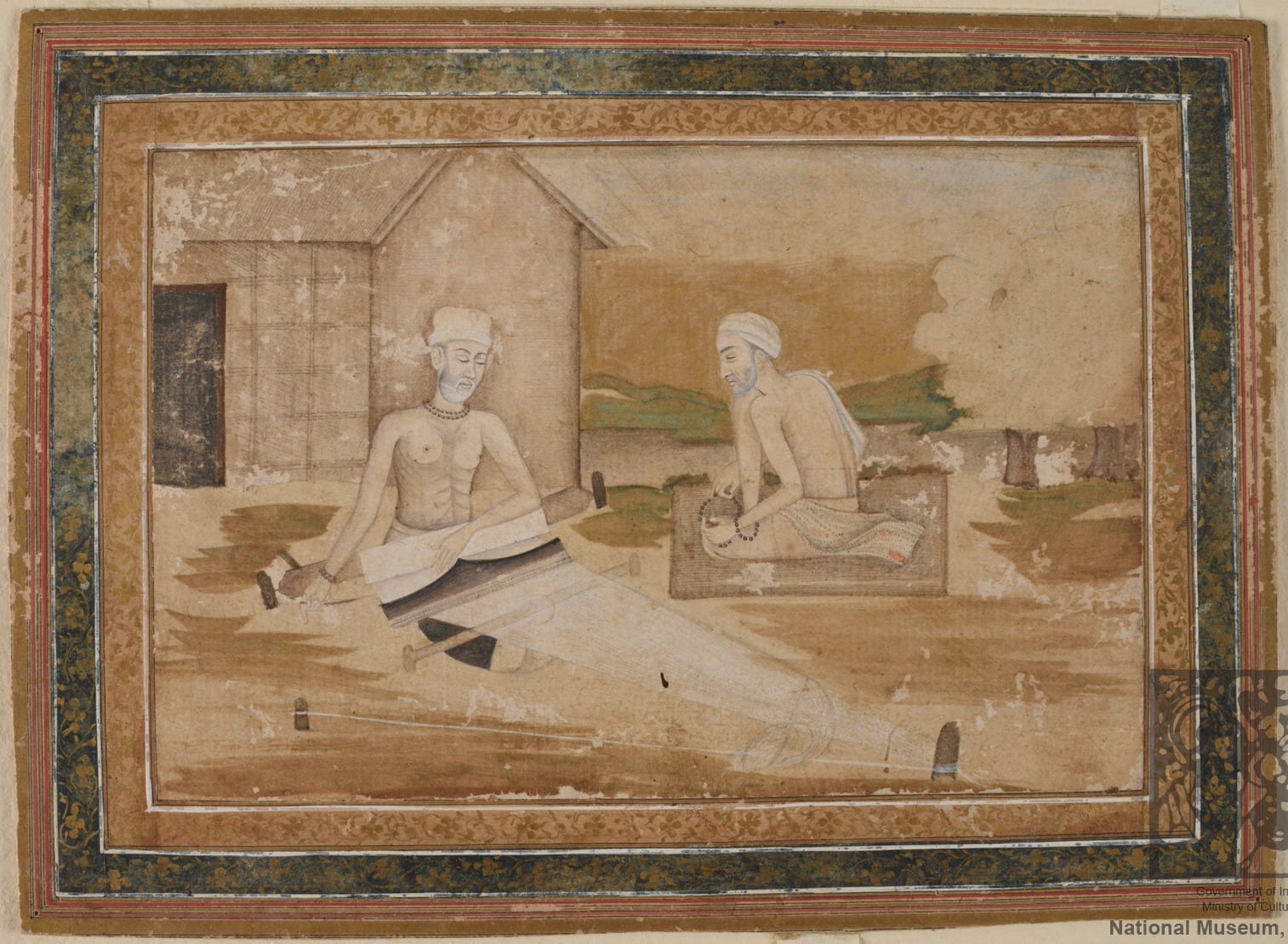
Kabir y Ravidas · Public domain
Dans ses propres mots
«If God be within the mosque, then to whom does this world belong? If Ram be within the image which you find upon your pilgrimage, then who is there to know what happens without?»Guru Granth Sahib, Prabhati, p. 1349 (texto gurmukhi según BaniDB); trad. española propia; versión inglesa de Tagore (*Songs of Kabir*, 1915, poema LXIX, uno de los seis que V. C. Mishra tiene por auténticos).

Pour commencer, une œuvre
BijakSon idée centrale
Nirguna: the divine without attributes: Kabir's devotion is directed to a *nirguna* absolute, 'without qualities', which has no form, no incarnations and no image in temples.
Le voir en contexte
Biographie
5 min de lecture
Traduction assistée à partir de l'original espagnol, en attente de relecture par un traducteur natif.
Un tisserand de Bénarès
De Kabir, le poète le plus cité de l'Inde du Nord, deux choses seulement peuvent être affirmées avec certitude à partir des vers qu'on lui attribue avec le plus de sûreté : qu'il passa l'essentiel de sa vie à Bénarès, l'actuelle Varanasi, et qu'il était tisserand, julaha, membre d'une caste de rang inférieur devenue en majorité musulmane à son époque. Son nom même, l'un des quatre-vingt-dix-neuf noms de Dieu en islam, trahit une origine musulmane. Tout le reste — ses parents, son maître, ses miracles — appartient aux traditions qui se le disputèrent ensuite : pour les sikhs, il est un précurseur de Guru Nanak ; pour les musulmans, un soufi ; pour les hindous, un dévot vishnouite aux penchants universalistes.
Même ses dates ne sont pas assurées. La tradition de la secte qui porte son nom le fait naître en 1398 et mourir en 1518, à cent vingt ans ; les savants se partagent entre ceux qui, comme Jaroslav Strnad, préfèrent 1398-1448 et ceux qui, avec l'Encyclopaedia Britannica, situent sa vie entre 1440 et 1518. David Lorenzen estime qu'il dut mourir aux alentours de la date traditionnelle de 1518, à Maghar, près de Gorakhpur, comme l'affirment unanimement la tradition des kabirpanthis et un document moghol de 1698-1699.
Les légendes
Les hagiographies ont comblé ce vide. Selon l'une, il était le fils d'une veuve brahmane qui l'abandonna, et fut recueilli au bord de l'étang de Lahartara par un tisserand musulman, Niru, et sa femme, Nima ; selon une autre, il apparut sur une fleur de lotus. La plus célèbre raconte comment le jeune garçon, sachant qu'un gourou hindou n'accepterait pas un musulman, s'allongea sur les marches du Gange où Ramananda venait se baigner : le maître, en descendant, marcha sur lui et s'écria « Ram, Ram ! », et Kabir proclama qu'il avait ainsi reçu le mantra de l'initiation. D'autres le montrent jugé par le sultan Sikandar Lodi et vainqueur des brahmanes, des cadis et des marchands. Les premières hagiographies, la Kabir parachai d'Anantadas, datent des environs de 1590, près d'un siècle après sa mort.
Evelyn Underhill, dans son introduction de 1915 aux versions de Tagore, racontait encore comme des faits le procès devant Sikandar Lodi, qu'elle datait de 1495, et la mort en 1518. Et elle transmettait la plus belle des légendes : à la mort du poète, ses disciples hindous voulurent l'incinérer et les musulmans l'enterrer ; Kabir leur apparut et leur demanda de soulever le linceul, sous lequel ils ne trouvèrent qu'un monceau de fleurs, qu'ils se partagèrent. À Maghar s'élèvent encore, à quelques pas l'un de l'autre, un tombeau musulman et un samadhi hindou.
Les témoignages qui ne relèvent pas de l'hagiographie sont rares et tardifs. Abu'l-Fazl, le chroniqueur d'Akbar, mentionne à la fin du XVIe siècle deux tombeaux de Kabir, l'un à Puri et l'autre à Ratanpur, preuve que plusieurs lieux se le disputaient déjà. Le Dabestan-e mazaheb, traité persan du XVIIe siècle sur les religions, le décrit comme un bairagi, un ascète vishnouite, disciple de Ramananda : selon l'historien Irfan Habib, c'est le plus ancien texte qui fournisse des données biographiques à son sujet.
Une voix que l'on chantait
Kabir n'écrivit pas : il composa et chanta. Son œuvre se compose de pad, chants brefs destinés à un mode musical ; de sakhi, distiques ou « témoignages » ; et de ramaini à caractère didactique, dans une langue composite de l'Inde du Nord que la critique appelle sadhukkari, la langue des sadhus. Ces vers ont circulé pendant des siècles de bouche à oreille et par écrit, et chemin faisant ils se sont transformés, multipliés, et des compositions d'admirateurs ont été placées sous son nom. Il est aujourd'hui impossible de dire avec exactitude quelles paroles sont les siennes ; ce qu'elles ont toutes en commun, c'est une franchise âpre et ironique contre l'hypocrisie, l'arrogance et le formalisme religieux.
Les plus anciens témoins écrits sont tardifs et ne proviennent pas de sa secte. Les pothi de Goindval, précurseurs de l'écriture sikhe, réunis vers 1570-1572, contiennent cinquante de ses chants ; le manuscrit de Fatehpur, de 1582, quinze. À partir de là, l'œuvre se partage entre trois grandes traditions régionales. La sikhe l'a fixée dans l'Adi Granth, que Guru Arjan acheva en 1604 et où les vers de Kabir forment la plus importante contribution d'un auteur étranger à la lignée des gourous, dont une section de 243 shalok. Celle des dadupanthis du Rajasthan l'a recueillie dans les grandes anthologies appelées Panch-vani, « les cinq voix », où la part de Kabir est la deuxième en étendue, après celle de Dadu lui-même : c'est la base des Kabir Granthavali modernes. L'orientale, celle des kabirpanthis de Bénarès, est le Bijak, tenu pour la version la plus ancienne et la plus authentique, bien que son plus ancien manuscrit conservé ne soit pas antérieur au début du XIXe siècle et que peu de ses vers coïncident avec ceux des deux autres.
Ni hindou ni musulman
Kabir ne fut pas un conciliateur des religions, comme l'a présenté le XXe siècle, mais un critique également implacable de l'une et de l'autre. Pour lui, réciter sans comprendre revenait au même devant les Védas et devant le Coran ; le brahmane et le cadi, le cordon sacré et la circoncision, le pèlerinage à Bénarès et le pèlerinage à La Mecque étaient des formes parallèles de l'erreur. Seule comptait la fidélité à l'unique vérité de la vie, qu'il appelait indifféremment Allah et Ram, entendant Ram comme un nom du divin et non comme le héros du Ramayana. Cette vérité sans attributs, nirguna, se cherche au-dedans : « cherche dans ton cœur », dit un hymne de l'Adi Granth, « c'est là qu'est sa demeure ». Et dans un autre, il se flatte d'avoir quitté Bénarès, la ville où mourir délivre, pour aller mourir à Maghar, où la croyance populaire promettait une mauvaise renaissance.
Postérité
Kabir ne fonda aucune secte, mais ses disciples organisèrent peu à peu le Kabir Panth au XVIe siècle ; à la fin du XVIIe, il avait des centres dans toute l'Inde du Nord, et ses fidèles, dont beaucoup de dalits, se comptent aujourd'hui par millions. Sa présence dans l'Adi Granth en a fait un interlocuteur de Guru Nanak, même si les spécialistes discutent de la mesure de son influence sur lui. En Occident, il fut révélé en 1915 par Songs of Kabir, cent poèmes traduits par Rabindranath Tagore avec l'aide d'Evelyn Underhill d'après le recueil que Kshitimohan Sen avait constitué à partir de livres et de chanteurs itinérants. Le livre devint un classique, mais V. C. Mishra a soutenu en 1987 que six seulement de ces cent poèmes sont authentiques et que Tagore a projeté sur Kabir la théologie de son temps. Les traductions critiques de Charlotte Vaudeville, de Linda Hess et de Shukdev Singh, ainsi que les récitals de chanteurs populaires comme Prahlad Tipanya, ont rendu à Kabir sa voix rugueuse.
Sources: Kabir. Songs of Kabir, trad. Rabindranath Tagore, introducción de Evelyn Underhill. Nueva York: Macmillan, 1915 (en Londres: One Hundred Poems of Kabir, India Society). Project Gutenberg n.º 6519.
Chronologie
La vie, année après année
Chaque point est un événement documenté. Cliquez pour le lire, avec sa source et son degré de certitude.
1398Benarés
Birth according to tradition
Kabirpanthi tradition places his birth in 1398 (full moon of *Jyeshtha*, Samvat 1455), which would make him a hundred and twenty at his death in 1518. Strnad accepts 1398 but moves his death to 1448.
Tradition«Kabir». Wikipedia en inglés (leyendas de nacimiento y persecución según Lorenzen; Dabestan-e Mazaheb; recensiones; crítica de V. C. Mishra, «Two Truths Are Told: Tagore's Kabir», en K. Schomer y W. H. McLeod (eds.), The Sants, 1987, pp. 167–180; Kabir Panth).
Après sa mort
- v. 1570 – 1572The Goindval pothis
- 1582Fatehpur manuscript
- v. 1590First hagiography
- 1604Kabir in the Adi Granth
- v. 1699Mughal document on the Magahar tomb
- 1910 – 1911Kshitimohan Sen's collection
- 1915Tagore's Songs of Kabir
- 1928Shyamsundar Das's Kabir Granthavali
- 1983Hess and Singh's Bijak
- 1987V. C. Mishra's critique of Tagore
1398
Birth according to tradition
Kabirpanthi tradition places his birth in 1398 (full moon of *Jyeshtha*, Samvat 1455), which would make him a hundred and twenty at his death in 1518. Strnad accepts 1398 but moves his death to 1448.
Tradition
v. 1440 · 0 ans
Birth according to much scholarship
The *Britannica* and other scholars place his birth around 1440 in Benares, into a family of Muslim weavers (*julaha*).
Probable
v. 1460 – 1518
Weaver and singer in Benares
He lives by his loom in Benares, married with a family according to the legends; he composes and sings *padas* and *sakhis* criticising Brahmins and mullahs alike. His relationship with Ramananda is the stuff of legend.
Probable
v. 1495
The trial before Sikandar Lodi (legend)
The hagiographies show him tried by Sultan Sikandar Lodi (r. 1489–1517) and banished from Benares; Underhill (1915) dated the episode to 1495, but there is no independent evidence.
Contesté
v. 1518
Death at Magahar
He dies, according to the traditional date Lorenzen considers approximately correct, at Magahar near Gorakhpur. A hymn in the *Adi Granth* has Kabir say that he left Benares to die at Magahar.
Probable
v. 1570 – 1572
The Goindval pothis
The Sikh Goindval manuscripts, copies of an anthology assembled around 1570–1572, include fifty songs by Kabir: the oldest written witness to his work.
Documenté
1582
Fatehpur manuscript
The Fatehpur manuscript, mainly a collection of Surdas's songs, is the oldest dated manuscript containing poems by Kabir (fifteen).
Documenté
v. 1590
First hagiography
Anantadas writes the *Kabir parachai*, the oldest hagiography; in 1712 Priyadas comments on the stanza about Kabir in Nabhadas's *Bhaktamal*.
Documenté
1604
Kabir in the Adi Granth
On 29 August Guru Arjan completes the *Adi Granth*, the first edition of the Sikh scripture, with a large number of Kabir's hymns and a section of 243 *shaloks* under his name.
Documenté
v. 1699
Mughal document on the Magahar tomb
A document from Aurangzeb's reign (1698–1699) records the gift of a village for the upkeep of the Muslim tomb of 'Shah Kabir' at Magahar: the first documentary evidence of institutions linked to Kabir.
Documenté
1910 – 1911
Kshitimohan Sen's collection
Kshitimohan Sen publishes his four-part *Kabir* at Santiniketan (1910–1911), gathered from books, manuscripts and wandering singers; it will be the basis of Tagore's version.
Documenté
1915
Tagore's Songs of Kabir
Rabindranath Tagore publishes, with Evelyn Underhill, a hundred poems of Kabir in English (New York, Macmillan; in London, *One Hundred Poems of Kabir*). It becomes the West's Kabir.
Documenté
1928
Shyamsundar Das's Kabir Granthavali
Shyamsundar Das edits the *Kabir Granthavali* from manuscripts of the Rajasthani tradition, one of them bearing a date of 1504 that later scholarship does not accept as reliable.
Documenté
1983
Hess and Singh's Bijak
Linda Hess and Shukdev Singh publish their English translation of the *Bijak*, with essays and notes, a reference for modern Kabir studies.
Documenté
1987
V. C. Mishra's critique of Tagore
In *The Sants* (ed. Schomer and McLeod), V. C. Mishra argues that only six of Tagore's hundred poems (15, 32, 34, 35, 69 and 94) are authentic.
Documenté
Œuvres
Œuvres essentielles
Les œuvres sans lesquelles on ne comprend pas son héritage.
Compilation postérieure
Bijak
बीजक (Bījak)
Scripture of the Kabirpanthis: didactic *ramainis*, *shabdas* (songs) and *sakhis* (couplets), plus some popular forms. It is the most polemical and disconcerting Kabir, that of the direct attacks on caste, rites and sacred books, and of the *ulatbansi*, 'upside-down language' riddles that jolt the listener's mind. Linda Hess and Shukdev Singh translated it in full in 1983, and their edition remains the English reference.
4 éditions
Kabir
Kabir Granthavali
Compilation postérieure
Kabir Granthavali
कबीर ग्रंथावली (Kabīr granthāvalī)
A corpus of *sakhis* arranged by theme (*ang*), *padas* for singing and some *ramainis*, preserved by the followers of Dadu Dayal in Rajasthan. According to Hawley, the western Kabir is more devotional than the Punjabi one; in it Nath yogi influence, devotion to Ram and sant ethics coexist. Its couplets are the ones that have passed into everyday speech in northern India. Charlotte Vaudeville translated the *dohas* into French (1957) and English (1974).
5 éditions

Compilation postérieure · 1604
Hymns and shaloks in the Guru Granth Sahib
ਭਗਤ ਕਬੀਰ ਜੀ ਕੀ ਬਾਣੀ — ਸ੍ਰੀ ਗੁਰੂ ਗ੍ਰੰਥ ਸਾਹਿਬ (Bāṇī Bhagat Kabīr jī kī)
Hymns (*shabad*) distributed through the ragas of the Sikh scripture (Gauri, Asa, Sorath, Bhairo, Prabhati and others) and, in the final section, the *Salok Bhagat Kabir* (243 couplets). Here appears a more earthly Kabir, the householder swept away by the intensity of love, and many of his best-known verses: seeking God in the heart and not in mosque or temple, mocking the fasts of Brahmins and Muslims, telling how he left Benares to die at Magahar. They are sung daily in gurdwaras.
2 éditions
Kabir
Songs of Kabir / One Hundred Poems of Kabir (Tagore's version)
Attribution traditionnelle · 1915
Songs of Kabir / One Hundred Poems of Kabir (Tagore's version)
Songs of Kabir / One Hundred Poems of Kabir (versión de Tagore)
The book that made Kabir known in the West: a hundred poems in poetic prose about the God within man, the true master, the unstruck music (*anahad*), the inadequacy of words and the unity of all things. With Evelyn Underhill's introduction, which recounted the legends as facts, it was endlessly reprinted, retranslated into Spanish (Joaquín V. González, 1918), French (Henriette Mirabaud-Thorens and, in versions unpublished until 2012, André Gide) and many other languages, and it inspired Robert Bly's paraphrases. It is literature in its own right, but only a small part of it can be read as Kabir.
4 éditions

Citations
Citations localisées dans une œuvre précise. Chacune porte sa provenance et son degré de fiabilité.
If God be within the mosque, then to whom does this world belong? If Ram be within the image which you find upon your pilgrimage, then who is there to know what happens without?ਅਲਹੁ ਏਕੁ ਮਸੀਤਿ ਬਸਤੁ ਹੈ ਅਵਰੁ ਮੁਲਖੁ ਕਿਸੁ ਕੇਰਾ ॥ ਹਿੰਦੂ ਮੂਰਤਿ ਨਾਮ ਨਿਵਾਸੀ ਦੁਹ ਮਹਿ ਤਤੁ ਨ ਹੇਰਾ ॥
VérifiéeGuru Granth Sahib, Prabhati, p. 1349 (texto gurmukhi según BaniDB); trad. española propia; versión inglesa de Tagore (*Songs of Kabir*, 1915, poema LXIX, uno de los seis que V. C. Mishra tiene por auténticos).
Citations apocryphes ou d'attribution contestée (2)
«O servant, where dost thou seek Me? Lo! I am beside thee. I am neither in temple nor in mosque: I am neither in Kaaba nor in Kailash.»
First poem of *Songs of Kabir* (Tagore, 1915), perhaps the most quoted 'Kabir' in the West. It comes from Kshitimohan Sen's collection and is not among the six V. C. Mishra regards as authentic: it may be the work of a later admirer imitating his style.
«Do not go to the garden of flowers! O Friend! go not there; In your body is the garden of flowers.»
Poem IV of *Songs of Kabir* (Tagore, 1915), widely circulated; like most of the selection, its attribution to Kabir is not proven according to Mishra's critique.
Dernières paroles
Il n'existe aucun témoignage vérifiable de ses dernières paroles.
No attested last words survive. A hymn in the *Adi Granth* (Gauri, p. 326) has Kabir say that, having spent his life in Benares, 'at the time of death' he went to Magahar, and ends: 'Kabir died repeating the name of Ram'; it is poetry, not testimony. The legend of the flowers under the shroud comes from hagiography and is recorded by Underhill in 1915.
Source: Sri Guru Granth Sahib, bani de Bhagat Kabir (texto gurmukhi por página o *ang*: Gauri 326, Prabhati 1349–1350, Salok 1364–1377). BaniDB.
Interroger
Ce que répond son œuvre
Douze grandes questions de l'humanité et ce que ses textes permettent d'y répondre, références à l'appui. Nous ne lui prêtons jamais de paroles.
Qu'est-ce que l'Absolu ? Dieu existe-t-il ?
Ram without attributes: not in mosque or idol, but in the heart
L'innommableIl le dit expressément
Kabir calls the ultimate Ram, Hari or Allah, but insists that it is not the Rama of the avatars nor a God enclosed in a temple: it is nirguna, without attributes, and its story is ‘unspeakable’. In verses preserved in the Guru Granth Sahib he asks whose the rest of the world would be if Allah lived only in the mosque, and says he found the truth neither in the Hindu image nor in the Muslim rite; Hari and Allah dwell neither in the south nor in the west but deep in the heart. His language of paradox (ulatbansi) shows that ordinary thought cannot reach that One. And yet Kabir addresses it with a servant’s tenderness: the formless Lord is also the one with whom love cannot be broken.
Comparer cette question avec d'autres maîtresQui suis-je ? Existe-t-il un vrai soi ?
What you seek outside is within: search deep in the heart
Le Soi est l'AbsoluCela se déduit de sa doctrine
Kabir develops no doctrine of the soul, but his verses agree in turning the search inward: Hari and Allah dwell neither in the south nor in the west but deep in the heart, which is their abode. The tradition bearing his name abounds in images of the drop and the ocean, or of the deer that searches outside for the musk it carries within. The self that boasts of caste, learning or piety is for Kabir a mask that death tears off; what remains is the place where the Name dwells. His language oscillates between identity with the divine and the relation of a servant to his Lord, and never turns that tension into a system.
Comparer cette question avec d'autres maîtresPourquoi souffrons-nous ?
Maya deceives, and separation from the Beloved burns
La séparation d'avec DieuCela se déduit de sa doctrine
In Kabir’s verses suffering has two faces. One is maya, which he calls the great swindler: attachment to wealth, body, caste and rites, which makes one forget the Name and leaves the human being at the mercy of death. The other is viraha, the pain of separation from the Beloved, which Kabir describes as a snake living in the body or a fire that will not go out. This second pain is not merely an evil: it is the sign that the soul has woken to its absence, and the one who suffers it is closer to Ram than the one who feels satisfied. The death that terrifies the world, says one of his verses, fills his mind with joy.
Comparer cette question avec d'autres maîtresQue se passe-t-il après la mort ?
Dying while alive: the death that terrifies the world is his joy
Mourir chaque jour au connuIl le dit expressément
Kabir speaks of death with unusual insistence and turns it upside down. In a verse of the Guru Granth Sahib he says that the death which terrifies the world fills his mind with joy, because only by dying is supreme bliss attained: the point is to die while living, for the ego to die before the body. His final gesture, according to tradition, was to go and die in Magahar, a place said to bring a bad rebirth, rather than in Benares, where dying guaranteed liberation; one of his verses recalls it. With this he denied that place or rite decide the soul’s fate. Kabir shares the belief in cycles of births, but his interest lies in the inner death that frees now.
Comparer cette question avec d'autres maîtresComment atteint-on la libération ou le salut ?
The Name of Ram and the true master, not rituals
Par la dévotion et l'abandonIl le dit expressément
Kabir rejects every external path to liberation: ablutions, fasts, pilgrimage, the study of the Vedas and the Qur’an, caste and the ascetic’s garb. Not even the place of death saves, as he showed by going to die in Magahar. What frees is the loving repetition of the Name of Ram (ram nam), received from the satguru, and the inner devotion that transforms the one who lives it. The tradition bearing his name also speaks of sahaj, a natural and spontaneous state, as opposed to the forced techniques of yoga. One of his most quoted verses offers itself in sacrifice for his own humble caste, in which he was able to repeat the Creator’s name: devotion knows no lineage.
Comparer cette question avec d'autres maîtresFaut-il un maître ?
The satguru opens the eyes; without him one cannot cross over
IndispensableIl le dit expressément
The satguru, the true master, holds a central place in Kabir’s verses. The section on the guru (gurudev ko ang) in the Rajasthani recension describes him as the one who opens the disciple’s eyes, shows him the infinite and gives him the word that frees. A much-quoted doha imagines guru and God standing before the disciple and asks to whom one should bow first, concluding: to the guru, for he has shown God. Kabir, who mercilessly criticises Brahmins, mullahs and ascetics, does not confuse that master with religious authority: the satguru is the one who transmits the experience of the Name. In some readings the true guru is the Word (shabad) itself.
Comparer cette question avec d'autres maîtresLe monde est-il réel ?
The world is a passing market; only the Name endures
Apparence sur l'unique réalitéCela se déduit de sa doctrine
In Kabir’s verses the world is above all transient and deceptive. He compares it to a fair being taken down, to a dream, to a clay pot that breaks; maya, the great swindler, makes people cling to house, body and wealth as if they would last. Only the Name of Ram is real and endures. Yet the world is not sheer nothingness for Kabir: one of his verses in the Guru Granth Sahib states that the whole world sprang from a single light, so no one can be called good or bad by origin. What deceives is not the world’s existence but taking it for the ultimate.
Comparer cette question avec d'autres maîtresQu'est-ce que l'amour ?
Like the lotus leaf on water: a love that cannot break
Le désir ardent et l'unionIl le dit expressément
Kabir makes love (prem) the centre of his path and sets it against book learning: according to a much-quoted doha, no one became wise by reading books, but whoever learns the few letters of the word love is wise. In a verse preserved in the Guru Granth Sahib he asks how the love between his Lord and him could ever break, and answers with an image: as the lotus leaf rests on the water, so He is his Lord and he his servant. That love is also made of separation and seeking, and in his verses the soul appears as a bride waiting for the Beloved. For Kabir love is not one feeling among others: it is the only key that opens Ram’s door.
Comparer cette question avec d'autres maîtresSommes-nous libres ou tout est-il déterminé ?
He does not debate fate: all is Ram’s doing; the choice is love
Ne s'est pas prononcé
The verses attributed to Kabir do not pose the philosophical problem of freedom and fate. On the one hand they repeat that everything happens by the Lord’s will and that human beings own nothing, not even their next breath. On the other they constantly challenge the listener to change: to give up hypocrisy, wake up before death comes and repeat the Name while there is still time. That constant exhortation presupposes that something depends on the hearer, but Kabir never reconciles the two claims or turns them into doctrine. His interest is not in explaining how the will works but in shaking it. It would strain the texts to attribute to him a theory of free will.
Comparer cette question avec d'autres maîtresPourquoi méditer ou prier ?
Search your heart: there the unstruck music plays
Revenir à la source du jeIl le dit expressément
Kabir scorns ritual prayer: he mocks the muezzin who shouts as if God were deaf and the Brahmin who tells his rosary beads while his mind wanders. What he proposes is turning inward: Hari and Allah live neither in the south nor in the west but deep in the heart, and it is there one must search. His practice is continuous remembrance of the Name (simran) and listening to the inner sound, the unstruck music (anahad) which in one of his verses plays by itself where rivers of light flow. Meditation is not a separate exercise but a natural state (sahaj) that accompanies the whole of life. To pray is to discover that what was sought was in the seeker.
Comparer cette question avec d'autres maîtresLa raison peut-elle connaître l'ultime ?
No one became wise by reading books: the ultimate is known by loving
L'ultime est au-delà du mentalIl le dit expressément
Kabir, a low-caste weaver and probably illiterate, mocks the scholars who recite the Vedas and the qazi who quotes the Qur’an without knowing God. In his verses scriptures and theological debate are an obstacle when they replace experience: the pandit speaks of what he has not seen. His paradoxical language (ulatbansi), with impossible images such as the cow milking the calf or the river on fire, deliberately baffles the logical mind to point to what lies beyond it. The ultimate is known through direct experience, love and the grace of the true master. Kabir does not set faith against reason: he sets experience against empty talk.
Comparer cette question avec d'autres maîtresSe retirer du monde ou le transformer ?
Weaver and householder: the divine is not in the ascetic’s robe
La contemplation dans l'actionIl le dit expressément
Kabir lived, according to tradition, as a weaver in Benares, married with children, and never took up the renunciant’s life. His verses mock the yogis who smear themselves with ash, grow their hair or pierce their ears, and the ascetics who flee to the forest thinking to find God there. For Kabir the divine is found neither in a place nor in a robe but in the heart, and can be remembered while working at the loom. His ideal of sahaj, the natural and spontaneous, rejects both worldliness and ostentatious renunciation. At the same time his critique of caste and religious hypocrisy had a social reach that his low-caste followers claimed.
Comparer cette question avec d'autres maîtres
Affinités et tensions
Affinités et tensions
Calculées question par question à partir de ses positions. La raison de chaque accord ou de chaque désaccord s'affiche d'un clic.
Pense comme
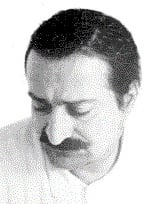
Meher Baba
Ils concordent sur: Qui suis-je ? Existe-t-il un vrai soi ? · Comment atteint-on la libération ou le salut ? · Faut-il un maître ?
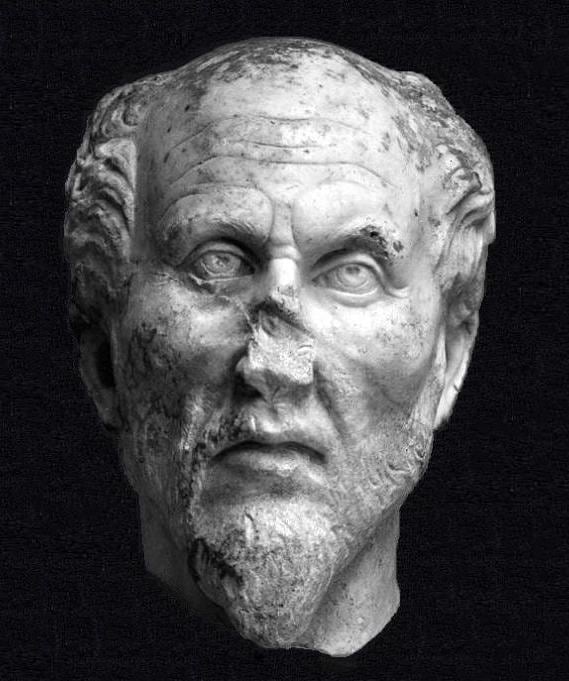
Plotinus
Ils concordent sur: Qu'est-ce que l'Absolu ? Dieu existe-t-il ? · Qui suis-je ? Existe-t-il un vrai soi ? · Pourquoi souffrons-nous ?
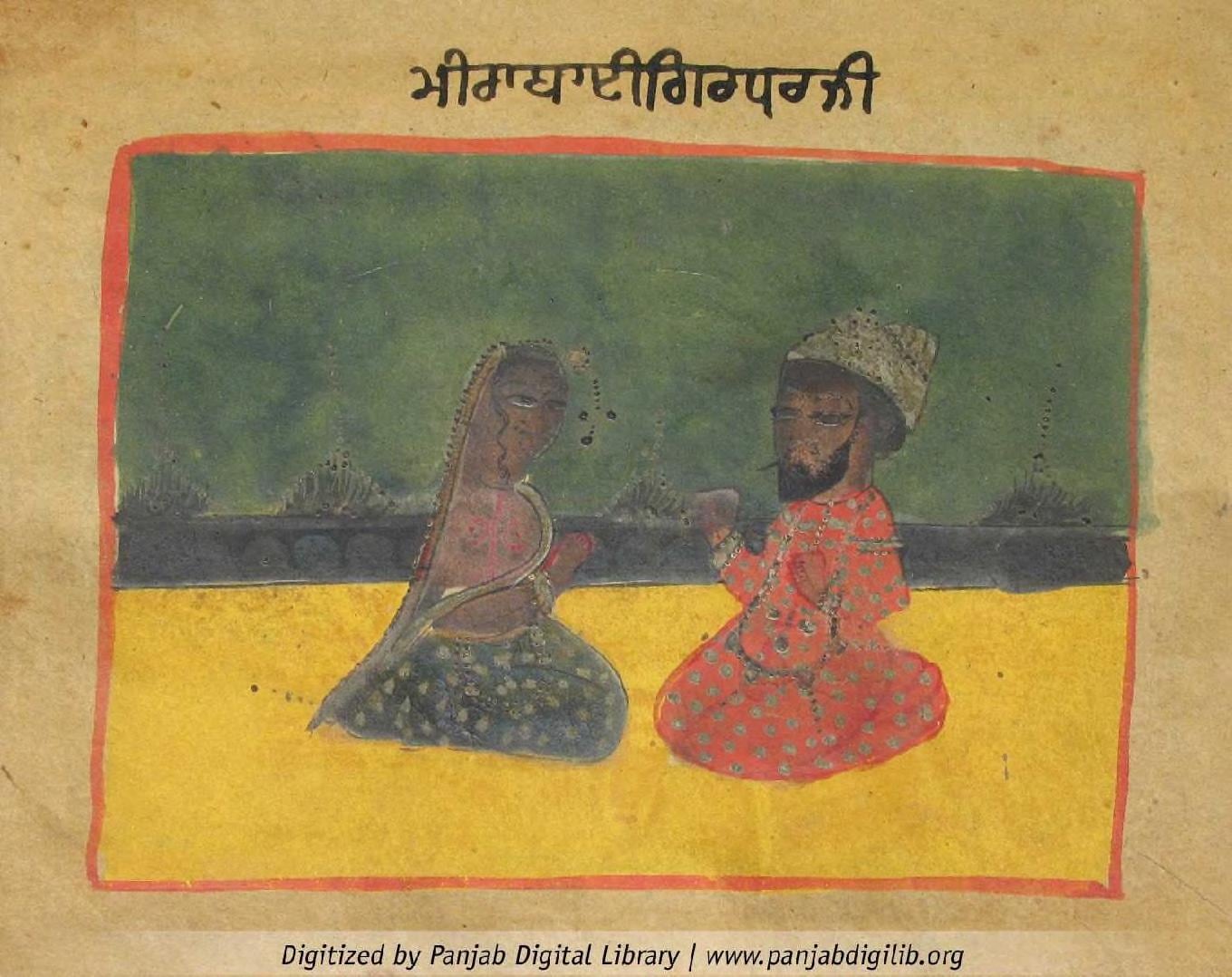
Mirabai
Ils concordent sur: Pourquoi souffrons-nous ? · Comment atteint-on la libération ou le salut ? · Faut-il un maître ?
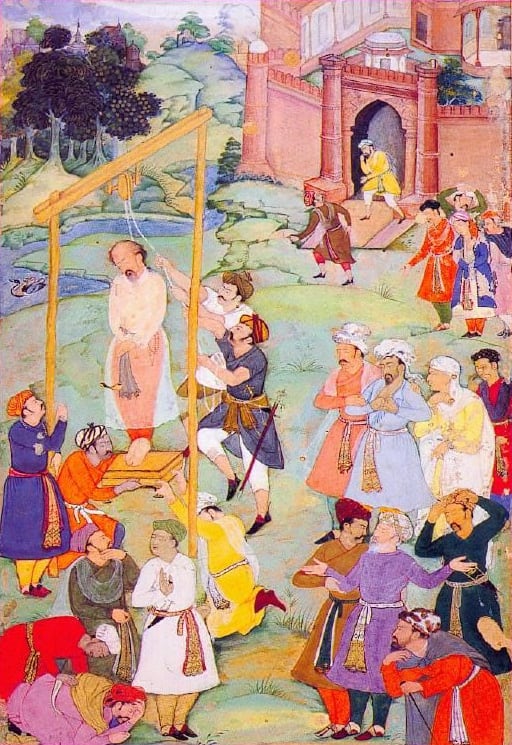
Al-Hallaj
Ils concordent sur: Pourquoi souffrons-nous ? · Qui suis-je ? Existe-t-il un vrai soi ? · Comment atteint-on la libération ou le salut ?
Pense autrement que

Pema Chödrön
Ils s'opposent sur: Qui suis-je ? Existe-t-il un vrai soi ?
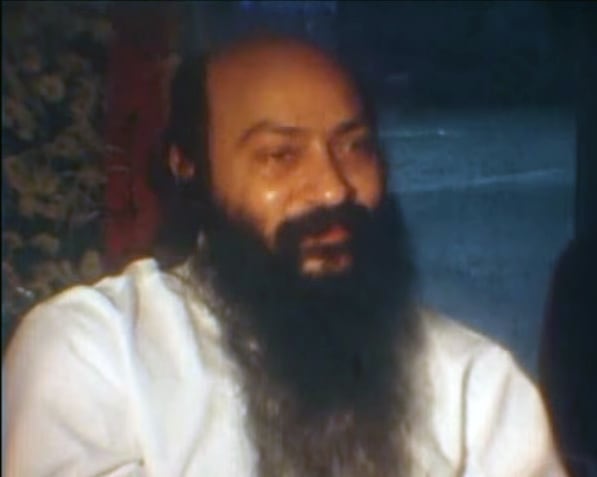
Osho
Ils s'opposent sur: Comment atteint-on la libération ou le salut ?

Epicurus
Ils s'opposent sur: Qui suis-je ? Existe-t-il un vrai soi ?
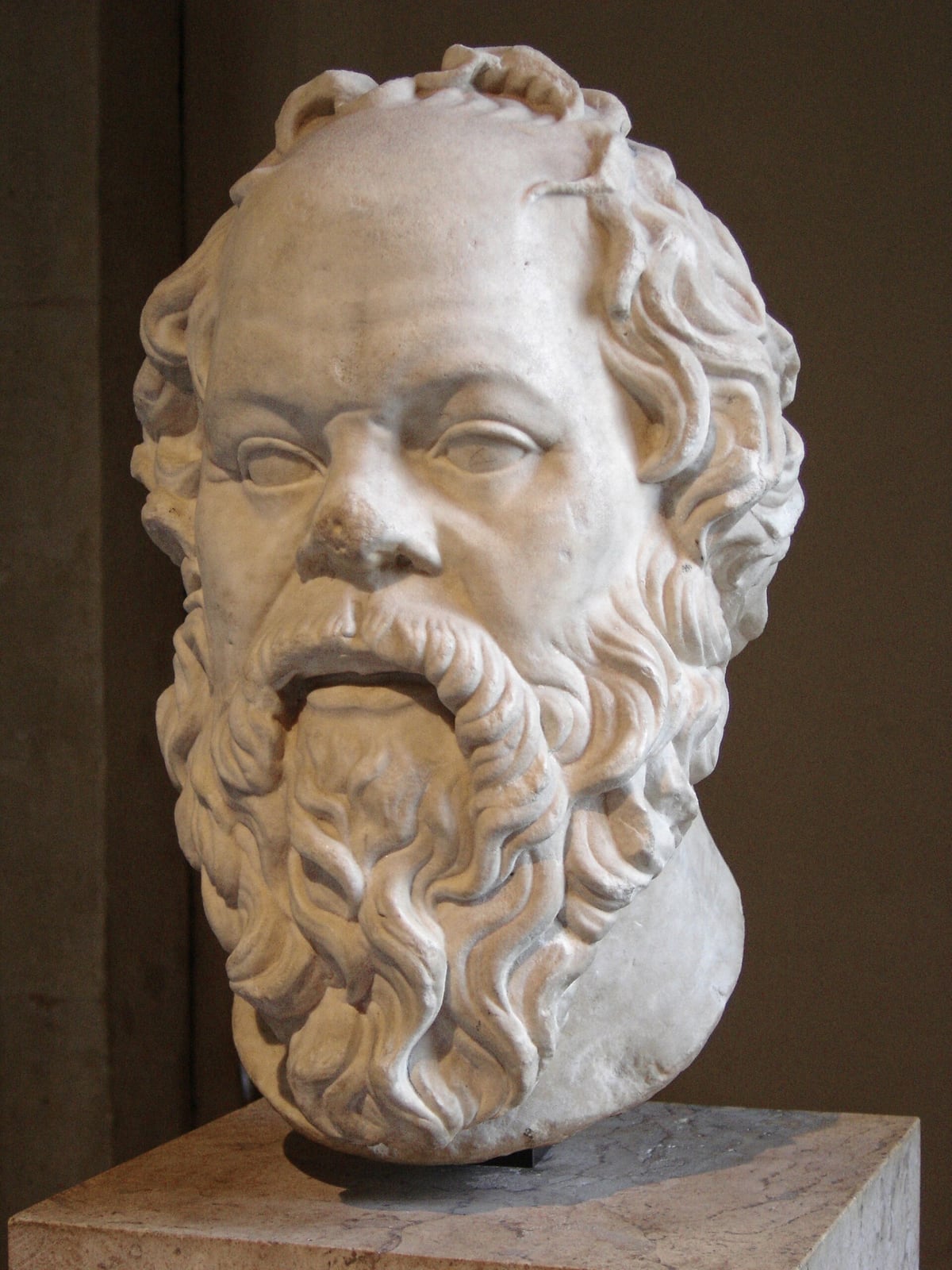
Socrates
Ils s'opposent sur: Qui suis-je ? Existe-t-il un vrai soi ? · Le monde est-il réel ?
Anecdotes et récits
Anecdotes et récits
Récit hagiographiques. XV (según la leyenda)
The child of the Lahartara pond
Origine du récit: Legends from Hindu and Kabir Panth hagiographies, nearly a century later than his death (the oldest, Anantadas's *Kabir parachai*, c. 1590). The *Britannica* records the Brahmin widow; Wikipedia, the lotus and Niru and Nima. His name and trade point to a Muslim origin.
Récit hagiographiques. XV (según la leyenda)
Initiated by a footstep
Origine du récit: A hagiographic story told by Evelyn Underhill in her introduction to *Songs of Kabir* (1915). The *Dabestan-e mazaheb* (17th century) already calls him Ramananda's disciple; the *Britannica* allows for a strong influence from Ramananda, but the scene on the steps has no contemporary source.
Récit hagiographiquec. 1495 (según la leyenda)
Before Sultan Sikandar Lodi
Origine du récit: A narrative cycle developed in Anantadas's *Kabir parachai* (c. 1590) and later hagiographies (Lorenzen, *Kabir Legends and Ananta-Das's Kabir Parachai*, 1991). Underhill (1915) presented it as fact; many scholars doubt its historicity for lack of independent evidence.
Récit hagiographiquec. 1518 (según la leyenda)
The flowers under the shroud
Origine du récit: A hagiographic legend recorded by Underhill (1915). That he died at Magahar is unanimously held by Kabirpanthi tradition and by a Mughal document of 1698–1699 on the tomb of 'Shah Kabir' (Lorenzen, 2019); the *Adi Granth* itself contains a hymn about his move from Benares to Magahar to die.
Documenté1604
Guru Arjan takes Kabir into the Sikh scripture
Origine du récit: Facts documented by the Sikh manuscripts themselves; dates according to the history of the *Adi Granth* and Strnad (2023) for the Goindval *pothis*. The count of *shaloks* checked against the BaniDB text (pp. 1364–1377).
Documenté1910–1915
How Tagore's Kabir was born
Origine du récit: Preface and introduction of *Songs of Kabir* (1915) and the Wikipedia article on the book; V. C. Mishra's critique, 'Two Truths Are Told: Tagore's Kabir', in Schomer and McLeod (eds.), *The Sants* (1987), pp. 167–180, is cited at second hand.
Enseignements
Enseignements
Les notions qui structurent sa pensée, expliquées dans leur contexte.
Nirguna: the divine without attributesnirguna
A feature shared by the *sants* of northern India (Ravidas, Dadu, Nanak) as opposed to *saguna* devotion to incarnate Krishna or Rama (Tulsidas, Surdas, Mirabai).
The Name: Ram, Allah, Hariram-nam
The practice of *nam-simran*, shared with the *sants* and central to Sikhism.
The true master (satguru)satguru
A concept common to the *sant* tradition and to Sikhism, where the guru acquires an institutional dimension.
Sahaj: the spontaneous and naturalsahaj
A term inherited from the tantric *siddhas* and the *nath* yogis, reinterpreted by the *sants*.
Ulatbansi: upside-down languageulatbansi
A genre related to the *sandhya-bhasha* of the Buddhist tantric *siddhas* and the *naths*.
Vidéos
Vidéos
Enregistrements, entretiens et documentaires. Les vidéos sont lues depuis YouTube ; elles ne sont pas hébergées ici.
Had Anhad: Journeys with Ram & Kabir
Documentaire· HI· 103 min
Ajab Shahar — Kabir ProjectChaîne officielle
Kabira Khada Bazaar Mein: Journeys with Sacred & Secular Kabir
Documentaire· HI· 94 min
Ajab Shahar — Kabir ProjectChaîne officielle
Chalo Hamara Des: Journeys with Kabir & Friends
Documentaire· EN· 97 min
Ajab Shahar — Kabir ProjectChaîne officielle
Linda Hess introduces Kabir — Episode 3 of 'Chalo Hamara Des'
Entretien· EN· 4 min
Ajab Shahar — Kabir ProjectChaîne officielle
Kabir: Revisiting 'Bodies of Song', a talk by Prof. Linda Hess
Conférence· EN· 2020· 97 min
Ulatbansi
Bodies of Song: The Legacy of Kabir — Linda Hess in conversation with Sanjoy K. Roy
Entretien· EN· 41 min
JLF InternationalChaîne officielle
Understanding Kabir: Life, Philosophy and Poetry by Purushottam Agarwal (Module 1)
Conférence· HI· 2026· 41 min
Jashn-e-RekhtaChaîne officielle
Kabir Das | Documentary | Story of Kabir Das
Documentaire· HI· 26 min
Prasar Bharati ArchivesChaîne officielle
'Kahaan Se Aaya Kahaan Jaaoge?' by Prahlad Tipanya
Enregistrement de tiers· HI· 10 min
Ajab Shahar — Kabir ProjectChaîne officielle
'Nirbhay Nirgun Gun Re' sings Pt. Kumar Gandharva
Enregistrement de tiers· HI· 10 min
Ajab Shahar — Kabir ProjectChaîne officielle
Salok Bhagat Kabir Ji — Bhai Maninder Singh Ji (Gurbani Kirtan)
Enregistrement de tiers· PA· 21 min
Amrit Baani — Goyal MusicChaîne officielle
KABÎR — Une vie, une œuvre : le vagabond céleste (France Culture, 1991)
Documentaire· FR· 1991· 80 min
ÉCLAIR BRUT
Kabir: the poet, saint and weaver of Ancient India (full version)
Documentaire· EN· 2004· 29 min
Peter Steven MalakoffChaîne officielle
Galerie
Galerie
Images dont la licence a été vérifiée. Chacune conserve son auteur et son attribution.
Manuscrits
Manuscrits
Témoins manuscrits et textes anciens, avec leur dépositaire et leurs conditions de consultation.
PA · Gurmukhi · s. XV–XVI
Goindval pothis (Mohan pothis)
- Témoin conservé
- Dos manuscritos, copias de una antología reunida hacia 1570–1572, con cincuenta canciones de Kabir; solo uno lleva una fecha, equivalente a 1595
- Dépositaire
- Colección de los descendientes de Baba Mohan
HI · Devanagari · s. XV–XVI
Manuscrito de Fatehpur
- Témoin conservé
- Antología fechada en 1582 (Samvat 1639), sobre todo de canciones de Surdas: el manuscrito fechado más antiguo con poemas de Kabir
HI · Devanagari · s. XV–XVII
Panch-vani dadupanthi
- Témoin conservé
- Antologías manuscritas del siglo XVII de la secta de Dadu Dayal, en las que la *Kabir vani* es la segunda sección en extensión
- Dépositaire
- Diversas bibliotecas y monasterios dadupanthis de Rajastán
Relations
Relations
Influences, filiations et affinités. On distingue la relation documentée de la similitude identifiée par analyse.
A influencé
Documented: Kabir's verses appear in the Goindval *pothis* (c. 1570) and in the *Adi Granth* (1604), where they dialogue with the gurus'. Disputed: W. H. McLeod places Nanak in Kabir's *sant* tradition and sees in him a reproduction of its fundamental doctrines; Surjit Singh Gandhi and J. S. Grewal deny it. No meeting between them is recorded; accounts of one are traditional.
Relation documentée
Idées proches de
Great voices of vernacular *bhakti* in northern India, partly contemporaries if Kabir died in 1518; but Mirabai sings to Krishna with form (*saguna*) and Kabir to the divine without attributes (*nirguna*). The Kabir Project has brought them together in its films.
Similitude identifiée par analyse
Idées proches de
Vaudeville, Lorenzen and Adrián Muñoz relate Kabir's *nirguna* absolute to the Brahman of Advaita Vedanta, albeit with differences; Kabir scorns the Brahmanical learning Shankara embodies.
Similitude identifiée par analyse
Idées proches de
The mysticism of love and separation brings them together, and Underhill (1915) assumed an influence from the Persian Sufi poets; scholars debate whether Sufism influenced the *sants* or whether both developed through mutual interaction.
Similitude identifiée par analyse
Idées proches de
Both teach that what is sought lies within the seeker and distrust outward religion; no historical connection is known.
Similitude identifiée par analyse
Idées proches de
Both aim their sharpest verses at outward religion (the ascetic, the preacher, the pandit and the mullah) in the name of inner sincerity.
Similitude identifiée par analyse
Sources
Sources
Bibliographie et catalogues consultés pour cette fiche.
- Wikidata, Q312551 «Kabir» (P31=Q5; 85 enlaces entre wikis; P569 1398 y 1440; P570 1518; P19 Varanasi; P20 Maghar).
- The Editors of Encyclopaedia Britannica. «Kabir». Encyclopaedia Britannica (consultada en la copia de Wayback Machine de 2024).
- Lorenzen, David N. Reseña de Purnendu Ranjan, Kabirpanth till the end of the Medieval India (Chandigarh: Gyankosh, 2016). Kervan. International Journal of Afro-Asiatic Studies 23/1 (2019), pp. 261–263.
- Strnad, Jaroslav. «Kabīr's Pads». En Triveṇī: Texts of Three Literary Traditions in Early Modern Languages of North India. Osaka: Osaka University, 2023, pp. 61–128. DOI 10.18910/94760.
- Kabir. Songs of Kabir, trad. Rabindranath Tagore, introducción de Evelyn Underhill. Nueva York: Macmillan, 1915 (en Londres: One Hundred Poems of Kabir, India Society). Project Gutenberg n.º 6519.
- «Kabir». Wikipedia en inglés (leyendas de nacimiento y persecución según Lorenzen; Dabestan-e Mazaheb; recensiones; crítica de V. C. Mishra, «Two Truths Are Told: Tagore's Kabir», en K. Schomer y W. H. McLeod (eds.), The Sants, 1987, pp. 167–180; Kabir Panth).
- «Songs of Kabir». Wikipedia en inglés (fuentes de Tagore: colección de Kshitimohan Sen y traducción inédita de Ajit Kumar Chakravarty; autenticidad).
- Sri Guru Granth Sahib, bani de Bhagat Kabir (texto gurmukhi por página o *ang*: Gauri 326, Prabhati 1349–1350, Salok 1364–1377). BaniDB.
- «Guru Granth Sahib». Wikipedia en inglés (compilación del Adi Granth por Guru Arjan, completada el 29 de agosto de 1604; bhagats incluidos).
- Ayant droit
- Dominio público (obra oral del siglo XV). Las traducciones de Tagore (1915) y Underhill son de dominio público; las ediciones críticas y traducciones modernas (Oxford University Press, Motilal Banarsidass, Penguin, NYRB, SUNY Press, Brill, Gallimard) están sujetas a los derechos de sus editores y traductores.
En attente de confirmation
Ce que cette fiche n'a pas encore pu établir. Nous préférons le dire plutôt que de combler.
- Recuento exacto de los himnos (*shabad*) de Kabir en el Guru Granth Sahib por raga: solo se ha comprobado la sección de 243 *shaloks* (pp. 1364–1377); no se ha encontrado una fuente fiable para las cifras que circulan.
- Sala de lectura en español: la traducción de Joaquín V. González (1918, dominio público) solo se ha hallado en una adaptación de 2023 con notas de Luis Cárdenas Camus (archive.org, con derechos); buscar el texto de 1918.
- Sala de lectura en hindi: localizar una transcripción de las *Kabir Granthavali* de Shyamsundar Das (1928; Das m. 1945, dominio público en España desde 2026) o del *Bijak* en Wikisource hindi; la API de hi.wikisource no respondió.
- Confirmar la fecha de muerte de Ahmad Shah, traductor del *Bijak* (1917), para decidir si su texto entra en la sala de lectura.
- Leer directamente el ensayo de V. C. Mishra (Schomer y McLeod, *The Sants*, 1987, pp. 167–180) y la introducción de Hess y Singh al *Bijak*; aquí se citan de segunda mano a través de Wikipedia.
- Confirmar el ISBN de *Kabir: Ecstatic Poems* (Robert Bly, Beacon Press): el que da Wikipedia (9780807063804) corresponde en Open Library a otro libro.
- Vídeos en español: no se ha encontrado ninguno de un canal institucional.
- Confirmar los datos editoriales de la edición de Parasnath Tiwari (1961) y de la traducción francesa de Vaudeville (Pondichéry, 1957).
Recherche effectuée le 2026-10-25