Hindouisme · Soufisme
Meher Baba
मेहेर बाबा · مهر بابا
1894 – 1969Personne historiquement documentée
Meher Baba (1894-1969), né Merwan Sheriar Irani à Poona dans une famille zoroastrienne, fut un maître spirituel indien qui se proclama l'Avatar de son temps. À partir du 10 juillet 1925, il garda le silence pendant quarante-quatre ans, communiquant au moyen d'une planche alphabétique, puis par gestes. Ses Discourses et Dieu parle (God Speaks), dictés et édités par des disciples, exposent une cosmologie du voyage de l'âme vers la conscience de Dieu. Il fonda Meherabad, prit soin des masts et voyagea en Occident dès 1931.
- œuvres
- 31œuvres
- éditions
- 49éditions
- citations
- 7citations
- vidéos
- 15vidéos
- images
- 10images
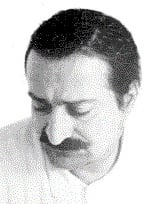
Meher Baba en 1941 · Public domain
Dans ses propres mots
«I have come not to teach but to awaken. Understand therefore that I lay down no precepts.»«The Universal Message» (1958), en The Path of Love

Pour commencer, une œuvre
God Speaks: The Theme of Creation and Its PurposeSon idée centrale
God alone is real; the universe is his imagination, and each soul is God passing through that imagination in order to come to know himself consciously.
Le voir en contexte
Biographie
5 min de lecture
Traduction assistée à partir de l'original espagnol, en attente de relecture par un traducteur natif.
Un fils de zoroastriens à Poona
Merwan Sheriar Irani naquit le 25 février 1894 à Poona, l'actuelle Pune, deuxième fils de Sheriar Mundegar Irani et de Shireen. Le père, un zoroastrien persan, avait passé des années en derviche errant avant de se fixer à Poona et de s'y marier ; la famille appartenait à la communauté irani, apparentée aux parsis mais arrivée de Perse plus tardivement. Merwan fit ses études à Poona et fréquenta le Deccan College. Les témoignages sur sa jeunesse le décrivent comme un garçon sociable et sportif, amateur de musique et de poésie — Hafez, Shakespeare, Shelley —, qui fonda avec ses amis un club pour commenter l'actualité et réunir des fonds au profit d'œuvres de bienfaisance.
Le baiser de Babajan
En mai 1913, sur le chemin de ses cours, il remarqua une vieille musulmane qui vivait au pied d'un arbre, à Poona, et que les uns vénéraient comme une sainte tandis que les autres la tenaient pour folle : Hazrat Babajan. Pendant des mois, il lui rendit visite. Une nuit de janvier 1914, selon le récit qu'il autorisa lui-même, elle l'embrassa sur le front, et le jeune homme demeura près de neuf mois dans un état d'absorption presque totale, étranger à son propre corps. Dans les années suivantes, il chercha d'autres figures qu'il appellerait plus tard les cinq « maîtres parfaits » de son temps : Sai Baba de Shirdi, Upasni Maharaj, Tajuddin Baba et Narayan Maharaj. Ce fut Upasni, à Sakori, qui selon lui le ramena à la conscience ordinaire sans qu'il perde l'expérience de Dieu ; à la fin de 1921, d'après la biographie de Charles Purdom, Upasni déclara devant ses disciples qu'il avait rendu Merwan « parfait ».
Meherabad et le commencement du silence
En 1922, il réunit un groupe de disciples — le mandali — qui lui donna le nom de Meher Baba, « père compatissant », et ouvrit à Bombay une maison à la discipline sévère, Manzil-e-Meem. En 1923, il s'établit près du village d'Arangaon, non loin d'Ahmednagar, dans un ancien camp militaire qu'il nomma Meherabad ; on y vit fonctionner une école, un hôpital et un dispensaire gratuits, ouverts à toutes les castes. Le 10 juillet 1925, il cessa de parler. Pendant un an et demi, il écrivit sur des ardoises et des carnets ; à partir du début de 1927, il communiqua en désignant les lettres d'une planche alphabétique, et à partir d'octobre 1954 uniquement par des gestes des mains, que ses proches, Eruch Jessawala surtout, traduisaient à voix haute. Il présentait son silence non comme une pratique ascétique, mais comme une part de son travail universel, et annonça bien des fois qu'il le romprait par une parole qui éveillerait l'humanité. Il ne le fit pas : toutes les sources contemporaines s'accordent à dire qu'il garda le silence jusqu'à sa mort, et ses fidèles interprètent diversement cette promesse non tenue.
L'Occident : Gandhi, Hollywood et la presse
En 1931, il se rendit pour la première fois en Europe à bord du SS Rajputana, le navire même qui conduisait Gandhi à la Conférence de la Table ronde ; les deux hommes se rencontrèrent trois fois pendant la traversée, bien qu'un collaborateur de Gandhi ait nié que celui-ci lui eût demandé conseil sur le plan spirituel. En 1932, la presse américaine suivit ses pas : le 1er juin, Mary Pickford et Douglas Fairbanks donnèrent une réception en son honneur à Pickfair. Il annonça qu'il romprait son silence au Hollywood Bowl et, au dernier moment, s'embarqua pour Hong Kong. Le journaliste Paul Brunton, qui l'avait connu en Inde, laissa de lui dans L'Inde secrète (A Search in Secret India, 1934) un portrait désenchanté. À la fin de la décennie, il parcourut l'Inde en autobus avec un groupe de femmes occidentales, et en 1938 ses disciples fondèrent le Meher Baba Journal.
Les masts, la Nouvelle Vie et les accidents
Dans les années 1930 et 1940, il sillonna le sous-continent à la recherche des masts, des êtres qu'il tenait pour « ivres de Dieu », bouleversés par des expériences des plans intérieurs ; il les lavait, les nourrissait et passait des heures avec eux, un travail que son disciple William Donkin consigna dans The Wayfarers (1948). En octobre 1949, il entreprit avec vingt compagnons la « Nouvelle Vie », une période de mendicité et d'anonymat vécue dans « le désespoir et l'impuissance », qui prit fin en février 1952. Cette même année, il inaugura le Meher Spiritual Center de Myrtle Beach, en Caroline du Sud, et le 24 mai il fut victime, près de Prague, dans l'Oklahoma, d'un accident de voiture qui lui brisa une jambe. Un second accident, à Satara, le 2 décembre 1956, lui fractura le bassin et tua l'un de ses compagnons. Il ne marcha plus, dès lors, qu'avec douleur et difficulté.
Les paroles d'un homme qui ne parlait pas
La question de savoir qui a écrit les livres de Meher Baba n'est pas rhétorique. Les Discourses naquirent sous forme d'articles mensuels du Meher Baba Journal (1938-1942), dictés sur la planche alphabétique et mis en forme par le professeur Chakradhar D. Deshmukh ; ils furent réunis en cinq volumes entre 1939 et 1943. En 1955, sa sœur Mani écrivit que Deshmukh avait « embelli et développé » les points dictés et qu'il les avait parfois mal compris. Charles Purdom en publia une version abrégée en 1955 ; Ivy O. Duce et Don E. Stevens rééditèrent l'ensemble en 1967, avec son approbation, et en 1987 Eruch Jessawala, Bal Natu et Flagg Kris préparèrent la septième édition. God Speaks (Dieu parle, 1955), son œuvre métaphysique majeure, fut dictée sur la planche à partir d'août 1953 et éditée par Ludwig Dimpfl et Don Stevens. Le lire avec rigueur exige de se souvenir de ces mains intermédiaires.
En septembre 1954, lors de rencontres à Meherabad, il publia « Meher Baba's Call », où il se présentait comme l'Avatar, la même conscience qui, selon lui, s'était manifestée en Zoroastre, Rama, Krishna, le Bouddha, Jésus et Mahomet ; le 30 septembre, il prononça sa « Déclaration finale ». Pour ses fidèles, c'est une affirmation de foi ; pour l'historien, une autodéfinition qu'il convient d'enregistrer comme telle.
La mort à Meherazad et l'héritage
Dans ses dernières années, il vécut retiré à Meherazad, près d'Ahmednagar. En 1966, dans la brochure God in a Pill?, il déconseilla aux jeunes Occidentaux l'usage du LSD à des fins spirituelles. À partir de la fin de 1968, il souffrit de violents spasmes musculaires. Il mourut le 31 janvier 1969 à 12 h 15 à Meherazad, selon le certificat signé par ses médecins ; son corps fut inhumé dans le tombeau de Meherabad qu'il avait fait construire des décennies plus tôt. Le « dernier darshan », préparé à Pune pour avril 1969, eut lieu sans lui. En vertu de dispositions testamentaires de 1967, les droits sur ses paroles appartiennent à l'Avatar Meher Baba Perpetual Public Charitable Trust. Son écho atteignit la culture populaire : Pete Townshend lui dédia l'opéra rock Tommy, et sa maxime « Don't worry, be happy » inspira la chanson de Bobby McFerrin.
Sources: Kalchuri, Bhau. Meher Prabhu: Lord Meher. The Biography of the Avatar of the Age, Meher Baba. Myrtle Beach: Manifestation, 1986-2001; edición en línea revisada (lordmeher.org), pp. 5286-5289 y 5400-5404. · Purdom, Charles B. The God-Man: The Life, Journeys and Work of Meher Baba with an Interpretation of His Silence and Spiritual Teaching. Londres: George Allen & Unwin, 1964. · Meher Baba. Discourses. 7.ª ed. revisada, ed. Eruch Jessawala, Bal Natu y J. Flagg Kris. Myrtle Beach: Sheriar Press, 1987 (3.ª reimpr. 1995), «Foreword» (historia editorial y carta de Mani Irani en The Awakener 3, n.º 1, 1955). Edición en línea del Avatar Meher Baba Trust. · Meher Baba. God Speaks: The Theme of Creation and Its Purpose. 2.ª ed. Walnut Creek: Sufism Reoriented, 1973 (3.ª reimpr. 1997); 1.ª ed. Nueva York: Dodd, Mead, 1955. Edición en línea del Trust. · Meher Baba. The Path of Love. Comp. Filis Frederick. Myrtle Beach: Sheriar Foundation, 2000 (1.ª ed. 1976); incluye «The Universal Message».
Chronologie
La vie, année après année
Chaque point est un événement documenté. Cliquez pour le lire, avec sa source et son degré de certitude.
25 février 18940 ansPoona
Birth of Merwan Sheriar Irani
Born into a Zoroastrian Irani family, second son of Sheriar Mundegar Irani and Shireen.
DocumentéWikipedia (en), «Meher Baba».
25 février 1894 · 0 ans
Birth of Merwan Sheriar Irani
Born into a Zoroastrian Irani family, second son of Sheriar Mundegar Irani and Shireen.
Documenté
mai 1913 · 19 ans
First meeting with Hazrat Babajan
While a student at Deccan College, he begins visiting the Muslim holy woman who lives under a tree in Poona.
Documenté
janvier 1914 · 19 ans
Babajan's kiss
Babajan kisses his forehead; by his own account and that of his biographers, he remains nearly nine months unaware of his surroundings.
Tradition
1915 · 21 ans
Meetings with Sai Baba of Shirdi and Upasni Maharaj
Meets Upasni Maharaj at Shirdi; over the following years he spends long periods with him at Sakori.
Documenté
décembre 1921 · 27 ans
Upasni declares him 'perfect'
According to Charles Purdom, Upasni tells his disciples he has made Merwan perfect and that he is the sadguru of the age.
Tradition
1922 · 28 ans
Manzil-e-Meem and the name Meher Baba
Gathers his first disciples, who call him Meher Baba, and opens a house of discipline in Bombay.
Documenté
1923 · 29 ans
Founding of Meherabad
Settles on a former military camp near Ahmednagar; there he will open a free school, hospital and dispensary.
Documenté
10 juillet 1925 · 31 ans
The silence begins
Stops speaking; he will keep silence until his death forty-four years later.
Documenté
janvier 1927 · 32 ans
Gives up writing for the alphabet board
After his last written message (December 1926), he communicates by pointing to letters on a board.
Documenté
août 1931 · 37 ans
First journey to the West; meetings with Gandhi
Travels to England on the same ship as Gandhi, with whom he meets three times.
Documenté
1 juin 1932 · 38 ans
Reception at Pickfair
Mary Pickford and Douglas Fairbanks hold a reception at which he delivers a message to Hollywood.
Documenté
novembre 1938 · 44 ans
The Meher Baba Journal appears
Monthly magazine in which the Discourses are serialised, prepared by C. D. Deshmukh.
Documenté
16 octobre 1949 · 55 ans
The New Life begins
With twenty companions he begins a life of begging and anonymity that will last until February 1952.
Probable
24 mai 1952 · 58 ans
Car accident in the United States
A head-on collision breaks his leg and injures his face.
Documenté
30 septembre 1954 · 60 ans
'Final Declaration'
After 'Meher Baba's Call', in which he reaffirms his Avatarhood, he gives his Final Declaration; in October he gives up the alphabet board.
Documenté
1955 · 61 ans
Publication of God Speaks
Dodd, Mead publishes his main metaphysical work, edited by Ludwig Dimpfl and Don Stevens.
Documenté
2 décembre 1956 · 62 ans
Second car accident
Suffers a fractured pelvis; one of his companions, Nilu, is killed.
Documenté
1966 · 72 ans
God in a Pill?
His rejection of the spiritual use of LSD and other drugs is published, compiled from letters to Western academics.
Documenté
17 juin 1967 · 73 ans
Last will
Signs his will, which gives particular attention to the copyrights of his books and messages.
Documenté
31 janvier 1969 · 74 ans
Death
Dies at 12:15 after violent spasms; the certificate gives respiratory failure. He is buried in the Meherabad tomb.
Documenté
10 avril 1969
The 'last darshan'
Thousands of followers, hundreds of them Westerners, attend the gathering he had prepared, held in his absence until 10 June.
Documenté
Œuvres
Œuvres essentielles
Les œuvres sans lesquelles on ne comprend pas son héritage.
Œuvre écrite · 1955
God Speaks: The Theme of Creation and Its Purpose
His most systematic metaphysical exposition. It describes how God, in an original state of unconscious infinity, experiences the urge to know himself and, through imagination, identifies with ever more complex forms—gas, stone, metal, vegetable, worm, fish, bird, animal and human—in a process of evolution of consciousness; then, through reincarnation, the soul exhausts its accumulated impressions and, in involution, crosses seven inner planes until it realises God. It distinguishes ten states of God and sets out the role of the Perfect Masters and the Avatar. It includes eleven charts and an extensive supplement of Sufi and Vedantic terminology. It is dedicated 'To the Universe—the Illusion that sustains Reality'.
5 éditions

Conférences publiées · 1939
Discourses
The practical exposition of his teaching: the *sanskaras* or mental impressions that bind consciousness, maya, the ego, reincarnation and karma, violence and non-violence, meditation, love, discipleship and God-realisation. It alternates doctrinal explanation with stories from Indian and Sufi tradition, such as that of Majnun and Layla, and prefers explaining why some actions bind and others free over laying down moral rules. It is the work most read by his followers and the one that best shows the editorial problem of a silent teacher: between dictation and printed text stand several hands and several revisions.
8 éditions

Conférences publiées · 1963
The Everything and the Nothing
A collection of short texts, poetic in tone, on the relation of lover and Beloved, illusion, ego and realisation: 'The Lover and the Beloved', 'The Pearl Diver', 'Maya the Showman', 'The One and the Zero'. It includes a chart of the soul's four journeys. It is one of the few books his followers regard as written by him, and its language is more direct and lyrical than that of the Discourses.
2 éditions
Toute son œuvre (31)
Meher Baba
Tiffin Lectures
The Conscious LibraryTiffin Lectures
2017
Meher Baba
Infinite Intelligence
The Conscious LibraryInfinite Intelligence
2005

In God's Hand
1925

Listen, Humanity
1957

Beams from Meher Baba on the Spiritual Panorama
1958

Life at Its Best
1957

God to Man and Man to God
1955

The Path of Love
1976
Meher Baba
The Sayings of Shri Meher Baba
The Conscious LibraryThe Sayings of Shri Meher Baba
1933
Meher Baba
Shri Meher Baba, the Perfect Master: Questions and Answers
The Conscious LibraryShri Meher Baba, the Perfect Master: Questions and Answers
1933
Meher Baba
Divine Theme
The Conscious LibraryDivine Theme
1943
Meher Baba
Messages of Meher Baba Delivered in the East and West
The Conscious LibraryMessages of Meher Baba Delivered in the East and West
1945
Meher Baba
Gems from the Discourses
The Conscious LibraryGems from the Discourses
1945
Meher Baba
God in a Pill?
The Conscious LibraryGod in a Pill?
1966
Meher Baba
Sparks from Meher Baba
The Conscious LibrarySparks from Meher Baba
1962
Meher Baba
The New Life Circulars
The Conscious LibraryThe New Life Circulars
1949
Meher Baba
The Life Circulars
The Conscious LibraryThe Life Circulars
1952
Meher Baba
On the Fiery Free Life
The Conscious LibraryOn the Fiery Free Life
1952
Meher Baba
Be True to Your Duty
The Conscious LibraryBe True to Your Duty
1954
Meher Baba
6 Messages
The Conscious Library6 Messages
1955
Meher Baba
Final Declaration
The Conscious LibraryFinal Declaration
1954
Meher Baba
The Universal Message
The Conscious LibraryThe Universal Message
1958
Meher Baba
Meher Baba Journal
The Conscious LibraryMeher Baba Journal
1938

Early Messages to the West
2009
Citations
Citations localisées dans une œuvre précise. Chacune porte sa provenance et son degré de fiabilité.
I have come not to teach but to awaken. Understand therefore that I lay down no precepts.Vérifiée«The Universal Message» (1958), en The Path of Love
Idées essentielles (résumé éditorial)
Par respect du droit d'auteur, ces idées sont résumées avec nos propres mots et ne sont pas présentées comme des citations littérales.
- God alone is real; the universe is his imagination, and each soul is God passing through that imagination in order to come to know himself consciously.
- Consciousness is formed through the evolution of forms, from stone to human being; in the human it reaches its fullness but remains covered by accumulated impressions, which are exhausted in successive reincarnations.
- Mental impressions or sanskaras bind consciousness to illusion; the spiritual path consists in wearing them away through love, selfless service and surrender to the master, not through the accumulation of merit.
- In each age there are five Perfect Masters who, when the cycle comes, bring down the Avatar; the Avatar is the same consciousness that manifested, in his view, in Zoroaster, Rama, Krishna, the Buddha, Jesus and Muhammad.
- The renunciation that matters is not outward but mental: one can live in the world, with family and duties, while renouncing the limited self.
- Drug-induced experiences are not spiritual: they are discontinuous and illusory, whereas God-realisation is a continuous experience.
- Worry is a self-perpetuating habit; against it he advised doing one's best, ceasing to worry and remaining cheerful in God's love, advice that circulated on cards with the formula don't worry, be happy.
Dernières paroles
Récit postérieur de témoins
«Do not forget that I am God.»Do not forget that I am God.
Meher Baba did not speak: his last words were gestures interpreted by those present. According to *Lord Meher*, the biography by his disciple Bhau Kalchuri, shortly before 12:15 on 31 January 1969 he asked Dr Goher Irani to stop giving him injections with this phrase; that same morning he had told the men mandali 'Remember this, that I am God!' Eruch Jessawala recalled that in the early hours he spelled out with his fingers 'He did not come back', alluding to a story about a Tibetan monk, and added 'but I shall return'. Adi K. Irani's circular of 5 February 1969 says that at noon he was joking with those present about the medicines. These are testimonies from his inner circle, not independent, and transmitted through interpreted gestures.
Source: Kalchuri, Bhau. Meher Prabhu: Lord Meher. The Biography of the Avatar of the Age, Meher Baba. Myrtle Beach: Manifestation, 1986-2001; edición en línea revisada (lordmeher.org), pp. 5286-5289 y 5400-5404.
Interroger
Ce que répond son œuvre
Douze grandes questions de l'humanité et ce que ses textes permettent d'y répondre, références à l'appui. Nous ne lui prêtons jamais de paroles.
Qu'est-ce que l'Absolu ? Dieu existe-t-il ?
God alone is real: featureless infinite and Beloved who incarnates
À la fois personnel et impersonnelIl le dit expressément
In God Speaks Meher Baba describes God in the ‘Beyond-Beyond’ state as infinite existence, knowledge and bliss, unconscious of itself, and explains creation as that God’s original whim to know himself: the question ‘Who am I?’ sets the evolution of consciousness in motion. This Absolute has no features, yet it is not merely impersonal: God is also the Beloved who is loved, and Meher Baba presented himself as the Avatar, God become man in every age. In the Discourses he insists that God alone is real and all else is illusion. The divine thus has an infinite ground and a human face, and the path is to love that face until one discovers that one is oneself God.
Comparer cette question avec d'autres maîtresQui suis-je ? Existe-t-il un vrai soi ?
The soul is God, and its long journey ends in discovering it
Le Soi est l'AbsoluIl le dit expressément
In God Speaks Meher Baba holds that the soul (atma) is in reality identical with the Oversoul (Paramatma): it is infinite and eternal but does not know it. To know it, it undertakes a journey he describes in detail: the evolution of consciousness through ever more complex forms, from stone to human being; reincarnation in millions of human forms; and involution through the inner planes up to realisation. What prevents the soul from knowing itself are sanskaras, impressions that bind consciousness to illusion. When they are exhausted, false individuality vanishes and the soul discovers that it was always God. The ego, for Meher Baba, is the last obstacle, and renouncing it is the only renunciation needed.
Comparer cette question avec d'autres maîtresPourquoi souffrons-nous ?
Sanskaras bind consciousness; suffering wears them away
Le karma et l'apprentissage de l'âmeIl le dit expressément
Meher Baba explains suffering through sanskaras, the impressions each experience leaves in the mind that drive new actions and new births. These impressions, accumulated through evolution and reincarnation, bind consciousness to illusion and feed the ego. In the Discourses he describes how karma operates from one life to the next and how pain, like pleasure, is the expression of sanskaras being spent. Suffering thus has no value in itself, but it is part of the process that ultimately frees the soul, especially if accepted with love and without rebellion. What truly dissolves it is love for God, which consumes impressions like fire.
Comparer cette question avec d'autres maîtresQue se passe-t-il après la mort ?
After death, states of heaven and hell and a new incarnation
Renaissance selon le karmaIl le dit expressément
In the Discourses and God Speaks Meher Baba sets out a detailed theory of reincarnation. After death the soul keeps its sanskaras in the subtle and mental bodies and passes through states of heaven or hell, which are not places but states of consciousness in which good and bad impressions are lived intensely. When that phase is exhausted it incarnates again in a human body, alternating between male and female lives, in different places and conditions, as its impressions require. The cycle continues until the soul begins involution and attains God-realisation. For Meher Baba death is as ordinary as sleep, and as illusory as everything that is not God.
Comparer cette question avec d'autres maîtresComment atteint-on la libération ou le salut ?
Love God and surrender to the Master: renounce only the self
Par la dévotion et l'abandonIl le dit expressément
Meher Baba describes several paths in the Discourses, but considers love for God the most direct and surrender to a Perfect Master or to the Avatar the most effective. The ego cannot eliminate itself: it needs an object of love greater than itself. That is why he asked his followers to make him their constant companion and think of him more than of themselves. One of his best-known sayings sums up the demand: one need renounce nothing but one’s own self, which is simple yet almost impossible. He rejected shortcuts: he wrote against the use of drugs in search of spiritual experiences. Liberation, for him, is the realisation that one is God.
Comparer cette question avec d'autres maîtresFaut-il un maître ?
The Perfect Master and the Avatar awaken what the soul cannot alone
IndispensableIl le dit expressément
Meher Baba gives the Perfect Masters and the Avatar a decisive role. In God Speaks and the Discourses he explains that in every age there are five Perfect Masters who direct the world’s spiritual affairs, and that the Avatar, God become man, descends periodically to give humanity a new impulse. The soul cannot cross the inner planes alone without getting lost in their powers and visions; it needs the grace and guidance of a realised master. He himself asked his followers to love and obey him and to make him their constant companion. At the same time he refused to found a religion and said he had come to awaken, not to teach.
Comparer cette question avec d'autres maîtresLe monde est-il réel ?
The universe is the Illusion that sustains Reality
Apparence sur l'unique réalitéIl le dit expressément
Meher Baba dedicated God Speaks to the universe with a paradoxical formula: ‘the Illusion that sustains Reality’. Creation, he explains, arises from God’s whim to know himself; for that, consciousness passes through forms, worlds and planes that have no existence of their own, like images in a dream. Only God is real, and the universe is a nothing that seems to be something. But that illusion is not useless: it is the means by which the soul gains consciousness of itself and finally discovers that it is God. In The Everything and the Nothing he develops the idea that the Nothing (illusion) is the shadow of the Everything (God). The world is lived seriously but not taken for the ultimate.
Comparer cette question avec d'autres maîtresQu'est-ce que l'amour ?
Love cannot be imposed: only love awakens love
Le désir ardent et l'unionIl le dit expressément
For Meher Baba love is the central force of the spiritual life. In the Discourses he describes it as the reflection of God’s unity in the world of duality: every being seeks, more or less consciously, union with what it loves, and at bottom what it seeks is God. He distinguishes human love, mixed with desire, from divine love, which asks for nothing and culminates in union with the Beloved. One of his recorded sayings states its nature: love and coercion can never go together, and though love cannot be forced on anyone, it can be awakened through love itself. That is why his teaching comes down to loving God.
Comparer cette question avec d'autres maîtresSommes-nous libres ou tout est-il déterminé ?
Sanskaras push, but each present act can unbind them
Le karma et le choixCela se déduit de sa doctrine
In the Discourses Meher Baba describes a strongly conditioned human life: accumulated impressions (sanskaras) largely determine the desires, circumstances and even the place and sex of each incarnation, and karma operates from one life to the next with strict logic. But he is no fatalist: human beings can act so as not to create new bonds, serve without selfishness, accept what comes with love and surrender to a master, and so hasten the exhaustion of impressions. At the same time he recalls that from the standpoint of Reality all this belongs to illusion: only God is, and his will is in everything. Full freedom comes with realisation.
Comparer cette question avec d'autres maîtresPourquoi méditer ou prier ?
Make the Beloved a constant companion
L'amitié avec DieuIl le dit expressément
Meher Baba devoted several chapters of the Discourses to meditation: he describes it as the path the mind cuts for itself through its own illusions and distinguishes many forms, from meditation on ideas or on the master’s form to objectless meditation. But his main recommendation was simpler: to remember and love him, make him a constant companion and think of him more than of oneself. The prayer he composed, the Master’s Prayer, praises God by many names, and another, the Prayer of Repentance, asks forgiveness for faults. Praying and meditating serve, for him, to direct towards God the energy that the ego scatters, until love replaces thought.
Comparer cette question avec d'autres maîtresLa raison peut-elle connaître l'ultime ?
He came not to teach but to awaken: the mind must be annihilated
L'ultime est au-delà du mentalIl le dit expressément
Meher Baba wrote works of great doctrinal complexity, such as God Speaks, with detailed maps of planes and states of consciousness. But he insisted that such knowledge does not free: in one of his recorded sayings he states that he has come not to teach but to awaken, and therefore lays down no precepts. Real knowledge of God requires the annihilation of the mind (manonash), because the mind, however subtle, still belongs to illusion. He kept outward silence for more than forty years, which he himself explained as a service to the world, not a spiritual exercise. Reason can describe the path, but the ultimate is known only when the reasoning mind ceases.
Comparer cette question avec d'autres maîtresSe retirer du monde ou le transformer ?
Renounce not the world but the self, serving selflessly
La contemplation dans l'actionIl le dit expressément
Meher Baba did not ask his followers to withdraw from the world: one of his recorded sayings states that one need renounce nothing but one’s own self. In the Discourses he describes the ideal life as a life in the world, active and detached, in which selfless service is a form of worship. He himself founded schools, a hospital and a shelter at Meherabad, and spent years caring for the masts, people absorbed in ecstatic states whom he considered advanced souls. At the same time he alternated periods of seclusion, fasting and silence, and in 1949 undertook with a few companions the New Life, a phase of voluntary wandering and helplessness.
Comparer cette question avec d'autres maîtres
Affinités et tensions
Affinités et tensions
Calculées question par question à partir de ses positions. La raison de chaque accord ou de chaque désaccord s'affiche d'un clic.
Pense comme
Anandamayi Ma
Ils concordent sur: Pourquoi méditer ou prier ? · Qu'est-ce que l'Absolu ? Dieu existe-t-il ? · Qui suis-je ? Existe-t-il un vrai soi ?
Paramahansa Yogananda
Ils concordent sur: Qu'est-ce que l'Absolu ? Dieu existe-t-il ? · Pourquoi souffrons-nous ? · Que se passe-t-il après la mort ?
Ramakrishna
Ils concordent sur: Qu'est-ce que l'Absolu ? Dieu existe-t-il ? · Qui suis-je ? Existe-t-il un vrai soi ? · Que se passe-t-il après la mort ?
Helena Roerich
Ils concordent sur: Pourquoi souffrons-nous ? · Que se passe-t-il après la mort ? · Comment atteint-on la libération ou le salut ?
Pense autrement que

Emanuel Swedenborg
Ils s'opposent sur: Qui suis-je ? Existe-t-il un vrai soi ? · Que se passe-t-il après la mort ?

Julian of Norwich
Ils s'opposent sur: Qui suis-je ? Existe-t-il un vrai soi ? · Que se passe-t-il après la mort ? · Le monde est-il réel ?

Epicurus
Ils s'opposent sur: Qui suis-je ? Existe-t-il un vrai soi ? · Que se passe-t-il après la mort ?
Jiddu Krishnamurti
Ils s'opposent sur: Comment atteint-on la libération ou le salut ? · Faut-il un maître ?
Anecdotes et récits
Anecdotes et récits
Témoignage1913-1914
The kiss under the tree
Origine du récit: Meher Baba's own account recorded by his biographers (C. B. Purdom, Bhau Kalchuri) and summarised in encyclopaedias. There are no independent testimonies of the episode.
Documenté1931
Three conversations with Gandhi at sea
Origine du récit: Documented by the press of the time and by the denial from Gandhi's circle; the details of the conversations come from Meher Baba's biographers.
Source: Wikipedia (en), «Meher Baba».
Documenté1932
The word not spoken at the Hollywood Bowl
Origine du récit: Documented by the American press (Associated Press) and by the biographies.
Source: Wikipedia (en), «Meher Baba».
Documenté1949-1952
The New Life
Origine du récit: Documented by the New Life circulars (1949-1952) and by the companions' diaries recorded in Lord Meher.
Source: Wikipedia (en), «Meher Baba».
Documenté1967
The 1967 interview
Origine du récit: Filmed; transcript and participants' memories in Lord Meher, pp. 5286-5289.
Témoignage1969
'He did not come back'
Origine du récit: Eruch Jessawala's recollection published by the Avatar Meher Baba Trust (Davana Brown, 2015). A single witness, from the inner circle.
Enseignements
Enseignements
Les notions qui structurent sa pensée, expliquées dans leur contexte.
The Avatar and the five Perfect Mastersavatar
Set out in God Speaks and the Discourses; reaffirmed in 'Meher Baba's Call' (1954).
Evolution, reincarnation and involution of consciousnessevolucion-reencarnacion-involucion
A synthesis of Vedantic (Paramatma, atma) and Sufi (planes and journeys) terminology, with an evolutionary scheme of his own.
Sanskarassanskaras
A Sanskrit term (*saṃskāra*) from Yoga and Vedanta, reinterpreted within a framework of evolving consciousness.
The silencesilencio
A central feature of his biography and of his followers' practice (Silence Day).
Source: Wikipedia (en), «Meher Baba».
The mastsmasts
The Sufi notion of the *majdhub*, the one seized by God.
Source: Wikipedia (en), «Meher Baba».
Divine loveamor-divino
An inheritance of Persian Sufism (Hafez) and Indian *bhakti*.
Vidéos
Vidéos
Enregistrements, entretiens et documentaires. Les vidéos sont lues depuis YouTube ; elles ne sont pas hébergées ici.
Meher Baba Interview 1932 Newsreel
Enregistrement original· EN· 1932· 1 min
timmer17
Meher Baba in America 1932
Enregistrement original· EN· 1932· 15 min
Meher Spiritual CenterChaîne officielle
Meher Baba's 1932 Message to Hollywood
Documentaire· EN· 1932· 17 min
TechnoBaba Films
Beyond words - 1967 film of Meher Baba
Enregistrement original· EN· 1967· 37 min
Parabrama Ilahi
"The Awakener" - new Hi-Res scan of 35mm film, with sound
Documentaire· EN· 1969· 4 min
Meher Nazar PublicationsChaîne officielle
Meher Baba, The Awakener (Remastered 2021)
Documentaire· EN· 1969· 55 min
timmer17
God In Human Form The Biography of Avatar Meher Baba
Documentaire· EN· 66 min
Meher FilmworksChaîne officielle
Dios En Forma Humana - Película completa en español - Meher Baba
Documentaire· ES· 68 min
Meher Baba en Español - La Plata, Argentina
अवतार मेहेर बाबा के जीवन और कार्य की विशिष्टता / Meher Baba Highlights of His Life, Work and Message
Documentaire· HI· 9 min
Meher Baba Video's
Pete Townshend (The Who) • Interview (Guru Meher Baba) • 1969
Entretien· EN· 1969· 10 min
ReelinInTheYears66
Eruch Jessawala - The Oral History Archive Project - 1996 Meherazad
Entretien· EN· 1996· 103 min
MeherBabaLibrary
The Greatest of My Sufferings - Meher Baba's Accident in America
Conférence· EN· 60 min
Avatar Meher Baba Heartland CenterChaîne officielle
Meher Baba's New Life- From the Great Seclusion to Manonash: An In-Depth Review (Session 1)
Conférence· EN· 79 min
Meher Spiritual CenterChaîne officielle
"Meher Baba Begins His Work at Meherabad 1924" A talk by Peter Nordeen
Conférence· EN· 82 min
Meher Spiritual CenterChaîne officielle
Avatar Meher Baba's Samadhi in Full High Definition
Documentaire· EN· 5 min
Meherabad Moments
Galerie
Galerie
Images dont la licence a été vérifiée. Chacune conserve son auteur et son attribution.
Manuscrits
Manuscrits
Témoins manuscrits et textes anciens, avec leur dépositaire et leurs conditions de consultation.
EN · Latin · c. 1925
In God's Hand
- Témoin conservé
- Manuscrito autógrafo de 39 páginas
- Dépositaire
- Avatar Meher Baba Perpetual Public Charitable Trust, Archives Collection (Ahmednagar)
- Numérisation
- avatarmeherbabatrust.org/online-library/…
EN · Latin · mediados de los años veinte
Intelligence Notebooks I-II
- Témoin conservé
- Dos cuadernos manuscritos
- Dépositaire
- Avatar Meher Baba Perpetual Public Charitable Trust, Archives Collection (Ahmednagar)
EN · Latin · 1926-1927
Tiffin Lectures (notas de Framroze Dadachanji)
- Témoin conservé
- Manuscritos mecanografiados y manuscritos
- Dépositaire
- Avatar Meher Baba Perpetual Public Charitable Trust
- Numérisation
- avatarmeherbabatrust.org/tiffin-lectures/…
Relations
Relations
Influences, filiations et affinités. On distingue la relation documentée de la similitude identifiée par analyse.
A rencontré
Paul Brunton
The journalist visited him and portrayed him with disenchantment in A Search in Secret India (1934).
Relation documentée
A correspondu avec
Richard Alpert (Ram Dass)
Recipient of letters on psychedelic drugs collected in God in a Pill? (1966).
Relation documentée
A influencé
Pete Townshend
The Who's guitarist dedicated the rock opera Tommy (1969) and several albums to him.
Relation documentée
Disciple de
Hazrat Babajan
The Poona saint whose kiss (January 1914) marked the beginning of his transformation.
Relation documentée
Disciple de
Upasni Maharaj
His master at Sakori from 1915; according to Purdom, declared him 'perfect' in 1921. Last meeting in 1941.
Relation documentée
A rencontré
Sai Baba de Shirdi
One of the five Perfect Masters of his age according to his teaching; he met him at Shirdi around 1915.
Relation documentée
A rencontré
Tajuddin Baba
Master of Nagpur, another of the five Perfect Masters he recognised.
Relation documentée
A rencontré
Narayan Maharaj
Master of Kedgaon, another of the five Perfect Masters he recognised.
Relation documentée
A rencontré
Mahatma Gandhi
Three meetings aboard the SS Rajputana in 1931.
Relation documentée
A reçu l'influence de
He read him from youth and often quoted his couplets on obedience to the master; he had them recited on the day of his death.
Relation documentée
Idées proches de
Meher Baba identified himself with the same avataric consciousness that, he said, manifested in Jesus; it is a statement of faith, not a historical relation.
Similitude identifiée par analyse
Idées proches de
The Sufi language of lover and Beloved, and of love as the path to God.
Similitude identifiée par analyse
Contemporain de
An Indian contemporary who also often taught through silence, with a very different conception.
Similitude identifiée par analyse
Sources
Sources
Bibliographie et catalogues consultés pour cette fiche.
- Kalchuri, Bhau. Meher Prabhu: Lord Meher. The Biography of the Avatar of the Age, Meher Baba. Myrtle Beach: Manifestation, 1986-2001; edición en línea revisada (lordmeher.org), pp. 5286-5289 y 5400-5404.
- Purdom, Charles B. The God-Man: The Life, Journeys and Work of Meher Baba with an Interpretation of His Silence and Spiritual Teaching. Londres: George Allen & Unwin, 1964.
- Wikidata, «Meher Baba» (Q312701).
- Wikipedia (en), «Meher Baba».
- Meher Baba. Discourses. 7.ª ed. revisada, ed. Eruch Jessawala, Bal Natu y J. Flagg Kris. Myrtle Beach: Sheriar Press, 1987 (3.ª reimpr. 1995), «Foreword» (historia editorial y carta de Mani Irani en The Awakener 3, n.º 1, 1955). Edición en línea del Avatar Meher Baba Trust.
- «A Short Publication History of the Five-volume Set», extracto de «A History of the Discourses», en Meher Baba, Discourses, 6.ª ed. revisada (Myrtle Beach: Sheriar Foundation, 2007), vol. 4, pp. 27-31; e «Introduction» al conjunto de cinco volúmenes, Avatar Meher Baba Trust.
- Meher Baba. God Speaks: The Theme of Creation and Its Purpose. 2.ª ed. Walnut Creek: Sufism Reoriented, 1973 (3.ª reimpr. 1997); 1.ª ed. Nueva York: Dodd, Mead, 1955. Edición en línea del Trust.
- Meher Baba. The Path of Love. Comp. Filis Frederick. Myrtle Beach: Sheriar Foundation, 2000 (1.ª ed. 1976); incluye «The Universal Message».
- Meher Baba. God in a Pill? San Francisco: Sufism Reoriented, 1966. Edición en línea del Trust.
- Irani, Adi K. Circular «This is the true account of Avatar Meher Baba's dropping His body, on 31st January 1969 according to the resident mandali». Ahmednagar: Meher Publications, 5 de febrero de 1969.
- Brown, Davana. «A Last Message for Us All». Avatar Meher Baba Trust, 29 de enero de 2015 (recuerdo de Eruch Jessawala).
- Avatar Meher Baba Perpetual Public Charitable Trust, Online Library «Books by Baba» (descripciones de cada título) y «Copyright and Fair Use» (testamento de 17-6-1967).
- Meher Baba. Tiffin Lectures. Ahmednagar: Avatar Meher Baba Perpetual Public Charitable Trust / Myrtle Beach: Sheriar Foundation, 2017, «Introduction». ISBN 9781880619452.
- Open Library, ediciones de Meher Baba (God Speaks, Discourses, Listen Humanity, Infinite Intelligence, Huma, Dios habla, etc.); y Meher Baba, Infinite Intelligence (Sheriar Foundation, 2005), «Acknowledgments» e introducción.
- Wikipedia (en), «Hazrat Babajan» y «Upasni Maharaj» (apoyadas en Purdom, The God-Man, y Kalchuri, Lord Meher).
- Ayant droit
- Avatar Meher Baba Perpetual Public Charitable Trust (Ahmednagar), por disposición de su testamento de 17-6-1967, para la mayor parte de sus palabras; Sufism Reoriented para God Speaks (1955, 1973) y otros títulos suyos; otros derechos repartidos entre editores y compiladores. Derechos vigentes: murió en 1969.
- Site officiel
- avatarmeherbabatrust.org/
En attente de confirmation
Ce que cette fiche n'a pas encore pu établir. Nous préférons le dire plutôt que de combler.
- Sala de lectura: ninguna obra de Meher Baba es de dominio público (murió en 1969; derechos del Trust y de Sufism Reoriented). Los libros de 1933 (Sayings, The Perfect Master) podrían no tener copyright vigente en EE. UU., pero no en la UE ni en España: no se registran. El Trust ofrece lectura gratuita con derechos reservados.
- Confirmar en Lord Meher la fecha exacta de inicio de la Nueva Vida (16-10-1949 es la que suele darse) y la de «Meher Baba's Call» (septiembre de 1954).
- Huma: precisar fechas y lengua original (urdu o persa) de los gazales de juventud.
- Ediciones en español: solo se han verificado Dios habla (Kairós, 2001) y Discursos (Companion Enterprises, 1989); buscar traducciones de The Everything and the Nothing y Listen, Humanity.
- Consultar directamente The God-Man (Purdom, 1964) y Much Silence (Hopkinson, 1974) para cotejar la cronología temprana; aquí se citan a través de fuentes secundarias.
- Verificar si existe la edición digital de los Discourses en discoursesbymeherbaba.org con la 6.ª ed. revisada (2007) y su ensayo editorial completo.
- Relaciones con slugs fuera del catálogo (hazrat-babajan, upasni-maharaj, sai-baba-de-shirdi, tajuddin-baba, narayan-maharaj, mahatma-gandhi, paul-brunton, richard-alpert, pete-townshend).
- Fecha y forma del acto por el que los derechos pasaron al Avatar Meher Baba Trust (el Trust se constituyó por escritura en 1959; se citaba un «testamento de 1967» sin fuente primaria): confirmar antes de precisarlo.
Recherche effectuée le 2026-10-25