Islam · Soufisme
Rumi
جلالالدین محمد بلخی رومی · مولانا · Mevlânâ Celâleddîn-i Rûmî
1207 – 1273Personne historiquement documentée
Juriste et prédicateur hanafite (1207-1273), né au Khorassan et établi à Konya, capitale seldjoukide de l'Anatolie. À trente-sept ans, la rencontre du derviche Shams de Tabriz fit de lui un poète : le Dîwân-e Shams réunit plus de trois mille ghazals écrits depuis l'absence de l'ami, et le Mathnawî, six livres d'histoires commentées, est la grande œuvre didactique du soufisme persan. Son fils fonda la confrérie mevlevie des derviches tourneurs. Nombre de « citations de Rûmî » modernes ne proviennent pas de son œuvre.
- œuvres
- 8œuvres
- éditions
- 39éditions
- citations
- 8citations
- vidéos
- 10vidéos
- images
- 8images
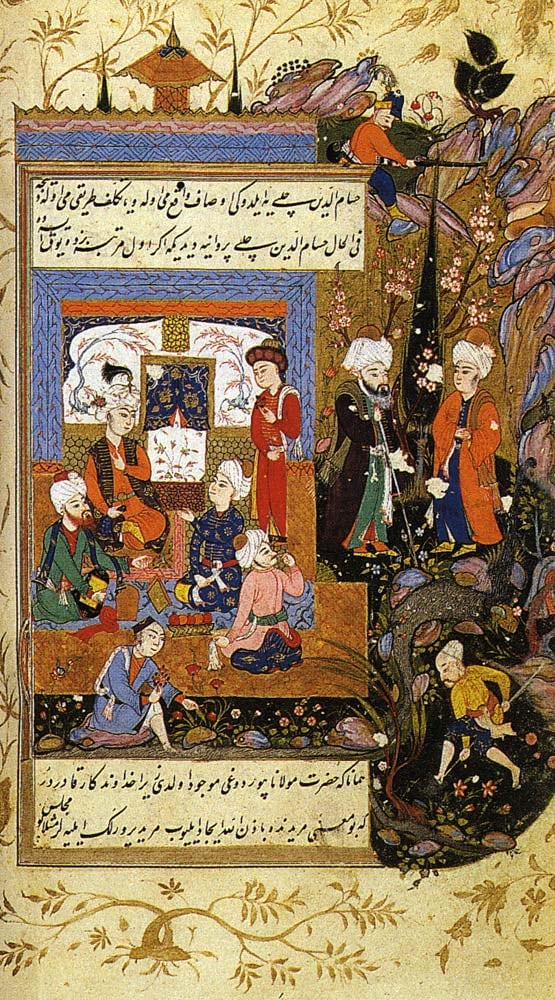
Rumi y su discípulo Husam al-Din Chelebi · Public domain
Dans ses propres mots
«Listen to the reed how it tells a tale, complaining of separations— Saying, "Ever since I was parted from the reed-bed, my lament hath caused man and woman to moan."»Masnavi, libro I, vv. 1–2 (trad. inglesa de Nicholson, 1926; texto persa según Ganjoor; la versión de Nicholson sigue una lectura que invierte «queja» y «relato»)

Son idée centrale
Love (ishq): In Rumi love (*ishq*) is not one feeling among others but the force that moves the cosmos and the only knowledge capable of reaching God.
Le voir en contexte
Biographie
5 min de lecture
Traduction assistée à partir de l'original espagnol, en attente de relecture par un traducteur natif.
Un enfant du Khorassan sur la route de l'ouest
Djalâl al-Dîn Muhammad naquit, selon la date que fixa la tradition de sa propre maison, le 6 rabî' al-awwal de l'an 604 de l'hégire, soit le 30 septembre 1207. La mémoire ultérieure fit de lui un fils de Balkh, la grande ville du Khorassan ; l'étude de Franklin Lewis a montré que la famille vivait alors à Wakhsh, petite ville sur les rives du fleuve du même nom, dans l'actuel Tadjikistan, où son père exerçait comme prédicateur et juriste. Lui-même se rappelle, dans ses entretiens, s'être trouvé à Samarcande pendant le siège mené par le shâh du Khwârezm, vers 1212, et certains chercheurs en déduisent qu'il a pu naître quelques années plus tôt. Le milieu, lui, est certain : un foyer persan, sunnite de rite hanafite, présidé par Bahâ al-Dîn Walad, prédicateur au tempérament ardent dont le carnet spirituel, les Ma'ârif, le fils lirait toute sa vie.
Vers 1216, la famille quitta le Khorassan. La tradition mevlevie attribua ce départ à un différend avec le shâh ou à un pressentiment de l'invasion mongole, qui allait ravager la région entre 1219 et 1221 ; toujours est-il que l'exode les sauva. Après le pèlerinage à La Mecque et un passage en Syrie, ils s'établirent en Anatolie, la terre que les Persans appelaient Rûm — l'ancien territoire romain —, d'où vient le surnom sous lequel l'Occident le connaît. À Larende, l'actuelle Karaman, le jeune Djalâl al-Dîn épousa Gawhar Khâtûn, perdit sa mère et vit naître son premier fils, Sultân Walad (1226). Vers 1229, invité par l'entourage du sultan seldjoukide 'Alâ' al-Dîn Kayqubâd Ier, Bahâ al-Dîn s'installa à Konya, la capitale. Il mourut en février 1231, et son fils, à vingt-trois ans, hérita de sa chaire.
Le juriste et le maître de la discipline
En 1232 arriva à Konya Burhân al-Dîn Muhaqqiq Tirmidhî, ancien disciple du père. Pendant quelque neuf ans, il guida le jeune homme dans l'ascèse soufie — jeûnes, retraites de quarante jours — et, selon les sources de la confrérie, l'envoya parfaire sa formation dans les madrasas d'Alep et de Damas. Lorsque Burhân mourut à Kayseri, vers 1241, Djalâl al-Dîn était déjà un mawlânâ, « notre maître » : il enseignait le droit, prêchait à la mosquée et avait des disciples. Les Sept séances que l'on conserve de ses sermons montrent un prédicateur savant, capable de commenter un hadith ou un verset coranique à l'aide d'anecdotes édifiantes. Rien n'annonce encore le poète.
Shams de Tabriz
Le 29 novembre 1244 arriva à Konya un derviche errant d'une soixantaine d'années, Shams al-Dîn de Tabriz. Ce que nous savons de lui provient surtout de ses propres Maqâlât, propos recueillis par des auditeurs, et de trois sources de la confrérie : le poème narratif de Sultân Walad (1291), l'épître de Sipahsâlâr et, plus tard et avec bien davantage de légende, les Manâqib al-'ârifîn d'Aflâkî, composés entre 1318 et 1353. Elles s'accordent sur l'essentiel : la rencontre bouleversa le juriste. Des mois durant, les deux hommes s'enfermèrent en de longues conversations ; les disciples, écartés, murmurèrent ; Shams partit pour Damas en 1246. C'est alors que Djalâl al-Dîn se mit à écrire des poèmes, à écouter de la musique et à tourner dans le samâ', l'audition extatique. Sultân Walad ramena Shams en 1247 ; l'hostilité reprit et, vers la fin de cette année-là ou au début de la suivante, Shams disparut pour toujours. Aflâkî rapporte la version d'un assassinat avec la complicité d''Alâ' al-Dîn, second fils de Rûmî ; Sultân Walad ne parle que d'une disparition, et la critique moderne tient le crime pour possible mais non démontré.
Rûmî se rendit deux fois à Damas pour le chercher. Il en revint, dit son fils, en sachant qu'il n'avait pas besoin de le trouver au-dehors : il l'avait trouvé en lui-même. De cette absence naquit le Dîwân-e Shams, plus de trois mille deux cents ghazals et près de deux mille quatrains dans lesquels le poète signe souvent du nom de l'ami perdu, ou de celui de Khâmûsh, « le Silencieux ».
L'orfèvre, le disciple et le livre
La plénitude que Shams avait incarnée passa ensuite à un orfèvre presque illettré du bazar, Salâh al-Dîn Zarkûb, dont la fille épousa Sultân Walad, puis, à sa mort en 1258, à Husâm al-Dîn Tchelebî, jeune homme issu d'une famille des confréries d'artisans. C'est Husâm qui lui demanda un poème didactique à la manière de Sanâ'î et d''Attâr, afin que les disciples n'aient pas à en lire d'autres. Ainsi naquit, vers 1258-1261, le Masnavi-ye ma'navi, le « Mathnawî spirituel » ou « Distiques spirituels » : quelque vingt-cinq mille six cents vers en six livres, dictés à Husâm, qui les copiait et les relisait à voix haute. Après le premier livre, la mort de l'épouse de Husâm interrompit le travail pendant deux ans ; il reprit en 1263-1264, et le sixième livre restait ouvert à la mort de l'auteur. Le Mathnawî n'est pas un traité : c'est un fleuve d'histoires qui s'interrompent les unes les autres — l'éléphant dans l'obscurité, le marchand et le perroquet, Moïse et le berger —, commentées avec la liberté de qui pense à voix haute. Autour de lui se conservent en outre le Fîhi mâ fîhi (« Le Livre du dedans »), propos de table recueillis par des disciples, et quelque cent cinquante lettres, dont beaucoup sont des démarches en faveur de personnes qui lui demandaient de les aider auprès des puissants.
La nuit de noces
À l'automne 1273, il tomba malade. Il mourut à Konya au coucher du soleil, le 17 décembre 1273 (5 djumâdâ al-âkhira 672). Aflâkî décrit des funérailles auxquelles accoururent, aux côtés des musulmans, les chrétiens et les juifs de la ville, et il conserve l'expression par laquelle la confrérie désigna dès lors ce jour : sa nuit de noces, shab-e 'arûs, l'union avec l'Aimé. On l'enterra auprès de son père, sous ce qui deviendrait la coupole verte de l'actuel musée Mevlâna.
Ce qui est resté et ce qu'on lui attribue
Sultân Walad donna forme à la confrérie mevlevie, qui codifia la giration rituelle et s'étendit dans tout le monde ottoman jusqu'à ce que la République turque ferme les ordres soufis en 1925. Dans le monde persan, le Mathnawî devint le livre le plus commenté après le Coran ; un vers que la tradition attribue à Djâmî l'appela « le Coran en langue persane ». L'Europe le découvrit avec Hammer-Purgstall et Friedrich Rückert, et l'étudia avec rigueur grâce à Reynold Nicholson, qui entre 1925 et 1940 édita et traduisit le texte intégral, puis à Arberry et à Annemarie Schimmel. À la fin du XXe siècle, les versions libres de Coleman Barks firent de Rûmî le poète le plus vendu des États-Unis, au prix d'un effacement de l'islam dans des poèmes saturés de Coran. Bien des phrases qui circulent sous son nom ne reposent sur aucun manuscrit. Lu dans sa langue, Rûmî est autre chose : un juriste qui perdit pied, un théologien qui découvrit que l'amour en sait plus long que l'explication de l'amour, et un poète qui fit de l'absence le lieu même de la présence.
Sources: Jalaluddin Rumi. The Mathnawi of Jalalu'ddin Rumi. Ed., trad. y comentario de Reynold A. Nicholson. E. J. W. Gibb Memorial, New Series IV, 8 vols. Londres: Luzac, 1925–1940 (vol. II: trad. libros I–II, 1926; vol. IV: trad. libros III–IV, 1930). · Lewis, Franklin D. Rumi: Past and Present, East and West. The Life, Teachings and Poetry of Jalal al-Din Rumi. Oxford: Oneworld, 2000 (ed. revisada 2008). · Lewis, Franklin D. Rumi: Past and Present, East and West. Oxford: Oneworld, 2000, caps. 1–7 (cronología de Baha al-Din Walad, Burhan al-Din, Shams y Husam al-Din; discusión de las fechas de nacimiento y de la desaparición de Shams). · Sultán Walad. Ibtida-nama (Walad-nama), 1291; y Faridun Sipahsalar, Risala dar ahwal-e Mawlana. Fuentes primarias de la cofradía, citadas a través de Lewis 2000 y Schimmel 1978. · Aflaki, Shams al-Din Ahmad. Manaqib al-arifin (1318–1353). Ed. Tahsin Yazıcı, Ankara: Türk Tarih Kurumu, 1959–1961. Trad. inglesa: John O'Kane, The Feats of the Knowers of God. Leiden: Brill, 2002.
Chronologie
La vie, année après année
Chaque point est un événement documenté. Cliquez pour le lire, avec sa source et son degré de certitude.
30 septembre 12070 ansWajsh o Balj (Jorasán)
Birth
Jalal al-Din Muhammad is born, son of the preacher Baha al-Din Walad. The date (6 Rabi al-Awwal 604) is the order's tradition; Lewis places the family in Wakhsh rather than Balkh.
ProbableLewis, Franklin D. Rumi: Past and Present, East and West. Oxford: Oneworld, 2000, caps. 1–7 (cronología de Baha al-Din Walad, Burhan al-Din, Shams y Husam al-Din; discusión de las fechas de nacimiento y de la desaparición de Shams).
Après sa mort
- 1291Sultan Walad organises the order
- 1925Closure of the orders
- 1925Nicholson publishes the critical *Masnavi*
30 septembre 1207 · 0 ans
Birth
Jalal al-Din Muhammad is born, son of the preacher Baha al-Din Walad. The date (6 Rabi al-Awwal 604) is the order's tradition; Lewis places the family in Wakhsh rather than Balkh.
Probable
v. 1212 · 5 ans
In Samarkand during the siege
In *Fihi ma fihi* he recalls being in Samarkand when the Khwarazmshah besieged it.
Probable
v. 1216 · 9 ans
The family's exodus
The family leaves Central Asia shortly before the Mongol invasion; pilgrimage to Mecca and passage through Syria.
Probable
v. 1222 · 15 ans
Larende: marriage and first son
The family settles in Larende; Rumi marries Gowhar Khatun. In 1226 Sultan Walad, future organiser of the order, is born.
Probable
v. 1229 · 22 ans
Arrival in Konya
Baha al-Din Walad settles in the Seljuq capital under Ala al-Din Kayqubad I.
Probable
février 1231 · 24 ans
Father's death; he inherits the chair
Baha al-Din Walad dies (February 1231). His son succeeds him as preacher and teacher.
Documenté
v. 1232 · 25 ans
Discipleship under Burhan al-Din
Burhan al-Din Muhaqqiq Tirmidhi guides him for some nine years; studies in Aleppo and Damascus.
Probable
29 novembre 1244 · 37 ans
Meeting with Shams of Tabriz
Shams arrives in Konya (26 Jumada al-Akhira 642). The friendship that will turn the jurist into a poet begins.
Documenté
1246 · 38 ans
Shams's first departure
Faced with the disciples' hostility, Shams leaves for Damascus. Rumi begins composing poetry and practising *sama*.
Documenté
v. 1247 · 40 ans
Disappearance of Shams
After his return, Shams vanishes for good (late 1247 or 1248). The murder theory comes from Aflaki and is unproven.
Contesté
v. 1258 · 51 ans
The *Masnavi* begins
With Salah al-Din Zarkub dead (1258), Husam al-Din Chelebi asks him for a didactic poem. He dictates the first book around 1258–1261.
Probable
v. 1263 · 56 ans
The *Masnavi* resumed
After a two-year interruption, the second book is begun (662 AH), as its own prologue states.
Documenté
17 décembre 1273 · 66 ans
Death: the "wedding night"
He dies at sunset on 17 December (5 Jumada al-Akhira 672). The order commemorates the date as *shab-e arus*.
Documenté
1291
Sultan Walad organises the order
Sultan Walad composes his narrative poem (*Ibtidanama*) and gives institutional form to the Mevlevi order.
Documenté
1925
Closure of the orders
The Turkish Republic bans the Sufi orders; the Konya mausoleum opens as a museum in 1926–1927.
Documenté
1925
Nicholson publishes the critical *Masnavi*
Reynold A. Nicholson's complete edition, translation and commentary begins (1925–1940).
Documenté
Œuvres
Œuvres essentielles
Les œuvres sans lesquelles on ne comprend pas son héritage.
Œuvre écrite · v. 1273
Masnavi (Spiritual Couplets)
مثنوی معنوی (Masnavi-ye manavi)
A didactic poem of some 25,600 couplets in six books, written in the ramal metre of the *masnavis* of Sanai and Attar. It opens with the lament of the reed severed from the reed-bed, image of the soul far from its origin, and moves through linked stories (the king and the handmaiden, the merchant and the parrot, the elephant in the dark, Moses and the shepherd) which the narrator interrupts to comment on in the light of the Qur'an and hadith. It follows no systematic plan: it thinks by association, retraces its steps and leaves tales unfinished. Persian tradition called it "the Qur'an in the Persian tongue" and has commented on it without pause for seven centuries.
15 éditions · amazon.fr

Œuvre écrite · v. 1273
Divan of Shams of Tabriz
دیوان شمس تبریزی / کلیات شمس (Divan-e Shams-e Tabrizi; Divan-e kabir)
The great lyric collection: some 3,229 ghazals, forty-odd strophic poems and nearly two thousand quatrains in Foruzanfar's edition. Written out of Shams's absence and in his name, it is poetry meant to be sung, strongly rhythmic, with the vocabulary of the tavern, of wine and of the Beloved, swinging between the ecstasy of union and the tearing of separation. Alongside the summits of Persian mysticism it contains occasional poems, wordplay and verses in Arabic, Greek and Turkish. Many modern "translations" are very free paraphrases; for the demanding reader the versions of Nicholson (1898) and Arberry (1968–1979) remain the most faithful.
8 éditions · amazon.fr

Enseignement oral recueilli · v. 1273
Fihi ma fihi (Discourses)
فیه ما فیه (Fihi ma fihi)
Table talk and answers to visitors' questions (among them the Seljuq minister Muin al-Din Parvana), in plain Persian prose with passages in Arabic. It is Rumi at his most conversational: he explains his parables, discusses theology, politics and the relation between master and disciple, and lets his humour show. It contains the famous passage on the one thing that must not be forgotten, the task for which the human being was sent into the world, and many parallels with the *Masnavi*.
7 éditions · amazon.fr


Citations
Citations localisées dans une œuvre précise. Chacune porte sa provenance et son degré de fiabilité.
Listen to the reed how it tells a tale, complaining of separations— Saying, "Ever since I was parted from the reed-bed, my lament hath caused man and woman to moan."بشنو این نی چون شکایت میکند / از جداییها حکایت میکند // کز نیستان تا مرا ببریدهاند / در نفیرم مرد و زن نالیدهاند
VérifiéeMasnavi, libro I, vv. 1–2 (trad. inglesa de Nicholson, 1926; texto persa según Ganjoor; la versión de Nicholson sigue una lectura que invierte «queja» y «relato»)
Citations apocryphes ou d'attribution contestée (6)
«Come, come, whoever you are; wanderer, idolater, worshipper of fire, come. Ours is not a caravan of despair; though you have broken your vows a hundred times, come again.»
The quatrain "Baz a, baz a…" (literally "return, return", in the Qur'anic sense of repentance) is displayed at the Mevlana Museum, but it does not appear in the early manuscripts of Rumi's quatrains and circulated earlier under the names of Abu Said Abul-Khayr or Baba Afzal Kashani.
«The wound is the place where the Light enters you.»
A viral line with no located counterpart in the *Masnavi*, the *Divan* or *Fihi ma fihi*. It comes from the circuit of free English versions and spreads without reference.
«Out beyond ideas of wrongdoing and rightdoing, there is a field. I'll meet you there.»
Coleman Barks's version (The Essential Rumi, 1995), rewriting an original about what lies beyond unbelief (*kufr*) and Islam: the religious context disappears in the paraphrase, as Rozina Ali points out.
«Yesterday I was clever, so I wanted to change the world. Today I am wise, so I am changing myself.»
No source in any work of Rumi; it appears on social media and in self-help books from the 2010s onward.
«What you seek is seeking you.»
Not located in the Persian corpus. It is sometimes presented as a summary of *Fihi ma fihi*, but corresponds to no identifiable passage.
«Raise your words, not voice. It is rain that grows flowers, not thunder.»
No located source; it circulates only in quote compilations.
Dernières paroles
Attribution traditionnelle
«Go, lay your head on the pillow and leave me alone; leave this ruined, night-wandering, love-stricken one.»رو سر بنه به بالین، تنها مرا رها کن / ترک من خراب شبگرد مبتلا کن
No last words attested by a witness survive. Mevlevi tradition, recorded by Aflaki, holds that ghazal 2039 of the *Divan* (Foruzanfar numbering) was the last he composed, addressed to Sultan Walad, who kept exhausted watch at his bedside; Aflaki also records several words of comfort to those close to him. The attribution of the ghazal to the deathbed cannot be verified.
Source: Aflaki, Shams al-Din Ahmad. Manaqib al-arifin (1318–1353). Ed. Tahsin Yazıcı, Ankara: Türk Tarih Kurumu, 1959–1961. Trad. inglesa: John O'Kane, The Feats of the Knowers of God. Leiden: Brill, 2002.
Interroger
Ce que répond son œuvre
Douze grandes questions de l'humanité et ce que ses textes permettent d'y répondre, références à l'appui. Nous ne lui prêtons jamais de paroles.
Qu'est-ce que l'Absolu ? Dieu existe-t-il ?
God is the Beloved: someone who calls, loves and awaits the soul's return
Un Dieu personnelIl le dit expressément
Jalal al-Din Rumi writes within Sufi Islam and his God is the God of the Qur'an, one and creator, but he lives Him above all as the Beloved. The Masnavi opens with the lament of the reed flute torn from the reed bed, an image of the soul separated from its origin and longing to return; the whole work is a commentary on that separation and that longing. In the Divan of Shams of Tabriz, love for the master Shams merges with love for God, who is addressed in the second person, reproached for absence and celebrated in presence. This God loves first, draws, wounds and consoles: not a principle to be contemplated but someone with whom one converses. At the same time, Rumi insists that in union the lover vanishes and only the Beloved remains, which brings him close to the experience of unity.
Comparer cette question avec d'autres maîtresQui suis-je ? Existe-t-il un vrai soi ?
The soul comes from God and returns to Him after dying to its ego
Une âme créée et immortelleIl le dit expressément
For Rumi, the human being is a soul that came from God and is exiled in the world, like the reed torn from the reed bed with which the Masnavi opens. Following Sufi psychology, he distinguishes the lower ego (nafs), seat of desire, vanity and cunning, which he compares to wild beasts and to the donkey that must be tamed, from the spirit (ruh), which recognises its origin. In Book III of the Masnavi he describes the soul's ascent: it died as mineral and became plant, died as plant and became animal, died as animal and became human, and will yet die as human to rise beyond the angels. The true self is found by dying to the ego; in that extinction (fana) the soul does not vanish but returns to the Beloved from whom it came.
Comparer cette question avec d'autres maîtresPourquoi souffrons-nous ?
Every lament is that of the reed torn from its reed bed
La séparation d'avec DieuIl le dit expressément
Rumi opens the Masnavi with a reed flute that laments: since it was torn from the reed bed, men and women have wept at its cry, and it seeks a breast torn by separation to tell the pain of longing. That is his diagnosis: human suffering is, at bottom, the homesickness of the soul separated from its origin, seeking in the world's objects what it will only find on returning. But pain is not only lack. In his verses the wound is also the opening through which grace enters; suffering breaks the ego's pride and awakens the longing that leads back. Rumi therefore celebrates burning, sorrow and searching as signs of spiritual life, and distrusts the comfort that lulls. Love turns what is bitter into sweetness.
Comparer cette question avec d'autres maîtresQue se passe-t-il après la mort ?
Death is the wedding night: the soul's return to its Beloved
Vie éternelle et résurrectionIl le dit expressément
Rumi thinks about death within Islam — resurrection, judgement, return to God — but lives it as an encounter. The Mevlevi tradition calls his death Şeb-i Arûs, «wedding night», because in his poems dying means rejoining the Beloved from whom the soul was separated, like the reed flute torn from the reed bed. In Book III of the Masnavi he describes an ascent: he died as a mineral and became a plant, died as a plant and became an animal, died as an animal and became a man; why fear, when nothing was ever lost by dying? — and he concludes that he will also leave the human condition to return to God, for to Him we return. Rumi also takes up the Sufi saying of dying before one dies: the extinction of the ego in life anticipates physical death and takes away its bitterness. For the lover, death is not an end but a door.
Comparer cette question avec d'autres maîtresComment atteint-on la libération ou le salut ?
Love is the path: the reed cut from its bed longs to return
Par la dévotion et l'abandonIl le dit expressément
Rumi expresses the human condition in the eighteen verses that open the Masnavi: the reed flute laments because it was torn from the reed bed, and its complaint is that of the soul separated from its origin. What brings it back is not reasoning, which often appears as insufficient in his work, but love, a fire that consumes the lover and leads him to the extinction of self (fana) in the Beloved. For Rumi that love was kindled in his encounter with Shams of Tabriz and is cultivated through the relationship with the master, listening, music and the ritual dance practised by his circle. All of this belongs within Islamic life: law and prayer are the starting point, not an obstacle.
Comparer cette question avec d'autres maîtresFaut-il un maître ?
Without the master the path is lost; Shams was the fire that transformed him
IndispensableIl le dit expressément
Rumi lived the relationship with the master as the central event of his life: the encounter with Shams of Tabriz in 1244 turned a respected jurist and preacher into the poet of love, and his lyrical work bears Shams's name. In the Masnavi the need for a spiritual guide (pir) is a recurring theme: the disciple who wants the fruits of the path without bearing the master's discipline is ridiculed in the story of the man from Qazvin who asks for a lion tattoo and cannot bear the needle. For Rumi, the traveller without a guide goes astray, and surrender to the master is the means by which the lover learns to die to himself. After Shams, he transferred that relationship to successors.
Comparer cette question avec d'autres maîtresLe monde est-il réel ?
Forms are foam on an invisible sea: the world reflects the Beloved
Manifestation du divinCela se déduit de sa doctrine
Rumi does not build a systematic metaphysics, but his poetry continually refers the forms of the world to a reality that exceeds them. Recurring images such as the sea and the foam, or the sun and its reflections, present creatures as passing appearances of a single source: the visible is real as sign and reflection, not as independent reality. The human error is to stop at form and forget meaning, to love the image without recognising where its beauty comes from. The Masnavi is built on this distinction between form (surat) and meaning (ma'na). At the same time, the world is the place where the separated soul learns to return through love.
Comparer cette question avec d'autres maîtresQu'est-ce que l'amour ?
Love is the lament of the reed longing to return to the reed bed
Le désir ardent et l'unionIl le dit expressément
Rumi is perhaps the great poet of love as longing for union. The Masnavi opens with the complaint of the reed flute: ever since it was torn from the reed bed, its lament has made men and women weep, and all who are far from their origin seek the time of union. The fire that sounds in the flute, he says, is the fire of love. For Rumi love is the force that moves the cosmos and returns the soul to God; no reasoning can explain it, and in the same first book he calls it the astrolabe of divine mysteries. His encounter with Shams of Tabriz, to whom he dedicated the Divan-e Shams, turned the jurist into a poet: human love for the master becomes a mirror and path of divine love. The lover must be consumed, like the candle, until only the Beloved remains.
Comparer cette question avec d'autres maîtresSommes-nous libres ou tout est-il déterminé ?
Our shame proves that we choose: Rumi against fatalism
Un libre arbitre réelIl le dit expressément
The *Masnavi* returns again and again to the theological dispute between *jabr* (divine compulsion) and *ikhtiyār* (choice), and Rumi sides with responsibility. In Book I, the debate between the lion and the other beasts sets pure trust in God against effort, and the poem ends by vindicating the Prophet's saying: trust in God, but tie your camel's knee. In another passage of the same book he argues that our supplication shows our dependence on God, but our shame after doing wrong shows we could have acted otherwise. For Rumi the fatalist uses the divine will as an excuse; human freedom is real, even if it is a gift of God and is fulfilled in surrender to Him.
Comparer cette question avec d'autres maîtresPourquoi méditer ou prier ?
God looks at the heart, not the words: prayer as a lover's conversation
L'amitié avec DieuIl le dit expressément
In Book II of the *Masnavi*, Rumi tells the story of Moses and the shepherd: a shepherd offers to comb God's hair, wash his feet and bring him milk, and Moses rebukes him for blasphemy; then God reproaches Moses for separating a servant from Him, for He looks not at words or form but at the heart and its burning. Prayer, for Rumi, is above all a dialogue of love with the Beloved, born of the separated soul's longing, like the lament of the reed flute that opens the poem. Alongside ritual prayer, which he respected as jurist and preacher, the Mevlevi tradition links his name to the remembrance of God (*dhikr*) and to *samāʿ*, musical audition with whirling, as forms of that same intimacy.
Comparer cette question avec d'autres maîtresLa raison peut-elle connaître l'ultime ?
The reasoners' leg is made of wood: love sees further
L'ultime est au-delà du mentalIl le dit expressément
In the *Masnavi* Rumi distinguishes between the partial intellect (*ʿaql-i juzwī*), calculating and bound to appearances, and the universal intellect, which is divine light. He mocks the former with famous images: in Book I he says the leg of those who argue by proofs is wooden, and a wooden leg is very unsteady. Against it he sets love, which knows by union rather than demonstration, and the vision of the purified heart. He is not simply an anti-rationalist: he was a jurist and preacher trained in the religious sciences, and he values intelligence placed at the service of love. But access to God does not go through logic but through the seeker's transformation, which in his case came with the encounter with Shams of Tabriz.
Comparer cette question avec d'autres maîtresSe retirer du monde ou le transformer ?
Do not become a monk: the path is walked in the midst of people
La contemplation dans l'actionIl le dit expressément
Rumi lived at the centre of urban life in Konya: he was a jurist and preacher, a family man, teacher of a large community and adviser to rulers. The conversations collected in Fihi ma fihi are largely addressed to Muʿin al-Din Parvana, the powerful Seljuk vizier, whom he urges to govern justly without attachment to power. In Book V of the Masnavi, the story of the peacock that plucks out its feathers to escape vanity serves him to reject monasticism: the point is not to mutilate oneself or flee, but to fight the ego amid temptations, since without them there is no virtue. The Mevlevi practice, with its whirling dance, likewise unites the inner and the visible. For Rumi contemplation does not require abandoning the world, but living in it with the heart turned towards the Beloved.
Comparer cette question avec d'autres maîtres
Affinités et tensions
Affinités et tensions
Calculées question par question à partir de ses positions. La raison de chaque accord ou de chaque désaccord s'affiche d'un clic.
Pense comme

Chaitanya Mahaprabhu
Ils concordent sur: Qu'est-ce que l'Absolu ? Dieu existe-t-il ? · Qui suis-je ? Existe-t-il un vrai soi ? · Pourquoi souffrons-nous ?

Rabia al-Adawiyya
Ils concordent sur: Pourquoi souffrons-nous ? · Qu'est-ce que l'Absolu ? Dieu existe-t-il ? · Que se passe-t-il après la mort ?
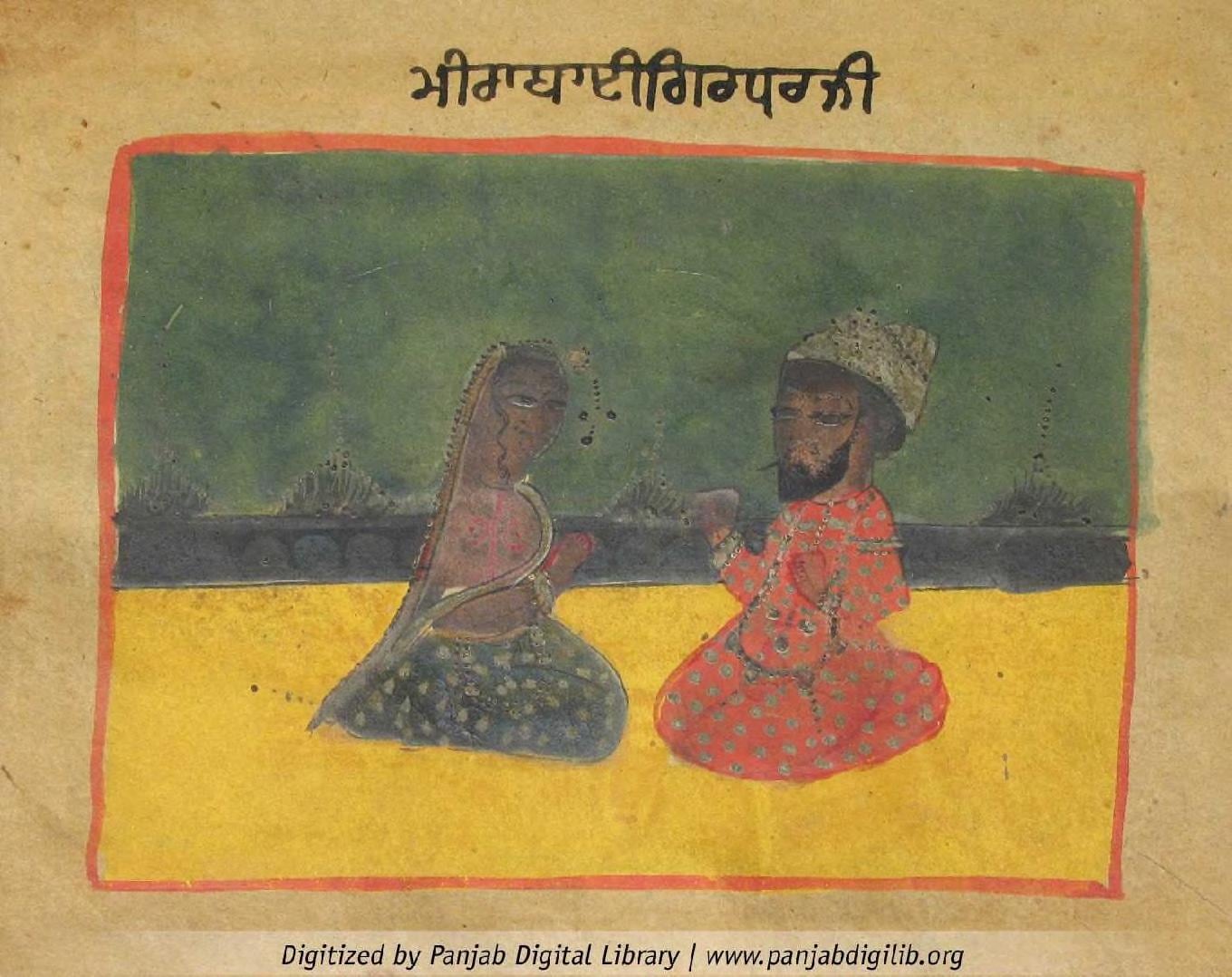
Mirabai
Ils concordent sur: Qu'est-ce que l'Absolu ? Dieu existe-t-il ? · Pourquoi souffrons-nous ? · Comment atteint-on la libération ou le salut ?
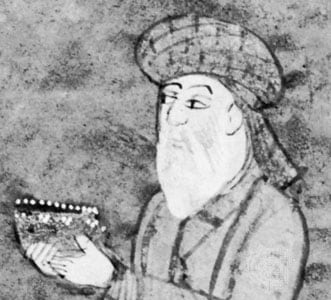
Hafez
Ils concordent sur: Qu'est-ce que l'Absolu ? Dieu existe-t-il ? · Qui suis-je ? Existe-t-il un vrai soi ? · Pourquoi souffrons-nous ?
Pense autrement que

Pema Chödrön
Ils s'opposent sur: Qu'est-ce que l'Absolu ? Dieu existe-t-il ? · Qui suis-je ? Existe-t-il un vrai soi ? · Que se passe-t-il après la mort ?

The 14th Dalai Lama (Tenzin Gyatso)
Ils s'opposent sur: Qu'est-ce que l'Absolu ? Dieu existe-t-il ? · Qui suis-je ? Existe-t-il un vrai soi ? · Que se passe-t-il après la mort ?
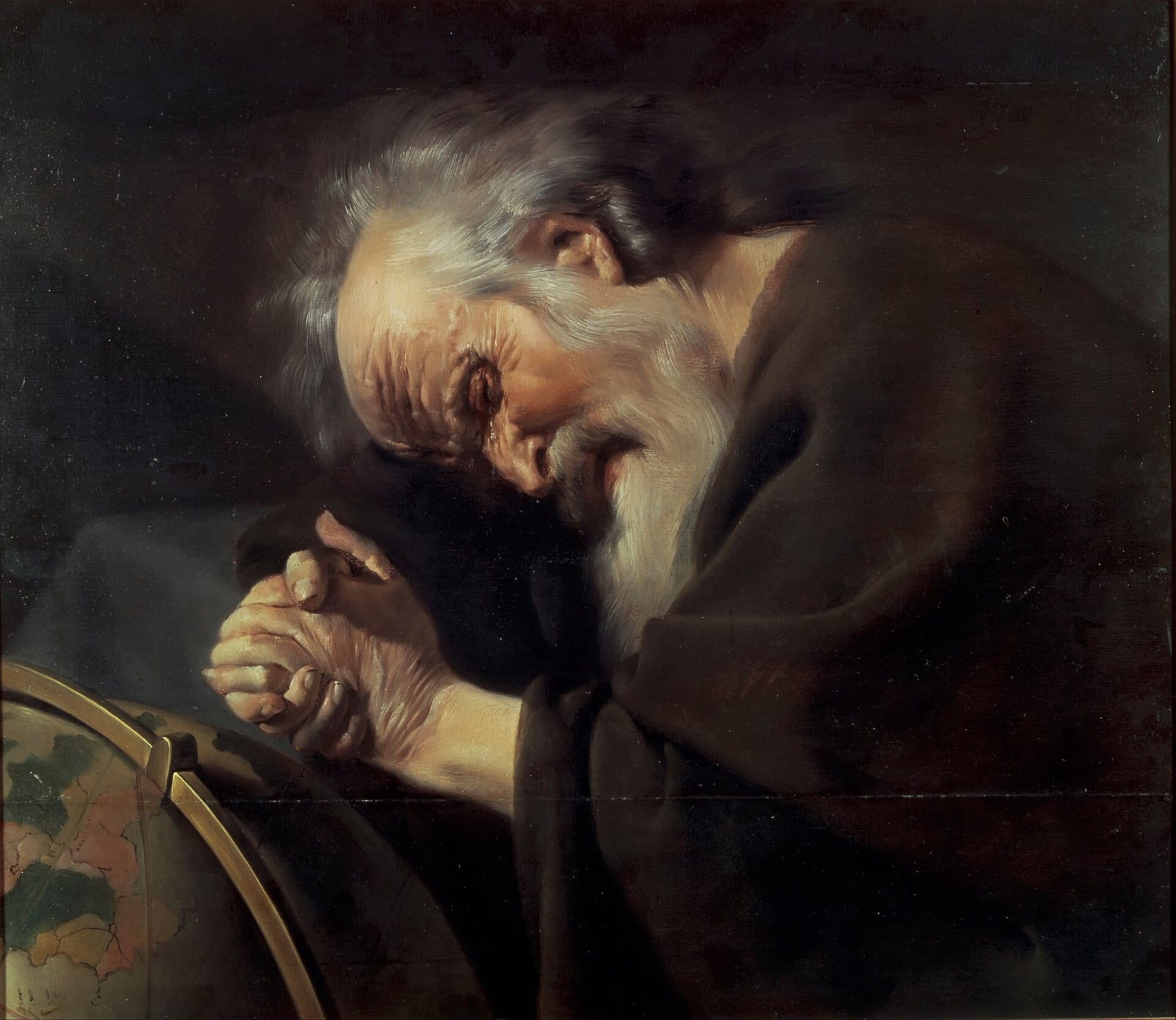
Heraclitus
Ils s'opposent sur: Qui suis-je ? Existe-t-il un vrai soi ? · Faut-il un maître ?
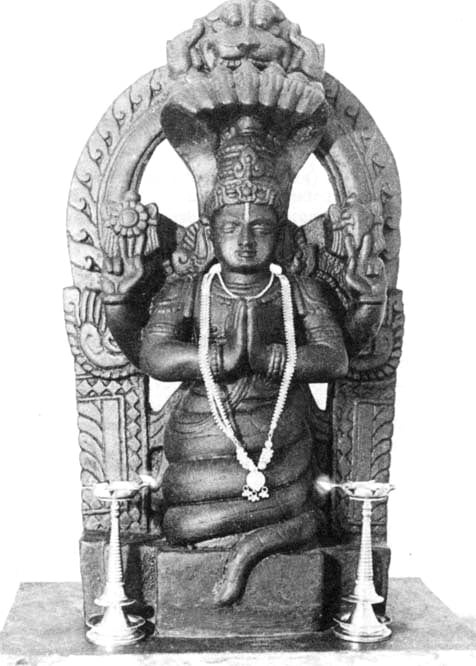
Patañjali
Ils s'opposent sur: Qu'est-ce que l'Absolu ? Dieu existe-t-il ? · Qui suis-je ? Existe-t-il un vrai soi ? · Que se passe-t-il après la mort ?
Ils concordent sur
Rumi · Hildegard of Bingen
Love as the fire that moves the cosmos, and music as memory of the origin
Pourquoi: There was no contact between the twelfth-century Rhineland abbess and the thirteenth-century poet of Konya, but they share a distant inheritance: the idea of a harmonious cosmos, Pythagorean and Neoplatonic in origin, which Latin Christianity and Persian Sufism received by different routes. Both also write in a symbolic and poetic register, not a scholastic one, where the image teaches more than the concept. The difference lies in emphasis: Hildegard sings love as the order that sustains a good creation and as the liturgy of the community; Rumi, as the wound and longing of the separated soul. In her love orders; in him, it consumes.
Ils s'opposent surContradiction apparente
Rumi · Ramana Maharshi
The path of knowledge and the path of love: two ways ending in the same burning of the ego
Pourquoi: The contradiction is apparent at the level of the path: both seek the dissolution of the ego and attribute it to something that exceeds the subject, the Beloved who draws in Rumi, the Self or grace in Ramana. The difference of language comes from their traditions: Persian Sufism expresses the way in terms of lover and Beloved; Advaita, in terms of knowledge of the Self. A metaphysical difference remains, however, that is not apparent: Rumi stays within the Islamic doctrine of creation, and the soul returns to a God who is not itself, while Ramana affirms that the Self is the Absolute. They agree on the how more than on the what.
Ils concordent sur
Rumi · Ibn Arabi
Love as the origin and return of the world: two summits of Sufism in the same century
Pourquoi: They share an era, a religious language and sources: the Qur'an, the sayings attributed to the Prophet and the Sufi tradition that made love the principal way. There was also an indirect link: Sadr al-Din al-Qunawi, Ibn Arabi's stepson and chief disciple, taught in Konya in the same years as Rumi, and the Mevlevi hagiographies present them on cordial terms; there is no evidence that Rumi read Ibn Arabi or that they met. The difference is one of register. Ibn Arabi elaborates a technical metaphysics of the divine Names and of manifestation; Rumi writes narrative and lyrical poetry, without a system, where love is an experience of separation and longing before it is doctrine.
Ils s'opposent surDésaccord de fond
Rumi · Annie Besant
He died as a mineral and became a plant: the soul's ascent, not reincarnation
Pourquoi: The contradiction is real, although it is often presented as an affinity. Besant systematises a Theosophical doctrine that takes reincarnation and karma from Hinduism and Buddhism and combines them with a modern idea of the soul's evolution. Rumi writes in the thirteenth century within Islam, which affirms a single earthly life followed by resurrection; his verses on mineral, plant and animal refer to the Neoplatonic cosmology of the grades of being and to the Sufi saying about dying before death. Reading them as reincarnation, or as an anticipation of evolutionism, projects foreign categories onto the poem. Both see death as a passage and not an end; they differ over whether the passage repeats.
Ils concordent sur
Rumi · Teresa of Ávila
It is not a matter of thinking much: love knows more than reasoning
Pourquoi: The affinity is comparative: there is no relation between the Castilian Carmelite and the poet of Konya. They converge because both speak from monotheistic traditions with a highly developed scholastic theology, Christian and Islamic, which reserved for mysticism a knowledge through love and experience that does not contradict theology but exceeds it. Both also write for readers who are not professional theologians: nuns in one case, disciples and listeners in the other. The difference lies in the form of that experience: Teresa lives it as friendship with a personal Christ and describes it with almost clinical precision; Rumi, as longing and fire, in poetic images.
Anecdotes et récits
Anecdotes et récits
Récit hagiographique1244
The meeting with Shams and the question about Bayazid
Origine du récit: Aflaki, *Manaqib al-arifin* (1318–1353); there are other versions of the first meeting. The one about books thrown into a pool comes from even later sources (Dawlatshah, 15th c.) and Lewis considers it legendary.
Source: Aflaki, Shams al-Din Ahmad. Manaqib al-arifin (1318–1353). Ed. Tahsin Yazıcı, Ankara: Türk Tarih Kurumu, 1959–1961. Trad. inglesa: John O'Kane, The Feats of the Knowers of God. Leiden: Brill, 2002.
Invérifiable1244
The books in the pool
Origine du récit: First recorded in sources of the 15th century and later (Dawlatshah Samarqandi, *Tadhkirat al-shuara*, 1487) and spread through Jami; Lewis classes it among legends with no basis in 13th-century sources.
Source: Lewis, Franklin D. Rumi: Past and Present, East and West. The Life, Teachings and Poetry of Jalal al-Din Rumi. Oxford: Oneworld, 2000 (ed. revisada 2008).
Récit hagiographiquec. 1248
The goldsmiths' hammers
Origine du récit: Aflaki, *Manaqib al-arifin*. The relationship with Salah al-Din and his position in the order are attested by Sultan Walad and by the ghazals Rumi addresses to him; the bazaar scene, only by Aflaki.
Source: Aflaki, Shams al-Din Ahmad. Manaqib al-arifin (1318–1353). Ed. Tahsin Yazıcı, Ankara: Türk Tarih Kurumu, 1959–1961. Trad. inglesa: John O'Kane, The Feats of the Knowers of God. Leiden: Brill, 2002.
Récit hagiographiquec. 1258
The eighteen verses in the turban
Origine du récit: Aflaki, *Manaqib al-arifin*; Husam's role is documented in the prologues to books II–VI of the *Masnavi* (Nicholson ed.).
Source: Aflaki, Shams al-Din Ahmad. Manaqib al-arifin (1318–1353). Ed. Tahsin Yazıcı, Ankara: Türk Tarih Kurumu, 1959–1961. Trad. inglesa: John O'Kane, The Feats of the Knowers of God. Leiden: Brill, 2002.
Récit hagiographique1273
A funeral of all religions
Origine du récit: Aflaki, *Manaqib al-arifin*, chapter III; neither Sultan Walad nor Sipahsalar describes the participation of Christians and Jews in such detail.
Source: Aflaki, Shams al-Din Ahmad. Manaqib al-arifin (1318–1353). Ed. Tahsin Yazıcı, Ankara: Türk Tarih Kurumu, 1959–1961. Trad. inglesa: John O'Kane, The Feats of the Knowers of God. Leiden: Brill, 2002.
Contesté1247–1248
The end of Shams: disappearance or murder?
Origine du récit: Sultan Walad, *Ibtidanama* (1291): disappearance; Aflaki, *Manaqib al-arifin*: murder. Discussion in Lewis 2000, ch. 4.
Source: Lewis, Franklin D. Rumi: Past and Present, East and West. Oxford: Oneworld, 2000, caps. 1–7 (cronología de Baha al-Din Walad, Burhan al-Din, Shams y Husam al-Din; discusión de las fechas de nacimiento y de la desaparición de Shams).
Invérifiablec. 1216
Attar and the boy from Balkh
Origine du récit: Dawlatshah Samarqandi (1487) and Jami, *Nafahat al-uns* (1478); Lewis treats it as legend.
Source: Lewis, Franklin D. Rumi: Past and Present, East and West. The Life, Teachings and Poetry of Jalal al-Din Rumi. Oxford: Oneworld, 2000 (ed. revisada 2008).
Enseignements
Enseignements
Les notions qui structurent sa pensée, expliquées dans leur contexte.
Love (ishq)ishq
It inherits the love mysticism of Ahmad Ghazali, Sanai and Attar, as opposed to the more intellectual path of Ibn Arabi's school.
Source: Chittick, William C. The Sufi Path of Love: The Spiritual Teachings of Rumi. Albany: State University of New York Press, 1983.
Separation and longing for the origin (firaq)firaq
It takes up the Neoplatonic and Qur'anic theme of return ("to Him we shall return", Qur'an 2:156).
Mystical audition and turning (sama)sama
Debate on the lawfulness of *sama* since al-Ghazali (*Ihya*, book XVIII).
Source: Lewis, Franklin D. Rumi: Past and Present, East and West. The Life, Teachings and Poetry of Jalal al-Din Rumi. Oxford: Oneworld, 2000 (ed. revisada 2008).
Dying before dying (fana)fana
Fana and baqa since al-Junayd and al-Qushayri; the scale of beings is of Aristotelian and Neoplatonic origin.
Silence (khamush)khamush
A topos of Persian apophatic mysticism; contrast between *qal* (word) and *hal* (state).
Source: Schimmel, Annemarie. The Triumphal Sun: A Study of the Works of Jalaloddin Rumi. Londres: Fine Books / East-West Publications, 1978; Albany: SUNY Press, 1993.
Retraites
Retraites et centres
Lieux et rencontres liés à son enseignement. Nous vous mettons en relation avec ceux qui les organisent.
Barons Court, Londres · Reino Unido
The Study Society, Colet House (London)
The Study Society
The Study Society was registered in 1951, four years after Ouspensky's death, at the initiative of his pupil Dr Francis Roles, to continue his work as a school of the Fourth Way. It is based at Colet House in west London, which presents itself as a spiritual gateway in the centre of the city. Its current programme brings together meditation, the Movements, study groups on the Masnavi and meetings devoted to Rumi, the dervish turning and a Sunday Advaita gathering. Its main website sometimes rejects automated requests; the Colet House site responds normally.
Chisholme House (Escocia), Sutton Courtenay (Oxfordshire), Londres y en línea · Reino Unido
Beshara: Foundation course and Masnavi study
The Beshara Trust
Beshara is the educational offering of the Beshara Trust, a British charity founded in 1971. Its foundation course takes the metaphysics of Ibn Arabi as its starting point to explore what it means to know oneself and the world in the light of the Unity of Existence, combining an introductory weekend, fortnightly online sessions and an optional residential at Chisholme House in the Scottish Borders. It also runs study groups on Rumi's Masnavi and other texts of the Sufi tradition. It is funded by philanthropic donations and voluntary work, and bookings are made by contacting the trust.
Centro Cultural Mevlana, Konya · Turquía
Şeb-i Arûs: commemoration of Rumi in Konya
Ministerio de Cultura y Turismo de Turquía
Şeb-i Arûs, the wedding night, is the name the Mevlevi tradition gives to Rumi's death on 17 December 1273, understood as his reunion with the Beloved. Every year, in the days leading up to that date, Konya holds the international commemoration ceremonies organised by the Ministry of Culture and Tourism, with concerts, lectures and performances of the sema, the whirling ceremony of the dervishes, in the hall of the Mevlana Cultural Centre. The cultural activities are free and the final ceremony on the 17th requires a ticket. It is the time of year when most pilgrims come to the city.
Konya (distrito de Karatay) · Turquía
Mevlana Museum: Rumi's mausoleum in Konya
Ministerio de Cultura y Turismo de Turquía (Mevlâna Müzesi)
The Mevlana Museum occupies the former lodge of the Mevlevi dervishes in Konya, built around the mausoleum of Jalal al-Din Rumi, constructed in 1274, a year after his death. Beneath the famous green dome lie Rumi, his father and other members of the order. The lodge was closed in 1925 under the law that abolished the Sufi orders and reopened the following year as a museum, now run by the Turkish Ministry of Culture. It holds manuscripts of the Masnavi, musical instruments and the dervishes' cells, and remains one of the most visited places of pilgrimage in the Islamic world.
Vidéos
Vidéos
Enregistrements, entretiens et documentaires. Les vidéos sont lues depuis YouTube ; elles ne sont pas hébergées ici.
Franklin Lewis: Rumi's Poetic Theology of Love
Conférence· EN· 70 min
Theosophical Society
What Would Rumi Make of His Popularity in the Modern West? w/ William Chittick
Entretien· EN· 9 min
Rumi Center for Spirituality & the Arts
Rumi Lecture with Prof. Bilal Kuspinar | Bradford Literature Festival 2025
Conférence· EN· 2025· 70 min
Bradford Literature FestivalChaîne officielle
How to love, according to Rumi - Stephanie Honchell Smith
Analyse· EN· 6 min
TED-EdChaîne officielle
A Meditation on Rumi and the Power of Poetry | Leili Anvar | TED
Conférence· EN· 10 min
TEDChaîne officielle
Rumi - The Most Famous Sufi Poet in the World
Analyse· EN· 79 min
Let's Talk Religion
Masnavi-ye-Ma'navi of Rumi | مثنوی معنوی | Volume 1 Part 1 | Persian with English Translations
Enregistrement de tiers· FA· 7 min
Sadai Salah
Mevlana Celaleddin-i Rumi / Belgesel - TRT Avaz
Documentaire· TR· 65 min
TRT AvazChaîne officielle
Sirus Shahnavaz - Rumi: El brillante sol del Sufismo
Conférence· ES· 61 min
EspacioRonda
The Mevlevi Sema Ceremony
Documentaire· EN· 2009
UNESCOChaîne officielle
Galerie
Galerie
Images dont la licence a été vérifiée. Chacune conserve son auteur et son attribution.
Manuscrits
Manuscrits
Témoins manuscrits et textes anciens, avec leur dépositaire et leurs conditions de consultation.
FA · Nasj · c. 1258–1273 (texto); rayab de 677 / nov.–dic. de 1278 (copia)
مثنوی معنوی (Masnavi-ye manavi), copia de Konya
- Témoin conservé
- Códice completo en seis libros, 50 × 32 cm, tinta, oro y color sobre papel
- Dépositaire
- Museo Mevlana, Konya · Ms. 51
- Numérisation
- artsandculture.google.com/asset/masnavi-s-first-…
FA · Nastaliq · c. 1460 (copia)
مثنوی (Masnavi), copia de Shiraz
- Témoin conservé
- Códice iluminado con página inicial ornamentada
- Dépositaire
- Bodleian Library, Oxford · MS. Elliott 251
- Numérisation
- commons.wikimedia.org/wiki/File:Opening_page_of_…
FA · Nastaliq · 1073 H. / 1663 (copia)
مثنوی (Masnavi), códice ilustrado
- Témoin conservé
- Códice ilustrado con miniaturas de las historias del *Masnavi*
- Dépositaire
- Walters Art Museum, Baltimore · W.626
- Numérisation
- art.thewalters.org/…
TR · Nasj / nastaliq otomano · c. 1590–1599 (copia ilustrada)
Tercüme-i Sevakib (traducción turca del Thawaqib al-manaqib, compendio de las Manaqib al-arifin de Aflaki)
- Témoin conservé
- Códice ilustrado con miniaturas de la vida de Rumi y de sus sucesores
- Dépositaire
- Morgan Library & Museum, Nueva York · MS M.466
- Numérisation
- www.themorgan.org/…
Relations
Relations
Influences, filiations et affinités. On distingue la relation documentée de la similitude identifiée par analyse.
Contemporain de
Contemporaries; no meeting is recorded. The documented link is Sadr al-Din Qunawi, Ibn Arabi's stepson and chief disciple, who lived in Konya, knew Rumi and, according to Aflaki, was to lead his funeral prayer. The anecdote that Ibn Arabi saw the boy Rumi in Damascus walking behind his father is late and unverifiable.
Relation documentée
A reçu l'influence de
The *Masnavi* draws tales and arguments from the Ghazalian tradition (Abu Hamid and his brother Ahmad, the theorist of love); Nicholson's commentary notes many parallels with the *Ihya*.
Relation documentée
Idées proches de
Mystical poetry in the vernacular, critique of formal religion, and the language of love and separation. No documented contact or influence.
Similitude identifiée par analyse
Idées proches de
Approximate contemporaries (Eckhart was born c. 1260). They share the theme of the death of the self and silence before the divine; there was no contact.
Similitude identifiée par analyse
Lié depuis d'autres fiches
- Kabir · Idées proches de
- Attar · A influencé
- Jesus of Nazareth · A influencé
- Chaitanya Mahaprabhu · Idées proches de
- Meher Baba · Idées proches de
- Guru Nanak · Idées proches de
- Rabia al-Adawiyya · Idées proches de
- Al-Ghazali · A influencé
- Ibn Arabi · Contemporain de
- Hafez · Idées proches de
- Kahlil Gibran · Idées proches de
- Al-Hallaj · A influencé
- Baal Shem Tov · Idées proches de
Sources
Sources
Bibliographie et catalogues consultés pour cette fiche.
- Wikidata, Q43347 «Rumi» (P31=Q5; 160 enlaces entre wikis; P569 1207-09-30; P570 1273-12-17).
- Jalaluddin Rumi. The Mathnawi of Jalalu'ddin Rumi. Ed., trad. y comentario de Reynold A. Nicholson. E. J. W. Gibb Memorial, New Series IV, 8 vols. Londres: Luzac, 1925–1940 (vol. II: trad. libros I–II, 1926; vol. IV: trad. libros III–IV, 1930).
- Lewis, Franklin D. Rumi: Past and Present, East and West. The Life, Teachings and Poetry of Jalal al-Din Rumi. Oxford: Oneworld, 2000 (ed. revisada 2008).
- Lewis, Franklin D. Rumi: Past and Present, East and West. Oxford: Oneworld, 2000, caps. 1–7 (cronología de Baha al-Din Walad, Burhan al-Din, Shams y Husam al-Din; discusión de las fechas de nacimiento y de la desaparición de Shams).
- Sultán Walad. Ibtida-nama (Walad-nama), 1291; y Faridun Sipahsalar, Risala dar ahwal-e Mawlana. Fuentes primarias de la cofradía, citadas a través de Lewis 2000 y Schimmel 1978.
- Aflaki, Shams al-Din Ahmad. Manaqib al-arifin (1318–1353). Ed. Tahsin Yazıcı, Ankara: Türk Tarih Kurumu, 1959–1961. Trad. inglesa: John O'Kane, The Feats of the Knowers of God. Leiden: Brill, 2002.
- Schimmel, Annemarie. The Triumphal Sun: A Study of the Works of Jalaloddin Rumi. Londres: Fine Books / East-West Publications, 1978; Albany: SUNY Press, 1993.
- Chittick, William C. The Sufi Path of Love: The Spiritual Teachings of Rumi. Albany: State University of New York Press, 1983.
- Ali, Rozina. «The Erasure of Islam from the Poetry of Rumi». The New Yorker, 5 de enero de 2017.
- Nicholson, Reynold A. (ed. y trad.). Selected Poems from the Divani Shamsi Tabriz. Cambridge: Cambridge University Press, 1898.
- Ganjoor (گنجور), texto persa del Masnavi-ye manavi y del Divan-e Shams, edición digital.
- Gamard, Ibrahim. Dar al-Masnavi: «About Nicholson» (lista de los siete gazales de la selección de Nicholson —IV, VIII, XII, XVII, XXXI, XXXIII, XLIV— ausentes de los manuscritos más antiguos y omitidos por Arberry).
- Semazen.net, «Some popular pieces of false knowledge regarding Rumi and his works» (Kulliyat), sobre la cuarteta «Baz a, baz a…».
- Open Library, registros de ediciones de las obras de Rumi (Masnavi, Divan, Fihi ma fihi, Majalis-e sab'a, Maktubat).
- Ayant droit
- Dominio público (obra del siglo XIII). Las ediciones críticas (Nicholson/Gibb Memorial Trust; Foruzanfar) y las traducciones modernas (Oxford, Penguin, University of Chicago Press, Paidós, Hiperión, Éditions du Rocher, Albin Michel, Seuil…) están sujetas a los derechos de sus editores. Las versiones de Coleman Barks (HarperCollins) son paráfrasis con derechos vigentes.
En attente de confirmation
Ce que cette fiche n'a pas encore pu établir. Nous préférons le dire plutôt que de combler.
- Confirmar en Open Library/Google Books el traductor de «El Masnavi» (Edicomunicación, 1998) y de «Poemas sufíes» (Hiperión, 1988), y si se tradujeron directamente del persa.
- Localizar ISBN de la edición crítica de Foruzanfar del Divan (Kulliyat-e Shams) y de las ediciones de Subhani de Majalis-e sab'a y Maktubat.
- Buscar una traducción castellana completa y directa del persa del Masnavi con ISBN verificado (no localizada en Open Library).
- Verificar el idioma de la charla TED de Leili Anvar (iyabl4dlxbY).
- Confirmar con una fuente impresa la numeración exacta de los gazales 636, 1919 y 2039 en la edición de Foruzanfar (se ha usado la de Ganjoor).
- Comprobar los enlaces de las fichas de la Walters (W.626) y la Morgan (MS M.466): se enlaza el portal, no el ítem.
- Obras completas (2026-10-25): las obras de Rumi son cinco —Masnavi, Divan-e Shams (que incluye los cuartetos, registrados aparte como «rubaiyat»), Fihi ma fihi, Majalis-e sab'a y Maktubat— y están todas registradas. Se añaden como recopilaciones las dos antologías en inglés de mayor circulación (Barks 1995, Nicholson 1950); las demás antologías y versiones libres (Barks, Helminski, Harvey, Star) son ediciones de esas obras y no obras nuevas.
- Vídeos: añadido el de la UNESCO sobre el sema mevleví (diez en total); siguen faltando vídeos en francés, alemán y persa de canales institucionales verificables.
- Sala de lectura: el vol. VI de la traducción de Nicholson (libros V–VI, 1934; archive.org/details/in.ernet.dli.2015.285559) no se registra porque en EE. UU. podría seguir protegido hasta 2030 (restauración URAA); es dominio público en los países de 70 años post mortem. No se ha localizado ninguna traducción española de dominio público, ni una transcripción del Fihi ma fihi libre de derechos; el texto persa de Wikisource (fa) está troceado por relatos sin orden numérico y no se ha registrado.
Recherche effectuée le 2026-10-23