Bouddhisme · Mahāyāna
Shinran
親鸞 · 愚禿釋親鸞 · 範宴 · 藤井善信 · 見真大師
1173 – 1263Personne historiquement documentée
Moine japonais (1173-1263), disciple de Hônen et fondateur posthume de l'école Jôdo Shinshû, la « véritable école de la Terre pure ». Après vingt ans sur le mont Hiei, il embrassa l'invocation du nom d'Amida, fut exilé en 1207 et vécut dès lors « ni moine ni laïc », marié et père de famille. Il enseigna que la naissance dans la Terre pure ne dépend pas de l'effort propre, mais de la confiance (shinjin) accordée par le Vœu d'Amida. Son œuvre majeure est le Kyôgyôshinshô ; ses paroles les plus lues, celles du Tannishô.
- œuvres
- 30œuvres
- éditions
- 37éditions
- citations
- 9citations
- vidéos
- 11vidéos
- images
- 6images
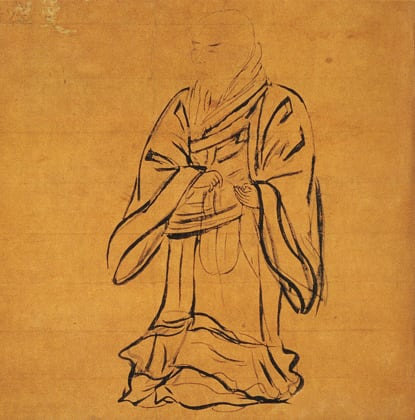
Retrato de Shinran «del espejo» (Kagami no goei) · Public domain
Dans ses propres mots
«I, Shaku Shinran, the foolish bald-headed one, in the year of the metal rooster of the Kennin era [1201], abandoned the sundry practices and took refuge in the Primal Vow.»Kyōgyōshinshō, epílogo del capítulo sobre los budas y tierras transformados. Traducción propia.
Shinran
Kyōgyōshinshō (The True Teaching, Practice and Realization of the Pure Land Way)
Pour commencer, une œuvre
Kyōgyōshinshō (The True Teaching, Practice and Realization of the Pure Land Way)Son idée centrale
Other Power (tariki): A term taken from Tanluan's commentary that Shinran makes the key to his whole teaching.
Le voir en contexte
Biographie
5 min de lecture
Traduction assistée à partir de l'original espagnol, en attente de relecture par un traducteur natif.
Un petit noble sur la montagne
Shinran naquit en 1173 à Hino, au sud-est de Kyôto, dans une branche modeste du clan Fujiwara ; son père, Hino Arinori, était fonctionnaire de la cour. De l'enfant, on ne sait presque rien avec certitude. La biographie que composa en 1295 son arrière-petit-fils Kakunyo rapporte qu'il fut ordonné à neuf ans par Jien, abbé du Shôren-in et futur patriarche du Tendai, et qu'il passa les deux décennies suivantes sur le mont Hiei. Les lettres de son épouse, Eshinni, précisent qu'il y servit comme « moine de salle » (dôsô) dans l'un des pavillons voués à l'invocation continue du bouddha Amida.
Le songe du Rokkakudô et la rencontre avec Hônen
En 1201, à vingt-neuf ans, il quitta la montagne. Selon le récit d'Eshinni, il fit une retraite de cent jours au Rokkakudô de Kyôto, le temple consacré au prince Shôtoku, et à l'aube du quatre-vingt-quinzième jour reçut en songe une révélation du prince. Il se rendit alors auprès de Hônen, qui prêchait à Yoshimizu que l'invocation du nom d'Amida (nembutsu) suffisait pour naître dans sa Terre pure, et l'écouta pendant cent autres jours. Shinran le résuma des années plus tard en une phrase célèbre : cette année-là, « j'abandonnai les pratiques diverses et pris refuge dans le Vœu originel ».
Il fut un disciple proche. En 1205, Hônen l'autorisa à copier son œuvre principale, le Senchakushû, ainsi que son portrait, et écrivit de sa main le nouveau nom du disciple. Shinran en garda une trace émue dans l'épilogue du Kyôgyôshinshô, car rares furent ceux qui reçurent ce privilège.
Ni moine ni laïc
En 1207, la cour interdit le mouvement du nembutsu à la suite d'un scandale impliquant des dames du palais : quatre disciples furent exécutés, Hônen exilé dans la province de Tosa et Shinran dans celle d'Echigo, sur la côte de la mer du Japon, réduit à l'état laïc sous le nom de Fujii Yoshizane. Il répondit en adoptant une identité nouvelle : il n'était plus moine, mais pas davantage laïc, et signa désormais Gutoku, « le tondu insensé ». À un moment de ces années, il épousa Eshinni, fille, selon la tradition, de Miyoshi Tamenori, un fonctionnaire ayant des intérêts en Echigo, dont il eut plusieurs enfants.
Gracié en 1211, il ne revint pas à Kyôto ; Hônen mourut l'année suivante. En 1214, il s'établit avec sa famille dans la région du Kantô, à l'est du pays. Eshinni rapporterait plus tard un épisode de ce voyage : Shinran entreprit de réciter mille fois les trois sûtras de la Terre pure au bénéfice des êtres, puis s'interrompit au bout de quelques jours, comprenant qu'il se fiait à son propre effort au lieu du nom d'Amida.
Vingt ans dans le Kantô
Pendant deux décennies environ, Shinran vécut dans la province de Hitachi et ses environs, enseignant à des paysans, des guerriers et des marchands qui se réunissaient dans de petites salles de pratique (dôjô), et non dans des temples. De cette époque date la première ébauche du Kyôgyôshinshô, que l'école situe en 1224 d'après une référence interne ; son manuscrit autographe, dit exemplaire de Bandô, corrigé tout au long de sa vie, est conservé au Higashi Honganji et classé Trésor national.
Kyôto : l'écriture de la vieillesse
Vers 1235, passé la soixantaine, il revint à Kyôto, où il vécut jusqu'à sa mort dans des maisons prêtées, soutenu par les dons de ses fidèles du Kantô. Ce fut la période la plus féconde de son œuvre écrite : il acheva le Kyôgyôshinshô, qu'il laissait copier dès 1247 ; il composa en japonais des centaines d'hymnes (wasan) qui rendaient la doctrine accessible à ceux qui ne lisaient pas le chinois ; il écrivit des commentaires de textes d'autres maîtres et entretint une abondante correspondance avec les communautés de l'Est.
Cette correspondance révèle aussi le drame de ses dernières années. Les communautés du Kantô se divisèrent entre ceux qui pensaient que, sauvés par Amida, ils pouvaient faire le mal sans souci, et ceux qui exigeaient des efforts moraux et des pratiques supplémentaires. Shinran envoya son fils Zenran rétablir l'ordre, mais celui-ci répandit ses propres enseignements, prétendant avoir reçu de son père une doctrine secrète. En 1256, à quatre-vingt-trois ans, Shinran le renia par lettre.
Une foi reçue
Le cœur de sa pensée est une radicalisation de l'enseignement de Hônen. Pour Shinran, aucun acte humain, pas même la récitation du nom, ne peut produire la naissance dans la Terre pure : tout procède du « pouvoir de l'autre » (tariki), le Vœu par lequel Amida s'est engagé à sauver tous les êtres. Ce qui est décisif, c'est la confiance sincère (shinjin), qui n'est pas une conquête du croyant, mais un don que lui accorde Amida ; dès l'instant où elle surgit, la naissance est assurée dans cette vie même. L'invocation du nom cesse d'être une pratique méritoire et devient l'expression de la gratitude.
La mort et l'école
Il mourut à Kyôto au onzième mois de 1262 selon le calendrier japonais, soit déjà en janvier 1263, à quatre-vingt-neuf ans, dans la maison de son frère cadet. Sa fille Kakushinni, qui l'avait accompagné, écrivit à sa mère en Echigo ; la réponse d'Eshinni, conservée, console sa fille en l'assurant que, quelle qu'ait été la manière dont il était mort, la naissance de Shinran dans la Terre pure était certaine. Kakushinni fit construire en 1272 à Ôtani un mausolée qui allait devenir le Honganji, et Kakunyo, son petit-fils, organisa à partir de lui l'école Jôdo Shinshû.
Vers 1290, un disciple, Yuien, réunit dans le Tannishô des paroles du maître entendues de sa bouche, afin de corriger les déviations qu'il observait dans sa communauté ; avec son paradoxe de l'« homme mauvais » comme objet du Vœu, ce texte est devenu, depuis la fin du XIXᵉ siècle, le plus lu de Shinran. Au début du XXᵉ siècle, certains historiens allèrent jusqu'à douter de son existence historique, car presque tout ce que l'on savait de lui provenait de sa propre école ; la découverte, en 1921, des lettres d'Eshinni dans les archives du Nishi Honganji trancha la question. Les deux branches principales de la Jôdo Shinshû forment aujourd'hui la plus grande famille bouddhique du Japon.
Sources: Dobbins, James C. Jōdo Shinshū: Shin Buddhism in Medieval Japan. Bloomington: Indiana University Press, 1989 (reimpr. Honolulu: University of Hawai'i Press, 2002, ISBN 9780824826208). · Dobbins, James C. Letters of the Nun Eshinni: Images of Pure Land Buddhism in Medieval Japan. Honolulu: University of Hawai'i Press, 2004. ISBN 9780824826673. · Hirota, Dennis (dir.) et al. (trads.). The Collected Works of Shinran. 2 vols. Kioto: Jōdo Shinshū Hongwanji-ha, 1997. Edición en línea del Hongwanji. · Bloom, Alfred. Shinran's Gospel of Pure Grace. Tucson: University of Arizona Press, 1965. ISBN 9780816504053. · Ueda, Yoshifumi; Hirota, Dennis. Shinran: An Introduction to His Thought. Kioto: Hongwanji International Center, 1989.
Chronologie
La vie, année après année
Chaque point est un événement documenté. Cliquez pour le lire, avec sa source et son degré de certitude.
14 mai 11730 ansHino (Kioto)
Birth
Born on the 1st day of the 4th month of Jōan 3 (14 May 1173 Julian; 21 May proleptic Gregorian, the date celebrated by the school), son of Hino Arinori.
DocumentéWikidata, entidad Q512934 «Shinran» (P31=Q5; 28 enlaces entre wikis; nacimiento 1173, muerte 1263 en Kioto; firma 愚禿釋親鸞).
Après sa mort
- 1272Ōtani mausoleum
- 1295Kakunyo's illustrated biography
- 1876Title of Kenshin Daishi
- 1921Discovery of Eshinni's letters
14 mai 1173 · 0 ans
Birth
Born on the 1st day of the 4th month of Jōan 3 (14 May 1173 Julian; 21 May proleptic Gregorian, the date celebrated by the school), son of Hino Arinori.
Documenté
1181 · 8 ans
Ordination
According to Kakunyo's biography, he receives the tonsure at nine from Jien under the name Han'en.
Tradition
1201 · 28 ans
Rokkakudō retreat and joining Hōnen
Leaves Mount Hiei after twenty years, receives a revelatory dream at the Rokkakudō and becomes Hōnen's disciple: "I abandoned the sundry practices and took refuge in the Primal Vow".
Documenté
1205 · 32 ans
Copy of the Senchakushū
Hōnen allows him to copy the Senchakushū and his portrait and gives him a new name, according to the postscript of the Kyōgyōshinshō.
Documenté
1207 · 34 ans
Exile to Echigo
The Jōgen persecution: Hōnen is exiled to Tosa and Shinran to Echigo under a lay name. From then on he declares himself "neither monk nor layman" and signs as Gutoku.
Documenté
1211 · 38 ans
Pardon
Receives a pardon but remains in Echigo; Hōnen dies in Kyoto the following year.
Documenté
1214 · 41 ans
Move to Kantō
Settles with his family in the Kantō region, where he will teach for some twenty years.
Documenté
1224 · 51 ans
First draft of the Kyōgyōshinshō
The date the school assigns to the composition of the Kyōgyōshinshō, on the basis of an internal reference to the year Gennin 1, and regards as its founding.
Probable
v. 1235 · 62 ans
Return to Kyoto
Returns to Kyoto at about sixty-two; he will live there on the donations of his followers.
Probable
1248 · 75 ans
Hymns of the Pure Land and of the Masters
Composes the Jōdo wasan and the Kōsō wasan, aged seventy-five.
Documenté
1256 · 83 ans
Disowning of Zenran
On the 29th day of the 5th month he signs the letter breaking with his son Zenran over his teachings.
Documenté
1258 · 85 ans
Hymns of the Dharma-Ages
Completes the Shōzōmatsu wasan; the same year his disciple Kenchi records his words on jinen hōni.
Documenté
9 janvier 1263 · 89 ans
Death
Dies on the 28th day of the 11th month of Kōchō 2 (9 January 1263 Julian; 16 January proleptic Gregorian) at his brother Jin'u's house, aged eighty-nine.
Documenté
1272
Ōtani mausoleum
His daughter Kakushinni builds a mausoleum that will be the origin of the Honganji.
Documenté
1295
Kakunyo's illustrated biography
Kakunyo composes the Godenshō, the basis of the traditional image of Shinran.
Documenté
1876
Title of Kenshin Daishi
Emperor Meiji grants him the posthumous title Kenshin Daishi.
Documenté
1921
Discovery of Eshinni's letters
His wife's letters are discovered in the Nishi Honganji archives, confirming the essential facts of his life.
Documenté
Œuvres
Œuvres essentielles
Les œuvres sans lesquelles on ne comprend pas son héritage.
Shinran
Kyōgyōshinshō (The True Teaching, Practice and Realization of the Pure Land Way)
Œuvre écrite · v. 1247
Kyōgyōshinshō (The True Teaching, Practice and Realization of the Pure Land Way)
顕浄土真実教行証文類
Shinran's major doctrinal work and the founding text of Jōdo Shinshū. In six chapters —Teaching, Practice, Shinjin, Realization, True Buddha and Land, Transformed Buddhas and Lands— it gathers and comments on hundreds of passages from sutras and the seven Pure Land patriarchs to show that everything, from practice to entrusting, is transferred by Amida. It includes the "Hymn of True Shinjin and the Nembutsu" (Shōshinge) and an autobiographical postscript.
4 éditions
Shinran
Shōshinge (Hymn of True Shinjin and the Nembutsu)
Œuvre écrite · v. 1247
Shōshinge (Hymn of True Shinjin and the Nembutsu)
正信念仏偈
Sixty seven-character verses (120 lines) summarising Jōdo Shinshū doctrine: they praise Amida and his Vow and celebrate the teaching of the seven patriarchs of India, China and Japan. Since Rennyo in the 15th century it has been the text recited daily by the school's followers.
1 édition
Shinran
Sanjō wasan (The Three Collections of Hymns)
Compilation postérieure · v. 1258
Sanjō wasan (The Three Collections of Hymns)
三帖和讃
Some three hundred and fifty four-line Japanese hymns that spread the doctrine among followers who could not read Chinese and form, with the Shōshinge, the core of the school's liturgy. They celebrate Amida and his land, the seven patriarchs and the situation of beings in the final Dharma age, culminating in Gutoku's hymns of lament and reflection.
2 éditions

Compilation postérieure · v. 1288
Tannishō (A Record in Lament of Divergences)
歎異抄
A short book of eighteen chapters with preface and epilogue, the most read text of the tradition. It contains the most famous sayings attributed to Shinran: "if even a good person attains birth, how much more the evil person!", that he has not a single disciple, that he never recited the nembutsu for his parents, or that the Vow, properly considered, was "for me, Shinran, alone". Popularised from the Meiji era, it influenced 20th-century Japanese philosophers and writers.
7 éditions
Toute son œuvre (30)
Shinran
Kyōgyōshinshō, ch. 1: Chapter on Teaching
The Conscious LibraryKyōgyōshinshō, ch. 1: Chapter on Teaching
1247
Shinran
Kyōgyōshinshō, ch. 2: Chapter on Practice
The Conscious LibraryKyōgyōshinshō, ch. 2: Chapter on Practice
1247
Shinran
Kyōgyōshinshō, ch. 3: Chapter on Shinjin
The Conscious LibraryKyōgyōshinshō, ch. 3: Chapter on Shinjin
1247
Shinran
Kyōgyōshinshō, ch. 4: Chapter on Realization
The Conscious LibraryKyōgyōshinshō, ch. 4: Chapter on Realization
1247
Shinran
Kyōgyōshinshō, ch. 5: Chapter on the True Buddha and Land
The Conscious LibraryKyōgyōshinshō, ch. 5: Chapter on the True Buddha and Land
1247
Shinran
Kyōgyōshinshō, ch. 6: Chapter on Transformed Buddha-Bodies and Lands
The Conscious LibraryKyōgyōshinshō, ch. 6: Chapter on Transformed Buddha-Bodies and Lands
1247
Shinran
Jōdo monrui jushō (Passages on the Pure Land Way)
The Conscious LibraryJōdo monrui jushō (Passages on the Pure Land Way)
1251
Shinran
Gutokushō (Gutoku's Notes)
The Conscious LibraryGutokushō (Gutoku's Notes)
1255
Shinran
Nyūshutsu nimon geju (Hymn of the Two Gateways of Entrance and Emergence)
The Conscious LibraryNyūshutsu nimon geju (Hymn of the Two Gateways of Entrance and Emergence)
1256
Shinran
Jōdo sangyō ōjō monrui (Passages on the Types of Birth in the Three Pure Land Sutras)
The Conscious LibraryJōdo sangyō ōjō monrui (Passages on the Types of Birth in the Three Pure Land Sutras)
1255
Shinran
Songō shinzō meimon (Notes on the Inscriptions on Sacred Scrolls)
The Conscious LibrarySongō shinzō meimon (Notes on the Inscriptions on Sacred Scrolls)
1255
Shinran
Ichinen tanen mon'i (Notes on Once-calling and Many-calling)
The Conscious LibraryIchinen tanen mon'i (Notes on Once-calling and Many-calling)
1257
Shinran
Yuishinshō mon'i (Notes on Essentials of Faith Alone)
The Conscious LibraryYuishinshō mon'i (Notes on Essentials of Faith Alone)
1250
Shinran
Nyorai nishu ekō mon (Passages on the Two Aspects of the Tathāgata's Directing of Virtue)
The Conscious LibraryNyorai nishu ekō mon (Passages on the Two Aspects of the Tathāgata's Directing of Virtue)
1256
Shinran
Mida nyorai myōgō toku (The Virtue of the Name of Amida Tathāgata)
The Conscious LibraryMida nyorai myōgō toku (The Virtue of the Name of Amida Tathāgata)
1260
Shinran
Jōdo wasan (Hymns of the Pure Land)
The Conscious LibraryJōdo wasan (Hymns of the Pure Land)
1248
Shinran
Kōsō wasan (Hymns of the Pure Land Masters)
The Conscious LibraryKōsō wasan (Hymns of the Pure Land Masters)
1248
Shinran
Shōzōmatsu wasan (Hymns of the Dharma-Ages)
The Conscious LibraryShōzōmatsu wasan (Hymns of the Dharma-Ages)
1258
Shinran
Kōtaishi Shōtoku hōsan (Hymns in Praise of Prince Shōtoku)
The Conscious LibraryKōtaishi Shōtoku hōsan (Hymns in Praise of Prince Shōtoku)
1255
Shinran
Dai Nihonkoku zokusan-ō Shōtoku taishi hōsan (Hymns to Prince Shōtoku, Ruler of Great Japan)
The Conscious LibraryDai Nihonkoku zokusan-ō Shōtoku taishi hōsan (Hymns to Prince Shōtoku, Ruler of Great Japan)
1257
Shinran
Jinen hōni shō (On Jinen Hōni)
The Conscious LibraryJinen hōni shō (On Jinen Hōni)
1258
Shinran
Mattōshō (Lamp for the Latter Ages)
The Conscious LibraryMattōshō (Lamp for the Latter Ages)
1333
Shinran
Goshōsoku shū (A Collection of Letters)
The Conscious LibraryGoshōsoku shū (A Collection of Letters)
1260
Shinran
Letter Disowning Zenran
The Conscious LibraryLetter Disowning Zenran
1256
Citations
Citations localisées dans une œuvre précise. Chacune porte sa provenance et son degré de fiabilité.
I, Shaku Shinran, the foolish bald-headed one, in the year of the metal rooster of the Kennin era [1201], abandoned the sundry practices and took refuge in the Primal Vow.然愚禿釋鸞、建仁辛酉暦、棄雜行兮歸本願。
VérifiéeKyōgyōshinshō, epílogo del capítulo sobre los budas y tierras transformados. Traducción propia.
Citations apocryphes ou d'attribution contestée (1)
«"Though my life come to its end and I return to the Pure Land, I shall come back again and again like the waves of Waka bay. When you are alone and rejoice, think that there are two; when you are two and rejoice, think that there are three: that other one is Shinran."»
This is the so-called Gorinmatsu no gosho ("Deathbed Writing"), dated the 11th month of 1262 and signed "Gutoku Shinran, fully ninety years old". Widespread in popular piety, scholarship regards it as apocryphal: it appears neither in the early collections of his writings nor in Kakunyo's biography. It was transmitted in later compilations, such as Shimaji Daitō's Seiten (1928).
Dernières paroles
Attribution traditionnelle
«"He did not mingle worldly matters in his words; he spoke only of the depth of the Buddha's benevolence. His voice uttered nothing else: the invocation of the name never ceased."»口に世事をまじへず、ただ仏恩のふかきことをのぶ。声に余言をあらはさず、もつぱら称名たゆることなし。
No last words of Shinran survive. This passage from Kakunyo's biography (Godenshō, 1295), written thirty-two years later, describes his last days: from the end of the 11th month he was ill, spoke only of gratitude to the Buddha and recited Amida's name unceasingly, until he died lying on his right side, head to the north and face to the west. Eshinni's letter to her daughter Kakushinni, written after receiving the news, transmits no words of his and simply affirms that his birth in the Pure Land was certain. The "Deathbed Writing" circulating under his name is apocryphal.
Source: Kakunyo. Honganji Shōnin Shinran den'e (Godenshō, «Biografía ilustrada de Shinran»), 1295. Trad. inglesa en The Life of Shinran Shonin: The Journey to Self-Acceptance, de Alfred Bloom (Leiden: Brill, 1968).
Interroger
Ce que répond son œuvre
Douze grandes questions de l'humanité et ce que ses textes permettent d'y répondre, références à l'appui. Nous ne lui prêtons jamais de paroles.
Qu'est-ce que l'Absolu ? Dieu existe-t-il ?
Amida is compassion that calls, and also the form of the formless
À la fois personnel et impersonnelIl le dit expressément
For Shinran, the ultimate manifests as Amida, the Buddha of Immeasurable Light and Immeasurable Life, whose Vow seeks out and embraces beings: a face that knows and calls. But Amida is not a creator god, and Shinran does not stop at the face. Following Tanluan, in his Notes on «Essentials of Faith Alone» he distinguishes a dharma-body as suchness, without colour or form, and a dharma-body as compassionate means, from which the bodhisattva Dharmākara and his Vow arise. In the brief On Jinen Hōni he says it more plainly: the supreme Buddha is formless, and Amida is the means by which we come to know that reality which works of itself (jinen). The personal face is true, but it is the form the formless takes to reach beings.
Comparer cette question avec d'autres maîtresQui suis-je ? Existe-t-il un vrai soi ?
No speculation on the self: he knows himself a fool full of passions
Ne s'est pas prononcé
Shinran does not pronounce on the ontology of the self; he takes the Buddhist framework for granted and does not discuss it. What he says of himself is of another order: existential and moral. He calls himself Gutoku, the foolish bald one; in the Hymns of the Dharma Ages he confesses that, though he has taken refuge in the true teaching, he is false and insincere and there is no trace of a pure heart in him. In the chapter on shinjin of the Kyōgyōshinshō he takes from Shandao the two sides of deep faith: recognising oneself as an ordinary being, bound by karma from time without beginning, with no way out by one's own powers, and trusting at the same time that Amida's Vow embraces one. Who am I, for Shinran, is answered in the light of the Vow, not by introspection.
Comparer cette question avec d'autres maîtresPourquoi souffrons-nous ?
We are beings bound by blind passions, unable to escape by our own power
Le désir et l'attachementIl le dit expressément
Shinran locates the root of suffering in the blind passions (bonnō) that fill the ordinary being until the last moment of life, and in the karma carried from a beginningless past. What is specific to his diagnosis is what he adds: in the final age of the Dharma, lamented in his Hymns of the Dharma Ages, no one can cut off those passions by their own effort. The Tannishō, compiled by his disciple Yuien, attributes to him the idea that the good and evil we do depend on past karma more than on our will. Hence the remedy is not a discipline but Amida's Vow, which embraces beings as they are, without requiring them first to stop suffering or desiring.
Comparer cette question avec d'autres maîtresQue se passe-t-il après la mort ?
With shinjin, birth is already settled: at death one attains nirvana
Vie éternelle et résurrectionIl le dit expressément
For Shinran, whoever has received shinjin is already, in this life, among those whose birth in the Pure Land is assured. That is why, in the first of the letters collected in Lamp for the Latter Ages, he holds that one need not wait for the hour of death nor rely on Amida's coming at the deathbed, as other schools taught: birth is settled at the moment shinjin arises. At death the ordinary being is born in the Pure Land, which for Shinran is not a paradise of enjoyment but the immediate realisation of great nirvana, as the chapter on realisation of the Kyōgyōshinshō sets out. And from there one returns to this world to guide others.
Comparer cette question avec d'autres maîtresComment atteint-on la libération ou le salut ?
Not even faith is one's own merit: all is the work of Amida's Vow
Par la grâce et l'amourIl le dit expressément
Shinran takes the doctrine of other-power (tariki) further than anyone in his tradition. Birth in the Pure Land depends not on practices, merits or virtues but on Amida's Vow; and shinjin itself is not an act of the practitioner but Amida's mind given to him, as the third chapter of the Kyōgyōshinshō argues. Even the nembutsu is the activity of the name, not an effort. Hence the sentence the Tannishō attributes to him: if even the good person attains birth, how much more the evil one, because whoever relies on good works still leans on their own power. The human being neither prepares nor cooperates: he receives, and responds with gratitude.
Comparer cette question avec d'autres maîtresFaut-il un maître ?
He has no disciples: all are companions receiving the same Vow
La communauté et la traditionIl le dit expressément
Shinran acknowledges an immense debt to his teacher Hōnen: according to the Tannishō, he said that even if Hōnen had deceived him and he fell into hell for saying the nembutsu, he would have no regrets. And he devoted the Hymns of the Pure Land Masters to the seven patriarchs who transmitted the teaching from India onwards. But he refuses to occupy the place of teacher himself: the same text attributes to him the sentence «I, Shinran, do not have a single disciple», because shinjin is given by no human being but by Amida. Those who listen with him are companions on the way (dōbō), and the teaching lives in that community of equals and in the texts that transmit it, not in a personal authority.
Comparer cette question avec d'autres maîtresLe monde est-il réel ?
This world is a burning house; only the nembutsu is true
Apparence sur l'unique réalitéIl le dit expressément
Shinran does not develop a metaphysics of the world, but he judges it harshly. In the epilogue of the Tannishō, his disciple Yuien records a sentence he attributes to him: for an ordinary being full of passions, in this impermanent world, which is like a burning house, all things are empty and false, with nothing true; only the nembutsu is true. The Hymns of the Dharma Ages also describe the period as the final age, in which the teaching declines and practices no longer bear fruit. The world is real as a place of suffering and karma, but lacks ultimate truth; the only true thing is what comes from Amida's Vow, and the Pure Land is a realm of light beyond any conceivable form.
Comparer cette question avec d'autres maîtresQu'est-ce que l'amour ?
Our compassion falls short; only Amida's saves all
Une compassion sans limitesIl le dit expressément
Shinran is clear-sighted about the limits of human love. The fourth chapter of the Tannishō attributes to him a distinction between two compassions: that of the path of sages, which consists in pitying, loving and caring for beings, but rarely manages to save them completely; and that of the Pure Land, which consists in saying the nembutsu, swiftly attaining buddhahood and, with great compassion, freely benefiting beings. However much one loves and pities in this life, that love does not persevere. True compassion is Amida's, whose Vow, according to a sentence the same text's epilogue attributes to him, was for him, Shinran, alone. The human response is gratitude and return to the world after birth.
Comparer cette question avec d'autres maîtresSommes-nous libres ou tout est-il déterminé ?
Nothing rests on one's calculation: evil comes from karma, salvation from the Vow
Il n'y a pas d'agentIl le dit expressément
Shinran radically distrusts self-will where salvation is concerned. In On Jinen Hōni he explains that birth in the Pure Land comes about of itself (jinen), without the practitioner's calculation (hakarai), because it is the working of the Vow; shinjin itself is given, not chosen. The Tannishō, compiled by Yuien, further attributes to him the idea that the good and evil we do depend on the conditions of past karma: if conditions led to it, one might kill a thousand people. But Shinran does not draw a licence from this: in his letters he rebukes those who justify evil by the Vow, like someone who takes poison because an antidote exists.
Comparer cette question avec d'autres maîtresPourquoi méditer ou prier ?
The nembutsu is neither practice nor merit: it is gratitude to one who embraces
L'amitié avec DieuIl le dit expressément
Shinran does not teach meditation: he regards meditative practices and good works as efforts of self-power, insufficient in the final age. What remains is the nembutsu, saying the name of Amida. But its meaning changes completely: according to the Tannishō, for the one who says it, it is neither a practice nor a good act, because it is not done by one's own calculation and produces no merit. In the chapter on practice of the Kyōgyōshinshō he presents it as the working of the name itself, transferred by the Vow. Saying it is, at bottom, a response of gratitude to a compassion that has already embraced the person, as the opening lines of the Shōshinge express: I take refuge in the Tathāgata of Immeasurable Life.
Comparer cette question avec d'autres maîtresLa raison peut-elle connaître l'ultime ?
The sutras and the masters, not one's own judgement, show the way
L'Écriture et le raisonnementIl le dit expressément
Shinran's major work, the Kyōgyōshinshō, is largely an anthology: it gathers passages from the sutras and from the masters of India, China and Japan, and orders and comments on them to show the true teaching. His method is scriptural: authority lies in the Larger Sutra of Immeasurable Life, which reveals the Vow, and in the chain of the seven patriarchs. Shinran interprets with great freedom, sometimes reading the Chinese in unusual ways to draw out a new sense, but he does not appeal to autonomous reason; he distrusts one's own calculation (hakarai), which he treats as a way of leaning on self-power. The ultimate, nirvana or what is naturally so, lies beyond what the mind can conceive.
Comparer cette question avec d'autres maîtresSe retirer du monde ou le transformer ?
Neither monk nor layman: ordinary family life is the place of the Vow
La contemplation dans l'actionIl le dit expressément
Shinran broke with the monastic model in which he had trained for twenty years on Mount Hiei. After the exile of 1207 he declared himself, in the epilogue of the Kyōgyōshinshō, neither monk nor layman, and took as his surname the character for «bald». He married, had children and lived among peasants and ordinary people in the Kantō region, where the first communities formed. Since Amida's Vow embraces beings as they are, there is no need to abandon ordinary life to receive it: the home, the trade and the family are the place where shinjin is lived and answered with gratitude. He preached no organised social action, but no withdrawal either.
Comparer cette question avec d'autres maîtres
Affinités et tensions
Affinités et tensions
Calculées question par question à partir de ses positions. La raison de chaque accord ou de chaque désaccord s'affiche d'un clic.
Pense comme

Theophan the Recluse
Ils concordent sur: Que se passe-t-il après la mort ? · Comment atteint-on la libération ou le salut ? · Faut-il un maître ?
Ibn Arabi
Ils concordent sur: Qu'est-ce que l'Absolu ? Dieu existe-t-il ? · Que se passe-t-il après la mort ? · Sommes-nous libres ou tout est-il déterminé ?
Vladimir Solovyov
Ils concordent sur: Qu'est-ce que l'Absolu ? Dieu existe-t-il ? · Que se passe-t-il après la mort ? · Comment atteint-on la libération ou le salut ?

Francis of Assisi
Ils concordent sur: Que se passe-t-il après la mort ? · Comment atteint-on la libération ou le salut ? · Faut-il un maître ?
Pense autrement que
Socrates
Ils s'opposent sur: Le monde est-il réel ?
Empedocles
Ils s'opposent sur: Que se passe-t-il après la mort ?
Carl Gustav Jung
Ils s'opposent sur: Qu'est-ce que l'Absolu ? Dieu existe-t-il ? · Pourquoi souffrons-nous ? · Que se passe-t-il après la mort ?
Baruch Spinoza
Ils s'opposent sur: Qu'est-ce que l'Absolu ? Dieu existe-t-il ? · Pourquoi souffrons-nous ? · Que se passe-t-il après la mort ?
Anecdotes et récits
Anecdotes et récits
Témoignage1201
The dream of the ninety-fifth day
Origine du récit: Eshinni's letter to her daughter Kakushinni (1263), discovered in 1921 at Nishi Honganji: testimony of his wife, who heard it from him. The Kannon verse comes from the so-called Shinran muki and Kakunyo's biography.
Source: Dobbins, James C. Letters of the Nun Eshinni: Images of Pure Land Buddhism in Medieval Japan. Honolulu: University of Hawai'i Press, 2004. ISBN 9780824826673.
Témoignage1214 y 1231
The interrupted thousand readings
Origine du récit: Eshinni's letters (1263), written half a century later but by a direct witness.
Source: Dobbins, James C. Letters of the Nun Eshinni: Images of Pure Land Buddhism in Medieval Japan. Honolulu: University of Hawai'i Press, 2004. ISBN 9780824826673.
Documenté1207
"Neither monk nor layman"
Origine du récit: Postscript of the Kyōgyōshinshō, in Shinran's own words; the list of those executed and exiled appears in the appendix to the Tannishō.
Documenté1256
The disowning of Zenran
Origine du récit: Letter of disownment (Kenchi's copy, Senju-ji) and letter to Shōshin of the same date, in the collections of Shinran's letters.
Documenté1263
Eshinni's letter to her daughter
Origine du récit: Eshinni's autograph letters (Nishi Honganji), discovered in 1921 and published by Washio Kyōdō.
Source: Dobbins, James C. Letters of the Nun Eshinni: Images of Pure Land Buddhism in Medieval Japan. Honolulu: University of Hawai'i Press, 2004. ISBN 9780824826673.
Enseignements
Enseignements
Les notions qui structurent sa pensée, expliquées dans leur contexte.
Other Power (tariki)tariki
Kyōgyōshinshō, Yuishinshō mon'i, letters and Tannishō.
Source: Ueda, Yoshifumi; Hirota, Dennis. Shinran: An Introduction to His Thought. Kioto: Hongwanji International Center, 1989.
True entrusting (shinjin)shinjin
Kyōgyōshinshō, third chapter (Shinjin).
The evil person as the true object of the Vow (akunin shōki)akunin-shoki
Tannishō, ch. 3; letters of the Mattōshō.
Source: Unno, Taitetsu (trad.). Tannisho: A Shin Buddhist Classic. Honolulu: Buddhist Study Center Press, 1984 (ed. rev. 1996). ISBN 9780938474043.
Naturalness (jinen hōni)jinen-honi
Jinen hōni shō (1258), recorded by Kenchi; Yuishinshō mon'i.
Neither monk nor layman (hisō hizoku)hiso-hizoku
Postscript of the Kyōgyōshinshō.
Source: Dobbins, James C. Jōdo Shinshū: Shin Buddhism in Medieval Japan. Bloomington: Indiana University Press, 1989 (reimpr. Honolulu: University of Hawai'i Press, 2002, ISBN 9780824826208).
The two aspects of transference: going and returning (ōsō ekō, gensō ekō)oso-genso-eko
Kyōgyōshinshō (chs. 1 and 4); Nyorai nishu ekō mon.
The truly settled (shōjōju)shojoju
Kyōgyōshinshō (chs. 3 and 4); Mattōshō, letter 1.
Vidéos
Vidéos
Enregistrements, entretiens et documentaires. Les vidéos sont lues depuis YouTube ; elles ne sont pas hébergées ici.
親鸞聖人の生涯~ご誕生から入滅まで~
Documentaire· JA· 2024· 5 min
真宗大谷派東本願寺【公式】Chaîne officielle
立教開宗の書 教行信証《坂東本》の世界
Documentaire· JA· 2023· 36 min
真宗大谷派東本願寺【公式】Chaîne officielle
本廟創立と東本願寺の歴史―親鸞聖人の示寂と大谷廟堂の創建―
Documentaire· JA· 2021· 4 min
真宗大谷派東本願寺【公式】Chaîne officielle
「初めて学ぶ〈親鸞聖人のご生涯〉講座」第1回(比叡山時代の親鸞聖人)
Conférence· JA· 2025· 63 min
浄土真宗本願寺派Chaîne officielle
2021 Annual Symposium: The Radical Other Power of Shinran (1173-1263)
Conférence· EN· 2022· 107 min
UBC Asian StudiesChaîne officielle
Mark Blum, "Critically Reading the Tannisho", February 10, 2017
Conférence· EN· 2017· 77 min
Smith College Buddhist StudiesChaîne officielle
Mark Unno - Shin Buddhism in Interreligious Dialogue: A World of Teaching and Learning
Conférence· EN· 2010· 46 min
The University of British ColumbiaChaîne officielle
Introduction to Buddhism-Shinran ①
Conférence· EN· 2021· 22 min
American Buddhist Study Center
Shinran's Understanding of Pure Land Buddhism by Reverend Professor Kemmyo Taira Sato
Voir sur YouTube
Cette vidéo ne peut pas être intégrée ; elle s'ouvre sur YouTube.
Shinran's Understanding of Pure Land Buddhism by Reverend Professor Kemmyo Taira Sato
Conférence· EN· 2025· 89 min
The Buddhist SocietyChaîne officielle
El Buda Amida y Su Tierra Pura y La Fe y el Nembutsu no son creados por nuestras mentes
Enregistrement de tiers· ES· 2020· 14 min
Templo Internacional Amidaji de Hispanoamérica
Shinran et le bouddhisme de la Terre Pure - Sagesses bouddhistes - France 2
Documentaire· FR· 2022· 15 min
Inspiration- Zen
Galerie
Galerie
Images dont la licence a été vérifiée. Chacune conserve son auteur et son attribution.
Manuscrits
Manuscrits
Témoins manuscrits et textes anciens, avec leur dépositaire et leurs conditions de consultation.
ZH · Kanji con anotaciones en katakana · Redacción iniciada hacia 1224 y corregida hasta la década de 1250
顕浄土真実教行証文類 (坂東本)
- Témoin conservé
- Seis volúmenes con numerosas correcciones, tachaduras y hojas añadidas por el autor
- Dépositaire
- Shinshū Ōtani-ha, Higashi Honganji (Kioto)
- Numérisation
- commons.wikimedia.org/wiki/File:Kyogyoshinsho.jp…
JA · s. XIII
紙本墨画親鸞聖人像 (鏡御影)
- Témoin conservé
- Rollo colgante, tinta sobre papel, 35,2 × 33 cm
- Dépositaire
- Jōdo Shinshū Hongwanji-ha, Nishi Honganji (Kioto)
- Numérisation
- commons.wikimedia.org/wiki/File:Shinran_Shonin.j…
JA · Kana y kanji · 1256–1268
恵信尼消息
- Témoin conservé
- Diez cartas de Eshinni a su hija Kakushinni
- Dépositaire
- Nishi Honganji (Kioto)
JA · Kanji y kana · Copia del siglo XV
歎異抄 (蓮如書写本)
- Témoin conservé
- Manuscrito más antiguo conservado del Tannishō, con la nota de Rennyo que restringe su lectura
- Dépositaire
- Nishi Honganji (Kioto)
Relations
Relations
Influences, filiations et affinités. On distingue la relation documentée de la similitude identifiée par analyse.
Disciple de
Hōnen
Shinran's teacher from 1201; Shinran regards him as the true master who revealed to him the nembutsu path and includes him among the seven patriarchs.
Relation documentée
Famille de
Eshinni
His wife; her letters to their daughter Kakushinni (1256–1268) are the main independent source on his life.
Relation documentée
Famille de
Kakushinni
His youngest daughter, who cared for him at the end of his life and founded the Ōtani mausoleum, origin of the Honganji.
Relation documentée
Famille de
Zenran
His eldest son, whom he disowned in 1256 for spreading teachings he attributed to a secret transmission from his father.
Relation documentée
Maître de
Yuien
A Kantō disciple, compiler of the Tannishō around 1288.
Relation documentée
A influencé
Kakunyo
Shinran's great-grandson and third custodian of the mausoleum, author of the illustrated biography (1295) and organiser of the Honganji as a school.
Relation documentée
A reçu l'influence de
First of the seven Pure Land patriarchs in the Shōshinge and the Kōsō wasan, for his presentation of the "easy path".
Relation documentée
Contemporain de
Contemporaries in Kamakura-period Kyoto and founders of the two most numerous Japanese schools, with opposite paths: trust in Amida's power and seated practice. There is no record that they met.
Relation documentée
Idées proches de
A distant contemporary: poverty, preaching to simple people and a movement that overflowed the religious institutions of its time. A typological comparison, without contact.
Similitude identifiée par analyse
Lié depuis d'autres fiches
Sources
Sources
Bibliographie et catalogues consultés pour cette fiche.
- Wikidata, entidad Q512934 «Shinran» (P31=Q5; 28 enlaces entre wikis; nacimiento 1173, muerte 1263 en Kioto; firma 愚禿釋親鸞).
- Dobbins, James C. Jōdo Shinshū: Shin Buddhism in Medieval Japan. Bloomington: Indiana University Press, 1989 (reimpr. Honolulu: University of Hawai'i Press, 2002, ISBN 9780824826208).
- Dobbins, James C. Letters of the Nun Eshinni: Images of Pure Land Buddhism in Medieval Japan. Honolulu: University of Hawai'i Press, 2004. ISBN 9780824826673.
- Hirota, Dennis (dir.) et al. (trads.). The Collected Works of Shinran. 2 vols. Kioto: Jōdo Shinshū Hongwanji-ha, 1997. Edición en línea del Hongwanji.
- Bloom, Alfred. Shinran's Gospel of Pure Grace. Tucson: University of Arizona Press, 1965. ISBN 9780816504053.
- Ueda, Yoshifumi; Hirota, Dennis. Shinran: An Introduction to His Thought. Kioto: Hongwanji International Center, 1989.
- Kakunyo. Honganji Shōnin Shinran den'e (Godenshō, «Biografía ilustrada de Shinran»), 1295. Trad. inglesa en The Life of Shinran Shonin: The Journey to Self-Acceptance, de Alfred Bloom (Leiden: Brill, 1968).
- Akamatsu Toshihide. Shinran. Tokio: Yoshikawa Kōbunkan (Jinbutsu sōsho), 1961.
- «正信念仏偈», texto original de Shinran (final del capítulo de la Práctica del Kyōgyōshinshō), en Wikisource japonés, con nota sobre la variante del manuscrito autógrafo de Bandō.
- «善鸞義絶状» (carta de repudio de Zenran, 1256), texto según la copia de Kenchi conservada en el Senju-ji, en Wikisource japonés.
- Imadate, Tosui (trad.). The Tannisho (Tract on Deploring the Heterodoxies). Kioto: The Eastern Buddhist Society, 1928. Ejemplar digitalizado en Internet Archive.
- Yamabe, S.; Beck, L. Adams (trads.). Buddhist Psalms Translated from the Japanese of Shinran Shōnin. Londres: John Murray (Wisdom of the East), 1921. Project Gutenberg n.º 7015.
- Shinshū Ōtani-ha (Higashi Honganji). «親鸞聖人の生涯» (La vida de Shinran), sitio oficial.
- Unno, Taitetsu (trad.). Tannisho: A Shin Buddhist Classic. Honolulu: Buddhist Study Center Press, 1984 (ed. rev. 1996). ISBN 9780938474043.
- Suzuki, Daisetz Teitaro (trad.). The Kyōgyōshinshō. Kioto: Shinshū Ōtaniha, 1973; reed. como Shinran's Kyogyoshinsho, Nueva York: Oxford University Press, 2012. ISBN 9780199863105.
- Inagaki, Hisao (trad.). Kyōgyōshinshō: On Teaching, Practice, Faith, and Enlightenment. Berkeley: Numata Center for Buddhist Translation and Research (BDK English Tripiṭaka 105-I), 2003. ISBN 9781886439160.
- Ducor, Jérôme (trad.). Le Tannishô. Paris: Cerf (Patrimoines – Orient), 2011. ISBN 9782204093781.
- Wikipedia en japonés, «親鸞» (cronología, obras y títulos póstumos). Consultada el 25-10-2026 y contrastada con s2, s3 y s13.
- «歎異抄 (意訳聖典)», versión en japonés moderno publicada por el Honganji en Iyaku seiten (Naigai shuppan, 1923), en Wikisource japonés.
- Bandō, Shōjun; Stewart, Harold (trads.). Tannishō: Passages Deploring Deviations of Faith. Berkeley: Numata Center for Buddhist Translation and Research, 1996. ISBN 9781886439030.
- Ayant droit
- Obra en dominio público. Las traducciones modernas pertenecen a sus traductores o editoriales; la traducción inglesa completa (The Collected Works of Shinran, 1997) es del Jōdo Shinshū Hongwanji-ha, que la ofrece gratuitamente en línea.
- Site officiel
- www.higashihonganji.or.jp/about/shinran/
En attente de confirmation
Ce que cette fiche n'a pas encore pu établir. Nous préférons le dire plutôt que de combler.
- Ediciones en español: no se ha localizado en catálogos (Open Library, búsquedas generales) ninguna traducción española publicada con ISBN del Kyōgyōshinshō ni del Tannishō; existen versiones de comunidades jōdo shinshū hispanohablantes sin datos editoriales comprobados y una traducción española de «Las canciones de Shinran Shōnin» de Beatrice Lane Suzuki en Internet Archive sin traductor identificado (no incluida en la sala de lectura). Buscar en la BNE y en el Hongwanji International Center.
- Fechas en calendario juliano (14-05-1173 y 09-01-1263, como Wikidata); la escuela celebra el 21 de mayo y el 16 de enero, equivalentes en gregoriano proléptico.
- Datación de obras menores aproximada (Jōdo monrui jushō, Nyūshutsu nimon geju, Nyorai nishu ekō mon, Mida nyorai myōgō toku, notas a los sutras); confirmar con la cronología de la edición Teihon Shinran Shōnin zenshū.
- Sala de lectura: no hay en línea un texto original completo del Kyōgyōshinshō ni del Tannishō en una fuente libre de derechos editoriales comprobada (WikiArc reproduce la edición anotada del Hongwanji). Se registran el Shōshinge, la carta a Zenran, la versión de 1923 del Tannishō, la traducción inglesa de Imadate (1928) y Buddhist Psalms (1921).
- Confirmar la condición de Bien Cultural Importante de las cartas de Eshinni y la autoría tradicional del «retrato del espejo» (Sen'amidabutsu).
- Relaciones con slugs no presentes en el catálogo del Atlas (honen, eshinni, kakushinni, zenran, yuien, kakunyo): revisar si se crean fichas.
- Vídeos: la conferencia de Kemmyo Taira Sato (The Buddhist Society) no es insertable (oEmbed 401); la emisión de France 2 procede de un canal de terceros.
Recherche effectuée le 2026-10-25