Christianisme · Mystique chrétienne · Protestantisme · Hermétisme
Jakob Böhme
Jacob Böhme
1575 – 1624Personne historiquement documentée
Cordonnier de Görlitz (1575-1624) et l'un des grands mystiques spéculatifs de l'Occident. Sans études ni latin, il écrivit après une illumination vers 1600 L'Aurore naissante (1612), qui lui valut l'interdiction d'écrire, puis, de 1618 à 1624, une œuvre immense : Des trois principes, la Triple vie, les Quarante questions sur l'âme, De signatura rerum, le Mysterium Magnum et Le Chemin vers le Christ, seul livre imprimé de son vivant. Sa théosophie de l'Ungrund, de la Sophia et de l'origine du mal marqua le piétisme, l'idéalisme allemand, le romantisme et la philosophie religieuse russe.
- œuvres
- 32œuvres
- éditions
- 63éditions
- citations
- 5citations
- vidéos
- 15vidéos
- images
- 9images
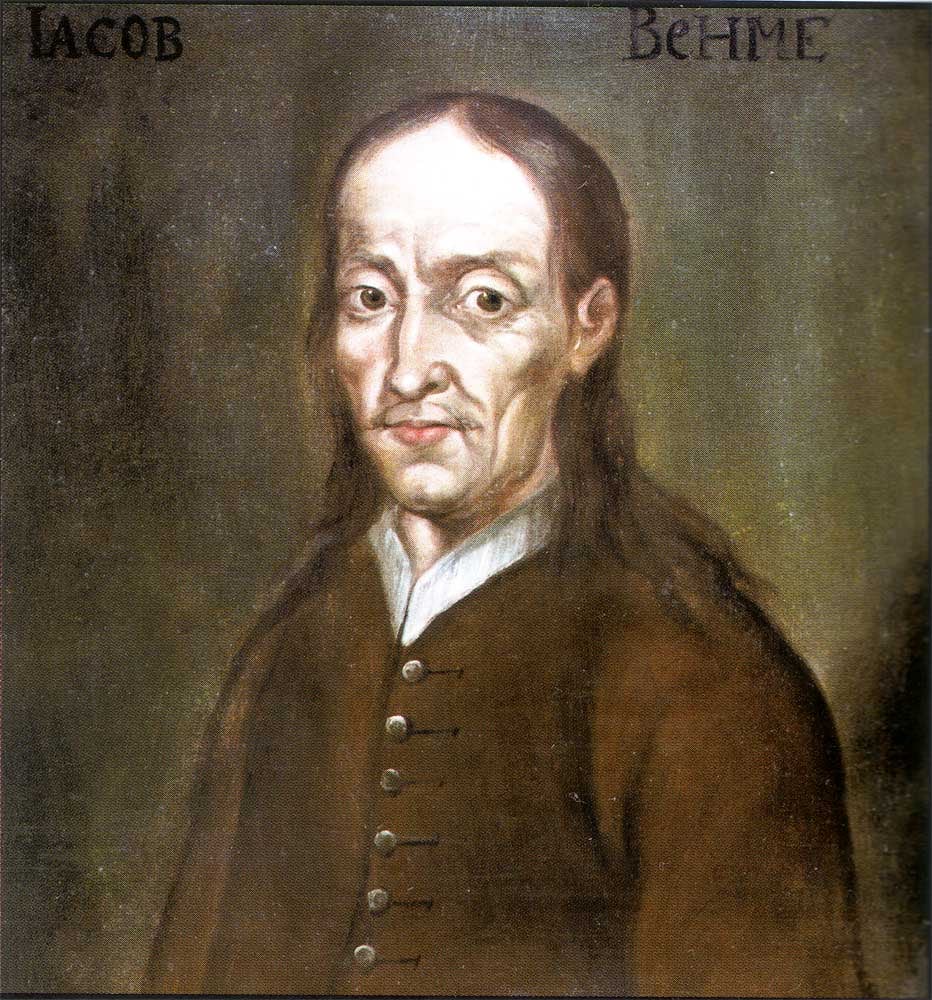
Retrato póstumo de Jakob Böhme · Public domain
Dans ses propres mots
«But when in my resolved zeal I stormed so hard against God and all the gates of hell, as if I had more strength still in reserve, ready to stake my life on it (which would not have been in my power without the help of God's Spirit), suddenly, after some hard storms, my spirit broke through the gates of hell into the innermost birth of the Godhead, and there was embraced with love, as a bridegroom embraces his dear bride.»Morgenröte im Aufgang (Aurora), cap. 19, § 11 (texto de la ed. de Friburgo, 1977, en Zeno.org)

Son idée centrale
Ungrund (the groundless): Ungrund is the word with which Böhme names what lies 'before' God as revealed God: a bottomless abyss, without nature or determination, which is neither good nor evil, neither light nor darkness, but pure will that does not yet will anything.
Le voir en contexte
Biographie
5 min de lecture
Traduction assistée à partir de l'original espagnol, en attente de relecture par un traducteur natif.
Le berger d'Alt Seidenberg
Jacob Boehme naquit en 1575 à Alt Seidenberg, un village de Haute-Lusace situé à quelques kilomètres de Görlitz, dans les terres de la Couronne de Bohême ; la date du 24 avril que reprennent certains répertoires ne repose sur aucun document solide. Il était le quatrième enfant d'une famille paysanne luthérienne assez aisée ; son père était en outre marguillier et échevin du tribunal local. Trop chétif pour les travaux des champs, il garda le bétail dans son enfance et, vers quatorze ans, entra en apprentissage chez un cordonnier. Le peu que l'on sait de ces années vient de la biographie que son disciple Abraham von Franckenberg rédigea en 1651, plus proche du récit édifiant que de la chronique : le trésor entrevu dans une crevasse du mont Landeskrone, l'étranger qui lui annonça qu'il serait grand.
Après ses années de compagnon itinérant, il s'établit à Görlitz. Le 24 avril 1599, il fut reçu bourgeois et maître cordonnier, acheta l'un des étals de chaussures de l'Untermarkt et épousa la même année Katharina Kuntzschmann, fille d'un boucher de la ville ; de ce mariage naquirent au moins quatre fils. Boehme fréquentait le cercle pieux réuni autour de l'ancien premier pasteur Martin Moller, foyer d'une spiritualité d'inspiration mystique au sein du luthéranisme, et lisait la Bible avec une intensité que la théologie d'école de son temps ignorait presque.
Un quart d'heure
Vers 1600, il vécut l'expérience qui ordonna toute sa vie. Franckenberg la rattache au reflet du soleil sur un vase d'étain, dans lequel Boehme aurait soudain aperçu le fond de toutes choses. Lui-même la raconta vingt ans plus tard, sans le moindre vase, dans une lettre à Caspar Lindner, receveur des douanes à Beuthen : après une longue mélancolie et une lutte obstinée avec Dieu, « la porte s'ouvrit », et en un quart d'heure il vit et sut davantage que s'il avait passé de longues années dans une université : l'être de tous les êtres, le fond et le sans-fond, la naissance de la Trinité, l'origine de ce monde et de toutes les créatures. Pendant douze ans, il n'écrivit rien ; la tradition place en 1610 un renouvellement de cette lumière.
L'Aurore et le pasteur Richter
En 1612, il commença à écrire, pour lui seul, Morgenröte im Aufgang (L'Aurore naissante), le livre que ses amis appelleraient Aurora : un traité inachevé sur Dieu, les anges, la chute de Lucifer et la nature, dont le dix-neuvième chapitre raconte comment son esprit franchit les portes de l'enfer jusqu'à la naissance la plus intime de la divinité et y fut embrassé « comme un fiancé embrasse sa bien-aimée ». Le gentilhomme Karl von Ender vit le manuscrit et le fit copier ; une copie parvint au premier pasteur de Görlitz, Gregor Richter, qui le dénonça du haut de la chaire. En juillet 1613, le conseil de la ville fit brièvement détenir Boehme, confisqua l'original et lui interdit d'écrire. Il obéit plus de cinq ans ; il vendit son étal de cordonnier et se fit marchand de fil et de gants, commerce qui le mena souvent à Prague.
Six années d'écriture
En 1618, encouragé par des amis — médecins, nobles silésiens, lecteurs de Paracelse —, il reprit la plume et, en six ans, éleva une œuvre de plusieurs milliers de pages. En 1619, il acheva Des trois principes de l'essence divine ; en 1620, De la triple vie de l'homme, les Quarante questions sur l'âme — réponse à celles que lui avait adressées le médecin Balthasar Walther, voyageur en Orient qui lui transmit des notions kabbalistiques et alchimiques —, De l'incarnation de Jésus-Christ, les Six points théosophiques et le Mysterium pansophicum. Vinrent ensuite les répliques à ses critiques Balthasar Tilke et Esaias Stiefel, le De signatura rerum (1622), une série de brefs traités de dévotion sur la pénitence, l'abandon et la vie suprasensible, et en 1623 son grand commentaire de la Genèse, le Mysterium Magnum, ainsi que De l'élection de la grâce et Des testaments du Christ. Tout circulait en copies manuscrites ; ses lettres, dont plus de soixante sont conservées, demeurent la meilleure porte d'entrée dans sa pensée.
Boehme ne savait pas le latin et n'avait jamais mis les pieds dans une université. Il écrivait dans l'allemand de Lusace, mêlant le vocabulaire de la Bible de Luther à celui de Paracelse et de l'alchimie, et forgeait des mots pour ce qui n'avait pas de nom : l'Ungrund, le « sans-fond » antérieur à toute détermination ; les Quellgeister, les esprits-sources qui engendrent la nature éternelle ; la Sophia, vierge de la sagesse, miroir de Dieu. Sa question constante est celle de l'origine du mal : comment un Dieu qui est amour porte dans sa nature éternelle un feu obscur, et comment l'homme, placé entre la colère et l'amour, peut naître de nouveau. Hegel, qui le lut avec admiration et non sans impatience devant son langage, l'appela le premier philosophe allemand.
Le Chemin vers le Christ et la fin
Au début de 1624, des amis firent imprimer à Görlitz, sans son autorisation selon ce qu'il déclara lui-même devant le conseil, un petit volume de ses traités de dévotion : Der Weg zu Christo (Le Chemin vers le Christ), le seul de ses livres qu'il vit imprimé. Richter riposta par un libelle qui l'accusait d'hérésie et d'ivrognerie, et Boehme lui répondit par une apologie. Le 26 mars, le conseil l'invita à quitter la ville. En mai, il se rendit à Dresde, où il logea chez le médecin de la cour et s'entretint avec des théologiens et des conseillers de l'Électeur ; il en revint sans condamnation et passa l'été chez des amis nobles en Silésie, où il entreprit les Cent soixante-dix-sept questions théosophiques. Richter mourut en août. Atteint de fièvre et d'un mal intestinal, Boehme regagna Görlitz au début de novembre ; le nouveau clergé lui fit subir un interrogatoire avant de lui donner la communion. Il mourut le 17 novembre 1624. Son inhumation fut imposée par le conseil contre la volonté du pasteur, et sa tombe fut profanée peu après.
Postérité
Ses écrits furent sauvés grâce à ses disciples et, surtout, aux Pays-Bas : Johann Georg Gichtel publia à Amsterdam en 1682 la première édition complète, et la Theosophia revelata parut en 1730. En Angleterre, John Sparrow, John Ellistone et Humphrey Blunden le traduisirent entre 1645 et 1662 ; les « behménistes » influencèrent quakers et philadelphiens, et au XVIIIe siècle William Law le tint pour son maître, au point que l'édition anglaise de 1764-1781 est connue sous son nom. Par Oetinger, il atteignit le piétisme souabe et Schelling ; par Saint-Martin, la France ; par Novalis, le romantisme. Au XXe siècle, il fut lu par Berdiaev, qui vit dans l'Ungrund l'intuition d'une liberté antérieure à l'être, et par Jung, qui reproduisit comme mandala la sphère philosophique des Quarante questions. Depuis 2020, l'université de Stuttgart prépare la première édition historico-critique de ses œuvres.
Sources: Franckenberg, Abraham von. Gründlich und wahrhafftiger Bericht von dem Leben und Abschied des in Gott selig-ruhenden Jacob Böhmens (1651). En: Des gottseeligen hocherleuchteten Jacob Böhmens Teutonici Philosophi Alle Theosophische Wercken, Ámsterdam, 1682, vol. [1]; reimpr. en Theosophia revelata, 1730. Trad. inglesa en The Works of Jacob Behmen, Londres, 1764, vol. I. · Weeks, Andrew. Boehme: An Intellectual Biography of the Seventeenth-Century Philosopher and Mystic. Albany: State University of New York Press, 1991. · Hessayon, Ariel, y Sarah Apetrei (eds.). An Introduction to Jacob Boehme: Four Centuries of Thought and Reception. Nueva York y Londres: Routledge, 2014. · Martensen, Hans Lassen. Jacob Boehme: His Life and Teaching. Trad. T. Rhys Evans. Londres: Hodder and Stoughton, 1885. · Böhme, Jacob. Concerning the Three Principles of the Divine Essence. Trad. John Sparrow (1648); reed. C. J. Barker, con introducción de Paul Deussen (incluye las actas del concejo de Görlitz de 1613 y 1624 y la cronología de los últimos meses). Londres: John M. Watkins, 1910.
Chronologie
La vie, année après année
Chaque point est un événement documenté. Cliquez pour le lire, avec sa source et son degré de certitude.
15750 ansAlt Seidenberg (Stary Zawidów)
Birth
Born at Alt Seidenberg, fourth child of a Lutheran peasant family. The year is secure; the day (24 April) given by some reference works is undocumented.
ProbableFranckenberg, Abraham von. Gründlich und wahrhafftiger Bericht von dem Leben und Abschied des in Gott selig-ruhenden Jacob Böhmens (1651). En: Des gottseeligen hocherleuchteten Jacob Böhmens Teutonici Philosophi Alle Theosophische Wercken, Ámsterdam, 1682, vol. [1]; reimpr. en Theosophia revelata, 1730. Trad. inglesa en The Works of Jacob Behmen, Londres, 1764, vol. I.
Après sa mort
- 1682First complete edition (Amsterdam)
- 1730Theosophia revelata
- 1764 – 1781The 'William Law' English edition
- 2020Historical-critical edition
1575 · 0 ans
Birth
Born at Alt Seidenberg, fourth child of a Lutheran peasant family. The year is secure; the day (24 April) given by some reference works is undocumented.
Probable
v. 1589 · 14 ans
Shoemaker's apprentice
After herding cattle as a boy, and owing to his frail constitution, he is apprenticed to a shoemaker at Seidenberg at about fourteen.
Probable
24 avril 1599 · 24 ans
Citizen and master in Görlitz; marriage
On 24 April he is enrolled as a citizen of Görlitz, buys a shoe stall on the Untermarkt and that year marries Katharina Kuntzschmann.
Documenté
v. 1600 · 25 ans
The illumination
An experience he himself describes in his letter to Caspar Lindner: in a quarter of an hour he saw 'the Being of all beings'. Franckenberg ties it to sunlight reflected in a pewter vessel.
Documenté
1610 · 35 ans
Second illumination
The biographical tradition places a renewal of the vision and the awareness of a vocation in this year.
Tradition
1612 · 37 ans
Aurora
He writes Morgenröte im Aufgang for himself; it remains unfinished. The nobleman Karl von Ender has it copied and it circulates.
Documenté
juillet 1613 · 38 ans
Council condemnation and ban on writing
Denounced by the chief pastor Gregor Richter, the council briefly detains him, confiscates the manuscript and forbids him to write. He sells his stall and takes up the trade in yarn and gloves.
Documenté
1618 · 43 ans
He writes again
Encouraged by friends, he breaks his silence. He begins The Three Principles of the Divine Essence, completed in 1619.
Documenté
1620 · 45 ans
The year of the great treatises
He writes The Threefold Life of Man, the Forty Questions of the Soul (for Balthasar Walther), The Incarnation of Jesus Christ, the Six Theosophic Points, the Six Mystical Points and the Mysterium pansophicum.
Documenté
1622 · 47 ans
De signatura rerum and the devotional treatises
He composes De signatura rerum and the short treatises on repentance, resignation and the supersensual life that will form Der Weg zu Christo.
Documenté
1623 · 48 ans
Mysterium Magnum
He completes his commentary on Genesis, Mysterium Magnum, and writes The Election of Grace and Of Christ's Testaments.
Documenté
janvier 1624 · 48 ans
Der Weg zu Christo printed
At the beginning of the year his friends print Der Weg zu Christo in Görlitz, the only book of his published in his lifetime. Richter attacks it in a lampoon; Böhme answers with his Apology.
Documenté
26 mars 1624 · 48 ans
The council invites him to leave
Summoned on 26 March, he declares that a nobleman printed the book without his involvement; the council warns him to leave the town.
Documenté
mai 1624 · 49 ans
Stay in Dresden
From May he lives in Dresden at the house of the court physician; he converses with theologians and counsellors of the Elector of Saxony and returns uncondemned.
Documenté
17 novembre 1624 · 49 ans
Death
Ill since his stay in Silesia, he returns to Görlitz and dies on 17 November. The new clergy had examined him before giving him communion; the burial is imposed by the council.
Documenté
1682
First complete edition (Amsterdam)
Johann Georg Gichtel publishes the complete works in Amsterdam in fifteen parts, with Franckenberg's biography.
Documenté
1730
Theosophia revelata
Johann Wilhelm Ueberfeld's edition appears, the basis of most later editions and of Peuckert's facsimile.
Documenté
1764 – 1781
The 'William Law' English edition
The Works of Jacob Behmen appear in London (1764–1781) in four volumes, based on the seventeenth-century translations and associated with the name of William Law.
Documenté
2020
Historical-critical edition
The University of Stuttgart and Frommann-Holzboog begin the Historisch-kritische Gesamtausgabe, directed by Günther Bonheim.
Documenté
Œuvres
Œuvres essentielles
Les œuvres sans lesquelles on ne comprend pas son héritage.
Œuvre écrite · 1612
Aurora, or the Day-Spring (Morning Redness in the Rising)
Morgenröte im Aufgang (Aurora)
His first book, written for himself in 1612 and never finished. Subtitled 'the root or mother of philosophy, astrology and theology', it covers the Trinity, the creation of the angels, the fall of Lucifer and the seven 'source-spirits' of divine nature, and comments on the first days of creation. In chapter nineteen Böhme narrates his own illumination. Copied without his permission, it provoked Pastor Richter's denunciation and the 1613 ban on writing; the manuscript remained in the authorities' hands. It already contains his whole thought in germ, in a language still groping and impassioned.
6 éditions · amazon.com

Œuvre écrite · 1622
De Signatura Rerum (The Signature of All Things)
De signatura rerum, oder Von der Geburt und Bezeichnung aller Wesen
His treatise on the 'signature': everything visible bears inscribed in its form, colour and sound the inner quality that generated it, and whoever can read those marks reads the being of all beings. Böhme combines the Paracelsian doctrine of signatures with an alchemical-type process (the seven properties, the death and resurrection of matter) which he applies at once to metals, plants and the rebirth of the soul. It was one of his most widely read books in England and among the German Romantics.
5 éditions · amazon.com

Compilation postérieure · 1624
The Way to Christ
Der Weg zu Christo (Christosophia)
The only book of Böhme's printed in his lifetime (Görlitz, early 1624), at his friends' initiative. It gathers the devotional treatises on repentance, resignation and the supersensual life; later editions expanded it to nine 'little books' with the new birth, prayer, the dialogue of the two souls and divine contemplation. It is the most accessible way into his spirituality and the immediate cause of Richter's last persecution.
5 éditions · amazon.com

Œuvre écrite · 1623
Mysterium Magnum, or an Exposition of the First Book of Moses called Genesis
Mysterium Magnum, oder Erklärung über das erste Buch Mosis
His longest work: a chapter-by-chapter commentary on Genesis, from creation to the death of Joseph, read as the history of God's revelation in nature and in the soul. Creation, the fall, Cain and Abel, Noah, Babel, Abraham, Isaac, Jacob and Joseph become figures of inner processes and of the struggle between wrath and love. It contains his most mature exposition of the Ungrund, Sophia and the 'language of nature'. Berdyaev considered it his chief work.
6 éditions · amazon.com
Toute son œuvre (32)

The Three Principles of the Divine Essence
1619

The Threefold Life of Man
1620

Forty Questions of the Soul
1620
Jakob Böhme
Of the Incarnation of Jesus Christ
The Conscious LibraryOf the Incarnation of Jesus Christ
1620

Six Theosophic Points
1620

Six Mystical Points
1620
Jakob Böhme
Mysterium Pansophicum (On the Earthly and Heavenly Mystery)
The Conscious LibraryMysterium Pansophicum (On the Earthly and Heavenly Mystery)
1620
Jakob Böhme
Of the Last Times (to Paul Kaym)
The Conscious LibraryOf the Last Times (to Paul Kaym)
1620
Jakob Böhme
The Four Complexions (A Consolatory Treatise)
The Conscious LibraryThe Four Complexions (A Consolatory Treatise)
1624
Jakob Böhme
Apologies against Balthasar Tilke
The Conscious LibraryApologies against Balthasar Tilke
1621
Jakob Böhme
Antistifelius (Considerations upon Esaias Stiefel's Book)
The Conscious LibraryAntistifelius (Considerations upon Esaias Stiefel's Book)
1621
Jakob Böhme
Of the Error of the Sects of Esaias Stiefel and Ezechiel Meth
The Conscious LibraryOf the Error of the Sects of Esaias Stiefel and Ezechiel Meth
1622

Of True Repentance
1622

Of True Resignation
1622

Of the Supersensual Life (Dialogue between a Master and a Disciple)
1622
Jakob Böhme
Of the New Birth (Regeneration)
The Conscious LibraryOf the New Birth (Regeneration)
1622
Jakob Böhme
Theoscopia, or Of Divine Contemplation
The Conscious LibraryTheoscopia, or Of Divine Contemplation
1622

Of the Election of Grace
1623
Jakob Böhme
Of Christ's Testaments (Baptism and the Supper)
The Conscious LibraryOf Christ's Testaments (Baptism and the Supper)
1623
Jakob Böhme
Of Holy Prayer
The Conscious LibraryOf Holy Prayer
1624
Jakob Böhme
Dialogue between an Enlightened and an Unenlightened Soul
The Conscious LibraryDialogue between an Enlightened and an Unenlightened Soul
1624
Jakob Böhme
Apology against Gregor Richter
The Conscious LibraryApology against Gregor Richter
1624
Jakob Böhme
Written Defence to the Council of Görlitz
The Conscious LibraryWritten Defence to the Council of Görlitz
1624
Theosophic Questions (177 Questions on Divine Revelation)
1624
Citations
Citations localisées dans une œuvre précise. Chacune porte sa provenance et son degré de fiabilité.
But when in my resolved zeal I stormed so hard against God and all the gates of hell, as if I had more strength still in reserve, ready to stake my life on it (which would not have been in my power without the help of God's Spirit), suddenly, after some hard storms, my spirit broke through the gates of hell into the innermost birth of the Godhead, and there was embraced with love, as a bridegroom embraces his dear bride.Als ich aber in meinem angesetzten Eifer also hart wider Gott und aller Höllen Porten stürmete, als wären meiner Kräften noch mehr vorhanden, in willens, das Leben daran zu setzen – welches freilich nicht mein Vermögen wäre gewesen ohne des Geistes Gottes Beistand – alsbald nach etlichen harten Stürmen ist mein Geist durch der Höllen Porten durchgebrochen bis in die innerste Geburt der Gottheit und allda mit Liebe umfangen worden, wie ein Bräutigam seine liebe Braut umfähet.
VérifiéeMorgenröte im Aufgang (Aurora), cap. 19, § 11 (texto de la ed. de Friburgo, 1977, en Zeno.org)
Citations apocryphes ou d'attribution contestée (1)
«He to whom time is as eternity and eternity as time is free from all strife.»
A verse circulating in German ('Wem Zeit wie Ewigkeit / und Ewigkeit wie Zeit, / der ist befreit / von allem Streit') as Böhme's motto. It is traditionally attributed to him as an album inscription, but has not been located in the 1682 or 1730 editions; it is recorded as a traditional attribution without a verified source.
Dernières paroles
Récit postérieur de témoins
«Now I go hence into Paradise.»Nun fahre ich hin ins Paradeis.
Transmitted by Abraham von Franckenberg in his Bericht (1651), which relies on the account of those present, in particular the physician Tobias Kober, who attended Böhme in his last illness. According to that account, in the early hours of 17 November 1624 Böhme asked his son Tobias whether he did not hear a most sweet music and asked for the door to be opened so that it might be heard better; at about six in the morning he took leave of his wife and son, spoke these words and died. The sentence belongs to a devout narrative written by a disciple, not to an official record.
Source: Franckenberg, Abraham von. Gründlich und wahrhafftiger Bericht von dem Leben und Abschied des in Gott selig-ruhenden Jacob Böhmens (1651). En: Des gottseeligen hocherleuchteten Jacob Böhmens Teutonici Philosophi Alle Theosophische Wercken, Ámsterdam, 1682, vol. [1]; reimpr. en Theosophia revelata, 1730. Trad. inglesa en The Works of Jacob Behmen, Londres, 1764, vol. I.
Interroger
Ce que répond son œuvre
Douze grandes questions de l'humanité et ce que ses textes permettent d'y répondre, références à l'appui. Nous ne lui prêtons jamais de paroles.
Qu'est-ce que l'Absolu ? Dieu existe-t-il ?
From the will-less Unground the self-revealing God is born
À la fois personnel et impersonnelIl le dit expressément
Jakob Böhme places at the origin the Ungrund, the Unground: an eternal nothing, free of all determination, neither good nor evil as yet. In that abyss arises a will that longs to know itself and, to do so, gives itself a ground: thus the Trinity is begotten and, from it, eternal nature with its dark and luminous forces. The God who reveals himself is fully personal —Father, Son and Spirit, love and light overcoming wrath— but proceeds from a ground prior to all form. Böhme claims to have seen in his illumination of 1600 the ground and the Unground and the birth of the Trinity. Both aspects are true: the hidden deity and the manifested God.
Comparer cette question avec d'autres maîtresQui suis-je ? Existe-t-il un vrai soi ?
The soul is an eternal fire that must be reborn into light
Une âme créée et immortelleIl le dit expressément
Jakob Böhme devoted his Forty Questions on the Soul (1620) to the subject. The soul proceeds from God's eternal nature: it is a spark of fire, a centre of will with the same dark and luminous forces that exist at the origin, and is therefore an image of the whole. After the fall, the human being lives in three principles: the dark fire of wrath, the light of love and the outer world of the elements. The self-will, the will closed upon itself, is what burns in wrath; the true self is the soul that abandons its own will and is reborn in Christ, in the light. The soul does not die: it remains in the principle in which it has fixed itself.
Comparer cette question avec d'autres maîtresPourquoi souffrons-nous ?
The will that closes on itself suffers, burning in wrath
La séparation d'avec DieuIl le dit expressément
Jakob Böhme looks for the origin of evil in eternal nature itself. In God there is a first dark principle, of fire and wrath, which in the deity is always overcome by the light of love. Lucifer, and later the human being, wanted to live in that fire by themselves, with a will of their own, and thus separated themselves from the light: hell is not an added place, but the wrath in which the will that turns from love locks itself. Suffering is the torment of that self-will. Hence the remedy is surrender (Gelassenheit): where self-love dies, God's will takes up the same space in the soul.
Comparer cette question avec d'autres maîtresQue se passe-t-il après la mort ?
At death the soul remains in the principle it has chosen
Vie éternelle et résurrectionIl le dit expressément
Jakob Böhme treats the soul's destiny in the Forty Questions on the Soul. When the outer body, made of the elements, dissolves, the soul remains in the principle in which it has fixed its will: if it has been reborn in Christ, in the light of love; if it has shut itself up in itself, in the dark fire of wrath, which is hell. This is not a place to which one is sent, but the manifestation of what the soul already was. Böhme keeps the Christian hope of resurrection and of the heavenly body, which the reborn person already begins to bear in this life as an inner spiritual substance.
Comparer cette question avec d'autres maîtresComment atteint-on la libération ou le salut ?
Rebirth: die to self-will so that Christ is born within
Par la grâce et l'amourIl le dit expressément
For Jakob Böhme, salvation is an inner new birth. The Way to Christ, his only book printed in his lifetime (1624), gathers treatises on true repentance, surrender and the supersensual life. The process begins with the conversion of the will: the soul recognises that it lives in the wrath of its self-will and turns toward God's mercy. Then comes Gelassenheit, self-abandonment, in which the will ceases to will on its own account. Then Christ is born in the soul as light and renews it. Böhme criticises reliance on a merely outward justification: without this rebirth, faith remains history and titles.
Comparer cette question avec d'autres maîtresFaut-il un maître ?
A quarter-hour of light teaches more than years at university
Le maître est à l'intérieurIl le dit expressément
Jakob Böhme, a shoemaker of Görlitz without university studies, recounts that after an inner struggle the gate was opened to him and in a quarter of an hour he saw and knew more than if he had spent many years at a university. His authority comes from no teacher and no school, but from the Spirit who teaches within. Hence his constant criticism of professional theologians and the «stone church», who know the history of Christ without having seen him born in themselves. Yet his Theosophical Letters show that he ended up acting as a guide for a circle of readers and friends, whom he always referred to their own experience of inner rebirth.
Comparer cette question avec d'autres maîtresLe monde est-il réel ?
Each thing bears the signature of what it is within
Manifestation du divinIl le dit expressément
For Jakob Böhme, the visible world is the outward manifestation of the inner, eternal world. In De signatura rerum he maintains that every thing has a signature: its form, colour, taste and sound express the inner quality that formed it, as a person's face and voice reveal their mood. The outer world proceeds from the mingling of the two eternal principles, the dark and the luminous, and therefore good and evil are intertwined in it. It is real, but not ultimate: it is God's language, which the illuminated can read. The Mysterium magnum comments on Genesis as an account of that divine self-revelation.
Comparer cette question avec d'autres maîtresQu'est-ce que l'amour ?
Where self-love is banished, the love of God dwells
Ce qui apparaît quand le moi cesseIl le dit expressément
In the dialogue Of the Supersensual Life, the master explains to the disciple that the love of God and self-love exclude one another: where self-love is banished, there the love of God dwells, and as much of the self-will as has died, so much space does the divine will, which is love, occupy in the soul. Böhme further describes love as something that, in a sense, is nothing: it appropriates nothing, and therefore it is above all things and contains them. Whoever finds it finds it in the nothingness of their own will. Love is not a virtue the self cultivates, but what appears when the self-will surrenders.
Comparer cette question avec d'autres maîtresSommes-nous libres ou tout est-il déterminé ?
Freedom is rooted in the eternal Unground
Un libre arbitre réelIl le dit expressément
Jakob Böhme gives freedom a metaphysical foundation. The Ungrund, the Unground from which everything proceeds, is pure freedom, will without determination; and the human soul, born from eternal nature, retains something of that original freedom: it can turn toward the light of love or shut itself up in the fire of wrath. That is why in On the Election of Grace (1623) he combats the Calvinist doctrine of a predestination that would condemn some before they choose: God wills no one's evil, and each soul decides for the principle in which it wishes to live. Freedom is real and terrible: on it depends which fire the soul opens to.
Comparer cette question avec d'autres maîtresPourquoi méditer ou prier ?
Cease for a moment from thinking and willing to hear God
Être présentIl le dit expressément
In the dialogue Of the Supersensual Life, the disciple asks how to come to see God and hear him speak. The master answers that if he can cease for a moment from all his thinking and willing, he will hear the unspeakable words of God. The obstacle is one's own thinking and willing, which shuts the soul up in its self-image and in the noise of outward things; when that movement stops, even for an instant, the space opens where God speaks. Böhme also composed a prayer book, On Holy Prayer, for each day of the week, in which vocal prayer is a path toward that stillness of the will.
Comparer cette question avec d'autres maîtresLa raison peut-elle connaître l'ultime ?
The Spirit's light reveals the ground of all beings
Une connaissance ésotériqueIl le dit expressément
Jakob Böhme claims a knowledge that comes not from books or school reason, but from illumination. In Aurora (1612) he recounts that, after assailing God with zeal, his spirit broke through the gates of hell to the innermost generation of the deity; in a letter of 1621 he adds that he saw and knew the being of all beings, the ground and the Unground, the birth of the Trinity and the origin of the world. That knowledge, which he calls theosophy, is expressed in a language of its own made of qualities, principles and signatures. Böhme insists that it is verifiable: whoever is reborn of the Spirit can see it for himself. Outer reason, without that rebirth, knows only the husk.
Comparer cette question avec d'autres maîtresSe retirer du monde ou le transformer ?
The outer man works; the inner man remains in God
La contemplation dans l'actionIl le dit expressément
Jakob Böhme was neither monk nor cleric: he was a shoemaker, later a trader in gloves and wool, married and a family man in Görlitz, and wrote in the time his trade left him. His doctrine does not demand withdrawal from the world. In the dialogues of The Way to Christ, the master teaches the disciple that he may remain in his station and work with his hands and outer senses, while his will, surrendered to God, abides in the supersensual. What he rejects is outward religion of titles, disputes and the «stone church», and the confessional wars of his time. The change that matters is the inner new birth, lived in the midst of ordinary life.
Comparer cette question avec d'autres maîtres
Affinités et tensions
Affinités et tensions
Calculées question par question à partir de ses positions. La raison de chaque accord ou de chaque désaccord s'affiche d'un clic.
Pense comme
Augustine of Hippo
Ils concordent sur: Qui suis-je ? Existe-t-il un vrai soi ? · Pourquoi souffrons-nous ? · Que se passe-t-il après la mort ?
Vladimir Solovyov
Ils concordent sur: Qu'est-ce que l'Absolu ? Dieu existe-t-il ? · Qui suis-je ? Existe-t-il un vrai soi ? · Pourquoi souffrons-nous ?
Hafez
Ils concordent sur: Qui suis-je ? Existe-t-il un vrai soi ? · Pourquoi souffrons-nous ? · Que se passe-t-il après la mort ?

Nikolai Berdyaev
Ils concordent sur: Qu'est-ce que l'Absolu ? Dieu existe-t-il ? · Qui suis-je ? Existe-t-il un vrai soi ? · Pourquoi souffrons-nous ?
Pense autrement que

Patañjali
Ils s'opposent sur: Qui suis-je ? Existe-t-il un vrai soi ? · Que se passe-t-il après la mort ?

Pema Chödrön
Ils s'opposent sur: Qui suis-je ? Existe-t-il un vrai soi ? · Que se passe-t-il après la mort ?
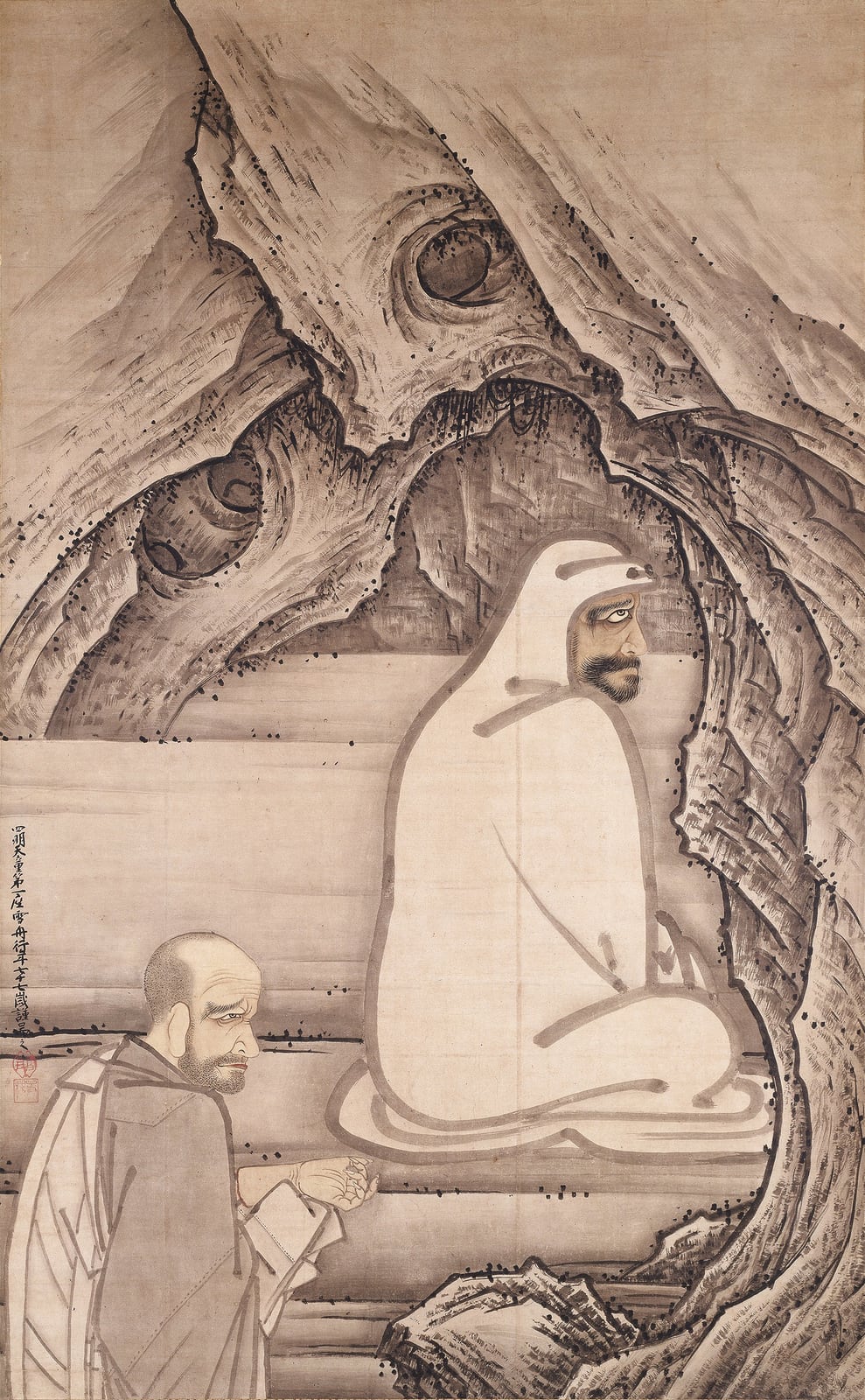
Bodhidharma
Ils s'opposent sur: Qui suis-je ? Existe-t-il un vrai soi ? · Que se passe-t-il après la mort ?

Nāgārjuna
Ils s'opposent sur: Qui suis-je ? Existe-t-il un vrai soi ? · Que se passe-t-il après la mort ?
Anecdotes et récits
Anecdotes et récits
Récit hagiographiquec. 1585
The treasure of the Landeskrone
Origine du récit: Abraham von Franckenberg, Bericht von dem Leben und Abschied Jacob Böhmens (1651); repeated by all later biographies.
Récit hagiographiquec. 1590
The stranger at the workshop
Origine du récit: Franckenberg, Bericht (1651). There is no independent testimony; the story belongs to the genre of the prophecy of vocation.
Contestéc. 1600
The pewter vessel
Origine du récit: Franckenberg, Bericht (1651); compare Böhme's letter to Caspar Lindner (1621), §§ 6–8, which describes the experience without that detail.
Tradition orale1613–1624
Pastor Richter's slipper
Origine du récit: Caption of the engraving in the 1686 series (Rijksmuseum RP-P-OB-2363; Van Eeghen 501-4, catalogue of the work of Jan and Casper Luyken; Wikipedia attributes it to Joseph Mulder) for the 1686 Amsterdam edition; Richter's hostility, in the 1613 and 1624 records published by Deussen (1910).
Source: Hessayon, Ariel, y Sarah Apetrei (eds.). An Introduction to Jacob Boehme: Four Centuries of Thought and Reception. Nueva York y Londres: Routledge, 2014.
Documenté1624
'It smells of shoemaker's pitch'
Origine du récit: Richter's lampoon and Böhme's letter of 2 April 1624, quoted by Paul Deussen in the introduction to Concerning the Three Principles (1910), pp. xlviii–xlix, and by Martensen (1885), p. 13.
Témoignage1624
The music of the last night
Origine du récit: Franckenberg, Bericht (1651), based on the testimony of the physician Tobias Kober; the doctrinal examination and the resistance to the burial are also recorded in the sources gathered by Deussen (1910).
Enseignements
Enseignements
Les notions qui structurent sa pensée, expliquées dans leur contexte.
Ungrund (the groundless)ungrund
Mysterium pansophicum, Six Theosophic Points, Mysterium Magnum (ch. 1–3) and Clavis; reception in German Idealism and Russian religious philosophy.
Source: O'Regan, Cyril. Gnostic Apocalypse: Jacob Boehme's Haunted Narrative. Albany: State University of New York Press, 2002.
The three principlesdrei-prinzipien
Systematic exposition in De tribus principiis (1619) and De triplici vita (1620); synoptic tables in the Tabulae principiorum (1624).
The seven source-spirits (Quellgeister)quellgeister
Aurora, ch. 8–11; Clavis; De signatura rerum.
Sophia, the virgin of wisdomsophia
Of the Incarnation of Jesus Christ, The Threefold Life, Mysterium Magnum; reception in English Behmenism and Russian sophiology.
Source: Berdyaev, Nicolas. «Unground and Freedom», ensayo introductorio a Jacob Boehme, Six Theosophic Points and Other Writings, trad. John Rolleston Earle. Ann Arbor: University of Michigan Press, 1958. Y «Из этюдов о Я. Беме. Этюд I: Учение об Ungrund и свободе; Этюд II: Учение о Софии и андрогине Я. Беме и русские софиологические течения», Путь (Put'), París, 1930, n.os 20–21.
The signature of things and the language of naturesignatura-rerum
De signatura rerum (1622), Mysterium Magnum (ch. 35–36), Aurora; Paracelsian tradition.
Source: Weeks, Andrew. Boehme: An Intellectual Biography of the Seventeenth-Century Philosopher and Mystic. Albany: State University of New York Press, 1991.
New birth and Gelassenheitwiedergeburt
Der Weg zu Christo and its treatises (repentance, resignation, supersensual life, new birth); continuity with Eckhart, Tauler and the Theologia Deutsch.
Vidéos
Vidéos
Enregistrements, entretiens et documentaires. Les vidéos sont lues depuis YouTube ; elles ne sont pas hébergées ici.
How is Jacob Böhme relevant today? Lecture by Scott Brown
Conférence· EN· 39 min
Embassy of the Free MindChaîne officielle
7 Most Important Themes in Jacob Böhme's Philosophy | Curator's Guided Tour
Documentaire· EN· 20 min
Embassy of the Free MindChaîne officielle
Infinite Fire Webinar VI - Prof. Dr. Wouter J. Hanegraaff on The Theosophical System of Jakob Böhme
Conférence· DE· 61 min
Embassy of the Free MindChaîne officielle
Jacob Böhme in Amsterdam | Curator's Guided Tour
Documentaire· EN· 25 min
Embassy of the Free MindChaîne officielle
Sophia and Sophiology: From Boehme to Schelling
Conférence· EN· 90 min
Harvard Divinity SchoolChaîne officielle
An Introduction to the Philosophical System of Jacob Boehme
Conférence· EN· 77 min
Ephrata CloisterChaîne officielle
ALLES IN ALLEM. Die Gedankenwelt des mystischen Philosophen Jacob Böhme
Documentaire· DE· 5 min
Staatliche Kunstsammlungen DresdenChaîne officielle
"Men Who've Walked With God #12: Jacob Boehme" a sermon by Howard Thurman (July 12, 1953)
Enregistrement original· EN· 1953· 34 min
American Museum of Paramusicology
How Theosophy Created Spiritual Alchemy - The Alchemy of Jakob Böhme
Analyse· EN· 41 min
ESOTERICA
The Mysticism of Jacob Boehme with Aaron French
Entretien· EN· 68 min
Hermitix Podcast
Trailer for "The Life and Legacy of Jacob Boehme"
Documentaire· EN· 3 min
BoehmeFilm / meandriaChaîne officielle
Jakob Böhme Tagung, Görlitz 2014: Ralf Gleide
Conférence· DE· 77 min
Oberlausitz Leben
Jakob Böhme: El místico que atravesó el Misterio | Entrevista a Paco Martínez Albarracín (Boehme)
Entretien· ES· 78 min
Psicología y Espiritualidad
Mysterium Magnum: Jakob Böhme y la dialéctica del Abismo, con Isidoro Reguera
Entretien· ES· 46 min
La Taberna de Rudolf Steiner
Francisco Martínez Albarracín: Sophia en la visión cosmoteándrica de Jacob Boehme.
Conférence· ES· 67 min
MIAS Latina
Galerie
Galerie
Images dont la licence a été vérifiée. Chacune conserve son auteur et son attribution.
Relations
Relations
Influences, filiations et affinités. On distingue la relation documentée de la similitude identifiée par analyse.
A influencé
Berdyaev made Böhme's Ungrund the basis of his philosophy of uncreated freedom; he devoted two studies to him in Put' (1930) and the essay 'Unground and Freedom' (1958).
Relation documentée
A influencé
Solovyov read Böhme in his formative years, particularly in London in 1875; Böhme's Sophia is one of the acknowledged sources of his sophiology.
Relation documentée
Idées proches de
In 1930 Berdyaev compared Böhme's Sophia with that of Russian sophiology, from Solovyov to Florensky and Bulgakov, and noted their differences.
Relation documentée
Idées proches de
Böhme's Ungrund and Eckhart's 'ground' (grunt), and the Gelassenheit of both, belong to the same family of German mysticism; there is no evidence that Böhme read Eckhart directly, though the tradition reached him through Tauler, the Theologia Deutsch and Weigel.
Similitude identifiée par analyse
Idées proches de
Near contemporaries without theological schooling, both wrote down under inner command an experience that their church authorities examined with suspicion. Teresa describes the soul's itinerary; Böhme, the genesis of God and the world. There was no contact.
Similitude identifiée par analyse
A influencé
Blavatsky quoted him with admiration and gave him an entry in the Theosophical Glossary (1892), where she calls him 'a mystic and great philosopher', one of the most prominent theosophists; his terminology reached the Theosophical Society through Franz Hartmann.
Relation documentée
A influencé
Jung reproduced and discussed the philosophical sphere of the Forty Questions as a mandala in 'A Study in the Process of Individuation' and cited Böhme in his works on alchemy as a witness to the union of opposites.
Relation documentée
A influencé
Steiner devoted a chapter to him in Mystics of the Renaissance (1901), placing him among the forerunners of a modern consciousness of spirit.
Relation documentée
Idées proches de
Two Protestant visionaries who described spiritual worlds and a correspondence between the visible and the invisible; Oetinger set them side by side in the eighteenth century. Swedenborg acknowledged no debt to Böhme and his method is very different.
Similitude identifiée par analyse
Idées proches de
The devotional treatises of The Way to Christ share with The Imitation of Christ the renunciation of self-will and the distrust of knowledge that does not transform; Böhme adds a cosmology the Imitation ignores.
Similitude identifiée par analyse
Lié depuis d'autres fiches
- Carl Gustav Jung · A reçu l'influence de
- Nikolai Berdyaev · A reçu l'influence de
- Emanuel Swedenborg · Idées proches de
- Thomas à Kempis · Idées proches de
- Rudolf Steiner · A reçu l'influence de
- Martin Buber · A reçu l'influence de
- Pavel Florensky · Idées proches de
- Vladimir Solovyov · A reçu l'influence de
Sources
Sources
Bibliographie et catalogues consultés pour cette fiche.
- Wikidata, Q77017 «Jakob Böhme» (P31=Q5; 59 enlaces entre wikis; P19 Alt Seidenberg; P20 Görlitz; P570 1624-11-17).
- Franckenberg, Abraham von. Gründlich und wahrhafftiger Bericht von dem Leben und Abschied des in Gott selig-ruhenden Jacob Böhmens (1651). En: Des gottseeligen hocherleuchteten Jacob Böhmens Teutonici Philosophi Alle Theosophische Wercken, Ámsterdam, 1682, vol. [1]; reimpr. en Theosophia revelata, 1730. Trad. inglesa en The Works of Jacob Behmen, Londres, 1764, vol. I.
- Weeks, Andrew. Boehme: An Intellectual Biography of the Seventeenth-Century Philosopher and Mystic. Albany: State University of New York Press, 1991.
- Hessayon, Ariel, y Sarah Apetrei (eds.). An Introduction to Jacob Boehme: Four Centuries of Thought and Reception. Nueva York y Londres: Routledge, 2014.
- Martensen, Hans Lassen. Jacob Boehme: His Life and Teaching. Trad. T. Rhys Evans. Londres: Hodder and Stoughton, 1885.
- Böhme, Jacob. Concerning the Three Principles of the Divine Essence. Trad. John Sparrow (1648); reed. C. J. Barker, con introducción de Paul Deussen (incluye las actas del concejo de Görlitz de 1613 y 1624 y la cronología de los últimos meses). Londres: John M. Watkins, 1910.
- Böhme, Jacob. The Epistles of Jacob Boehme. Trad. John Ellistone (1649). Reimpr. Glasgow, 1886. Carta segunda, a Caspar Lindner, aduanero de Beuthen (corresponde a la 12.ª de los Theosophische Sendbriefe, 1621).
- Böhme, Jakob. Aurora oder Morgenröte im Aufgang. Freiburg i. Br.: Aurum, 1977 (texto electrónico en Zeno.org, cap. 19, §§ 10–12).
- Böhme, Jacob. Dialogues on the Supersensual Life. Trad. William Law y otros; ed. Bernard Holland. Londres: Methuen, 1901 (Project Gutenberg n.º 33742).
- Böhme, Jacob. Sämtliche Schriften. Faksimile-Neudruck der Ausgabe von 1730. Ed. Will-Erich Peuckert. 11 vols. Stuttgart-Bad Cannstatt: Frommann-Holzboog, 1955–1989.
- Buddecke, Werner. Die Jakob Böhme-Ausgaben: Ein beschreibendes Verzeichnis. 2 vols. Gotinga, 1937–1957 (vol. 1: ediciones en alemán; vol. 2: traducciones).
- Hegel, G. W. F. Vorlesungen über die Geschichte der Philosophie, III, «Bacon und Böhme. B. Jakob Böhme». En Werke in zwanzig Bänden, vol. 20. Fráncfort: Suhrkamp, 1971.
- Berdyaev, Nicolas. «Unground and Freedom», ensayo introductorio a Jacob Boehme, Six Theosophic Points and Other Writings, trad. John Rolleston Earle. Ann Arbor: University of Michigan Press, 1958. Y «Из этюдов о Я. Беме. Этюд I: Учение об Ungrund и свободе; Этюд II: Учение о Софии и андрогине Я. Беме и русские софиологические течения», Путь (Put'), París, 1930, n.os 20–21.
- Jung, C. G. «A Study in the Process of Individuation» (1934, rev. 1950). En The Archetypes and the Collective Unconscious, Collected Works 9/I. Princeton: Princeton University Press, 1959 (reproduce y comenta la figura de las Cuarenta preguntas como mandala).
- Blavatsky, H. P. The Theosophical Glossary. Londres: Theosophical Publishing Society, 1892, s. v. «Boehme (Jacob)».
- Internationale Jacob-Böhme-Gesellschaft. «Lebens-Chronik» (cronología documentada de la vida de Böhme).
- Open Library (Internet Archive): registros consultados por autor, título e ISBN para las ediciones listadas.
- Wikimedia Commons: metadatos de licencia (extmetadata) de cada fichero, leídos por la API imageinfo el 2026-10-25.
- Marcial Pons Librero: fichas de Aurora (Siruela, 2012), Mysterium Magnum (Atalanta, 2024) y Sobre la vida espiritual (Olañeta, 2007), con ISBN, editorial y fecha.
- Steiner, Rudolf. Die Mystik im Aufgange des neuzeitlichen Geisteslebens und ihr Verhältnis zur modernen Weltanschauung. Berlín, 1901 (trad. inglesa Mystics of the Renaissance, Project Gutenberg n.º 75994).
- O'Regan, Cyril. Gnostic Apocalypse: Jacob Boehme's Haunted Narrative. Albany: State University of New York Press, 2002.
- Penman, Leigh T. I. «A Second Christian Rosencreuz? Jakob Böhme's Disciple Balthasar Walther (1558–c. 1630) and the Kabbalah». En Tore Ahlbäck (ed.), Western Esotericism (Scripta Instituti Donneriani Aboensis 20). Åbo, 2008, pp. 154–172.
- Brink, Claudia, y Lucinda Martin (eds.). Alles in Allem: Die Gedankenwelt des mystischen Philosophen Jacob Böhme. Catálogo de la exposición de las Staatliche Kunstsammlungen Dresden. Dresde: Sandstein, 2017.
- Koyré, Alexandre. La philosophie de Jacob Boehme. París: Vrin, 1929.
- Jacob-Böhme-Forschungsstelle, Stuttgart Research Center for Text Studies (Universität Stuttgart): Historisch-kritische Gesamtausgabe, ed. Günther Bonheim, Stuttgart-Bad Cannstatt: Frommann-Holzboog, 2020 ss.
- Embassy of the Free Mind (Bibliotheca Philosophica Hermetica, Ámsterdam): fondo y exposiciones sobre Böhme y su recepción neerlandesa.
- Kornblatt, Judith Deutsch (ed. y trad.). Divine Sophia: The Wisdom Writings of Vladimir Solovyov. Ithaca: Cornell University Press, 2009 (sobre las lecturas de Böhme y Swedenborg en Londres, 1875).
- Rijksmuseum, Ámsterdam: fichas de los grabados RP-P-OB-2353, RP-P-OB-2361, RP-P-OB-2362 y RP-P-OB-2363 (retrato y escenas de la vida de Böhme, 1686), dominio público (CC0).
- Ayant droit
- Dominio público (Böhme murió en 1624). Las traducciones del siglo XVII (Sparrow, Ellistone, Blunden) y la edición inglesa de 1764–1781 son de dominio público; las ediciones modernas (Frommann-Holzboog, Deutscher Klassiker Verlag, Siruela, Atalanta, Olañeta, Paulist Press, James Clarke/Lutterworth) están sujetas a los derechos de sus editores y traductores.
- Site officiel
- www.jacob-boehme.org/
En attente de confirmation
Ce que cette fiche n'a pas encore pu établir. Nous préférons le dire plutôt que de combler.
- Localizar el texto alemán de la carta a Caspar Lindner (Theosophische Sendbriefe, 12) para dar las dos citas en su lengua original; hoy se citan en la traducción inglesa de Ellistone.
- Verificar la fecha de muerte de C. J. Barker, editor de las reediciones inglesas de 1909–1924 (Watkins), para confirmar el dominio público en la UE y España de esos volúmenes.
- Separar el texto de 1656/1654 de la introducción moderna en las ediciones electrónicas de D. S. Hehner (Aurora, Mysterium Magnum) o localizar escaneos limpios de las ediciones de Watkins de 1914 y 1924; hasta entonces van con caution.
- Sala de lectura: no se ha localizado texto limpio (OCR de calidad) de De signatura rerum (Ellistone, 1651), De la encarnación, Seis puntos teosóficos (trad. Earle, fecha de muerte del traductor no verificada) ni del alemán de 1730 (Fraktur con OCR deficiente). La transcripción EEBO-TCP de Signatura rerum (Oxford Text Archive, A28534) no respondió.
- Confirmar el traductor de la Aurora de Siruela (2012) y el contenido exacto de Sobre la vida espiritual (Olañeta, 2007), que se asigna por su título a Vom übersinnlichen Leben.
- Confirmar la autoría de la serie de grabados de la edición neerlandesa de 1686 (catálogo Van Eeghen de Jan y Casper Luyken frente a la atribución a Joseph Mulder).
- Fijar el lugar de custodia actual de los autógrafos (Die Urschriften, ed. Buddecke) para registrar manuscritos.
- Ediciones en español de De signatura rerum, El camino a Cristo, Los tres principios y De la triple vida: no localizadas en catálogo.
- Programas de afiliación: ninguno verificado; lista vacía.
Recherche effectuée le 2026-10-25