Islam · Sufismus
Ibn Arabi
محيي الدين ابن عربي · أبو عبد الله محمد بن علي بن محمد ابن العربي الحاتمي الطائي · الشيخ الأكبر
1165 – 1240Historisch belegte Person
Andalusischer Mystiker, Dichter und Denker (Murcia 1165 – Damaskus 1240), genannt „der Größte Meister“. Im almohadischen Sevilla ausgebildet, verließ er al-Andalus 1201 und durchwanderte den islamischen Osten, bis er sich in Damaskus niederließ. Seine Hauptwerke – al-Futuhat al-makkiyya, eine visionäre Enzyklopädie von Tausenden Seiten, und die Fusus al-hikam über die Weisheit jedes Propheten – begründeten die einflussreichste Schule des spekulativen Sufismus; der Tardschuman al-aschwaq versammelt seine Liebesdichtung. Sein Denken wurde später, nicht immer zutreffend, als „Einheit des Seins“ zusammengefasst.
- Werke
- 30Werke
- Ausgaben
- 68Ausgaben
- Zitate
- 5Zitate
- Videos
- 11Videos
- Bilder
- 7Bilder
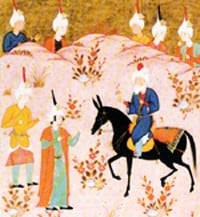
Ibn Arabi a caballo con dos discípulos (miniatura safaví) · Public domain
In eigenen Worten
«My heart has become capable of every form: it is a pasture for gazelles and a convent for Christian monks, And a temple for idols and the pilgrim's Ka'ba and the tables of the Tora and the book of the Koran. I follow the religion of Love: whatever way Love's camels take, that is my religion and my faith.»Tarjuman al-ashwaq, oda XI, vv. 13–15 (trad. Nicholson, 1911, pp. 66–67). En el comentario, el autor precisa que esa religión del amor es prerrogativa de los musulmanes, por ser Muhammad el amado de Dios.

Der zentrale Gedanke
Oneness of being (wahdat al-wujud): The formula *wahdat al-wujud* does not appear as such in Ibn Arabi; it was coined by his interpreters and above all by his critics, among them Ibn Taymiyya, to designate his doctrine.
Im Zusammenhang sehen
Biografie
5 Min. Lesezeit
Unterstützte Übersetzung aus dem spanischen Original, Durchsicht durch einen muttersprachlichen Übersetzer ausstehend.
Ein Murcianer im almohadischen Sevilla
Abu Abd Allah Muhammad ibn Ali ibn Muhammad ibn al-Arabi al-Hatimi at-Tai wurde am 17. Ramadan des Jahres 560 der Hidschra, also am 28. Juli 1165, in Murcia geboren. Seine Familie, arabischer Abstammung, die sich auf den Stamm Tayy und auf den sprichwörtlich freigebigen Hatim at-Tai zurückführte, diente König Ibn Mardanisch, dem „Wolfskönig“, der in der andalusischen Levante den Almohaden die Stirn bot. Als Murcia 1172 fiel, trat der Vater in die Dienste der Sieger, und die Familie ließ sich in Sevilla nieder. Dort wuchs der Junge auf, erzogen als Sohn eines Beamten: Koran, Hadith, Grammatik, Dichtung und, wie er sich selbst erinnern wird, eine weltliche Jugend mit Jagd und Geselligkeit, auf die er ohne Einzelheiten anspielt.
Um 1184, mit etwa zwanzig Jahren, betrat er den geistlichen Weg. In den Futuhat führt er seine Umkehr auf eine Vision zurück, in der ihm Jesus, Moses und Muhammad erschienen, und nennt Jesus seinen ersten Meister. In jenen Jahren lernte er die Sufis von al-Andalus kennen, deren Porträts er in zwei in Mekka geschriebenen Büchern hinterlassen sollte, dem Ruh al-quds und ad-Durra al-fachira: Asketen, Bäcker, Schuster und eine alte Frau aus Sevilla, Fatima bint al-Muthanna, die vor Freude das Tamburin schlug, weil Gott ihr diesen Schüler zum Sohn gegeben hatte. Aus dieser Zeit stammt auch die von ihm selbst erzählte Begegnung mit Averroes in Córdoba: Der große Philosoph wollte den Jüngling kennenlernen, von dem es hieß, er habe durch Erleuchtung erlangt, was andere durch Nachdenken suchen, und das Gespräch, das aus einem „Ja“ und einem „Nein“ bestand, ließ ihn blass und nachdenklich zurück.
Die Wanderjahre im Maghreb
Zwischen 1193 und 1200 wechselten Aufenthalte in al-Andalus mit Reisen in den Maghreb ab: Tunis, Fès, Marrakesch. In Almería schrieb er 1199 in elf Tagen die Mawaqi an-nudschum, eine Abhandlung über die Stationen des inneren Weges. In Córdoba erlebte er die Heimkehr des Leichnams von Averroes, der 1198 in Marrakesch gestorben war, und hielt ein berühmt gewordenes Bild fest: der Sarg auf der einen Seite des Maultiers und auf der anderen die Bücher des Philosophen, um das Gewicht auszugleichen. 1200 befahl ihm eine Vision in Marrakesch, nach Osten aufzubrechen. 1201 reiste er nach Tunis ab und sollte die Iberische Halbinsel nie wiedersehen.
Mekka und der Beginn eines gewaltigen Werkes
Über Tunis, Kairo, Hebron und Jerusalem erreichte er 1202 Mekka. Dort begann er al-Futuhat al-makkiyya, die „Mekkanischen Offenbarungen“, die ihm nach eigenem Bericht von einem geheimnisvollen jungen Mann eingegeben wurden, dem er bei der Kaaba begegnete. Dort lernte er auch den persischen Gelehrten Zahir ibn Rustam und dessen Tochter Nizam kennen, „das Auge der Sonne und des Glanzes“, eine junge Frau von großer Schönheit, Gelehrsamkeit und Frömmigkeit, die er in den Oden des Tardschuman al-aschwaq, „Der Dolmetsch der Sehnsüchte“, besingen sollte. Als Jahre später ein Rechtsgelehrter in Aleppo andeutete, diese Liebesgedichte seien bloße Galanterie, schrieb Ibn Arabi einen Kommentar Vers für Vers, um zu zeigen, dass jede Gazelle, jede Ruine in der Wüste und jedes ziehende Kamel von göttlichen Wirklichkeiten sprach.
Ein Reisender durch den seldschukischen und ayyubidischen Osten
Ab 1204 war sein Leben eine unablässige Wanderung: Mossul, wo er den Initiationsmantel (chirqa) aus der Hand eines Schülers von al-Chidr empfing; Konya, Malatya und Sivas am Seldschukenhof, wo er Freundschaft mit Madschd ad-Din Ishaq schloss, dessen Sohn Sadr ad-Din al-Qunawi sein großer Schüler und Ausleger werden sollte; Kairo, wo ihn die Rechtsgelehrten der Ketzerei bezichtigten; Bagdad, Aleppo, erneut Mekka. Die Überlieferung behauptet, er habe die Witwe Madschd ad-Dins geheiratet und Sadr ad-Din wie einen Sohn aufgezogen; über seine Frauen und Kinder weiß man kaum mehr, außer dem Namen seines Sohnes Sad ad-Din, eines in Malatya geborenen Dichters. Er schrieb ohne Unterlass: Sein eigenes Verzeichnis von 1234 nennt etwa zweihundertneunzig Werke, und der moderne Katalog von Osman Yahia erfasst 846 ihm zugeschriebene Titel, viele davon apokryph oder doppelt.
Damaskus: die Ringsteine und das Ende
Um 1223 ließ er sich in Damaskus nieder, unter dem Schutz einer Kadi-Familie, der Banu Zaki, und des ayyubidischen Umfelds. Dort sah er in den letzten zehn Nächten des Muharram 627 (Dezember 1229) im Traum den Propheten, der ihm ein Buch reichte und ihm befahl, es den Menschen zu übergeben: So stellt er selbst den Ursprung der Fusus al-hikam dar, der „Ringsteine der Weisheit“, siebenundzwanzig Kapitel über die jedem Propheten eigene Weisheit, von Adam bis Muhammad, die zum meistkommentierten und umstrittensten Text des Sufismus werden sollten. 1231 vollendete er die erste Fassung der Futuhat und 1238 die zweite, deren Autograph in siebenunddreißig Bänden in Istanbul aufbewahrt wird. Er starb in Damaskus am 16. November 1240 (Rabi ath-thani 638), im Kreis seiner Schüler, und wurde im Viertel Salihiyya am Fuß des Berges Qasiyun begraben. Letzte Worte sind nicht überliefert.
Ein Werk, das unaufhörlich umstritten bleibt
Man nannte ihn asch-Schaich al-akbar, den „Größten Meister“, und Muhyi ad-Din, „den Beleber der Religion“. Seine Schüler, allen voran al-Qunawi, systematisierten sein Denken in der Sprache der Philosophie, und die Formel wahdat al-wudschud, „Einheit des Seins“, die er selbst nie als solche verwendete, fasste ihn am Ende für Freunde wie Feinde zusammen. Ibn Taimiyya bekämpfte ihn hart; die Osmanen verehrten ihn, und Sultan Selim I. errichtete 1517 die Moschee und das Mausoleum, die noch heute sein Grab überwölben. Sein Einfluss durchzieht sieben Jahrhunderte lang die persische, türkische und indische Mystik. In Europa entdeckte ihn Miguel Asín Palacios, der ihn in El islam cristianizado (1931) neben der christlichen Mystik las; Henry Corbin machte ihn zum Philosophen der schöpferischen Imagination, und Michel Chodkiewicz, Claude Addas und William Chittick stellten ihn in seinen islamischen und koranischen Zusammenhang zurück. Murcia ehrt ihn heute als seinen universalsten Sohn.
Das Belegte und das Überlieferte
Anders als viele Mystiker hat Ibn Arabi viel von sich selbst gesprochen: Fast alles, was man über sein Leben weiß, stammt aus seinen eigenen Büchern, vor allem aus den Futuhat, dem Ruh al-quds und den Vorreden seiner Werke. Dieser Reichtum hat seinen Preis: Die Episoden sind aus seiner visionären Erfahrung heraus erzählt und lassen sich nicht immer überprüfen. Spätere arabische Biographien, etwa die von al-Maqqari im 17. Jahrhundert, fügen Wunder und posthume Prophezeiungen hinzu, die bereits der Legende angehören.
Quellen: Ibn al-Arabi. The Tarjumán al-Ashwáq: A Collection of Mystical Odes. Ed. y trad. de Reynold A. Nicholson. Oriental Translation Fund, New Series XX. Londres: Royal Asiatic Society, 1911. · Addas, Claude. Ibn ʿArabī ou la quête du Soufre Rouge. París: Gallimard, 1989. Trad. inglesa: Quest for the Red Sulphur: The Life of Ibn ʿArabī. Cambridge: Islamic Texts Society, 1993. · Chittick, William C. The Sufi Path of Knowledge: Ibn al-ʿArabi's Metaphysics of Imagination. Albany: State University of New York Press, 1989. · Corbin, Henry. L'imagination créatrice dans le soufisme d'Ibn ʿArabî. París: Flammarion, 1958 (trad. inglesa: Creative Imagination in the Sufism of Ibn ʿArabī, Princeton University Press, 1969); incluye la traducción del relato del encuentro con Averroes (Futuhat, ed. Bulaq, I, 153–154). · Nicholson, Reynold A. «Introduction» y prefacios traducidos, en The Tarjumán al-Ashwáq (1911), pp. 1–14.
Zeitleiste
Das Leben, Jahr für Jahr
Jeder Punkt ist ein belegtes Ereignis. Klicken Sie, um es mit Quelle und Grad der Gewissheit zu lesen.
28. Juli 11650 JahreMurcia
Birth
Born on 17 Ramadan 560 in the Murcia of Ibn Mardanish, into a family of officials of Arab lineage.
BelegtAddas, Claude. Ibn ʿArabī ou la quête du Soufre Rouge. París: Gallimard, 1989. Trad. inglesa: Quest for the Red Sulphur: The Life of Ibn ʿArabī. Cambridge: Islamic Texts Society, 1993.
Nach dem Tod
- 1517Ottoman mausoleum
- 1931El islam cristianizado
28. Juli 1165 · 0 Jahre
Birth
Born on 17 Ramadan 560 in the Murcia of Ibn Mardanish, into a family of officials of Arab lineage.
Belegt
1172 · 7 Jahre
Move to Seville
After the Almohad conquest of Murcia, the family settles in Seville, where the father serves the new rulers.
Belegt
um 1180 · 15 Jahre
Meeting with Averroes
While still an adolescent, he converses with Ibn Rushd in Córdoba; he recounts it himself in the *Futuhat*.
Belegt
um 1184 · 19 Jahre
Entry into the Sufi path
Around 580 AH he abandons worldly life; he attributes his conversion to a vision of Jesus, Moses and Muhammad.
Belegt
um 1193 · 28 Jahre
Journeys in the Maghreb
First stays in Tunis and Fez; he frequents the disciples of Abu Madyan.
Belegt
1199 · 34 Jahre
Mawaqi al-nujum
In Almería he composes in eleven days *Mawaqi al-nujum*, a treatise on the stages of the spiritual path.
Belegt
1201 · 36 Jahre
Final departure from al-Andalus
After a vision in Marrakesh (1200) ordering him to set out for the East, he leaves the peninsula for ever.
Belegt
1202 · 37 Jahre
Arrival in Mecca; the Futuhat begins
He arrives in 598 AH; he meets Zahir ibn Rustam and his daughter Nizam and begins *al-Futuhat al-Makkiyya*.
Belegt
1203 · 38 Jahre
Ruh al-quds
He writes the *Ruh al-quds*, an epistle with portraits of his Andalusi masters.
Belegt
um 1204 · 39 Jahre
Travels in Iraq and Anatolia
In Mosul he receives the mantle of al-Khidr; in Anatolia he befriends Majd al-Din Ishaq, father of Sadr al-Din al-Qunawi.
Wahrscheinlich
Januar 1215 · 49 Jahre
Tarjuman al-ashwaq and its commentary
He finishes the odes of the *Tarjuman* in Ramadan 611 (January 1215) and, in response to an Aleppan jurist's criticism, writes his commentary (*Dhakhair al-alaq*).
Belegt
um 1223 · 58 Jahre
Settlement in Damascus
He settles in Damascus under the protection of the Banu Zaki judges.
Wahrscheinlich
Dezember 1229 · 64 Jahre
The vision of the Fusus al-hikam
In the last ten nights of Muharram 627 he dreams that the Prophet hands him the *Fusus al-hikam*.
Belegt
1234 · 69 Jahre
Licence to Sultan al-Muzaffar
He grants an *ijaza* to the Ayyubid prince al-Malik al-Muzaffar listing some 290 of his works.
Belegt
1238 · 73 Jahre
Second redaction of the Futuhat
He completes the second version of *al-Futuhat al-Makkiyya*, whose autograph in 37 volumes survives.
Belegt
16. November 1240 · 75 Jahre
Death
He dies on 22 Rabi al-Thani 638 and is buried in Salihiyya, at the foot of Mount Qasiyun.
Belegt
1517
Ottoman mausoleum
After conquering Damascus, Selim I builds the mosque and mausoleum over his tomb.
Belegt
1931
El islam cristianizado
Miguel Asín Palacios publishes his study of Ibn Arabi, a starting point of Akbarian studies in the West.
Belegt
Werke
Grundlegende Werke
Die Werke, ohne die sich das Vermächtnis nicht verstehen lässt.
Schriftliches Werk · 1238
The Meccan Openings (al-Futuhat al-Makkiyya)
الفتوحات المكية (al-Futuhat al-Makkiyya)
A monumental work of 560 chapters in six sections, gathering all of Ibn Arabi's knowledge: the metaphysics of the divine names, cosmology, the esoteric interpretation of worship (purification, prayer, fasting, pilgrimage), the stations and abodes of the spiritual path, the hierarchy of saints and eschatology, together with many autobiographical episodes and visions. The author states that he did not compose it by reflection but through "openings" or illuminations received. It is the main source for his biography and the reference work of the whole Akbarian school; only part has been translated into European languages.
7 Ausgaben · amazon.de

Schriftliches Werk · um 1229
The Bezels of Wisdom (Fusus al-hikam)
فصوص الحكم (Fusus al-hikam)
Twenty-seven chapters, each devoted to the "wisdom" of a prophet (from Adam to Muhammad, by way of Noah, Abraham, Moses, Jesus or Solomon), understood as a bezel in which a precious stone is set: an aspect of divine knowledge. It is his densest work and the one that concentrates his boldest theses on the relationship between God and the world, imagination, beliefs and the perfect human being. It was commented on more than a hundred times (al-Qunawi, al-Jandi, al-Qashani, al-Qaysari, Jami) and attacked with equal intensity, by Ibn Taymiyya among others.
9 Ausgaben · amazon.com

Schriftliches Werk · 1215
The Interpreter of Desires (Tarjuman al-ashwaq)
ترجمان الأشواق (Tarjuman al-ashwaq)
A collection of love poetry in the tradition of the Arabic qasida: abandoned encampments, departing camels, gazelles and gardens, and a beloved inspired by Nizam, daughter of the Persian scholar with whom he studied in Mecca. Its famous ode XI proclaims a heart "capable of every form" and a "religion of love". The author's own commentary reads every image as a symbol of divine realities and is one of the keys to the Sufi hermeneutics of erotic language.
5 Ausgaben · amazon.com
Das gesamte Werk (30)
Ibn Arabi
The Treasures of Lovers (commentary on the Tarjuman)
The Conscious LibraryThe Treasures of Lovers (commentary on the Tarjuman)
1215

The Spirit of Holiness (portraits of Andalusi masters)
1203
Ibn Arabi
The Setting-Places of the Stars
The Conscious LibraryThe Setting-Places of the Stars
1199

The Contemplations of the Holy Mysteries
1194

The Book of Theophanies
1205

Treatise on Unity (attributed)
Ibn Arabi
The Production of the Circles
The Conscious LibraryThe Production of the Circles

Divine Governance of the Human Kingdom

The Book of Majesty and Beauty
What the Seeker Needs

The Adornment of the Spiritually Transformed
1203

Journey to the Lord of Power
1205
Ibn Arabi
The Book of the Night Journey
The Conscious LibraryThe Book of the Night Journey
1198

The Precious Pearl

The Fabulous Gryphon
1199

The Niche of Lights (Divine Sayings)
1203

The Universal Tree and the Four Birds

The Seven Days of the Heart

The Unveiling of the Effects of the Journey

The Secret of the Names of God
Ibn Arabi
The Brilliant Star: The Virtues of Dhu l-Nun the Egyptian
The Conscious LibraryThe Brilliant Star: The Virtues of Dhu l-Nun the Egyptian

The Tree of Being
Ibn Arabi
The Book of Mim, Waw and Nun
The Conscious LibraryThe Book of Mim, Waw and Nun
Ibn Arabi
The Great Diwan (mystical poetry)
The Conscious LibraryThe Great Diwan (mystical poetry)
Zitate
Zitate, die in einem bestimmten Werk nachgewiesen sind. Jedes trägt seine Herkunft und seinen Grad an Verlässlichkeit.
My heart has become capable of every form: it is a pasture for gazelles and a convent for Christian monks, And a temple for idols and the pilgrim's Ka'ba and the tables of the Tora and the book of the Koran. I follow the religion of Love: whatever way Love's camels take, that is my religion and my faith.لقد صار قلبي قابلاً كل صورةٍ / فمرعى لغزلانٍ وديرٌ لرهبانِ // وبيتٌ لأوثانٍ وكعبةُ طائفٍ / وألواحُ توراةٍ ومصحفُ قرآنِ // أدينُ بدينِ الحبِّ أنّى توجّهتْ / ركائبُه فالحبُّ ديني وإيماني
GeprüftTarjuman al-ashwaq, oda XI, vv. 13–15 (trad. Nicholson, 1911, pp. 66–67). En el comentario, el autor precisa que esa religión del amor es prerrogativa de los musulmanes, por ser Muhammad el amado de Dios.
Apokryphe Zitate oder Zitate umstrittener Zuschreibung (2)
«"When the sin enters the shin, the tomb of Muhyi al-Din will appear."»
A coded prophecy that Ottoman tradition ascribes to Ibn Arabi, read as announcing that Selim (with *sin*) would enter Damascus (*Sham*, with *shin*) and restore his tomb, as he did in 1517. It comes from *al-Shajara al-numaniyya*, an apocalyptic work attributed to him without foundation; it appears in none of his authentic writings.
«"Whoever knows himself knows his Lord", presented as the central teaching of Ibn Arabi's *Treatise on Unity*.»
The saying is a hadith of earlier Sufi circulation, which Ibn Arabi comments on in other works; but the *Treatise on Unity* (*Risalat al-ahadiyya*), where it is developed in radical terms, is by Awhad al-Din Balyani, as Michel Chodkiewicz demonstrated.
Letzte Worte
Es gibt keine überprüfbaren Aufzeichnungen der letzten Worte.
No reliably attributed final sentence survives. The biographical sources fix the date (22 Rabi al-Thani 638) and place of his death, in the house of the judge Muhyi al-Din ibn al-Zaki in Damascus, and his burial in Salihiyya, but transmit no last words.
Quelle: Addas, Claude. Ibn ʿArabī ou la quête du Soufre Rouge. París: Gallimard, 1989. Trad. inglesa: Quest for the Red Sulphur: The Life of Ibn ʿArabī. Cambridge: Islamic Texts Society, 1993.
Fragen
Was das Werk beantwortet
Zwölf große Fragen der Menschheit und was sich aus den Texten darauf antworten lässt, mit Belegen. Wir legen niemandem Worte in den Mund.
Was ist das Absolute? Gibt es Gott?
The Essence is unknowable; God makes Himself known through His Names
Persönlich und unpersönlich zugleichAusdrücklich gesagt
Ibn Arabi distinguishes rigorously between the divine Essence (al-dhat) and the Divinity that relates to the world. Of the Essence nothing can be said or known: it is free of all relation and all attribute. Yet that same Reality manifests as Lord through His Names — the Merciful, the Wise, the Living — which need beings in order to become visible; in the chapter on Adam of the Fusus al-hikam, the human being is the mirror in which God contemplates His Names. This God loves, wishes to be known and turns to each according to their capacity, to the point that every believer worships the God their belief has shaped. The Absolute is both inaccessible ground and a face turned towards the creature; to confuse the two planes, or to separate one entirely from the other, is for him an error.
Diese Frage mit anderen Meistern vergleichenWer bin ich? Gibt es ein wahres Selbst?
Whoever knows himself knows his Lord: He and not He
Das Selbst ist das AbsoluteAusdrücklich gesagt
Ibn Arabi makes the traditional saying «whoever knows himself knows his Lord» an axis of his work. For him, the human being has no existence of its own: what exists in it is God's existence, manifested according to the predisposition of each creature, its immutable entity (ayn thabita) eternally present in divine knowledge. In the Fusus al-hikam, the chapter on Adam presents the complete human being (al-insan al-kamil) as the mirror in which Reality contemplates all its Names. To know oneself is to discover that the self, in itself, is nothing, and that its reality is that of the Real. Yet Ibn Arabi rejects fusion (ittihad) and incarnation (hulul): the servant remains servant. His formula is paradoxical: the creature is He and is not He.
Diese Frage mit anderen Meistern vergleichenWarum leiden wir?
We suffer behind the veil; divine mercy precedes wrath
Die Trennung von GottAus der Lehre abgeleitet
Ibn Arabi does not treat suffering as a separate theme, but his work allows an answer to be reconstructed. The human being suffers because it is veiled: it perceives the multiplicity of things and not the single Reality manifest in them, and believes itself separate from God when its very existence is that of the Real. At the same time, Ibn Arabi gives central place to the divine saying that God's mercy precedes His wrath, and to the Qur'anic verse stating that His mercy embraces all things. Hence his thesis, controversial among theologians, that even the punishment of hell will eventually become sweet for those who dwell there, playing on the closeness in Arabic between punishment (adhab) and sweetness (adhb). Pain is real but provisional; the ultimate is mercy.
Diese Frage mit anderen Meistern vergleichenWas geschieht nach dem Tod?
From the barzakh to the resurrection: and mercy finally reaches everyone
Ewiges Leben und AuferstehungAusdrücklich gesagt
Ibn Arabi fully accepts Qur'anic eschatology — death, the intermediate state, bodily resurrection, judgement, paradise and hell — and interprets it through his metaphysics of imagination. After death the soul enters the barzakh, an intermediate world of images where deeds and beliefs take form; at the resurrection it receives a new body suited to the next life. His boldest feature is the primacy of mercy: relying on the verse according to which God's mercy embraces all things, he holds in the Futuhat and the Fusus that the punishment of the fire is not eternal in its pain. The damned will remain in their abode, but the torment (ʿadhāb) will eventually turn sweet (ʿadhb) for them. Death does not destroy the being's relationship with God; it reveals it, because every creature has always been a manifestation of His names.
Diese Frage mit anderen Meistern vergleichenWie erlangt man Befreiung oder Erlösung?
Realising who one is means knowing one's Lord: knowledge by unveiling, not by reasoning
Durch unmittelbare ErkenntnisAusdrücklich gesagt
Ibn Arabi organises the path around the saying, transmitted in Sufi circles, that whoever knows himself knows his Lord. The goal is realisation (tahqiq): understanding by experience that every being is a manifestation of the divine Names and that the complete human being reflects the totality of those Names. That knowledge does not come from philosophical reasoning, to which he grants limited scope, but from unveiling (kashf), which God grants to whoever prepares through observance of the law, invocation, retreat and purification. Alongside this, Ibn Arabi holds that divine mercy embraces everything, which leads him to qualify the eternity of punishment in the hereafter.
Diese Frage mit anderen Meistern vergleichenBraucht es einen Lehrer?
The ordinary path passes through masters, but God can teach directly
Hilfreich, aber nicht unverzichtbarAus der Lehre abgeleitet
Ibn Arabi had numerous teachers in al-Andalus and the Maghreb, to whom he devoted portraits in The Spirit of Holiness, and in The Meccan Revelations he deals in detail with the rules of courtesy (adab) governing the relationship between disciple and master. For most people, the path runs through a shaykh who knows the states and dangers of the way. Yet Ibn Arabi admits and claims another mode of transmission: that of someone instructed directly by God or by spiritual figures such as Khidr, from whom he claimed to have received investiture. The human teacher is therefore the usual and valuable channel, but not the exclusive one, because the true teacher of all knowledge is God.
Diese Frage mit anderen Meistern vergleichenIst die Welt wirklich?
The cosmos is the mirror in which God contemplates His Names
Offenbarung des GöttlichenAusdrücklich gesagt
Ibn Arabi conceives of the world as God's self-disclosure (tajalli). The first chapter of The Bezels of Wisdom, devoted to Adam, explains that God wished to see His Names in a being that would reflect them all: He created the cosmos like an unpolished mirror, and the human being was the polishing of that mirror. Everything that exists is thus a locus of manifestation of some divine Name. The world is neither God in His essence, which remains unknowable, nor an independent reality: it is «He and not He», and is renewed at every instant. Ibn Arabi therefore gives the world an intermediate status, comparable to imagination, real as reflection, without consistency of its own.
Diese Frage mit anderen Meistern vergleichenWas ist Liebe?
God loved to be known: love is the origin of the world and its return
Sehnsucht und VereinigungAusdrücklich gesagt
Ibn Arabi makes love the very principle of creation. Relying on a saying attributed to God in the Sufi tradition — I was a hidden treasure and loved to be known — he explains that the world is born of divine love for self-manifestation, and that all created love is, at bottom, God's love for himself through creatures. No one loves anything but God, even when believing they love a particular person, because all beauty is his manifestation. In the chapter on love in the Futuhat he distinguishes divine, spiritual and natural love and describes their states. In the Tarjuman al-ashwaq, a collection of love poems inspired by the young Nizam, he declares that his heart has become capable of every form and that he follows the religion of love, wherever its caravans turn.
Diese Frage mit anderen Meistern vergleichenSind wir frei, oder ist alles vorherbestimmt?
God gives only what each essence asks for: the secret of destiny
Es gibt keinen HandelndenAusdrücklich gesagt
Ibn Arabi addresses the question in the chapter of the *Fusus al-hikam* devoted to the prophet Uzayr, under the name «secret of destiny» (*sirr al-qadar*). His thesis is that the divine decree follows God's knowledge, and that this knowledge follows the known: the immutable essences (*aʿyān thābita*) of each thing, which by their own preparedness ask for what they will receive. No one is compelled except by what he himself is in God's knowledge. At the same time, the only real agent is God, acting through the forms of creatures. The consequence is not moral fatalism, since the revealed law still binds, but that the self who believes it decides on its own is a partial perspective on a single divine activity.
Diese Frage mit anderen Meistern vergleichenWozu meditieren oder beten?
Prayer is intimate conversation between God and his servant
Freundschaft mit GottAusdrücklich gesagt
In the last chapter of the *Fusus al-hikam*, devoted to the Prophet Muhammad, Ibn Arabi interprets ritual prayer (*ṣalāt*) as *munājāt*, intimate conversation: drawing on the hadith that God has divided the prayer between Himself and His servant, he holds that in it God speaks and listens at once, and that the one who prays sees the One with whom he converses. Hence he calls it, following another hadith, the coolness of the Prophet's eyes. Alongside prescribed prayer he valued remembrance of God (*dhikr*) and retreat (*khalwa*), which he describes in the *Epistle of Lights*. The aim is not to leave the relationship but to worship God as if seeing Him, what tradition calls *iḥsān*, until recognising Him in every form.
Diese Frage mit anderen Meistern vergleichenKann die Vernunft das Letzte erkennen?
Reason binds; divine unveiling grants the knowledge of secrets
Das Letzte liegt jenseits des VerstandesAusdrücklich gesagt
In the introduction to *The Meccan Openings* (*al-Futuhat al-makkiyya*), Ibn Arabi distinguishes three kinds of knowledge: that of the intellect, obtained by demonstration; that of states, reached only by tasting or experience; and that of secrets, which lies above the intellect and is granted by God to prophets and saints. He plays on the etymology of *ʿaql* (intellect), related to the hobble placed on a camel: reason binds and delimits, and so cannot encompass a God who is both transcendent and present in every form. In his letter to the theologian Fakhr al-Din al-Razi he advises him to leave speculation and seek the knowledge that comes from God through retreat and remembrance.
Diese Frage mit anderen Meistern vergleichenSich von der Welt zurückziehen oder sie verwandeln?
The highest is outwardly indistinguishable: he returns to live among creatures
Kontemplation im HandelnAus der Lehre abgeleitet
Ibn Arabi practised retreats (khalwa) and describes in the Futuhat the illuminations he received in them, but he does not make retreat the goal. In his spiritual hierarchy the highest rank belongs to the malamiyya, the «people of blame», who after attaining realisation return to ordinary life, without distinctive dress or visible wonders, and blend in with common people while their inner being remains with God. The spiritual journey, for him, has a return: the one who has ascended to God descends again towards creatures to serve and guide them. His own life was that of a traveller between al-Andalus, the Maghreb, Mecca, Anatolia and Damascus, in contact with masters, disciples and rulers, to whom he occasionally wrote advising them on how to govern. Contemplation and presence in the world are not opposed: the world is God's manifestation.
Diese Frage mit anderen Meistern vergleichen
Affinitäten und Spannungen
Affinitäten und Spannungen
Frage für Frage aus den Positionen berechnet. Den Grund jeder Übereinstimmung und jedes Widerspruchs zeigt ein Klick.
Denkt ähnlich wie
Attar
Übereinstimmung bei: Was ist das Absolute? Gibt es Gott? · Wer bin ich? Gibt es ein wahres Selbst? · Warum leiden wir?

Al-Hallaj
Übereinstimmung bei: Wer bin ich? Gibt es ein wahres Selbst? · Warum leiden wir? · Was geschieht nach dem Tod?
Ramakrishna
Übereinstimmung bei: Was ist das Absolute? Gibt es Gott? · Wer bin ich? Gibt es ein wahres Selbst? · Warum leiden wir?
Anandamayi Ma
Übereinstimmung bei: Was ist das Absolute? Gibt es Gott? · Wer bin ich? Gibt es ein wahres Selbst? · Ist die Welt wirklich?
Denkt anders als

Epicurus
Widerspruch bei: Wer bin ich? Gibt es ein wahres Selbst? · Was geschieht nach dem Tod?

Tsongkhapa
Widerspruch bei: Wer bin ich? Gibt es ein wahres Selbst? · Was geschieht nach dem Tod?

Pema Chödrön
Widerspruch bei: Wer bin ich? Gibt es ein wahres Selbst? · Was geschieht nach dem Tod?
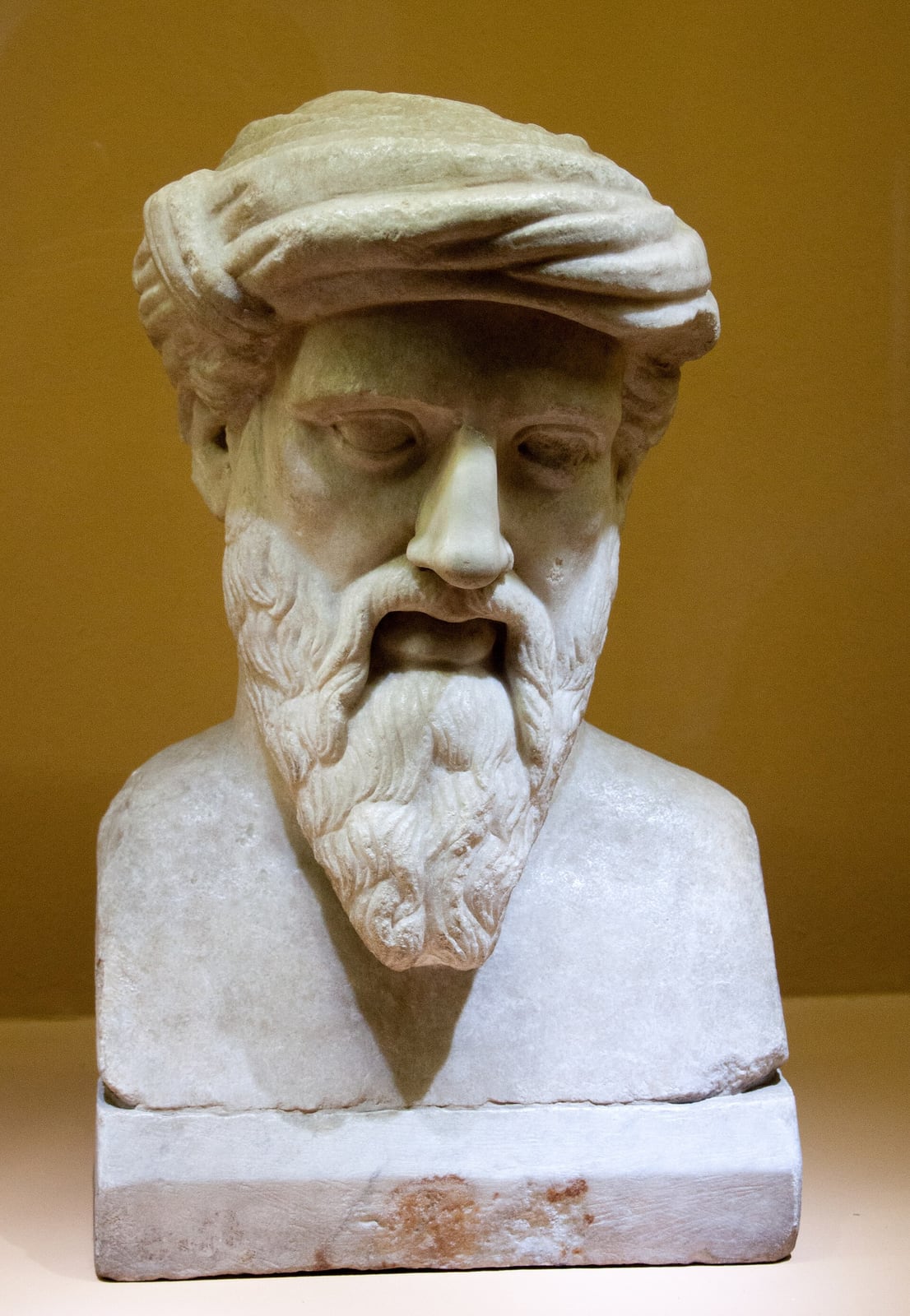
Pythagoras
Widerspruch bei: Was geschieht nach dem Tod?
Übereinstimmung bei
Ibn Arabi · Adi Shankara
Two metaphysics of unity, in Murcia and in Kerala
Warum: The affinity comes from the same question pushed to its limit: how can there be multiplicity if the Absolute is one. Both answer with a doctrine of levels, empirical and ultimate truth in one, Essence and Names in the other, which allows them to keep worship and law without giving up unity. There is no historical relation between them, and the differences are serious: for Ibn Arabi the world is a self-revelation willed by a God who loves to be known, and the servant remains a servant; for Shankara the world is a superimposition due to ignorance, and the liberated one retains no distinction. One thinks a theophany; the other, an error that dissolves. They agree in structure, not in feeling.
Widerspruch beiScheinbarer Widerspruch
Ibn Arabi · Teresa of Ávila
Always a creature, or He and not He: two languages for a union without confusion
Warum: The tension is apparent because they use different categories for a similar experience. Teresa writes under the scrutiny of the Inquisition and of her learned confessors, within a theology that distinguishes creator and creature at the level of being, and so she stresses the distinction every time she describes union. Ibn Arabi works with a metaphysics of the single existence and of the mirror, in which saying that the creature has no being of its own does not mean it is God in his Essence, which remains unknowable. She speaks of what the soul lives; he, of what being is. They agree in practice: knowing oneself and knowing God go together, and the goal is intimacy without confusion.
Übereinstimmung bei
Ibn Arabi · Rumi
Love as the origin and return of the world: two summits of Sufism in the same century
Warum: They share an era, a religious language and sources: the Qur'an, the sayings attributed to the Prophet and the Sufi tradition that made love the principal way. There was also an indirect link: Sadr al-Din al-Qunawi, Ibn Arabi's stepson and chief disciple, taught in Konya in the same years as Rumi, and the Mevlevi hagiographies present them on cordial terms; there is no evidence that Rumi read Ibn Arabi or that they met. The difference is one of register. Ibn Arabi elaborates a technical metaphysics of the divine Names and of manifestation; Rumi writes narrative and lyrical poetry, without a system, where love is an experience of separation and longing before it is doctrine.
Übereinstimmung bei
Ibn Arabi · Hildegard of Bingen
The human being as mirror of the cosmos and of the divine
Warum: There was no contact between the German abbess and the Andalusian mystic, contemporaries for only a few years. The affinity stems from a common inheritance: the ancient idea of the human being as microcosm, Greek and Neoplatonic in origin, which circulated both in Latin Europe and in the Islamic world, and a reading of creation as the language of God. The differences are substantive. Hildegard sharply maintains the distinction between Creator and creature and thinks of the harmony lost through sin and restored in Christ; Ibn Arabi says the world is He and not He, within a metaphysics of the single existence. She contemplates visions; he builds a theory of the Names.
Anekdoten und Erzählungen
Anekdoten und Erzählungen
Zeugnisc. 1180
"Yes" and "No": the meeting with Averroes
Herkunft der Erzählung: Autobiographical account in *al-Futuhat al-Makkiyya* (Bulaq ed., I, 153–154), translated by Corbin (1958). It is the only testimony of the meeting; Averroes does not mention it.
Quelle: Corbin, Henry. L'imagination créatrice dans le soufisme d'Ibn ʿArabî. París: Flammarion, 1958 (trad. inglesa: Creative Imagination in the Sufism of Ibn ʿArabī, Princeton University Press, 1969); incluye la traducción del relato del encuentro con Averroes (Futuhat, ed. Bulaq, I, 153–154).
Zeugnis1198–1199
The coffin and the books
Herkunft der Erzählung: *Al-Futuhat al-Makkiyya*, I, 154 (Bulaq ed.), following the account of the first meeting; translation in Corbin 1958.
Quelle: Corbin, Henry. L'imagination créatrice dans le soufisme d'Ibn ʿArabî. París: Flammarion, 1958 (trad. inglesa: Creative Imagination in the Sufism of Ibn ʿArabī, Princeton University Press, 1969); incluye la traducción del relato del encuentro con Averroes (Futuhat, ed. Bulaq, I, 153–154).
Zeugnisc. 1185–1190
Fatima of Seville, the old woman with the tambourine
Herkunft der Erzählung: *Ruh al-quds* and *al-Durra al-fakhira*, trans. Austin, Sufis of Andalusia (1971); Asín Palacios, Vidas de santones andaluces (1933).
Quelle: Ibn al-Arabi. Sufis of Andalusia: The Ruh al-quds and al-Durrat al-fakhirah. Trad. de R. W. J. Austin. Londres: Allen & Unwin, 1971; y Asín Palacios, Miguel. Vidas de santones andaluces. Madrid, 1933 (reed. Hiperión, 1981).
Belegt1202–1215
Nizam and the jurist of Aleppo
Herkunft der Erzählung: Prefaces to the first and third recensions of the *Tarjuman*, translated by Nicholson (1911, pp. 3–5).
Zeugnis1202
The youth beside the Kaaba
Herkunft der Erzählung: *Al-Futuhat al-Makkiyya*, ch. 1 (the author's visionary account); analysis in Addas 1989 and Corbin 1958.
Quelle: Addas, Claude. Ibn ʿArabī ou la quête du Soufre Rouge. París: Gallimard, 1989. Trad. inglesa: Quest for the Red Sulphur: The Life of Ibn ʿArabī. Cambridge: Islamic Texts Society, 1993.
Zeugnis1229
The vision of the Bezels
Herkunft der Erzählung: Preface to the *Fusus al-hikam* (Afifi ed., 1946; Austin trans., 1980).
Quelle: Ibn al-Arabi. Fusus al-hikam. Ed. Abu al-Ala Afifi. El Cairo, 1946. Trad. inglesa: R. W. J. Austin, The Bezels of Wisdom (Classics of Western Spirituality). Nueva York: Paulist Press, 1980.
Nicht überprüfbar1516–1517
Selim I and the hidden tomb
Herkunft der Erzählung: Ottoman tradition based on the apocryphal *al-Shajara al-numaniyya*; Addas and Chodkiewicz record it as legend.
Quelle: Addas, Claude. Ibn ʿArabī ou la quête du Soufre Rouge. París: Gallimard, 1989. Trad. inglesa: Quest for the Red Sulphur: The Life of Ibn ʿArabī. Cambridge: Islamic Texts Society, 1993.
Lehren
Lehren
Die Begriffe, die das Denken gliedern, in ihrem Zusammenhang erklärt.
Oneness of being (wahdat al-wujud)wahdat-al-wujud
Doctrine systematised by al-Qunawi and debated for centuries (as against Ahmad Sirhindi's *wahdat al-shuhud*).
Quelle: Chittick, William C. The Sufi Path of Knowledge: Ibn al-ʿArabi's Metaphysics of Imagination. Albany: State University of New York Press, 1989.
The perfect human being (al-insan al-kamil)insan-kamil
Qur'anic anthropology and the hadith of the image; extended by Abd al-Karim al-Jili (d. c. 1408).
Quelle: Ibn al-Arabi. Fusus al-hikam. Ed. Abu al-Ala Afifi. El Cairo, 1946. Trad. inglesa: R. W. J. Austin, The Bezels of Wisdom (Classics of Western Spirituality). Nueva York: Paulist Press, 1980.
Imagination and isthmus (khayal, barzakh)khayal
A reworking of philosophical psychology (Avicenna) and of the Qur'anic eschatology of the *barzakh* (Qur'an 23:100).
Quelle: Corbin, Henry. L'imagination créatrice dans le soufisme d'Ibn ʿArabî. París: Flammarion, 1958 (trad. inglesa: Creative Imagination in the Sufism of Ibn ʿArabī, Princeton University Press, 1969); incluye la traducción del relato del encuentro con Averroes (Futuhat, ed. Bulaq, I, 153–154).
Theophany or divine self-disclosure (tajalli)tajalli
It develops the Qur'anic notion of God's signs in the world and in souls (Qur'an 41:53).
Quelle: Chittick, William C. The Sufi Path of Knowledge: Ibn al-ʿArabi's Metaphysics of Imagination. Albany: State University of New York Press, 1989.
Immutable entities (ayan thabita)ayan-thabita
It takes up and transforms debates of *Mutazili* theology on the "thingness" of the non-existent.
Quelle: Chittick, William C. The Sufi Path of Knowledge: Ibn al-ʿArabi's Metaphysics of Imagination. Albany: State University of New York Press, 1989.
The seal of the saints (khatm al-awliya)khatm-al-awliya
It develops ideas of al-Hakim al-Tirmidhi (9th c.) on the seal of sainthood.
Quelle: Chodkiewicz, Michel. Le Sceau des saints: prophétie et sainteté dans la doctrine d'Ibn ʿArabî. París: Gallimard, 1986. Trad. inglesa: The Seal of the Saints. Cambridge: Islamic Texts Society, 1993.
Retreats
Retreats und Zentren
Orte und Begegnungen, die mit dieser Lehre verbunden sind. Wir stellen den Kontakt zu den Veranstaltern her.
Oxford (Reino Unido) y Berkeley (EE. UU.), y en línea · Reino Unido / Estados Unidos
Muhyiddin Ibn Arabi Society: symposia and courses
Muhyiddin Ibn Arabi Society
The Muhyiddin Ibn Arabi Society was founded in 1977 to promote understanding of the work of Ibn Arabi and his followers, and is represented by non-profit organisations in Oxford and Berkeley. Since 1982 it has published a peer-reviewed journal, since 1984 it has held conferences in the UK and the USA, with more than a hundred talks available as podcasts and videos, and it runs an education programme with courses. Since 2002 it has also been collecting copies of the historic manuscripts of his works. It is the reference institution for the rigorous study of the Shaykh al-Akbar.
Chisholme House (Escocia), Sutton Courtenay (Oxfordshire), Londres y en línea · Reino Unido
Beshara: Foundation course and Masnavi study
The Beshara Trust
Beshara is the educational offering of the Beshara Trust, a British charity founded in 1971. Its foundation course takes the metaphysics of Ibn Arabi as its starting point to explore what it means to know oneself and the world in the light of the Unity of Existence, combining an introductory weekend, fortnightly online sessions and an optional residential at Chisholme House in the Scottish Borders. It also runs study groups on Rumi's Masnavi and other texts of the Sufi tradition. It is funded by philanthropic donations and voluntary work, and bookings are made by contacting the trust.
Videos
Videos
Aufnahmen, Gespräche und Dokumentarfilme. Die Videos werden von YouTube wiedergegeben; sie werden nicht hier gespeichert.
Translation, Ibn al-ʿArabi, and the Islamic Past: William C. Chittick Keynote (2023 Conference)
Vortrag· EN· 2023· 91 min
Columbia University Department of HistoryOffizieller Kanal
Eric Geoffroy: Some Aspects of "Supra-reason" in Ibn 'Arabi's Epistomology
Vortrag· EN· 61 min
Ibn 'Arabi SocietyOffizieller Kanal
Pablo Beneito: Keys to Decipher Ibn ʻArabī's Manzil al-manāzil
Vortrag· EN· 55 min
Ibn 'Arabi SocietyOffizieller Kanal
Ibn 'Arabi & The Unity of Being
Analyse· EN· 72 min
Let's Talk Religion
The Bezels of Wisdom - Ibn 'Arabi's Controversial Masterpiece
Analyse· EN· 94 min
Let's Talk Religion
La morada de la no-morada: el legado vivo de Ibn Arabi en su 850 aniversario
Vortrag· ES· 2015· 62 min
Casa ÁrabeOffizieller Kanal
La Visión De Ibn Arabi | Pablo Beneito
Gespräch· ES· 66 min
Psicología y Espiritualidad
Ibn 'Arabî: un saint, un penseur et un poète par Claude Addas
Vortrag· FR· 27 min
Conscience Soufie
Ibn ‘Arabî et sainteté en islam par Michel Chodkiewicz
Vortrag· FR· 26 min
Conscience Soufie
İbnü'l Arabi ve "Vahdet-i Vücud" | Düşüncenin Seyir Defteri | 16. Bölüm
Dokumentarfilm· TR· 51 min
TRT 2Offizieller Kanal
بالهجري: ابن عربي
Dokumentarfilm· AR· 3 min
AlJazeera Arabic قناة الجزيرةOffizieller Kanal
Galerie
Galerie
Bilder mit geprüfter Lizenz. Jedes bewahrt seine Urheberschaft und seinen Herkunftsnachweis.
Handschriften
Handschriften
Handschriftliche Zeugen und alte Texte, mit ihrer verwahrenden Einrichtung und ihren Einsichtsbedingungen.
AR · Nasj · 1231–1238 (segunda redacción)
الفتوحات المكية (al-Futuhat al-Makkiyya), autógrafo de la segunda redacción
- Erhaltener Textzeuge
- 37 volúmenes autógrafos, con certificados de lectura
- Verwahrende Einrichtung
- Museo de Arte Turco e Islámico (Türk ve İslam Eserleri Müzesi), Estambul · Evkaf Müzesi 1845–1881
AR · Nasj · 1229 (texto); c. 1232 (copia)
فصوص الحكم (Fusus al-hikam), copia de Sadr al-Din al-Qunawi
- Erhaltener Textzeuge
- Códice con certificado de audición en presencia del autor
- Verwahrende Einrichtung
- Museo de Arte Turco e Islámico, Estambul · Evkaf Müzesi 1933
Beziehungen
Beziehungen
Einflüsse, Schülerschaften und Verwandtschaften. Die belegte Beziehung wird von der durch Analyse ermittelten Ähnlichkeit unterschieden.
Zeitgenosse von
Contemporaries with no documented meeting. The link is Sadr al-Din al-Qunawi, Ibn Arabi's stepson and chief disciple, who lived in Konya, knew Rumi and, according to Aflaki, was to lead his funeral prayer. The anecdote that Ibn Arabi saw the boy Rumi in Damascus is late.
Belegte Beziehung
Beeinflusst von
Ibn Arabi read and cites al-Ghazali, with whom he shares the critique of the limits of speculative reason, though he disagrees with him on points of metaphysics.
Belegte Beziehung
Verwandte Gedanken mit
Asín Palacios proposed parallels between Andalusi and Carmelite mysticism (dark night, love and erotic symbolism). The hypothesis of direct influence is unproven.
Durch Analyse ermittelte Ähnlichkeit
Verwandte Gedanken mit
Convergences in the metaphysics of being and the relation between God and the soul, studied comparatively; no contact.
Durch Analyse ermittelte Ähnlichkeit
Verwandte Gedanken mit
Toshihiko Izutsu systematically compared Ibn Arabi's key concepts with those of Laozi and Zhuangzi in *Sufism and Taoism* (1983). An academic comparison, not influence.
Durch Analyse ermittelte Ähnlichkeit
Von anderen Einträgen aus verknüpft
Quellen
Quellen
Für diesen Eintrag herangezogene Bibliografie und Kataloge.
- Wikidata, Q46420 «Ibn Arabi» (P31=Q5; 89 enlaces entre wikis; P569 1165-07-28; P570 1240-11-16).
- Ibn al-Arabi. The Tarjumán al-Ashwáq: A Collection of Mystical Odes. Ed. y trad. de Reynold A. Nicholson. Oriental Translation Fund, New Series XX. Londres: Royal Asiatic Society, 1911.
- Addas, Claude. Ibn ʿArabī ou la quête du Soufre Rouge. París: Gallimard, 1989. Trad. inglesa: Quest for the Red Sulphur: The Life of Ibn ʿArabī. Cambridge: Islamic Texts Society, 1993.
- Chittick, William C. The Sufi Path of Knowledge: Ibn al-ʿArabi's Metaphysics of Imagination. Albany: State University of New York Press, 1989.
- Corbin, Henry. L'imagination créatrice dans le soufisme d'Ibn ʿArabî. París: Flammarion, 1958 (trad. inglesa: Creative Imagination in the Sufism of Ibn ʿArabī, Princeton University Press, 1969); incluye la traducción del relato del encuentro con Averroes (Futuhat, ed. Bulaq, I, 153–154).
- Nicholson, Reynold A. «Introduction» y prefacios traducidos, en The Tarjumán al-Ashwáq (1911), pp. 1–14.
- Ibn al-Arabi. Fusus al-hikam. Ed. Abu al-Ala Afifi. El Cairo, 1946. Trad. inglesa: R. W. J. Austin, The Bezels of Wisdom (Classics of Western Spirituality). Nueva York: Paulist Press, 1980.
- Asín Palacios, Miguel. El islam cristianizado: estudio del sufismo a través de las obras de Abenarabi de Murcia. Madrid: Plutarco, 1931 (reed. Hiperión, 1981).
- Chodkiewicz, Michel. Le Sceau des saints: prophétie et sainteté dans la doctrine d'Ibn ʿArabî. París: Gallimard, 1986. Trad. inglesa: The Seal of the Saints. Cambridge: Islamic Texts Society, 1993.
- Nicholson, Reynold A. The Mystics of Islam. Londres: G. Bell and Sons, 1914.
- Yahia, Osman. Histoire et classification de l'œuvre d'Ibn ʿArabî: étude critique. 2 vols. Damasco: Institut Français de Damas, 1964.
- Ibn al-Arabi. Sufis of Andalusia: The Ruh al-quds and al-Durrat al-fakhirah. Trad. de R. W. J. Austin. Londres: Allen & Unwin, 1971; y Asín Palacios, Miguel. Vidas de santones andaluces. Madrid, 1933 (reed. Hiperión, 1981).
- Muhyiddin Ibn ʿArabi Society (Oxford), recursos y catálogo de manuscritos (Ibn ʿArabi Digital Archive).
- Open Library, registros de ediciones de las obras de Ibn Arabi (Futuhat, Fusus, Tarjuman, Ruh al-quds, Mashahid al-asrar).
- Open Library, registros de ediciones y traducciones de los tratados menores de Ibn Arabi (Nyberg 1919; Anqa Publishing; Fons Vitae; Threshold; Éditions de l'Éclat; Éditions de l'Œuvre; Editora Regional de Murcia; Sirio), consultados el 2026-10-25.
- Chittick, William C. «Ibn ʿArabī». En Edward N. Zalta (ed.), The Stanford Encyclopedia of Philosophy. Primera publicación: 5 de agosto de 2008; revisión sustancial: 5 de diciembre de 2025.
- Rechteinhaber
- Dominio público (obra del siglo XIII). Las ediciones críticas (Osman Yahia, Afifi) y las traducciones modernas (Siruela, Hiperión, Editora Regional de Murcia, Paulist Press, Pir Press, Albin Michel, Al-Bouraq, C. H. Beck…) están sujetas a los derechos de sus editores.
- Offizielle Website
- www.ibnarabisociety.org/
Bestätigung ausstehend
Was dieser Eintrag noch nicht klären konnte. Wir sagen es lieber, als es aufzufüllen.
- Localizar ISBN de «El intérprete de los deseos» (trad. Carlos Varona, Editora Regional de Murcia, 2002) en el catálogo de la BNE o de la editorial.
- Comprobar el ISBN de «Contemplation of the Holy Mysteries» (Anqa, 2001) y de las ediciones árabes críticas (Osman Yahia; al-Mansub, Saná 2010).
- Verificar en el catálogo del Museo de Arte Turco e Islámico las signaturas Evkaf 1845–1881 (Futuhat) y Evkaf 1933 (Fusus).
- Identificar la obra de procedencia de la cita «Gnostics cannot impart their feelings…» (Nicholson, 1914) y el capítulo exacto de los Fusus de la cita sobre los credos.
- Cotejar el texto árabe del prefacio de los Fusus con la edición de Afifi (se ha transcrito sin verificación directa).
- Añadir ediciones en ruso (A. V. Smirnov), hindi y persa de los Fusus con ISBN verificado.
- Precisar la fecha y el lugar de redacción de *Mashahid al-asrar* y *Kitab al-tajalliyat*.
- Obra completa (2026-10-25): Osman Yahia (fuente i10) catalogó 846 títulos atribuidos, de los que unos 550 se conservan y buena parte son opúsculos o atribuciones dudosas. Se registran los tratados principales con edición o traducción real; quedan fuera, entre otros, Kitab al-fana' fi l-mushahada (trad. francesa de Michel Vâlsan, sin edición verificada en catálogo), Muhadarat al-abrar (atribución discutida), al-Diwan al-akbar, Naqsh al-fusus, Kitab al-'abadila, Kitab al-qurba, Kitab al-ahadiyya y las selecciones de capítulos de las Futuhat publicadas como libro (Traité de l'amour, L'alchimie du bonheur parfait, La profession de foi, Textos sobre la caballería espiritual). Catálogo completo: Yahia 1964 y el Ibn Arabi Digital Archive (MIAS, i12).
- Confirmar el traductor de The Four Pillars of Spiritual Transformation (Anqa, 2009) y de Divine Sayings (Anqa, 2005): Open Library no lo indica.
- Precisar la fecha de redacción de Insha' al-dawa'ir, al-Tadbirat al-ilahiyya, Kitab al-jalal wa-l-jamal y al-Ittihad al-kawni (Yahia 1964).
- Sala de lectura (2026-10-25): no se registran otras traducciones. «Wisdom of the Prophets» (Fusus, trad. sinóptica de Khaja Khan, Madrás 1928; archive.org in.ernet.dli.2015.217778) es libre en EE. UU., pero se desconoce la fecha de muerte del traductor, lleva prólogo de Louis Massignon (m. 1962) y el OCR es defectuoso. «Vidas de santones andaluces» (Asín Palacios, 1933) y las traducciones de «El islam cristianizado» (1931) son libres en España y la UE (Asín murió en 1944), pero no en EE. UU. hasta 2029 y 2027. Los textos árabes de la Futuhat y los Fusus no están en Wikisource árabe (solo refutaciones de Ibn Taymiyya).
- Obras (2026-10-25): añadidos al-Diwan al-akbar, Muhadarat al-abrar (atribuida), Tadhkirat al-khawass y la colección Rasaʾil Ibn al-ʿArabi; siguen fuera como obras propias Kitab al-ʿabadila, Kitab al-qurba (incluido en la colección Rasaʾil), Naqsh al-fusus y las antologías temáticas de la Futuhat (p. ej. «Textos sobre la caballería espiritual», Edaf 2006, ISBN 8441417431, sin traductor en catálogo).
- Vídeos: año de emisión de la cápsula de Al Jazeera («Bil-hijri: Ibn Arabi») no indicado; queda en null.
Recherchiert am 2026-10-23