Islam · Sufismus
Attar
فریدالدین ابوحامد محمد عطار نیشابوری · عطار
um 1145 – 1221Historisch belegte Person
Persischer Dichter und Hagiograph (Nischapur, um 1145 – um 1221), Apotheker von Beruf und eine Hauptgestalt der Sufi-Dichtung. Seine Vogelgespräche (Mantiq at-tair) erzählen von der Reise der Vögel durch sieben Täler, bis sie entdecken, dass der Simurgh sie selbst sind; mit dem Ilahi-Name, dem Musibat-Name und dem Asrar-Name bilden sie einen Zyklus mystischer Masnawis, und seine Tadhkirat al-auliya ist die große persische Sammlung von Heiligenleben. Viele Werke, die unter seinem Namen umlaufen, stammen von einem anderen Attar. Rumi war sein Erbe.
- Werke
- 29Werke
- Ausgaben
- 32Ausgaben
- Zitate
- 6Zitate
- Videos
- 13Videos
- Bilder
- 8Bilder
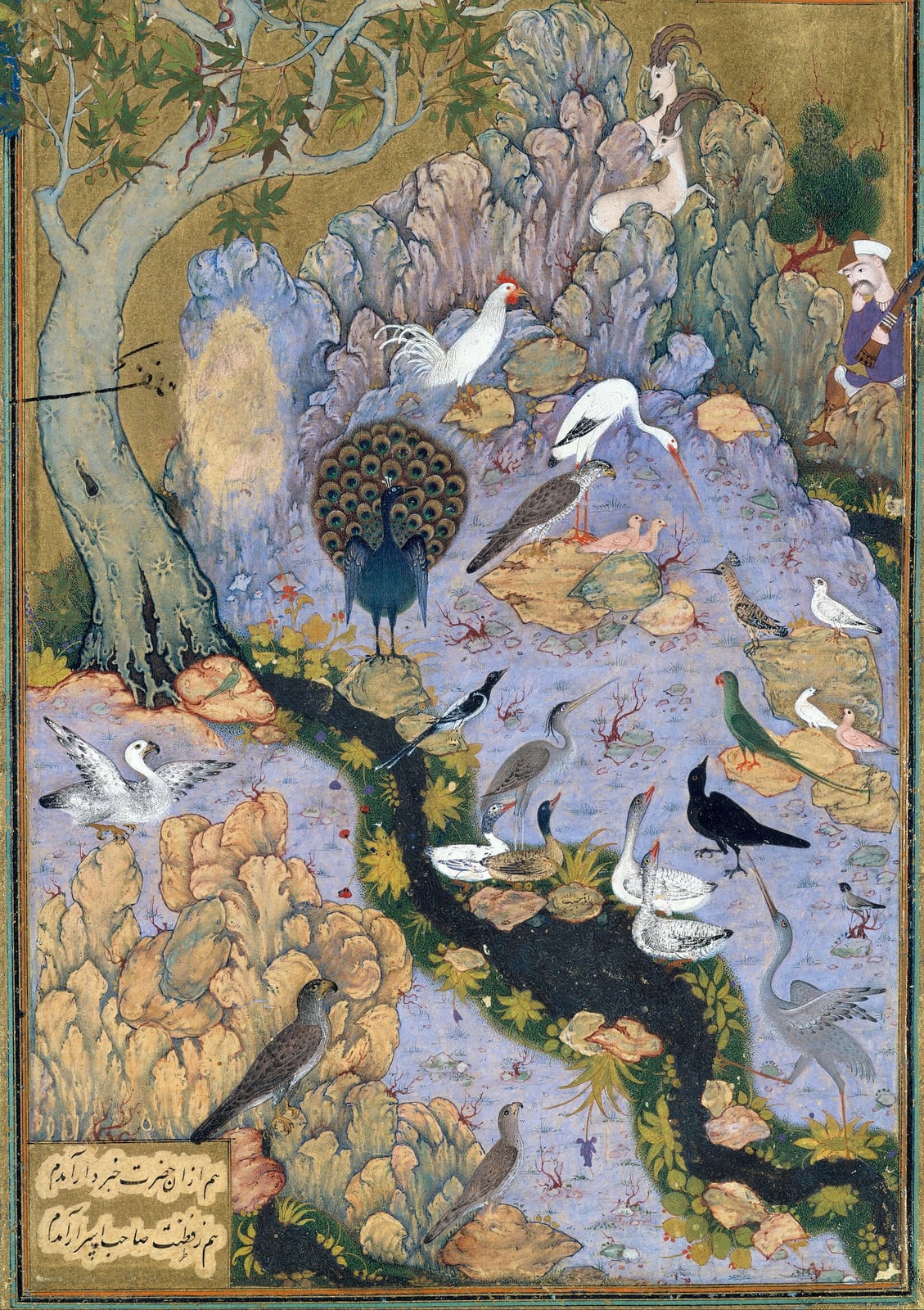
La asamblea de las aves · CC0
In eigenen Worten
«Praise to the pure Creator of the soul, who gave the dust a soul and gave it faith.»Mantiq al-tayr, dístico inicial («Fi al-tawhid»), texto persa según Ganjoor; traducciones propias.

Der zentrale Gedanke
The Simorgh and the thirty birds: The Simorgh is a fabulous bird of Iranian tradition, wise and benevolent, which in the *Shahnameh* raises the hero Zal.
Im Zusammenhang sehen
Biografie
5 Min. Lesezeit
Unterstützte Übersetzung aus dem spanischen Original, Durchsicht durch einen muttersprachlichen Übersetzer ausstehend.
Der Apotheker von Nischapur
Abu Hamid Muhammad, Sohn des Abu Bakr Ibrahim, zeichnete sein Werk mit zwei Namen: Farid ad-Din, „Perle der Religion“, und Attar, die Berufsbezeichnung dessen, der Duftstoffe, Drogen und Arzneien verkauft. Er lebte in Nischapur, der großen Stadt Chorasans, und über sein Leben weiß man nur sehr wenig mit Sicherheit. Lediglich zwei Zeitgenossen erwähnen ihn: der Anthologist Muhammad Aufi, der ihn unter die Dichter der Seldschukenzeit einreiht, und der Philosoph Nasir ad-Din Tusi, der ihn als Student besuchte, als Attar bereits ein Greis war, und Jahre später seinem Schüler Ibn al-Fuwati erzählte, wie sehr ihn dessen Beredsamkeit beeindruckt habe. Die nächste Nachricht, die Tarich-i guzida des Hamdallah Mustaufi, stammt von 1330.
Sein eigenes Werk sagt wenig, doch eines sagt es genau: dass er den Apothekerberuf ausübte und persönlich eine große Zahl von Kunden bediente und dass er das Musibat-Name und das Ilahi-Name verfasste, während er in seiner Offizin arbeitete. Da er nicht von der Dichtung leben musste, konnte er das Handwerk des höfischen Lobdichters verachten, das er nie betrieb. Bernd Reinert hebt hervor, dass sein Dasein als Apotheker und Sufi offenbar durch keine Reisen unterbrochen wurde und dass er im Alter sehr zurückgezogen lebte; die großen Fahrten nach Mekka, Damaskus oder Indien, die ihm spätere Biographien zuschreiben, gehören ins Reich der Legende.
Unsichere Daten
Badiʿ az-Zaman Furuzanfar errechnete, dass er um 540 der Hidschra (1145/46) geboren wurde; das einzige Datum, das Attar selbst nennt – 573 (1177) als Jahr, in dem er die Vogelgespräche vollendete –, steht in einem Vers, der nicht in allen Handschriften überliefert ist. Was seinen Tod betrifft, so lautet die verbreitetste Ansicht, der Furuzanfar und Reinert folgen, dass er bei dem Blutbad umkam, mit dem die Mongolen im Safar 618, im April 1221, Nischapur verheerten; Hermann Landolt erinnert daran, dass auch 1230 möglich bleibt. Die Encyclopaedia Britannica von 1911 gestand ihm, getreu den späten Quellen, noch hundertzehn Lebensjahre zu, von 1119 bis 1229: ein Beispiel dafür, wie die Gestalt wuchs, als sein Werk berühmt wurde.
Die Legenden
Zu Lebzeiten war Attar außerhalb Nischapurs kaum bekannt. Seine Größe als Mystiker und Erzähler wurde im 15. Jahrhundert entdeckt, und damals schmückten Dschami und Daulatschah von Samarkand seine Biographie mit phantastischen Geschichten aus. Nach Daulatschah fragte ihn ein Derwisch, der in seinen Laden blickte, wie er denn zu sterben gedenke, wenn er so viele Waren zurücklassen müsse; Attar gab die Apotheke auf und wurde Sufi. Nach demselben Autor schlug ein mongolischer Soldat, der ihn gefangen genommen hatte, tausend Dirham für ihn aus, und als ein anderer einen Sack Stroh bot, riet Attar ihm, zu verkaufen, denn mehr sei er nicht wert; der Soldat erschlug ihn voller Zorn. Furuzanfar wies nach, dass die Lehrer, die man ihm zuschrieb – Nadschm ad-Din Kubra, Qutb ad-Din Haidar und andere –, Erfindungen sind; möglich ist allein seine Verbindung zu Madschd ad-Din Baghdadi, den er nach eigenen Worten kannte, und vielleicht eine innere, uwaisitische Filiation mit Abu Saʿid Abu l-Chair.
Ein Werk, das mit seinem Ruhm wuchs
Die Legende schrieb ihm so viele Werke zu, wie der Koran Suren zählt, und herauszufinden, welche wirklich von ihm stammen, hat die Fachwelt ein Jahrhundert lang beschäftigt. Hellmut Ritter bemerkte Unterschiede im Stil und im Bekenntnis – manche Werke sind sunnitisch, andere schiitisch – und dachte zunächst an eine Entwicklung des Dichters; 1941 wies Saʿid Nafisi nach, dass die schiitisch geprägten, etwa das Mazhar al-adschaʾib und das Lisan al-ghaib, einem anderen Attar gehören, der aus Tun stammte und rund zweihundertfünfzig Jahre später in Maschhad lebte. Auch eine zweite Gruppe, angeführt vom Dschauhar adh-dhat und um die Gestalt al-Halladschs kreisend, stammt aus stilistischen Gründen nicht von ihm, wenngleich ihr Verfasser bis heute unbekannt ist. Attar selbst zählt seine Werke in den Vorreden auf: den Diwan, das Asrar-Name, die Vogelgespräche, das Musibat-Name, das Ilahi-Name, das Dschawahir-Name und das Scharh al-qalb, und er fügt hinzu, die beiden letzten habe er mit eigenen Händen vernichtet.
Zu dieser Liste kommen das Muchtar-Name, eine Auswahl seiner Vierzeiler, und die Tadhkirat al-auliya, sein einziges Prosawerk. Am umstrittensten ist das Chosrau-Name, ein höfischer Versroman, der auch Gul u Hurmuz heißt: Reinert hielt es für echt; Mohammad Reza Schafiʿi-Kadkani vertrat die Ansicht, es sei eine spätere Fälschung und der Titel, mit dem Attar ein anderes seiner Werke bezeichnete, gehöre in Wahrheit zum Ilahi-Name – eine These, die Landolt für erwiesen hält; Austin O'Malley hat die Frage 2019 mit einer Handschrift von 1297 neu aufgeworfen, die es bereits Attar zuschreibt.
Die vier mystischen Masnawis
Das Asrar-Name, das „Buch der Geheimnisse“, kommt ohne Rahmenerzählung aus und sinnt in zweiundzwanzig Reden über den Fall der Seele und ihre Befreiung aus den Fesseln der Welt nach. Die Vogelgespräche (Mantiq at-tair), sein Meisterwerk, übernehmen aus der den Brüdern Ghazali zugeschriebenen Risalat at-tair die Versammlung der Vögel, die einen König suchen: Vom Wiedehopf geführt, durchqueren sie sieben Täler, und nur dreißig gelangen vor den Simurgh – um zu entdecken, dass der Simurgh sie selbst sind, si murgh, „dreißig Vögel“. Das Musibat-Name, das „Buch der Leiden“, folgt einem Wanderer, der vierzig Wesen befragt, vom Engel Gabriel bis zu den Propheten, bis ihm die Allseele sagt, dass das Gesuchte in ihm selbst liegt. Im Ilahi-Name, dem „Göttlichen Buch“, antwortet ein Kalif auf die weltlichen Wünsche seiner sechs Söhne – die Tochter des Feenkönigs, die Magie, den Becher Dschamschids, das Lebenswasser, den Ring Salomos, die Alchemie –, indem er ihnen deren inneren Sinn enthüllt. Die vier Werke sagen dasselbe auf vier Weisen: Das Ziel des Menschen liegt verborgen in ihm.
Das Gedenkbuch der Heiligen
Die Tadhkirat al-auliya, die „Erinnerung an die Gottesfreunde“, versammelt Leben und Aussprüche der Meister des klassischen Sufismus, von Dschaʿfar as-Sadiq, Uwais al-Qarani und Hasan von Basra bis zu al-Halladsch, in dem Attar denjenigen sah, der den Sufismus zur Vollendung geführt hatte. Die späteren Biographien, die in manchen Abschriften stehen, stammen nicht von ihm. Attar nennt seine Quellen fast nie und gestaltet die Erzählungen auf seine Weise um, sodass das Buch als Geschichte der dargestellten Personen wenig taugt, als Zeugnis sufischen Empfindens aber viel; überdies übertrug er die auf Arabisch überlieferten Aussprüche mit großer Treue ins Persische. Seit der zweiten Hälfte des 13. Jahrhunderts wurde es viel gelesen; eine alte osttürkische Fassung in uigurischer Schrift übersetzte Pavet de Courteille 1889 ins Französische.
Nachwirkung
Rumi verwendete für sein Masnawi das Versmaß der Vogelgespräche und gestaltete Geschichten Attars neu. Die Überlieferung wollte mehr: Der greise Dichter habe, als die Familie Baha ad-Din Walads durch Nischapur zog, dem kleinen Rumi ein Exemplar des Asrar-Name geschenkt. Ritter erklärte die Legende aus dem Einfluss dieses Werkes auf den Prolog des Masnawi, und Franklin Lewis hält sie für einen Nachfolgemythos. Ali Schir Nawai übertrug die Vogelgespräche ins Tschagataische und ließ das Mausoleum in Nischapur errichten, das 1940 erneuert wurde. Europa lernte ihn durch das Pand-Name kennen, das Silvestre de Sacy 1819 übersetzte und das heute als apokryph gilt, und durch Garcin de Tassys Ausgabe (1857) und Übersetzung (1863) des Mantiq at-tair, die Edward FitzGerald so begeisterte, dass er das Werk frei nachdichtete: Sein Bird-Parliament blieb zu Lebzeiten ungedruckt und erschien erst 1889 aus dem Nachlass.
Quellen: «Farīd ud-Dīn ʽAttār». Encyclopædia Britannica, 11.ª ed., vol. 10. Cambridge, 1910–1911 (resume los relatos de Dawlatshah sobre su conversión y su muerte). Texto en Wikisource. · FitzGerald, Edward. Letters and Literary Remains of Edward FitzGerald, ed. William Aldis Wright, vol. II. Londres: Macmillan, 1889 (incluye «Bird-Parliament» con la nota de E. B. Cowell sobre su génesis). · Attar, Farid al-Din. The Tadhkiratu 'l-awliya («Memoirs of the saints»), ed. Reynold A. Nicholson, con introducción de Mirza Muhammad Qazvini. 2 vols. Londres y Leiden: Luzac / Brill, 1905–1907 (Persian Historical Texts).
Zeitleiste
Das Leben, Jahr für Jahr
Jeder Punkt ist ein belegtes Ereignis. Klicken Sie, um es mit Quelle und Grad der Gewissheit zu lesen.
um 11450 JahreNishapur
Birth in Nishapur
Abu Hamid Muhammad, son of Abu Bakr Ibrahim, is born. Foruzanfar calculates c. 540/1145–1146; the 1911 Britannica, following late sources, gave 1119.
WahrscheinlichReinert, Bernd. «ʿAṭṭār, Farīd-al-Dīn». Encyclopaedia Iranica, vol. III, fasc. 1, pp. 20–25. Publicado el 15-12-1987.
Nach dem Tod
- 1297Oldest manuscript of the Khusraw-nama
- 1330Mustawfi's mention
- um 1486The legend is born
- 1819The Pand-nama in Europe
- 1857 – 1863Garcin de Tassy's edition
- 1905 – 1907Nicholson's edition of the Tadhkirat
- 1940Ilahi-nama edition and renovation of the mausoleum
- 1941Nafisi identifies the 'other Attar'
- 1984Davis and Darbandi translation
um 1145 · 0 Jahre
Birth in Nishapur
Abu Hamid Muhammad, son of Abu Bakr Ibrahim, is born. Foruzanfar calculates c. 540/1145–1146; the 1911 Britannica, following late sources, gave 1119.
Wahrscheinlich
um 1170 – 1221
Druggist and Sufi
He practises pharmacy in Nishapur and attends many customers; according to his prefaces, he composes the *Musibat-nama* and the *Ilahi-nama* in the shop. The legends of his conversion by a dervish date from the fifteenth century.
Belegt
1177
Date of the Mantiq al-tayr
A closing line of the *Mantiq al-tayr* dates its completion to 573/1177, but it is not found in all manuscripts.
Umstritten
um 1209
Meeting with Majd al-Din Baghdadi
Attar says in the *Tadhkirat al-awliya* that he met Majd al-Din Baghdadi, disciple of Najm al-Din Kubra, who died around 1209; he is the only plausible master among those tradition ascribed to him.
Wahrscheinlich
um 1215 – 1221
Visit of Nasir al-Din Tusi
The young Tusi visits the aged Attar in Nishapur (between 612/1215 and 618/1221, according to Foruzanfar) and praises his eloquence, as transmitted by his pupil Ibn al-Fuwati.
Belegt
April 1221
Death in the Mongol sack of Nishapur
According to the most widespread opinion (Foruzanfar, Reinert), he dies violently in the massacre of Safar 618/April 1221; Landolt considers 1230 possible. The tale of the sack of straw is Dawlatshah's legend.
Wahrscheinlich
1297
Oldest manuscript of the Khusraw-nama
A copy of 1297, now in the Bibliothèque nationale de France, already contains the romance and its preface under Attar's name: Austin O'Malley adduces it in 2019 against the forgery thesis.
Belegt
1330
Mustawfi's mention
Hamdallah Mustawfi mentions him in the *Tarikh-e guzida*, the third surviving notice after those of Awfi and Tusi.
Belegt
um 1486
The legend is born
In the fifteenth century his work is rediscovered; Jami (*Nafahat al-uns*, 1476–1478) and Dawlatshah (*Tadhkirat al-shu'ara*, 1486) embroider his life with tales of conversion, masters and death. Ali Shir Nava'i raises a mausoleum for him in Nishapur.
Belegt
1819
The Pand-nama in Europe
Silvestre de Sacy publishes in Paris the *Pend-Namèh, ou le Livre des conseils*, the first 'Attar' work translated in Europe; modern scholarship considers it apocryphal.
Belegt
1857 – 1863
Garcin de Tassy's edition
Joseph Garcin de Tassy edits the Persian text of the *Mantiq al-tayr* (1857) and publishes his French translation in 1863; Edward FitzGerald, delighted, composes his free version *Bird-Parliament* (1862, posthumous in 1889).
Belegt
1905 – 1907
Nicholson's edition of the Tadhkirat
Reynold A. Nicholson publishes in London and Leiden, with an introduction by Muhammad Qazvini, the edition of the *Tadhkirat al-awliya* (1905–1907).
Belegt
1940
Ilahi-nama edition and renovation of the mausoleum
Hellmut Ritter publishes the critical edition of the *Ilahi-nama* (Leipzig and Istanbul); the Nishapur mausoleum is fully renovated under Reza Shah.
Belegt
1941
Nafisi identifies the 'other Attar'
Sa'id Nafisi shows in his *Jostoju dar ahval o asar-e Farid al-Din Attar* that the Shi'ite works ascribed to Attar belong to a namesake from Tun who lived in Mashhad some two and a half centuries later.
Belegt
1984
Davis and Darbandi translation
Afkham Darbandi and Dick Davis publish *The Conference of the Birds* in Penguin Classics, the most widely read English verse version.
Belegt
Werke
Grundlegende Werke
Die Werke, ohne die sich das Vermächtnis nicht verstehen lässt.
Schriftliches Werk · um 1177
Mantiq al-tayr (The Conference of the Birds)
منطقالطیر (Mantiq al-tayr), también مقامات الطیور (Maqamat al-tuyur)
A masnavi of several thousand couplets and Attar's masterpiece. The birds of the world gather to choose a king; the hoopoe, Solomon's messenger, proposes that they seek the Simorgh. Each bird excuses itself with a human weakness (the nightingale's love for the rose, the parrot's longing for immortality, the peacock's paradise) and the hoopoe answers with stories, among them that of Shaykh San'an in love with a Christian girl. Those who set out cross seven valleys: quest, love, knowledge, detachment, unity, bewilderment, and poverty and annihilation. Only thirty arrive, and they discover that the Simorgh is their own reflection: *si morgh*, 'thirty birds'. The frame story comes from the Ghazalis' *Risalat al-tayr*.
14 Ausgaben · amazon.com
Attar
Ilahi-nama (The Book of God)
Schriftliches Werk
Ilahi-nama (The Book of God)
الهینامه (Ilahi-nama)
A masnavi of some 6,500 couplets with a frame story: a caliph asks his six sons what they desire, and each asks for something marvellous (the daughter of the king of the fairies, mastery of magic, Jamshid's world-reflecting cup, the water of life, Solomon's ring, alchemy). The father shows them that, taken literally, these wishes are absurd, but that understood inwardly they can be fulfilled: the princess is the purified soul, the cup is the mystic united with God, the elixir is the divine light that transforms everything. Hundreds of stories, from three to four hundred lines, illustrate the same message as the *Mantiq al-tayr*: what man seeks is within him.
3 Ausgaben · amazon.com

Schriftliches Werk
Tadhkirat al-awliya (Memorial of God's Friends)
تذکرة الأولیاء (Tadhkirat al-awliya)
Attar's only prose work and the great Persian collection of saints' lives: some seventy biographies of masters of classical Sufism, from Ja'far al-Sadiq, Uways al-Qarani and Hasan of Basra to al-Hallaj, with their sayings and anecdotes, among them those of Rabi'a al-Adawiyya. Attar relies almost solely on written sources he rarely names and reworks the stories with a taste of his own, but he translates the Arabic sayings faithfully. The account of al-Hallaj's execution is its most famous page. Widely read since the thirteenth century, it also matters as a specimen of early Persian prose.
6 Ausgaben · amazon.com
Das gesamte Werk (29)

Musibat-nama (The Book of Affliction)
Attar
Asrar-nama (The Book of Secrets)
The Conscious LibraryAsrar-nama (The Book of Secrets)

Divan
Attar
Mukhtar-nama (The Book of Selections)
The Conscious LibraryMukhtar-nama (The Book of Selections)
Attar
Khusraw-nama (Gol and Hormoz)
The Conscious LibraryKhusraw-nama (Gol and Hormoz)
Attar
Mi'raj-nama (Book of the Ascension)
The Conscious LibraryMi'raj-nama (Book of the Ascension)
Attar
Jumjuma-nama (Book of the Skull)
The Conscious LibraryJumjuma-nama (Book of the Skull)
Attar
Jawahir-nama (Book of Jewels)
The Conscious LibraryJawahir-nama (Book of Jewels)
Attar
Sharh al-qalb (Commentary on the Heart)
The Conscious LibrarySharh al-qalb (Commentary on the Heart)
Attar
Kashf al-asrar and Ma'rifat al-nafs
The Conscious LibraryKashf al-asrar and Ma'rifat al-nafs
Attar
Pand-nama (Book of Counsel)
The Conscious LibraryPand-nama (Book of Counsel)
Attar
Bulbul-nama (Book of the Nightingale)
The Conscious LibraryBulbul-nama (Book of the Nightingale)
Attar
Jawhar al-dhat (The Essence of Essence)
The Conscious LibraryJawhar al-dhat (The Essence of Essence)
Attar
Ushtur-nama (Book of the Camel)
The Conscious LibraryUshtur-nama (Book of the Camel)
Attar
Haylaj-nama
The Conscious LibraryHaylaj-nama
Attar
Mansur-nama
The Conscious LibraryMansur-nama
Attar
Bisar-nama (Book of the Headless)
The Conscious LibraryBisar-nama (Book of the Headless)
Attar
Mazhar al-aja'ib (Manifestation of Wonders)
The Conscious LibraryMazhar al-aja'ib (Manifestation of Wonders)
Attar
Lisan al-ghayb (The Tongue of the Unseen)
The Conscious LibraryLisan al-ghayb (The Tongue of the Unseen)
Attar
Waslat-nama (Book of Union)
The Conscious LibraryWaslat-nama (Book of Union)
Attar
Khayyat-nama (Book of the Tailor)
The Conscious LibraryKhayyat-nama (Book of the Tailor)
Attar
Kanz al-asrar (The Treasure of Secrets)
The Conscious LibraryKanz al-asrar (The Treasure of Secrets)
Attar
Miftah al-futuh (The Key of Openings)
The Conscious LibraryMiftah al-futuh (The Key of Openings)
Attar
Wasiyat-nama (Book of the Testament)
The Conscious LibraryWasiyat-nama (Book of the Testament)
Zitate
Zitate, die in einem bestimmten Werk nachgewiesen sind. Jedes trägt seine Herkunft und seinen Grad an Verlässlichkeit.
Praise to the pure Creator of the soul, who gave the dust a soul and gave it faith.آفرین جان آفرین پاک را / آن که جان بخشید و ایمان خاک را
GeprüftMantiq al-tayr, dístico inicial («Fi al-tawhid»), texto persa según Ganjoor; traducciones propias.
Apokryphe Zitate oder Zitate umstrittener Zuschreibung (2)
«Boundless praise to that pure God who gave faith to a handful of dust.»
Opening couplet of the *Pand-nama*, which imitates the beginning of the *Mantiq al-tayr*. Ritter considers it apocryphal: there is no trace of the work before the fifteenth century and its language is alien to Attar's, although it was the first work 'of his' translated in Europe (Silvestre de Sacy, 1819).
«Praise to the Creator of the soul and soul of the soul, who is both manifest and hidden.»
Opening of the *Mazhar al-aja'ib*, a fifteenth-century Shi'ite poem composed by the Attar of Tun and ascribed for centuries to Farid al-Din; Sa'id Nafisi showed in 1941 that it belongs to that late namesake.
Letzte Worte
Traditionelle Zuschreibung
«Sell me for the sack of straw, for I am worth no more.»Words put in his mouth by the legend transmitted by Dawlatshah of Samarkand (1486), more than two and a half centuries later: captured by a Mongol soldier, he is said to have refused to be sold for a thousand dirhams and then advised accepting a sack of straw (or fodder), which enraged the soldier, who killed him. It is a Sufi parable on the worth of the self, not a testimony; it is not even certain that he died in 1221.
Quelle: «Farīd ud-Dīn ʽAttār». Encyclopædia Britannica, 11.ª ed., vol. 10. Cambridge, 1910–1911 (resume los relatos de Dawlatshah sobre su conversión y su muerte). Texto en Wikisource.
Fragen
Was das Werk beantwortet
Zwölf große Fragen der Menschheit und was sich aus den Texten darauf antworten lässt, mit Belegen. Wir legen niemandem Worte in den Mund.
Was ist das Absolute? Gibt es Gott?
The Creator praised is also the mirror where the seeker is lost
Persönlich und unpersönlich zugleichAusdrücklich gesagt
Attar opens The Conference of the Birds by praising a personal Creator who gave soul to dust and granted it faith, and in the Memorial of the Saints he gathers prayers addressed to a Thou who answers. But the ending of the same poem shows another face of the divine. The Simurgh, the king the birds seek through seven valleys, turns out to be a mirror: the thirty birds who arrive — si murgh, in Persian — see that those thirty birds are the Simurgh, and the Presence explains to them, without tongue, that whoever arrives sees himself in it. Then they are lost in Him like a shadow in the sun. The Absolute is at once the King who is sought and entreated and the faceless unity in which the seeker is extinguished.
Diese Frage mit anderen Meistern vergleichenWer bin ich? Gibt es ein wahres Selbst?
The thirty birds discover that they are the Simurgh
Das Selbst ist das AbsoluteAusdrücklich gesagt
Attar's answer lies in the ending of The Conference of the Birds. Thousands of birds set out in search of their king, the Simurgh; only thirty survive the seven valleys. On arriving, they see that those thirty birds, si murgh in Persian, are the Simurgh, and the Presence tells them it is a mirror in which whoever arrives sees himself, soul and body. What the seeker finds at the end of the path is not a different object but his own reality in God. To get there one must cross the valley of poverty and annihilation (fana), where the self is consumed like the moth in the flame. The self being sought is not the one that sets out on the journey: it is the one that appears when that one has been extinguished.
Diese Frage mit anderen Meistern vergleichenWarum leiden wir?
The soul's unrest is longing for the King; its pain is already the path
Die Trennung von GottAusdrücklich gesagt
Attar wrote an entire book on affliction, the Musibat-nama: a restless wayfarer, guided by his master, questions angels, prophets, elements and creatures without anything calming his unrest, until he discovers that what he seeks lies in the ocean of the soul. The root of suffering is separation from the King: the birds of The Conference of the Birds live without a sovereign, scattered and busy with their attachments, and each makes an excuse not to set out. But Attar does not want to suppress this pain. The pain (dard) of the search is precious, because it is what sets one moving: whoever enters the valley of the quest meets a hundred hardships at every moment, and only through them advances. What is truly tragic is not to feel the lack.
Diese Frage mit anderen Meistern vergleichenWas geschieht nach dem Tod?
Dying to oneself in the valley of annihilation to subsist in God
Ewiges Leben und AuferstehungAusdrücklich gesagt
Attar shares the eschatology of Islam, but his attention lies on another death: the one the seeker must pass through in life. The seventh valley of The Conference of the Birds is that of poverty and annihilation (fana), where the self is lost like a drop in the ocean or a moth in the flame; the poem adds that after this extinction the birds are returned to themselves and subsist in God. In the Memorial of the Saints he narrates the death of many masters as the culmination of their path, and his account of the execution of al-Hallaj is one of the most famous. Legend attributes to Attar himself a death at the hands of a Mongol soldier, with a last gesture of detachment, but it is a late account.
Diese Frage mit anderen Meistern vergleichenWie erlangt man Befreiung oder Erlösung?
Crossing seven valleys with a guide: of thousands of birds, thirty arrive
Durch disziplinierte ÜbungAusdrücklich gesagt
The Conference of the Birds is an itinerary. The hoopoe announces to the birds that there are seven valleys on the way: the quest, love, knowledge, detachment, unity, bewilderment and, finally, poverty and annihilation; after that lies the King's court. Before setting out, each bird presents its excuse — the nightingale its rose, the hawk its king, the duck its water — and the hoopoe answers each with a story that dismantles its attachment. Liberation thus requires sustained effort, a guide and the progressive renunciation of all that holds one back. Many die on the way or give up; only thirty arrive. What they find at the end, however, is not a reward earned: it is their own annihilation in the Simurgh.
Diese Frage mit anderen Meistern vergleichenBraucht es einen Lehrer?
Without the hoopoe, no bird would have set out to seek the King
UnverzichtbarAusdrücklich gesagt
In The Conference of the Birds the birds do not set out on their own: they need the hoopoe, who knows the way, has been with Solomon and knows where the Simurgh lives. Before leaving they cast lots to choose a guide, and the lot falls on her; from then on they follow her, question her and confide their fears to her, and she answers each with a story. In The Book of Affliction the wayfarer also advances accompanied by a master who interprets what each creature tells him. For Attar, without a guide the soul gets lost in its excuses and in the dangers of the journey. The Memorial of the Saints is, at bottom, a gallery of masters whose lives and words serve as a guide to the reader.
Diese Frage mit anderen Meistern vergleichenIst die Welt wirklich?
All the birds are the shadow of the Simurgh
Offenbarung des GöttlichenAusdrücklich gesagt
In The Conference of the Birds the hoopoe tells that the Simurgh first manifested itself in China, at midnight, and let fall a feather; all the images and arts of the world arise from the attempt to reproduce it. Later she explains to the birds that when the Simurgh showed its face its shadow fell upon the earth, and from that shadow came the birds: each of them is a shadow of the King it seeks. The world, then, is neither illusion nor autonomous reality but manifestation: reflection, shadow or trace of a beauty that exceeds it. That is why it can lead the seeker to that beauty, and why it can also hold him back, when the shadow is mistaken for the one who casts it.
Diese Frage mit anderen Meistern vergleichenWas ist Liebe?
Love is a fire that burns reason: the valley of love
Sehnsucht und VereinigungAusdrücklich gesagt
In The Conference of the Birds the second valley is that of love: whoever enters it must be all fire, and whoever is not cannot cross it. Love does not calculate, knows neither prudence nor reputation, and that is why Attar constantly sets it against reason, which stops at the threshold. His most famous story shows it to the point of scandal: Shaykh San'an, a venerated master, falls in love with a Christian girl, abandons his faith, tends pigs for her, and returns to Islam only through his disciples' intercession. The story does not approve of apostasy; it teaches that love drags one on to lose everything and that only such total detachment prepares for true Love, in which the lover is finally consumed.
Diese Frage mit anderen Meistern vergleichenSind wir frei, oder ist alles vorherbestimmt?
No theory of freedom: in the valley of independence, all is God's
Nicht geäußert
Attar does not address free will as a theological problem. His poems presuppose both the seeker's decision and God's sovereignty. The birds of The Conference of the Birds choose to set out or to stay, and each is responsible for its excuses; but in the fourth valley, that of independence (istighna), the hoopoe describes a God who needs nothing and no one, before whom a hundred worlds may burn without its mattering. And in the valley of unity everything is discovered to be one, so that the distinction between the one who acts and what happens fades away. Attar lets effort and absolute divine self-sufficiency coexist without trying to reconcile them in a doctrine.
Diese Frage mit anderen Meistern vergleichenWozu meditieren oder beten?
The prayer of the saints: intimate converse with God, without calculation
Freundschaft mit GottAus der Lehre abgeleitet
Attar wrote no treatise on prayer, but his work is full of it. His masnavis open with praises and supplications to God, and the Memorial of the Saints gathers dozens of prayers of the Sufi masters, among them Rabia's famous one, which asks to be burned in hell if she worships from fear and not to be deprived of eternal beauty if she worships for God Himself. In the stories of his poems, the one who truly prays is often God's madman or the beggar, who speaks to the Lord with a frankness that would scandalise the pious. What Attar celebrates is that relationship without intermediaries or calculation, in which the soul addresses God as a Friend, with complaints, entreaties and love.
Diese Frage mit anderen Meistern vergleichenKann die Vernunft das Letzte erkennen?
Reason stops at the threshold; love and bewilderment go on
Das Letzte liegt jenseits des VerstandesAusdrücklich gesagt
Attar insistently sets love against reason. In the valley of love of The Conference of the Birds reason has no place: love is fire and reason, smoke. In the valley of knowledge each traveller sees according to his capacity, and no knowledge is the same for all. Further on, in the valley of bewilderment (hayrat), the seeker no longer knows anything, not even whether he exists or not, whether he is inside or outside; it is a perplexity worth more than all certainties. The stories of God's madmen that fill his masnavis say the same with humour: the one who has lost his mind sometimes sees more than the sage. For Attar the ultimate is not thought: it is suffered and loved.
Diese Frage mit anderen Meistern vergleichenSich von der Welt zurückziehen oder sie verwandeln?
He wrote his poems in the pharmacy, among hundreds of patients
Kontemplation im HandelnAus der Lehre abgeleitet
Attar was neither a withdrawn ascetic nor the shaykh of an order, but a pharmacist of Nishapur. In the introduction to the Khusraw-nama he tells that he composed The Book of Affliction and The Divine Book in his pharmacy, where hundreds of patients consulted him every day. His doctrine, however, demands radical detachment: the birds of The Conference of the Birds must abandon wealth, affections and securities, and the fourth valley is that of independence from everything. Attar resolves the tension in a way characteristic of Persian Sufism: detachment is inward and does not require giving up one's trade. One can heal bodies, sell remedies and write verses while the heart travels the valleys of the path.
Diese Frage mit anderen Meistern vergleichen
Affinitäten und Spannungen
Affinitäten und Spannungen
Frage für Frage aus den Positionen berechnet. Den Grund jeder Übereinstimmung und jedes Widerspruchs zeigt ein Klick.
Denkt ähnlich wie
Ibn Arabi
Übereinstimmung bei: Was ist das Absolute? Gibt es Gott? · Wer bin ich? Gibt es ein wahres Selbst? · Warum leiden wir?
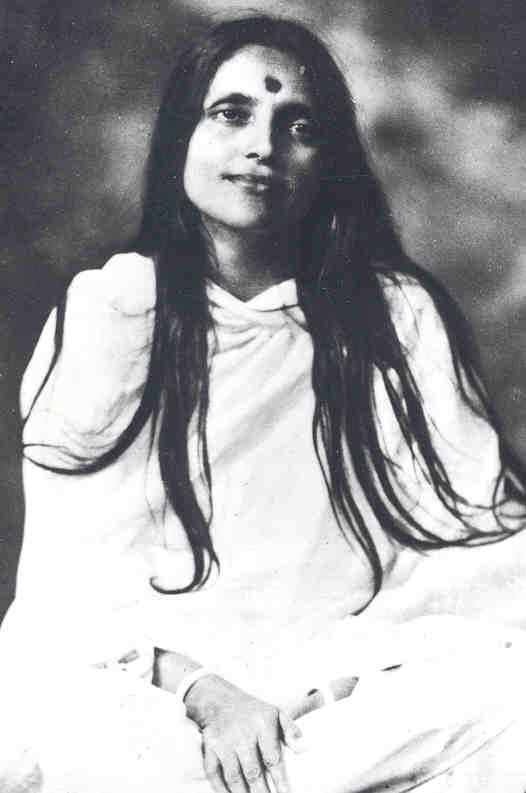
Anandamayi Ma
Übereinstimmung bei: Was ist das Absolute? Gibt es Gott? · Wer bin ich? Gibt es ein wahres Selbst? · Braucht es einen Lehrer?

Al-Hallaj
Übereinstimmung bei: Wer bin ich? Gibt es ein wahres Selbst? · Warum leiden wir? · Was geschieht nach dem Tod?
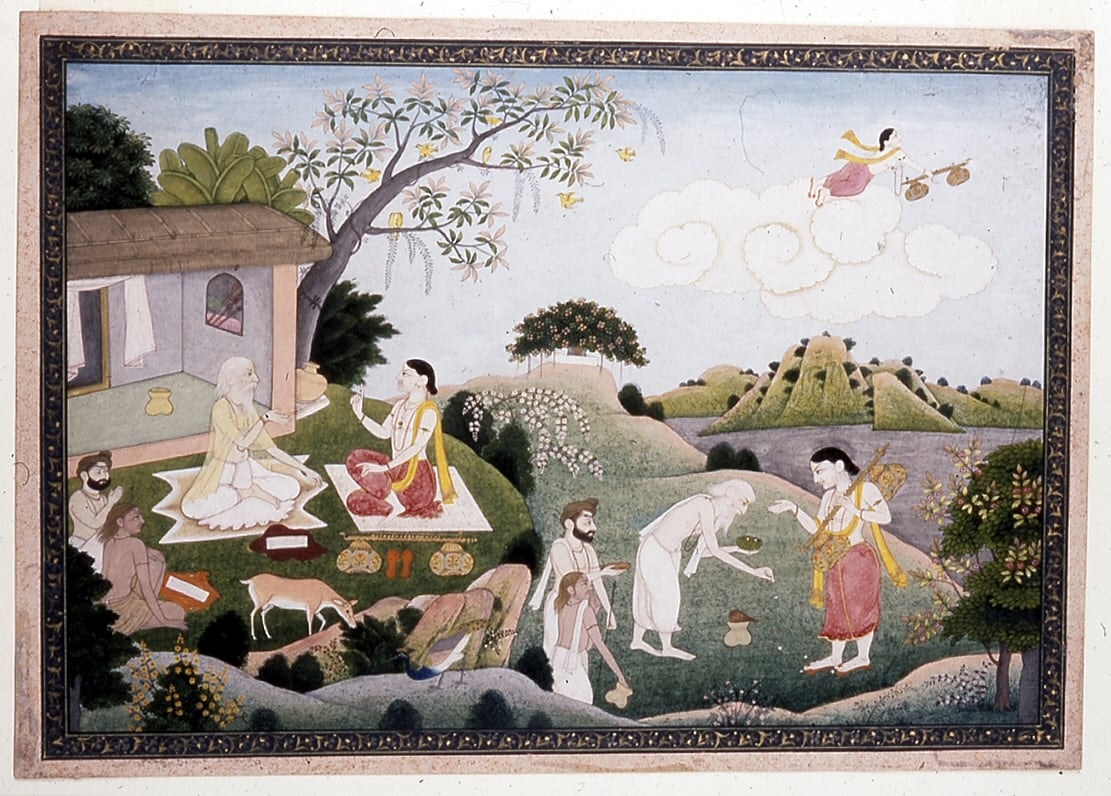
Narada
Übereinstimmung bei: Warum leiden wir? · Ist die Welt wirklich? · Was ist Liebe?
Denkt anders als
Jiddu Krishnamurti
Widerspruch bei: Wie erlangt man Befreiung oder Erlösung? · Braucht es einen Lehrer?
Kapila
Widerspruch bei: Was geschieht nach dem Tod?

Pema Chödrön
Widerspruch bei: Wer bin ich? Gibt es ein wahres Selbst? · Was geschieht nach dem Tod?

Nāgārjuna
Widerspruch bei: Wer bin ich? Gibt es ein wahres Selbst? · Was geschieht nach dem Tod?
Anekdoten und Erzählungen
Anekdoten und Erzählungen
Hagiographische Erzählungs. XII (según la leyenda)
The dervish at the shop
Herkunft der Erzählung: A story transmitted by Dawlatshah of Samarkand (*Tadhkirat al-shu'ara*, 1486) and summarised by the 1911 *Britannica*; Reinert counts it among the initiation myths created in the fifteenth century. Attar's own work shows that he went on practising as a pharmacist while writing his poems.
Hagiographische Erzählung1221 (según la leyenda)
A thousand dirhams or a sack of straw
Herkunft der Erzählung: Dawlatshah (1486), summarised by the 1911 *Britannica*. That Attar died in the Nishapur massacre of 1221 is the most widespread opinion (Foruzanfar, Reinert), but Landolt allows for 1230; the details of the dialogue are legend.
Hagiographische Erzählungc. 1216 (según la leyenda)
The old poet and the boy Rumi
Herkunft der Erzählung: A tradition of the late anthologies. Hellmut Ritter explained it as a reflection of the *Asrar-nama*'s influence on the prologue of the *Masnavi* (Reinert), and Franklin Lewis (2000) considers it a succession myth, as summarised by Landolt. There is no contemporary source for the meeting.
Zeugnis1215–1221
Tusi visits the old druggist
Herkunft der Erzählung: Tusi's report transmitted by his pupil Ibn al-Fuwati (d. 1323); dates according to Foruzanfar's reckoning. Recorded by Reinert and Landolt.
Belegts. XII–XIII
Poems written in the pharmacy
Herkunft der Erzählung: Attar's own statements in the *Asrar-nama* (p. 170 and vv. 3146–3151 of Gowharin's edition) and in the second preface of the *Khusraw-nama* (Ritter, 'Philologika X', 1939), recorded by Reinert. Should the *Khusraw-nama* not be his, as Shafi'i-Kadkani argues, this last point would lose support.
Belegts. XII–XIII
Two books cast into the fire
Herkunft der Erzählung: Preface to the *Mukhtar-nama* (text in Ritter, 'Philologika X', pp. 147–153), cited by Reinert and Landolt.
Lehren
Lehren
Die Begriffe, die das Denken gliedern, in ihrem Zusammenhang erklärt.
The Simorgh and the thirty birdssimurgh
It reworks the motif of the birds' journey to the king from the *Risalat al-tayr* of Avicenna and the Ghazalis.
The seven valleyshaft-vadi
It turns into an itinerary the stations (*maqamat*) and states (*ahwal*) of the Sufi manuals.
Love and reasonishq-o-aql
A common theme of Persian mysticism since Ahmad Ghazali and Sanai; Rumi inherited it from Attar.
Hayrat: bewildermenthayrat
A concept present in Islamic mysticism since Dhu'l-Nun and al-Junayd.
Faqr and fana: poverty and annihilationfana
Classical Sufi doctrine formulated by al-Junayd and Bayazid; in al-Hallaj, hero of the *Tadhkirat*, it reaches its extreme expression.
Videos
Videos
Aufnahmen, Gespräche und Dokumentarfilme. Die Videos werden von YouTube wiedergegeben; sie werden nicht hier gespeichert.
The Long Journey Home | Attar's «The Conference of the Birds» | Spotlight
Analyse· EN· 2022· 7 min
The MetOffizieller Kanal
Attar's «Conference of the Birds» — The Greatest Sufi Masterpiece?
Analyse· EN· 25 min
Let's Talk Religion
Life-changing power of Attar's Conference of the Birds
Gespräch· EN· 3 min
Sholeh WolpéOffizieller Kanal
La quête de l'Autre : «Le cantique des oiseaux» d'Attâr par Leili Anvar
Vortrag· FR· 2014· 59 min
Résonance[s]
Et Dieu dans tout ça : «Le cantique des oiseaux» d'Attâr avec Leili Anvar
Gespräch· FR· 2012· 18 min
Résonance[s]
Leili Anvar présente le livre d'art Le Cantique des oiseaux sur Public Sénat
Gespräch· FR· 9 min
Éditions Diane de SelliersOffizieller Kanal
Lecture du Cantique des Oiseaux d'Attâr au Festival des Musiques Sacrées de Fès 2014
Aufnahme Dritter· FR· 2014· 68 min
Transcordancias | Global Music Live
Philosophie et Littérature — Attar : La Conférence des Oiseaux (Jeudis Philo)
Vortrag· FR· 106 min
Ancrages Éditions
هفت شهر عشق عطار ۱ (Las siete ciudades del amor de Attar, 1)
Vortrag· FA· 26 min
Dr Elahi Ghomshei — canal oficialOffizieller Kanal
دکتر الهی قمشهای — آشنایی با عطار نیشابوری
Vortrag· FA· 2025· 39 min
Majalle-ye farhangi-honari-ye Attar
حکایت نوشیروان و پیرمرد | الهی نامه عطار نیشابوری
Aufnahme Dritter· FA· 28 min
Rashid KakavandOffizieller Kanal
مختارنامه | رباعیات عطار نیشابوری
Aufnahme Dritter· FA· 2026· 24 min
Rashid KakavandOffizieller Kanal
La conferencia de los pájaros — Farid ud-Din Attar
Analyse· ES· 2022· 3 min
Universidad Externado de ColombiaOffizieller Kanal
Galerie
Galerie
Bilder mit geprüfter Lizenz. Jedes bewahrt seine Urheberschaft und seinen Herkunftsnachweis.
Handschriften
Handschriften
Handschriftliche Zeugen und alte Texte, mit ihrer verwahrenden Einrichtung und ihren Einsichtsbedingungen.
FA · Nastaliq · c. 1177 (texto)
منطقالطیر (Mantiq al-tayr), manuscrito de Herat
- Erhaltener Textzeuge
- Códice copiado en 892/1487 por Sultán Ali Mashhadi; pinturas timúridas y otras añadidas hacia 1600 por Habiballah de Saveh
- Verwahrende Einrichtung
- Metropolitan Museum of Art, Nueva York · 63.210
FA · Perso-árabe · s. XII–XIII
خسرونامه (Khusraw-nama), copia de 1297
- Erhaltener Textzeuge
- Manuscrito fechado en 1297 que contiene el romance y su prólogo atribuido a Attar
- Verwahrende Einrichtung
- Bibliothèque nationale de France, París
CHG · Uigur · s. XIII (original persa)
تذکرة الأولیاء (Tadhkirat al-awliya), versión turca oriental en escritura uigur
- Erhaltener Textzeuge
- Manuscrito de la Biblioteca Nacional de Francia traducido por Pavet de Courteille (*Tezkereh-i-Evliâ*, 1889-1890)
- Verwahrende Einrichtung
- Bibliothèque nationale de France, París
Beziehungen
Beziehungen
Einflüsse, Schülerschaften und Verwandtschaften. Die belegte Beziehung wird von der durch Analyse ermittelten Ähnlichkeit unterschieden.
Beeinflusste
Documented literary influence: Rumi adopted the metre of the *Mantiq al-tayr* for the *Masnavi* and reworked Attar's stories. By contrast, the meeting in Nishapur in which the aged Attar supposedly gave the *Asrar-nama* to the boy Rumi is a late legend: Ritter explained it by that work's influence on the prologue of the *Masnavi*, and Franklin Lewis considers it a succession myth (classification: hagiographic, no contemporary source).
Belegte Beziehung
Beeinflusst von
The frame story of the *Mantiq al-tayr* comes from the *Risalat al-tayr* ascribed to Ahmad Ghazali or to his brother Abu Hamid Muhammad al-Ghazali; Attar expanded and deepened the allegory.
Belegte Beziehung
Beeinflusst von
Attar closes the *Tadhkirat al-awliya* with the life and martyrdom of al-Hallaj, whom he regarded as the perfecter of Sufism; the apocryphal *Jawhar al-dhat* and other 'second group' works make him their central figure.
Belegte Beziehung
Beeinflusst von
Attar devotes a chapter of the *Tadhkirat al-awliya* to Rabi'a, the main source for many of her sayings and anecdotes in the Persian tradition, among them the prayer of disinterested love.
Belegte Beziehung
Zeitgenosse von
Contemporaries (Ibn Arabi was born in 1165 and Attar died around 1221), at the two ends of the Islamic world; no contact or mutual knowledge of their works is recorded.
Belegte Beziehung
Verwandte Gedanken mit
Attar's *qalandari* ghazals, with their language of wine and the libertine, anticipate the figure of the *rend* that Hafez brought to its most refined form.
Durch Analyse ermittelte Ähnlichkeit
Verwandte Gedanken mit
Both teach that what is sought lies within the seeker and distrust outward religion; no historical connection is known.
Durch Analyse ermittelte Ähnlichkeit
Quellen
Quellen
Für diesen Eintrag herangezogene Bibliografie und Kataloge.
- Wikidata, Q194091 «Attar of Nishapur» (P31=Q5; 69 enlaces entre wikis; P569 1145-03; P570 1221-04-26; P1559 فَریدالدّین ابوحامِد محمّد عطّار نِیشابوری).
- Reinert, Bernd. «ʿAṭṭār, Farīd-al-Dīn». Encyclopaedia Iranica, vol. III, fasc. 1, pp. 20–25. Publicado el 15-12-1987.
- Landolt, Hermann. «Farid al-Din 'Attar». En Medieval Islamic Civilization: An Encyclopaedia. Nueva York: Routledge, 2006; versión publicada por The Institute of Ismaili Studies.
- O'Malley, Austin. «An Unexpected Romance: Reevaluating the Authorship of the Khosrow-nāma». Al-'Usur al-Wusta 27 (2019), pp. 201–232. DOI 10.7916/alusur.v27i1.6785.
- «Farīd ud-Dīn ʽAttār». Encyclopædia Britannica, 11.ª ed., vol. 10. Cambridge, 1910–1911 (resume los relatos de Dawlatshah sobre su conversión y su muerte). Texto en Wikisource.
- Attar. Obras en persa: Diván, Mantiq al-tayr, Ilahi-nama, Asrar-nama, Musibat-nama, Mujtar-nama, Tadhkirat al-awliya y obras atribuidas (Pand-nama, Bulbul-nama, Ushtur-nama, Yawhar al-dhat, Mazhar al-ayaib, Haylay-nama, Bisar-nama, Waslat-nama, Si fasl, Bayan al-irshad, Nuzhat al-ahbab, Jusraw-nama). Ganjoor.
- «Attar of Nishapur». Wikipedia en inglés (mausoleo de Navai y su renovación de 1940; recepción moderna).
- FitzGerald, Edward. Letters and Literary Remains of Edward FitzGerald, ed. William Aldis Wright, vol. II. Londres: Macmillan, 1889 (incluye «Bird-Parliament» con la nota de E. B. Cowell sobre su génesis).
- Attar, Farid al-Din. The Tadhkiratu 'l-awliya («Memoirs of the saints»), ed. Reynold A. Nicholson, con introducción de Mirza Muhammad Qazvini. 2 vols. Londres y Leiden: Luzac / Brill, 1905–1907 (Persian Historical Texts).
- Rechteinhaber
- Dominio público (obra de los siglos XII–XIII). Las ediciones críticas (Shafii-Kadkani, Sukhan) y las traducciones modernas (Penguin, Norton, Islamic Texts Society, Paulist Press, Manchester University Press, Cerf, Diane de Selliers, Seuil, Fayard…) están sujetas a los derechos de sus editores y traductores.
Bestätigung ausstehend
Was dieser Eintrag noch nicht klären konnte. Wir sagen es lieber, als es aufzufüllen.
- Sala de lectura en inglés: el *Bird-Parliament* de FitzGerald (dominio público) solo se ha encontrado dentro del vol. II de *Letters and Literary Remains* (archive.org/details/lettersliteraryr02fitziala, OCR limpio), que contiene otras obras; no se registra hasta hallar una página propia.
- Sala de lectura en francés: la traducción de Garcin de Tassy (1863) está en Internet Archive con un OCR inservible (texto francés leído como persa); buscar una transcripción limpia (Wikisource o Gallica en modo texto).
- No se ha encontrado traducción española del *Ilahi-nama*, del *Musibat-nama* ni del *Asrar-nama* en Open Library; confirmar traductor de las ediciones de Humanitas (2007), Troquel (1994) y de «72 santos sufíes» (Hastinapura, 2000), y si esta última procede del *Tadhkirat*.
- Localizar ISBN de las ediciones críticas de Shafii-Kadkani del *Ilahi-nama*, *Asrar-nama*, *Musibat-nama*, *Mujtar-nama* y *Tadhkirat* (Sukhan).
- Imagen: la miniatura de Hossein Behzad (1960) que usa Wikidata como retrato figura en Commons como dominio público por la ley iraní, pero el pintor murió en 1968; no se ha incluido por dudas sobre su situación en la UE.
- Verificar con la edición impresa (Shafii-Kadkani, introducción al *Ilahi-nama*) la tesis de que el *Jusraw-nama* citado por Attar es el *Ilahi-nama*; aquí se apoya en Landolt (2006). Leer el artículo de O'Malley (2019), del que solo se ha consultado el resumen.
- Comprobar el enlace de la ficha del Met (63.210) y la signatura del manuscrito de 1297 del *Jusraw-nama* en la BnF.
- Vídeos en español de canales institucionales: solo uno (Universidad Externado de Colombia); faltan documentales de televisiones públicas.
Recherchiert am 2026-10-25