Hinduismus · Yoga · Vedische Tradition · Samkhya
Kapila
कपिल
Legendäre Gestalt
Weiser der indischen Tradition, dem die Begründung des Samkhya zugeschrieben wird, jenes Dualismus von Bewusstsein (puruṣa) und Natur (prakṛti), der dem Yoga als metaphysische Grundlage dient. Kein Werk von ihm ist erhalten: Der älteste Text der Schule ist die Sāṃkhya Kārikā des Īśvarakṛṣṇa (4.–5. Jh.), und die Sāṃkhya Sūtra, die seinen Namen tragen, stammen aus dem 14. bis 15. Jahrhundert. Die Purāṇas machten ihn zu einer Inkarnation Viṣṇus und zum Lehrer seiner Mutter Devahūti, das Epos zum Asketen, der die Söhne Sagaras zu Asche verbrannte.
- Werke
- 13Werke
- Ausgaben
- 22Ausgaben
- Zitate
- 6Zitate
- Videos
- 14Videos
- Bilder
- 5Bilder
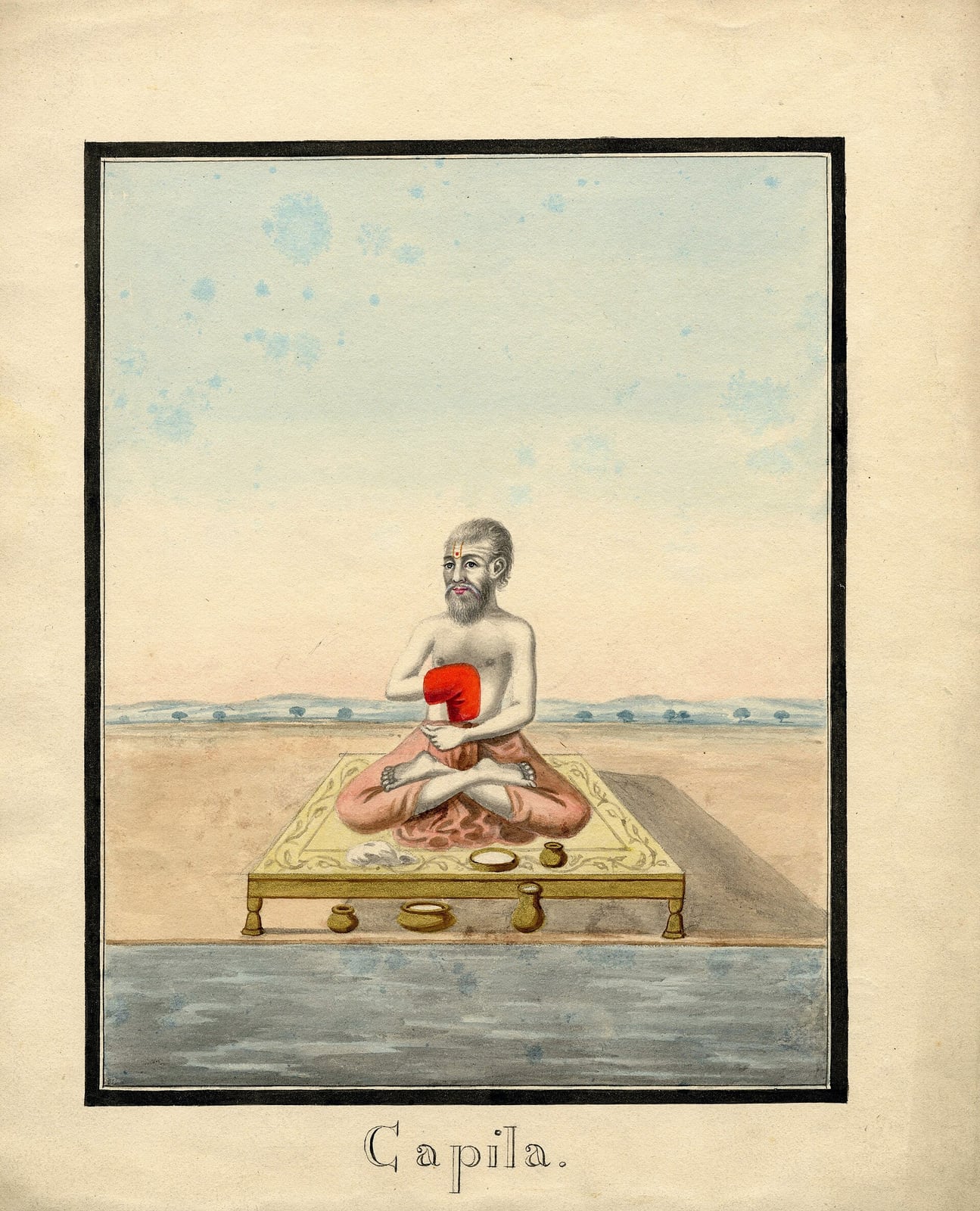
Kapila, sabio védico (pintura de la Company School) · Public domain
In eigenen Worten
«Well, the complete cessation of pain, [which is] of three kinds, is the complete end of man.»Sāṃkhya Sūtra I.1 (obra atribuida, s. XIV–XV); trad. inglesa de Ballantyne (1885, dominio público); versión española del investigador.

Der zentrale Gedanke
Puruṣa (witnessing consciousness): In Sāṃkhya, puruṣa is pure consciousness: it does not act, change or produce anything and has no qualities; it merely witnesses.
Im Zusammenhang sehen
Biografie
5 Min. Lesezeit
Unterstützte Übersetzung aus dem spanischen Original, Durchsicht durch einen muttersprachlichen Übersetzer ausstehend.
Ein Name an der Schwelle der Philosophie
Wenige Namen des alten Indien tragen so viel Gewicht bei so wenig Biographie. Für die Tradition ist Kapila der „erste Weise“ (ādividvān), der das Samkhya offenbarte, die älteste der brahmanischen Philosophenschulen, die zu einem System ausgebaut wurden; für die kritische Geschichtsschreibung ist er vor allem eine Autorität, auf die sich Texte berufen, die lange nach ihm entstanden sind. Kein Werk lässt sich ihm mit Sicherheit zuschreiben, für sein Leben gibt es kein Datum und für seinen Tod keinen Ort, und der Name selbst – im Sanskrit „lohfarben“, „rötlich“ – bezeichnet in der indischen Literatur mehrere verschiedene Gestalten. Was sich von ihm erzählen lässt, ist daher die Geschichte einer Erinnerung: wie eine Schule, ein Kult und eine heilige Geographie einem Namen nach und nach Gestalt gaben.
Die ersten Spuren
Die älteste Stelle, die man gewöhnlich anführt, ist ein Vers der Śvetāśvatara-Upaniṣad (5,2), der von einem „rötlichen Seher“ (ṛṣiṃ prasūtaṃ kapilam) spricht, der am Anfang hervorgebracht und mit Erkenntnissen genährt wurde. Die moderne Philologie bezweifelt, dass damit eine Person gemeint ist: Larson und Bhattacharya lesen darin ein Epitheton des kosmischen Prinzips Hiraṇyagarbha, und schon im 8. Jahrhundert merkte Śaṅkara an, der Text nenne „den bloßen Namen“, ohne zu sagen, welcher Kapila gemeint sei. Das Mahābhārata dagegen ist eindeutig: Im Mokṣadharma, dem der Erlösung gewidmeten Abschnitt des Śāntiparvan, ist Kapila der höchste Weise, der das Samkhya verkündete, so wie Hiraṇyagarbha das Yoga, und er erscheint im Streitgespräch mit dem Asketen Syūmaraśmi über den Wert des vedischen Opfers gegenüber Entsagung und Gewaltlosigkeit.
Der Lehrer des Āsuri
Die Überlieferungskette, die die Schule als die ihre anerkannte, wurde in der Sāṃkhya Kārikā des Īśvarakṛṣṇa festgeschrieben, die um das 4. bis 5. Jahrhundert entstand und genau genommen der älteste erhaltene Text des klassischen Samkhya ist. Ihre Schlussstrophen erklären, der Weise habe diese läuternde Lehre aus Mitgefühl an Āsuri weitergegeben, Āsuri habe sie Pañcaśikha gelehrt und dieser sie weit verbreitet, bis Īśvarakṛṣṇa sie in Strophen im Āryā-Versmaß zusammenfasste. Der Kommentar zum Yoga (Yoga-bhāṣya) zitiert ein Pañcaśikha zugeschriebenes Fragment, in dem Kapila „der Erste Wissende“ ist, der aus Mitgefühl einen geschaffenen Geist annahm und die Lehre dem wissbegierigen Āsuri verkündete. In dieser Formel liegt bereits die Doppeldeutigkeit, die Kapila stets begleiten wird: ein menschlicher Lehrer und zugleich eine kosmische Gestalt, die am Beginn eines Weltzyklus lehrt.
Was das Samkhya lehrte
Das ihm zugeschriebene System ist ein strenger Dualismus. Auf der einen Seite steht der puruṣa, das reine Bewusstsein, vielfach, untätig und bloßer Zeuge; auf der anderen die prakṛti, die Urnatur, eine und dynamisch, gewoben aus drei Eigenschaften (guṇa) – sattva, rajas und tamas –, deren Gleichgewicht, wenn es zerbricht, in einer Evolution die Prinzipien (tattva) der Welt entfaltet: den Intellekt, das Ichbewusstsein, das Denkorgan, die Sinne, die feinen und die groben Elemente. Das Leiden entsteht daraus, dass man den Zeugen mit dem verwechselt, was er betrachtet; die Erlösung (kaivalya, „Absonderung“) kommt mit der unterscheidenden Erkenntnis, die beide trennt. Der erste Aphorismus der Sāṃkhya Sūtra fasst das mit beinahe ärztlicher Nüchternheit zusammen: Das völlige Aufhören der drei Arten des Leids ist das höchste Ziel des Menschen. Auf dieser Grundlage wurde das Yoga des Patañjali errichtet, dessen metaphysischer Rahmen im Wesentlichen der des Samkhya ist.
Ein spätes Buch unter seinem Namen
Die Texte, die heute Kapilas Namen tragen, sind weit jünger als jede vernünftige Datierung seiner Person. Die Sāṃkhya Sūtra, auch Sāṃkhya-pravacana Sūtra genannt, etwas mehr als fünfhundert Aphorismen in sechs Büchern, fehlen in der Darstellung des Samkhya, die Mādhava im 14. Jahrhundert auf der Grundlage der Kārikā gab, und ihre ersten bekannten Kommentatoren sind Aniruddha und Vijñānabhikṣu, Letzterer aus der zweiten Hälfte des 16. Jahrhunderts. Schon Garbe hielt sie für sehr spät, und Larson und Bhattacharya setzen sie um das 14. bis 15. Jahrhundert an. Unsicherer ist die Datierung des Tattva Samāsa, eines ganz knappen Katalogs der Prinzipien, den Max Müller für sehr alt hielt und den die spätere Forschung in der überlieferten Form ebenfalls für spät erachtet. Keines der beiden Werke kann als Wort Kapilas gelesen werden: Sie sind die schulische Erinnerung an eine Lehre, die man ihm zuschrieb.
Der Avatar und die Mutter
In der Andachtsliteratur wurde Kapila zu einer Gestalt Viṣṇus. Das Bhāgavata Purāṇa zählt ihn zu den Inkarnationen des Gottes – der fünften, Herr der Vollendeten, der Āsuri das im Lauf der Zeit verlorene Samkhya lehrte – und widmet ihm in seinem dritten Buch eine lange Erzählung: Als Sohn des Weisen Kardama und der Devahūti, einer Tochter Manus, unterweist Kapila seine Mutter, nachdem deren Gatte sich in das asketische Leben zurückgezogen hat, in einem theistischen Samkhya, in dem die Erkenntnis der Prinzipien in der Hingabe an Gott gipfelt. Es ist eine eigene Schicht der Tradition, wahrscheinlich um das 9. bis 10. Jahrhundert entstanden, die den Philosophen des Dualismus zu einem Lehrer der bhakti macht. Die Bhagavadgītā hatte diese Heiligung vorweggenommen: Unter den Vollendeten, sagt Kṛṣṇa, sei er der Weise Kapila.
Der Weise, der die Söhne Sagaras verbrannte
Eine andere Erzählströmung, die epische, machte aus Kapila einen furchterregenden Asketen. Nach dem Rāmāyaṇa und dem Mahābhārata gruben die sechzigtausend Söhne des Königs Sagara auf der Suche nach dem Pferd eines Opfers die Erde auf, bis sie es neben Kapila fanden, den sie für den Dieb hielten; der Weise verwandelte sie in Asche, und erst die Herabkunft der Gaṅgā, Generationen später durch die Askese Bhagīrathas erwirkt, sollte ihre Überreste läutern. Aus dieser Erzählung ging die Wallfahrt nach Gaṅgāsāgar an der Mündung des Ganges hervor, wo ein Kapila-Tempel jedes Jahr im Januar Menschenmassen empfängt. Śaṅkara nutzte diese Doppelung, um dem Samkhya vedische Autorität abzusprechen: Die Überlieferung, schrieb er, kenne „einen anderen Kapila“, jenen, der die Söhne Sagaras verbrannte.
Kapilavastu und andere Vermächtnisse
Die buddhistische Überlieferung verbindet den Namen Kapilavastu, der Stadt der Śākya, in der Siddhārtha Gautama aufwuchs, mit der Einsiedelei eines Weisen Kapila: So erzählt es Aśvaghoṣa im ersten Gesang des Saundarananda. Es handelt sich um eine Volksetymologie von ungewissem historischem Wert, die mehr über das Ansehen des Namens aussagt als über die Geographie des Altertums. Auch der Jainismus kennt einen Kapila, den Verfasser der „Verse des Kapila“ im Uttarādhyayana, doch ist das eine andere Gestalt. Diese Wucherung von Namensvettern, von unvereinbaren Genealogien – Sohn Brahmās, Kardamas, Kaśyapas – und von heiligen Orten ist der kennzeichnendste Zug seines Nachlebens.
Eine Autorität ohne Text
Was bleibt, ist eine Autorität ohne Werk. Vivekananda nannte ihn 1897 den vielleicht größten Namen der indischen Geschichte auf psychologischem und philosophischem Gebiet, und die moderne Forschung erkennt, nüchterner, im Samkhya den ersten großen indischen Versuch, die Natur als einen ursächlichen Prozess zu denken, der keines Schöpfergottes bedarf: Die Sūtra selbst lehnen es ab, einen Herrn anzunehmen, „weil er nicht bewiesen ist“. Kapila ist der Name, den Indien dem Ursprung dieses Versuchs gab; alles Übrige – seine Worte, sein Jahrhundert, sein Gesicht – gehört der Legende oder dem Schweigen.
Quellen: Larson, Gerald James y Ram Shankar Bhattacharya (eds.). Sāṃkhya: A Dualist Tradition in Indian Philosophy. Encyclopedia of Indian Philosophies, vol. IV. Princeton: Princeton University Press / Delhi: Motilal Banarsidass, 1987. · Larson, Gerald James. Classical Sāṃkhya: An Interpretation of its History and Meaning. Delhi: Motilal Banarsidass, 1969; 2.ª ed. revisada, 1979 (ISBN 9788120805033). · Jacobsen, Knut A. Kapila, Founder of Sāṃkhya and Avatāra of Viṣṇu: With a Translation of Kapilāsurisaṃvāda. Nueva Delhi: Munshiram Manoharlal, 2008 (ISBN 9788121511940). · Ballantyne, James Robert (trad.). The Sánkhya Aphorisms of Kapila, with Illustrative Extracts from the Commentaries. 3.ª ed., ed. Fitzedward Hall. Londres: Trübner & Co., 1885 (Trübner's Oriental Series). Texto consultado en el OCR de Internet Archive. · Colebrooke, Henry Thomas (trad.) y Horace Hayman Wilson (trad. y coment.). The Sánkhya Káriká, or Memorial Verses on the Sánkhya Philosophy, by Íswara Krishna; also the Bháshya or Commentary of Gaurapáda. Oxford: Oriental Translation Fund, 1837. Estrofas LXIX–LXXI y comentario de Wilson, pp. 188–191.
Zeitleiste
Das Leben, Jahr für Jahr
Jeder Punkt ist ein belegtes Ereignis. Klicken Sie, um es mit Quelle und Grad der Gewissheit zu lesen.
IV. Jahrhundert v. Chr.
A “reddish seer” in the Śvetāśvatara Upaniṣad
Verse 5.2 mentions a ṛṣi kapila begotten in the beginning. The Upaniṣad’s date is uncertain (last centuries BCE) and scholars doubt that the word names a person rather than an epithet of Hiraṇyagarbha.
UmstrittenLarson, Gerald James y Ram Shankar Bhattacharya (eds.). Sāṃkhya: A Dualist Tradition in Indian Philosophy. Encyclopedia of Indian Philosophies, vol. IV. Princeton: Princeton University Press / Delhi: Motilal Banarsidass, 1987.
IV. Jahrhundert v. Chr.
A “reddish seer” in the Śvetāśvatara Upaniṣad
Verse 5.2 mentions a ṛṣi kapila begotten in the beginning. The Upaniṣad’s date is uncertain (last centuries BCE) and scholars doubt that the word names a person rather than an epithet of Hiraṇyagarbha.
Umstritten
um 200 v. Chr. – 400
Kapila, proclaimer of Sāṃkhya in the Mahābhārata
The Mokṣadharma of the Śāntiparvan presents him as the supreme sage who taught Sāṃkhya and records his dialogues with Āsuri and Syūmaraśmi. The epic took shape between c. 300 BCE and 400 CE; the dating of these sections is approximate.
Wahrscheinlich
I. Jahrhundert
Kapilavastu, city of the sage Kapila
Aśvaghoṣa relates in the Saundarananda (canto I) that the Śākya princes founded their city beside the hermitage of Kapila Gautama and named it Kapilavastu. It is a folk etymology.
Überlieferung
um 350 – 450
The Sāṃkhya Kārikā fixes the line Kapila–Āsuri–Pañcaśikha
Īśvarakṛṣṇa composes the oldest surviving text of classical Sāṃkhya; stanzas 69–71 ascribe the doctrine to the “sage” who taught it to Āsuri. Before 569 Paramārtha translated it into Chinese with a commentary.
Wahrscheinlich
um 400
The “First Knower” in the Yoga-bhāṣya
The commentary on the Yogasūtra (I.25) quotes a fragment of Pañcaśikha: the First Knower, assuming a created mind out of compassion, declared the doctrine to Āsuri.
Wahrscheinlich
VIII. Jahrhundert
Śaṅkara distinguishes “another Kapila”
In the Brahmasūtra-bhāṣya (II.1.1) Śaṅkara denies Vedic authority to Kapila’s smṛti and recalls that tradition knows another Kapila, the one who burned the sons of Sagara.
Belegt
um 900
Kapila, avatar of Viṣṇu and teacher of Devahūti
The Bhāgavata Purāṇa (I.3.10 and III.24–33) counts him as Viṣṇu’s fifth incarnation and narrates his teaching of a devotional Sāṃkhya to his mother. The Purāṇa’s date is debated (c. 9th–10th centuries).
Umstritten
um 1400 – 1500
The Sāṃkhya Sūtra
The aphorisms that tradition calls the “sūtras of Kapila” are fixed. Larson and Bhattacharya place them around the 14th–15th centuries; their earliest known commentator is Aniruddha.
Wahrscheinlich
1837
First European translation of the Kārikā
Colebrooke and Wilson publish the Sāṃkhya Kārikā with Gauḍapāda’s commentary in Oxford; Wilson summarises the traditions about Kapila.
Belegt
1852
Ballantyne translates the Sāṃkhya Sūtra
James R. Ballantyne publishes in India his English version of the aphorisms with extracts from the commentaries; the third edition, revised by Fitzedward Hall, appears in London in 1885.
Belegt
1897
Vivekananda praises Kapila
In a lecture in Calcutta he calls him perhaps the greatest name in Indian history in psychology and philosophy.
Belegt
Werke
Grundlegende Werke
Die Werke, ohne die sich das Vermächtnis nicht verstehen lässt.
Traditionelle Zuschreibung · um 1400
Sāṃkhya Sūtra (Sāṃkhya-pravacana Sūtra)
सांख्यसूत्र (साङ्ख्यप्रवचनसूत्र)
Some five hundred aphorisms (527 in the Wikisource numbering; editions vary by one or two) in six books: the first sets out the doctrine and the theory of knowledge, the second and third the evolution of nature and the means of liberation, the fourth a series of illustrative parables, the fifth refutes rival schools and the sixth recapitulates. It defends the dualism of puruṣa and prakṛti, the pre-existence of the effect in its cause and the impossibility of proving the existence of a Lord (I.92). It was commented on by Aniruddha (c. 1500), Vijñānabhikṣu (second half of the 16th century), who read it in a theistic and Vedāntic key, and Mahādeva Vedāntin.
6 Ausgaben

Traditionelle Zuschreibung · um 900
Kapila’s teaching to Devahūti (Kapila-gītā, Bhāgavata Purāṇa III.25–33)
कपिलगीता (भागवतपुराण ३.२५–३३)
Nine chapters in which Kapila, presented as an incarnation of Viṣṇu, answers his mother Devahūti, who asks him to free her from attachment to the body and to “mine”. He expounds the Sāṃkhya principles, nature and puruṣa, the practice of yoga and meditation on the divine form, the kinds of devotion according to the three qualities, the cycle of transmigration and the fate of those who live for pleasure. Its thesis is that the mind bound to the qualities enslaves and the mind fixed on God liberates. It ends with Devahūti’s liberation.
4 Ausgaben
Kapila
Tattva Samāsa
Traditionelle Zuschreibung
Tattva Samāsa
तत्त्वसमास (तत्त्वसमाससूत्र)
A very brief list of some twenty-two to twenty-five statements that enumerates, without argument, the categories of the system: the eight “producers” (nature, intellect, the sense of self and the five subtle elements), the sixteen modifications, puruṣa, the three qualities, the processes of manifestation and dissolution, the dispositions of the intellect, the forms of error and of perfection, and liberation. It works as a mnemonic index of the doctrine, and its meaning depends entirely on the accompanying commentary.
3 Ausgaben
Das gesamte Werk (13)

Dialogue of Kapila and Āsuri (Kapilāsurisaṃvāda)
Kapila
Dialogue of Kapila and Syūmaraśmi (Gokapilīya)
The Conscious LibraryDialogue of Kapila and Syūmaraśmi (Gokapilīya)
Kapila
Ṣaṣṭitantra (“Treatise of Sixty Topics”)
The Conscious LibraryṢaṣṭitantra (“Treatise of Sixty Topics”)

Sāṃkhya Kārikā (a work by Īśvarakṛṣṇa, not by Kapila)
350
Kapila
Kapila Purāṇa
The Conscious LibraryKapila Purāṇa
Kapila
Kapila Saṃhitā
The Conscious LibraryKapila Saṃhitā
Kapila
Kapila Smṛti
The Conscious LibraryKapila Smṛti
Kapila
Kapila Pañcarātra
The Conscious LibraryKapila Pañcarātra
Kapila, Founder of Sāṃkhya and Avatāra of Viṣṇu (Knut A. Jacobsen)
2008

Classical Sāṃkhya (Gerald James Larson)
1969
Zitate
Zitate, die in einem bestimmten Werk nachgewiesen sind. Jedes trägt seine Herkunft und seinen Grad an Verlässlichkeit.
Well, the complete cessation of pain, [which is] of three kinds, is the complete end of man.atha trividhaduḥkhātyantanivṛttir atyantapuruṣārthaḥ
GeprüftSāṃkhya Sūtra I.1 (obra atribuida, s. XIV–XV); trad. inglesa de Ballantyne (1885, dominio público); versión española del investigador.
Letzte Worte
Es gibt keine überprüfbaren Aufzeichnungen der letzten Worte.
There is no record of Kapila’s last words: he is a legendary figure without a documented biography, and the traditional sources do not narrate his death.
Fragen
Was das Werk beantwortet
Zwölf große Fragen der Menschheit und was sich aus den Texten darauf antworten lässt, mit Belegen. Wir legen niemandem Worte in den Mund.
Was ist das Absolute? Gibt es Gott?
The existence of a Lord is not proven: there are consciousnesses and nature
Kein SchöpfergottAusdrücklich gesagt
The Sāṃkhya tradition that goes back to Kapila explains reality by two uncreated principles: consciousness (puruṣa), plural, inactive and witnessing, and primordial nature (prakṛti), single, unconscious and active, from which everything else proceeds. It needs no creator God: nature unfolds by itself for the sake of the consciousnesses, as milk flows for the calf. The Sāṃkhya Sūtras that bear his name dismiss the theistic objection with a terse formula, «because the existence of a Lord is not proven» (1.92), and in book V they examine and reject the arguments for a governor of the world. The ultimate is not a being to be worshipped but pure consciousness, which has never been mixed with what it beholds.
Diese Frage mit anderen Meistern vergleichenWer bin ich? Gibt es ein wahres Selbst?
The «I» is a product of nature; the witnessing consciousness is not
Das Ego ist ein Konstrukt des DenkensAusdrücklich gesagt
In Sāṃkhya, everything we usually call «I» —thinking, deciding, feeling, saying «this is mine»— belongs to nature (prakṛti). The sense of I (ahaṃkāra) is one of its products: it arises from the intellect and gives rise to the mind and the senses. The true self is something else: puruṣa, pure consciousness that does not act or change and merely witnesses, illumining these processes without mixing with them. The fundamental illusion is to ascribe the states of the mind to oneself, and liberating knowledge is formulated as a triple negation: «I am not, nothing is mine, there is no I» (Sāṃkhya Kārikā, verse 64). Unlike non-dual Vedānta, the puruṣas are many, one for each conscious being, and none merges into a common Absolute.
Diese Frage mit anderen Meistern vergleichenWarum leiden wir?
The threefold pain arises from not distinguishing consciousness from nature
Unwissenheit über das, was wir sindAusdrücklich gesagt
Sāṃkhya begins with pain. The Sāṃkhya Sūtras open by declaring that the complete cessation of pain, which is of three kinds, is the complete end of man (1.1): the pain that arises from oneself, that which comes from other beings and that which proceeds from supernatural forces. Neither ordinary remedies nor Vedic rites remove it, because their effect is temporary. Its cause is lack of discrimination (aviveka): consciousness, which merely witnesses, ascribes to itself the states of nature, in which the quality rajas is activity and pain. As long as puruṣa believes itself the one who suffers, suffering belongs to it; when it recognises that it was never mind or body, nature ceases to act with respect to it.
Diese Frage mit anderen Meistern vergleichenWas geschieht nach dem Tod?
The subtle body transmigrates, not consciousness, until discrimination
Wiedergeburt nach dem KarmaAusdrücklich gesagt
The Sāṃkhya tradition accepts rebirth, but explains it with technical precision. What passes from one body to another is the subtle body (liṅga), made up of intellect, the sense of I, mind, senses and subtle elements, which carries acquired dispositions as an actor changes roles (Kārikā, verses 40–42). Consciousness, puruṣa, never transmigrates: strictly speaking, says verse 62, no puruṣa is bound, liberated or wanders from life to life; it is nature that transmigrates, is bound and is freed. When discriminating knowledge matures, the body continues for a time by inertia, like the potter's wheel that keeps turning after the hand is withdrawn (verse 67), and at its fall comes final isolation (kaivalya).
Diese Frage mit anderen Meistern vergleichenWie erlangt man Befreiung oder Erlösung?
Through discrimination between consciousness and nature, which leaves the witness alone
Durch unmittelbare ErkenntnisAusdrücklich gesagt
Sāṃkhya is above all a path of knowledge. Since neither ordinary remedies nor Vedic rites end the threefold pain, only discriminating knowledge (viveka) achieves it: understanding that puruṣa is not nature nor any of its products. The Kārikā sums it up in the formula «I am not, nothing is mine, there is no I» (verse 64). The Sāṃkhya Sūtras illustrate it with the parable of the king's son raised among hunters, who knows himself a prince only when someone tells him: discrimination arises from teaching about the truth (4.1). Its purpose fulfilled, nature withdraws like the dancer who has finished her dance (3.69), and consciousness remains in kaivalya, isolated and free from all experience.
Diese Frage mit anderen Meistern vergleichenBraucht es einen Lehrer?
Discrimination arises from teaching, like the prince unaware he is one
Hilfreich, aber nicht unverzichtbarAus der Lehre abgeleitet
Sāṃkhya grants teaching a decisive role but does not turn it into submission to a person. The Sāṃkhya Sūtras open their fourth book with the parable of the king's son, raised among humble people, who knows himself a prince only when someone reveals his origin: likewise, discrimination between consciousness and nature arises from teaching about the truth (4.1). The school also preserves a lineage of transmission: the Sāṃkhya Kārikā relates that the sage Kapila compassionately imparted this doctrine to Āsuri, he to Pañcaśikha, and from him it spread (verse 70). But taught knowledge must become one's own discernment, and Kapila himself is for the tradition the «first knower», born already with wisdom.
Diese Frage mit anderen Meistern vergleichenIst die Welt wirklich?
The world is real: nature unfolding from three qualities
Natürliche Ordnung im WandelAusdrücklich gesagt
For Sāṃkhya the world is neither an illusion nor a divine creation, but the real transformation of primordial nature (prakṛti). Its theory of causation holds that the effect pre-exists in the cause —the oil in the sesame seed, the pot in the clay— so that nothing arises from nothing: the universe is the manifestation of what was latent, and dissolution is its return to that state (Kārikā, verse 9). Nature unfolds in twenty-four principles, from intellect to the gross elements, and its diversity is explained by the varying proportion of three qualities: sattva, rajas and tamas. Unconscious yet ordered, it acts with a purpose: to offer consciousness experience and, afterwards, the discrimination that frees it.
Diese Frage mit anderen Meistern vergleichenWas ist Liebe?
Sāṃkhya is silent; the Bhāgavata's Kapila makes attachment to saints a door
Nicht geäußert
The Sāṃkhya tradition has no doctrine of love. Its theme is the separation of consciousness from nature, and affection appears in it as one more modification of the mind, which belongs to prakṛti and binds as long as consciousness ascribes it to itself. It is otherwise with the Kapila of the Bhāgavata Purāṇa, an avatar of Viṣṇu, who in his teaching to his mother Devahūti says that the mind is the cause of bondage and liberation: attached to the qualities it binds, enamoured of the supreme Person it frees (3.25.15); and that attachment, the unageing chain of the soul, when placed in the saints is the open door to liberation (3.25.20). But that is the voice of a later devotional figure, not of Sāṃkhya.
Diese Frage mit anderen Meistern vergleichenSind wir frei, oder ist alles vorherbestimmt?
Nature acts; consciousness only seems an agent through proximity
Es gibt keinen HandelndenAusdrücklich gesagt
In Sāṃkhya action is real, but it does not belong to whom we think. All doing —deciding, desiring, moving the body— is the activity of nature, of its three qualities and of the instruments it produces: intellect, sense of I, mind and senses. Consciousness (puruṣa) is by essence inactive, witnessing and indifferent; through its union with nature, says the Kārikā, the unconscious seems conscious and, although the agent is nature, consciousness seems to be the one who acts (verse 20). The merits, demerits and dispositions that condition each new life reside in the intellect, not in puruṣa. To be liberated is not to conquer free will, but to recognise that the witness was never the author of anything.
Diese Frage mit anderen Meistern vergleichenWozu meditieren oder beten?
Meditating in order to discern: seeing that consciousness is not the mind
Die Wirklichkeit sehen, wie sie istAusdrücklich gesagt
The Sāṃkhya tradition knows no prayer, since there is no Lord to address, but it does know meditation. The Sāṃkhya Sūtras, in their third book, define it as the means that removes attachment and list a stable and comfortable posture and the performance of one's own duties among its conditions; Patañjali's Yoga, which adopts Sāṃkhya metaphysics, develops these techniques in detail. But in Sāṃkhya meditation serves a knowledge: the discernment (viveka) that puruṣa is not nature nor any of its products. The Kārikā says that through the repeated practice of the true principles there arises a complete, pure and unerring knowledge: «I am not, nothing is mine, there is no I» (verse 64).
Diese Frage mit anderen Meistern vergleichenKann die Vernunft das Letzte erkennen?
Perception, inference and testimony: reason reaches the unmanifest
Schrift und DenkenAusdrücklich gesagt
Sāṃkhya is probably the most rationalist of the classical Indian schools. It admits three means of knowledge: perception, inference and reliable testimony, which includes revelation (Kārikā, verses 4–6). But it gives inference a decisive role: what is not perceived —unmanifest nature, consciousness— is known by reasoning, and the existence of puruṣa is proven because every aggregate exists for another and someone must experience. With the same tool the Sāṃkhya Sūtras deny that a Lord is proven (1.92). Revelation is accepted, but its ritual part is criticised, which the Kārikā judges impure and ineffective (verse 2). The ultimate, liberating discrimination, is a knowledge that ripens with practice, not a leap beyond reason.
Diese Frage mit anderen Meistern vergleichenSich von der Welt zurückziehen oder sie verwandeln?
Detachment and isolation: the goal is for nature to cease acting
Sich zurückziehen, um zu findenAus der Lehre abgeleitet
Sāṃkhya offers no programme for the world, because its goal is the isolation (kaivalya) of consciousness from nature. The path runs through detachment (vairāgya) and renunciation: the Sāṃkhya Sūtras illustrate in their fourth book, with a series of parables, the wisdom of living without hopes, without distracting company and without accumulating, like the courtesan Piṅgalā, who was happy once she stopped expecting. The Kārikā warns that not even the Vedic rites, which promise better worlds, free from pain (verse 2). Life in the world is not condemned, but it is regarded as a field of experiences that consciousness, once satisfied, leaves behind, like the spectator who has already seen the dance (verse 59).
Diese Frage mit anderen Meistern vergleichen
Affinitäten und Spannungen
Affinitäten und Spannungen
Frage für Frage aus den Positionen berechnet. Den Grund jeder Übereinstimmung und jedes Widerspruchs zeigt ein Klick.
Denkt ähnlich wie
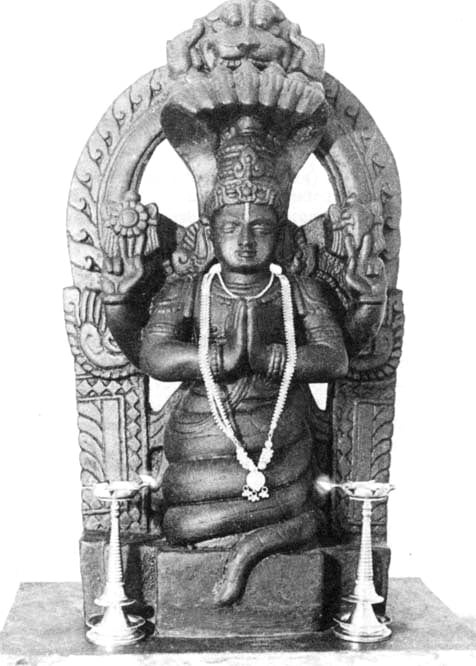
Patañjali
Übereinstimmung bei: Was ist das Absolute? Gibt es Gott? · Warum leiden wir? · Was geschieht nach dem Tod?
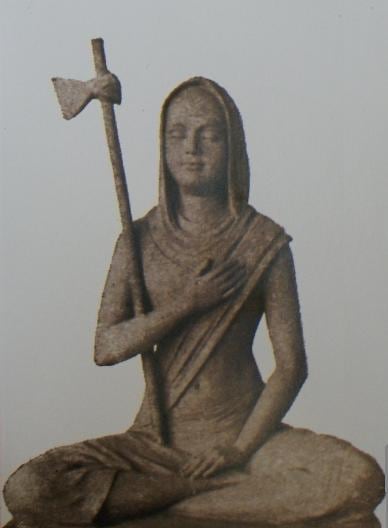
Gaudapada
Übereinstimmung bei: Warum leiden wir? · Wie erlangt man Befreiung oder Erlösung? · Sind wir frei, oder ist alles vorherbestimmt?

Nāgārjuna
Übereinstimmung bei: Wie erlangt man Befreiung oder Erlösung? · Was ist das Absolute? Gibt es Gott? · Was geschieht nach dem Tod?

Siddhartha Gautama, the Buddha
Übereinstimmung bei: Was ist das Absolute? Gibt es Gott? · Was geschieht nach dem Tod? · Braucht es einen Lehrer?
Denkt anders als

Francis of Assisi
Widerspruch bei: Was ist das Absolute? Gibt es Gott? · Was geschieht nach dem Tod?
Hafez
Widerspruch bei: Was ist das Absolute? Gibt es Gott? · Was geschieht nach dem Tod?
Pavel Florensky
Widerspruch bei: Was ist das Absolute? Gibt es Gott? · Was geschieht nach dem Tod?
Fyodor Dostoevsky
Widerspruch bei: Was ist das Absolute? Gibt es Gott? · Was geschieht nach dem Tod?
Anekdoten und Erzählungen
Anekdoten und Erzählungen
Hagiographische Erzählungtiempo mítico
The sixty thousand sons of Sagara
Herkunft der Erzählung: An epic narrative of the Rāmāyaṇa (Bālakāṇḍa) and the Mahābhārata (Āraṇyakaparvan), taken up by the Bhāgavata Purāṇa (IX.8). Wilson (1837) already noted that the Rāmāyaṇa identifies this Kapila with Vāsudeva; Śaṅkara (8th c.) distinguished him from the founder of Sāṃkhya. The link with Gaṅgāsāgar is a pilgrimage tradition studied by Jacobsen (2013).
Hagiographische Erzählungtiempo mítico
The mother who asked to be set free
Herkunft der Erzählung: Bhāgavata Purāṇa III.21–33, a devotional text of debated date (c. 9th–10th centuries). Burnouf (1840) already noted that this story is not found elsewhere and turns Kapila into a form of Bhagavat. The identification with Siddhpur is a pilgrimage tradition studied by Jacobsen (2013).
Mündliche Überlieferungtiempo épico
The sage and the sacrificial cow
Herkunft der Erzählung: Mahābhārata, Śāntiparvan (Mokṣadharma), the episode called Gokapilīya in the Poona critical edition. It is a didactic epic narrative, not a historical testimony. Kapila’s exact exclamation varies among translations; the content is summarised here without quoting it.
Quelle: The Mahābhārata. Edición crítica, vols. 13–16: Śāntiparvan, ed. S. K. Belvalkar. Poona: Bhandarkar Oriental Research Institute, 1949–1966 (Mokṣadharma; diálogos de Kapila con Syūmaraśmi y con Āsuri; XII.337.60 sobre Kapila como proclamador del Sāṃkhya).
Mündliche Überlieferungs. XIV–XVI (texto y comentario)
The prince raised by a forester
Herkunft der Erzählung: Sāṃkhya Sūtra IV.1 (a text ascribed to Kapila, 14th–15th c.) and Vijñānabhikṣu’s commentary (16th c.), in Ballantyne’s translation (1885), pp. 284–285. It is a didactic parable, not an episode in Kapila’s life.
Belegts. VIII
Śaṅkara and “the other Kapila”
Herkunft der Erzählung: Brahmasūtra-bhāṣya II.1.1, in Thibaut’s translation (SBE 34, 1890), checked against the OCR of the volume. Śaṅkara’s date (c. 8th century) is the usual scholarly one.
Hagiographische Erzählungtiempo legendario (texto del s. I–II)
Kapilavastu, the city beside the hermitage
Herkunft der Erzählung: Aśvaghoṣa, Saundarananda, canto I (1st–2nd c. CE), ed. and trans. E. H. Johnston. An aetiological story; the Pali tradition preserves other versions of the origin of the Śākyas.
Quelle: Johnston, E. H. (ed. y trad.). The Saundarananda of Aśvaghoṣa. Oxford University Press / Panjab University, 1928 (texto) y 1932 (traducción). Canto I, sobre la fundación de Kapilavastu junto a la ermita del sabio Kapila Gautama.
Hagiographische Erzählungépoca de Prasenajit (s. VI–V a. C., según el relato)
The other Kapila: two gold coins
Herkunft der Erzählung: Jain commentary on Uttarādhyayana VIII, summarised by Hermann Jacobi in his translation (SBE 45, 1895, p. 31, note 1); verse 17 is the one the story places in Kapila’s mouth before the king. It is included to dispel the homonymy: this is another Kapila.
Lehren
Lehren
Die Begriffe, die das Denken gliedern, in ihrem Zusammenhang erklärt.
Puruṣa (witnessing consciousness)purusha
It is one of the two irreducible principles of Sāṃkhya and the point at which it diverges most from Vedānta, which affirms a single consciousness. Patañjali’s Yoga inherits the notion (as draṣṭṛ, “the seer”).
Quelle: Larson, Gerald James. Classical Sāṃkhya: An Interpretation of its History and Meaning. Delhi: Motilal Banarsidass, 1969; 2.ª ed. revisada, 1979 (ISBN 9788120805033).
Prakṛti (primordial nature)prakriti
The theory of prakṛti was adopted by Yoga, by much of Purāṇic cosmology and by Āyurvedic medicine, although Vedānta reinterpreted it as the power (māyā) of a single Brahman.
Quelle: Larson, Gerald James. Classical Sāṃkhya: An Interpretation of its History and Meaning. Delhi: Motilal Banarsidass, 1969; 2.ª ed. revisada, 1979 (ISBN 9788120805033).
The three qualities (guṇa)gunas
The guṇas already appear in the epic and are systematised in the Kārikā (stanzas 12–13). They are one of the notions most widely shared among Indian schools.
The twenty-five principles (tattva)tattvas
The list of twenty-five principles is the classical form fixed in the Kārikā; in the epic there are different counts (twenty-six or seventeen), a sign of a doctrine still in formation. The Tattva Samāsa is essentially an index of these categories.
Quelle: Larson, Gerald James y Ram Shankar Bhattacharya (eds.). Sāṃkhya: A Dualist Tradition in Indian Philosophy. Encyclopedia of Indian Philosophies, vol. IV. Princeton: Princeton University Press / Delhi: Motilal Banarsidass, 1987.
Satkāryavāda (the effect pre-exists in the cause)satkaryavada
It is one of the logical pillars of the system and the reason why Sāṃkhya can dispense with a creator god. The Sāṃkhya Sūtra defend it in book I.
Viveka and kaivalya (discrimination and isolation)kaivalya
The term kaivalya passed into Patañjali’s Yoga, which names its fourth chapter after it (Kaivalya-pāda). The devotional version of the Bhāgavata replaces isolation with loving union with God.
Videos
Videos
Aufnahmen, Gespräche und Dokumentarfilme. Die Videos werden von YouTube wiedergegeben; sie werden nicht hier gespeichert.
Kapila of Sāṃkhya: Manifestations and interpretations by Prof. Knut Axel Jacobsen
Vortrag· EN· 93 min
Bhaktivedanta Research Center
Sāṃkhya philosophy and Yoga practice: how are they related? - Dr Mikel Burley
Vortrag· EN· 76 min
SOAS Centre Of Yoga StudiesOffizieller Kanal
Samkhya Karikas (Part 1) - Edwin Bryant
Vortrag· EN· 139 min
Edwin Bryant OfficialOffizieller Kanal
Hindu Philosophy Introduction 7: Yoga and Sāṃkhya - Edwin Bryant
Vortrag· EN· 60 min
Edwin Bryant OfficialOffizieller Kanal
“Concept of Mind in Yoga and Sankhya Philosophy" Lecture with Dr. N. Ganesh Rao
Vortrag· EN· 75 min
Loyola Marymount University, BCLA Yoga StudiesOffizieller Kanal
Revisiting Sāṃkhya Kārikās 25-31: The Determinative Nature of the Guṇas
Vortrag· EN· 49 min
Loyola Marymount University, BCLA Yoga StudiesOffizieller Kanal
Saga of the Soul 065 - Samkhya Darshan (Kapila School Of Philosophy)
Vortrag· EN· 64 min
Chicago VedantaOffizieller Kanal
Swami Purnananda explains the 24 elements of the Sankhya philosophy and verses from Katha Upanishad
Vortrag· EN· 60 min
Éire Vedanta SocietyOffizieller Kanal
Know our Shastras: Essentials of Sankhya Philosophy
Vortrag· EN· 84 min
MIT IIKS
Samkhya-Sutra, El hilo de oro del Indo, por Ibn Asad y Fernando Sánchez Dragó (1ª Parte - Ponencia)
Vortrag· ES· 56 min
LaDanzaFinaldeKali
Introducción a la filosofía Samkhya. Yogacharya Emiliano Crivellari
Vortrag· ES· 37 min
Emiliano CrivellariOffizieller Kanal
कपिल अवतार और सांख्य शास्त्र के प्रवर्तक कपिल मुनि अलग थे
Analyse· HI· 2 min
Govardhan Math, PuriOffizieller Kanal
सांख्य दर्शन SANKHYA DARSHAN की सरल और व्यावहारिक व्याख्या - DR HIMMAT SINGH SINHA
Vortrag· HI· 14 min
The Quest
সাগরের জল স্পর্শ করে, কপিল মুনির আশীর্বাদের আশা, এর পেছনে পৌরাণিক ঘটনা, শুনব| ABP Ananda
Dokumentarfilm· BN· 2 min
ABP ANANDAOffizieller Kanal
Galerie
Galerie
Bilder mit geprüfter Lizenz. Jedes bewahrt seine Urheberschaft und seinen Herkunftsnachweis.
Beziehungen
Beziehungen
Einflüsse, Schülerschaften und Verwandtschaften. Die belegte Beziehung wird von der durch Analyse ermittelten Ähnlichkeit unterschieden.
Widersprach
Śaṅkara refuted Sāṃkhya in his Brahmasūtra-bhāṣya (II.1.1 and II.2) and denied Vedic authority to “Kapila’s smṛti”, also distinguishing “another Kapila”, the one who burned the sons of Sagara.
Belegte Beziehung
Beeinflusste
Patañjali’s Yoga adopts the metaphysical framework of Sāṃkhya (puruṣa, prakṛti, guṇa, kaivalya), and its commentary (Yoga-bhāṣya I.25) quotes the Pañcaśikha fragment presenting Kapila as the “First Knower”.
Belegte Beziehung
Beeinflusste
The Yoga-bhāṣya, traditionally ascribed to Vyāsa, quotes Kapila’s teaching to Āsuri; the Bhagavad Gītā, in the Mahābhārata ascribed to Vyāsa, names Kapila among the perfected. A textual, not historical, relation.
Belegte Beziehung
Beeinflusste
A commentary on the Sāṃkhya Kārikā bears Gauḍapāda’s name and quotes a verse counting Kapila among the sons of Brahmā. Whether its author is the Gauḍapāda of the Māṇḍūkya-kārikā is doubtful.
Belegte Beziehung
Beeinflusste
In 1897 he called him “perhaps the greatest name in the history of India in psychological and philosophical lines” and devoted several lectures to Sāṃkhya.
Belegte Beziehung
Verwandte Gedanken mit
Siddhartha Gautama, the Buddha
Buddhist tradition associates Kapilavastu, the Buddha’s city, with the hermitage of a sage Kapila (a folk etymology). Since Max Müller the Sāṃkhya and Buddhist diagnoses of suffering have been compared, though their paths differ.
Durch Analyse ermittelte Ähnlichkeit
Verwandte Gedanken mit
The Bhagavad Gītā (10.26) has Kṛṣṇa say in the same verse that among divine sages he is Nārada and among the perfected, Kapila; the Mahābhārata presents Nārada as versed in Sāṃkhya.
Durch Analyse ermittelte Ähnlichkeit
Verwandte Gedanken mit
Uddālaka’s teaching in the Chāndogya Upaniṣad (VI), with its analysis of effects as modifications of one substance (clay and its pots), anticipates themes of Sāṃkhya’s satkāryavāda.
Durch Analyse ermittelte Ähnlichkeit
Verwandte Gedanken mit
The figure of the witness that cannot be seen, in Yājñavalkya’s teachings in the Bṛhadāraṇyaka Upaniṣad, is one of the Upaniṣadic antecedents of the notion of puruṣa.
Durch Analyse ermittelte Ähnlichkeit
Verwandte Gedanken mit
The Gauḍīya tradition founded by Caitanya reads Kapila’s teaching to Devahūti as a devotional Sāṃkhya; Bhaktivedanta Swami’s commentary (Teachings of Lord Kapila) comes from it.
Durch Analyse ermittelte Ähnlichkeit
Von anderen Einträgen aus verknüpft
Quellen
Quellen
Für diesen Eintrag herangezogene Bibliografie und Kataloge.
- Wikidata, «Kapila» (sabio védico de la tradición hindú), QID Q574355; LCCN n50059441; GND 119244233; BnF 11909405v; VIAF 9848428.
- Larson, Gerald James y Ram Shankar Bhattacharya (eds.). Sāṃkhya: A Dualist Tradition in Indian Philosophy. Encyclopedia of Indian Philosophies, vol. IV. Princeton: Princeton University Press / Delhi: Motilal Banarsidass, 1987.
- Larson, Gerald James. Classical Sāṃkhya: An Interpretation of its History and Meaning. Delhi: Motilal Banarsidass, 1969; 2.ª ed. revisada, 1979 (ISBN 9788120805033).
- Jacobsen, Knut A. Kapila, Founder of Sāṃkhya and Avatāra of Viṣṇu: With a Translation of Kapilāsurisaṃvāda. Nueva Delhi: Munshiram Manoharlal, 2008 (ISBN 9788121511940).
- Ballantyne, James Robert (trad.). The Sánkhya Aphorisms of Kapila, with Illustrative Extracts from the Commentaries. 3.ª ed., ed. Fitzedward Hall. Londres: Trübner & Co., 1885 (Trübner's Oriental Series). Texto consultado en el OCR de Internet Archive.
- Colebrooke, Henry Thomas (trad.) y Horace Hayman Wilson (trad. y coment.). The Sánkhya Káriká, or Memorial Verses on the Sánkhya Philosophy, by Íswara Krishna; also the Bháshya or Commentary of Gaurapáda. Oxford: Oriental Translation Fund, 1837. Estrofas LXIX–LXXI y comentario de Wilson, pp. 188–191.
- Woods, James Haughton (trad.). The Yoga-System of Patañjali. Cambridge (Mass.): Harvard University Press, 1914 (Harvard Oriental Series 17). Yoga-bhāṣya I.25, con la cita de Pañcaśikha sobre el «Primer Conocedor».
- Thibaut, George (trad.). The Vedânta-Sûtras with the Commentary by Sankarâkârya, parte I. Oxford: Clarendon Press, 1890 (Sacred Books of the East 34). Brahmasūtra-bhāṣya II.1.1, sobre la «smṛti de Kapila».
- Jacobi, Hermann (trad.). Gaina Sûtras, parte II: The Uttarâdhyayana Sûtra, The Sûtrakritâṅga Sûtra. Oxford: Clarendon Press, 1895 (Sacred Books of the East 45). Lección VIII, «Kapila's Verses», con la nota sobre el relato del comentario.
- Burnouf, Eugène (trad.). Le Bhâgavata Purâna, ou Histoire poétique de Krĭchṇa, tome premier. París: Imprimerie royale, 1840. Libros I–III; prefacio sobre el relato de Kapila y Devahūti; I.3.10 (Kapila, quinta encarnación).
- Wikisource en sánscrito: «साङ्ख्यसूत्राणि» (Sāṃkhya Sūtra, 527 aforismos numerados) y «श्रीमद्भागवतपुराणम्/स्कन्धः ३/अध्यायः २५» (Bhāgavata Purāṇa III.25).
- Arnold, Edwin (trad.). The Song Celestial, or Bhagavad-Gîtâ. Londres: Trübner, 1885. Capítulo X (verso 26: «Kapila of Munis»). Project Gutenberg n.º 2388.
- Vivekananda, Swami. «The Vedanta in all its phases» (Calcuta, 1897), en Lectures from Colombo to Almora; The Complete Works of Swami Vivekananda, vol. 3. Texto en Wikisource.
- Ballantyne, James Robert. A Lecture on the Sánkhya Philosophy, embracing the Text of the Tattwa Samása. Mirzapur: Orphan School Press, 1850.
- Sinha, Nandalal (trad.). The Sāmkhya Philosophy: containing Sāmkhya-pravachana Sūtram, with the Vritti of Aniruddha and the Bhāsya of Vijñāna Bhiksu…; Tattva Samāsa; Sāmkhya Kārikā; Panchaśikha Sūtram. Allahabad: Pāṇini Office, 1915 (Sacred Books of the Hindus 11).
- Johnston, E. H. (ed. y trad.). The Saundarananda of Aśvaghoṣa. Oxford University Press / Panjab University, 1928 (texto) y 1932 (traducción). Canto I, sobre la fundación de Kapilavastu junto a la ermita del sabio Kapila Gautama.
- Garbe, Richard. Die Sâṃkhya-Philosophie: eine Darstellung des indischen Rationalismus. Leipzig: H. Haessel, 1894 (2.ª ed. 1917).
- The Mahābhārata. Edición crítica, vols. 13–16: Śāntiparvan, ed. S. K. Belvalkar. Poona: Bhandarkar Oriental Research Institute, 1949–1966 (Mokṣadharma; diálogos de Kapila con Syūmaraśmi y con Āsuri; XII.337.60 sobre Kapila como proclamador del Sāṃkhya).
- Müller, F. Max. The Six Systems of Indian Philosophy. Londres: Longmans, Green & Co., 1899. Capítulo sobre el Sāṃkhya y el Tattva-samāsa.
- Jacobsen, Knut A. Pilgrimage in the Hindu Tradition: Salvific Space. Londres y Nueva York: Routledge, 2013 (lugares de Kapila, entre ellos Gaṅgāsāgar).
- Wikipedia en inglés, «Kapila» (consultada para la lista de obras menores atribuidas y las genealogías purāṇicas; contrastada con Larson y Bhattacharya, 1987).
- Rechteinhaber
- Textos sánscritos en dominio público. Las traducciones de Ballantyne (1852, 1885), Colebrooke y Wilson (1837), Burnouf (1840) y Woods (1914) son de dominio público; las ediciones modernas (Routledge, Munshiram Manoharlal, Motilal Banarsidass, Bhaktivedanta Book Trust, Agamat) tienen derechos propios.
Bestätigung ausstehend
Was dieser Eintrag noch nicht klären konnte. Wir sagen es lieber, als es aufzufüllen.
- Ediciones en español con ISBN de los Sāṃkhya Sūtra, de la Sāṃkhya Kārikā y del canto III del Bhāgavata (Bhaktivedanta Book Trust): no localizadas en Open Library; Google Books devolvió error 429 durante la investigación.
- Verificar la numeración exacta (edición crítica de Poona) del Gokapilīya y del Kapilāsurisaṃvāda en el Śāntiparvan, y la cita del Mokṣadharma (XII.337.60) sobre Kapila como proclamador del Sāṃkhya.
- Comprobar la fecha de muerte de Nandalal Sinha para decidir el dominio público de su traducción de 1915 en la UE y España.
- Confirmar en Jacobsen (2008, 2013) los datos sobre Siddhpur (Bindu Sarovar) y Gaṅgāsāgar.
- Localizar manuscritos digitalizados de los Sāṃkhya Sūtra con signatura (campo manuscripts vacío).
- Los vídeos no traen año de publicación en oEmbed; se dejó year en null.
Recherchiert am 2026-10-26