Hinduismus · Bhakti
Chaitanya Mahaprabhu
শ্রীচৈতন্য মহাপ্রভু · चैतन्य महाप्रभु
1486 – um 1533Historisch belegte Person
Bengalischer Religionsreformer (1486–1533/34), von seinen Anhängern als gemeinsame Inkarnation von Radha und Krishna verehrt und als Begründer des Gaudiya-Vishnuismus angesehen. Der Grammatiker wurde nach seiner Einweihung in Gaya zum Ekstatiker, machte den gemeinschaftlichen Gesang der göttlichen Namen populär, verbrachte seine letzten achtzehn Jahre in Puri und hinterließ nach Ansicht der Forschung schriftlich nur die acht Strophen des Shikshashtaka. Sein Leben ist allein aus späteren Hagiographien bekannt, vor allem aus dem Chaitanya Bhagavata und dem Chaitanya Charitamrita.
- Werke
- 13Werke
- Ausgaben
- 21Ausgaben
- Zitate
- 7Zitate
- Videos
- 11Videos
- Bilder
- 7Bilder
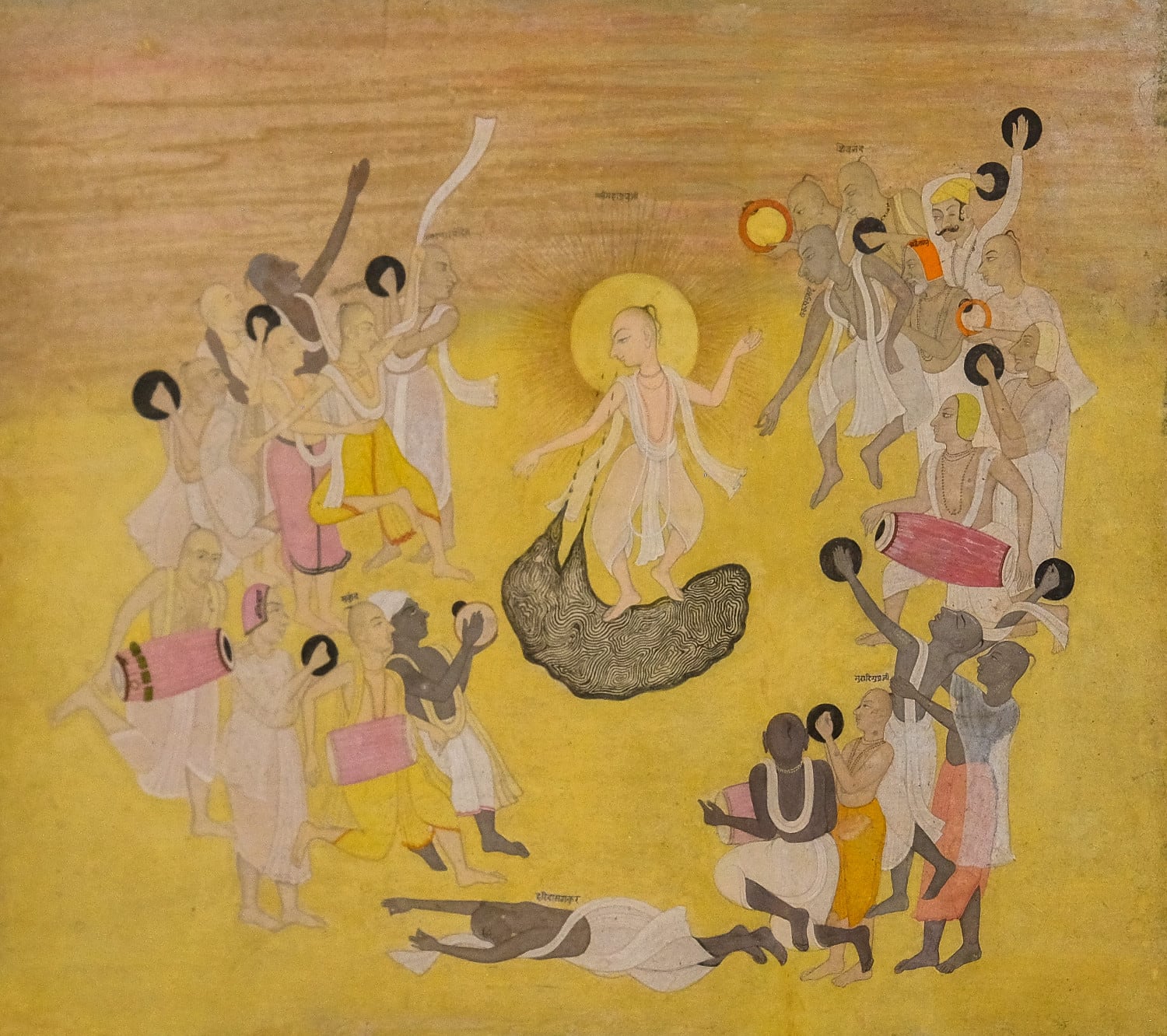
Chaitanya danza entre sus seguidores · Public domain
In eigenen Worten
«Victory to the congregational chanting of Krishna, which cleanses the mirror of the mind and puts out the great forest fire of existence; which sheds moonlight on the white lotus of the good and is the life of the bride that is knowledge; which swells the ocean of bliss, gives at every step a taste of the full nectar and bathes the whole self.»Shikshashtaka, estrofa 1 (Chaitanya Charitamrita, Antya-lila 20.12). Traducción propia.

Der zentrale Gedanke
Congregational chanting of the name (nama-sankirtana): For Chaitanya and his school, Krishna's name is not a sign pointing to God but God himself present in sound, endowed with all his power, as the second stanza of the Shikshashtaka states.
Im Zusammenhang sehen
Biografie
5 Min. Lesezeit
Unterstützte Übersetzung aus dem spanischen Original, Durchsicht durch einen muttersprachlichen Übersetzer ausstehend.
Der Junge aus Navadvipa
Vishvambhara Mishra wurde in Navadvipa geboren, der Stadt der Pandits am Ufer der Bhagirathi, in einem Bengalen, das damals von Sultanen regiert wurde. Die Überlieferung legt seine Geburt auf den Vollmond des Monats Phalguna im Jahr 1486 – nach der meistzitierten Umrechnung den 18. Februar –, in eine Nacht mit Mondfinsternis, in der, so berichten die Biographen, die ganze Stadt göttliche Namen sang. Sein Vater, Jagannatha Mishra, war ein aus Sylhet zugezogener Brahmane; seine Mutter Shachi die Tochter des Gelehrten Nilambara Chakravarti. Von den Kindern des Paares überlebten nur zwei: Vishvarupa, der das Elternhaus verließ, um Entsagender zu werden, und der jüngere, den man Nimai und wegen seiner hellen Haut Gaura nannte. Man muss es gleich zu Beginn sagen: Alles, was wir über ihn wissen, stammt aus Hagiographien, die von Verehrern verfasst wurden, die ihn für Krishna selbst hielten, und keine Quelle außerhalb seiner Gemeinschaft erwähnt ihn zu Lebzeiten.
Ein stolzer Grammatiker
Die Biographien der 1540er und 1550er Jahre zeichnen einen jungen Mann von blitzender Intelligenz und spitzer Zunge. Er studierte Sanskrit-Grammatik und die neue Logik (navya-nyaya), die Navadvipa berühmt machte, eröffnete eine eigene Schule und erwarb sich den Ruf eines gefürchteten Disputanten: Vrindavana Dasa schreibt ihm einen Sieg über den kaschmirischen Gelehrten Keshava zu. Nach dem Tod des Vaters stand er dem Haushalt vor. Er heiratete Lakshmipriya, die an einem Schlangenbiss starb, während er in Ostbengalen unterrichtete, und danach, auf Wunsch seiner Mutter, Vishnupriya, die Tochter eines Hofpandits. Nichts in diesem Bild kündigt schon den Heiligen an; gerade auf diesem Gegensatz bestehen die Hagiographen.
Gaya: die Wende
Um 1508 reiste er nach Gaya, um dort die Totenriten für seinen Vater zu vollziehen. Dort begegnete er Ishvara Puri, einem Schüler des vishnuitischen Asketen Madhavendra Puri, und empfing von ihm die Einweihung in ein Krishna-Mantra. Er kehrte verwandelt zurück: Er weinte, wenn er den Namen Krishnas hörte, fiel in Trance, verlor das Bewusstsein für seine Umgebung. Er schloss die Schule. Im Hof seines Nachbarn Shrivasa begann er nachts einen immer größeren Kreis zu versammeln, um mit Trommeln und Zimbeln die göttlichen Namen zu singen. Zu ihm stießen Nityananda, ein umherziehender Avadhuta, der sein unzertrennlicher Gefährte werden sollte; Advaita Acharya, ein betagter Brahmane aus Shantipur; Haridasa, ein Konvertit muslimischer Herkunft; und der Arzt Murari Gupta, dessen Sanskrit-Aufzeichnungen als ältestes Zeugnis dieser Jahre gelten, auch wenn ein Teil der Forschung ihre heutige Gestalt für jünger als den Tod des Meisters hält.
Der Gesang geht auf die Straße
Der Kirtan sprengte bald die Grenzen der Häuser. Vrindavana Dasa erzählt, der Kadi von Navadvipa habe das Singen verboten und Vishvambhara habe darauf mit einer nächtlichen Prozession von Tausenden bis vor die Tür des Richters geantwortet, der schließlich nachgab; er berichtet auch von der Bekehrung Jagais und Madhais, zweier gewalttätiger Brüder. Das sind hagiographische Episoden, aber sie sagen etwas Wahres über die Bewegung: ein Gesang, der jeder Kaste offenstand und öffentlich gepflegt wurde, nicht im Tempel. Anfang 1510, mit vierundzwanzig Jahren, legte er in Katwa vor Keshava Bharati die Gelübde des Entsagenden ab und erhielt von ihm den Namen Krishna Chaitanya. Seine Mutter bat ihn, sich nicht zu weit zu entfernen, und so wählte er Puri, die Stadt Jagannathas, in Orissa.
Puri und die Wege des Südens
In Puri gewann er Vasudeva Sarvabhauma für sich, den großen Lehrer der Logik und des Vedanta am Hof. Zwischen 1510 und 1512 durchwanderte er Südindien; am Ufer der Godavari führte er mit Ramananda Raya, einem Statthalter im Dienst des Königs von Orissa, jenes Gespräch, das Krishnadasa Kaviraja zur ehrgeizigsten Darlegung der Theologie der Liebe ausbauen sollte, und auf dieser Reise verschaffte er sich Abschriften der Brahma-samhita und des Krishnakarnamrita. 1514 kam er durch Ramakeli, nahe der Hauptstadt des Sultans von Bengalen, wo er zwei Brüder kennenlernte, die als hohe Beamte Husain Shahs dienten: Rupa und Sanatana. Im folgenden Jahr erreichte er endlich Vrindavan; auf dem Rückweg unterwies er Rupa in Prayag und Sanatana in Benares und trug ihnen auf, die heiligen Stätten Krishnas wiederzuentdecken und zu schreiben. Aus diesem Auftrag sollte die Theologie der Gosvamis hervorgehen.
Die Gambhira
Die letzten achtzehn Jahre verbrachte er in Puri. König Prataparudra, den er anfangs als Mann der Welt nicht empfangen wollte, gewann schließlich seine Gunst, als er ihn wie einen Diener den Weg für den Wagen Jagannathas fegen sah. Jeden Sommer tanzte er mit den aus Bengalen angereisten Pilgern vor diesem Wagen. Vor allem aber beschreiben die Hagiographien eine immer glühendere Innerlichkeit: Eingeschlossen in einer engen Kammer im Haus des Kashi Mishra, der Gambhira, begleitet von seinem Sekretär Svarupa Damodara und von Ramananda Raya, die ihm aus Jayadeva und Chandidasa vorlasen, durchlebte er Zustände der Trennung von Krishna, die Krishnadasa »göttlichen Wahnsinn« nennt. Er schlug sein Gesicht gegen die Wände, verlor die Besinnung, verschwand in der Nacht. Nach Krishnadasa rezitierte er in diesen Nächten die acht Strophen, die die Überlieferung als Shikshashtaka kennt.
Ein Ende ohne Zeugen
Er starb 1533 oder 1534 in Puri, mit etwa achtundvierzig Jahren, doch niemand weiß, wie. Krishnadasa Kaviraja, der kanonische Biograph, schweigt. Jayananda erzählt, er habe sich beim Tanz am Wagenfest den Fuß an einem Ziegelstein verletzt und sei wenige Tage später am Fieber gestorben; Lochana Dasa, er sei in den Tempel getreten und mit dem Bild Jagannathas verschmolzen; orissische Überlieferungen lassen ihn im Bild des Tota Gopinatha verschwinden. Moderne Thesen von einer Ermordung durch Tempelpriester sind weit verbreitet und stützen sich auf kein einziges Dokument. Dieses Schweigen gehört zu seiner Gestalt: Die Überlieferung zog das Verschwinden dem Leichnam vor.
Acht Strophen und eine Schule
Chaitanya schrieb keine Abhandlungen. Die Forschung schreibt ihm mit Sicherheit nur das Shikshashtaka zu, dessen Strophen zuerst Rupa Gosvamin in seiner Anthologie Padyavali aufnahm und die Krishnadasa am Ende seines Werkes zusammenstellte. Die Lehre, die seinen Namen trägt, formulierten andere: Rupa im Bhaktirasamritasindhu, Sanatana und vor allem Jiva Gosvamin, der die Formel vom »unbegreiflichen Unterschied und Nicht-Unterschied« (achintya-bhedabheda) ausarbeitete. Die großen Biographien kamen später: das Chaitanya Bhagavata des Vrindavana Dasa um 1540–1550 und das Chaitanya Charitamrita des Krishnadasa, nach der gängigsten Datierung um 1612–1615 vollendet, das Tony K. Stewart »das letzte Wort« der Überlieferung nennt. Im 19. Jahrhundert erneuerte Bhaktivinoda Thakura die Bewegung; sein Sohn Bhaktisiddhanta gründete die Gaudiya Math, und ein Schüler von diesem, A. C. Bhaktivedanta Swami, rief 1966 in New York die Internationale Gesellschaft für Krishna-Bewusstsein ins Leben, die den Gesang des Hare-Krishna-Mantras auf die Straßen der ganzen Welt trug.
Quellen: Majumdar, A. K. Caitanya: His Life and Doctrine. A Study in Vaiṣṇavism. Bombay: Bharatiya Vidya Bhavan, 1969. · Kṛṣṇadāsa Kavirāja. Caitanya Caritāmṛta of Kṛṣṇadāsa Kavirāja: A Translation and Commentary. Trad. de Edward C. Dimock Jr.; introd. de Edward C. Dimock Jr. y Tony K. Stewart; ed. de Tony K. Stewart. Harvard Oriental Series 56. Cambridge (Mass.): Dept. of Sanskrit and Indian Studies, Harvard University, 1999. ISBN 9780674002852. · Vṛndāvana Dāsa. Śrī Caitanya-bhāgavata (bengalí, c. 1540-1550). Trad. inglesa de Bhūmipati Dāsa, ed. de Puṇḍarīka Vidyānidhi Dāsa. Vṛndāvana: Vrajraj Press, 2000-2005 (varios volúmenes). · Stewart, Tony K. The Final Word: The Caitanya Caritāmṛta and the Grammar of Religious Tradition. Nueva York: Oxford University Press, 2010. ISBN 9780195392722. · Kennedy, Melville T. The Chaitanya Movement: A Study of the Vaishnavism of Bengal. Calcuta: Association Press; Londres: Oxford University Press, 1925.
Zeitleiste
Das Leben, Jahr für Jahr
Jeder Punkt ist ein belegtes Ereignis. Klicken Sie, um es mit Quelle und Grad der Gewissheit zu lesen.
18. Februar 14860 JahreNavadvipa (Nadia), Bengala
Birth of Vishvambhara
Born on the full moon of Phalguna, during a lunar eclipse, according to the hagiographies. 18 February is the most repeated conversion; some sources give the 27th.
ÜberlieferungStewart, Tony K. «Chaitanya, Sri». En Banglapedia: The National Encyclopedia of Bangladesh, ed. en línea. Dhaka: Asiatic Society of Bangladesh, 2012.
Nach dem Tod
- 1540er JahreThe Chaitanya Bhagavata
- um 1612The Chaitanya Charitamrita
- Juli 1966Founding of ISKCON
18. Februar 1486 · 0 Jahre
Birth of Vishvambhara
Born on the full moon of Phalguna, during a lunar eclipse, according to the hagiographies. 18 February is the most repeated conversion; some sources give the 27th.
Überlieferung
um 1500
Grammar teacher and first marriage
After studying grammar and logic he opens his own school and marries Lakshmipriya, who will die of a snakebite; he then marries Vishnupriya.
Überlieferung
um 1508 · 22 Jahre
Initiation by Ishvara Puri
On the journey for his father's funeral rites he is initiated by Ishvara Puri and returns to Navadvipa in a state of ecstatic devotion.
Wahrscheinlich
um 1509 · 23 Jahre
The kirtan at Shrivasa's house
He closes his school and leads nightly congregational chanting with Nityananda, Advaita, Haridasa and Murari Gupta. The hagiographies place the challenge to the qadi here.
Überlieferung
um 1510 · 24 Jahre
Vows of renunciation
Receives sannyasa from Keshava Bharati and the name Krishna Chaitanya; at his mother's wish he settles in Puri.
Wahrscheinlich
1510 · 24 Jahre
Vasudeva Sarvabhauma
Wins over to devotion the Vedanta master of the Orissan court, a central episode of the Chaitanya Charitamrita.
Überlieferung
um 1510 – 1512 · 24 Jahre
Southern pilgrimage and dialogue with Ramananda Raya
Two years of travel in the south; conversation with Ramananda Raya on the degrees of love for Krishna, and discovery of the Brahma-samhita and the Krishnakarnamrita.
Wahrscheinlich
um 1514 · 28 Jahre
Meeting with Rupa and Sanatana
Meets two high officials of Sultan Husain Shah who, renouncing their posts, will become the first Gosvamis of Vrindavan.
Wahrscheinlich
um 1515 · 29 Jahre
Vrindavan and the teachings to Rupa and Sanatana
Visits Krishna's land and, on the way back, instructs Rupa at Prayag and Sanatana at Benares: the seed of Gaudiya theology.
Wahrscheinlich
um 1516 – 1533 · 30 Jahre
The Gambhira years
Lives in Puri until his death; dances before Jagannatha's chariot and, according to Krishnadasa, passes through states of 'divine madness' in separation from Krishna.
Wahrscheinlich
um 1533 · 47 Jahre
Death or disappearance
Dies in 1533 or 1534; the sources disagree on the circumstances (injury and fever, merging with Jagannatha or with Tota Gopinatha) and the canonical biographer is silent.
Umstritten
1540er Jahre
The Chaitanya Bhagavata
Vrindavana Dasa composes in Bengali the first great biography, centred on the Navadvipa years.
Wahrscheinlich
um 1612
The Chaitanya Charitamrita
Krishnadasa Kaviraja completes the theological biography that will become the canonical version; the date is debated (others propose 1581).
Umstritten
Juli 1966
Founding of ISKCON
A. C. Bhaktivedanta Swami, of Bhaktisiddhanta Sarasvati's line, founds the International Society for Krishna Consciousness.
Belegt
Werke
Grundlegende Werke
Die Werke, ohne die sich das Vermächtnis nicht verstehen lässt.
Schriftliches Werk
Shikshashtaka (Eight Stanzas of Instruction)
शिक्षाष्टकम्
Eight Sanskrit stanzas summing up Chaitanya's path. The first celebrates the congregational chanting of Krishna's name as the cleansing of the mirror of the mind; the second laments one's own lack of attachment despite the grace of the name; the third sets the singer's attitude, humbler than grass and more patient than a tree; the fourth asks for motiveless devotion; the last four shift to the voice of the separated lover, up to the final stanza, in which Radha accepts whatever the beloved chooses to do with her. It is the most recited prayer of Gaudiya Vaishnavism.
5 Ausgaben · amazon.com

Spätere Zusammenstellung · um 1612
Chaitanya Charitamrita (Krishnadasa Kaviraja)
শ্রীচৈতন্যচরিতামৃত
In three parts —Adi, Madhya and Antya— it narrates childhood and the Navadvipa years summarily and dwells on the Puri period, the journeys and the final "divine madness". It integrates the theology of the Gosvamis: Chaitanya as Radha and Krishna in one body, the doctrine of divine energy, the degrees of love. Tony K. Stewart has shown how it fixed a canonical version that absorbed and displaced earlier biographies. It is the work any reader looks for when approaching Chaitanya.
4 Ausgaben · amazon.com
Chaitanya Mahaprabhu
Chaitanya Bhagavata (Vrindavana Dasa)
Spätere Zusammenstellung · 1540er Jahre
Chaitanya Bhagavata (Vrindavana Dasa)
শ্রীচৈতন্যভাগবত
It vividly narrates childhood, studies, the Gaya conversion, the kirtan at Shrivasa's house, the challenge to the qadi, the conversion of Jagai and Madhai and the first period after renunciation. It presents Chaitanya as Krishna descended with his companions to teach the chanting of the name, and gives great prominence to Nityananda. It remained incomplete regarding the Puri years, which Krishnadasa would cover.
2 Ausgaben · amazon.com
Das gesamte Werk (13)
Chaitanya Mahaprabhu
Stanzas attributed to Chaitanya in the Padyavali
The Conscious LibraryStanzas attributed to Chaitanya in the Padyavali

Murari Gupta's notes (Śrīkṛṣṇacaitanyacaritāmṛtam)
Chaitanya Mahaprabhu
Chaitanya Charitamrita Mahakavya (Kavi Karnapura)
The Conscious LibraryChaitanya Charitamrita Mahakavya (Kavi Karnapura)
1542
Chaitanya Mahaprabhu
Chaitanya Chandrodaya (Kavi Karnapura)
The Conscious LibraryChaitanya Chandrodaya (Kavi Karnapura)
1572
Chaitanya Mahaprabhu
Chaitanya Mangala (Lochana Dasa)
The Conscious LibraryChaitanya Mangala (Lochana Dasa)
1560
Chaitanya Mahaprabhu
Chaitanya Mangala (Jayananda)
The Conscious LibraryChaitanya Mangala (Jayananda)
1560

Teachings of Lord Chaitanya (A. C. Bhaktivedanta Swami)
1968
Chaitanya Mahaprabhu
Chaitanya and His Age (Dinesh Chandra Sen)
The Conscious LibraryChaitanya and His Age (Dinesh Chandra Sen)
1922
Chaitanya Mahaprabhu
The Chaitanya Movement (Melville T. Kennedy)
The Conscious LibraryThe Chaitanya Movement (Melville T. Kennedy)
1925

The Final Word (Tony K. Stewart)
2010
Zitate
Zitate, die in einem bestimmten Werk nachgewiesen sind. Jedes trägt seine Herkunft und seinen Grad an Verlässlichkeit.
Victory to the congregational chanting of Krishna, which cleanses the mirror of the mind and puts out the great forest fire of existence; which sheds moonlight on the white lotus of the good and is the life of the bride that is knowledge; which swells the ocean of bliss, gives at every step a taste of the full nectar and bathes the whole self.चेतोदर्पणमार्जनं भवमहादावाग्निनिर्वापणम् श्रेयः कैरवचन्द्रिकावितरणं विद्यावधू जीवनम् । आनंदाम्बुधिवर्धनं प्रतिपदं पूर्णामृतास्वादनम् सर्वात्मस्नपनं परं विजयते श्रीकृष्ण संकीर्तनम् ॥१॥
WahrscheinlichShikshashtaka, estrofa 1 (Chaitanya Charitamrita, Antya-lila 20.12). Traducción propia.
Apokryphe Zitate oder Zitate umstrittener Zuschreibung (1)
«"The moment you say you love God, all human beings will be your brethren: there will be no Brahmin, no Sudra."»
It circulates in English as a quotation from Chaitanya on the basis of Dinesh Chandra Sen's synthesis (Chaitanya and His Age, 1922). It is a modern paraphrase of the tradition's spirit; it has not been located in that form in the Chaitanya Bhagavata or the Chaitanya Charitamrita.
Letzte Worte
Es gibt keine überprüfbaren Aufzeichnungen der letzten Worte.
No last words are recorded. The Chaitanya Charitamrita ends with the master reciting the Shikshashtaka stanzas at night but does not narrate his death; Jayananda (injury and fever), Lochana Dasa (merging with Jagannatha) and Oriya traditions (disappearance into Tota Gopinatha) give incompatible versions and none records a final utterance.
Quelle: Kennedy, Melville T. The Chaitanya Movement: A Study of the Vaishnavism of Bengal. Calcuta: Association Press; Londres: Oxford University Press, 1925.
Fragen
Was das Werk beantwortet
Zwölf große Fragen der Menschheit und was sich aus den Texten darauf antworten lässt, mit Belegen. Wir legen niemandem Worte in den Mund.
Was ist das Absolute? Gibt es Gott?
Krishna is God in person; formless Brahman is his radiance
Ein persönlicher GottAusdrücklich gesagt
Chaitanya wrote almost nothing; his theology reaches us through his biographers, above all Krishnadasa Kaviraja’s Chaitanya Charitamrita, which puts long teachings to Rupa and Sanatana Gosvami in his mouth. According to that text the Absolute Truth is known in three ways: as impersonal Brahman, as Paramatma in the heart and as Bhagavan, the personal Lord, its fullest aspect. That Lord is Krishna, and formless Brahman is only the radiance of his body. The relation between God, his energies and souls is formulated as inconceivable oneness and difference (achintya-bhedabheda). Chaitanya argues with Shankara’s followers and rejects the idea that the personal is an appearance: the ultimate is someone to be loved and served.
Diese Frage mit anderen Meistern vergleichenWer bin ich? Gibt es ein wahres Selbst?
The soul is Krishna’s eternal servant, one with and distinct from Him
Eine geschaffene, unsterbliche SeeleAusdrücklich gesagt
According to the Chaitanya Charitamrita, Chaitanya taught Sanatana Gosvami that the constitutional nature of the living being is to be Krishna’s eternal servant. The soul (jiva) is a minute part of God’s energy, the so-called marginal energy, situated between the spiritual and the material: it can turn towards Krishna or towards illusion. It is eternal and was not created in time, but it never becomes identical with God: the relation between them is one of inconceivable oneness and difference. The ego that thinks itself lord of the world is an identity lent by maya; the true self is discovered in the relation of love and service. His own self-description as servant of the servant of Krishna’s servants sums up this idea of the self.
Diese Frage mit anderen Meistern vergleichenWarum leiden wir?
The soul forgot Krishna, and maya gives it the world’s pain
Die Trennung von GottAusdrücklich gesagt
According to the Chaitanya Charitamrita, Chaitanya explained to Sanatana Gosvami that the soul, having turned away from Krishna since beginningless time, falls under the sway of maya, which imposes on it the suffering of material existence. Pain therefore comes not from a specific sin but from forgetting one’s own relation to God. Yet Chaitanya’s tradition also knows another pain, that of loving separation (vipralambha), which it considers the highest form of love: in the Shikshashtaka a blink of the eye becomes an age and the whole world is empty in Govinda’s absence. The first suffering takes one away from God; the second is the most intense way of being united with Him.
Diese Frage mit anderen Meistern vergleichenWas geschieht nach dem Tod?
The devotee does not merge into God: he serves Him forever in His abode
Ewiges Leben und AuferstehungAusdrücklich gesagt
Chaitanya’s tradition accepts rebirth for the soul still forgetful of Krishna, but its attention is on another goal. According to the Chaitanya Charitamrita, liberation understood as impersonal merging with Brahman is undesirable for the devotee, who regards it as inferior to love. The ultimate end (prayojana) is prema, pure love of Krishna, and the soul that attains it lives eternally in the spiritual world, in the transcendent Vrindavan, serving Radha and Krishna in a personal relationship. In the Shikshashtaka Chaitanya asks not for liberation but for unmotivated devotion in every one of his lives. Eternal life here is not bodily resurrection but endless loving service.
Diese Frage mit anderen Meistern vergleichenWie erlangt man Befreiung oder Erlösung?
Chanting Krishna’s Name, with the humility of grass
Durch Hingabe und ErgebungAusdrücklich gesagt
Chaitanya’s central teaching, condensed in the Shikshashtaka, is the collective chanting of Krishna’s Name (nama-sankirtana): it cleans the mirror of the mind and puts out the fire of existence, as the first stanza says. The third stanza sets the attitude: humbler than grass, more patient than a tree, seeking no honour and honouring others. The goal is not liberation in the Advaita sense but prema, pure love of Krishna, which the devotee prefers to any other reward. The Chaitanya Charitamrita presents this path as the one suited to the present age (kali yuga), open to all regardless of caste. The grace of Krishna and his devotees accompanies every step.
Diese Frage mit anderen Meistern vergleichenBraucht es einen Lehrer?
The guru is Krishna’s mercy in person
UnverzichtbarAusdrücklich gesagt
Chaitanya received initiation from Ishvara Puri in Gaya, and his life changed after that meeting, as his biographers recount. The Chaitanya Charitamrita teaches that the soul wandering in the cycle of births receives the seed of devotion through the grace of Krishna and the guru; the guru is a manifestation of Krishna’s mercy and must be honoured as such. To that figure is added the company of devotees (sadhu-sanga), which the text regards as the root of bhakti. Chaitanya, however, presented himself as servant of the servants, and the Shikshashtaka’s demand for humility reaches the teacher too: no one owns devotion; it is received.
Diese Frage mit anderen Meistern vergleichenIst die Welt wirklich?
The world is Krishna’s real energy, not an appearance
Offenbarung des GöttlichenAusdrücklich gesagt
In the debate with the Advaita scholar Sarvabhauma Bhattacharya, narrated in the Chaitanya Charitamrita, Chaitanya rejects Shankara’s reading whereby the world is an appearance superimposed on Brahman. For him the world is a real transformation of Krishna’s energy: not false, though temporary. Material energy (maya) is one of God’s potencies, distinct from the spiritual energy and from souls, and with all of them it holds a relation of inconceivable oneness and difference. What deceives is not the world’s existence but the belief that it exists by itself or for one’s own enjoyment. Seen as Krishna’s energy, the world can be used in his service.
Diese Frage mit anderen Meistern vergleichenWas ist Liebe?
Prema: pure love of Krishna, whose summit is separation
Sehnsucht und VereinigungAusdrücklich gesagt
Chaitanya’s tradition makes love of Krishna (prema) the supreme goal of life, above even liberation. In the Shikshashtaka he asks for unmotivated devotion seeking neither wealth, followers nor beauty, and in the last stanza the lover declares that whether he embraces her or tramples her, Krishna will remain the lord of her life. The Gosvamis classified that love into relationships or flavours (rasas): servitude, friendship, parental affection and conjugal love, the last the highest, embodied in Radha. For his devotees Chaitanya was Radha and Krishna in one body, and his life in Puri, consumed by the pain of separation, showed the summit of that love.
Diese Frage mit anderen Meistern vergleichenSind wir frei, oder ist alles vorherbestimmt?
He does not theorise freedom: the soul turned to maya and can return
Nicht geäußert
The teachings the Chaitanya Charitamrita attributes to Chaitanya do not expressly address the problem of freedom and fate. They explain that the soul, forgetful of Krishna since beginningless time, is subject to maya and karma, and that through Krishna’s grace and a meeting with a devotee it may receive the seed of devotion. This narrative presupposes that the soul turns away and can return, but does not clarify how the soul’s initiative and divine grace are shared out. The doctrine of the soul’s ‘minute independence’, which answers this, is an elaboration of later, largely modern, Gaudiya theology. Attributing it to Chaitanya would be anachronistic.
Diese Frage mit anderen Meistern vergleichenWozu meditieren oder beten?
Chanting the Name cleans the mirror of the mind
Freundschaft mit GottAusdrücklich gesagt
The prayer Chaitanya made popular is not silent: it is the collective chanting of Krishna’s Name, with drums and cymbals, through the streets of Navadvip and Puri. The first stanza of the Shikshashtaka sums up its effects: it cleans the mirror of the mind, puts out the fire of existence and swells the ocean of bliss. The second adds that Krishna has placed all his powers in his names and set no rules of time for remembering them. To pray this way is not to ask for favours but to cultivate a personal relationship with Krishna, which tradition describes in flavours: servant, friend, parent or lover. The aim of chanting is love, not liberation.
Diese Frage mit anderen Meistern vergleichenKann die Vernunft das Letzte erkennen?
The Bhagavata is the authority; reason interprets it, but God is inconceivable
Schrift und DenkenAusdrücklich gesagt
According to the Chaitanya Charitamrita, Chaitanya was a brilliant scholar in his youth, a teacher of grammar in Navadvip, and never gave up reasoned argument: the text narrates his debates with the Vedantin Sarvabhauma Bhattacharya in Puri and with Prakashananda Sarasvati in Benares. In them he holds that revealed scripture, and in particular the Bhagavata Purana, which he considers the natural commentary on the Vedanta Sutras, is the source of knowledge about God, and that reason must interpret it without forcing it. But the central principle of his theology, inconceivable (achintya) oneness and difference, marks the limit: there are truths about God that reason cannot reconcile, accepted only through scripture and lived in love.
Diese Frage mit anderen Meistern vergleichenSich von der Welt zurückziehen oder sie verwandeln?
He renounced, but asked others for inner devotion without display
Kontemplation im HandelnAusdrücklich gesagt
Chaitanya took renunciant vows at twenty-four and spent the rest of his life in Puri, devoted to chanting and devotional ecstasy. Yet the Chaitanya Charitamrita relates that when the young Raghunatha Dasa wished to leave his wealthy family to follow him, he advised him to go home, make no show of renunciation and keep devotion within while living as an ordinary man. His movement of collective chanting, open to all castes, was moreover a public phenomenon that filled the streets of Bengal. The Gaudiya tradition has since combined renunciants and householders, and holds that love of Krishna can be lived in any state of life.
Diese Frage mit anderen Meistern vergleichen
Affinitäten und Spannungen
Affinitäten und Spannungen
Frage für Frage aus den Positionen berechnet. Den Grund jeder Übereinstimmung und jedes Widerspruchs zeigt ein Klick.
Denkt ähnlich wie
Rumi
Übereinstimmung bei: Was ist das Absolute? Gibt es Gott? · Wer bin ich? Gibt es ein wahres Selbst? · Warum leiden wir?
Mirabai
Übereinstimmung bei: Was ist das Absolute? Gibt es Gott? · Warum leiden wir? · Wie erlangt man Befreiung oder Erlösung?

Rabia al-Adawiyya
Übereinstimmung bei: Was ist das Absolute? Gibt es Gott? · Warum leiden wir? · Was geschieht nach dem Tod?
Narada
Übereinstimmung bei: Was ist das Absolute? Gibt es Gott? · Warum leiden wir? · Wie erlangt man Befreiung oder Erlösung?
Denkt anders als

Patañjali
Widerspruch bei: Was ist das Absolute? Gibt es Gott? · Wer bin ich? Gibt es ein wahres Selbst? · Was geschieht nach dem Tod?

Pema Chödrön
Widerspruch bei: Was ist das Absolute? Gibt es Gott? · Wer bin ich? Gibt es ein wahres Selbst? · Was geschieht nach dem Tod?

Nāgārjuna
Widerspruch bei: Was ist das Absolute? Gibt es Gott? · Wer bin ich? Gibt es ein wahres Selbst? · Was geschieht nach dem Tod?

Epicurus
Widerspruch bei: Was ist das Absolute? Gibt es Gott? · Wer bin ich? Gibt es ein wahres Selbst? · Was geschieht nach dem Tod?
Anekdoten und Erzählungen
Anekdoten und Erzählungen
Hagiographische Erzählungc. 1509
Jagai and Madhai
Herkunft der Erzählung: Narrated by Vrindavana Dasa in the Chaitanya Bhagavata (Madhya-khanda) and taken up by Krishnadasa; no external source.
Quelle: Vṛndāvana Dāsa. Śrī Caitanya-bhāgavata (bengalí, c. 1540-1550). Trad. inglesa de Bhūmipati Dāsa, ed. de Puṇḍarīka Vidyānidhi Dāsa. Vṛndāvana: Vrajraj Press, 2000-2005 (varios volúmenes).
Hagiographische Erzählungc. 1509
The procession against the qadi
Herkunft der Erzählung: Chaitanya Bhagavata, Madhya-khanda 23, and Chaitanya Charitamrita, Adi-lila 17. Local tradition identifies his tomb in Mayapur.
Quelle: Vṛndāvana Dāsa. Śrī Caitanya-bhāgavata (bengalí, c. 1540-1550). Trad. inglesa de Bhūmipati Dāsa, ed. de Puṇḍarīka Vidyānidhi Dāsa. Vṛndāvana: Vrajraj Press, 2000-2005 (varios volúmenes).
Hagiographische Erzählung1510
Vasudeva Sarvabhauma
Herkunft der Erzählung: Chaitanya Charitamrita, Madhya-lila 6; also in Kavi Karnapura. Sarvabhauma's existence as a scholar at Prataparudra's court is plausible; the details of the debate are a theological construction.
Quelle: Kṛṣṇadāsa Kavirāja. Caitanya Caritāmṛta of Kṛṣṇadāsa Kavirāja: A Translation and Commentary. Trad. de Edward C. Dimock Jr.; introd. de Edward C. Dimock Jr. y Tony K. Stewart; ed. de Tony K. Stewart. Harvard Oriental Series 56. Cambridge (Mass.): Dept. of Sanskrit and Indian Studies, Harvard University, 1999. ISBN 9780674002852.
Hagiographische Erzählungc. 1511
"That is external; go further"
Herkunft der Erzählung: Chaitanya Charitamrita, Madhya-lila 8 (the "Ramananda-samvada"). Kavi Karnapura mentions the meeting; the doctrinal development is Krishnadasa's.
Quelle: Kṛṣṇadāsa Kavirāja. Caitanya Caritāmṛta of Kṛṣṇadāsa Kavirāja: A Translation and Commentary. Trad. de Edward C. Dimock Jr.; introd. de Edward C. Dimock Jr. y Tony K. Stewart; ed. de Tony K. Stewart. Harvard Oriental Series 56. Cambridge (Mass.): Dept. of Sanskrit and Indian Studies, Harvard University, 1999. ISBN 9780674002852.
Hagiographische Erzählungc. 1512-1513
The king who swept the road
Herkunft der Erzählung: Chaitanya Charitamrita, Madhya-lila 11-14. The king's ritual sweeping of the road (chhera pahanra) is a documented practice of the Puri festival that is still performed.
Quelle: Kṛṣṇadāsa Kavirāja. Caitanya Caritāmṛta of Kṛṣṇadāsa Kavirāja: A Translation and Commentary. Trad. de Edward C. Dimock Jr.; introd. de Edward C. Dimock Jr. y Tony K. Stewart; ed. de Tony K. Stewart. Harvard Oriental Series 56. Cambridge (Mass.): Dept. of Sanskrit and Indian Studies, Harvard University, 1999. ISBN 9780674002852.
Nicht überprüfbarc. 1500
The commentary thrown into the river
Herkunft der Erzählung: It is repeated in modern devotional and popular biographies without citing an early source; it has not been located in the sixteenth-century hagiographies.
Quelle: Sen, Dinesh Chandra. Chaitanya and His Age. Calcuta: University of Calcutta, 1922.
Lehren
Lehren
Die Begriffe, die das Denken gliedern, in ihrem Zusammenhang erklärt.
Congregational chanting of the name (nama-sankirtana)nama-sankirtana
It inherits the theology of the name from the Bhagavata tradition and earlier Vaishnavas; Jiva and Rupa Gosvamin systematised it.
Quelle: Bryant, Edwin F. (ed.). Krishna: A Sourcebook. Nueva York: Oxford University Press, 2007. ISBN 9780195148916 (en especial N. Delmonico, «Chaitanya Vaishnavism and the Holy Names», y S. Dasa, «The Six Sandarbhas of Jiva Gosvami»).
Divine love (prema) as the supreme goalprema-bhakti
Developed by Rupa Gosvamin in the Bhaktirasamrtasindhu and the Ujjvalanilamani.
Quelle: Kṛṣṇadāsa Kavirāja. Caitanya Caritāmṛta of Kṛṣṇadāsa Kavirāja: A Translation and Commentary. Trad. de Edward C. Dimock Jr.; introd. de Edward C. Dimock Jr. y Tony K. Stewart; ed. de Tony K. Stewart. Harvard Oriental Series 56. Cambridge (Mass.): Dept. of Sanskrit and Indian Studies, Harvard University, 1999. ISBN 9780674002852.
Inconceivable difference and non-difference (achintya-bhedabheda)achintya-bhedabheda
Gaudiya Vedanta school; Jiva Gosvamin (sixteenth century); Baladeva Vidyabhushana wrote the Gaudiya commentary on the Brahma-sutras in the eighteenth century.
Quelle: Bryant, Edwin F. (ed.). Krishna: A Sourcebook. Nueva York: Oxford University Press, 2007. ISBN 9780195148916 (en especial N. Delmonico, «Chaitanya Vaishnavism and the Holy Names», y S. Dasa, «The Six Sandarbhas of Jiva Gosvami»).
Radha and Krishna in one bodyradha-krishna-en-un-cuerpo
Chaitanya Charitamrita, Adi-lila 1 and 4; theology of the Gosvamis and the Navadvipa devotees.
Quelle: Stewart, Tony K. The Final Word: The Caitanya Caritāmṛta and the Grammar of Religious Tradition. Nueva York: Oxford University Press, 2010. ISBN 9780195392722.
Love in separation (vipralambha)vipralambha
Rasa poetics; Bengali Vaishnava lyric (padavali); Rupa Gosvamin, Ujjvalanilamani.
Quelle: Kṛṣṇadāsa Kavirāja. Caitanya Caritāmṛta of Kṛṣṇadāsa Kavirāja: A Translation and Commentary. Trad. de Edward C. Dimock Jr.; introd. de Edward C. Dimock Jr. y Tony K. Stewart; ed. de Tony K. Stewart. Harvard Oriental Series 56. Cambridge (Mass.): Dept. of Sanskrit and Indian Studies, Harvard University, 1999. ISBN 9780674002852.
Videos
Videos
Aufnahmen, Gespräche und Dokumentarfilme. Die Videos werden von YouTube wiedergegeben; sie werden nicht hier gespeichert.
Sri Chaitanya - In Love with God | Swami Sarvapriyananda
Vortrag· EN· 78 min
Vedanta Society of New YorkOffizieller Kanal
Śikṣāṣṭakam and Q&A Session - Edwin Bryant
Vortrag· EN· 122 min
Edwin Bryant OfficialOffizieller Kanal
Lord Chaitanya Mahaprabhu the Golden Avatar - (ENGLISH)
Dokumentarfilm· EN· 1986· 29 min
Hare Krishna Film Classics
The Gift of Śrī Caitanya Mahāprabhu – Full Feature Film
Dokumentarfilm· EN· 2022· 109 min
The Gift of Śrī Caitanya MahāprabhuOffizieller Kanal
Sri Chaitanya Mahaprabhu | CC Adi Lila 1.4 | Mayapur, India | Srila Prabhupada
Originalaufnahme· EN· 18 min
The Acharya
Nilachaley Mahprabhu, 1957, Full Length Film, With English Subtitles
Aufnahme Dritter· BN· 1957· 133 min
Krishna Chandra Dasa
চৈতন্যদের এবং প্রেম সংকীর্তন || নৃসিংহপ্রসাদ ভাদুড়ী
Vortrag· BN· 68 min
Nrisingha Prasad BhaduriOffizieller Kanal
Chaitanyer Jagannath || History of Rathayatra || Nrisingha Prasad Bhaduri
Vortrag· BN· 12 min
Nrisingha Prasad BhaduriOffizieller Kanal
Chaitanya Mahaprabhu Biography - चैतन्य महाप्रभु का जीवन
Analyse· HI· 19 min
StudyIQ IAS
Sri Shikshashtakam - written by Chaitanya Mahaprabhu
Aufnahme Dritter· SA· 5 min
Vedic Vigyan
Breve biografía de Sri Caitanya Mahaprabhu, el avatar dorado (1)
Vortrag· ES· 57 min
Gastón Castro 108
Galerie
Galerie
Bilder mit geprüfter Lizenz. Jedes bewahrt seine Urheberschaft und seinen Herkunftsnachweis.
Beziehungen
Beziehungen
Einflüsse, Schülerschaften und Verwandtschaften. Die belegte Beziehung wird von der durch Analyse ermittelten Ähnlichkeit unterschieden.
Beeinflusste
Ramakrishna venerated Chaitanya as a divine incarnation and practised Vaishnava devotion; his biographer Saradananda reports a vision of Gauranga's kirtan.
Belegte Beziehung
Verwandte Gedanken mit
Contemporaries and devotees of Krishna; both embody the bhakti of the separated lover. No meeting is recorded; the legend of Mira in Vrindavan links her with Jiva Gosvamin, not with Chaitanya.
Durch Analyse ermittelte Ähnlichkeit
Zeitgenosse von
Contemporaries (Nanak, 1469-1539). The janamsakhis take Nanak to Puri, but no meeting with Chaitanya is recorded.
Durch Analyse ermittelte Ähnlichkeit
Verwandte Gedanken mit
Both placed the divine name at the centre of practice and relativised caste, although Kabir rejected the images and the personal Krishna Chaitanya worshipped.
Durch Analyse ermittelte Ähnlichkeit
Verwandte Gedanken mit
A frequent analogy: a mysticism of love, music and ecstatic dance as a way to God. No historical connection.
Durch Analyse ermittelte Ähnlichkeit
Verwandte Gedanken mit
Both traditions read the relationship with God in the language of lovers and value the night of absence. No historical connection.
Durch Analyse ermittelte Ähnlichkeit
Quellen
Quellen
Für diesen Eintrag herangezogene Bibliografie und Kataloge.
- Majumdar, A. K. Caitanya: His Life and Doctrine. A Study in Vaiṣṇavism. Bombay: Bharatiya Vidya Bhavan, 1969.
- Kṛṣṇadāsa Kavirāja. Caitanya Caritāmṛta of Kṛṣṇadāsa Kavirāja: A Translation and Commentary. Trad. de Edward C. Dimock Jr.; introd. de Edward C. Dimock Jr. y Tony K. Stewart; ed. de Tony K. Stewart. Harvard Oriental Series 56. Cambridge (Mass.): Dept. of Sanskrit and Indian Studies, Harvard University, 1999. ISBN 9780674002852.
- Vṛndāvana Dāsa. Śrī Caitanya-bhāgavata (bengalí, c. 1540-1550). Trad. inglesa de Bhūmipati Dāsa, ed. de Puṇḍarīka Vidyānidhi Dāsa. Vṛndāvana: Vrajraj Press, 2000-2005 (varios volúmenes).
- Stewart, Tony K. The Final Word: The Caitanya Caritāmṛta and the Grammar of Religious Tradition. Nueva York: Oxford University Press, 2010. ISBN 9780195392722.
- Stewart, Tony K. «Chaitanya, Sri». En Banglapedia: The National Encyclopedia of Bangladesh, ed. en línea. Dhaka: Asiatic Society of Bangladesh, 2012.
- Kennedy, Melville T. The Chaitanya Movement: A Study of the Vaishnavism of Bengal. Calcuta: Association Press; Londres: Oxford University Press, 1925.
- Sen, Dinesh Chandra. Chaitanya and His Age. Calcuta: University of Calcutta, 1922.
- De, Sushil Kumar. Early History of the Vaishnava Faith and Movement in Bengal, from Sanskrit and Bengali Sources. Calcuta: General Printers and Publishers, 1942 (2.ª ed., Calcuta: Firma K. L. Mukhopadhyay, 1961).
- Sarkar, Jadunath (trad.). Chaitanya's Life and Teachings, from His Contemporary Bengali Biography the Chaitanya-charit-amrita. 2.ª ed. Calcuta: M. C. Sarkar & Sons, 1922 (1.ª ed. con el título Chaitanya's Pilgrimages and Teachings, 1913). Edición digital: Project Gutenberg, n.º 38016.
- Wikidata, «Chaitanya Mahaprabhu» (Q870262).
- Rūpa Gosvāmin. The Padyāvalī: An Anthology of Vaiṣṇava Verses in Sanskrit. Ed. crítica de Sushil Kumar De. Dacca: University of Dacca, 1934.
- Valpey, Kenneth. «Caitanya». En Knut A. Jacobsen et al. (eds.), Brill's Encyclopedia of Hinduism Online. Leiden: Brill, 2018.
- Murāri Gupta. Śrī Caitanya-carita-mahākāvya (Śrīkṛṣṇacaitanyacaritāmṛtam). Trad. de Swami Bhakti Vedanta Bhagavata Maharaja, ed. de Pūrṇaprajña Dāsa. Vṛndāvana: Rasbihari Lal & Sons, 2006. ISBN 9788184030068.
- Bhaktivedanta Swami, A. C. (trad. y coment.). Śrī Caitanya-caritāmṛta of Kṛṣṇadāsa Kavirāja Gosvāmī. 17 vols. Nueva York / Los Ángeles: Bhaktivedanta Book Trust, 1973-1975. ISBN del primer volumen 9780912776507.
- Bryant, Edwin F. (ed.). Krishna: A Sourcebook. Nueva York: Oxford University Press, 2007. ISBN 9780195148916 (en especial N. Delmonico, «Chaitanya Vaishnavism and the Holy Names», y S. Dasa, «The Six Sandarbhas of Jiva Gosvami»).
- «शिक्षाष्टकम्» (Śikṣāṣṭakam), texto sánscrito. Wikisource en sánscrito.
- Saradananda, Swami. Sri Ramakrishna, the Great Master. Trad. de Swami Jagadananda. Madrás: Sri Ramakrishna Math, 1952 (orig. bengalí Śrīśrīrāmakṛṣṇalīlāprasaṅga, 1909-1919).
- Rechteinhaber
- Las estrofas de Chaitanya y las hagiografías de los siglos XVI-XVII son de dominio público. Las traducciones modernas tienen titulares propios: la de Dimock y Stewart, la Harvard Oriental Series; la de A. C. Bhaktivedanta Swami, el Bhaktivedanta Book Trust.
Bestätigung ausstehend
Was dieser Eintrag noch nicht klären konnte. Wir sagen es lieber, als es aufzufüllen.
- No se localizó una edición española independiente del Shikshashtaka con ISBN; solo dentro de la edición española del Chaitanya Charitamrita (BBT).
- Faltan ediciones bengalíes críticas con ISBN del Chaitanya Charitamrita y del Chaitanya Bhagavata (p. ej., la de Radhagovinda Nath) y traducciones de Lochana Dasa, Jayananda y Kavi Karnapura.
- Confirmar la editorial y el año de la edición del Chaitanya Bhagavata con ISBN 9788187216117 (la ficha de Open Library no los consigna) y el año de las ediciones españolas del BBT Argentina.
- La fecha de muerte (1533 o 1534) y sus circunstancias no pueden cerrarse con las fuentes disponibles.
- La traducción de Sarkar queda con cautela hasta 2039 (derechos en España).
Recherchiert am 2026-10-25