Christianisme · Christianisme orthodoxe
Leo Tolstoy
Лев Никола́евич Толсто́й
1828 – 1910Personne historiquement documentée
Romancier russe (1828-1910), auteur de « Guerre et Paix » et d'« Anna Karénine », et l'un des grands penseurs religieux de son temps. Après une crise de sens vers 1877, racontée dans la « Confession », il rompit avec l'Église orthodoxe et prêcha un christianisme sans dogmes, centré sur le Sermon sur la montagne et sur la non-résistance au mal par la violence. « Le Royaume de Dieu est en vous » exerça une influence décisive sur Gandhi. Il mourut à la gare d'Astapovo après avoir fui sa maison.
- œuvres
- 506œuvres
- éditions
- 69éditions
- citations
- 12citations
- vidéos
- 15vidéos
- images
- 11images
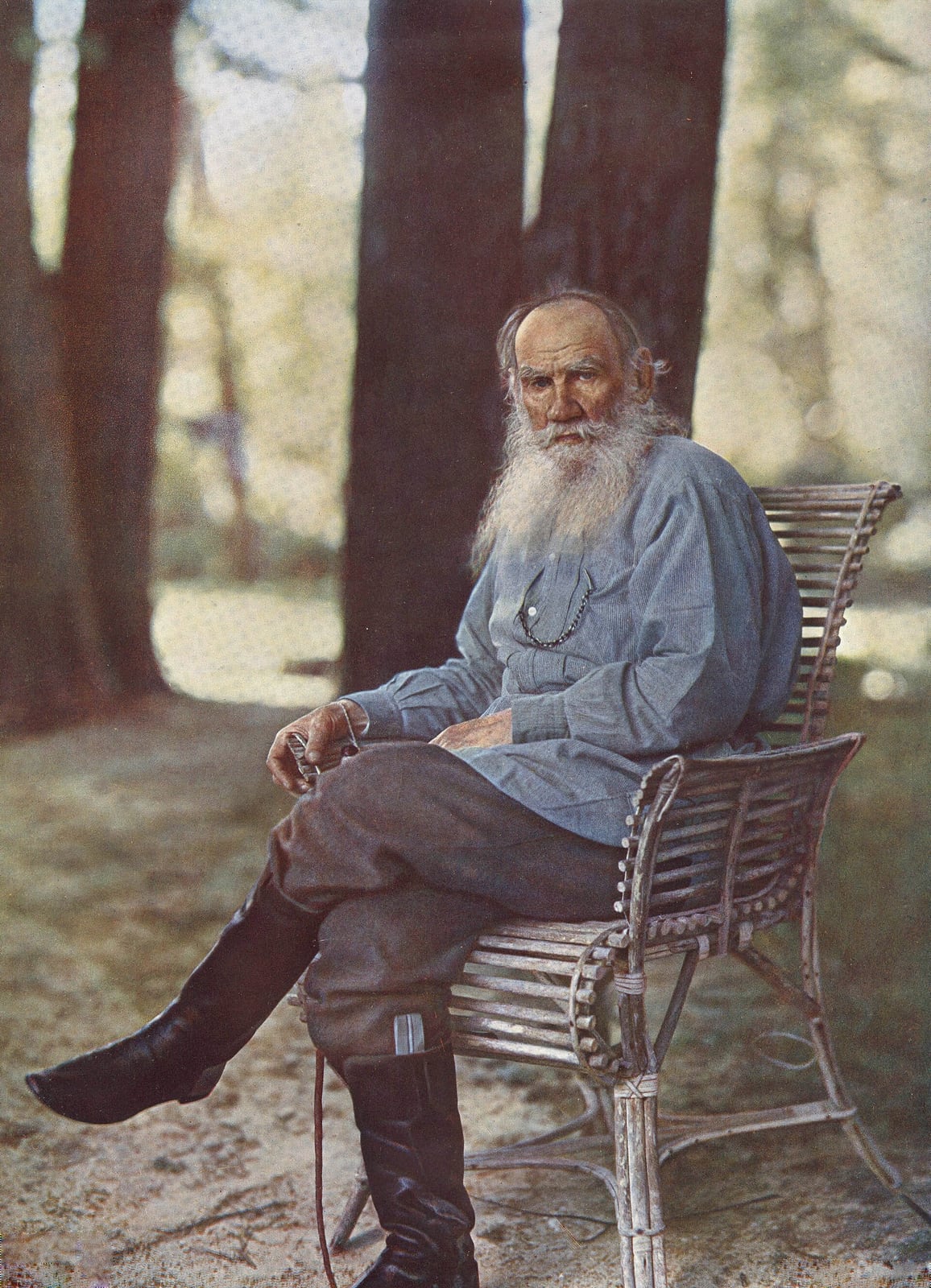
Lev Tolstói en Yásnaia Poliana (1908) · Public domain
Dans ses propres mots
«All happy families are alike; each unhappy family is unhappy in its own way.»Anna Karénina, parte I, cap. 1 (texto ruso en Wikisource)

Son idée centrale
Non-resistance to evil by violence: It is the centre of Tolstoy's faith from the early 1880s.
Le voir en contexte
Biographie
5 min de lecture
Traduction assistée à partir de l'original espagnol, en attente de relecture par un traducteur natif.
Un comte orphelin à Iasnaïa Poliana
Léon Nikolaïevitch Tolstoï naquit le 28 août 1828 selon le calendrier julien — le 9 septembre selon le grégorien — à Iasnaïa Poliana, le domaine familial de la province de Toula, quatrième des cinq enfants du comte Nikolaï Ilitch Tolstoï et de la princesse Maria Nikolaïevna Volkonskaïa. Il perdit sa mère avant d'avoir deux ans et son père à huit ans ; il fut élevé par des tantes et des tutrices, surtout par Tatiana Ergolskaïa, dont il se souviendrait comme de la personne qui lui avait appris « la jouissance spirituelle de l'amour ». En 1844, il entra à l'université de Kazan, d'abord en langues orientales, puis en droit, et la quitta sans diplôme en 1847, l'année où il hérita d'Iasnaïa Poliana et commença le journal qu'il tiendrait, avec des interruptions, pendant soixante-trois ans.
Du Caucase à Sébastopol
Après quelques années de jeu, de dettes et de bonnes résolutions que le journal consigne avec une sévérité presque clinique, il suivit en 1851 son frère Nikolaï au Caucase et s'engagea dans l'artillerie. Il y écrivit Enfance, que Nekrassov publia en 1852 dans Le Contemporain sous les seules initiales de l'auteur. Pendant la guerre de Crimée, il servit au siège de Sébastopol, y compris au redoutable quatrième bastion, et les Récits de Sébastopol (1855-1856) lui valurent une renommée immédiate par une nouveauté qui était déjà une morale : la guerre racontée sans gloire, à partir de la peur et de la vanité de ceux qui la font.
L'école, le mariage et les deux grands romans
En 1857, il voyagea en Europe ; à Paris, il assista à une exécution à la guillotine et écrivit qu'il ne servirait jamais aucun gouvernement. De retour à Iasnaïa Poliana, il ouvrit une école pour les enfants de ses paysans, sans châtiments ni programme obligatoire, et en 1860 la mort de son frère Nikolaï, emporté par la tuberculose à Hyères, lui laissa sur la mort une question qui ne le quitterait plus. En septembre 1862, il épousa Sofia Andreïevna Behrs, âgée de dix-huit ans, qui recopia et mit en ordre ses manuscrits et lui donna treize enfants. Vinrent les années de plénitude : Guerre et Paix (1863-1869), la grande épopée de l'invasion napoléonienne et de la vie privée qu'emporte l'histoire, et Anna Karénine (1873-1877), où le destin d'une femme qui joue tout sur l'amour se déroule à côté de celui de Levine, un propriétaire terrien qui cherche à tâtons le sens de sa vie. Entre les deux, il écrivit l'Abécédaire (Azbouka, 1872), un manuel scolaire riche de centaines de fables et de récits pour les enfants des campagnes.
La crise : une vie sans raison d'être
Au faîte de la gloire et de la prospérité, vers 1877, Tolstoï se découvrit incapable de répondre à une question élémentaire : que resterait-il de tout ce qu'il faisait lorsqu'il mourrait ? Il le raconta dans la Confession (écrite entre 1879 et 1882, interdite en Russie et imprimée à Genève en 1884) : il cachait les cordes pour ne pas se pendre et cessa d'aller à la chasse avec un fusil pour ne pas céder à la tentation de se tirer une balle. Il ne trouva de réponse ni dans la science ni dans la philosophie ; il revint à l'Église orthodoxe et la pratiqua avec discipline pendant près de deux ans, mais la quitta parce qu'il ne pouvait accepter ni ses dogmes ni la bénédiction qu'elle donnait à la guerre et aux exécutions. L'issue, il la trouva dans la foi simple des paysans, qui vivaient et mouraient sans désespoir, et dans l'Évangile lu sans la théologie qui l'enveloppait.
Un christianisme sans Église
Dès lors, il consacra l'essentiel de son énergie à une œuvre religieuse : une Critique de la théologie dogmatique, une traduction et une concordance personnelles des quatre Évangiles, leur résumé dans L'Évangile abrégé, et Ma religion (1884). Il réduisit l'enseignement de Jésus aux commandements du Sermon sur la montagne et plaça au centre un seul d'entre eux : ne pas résister au mal par la violence. Il en tira, avec une logique qu'il n'adoucit jamais, le refus de l'État, des tribunaux, de l'armée, du serment et de la propriété. Le Royaume de Dieu est en vous (1890-1893), publié à l'étranger en 1894, fit de lui le grand théoricien de la non-violence, et autour de lui naquit un mouvement — les tolstoïens — dirigé par son disciple Vladimir Tchertkov, avec qui il fonda en 1884 la maison d'édition populaire Posrednik (« L'Intermédiaire »). En 1891, il renonça aux droits sur tout ce qu'il avait écrit depuis 1881, devint végétarien, travailla la terre, organisa des soupes populaires pendant la famine de 1891-1892 et consacra ce que lui rapporta Résurrection (1899) à l'émigration des doukhobors au Canada. En février 1901, le Saint-Synode déclara qu'il s'était séparé de l'Église ; il répondit qu'il y avait en effet renoncé parce qu'il aimait la vérité plus que toute autre chose.
Gandhi et la non-résistance
Son influence la plus visible emprunta un chemin inattendu. En 1894, en Afrique du Sud, un jeune avocat indien, Mohandas K. Gandhi, lut Le Royaume de Dieu est en vous ; il écrivit dans son autobiographie que le livre l'avait bouleversé et qu'il était l'une des trois œuvres modernes qui avaient le plus marqué sa vie. En 1908, Tolstoï rédigea la Lettre à un Hindou, adressée au nationaliste bengali Taraknath Das, où il soutenait que l'Inde était asservie parce que les Indiens eux-mêmes collaboraient à la violence qui les opprimait. Gandhi lui écrivit de Londres en octobre 1909, demanda la permission de la diffuser, la traduisit en gujarati et la publia avec une préface de sa main. Suivit une brève correspondance ; en 1910, Gandhi baptisa Tolstoy Farm la communauté qu'il fonda près de Johannesburg, et la dernière longue lettre de Tolstoï, de septembre de la même année, saluait la résistance passive des Indiens du Transvaal comme la question la plus importante au monde.
La fuite et Astapovo
Les dernières années furent faites de gloire mondiale et de tourment domestique. La rivalité entre Sofia Andreïevna et Tchertkov au sujet des droits et des journaux éclata en 1910, lorsque Tolstoï signa en secret un testament qui mettait son œuvre à la disposition de tous par l'intermédiaire de sa fille Alexandra. À l'aube du 28 octobre (10 novembre) 1910, à quatre-vingt-deux ans, il quitta Iasnaïa Poliana accompagné de son médecin, Dušan Makovický ; il passa par le monastère d'Optina et rendit visite à sa sœur Maria, religieuse à Chamordino, mais il contracta une pneumonie dans le train et dut s'arrêter à la petite gare d'Astapovo. Il mourut dans la maison du chef de gare au petit matin du 7 (20) novembre, entouré de journalistes et de caméras, tandis que sa femme attendait dehors. Il fut enterré sans rites ecclésiastiques dans la forêt d'Iasnaïa Poliana, près de l'endroit où, enfant, son frère Nikolaï disait avoir caché la petite baguette verte qui gardait le secret du bonheur de tous les hommes.
Sources: Monk, Ray. Ludwig Wittgenstein: The Duty of Genius. Londres: Jonathan Cape, 1990 (lectura de «El Evangelio abreviado» de Tolstói en 1914). · Maude, Aylmer. The Life of Tolstoy. 2 vols.: First Fifty Years (1908) y Later Years (1910). Londres: Constable, 1908–1910. Consultado en Internet Archive. · Bartlett, Rosamund. Tolstoy: A Russian Life. Londres: Profile Books, 2010. · Толстой, Л. Н. Исповедь (1879–1882). Ginebra: M. Elpidin, 1884; ПСС t. 23. Texto en Викитека. · Gandhi, M. K. An Autobiography, or The Story of My Experiments with Truth. Ahmedabad: Navajivan, 1927–1929, parte II, caps. 1 y 15 (lectura de The Kingdom of God Is Within You en 1894).
Chronologie
La vie, année après année
Chaque point est un événement documenté. Cliquez pour le lire, avec sa source et son degré de certitude.
9 septembre 18280 ansYásnaia Poliana, provincia de Tula
Birth
Born on the family estate on 28 August (Julian), 9 September (Gregorian), fourth child of Count Nikolai Tolstoy and Maria Volkonskaya.
DocumentéWikidata: León Tolstói / Leo Tolstoy (Q7243). Nacimiento 28-08-1828 (juliano) = 09-09-1828 (gregoriano); muerte 07-11-1910 (juliano) = 20-11-1910 (gregoriano).
9 septembre 1828 · 0 ans
Birth
Born on the family estate on 28 August (Julian), 9 September (Gregorian), fourth child of Count Nikolai Tolstoy and Maria Volkonskaya.
Documenté
1830 · 2 ans
Death of his mother
Maria Nikolayevna Volkonskaya dies; Tolstoy will keep no memory of her.
Documenté
1837 · 8 ans
Death of his father
Count Nikolai Ilyich dies; the children are left in the care of aunts and guardians, above all Tatiana Yergolskaya.
Documenté
1844 · 16 ans
Kazan University
Enters the faculty of oriental languages; in 1845 moves to law. Leaves in 1847.
Documenté
mars 1847 · 18 ans
The diary begins
In the Kazan hospital he begins the diary he will keep until 1910. That year he inherits Yasnaya Polyana.
Documenté
1851 · 22 ans
To the Caucasus
Goes with his brother Nikolai to the Caucasus and joins the artillery.
Documenté
septembre 1852 · 24 ans
Childhood in The Contemporary
Nekrasov publishes Childhood signed with the initials L. N.
Documenté
novembre 1854 · 26 ans
The siege of Sevastopol
Posted to Sevastopol; serves on the Fourth Bastion and writes the Sevastopol Sketches (1855–1856).
Documenté
avril 1857 · 28 ans
The guillotine
Witnesses an execution in Paris and writes that he will never serve any government.
Probable
1859 · 31 ans
The peasant school
Opens a school for his peasants' children; in 1862 publishes the educational journal Yasnaya Polyana.
Documenté
septembre 1860 · 32 ans
Death of Nikolai
His elder brother dies of tuberculosis in his arms; death becomes the great question of his work.
Documenté
23 septembre 1862 · 34 ans
Marriage to Sofia Behrs
Marries Sofia Andreyevna Behrs, aged eighteen (Julian date). They will have thirteen children.
Documenté
1869 · 41 ans
War and Peace
Book publication of War and Peace, begun in instalments in 1865, is completed. In September he lives through a night of terror of death at Arzamas.
Documenté
novembre 1872 · 44 ans
The Azbuka
Publishes the Azbuka, a primer in four books with hundreds of fables and stories for children.
Documenté
1877 · 49 ans
Anna Karenina and the crisis
Finishes Anna Karenina (serialised from 1875; the last part appears separately in 1878) in the midst of a spiritual crisis.
Documenté
1882 · 54 ans
A Confession and the Moscow census
Completes A Confession, banned by the censor; takes part in the Moscow census, origin of What Then Must We Do?
Documenté
1884 · 56 ans
What I Believe and Posrednik
Finishes What I Believe and founds with Vladimir Chertkov the popular publishing house Posrednik.
Documenté
septembre 1891 · 63 ans
Renunciation of rights
Declares everything written since 1881 public domain. That autumn he organises soup kitchens for starving peasants in Ryazan.
Documenté
1894 · 66 ans
The Kingdom of God Is Within You
Published abroad, banned in Russia. In South Africa Gandhi reads it the same year.
Documenté
1899 · 71 ans
Resurrection and the Doukhobors
Publishes Resurrection and gives its proceeds to the Doukhobors' emigration to Canada.
Documenté
février 1901 · 72 ans
Separated from the Church
The Holy Synod publishes its decision of 20–22 February (Julian); Tolstoy replies on 4 April.
Documenté
décembre 1908 · 80 ans
A Letter to a Hindu
Writes to Taraknath Das the letter on non-violence that Gandhi will translate. That year he publishes I Cannot Be Silent against executions.
Documenté
octobre 1909 · 81 ans
Correspondence with Gandhi
Gandhi writes to him from London; an exchange of letters begins that lasts until September 1910.
Documenté
10 novembre 1910 · 82 ans
The flight
In the early hours of 28 October (Julian) he leaves home with Dr Makovický.
Documenté
20 novembre 1910 · 82 ans
Death at Astapovo
Dies of pneumonia in the stationmaster's house on 7 November (Julian), 20 November (Gregorian).
Documenté
22 novembre 1910
Burial without rites
He is buried without a religious ceremony in the estate's woods, at the place of the «green stick».
Documenté
Œuvres
Œuvres essentielles
Les œuvres sans lesquelles on ne comprend pas son héritage.
Œuvre écrite · 1869
War and Peace
Война и мир
Monumental novel of Russian society between 1805 and 1820, with Napoleon's 1812 invasion at its centre. It follows several families — the Rostovs, the Bolkonskys, the Bezukhovs — and alternates private life with the battles of Austerlitz and Borodino and the burning of Moscow. Tolstoy interleaves chapters of philosophy of history denying the decisive role of great men and attributing events to the sum of countless wills. Serialised from 1865 in The Russian Messenger, published as a book in 1867–1869, and revised in 1873.
7 éditions · amazon.com

Œuvre écrite · 1877
Anna Karenina
Анна Каренина
Novel in eight parts about a married woman of St Petersburg high society who leaves her husband and son for the officer Vronsky and is destroyed by social judgement and jealousy. In counterpoint runs the story of Konstantin Levin, a landowner who seeks a meaning for his life in farm work, marriage and finally faith, a direct echo of Tolstoy's own crisis. Serialised in The Russian Messenger from 1875 to 1877; the eighth part appeared separately in 1878.
5 éditions · amazon.com

Œuvre écrite · 1882
A Confession
Исповедь
Autobiographical account of Tolstoy's spiritual crisis around 1877–1879. It tells how, at the height of fame and family happiness, the question of the meaning of a life that ends in death brought him to the edge of suicide; how he found no answer in science or philosophy, nor in Solomon, Socrates, Schopenhauer or the Buddha; and how he found it in the faith of the peasants and in a God understood as that without which one cannot live. Conceived as the introduction to his religious work, it was banned by the censor and published in Geneva in 1884.
3 éditions · amazon.com

Œuvre écrite · 1893
The Kingdom of God Is Within You
Царство Божие внутри вас
The founding work of Tolstoyan non-violence, written 1890–1893. Starting from the letters he received after What I Believe, it acknowledges as forerunners the Quakers, William Lloyd Garrison and Adin Ballou, and holds that Christianity is not a mystical religion but a new conception of life incompatible with the state, which rests on organised violence: the army, the courts, taxation. It calls for refusal of obedience and of military service. Banned in Russia, it was published in Berlin in 1894. Gandhi read it that year in South Africa.
4 éditions · amazon.com
Toute son œuvre (506)

Resurrection
1899

Childhood
1852
Boyhood
1854
Youth
1857

The Cossacks
1863
Family Happiness
1859

The Death of Ivan Ilyich
1886

The Kreutzer Sonata
1889
Hadji Murat
1904
Leo Tolstoy
Father Sergius
The Conscious LibraryFather Sergius
1898
Leo Tolstoy
Master and Man
The Conscious LibraryMaster and Man
1895
Leo Tolstoy
The Devil
The Conscious LibraryThe Devil
1889
Leo Tolstoy
The Forged Coupon
The Conscious LibraryThe Forged Coupon
1904
Leo Tolstoy
Polikushka
The Conscious LibraryPolikushka
1863
Leo Tolstoy
A Landowner's Morning
The Conscious LibraryA Landowner's Morning
1856
Leo Tolstoy
Two Hussars
The Conscious LibraryTwo Hussars
1856
Leo Tolstoy
Albert
The Conscious LibraryAlbert
1858

Kholstomer (Strider)
1886
Leo Tolstoy
Notes of a Madman
The Conscious LibraryNotes of a Madman
1884
Leo Tolstoy
Posthumous Notes of the Elder Fyodor Kuzmich
The Conscious LibraryPosthumous Notes of the Elder Fyodor Kuzmich
1905
Leo Tolstoy
A History of Yesterday
The Conscious LibraryA History of Yesterday
1851
Leo Tolstoy
The Raid
The Conscious LibraryThe Raid
1853
Leo Tolstoy
A Christmas Night
The Conscious LibraryA Christmas Night
1853
Leo Tolstoy
Uncle Zhdanov and Cavalier Chernov
The Conscious LibraryUncle Zhdanov and Cavalier Chernov
1854
Citations
Citations localisées dans une œuvre précise. Chacune porte sa provenance et son degré de fiabilité.
All happy families are alike; each unhappy family is unhappy in its own way.Все счастливые семьи похожи друг на друга, каждая несчастливая семья несчастлива по-своему.
VérifiéeAnna Karénina, parte I, cap. 1 (texto ruso en Wikisource)
Citations apocryphes ou d'attribution contestée (2)
«"If you want to be happy, be."»
It circulates widely attributed to Tolstoy, but it is an aphorism of Kozma Prutkov ("Хочешь быть счастливым, будь им"), the fictitious author invented in the 1850s by Alexei K. Tolstoy — Leo's second cousin — and the Zhemchuzhnikov brothers. The shared surname explains the confusion.
«"But the peasants… how do the peasants die?" (presented as his last words).»
They do not appear in the account of his son Sergei, an eyewitness, nor in the testimonies of Makovický and Chertkov consulted through the literature; their origin has not been traced.
Dernières paroles
Versions contradictoires
«"The truth… I love much… all of them…"»Истина… люблю много… все они…
There is no single final sentence, only witness versions that do not coincide. According to his son Sergei Lvovich, who was present and described it in «At Astapovo» (1923), Dr Dušan Makovický heard Tolstoy, shortly before the end, say brokenly "The truth… I love much… all of them…". His daughter Tatiana remembered instead that, addressing Sergei, he said: "Seryozha! I love the truth… Very much… I love the truth." That same evening of 6 November (Julian), already delirious, he had repeated "I must escape, I must escape" ("Удирать, надо удирать"), and he advised his children to remember that there were a great many people in the world besides Leo Tolstoy. The sentence "But the peasants… how do the peasants die?", which circulates as his last words, does not appear in Sergei's account and could not be traced to a first-hand testimony.
Source: Толстой, С. Л. «В Астапове» (1923), en Очерки былого, 3.ª ed., Tula, 1966. Texto en Викитека.
Interroger
Ce que répond son œuvre
Douze grandes questions de l'humanité et ce que ses textes permettent d'y répondre, références à l'appui. Nous ne lui prêtons jamais de paroles.
Qu'est-ce que l'Absolu ? Dieu existe-t-il ?
God is spirit, love and source of all; knowing him and living are one
Un Absolu impersonnelIl le dit expressément
Tolstoy reached God through the crisis narrated in A Confession: after years in which life seemed to him a cruel joke, he concluded that to know God and to live are one and the same, and that God is life. In his Reply to the Synod of 1901 he sets out his creed: he believes in a God whom he understands as spirit, as love and as the source of all, who is in him as he is in God. He rejects, on the other hand, the Trinity, the divinity of Christ, miracles and sacraments, which he regards as ecclesiastical additions to the Gospel. His God is not a being who intervenes capriciously in history, but the source of the rational and loving life that each person discovers within. He keeps the language of the Father and his will, but detaches it from the figure of a sovereign who rewards and punishes.
Comparer cette question avec d'autres maîtresQui suis-je ? Existe-t-il un vrai soi ?
The true self is not the animal personality but the divine spiritual principle
Le Soi est l'AbsoluIl le dit expressément
In On Life, the treatise of 1887, Tolstoy distinguishes between the animal personality, which seeks its own good and fears death, and rational consciousness, which discovers that the personality's good is impossible and that true life consists in subordinating it to the law of reason, which is the law of love. The self that clings to itself is for him an illusion that produces anguish; the real self is the spiritual principle dwelling in every human being and the same in all. In the Reply to the Synod he says he believes that God is in him and he in God, and in The Path of Life, his last compilation, he devotes a chapter to the soul as a spiritual principle uniting all beings. This identity with the divine does not abolish consciousness, but frees it from egoism.
Comparer cette question avec d'autres maîtresPourquoi souffrons-nous ?
We suffer from living for the animal personality and not by the law of love
L'ignorance de ce que nous sommesIl le dit expressément
Tolstoy knew existential suffering at first hand: in A Confession he relates that, rich, famous and healthy, he hid a cord and stopped going shooting with a gun so as not to take his own life. His diagnosis, developed in On Life, is that pain arises from placing life in the animal personality, which wants its own good and knows it will lose it at death. The Death of Ivan Ilyich dramatises it: the judge suffers less from illness than from the lie of an ordinary, correct and empty life, and the anguish yields only when, at the end, he feels pity for his family. To this inner suffering he adds what men inflict on one another through violence, property and the State. The remedy is the same on both levels: to live by reason and love, not by the self.
Comparer cette question avec d'autres maîtresQue se passe-t-il après la mort ?
Death exists only for the personality; true life lies outside time
Ce que je suis ne naît ni ne meurtIl le dit expressément
Death obsessed Tolstoy from his youth, and his fiction studies it as few others do: Three Deaths, Prince Andrei in War and Peace, The Death of Ivan Ilyich, Master and Man. In On Life he gives his doctrinal answer: the fear of death arises from identifying life with the animal personality, which does indeed perish; but true life, the rational and loving relation to the world, is not subject to space and time and cannot be destroyed. As evidence he notes that the influence of a dead brother continues to act in him more strongly than in life. He rejects the resurrection of the flesh and personal immortality as the Church teaches them. In the last chapter of Ivan Ilyich, the dying man, on feeling pity for his family, discovers that instead of death there is light and that death is no more.
Comparer cette question avec d'autres maîtresComment atteint-on la libération ou le salut ?
Salvation is keeping the commandments of the Sermon on the Mount here and now
Par une pratique disciplinéeIl le dit expressément
Tolstoy rejects the doctrine of redemption through Christ's death and the efficacy of the sacraments. In What I Believe he sums up Jesus's teaching in five commandments drawn from the Sermon on the Mount: do not be angry, do not commit adultery or abandon one's spouse, do not swear oaths, do not resist evil by violence, and love one's enemies, without distinction between peoples. Salvation is not a future reward but life itself, obtained by keeping them: the kingdom of God is within each person and is realised insofar as one lives by the law of love. The task is therefore one of daily moral self-perfection, sustained by reading the sages he compiled in The Path of Life and in his calendars of readings, and by a simple life of one's own labour.
Comparer cette question avec d'autres maîtresFaut-il un maître ?
The sages guide, but each must verify the truth with his own reason
Utile mais pas indispensableIl le dit expressément
Tolstoy broke with the authority of the Church, which he accused of hiding Christ's teaching under dogmas and rites, and in the Reply to the Synod he explains that he began by loving his Orthodox faith more than his peace of mind, then Christianity more than his Church, and finally truth more than anything in the world. He recognises no intermediaries between conscience and God: reason and conscience are the final criterion. But he does not do without teachers: he reveres Jesus as the greatest of them, though not as God, and spent his last years compiling the thoughts of sages from every tradition, from the Buddha and Confucius to Pascal, in Thoughts of Wise Men, A Calendar of Wisdom and The Path of Life. In the story The Three Hermits, the hermits' simple prayer surpasses the bishop's instruction.
Comparer cette question avec d'autres maîtresLe monde est-il réel ?
He does not speculate on the world's reality: what matters is how to live in it
Ne s'est pas prononcé
Tolstoy did not pose the reality of the world as a metaphysical problem. His fiction is among the most attentive in literature to the materiality of things, to bodies, to nature, to farm labour, and the Olenin of The Cossacks lives in the Caucasian forest an experience of communion with all living things. But in his religious writings he distrusts speculative theology and cosmologies, including the narratives of creation, which he regards as irrelevant to the only important thing: the meaning of one's own life and the law of love. In On Life he maintains that the human being knows the outer world only through his relation to it, and that it is this relation, not the ultimate nature of things, that constitutes true life.
Comparer cette question avec d'autres maîtresQu'est-ce que l'amour ?
The law of love is life's supreme law and excludes all violence
L'amour de Dieu et du prochainIl le dit expressément
For Tolstoy love is not one feeling among others, but the law of life that Christ revealed and that all the great religions know. In On Life he defines it as the activity of rational consciousness that places the good of others before one's own; love that prefers some to others, family or homeland over strangers, is still enlarged egoism. In The Law of Violence and the Law of Love, of 1908, he argues that such love is incompatible with any use of force, including that of the State, and his Letter to a Hindu, which Gandhi translated and spread, applies the same idea to India's liberation. His popular tales, such as What Men Live By or Where Love Is, God Is, turn it into parables: God is where there is love.
Comparer cette question avec d'autres maîtresSommes-nous libres ou tout est-il déterminé ?
History obeys necessity; freedom lies in obeying reason
Le destin et la responsabilitéIl le dit expressément
Tolstoy devoted the second part of the epilogue of War and Peace to the question of freedom and necessity. There he argues that, seen from outside, human actions and the movements of history are determined by countless causes that no individual, not even Napoleon, controls; seen from within, each consciousness knows itself to be free. The more the conditions of an act are known, the less free it appears. In his religious work he gives this tension a moral resolution: human freedom does not consist in arbitrary choice, but in recognising truth and submitting to the law of love; in The Kingdom of God Is Within You he states that the human being is free insofar as he obeys that law and not the powers of the world. Responsibility remains where conscience is at stake.
Comparer cette question avec d'autres maîtresPourquoi méditer ou prier ?
To pray is to recall the divine within; the only time that matters is now
Être présentCela se déduit de sa doctrine
Tolstoy rejected liturgical and petitionary prayer, which he regarded as attempts to bend God's will in one's favour. In the story The Three Hermits, a bishop teaches the Lord's Prayer to hermits who know only a naive formula, and they later run across the water to have him repeat it: the simple prayer of the heart is worth more than the correct one. For him to pray is to recall one's relation to God and to examine one's conscience, and in his diaries he does so daily. His most widely known answer is in The Three Questions: the most important time is the present, the most important person the one before you, and the most important task to do that person good. The Path of Life insists that true life is lived only in the present.
Comparer cette question avec d'autres maîtresLa raison peut-elle connaître l'ultime ?
Reason alone leads to despair; a reasonable faith gives life meaning
La foi et la raison s'entraidentIl le dit expressément
Tolstoy holds a double thesis. In A Confession he relates how he sought the meaning of life in the experimental sciences and philosophy and found only, in Solomon, the Buddha, Socrates and Schopenhauer, confirmation that life is an evil; rational knowledge, he concludes, cannot answer the question of meaning. What saved him was the faith of simple people, which he calls an irrational knowledge, able to link the finite with the infinite. But in his later work, such as Reason and Religion or What Is Religion and What Is Its Essence, he demands that this faith be reasonable: he rejects everything that contradicts reason, such as miracles or incomprehensible dogmas, and considers reason a gift of God for knowing his law. Faith and reason are not opposed: reason purifies faith and faith gives reason its object.
Comparer cette question avec d'autres maîtresSe retirer du monde ou le transformer ?
Society changes when each person stops cooperating with violence
La révolution est intérieureIl le dit expressément
Tolstoy was a relentless critic of the State, the army, the official Church and landed property, and he did not withdraw from the world: he organised soup kitchens during the famine of 1891, defended the persecuted Doukhobors and wrote letters to Alexander III, Nicholas II and Stolypin. But he rejected both violent revolution and political reform as means of change. In The Kingdom of God Is Within You he argues that social evil is sustained because each individual cooperates with it, as soldier, taxpayer or official, and that it will disappear only when each person, moved by conscience, refuses to take part in violence. To a revolutionary he wrote that violence only breeds violence. Transformation begins in individual conscience, but is proved in life.
Comparer cette question avec d'autres maîtres
Affinités et tensions
Affinités et tensions
Calculées question par question à partir de ses positions. La raison de chaque accord ou de chaque désaccord s'affiche d'un clic.
Pense comme
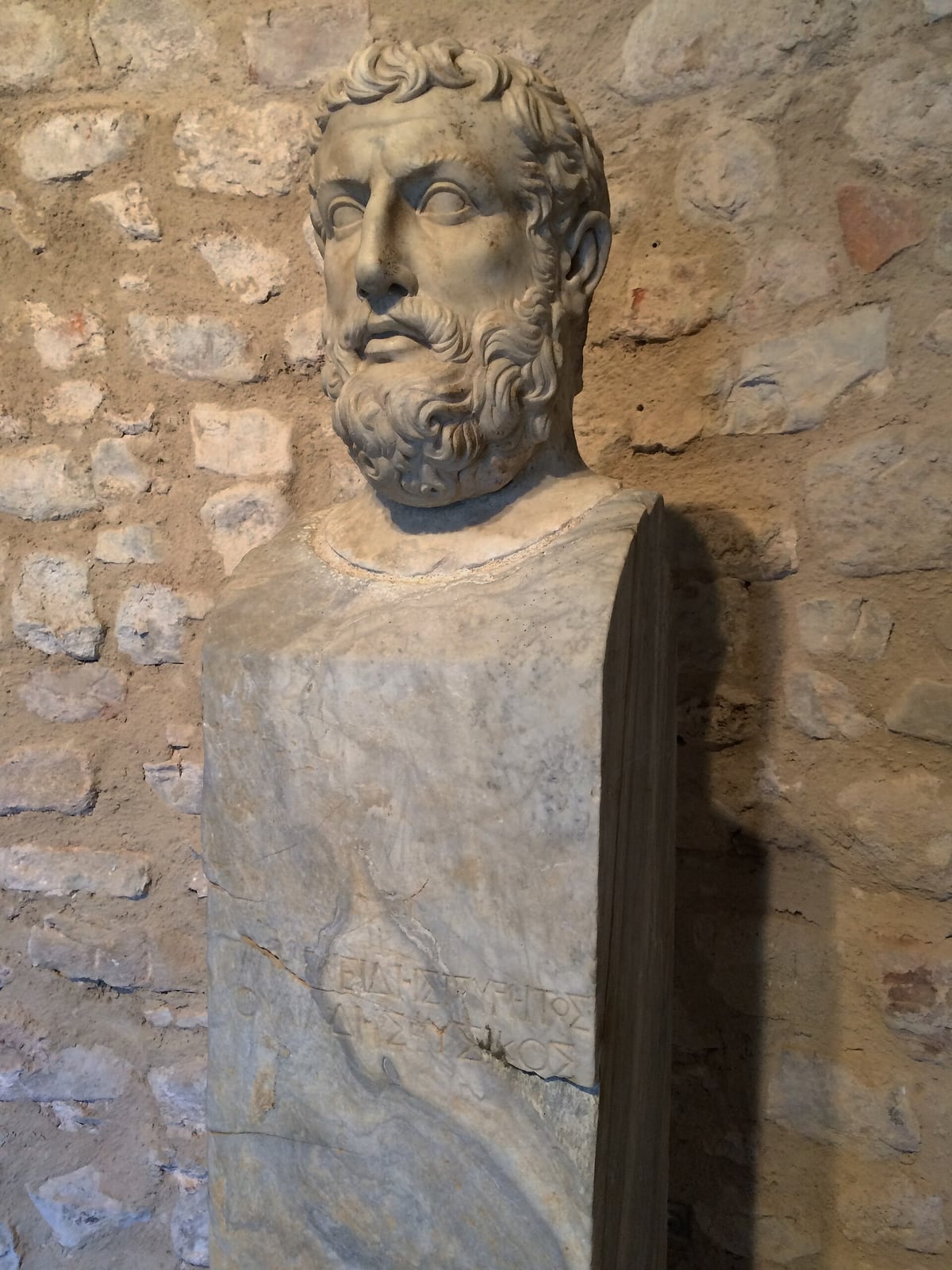
Parmenides
Ils concordent sur: Qu'est-ce que l'Absolu ? Dieu existe-t-il ? · Faut-il un maître ? · La raison peut-elle connaître l'ultime ?

David R. Hawkins
Ils concordent sur: Qui suis-je ? Existe-t-il un vrai soi ? · Pourquoi souffrons-nous ? · Que se passe-t-il après la mort ?
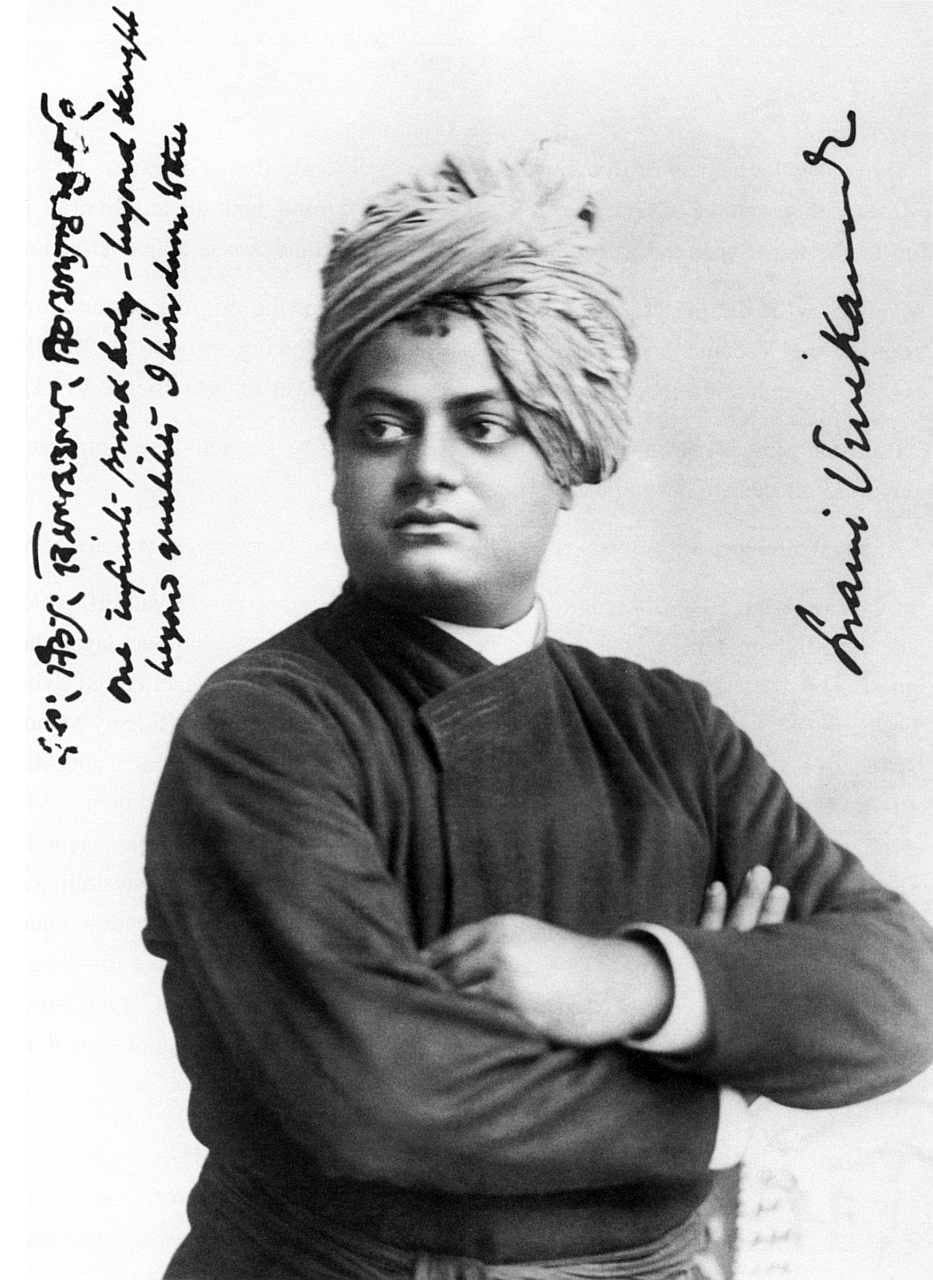
Swami Vivekananda
Ils concordent sur: Qui suis-je ? Existe-t-il un vrai soi ? · Pourquoi souffrons-nous ? · Que se passe-t-il après la mort ?
Baruch Spinoza
Ils concordent sur: Qu'est-ce que l'Absolu ? Dieu existe-t-il ? · Qui suis-je ? Existe-t-il un vrai soi ? · Pourquoi souffrons-nous ?


Anecdotes et récits
Anecdotes et récits
Témoignagehacia 1833; recordado en 1905–1906
The green stick
Origine du récit: It comes from the Reminiscences Tolstoy wrote between 1903 and 1906 for his biographer Biryukov, and from his request to be buried at the place of the stick, recorded by his family. It is a childhood memory told seventy years later; the burial on that spot is documented.
Source: Bartlett, Rosamund. Tolstoy: A Russian Life. Londres: Profile Books, 2010.
Documentéseptiembre de 1869
The Arzamas horror
Origine du récit: It is documented by Tolstoy's letter to his wife of September 1869 (PSS vol. 83) and reworked as fiction in Notes of a Madman (1884–1903). Its reading as a foretaste of the crisis is the biographers'.
Source: Bartlett, Rosamund. Tolstoy: A Russian Life. Londres: Profile Books, 2010.
Documentéabril de 1857
The Paris guillotine
Origine du récit: Documented in the 1857 diary, in the letter to V. P. Botkin written in Paris and in chapter III of A Confession, where Tolstoy returns to it twenty-five years later.
Source: Толстой, Л. Н. Исповедь (1879–1882). Ginebra: M. Elpidin, 1884; ПСС t. 23. Texto en Викитека.
Témoignagediciembre de 1858
The she-bear
Origine du récit: Told by Aylmer Maude and the biographers from Tolstoy's letters and diary; the author fictionalised it himself in the Azbuka story, whose narrator says the bearskin remained in his house.
Documentéjulio–agosto de 1866
The soldier Shabunin
Origine du récit: Tolstoy himself tells it in Recollections of a Soldier's Trial (1908), written for his biographer Biryukov; the trial is recorded in the military archives studied by the biographers.
Documenté1908–1910
The voice on the phonograph
Origine du récit: Documented by the State L. N. Tolstoy Museum, which keeps the cylinders and film fragments and has made them public (documentary Живой Толстой), and by the catalogues of the Russian film archives.
Source: Museo-finca «Yásnaia Poliana» (Музей-усадьба «Ясная Поляна»), web oficial.
Documentéoctubre–noviembre de 1910
The flight
Origine du récit: Documented by Tolstoy's farewell letter, by the diaries of Makovický and Alexandra Tolstaya and by Sergei Lvovich Tolstoy's account At Astapovo (1923). Dates are Julian.
Source: Толстой, С. Л. «В Астапове» (1923), en Очерки былого, 3.ª ed., Tula, 1966. Texto en Викитека.
Enseignements
Enseignements
Les notions qui structurent sa pensée, expliquées dans leur contexte.
Non-resistance to evil by violenceno-resistencia-al-mal
Formulated in What I Believe (1884) and developed in The Kingdom of God Is Within You (1893); Solovyov attacked it in Three Conversations (1900).
The kingdom of God withinreino-de-dios-interior
Title and conclusion of his 1893 treatise; the idea also structures The Christian Teaching and The Path of Life.
The law of loveley-del-amor
Developed in The Law of Love and the Law of Violence (1908) and A Letter to a Hindu (1908); gathered in the anthologies Circle of Reading and The Path of Life.
Oproshchenie: simplification of lifeoproshchenie
Set out in What Then Must We Do? (1886) and The First Step (1891); Repin fixed it in the painting of Tolstoy ploughing (1887).
Source: Bartlett, Rosamund. Tolstoy: A Russian Life. Londres: Profile Books, 2010.
Art as the infection of feelingel-arte-como-contagio
Prepared by On Art (1889) and applied in On Shakespeare and the Drama (1906).
Non-doing (wu wei) in Tolstoyel-no-hacer
Documented by his 1884 diary, the 1893 essay and the Laozi editions of 1910 and 1913 studied by Derk Bodde (Tolstoy and China, 1950).
Vidéos
Vidéos
Enregistrements, entretiens et documentaires. Les vidéos sont lues depuis YouTube ; elles ne sont pas hébergées ici.
Живой Толстой
Documentaire· RU· 25 min
Государственный музей Л.Н. Толстого - ГМТChaîne officielle
Лев Толстой. Документальный фильм 1908 – 1910
Enregistrement original· RU· 1960· 52 min
History Club
Leo Tolstoy. Лев Толстой в Ясной Поляне. Кинохроника 1908-1910 гг.
Enregistrement original· RU· 1910· 5 min
Путешествие во времени
1908-10: Footage of the life and death of Leo Tolstoy
Enregistrement original· 1910· 6 min
Public Domain Archive
Запись голоса Льва Толстого / Voice recording of Leo Tolstoy (English Subt)
Enregistrement original· RU· 1908· 2 min
PeterShop.com - Russian Movie
The Power of Childhood - Lev Tolstoy (1908 recording)
Enregistrement original· RU· 1908· 7 min
ChildoStorm
Ист. Хроники: 1910 - Лев Толстой
Documentaire· RU· 43 min
TheComradeRussia
Ясная Поляна (1980)
Documentaire· RU· 1980· 100 min
Советское телевидение. ГОСТЕЛЕРАДИОФОНДChaîne officielle
Lev Tolstoi. El hombre, el escritor, el ruso | Cristina Rosario Franco
Conférence· ES· 76 min
Ateneo Mercantil de ValenciaChaîne officielle
Conferencia «La filosofía de Tolstói y su impacto»
Conférence· ES· 2020· 118 min
Universitat Pompeu Fabra - BarcelonaChaîne officielle
On Radical Nonviolence and Anarchism: Gandhi, Tolstoy, and the Doukhobors
Conférence· EN· 76 min
Vinay LalChaîne officielle
Why should you read Tolstoy's "War and Peace"? - Brendan Pelsue
Analyse· EN· 5 min
TED-EdChaîne officielle
16. Dying alone; The badness of death, Part I
Conférence· EN· 2007· 50 min
YaleCoursesChaîne officielle
Tolstoy's "Death Of Ivan Ilyich" - Dr Andrew Kaufman Book Talk 2009
Conférence· EN· 2009· 82 min
Regent University LibraryChaîne officielle
Henri Guillemin - Léon Tolstoï (Intégral)
Conférence· FR· 357 min
Henri Guillemin Histoire Intégral
Galerie
Galerie
Images dont la licence a été vérifiée. Chacune conserve son auteur et son attribution.
Relations
Relations
Influences, filiations et affinités. On distingue la relation documentée de la similitude identifiée par analyse.
A reçu l'influence de
Tolstoy centred all his religious work on Jesus's moral teaching, particularly the Sermon on the Mount, which he translated, harmonised and summarised (The Four Gospels Harmonized and Translated, The Gospel in Brief). He rejected his divinity and the miracles and regarded him as the teacher who revealed the law of love and non-resistance.
Relation documentée
A reçu l'influence de
Siddhartha Gautama, the Buddha
In A Confession (ch. VI) Tolstoy recalls the story of the young Shakyamuni discovering old age, sickness and death, and cites his teaching alongside Solomon, Socrates and Schopenhauer. In Karma (1894) he adapted a Buddhist tale by Paul Carus, and he included sayings of the Buddha in the Circle of Reading.
Relation documentée
A reçu l'influence de
Tolstoy read Laozi from 1884 ("Have been translating Lao Tzu", he notes in his diary), from 1895 revised D. P. Konishi's Russian translation of the Daodejing, published in 1913 "edited by" him, and in 1910 edited a selection of his sayings with an essay of his own. He interpreted wu wei as "non-doing", close to Gospel non-resistance.
Relation documentée
A reçu l'influence de
Tolstoy wrote an essay for Pavel Boulanger's book on the life and teaching of Confucius (1903) and in 1907 published a selection of Confucian texts (Chinese Wisdom).
Relation documentée
Contemporain de
The two great Russian novelists of their generation never met, although both attended a lecture by Solovyov in 1878. Dostoevsky praised Anna Karenina in his Diary of a Writer (1877) as a fact of special importance; at his death in 1881 Tolstoy wrote to Strakhov that he felt he had lost the person closest, dearest and most necessary to him, though he had never seen him.
Relation documentée
En désaccord avec
The philosopher Vladimir Solovyov, who shared Tolstoy's criticism of the state and the death penalty, rejected his doctrine of non-resistance and his Christianity without the risen Christ. In Three Conversations (1900) he personified it in the Prince, a Tolstoyan whose metaphysics-free morality cannot answer evil.
Relation documentée
A influencé
Berdyaev devoted critical essays to Tolstoy: The Old and New Testaments in L. Tolstoy's Religious Consciousness (1912) and the Tolstoy chapter of The Spirits of the Russian Revolution (1918), where he credits him with exposing the lie of civilisation but reproaches him for a rationalist moralism blind to grace and freedom, and holds him co-responsible for the spirit of the revolution.
Relation documentée
A influencé
Mohandas K. Gandhi
Gandhi read The Kingdom of God Is Within You in South Africa in 1894 and counted it among the three modern works that most marked his life. He translated and published A Letter to a Hindu (1909), corresponded with Tolstoy in 1909–1910 and named the community he founded near Johannesburg in 1910 Tolstoy Farm.
Relation documentée
Maître de
Vladímir Chertkov
A former Guards officer, he met Tolstoy in 1883 and became his closest disciple, publisher and executor: he founded Posrednik with him (1884), published his banned works in England during his exile and directed the 90-volume complete works. His influence over Tolstoy was the heart of the conflict with Sofia Tolstaya in 1910.
Relation documentée
A reçu l'influence de
Henry George
From the 1880s Tolstoy adopted the American economist's proposal of a single tax on land as a way to abolish its private ownership, and defended it in A Great Iniquity (1905) and in letters to the tsar and to Stolypin.
Relation documentée
A reçu l'influence de
Adin Ballou y William Lloyd Garrison
In the first chapter of The Kingdom of God Is Within You Tolstoy acknowledges as forerunners of non-resistance the American abolitionists William Lloyd Garrison and Adin Ballou, whose writings had been sent to him after he published What I Believe.
Relation documentée
Idées proches de
Affinity not documented as a direct influence: the voluntary poverty, manual work and brotherhood with the poor and with animals that Tolstoy sought in his oproshchenie recall the Franciscan ideal, though Tolstoy rejected the institutional Church in which Francis remained.
Similitude identifiée par analyse
Sources
Sources
Bibliographie et catalogues consultés pour cette fiche.
- Monk, Ray. Ludwig Wittgenstein: The Duty of Genius. Londres: Jonathan Cape, 1990 (lectura de «El Evangelio abreviado» de Tolstói en 1914).
- Catálogos de editoriales y librerías consultados para ediciones e ISBN: Acantilado (acantilado.es), Kairós (editorialkairos.com), Alba, Alianza, Austral, Reino de Cordelia, Penguin Clásicos (fichas de Casa del Libro, Marcial Pons y Polifemo) y Open Library (ediciones inglesas).
- Wikidata: León Tolstói / Leo Tolstoy (Q7243). Nacimiento 28-08-1828 (juliano) = 09-09-1828 (gregoriano); muerte 07-11-1910 (juliano) = 20-11-1910 (gregoriano).
- Maude, Aylmer. The Life of Tolstoy. 2 vols.: First Fifty Years (1908) y Later Years (1910). Londres: Constable, 1908–1910. Consultado en Internet Archive.
- Bartlett, Rosamund. Tolstoy: A Russian Life. Londres: Profile Books, 2010.
- Толстой, Л. Н. Полное собрание сочинений в 90 томах (edición del Jubileo). Moscú–Leningrado: Gosudárstvennoe izdátelstvo judózhestvennoi literatury, 1928–1958. Serie I: obras (t. 1–45); serie II: diarios (t. 46–58); serie III: cartas (t. 59–89); t. 90: suplementos. Edición digital del Museo Estatal L. N. Tolstói.
- Wikipedia (en). «Leo Tolstoy bibliography» (novelas, novelas cortas, relatos, cuentos populares, relatos de la Azbuka, teatro, tratados, panfletos, artículos y cartas publicadas).
- Википедия (ru). «Библиография Льва Толстого» y Викитека, «Автор:Лев Николаевич Толстой» (títulos originales y fechas de composición y publicación).
- Толстой, Л. Н. Собрание сочинений в 22 томах. Moscú: Judózhestvennaia literatura, 1978–1985 (índices de los tomos 1–22 en la Biblioteca Virtual Rusa, RVB; el t. 10, de 1982, recoge los relatos de la Nueva Azbuka y de los cuatro Libros rusos de lectura).
- Толстой, Л. Н. Исповедь (1879–1882). Ginebra: M. Elpidin, 1884; ПСС t. 23. Texto en Викитека.
- Gandhi, M. K. An Autobiography, or The Story of My Experiments with Truth. Ahmedabad: Navajivan, 1927–1929, parte II, caps. 1 y 15 (lectura de The Kingdom of God Is Within You en 1894).
- Tolstoy, Leo. A Letter to a Hindu: The Subjection of India — Its Cause and Cure, with an Introduction by M. K. Gandhi (1908; introducción de Gandhi fechada en 1909). Project Gutenberg n.º 7176.
- Толстой, С. Л. «В Астапове» (1923), en Очерки былого, 3.ª ed., Tula, 1966. Texto en Викитека.
- Bodde, Derk (con Galia Speshneff Bodde). Tolstoy and China. Princeton: Princeton University Press, 1950; y base de datos China-West de la Universidad de Zúrich (cronología de Tolstói y China: diario de marzo de 1884; Izrechéniia kitáiskogo mudretsa Lao-Tze, Posrédnik, 1910; Tao-Te-King, trad. D. P. Konishi, ed. Tolstói, 1913).
- Соловьёв, В. С. Три разговора о войне, прогрессе и конце всемирной истории. San Petersburgo, 1900 (prefacio y personaje del Príncipe, crítica de la doctrina tolstoiana de la no resistencia).
- Бердяев, Н. А. «Ветхий и Новый Завет в религиозном сознании Л. Толстого», en О религии Льва Толстого. Moscú: Put', 1912; y «Духи русской революции», en Из глубины (1918).
- Толстой, Л. Н. Carta a N. N. Strájov sobre la muerte de Dostoievski (febrero de 1881), ПСС t. 63; y Достоевский, Ф. М. Дневник писателя, julio–agosto de 1877 (sobre Anna Karénina).
- Encyclopaedia Britannica. «Leo Tolstoy».
- Project Gutenberg. Página de autor de Leo Tolstoy (n.º 136) e «Index of the Project Gutenberg Works of Leon Tolstoy» (n.º 59195).
- Museo-finca «Yásnaia Poliana» (Музей-усадьба «Ясная Поляна»), web oficial.
- Wikimedia Commons. Licencias de las imágenes verificadas por la API imageinfo.
- Маковицкий, Д. П. У Толстого, 1904–1910: «Яснополянские записки». Литературное наследство, t. 90, libros 1–5. Moscú: Nauka, 1979–1981 (diario del médico que acompañó a Tolstói en la huida y en Astápovo).
- Tolstoy, Leo. «The Kingdom of God Is Within You»: Christianity Not as a Mystic Religion but as a New Theory of Life. Trad. Constance Garnett. Londres: Heinemann, 1894. Project Gutenberg n.º 4602.
- Толстой, Л. Н. «Ответ на определение синода от 20—22 февраля и на полученные мною по этому случаю письма» (4 de abril de 1901), ПСС t. 34. Texto en Викитека.
- Orwell, George. «Lear, Tolstoy and the Fool», Polemic, n.º 7, 1947 (respuesta a «Sobre Shakespeare y el drama»).
- Шкловский, В. Б. «Искусство как приём» (1917), sobre el extrañamiento en «Jolstomer».
- YouTube. Vídeos verificados por oEmbed (código 200) el 25 de octubre de 2026; canales indicados en cada ficha.
- Ayant droit
- Las obras de Tolstói (m. 1910) están en dominio público en todo el mundo; él mismo renunció en 1891 a los derechos de lo escrito desde 1881. Las traducciones modernas y los aparatos críticos pertenecen a sus traductores y editoriales. Las traducciones inglesas de Louise y Aylmer Maude (m. 1939 y 1938) y de Constance Garnett (m. 1946) están ya en dominio público en la Unión Europea.
- Site officiel
- ypmuseum.ru/
En attente de confirmation
Ce que cette fiche n'a pas encore pu établir. Nous préférons le dire plutôt que de combler.
- Azbuka: se han registrado una a una las 213 piezas con título del t. 10 de las obras en 22 tomos (Nueva Azbuka y los cuatro Libros rusos de lectura) más 8 piezas citadas por la bibliografía inglesa. La Azbuka de 1872 contiene además decenas de fábulas sin título propio en la bibliografía de referencia, textos en eslavo eclesiástico y ejercicios; falta cotejar su índice completo con los t. 21–22 de las obras completas en 90 tomos.
- Títulos rusos no verificados (title_original nulo y nota): unas 40 cartas y artículos menores tomados de la bibliografía inglesa (p. ej. «God or Mammon?», «Nobel's Bequest», «The Commune and the World», cartas a Crosby, Schmitt, Verigin, etc.). Fijar el título ruso exacto y la fecha con los índices de la edición en 90 tomos.
- Obras que no figuran en las bibliografías consultadas y deben comprobarse en las obras completas: «¿Quiénes son los asesinos? Pável Kudriash» (1908), «La oración» (1905) y otros fragmentos tardíos; informes individuales sobre el hambre de 1892–1893 (aquí agrupados en «Entre los necesitados»).
- Correspondencia y diarios: registrados como conjunto (t. 46–58 y 59–89 de la edición en 90 tomos) y por cartas y diarios notables; no se han desglosado las más de diez mil cartas.
- Ediciones en español con ISBN pendientes para: «¿Qué es el arte?», «En qué consiste mi fe», «¿Qué hacer, pues?», «Hadjí Murat» como volumen independiente, «Los cosacos», «Infancia, adolescencia, juventud» y «Relatos de Sebastopol». Google Books devolvió cuota 0 y Open Library apenas registra ediciones españolas.
- Ediciones en francés, alemán, italiano y ruso moderno con ISBN de las obras principales: no buscadas sistemáticamente.
- Últimas palabras: la versión de Makovicki se conoce aquí a través del relato de Serguéi L. Tolstói (1923); cotejar directamente con las «Notas de Yásnaia Poliana» de Makovicki (Literatúrnoie naslédstvo, t. 90) y con «La partida de mi padre» de Aleksandra Tolstaia.
- Citas de «El reino de Dios está en vosotros» y de la «Carta a un hindú»: tomadas de las traducciones inglesas de dominio público (Garnett, 1894; edición de Gandhi, 1909); falta localizar el original ruso de los mismos pasajes.
- Vídeos: varias grabaciones históricas (filmaciones de 1908–1910, voz en fonógrafo) están subidas por canales de terceros; el documental «Живой Толстой» del Museo Estatal L. N. Tolstói es la fuente oficial. La atribución de la lectura de «La fuerza de la infancia» (biEPM-gEt2o) procede de la descripción del canal.
- Reading texts: comprobar la fecha de muerte de los traductores Augusto Riera, Enrique L. de Verneuil y Rose Strunsky, y el traductor anónimo de «The Forged Coupon» (Gutenberg n.º 243), para confirmar el dominio público fuera de EE. UU.
- Nominaciones al Premio Nobel (literatura 1902–1906; paz 1901, 1902, 1909) y carta a Arvid Järnefelt de 1906 pidiendo que no se le concediera: no incorporadas por no haberse consultado el archivo de nominaciones.
- Sin programas de afiliación verificados para las editoriales enlazadas (Acantilado, Kairós, Penguin, Oxford).
- Imagen descartada: «Tolstoy-Gandhi letter.jpg» (Commons) carece de fecha y descripción suficientes; revisar antes de usarla.
Recherche effectuée le 2026-10-25