اليهودية · القبالة
Baal Shem Tov
ישראל בן אליעזר · הבעל שם טוב (הבעש״ט) · דער בעל־שם־טובֿ
نحو 1700 – 1760شخصية موثّقة تاريخيًا
إسرائيل بن إليعازر (نحو 1700–1760)، الملقّب ببعل شيم طوف أو البيشت، معالجٌ ومتصوّف من بودوليا تعدّه الحسيدية مؤسِّسها. لم يؤلّف كتبًا: فباستثناء رسالة واحدة، لم تصلنا تعاليمه عن الالتصاق بالله في كل فعل، والصلاة المفعمة بالفرح، والحضور الإلهي في كل المخلوقات، إلا عبر تلاميذه. وتؤكّد السجلات الضريبية في ميجيبوج وجوده التاريخي، أما سيرة المناقب الصادرة عام 1815 فهي التي صنعت أسطورته.
- مؤلَّفًا
- 16مؤلَّفًا
- طبعة
- 29طبعة
- اقتباسًا
- 8اقتباسًا
- مقطع فيديو
- 12مقطع فيديو
- صورة
- 8صورة
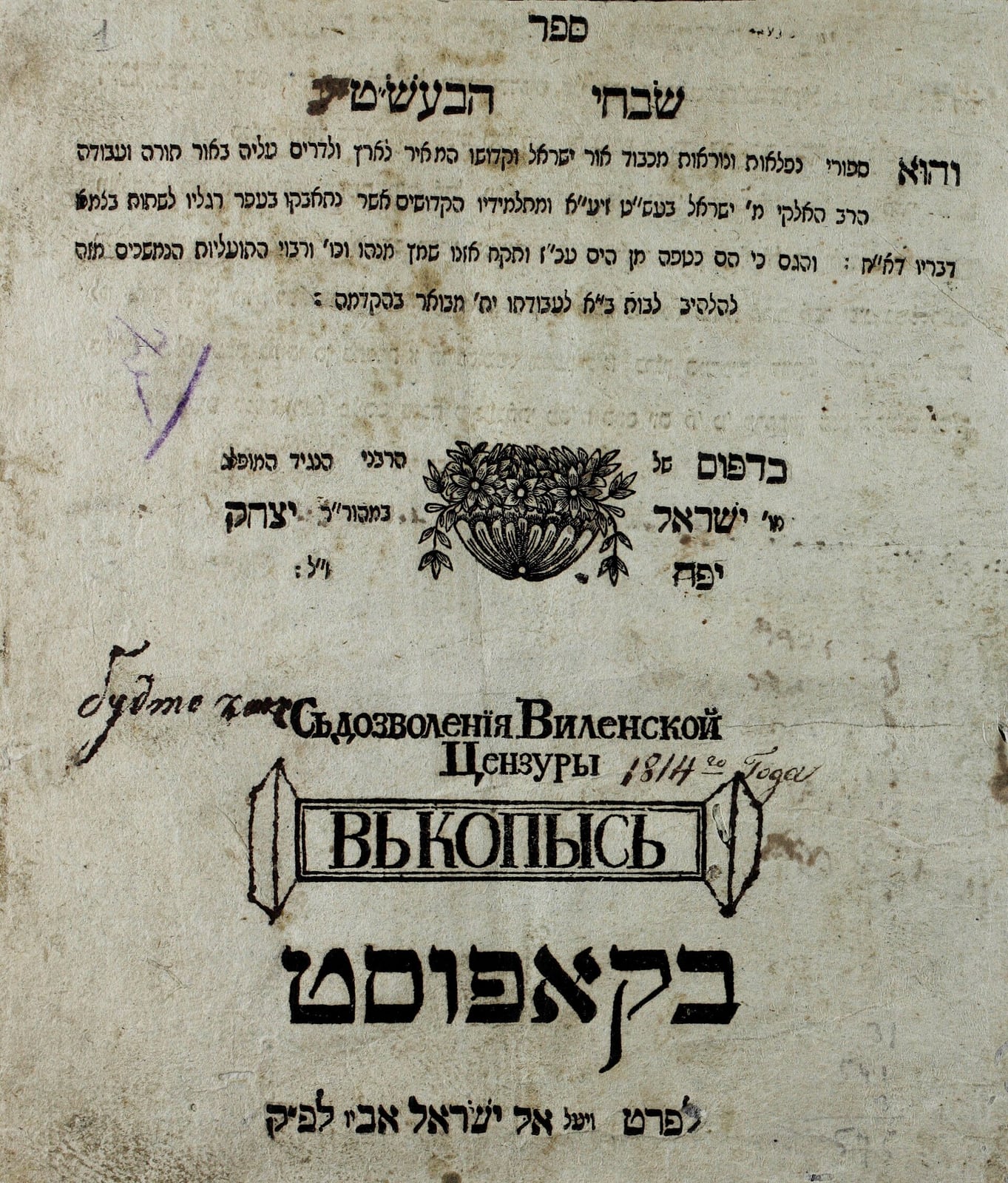
Portada de la primera edición de Shivhei ha-Besht (Kopys, 1814–1815) · Public domain
بكلماته
«When your teaching is publicised and revealed in the world, and your springs overflow outward.»Igeret ha-Kodesh, respuesta del Mesías al Besht (Ben Porat Yosef, Korets, 1781)
فكرته المحورية
Devekut (cleaving to God): *Devekut*, from the Hebrew root "to cleave", designates in the kabbalistic tradition the union of thought with God, which earlier authors reserved for a few and for exceptional moments.
السيرة
4 دقيقة قراءة
ترجمة مُعانة من الأصل الإسباني، بانتظار مراجعة مترجم من أهل اللغة.
مؤسِّس بلا كتاب
قلّما غيّرت شخصيةٌ الحياةَ الدينية اليهودية بهذا العمق وهي لا تترك وراءها إلا هذا القدر الضئيل من الأثر المكتوب. فإسرائيل بن إليعازر، الذي سمّاه أتباعه «بعل شيم طوف» — أي «صاحب الاسم الحسن» — أو «البِيشْت» اختصارًا من الأحرف الأولى لاسمه، لم يصنّف رسالةً واحدة. وكلّ ما نعرفه عنه يأتي من ثلاث طبقات متفاوتة القيمة تفاوتًا كبيرًا: حفنة من السجلات الإدارية البولندية وشهادات معاصرين من خارج حلقته؛ ورسالة كتبها بيده طُبعت بعد موته بعقدين؛ ثم ذلك الكمّ الهائل من التعاليم والحكايات التي دوّنها تلاميذه وتلاميذ تلاميذه ابتداءً من عام 1780. وقد تعلّمت أبحاث العقود الأخيرة، ولا سيما أبحاث موشيه روسمان وعمانوئيل إتكس، أن تفصل بين هذه الطبقات: الرجل الذي تشهد له الوثائق، والمعلّم كما يتذكّره تلاميذه، والقدّيس كما ترسمه الأسطورة.
السنوات المعتمة
وُلد نحو عام 1700 في الشريط الحدودي بين الكومنولث البولندي الليتواني وإمارة مولدافيا. ويضع كتاب «شِفحي ها-بيشت» («مدائح البيشت»)، وهو مجموعة في سِيَر القدّيسين طُبعت في كوبيس عامي 1814 و1815، أباه إليعازر «في بلاد الأفلاق، قرب الحدود»؛ أما التقليد الحسيدي اللاحق، الذي يجعل مولده عام 1698، فيؤثر قرية أوكوبي في بودوليا، ولا دليل وثائقيًّا على ذلك. ويروي الكتاب نفسه أن أبويه رُزقا به على كِبَر، وأنه تيتّم صغيرًا فربّته الجماعة؛ وأنه عمل مساعدًا لمعلّم الصبيان وقيّمًا على الكنيس، وعاش مع زوجته حنّة، أخت العالِم أبراهام غرشون من كوتي، يستخرج الطين في جبال الكاربات، ثم أدار حانة.
لا سبيل إلى التحقّق من هذه التفاصيل، وبعضها يجري على نمط مألوف في أدب المناقب: الصدّيق المستور الذي يعيش بين المتواضعين حتى تحين ساعة ظهوره، أو الكتابات السرّية لرجل غامض يُدعى آدم بعل شيم تقع بين يديه. غير أنها ترسم سِمةً تؤكّدها الوثائق: فالبيشت لم يخرج من المدارس الربّانية الكبرى، بل من عالم الحِرَف المتواضعة والوعّاظ الجوّالين والمعالجين الشعبيين على تخوم بودوليا.
بعل شيم ميجيبوج
كان «البعل شيم» في أوروبا الشرقية في القرن الثامن عشر اختصاصيًّا معترفًا به: يكتب التمائم، ويطرد الأرواح، ويصف الأدوية، ويحمي النُّفَساء والأطفال باستعمال الأسماء الإلهية. وقد مارس إسرائيل هذه الحرفة، ولقبُه يعلن ذلك. وتُظهره أولى الإشارات الموثوقة معروفًا قبل عام 1738: فقد تذكّر شلومو يتسحاق هالبرن أن أباه، حاخام جفانيتس، كانت له صلة بـ«إسرائيل بعل شيم الذائع الصيت». ونحو عام 1740 استقرّ في ميجيبوج (مدجيبيج اليوم، في أوكرانيا)، وهي بلدة خاصة يملكها أقطاب أسرة تشارتوريسكي. وتضعه السجلات الضريبية التي عثر عليها روسمان في أرشيف الأسرة في بيت تملكه الجماعة ومعفًى من الضرائب، أولًا بصفة «قبّالي»، ثم في عام 1758 بصفة «بعل شيم دكتور». فلم يكن متمرّدًا على سلطة الجماعة، بل كان اختصاصيًّا دينيًّا تنفق عليه الجماعة نفسها.
صعود الروح
النصّ الوحيد الذي يُرجَّح كثيرًا أنه بخطّ يده رسالةٌ إلى صهره أبراهام غرشون من كوتي، الذي هاجر إلى أرض إسرائيل. يروي فيها أنه في رأس السنة اليهودية عام 1746 أجرى، «كما تعلم»، رُقيةً لصعود الروح، فاجتاز القصور السماوية حتى بلغ قصر المسيح، فسأله متى يأتي. وصار الجواب — حين يذيع تعليمك وينكشف في العالم وتفيض ينابيعك إلى الخارج — الشعارَ الدعوي للحسيدية. وتروي الرسالة كذلك صعودًا آخر في رأس السنة عام 1749، وشفاعته في وباء، وتهم القتل الطقسي في زاسواف وجماعات أخرى، وتنتهي بنصيحة في الصلاة: في كل حرف عوالم وأرواح وألوهية، وعلى المصلّي أن يوحّد روحه بها. وقد عُهد بها إلى يعقوب يوسف من بولونّه ليحملها إلى فلسطين، فلم تبلغ وجهتها قطّ، وطُبعت عام 1781 في آخر كتاب «بن بورات يوسف».
الصحبة المقدّسة
بيّن إتكس أن البيشت كان في آنٍ واحد ساحرًا ومتصوّفًا وقائدًا. فقد التفّت حوله «صحبة مقدّسة» صغيرة من أهل العلم، بعضهم حاخامات ووعّاظ معروفون، قبلوا سلطته الكاريزمية: يعقوب يوسف هاكوهين، حاخام شارهورود ثم بولونّه؛ ودوف بير، واعظ ميزيريتش؛ وبنحاس من كوريتس؛ ونحمان من هورودنكا. ولم يؤسّس تنظيمًا: فالحسيدية بوصفها حركة، ببلاطاتها وسلالاتها وشبكات أتباعها، لم تتبلور إلا بعد موته، ولا سيما على يد دوف بير وتلاميذه. لكن حول شخصه تكوّنت القناعة بأن الرجل القدّيس قادر على الشفاعة للجماعة، والارتقاء بالأرواح، واستنزال البركة، وهي القناعة التي ستصير لاحقًا عقيدة «الصدّيق» (التسادِيق).
ما كان يعلّمه
لا تصلنا تعاليمه إلا منقولةً على ألسنة غيره. فيعقوب يوسف يورد المئات منها بصيغة «سمعتُ من معلّمي» في كتاب «تولدوت يعقوب يوسف» (1780)، أول كتاب حسيدي مطبوع، ثم جمعتها مختارات مثل «وصية الريباش» (1793) و«كيتر شيم طوف» (1794–1795) ومزجتها بتعاليم واعظ ميزيريتش. ومن خلال هذه المصفاة تتبيّن نواة متماسكة. فغاية الحياة الدينية هي «الدِّفيقوت»، أي التصاق الفكر بالله في كل حين، لا في الصلاة أو الدرس وحدهما؛ وما دامت «الأرض كلّها مملوءة من مجده»، فإن عبادة الله ممكنة في الأكل والعمل والحديث أيضًا، بل إن الخواطر الغريبة التي تهجم على المصلّي يمكن أن تُرفع إلى أصلها. والفرح شرط العبادة، والحزن أكبر عوائقها؛ أما الزهد بالصوم وإماتة الجسد، الذي كان شائعًا بين الأتقياء في زمانه، فيبدو في هذه المصادر طريقًا محفوفًا بالخطر. وتلخّص عبارةٌ محفوظة في «كيتر شيم طوف» هذا العلم الروحي بالنفس: حيث يفكّر الإنسان، هناك يكون بكلّيته.
موته وما بعده
مات في ميجيبوج في اليوم الأول من عيد الأسابيع (شافوعوت) عام 1760، في السادس من شهر سيوان سنة 5520 العبرية (21 أيار/مايو بحسب التقويم الغريغوري). ويضمّ «شِفحي ها-بيشت» رواية مفصّلة لساعاته الأخيرة تُنسب إلى شهود من حلقته. وحمل تلاميذه اسمه في أرجاء بودوليا وفولينيا وغاليسيا؛ وفي عام 1772 أصدرت السلطات الحاخامية في فيلنا الحِرم على الحسيديم، وطبع النزاع بين الحسيديم و«المِتْنَغْديم» (المعارضين) الحياة اليهودية في أوروبا الشرقية نصف قرن. وثبّت «شِفحي ها-بيشت» عام 1815 صورة القدّيس صانع الكرامات؛ وفي القرن العشرين أعاد مارتن بوبر كتابة أساطيره لجمهور أوروبي، ووضعه جرشوم شوليم في تاريخ التصوّف اليهودي بوصفه فاتحَ «مرحلته الأخيرة». واليوم صار قبره في مدجيبيج مزارًا يحجّ إليه الناس، وما زال النقاش حول البيشت التاريخي مفتوحًا.
المصادر: Rosman, Moshe. Founder of Hasidism: A Quest for the Historical Ba'al Shem Tov. Berkeley: University of California Press, 1996; 2.ª ed. Oxford/Portland: Littman Library of Jewish Civilization, 2013. · Etkes, Immanuel. The Besht: Magician, Mystic, and Leader. Trad. Saadya Sternberg. Waltham (Mass.): Brandeis University Press, 2005 (original hebreo: Ba'al ha-Shem, Jerusalén, Merkaz Zalman Shazar, 2000). · Ben-Amos, Dan, y Jerome R. Mintz (trads. y eds.). In Praise of the Baal Shem Tov [Shivhei ha-Besht]: The Earliest Collection of Legends about the Founder of Hasidism. Bloomington: Indiana University Press, 1970 (reed. Northvale: Jason Aronson, 1993). · Biale, David; Assaf, David; Brown, Benjamin; Gellman, Uriel; Heilman, Samuel C.; Rosman, Moshe; Sagiv, Gadi; Wodziński, Marcin. Hasidism: A New History. Princeton: Princeton University Press, 2018. · Scholem, Gershom. Major Trends in Jewish Mysticism. Jerusalén: Schocken, 1941 (reed. Nueva York: Schocken, 1946 y ss.), «Ninth Lecture: Hasidism, the Latest Phase». Trad. esp.: Las grandes tendencias de la mística judía, Madrid, Siruela.
الخط الزمني
الحياة عامًا بعد عام
كل نقطة حدث موثّق. انقر لتقرأه مع مصدره ودرجة اليقين فيه.
نحو 1700أقل من عامFrontera podolio-moldava
Birth
Israel, son of Eliezer, is born on the border between Poland and Moldavia. Hasidic tradition gives 18 Elul 5458 (1698) and the village of Okopy; neither is attested in documents.
تقليدRosman, Moshe. Founder of Hasidism: A Quest for the Historical Ba'al Shem Tov. Berkeley: University of California Press, 1996; 2.ª ed. Oxford/Portland: Littman Library of Jewish Civilization, 2013.
بعد وفاته
- 1772First bans on the Hasidim
- 1780First Hasidic book
- 1793 – 1795Tsava'at ha-Rivash and Keter Shem Tov
- 1815Shivhei ha-Besht
- 1908The legend according to Buber
- 1996The historical Besht
نحو 1700 · أقل من عام
Birth
Israel, son of Eliezer, is born on the border between Poland and Moldavia. Hasidic tradition gives 18 Elul 5458 (1698) and the village of Okopy; neither is attested in documents.
تقليد
عقد 1730 · 30 عامًا
Years of humble trades
According to Shivhei ha-Besht he works as a teacher's assistant, beadle, clay-digger with his wife Hannah and tavern-keeper, living as a hidden saint until his "revelation". Hagiographic account, unverifiable.
تقليد
نحو 1738 · 38 عامًا
First outside testimony
Before 1738, the year of his death, Rabbi Jacob Halpern of Zhvanets has dealings with "the renowned Israel Baal Shem", as his son Solomon Isaac Halpern, no Hasid, would recall.
مرجَّح
نحو 1740 · 40 عامًا
Settles in Międzybóż
The records of this Czartoryski private town place him from 1740 in a tax-exempt community house, first described as a "kabbalist".
موثّق
سبتمبر 1746 · 46 عامًا
The Rosh Hashanah ascent
On the New Year of 5507 he performs an "ascent of the soul" in which, according to his own letter, he reaches the palace of the Messiah and asks him when he will come.
موثّق
نحو 1747 · 47 عامًا
His brother-in-law emigrates to Palestine
Abraham Gershon of Kuty, his wife's brother and a student of Kabbalah, settles in the Land of Israel; he will be the addressee of the Besht's letter.
مرجَّح
نحو 1750 · 50 عامًا
The letter to Gershon of Kuty
Having received a letter from his brother-in-law at the Luka fair of 5510, he replies with the account of his ascents of 1746 and 1749. He entrusts it to Jacob Joseph of Polonne, who never makes the journey.
موثّق
1758 · 58 عامًا
"Baal Shem doktor"
The Międzybóż tax inventory lists the "Baal Shem doktor" in a tax-exempt house.
موثّق
21 مايو 1760 · 60 عامًا
Death on Shavuot
He dies on the first day of Shavuot 5520. Shivhei ha-Besht narrates his last hours according to witnesses from his circle.
موثّق
1772
First bans on the Hasidim
The rabbinic authorities of Vilna and Brody excommunicate the Hasidim: the quarrel with the mitnagdim begins.
موثّق
1780
First Hasidic book
Jacob Joseph of Polonne publishes Toledot Ya'akov Yosef, with hundreds of teachings introduced by "I heard from my master". In 1781, Ben Porat Yosef prints the Besht's letter.
موثّق
1793 – 1795
Tsava'at ha-Rivash and Keter Shem Tov
The anthologies Tsava'at ha-Rivash (1793) and Keter Shem Tov (Zolkiew, 1794–1795) are printed, mixing teachings of the Besht and the Maggid of Mezeritch.
موثّق
1815
Shivhei ha-Besht
Israel Jaffe prints in Kopys the tales collected by Dov Ber of Linits: the Besht's hagiography is born. Yiddish editions appear the same year.
موثّق
1908
The legend according to Buber
Martin Buber publishes Die Legende des Baalschem, which introduces the Besht to a non-Jewish European readership.
موثّق
1996
The historical Besht
Moshe Rosman publishes Founder of Hasidism, based on the Czartoryski archives: the Besht appears as a religious specialist integrated into the community.
موثّق
المؤلَّفات
المؤلَّفات الأساسية
المؤلَّفات التي لا يُفهم إرثه من دونها.
Baal Shem Tov
Igeret ha-Kodesh (Letter to Abraham Gershon of Kuty)
مراسلات · نحو 1750
Igeret ha-Kodesh (Letter to Abraham Gershon of Kuty)
אגרת הקודש (אגרת הבעש״ט לר׳ גרשון מקוטוב)
Letter to his brother-in-law, who had emigrated to the Land of Israel, written shortly after 1750. It recounts the ascent of the soul on the New Year of 1746, in which the Besht reaches the palace of the Messiah and asks him when he will come ("when your teaching is publicised and your springs overflow outward"), a second ascent in 1749, his intercession during an epidemic and against ritual-murder accusations in Zasław and two other communities, and closes with instruction on prayer through the letters. It is the key document for his self-understanding as mystic and intercessor, and the origin of Hasidism's missionary drive.
3 طبعات · amazon.com

مجموعة لاحقة · 1793
Tsava'at ha-Rivash (The Testament of Rabbi Israel Baal Shem)
צוואת הריב״ש
Some hundred and forty short paragraphs on the inner life: equanimity before praise and contempt (*hishtavut*), constant cleaving to God (*devekut*), prayer in joy rather than in tears, the raising of stray thoughts, distrust of sadness and scruples, and moderate asceticism. It was one of the books the *mitnagdim* cited as proof of Hasidic heterodoxy, and at the same time one of the movement's most read manuals of piety. Jacob Immanuel Schochet's annotated edition (Kehot) traces the sources of each paragraph.
3 طبعات · amazon.com

مجموعة لاحقة · 1794
Keter Shem Tov (Crown of the Good Name)
כתר שם טוב
It is the first anthology devoted explicitly to the Besht's teachings. In two parts, it gathers comments on biblical verses and sayings on prayer, humility, the divine presence in all things and the relation between the righteous man and the people. Some of the most quoted maxims come from here, such as that a man is wholly where his thought is. The Kehot edition (*Keter Shem Tov ha-Shalem*), prepared by J. I. Schochet, corrects the text and adds sources and commentary.
3 طبعات · amazon.com

مجموعة لاحقة · 1815
Shivhei ha-Besht (In Praise of the Baal Shem Tov)
שבחי הבעש״ט
Some two hundred and fifty narratives that follow the Besht's life from the legend of his father, captive in a distant land, to his death on Shavuot 1760: the orphaned childhood, the years as a hidden saint, the revelation, the healings and exorcisms, the ascents of the soul, the encounters with disciples and opponents, the thwarted journey to the Land of Israel. Each tale usually states from whom the compiler heard it, which allows historians to reconstruct chains of transmission. The annotated English translation by Dan Ben-Amos and Jerome R. Mintz (1970) is the reference in that language.
5 طبعات · amazon.com
جميع مؤلَّفاته (16)
Baal Shem Tov
Toledot Ya'akov Yosef
The Conscious LibraryToledot Ya'akov Yosef
1780
Baal Shem Tov
Ben Porat Yosef
The Conscious LibraryBen Porat Yosef
1781
Baal Shem Tov
Tsafnat Pa'neah
The Conscious LibraryTsafnat Pa'neah
1782
Baal Shem Tov
Ketonet Passim
The Conscious LibraryKetonet Passim
1866
Baal Shem Tov
Likkutim Yekarim (Precious Gleanings)
The Conscious LibraryLikkutim Yekarim (Precious Gleanings)
1792
Baal Shem Tov
Degel Mahaneh Efrayim
The Conscious LibraryDegel Mahaneh Efrayim
1810
Baal Shem Tov
Sefer Baal Shem Tov (The Book of the Baal Shem Tov)
The Conscious LibrarySefer Baal Shem Tov (The Book of the Baal Shem Tov)
1938
Baal Shem Tov
Kabbalistic commentary on Psalm 107 (attributed)
The Conscious LibraryKabbalistic commentary on Psalm 107 (attributed)
1804
Baal Shem Tov
Letters of the "Kherson genizah" (spurious)
The Conscious LibraryLetters of the "Kherson genizah" (spurious)
1918

Founder of Hasidism (Moshe Rosman)
1996
Baal Shem Tov
The Besht: Magician, Mystic, and Leader (Immanuel Etkes)
The Conscious LibraryThe Besht: Magician, Mystic, and Leader (Immanuel Etkes)
2000

The Circle of the Baal Shem Tov (Abraham J. Heschel)
1985
الأقوال
أقوال محدَّدة الموضع في مؤلَّف بعينه. كل منها يحمل مصدره ودرجة الثقة به.
When your teaching is publicised and revealed in the world, and your springs overflow outward.בעת שיתפרסם למודך ויתגלה בעולם ויפוצו מעינותיך חוצה
متحقَّق منهIgeret ha-Kodesh, respuesta del Mesías al Besht (Ben Porat Yosef, Korets, 1781)
الكلمات الأخيرة
نسبة تقليدية
«I know that the clock has stopped, and I do not worry about myself, for I know for certain that I shall go out by this door and at once enter by another.»ידעתי שעמד הזייגר ואין אני דואג על עצמי כי יודע אני בבירור שאצא מפתח זה ותיכף אכנס בפתח אחר
Shivhei ha-Besht (Kopys, 1815), in the account of his death on Shavuot 1760, which the compiler says he heard from Rabbi Jacob of Międzybóż. After these words he is said to have asked those present to recite the psalm "May the pleasantness of the Lord" (Ps 90:17), to have taught his disciples about the upper worlds and to have expired covered with a sheet. It is second-hand testimony written down half a century later, within a hagiographic work.
المصدر: Dov Ber ben Shmuel de Linits, Shivhei ha-Besht, Kopys, 1814–1815; texto hebreo de la edición de Kopys en Sefaria (dominio público).
اسأل
بماذا يجيب أثره
اثنا عشر سؤالًا كبيرًا من أسئلة الإنسانية، وما تتيح نصوصه الإجابة به عنها، مع المراجع. ولا نقوّله ما لم يقل أبدًا.
ما المطلق؟ هل الله موجود؟
The King one serves fills everything: in every letter there is divinity
شخصي وغير شخصي معًايقوله صراحةً
The Baal Shem Tov wrote no books: apart from one letter, his teachings come to us through the homilies of his disciples, above all Jacob Joseph of Polonne, and through later anthologies. In those sources the God of Israel to whom one prays and to whom one cleaves (devekut) is at the same time the presence that fills everything, so that no place is empty of Him. In his own letter to his brother-in-law, instructing him on prayer, he states that in every letter there are worlds, souls and divinity. From Lurianic Kabbalah he takes the idea of divine sparks scattered in things, which man raises when he eats, works or prays with intention. God is thus the King served with joy and the vitality hidden in each thing: concealment exists only for one who cannot see Him.
قارن هذا السؤال مع معلّمين آخرينمن أنا؟ هل توجد ذات حقيقية؟
A soul that ascends, and a man is where his thought is
روح مخلوقة خالدةيُستنتج من تعاليمه
The Baal Shem Tov wrote no treatise on the soul; what we know of his view of the self comes through his letter and the sayings his disciples transmitted. In the letter to his brother-in-law he tells how his soul ascended, at the New Year of 1746, to the palace of the Messiah: the soul can leave the body and travel through the upper worlds. The anthologies record a maxim that shifts the centre of the person: wherever a man thinks with his thought, there he is entirely. The true self is the soul cleaving to God; the ego that compares itself and grows vain is a hindrance, which is why he warns that whoever serves with devotion must not think himself greater than his fellow, for he is a creature like the others, made to serve.
قارن هذا السؤال مع معلّمين آخرينلماذا نتألّم؟
Sadness distances from God; behind every concealment He is there
الانفصال عن اللهيُستنتج من تعاليمه
The teachings his disciples attribute to the Baal Shem Tov place the greatest evil not in outward misfortune but in the sadness that separates from God. Weeping, says the Testament of Rabbi Israel, is very bad, because the Creator is served with joy; only weeping for joy is good. Melancholy and scruples are traps that draw one away from cleaving to God (devekut). Suffering itself is not foreign to God: according to a teaching his disciples transmit, God hides behind the walls of misfortune like a king behind illusory walls, and whoever knows He is there dissolves the concealment. In his letter the Besht also appears as an intercessor in epidemics and persecutions: the community's pain calls for prayer, not resignation.
قارن هذا السؤال مع معلّمين آخرينماذا يحدث بعد الموت؟
To go out by one door and at once enter by another
الحياة الأبدية والقيامةيُستنتج من تعاليمه
The Baal Shem Tov left no written teaching on death; what is known comes through his letter and through tradition. In the letter to his brother-in-law he describes how, in his ascents of the soul, he saw souls of the living and the dead rising from world to world, and how he himself interceded for them: the life of the soul continues and can be helped. Hasidic tales, gathered in In Praise of the Baal Shem Tov, speak of souls returning in another body to repair what they left undone, according to the kabbalistic doctrine of transmigration. The same book narrates his death at Shavuot in 1760: he is said to have declared that he did not fear for himself, because he knew he would go out by one door and at once enter by another.
قارن هذا السؤال مع معلّمين آخرينكيف يُبلَغ التحرّر أو الخلاص؟
Cleaving to God with joy in every act, the bodily included
بالتعبّد والتسليميقوله صراحةً
The teachings his disciples attribute to the Baal Shem Tov place at the centre cleaving to God (devekut), not as a state reserved for ascetics but as a constant orientation of the heart. It is reached through prayer made with joy, which is more acceptable than prayer made with weeping, through equanimity before praise and contempt, and through serving God in bodily things: eating, working, conversing with the intention of raising the divine sparks present in everything. The Besht discouraged excessive fasting and mortification, common in the pious circles of his time. Personal and collective redemption are linked: in his letter, the Messiah answers him that he will come when his teaching is spread abroad and his springs overflow outward.
قارن هذا السؤال مع معلّمين آخرينهل نحتاج إلى معلّم؟
The righteous man raises his generation; the people reach God through him
لا غنى عنهيُستنتج من تعاليمه
The Baal Shem Tov was master of a circle of disciples who ascribed singular authority to him, and later Hasidism made the righteous man (tsaddik) the centre of religious life. The teachings transmitted by Jacob Joseph of Polonne describe the relationship between «men of form», the sages who cleave to God, and «men of matter», the simple people, who are raised through them; the righteous man is responsible for his generation. According to the tradition recorded in Hasidic tales, the Besht himself had a heavenly master, the prophet Ahijah the Shilonite. His letter shows him interceding for entire communities. For the simple people, the way to God passed through closeness to a righteous man.
قارن هذا السؤال مع معلّمين آخرينهل العالم حقيقي؟
No place is empty of God: divine sparks in all things
تجلٍّ للإلهييقوله صراحةً
The teachings transmitted by the Baal Shem Tov's disciples make the world the stage of divine presence: the whole earth is full of His glory, and no place is empty of Him. From Lurianic Kabbalah they take the idea that at creation sparks of holiness were scattered in things, and that man raises them when he uses the world with intention: when eating, trading, working or conversing. Hence the service of God in bodily things that marked nascent Hasidism. In his letter the Besht himself states that in every letter there are worlds, souls and divinity. The world is neither illusion nor obstacle but a garment of the divine: what conceals is the same as what reveals, for one who knows how to look.
قارن هذا السؤال مع معلّمين آخرينما الحب؟
To love God with joy and one's fellow without thinking oneself above him
محبة الله والقريبيُستنتج من تعاليمه
In the transmitted teachings of the Baal Shem Tov, love of God takes the form of joyful cleaving (devekut): serving Him with joy, in prayer and in every act. That love does not set the devout apart from others. The Testament of Rabbi Israel warns that whoever serves with devotion should not say in his heart that he is greater than his fellow, for he is one more creature, made for service. Hasidic tales present the Besht as someone who sought out the simple, the unlettered and sinners, and who valued the prayer of the unlearned man above learning without heart. Love for every Jew, which Hasidism made one of its marks, goes back in tradition to his figure.
قارن هذا السؤال مع معلّمين آخرينهل نحن أحرار أم أن كل شيء مقدَّر؟
Nothing happens by chance: what one encounters is a task for him
القدر والمسؤوليةيُستنتج من تعاليمه
The teachings attributed to the Baal Shem Tov extend divine providence to everything: nothing a man sees or hears reaches him by chance, but so that he may learn something with which to serve God. That providence does not cancel choice: every encounter, every place one comes to and every object one touches contains sparks that only he can raise, and whether he does so depends on his intention. The Testament of Rabbi Israel teaches equanimity: to accept praise and contempt alike, because everything comes from God. Freedom does not consist in escaping destiny but in responding well to what it brings. Later tradition developed this idea as individual providence reaching even the leaf the wind stirs.
قارن هذا السؤال مع معلّمين آخرينلماذا نتأمّل أو نصلّي؟
Praying with joy, with the whole body, cleaving to every letter
صداقة مع اللهيقوله صراحةً
Prayer is at the centre of the teachings the disciples attribute to the Baal Shem Tov. It must be done with joy, which makes it more acceptable than prayer with weeping, and with the whole body and all one's strength, so that the one who prays cleaves to God in every word. The Testament of Rabbi Israel describes it with a bold image taken from Kabbalah: prayer is union with the divine Presence (Shekhinah). The strange thoughts that assail the one praying are not simply rejected but raised to their root. In his letter the Besht himself advises his brother-in-law to concentrate his intention on the letters of each word, because in every letter there are worlds, souls and divinity.
قارن هذا السؤال مع معلّمين آخرينهل يستطيع العقل أن يعرف الحقيقة القصوى؟
The simple man's sincere prayer outweighs learning without fear of God
الحقيقة القصوى وراء العقليُستنتج من تعاليمه
The Baal Shem Tov was not a first-rank Talmudic scholar nor did he claim to be, and the teachings his disciples transmit shift the centre of religious life from study to cleaving to God. Jacob Joseph of Polonne, in the books where he quotes his master, harshly criticises scholars who study out of pride or profession, without fear of God, and Hasidic tales present the Besht valuing the prayer of the simple man above casuistry. Torah study keeps its value, but it must be done with devotion, attending to the light of the letters more than to sharpness of reasoning. What unites with God is not the intellect that argues but the soul that cleaves.
قارن هذا السؤال مع معلّمين آخرينالانسحاب من العالم أم تغييره؟
Serving God in bodily things: eating, trading and speaking with intention
التأمّل في الفعليقوله صراحةً
The Baal Shem Tov lived in the world: he was a healer, a writer of amulets and a religious specialist in the community of Międzybóż, and his life was spent among people, not in isolation. The teachings his disciples attribute to him make that presence a doctrine: God is served also in bodily things, in food, trade, conversation and work, because in everything there are divine sparks to raise. That is why he discouraged the excessive fasting and mortification common among the pious of his time. His letter also shows him occupied with his people's troubles, interceding in epidemics and against blood-libel accusations. Cleaving to God does not require leaving the world but inhabiting it with another intention.
قارن هذا السؤال مع معلّمين آخرين
التقارب والتوتّر
التقارب والتوتّر
محسوبة سؤالًا سؤالًا انطلاقًا من مواقفه. وسبب كل اتفاق أو اختلاف يظهر بالنقر.
يقترب في تفكيره من
Rumi
يتّفقان في: من أنا؟ هل توجد ذات حقيقية؟ · لماذا نتألّم؟ · ماذا يحدث بعد الموت؟

Chaitanya Mahaprabhu
يتّفقان في: من أنا؟ هل توجد ذات حقيقية؟ · لماذا نتألّم؟ · ماذا يحدث بعد الموت؟
Hafez
يتّفقان في: من أنا؟ هل توجد ذات حقيقية؟ · لماذا نتألّم؟ · ماذا يحدث بعد الموت؟
Attar
يتّفقان في: ما المطلق؟ هل الله موجود؟ · لماذا نتألّم؟ · ماذا يحدث بعد الموت؟
يبتعد في تفكيره عن

Pema Chödrön
يختلفان في: من أنا؟ هل توجد ذات حقيقية؟ · ماذا يحدث بعد الموت؟

Epicurus
يختلفان في: من أنا؟ هل توجد ذات حقيقية؟ · ماذا يحدث بعد الموت؟

The 14th Dalai Lama (Tenzin Gyatso)
يختلفان في: من أنا؟ هل توجد ذات حقيقية؟ · ماذا يحدث بعد الموت؟
Jiddu Krishnamurti
يختلفان في: كيف يُبلَغ التحرّر أو الخلاص؟ · هل نحتاج إلى معلّم؟
حكايات وروايات
حكايات وروايات
شهادة1746
The question to the Messiah
أصل الرواية: First-person account by the Besht himself in his letter to Abraham Gershon of Kuty, printed in 1781 in Ben Porat Yosef. What is documented is that the Besht wrote that he had this experience, not the experience itself; Etkes and Rosman read it as evidence of his self-understanding as a mystical intercessor.
رواية من سِيَر القدّيسينdécada de 1740–1750
The pipe and the weeping
أصل الرواية: Shivhei ha-Besht (Kopys, 1815), a tale the compiler Dov Ber of Linits says he heard from Jacob Joseph of Polonne himself and from Rabbi Gedaliah. Jacob Joseph's forced departure from Shargorod is accepted by historians; the details of the conversion are tradition.
رواية من سِيَر القدّيسينc. 1750
The shoes of Simhat Torah
أصل الرواية: Shivhei ha-Besht (Kopys, 1815). The chain of transmission is not stated. Baruch of Międzybóż (1753–1811), the Besht's grandson, is a historical figure.
رواية من سِيَر القدّيسين1760
The last lesson
أصل الرواية: Shivhei ha-Besht (Kopys, 1815), section on his death; the compiler says he heard it from Rabbi Jacob of Międzybóż, who later died in the Land of Israel, and cites Leib Kessler as witness to the soul's departure.
موثّق1740–1760
The "Baal Shem doktor" in the account books
أصل الرواية: Rosman, "Miedzyboz and Rabbi Israel Baal Shem Tov", Zion 52 (1987), and Founder of Hasidism (1996), based on the Czartoryski holdings in Kraków.
لا يمكن التحقق منهsin fecha
The boy's whistle on Yom Kippur
أصل الرواية: It does not appear in the Kopys edition of Shivhei ha-Besht nor in the eighteenth-century anthologies consulted. It circulates in twentieth-century collections of Hasidic tales and in popular teaching, with variants (flute, whistle, the recited alphabet); we have not been able to trace its first printed appearance.
المصدر: Ben-Amos, Dan, y Jerome R. Mintz (trads. y eds.). In Praise of the Baal Shem Tov [Shivhei ha-Besht]: The Earliest Collection of Legends about the Founder of Hasidism. Bloomington: Indiana University Press, 1970 (reed. Northvale: Jason Aronson, 1993).
التعاليم
التعاليم
المفاهيم التي ينتظم بها فكره، مشروحة في سياقها.
Devekut (cleaving to God)devekut
It takes up kabbalistic mysticism (Nahmanides, the Zohar, Safed Kabbalah) and redirects it toward everyday life.
المصدر: Scholem, Gershom. Major Trends in Jewish Mysticism. Jerusalén: Schocken, 1941 (reed. Nueva York: Schocken, 1946 y ss.), «Ninth Lecture: Hasidism, the Latest Phase». Trad. esp.: Las grandes tendencias de la mística judía, Madrid, Siruela.
Worship through corporeality (avodah be-gashmiyut)avodah-be-gashmiyut
It develops the Lurianic doctrine of raising the sparks in an ethical and everyday direction.
Hishtavut (equanimity)hishtavut
It has precedents in the ethics of Bahya ibn Paquda and in Safed Kabbalah; in Hasidism it becomes a central virtue.
Raising of stray thoughtshaalat-mahshavot-zarot
Application of the Lurianic doctrine of sparks to the psychology of prayer.
Ascent of the soul (aliyat ha-neshamah)aliyat-ha-neshamah
It goes back to the mysticism of the palaces (hekhalot) and to practical Kabbalah; in the Besht it joins the figure of the intercessor.
المصدر: Etkes, Immanuel. The Besht: Magician, Mystic, and Leader. Trad. Saadya Sternberg. Waltham (Mass.): Brandeis University Press, 2005 (original hebreo: Ba'al ha-Shem, Jerusalén, Merkaz Zalman Shazar, 2000).
Joy (simhah)simha
A reaction against the penitential and ascetic piety widespread after the Sabbatean crisis; it has roots in the Talmud ("the Presence does not rest amid sadness").
مقاطع الفيديو
مقاطع الفيديو
تسجيلات ومقابلات وأفلام وثائقية. تُشغَّل مقاطع الفيديو من YouTube؛ ولا تُستضاف هنا.
ר' ישראל בעל שם טוב (הבעש"ט) וראשית החסידות
محاضرة· HE· 73 min
Hebrew University of Jerusalem
Prof. Moshe Rosman on "Yisrael Ba'al Shem Tov and the Beginnings of Hasidism"
محاضرة· EN· 78 min
Brooklyn College Judaic Studies Department
The Baal Shem Tov | An Introduction to Hasidism | Rabbi Dr. Nehemia Polen
محاضرة· EN· 60 min
Beit Avi Chai
בעקבות הבעש"ט | שיעור 1 - דמותו המיתולוגית | פרופ' יונתן מאיר
محاضرة· HE· 40 min
בית אבי חי (Beit Avi Chai)
בעקבות הבעש"ט | שיעור 2 - היסטוריה ותיאולוגיה | פרופ' יונתן מאיר
محاضرة· HE· 44 min
בית אבי חי (Beit Avi Chai)
Who Was The Ba'al Shem Tov? Founder of Hasidism | Jewish History Lecture | Dr. Henry Abramson
محاضرة· EN· 60 min
Henry Abramson
Prof. Marcin Wodziński | Understanding Hasidism: Theology, Tales, Charisma | 2026 Buber Lecture
محاضرة· EN· 71 min
The Israel Academy of Sciences and Humanitiesالقناة الرسمية
Historical Atlas of Hasidism by Marcin Wodziński
محاضرة· EN· 73 min
YIVO Institute for Jewish Researchالقناة الرسمية
The Origins of Hasidic Judaism: The Ba'al Shem Tov | The Jewish Story | Unpacked
فيلم وثائقي· EN· 6 min
Unpacked
Fernando Carbonell - Baal Shem Tov, un precursor de nuestro tiempo
محاضرة· ES· 56 min
EspacioRonda
JaZ"L: Las Vidas de los Sabios Asquenazi; 14 El Baal Shem Tov y el Jasidismo
محاضرة· ES· 100 min
Rabino Rigoberto Manny Viñas
HEBRAICA - Cycle Histoire Juive - Roger Attali : Le Baal Shem Tov
المشاهدة على YouTube
لا يسمح هذا الفيديو بالتضمين؛ وسيُفتح على YouTube.
HEBRAICA - Cycle Histoire Juive - Roger Attali : Le Baal Shem Tov
محاضرة· FR· 92 min
Association Hebraica
المعرض
المعرض
صور بترخيص متحقَّق منه. كل منها تحتفظ بمؤلّفها ونسبتها.
العلاقات
العلاقات
تأثيرات وتلمذة وتقارب في الأفكار. تُميَّز العلاقة الموثّقة عن التشابه المستخلَص بالتحليل.
أثّر في
Buber retold the Besht's legends in German (*Die Legende des Baalschem*, 1908) and saw in Hasidism a model of dialogical religious life; his reading spread the figure of the Besht in Europe and was criticised by Scholem for its selectivity.
علاقة موثّقة
أفكار قريبة من
Opposite poles of Jewish spirituality according to a frequent reading: the Aristotelian rationalism of the *Guide of the Perplexed* versus the Besht's affective mysticism. Both share, however, the pursuit of an intellectual or cleaving love of God as the end of religious life.
تشابه مستخلَص بالتحليل
أفكار قريبة من
The *hishtavut* (equanimity) of *Tsava'at ha-Rivash* and Eckhartian detachment (*Abgeschiedenheit*) propose an evenness of mind founded on union with God; there is no historical connection.
تشابه مستخلَص بالتحليل
أفكار قريبة من
Both embody a religiosity of joy, simplicity and closeness to the humble as opposed to learned or penitential piety, and both are known above all through collections of tales by their disciples.
تشابه مستخلَص بالتحليل
أفكار قريبة من
Song, dance and joyful ecstasy as forms of prayer link nascent Hasidism and the Mevlevi tradition; no contact between them is documented.
تشابه مستخلَص بالتحليل
أفكار قريبة من
Charismatic mystics without written works, known through the accounts of their circles, who valued the devotion of the heart above learning.
تشابه مستخلَص بالتحليل
أفكار قريبة من
The claim that "there is no place empty of Him" has led to talk of Hasidic panentheism; the comparison with Spinozan immanence is frequent in historiography, though the premises are very different.
تشابه مستخلَص بالتحليل
مرتبط من صفحات أخرى
المصادر
المصادر
المراجع والفهارس التي رُوجعت لهذه الصفحة.
- Rosman, Moshe. Founder of Hasidism: A Quest for the Historical Ba'al Shem Tov. Berkeley: University of California Press, 1996; 2.ª ed. Oxford/Portland: Littman Library of Jewish Civilization, 2013.
- Etkes, Immanuel. The Besht: Magician, Mystic, and Leader. Trad. Saadya Sternberg. Waltham (Mass.): Brandeis University Press, 2005 (original hebreo: Ba'al ha-Shem, Jerusalén, Merkaz Zalman Shazar, 2000).
- Ben-Amos, Dan, y Jerome R. Mintz (trads. y eds.). In Praise of the Baal Shem Tov [Shivhei ha-Besht]: The Earliest Collection of Legends about the Founder of Hasidism. Bloomington: Indiana University Press, 1970 (reed. Northvale: Jason Aronson, 1993).
- Biale, David; Assaf, David; Brown, Benjamin; Gellman, Uriel; Heilman, Samuel C.; Rosman, Moshe; Sagiv, Gadi; Wodziński, Marcin. Hasidism: A New History. Princeton: Princeton University Press, 2018.
- Scholem, Gershom. Major Trends in Jewish Mysticism. Jerusalén: Schocken, 1941 (reed. Nueva York: Schocken, 1946 y ss.), «Ninth Lecture: Hasidism, the Latest Phase». Trad. esp.: Las grandes tendencias de la mística judía, Madrid, Siruela.
- Wikidata, Q319062: «Baal Shem Tov» (Israel ben Eliezer), 47 enlaces entre wikis.
- Israel Baal Shem Tov, Igeret ha-Kodesh (carta a Abraham Gershon de Kuty), impresa en Jacob Joseph de Polonne, Ben Porat Yosef, Korets, 1781; texto hebreo en Sefaria (ed. Eichen, Jerusalén, 2011).
- Tsava'at ha-Rivash (primera impresión 1793); texto hebreo de la edición de Varsovia, 1913, en Sefaria (dominio público).
- Keter Shem Tov, compilado por Aharon ha-Kohen de Apta, Zolkiew, 1794–1795; texto hebreo en Sefaria.
- Dov Ber ben Shmuel de Linits, Shivhei ha-Besht, Kopys, 1814–1815; texto hebreo de la edición de Kopys en Sefaria (dominio público).
- Kohler, Kaufmann, y Louis Ginzberg. «Ba'al Shem-Ṭob, Israel b. Eliezer». The Jewish Encyclopedia, vol. 2. Nueva York: Funk & Wagnalls, 1902.
- Idel, Moshe. Hasidism: Between Ecstasy and Magic. Albany: State University of New York Press, 1995.
- Schochet, Jacob Immanuel (trad. y notas). Tzava'at Harivash: The Testament of Rabbi Israel Baal Shem Tov. Brooklyn: Kehot Publication Society, 1998.
- Wikimedia Commons, categoría «Baal Shem Tov» y subcategorías (licencias leídas por la API imageinfo).
- Jacob Joseph ha-Kohen de Polonne, Toledot Ya'akov Yosef, Korets, 1780; texto hebreo en Sefaria.
- Buber, Martin. Die Legende des Baalschem. Fráncfort del Meno: Rütten & Loening, 1908 (trad. ingl. de Maurice Friedman, The Legend of the Baal-Shem, Nueva York, Harper, 1955).
- Sefaria, «Ba'al Shem Tov» (Sefer Baal Shem Tov, antología de Shimon Menahem Mendel Wodnik de Gowarczów, Łódź, 1938).
- صاحب الحقوق
- Dominio público: la carta del Besht y las antologías de los siglos XVIII–XIX. Las traducciones y ediciones anotadas modernas (Kehot, Indiana University Press, Jason Aronson, BST Publishing) tienen derechos de sus editores y traductores.
في انتظار التأكيد
ما لم تتمكّن هذه الصفحة من حسمه بعد. نفضّل أن نقول ذلك على أن نملأ الفراغ.
- Localizar ediciones españolas con ISBN de Tsava'at ha-Rivash, Keter Shem Tov y Shivhei ha-Besht (Open Library no registra ninguna; consultar el catálogo de Kehot Lubavitch Sudamericana y de la Biblioteca Nacional de España).
- Identificar al conferenciante del vídeo de la Universidad Hebrea (2qMI8RKtHgs): el título no lo indica.
- Verificar en Etkes (2005, cap. 2) la fecha exacta de redacción de la carta (la recepción de la carta de Gershon en la feria de Luka de 5510 da un término post quem de 1750) y la procedencia de la versión larga.
- Confirmar en catálogo la primera edición de Tsava'at ha-Rivash (1793): lugar de impresión (Zolkiew u Ostroh, según fuentes).
- Rastrear la primera aparición impresa del relato del muchacho que silba en Yom Kipur.
- Comprobar si el importador de la sala de lectura admite Sefaria (formato «other»); si no, sustituir por Wikisource hebreo o por los escaneos de la Biblioteca Nacional de Israel.
- Buscar vídeos de televisiones públicas (Kan, Arte) o del Museo ANU sobre el Besht y el jasidismo.
بُحث بتاريخ 2026-10-25