Досократическая философия
Parmenides
Παρμενίδης ὁ Ἐλεάτης
ок. 515 до н. э. – ?Исторически документированная личность
Философ из Элеи в Великой Греции (родился около 515 г. до н. э.), автор поэмы гекзаметром, от которой осталось около ста шестидесяти стихов. В ней богиня учит, что мыслить и высказывать можно лишь «то, что есть», и что оно нерожденно, непреходяще, едино и неподвижно; вторая часть излагает мнения смертных. Основатель элейской школы, учитель Зенона и, по преданию, законодатель своего города, он своим доводом определил всю последующую философию.
- трудов
- 5трудов
- изданий
- 22изданий
- цитат
- 14цитат
- видео
- 12видео
- изображений
- 5изображений
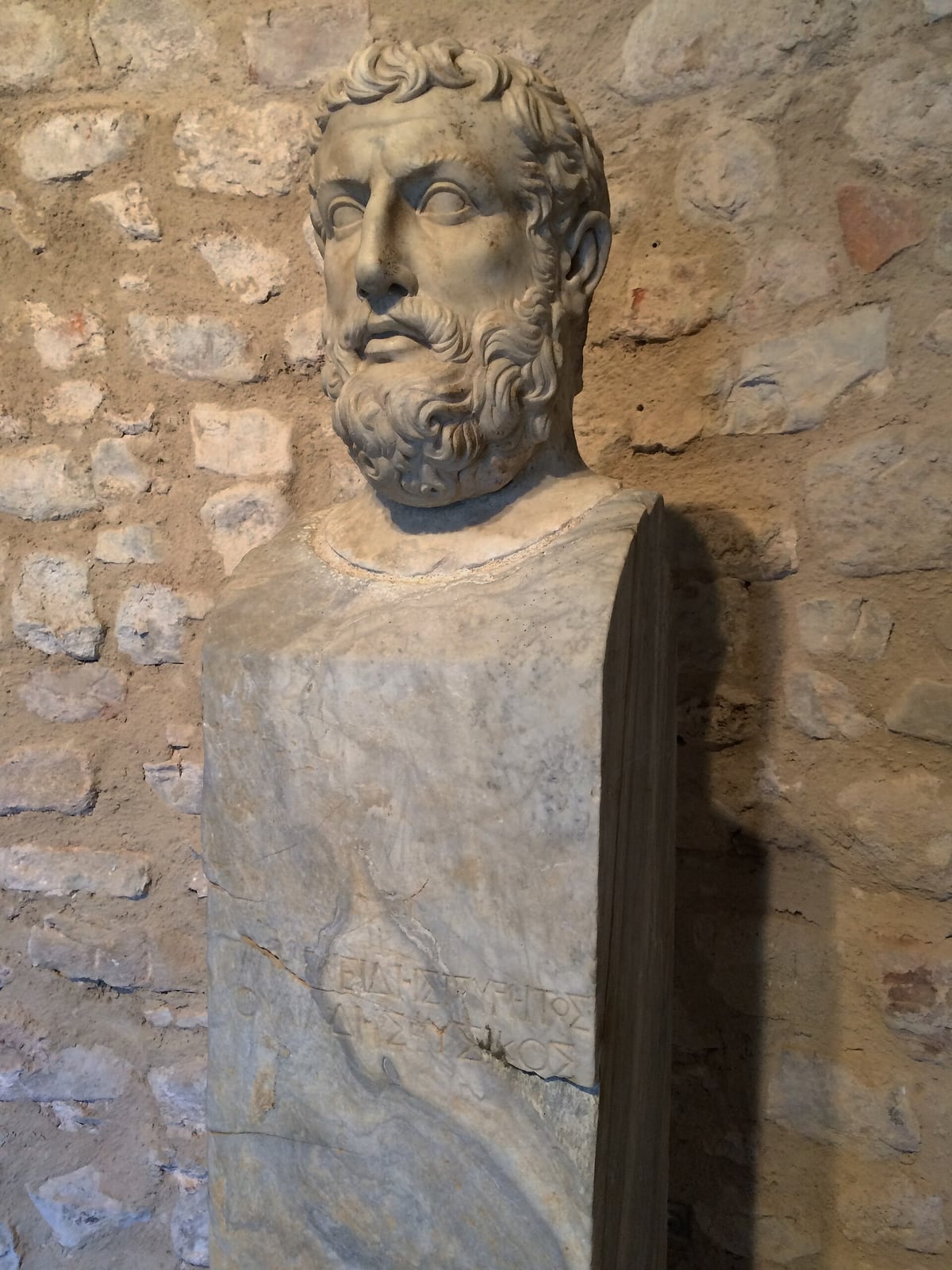
Cabeza identificada con Parménides (Velia) · CC BY-SA 4.0
Своими словами
«Meet it is that thou shouldst learn all things, as well the unshaken heart of well-rounded truth, as the opinions of mortals in which is no true belief at all.»DK 28 B1.28–30, en Sexto Empírico, Contra los matemáticos VII 111, y Simplicio, Comentario al Sobre el cielo 557. Griego: Diels-Kranz; inglés: John Burnet, Early Greek Philosophy (1908); español: traducción propia.

Главная мысль
What is (to eon): The poem turns on a single word, the Greek verb *esti*, "is", often without an expressed subject.
В контексте
Биография
4 мин чтения
Перевод с испанского оригинала, выполненный с помощью ИИ; ожидает проверки носителем языка.
Поэма единственного пути
Парменид написал единственную поэму гекзаметром — стихом Гомера и Гесиода, — от которой благодаря цитатам Секста Эмпирика, Симпликия, Прокла, Плутарха и других сохранилось около ста шестидесяти стихов. Это первый текст греческой философии, который рассуждает шаг за шагом, и первый, который спрашивает, что значит сказать о чем-либо, что оно «есть». Платон, назвавший его «почтенным и вместе грозным», посвятил ему диалог и представил разрыв с его учением как «отцеубийство»; Аристотель разбирал его тезисы в начале «Физики». Всю последующую философию природы, от Эмпедокла до атомистов, можно читать как ответ на его отрицание рождения и гибели.
Элея
Элея — Гиела для ее основателей, Велия для римлян — была молодой колонией на Тирренском побережье, к югу от Посейдонии. Ее основали около 540 г. до н. э. фокейцы, бежавшие от наступления персов в Ионии, как рассказывает Геродот. Диоген Лаэртский называет Парменида сыном Пирета, из знатной и богатой семьи, и вслед за Аполлодором относит его акме к 69-й олимпиаде (504–501 гг. до н. э.), что дало бы рождение около 540 г. Платон же рассказывает в «Пармениде», что философ посетил Афины примерно в шестьдесят пять лет, когда Сократ был совсем молод, — тогда он родился бы около 515 г. Бернет подозревал, что Аполлодор приурочил его акме к основанию Элеи; многие исследователи предпочитают платоновскую хронологию, хотя сцена диалога, вероятно, литературный вымысел; Бернет, считавший ее исторической, был одним из немногих, кто ее защищал.
Учители, ученики и законы
Древние приписывали ему нескольких учителей. Аристотель сообщает, что его называли учеником Ксенофана — поэта-философа, критиковавшего гомеровских богов и тоже жившего на греческом Западе; Феофраст связывал его с Анаксимандром. Сотион, говоривший определеннее, рассказывал, что к спокойной жизни в занятиях его привел бедный, но благородный пифагореец Аминий, сын Диохета, и что после его смерти Парменид воздвиг ему святилище как герою. Спевсипп, племянник Платона, утверждал, что он дал своему городу законы, а Плутарх добавляет, что магистраты Элеи ежегодно клялись их соблюдать; Страбон приписывает благоустройство города Пармениду и Зенону, самому знаменитому его ученику.
В 1962 году при раскопках Велии была найдена безголовая герма I века н. э. с надписью «Парменид, сын Пирета, Улиад, физиолог». Другие надписи того же здания чтят врачей титулом улиад, восходящим к Аполлону Улию, целителю. Находка позволяет предположить, что века спустя врачебная школа Элеи возводила себя к Пармениду. Питер Кингсли предложил видеть в нем иатроманта — жреца-целителя, практиковавшего инкубацию, — и читать поэму как рассказ о визионерском опыте; гипотеза заманчива, но не опирается на прямые свидетельства, и большинство специалистов считает ее умозрительной.
Путешествие
Поэма начинается с путешествия. Юношу несут на колеснице разумные кобылицы, ведомые дочерьми Солнца, покинувшими обитель Ночи; оси скрипят во втулках колес. Они достигают ворот путей Ночи и Дня, ключи от которых хранит мстительная Справедливость; девы уговаривают ее, и ворота распахиваются. По ту сторону безымянная богиня берет юношу за правую руку и возвещает, что он должен узнать все: «и Истины круглой бестрепетное сердце», и мнения смертных, в которых нет подлинной достоверности. Секст Эмпирик, сохранивший это вступление, толковал его как аллегорию познания; Вальтер Буркерт увидел в нем нисхождение в подземный мир, другие — посвящение.
Путь истины
Богиня учит, что мыслимы лишь два пути исследования: что «есть» и не быть невозможно, и что «не есть» и не быть необходимо. Второй путь непроходим, ибо несуществующее нельзя ни познать, ни высказать; «ибо мыслить и быть — одно и то же» (B3). Смертные, однако, блуждают по третьей тропе: «двухголовые», лишенные суждения, они считают бытие и небытие одним и тем же и не одним и тем же. Длинный фрагмент 8, который Симпликий переписал в VI веке, потому что, по его словам, книга стала редкостью, выводит «знаки» сущего: оно не рождено и не погибнет, ибо не может произойти из несуществующего; оно цельно, единственно, неподвижно и завершено; «оно не было и не будет, ибо оно есть теперь все вместе, единое, сплошное»; и оно отовсюду ограничено, подобно массе совершенно круглого шара.
Что именно есть «сущее», остается предметом споров. Согласно традиционному толкованию, Парменид отрицает множественность и изменение мира; Дж. Э. Л. Оуэн прочел здесь тезис обо всем, что может быть предметом мысли; Александр Мурелатос и Чарльз Кан подчеркнули предикативное и веритативное значение греческого глагола; Джон Палмер отстаивал «щедрый монизм», согласно которому Парменид описывает то, что есть необходимо, не отрицая существования других вещей.
Путь мнения
Завершив свою «достоверную речь», богиня излагает «обманчивый строй» смертных мнений: мир, построенный из двух форм — света, или эфирного огня, и густой ночи, — от которого сохранилось немного стихов. Здесь говорится о небесных венцах, о божестве, которое всем управляет и первым из всех богов замыслило Эрота, о луне, сияющей «чужим светом» и всегда обращенной к лучам солнца, о формировании зародыша и о мышлении, зависящем от смешения членов. Пармениду приписывали открытие того, что утренняя и вечерняя звезда — одно и то же светило и что земля шарообразна, хотя те же сведения сообщаются и о Пифагоре. Почему богиня подробно излагает космологию, которую сама объявляет ложной, — одна из загадок поэмы.
Наследие Элеи
Зенон, его ученик, защищал учение парадоксами, показывавшими нелепость множественности и движения; Мелисс Самосский переложил его в прозу. Эмпедокл, Анаксагор, Левкипп и Демокрит признали, что ничто не возникает из ничего и не уничтожается, и объяснили изменение как смешение и разделение неизменных элементов. Платону в «Софисте» пришлось «поднять руку на отца Парменида», чтобы придать смысл небытию как инаковости. О его смерти ничего не известно. Его поэма, утраченная как книга, уцелела в неоплатонических комментариях и сегодня принадлежит к самым изучаемым текстам античности.
Источники: Diógenes Laercio. Vidas y opiniones de los filósofos ilustres IX 21–23 (Parménides), 25 (Zenón) y 24 (Meliso), s. III d. C. Trad. inglesa de C. D. Yonge, Bohn, Londres, 1853 (Project Gutenberg n.º 57342); trad. inglesa de R. D. Hicks, Loeb, 1925 (Wikisource). · Diels, Hermann y Kranz, Walther. Die Fragmente der Vorsokratiker, 6.ª ed. Weidmann, Berlín, 1951–1952, cap. 28 (Parmenides), A (testimonios) y B 1–19. Texto griego consultado en la transcripción de Wikisource en griego («Περί φύσεως (Παρμενίδης)»). · Kirk, G. S., Raven, J. E. y Schofield, M. The Presocratic Philosophers, 2.ª ed. Cambridge University Press, 1983, cap. VIII (Parmenides of Elea). Trad. esp. de Jesús García Fernández, Gredos, 1987. · Burnet, John. Early Greek Philosophy, 2.ª ed. A. and C. Black, Londres, 1908, cap. IV (Parmenides of Elea), §§ 84–97 (Project Gutenberg n.º 67097). · Coxon, A. H. The Fragments of Parmenides: A Critical Text with Introduction and Translation, the Ancient Testimonia and a Commentary. Van Gorcum, Assen, 1986; ed. revisada por Richard McKirahan, Parmenides Publishing, Las Vegas, 2009.
Хронология
Жизнь год за годом
Каждая точка — документированное событие. Нажмите, чтобы прочитать о нём, с источником и степенью достоверности.
ок. 540 до н. э.Elea (Hyele), Campania
Foundation of Elea
Phocaeans fleeing the Persian advance found Hyele on the Tyrrhenian coast after the battle of Alalia (Herodotus I 163–167). Years BCE are expressed as negative numbers.
ВероятноHeródoto. Historias I 163–167 (los focenses y la fundación de Hyele/Elea), s. V a. C. Trad. inglesa de G. C. Macaulay, Macmillan, Londres, 1890 (Project Gutenberg n.º 2707).
ок. 540 до н. э.
Foundation of Elea
Phocaeans fleeing the Persian advance found Hyele on the Tyrrhenian coast after the battle of Alalia (Herodotus I 163–167). Years BCE are expressed as negative numbers.
Вероятно
ок. 515 до н. э. · 0 лет
Birth
Born in Elea, son of Pyres, of a noble and wealthy family. The date is inferred from Plato (Parmenides 127b); Apollodorus' chronology would place his birth around 540.
Вероятно
ок. 504 до н. э.
Floruit according to Apollodorus
Diogenes Laertius (IX 23) places his prime in the 69th Olympiad (504–501 BCE), the same as Heraclitus'.
Предание
ок. 490 до н. э.
Ameinias and the contemplative life
According to Sotion (in Diogenes Laertius IX 21), the Pythagorean Ameinias turns him to the life of study; at his death Parmenides dedicates a hero-shrine to him. Date unknown.
Предание
ок. 480 до н. э.
Composition of the poem
He composes his hexameter poem, traditionally called On Nature. The date is an estimate; the poem seems to respond to Heraclitus and precedes Empedocles and Zeno.
Оспаривается
ок. 470 до н. э.
Lawgiver of Elea
Speusippus (in Diogenes Laertius IX 23) and Plutarch (Against Colotes 1126a) credit him with Elea's laws, which magistrates swore each year to obey. Date unknown.
Предание
ок. 450 до н. э. · 65 лет
Visit to Athens with Zeno
According to Plato's Parmenides (127a–c), he attends the Great Panathenaea with Zeno, stays in the Ceramicus and converses with a very young Socrates. The meeting is probably a literary fiction; Athenaeus (XI 505f) already doubted it.
Оспаривается
ок. 370 до н. э.
Plato writes the Parmenides and the Sophist
Plato makes Parmenides the protagonist of a dialogue and, in the Sophist (241d), presents the critique of his thesis on not-being as "parricide".
Вероятно
ок. 530
Simplicius copies fragment 8
In his commentary on Aristotle's Physics, Simplicius transcribes long passages of the poem "because of the rarity of the book" (In Phys. 144.25). Without him the way of truth would be unknown.
Документировано
1897
Diels's Parmenides Lehrgedicht
Hermann Diels publishes the critical edition of the poem with German translation, the basis of the DK 28 numbering.
Документировано
1962
Discovery of the Velia herm
Excavations bring to light a headless herm of the 1st century CE inscribed «Παρμενείδης Πύρητος Οὐλιάδης φυσικός», alongside others dedicated to Ouliad physicians.
Документировано
1965
Tarán's edition
Leonardo Tarán publishes Parmenides: A Text with Translation, Commentary and Critical Essays, one of the standard twentieth-century editions.
Документировано
Труды
Главные труды
Труды, без которых не понять это наследие.
Письменный труд · ок. 480 до н. э.
On Nature (poem)
Περὶ φύσεως (título convencional)
A didactic poem in dactylic hexameters, divided into a proem and two parts. In the proem (B1) a youth travels by chariot to the gates of Night and Day and is received by a goddess who promises to teach him the truth and the opinions of mortals. The way of truth (B2–B8.49) argues that only "what is" can be thought and said, and deduces that it is unborn, imperishable, one, continuous, unmoving and like a sphere. The way of opinion (B8.50–B19) sets out a cosmology of two principles, light and night, with theories of the stars, the moon, generation and thought. It is the founding text of Western ontology.
18 изданий · amazon.es
Письменный труд · ок. 480 до н. э.
Way of Truth (B2–B8.49)
Ἀλήθεια (DK 28 B2–B8.49)
The goddess's central teaching. It presents two ways of inquiry—"is" and "is not"—, rules out the second because what is not can be neither thought nor said, and censures the "two-headed" mortals who confuse being and not-being. In B8 it deduces the properties of what is: unborn and imperishable, whole and single, unmoving, without past or future, continuous, bounded and like a well-rounded sphere. It is the first extended deductive argument in Greek philosophy.
4 издания
Изречения
Изречения, найденные в конкретном труде. Каждое сопровождается указанием происхождения и степени надёжности.
Meet it is that thou shouldst learn all things, as well the unshaken heart of well-rounded truth, as the opinions of mortals in which is no true belief at all.χρεὼ δέ σε πάντα πυθέσθαι / ἠμὲν Ἀληθείης εὐκυκλέος ἀτρεμὲς ἦτορ / ἠδὲ βροτῶν δόξας, ταῖς οὐκ ἔνι πίστις ἀληθής.
ПровереноDK 28 B1.28–30, en Sexto Empírico, Contra los matemáticos VII 111, y Simplicio, Comentario al Sobre el cielo 557. Griego: Diels-Kranz; inglés: John Burnet, Early Greek Philosophy (1908); español: traducción propia.
Апокрифические изречения и изречения спорной атрибуции (4)
«Nothing comes from nothing (ex nihilo nihil fit).»
The idea is in B8.7–10, but the Latin formula is not his: it comes from Lucretius (I 150, "nil posse creari de nilo") and scholasticism. It is ascribed to him through textbook summary.
«Being is and non-being is not.»
A textbook formula condensing B2 and B6, but not found as such in the poem. Parmenides says "is" with no expressed subject, and the nominalised "Being" is a later interpretation.
«Change is an illusion.»
A modern paraphrase. The poem says that coming to be, perishing, changing place and colour are "names" mortals have given believing them true (B8.38–41); it does not speak of illusion.
«If the one is not, nothing is.»
The conclusion of Plato's dialogue Parmenides (166c), spoken by the character Parmenides. It is a Platonic construction, not a quotation from the historical philosopher.
Последние слова
Проверяемых записей о последних словах не существует.
No record of his last words or of the circumstances of his death survives.
Спросить
На что отвечают эти труды
Двенадцать великих вопросов человечества и то, что позволяют на них ответить эти тексты, со ссылками. Мы никогда не вкладываем слова в чужие уста.
Что такое Абсолют? Существует ли Бог?
What is: one, ungenerated, imperishable and complete like a sphere
Безличный АбсолютСледует из учения
Parmenides does not speak of God in the Way of Truth. What his poem presents as ultimate is “what is”: that which cannot not be, which is neither born nor perishes, which is all at once, one and continuous, and complete on every side like the bulk of a well-rounded sphere. It is held within its limits by Justice and Necessity, divine figures that in the poem function almost as names of logical law. The revelation itself is spoken by a nameless goddess who welcomes the youth in the proem. What the text allows us to affirm is an absolute without personal features, accessible only to thought, from which all genesis, change and plurality are excluded.
Сравнить этот вопрос с другими учителямиКто я? Существует ли истинное «я»?
The poem does not treat the self: only being and thinking
Не высказывался
The surviving fragments of Parmenides contain no doctrine of the self or of the individual soul. The Way of Truth deals with “what is” and its relation to thought — the same is thinking and being, says B3 — but this thinking is not presented as the consciousness of a subject. In the Way of Opinion, B16 explains that the mind of humans depends on the mixture of their limbs at each moment, a physical psychology the goddess herself has labelled the opinion of mortals. The figure of the youth brought before the goddess in the proem is narrative. Readings that see in B3 an identity between consciousness and being belong to the later tradition.
Сравнить этот вопрос с другими учителямиПочему мы страдаем?
The poem deals with mortals' error, not their pain
Не высказывался
Parmenides does not ask why we suffer. What his poem diagnoses is something else: the straying of “two-headed” mortals, who know nothing, wander deaf and blind, and take being and not-being as the same and not the same (B6). That error is cognitive, not moral or existential, and the remedy the goddess offers is to judge by reason and not be carried along by the habit of the senses (B7). Neither the Way of Truth nor the remains of the Way of Opinion, devoted to cosmology and physiology, treat human pain as a problem. Attributing a doctrine of suffering to him would be inventing it.
Сравнить этот вопрос с другими учителямиЧто происходит после смерти?
What is is neither born nor dies; the poem ignores the individual
Не высказывался
The fragments of Parmenides do not deal with what happens to the person after death. The Way of Truth holds that what is is ungenerated and imperishable, because from what is not nothing can come and into it nothing can go; Justice does not loosen her fetters to let it be born or perish. But that argument concerns being as such, not the individual soul, and applying it to the soul would be an extrapolation. The Way of Opinion, which contains the cosmology, mentions a divinity that governs birth and the union of the sexes, but the surviving remains say nothing of a destiny after death.
Сравнить этот вопрос с другими учителямиКак достигается освобождение или спасение?
A journey from night to light to learn well-rounded truth
Через прямое знаниеСледует из учения
Parmenides' proem narrates a journey: mares carry the youth, “the man who knows”, along the road of the goddess; the daughters of the Sun leave the halls of Night and open for him the gates guarded by Justice. There the goddess promises to teach him everything: both the unshaken heart of well-rounded truth and the opinions of mortals, in which there is no true belief. The rest of the poem is that teaching, and its condition is to judge by reason and not by the unseeing eye or the echoing ear. If one can speak of liberation in Parmenides, it is that of thought leaving the path of mortals.
Сравнить этот вопрос с другими учителямиНужен ли учитель?
A goddess teaches, but asks that her proof be judged by reason
Полезен, но не обязателенСледует из учения
Parmenides' poem takes the form of teaching: a nameless goddess welcomes the youth, takes his right hand and promises to teach him the truth and the opinions of mortals. It might seem a revelation accepted on authority. Yet the goddess asks for no faith: she urges him not to be carried by the habit of the senses and to judge by reason the much-contested refutation she sets before him (B7). The divine guide opens the way, but assent depends on the disciple's reasoning. The fragments say nothing of human teachers; tradition makes Parmenides a pupil of Xenophanes and of the Pythagorean Ameinias, and teacher of Zeno of Elea.
Сравнить этот вопрос с другими учителямиРеален ли мир?
Only what is is; the world of mortals is name and opinion
Видимость поверх единой реальностиСказано прямо
The Way of Truth proves that what is can neither come to be nor perish, nor move, nor be divided, because that would mean admitting what is not. It follows that the world the senses perceive — birth, death, change of place, alteration of colour — consists of names mortals have laid down trusting them to be true. Yet the goddess does not simply dismiss that world: in the second part of the poem she sets out a complete cosmology, based on light and night, so that no mortal may outstrip him in knowledge, although she warns that its arrangement is deceptive. The world has the consistency of appearance; only what is is fully real.
Сравнить этот вопрос с другими учителямиЧто такое любовь?
Eros appears only in the cosmogony, as the first of the gods
Не высказывался
Parmenides does not treat love as a human experience or as a path. In the Way of Opinion, devoted to the cosmology of mortals, a divinity who governs all things drives the union of female and male (B12), and of her it is said that she devised Eros, first of all the gods (B13), a line Plato quotes in the Symposium. It is a cosmogonic force explaining generation, not a doctrine of love as a bond between persons or as longing for the divine. Moreover, the goddess presents that whole section of the poem as the opinion of mortals. On love in an ethical or mystical sense, Parmenides is silent.
Сравнить этот вопрос с другими учителямиСвободны ли мы или всё предопределено?
Necessity binds being, but the poem says nothing of human action
Не высказывался
In Parmenides' poem Necessity and Justice appear often, but not as forces governing human life. In the Way of Truth mighty Necessity holds what is in the bonds of the limit, and Justice does not loosen her fetters to let it come to be or perish: they are figures of the immutability of being. In the cosmology, Necessity binds the heaven to hold the limits of the stars (B10). None of the fragments asks whether humans choose their acts or whether everything is determined. Ancient tradition made Parmenides lawgiver of Elea, but his laws do not survive. On this question he is silent.
Сравнить этот вопрос с другими учителямиЗачем медитировать или молиться?
The proem's journey is no method of prayer or meditation
Не высказывался
The fragments of Parmenides contain no teachings on prayer or meditative practices. The proem narrates a chariot journey to a goddess and is full of religious imagery — the daughters of the Sun, Justice holding the keys, the gates of the paths of Night and Day —, but its function in the poem is to introduce a teaching that must be judged by reason. A recent line of interpretation, represented by Peter Kingsley, has linked Parmenides with Apollo's healer-priests at Elea and with incubation practices; it rests on inscriptions found at Velia, not on the poem. Attributing a doctrine of prayer to him would go beyond the texts.
Сравнить этот вопрос с другими учителямиМожет ли разум познать предельное?
A goddess reveals the truth, but demands it be judged by reason alone
Вера и разум помогают друг другуСледует из учения
Parmenides is at once the thinker of revelation and the founder of deductive argument. His poem puts the truth in the mouth of a goddess, reached by a journey far from the paths of men; but what the goddess teaches is rigorous reasoning, and her watchword is not to be carried by the habit of the senses but to judge by reason the refutation she proposes. For Parmenides thought does reach the ultimate: thinking and being are the same, and what is not cannot be thought or said. Divine revelation and reason do not compete: the first provides the frame, the second the proof; the senses are relegated to opinion.
Сравнить этот вопрос с другими учителямиУйти от мира или преобразить его?
The poem does not treat social life; tradition made him a lawgiver
Не высказывался
The fragments of Parmenides' poem contain no reflection on how to live among humans, whether to withdraw or act in the city. The proem's journey takes the youth far from the paths of men, but that distance is one of knowledge, not a programme of life. Reports of his public life come from other sources: Speusippus, according to Diogenes Laertius, said he gave laws to his fellow citizens of Elea, and Plutarch adds that magistrates swore each year to observe them. If so, Parmenides would have been an active citizen; but his laws do not survive and cannot be connected with his doctrine. On this question his work is silent.
Сравнить этот вопрос с другими учителями
Созвучия и противоречия
Созвучия и противоречия
Рассчитаны вопрос за вопросом на основе позиций. Причина каждого совпадения или расхождения — по нажатию.
Ближе всего к
Leo Tolstoy
Совпадают в вопросах: Что такое Абсолют? Существует ли Бог? · Нужен ли учитель? · Может ли разум познать предельное?
Ramana Maharshi
Совпадают в вопросах: Что такое Абсолют? Существует ли Бог? · Как достигается освобождение или спасение? · Реален ли мир?
Adi Shankara
Совпадают в вопросах: Что такое Абсолют? Существует ли Бог? · Как достигается освобождение или спасение? · Реален ли мир?
- BKByron Katie
Byron Katie
Совпадают в вопросах: Что такое Абсолют? Существует ли Бог? · Как достигается освобождение или спасение? · Реален ли мир?

Предания и рассказы
Предания и рассказы
Оспариваетсяc. 500–490 a. C. (incierto)
Ameinias' shrine
Происхождение рассказа: Diogenes Laertius IX 21, quoting Sotion of Alexandria (2nd century BCE). There is no other source. Burnet (Early Greek Philosophy, § 84) considers it plausible.
Свидетельствоs. V a. C.
The magistrates' oath
Происхождение рассказа: Speusippus in Diogenes Laertius IX 23; Plutarch, Against Colotes 1126a–b; Strabo VI 1.1. The three sources are independent of one another, though none is contemporary.
Источник: Plutarco. Contra Colotes 1126a–b; Estrabón, Geografía VI 1.1; Espeusipo citado por Diógenes Laercio IX 23.
Оспариваетсяc. 450 a. C.
The meeting with the young Socrates
Происхождение рассказа: Plato, Parmenides 127a–c; Theaetetus 183e; Sophist 217c. Athenaeus, Deipnosophists XI 505f, considers it anachronistic. It is a literary testimony without independent confirmation.
Документированоs. I d. C. (inscripción); 1962 (hallazgo)
"Parmenides, son of Pyres, Ouliades, natural philosopher"
Происхождение рассказа: Packard Humanities Institute, inscription no. 301222 (Apollo 2, 1962, 125–136; SEG 38.1020). Reading "Ouliades" as the title of a medical school is the most widespread interpretation; Peter Kingsley developed it into his hypothesis of Parmenides the healer.
Оспариваетсяs. V a. C.
The evening star and the morning star
Происхождение рассказа: Diogenes Laertius IX 21 and 23 (Theophrastus, Favorinus); VIII 14 and 48 ascribe the same to Pythagoras. Fragments B14 and B15 are transmitted by Plutarch.
Документированоc. 530 d. C.
Simplicius and the rarity of the book
Происхождение рассказа: Simplicius, Commentary on Aristotle's Physics 144.25–28 (ed. Diels, 1882). The commentator himself states his motive.
Источник: Simplicio. In Aristotelis Physicorum libros commentaria, ed. Hermann Diels, Commentaria in Aristotelem Graeca IX, Reimer, Berlín, 1882, pp. 144–146 (transcripción de B8 «por la rareza del libro»).
Учение
Учение
Понятия, на которых строится мысль учителя, объяснённые в их контексте.
What is (to eon)lo-que-es
The core of the way of truth (B2, B6, B8).
The two ways of inquirylas-dos-vias
Fragments B2, B6, B7 and B8.1–2.
Источник: Mourelatos, Alexander P. D. The Route of Parmenides. Yale University Press, New Haven, 1970 (ed. revisada, Parmenides Publishing, 2008); y Palmer, John, Parmenides and Presocratic Philosophy, Oxford University Press, 2009.
Thinking and beingpensar-y-ser
Fragments B3 and B8.34–36; reception in Plotinus (Enneads V 1, 8).
Truth (aletheia) and opinion (doxa)verdad-y-opinion
Fragments B1.28–32, B8.50–61, B9–B19.
Источник: Kirk, G. S., Raven, J. E. y Schofield, M. The Presocratic Philosophers, 2.ª ed. Cambridge University Press, 1983, cap. VIII (Parmenides of Elea). Trad. esp. de Jesús García Fernández, Gredos, 1987.
The well-rounded sphereesfera
Fragment B8.42–49.
The journey of the proemel-viaje-del-proemio
Fragment B1; testimony of Sextus Empiricus (Against the Mathematicians VII 111–114).
Источник: Sexto Empírico. Contra los matemáticos VII 111–114 (cita y alegoría del proemio, B1.1–30). Trad. inglesa de R. G. Bury, Loeb Classical Library, 1935.
Видео
Видео
Записи, интервью и документальные фильмы. Видео воспроизводятся с YouTube; здесь они не хранятся.
Parmenides: Pre-Socratic Philosophy
Лекция· EN· 2022· 47 min
Philosophy Overdose
The Eleatic Monists (Parmenides & Zeno)
Лекция· EN· 2017· 73 min
Adam RosenfeldОфициальный канал
Parmenides of Elea | Being and Non-Being | Philosophy Core Concepts
Разбор· EN· 2019· 14 min
Gregory B. Sadler - That Philosophy GuyОфициальный канал
4. All is One: Parmenides & Zeno on Being and Nothingness
Лекция· EN· 2014· 46 min
Mark ThorsbyОфициальный канал
Parmenides of Elea
Лекция· EN· 2021· 30 min
Michael WiitalaОфициальный канал
Gadamer on Parmenides & the Birth of Philosophy
Интервью· DE· 2021· 8 min
Philosophy Overdose
Parménides de Elea
Документальный фильм· ES· 2017· 28 min
UNEDОфициальный канал
Conferencia José Luis Díaz Arroyo "Parménides"
Лекция· ES· 2018· 135 min
Hercritia-Cátedra de Hermenéutica CríticaОфициальный канал
Parménides | Historia de la filosofía (6/61)
Лекция· ES· 2017· 80 min
Ernesto CastroОфициальный канал
Filosofía más allá de la academia. Ciclo de filosofía antigua. Parménides y Heráclito
Лекция· ES· 2022· 88 min
Universidad Nacional Abierta y a Distancia UNADОфициальный канал
Le Parménide historique et le «Parménide» de Platon — Francesco Fronterotta
Лекция· FR· 2019· 94 min
Andrea Cirla
Parménide avec Lambros Couloubaritsis
Интервью· FR· 2016· 44 min
Résonance[s]
Галерея
Галерея
Изображения с проверенной лицензией. Каждое сохраняет своё авторство и атрибуцию.
Связи
Связи
Влияния, ученичество и близость взглядов. Документированная связь отличается от сходства, выявленного путём анализа.
Ученик
Jenófanes
Aristotle (Metaphysics A 5) records that he "is said" to have been his pupil, and Diogenes Laertius states it; the relationship is traditional and disputed.
Сходство, выявленное путём анализа
Испытал влияние
According to Sotion, it was the Pythagorean Ameinias who led him to the life of study; the link with Pythagoreanism is indirect.
Сходство, выявленное путём анализа
Современник
Contemporaries; many read in B6 ("two-headed mortals… for whom the path of all things turns back on itself") a polemical allusion to Heraclitus.
Сходство, выявленное путём анализа
Учитель
Zenón de Elea
His pupil and, according to Plato, his beloved; he defended his doctrine with the paradoxes against plurality and motion.
Документированная связь
Учитель
Meliso de Samos
Diogenes Laertius (IX 24) makes him a pupil of Parmenides; he reformulated the Eleatic thesis in prose, with what is as infinite.
Документированная связь
Повлиял на
Theophrastus, quoted by Diogenes Laertius (VIII 55), calls him an "emulator and imitator" of Parmenides in his poems; Empedocles accepts that nothing comes to be or perishes.
Документированная связь
Встречался с
Plato narrates a meeting in Athens around 450 BCE (Parmenides 127a–c; Theaetetus 183e; Sophist 217c); many consider it fictitious, though Burnet accepted it as historical.
Сходство, выявленное путём анализа
Повлиял на
He devotes the dialogue Parmenides to him and, in the Sophist, presents his own theory of not-being as "parricide" against him.
Документированная связь
Повлиял на
He discusses the Eleatic thesis at the start of the Physics (I 2–3) and in the Metaphysics (A 5), and explains the pluralists as a response to it.
Документированная связь
Повлиял на
In the Enneads (V 1, 8) he quotes B3 and presents Parmenides as a forerunner of the identity of Intellect and being.
Документированная связь
Идеи, близкие к
The affirmation of a single reality, unborn and unchanging, against apparent multiplicity has led to comparisons between the way of truth and Advaita Vedanta; there is no historical contact.
Сходство, выявленное путём анализа
Источники
Источники
Библиография и каталоги, использованные для этой статьи.
- Wikidata, entidad Q125551 «Parmenides» (112 enlaces entre wikis; P31=Q5). Registra nacimiento en 515 a. C. y muerte en 470 a. C. (esta última incompatible con la cronología platónica) y Elea como lugar de nacimiento.
- Diógenes Laercio. Vidas y opiniones de los filósofos ilustres IX 21–23 (Parménides), 25 (Zenón) y 24 (Meliso), s. III d. C. Trad. inglesa de C. D. Yonge, Bohn, Londres, 1853 (Project Gutenberg n.º 57342); trad. inglesa de R. D. Hicks, Loeb, 1925 (Wikisource).
- Diels, Hermann y Kranz, Walther. Die Fragmente der Vorsokratiker, 6.ª ed. Weidmann, Berlín, 1951–1952, cap. 28 (Parmenides), A (testimonios) y B 1–19. Texto griego consultado en la transcripción de Wikisource en griego («Περί φύσεως (Παρμενίδης)»).
- Kirk, G. S., Raven, J. E. y Schofield, M. The Presocratic Philosophers, 2.ª ed. Cambridge University Press, 1983, cap. VIII (Parmenides of Elea). Trad. esp. de Jesús García Fernández, Gredos, 1987.
- Palmer, John. «Parmenides». The Stanford Encyclopedia of Philosophy, ed. Edward N. Zalta y Uri Nodelman; primera publicación el 8 de febrero de 2008, revisión sustancial del 4 de marzo de 2025.
- Burnet, John. Early Greek Philosophy, 2.ª ed. A. and C. Black, Londres, 1908, cap. IV (Parmenides of Elea), §§ 84–97 (Project Gutenberg n.º 67097).
- Coxon, A. H. The Fragments of Parmenides: A Critical Text with Introduction and Translation, the Ancient Testimonia and a Commentary. Van Gorcum, Assen, 1986; ed. revisada por Richard McKirahan, Parmenides Publishing, Las Vegas, 2009.
- Laks, André y Most, Glenn W. (eds. y trads.). Early Greek Philosophy, vol. V: Western Greek Thinkers, Part 2. Loeb Classical Library 528, Harvard University Press, 2016.
- Graham, Daniel W. (ed. y trad.). The Texts of Early Greek Philosophy, 2 vols. Cambridge University Press, 2010.
- Eggers Lan, Conrado y otros (introd., trad. y notas). Los filósofos presocráticos I. Biblioteca Clásica Gredos 12, Gredos, Madrid, 1978.
- Platón. Parménides 127a–128b; Teeteto 183e–184a; Sofista 237a, 241d–242a; Banquete 178b. Trad. inglesa de Benjamin Jowett, The Dialogues of Plato, 3.ª ed., Clarendon Press, Oxford, 1892 (Project Gutenberg n.º 1687, Parmenides).
- Aristóteles. Metafísica A 5, 986b18–987a2; Física I 2–3, 184b–187a; Sobre la generación y la corrupción I 8, 325a. Trad. inglesa de W. D. Ross y R. P. Hardie (Internet Classics Archive, MIT).
- Simplicio. In Aristotelis Physicorum libros commentaria, ed. Hermann Diels, Commentaria in Aristotelem Graeca IX, Reimer, Berlín, 1882, pp. 144–146 (transcripción de B8 «por la rareza del libro»).
- Sexto Empírico. Contra los matemáticos VII 111–114 (cita y alegoría del proemio, B1.1–30). Trad. inglesa de R. G. Bury, Loeb Classical Library, 1935.
- Packard Humanities Institute, Searchable Greek Inscriptions, n.º 301222: herma acéfala de mármol blanco de Velia, s. I d. C., «Παρμενείδης Πύρητος Οὐλιάδης φυσικός»; primera publicación en Apollo 2 (1962) 125–136; SEG 38.1020 y 53.1114.
- Kingsley, Peter. In the Dark Places of Wisdom. Golden Sufi Center, Inverness (California), 1999.
- Plutarco. Contra Colotes 1126a–b; Estrabón, Geografía VI 1.1; Espeusipo citado por Diógenes Laercio IX 23.
- Cordero, Néstor Luis. Siendo, se es. La tesis de Parménides. Biblos, Buenos Aires, 2005.
- Tarán, Leonardo. Parmenides: A Text with Translation, Commentary and Critical Essays. Princeton University Press, Princeton, 1965.
- Gallop, David. Parmenides of Elea: Fragments. A Text and Translation with an Introduction. University of Toronto Press (Phoenix, suppl. vol. 18), Toronto, 1984.
- Davidson, Thomas. «The Fragments of Parmenides». Journal of Speculative Philosophy, 4 (1870); separata, E. P. Gray, St. Louis, 1869 (Wikisource).
- Fairbanks, Arthur (ed. y trad.). The First Philosophers of Greece. Kegan Paul, Trench, Trübner, Londres, 1898 (Project Gutenberg n.º 78670).
- «Parmenides», Wikipedia en inglés, y «Parménides», Wikipedia en español (consultadas para contrastar datos y bibliografía; texto propio).
- Open Library (Internet Archive): ediciones del poema de Parménides verificadas por ISBN.
- Heródoto. Historias I 163–167 (los focenses y la fundación de Hyele/Elea), s. V a. C. Trad. inglesa de G. C. Macaulay, Macmillan, Londres, 1890 (Project Gutenberg n.º 2707).
- Bernabé, Alberto (ed. y trad.) y Pérez de Tudela, Jorge (introd., notas y comentarios). Parménides. Poema. Fragmentos y tradición textual, epílogo de Néstor-Luis Cordero. Istmo (Fundamentos), Madrid, 2007.
- Mourelatos, Alexander P. D. The Route of Parmenides. Yale University Press, New Haven, 1970 (ed. revisada, Parmenides Publishing, 2008); y Palmer, John, Parmenides and Presocratic Philosophy, Oxford University Press, 2009.
- Owen, G. E. L. «Eleatic Questions». The Classical Quarterly, 10 (1960), pp. 84–102.
- Plotino. Enéadas V 1, 8 (Parménides y la identidad de pensar y ser). Trad. inglesa de Stephen MacKenna, 1917–1930.
- Правообладатель
- Textos antiguos en dominio público; cada traducción y edición crítica pertenece a su traductor o editorial
Ожидает подтверждения
То, что в этой статье пока не удалось установить. Мы предпочитаем сказать об этом, а не заполнять пробел.
- Muerte: no hay ningún dato antiguo sobre su fecha o lugar; Wikidata da 470 a. C., incompatible con la visita a Atenas a los 65 años que narra Platón. Se deja como «unknown».
- Nacimiento: se adopta c. 515 a. C. (Platón, Parménides 127b; Wikidata); la cronología de Apolodoro (madurez en 504–501) lo situaría hacia el 540.
- Edición de Akal (Básica de Bolsillo, 2008): traductor no verificado en catálogo. Tarán (Princeton, 1965): ISBN no verificado.
- Traducción española de dominio público del poema: no localizada en línea con URL estable.
- Manuscritos: el poema depende de los códices de Simplicio y Sexto Empírico; falta identificar signaturas y digitalizaciones fiables.
- Programas de afiliación: ninguno verificado. Lista vacía.
- Año de los vídeos: el de la grabación cuando la descripción lo indica y, si no, el de publicación en YouTube.
Исследовано 2026-10-25