Досократическая философия
Empedocles
Ἐμπεδοκλῆς ὁ Ἀκραγαντῖνος
ок. 494 до н. э. – ок. 434 до н. э.Исторически документированная личность
Философ, врач и политик из Акраганта на Сицилии (ок. 494–434 гг. до н. э.), автор двух поэм гекзаметром, «О природе» и «Очищения», от которых сохранилось около пятисот стихов и страсбургский папирус. Учил, что все состоит из четырех вечных корней, смешиваемых Любовью и разделяемых Враждой, и что душа, изгнанная за пролитую кровь, переселяется во все живые формы. Легенда о его прыжке в Этну сделала его литературным персонажем.
- трудов
- 11трудов
- изданий
- 25изданий
- цитат
- 14цитат
- видео
- 10видео
- изображений
- 7изображений
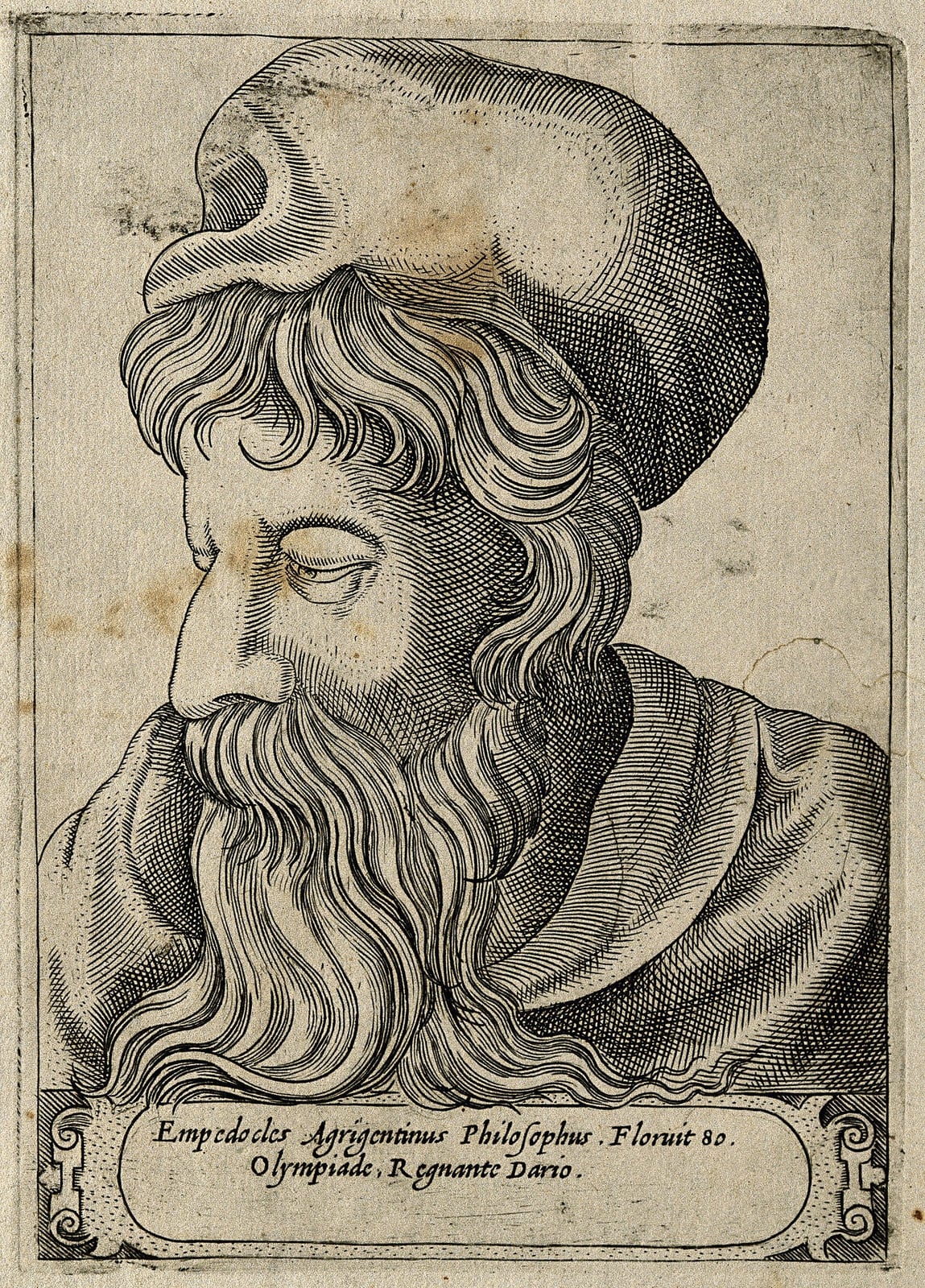
Empédocles, grabado de 1580 · CC BY 4.0
Своими словами
«For straitened are the powers that are spread over their bodily parts.»DK 31 B2.1, en Sexto Empírico, Contra los matemáticos VII 123. Griego: texto de Fairbanks (1898), basado en la edición de Stein; numeración Diels-Kranz. Inglés: John Burnet, Early Greek Philosophy (1908). Español: traducción propia.

Главная мысль
The four roots (rhizomata): Empedocles accepts with Parmenides that nothing comes from what is not or is annihilated, but he does not give up explaining change.
В контексте
Биография
4 мин чтения
Перевод с испанского оригинала, выполненный с помощью ИИ; ожидает проверки носителем языка.
Философ, назвавший себя богом
Ни от одного досократика не сохранилось столько стихов, сколько от Эмпедокла: около пятисот, к которым страсбургский папирус в 1999 году добавил еще несколько десятков. Он писал, как и Парменид, гекзаметром и был одновременно физиком, врачом, оратором, демократическим политиком, пророком чистоты и чудотворцем. Его учение о четырех «корнях» — огне, воздухе, воде и земле, — движимых Любовью и Враждой, господствовало в европейской науке две тысячи лет; его возглашение, что он «бессмертный бог, а не смертный уже», и легенда о его прыжке в Этну сделали его одной из самых романических фигур античности. Аристотель назвал его изобретателем риторики и вместе с тем упрекнул в том, что от поэта у него только размер.
Акрагант
Он родился в Акраганте, нынешнем Агридженто, богатейшем городе греческой Сицилии, дорические храмы которого и сейчас возвышаются над долиной. Его отца звали Метоном, а дед, тоже Эмпедокл, победил в конских скачках в Олимпии в 496 г. до н. э., согласно Аристотелю, которого цитирует Эратосфен. Аполлодор отнес его акме к 444–443 гг. до н. э., году основания Фурий, которые он, по словам Главка Регийского, посетил; Аристотель утверждал, что он умер шестидесяти лет. Бернет подытожил то, что можно знать: он был ребенком при тиране Фероне, действовал в Акраганте после 472 г., когда пал сын Ферона Фрасидей и город вновь обрел свободное правление, и умер после 444 г. Отсюда привычные даты — около 494–434 гг. до н. э.
Демократ
Сицилийский историк Тимей, писавший полтора века спустя и собиравший местные предания, рассказывал, что политическое поприще Эмпедокла началось на пиру: один магистрат повел себя там как начинающий тиран, и Эмпедокл на следующий день привлек его к суду и добился смертного приговора. Он воспротивился также тому, чтобы совет отвел врачу Акрону участок для гробницы его отца, и распустил собрание Тысячи — возможно, олигархическое сообщество. Аристотель добавлял, что он отказался от царской власти, когда ему ее предложили. По Тимею, потомки его врагов впоследствии помешали его возвращению, и Эмпедокл умер изгнанником в Пелопоннесе.
Врач, оратор и маг
Гален поставил его вместе с Филистионом и Павсанием у истоков италийской врачебной школы, соперницы школ Коса и Книда. Его ученик Горгий Леонтинский, великий софист, рассказывал, по Сатиру, что видел, как тот занимался магией; Гераклид Понтийский поведал, как он тридцать дней поддерживал жизнь в женщине без дыхания и пульса. Тимей называл его «укротителем ветров» за то, что он развесил ослиные шкуры, чтобы сдержать этесии, а другие приписывали ему осушение болот Селинунта. Бернет заметил, что почти все эти чудеса выводятся из его собственных стихов, где он обещает ученику Павсанию снадобья от старости, власть над ветрами и дождем и даже способность вывести умершего из Аида.
Две поэмы
Диоген Лаэртский приписывает двум его великим поэмам, «О природе» и «Очищениям», около пяти тысяч стихов. Первая, посвященная Павсанию, излагает физику: ничто не рождается и не умирает, лишь смешиваются и разделяются четыре вечных корня, которым он дает имена богов — Зевс, Гера, Аидоней и Нестида, — под попеременным действием Любви, которая соединяет, и Вражды, которая разделяет. Космос колеблется так между совершенным единством Сфайроса и полным рассеянием, а в промежуточных фазах возникают живые существа — сначала как разрозненные члены: головы без шей, руки без плеч, — которые соединяются наудачу. Вторая поэма, обращенная к согражданам-акрагантцам, говорит о демоне, изгнанном на тридцать тысяч времен года за пролитую кровь и воплощающемся во все смертные формы; отсюда запрет есть мясо и приносить в жертву животных.
Современная наука целый век спорила о том, совместимы ли обе поэмы — физик-механицист и религиозный пророк — или на самом деле это одна поэма. Брэд Инвуд и другие даже предполагали, что они составляли единое произведение; Кэтрин Осборн подчеркивала непрерывность между физикой и религией.
Страсбургский папирус
В 1904 году Национальная и университетская библиотека Страсбурга приобрела в Египте фрагменты папируса из Панополя (Ахмима), которые девяносто лет оставались неопознанными. В 1994 году папиролог Ален Мартен узнал в них стихи Эмпедокла и в 1999 году опубликовал их вместе с Оливером Примавези. Переписанные в конце I века н. э., они содержат остатки примерно семидесяти четырех стихов, отчасти прежде неизвестных, из первой книги физики, с пометой, отмечающей трехсотый стих. Находка показала, что в этой книге космический цикл соседствовал с плачем о «безжалостном дне», когда было съедено мясо, — то есть что физика и учение о вине были переплетены теснее, чем считалось.
Этна и другие смерти
Диоген Лаэртский собирает несовместимые версии его кончины. Гераклид Понтийский рассказывал, что после жертвоприношения он исчез ночью; слуга услышал голос, звавший его, и увидел свет на небе, а Павсаний велел чтить его как бога. Гиппобот добавлял, что он бросился в кратер Этны, чтобы его сочли бессмертным, но вулкан выбросил одну из его медных сандалий. Тимей это отрицал: Эмпедокл уехал в Пелопоннес и больше не вернулся. Неанф говорил, что он умер, упав с повозки, а другие — что повесился. Гораций закрепил для потомков версию с Этной. Ава Читвуд показала, что, как и в случае Гераклита, эти смерти сфабрикованы на основе его поэм: тот, кто провозглашал себя бессмертным богом и делал огонь одним из корней мира, должен был умереть обожествленным или поглощенным огнем.
Наследие
Аристотель принял его четыре элемента, добавив к ним эфир, а вместе с ними и медицину четырех соков; Платон намекал на «сицилийских муз», а Лукреций прославил его как величайшего из сынов Сицилии. В Новое время Гёльдерлин написал, но не закончил трагедию «Смерть Эмпедокла» (1797–1800); Мэтью Арнольд — драматическую поэму «Эмпедокл на Этне» (1852), а Фрейд увидел в Любви и Вражде предвосхищение своей противоположности Эроса и влечения к смерти. Он остается самым ясным примером того, что у своих истоков греческая философия не разделяла науку, поэзию и спасение.
Источники: Diógenes Laercio. Vidas y opiniones de los filósofos ilustres VIII 51–77 (Empédocles), s. III d. C. Trad. inglesa de C. D. Yonge, Bohn, Londres, 1853 (Project Gutenberg n.º 57342); trad. inglesa de R. D. Hicks, Loeb, 1925 (Wikisource). · Diels, Hermann y Kranz, Walther. Die Fragmente der Vorsokratiker, 6.ª ed. Weidmann, Berlín, 1951–1952, cap. 31 (Empedokles), A (testimonios) y B 1–154. · Kirk, G. S., Raven, J. E. y Schofield, M. The Presocratic Philosophers, 2.ª ed. Cambridge University Press, 1983, cap. X (Empedocles of Acragas). Trad. esp. de Jesús García Fernández, Gredos, 1987. · Burnet, John. Early Greek Philosophy, 2.ª ed. A. and C. Black, Londres, 1908, cap. V (Empedokles of Akragas), §§ 98–105 y traducción de los fragmentos (Project Gutenberg n.º 67097). · Martin, Alain y Primavesi, Oliver. L'Empédocle de Strasbourg (P. Strasb. gr. Inv. 1665–1666): introduction, édition et commentaire. Walter de Gruyter / Bibliothèque Nationale et Universitaire de Strasbourg, Berlín, Nueva York y Estrasburgo, 1999.
Хронология
Жизнь год за годом
Каждая точка — документированное событие. Нажмите, чтобы прочитать о нём, с источником и степенью достоверности.
496 до н. э.Olimpia
His grandfather's Olympic victory
His grandfather Empedocles wins the horse race at the 71st Olympiad (496 BCE), according to Eratosthenes citing Aristotle (Diogenes Laertius VIII 51). Years BCE are expressed as negative numbers.
ВероятноDiógenes Laercio. Vidas y opiniones de los filósofos ilustres VIII 51–77 (Empédocles), s. III d. C. Trad. inglesa de C. D. Yonge, Bohn, Londres, 1853 (Project Gutenberg n.º 57342); trad. inglesa de R. D. Hicks, Loeb, 1925 (Wikisource).
После смерти
- 427 до н. э.Gorgias in Athens
- ок. 90 до н. э.Copy of the Strasbourg papyrus
- ок. 55 до н. э.Lucretius praises him
- ок. 1798Hölderlin's Death of Empedocles
- 1852Matthew Arnold's Empedocles on Etna
- 1994Identification of the papyrus
- 1999L'Empédocle de Strasbourg
496 до н. э.
His grandfather's Olympic victory
His grandfather Empedocles wins the horse race at the 71st Olympiad (496 BCE), according to Eratosthenes citing Aristotle (Diogenes Laertius VIII 51). Years BCE are expressed as negative numbers.
Вероятно
ок. 494 до н. э. · 0 лет
Birth
Born at Acragas, son of Meton, of a wealthy and distinguished family. The date is inferred from his death at sixty (Aristotle) and his activity after 472; Wikidata records 494, 492 and 490.
Вероятно
ок. 471 до н. э. · 23 года
Fall of Thrasydaeus and free government
After Theron's death (472 BCE), his son Thrasydaeus is defeated by Hieron of Syracuse and expelled; Acragas recovers a free government in which Empedocles will be a democratic leader.
Документировано
ок. 460 до н. э.
Dissolution of the assembly of the Thousand
According to Timaeus (in Diogenes Laertius VIII 64–66), he prosecutes two magistrates with tyrannical airs, opposes Acron's funerary privilege and dissolves the assembly of the Thousand. He refuses the kingship offered to him (Aristotle). Dates unknown.
Предание
ок. 450 до н. э.
Composition of the poems
He composes On Nature, dedicated to Pausanias, and the Purifications, addressed to the people of Acragas. The date and order of composition are conjectural.
Оспаривается
444 до н. э.
Visit to Thurii
Glaucus of Rhegium relates that he came to Thurii shortly after its foundation (444–443 BCE); Apollodorus fixed his prime in that year.
Вероятно
ок. 440 до н. э.
Exile
According to Timaeus, the descendants of his enemies oppose his return to Acragas and he withdraws to the Peloponnese. Date unknown.
Предание
ок. 434 до н. э. · 60 лет
Death
Dies at about sixty (Aristotle in Diogenes Laertius VIII 52 and 74). The versions of the manner and place—vanishing after a sacrifice, leaping into Etna, falling from his chariot, dying in the Peloponnese—are contradictory.
Оспаривается
427 до н. э.
Gorgias in Athens
His pupil Gorgias of Leontini comes to Athens as ambassador and dazzles with an artistic prose that, according to Diels, owed much to Empedocles' style.
Документировано
ок. 90 до н. э.
Copy of the Strasbourg papyrus
A scribe copies the first book of Empedocles' physics on a roll; its remains, reused in a funerary ornament, are the only direct witness to the poem.
Документировано
ок. 55 до н. э.
Lucretius praises him
In De rerum natura (I 716–733) Lucretius celebrates Empedocles as the most admirable man Sicily produced, though he criticises his theory of elements.
Документировано
ок. 1798
Hölderlin's Death of Empedocles
Friedrich Hölderlin writes three unfinished versions of the tragedy Der Tod des Empedokles (1797–1800).
Документировано
1852
Matthew Arnold's Empedocles on Etna
Matthew Arnold publishes the dramatic poem Empedocles on Etna, and Other Poems.
Документировано
1994
Identification of the papyrus
Alain Martin identifies as lines of Empedocles the fragments P. Strasb. gr. Inv. 1665–1666, acquired in 1904.
Документировано
1999
L'Empédocle de Strasbourg
Alain Martin and Oliver Primavesi publish the edition of the papyrus, adding some seventy-four lines, partly new, to the corpus.
Документировано
Труды
Главные труды
Труды, без которых не понять это наследие.
Письменный труд · ок. 450 до н. э.
On Nature
Περὶ φύσεως (Φυσικά)
A didactic poem in hexameters setting out Empedocles' physics. Nothing is born or perishes: four eternal roots—Zeus, Hera, Aidoneus and Nestis, that is, fire, air or earth, and water depending on the interpretation—are only mixed and separated under Love, which unites, and Strife, which separates. The cosmos alternates between the unity of the Sphere and dispersion, and in the intermediate phases living beings arise, first as loose limbs combining at random. It includes a theory of perception through effluences and pores, the comparison of breathing with the clepsydra and a physiology of the blood as the seat of thought.
12 изданий · amazon.com

Письменный труд · ок. 445 до н. э.
Purifications
Καθαρμοί
A poem addressed to the "friends who dwell in the great city by yellow Acragas", to whom Empedocles presents himself as "an immortal god, no longer mortal", followed by crowds asking for oracles and cures. It sets out the oracle of Necessity: the daimon who stains his hands with blood is banished for thirty thousand seasons and reborn in every mortal form; the poet himself has been boy, girl, bush, bird and fish. Hence the condemnation of animal sacrifice and meat-eating—the father who kills his transformed son without recognising him—and the evocation of a golden age under Cypris when no altar was stained with bulls' blood. Favorinus relates that the rhapsode Cleomenes recited it at Olympia.
9 изданий · amazon.com

Рукопись · ок. 90
Strasbourg papyrus (fragments of On Nature, book I)
P. Strasb. gr. Inv. 1665–1666
Remains of a papyrus roll from Panopolis (Akhmim, Egypt), acquired in 1904 by the Strasbourg library and reused in antiquity, according to its editors, for a funerary ornament. Its fragments—52, according to the editors—fall into several ensembles; the main one (a) contains lines 233–300 of the first book, identified by a stichometric mark (the letter gamma, 300), and connects with fragment B17. Besides new details of the cosmic cycle and zoogony, it includes first-person lines on the "pitiless day" on which the crime of eating flesh was committed, forcing a rethinking of the separation between the two poems.
4 издания · amazon.com
Все труды (11)
Empedocles
The Crossing of Xerxes (lost)
The Conscious LibraryThe Crossing of Xerxes (lost)
Empedocles
Proem to Apollo (lost)
The Conscious LibraryProem to Apollo (lost)
Empedocles
Tragedies (disputed attribution)
The Conscious LibraryTragedies (disputed attribution)
Empedocles
Political writings (lost)
The Conscious LibraryPolitical writings (lost)
Empedocles
Medical Discourse (lost)
The Conscious LibraryMedical Discourse (lost)
Empedocles
Epigrams (doubtful attribution)
The Conscious LibraryEpigrams (doubtful attribution)
Empedocles
The Sphere (spurious)
The Conscious LibraryThe Sphere (spurious)
Empedocles
Book of the Five Substances and other Arabic texts (spurious)
The Conscious LibraryBook of the Five Substances and other Arabic texts (spurious)
Изречения
Изречения, найденные в конкретном труде. Каждое сопровождается указанием происхождения и степени надёжности.
For straitened are the powers that are spread over their bodily parts.στεινωποὶ μὲν γὰρ παλάμαι κατὰ γυῖα κέχυνται.
ПровереноDK 31 B2.1, en Sexto Empírico, Contra los matemáticos VII 123. Griego: texto de Fairbanks (1898), basado en la edición de Stein; numeración Diels-Kranz. Inglés: John Burnet, Early Greek Philosophy (1908). Español: traducción propia.
Апокрифические изречения и изречения спорной атрибуции (3)
«Everything is composed of four elements: earth, water, air and fire.»
The doctrine is his, but not the vocabulary: Empedocles speaks of "roots" (rhizomata) and names them after gods. The term "elements" (stoicheia) comes from Plato and Aristotle.
«The nature of God is a circle whose centre is everywhere and whose circumference is nowhere.»
Often ascribed to Empedocles, it comes from the Book of the Twenty-Four Philosophers (12th century), proposition II, and was spread by Alan of Lille, Meister Eckhart, Nicholas of Cusa and Pascal.
«The people of Acragas indulge in pleasure as if they were to die tomorrow, and build their houses as if they were to live for ever.»
Diogenes Laertius (VIII 63) puts it in Empedocles' mouth, but Aelian (Varia Historia XII 29) ascribes an almost identical saying to Plato. It is a wandering apophthegm with no secure source.
Последние слова
Проверяемых записей о последних словах не существует.
No record of his last words survives. The versions of his death collected by Diogenes Laertius (VIII 67–75) are contradictory and legendary; in Heraclides of Pontus' version the only thing heard is a voice calling him in the night.
Источник: Diógenes Laercio. Vidas y opiniones de los filósofos ilustres VIII 51–77 (Empédocles), s. III d. C. Trad. inglesa de C. D. Yonge, Bohn, Londres, 1853 (Project Gutenberg n.º 57342); trad. inglesa de R. D. Hicks, Loeb, 1925 (Wikisource).
Спросить
На что отвечают эти труды
Двенадцать великих вопросов человечества и то, что позволяют на них ответить эти тексты, со ссылками. Мы никогда не вкладываем слова в чужие уста.
Что такое Абсолют? Существует ли Бог?
A holy and ineffable mind, with neither head nor human limbs
Безличный АбсолютСказано прямо
Empedocles fills his physics with divine names: the four roots are called Zeus, Hera, Aidoneus and Nestis, and the two forces that join and separate them are Love and Strife. When Love prevails, everything fuses in the Sphere, round and rejoicing in its solitude, which fragments B27–29 treat as a god. But in fragment B134 he explicitly rejects the anthropomorphic image: the divine has no human head upon its limbs, no arms or feet, but is only a holy and ineffable mind that darts through the whole cosmos with swift thoughts. The ultimate is thus divine and intelligent, yet faceless: a principle that thinks the world, not a lord who governs it from outside.
Сравнить этот вопрос с другими учителямиКто я? Существует ли истинное «я»?
A daimon exiled from the gods, wandering through many forms
Эволюционирующая душаСказано прямо
In the Purifications Empedocles speaks of himself as one of the long-lived daimons who, for having stained their hands with blood and trusted in Strife, have been exiled far from the blessed for thrice ten thousand seasons, being born in all kinds of mortal forms. He claims to have been already a boy and a girl, a bush, a bird and a mute fish of the sea, and describes the weeping of the newcomer to an unfamiliar place. The end of the journey is return: the best become seers, poets, physicians and leaders, and from there they spring up as gods, table companions of the immortals. The true self is that daimon passing through lives until it recovers its divine condition.
Сравнить этот вопрос с другими учителямиПочему мы страдаем?
We suffer because Strife exiled us from the blessed
Отделённость от БогаСказано прямо
In the Purifications suffering has a precise origin. Empedocles counts himself among the daimons who, for having shed blood and trusted in raging Strife, were cast far from the gods and condemned to be born in mortal forms. The world they reach is a joyless place of murder, wrath and disease, and he himself says he wept on seeing the unfamiliar place. The slaughter continues: humans sacrifice and eat animals without seeing that they devour one another, and a father slaughters among prayers his son changed in form. Pain is exile, and its causes are bloodshed and the dominion of Strife over Love.
Сравнить этот вопрос с другими учителямиЧто происходит после смерти?
There is no birth or death, only mixture; the daimon transmigrates until it returns
Перерождение согласно кармеСказано прямо
Empedocles answers in two registers. In On Nature he denies that there is properly birth or death of mortal things: there is only mixture and exchange of what is mixed, and “birth” is a name humans give them. In the Purifications the exiled daimon passes for thrice ten thousand seasons through every kind of form — boy and girl, bush, bird and fish — and that is why eating meat is killing a kinsman. At the end of the cycle, the purified are born as seers, poets, physicians and leaders, and from there rise as gods, free of human pains and table companions of the immortals. Death is a step in the journey home.
Сравнить этот вопрос с другими учителямиКак достигается освобождение или спасение?
Abstain from blood, purify oneself and reach divine thoughts
Через дисциплинированную практикуСказано прямо
The poem tradition calls the Purifications offers a way for the exiled daimon to return among the gods. Its core is an ethic of non-violence: to stop shedding blood, because the sacrificed animal may be a kinsman changed in form, and to abstain from certain foods, including beans and laurel. Knowledge is added to that discipline: blessed is he who has gained the wealth of divine thoughts, and wretched he who holds a dark opinion about the gods. The purified ascend through the highest callings — seers, poets, physicians, leaders — until they spring up as gods. It is a way of practice and sustained purification.
Сравнить этот вопрос с другими учителямиНужен ли учитель?
A sage who speaks as a god passes a guarded knowledge to his disciple
НезаменимСледует из учения
On Nature is addressed to a disciple, Pausanias, and Empedocles asks him to keep what he hears in his silent heart. He promises him knowledge of remedies against ills and old age, of stilling the winds and bringing a dead man back from Hades: a knowledge only he can impart. In the Purifications he presents himself to the citizens of Acragas as an immortal god, followed by crowds asking for oracles and cures. At the same time he acknowledges the limits of mortal knowledge and entreats the Muse. The figure that emerges is that of an inspired sage whose word is the necessary vehicle of truth, though the disciple must test it with all his senses.
Сравнить этот вопрос с другими учителямиРеален ли мир?
Four roots that Love unites and Strife divides, in an endless cycle
Природный порядок в измененииСказано прямо
Empedocles accepts from Parmenides that nothing comes from nothing nor is annihilated, but he saves the reality of the sensible world: what there is are four eternal roots — fire, air, earth and water — which mix and separate. Two forces move them: Love, which unites, and Strife, which divides. The account is double: sometimes everything comes together into one through Love, sometimes each thing is borne apart by the hatred of Strife, and this alternating change never ceases. Living beings, including the strange creatures of a primitive zoogony, arise from these combinations. The world is real and is a cyclical process of union and separation.
Сравнить этот вопрос с другими учителямиЧто такое любовь?
Love gathers what is separated until it fuses all in the Sphere
Тоска и соединениеСказано прямо
In Empedocles Love (Philotes, also called Aphrodite or Cypris) is one of the two forces moving the cosmos. It unites the separated roots and, when it rules completely, everything gathers in the Sphere, a round god rejoicing in its solitude, in which there is no strife. Humans know that force in their own limbs, he says, when they think loving thoughts and perform works of concord, but they do not see that it is the same one that whirls in the universe. In the Purifications the reign of Cypris is the golden age when no blood was shed. Love is thus the cosmic force returning what is scattered to the original unity, the exiled soul included.
Сравнить этот вопрос с другими учителямиСвободны ли мы или всё предопределено?
A decree of Necessity punishes shed blood, but purification is possible
Карма и выборСказано прямо
Empedocles opens fragment B115 with an oracle of Necessity, an ancient decree of the gods, eternal and sealed with broad oaths: when one of the daimons stains his limbs with blood or swears falsely following Strife, he wanders far from the blessed for thrice ten thousand seasons. There is thus a cosmic law binding faults to their consequences over many lives. But that law does not cancel responsibility: Empedocles urges his hearers to leave off slaughter and abstain from the impure, and states that the purified ascend until they become gods. The past conditions; the present can change the course.
Сравнить этот вопрос с другими учителямиЗачем медитировать или молиться?
A bloodless worship and a pure mind contemplating what it has learned
Ритуал и самосовершенствованиеСказано прямо
The Purifications propose a reform of worship. In the golden age, when Cypris reigned, humans honoured the goddess with painted images, perfumes, myrrh and incense, and the altar was not drenched with the blood of bulls, which was the greatest abomination. The religious practice Empedocles defends consists in abstaining from slaughter and certain foods, purifying oneself and leading a pure life. In On Nature he adds a form of contemplation: if you fix these teachings in your firm mind and contemplate them with goodwill and pure meditation, they will stay with you all your life and grow. Purified rite and attention to doctrine form a single practice.
Сравнить этот вопрос с другими учителямиМожет ли разум познать предельное?
The means of knowing are narrow: the Muse helps the mortal mind
Вера и разум помогают друг другуСказано прямо
Empedocles opens On Nature with a warning about human limits: narrow are the means of knowing spread through the limbs, many the miseries that blunt thought, and humans, having seen a small part of life, think they have found the whole. He asks the gods to turn madness from his tongue and the Muse to grant him what is lawful for ephemeral beings to hear. And he advises the disciple not to trust one sense more than another, but to consider each thing by every way it becomes evident. Observation, reasoning and divine inspiration cooperate in a knowledge aware of its limits, though it promises divine thoughts.
Сравнить этот вопрос с другими учителямиУйти от мира или преобразить его?
Physician, orator and democrat who refused kingship and toured the cities
Действовать в миреСледует из учения
Empedocles lived in the midst of his city. According to Diogenes Laertius, drawing on Timaeus and Aristotle, he championed democracy in Acragas, helped dissolve an oligarchic assembly and refused the kingship offered to him; he was famed as a physician and Aristotle considered him the inventor of rhetoric. His own verses show him touring the cities, followed by thousands asking him the way to profit, oracles and remedies for disease. And the summit he promises the purified is not isolation but the callings that serve humans: seers, poets, physicians and leaders. Wisdom proves itself in service to the community.
Сравнить этот вопрос с другими учителями
Созвучия и противоречия
Созвучия и противоречия
Рассчитаны вопрос за вопросом на основе позиций. Причина каждого совпадения или расхождения — по нажатию.
Ближе всего к
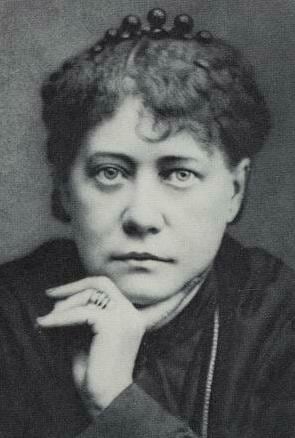
Helena Blavatsky
Совпадают в вопросах: Свободны ли мы или всё предопределено? · Что такое Абсолют? Существует ли Бог? · Кто я? Существует ли истинное «я»?

Sadhguru
Совпадают в вопросах: Как достигается освобождение или спасение? · Что такое Абсолют? Существует ли Бог? · Что происходит после смерти?
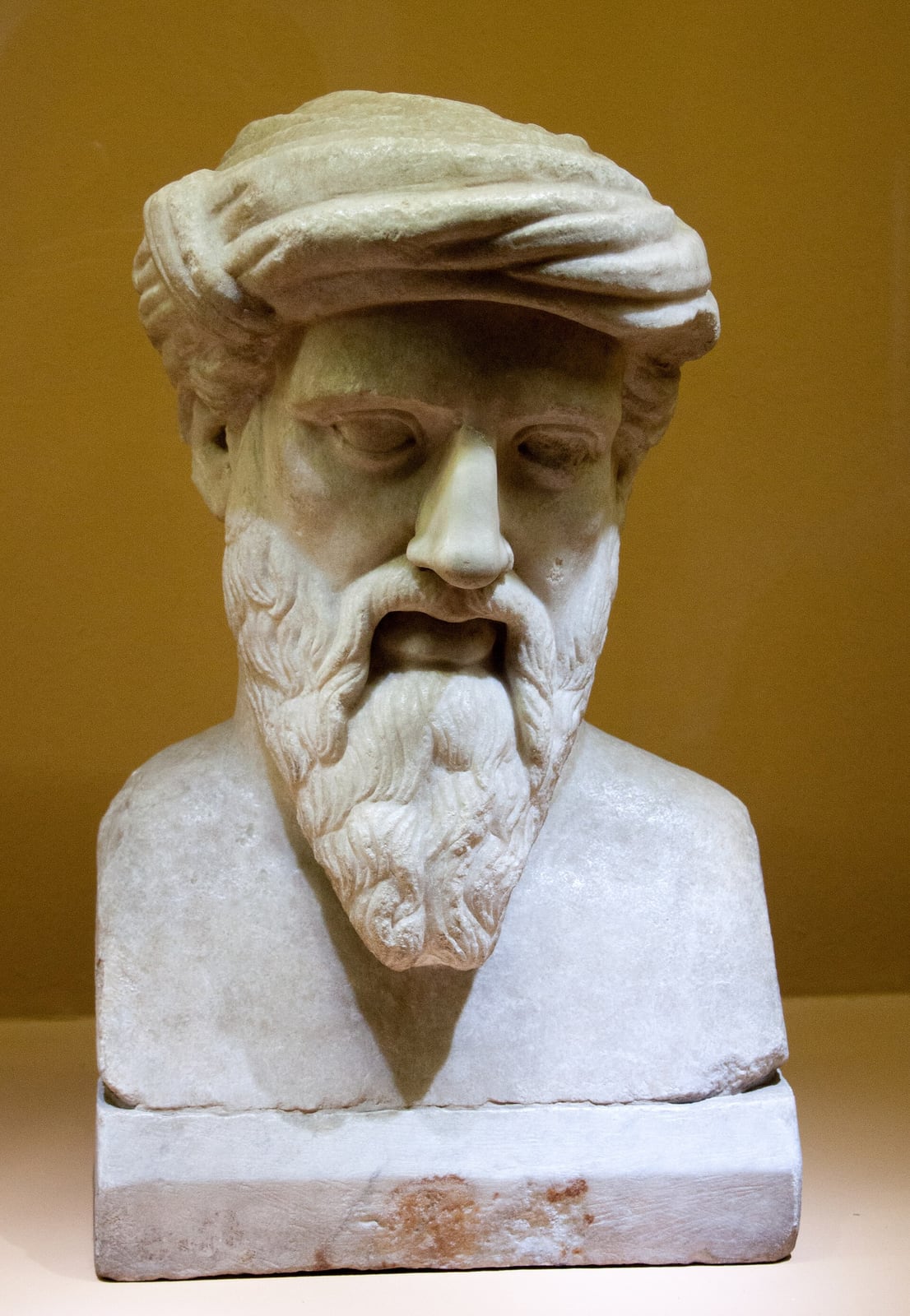
Pythagoras
Совпадают в вопросах: Что такое Абсолют? Существует ли Бог? · Кто я? Существует ли истинное «я»? · Что происходит после смерти?
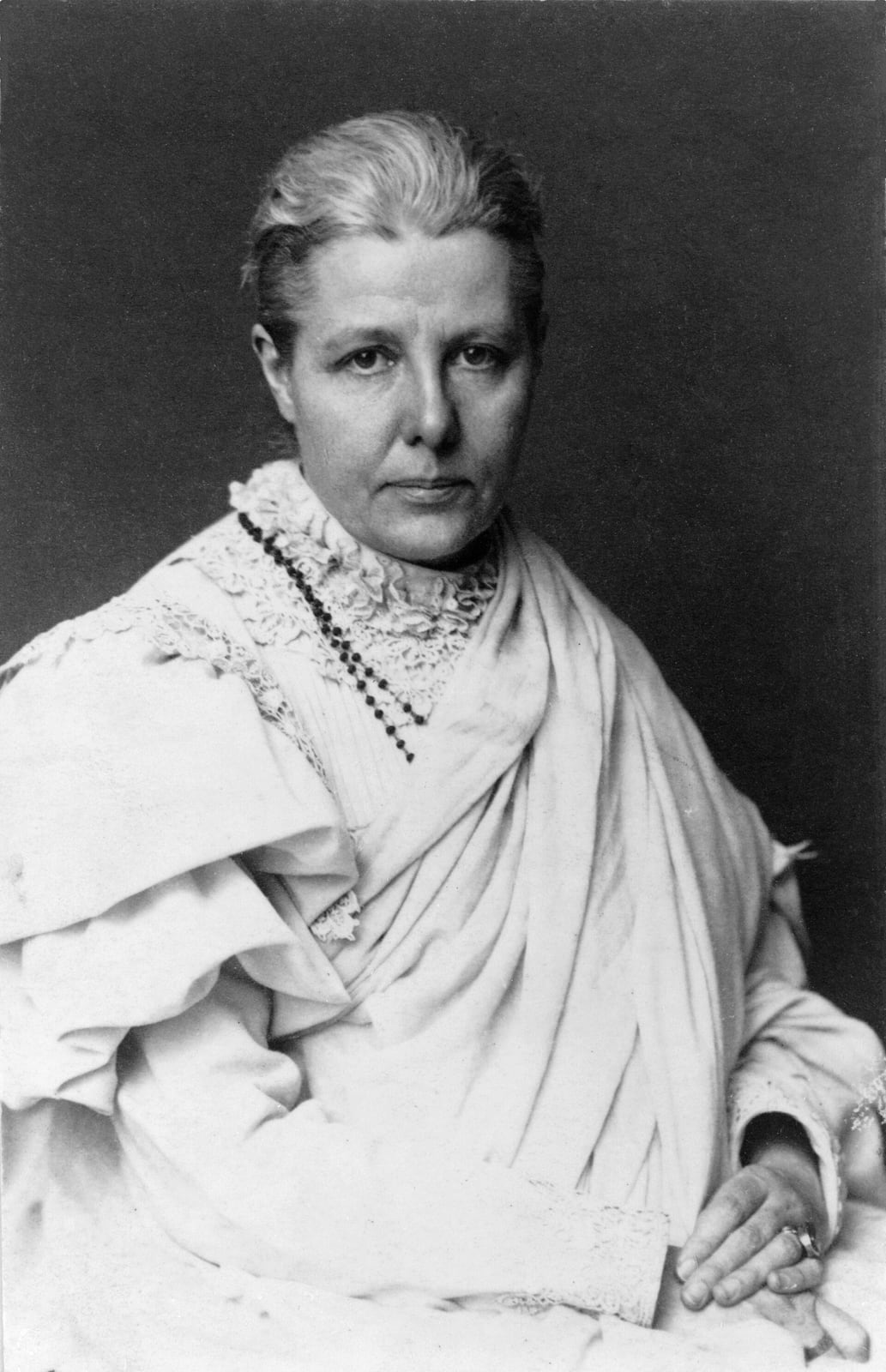
Annie Besant
Совпадают в вопросах: Свободны ли мы или всё предопределено? · Кто я? Существует ли истинное «я»? · Что происходит после смерти?
Дальше всего от
Jiddu Krishnamurti
Расходятся в вопросах: Как достигается освобождение или спасение? · Нужен ли учитель?

Nikolai Berdyaev
Расходятся в вопросах: Что происходит после смерти? · Нужен ли учитель?
Shinran
Расходятся в вопросах: Что происходит после смерти?
Alan Watts
Расходятся в вопросах: Как достигается освобождение или спасение? · Нужен ли учитель?
Предания и рассказы
Предания и рассказы
Оспариваетсяc. 434 a. C. (tradicional)
The bronze sandal of Etna
Происхождение рассказа: Diogenes Laertius VIII 67–75, with the versions of Heraclides of Pontus, Hippobotus, Diodorus of Ephesus, Timaeus, Neanthes and Demetrius of Troezen. Horace (Ars poetica 463–466) fixed the Etna version. Ava Chitwood (2004) analyses how they derive from the poems.
Источник: Chitwood, Ava. Death by Philosophy: The Biographical Tradition in the Life and Death of the Archaic Philosophers Empedocles, Heraclitus, and Democritus. University of Michigan Press, Ann Arbor, 2004.
Житийное повествованиеs. V a. C. (tradicional)
The breathless woman
Происхождение рассказа: Diogenes Laertius VIII 60–61 and 67–69 (Heraclides of Pontus, Hermippus). Heraclides' treatise, lost, was a literary work of a medico-philosophical kind, not a clinical record.
Не поддаётся проверкеs. V a. C. (tradicional)
The wind-stopper
Происхождение рассказа: Diogenes Laertius VIII 60 (Timaeus); Plutarch, Against Colotes 1126b and On Curiosity 515c. Burnet (Early Greek Philosophy, § 100) considers it deduced from B111.
Устная традицияc. 470–460 a. C.
The magistrate's banquet
Происхождение рассказа: Diogenes Laertius VIII 64–66, quoting Timaeus of Tauromenium (4th–3rd century BCE). Burnet (§ 99) considers them genuine local traditions gathered a century and a half later, though confused in their details.
Свидетельствоs. V a. C.
The refused crown
Происхождение рассказа: Diogenes Laertius VIII 63 (Aristotle, probably in the Sophist; Xanthus) and VIII 73 (the attire). It is one of the few reports going back to Aristotle.
Оспариваетсяs. V a. C. (tradicional)
The marshes of Selinus
Происхождение рассказа: Diogenes Laertius VIII 70 (Diodorus of Ephesus). The Selinus coins showing the drainage (Head's Historia Numorum) prove the event, not Empedocles' involvement.
Не поддаётся проверкеs. V a. C. (tradicional)
Expelled by the Pythagoreans
Происхождение рассказа: Diogenes Laertius VIII 54–55 (Timaeus, Neanthes). Fragment B129 is quoted by Porphyry (Life of Pythagoras 30) and Iamblichus (On the Pythagorean Life 67) as referring to Pythagoras.
Учение
Учение
Понятия, на которых строится мысль учителя, объяснённые в их контексте.
The four roots (rhizomata)cuatro-raices
Fragments B6, B8, B12, B17, B21, B23; reception in Aristotle, Metaphysics A 3–4.
Источник: Kirk, G. S., Raven, J. E. y Schofield, M. The Presocratic Philosophers, 2.ª ed. Cambridge University Press, 1983, cap. X (Empedocles of Acragas). Trad. esp. de Jesús García Fernández, Gredos, 1987.
Love (Philotes) and Strife (Neikos)amor-y-discordia
Fragments B17, B20, B22, B26, B35; Aristotle, Metaphysics A 4, 985a21–b4.
The cosmic cycle and the Sphereciclo-cosmico
Fragments B17, B26–B31, B35; Strasbourg papyrus, ensemble a.
Источник: Martin, Alain y Primavesi, Oliver. L'Empédocle de Strasbourg (P. Strasb. gr. Inv. 1665–1666): introduction, édition et commentaire. Walter de Gruyter / Bibliothèque Nationale et Universitaire de Strasbourg, Berlín, Nueva York y Estrasburgo, 1999.
The exiled daimon and transmigrationdaimon-y-transmigracion
Fragments B112, B115, B117, B136–B137, B146–B147.
Источник: Zuntz, Günther. Persephone: Three Essays on Religion and Thought in Magna Graecia. Clarendon Press, Oxford, 1971.
Effluences and pores: perception and thoughtefluvios-y-poros
Fragments B84, B89, B100, B105, B109; Plato, Meno 76c–d; Theophrastus, On the Senses 7–24.
Zoogony: wandering limbs and combinationszoogonia
Fragments B57–B62; Aristotle, Physics II 8, 198b29–32.
Видео
Видео
Записи, интервью и документальные фильмы. Видео воспроизводятся с YouTube; здесь они не хранятся.
Empedocles – Autobiography of a Demon
Лекция· EN· 2020· 19 min
Jackman Humanities InstituteОфициальный канал
HoP 011 - All You Need Is Love, and Five Other Things - Empedocles
Лекция· EN· 2020· 17 min
history of philosophy without any gapsОфициальный канал
4) The Pluralists and The Sophists
Лекция· EN· 2016· 74 min
Adam RosenfeldОфициальный канал
3-5 Empedocles
Лекция· EN· 2026· 12 min
Nicholaos JonesОфициальный канал
Aristotle, Metaphysics (Empedocles, love, and final causes) - Introduction to Philosophy
Разбор· EN· 2013· 64 min
Gregory B. Sadler - That Philosophy GuyОфициальный канал
Empédocles de Agrigento
Документальный фильм· ES· 2018· 27 min
UNEDОфициальный канал
Conferencia David Hernández Castro "Empédocles"
Лекция· ES· 2018· 88 min
Hercritia-Cátedra de Hermenéutica CríticaОфициальный канал
Heráclito, Empédocles y Anaxágoras | Historia de la filosofía (7/61)
Лекция· ES· 2017· 68 min
Ernesto CastroОфициальный канал
EMPÉDOCLE – De l'un au multiple - Sur les traces du présocratique (France Culture, 1997)
Документальный фильм· FR· 1997· 85 min
ÉCLAIR BRUT
EMPÉDOCLE d'Agrigente – Un présocratique en terre arabe (France Culture, 2007)
Интервью· FR· 2007· 46 min
ÉCLAIR BRUT
Галерея
Галерея
Изображения с проверенной лицензией. Каждое сохраняет своё авторство и атрибуцию.
Рукописи
Рукописи
Рукописные свидетельства и древние тексты, с указанием хранителя и условий доступа.
GRC · Escritura libraria griega sobre papiro · Poema compuesto en el s. V a. C.; copia de finales del s. I d. C.
P. Strasb. gr. Inv. 1665–1666
- Сохранившийся список
- Fragmentos de un rollo de papiro (52 según los editores), con restos de unos 74 versos
- Хранитель
- Bibliothèque nationale et universitaire de Strasbourg · P. Strasb. gr. Inv. 1665–1666
- Оцифровка
- commons.wikimedia.org/wiki/File:Empedokles_fragm…
Связи
Связи
Влияния, ученичество и близость взглядов. Документированная связь отличается от сходства, выявленного путём анализа.
Испытал влияние
Theophrastus calls him an "emulator and imitator" of Parmenides (Diogenes Laertius VIII 55); he accepts that nothing comes to be or perishes and writes, like him, in hexameters.
Документированная связь
Испытал влияние
Timaeus and Neanthes make him a pupil of the Pythagoreans; Porphyry and Iamblichus refer the praise of B129 to Pythagoras. He shares with Pythagoreanism transmigration and abstinence from meat.
Документированная связь
Испытал влияние
Jenófanes
Hermippus, according to Diogenes Laertius (VIII 56), considered him an imitator of Xenophanes, with whom he supposedly lived; the report is isolated.
Сходство, выявленное путём анализа
Современник
Anaxágoras
Aristotle (Metaphysics A 3, 984a11) says Anaxagoras was older than Empedocles but later in his works; both explain change as mixture.
Документированная связь
Современник
Zenón de Elea
Alcidamas, according to Diogenes Laertius (VIII 56), made them fellow pupils of Parmenides.
Сходство, выявленное путём анализа
Учитель
Gorgias de Leontinos
Satyrus, probably following Alcidamas, makes him Empedocles' pupil (Diogenes Laertius VIII 58); Plato ascribes to Gorgias the Empedoclean theory of effluences (Meno 76c).
Документированная связь
Учитель
Pausanias de Gela
Physician, pupil and beloved of Empedocles, addressee of On Nature (B1).
Документированная связь
Повлиял на
He alludes to the "Sicilian muses" (Sophist 242d–243a), ascribes his theory of effluences to Gorgias (Meno 76c) and adopts the four elements in the Timaeus.
Документированная связь
Повлиял на
He adopts the four roots as elements, calls him the inventor of rhetoric and discusses his zoogony (Physics II 8) and his causes (Metaphysics A 4).
Документированная связь
Повлиял на
Lucrecio
In De rerum natura (I 716–733) he praises him as Sicily's most admirable man and takes from him the model of the physical poem.
Документированная связь
Идеи, близкие к
The alternation of Love and Strife extends, in another key, the Heraclitean tension between harmony and war.
Сходство, выявленное путём анализа
Идеи, близкие к
Approximate contemporaries: the doctrine of transmigration through all living forms and the refusal to kill animals bring the Purifications close to Jain ethics, without known historical contact.
Сходство, выявленное путём анализа
Повлиял на
Sigmund Freud
In Analysis Terminable and Interminable (1937) he recognises in Empedocles' Love and Strife a precedent of his theory of Eros and the death drive.
Документированная связь
Источники
Источники
Библиография и каталоги, использованные для этой статьи.
- Open Library (Internet Archive): ediciones de los fragmentos de Empédocles verificadas por ISBN.
- Wikidata, entidad Q83375 «Empedocles» (107 enlaces entre wikis; P31=Q5). Registra varios años de nacimiento (494, 492, 490 a. C.) y de muerte (444, 434, 432, 430 a. C.), Acragante como lugar de nacimiento y el Etna o el Peloponeso como lugar de muerte.
- Diógenes Laercio. Vidas y opiniones de los filósofos ilustres VIII 51–77 (Empédocles), s. III d. C. Trad. inglesa de C. D. Yonge, Bohn, Londres, 1853 (Project Gutenberg n.º 57342); trad. inglesa de R. D. Hicks, Loeb, 1925 (Wikisource).
- Diels, Hermann y Kranz, Walther. Die Fragmente der Vorsokratiker, 6.ª ed. Weidmann, Berlín, 1951–1952, cap. 31 (Empedokles), A (testimonios) y B 1–154.
- Kirk, G. S., Raven, J. E. y Schofield, M. The Presocratic Philosophers, 2.ª ed. Cambridge University Press, 1983, cap. X (Empedocles of Acragas). Trad. esp. de Jesús García Fernández, Gredos, 1987.
- Kingsley, K. Scarlett y Parry, Richard. «Empedocles». The Stanford Encyclopedia of Philosophy, ed. Edward N. Zalta y Uri Nodelman; primera publicación el 26 de septiembre de 2019, revisión sustancial del 25 de septiembre de 2024.
- Burnet, John. Early Greek Philosophy, 2.ª ed. A. and C. Black, Londres, 1908, cap. V (Empedokles of Akragas), §§ 98–105 y traducción de los fragmentos (Project Gutenberg n.º 67097).
- Martin, Alain y Primavesi, Oliver. L'Empédocle de Strasbourg (P. Strasb. gr. Inv. 1665–1666): introduction, édition et commentaire. Walter de Gruyter / Bibliothèque Nationale et Universitaire de Strasbourg, Berlín, Nueva York y Estrasburgo, 1999.
- Laks, André y Most, Glenn W. (eds. y trads.). Early Greek Philosophy, vol. V: Western Greek Thinkers, Part 2. Loeb Classical Library 528, Harvard University Press, 2016.
- Inwood, Brad. The Poem of Empedocles: A Text and Translation with an Introduction, ed. revisada. University of Toronto Press, Toronto, 2001 (1.ª ed. 1992).
- Wright, M. R. Empedocles: The Extant Fragments. Yale University Press, New Haven, 1981 (reed. Bristol Classical Press, 1995).
- Chitwood, Ava. Death by Philosophy: The Biographical Tradition in the Life and Death of the Archaic Philosophers Empedocles, Heraclitus, and Democritus. University of Michigan Press, Ann Arbor, 2004.
- Aristóteles. Metafísica A 3, 984a8–11, y A 4, 985a21–b4; Poética 1, 1447b17–20; Física II 8, 198b29–32; Sobre el alma I 2, 404b11–15; fragmentos del Sofista y de Sobre los poetas citados por Diógenes Laercio VIII 57 y 63. Trad. inglesa de W. D. Ross y otros (Internet Classics Archive, MIT).
- Kingsley, Peter. Ancient Philosophy, Mystery, and Magic: Empedocles and Pythagorean Tradition. Clarendon Press, Oxford, 1995.
- Zuntz, Günther. Persephone: Three Essays on Religion and Thought in Magna Graecia. Clarendon Press, Oxford, 1971.
- Lucrecio. De rerum natura I 716–733 (elogio de Empédocles), s. I a. C.
- Horacio. Arte poética 463–466 («deus immortalis haberi / dum cupit Empedocles, ardentem frigidus Aetnam / insiluit»).
- Hölderlin, Friedrich. Der Tod des Empedokles (tres versiones, 1797–1800); Arnold, Matthew, Empedocles on Etna, and Other Poems, B. Fellowes, Londres, 1852 (Internet Archive).
- Leonard, William Ellery (trad.). The Fragments of Empedocles, Translated into English Verse. Open Court, Chicago, 1908 (Internet Archive).
- Fairbanks, Arthur (ed. y trad.). The First Philosophers of Greece. Kegan Paul, Trench, Trübner, Londres, 1898, cap. X (Empedokles), texto griego según la edición de H. Stein (1852) (Project Gutenberg n.º 78670).
- «Empedocles», Wikipedia en inglés, y «Empédocles», Wikipedia en español (consultadas para contrastar datos y bibliografía; texto propio).
- De Smet, Daniel. Empedocles Arabus. Une lecture néoplatonicienne tardive. Paleis der Academiën (Koninklijke Academie voor Wetenschappen, Letteren en Schone Kunsten van België), Bruselas, 1998.
- Eggers Lan, Conrado (dir.), Cordero, Néstor Luis, Olivieri, Francisco J., La Croce, Ernesto y Santa Cruz, María Isabel. Los filósofos presocráticos II. Biblioteca Clásica Gredos 24, Gredos, Madrid, 1979 (Empédocles, trad. de Ernesto La Croce).
- Bollack, Jean. Empédocle, 3 vols. (4 tomos). Éditions de Minuit, París, 1965–1969; reed. Gallimard (Tel), 1992.
- Platón. Menón 76c–d (efluvios y poros); Sofista 242d–243a (las «musas sicilianas»). Trad. inglesa de Benjamin Jowett, 1892 (Project Gutenberg n.º 1643, Meno).
- Galeno. De methodo medendi I 1 (X 5–6 Kühn): la escuela médica itálica de Filistión, Empédocles y Pausanias.
- Primavesi, Oliver. Empedokles Physika I: eine Rekonstruktion des zentralen Gedankengangs. Archiv für Papyrusforschung, Beiheft 22, Walter de Gruyter, Berlín, 2008.
- Osborne, Catherine. «Empedocles Recycled». The Classical Quarterly, 37 (1987), pp. 24–50; y Trépanier, Simon, Empedocles: An Interpretation, Routledge, Nueva York, 2004.
- Freud, Sigmund. «Die endliche und die unendliche Analyse». Internationale Zeitschrift für Psychoanalyse, 23 (1937), sección VI (Empédocles, el Amor y la Discordia).
- Правообладатель
- Textos antiguos en dominio público; cada traducción y edición crítica pertenece a su traductor o editorial
Ожидает подтверждения
То, что в этой статье пока не удалось установить. Мы предпочитаем сказать об этом, а не заполнять пробел.
- Fechas: se adopta c. 494–434 a. C. (muerte a los sesenta años según Aristóteles y actividad posterior al 472, Burnet); Apolodoro situaba la madurez en 444–443 y Wikidata registra varios años alternativos.
- Ediciones españolas específicas de Empédocles (aparte de Gredos, Kirk-Raven-Schofield y Bernabé): no verificadas en catálogo en esta sesión (la API de Google Books agotó su cuota).
- «La esfera» pseudoempedoclea: verificar la edición de 1898 (probablemente E. Maass, Commentariorum in Aratum reliquiae) antes de citarla con detalle.
- Papiro de Estrasburgo: comprobar si la BNU de Estrasburgo ofrece digitalización completa y sus condiciones; fecha exacta de adquisición (1904 o 1905).
- Texto griego de las citas tomado de Fairbanks (edición de Stein, 1852); cotejar con Diels-Kranz (diferencias menores señaladas en B6 y B117).
- Vídeos: diez verificados; faltan clases universitarias en español dedicadas monográficamente al papiro de Estrasburgo.
- Programas de afiliación: ninguno verificado. Lista vacía.
- Año de los vídeos: el de la grabación cuando la descripción lo indica y, si no, el de publicación en YouTube.
Исследовано 2026-10-25