Христианство · Христианская мистика · Католицизм
Hildegard of Bingen
Hildegardis Bingensis
1098 – 1179Исторически документированная личность
Рейнская аббатиса-бенедиктинка (1098–1179), провидица, композитор, естествоиспытательница и советчица пап и императоров. С детства затворница при монастыре Дизибоденберг, в сорок два года она получила повеление записывать свои видения: так появились «Scivias», «Книга заслуг жизни» и «Книга божественных дел». Она основала обители Рупертсберг и Айбинген, написала два медицинских трактата, семьдесят семь песнопений, драму «Ordo Virtutum», создала придуманный язык, оставила около четырехсот писем и проповедовала публично. С 2012 года — учитель Церкви.
- трудов
- 19трудов
- изданий
- 48изданий
- цитат
- 7цитат
- видео
- 12видео
- изображений
- 8изображений
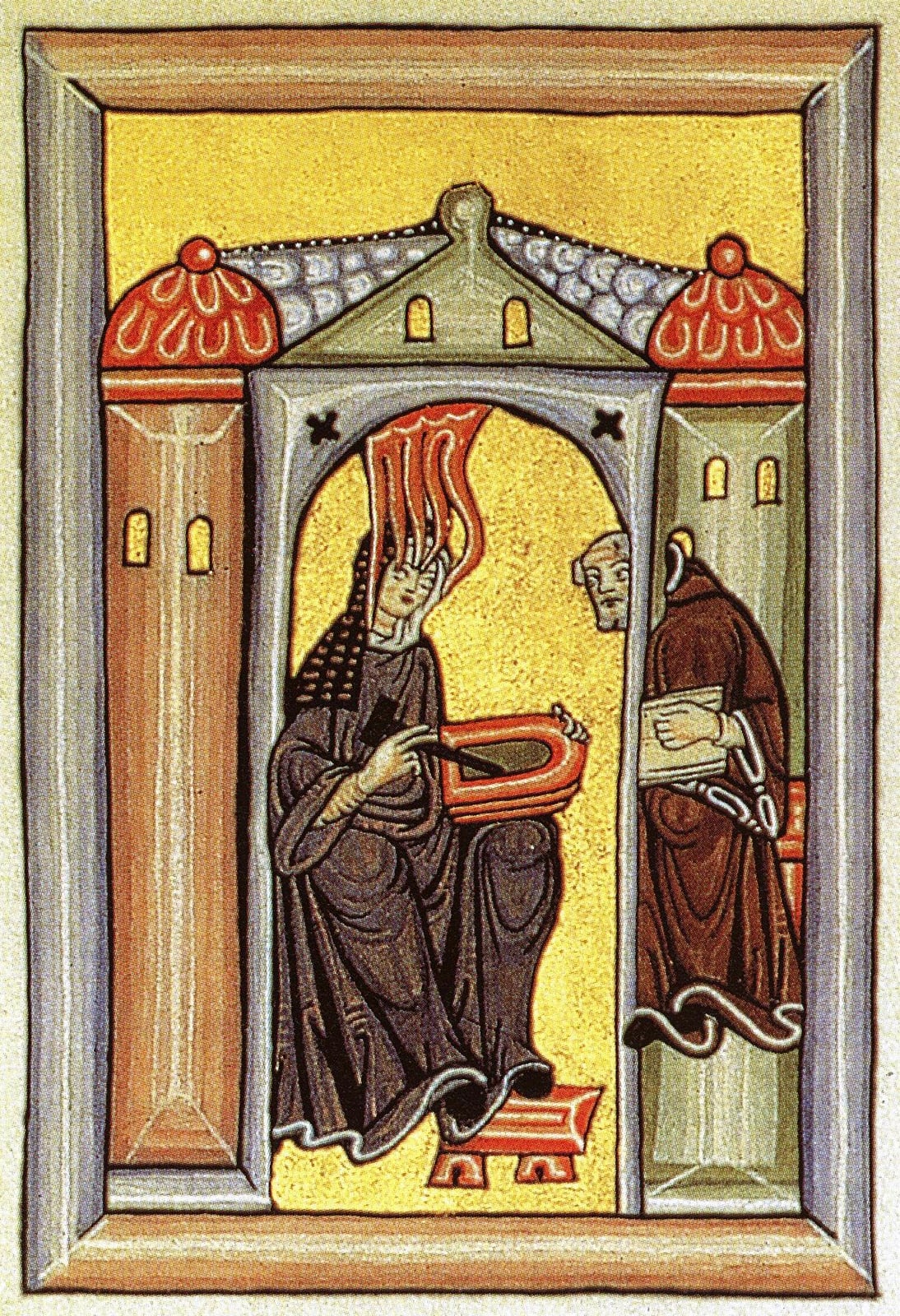
Hildegarda recibe la visión y la dicta a Volmar (Scivias de Rupertsberg) · Public domain
Своими словами
«It happened in the year 1141 of the incarnation of the Son of God, Jesus Christ, when I was forty-two years and seven months old, that a fiery light of the greatest brilliance, coming from the open heaven, poured through my whole brain.»Scivias, Protestificatio (declaración preliminar)

Главная мысль
Viriditas (greenness): Viriditas, 'greenness', is the word Hildegard uses most freely and in the most registers.
В контексте
Биография
5 мин чтения
Перевод с испанского оригинала, выполненный с помощью ИИ; ожидает проверки носителем языка.
Девочка, отданная как десятина
Хильдегарда родилась в 1098 году, вероятно, в Бермерсхайме близ Альцая, в Рейнской области, которая была тогда сердцем Империи. Ее родители, Хильдеберт и Мехтильда, принадлежали к мелкому свободному дворянству, состоявшему в вассальной зависимости от графов Шпонхеймских. Житие (Vita), написанное вскоре после ее смерти, сообщает, что она была десятым ребенком и что родители посвятили ее Богу; предание увидело в этом десятину. С самого раннего детства, как она расскажет сама в шестьдесят лет, она видела «свет столь великий, что душа моя трепетала», и рано научилась молчать о нем: служанка, которой она предсказала масть еще не родившегося теленка, посмотрела на нее с ужасом.
Около 1106 года восьмилетнюю девочку вверили Ютте Шпонхеймской, молодой знатной девушке, решившей жить затворницей. Древнейшие источники — Vita Juttae, обнаруженное в 1992 году, — указывают, что торжественное затворничество Ютты, Хильдегарды и еще одной девушки при бенедиктинском монастыре Дизибоденберг совершилось 1 ноября 1112 года по чину отпевания: их замуровывали. То, что должно было остаться кельей, с годами превратилось в небольшую женскую общину; Ютта научила Хильдегарду читать латинскую Псалтирь и петь службу. От монаха того же монастыря, Фольмара, она получила образование, которое житие называет «простым»; он тридцать лет был ее секретарем.
Повеление писать
Когда 22 декабря 1136 года Ютта умерла, монахини избрали Хильдегарду своей magistra, наставницей. Ей было тридцать восемь лет, и она по-прежнему хранила свои видения в тайне. В 1141 году, «в возрасте сорока двух лет и семи месяцев», огненный свет пронзил ее мозг и грудь, и голос повелел ей говорить и записывать то, что она видит. Она противилась, заболела — болезнь в ее рассказе всегда есть та форма, которую принимает непослушание, — и исцелилась лишь тогда, когда начала диктовать Фольмару. Так родилась книга Scivias («Знай пути»): десять лет труда и двадцать шесть видений о сотворении мира, искуплении и истории спасения, каждое из которых сначала описано как образ, а затем истолковано небесным голосом.
От других визионеров ее отличает осторожность, с которой она искала поддержки. Она написала Бернарду Клервоскому, и тот ответил ей кратким и любезным письмом. На Трирском синоде (ноябрь 1147 — февраль 1148 года) аббат Дизибоденберга Куно представил незаконченную рукопись папе Евгению III, цистерцианцу и ученику Бернарда; согласно житию, папа читал из нее вслух перед прелатами и письменно разрешил ей продолжать писать. Папское дозволение превратило рейнскую монахиню в авторитет, к которому обращались за советом епископы, аббаты и короли.
Рупертсберг
Около 1150 года вопреки воле аббата Куно — который терял при этом и приданое монахинь, и славу провидицы — Хильдегарда перевела около двадцати своих сестер на холм над Наэ, напротив Бингена, где, по преданию, был погребен святой Руперт. Чтобы сломить сопротивление аббата, она снова слегла и лежала недвижимо, пока Куно, по словам жития, не убедился, что даже он не может ее поднять. Церковь в Рупертсберге освятил в 1152 году архиепископ Майнцский; в 1158 году монастырь получил хозяйственную независимость от Дизибоденберга. Именно там Хильдегарда создала почти всё: еще две книги видений, два медицинских трактата, семьдесят семь песнопений, литургическую драму, придуманный язык и около четырехсот писем.
У человеческой цены переселения было имя: Рихардис фон Штаде, молодая монахиня из высшей знати, помогавшая ей в работе над Scivias; в 1151 году родня добилась ее назначения аббатисой в Бассум. Хильдегарда писала архиепископу Бременскому, папе и самой Рихардис письма обезоруживающей откровенности — «зачем ты покидаешь меня, как сироту?»; Рихардис умерла в октябре 1152 года, по-видимому, раскаявшись.
Врач, композитор, проповедница
Между 1151 и 1158 годами Хильдегарда написала два естественнонаучных сочинения без видений и без небесного голоса: «Физику» (Physica) — перечень растений, деревьев, камней, рыб, птиц и животных с их целебными свойствами — и «Причины и лечение» (Causae et curae) — о космосе, человеческом теле, зачатии, соках организма и лекарствах. Ее медицина — монастырская, опирающаяся на Галена и на народную рейнскую традицию, но с собственными наблюдениями о женской сексуальности и меланхолии, не имеющими параллелей в ее веке. Между 1158 и 1163 годами она написала «Книгу заслуг жизни» (Liber vitae meritorum) — о добродетелях и пороках в форме диалога, а между 1163 и 1173 годами — «Книгу божественных дел» (Liber divinorum operum), самое честолюбивое свое сочинение: космологию человека как микрокосма, со знаменитыми миниатюрами, сохранившимися в одном кодексе из Лукки.
Музыка не была для нее украшением. Семьдесят семь песнопений Symphonia armonie celestium revelationum — антифоны, респонсории, секвенции, гимны — отличаются расширенным диапазоном и мелизмами, выходящими за пределы григорианского хорала ее времени, а Ordo Virtutum, где Добродетели спорят с Дьяволом (единственным персонажем, который не поет) за душу, — древнейшая сохранившаяся музыкальная драма с именем автора. Когда в 1178 году майнцские прелаты наложили на ее монастырь интердикт за то, что там похоронили отлученного от Церкви дворянина, и запретили ей петь службу, Хильдегарда написала им, что музыка есть память о рае и что те, кто без тяжкой причины заставляет ее умолкнуть, рискуют лишиться места среди ангельских хоров. Интердикт сняли в марте 1179 года.
Между 1158 и 1171 годами она совершила четыре проповеднических путешествия — Майнц, Вюрцбург, Бамберг, Трир, Кельн, Верден, Маульбронн, Цвифальтен, — публично проповедуя перед клиром и народом, что для женщины было беспрецедентно, против испорченности духовенства и против катаров. В письмах она обличала императора Фридриха Барбароссу, когда тот поддерживал антипап, и делала это с резкостью, которую он стерпел: в 1163 году он даровал Рупертсбергу охранную грамоту. В 1165 году она основала вторую обитель в Айбингене, на другом берегу Рейна.
Язык, письма и конец
Хильдегарда изобрела lingua ignota — «неведомый язык» примерно из тысячи слов с собственным алфавитом, litterae ignotae; его назначение до сих пор обсуждается: игра, тайный язык общины или попытка вернуть речь, существовавшую до Вавилона. Ее переписка, частично сохранившаяся в висбаденском Riesencodex — пятнадцатикилограммовом кодексе, который объединяет ее сочинения и был составлен в Рупертсберге вскоре после ее смерти, — рисует советчицу пап, императоров, аббатов и безымянных женщин, писавших ей с просьбой о молитве.
Фольмар умер в 1173 году; в 1177 году секретарем стал валлонский монах Гвиберт из Жамблу, которому Хильдегарда написала самое точное описание своего видения: свет, «не имеющий места», яснее облака, несущего солнце, который она называет «тенью живого света» и в котором она одновременно видит, слышит и знает — бодрствуя, без экстаза. Она умерла 17 сентября 1179 года в возрасте восьмидесяти одного года. Попытки канонизации в XIII веке (1227–1243) затерялись в бюрократии; почитание ее продолжалось. Бенедикт XVI внес ее имя во всеобщий календарь 10 мая 2012 года и 7 октября того же года провозгласил ее учителем Церкви.
Что остается
От Хильдегарды остается прежде всего огромное латинское наследие, критически изданное современной филологией в серии Corpus Christianorum, и музыка, которую с 1980-х годов — ансамбли Sequentia, Gothic Voices — снова поют. Остается вопрос о ее видениях, которые невролог Оливер Сакс связывал с мигренью с аурой, а историки предпочитают читать как литературный жанр со своими правилами. Остается богословие viriditas, «зелености», жизненной силы, пронизывающей творение, которую экологическая мысль сделала своей эмблемой. И остается прежде всего женщина XII века, сумевшая заставить пап и императоров слушать себя, называя себя «бедным женским созданием» и «перышком, несомым ветром», — с иронией, которую может позволить себе лишь большой авторитет. Иллюминированная рукопись Scivias, созданная под ее присмотром в Рупертсберге, исчезла в Дрездене в 1945 году: мы знаем ее по рукописной копии, которую монахини Айбингена завершили в 1933 году, — словно история хотела показать нам, из чего сделана передача традиции.
Источники: Gottfried de Disibodenberg y Theoderich de Echternach. Vita sanctae Hildegardis. Ed. Monika Klaes. Corpus Christianorum Continuatio Mediaevalis 126. Turnhout: Brepols, 1993. Trad. inglesa en Anna Silvas, Jutta and Hildegard: The Biographical Sources. Turnhout: Brepols, 1998 (University Park: Penn State Press, 1999). · Hildegardis Bingensis. Scivias. Ed. Adelgundis Führkötter y Angela Carlevaris. CCCM 43–43A. Turnhout: Brepols, 1978. Trad. inglesa: Columba Hart y Jane Bishop, Hildegard of Bingen: Scivias (Classics of Western Spirituality). Nueva York: Paulist Press, 1990. Trad. española: Scivias: Conoce los caminos, trad. Antonio Castro Zafra y Mónica Castro. Madrid: Trotta, 1999. · Hildegardis Bingensis. Liber divinorum operum. Ed. Albert Derolez y Peter Dronke. CCCM 92. Turnhout: Brepols, 1996. Trad. inglesa: Nathaniel M. Campbell, The Book of Divine Works. Washington: Catholic University of America Press, 2018. · Hildegardis Bingensis. Liber vite meritorum. Ed. Angela Carlevaris. CCCM 90. Turnhout: Brepols, 1995. Trad. inglesa: Bruce W. Hozeski, The Book of the Rewards of Life. Nueva York: Oxford University Press, 1997. · Hildegardis Bingensis. Epistolarium. Ed. Lieven Van Acker (vols. I–II) y Monika Klaes-Hachmöller (vol. III). CCCM 91, 91A, 91B. Turnhout: Brepols, 1991–2001.
Хронология
Жизнь год за годом
Каждая точка — документированное событие. Нажмите, чтобы прочитать о нём, с источником и степенью достоверности.
10980 летBermersheim vor der Höhe (Renania-Palatinado), según la tradición
Birth
Born into a family of the lesser free nobility, daughter of Hildebert and Mechthild. The place (Bermersheim) is that accepted by most scholars; the year is inferred from her own dating of the 1141 vision.
ВероятноGottfried de Disibodenberg y Theoderich de Echternach. Vita sanctae Hildegardis. Ed. Monika Klaes. Corpus Christianorum Continuatio Mediaevalis 126. Turnhout: Brepols, 1993. Trad. inglesa en Anna Silvas, Jutta and Hildegard: The Biographical Sources. Turnhout: Brepols, 1998 (University Park: Penn State Press, 1999).
После смерти
- 1227 – 1243Unfinished canonisation process
- февраль 1945 г.Loss of the Rupertsberg Scivias
- 7 октября 2012 г.Doctor of the Church
1098 · 0 лет
Birth
Born into a family of the lesser free nobility, daughter of Hildebert and Mechthild. The place (Bermersheim) is that accepted by most scholars; the year is inferred from her own dating of the 1141 vision.
Вероятно
ок. 1106 · 8 лет
Entrusted to Jutta of Sponheim
At eight her parents entrust her to the young noblewoman Jutta of Sponheim for religious life.
Документировано
1 ноября 1112 г. · 14 лет
Enclosure at Disibodenberg
Jutta, Hildegard and another girl are enclosed beside the Benedictine monastery of Disibodenberg, according to the Vita Juttae. Hildegard makes her Benedictine profession in the following years.
Вероятно
22 декабря 1136 г. · 38 лет
Jutta dies; Hildegard elected magistra
On Jutta's death, the women's community at Disibodenberg elects Hildegard as superior.
Документировано
1141 · 42 года
The command to write
'In the forty-second year and seventh month' of her life she receives the vision of the fiery light and the command to write what she sees. She begins Scivias with the help of Volmar and Richardis of Stade.
Документировано
ноябрь 1147 г. – 1148 · 49 лет
Pope Eugene III approves her work
At the synod of Trier (Nov. 1147 – Feb. 1148) the pope reads passages of the unfinished Scivias and authorises her by letter to continue writing. Bernard of Clairvaux had already encouraged her by letter.
Документировано
ок. 1150 · 52 года
Move to Rupertsberg
Against Abbot Kuno's opposition she moves her community to Rupertsberg, near Bingen. The church is consecrated in 1152.
Документировано
1151 · 53 года
Scivias completed; Richardis departs
She completes Scivias. Richardis of Stade is appointed abbess of Bassum and leaves Rupertsberg despite Hildegard's letters; she dies in 1152.
Документировано
ок. 1151 – 1158 · 53 года
Physica and Causae et curae
Between c. 1151 and 1158 she composes her two works of natural science and medicine, together with the Ordo Virtutum and much of the Symphonia.
Вероятно
1158 – 1171 · 60 лет
First preaching journey
She begins the first of four preaching journeys (1158–1171) along the Main, Moselle, Rhine and into Swabia, preaching publicly to clergy and people. That year she begins the Liber vitae meritorum.
Документировано
1163 · 65 лет
Imperial privilege and start of the Liber divinorum operum
Frederick Barbarossa grants a privilege of protection to Rupertsberg. Hildegard begins the Liber divinorum operum, completed around 1173–1174.
Документировано
1165 · 67 лет
Foundation of Eibingen
She founds a second community at Eibingen, on the right bank of the Rhine, which she visits regularly.
Документировано
1173 · 75 лет
Death of Volmar
Volmar, her secretary for three decades, dies. He is succeeded by Gottfried of Disibodenberg (1174–1176), who begins the Vita, and Guibert of Gembloux (from 1177).
Документировано
1178 – 1179 · 80 лет
The Mainz interdict
For burying an excommunicated nobleman, the prelates of Mainz forbid the sung office at Rupertsberg. Hildegard refuses to exhume him and writes her letter on music. The interdict is lifted in March 1179.
Документировано
17 сентября 1179 г. · 81 год
Death
She dies at Rupertsberg aged eighty-one. The Vita relates that two luminous arcs appeared in the sky above the monastery.
Документировано
1227 – 1243
Unfinished canonisation process
Gregory IX opens the process (1227–1233); Innocent IV revives it (1243). The incomplete acts lead to no bull. Her cult nonetheless continues and her name enters the Roman Martyrology.
Документировано
февраль 1945 г.
Loss of the Rupertsberg Scivias
The illuminated Scivias codex (Wiesbaden, Hs. 1), evacuated to Dresden for safekeeping, vanishes after the bombings; it is known from black-and-white photographs of 1927 and from the hand-painted copy by the nuns of Eibingen (1927–1933).
Документировано
7 октября 2012 г.
Doctor of the Church
Benedict XVI, after extending her cult to the universal Church on 10 May 2012 (equivalent canonisation), proclaims her a Doctor of the Church together with John of Ávila.
Документировано
Труды
Главные труды
Труды, без которых не понять это наследие.
Письменный труд · 1151
Scivias (Know the Ways)
Scivias (Sci vias Domini)
Her first and most widely read visionary work: twenty-six visions in three books (six, seven and thirteen) traversing creation and the fall, redemption through Christ and the Church as bride, and the history of salvation to the end of time, closing with the songs and the drama of the Virtues. Each vision is first presented as an image (the iron mountain, the cosmic egg, Synagogue, the building of salvation) and then explained by a heavenly voice, with a dense exegesis of Scripture. The illuminated manuscript made at Rupertsberg under her supervision was lost in 1945; its thirty-five miniatures are known from photographs and from the Eibingen copy.
6 изданий · amazon.com

Письменный труд · ок. 1174
The Book of Divine Works
Liber divinorum operum (De operatione Dei)
Her cosmological synthesis. Ten visions in three parts: Charity as the fiery force animating the universe; man at the centre of the cosmic spheres, with winds, stars and humours corresponding to his limbs (the figure of the 'universal man' immortalised by the Lucca codex); an extended commentary on the prologue of John's Gospel and on Genesis; and, in the third part, the city of God and history up to the Antichrist. It is the work in which the theology of viriditas and the microcosm-macrocosm relation reach their fullest formulation.
4 издания · amazon.com

Письменный труд · ок. 1158
Physica (Book of the Subtleties of Creatures)
Physica (Liber subtilitatum diversarum naturarum creaturarum)
Nine books describing plants, elements, trees, stones, fish, birds, animals, reptiles and metals, with their qualities (hot, cold, moist, dry), their 'subtlety' and medicinal uses, often giving the German name of the plant beside the Latin. It blends Galenic learning, monastic tradition and Rhenish observation; its posterity is modern 'Hildegard medicine', which the work supports only in part.
3 издания · amazon.com

Письменный труд · ок. 1158
Symphony of the Harmony of Celestial Revelations
Symphonia armonie celestium revelationum
Antiphons, responsories, sequences and hymns for the Virgin, the Holy Spirit, the saints of her land (Rupert, Disibod), the virgins and, above all, Saint Ursula. The poetry is free, without rhyme or regular metre, full of images of greenness, light and water ('O nobilissima viriditas', 'O vis aeternitatis', 'Caritas abundat in omnia'); the music, of wide range and long melismas, is the largest collection of monophonic chant by an identified author in the Middle Ages. Since the recordings by Sequentia (1982) and Gothic Voices (1982) it has been part of the repertoire.
2 издания · amazon.com
Все труды (19)

The Book of Life's Merits (The Book of the Rewards of Life)
1163
Hildegard of Bingen
Causes and Cures
The Conscious LibraryCauses and Cures
1158

Ordo Virtutum (The Play of the Virtues)
1151

Unknown Language and Unknown Letters
1158

Letters
1179
Hildegard of Bingen
Homilies on the Gospels
The Conscious LibraryHomilies on the Gospels
1170
Hildegard of Bingen
Minor Works
The Conscious LibraryMinor Works
1170

Life of Saint Hildegard
1187

Life of Saint Disibod
1170
Life of Saint Rupert
1170

Explanation of the Rule of Benedict
Hildegard of Bingen
An Explanation of the Athanasian Creed
The Conscious LibraryAn Explanation of the Athanasian Creed
Solutions to Thirty-Eight Questions
1176
On the Excellence of Saint Martin
Hildegard of Bingen
Pentachronon, or Mirror of Future Times
The Conscious LibraryPentachronon, or Mirror of Future Times
1220
Изречения
Изречения, найденные в конкретном труде. Каждое сопровождается указанием происхождения и степени надёжности.
It happened in the year 1141 of the incarnation of the Son of God, Jesus Christ, when I was forty-two years and seven months old, that a fiery light of the greatest brilliance, coming from the open heaven, poured through my whole brain.Factum est in millesimo centesimo quadragesimo primo Filii Dei Iesu Christi incarnationis anno, cum quadraginta duorum annorum septemque mensium essem, maximae coruscationis igneum lumen aperto caelo veniens totum cerebrum meum transfudit.
ПровереноScivias, Protestificatio (declaración preliminar)
Апокрифические изречения и изречения спорной атрибуции (2)
«I am a feather on the breath of God.»
A popularised version (title of a 1982 Gothic Voices album) of a genuine image: in several letters Hildegard calls herself a 'feather' (penna) moved by the wind of the Spirit. The exact first-person sentence does not appear in that form in her works.
«Everything that is in the heavens, on earth and under the earth is penetrated with connectedness.»
A modern paraphrase circulating in anthologies of ecological spirituality, with no literal counterpart in the Latin corpus; it sums up ideas of the Liber divinorum operum but is not a quotation.
Последние слова
Проверяемых записей о последних словах не существует.
There is no reliable record of last words. The Vita (book III, Theoderich of Echternach) relates that Hildegard announced to her sisters the nearness of her death, that she died on 17 September 1179 and that two luminous arcs appeared in the sky above the monastery, but transmits no final sentence; nor do Guibert of Gembloux or the acts of the 1233 process.
Источник: Gottfried de Disibodenberg y Theoderich de Echternach. Vita sanctae Hildegardis. Ed. Monika Klaes. Corpus Christianorum Continuatio Mediaevalis 126. Turnhout: Brepols, 1993. Trad. inglesa en Anna Silvas, Jutta and Hildegard: The Biographical Sources. Turnhout: Brepols, 1998 (University Park: Penn State Press, 1999).
Спросить
На что отвечают эти труды
Двенадцать великих вопросов человечества и то, что позволяют на них ответить эти тексты, со ссылками. Мы никогда не вкладываем слова в чужие уста.
Что такое Абсолют? Существует ли Бог?
God is the Living Light who speaks, creates and loves the creation
Личный БогСказано прямо
Hildegard of Bingen writes within twelfth-century Benedictine theology and presents her visions as dictated by a heavenly voice that commands her to write what she sees. In Scivias, God appears as a most serene light and burning fire, and in the second vision of Book II the Trinity is shown to her as a sapphire-coloured human figure surrounded by light and flame: three in one, Father, Son and Spirit. In the Liber divinorum operum the first vision presents divine Love as a fiery power that sustains and quickens all creation. Her God is creator, judge and lover of the creation; He speaks and answers. The vital force she calls viriditas, greenness, is not an autonomous impersonal principle but the continuous action of that personal God in the world.
Сравнить этот вопрос с другими учителямиКто я? Существует ли истинное «я»?
The soul is a fiery sphere that God sends into the body
Сотворённая бессмертная душаСказано прямо
Hildegard of Bingen treats the soul in detail in the fourth vision of Book I of Scivias: she sees a fiery sphere descend into the body of the child in the womb and quicken it, and then that pilgrim soul besieged by temptations, asking about its origin and exile. The soul is created by God, immortal and rational; the body is its tabernacle, and between them there is both cooperation and tension. In Causae et curae she adds a medical anthropology: the soul acts in the body as sap in a tree, and health depends on its harmony with the humours. The human being is for her a microcosm, an image of the universe, and its identity is that of a singular creature, distinct from God, called to recover in Christ the harmony lost in the Fall.
Сравнить этот вопрос с другими учителямиПочему мы страдаем?
Sin broke the harmony of body and cosmos; hence illness
Социальный и нравственный беспорядокСказано прямо
Hildegard of Bingen places the origin of suffering in Adam's fall, but describes it as a rupture of harmony affecting body, soul and the whole world. In Causae et curae she explains that when Adam disobeyed, melancholy curdled in his blood, and since then human humours have been unbalanced: hence sadness, despair and many illnesses. In her cosmic vision the human being is bound to the elements and the stars, so that moral disorder affects nature, and nature in turn affects the person. In the Liber vitae meritorum the vices appear as misshapen figures and the virtues answer them, each with its remedy and penance. Suffering arises from the loss of measure and greenness (viriditas); healing means restoring the lost order, in body and in soul.
Сравнить этот вопрос с другими учителямиЧто происходит после смерти?
Bodies will rise and the whole cosmos will be renewed on the last day
Вечная жизнь и воскресениеСказано прямо
Hildegard of Bingen shares the Christian eschatology of her time, but sets it out in visions of great cosmic scope. The last vision of the Scivias shows the end of time: the elements are stirred, the dead rise with their bodies whole, Christ judges and, after the judgement, the world is transformed into a new heaven and a new earth, without night or corruption. For her the person is not dissolved: the soul, which quickens the body as sap quickens a tree, survives death and recovers its glorified body. In the Liber vitae meritorum she describes in detail the purgatorial pains that correspond to each vice and the joy of the blessed, so that the life to come prolongs and completes the moral measure of this one. Death is a passage: the final destiny is the restored harmony of body, soul and cosmos before God.
Сравнить этот вопрос с другими учителямиКак достигается освобождение или спасение?
Salvation through Christ and the Church, with an active struggle of virtues against vices
Через благодать и любовьСказано прямо
Hildegard of Bingen thinks of salvation within Christian sacred history: Adam's fall broke the harmony of creation and Christ's incarnation restores it. The second book of Scivias traces that redemptive work and its continuation in the Church and the sacraments, the ordinary channel of grace. Yet Hildegard does not conceive the believer as a passive recipient. In the Book of the Rewards of Life she stages thirty-five pairs of vices and virtues in dialogue, and in the Ordo Virtutum the straying soul returns through penance. Salvation is God's gift and, at the same time, a moral combat: the person must recover her spiritual «greenness» (viriditas) by cooperating with grace through penance and the virtues.
Сравнить этот вопрос с другими учителямиНужен ли учитель?
Teaching comes through the Church and the rule; her own light, without human teacher
Община и традицияСказано прямо
Hildegard of Bingen was formed in Benedictine life, alongside the recluse Jutta of Sponheim, and always lived within a community governed by the Rule of Saint Benedict, in which the abbot or abbess teaches and the Church's tradition is the norm. She herself was magistra of her community. Yet in the declaration that opens Scivias she states that she understood the meaning of the psalms, the gospels and the other books without having received human instruction in interpreting them, through the light that visited her. She did not thereby dispense with authority: she sought the approval of Bernard of Clairvaux and Pope Eugene III. Her position combines direct illumination and submission to the community that validates it.
Сравнить этот вопрос с другими учителямиРеален ли мир?
An ordered, greening cosmos, God's work, mirrored in the human being
Благое и реальное творениеСказано прямо
For Hildegard of Bingen the world is God's creation and is pervaded by His life force, which she calls viriditas, the greenness that makes all creatures germinate and sustains them. In Scivias she describes the universe in the shape of an egg with layers of fire, air and water, and in the Book of Divine Works she presents it as a wheel at whose centre stands the human being, a microcosm reproducing the structure of the macrocosm. In the first vision of this work Charity speaks as the supreme and fiery force that kindles all living sparks. The world is neither illusion nor divinity: it is a real, ordered and good work, whose harmony sin disturbs and Christ restores.
Сравнить этот вопрос с другими учителямиЧто такое любовь?
Charity is the fiery power that kindles and orders all creation
Любовь к Богу и ближнемуСказано прямо
Hildegard of Bingen conceives love above all as Caritas, a divine power that sustains the universe. In the first vision of the Liber divinorum operum a figure of fire appears and presents itself as the supreme power that kindled every living spark; the tradition and the work itself identify it with divine Charity, the origin and bond of what is created. In the antiphon Caritas abundat in omnia she sings that Charity abounds in all things, from the depths to beyond the stars, and gave the supreme King the kiss of peace. That love is not a feeling but the living order uniting God, cosmos and human being. On the moral plane it takes the form of the virtues that the Liber vitae meritorum sets against the vices, and in community life, the concrete charity of the Benedictine rule.
Сравнить этот вопрос с другими учителямиСвободны ли мы или всё предопределено?
The rational creature chooses between vices and virtues and answers for it
Подлинная свобода волиСказано прямо
For Hildegard the human being is the rational creature par excellence, and rationality includes the capacity to choose good or evil. The *Liber vitae meritorum* is built as a debate: thirty-five vices speak and thirty-five virtues answer them, and the soul must decide which to heed; then the penalties and purification belonging to each fault are described. In *Scivias* Adam's fall appears as a real choice that disorders the whole cosmos. Divine foreknowledge, which she celebrates in the *Symphonia*, does not abolish that choice: God knows every creature beforehand, yet merit and guilt remain human. Hers is the position of twelfth-century monastic theology, expressed in visions rather than scholastic argument.
Сравнить этот вопрос с другими учителямиЗачем медитировать или молиться?
Singing the divine office restores the voice humanity had in paradise
Ритуал и самосовершенствованиеСказано прямо
Hildegard's prayer is first of all that of a Benedictine nun: the divine office sung seven times a day and the mass. Her most explicit reflection on the meaning of that practice is in the letter she wrote around 1178 to the prelates of Mainz, when her community was placed under an interdict forbidding it to sing. There she holds that Adam, before the fall, had a voice like that of the angels, that the prophets devised chants and instruments to recall that lost harmony, and that whoever silences praise in the Church deprives God of his glory. Her musical work, the *Symphonia* and the *Ordo Virtutum*, springs from that conviction: liturgy is not ornament but human participation in the harmony of the cosmos.
Сравнить этот вопрос с другими учителямиМожет ли разум познать предельное?
The living light teaches what study cannot; reason sets it in order
Вера и разум помогают друг другуСказано прямо
In the declaration that opens *Scivias*, Hildegard recounts that in 1141 a fiery light pierced her brain and that suddenly she understood the meaning of the psalms, the gospels and the other books of Scripture, without being able to analyse their words or grammar. In the letter to Guibert of Gembloux she describes that light as not local, brighter than a cloud carrying the sun, and calls it the shadow of the living light. Her knowledge of the ultimate thus comes from revelation, not study. But she does not set the two against each other: in her work the human being is a rational creature, *rationalitas* is a divine gift, and her visions are set out and explained in rigorous doctrinal order, which she herself submitted to ecclesiastical approval.
Сравнить этот вопрос с другими учителямиУйти от мира или преобразить его?
A visionary abbess who preached, healed and admonished popes and emperors
Созерцание в действииСледует из учения
Hildegard of Bingen was a Benedictine nun from childhood and lived by a rule that unites prayer and work. Her life, however, overflows the cloister. She founded two communities, Rupertsberg and Eibingen, defending their autonomy against the monks of Disibodenberg; she kept up a correspondence of several hundred letters with popes, emperors such as Frederick Barbarossa, bishops, abbots and lay people, whom she advised and rebuked; and in her maturity she made several preaching tours through the Rhineland, something exceptional for a woman of her time, in which she denounced the corruption of the clergy. She also wrote treatises on medicine and natural science intended for healing. For her, vision does not remove one from the world: it obliges one to speak within it. What is contemplated must be translated into reform of the Church, care of the body and the order of Christian society.
Сравнить этот вопрос с другими учителями
Созвучия и противоречия
Созвучия и противоречия
Рассчитаны вопрос за вопросом на основе позиций. Причина каждого совпадения или расхождения — по нажатию.
Ближе всего к

Francis of Assisi
Совпадают в вопросах: Что такое Абсолют? Существует ли Бог? · Кто я? Существует ли истинное «я»? · Что происходит после смерти?

Theophan the Recluse
Совпадают в вопросах: Что такое Абсолют? Существует ли Бог? · Кто я? Существует ли истинное «я»? · Что происходит после смерти?

Teresa of Ávila
Совпадают в вопросах: Что такое Абсолют? Существует ли Бог? · Кто я? Существует ли истинное «я»? · Что происходит после смерти?

Fyodor Dostoevsky
Совпадают в вопросах: Что такое Абсолют? Существует ли Бог? · Кто я? Существует ли истинное «я»? · Что происходит после смерти?
Дальше всего от

Pema Chödrön
Расходятся в вопросах: Что такое Абсолют? Существует ли Бог? · Кто я? Существует ли истинное «я»? · Что происходит после смерти?

Patañjali
Расходятся в вопросах: Что такое Абсолют? Существует ли Бог? · Кто я? Существует ли истинное «я»? · Что происходит после смерти?

Nāgārjuna
Расходятся в вопросах: Что такое Абсолют? Существует ли Бог? · Кто я? Существует ли истинное «я»? · Что происходит после смерти?

Dōgen
Расходятся в вопросах: Что такое Абсолют? Существует ли Бог? · Кто я? Существует ли истинное «я»? · Что происходит после смерти?
Совпадают в вопросах
Hildegard of Bingen · Rumi
Love as the fire that moves the cosmos, and music as memory of the origin
Почему: There was no contact between the twelfth-century Rhineland abbess and the thirteenth-century poet of Konya, but they share a distant inheritance: the idea of a harmonious cosmos, Pythagorean and Neoplatonic in origin, which Latin Christianity and Persian Sufism received by different routes. Both also write in a symbolic and poetic register, not a scholastic one, where the image teaches more than the concept. The difference lies in emphasis: Hildegard sings love as the order that sustains a good creation and as the liturgy of the community; Rumi, as the wound and longing of the separated soul. In her love orders; in him, it consumes.
Совпадают в вопросах
Hildegard of Bingen · Confucius
Ritual and music as the form of the soul: the master of Lu and the abbess of the Rhine
Почему: The affinity is purely comparative and rests on a shared ancient intuition: music and ritual do not adorn moral life, they constitute it, because body and voice are educated before ideas. The Confucian tradition joined ritual and music very early as instruments of government and self-cultivation; Benedictine liturgy made the singing of psalms the axis of the monastic day. The difference is theological: Confucian ritual looks to human conduct and keeps the spirits at a distance, whereas Hildegard's chant is addressed to a personal God and is participation in the praise of the angels. They agree on pedagogy, not on the addressee.
Совпадают в вопросах
Hildegard of Bingen · Ibn Arabi
The human being as mirror of the cosmos and of the divine
Почему: There was no contact between the German abbess and the Andalusian mystic, contemporaries for only a few years. The affinity stems from a common inheritance: the ancient idea of the human being as microcosm, Greek and Neoplatonic in origin, which circulated both in Latin Europe and in the Islamic world, and a reading of creation as the language of God. The differences are substantive. Hildegard sharply maintains the distinction between Creator and creature and thinks of the harmony lost through sin and restored in Christ; Ibn Arabi says the world is He and not He, within a metaphysics of the single existence. She contemplates visions; he builds a theory of the Names.
Предания и рассказы
Предания и рассказы
Документировано1141
The illness of disobedience
Происхождение рассказа: First-person account in the Protestificatio of Scivias, confirmed by the autobiographical fragments in the Vita (book II).
Источник: Hildegardis Bingensis. Scivias. Ed. Adelgundis Führkötter y Angela Carlevaris. CCCM 43–43A. Turnhout: Brepols, 1978. Trad. inglesa: Columba Hart y Jane Bishop, Hildegard of Bingen: Scivias (Classics of Western Spirituality). Nueva York: Paulist Press, 1990. Trad. española: Scivias: Conoce los caminos, trad. Antonio Castro Zafra y Mónica Castro. Madrid: Trotta, 1999.
Свидетельство1147–1148
A pope reads aloud
Происхождение рассказа: Vita, book I, ch. 4 (Gottfried of Disibodenberg); Bernard's (Ep. 1r) and Eugene III's (Ep. 4) letters survive in the Epistolarium. The public reading at the synod is transmitted only by the Vita.
Источник: Gottfried de Disibodenberg y Theoderich de Echternach. Vita sanctae Hildegardis. Ed. Monika Klaes. Corpus Christianorum Continuatio Mediaevalis 126. Turnhout: Brepols, 1993. Trad. inglesa en Anna Silvas, Jutta and Hildegard: The Biographical Sources. Turnhout: Brepols, 1998 (University Park: Penn State Press, 1999).
Житийное повествованиеc. 1148–1150
The abbot who could not lift her
Происхождение рассказа: Vita, book II, ch. 5 (autobiographical fragment) and book I, ch. 5. Hildegard's letter to Abbot Kuno and the endowment charter of 1158 are in the Epistolarium (Baird–Ehrman, vol. 1).
Источник: Gottfried de Disibodenberg y Theoderich de Echternach. Vita sanctae Hildegardis. Ed. Monika Klaes. Corpus Christianorum Continuatio Mediaevalis 126. Turnhout: Brepols, 1993. Trad. inglesa en Anna Silvas, Jutta and Hildegard: The Biographical Sources. Turnhout: Brepols, 1998 (University Park: Penn State Press, 1999).
Документировано1151–1152
Richardis
Происхождение рассказа: Letters 4, 12, 13, 64 and 64r of the Epistolarium (ed. Van Acker; trans. Baird–Ehrman, vol. 1); Vita, book II. The episode has been analysed by Dronke (1984) and Newman (1987).
Источник: Hildegard of Bingen. The Letters of Hildegard of Bingen. Trad. Joseph L. Baird y Radd K. Ehrman. 3 vols. Nueva York: Oxford University Press, 1994, 1998, 2004.
Документировано1178–1179
The interdict and music
Происхождение рассказа: Letter to the prelates of Mainz (Epistolarium, Ep. 23, ed. Van Acker; Baird–Ehrman, vol. 1, Letter 23) and letters 24 and 24r to Archbishop Christian. Also narrated in the Vita, book III.
Источник: Hildegard of Bingen. The Letters of Hildegard of Bingen. Trad. Joseph L. Baird y Radd K. Ehrman. 3 vols. Nueva York: Oxford University Press, 1994, 1998, 2004.
Документировано1927–1948
The codex that vanished in Dresden
Происхождение рассказа: Bain (2018) reconstructs the story from the Wiesbaden archives; Führkötter and Carlevaris's introduction to the critical edition (CCCM 43) describes the loss and the sources for reproduction.
Документировано1158–1171
A nun preaches to the cities
Происхождение рассказа: Vita, book III, ch. 17 (list of places); sermon-letters to the clergy of Cologne (Ep. 15r) and Trier (Ep. 223r) in the Epistolarium (Baird–Ehrman, vols. 1 and 3).
Источник: Gottfried de Disibodenberg y Theoderich de Echternach. Vita sanctae Hildegardis. Ed. Monika Klaes. Corpus Christianorum Continuatio Mediaevalis 126. Turnhout: Brepols, 1993. Trad. inglesa en Anna Silvas, Jutta and Hildegard: The Biographical Sources. Turnhout: Brepols, 1998 (University Park: Penn State Press, 1999).
Учение
Учение
Понятия, на которых строится мысль учителя, объяснённые в их контексте.
Viriditas (greenness)viriditas
Twelfth-century cosmology (school of Chartres, the tradition of Isidore and Bede) read from monastic experience and the observation of Rhenish nature.
Источник: Newman, Barbara. Sister of Wisdom: St. Hildegard's Theology of the Feminine. Berkeley: University of California Press, 1987 (2.ª ed., 1997).
The shadow of the living light (the mode of vision)umbra-viventis-lucis
The Augustinian theory of the three kinds of vision (corporeal, spiritual, intellectual) and the modern debate on the phenomenology of visionary experience.
Источник: Hildegard of Bingen. The Letters of Hildegard of Bingen. Trad. Joseph L. Baird y Radd K. Ehrman. 3 vols. Nueva York: Oxford University Press, 1994, 1998, 2004.
Music as memory of paradisesymphonia-memoria-paraiso
The Boethian tradition of musica mundana, humana and instrumentalis, and the monastic theology of the divine office as participation in the heavenly liturgy.
Источник: Hildegard of Bingen. Symphonia: A Critical Edition of the Symphonia armonie celestium revelationum. Ed. y trad. Barbara Newman. Ithaca: Cornell University Press, 1988 (2.ª ed., 1998).
Man as microcosm (opus Dei)homo-microcosmos
Twelfth-century Christian Platonism (Bernard Silvestris, William of Conches, Honorius of Autun) and the patristic tradition of man as compendium of creation.
Источник: Hildegardis Bingensis. Liber divinorum operum. Ed. Albert Derolez y Peter Dronke. CCCM 92. Turnhout: Brepols, 1996. Trad. inglesa: Nathaniel M. Campbell, The Book of Divine Works. Washington: Catholic University of America Press, 2018.
The Virtues as living forcesvirtudes-personificadas
The tradition of Prudentius's Psychomachia and of monastic catalogues of virtues and vices.
Источник: Newman, Barbara. Sister of Wisdom: St. Hildegard's Theology of the Feminine. Berkeley: University of California Press, 1987 (2.ª ed., 1997).
Sapientia, Caritas, Ecclesia: the feminine figures of the divinesapientia-caritas
Biblical wisdom literature (Proverbs 8, Wisdom), exegesis of the Song of Songs and the tradition of personified Ecclesia.
Источник: Newman, Barbara. Sister of Wisdom: St. Hildegard's Theology of the Feminine. Berkeley: University of California Press, 1987 (2.ª ed., 1997).
Ретриты
Ретриты и центры
Места и встречи, связанные с этим учением. Мы свяжем вас с их организаторами.
Odernheim am Glan, Renania-Palatinado · Alemania
Disibodenberg: Hildegard's first monastery
Disibodenberger Scivias-Stiftung
On the Disibodenberg, above the confluence of the Nahe and the Glan, stand the ruins of the monastery Hildegard entered as a child and where she lived until she founded her own community on the Rupertsberg near Bingen. It was there that she began to write down her visions. A foundation cares for the ruins, open all year, and a small museum, and organises pilgrimage walks. The site is one of the stages of the Hildegard von Bingen Pilgerwanderweg, the trail of about 137 kilometres through the Nahe valley between Idar-Oberstein and Bingen, with meditation panels on her work.
Rüdesheim am Rhein (Eibingen), Hesse · Alemania
Abbey of St. Hildegard, Eibingen
Benediktinerinnenabtei St. Hildegard
The Benedictine Abbey of St. Hildegard, above the vineyards of the Rheingau, is the direct heir of the community the saint founded at Eibingen in the twelfth century. A community of nuns lives by the Rule of St. Benedict, with five times of prayer a day, and keeps its patroness's tradition alive. The abbey has a guest house and organises courses, lectures, concerts and seminars, along with a Hildegard study circle and training for speakers on her work. Its church, decorated in the Beuronese style, can be visited on guided tours, and its music recordings carry her chants.
Bingen am Rhein, Renania-Palatinado · Alemania
Hildegard Forum, Rochusberg (Bingen)
Hildegard Forum der Kreuzschwestern (St. Hildegardishaus gGmbH)
The Hildegard Forum stands on the Rochusberg in Bingen, beside the mother house of the Sisters of the Cross, overlooking the Rhine and the area where Hildegard had her Rupertsberg monastery. It describes itself as a place committed to conveying Hildegard's message: it brings together a medicinal herb garden inspired by her writings on nature, a restaurant, a shop, meeting rooms and guest rooms. Since 2004 it has been run by a non-profit social organisation as an inclusive employment enterprise. It is a good starting point for visiting the Hildegard sites of the region along the Rhine and the Nahe.
Видео
Видео
Записи, интервью и документальные фильмы. Видео воспроизводятся с YouTube; здесь они не хранятся.
ORDO VIRTUTUM by Hildegard von Bingen – Ensemble Vocatrix
Оригинальная запись· LA· 70 min
Ensemble Vocatrix
Ordo Virtutum [1/3] Prologue and Part II – Hildegard von Bingen (Score – Manuscript)
Оригинальная запись· LA· 19 min
Roc Vela
O vis aeternitatis – Benedictine Nuns of the Abbey of St. Hildegard, Eibingen
Оригинальная запись· LA· 6 min
Benedictine Nuns of the Abbey of St. Hildegard Eibingen – Topic
O vis eternitatis – Sequentia
Оригинальная запись· LA· 8 min
Sequentia – Topic
Die Deutschen: Hildegard von Bingen | Ganze Folge Terra X
Документальный фильм· DE· 2008· 42 min
Terra X History (ZDF)Официальный канал
Hildegard von Bingen – phoenix
Документальный фильм· DE· 44 min
phoenix (ARD/ZDF)Официальный канал
Hildegard of Bingen (1994) – James Runcie, con Patricia Routledge
Документальный фильм· EN· 1994· 47 min
Vision VideoОфициальный канал
Pioneers of the Spirit: Hildegard of Bingen
Документальный фильм· EN· 23 min
Vision VideoОфициальный канал
The Unruly Mystic: Saint Hildegard
Документальный фильм· EN· 64 min
The Unruly MysticsОфициальный канал
Vision – From the Life of Hildegard von Bingen – official U.S. trailer
Запись третьих лиц· EN· 2009· 2 min
Zeitgeist FilmsОфициальный канал
Hildegard von Bingen: iluminación y visión. Conferencia de Victoria Cirlot
Лекция· ES· 98 min
Universidad de la Mística (CITeS, Ávila)Официальный канал
De Hildegard von Bingen a Max Ernst, por Victoria Cirlot
Лекция· ES· 60 min
Fundación CajaCanariasОфициальный канал
Галерея
Галерея
Изображения с проверенной лицензией. Каждое сохраняет своё авторство и атрибуцию.
Рукописи
Рукописи
Рукописные свидетельства и древние тексты, с указанием хранителя и условий доступа.
LA · Carolina tardía / protogótica · 1141–1151 (texto); c. 1165 (códice)
Scivias (códice iluminado de Rupertsberg)
- Сохранившийся список
- Códice iluminado con 35 miniaturas; PERDIDO desde 1945
- Хранитель
- Perdido. Facsímil pintado a mano (1927–1933) en la Abtei St. Hildegard, Eibingen; fotografías en blanco y negro (1927) en la Hochschul- und Landesbibliothek RheinMain, Wiesbaden · Wiesbaden, Hs. 1 (signatura histórica)
LA · Protogótica, con notación neumática alemana · c. 1175–1190, compilado en Rupertsberg
Riesencodex (Wiesbadener Codex, «códice gigante»)
- Сохранившийся список
- Códice de 481 folios, 46 × 30 cm, c. 15 kg, con cadena original
- Хранитель
- Hochschul- und Landesbibliothek RheinMain, Wiesbaden · Hs. 2
- Оцифровка
- hlbrm.digitale-sammlungen.hebis.de/…
LA · Gótica · 1163–1174 (texto); primer cuarto del s. XIII (códice)
Liber divinorum operum (códice de Lucca)
- Сохранившийся список
- Único testimonio iluminado de la obra, con diez miniaturas a toda página
- Хранитель
- Biblioteca Statale di Lucca · Ms. 1942
- Оцифровка
- www.loc.gov/resource/gdcwdl.wdl_21658/…
LA · Protogótica · c. 1170–1175
Liber divinorum operum (códice de Gante)
- Сохранившийся список
- Testimonio más antiguo y autorizado del texto, base de la edición crítica (Derolez)
- Хранитель
- Universiteitsbibliotheek Gent · Ms. 241
LA · Protogótica · c. 1200
Scivias (códice de Salem)
- Сохранившийся список
- Copia completa con retrato de la autora
- Хранитель
- Universitätsbibliothek Heidelberg · Cod. Sal. X 16
- Оцифровка
- digi.ub.uni-heidelberg.de/diglit/salX16…
LA · Protogótica, con notación neumática · c. 1175
Symphonia (códice de Dendermonde)
- Сохранившийся список
- Testimonio más antiguo de la Symphonia (57 cantos) y del Liber vitae meritorum; faltan folios
- Хранитель
- Sint-Pieters-en-Paulusabdij, Dendermonde (Bélgica); según información de 2023, en depósito en la Maurits Sabbebibliotheek de la KU Leuven · Cod. 9
Связи
Связи
Влияния, ученичество и близость взглядов. Документированная связь отличается от сходства, выявленного путём анализа.
Идеи, близкие к
Two women who wrote under command, legitimised their word by experience and were proclaimed Doctors of the Church. Hildegard is visionary and cosmological; Teresa, introspective and psychological. No contact or documented reading.
Сходство, выявленное путём анализа
Идеи, близкие к
Both Rhinelanders and theologians of creation as divine overflow; but Eckhart (14th c.) is speculative and apophatic where Hildegard is visionary and imaginal. There is no evidence Eckhart read her.
Сходство, выявленное путём анализа
Идеи, близкие к
Hildegard's theology of creation (viriditas) and the Canticle of the Creatures share a fraternal gaze on nature; Francis was born two years after Hildegard's death.
Сходство, выявленное путём анализа
Источники
Источники
Библиография и каталоги, использованные для этой статьи.
- Wikidata, Q70991 «Hildegarda de Bingen / Hildegard of Bingen» (P31=Q5; 114 enlaces entre wikis; P570 1179-09-17).
- Gottfried de Disibodenberg y Theoderich de Echternach. Vita sanctae Hildegardis. Ed. Monika Klaes. Corpus Christianorum Continuatio Mediaevalis 126. Turnhout: Brepols, 1993. Trad. inglesa en Anna Silvas, Jutta and Hildegard: The Biographical Sources. Turnhout: Brepols, 1998 (University Park: Penn State Press, 1999).
- Hildegardis Bingensis. Scivias. Ed. Adelgundis Führkötter y Angela Carlevaris. CCCM 43–43A. Turnhout: Brepols, 1978. Trad. inglesa: Columba Hart y Jane Bishop, Hildegard of Bingen: Scivias (Classics of Western Spirituality). Nueva York: Paulist Press, 1990. Trad. española: Scivias: Conoce los caminos, trad. Antonio Castro Zafra y Mónica Castro. Madrid: Trotta, 1999.
- Hildegardis Bingensis. Liber divinorum operum. Ed. Albert Derolez y Peter Dronke. CCCM 92. Turnhout: Brepols, 1996. Trad. inglesa: Nathaniel M. Campbell, The Book of Divine Works. Washington: Catholic University of America Press, 2018.
- Hildegardis Bingensis. Liber vite meritorum. Ed. Angela Carlevaris. CCCM 90. Turnhout: Brepols, 1995. Trad. inglesa: Bruce W. Hozeski, The Book of the Rewards of Life. Nueva York: Oxford University Press, 1997.
- Hildegardis Bingensis. Epistolarium. Ed. Lieven Van Acker (vols. I–II) y Monika Klaes-Hachmöller (vol. III). CCCM 91, 91A, 91B. Turnhout: Brepols, 1991–2001.
- Hildegard of Bingen. The Letters of Hildegard of Bingen. Trad. Joseph L. Baird y Radd K. Ehrman. 3 vols. Nueva York: Oxford University Press, 1994, 1998, 2004.
- Newman, Barbara. Sister of Wisdom: St. Hildegard's Theology of the Feminine. Berkeley: University of California Press, 1987 (2.ª ed., 1997).
- Newman, Barbara (ed.). Voice of the Living Light: Hildegard of Bingen and Her World. Berkeley: University of California Press, 1998.
- Hildegard of Bingen. Symphonia: A Critical Edition of the Symphonia armonie celestium revelationum. Ed. y trad. Barbara Newman. Ithaca: Cornell University Press, 1988 (2.ª ed., 1998).
- Dronke, Peter. Women Writers of the Middle Ages: A Critical Study of Texts from Perpetua (†203) to Marguerite Porete (†1310). Cambridge: Cambridge University Press, 1984 (cap. 6, «Hildegard of Bingen»).
- Flanagan, Sabina. Hildegard of Bingen, 1098–1179: A Visionary Life. Londres: Routledge, 1989 (2.ª ed., 1998).
- Benedicto XVI. Carta apostólica por la que se proclama a Santa Hildegarda de Bingen, monja profesa de la Orden de San Benito, doctora de la Iglesia universal, 7 de octubre de 2012. Y Audiencias generales del 1 y 8 de septiembre de 2010.
- Cirlot, Victoria. Hildegard von Bingen y la tradición visionaria de Occidente. Barcelona: Herder, 2005. Y Vida y visiones de Hildegard von Bingen (ed. y trad.). Madrid: Siruela, 1997 (reed. 2001, 2009).
- Bain, Jennifer. «History of a Book: Hildegard of Bingen's 'Riesencodex' and World War II». Plainsong and Medieval Music 27/2 (2018), pp. 143–170.
- Hochschul- und Landesbibliothek RheinMain (Wiesbaden). «The Wiesbaden ('Giant') Codex», Hs. 2: descripción del códice y de su historia.
- Universitätsbibliothek Heidelberg. Cod. Sal. X 16 («Salemer Scivias», c. 1200), digitalización completa.
- Open Library (Internet Archive): registros bibliográficos consultados por autor, título e ISBN para las ediciones listadas.
- Wikimedia Commons: metadatos de licencia (extmetadata) de cada fichero, leídos por la API imageinfo el 2026-10-22.
- International Society of Hildegard von Bingen Studies: bibliografía, lista de manuscritos y recursos académicos.
- Abtei St. Hildegard, Eibingen (Rüdesheim am Rhein): comunidad benedictina heredera de Rupertsberg; custodia del facsímil pintado del Scivias y de las reliquias.
- Higley, Sarah L. Hildegard of Bingen's Unknown Language: An Edition, Translation, and Discussion. Nueva York: Palgrave Macmillan, 2007.
- Sacks, Oliver. Migraine. Londres: Faber & Faber, 1970; ed. revisada y ampliada, Berkeley: University of California Press, 1992 (apartado sobre las visiones de Hildegarda como aura migrañosa).
- Hayton, Magda. «Publishing Hildegard: The Creation and Circulation of the Pentachronon in the Thirteenth Century». Seminario, Pontifical Institute of Mediaeval Studies, Toronto, 8 de marzo de 2017 (resumen publicado).
- Migne, J.-P. (ed.). Patrologiae cursus completus. Series latina, vol. 197: S. Hildegardis abbatissae opera omnia. París, 1855 (ejemplar digitalizado en Internet Archive).
- Pitra, Jean-Baptiste (ed.). Analecta Sanctae Hildegardis opera spicilegio Solesmensi parata (Analecta sacra, vol. 8). Montecassino: Typis Sacri Montis Casinensis, 1882 (ejemplar de la Universidad de Oxford digitalizado en Internet Archive).
- Brepols Publishers. Hildegardis Bingensis, Opera minora II, ed. Christopher P. Evans, Jeroen Deploige, Sara Moens, Michael Embach y Kurt Gärtner. Corpus Christianorum Continuatio Mediaevalis 226A. Turnhout: Brepols, 2016. ISBN 9782503548371 (ficha editorial con el índice del volumen).
- Правообладатель
- Dominio público (obra del siglo XII). Las ediciones críticas (Brepols, Corpus Christianorum), traducciones (Trotta, Herder, Siruela, Paulist Press, Catholic University of America Press, Oxford, Cornell…) y grabaciones musicales están sujetas a los derechos de sus editores. La abadía de Santa Hildegarda de Eibingen custodia reliquias, facsímil y tradición.
- Официальный сайт
- www.abtei-st-hildegard.de/
Ожидает подтверждения
То, что в этой статье пока не удалось установить. Мы предпочитаем сказать об этом, а не заполнять пробел.
- Confirmar el enlace directo (handle) de la digitalización del Riesencodex (Hs. 2) en el portal hlbrm.digitale-sammlungen.hebis.de: el buscador del portal no devolvió resultados por consulta automatizada; se enlaza el portal, no el ítem.
- Verificar si el Ms. 241 de Gante está digitalizado en lib.ugent.be (la ficha existe; el catálogo es una aplicación dinámica que no se pudo leer).
- Comprobar manualmente el enlace de la Library of Congress / World Digital Library al códice de Lucca (Ms. 1942): el servidor devuelve 403 a las comprobaciones automatizadas.
- Localizar ISBN en catálogo para las ediciones del Corpus Christianorum (CCCM 43–43A, 90, 91–91B, 92, 126) y para el Libro de las obras divinas de Herder (Barcelona, 2009): no aparecen en Open Library y Google Books devuelve cuota 0 sin clave.
- Confirmar el estado actual de custodia del códice de Dendermonde (abadía o depósito en KU Leuven).
- Ediciones en italiano (Il libro delle opere divine, Mondadori; Scivias, ed. italiana), ruso y árabe: no localizadas con ISBN en Open Library.
- Fijar en la edición crítica (CCCM 91) la numeración de las cartas citadas (Guiberto: 103r; Maguncia: 23; Ricardis: 12–13, 64): se ha seguido la numeración de Van Acker / Baird–Ehrman de memoria bibliográfica y conviene cotejarla.
- Programas de afiliación: ninguno verificado para las editoriales listadas; se deja la lista vacía.
- No se ha localizado ninguna traducción española ni inglesa de dominio público con texto completo de las obras de Hildegarda (las versiones inglesas y españolas disponibles son posteriores a 1950 y están protegidas); la sala de lectura queda con el latín (PL 197, Pitra, Kaiser, Wikisource) y la traducción alemana de las cartas (1854).
- Pentachronon de Gebenón de Eberbach: no se ha localizado en catálogo una edición moderna con ISBN; se registra sin ediciones.
- Fechar con las introducciones de CCCM 226 y 226A la Explicación de la Regla de san Benito y la Explicación del Símbolo atanasiano (se dejan sin año).
Исследовано 2026-10-22