Буддизм · Махаяна · Дзэн / Чань
Dōgen
道元 · 希玄 · 承陽大師 · 永平道元
1200 – 1253Исторически документированная личность
Японский монах периода Камакура (1200–1253), основатель ветви Сото в японском дзэн и монастыря Эйхэйдзи. Получив подготовку в школе тэндай, он отправился в Китай эпохи Сун и принял от Жуцзина передачу школы цаодун. Он учил «просто сидению» (сикантадза) как самому осуществлению пути, а не средству его достижения, и оставил в «Сёбогэндзо», написанном по-японски, одну из вершин буддийской философии. Его труды, веками забытые за пределами школы, были заново открыты в XX веке.
- трудов
- 115трудов
- изданий
- 203изданий
- цитат
- 9цитат
- видео
- 11видео
- изображений
- 4изображений

Dōgen contemplando la luna (Tsukimi no zō) · Public domain
Своими словами
«To study the Buddha way is to study the self. To study the self is to forget the self. To forget the self is to be verified by the myriad things. To be verified by the myriad things is to let the body and mind of oneself and the body and mind of others drop away.»Shōbōgenzō, «Genjōkōan» (1233). Traducción propia del japonés.

Главная мысль
Just sitting (shikantaza): An expression Dōgen attributes to his teacher Rujing: "just sitting" (shikan, "only, solely"; taza, "sitting").
В контексте
Биография
4 мин чтения
Перевод с испанского оригинала, выполненный с помощью ИИ; ожидает проверки носителем языка.
Осиротевший аристократ на горе Хиэй
Догэн родился в Киото в начале 1200 года в семье высшей придворной знати. Кем были его родители, достоверно неизвестно: традиция, опирающаяся на хронику Кэндзэя (1452), переработанную в XVIII веке, считает его сыном министра Кога (Минамото) Мититики и дочери регента Мацудоно Мотофусы, тогда как другие историки называют его отцом Хорикаву Мититомо. Те же источники сообщают, что он лишился отца в два года, а матери — в семь и что дым благовоний на похоронах матери открыл ему непостоянство всего сущего; это назидательный рассказ, проверить который невозможно.
Около 1213 года он принял постриг на горе Хиэй, в крупнейшем центре школы тэндай. Согласно традиционному жизнеописанию, там его мучил вопрос: если все существа изначально наделены природой будды, как учила доктрина изначального просветления, зачем будды всех времен предавались практике? В 1217 году он поступил в киотский монастырь Кэннин-дзи, основанный Эйсаем, который принес в Японию школу риндзай, и стал учеником его преемника Мёдзэна.
Китай: повар и учитель
В 1223 году Догэн и Мёдзэн отплыли в Китай эпохи Сун. В его собственном рассказе, в «Наставлениях повару», запечатлены две решающие встречи: со старым монастырским поваром, который прошел много миль, чтобы купить грибы, и отказался задержаться для беседы, потому что его работа и была его практикой, и с другим, который сушил грибы под полуденным солнцем и ответил: «Другие — не я». Оба научили его тому, что путь неотделим от повседневных дел.
Обойдя несколько монастырей, в 1225 году он встретил на горе Тяньтун наставника Жуцзина из школы цаодун, который требовал от монахов неумолимой практики сидячей медитации. Под его руководством Догэн пережил опыт, который назовет «отбрасыванием тела и ума» (синдзин дацураку), и получил передачу линии. В том же году в монастыре умер Мёдзэн; Догэн сохранил его останки и оставил об этом запись. Записи его бесед с Жуцзином, «Хокёки», обнаружил после его смерти ученик Эдзё.
Возвращение с пустыми руками
В 1227 году он вернулся в Японию. Годы спустя он подытожит свое путешествие знаменитой фразой: он узнал, что глаза расположены горизонтально, а нос вертикально, и вернулся «с пустыми руками», не привезя ни волоска буддизма. В том же году он, по-видимому, написал «Фукан дзадзэнги» — «Всеобщее наставление о практике дзадзэн», автограф которого 1233 года хранится в Эйхэйдзи. Проведя некоторое время в Кэннин-дзи, он удалился в Фукакусу, к югу от Киото, где в 1231 году написал «Бэндова», а в 1233-м основал монастырь Косё-дзи.
В Косё-дзи сложилась первая община: в 1234 году туда пришел Коун Эдзё, его будущий преемник, а в 1241-м к нему присоединилась группа монахов школы Дарума, среди них Гикай и Гиэн. Здесь он написал «Тэндзо кёкун» (1237) и большую часть свитков, составляющих «Сёбогэндзо», — на японском, а не на китайском языке, как было принято у наставников его времени. Среди них — «Гэндзё коан» (1233), «Удзи» и «Сансуйкё» (1240), «Бусё» (1241).
Этидзэн и Эйхэйдзи
В 1243 году по причинам, которые обсуждаются до сих пор, — давление монахов с горы Хиэй, соперничество с другими наставниками дзэн в столице или стремление к более строгой монашеской жизни, — Догэн принял приглашение своего покровителя, воина Хатано Ёсисигэ, и перебрался в провинцию Этидзэн на побережье Японского моря. В первую зиму он проповедовал в горных храмах с необычайной интенсивностью: за несколько месяцев он изложил десятки свитков. В 1244 году он основал Дайбуцу-дзи, который в 1246-м переименовал в Эйхэйдзи — «Храм вечного мира».
В Эйхэйдзи Догэн сосредоточился на монашеской жизни и воспитании небольшой и требовательной общины. Его торжественные проповеди на китайском языке были собраны в «Эйхэй короку», а его уставы — о кухне, трапезе, поведении по отношению к старшим монахам или о монастырских должностях — позднее составили «Чистые правила Эйхэй». В 1247–1248 годах он по приглашению регента Ходзё Токиёри ездил в Камакуру, но через несколько месяцев вернулся, отказавшись основать там храм.
Последние годы
В последние годы он основательно переработал «Сёбогэндзо» и начал новую серию из двенадцати свитков, в большей мере посвященных вере в кармическую причинность, обетам и монашеской жизни; он намеревался довести их число до ста. Уже больным он написал последний свиток, «Восемь осознаний великого человека», в начале 1253 года. Летом он передал должность настоятеля Эдзё и отправился лечиться в Киото. Там он и умер в 28-й день восьмого месяца 1253 года в возрасте пятидесяти трех лет. Традиция сохранила его прощальное стихотворение и рассказ о том, что он написал на столбе отрывок из «Лотосовой сутры».
Заново открытое наследие
На протяжении веков «Сёбогэндзо» оставался сокровищем, которое хранили монастыри школы Сото, — скорее почитаемым, чем читаемым. Споры XVII–XVIII веков о дисциплине линии передачи пробудили интерес к его изучению, а издание Эйхэйдзи, печатавшееся в 1796–1815 годах, сделало его доступным для монахов. В 1926 году философ Вацудзи Тэцуро представил его образованной публике как философское произведение, и с тех пор Догэна читают рядом с Хайдеггером и феноменологией. Сегодня он один из самых переводимых японских мыслителей, а его школа Сото — одна из крупнейших в японском буддизме.
Источники: Kim, Hee-Jin. Eihei Dōgen: Mystical Realist. Boston: Wisdom Publications, 2004 (1.ª ed. Dōgen Kigen—Mystical Realist, Tucson: University of Arizona Press, 1975). ISBN 9780861713769. · Bodiford, William M. Sōtō Zen in Medieval Japan. Honolulu: University of Hawai'i Press, 1993. ISBN 9780824814823. · Bodiford, William M. «Textual Genealogies of Dōgen». En Steven Heine (ed.), Dōgen: Textual and Historical Studies. Nueva York: Oxford University Press, 2012, pp. 15–41. ISBN 9780199754472. · Tanahashi, Kazuaki (ed.). Treasury of the True Dharma Eye: Zen Master Dogen's Shobo Genzo. Boston: Shambhala, 2010. ISBN 9781590304747. · Leighton, Taigen Dan; Okumura, Shohaku (trads.). Dōgen's Extensive Record: A Translation of the Eihei Kōroku. Boston: Wisdom Publications, 2004 (ed. rev. 2010, ISBN 9780861716708).
Хронология
Жизнь год за годом
Каждая точка — документированное событие. Нажмите, чтобы прочитать о нём, с источником и степенью достоверности.
19 января 1200 г.0 летKioto
Birth
Born on the 2nd day of the 1st month of Shōji 2 (19 January 1200 in the Julian calendar; 26 January in the proleptic Gregorian), into a family of the high nobility. His exact parentage is disputed.
ДокументированоWikidata, entidad Q318064 «Dōgen» (P31=Q5; 54 enlaces entre wikis; nombre nativo 道元; nacimiento 1200, muerte 1253 en Kioto).
После смерти
- 1815Eiheiji printed edition
- 1879Title of Jōyō Daishi
- 1926Watsuji Tetsurō and the rediscovery
19 января 1200 г. · 0 лет
Birth
Born on the 2nd day of the 1st month of Shōji 2 (19 January 1200 in the Julian calendar; 26 January in the proleptic Gregorian), into a family of the high nobility. His exact parentage is disputed.
Документировано
1207 · 7 лет
Death of his mother
According to Kenzei's chronicle, his mother dies when he is seven; tradition links his vocation to this bereavement.
Предание
1213 · 13 лет
Tendai ordination
Receives the tonsure on Mount Hiei under the name Buppōbō Dōgen.
Вероятно
1217 · 17 лет
Disciple of Myōzen
Enters Kennin-ji, founded by Eisai, and studies with his successor Myōzen, of the Rinzai Zen school.
Документировано
1223 · 23 года
Journey to Song China
Sails to China with Myōzen. At the port he meets the old cook of Mount Ayuwang, an episode he relates in the Tenzo kyōkun.
Документировано
1225 · 25 лет
Rujing and "dropping off body and mind"
Studies with Tiantong Rujing of the Caodong school, receives his transmission and, according to his school, attains realisation. Myōzen dies at Tiantong the same year.
Документировано
1227 · 27 лет
Return to Japan
Returns to Japan with Myōzen's relics. The first draft of the Fukanzazengi is attributed to this year.
Документировано
1231 · 31 год
Bendōwa
Writes the Bendōwa, an exposition of zazen practice in question-and-answer form (colophon: "Kangi, year of the hare, mid-autumn").
Документировано
1233 · 33 года
Founding of Kōshō-ji and "Genjōkōan"
Founds Kannon-dōri-in (Kōshō-ji). Writes "Genjōkōan" for a lay disciple from Kyūshū and copies the Fukanzazengi in his own hand (Tenpuku version).
Документировано
1234 · 34 года
Koun Ejō arrives
Ejō, formerly of the Daruma school, becomes his disciple; he will be his successor and the compiler of many of his works.
Документировано
1243 · 43 года
Move to Echizen
Invited by Hatano Yoshishige, he leaves Kyoto and settles in the mountains of Echizen, where in a few months he preaches dozens of fascicles.
Документировано
1246 · 46 лет
Daibutsu-ji renamed Eihei-ji
The monastery founded in 1244 is given the name Eihei-ji, "Temple of Eternal Peace".
Документировано
1247 · 47 лет
Journey to Kamakura
Invited by the regent Hōjō Tokiyori, he teaches in Kamakura for some months and returns to Eiheiji in 1248.
Документировано
1253 · 53 года
Last fascicle
On the 6th day of the 1st month he writes "Hachi dainingaku" (The Eight Awarenesses of the Great Being), the last of the twelve-fascicle series.
Документировано
22 сентября 1253 г. · 53 года
Death
Dies in Kyoto on the 28th day of the 8th month of Kenchō 5 (22 September 1253 Julian; 29 September proleptic Gregorian), at the house of his disciple Kakunen.
Документировано
1815
Eiheiji printed edition
Woodblock printing of the Shōbōgenzō begins in the Eiheiji edition (Honzan-ban), the basis of modern 95-fascicle editions.
Документировано
1879
Title of Jōyō Daishi
Emperor Meiji grants him the posthumous title Jōyō Daishi; in 1854 Emperor Kōmei had bestowed that of Busshō Dentō Kokushi.
Документировано
1926
Watsuji Tetsurō and the rediscovery
The philosopher Watsuji publishes "Shamon Dōgen", presenting Dōgen as a thinker to the Japanese educated public.
Документировано
Труды
Главные труды
Труды, без которых не понять это наследие.
Письменный труд · ок. 1253
Shōbōgenzō (Treasury of the True Dharma Eye)
正法眼蔵
Dōgen's major work and one of the summits of Buddhist thought. Its fascicles, preached or written over twenty-two years, comment on kōans, sutras and sayings of Chinese masters in a deliberately twisted Japanese that breaks Chinese syntax to make the texts say what, in his view, they really say. It treats the oneness of practice and realisation, buddha-nature as impermanence, being-time, Dharma transmission, zazen and monastic life down to its most concrete details. It was little read outside his school until the 20th century.
10 изданий
Dōgen
Fukanzazengi (Universal Recommendation for Zazen)
Письменный труд · ок. 1227
Fukanzazengi (Universal Recommendation for Zazen)
普勧坐禅儀
A short manifesto in Chinese parallel prose presenting zazen as the universal practice, open to all. It describes the place, posture, breathing and mental attitude —"thinking not-thinking"— and asserts that zazen is not a method for attaining awakening but "the Dharma gate of ease and joy". It is the text Sōtō monasteries recite each evening.
2 издания
Dōgen
Eihei kōroku (Dōgen's Extensive Record)
Позднейший сборник · ок. 1253
Eihei kōroku (Dōgen's Extensive Record)
永平広録
It gathers 531 formal Dharma-hall sermons (jōdō), informal sermons, kōan commentaries, eulogies and Chinese poems, from Kōshō-ji to Eihei-ji. It is the main source for the teaching of his last years, and it contains the phrase about his return from China "with empty hands".
1 издание

Письменный труд · 1237
Tenzo kyōkun (Instructions for the Cook)
典座教訓
Instructions for the monk in charge of the kitchen, an office Dōgen considered among the highest in the monastery. It explains how to plan, wash rice or handle ingredients with the same care as one's eyes, and includes the account of his encounters in China with two old cooks. It ends with the "three minds": joyful, nurturing and magnanimous.
2 издания
Все труды (115)
Dōgen
Gakudō yōjinshū (Points to Watch in Studying the Way)
The Conscious LibraryGakudō yōjinshū (Points to Watch in Studying the Way)
1234
Dōgen
Bendōhō (Model for Engaging the Way)
The Conscious LibraryBendōhō (Model for Engaging the Way)
1246
Dōgen
Fushukuhanpō (The Dharma for Taking Food)
The Conscious LibraryFushukuhanpō (The Dharma for Taking Food)
1246
Dōgen
Shuryō shingi (Pure Standards for the Study Hall)
The Conscious LibraryShuryō shingi (Pure Standards for the Study Hall)
1249
Dōgen
Taitaiko gogejarihō (Dharma for Honouring Seniors)
The Conscious LibraryTaitaiko gogejarihō (Dharma for Honouring Seniors)
1244
Dōgen
Chiji shingi (Pure Standards for the Temple Administrators)
The Conscious LibraryChiji shingi (Pure Standards for the Temple Administrators)
1246

Eihei shingi (Pure Standards of Eihei)
1667
Dōgen
Hōkyōki (Record of the Baoqing Era)
The Conscious LibraryHōkyōki (Record of the Baoqing Era)
1227
Dōgen
Shinji Shōbōgenzō (Mana Shōbōgenzō)
The Conscious LibraryShinji Shōbōgenzō (Mana Shōbōgenzō)
1235
Dōgen
Shōbōgenzō zuimonki (Record of Things Heard)
The Conscious LibraryShōbōgenzō zuimonki (Record of Things Heard)
1238
Dōgen
Eihei goroku (Abbreviated Record of Eihei)
The Conscious LibraryEihei goroku (Abbreviated Record of Eihei)
1264
Dōgen
Sanshō dōei (Songs of the Way from Sanshō Peak)
The Conscious LibrarySanshō dōei (Songs of the Way from Sanshō Peak)
1253
Dōgen
Shari sōdenki (Record of Transmitting the Relics)
The Conscious LibraryShari sōdenki (Record of Transmitting the Relics)
1227
Dōgen
Kyōjukaimon (Instructions on the Precepts)
The Conscious LibraryKyōjukaimon (Instructions on the Precepts)
1253
Dōgen
Busso shōden bosatsukai sahō (Ritual of the Bodhisattva Precepts Transmitted by the Buddhas and Ancestors)
The Conscious LibraryBusso shōden bosatsukai sahō (Ritual of the Bodhisattva Precepts Transmitted by the Buddhas and Ancestors)
1253
Dōgen
Gokoku shōbōgi (The True Dharma for Protecting the Nation) [lost]
The Conscious LibraryGokoku shōbōgi (The True Dharma for Protecting the Nation) [lost]
1243
Dōgen
Shōbōgenzō (75 fascicles), no. 1: "Genjōkōan" (Actualizing the Fundamental Point)
The Conscious LibraryShōbōgenzō (75 fascicles), no. 1: "Genjōkōan" (Actualizing the Fundamental Point)
1233
Dōgen
Shōbōgenzō (75 fascicles), no. 2: "Maka hannya haramitsu" (The Perfection of Great Wisdom)
The Conscious LibraryShōbōgenzō (75 fascicles), no. 2: "Maka hannya haramitsu" (The Perfection of Great Wisdom)
1233
Dōgen
Shōbōgenzō (75 fascicles), no. 3: "Busshō" (Buddha-Nature)
The Conscious LibraryShōbōgenzō (75 fascicles), no. 3: "Busshō" (Buddha-Nature)
1241
Dōgen
Shōbōgenzō (75 fascicles), no. 4: "Shinjin gakudō" (Studying the Way with Body and Mind)
The Conscious LibraryShōbōgenzō (75 fascicles), no. 4: "Shinjin gakudō" (Studying the Way with Body and Mind)
1242
Dōgen
Shōbōgenzō (75 fascicles), no. 5: "Sokushin zebutsu" (This Very Mind Is Buddha)
The Conscious LibraryShōbōgenzō (75 fascicles), no. 5: "Sokushin zebutsu" (This Very Mind Is Buddha)
1239
Dōgen
Shōbōgenzō (75 fascicles), no. 6: "Gyōbutsu iigi" (The Awesome Presence of Active Buddhas)
The Conscious LibraryShōbōgenzō (75 fascicles), no. 6: "Gyōbutsu iigi" (The Awesome Presence of Active Buddhas)
1241
Dōgen
Shōbōgenzō (75 fascicles), no. 7: "Ikka myōju" (One Bright Pearl)
The Conscious LibraryShōbōgenzō (75 fascicles), no. 7: "Ikka myōju" (One Bright Pearl)
1238
Dōgen
Shōbōgenzō (75 fascicles), no. 8: "Shin fukatoku" (The Mind Cannot Be Grasped)
The Conscious LibraryShōbōgenzō (75 fascicles), no. 8: "Shin fukatoku" (The Mind Cannot Be Grasped)
1241
Изречения
Изречения, найденные в конкретном труде. Каждое сопровождается указанием происхождения и степени надёжности.
To study the Buddha way is to study the self. To study the self is to forget the self. To forget the self is to be verified by the myriad things. To be verified by the myriad things is to let the body and mind of oneself and the body and mind of others drop away.佛道をならふといふは、自己をならふ也。自己をならふといふは、自己をわするるなり。自己をわするるといふは、萬法に證せらるるなり。萬法に證せらるるといふは、自己の身心および他己の身心をして脱落せしむるなり。
ПровереноShōbōgenzō, «Genjōkōan» (1233). Traducción propia del japonés.
Апокрифические изречения и изречения спорной атрибуции (1)
«"If you cannot find the truth right where you are, where else do you expect to find it?"»
Widely circulated online as a quotation from Dōgen. It has not been located in that form in the Shōbōgenzō or the Eihei kōroku; it seems a free paraphrase of ideas from "Genjōkōan" or the Fukanzazengi ("why leave your own seat to wander in the dusty lands of other countries?").
Последние слова
Традиционная атрибуция
«"Fifty-four years lighting up the highest heaven. With a leap I shatter the billion worlds. Ah! The whole body seeks nothing: alive, I plunge into the Yellow Springs."»五十四年 照第一天 打箇𨁝跳 觸破大千 咦 渾身無覓 活陷黄泉
A farewell poem (yuige) transmitted by Kenzei's chronicle (1452), two centuries after his death, and reproduced by the Sōtō tradition. It closely follows the death poem of his teacher Rujing, which may be homage or reconstruction. The same chronicle relates that, days before dying in Kyoto, Dōgen walked around his room reciting the Lotus Sutra passage declaring that any place where practice occurs is a place of awakening, wrote it on a pillar and named the house "Lotus Sutra Hermitage". The "fifty-four years" follow the traditional reckoning of age.
Источник: Kenzei. Eihei kaisan Dōgen oshō gyōjō Kenzeiki (Crónica de Kenzei), 1452; ed. de Kawamura Kōdō, Shohon taikō Eihei kaisan Dōgen zenji gyōjō Kenzeiki, Tokio: Taishūkan shoten, 1975.
Спросить
На что отвечают эти труды
Двенадцать великих вопросов человечества и то, что позволяют на них ответить эти тексты, со ссылками. Мы никогда не вкладываем слова в чужие уста.
Что такое Абсолют? Существует ли Бог?
No creator and no eternal mind: the whole of existence is buddha-nature
Нет Бога-творцаСказано прямо
Dōgen does not raise the question of a creator God: his framework is Mahāyāna Buddhism, in which liberation depends on no supreme being. What takes the place of the ultimate is buddha-nature, and in «Busshō» he rereads it radically: the Nirvana Sutra's statement that all beings have buddha-nature comes to mean that the whole of existence is buddha-nature. At the same time he refuses to read it as a soul or eternal mind hidden behind phenomena; in «Sokushin zebutsu» and in the «Bendōwa» he calls that idea the heresy of Śreṇika. The ultimate is not behind things: according to «Shohō jissō», the true form of reality is phenomena themselves, mountains, rivers and the earth.
Сравнить этот вопрос с другими учителямиКто я? Существует ли истинное «я»?
To study the self is to forget the self
Постоянного «я» нетСказано прямо
Dōgen's answer lies in the most quoted passage of the «Genjōkōan»: to study the Buddha way is to study the self; to study the self is to forget the self; to forget the self is to be verified by the ten thousand things, and that is to drop off one's own body and mind and those of others. There is no true self to be discovered behind body and mind: in the «Bendōwa» and in «Sokushin zebutsu» Dōgen expressly rejects the idea of an eternal mind-nature that would survive the dissolution of the body. What is called self is realised in letting go, in the «dropping off of body and mind» he heard from his teacher Rujing and identifies with zazen.
Сравнить этот вопрос с другими учителямиПочему мы страдаем?
Flowers fall though we love them: suffering is resisting impermanence
Жажда и привязанностьСледует из учения
Dōgen does not build a theory of suffering distinct from the classical Buddhist one, but he gives it his own accent. In the «Genjōkōan», after describing how buddhas awaken within delusion, he observes that, even so, flowers fall though we love them and weeds grow though we dislike them: attachment and aversion stop nothing. The talks recorded by Ejō in the Shōbōgenzō zuimonki return again and again to impermanence, to the brevity of life and to the desire for fame and gain as what turns one from the way. The remedy is not to flee change but to practise without seeking gain, as the Gakudō yōjinshū asks, and to drop the self that clings.
Сравнить этот вопрос с другими учителямиЧто происходит после смерти?
Life and death are the Buddha's life; karma also ripens in future lives
Перерождение согласно кармеСказано прямо
Dōgen treats death in two registers. In the «Genjōkōan» firewood does not become ash: firewood occupies its position in time, and ash its own; likewise life does not become death, just as winter does not become spring. In «Zenki» life is the manifestation of the total function and so is death, and the brief «Shōji» states that this birth and death is the very life of the Buddha. None of these texts promises the survival of a soul: the «Bendōwa» expressly rejects the idea of a mind that survives the body. Yet in the late fascicles, such as «Sanjigō», Dōgen insists that karma ripens in this life, in the next or in later ones.
Сравнить этот вопрос с другими учителямиКак достигается освобождение или спасение?
Practice and realisation are one: sitting is already awakening
Через дисциплинированную практикуСказано прямо
For Dōgen, the way is zazen, and his central thesis is in the «Bendōwa»: to think that practice and realisation are not one is the view of those outside the way; in the Buddha Dharma they are one and the same. One does not meditate in order to attain awakening later: sitting in the right posture, seeking nothing, is already its realisation, and so practice never ends. The same text records the watchword of his lineage: from the first meeting with the teacher, do not resort to incense, prostrations, invocations, repentance or sutra reading, but simply sit and drop off body and mind. The Universal Recommendation for Zazen presents it as a gate open to all.
Сравнить этот вопрос с другими учителямиНужен ли учитель?
The way is transmitted face to face; without a true teacher, no way
НезаменимСказано прямо
Dōgen is one of the firmest defenders of the teacher in the history of Zen. His own life illustrates it: he travelled to China because he found no one in Japan to answer him, and only with Rujing did he understand, as he says in the Eihei kōroku, that the eyes are horizontal and the nose vertical. In Points to Watch in Studying the Way he asks the beginner to seek a true teacher, for without one it is better not to study. In «Menju» he insists that the way is transmitted from person to person, face to face, and in «Shisho» he describes the certificate of succession that attests it. In «Jishō zanmai» he criticises those who claim to verify their awakening by themselves, without teacher or scriptures.
Сравнить этот вопрос с другими учителямиРеален ли мир?
The mountains and waters of the present are the expression of the ancient buddhas
Проявление божественногоСказано прямо
Dōgen is perhaps the Buddhist thinker who most emphatically affirms the reality of phenomena. The «Sansuikyō» begins by saying that the mountains and waters of right now are the realisation of the expression of the ancient buddhas, and comments on the saying that the blue mountains are constantly walking. In «Shohō jissō» the true form of reality is not behind things but is things themselves. In «Kūge» he inverts the classic image of illusion, the flowers in the sky seen by the diseased eye, and holds that they too are the flowering of reality. And in «Uji» he joins being and time: each thing is a time, complete in its moment, and the whole world is that unfolding.
Сравнить этот вопрос с другими учителямиЧто такое любовь?
Generosity, kind speech, beneficial action and identity with others
Безграничное состраданиеСказано прямо
Dōgen does not treat love as a feeling but as the conduct of the bodhisattva. His most direct exposition is «Bodaisatta shishōbō», on the four methods by which the bodhisattva draws beings: generosity, which asks nothing in return; kind speech, born of a compassionate mind and able, he says, to change the course of things; action that benefits others without distinguishing between them and oneself; and identity with others, not separating oneself from them. In «Hotsu bodaishin» he defines the mind of awakening as the vow to free others before oneself. And in the Instructions for the Cook he shows the same attitude in the care with which food is prepared for the community.
Сравнить этот вопрос с другими учителямиСвободны ли мы или всё предопределено?
No one escapes causality, not even the awakened
Карма и выборСказано прямо
Dōgen returns twice to the kōan of Baizhang's wild fox: a former master was reborn five hundred times as a fox for answering that one who has awakened does not fall into the law of cause and effect, and was freed on hearing that he does not ignore it. In «Dai shugyō» he treats it with the ambiguity of the kōan; in «Jinshin inga», from his late series, he strongly affirms that no one, not even the awakened, escapes the causality of karma, and that denying it is the worst of wrong views. «Sanjigō» explains how acts ripen in this life or later ones. But karma does not cancel practice: «Shoaku makusa» recalls that not doing evil and practising good is something chosen and carried out.
Сравнить этот вопрос с другими учителямиЗачем медитировать или молиться?
Zazen is not learning meditation: it is the gate of repose and joy
Медитация — не техникаСказано прямо
Dōgen devoted whole texts to zazen, from the Universal Recommendation for Zazen to «Zazengi» and «Zazenshin». In them he describes precisely the place, the cushion, the posture, the breathing and the attitude: sitting immobile like a mountain, think not-thinking; and how does one think not-thinking, by non-thinking. But he warns that the zazen he speaks of is not learning meditation, not a gradual technique for reaching a state: it is the gate of repose and joy, the Dharma itself. In «Zazenshin» he criticises quietist readings that make meditation an emptying of the mind. One sits, then, not to obtain something, but because sitting in this way is already the realisation of the way.
Сравнить этот вопрос с другими учителямиМожет ли разум познать предельное?
The way is not intelligence, yet words too realise it
Предельное лежит за пределами умаСказано прямо
Dōgen occupies a singular place in Zen. On the one hand, he warns in Points to Watch in Studying the Way that the way must not be confused with intelligence or learning, and his instruction for zazen is to think not-thinking: an activity that is neither thinking nor ceasing to think. On the other, he rejects the Zen contempt for words. In «Gabyō» he holds, against the proverb, that without painted rice cakes there is no way to satisfy hunger; in «Dōtoku», that the buddhas always express the way and that saying something true is realisation itself; in «Bukkyō», that there is no special transmission outside the scriptures. Language is not a finger pointing at the moon: rightly used, it is the moon.
Сравнить этот вопрос с другими учителямиУйти от мира или преобразить его?
Leaving home is the way of all buddhas, far from court and fame
Уйти, чтобы найтиСказано прямо
Dōgen's views evolved on this point. In the 1231 «Bendōwa» he answered that lay people too can practise zazen and realise the way. But over the years he increasingly affirmed the superiority of monastic life: in «Shukke», preached in 1246 at the newly founded Eihei-ji, he holds that all buddhas attained the way after leaving home, and «Shukke kudoku», from his late series, sets out with sutra quotations the merits of ordination over lay life. His own life reflects it: in 1243 he left Kyoto for the mountains of Echizen, far from the court, and the Pure Standards of Eihei regulate every gesture of a secluded community. Service to the world is done from monastic practice.
Сравнить этот вопрос с другими учителями
Созвучия и противоречия
Созвучия и противоречия
Рассчитаны вопрос за вопросом на основе позиций. Причина каждого совпадения или расхождения — по нажатию.
Ближе всего к
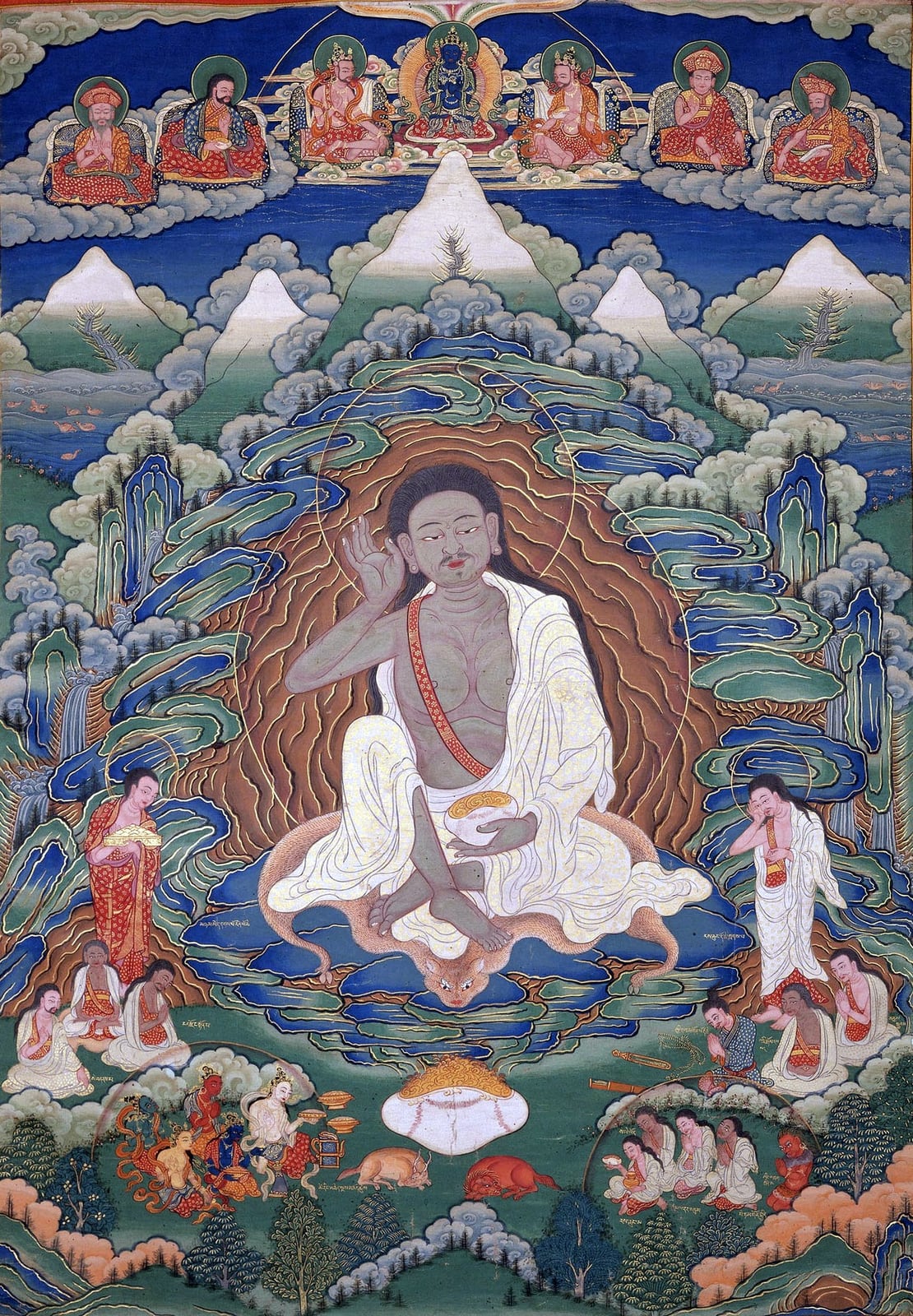
Milarepa
Совпадают в вопросах: Свободны ли мы или всё предопределено? · Что такое Абсолют? Существует ли Бог? · Кто я? Существует ли истинное «я»?

Śāntideva
Совпадают в вопросах: Как достигается освобождение или спасение? · Что такое Абсолют? Существует ли Бог? · Кто я? Существует ли истинное «я»?

Tsongkhapa
Совпадают в вопросах: Как достигается освобождение или спасение? · Что такое Абсолют? Существует ли Бог? · Кто я? Существует ли истинное «я»?

Siddhartha Gautama, the Buddha
Совпадают в вопросах: Что такое Абсолют? Существует ли Бог? · Кто я? Существует ли истинное «я»? · Почему мы страдаем?
Дальше всего от

Francis of Assisi
Расходятся в вопросах: Что такое Абсолют? Существует ли Бог? · Кто я? Существует ли истинное «я»? · Что происходит после смерти?

Emanuel Swedenborg
Расходятся в вопросах: Что такое Абсолют? Существует ли Бог? · Кто я? Существует ли истинное «я»? · Что происходит после смерти?
Catherine of Siena
Расходятся в вопросах: Что такое Абсолют? Существует ли Бог? · Кто я? Существует ли истинное «я»? · Что происходит после смерти?
Augustine of Hippo
Расходятся в вопросах: Что такое Абсолют? Существует ли Бог? · Кто я? Существует ли истинное «я»? · Что происходит после смерти?
Предания и рассказы
Предания и рассказы
Свидетельство1223
The two cooks
Происхождение рассказа: Dōgen's own first-person account in the Tenzo kyōkun (1237), written fourteen years later.
Источник: Uchiyama, Kōshō; Wright, Thomas (trad.). Refining Your Life: From the Zen Kitchen to Enlightenment (incluye la traducción del Tenzo kyōkun). Nueva York / Tokio: Weatherhill, 1983. ISBN 9780834801790.
Житийное повествование1225
"Drop off body and mind!"
Происхождение рассказа: The dialogue appears in Sōtō biographies of the 14th and 15th centuries, particularly Kenzei's chronicle (1452). Scholars (Kim, Heine) treat it as a hagiographic reconstruction of an experience Dōgen mentions without narrating.
Источник: Kenzei. Eihei kaisan Dōgen oshō gyōjō Kenzeiki (Crónica de Kenzei), 1452; ed. de Kawamura Kōdō, Shohon taikō Eihei kaisan Dōgen zenji gyōjō Kenzeiki, Tokio: Taishūkan shoten, 1975.
Документированоc. 1236
Coming home with empty hands
Происхождение рассказа: Eihei kōroku, vol. 1, formal sermon no. 48, in his disciples' compilation; words attributed to Dōgen in a contemporary record.
Источник: Leighton, Taigen Dan; Okumura, Shohaku (trads.). Dōgen's Extensive Record: A Translation of the Eihei Kōroku. Boston: Wisdom Publications, 2004 (ed. rev. 2010, ISBN 9780861716708).
Житийное повествованиеc. 1213–1217
The great doubt of Mount Hiei
Происхождение рассказа: Kenzei's chronicle (1452) and later Sōtō biographies. Kim and Bodiford read it as a doctrinal reconstruction rather than a biographical memory.
Источник: Kenzei. Eihei kaisan Dōgen oshō gyōjō Kenzeiki (Crónica de Kenzei), 1452; ed. de Kawamura Kōdō, Shohon taikō Eihei kaisan Dōgen zenji gyōjō Kenzeiki, Tokio: Taishūkan shoten, 1975.
Документировано1247–1248
Return from Kamakura
Происхождение рассказа: Eihei kōroku, vol. 3, formal sermon no. 251, delivered on his return; the length of the journey is inferred from the dates of the sermons.
Источник: Leighton, Taigen Dan; Okumura, Shohaku (trads.). Dōgen's Extensive Record: A Translation of the Eihei Kōroku. Boston: Wisdom Publications, 2004 (ed. rev. 2010, ISBN 9780861716708).
Житийное повествование1248
The expulsion of Genmyō
Происхождение рассказа: Kenzei's chronicle (1452), two centuries later. No confirmation in contemporary sources.
Источник: Kenzei. Eihei kaisan Dōgen oshō gyōjō Kenzeiki (Crónica de Kenzei), 1452; ed. de Kawamura Kōdō, Shohon taikō Eihei kaisan Dōgen zenji gyōjō Kenzeiki, Tokio: Taishūkan shoten, 1975.
Учение
Учение
Понятия, на которых строится мысль учителя, объяснённые в их контексте.
Just sitting (shikantaza)shikantaza
Bendōwa, Fukanzazengi, "Zazengi", "Zanmai ō zanmai", Hōkyōki.
Источник: Bielefeldt, Carl. Dōgen's Manuals of Zen Meditation. Berkeley: University of California Press, 1988.
Dropping off body and mind (shinjin datsuraku)shinjin-datsuraku
Hōkyōki, Bendōwa, "Genjōkōan", Eihei kōroku.
Источник: Kim, Hee-Jin. Eihei Dōgen: Mystical Realist. Boston: Wisdom Publications, 2004 (1.ª ed. Dōgen Kigen—Mystical Realist, Tucson: University of Arizona Press, 1975). ISBN 9780861713769.
Oneness of practice and realisation (shushō ittō)shusho-itto
Bendōwa (1231); basis of his critique of the Tendai doctrine of original enlightenment.
Actualising the fundamental point (genjōkōan)genjokoan
"Genjōkōan" (1233, revised in 1252).
Источник: Tanahashi, Kazuaki (ed.). Treasury of the True Dharma Eye: Zen Master Dogen's Shobo Genzo. Boston: Shambhala, 2010. ISBN 9781590304747.
Being-time (uji)uji
"Uji" (1240); related to "Genjōkōan" and "Busshō".
Thinking not-thinking (hishiryō)hishiryo
Fukanzazengi, "Zazengi" and "Zazenshin".
Источник: Bielefeldt, Carl. Dōgen's Manuals of Zen Meditation. Berkeley: University of California Press, 1988.
All existence is buddha-nature (shitsuu busshō)shitsuu-bussho
"Busshō" (1241); critical dialogue with the Tendai doctrine of original enlightenment.
Источник: Kim, Hee-Jin. Eihei Dōgen: Mystical Realist. Boston: Wisdom Publications, 2004 (1.ª ed. Dōgen Kigen—Mystical Realist, Tucson: University of Arizona Press, 1975). ISBN 9780861713769.
Видео
Видео
Записи, интервью и документальные фильмы. Видео воспроизводятся с YouTube; здесь они не хранятся.
第四章「証」~道元禅師の生涯~
Документальный фильм· JA· 2025· 19 min
【公式】大本山永平寺Официальный канал
第三章「道」~道元禅師の教え~
Документальный фильм· JA· 2025· 5 min
【公式】大本山永平寺Официальный канал
【禅のこころ-曹洞宗-】正法眼蔵(法話)
Лекция· JA· 2022· 4 min
【公式】禅のこころ-曹洞宗-Официальный канал
[EN] Soto Zen Buddhism, Daihonzan Eiheiji
Документальный фильм· EN· 2014· 11 min
SOTOZENNETОфициальный канал
[ES] Budismo Soto Zen, Daihonzan Eiheiji
Документальный фильм· ES· 2013· 11 min
SOTOZENNETОфициальный канал
[FR] Le Bouddhisme Soto Zen, le Sanctuaire Eiheiji
Документальный фильм· FR· 2013· 11 min
SOTOZENNETОфициальный канал
Philosophy and Philology in Edo Commentaries on Dōgen's Shōbōgenzō
Лекция· EN· 2017· 87 min
SOAS University of LondonОфициальный канал
Professor T. Griffith Foulk, "Dogen's Genjo Koan" workshop, June 20, 2020
Лекция· EN· 2020· 157 min
Village Zendo
The Life and Times of Dogen: Intro to Dogen 1 of 6
Лекция· EN· 2022· 86 min
Sanshin Zen Community
Le Zen entre deux langues : Le cas de Dôgen (1200-1253) (1) - Jean-Noël Robert (2017-2018)
Лекция· FR· 2022· 63 min
Lettres, langage, philosophie - Collège de FranceОфициальный канал
Conversación con Dokusho Villalba, maestro zen, traductor de Shobogenzo, de Eihei Dogen
Интервью· ES· 2023· 30 min
Editorial KairósОфициальный канал
Галерея
Галерея
Изображения с проверенной лицензией. Каждое сохраняет своё авторство и атрибуцию.
Рукописи
Рукописи
Рукописные свидетельства и древние тексты, с указанием хранителя и условий доступа.
ZH · Kanji (escritura regular) · 1233 (Tenpuku 1)
普勧坐禅儀 (天福本)
- Сохранившийся список
- Rollo de 28,8 × 318,7 cm, de mano de Dōgen
- Хранитель
- Daihonzan Eihei-ji (Eiheiji, Fukui)
- Оцифровка
- commons.wikimedia.org/wiki/File:Fukan-Zazengi-In…
JA · Kanji y kana · 1241
正法眼蔵 嗣書
- Сохранившийся список
- Fascículo «Shisho» del Shōbōgenzō
- Хранитель
- Museo de Historia de la Cultura Zen de la Universidad Komazawa (Tokio)
JA · Kanji y kana · 1240
正法眼蔵 山水経
- Сохранившийся список
- Fascículo «Sansuikyō» del Shōbōgenzō
- Хранитель
- Zenkyū-in (Toyohashi)
JA · Kanji y kana · Copia de 1446 a partir de otra de 1420
十二巻本正法眼蔵 (永光寺本)
- Сохранившийся список
- Único testimonio completo de la serie de doce fascículos y único de «Ippyakuhachi hōmyōmon»
- Хранитель
- Yōkō-ji (Hakui, Ishikawa)
Связи
Связи
Влияния, ученичество и близость взглядов. Документированная связь отличается от сходства, выявленного путём анализа.
Ученик
Tiantong Rujing
Chinese Caodong master on Mount Tiantong (1225–1227), from whom he received transmission. Dōgen calls him "my late teacher, the old buddha".
Документированная связь
Ученик
Myōzen
Eisai's successor at Kennin-ji; Dōgen's teacher from 1217 and travelling companion to China, where he died in 1225.
Документированная связь
Испытал влияние
Myōan Eisai
Founder of Kennin-ji, where Dōgen trained in Rinzai Zen. Whether they actually met is disputed: Eisai died in 1215 and Dōgen's references are indirect.
Сходство, выявленное путём анализа
Учитель
Koun Ejō
Disciple from 1234, copyist of most Shōbōgenzō fascicles, author of the Shōbōgenzō zuimonki and successor as abbot of Eihei-ji (1253).
Документированная связь
Повлиял на
Keizan Jōkin
Third successor in his lineage (through Ejō and Gikai), founder of Sōji-ji and great propagator of the Sōtō school; the school venerates Dōgen and Keizan as its two founders.
Документированная связь
Испытал влияние
Dōgen calls the Sixth Patriarch "Daikan Kōso" and comments on his sayings in several fascicles (for example "Busshō" and "Hokke ten hokke").
Документированная связь
Испытал влияние
Founding patriarch of Chan in tradition; Dōgen comments on his transmission of "skin, flesh, bones and marrow" in "Kattō" and his coming from the west in "Soshi seirai i".
Документированная связь
Испытал влияние
Dōgen counts him among the Indian patriarchs of his lineage and comments on his figure in "Busshō".
Документированная связь
Современник
Contemporaries in early Kamakura-period Kyoto and founders of two of the great Japanese schools, with opposite approaches: seated practice versus trust in Amida's power. There is no record that they met.
Документированная связь
Идеи, близкие к
Both think of reality as transformation and distrust fixed categories; an affinity noted by modern interpreters.
Сходство, выявленное путём анализа
Источники
Источники
Библиография и каталоги, использованные для этой статьи.
- Wikidata, entidad Q318064 «Dōgen» (P31=Q5; 54 enlaces entre wikis; nombre nativo 道元; nacimiento 1200, muerte 1253 en Kioto).
- Kim, Hee-Jin. Eihei Dōgen: Mystical Realist. Boston: Wisdom Publications, 2004 (1.ª ed. Dōgen Kigen—Mystical Realist, Tucson: University of Arizona Press, 1975). ISBN 9780861713769.
- Bodiford, William M. Sōtō Zen in Medieval Japan. Honolulu: University of Hawai'i Press, 1993. ISBN 9780824814823.
- Bodiford, William M. «Textual Genealogies of Dōgen». En Steven Heine (ed.), Dōgen: Textual and Historical Studies. Nueva York: Oxford University Press, 2012, pp. 15–41. ISBN 9780199754472.
- Tanahashi, Kazuaki (ed.). Treasury of the True Dharma Eye: Zen Master Dogen's Shobo Genzo. Boston: Shambhala, 2010. ISBN 9781590304747.
- Leighton, Taigen Dan; Okumura, Shohaku (trads.). Dōgen's Extensive Record: A Translation of the Eihei Kōroku. Boston: Wisdom Publications, 2004 (ed. rev. 2010, ISBN 9780861716708).
- Leighton, Taigen Dan; Okumura, Shohaku (trads.). Dōgen's Pure Standards for the Zen Community: A Translation of Eihei Shingi. Albany: State University of New York Press, 1996. ISBN 9780791427101.
- Bielefeldt, Carl. Dōgen's Manuals of Zen Meditation. Berkeley: University of California Press, 1988.
- Heine, Steven. Did Dōgen Go to China? What He Wrote and When He Wrote It. Nueva York: Oxford University Press, 2006.
- 正法眼藏 (Bendōwa, 75 fascículos y 12 fascículos), texto japonés con colofones de fecha y lugar de cada fascículo. Edición en línea del templo Shōmon-ji (松門寺).
- Wikisource en japonés: «普勸坐禪儀» y «學道用心集», según Eiheiji (ed.), Shōyō daishi shōgyō zenshū, vols. 1 y 3, 1909 (Biblioteca Nacional de la Dieta, NDLJP 823139 y 823141).
- Kenzei. Eihei kaisan Dōgen oshō gyōjō Kenzeiki (Crónica de Kenzei), 1452; ed. de Kawamura Kōdō, Shohon taikō Eihei kaisan Dōgen zenji gyōjō Kenzeiki, Tokio: Taishūkan shoten, 1975.
- Nagatomo, Shigenori. «Japanese Zen Buddhist Philosophy». En Edward N. Zalta (ed.), The Stanford Encyclopedia of Philosophy. Publicado el 28-06-2006; revisión sustancial del 07-03-2024.
- Dumoulin, Heinrich. Zen Buddhism: A History. Vol. 2: Japan. Bloomington: World Wisdom, 2005 (1.ª ed. inglesa 1990). ISBN 9780941532907.
- Wikipedia en inglés, «Shōbōgenzō» (listas de las versiones de 60, 75, 12 y 28 fascículos, basadas en Bodiford 2012), y en japonés, «正法眼蔵» y «道元». Consultadas el 25-10-2026 y contrastadas con s4 y s10.
- Uchiyama, Kōshō; Wright, Thomas (trad.). Refining Your Life: From the Zen Kitchen to Enlightenment (incluye la traducción del Tenzo kyōkun). Nueva York / Tokio: Weatherhill, 1983. ISBN 9780834801790.
- Tanahashi, Kazuaki (ed.). Moon in a Dewdrop: Writings of Zen Master Dōgen. San Francisco: North Point Press, 1985. ISBN 9780865471863.
- Masunaga, Reihō (trad.). A Primer of Sōtō Zen: A Translation of Dōgen's Shōbōgenzō Zuimonki. Honolulu: East-West Center Press, 1971. ISBN 9780824800949.
- Editorial Kairós. Ficha de «Shōbōgenzō. Volumen I», de Eihei Dōgen, trad. de Dokushō Villalba, ISBN 9788499884653 (e-book 9788499885018).
- Daihonzan Eiheiji, sitio oficial del monasterio fundado por Dōgen.
- Sōtōshū Shūmuchō, SOTOZEN-NET, sitio oficial de la escuela Sōtō.
- Watsuji Tetsurō. «Shamon Dōgen» (El monje Dōgen). En Nihon seishinshi kenkyū (Estudios de historia espiritual de Japón). Tokio: Iwanami Shoten, 1926.
- Правообладатель
- Obra en dominio público; cada traducción moderna pertenece a su traductor o editorial. Eihei-ji y la Sōtōshū custodian los manuscritos autógrafos.
- Официальный сайт
- daihonzan-eiheiji.com/
Ожидает подтверждения
То, что в этой статье пока не удалось установить. Мы предпочитаем сказать об этом, а не заполнять пробел.
- Filiación de Dōgen (Koga Michichika o Horikawa Michitomo como padre) discutida; la ficha sigue la versión tradicional con reservas.
- Fechas: se dan en calendario juliano (19-01-1200 y 22-09-1253); Wikidata registra 1253-09-29, que corresponde al gregoriano proléptico. Revisar la entrada de Wikidata.
- Fascículos sin colofón (serie de 12, «Shōji», «Yuibutsu yobutsu», «Dōshin») registrados con año aproximado (década de 1250); fechas de «Bodaisatta shishōbō» (1243) y «Hokke ten hokke» (1241) tomadas de la tradición, sin ver el colofón.
- Sala de lectura: el Shōbōgenzō solo está en línea en una página única (Shōmon-ji) que reúne todos los fascículos; el importador no puede separarlos. Buscar una edición por fascículos (Wikisource no la tiene aún). No hay traducciones inglesas o españolas en dominio público.
- Sala de lectura: confirmar si la transcripción del Shōmon-ji se basa en una edición crítica moderna con derechos editoriales propios en la UE (se ha registrado sin «caution» por ser texto del siglo XIII).
- ISBN no verificados: Bielefeldt (1988), Heine (2006), Nishijima-Cross (Windbell), Iwanami bunko (Mizuno), traducción italiana de Aldo Tollini; ediciones en ruso, árabe e hindi no localizadas.
- Confirmar la condición de Bien Cultural Importante del autógrafo de «Sansuikyō» (Zenkyū-in) y la signatura del autógrafo de «Shisho» (Universidad Komazawa).
- La autenticidad de «Shōji» y de parte de los poemas del Sanshō dōei es discutida; se mantienen como atribuidos.
- Vídeos: los documentales de France 2 («Sagesses bouddhistes») y la emisión de France Culture «Une vie, une œuvre» (1998) solo están en canales de terceros; no se han incluido.
Исследовано 2026-10-25