Тантра · Буддизм · Махаяна · Тибетский буддизм
Tsongkhapa
ཙོང་ཁ་པ་བློ་བཟང་གྲགས་པ། · tsong kha pa blo bzang grags pa · རྗེ་རིན་པོ་ཆེ། · 宗喀巴
1357 – 1419Исторически документированная личность
Тибетский монах, философ и реформатор (1357–1419), уроженец Амдо, который два десятилетия учился у наставников всех школ Центрального Тибета. Его синтез монашеской дисциплины, логически выверенного изучения текстов, постепенного пути (ламрим) и тантры, а также прасангиковское прочтение Нагарджуны легли в основу школы гелуг, сложившейся вокруг основанного им в 1409 году монастыря Ганден; к этой школе принадлежат и далай-ламы. Полное собрание его сочинений занимает восемнадцать томов.
- трудов
- 175трудов
- изданий
- 58изданий
- цитат
- 5цитат
- видео
- 13видео
- изображений
- 7изображений

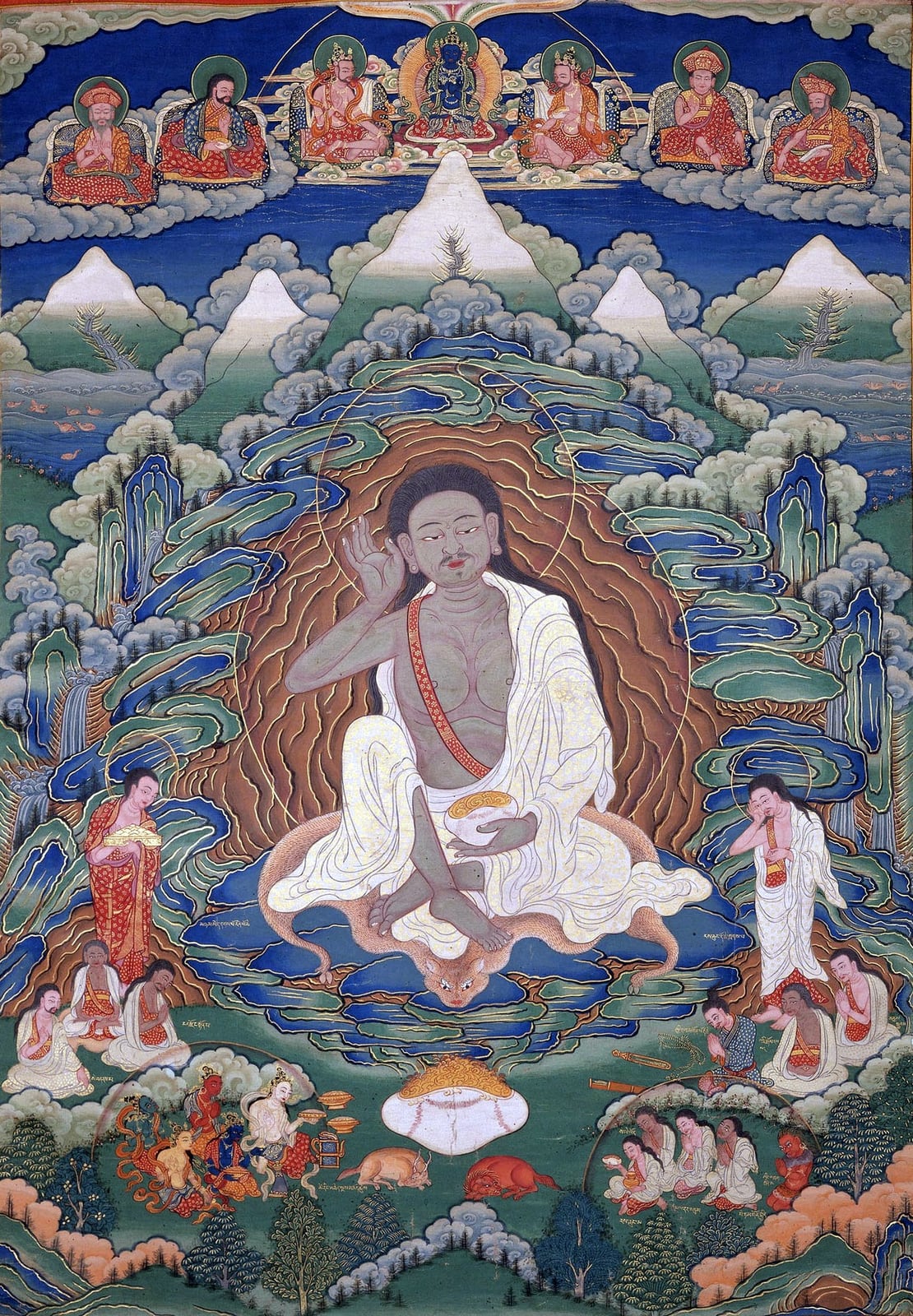
Tsongkhapa, pintura del siglo XVI (Rubin Museum of Art) · Public domain
Своими словами
«Without the wisdom that realises how things are, even if you have trained in renunciation and the mind of awakening you cannot cut the root of existence; therefore strive in the means of realising dependent origination.»Los tres aspectos principales del camino, estrofa 9 (texto tibetano de Lotsawa House; traducción del investigador)

Для начала — одна книга
Great Treatise on the Stages of the Path to Enlightenment (Lamrim Chenmo)Главная мысль
Stages of the path (lamrim): The lamrim is a way of organising all the Buddha's teachings as a graded itinerary for a single person.
В контексте
Биография
4 мин чтения
Перевод с испанского оригинала, выполненный с помощью ИИ; ожидает проверки носителем языка.
Монах из Амдо
Цонкапа родился в 1357 году, в десятом месяце года огненного петуха, в Цонкха — пастушеской местности провинции Амдо на северо-востоке тибетского мира; от названия этого места и происходит имя, под которым его знает история. Монашеское имя его было Лобсанг Дракпа, а ученики называли его Дже Ринпоче, «Драгоценный владыка». Почти всё, что известно о его детстве, восходит к жизнеописаниям, которые составили эти же ученики, прежде всего Кхедруб Гелек Пелсанг, в годы, последовавшие за его смертью. Согласно им, в три года он принял обеты мирянина от четвёртого Кармапы Ролпе Дордже, а в семь был посвящён в послушники своим первым учителем, Чодже Дондрубом Ринченом, воспитавшим его в традиции кадам.
Двадцать лет ученичества
В 1372 году, шестнадцати лет от роду, он отправился в Центральный Тибет, откуда уже никогда не вернулся. Последовало обучение исключительной даже для той эпохи широты: медицина и практики кагью в Дрикунге у Ченга Чокьи Гьялпо, Праджняпарамита в училище Ньетанг Девачен, Абхидхарма и Срединный путь у сакьяского учёного Рендавы Шонну Лодро — его главного наставника, — и Калачакра у мастеров традиции джонанг. В девятнадцать лет он провёл первые публичные диспуты, а около двадцати пяти принял полное монашеское посвящение. Перечень полученных им учений, сохранившийся в первом томе его сочинений, называет линии преемственности всех школ и объясняет, почему традиция видит в нём скорее великого систематизатора, чем основателя секты.
В 1388–1389 годах он завершил первый крупный труд — «Золотые чётки благого изъяснения», монументальный комментарий к «Украшению ясной реализации», утвердивший его славу учёного. Но молодой схоласт не был удовлетворён своим пониманием пустоты. Около 1390 года он встретил ламу Умапу, мистика из Восточного Тибета, который, по словам биографов, служил посредником между людьми и Манджушри, бодхисаттвой мудрости; через него, а позднее — опять же согласно этим рассказам — напрямую Цонкапа будто бы обращался к божеству со своими философскими сомнениями. Ответом стало практическое наставление: на время оставить преподавание, удалиться в затвор и очиститься.
Затвор в Вёлкха
С 1392 года он вместе с небольшой группой учеников — по преданию, восемью — уединился в долине Вёлкха, к юго-востоку от Лхасы. Там, как рассказывают биографы, он совершил сотни тысяч простираний перед тридцатью пятью буддами покаяния, восстановил большое изображение Майтреи в монастыре Дзингчи и получил от наставника Лходрака Намкха Гьялцена кадамские наставления о постепенном пути. Около 1397–1398 годов, увидев во сне Нагарджуну и его учеников, он будто бы достиг окончательного постижения пустоты при чтении комментария Буддапалиты к «Коренным строфам о Срединности». Сны и видения принадлежат агиографии; достоверно же то, что его творчество повернулось к прасангиковскому прочтению Нагарджуны, которое он отстаивал до конца, и что это прочтение воспевает поэма «Хвала взаимозависимому возникновению».
Великие трактаты
В 1402 году в монастыре Радренг (Ретинг), основанном в XI веке Дромтонпой, учеником Атиши, он завершил «Большое руководство к этапам Пути Пробуждения» — Ламрим Ченмо. В том же году он собрал в Намцэ Денге монашескую общину, чтобы восстановить соблюдение винаи, убеждённый, что дисциплина есть условие всего остального. Затем последовали трактаты об этике бодхисаттвы и тантрической этике (1403), «Большое руководство к этапам Тайной мантры» (1405), «Сущность красноречия» и «Океан рассуждений», написанные в обители Сера Чодинг в 1407–1408 годах, «Светильник, проясняющий пять ступеней» (1411), «Средний Ламрим» (1415) и, в 1418 году, «Прояснение замысла» — его последний большой комментарий.
Эти книги пронизывает одно убеждение. Для Цонкапы рассуждение не враг созерцания, а его орудие: пустоту следует постигать посредством анализа, и простое прекращение мысли к ней не ведёт. Более того, пустота не уничтожает условный мир: именно потому, что ничто не существует само по себе, причины порождают следствия и этика имеет смысл. Отсюда его настойчивое требование точно определить «объект отрицания», чтобы не отрицать ни слишком мало, ни слишком много, и его критика тех, кто в Тибете путал пустоту с небытием, а медитацию — с отсутствием мыслей.
Лхаса, 1409
Его слава достигла китайского двора. В 1407 году и снова в 1413-м император Юнлэ из династии Мин приглашал его к себе; Цонкапа отказался, и его ответное письмо сохранилось среди разных его сочинений. Вместо него годы спустя ко двору отправился его ученик Шакья Еше. В первом месяце 1409 года при покровительстве правителя из дома Пагмоду Дракпы Гьялцена он открыл в лхасском Джокханге Великий молитвенный праздник (Монлам Ченмо), который затем отмечали ежегодно вплоть до 1959 года. В том же году он основал на горе Друк Риво монастырь Ганден — «Радостный», названный по чистой земле Майтреи.
Вокруг Гандена сложилась община, которую потомки назовут гелуг — «следующие добродетельной традиции». Его ученики умножили число монастырей: Джамьянг Чодже Таши Палден основал Дрепунг в 1416 году, а Джамчен Чодже Шакья Еше — Сера в 1419-м. Гьялцаб Дарма Ринчен и Кхедруб Гелек Пелсанг стали его духовными преемниками в учёности, а ещё один ученик, Гендун Друп, был впоследствии признан первым далай-ламой.
Смерть и наследие
Цонкапа скончался в Гандене в 1419 году, в двадцать пятый день десятого тибетского месяца; с тех пор монастыри гелуг отмечают эту дату праздником светильников Ганден Нгамчо. Предание гласит, что перед смертью он передал свою шапку и плащ Гьялцабу Дже, первому держателю престола Гандена. Его тело, сохранявшееся в серебряной с золотом ступе, почиталось более пяти веков; после разрушения монастыря в 1959 году, в годы «культурной революции», оно было сожжено, и, по свидетельству, записанному Томасом Лэрдом, уцелели лишь череп и часть праха.
Немногие фигуры тибетского буддизма так обросли легендами. В 1845 году французский миссионер Эварист Гюк увидел в Кумбуме, монастыре, построенном на месте рождения Цонкапы, дерево, на листьях которого, по словам монахов, проступали священные письмена с тех пор, как там бросила свои волосы его мать; Гюк видел его и не смог этого объяснить. Жизнеописания говорят о видениях Манджушри и чудесных знамениях; его собственные сочинения, напротив, показывают неутомимого читателя индийских текстов, строгого к источникам, который писал для того, чтобы другие могли рассуждать самостоятельно. Это наследие — восемнадцать томов в издании Ташилунпо — по-прежнему остаётся ядром образования в монастырях гелуг и учений нынешнего далай-ламы.
Источники: Jinpa, Thupten. Tsongkhapa: A Buddha in the Land of Snows. Boulder: Shambhala Publications, 2019. ISBN 9781611806465. · Thurman, Robert A. F. (ed.). The Life and Teachings of Tsong Khapa. Dharamsala: Library of Tibetan Works and Archives, 1982; nueva ed. 2006, ISBN 9788186470442. Incluye la traducción de la biografía tradicional y de varias obras breves. · Tsong-kha-pa. The Great Treatise on the Stages of the Path to Enlightenment. Trad. Lamrim Chenmo Translation Committee; ed. Joshua W. C. Cutler y Guy Newland. 3 vols. Ithaca (NY): Snow Lion, 2000–2004. ISBN 9781559391528, 9781559391689, 9781559391665. · Tsongkhapa. Ocean of Reasoning: A Great Commentary on Nāgārjuna's Mūlamadhyamakakārikā. Trad. Geshe Ngawang Samten y Jay L. Garfield. Nueva York: Oxford University Press, 2006. ISBN 9780195147339. · Thurman, Robert A. F. Tsong Khapa's Speech of Gold in the Essence of True Eloquence: Reason and Enlightenment in the Central Philosophy of Tibet. Princeton: Princeton University Press, 1984. ISBN 9780691072852 (reed. como The Central Philosophy of Tibet, 1991, ISBN 9780691020679).
Хронология
Жизнь год за годом
Каждая точка — документированное событие. Нажмите, чтобы прочитать о нём, с источником и степенью достоверности.
13570 летTsongkha, Amdo
Birth
Born in the tenth month of the fire-bird year at Tsongkha (Amdo), into a herding family.
ДокументированоSparham, Gareth, y Chandra Chiara Ehm. «Tsongkhapa». En Edward N. Zalta (ed.), The Stanford Encyclopedia of Philosophy. Primera publicación 18 de julio de 2011; revisión sustancial 17 de abril de 2024.
После смерти
- 1845Huc at Kumbum
- ок. 1966Destruction of the tomb
1357 · 0 лет
Birth
Born in the tenth month of the fire-bird year at Tsongkha (Amdo), into a herding family.
Документировано
ок. 1360 · 3 года
Lay vows from the fourth Karmapa
According to his biographies he receives lay vows and the name Kunga Nyingpo from the fourth Karmapa, Rolpe Dorje.
Предание
ок. 1363 · 7 лет
Novice ordination
He is ordained a novice by Chöje Döndrub Rinchen, his first teacher, receiving the name Losang Drakpa.
Предание
1372 · 16 лет
Departure for central Tibet
He leaves Amdo to study in central Tibet and will never return home. He reaches Drikung in the autumn of 1373.
Документировано
1375 · 19 лет
First public debates
He holds his first formal debates on the great treatises.
Документировано
ок. 1381 · 25 лет
Full ordination
He receives full monastic ordination at about twenty-five.
Вероятно
ок. 1389 · 32 года
The Golden Garland
He completes his commentary on the Abhisamayālaṃkāra (1388–1389), his first major work; that year he makes a Cakrasaṃvara retreat in Yarlung.
Документировано
ок. 1390 · 33 года
Meeting Lama Umapa
He meets the mystic Umapa, through whom, according to the biographies, he consults Mañjuśrī.
Предание
ок. 1392 · 35 лет
The Wölkha retreat
He withdraws with eight disciples to Wölkha; prostrations, purification and restoration of the Dzingchi Maitreya.
Предание
ок. 1397 · 40 лет
Insight into emptiness
After dreaming of Nāgārjuna and his disciples he attains, according to tradition, a definitive understanding of emptiness while reading Buddhapālita; he composes the Praise of Dependent Origination.
Предание
1402 · 45 лет
The Lamrim Chenmo
He completes the Great Treatise on the Stages of the Path and gathers the community at Namtsé Deng to restore the vinaya.
Документировано
1405 · 48 лет
The Ngagrim Chenmo
He completes the Great Exposition of Secret Mantra.
Документировано
1407 · 50 лет
The Yongle emperor's invitation; the Essence of Eloquence
He declines the invitation to the Ming court (repeated in 1413) and composes the Essence of Eloquence and the Ocean of Reasoning at Sera Chöding (1407–1408).
Документировано
1409 · 52 года
Great Prayer Festival and founding of Ganden
He institutes the Monlam Chenmo at the Jokhang in the first month, with Drakpa Gyaltsen's patronage, and founds Ganden monastery.
Документировано
1415 · 58 лет
The Middle-Length Lamrim
He composes the middle-length version of the stages of the path.
Документировано
1416 · 59 лет
Founding of Drepung
His disciple Jamyang Chöje Tashi Palden founds Drepung.
Документировано
1418 · 61 год
Illuminating the Intent
He composes his last great commentary, on Candrakīrti's Entering the Middle Way.
Документировано
1419 · 62 года
Death
He dies at Ganden on the 25th day of the tenth Tibetan month; that year his disciple Shakya Yeshe founds Sera.
Документировано
1845
Huc at Kumbum
The missionary Évariste Huc describes Kumbum's 'tree of ten thousand images' and the legend of its origin.
Документировано
ок. 1966
Destruction of the tomb
After Ganden's destruction (1959) and during the Cultural Revolution his preserved body is burned; remains were saved according to testimonies.
Документировано
Труды
Главные труды
Труды, без которых не понять это наследие.
Письменный труд · 1402
Great Treatise on the Stages of the Path to Enlightenment (Lamrim Chenmo)
སྐྱེས་བུ་གསུམ་གྱི་ཉམས་སུ་བླང་བའི་རིམ་པ་ཐམས་ཅད་ཚང་བར་སྟོན་པའི་བྱང་ཆུབ་ལམ་གྱི་རིམ་པ། (skyes bu gsum gyi nyams su blang ba'i rim pa thams cad tshang bar ston pa'i byang chub lam gyi rim pa)
His most widely read work and the founding text of the Geluk school. Finished in 1402 at Radreng (Reting) monastery, it expands Atiśa's Lamp for the Path into a complete course for the 'three types of person': one who seeks a good rebirth, one who seeks liberation and one who aspires to buddhahood for the sake of others. Its last two sections, on calm abiding (śamatha) and special insight (vipaśyanā), contain his mature account of emptiness and of the 'object of negation'. It fills vol. 13 (pa) of the collected works.
11 изданий

Письменный труд · 1405
Great Exposition of Secret Mantra (Ngagrim Chenmo)
རྒྱལ་བ་ཁྱབ་བདག་རྡོ་རྗེ་འཆང་ཆེན་པོའི་ལམ་གྱི་རིམ་པ་གསང་བ་ཀུན་གྱི་གནད་རྣམ་པར་ཕྱེ་བ། (rgyal ba khyab bdag rdo rje 'chang chen po'i lam gyi rim pa gsang ba kun gyi gnad rnam par phye ba)
The tantric counterpart of the Lamrim Chenmo, completed in 1405. It sets out systematically the four classes of tantra (action, performance, yoga and highest yoga), the difference between the perfection vehicle and the mantra vehicle, the requirements of initiation and vows, deity yoga and the generation and completion stages of Guhyasamāja. Its central thesis is that tantra does not replace renunciation, bodhicitta and the view of emptiness but presupposes them. It fills vol. 3 (ga).
7 изданий

Письменный труд · 1407
Essence of Eloquence: Treatise Differentiating the Interpretable and the Definitive
དྲང་བ་དང་ངེས་པའི་དོན་རྣམ་པར་འབྱེད་པའི་བསྟན་བཅོས་ལེགས་བཤད་སྙིང་པོ། (drang ba dang nges pa'i don rnam par 'byed pa'i bstan bcos legs bshad snying po)
Composed in 1407–1408 at the Sera Chöding hermitage above Lhasa, it is his hermeneutical work: how to decide which of the Buddha's teachings are to be taken literally and which require interpretation. It goes through the Mind-Only (Yogācāra) reading of the Saṃdhinirmocana, then those of Bhāviveka and Candrakīrti within Madhyamaka, concluding in favour of the Prāsaṅgika approach. Tradition regards it as the most difficult of his books. Vol. 14 (pha).
3 издания

Переписка
The Three Principal Aspects of the Path
ལམ་གྱི་གཙོ་བོ་རྣམ་གསུམ། (lam gyi gtso bo rnam gsum)
Fourteen stanzas sent as a letter to his disciple Tsakho Önpo Ngawang Drakpa in Gyalmorong (eastern Tibet), and preserved among the miscellaneous writings (vol. 2, kha). They reduce the whole path to three dispositions: renunciation or the determination to be free, bodhicitta, and the correct view of emptiness understood as compatible with dependent origination. It is probably the most widely taught and memorised text by Tsongkhapa in the Tibetan world.
4 издания
Все труды (175)

Ocean of Reasoning: Great Commentary on the Fundamental Verses of the Middle Way
1408
Tsongkhapa
Illuminating the Intent: Extensive Exposition of Entering the Middle Way
The Conscious LibraryIlluminating the Intent: Extensive Exposition of Entering the Middle Way
1418

Middle-Length Treatise on the Stages of the Path to Enlightenment
1415

Concise Presentation of the Practice of the Stages of the Path (Lines of Experience)

In Praise of Dependent Origination: The Essence of Eloquence
1398

Golden Garland of Eloquence: Commentary on the Ornament for Clear Realization
1389

A Lamp to Illuminate the Five Stages
1411

Fulfilling All the Hopes of Disciples: Commentary on the Fifty Verses on the Guru

Ear of Accomplishments: Explanation of the Ethics of Secret Mantra
1403

The Main Path to Awakening: Explanation of Bodhisattva Ethics
1403

A Book of Three Inspirations: Guide to the Six Yogas of Nāropa

Ocean of Eloquence: Extensive Commentary on the Difficult Points of Mind and the Foundation Consciousness
Tsongkhapa
Gateway to the Seven Treatises: Dispelling the Darkness of the Mind of Seekers
The Conscious LibraryGateway to the Seven Treatises: Dispelling the Darkness of the Mind of Seekers

Stairway for Clear Minds: Presentation of the Great Beings who Enter and Abide in the Fruits
Tsongkhapa
Illumination of All Hidden Meanings: Extensive Commentary on the Concise Cakrasaṃvara Tantra
The Conscious LibraryIllumination of All Hidden Meanings: Extensive Commentary on the Concise Cakrasaṃvara Tantra
Tsongkhapa
Commentary on the Jñānavajrasamuccaya
The Conscious LibraryCommentary on the Jñānavajrasamuccaya
1410
Tsongkhapa
Annotations on the Brilliant Lamp (Candrakīrti's Guhyasamāja commentary)
The Conscious LibraryAnnotations on the Brilliant Lamp (Candrakīrti's Guhyasamāja commentary)
Tsongkhapa
How He Met the Great Adept of Lhodrak; and the Cycle of the Tooth Given to Khedrup Je
The Conscious LibraryHow He Met the Great Adept of Lhodrak; and the Cycle of the Tooth Given to Khedrup Je
Tsongkhapa
Profound and Special Guru Yoga, Given by Tsongkhapa to Khedrup as a Single-Lineage Transmission
The Conscious LibraryProfound and Special Guru Yoga, Given by Tsongkhapa to Khedrup as a Single-Lineage Transmission
Tsongkhapa
Guru Yoga Given to Baso Chöje as a Single-Lineage Transmission
The Conscious LibraryGuru Yoga Given to Baso Chöje as a Single-Lineage Transmission
Tsongkhapa
Record of Teachings Received (gsan yig)
The Conscious LibraryRecord of Teachings Received (gsan yig)
Tsongkhapa
Garland of Nectar of Supreme Medicine: Replies
The Conscious LibraryGarland of Nectar of Supreme Medicine: Replies
Tsongkhapa
Precepts for the Fully Ordained Monk, Known as 'of Namtsé Deng'
The Conscious LibraryPrecepts for the Fully Ordained Monk, Known as 'of Namtsé Deng'
Tsongkhapa
Precepts for the Novice, Known as 'of Namtsé Deng'
The Conscious LibraryPrecepts for the Novice, Known as 'of Namtsé Deng'
Изречения
Изречения, найденные в конкретном труде. Каждое сопровождается указанием происхождения и степени надёжности.
Without the wisdom that realises how things are, even if you have trained in renunciation and the mind of awakening you cannot cut the root of existence; therefore strive in the means of realising dependent origination.གནས་ལུགས་རྟོགས་པའི་ཤེས་རབ་མི་ལྡན་ན། །ངེས་འབྱུང་བྱང་ཆུབ་སེམས་ལ་གོམས་བྱས་ཀྱང༌། །སྲིད་པའི་རྩ་བ་བཅད་པར་མི་ནུས་པས། །དེ་ཕྱིར་རྟེན་འབྲེལ་རྟོགས་པའི་ཐབས་ལ་འབད། །
ПровереноLos tres aspectos principales del camino, estrofa 9 (texto tibetano de Lotsawa House; traducción del investigador)
Апокрифические изречения и изречения спорной атрибуции (1)
«The more you understand emptiness, the more respect you will have for the law of cause and effect.»
Circulates online as a literal quotation from Tsongkhapa. It has not been located in this form in any of his works; it is a popular paraphrase of an idea he does develop (the compatibility of emptiness and dependent origination in the Three Principal Aspects and the Praise of Dependent Origination).
Последние слова
Проверяемых записей о последних словах не существует.
No reliable last words survive. His disciples' biographies describe his death at Ganden, in meditation, on the 25th of the tenth month of 1419, and tradition adds that he handed his hat and cloak to Gyaltsab Je as a sign of succession, but they transmit no final sentence that can be attributed to him.
Источник: Jinpa, Thupten. Tsongkhapa: A Buddha in the Land of Snows. Boulder: Shambhala Publications, 2019. ISBN 9781611806465.
Спросить
На что отвечают эти труды
Двенадцать великих вопросов человечества и то, что позволяют на них ответить эти тексты, со ссылками. Мы никогда не вкладываем слова в чужие уста.
Что такое Абсолют? Существует ли Бог?
Nothing escapes emptiness, neither a god nor an Absolute
Нет Бога-творцаСледует из учения
Tsongkhapa does not devote a treatise to denying God: together with all the Indian scholasticism he comments on, he takes for granted the Buddhist critique of an eternal creator. What occupies his work is more radical. In the Praise of Dependent Origination he venerates the Buddha precisely for having seen and taught that everything arises dependently, and in the section on special insight in the Great Treatise on the Stages of the Path he carefully defines the «object of negation»: intrinsic existence, which nothing possesses. Neither a god nor an impersonal Absolute escapes this analysis; emptiness itself is empty. The buddhas, to whom he addresses prayers and praises, are not creators but beings who have completed the path; taking refuge in them is justified because they teach how to be liberated, not because they govern the world.
Сравнить этот вопрос с другими учителямиКто я? Существует ли истинное «я»?
The self exists only as a designation; what is negated is its intrinsic existence
Постоянного «я» нетСказано прямо
Tsongkhapa devoted much of his work to specifying exactly what is negated when one says there is no self. In the section on special insight in the Great Treatise on the Stages of the Path he distinguishes the conventional self, which acts, remembers and reaps the fruits of its deeds, from the self that exists by itself, which is the «object of negation». Negating too much leads to nihilism and destroys ethics; negating too little leaves clinging intact. The person exists as a mere designation on the aggregates, and precisely for that reason it functions: if it had its own existence it could not change. The Three Principal Aspects of the Path sums up the consequence: without the wisdom that understands how things are, neither renunciation nor the mind of awakening cuts the root of existence.
Сравнить этот вопрос с другими учителямиПочему мы страдаем?
The root of saṃsāra is clinging to an existence that nothing has
Жажда и привязанностьСказано прямо
The Great Treatise on the Stages of the Path devotes its middle section to contemplating the suffering of cyclic existence in order to awaken renunciation: the suffering of pain, that of change and the one that pervades all that is conditioned. Its origin is the afflictions and the karma they impel, and among them attachment keeps the wheel turning. But Tsongkhapa insists that the root is not cut by renunciation or compassion alone: in the Three Principal Aspects of the Path he warns that, without the wisdom that understands how things are, the root of existence cannot be cut (verse 9). That root is the ignorance that clings to self and things as though they existed intrinsically. We suffer because we cling to what we believe solid.
Сравнить этот вопрос с другими учителямиЧто происходит после смерти?
Death is certain, its hour uncertain, and only the Dharma helps
Перерождение согласно кармеСказано прямо
In the section on the initial scope of the Great Treatise on the Stages of the Path, Tsongkhapa arranges the meditation on death around three roots: death is certain, its moment uncertain, and at that moment nothing helps except the Dharma. From there he moves to the sufferings of the lower destinies, to refuge and to the law of karma, because what determines the next birth is one's actions. Rebirth is not for him an inherited, unexamined belief: mind does not arise from matter but from a previous instant of the same nature, which requires a continuity before and after this life. His work also includes tantric instructions for the moment of death, such as the transference of consciousness.
Сравнить этот вопрос с другими учителямиКак достигается освобождение или спасение?
A path in stages: renunciation, the mind of awakening and correct view
Через дисциплинированную практикуСказано прямо
Tsongkhapa's work is the most systematic exposition of the gradual path in Tibetan Buddhism. The Great Treatise on the Stages of the Path arranges practice into three scopes: that of one who seeks a good rebirth, that of one who seeks liberation from the cycle and that of one who aspires to buddhahood for the good of all. The Three Principal Aspects of the Path condenses it into renunciation, the mind of awakening and correct view of emptiness, and warns that without the last the other two do not cut the root. Wisdom is not a sudden intuition: it is cultivated by uniting mental calm and special insight, with study, reflection and analytical meditation. Monastic ethics and, at its culmination, tantra complete a path that demands discipline and perseverance.
Сравнить этот вопрос с другими учителямиНужен ли учитель?
Relying on the master is the root of the path; examining him first, too
НезаменимСказано прямо
The Great Treatise on the Stages of the Path opens its practical exposition with how to rely on the spiritual master, which it presents as the root of the whole path. Tsongkhapa lists the qualities the master must have, drawing on the Ornament of the Sūtras: disciplined, serene, pacified, wiser than the disciple, with knowledge of emptiness and compassion. He asks the disciple to examine him before committing and then to serve him in thought and deed. In the tantric domain, his commentary on the Fifty Verses on the Master regulates the relationship in detail. The figure of the master is indispensable because the path is long and subtle; but it does not cancel critical study, which he himself practised rigorously on the Indian texts.
Сравнить этот вопрос с другими учителямиРеален ли мир?
Appearance dispels the extreme of existence; emptiness, that of nothingness
Сеть причин без субстанцииСказано прямо
Tsongkhapa made dependent origination the centre of his work and of his devotion. In the Praise of Dependent Origination he venerates the Buddha for having seen and taught it, and in the Three Principal Aspects of the Path he formulates his most characteristic thesis: as long as the understanding of appearances, which arise dependently and do not deceive, and that of emptiness present themselves separately, one has not yet understood the Buddha's intent (verse 11). The two imply each other: precisely because things arise dependently they are empty, and because they are empty they can arise and function. Hence, he adds, appearance dispels the extreme of existence and emptiness that of non-existence (verse 13). The world is fully valid conventionally and lacks intrinsic existence.
Сравнить этот вопрос с другими учителямиЧто такое любовь?
See all as mothers swept by four rivers and take on their liberation
Безграничное состраданиеСказано прямо
In the Great Treatise on the Stages of the Path, Tsongkhapa systematised the two Indian and Tibetan methods for generating the mind of awakening: the seven instructions of cause and effect, which begin by recognising all beings as mothers in previous lives, remembering their kindness and wishing to repay it, and the method of equalising and exchanging self with others, inherited from Śāntideva. From love, which wishes their happiness, arises compassion, which cannot bear their suffering, and from it the extraordinary intention to take their liberation upon oneself. The Three Principal Aspects of the Path condenses it in an image: beings are swept along by the four rivers of birth, ageing, sickness and death, and seeing this awakens the supreme mind.
Сравнить этот вопрос с другими учителямиСвободны ли мы или всё предопределено?
Karma is certain and grows, but it can be purified and redirected
Карма и выборСказано прямо
In the section on the initial scope of the Great Treatise on the Stages of the Path, Tsongkhapa sets out the laws of karma as the Indian tradition records them: it is certain, because happiness arises from virtue and suffering from non-virtue; it multiplies, because a small act can yield a great fruit; one does not meet what one has not done; and what has been done is not lost by itself. But this determinism is not closed: the same treatise teaches how to purify negative karma through regret, the antidote, the resolve not to repeat it and refuge. Emptiness, far from cancelling causality, is what makes it possible, because only what lacks intrinsic existence can change. Present choice is real on the conventional level.
Сравнить этот вопрос с другими учителямиЗачем медитировать или молиться?
Unite mental calm and special insight; meditation is also analysis
Видеть реальность такой, как она естьСказано прямо
The last two sections of the Great Treatise on the Stages of the Path are devoted to mental calm (śamatha) and special insight (vipaśyanā). Tsongkhapa explains how to develop stable concentration, without laxity or agitation, and how to use it to examine the nature of things. His most characteristic thesis is that analytical meditation is not an obstacle to concentration but part of it: whoever merely fixes the mind without examining does not cut the root of cyclic existence. Special insight consists in understanding emptiness with a concentrated mind, until calm and analysis sustain each other. Prayer, supplications to the lineage and tantric practice have their place, but in the service of that understanding.
Сравнить этот вопрос с другими учителямиМожет ли разум познать предельное?
Reason decides which scripture is definitive and leads to emptiness
Писание и рассуждениеСказано прямо
Tsongkhapa grants reason a larger role than almost any other Tibetan Buddhist author. In the Essence of Eloquence he addresses a classic problem: the sūtras say different things, and one must distinguish those of interpretable meaning from those of definitive meaning. That distinction cannot be made by appeal to another scripture, which would be circular, but by reasoning. Scripture is a source of knowledge, but reason interprets it. Likewise, emptiness is first understood inferentially, through analysis, and only afterwards, by meditative familiarisation, directly and non-conceptually. Hence he criticises those who scorn analysis in the name of a thought-free experience: without reasoning, meditation does not cut the root of ignorance.
Сравнить этот вопрос с другими учителямиУйти от мира или преобразить его?
Withdraw into solitude and fulfil your purpose soon; then reform the community
Уйти, чтобы найтиСказано прямо
The Three Principal Aspects of the Path ends with an exhortation: when you have understood the essential points for yourself, withdraw into solitude, rouse the strength of effort and soon fulfil your ultimate purpose (verse 14). Tsongkhapa practised what he taught: he spent years in retreat with a small group of disciples before his maturity as a teacher. But his life is not exhausted in retreat. He restored monastic discipline, founded the monastery of Ganden, instituted the Great Prayer of Lhasa in 1409, with rules he himself set, and wrote letters of advice to rulers and to the Ming emperor. Retreat is the condition of realisation; the well-ordered monastic community is the place where that realisation is preserved and transmitted.
Сравнить этот вопрос с другими учителями
Созвучия и противоречия
Созвучия и противоречия
Рассчитаны вопрос за вопросом на основе позиций. Причина каждого совпадения или расхождения — по нажатию.
Ближе всего к
Milarepa
Совпадают в вопросах: Свободны ли мы или всё предопределено? · Что такое Абсолют? Существует ли Бог? · Кто я? Существует ли истинное «я»?

Śāntideva
Совпадают в вопросах: Как достигается освобождение или спасение? · Что такое Абсолют? Существует ли Бог? · Кто я? Существует ли истинное «я»?

Siddhartha Gautama, the Buddha
Совпадают в вопросах: Что такое Абсолют? Существует ли Бог? · Кто я? Существует ли истинное «я»? · Почему мы страдаем?

Pema Chödrön
Совпадают в вопросах: Что такое Абсолют? Существует ли Бог? · Кто я? Существует ли истинное «я»? · Почему мы страдаем?
Дальше всего от

Francis of Assisi
Расходятся в вопросах: Что такое Абсолют? Существует ли Бог? · Кто я? Существует ли истинное «я»? · Что происходит после смерти?

Al-Hallaj
Расходятся в вопросах: Что такое Абсолют? Существует ли Бог? · Кто я? Существует ли истинное «я»? · Что происходит после смерти?

Nikolai Berdyaev
Расходятся в вопросах: Кто я? Существует ли истинное «я»? · Что происходит после смерти? · Нужен ли учитель?

Fyodor Dostoevsky
Расходятся в вопросах: Что такое Абсолют? Существует ли Бог? · Кто я? Существует ли истинное «я»? · Что происходит после смерти?
Предания и рассказы
Предания и рассказы
Свидетельство1845–1846
The tree of ten thousand images
Происхождение рассказа: Huc, Souvenirs d'un voyage dans la Tartarie, le Thibet et la Chine (1850), vol. II, chapter on Kumbum; English translation by William Hazlitt (1852), vol. 2, 'The Tree of Ten Thousand Images' (Project Gutenberg no. 33269). The legend of the tree's birth is hagiographic; the description of the tree is Huc's direct testimony. Huc's closing comment is summarised, not quoted.
Источник: Huc, Évariste-Régis. Souvenirs d'un voyage dans la Tartarie, le Thibet et la Chine pendant les années 1844, 1845 et 1846. 2 vols. París: Adrien Le Clere, 1850 (descripción de Kumbum y del «árbol de las diez mil imágenes»).
Житийное повествованиеc. 1390–1398
Questions to Mañjuśrī
Происхождение рассказа: Khedrup Gelek Pelzang's biographies, especially the 'secret' one (gsang ba'i rnam thar, vol. 1 of the collected works); summarised and analysed in Jinpa 2019, chs. 5–7. Tsongkhapa left a note on the signs seen at Wölkha (bka' 'bum thor bu 02.3.037) and a letter to Umapa (02.3.045).
Источник: Jinpa, Thupten. Tsongkhapa: A Buddha in the Land of Snows. Boulder: Shambhala Publications, 2019. ISBN 9781611806465.
Житийное повествование1392–1393
The prostrations of Wölkha
Происхождение рассказа: Traditional biographies (Khedrup) and their oral circulation in Geluk monasteries; Jinpa 2019 discusses the retreat. The specific figures come from oral tradition and later biographies, not from Tsongkhapa's writings.
Источник: Jinpa, Thupten. Tsongkhapa: A Buddha in the Land of Snows. Boulder: Shambhala Publications, 2019. ISBN 9781611806465.
Житийное повествованиеc. 1397–1398
The dream of Nāgārjuna
Происхождение рассказа: Khedrup Gelek Pelzang's biography (dad pa'i 'jug ngogs); Jinpa 2019; Thurman (ed.) 1982. The dating varies between 1397 and 1398 according to the sources.
Источник: Jinpa, Thupten. Tsongkhapa: A Buddha in the Land of Snows. Boulder: Shambhala Publications, 2019. ISBN 9781611806465.
Документировано1407–1414
The emperor's invitation
Происхождение рассказа: Sparham and Ehm (SEP) give the invitations of 1407 and 1413; the letter appears in the bka' 'bum thor bu (BDRC index 02.3.110). Shakya Yeshe's journey to court and the founding of Sera are documented in Geluk historiography and Chinese sources.
Устная традицияfinales del s. XIV
The prayer that returned to its author
Происхождение рассказа: An account from the Geluk tradition, recorded by Jinpa 2019 and by Lotsawa House in its introduction to the 'Prayer to Rendawa'. The praises to Rendawa appear in the bka' 'bum thor bu (02.3.004–006).
Источник: Jinpa, Thupten. Tsongkhapa: A Buddha in the Land of Snows. Boulder: Shambhala Publications, 2019. ISBN 9781611806465.
Оспаривается1959–1969
What remained of his body
Происхождение рассказа: Laird, The Story of Tibet (2006), cited in Wikipedia's 'Ganden Monastery' article; the tooth version comes from the same encyclopaedia ('Je Tsongkhapa') and from unverified exile accounts. The exact date of the cremation could not be established.
Источник: Laird, Thomas. The Story of Tibet: Conversations with the Dalai Lama. Nueva York: Grove Press, 2006.
Учение
Учение
Понятия, на которых строится мысль учителя, объяснённые в их контексте.
Stages of the path (lamrim)lamrim
Heir to Atiśa's Kadam tradition; the axis of Geluk training, also adopted with variations by other Tibetan schools.
Источник: Tsong-kha-pa. The Great Treatise on the Stages of the Path to Enlightenment. Trad. Lamrim Chenmo Translation Committee; ed. Joshua W. C. Cutler y Guy Newland. 3 vols. Ithaca (NY): Snow Lion, 2000–2004. ISBN 9781559391528, 9781559391689, 9781559391665.
The three principal aspects of the pathtres-aspectos-principales
A synthesis of the lamrim; received according to tradition as an instruction from Mañjuśrī.
Источник: Jinpa, Thupten. Tsongkhapa: A Buddha in the Land of Snows. Boulder: Shambhala Publications, 2019. ISBN 9781611806465.
The object of negationdgag-bya
Prāsaṅgika Madhyamaka; Tibetan scholastic controversy of the fifteenth and sixteenth centuries.
Emptiness and dependent originationorigen-dependiente-vacuidad
Nāgārjuna's Madhyamaka in Candrakīrti's Prāsaṅgika interpretation.
Источник: Tsongkhapa. Ocean of Reasoning: A Great Commentary on Nāgārjuna's Mūlamadhyamakakārikā. Trad. Geshe Ngawang Samten y Jay L. Garfield. Nueva York: Oxford University Press, 2006. ISBN 9780195147339.
The eight difficult pointsocho-puntos-dificiles
Tibetan Madhyamaka doxography.
Union of calm abiding and special insightshamatha-vipashyana
The final section of the Lamrim Chenmo and the Middle-Length Lamrim; Tibetan polemic against the 'sudden' model attributed to Chan.
Источник: Tsong-kha-pa. The Great Treatise on the Stages of the Path to Enlightenment. Trad. Lamrim Chenmo Translation Committee; ed. Joshua W. C. Cutler y Guy Newland. 3 vols. Ithaca (NY): Snow Lion, 2000–2004. ISBN 9781559391528, 9781559391689, 9781559391665.
Видео
Видео
Записи, интервью и документальные фильмы. Видео воспроизводятся с YouTube; здесь они не хранятся.
Thupten Jinpa PhD - "Tsongkhapa: Philosopher, Teacher and Yogi"
Лекция· EN· 138 min
Tse Chen Ling Center
Thubten Jinpa | Tsongkhapa: Philosopher, Teacher & Yogi
Лекция· EN· 143 min
Jamyang Buddhist Centre
Tsongkhapa's Vision of Manjushri in Wölkha – Thupten Jinpa PhD
Лекция· EN· 90 min
Tse Chen Ling Center
Mystical Dimensions of Tsongkhapa with Thupten Jinpa (Full Talk)
Лекция· EN· 43 min
Sacred Stream
Thupten Jinpa on Tsongkhapa and Negating Too Much
Разбор· EN· 8 min
Wisdom Publications Inc.Официальный канал
Robert Thurman - "The Life and Legacy of Lama Tsongkhapa"
Лекция· EN· 119 min
Tse Chen Ling Center
What is Tsongkhapa's Essence of True Eloquence? Robert A.F. Thurman Exploring Buddhism
Лекция· EN· 117 min
Tibet House US NYC | Menla Resort OnlineОфициальный канал
“Three Principal Aspects of the Path" & "Concise Stages of the Path to Enlightenment"
Лекция· EN· 71 min
Dalai LamaОфициальный канал
«Los Tres Aspectos Principales del Camino» y el «Lamrim Abreviado», de Tsongkhapa
Лекция· ES· 71 min
El Dalái LamaОфициальный канал
Tsongkhapa's "Praise to Dependent Origination"
Лекция· EN· 171 min
Dalai Lama Archive
Day6-pm: Great Treatise on the Stages of the Path to Enlightenment
Лекция· EN· 117 min
Dalai LamaОфициальный канал
Las cualidades especiales de las enseñanzas de Lama Tsong Khapa
Лекция· ES· 80 min
FPMT EspañolОфициальный канал
La Vida de Lama Tsongkhapa - Dr. Alexander Berzin
Запись третьих лиц· ES· 22 min
Narraciones Budismo
Галерея
Галерея
Изображения с проверенной лицензией. Каждое сохраняет своё авторство и атрибуцию.
Рукописи
Рукописи
Рукописные свидетельства и древние тексты, с указанием хранителя и условий доступа.
BO · Tibetano (dbu can) · 1388–1419
རྗེ་ཙོང་ཁ་པའི་གསུང་འབུམ། (gsung 'bum, bkras lhun par rnying)
- Сохранившийся список
- Xilografía de las planchas antiguas de Tashi Lhunpo, 18 vols.; reimpresión fotográfica de Dharamsala (Sherig Parkhang), 1997
- Хранитель
- Buddhist Digital Resource Center (BDRC), copia digital · bdr:MW29193 (índice bdr:O2DB2379)
- Оцифровка
- library.bdrc.io/show/bdr:MW29193…
Связи
Связи
Влияния, ученичество и близость взглядов. Документированная связь отличается от сходства, выявленного путём анализа.
Испытал влияние
His philosophy is a reading of Nāgārjuna; the Ocean of Reasoning comments chapter by chapter on the Mūlamadhyamakakārikā, and he also annotated the Sixty Stanzas of Reasoning.
Документированная связь
Испытал влияние
He taught and annotated the wisdom chapter of the Bodhicaryāvatāra and the Śikṣāsamuccaya (vols. 14 and 16 of his works); Śāntideva is one of the sources of the great-scope lamrim.
Документированная связь
Испытал влияние
Siddhartha Gautama, the Buddha
The Praise of Dependent Origination addresses the Buddha as unsurpassed teacher for teaching dependent origination; the Essence of Eloquence is a hermeneutics of his words.
Документированная связь
Испытал влияние
A lineage relationship, not a personal one: the six yogas of Nāropa that Tsongkhapa expounded in the Book of Three Inspirations are the cycle Marpa transmitted to Milarepa, which he received at Kagyu centres such as Drikung.
Документированная связь
Повлиял на
The 14th Dalai Lama (Tenzin Gyatso)
The 14th Dalai Lama, spiritual head of the Geluk lineage descending from Tsongkhapa through his disciple Gendun Drub (1st Dalai Lama), has taught and commented on the Lamrim Chenmo (From Here to Enlightenment, 2012), the Three Principal Aspects and the Great Exposition of Secret Mantra.
Документированная связь
Расходился во взглядах с
An indirect, not historical, relationship: the Lamrim Chenmo criticises the concept-free meditation that Tibetan tradition attributed to the Chan master Heshang Moheyan (Samye debate, eighth century), heir of the school that claimed descent from Bodhidharma. Tsongkhapa does not mention Bodhidharma.
Сходство, выявленное путём анализа
Ученик
Rendawa Zhönnu Lodrö (1349–1412)
His principal teacher of Madhyamaka and Abhidharma; he dedicated praises, letters and an instruction to him (vols. 2, 12 and 14).
Документированная связь
Испытал влияние
Atiśa Dīpaṃkara Śrījñāna
The Lamrim Chenmo develops Atiśa's Lamp for the Path to Enlightenment and the Kadam tradition.
Документированная связь
Испытал влияние
Candrakīrti
His principal authority in Madhyamaka; Illuminating the Intent comments on his Entering the Middle Way.
Документированная связь
Учитель
Gyaltsab Darma Rinchen (1364–1432)
Chief disciple and first holder of the Ganden throne; he recorded several of his teachings in writing.
Документированная связь
Учитель
Khedrup Gelek Pelzang (1385–1438)
Disciple and author of his principal biographies; retrospectively, the first Panchen Lama.
Документированная связь
Учитель
Gendun Drub (1391–1474)
Disciple, founder of Tashi Lhunpo and posthumously recognised as the first Dalai Lama.
Документированная связь
Состоял в переписке с
Emperador Yongle (dinastía Ming)
He invited him to court in 1407 and 1413; Tsongkhapa declined by letter.
Документированная связь
Упоминается в других статьях
Источники
Источники
Библиография и каталоги, использованные для этой статьи.
- Wikidata, «Tsongkhapa», QID Q323439 (VIAF 65296968; LCCN n80017690; BDRC bdr:P64; Treasury of Lives 8986).
- Jinpa, Thupten. Tsongkhapa: A Buddha in the Land of Snows. Boulder: Shambhala Publications, 2019. ISBN 9781611806465.
- Sparham, Gareth, y Chandra Chiara Ehm. «Tsongkhapa». En Edward N. Zalta (ed.), The Stanford Encyclopedia of Philosophy. Primera publicación 18 de julio de 2011; revisión sustancial 17 de abril de 2024.
- Buddhist Digital Resource Center (BDRC). gsung 'bum/ tsong kha pa (bkras lhun par rnying / d+ha sar bskyar par brgyab pa), reimpresión de las planchas antiguas de Tashi Lhunpo, Dharamsala, 1997, 18 vols., instancia bdr:MW29193, índice bdr:O2DB2379 (contenido volumen por volumen).
- Thurman, Robert A. F. (ed.). The Life and Teachings of Tsong Khapa. Dharamsala: Library of Tibetan Works and Archives, 1982; nueva ed. 2006, ISBN 9788186470442. Incluye la traducción de la biografía tradicional y de varias obras breves.
- Tsong-kha-pa. The Great Treatise on the Stages of the Path to Enlightenment. Trad. Lamrim Chenmo Translation Committee; ed. Joshua W. C. Cutler y Guy Newland. 3 vols. Ithaca (NY): Snow Lion, 2000–2004. ISBN 9781559391528, 9781559391689, 9781559391665.
- Tsongkhapa. Ocean of Reasoning: A Great Commentary on Nāgārjuna's Mūlamadhyamakakārikā. Trad. Geshe Ngawang Samten y Jay L. Garfield. Nueva York: Oxford University Press, 2006. ISBN 9780195147339.
- Thurman, Robert A. F. Tsong Khapa's Speech of Gold in the Essence of True Eloquence: Reason and Enlightenment in the Central Philosophy of Tibet. Princeton: Princeton University Press, 1984. ISBN 9780691072852 (reed. como The Central Philosophy of Tibet, 1991, ISBN 9780691020679).
- Jinpa, Thupten. Self, Reality and Reason in Tibetan Philosophy: Tsongkhapa's Quest for the Middle Way. Londres: RoutledgeCurzon, 2002.
- Ary, Elijah S. Authorized Lives: Biography and the Early Formation of Geluk Identity. Somerville (MA): Wisdom Publications, 2015.
- Laird, Thomas. The Story of Tibet: Conversations with the Dalai Lama. Nueva York: Grove Press, 2006.
- Wikipedia (en). «Je Tsongkhapa», «Ganden Monastery» y «Monlam Prayer Festival». Usadas como índice de traducciones y bibliografía secundaria; contrastadas con t2, t3 y t4.
- Wikimedia Commons, API imageinfo (licencia, autor, fecha y descripción de cada fichero citado en images[]).
- Open Library (Internet Archive). Registros de ISBN de cada edición citada en works[].
- Huc, Évariste-Régis. Souvenirs d'un voyage dans la Tartarie, le Thibet et la Chine pendant les années 1844, 1845 et 1846. 2 vols. París: Adrien Le Clere, 1850 (descripción de Kumbum y del «árbol de las diez mil imágenes»).
- Ium, Michael. «Tsongkhapa as a mahāsiddha». Journal of the International Association of Buddhist Studies 45 (2022): 73–117. doi:10.2143/JIABS.45.0.3291577.
- Kilty, Gavin (trad.). The Splendor of an Autumn Moon: The Devotional Verse of Tsongkhapa. Boston: Wisdom Publications, 2001. ISBN 9780861711925.
- Mullin, Glenn H. Tsongkhapa's Six Yogas of Naropa. Ithaca (NY): Snow Lion, 1996. ISBN 9781559390583.
- Dalai Lama (Tenzin Gyatso). From Here to Enlightenment: An Introduction to Tsong-kha-pa's Classic Text The Great Treatise on the Stages of the Path to Enlightenment. Ed. y trad. Guy Newland. Boston: Snow Lion, 2012. Trad. esp.: De aquí a la iluminación, Madrid: Gaia Ediciones, 2014, ISBN 9788484454854.
- YouTube: conferencias y documentales verificados por oEmbed el 2026-10-25 (detalle en videos[]).
- Lotsawa House. «Three Principal Aspects of the Path» (lam gyi gtso bo rnam gsum), texto tibetano con colofón; y presentación de «Prayer to Rendawa Zhönnu Lodrö».
- Правообладатель
- Obra original en dominio público (m. 1419). Las traducciones modernas tienen derechos propios: Shambhala Publications/Snow Lion (Lamrim Chenmo; Gran exposición del mantra secreto; Seis yogas), Wisdom Publications (Iluminación del pensamiento, Lamrim medio, Lámpara de las cinco etapas, ética tántrica), Oxford University Press (Océano de razonamiento), Princeton University Press (Esencia de la elocuencia), SUNY Press, Ediciones Dharma (versión española del Lamrim Chenmo), Gaia Ediciones.
Ожидает подтверждения
То, что в этой статье пока не удалось установить. Мы предпочитаем сказать об этом, а не заполнять пробел.
- Sala de lectura: no se ha encontrado ningún texto de Tsongkhapa en dominio público con texto completo en Gutenberg, Wikisource (inglés, chino, multilingüe) ni Internet Archive con OCR limpio. Todas las traducciones occidentales son posteriores a 1970 y la china de Fazun (m. 1980) tiene derechos en la UE y en España. El texto tibetano original (libre en todas partes) solo está en BDRC, que el importador no lee. Revisar si BDRC o el ACIP ofrecen e-textos importables.
- Ediciones españolas: solo se han verificado en catálogo las de Ediciones Dharma (Lamrim Chenmo, 2000, 2007, 2011; el catálogo no indica qué volumen es cada una) y el comentario del Dalái Lama (Gaia, 2014). No se ha localizado con ISBN una edición española de Los tres aspectos principales, la Alabanza del origen dependiente ni de la Gran exposición del mantra secreto.
- Las obras secundarias de las obras completas (vols. 1–12, 14–18) se han registrado a partir del índice de BDRC; sus títulos se han traducido y descrito según el título y el género, sin lectura del texto. Algunas identificaciones quedan por confirmar: 01.09 (zhu lan sman mchog), 07.6 («Los cuatrocientos cincuenta»), 11.07 (a tsa la gar b+ha), 14.4 (relación con el Lamrim medio) y 02.3.056 (identificación con Yon tan gzhir gyur ma).
- Los textos del vol. 1 que son biografías de Tsongkhapa escritas por discípulos (01.01–01.04, entre ellas las de Khedrup) y el colofón de impresión del vol. 13 no se registran como obras suyas; se mencionan en la entrada «gsung-bum».
- Fechas: ordenación completa (c. 1381) y novicio (c. 1363) proceden de la tradición biográfica resumida en Jinpa 2019; no se ha podido leer el libro directamente. Treasury of Lives (8986) devuelve 403 a clientes automáticos.
- Citas: el texto tibetano de Los tres aspectos principales se ha cotejado con Lotsawa House; las traducciones al español e inglés son del investigador. La primera estrofa de la Alabanza del origen dependiente se da de memoria y está marcada como «probable»: cotejar con una edición.
- Relación con Padmasambhava: no se ha documentado ninguna relación directa entre ambos (separados por seis siglos y escuelas distintas); no se registra.
- Duraciones de vídeo tomadas de la página de resultados de YouTube; el año de publicación no se ha registrado (la API oEmbed no lo devuelve).
Исследовано 2026-10-25