पूर्व-सुकराती दर्शन
Parmenides
Παρμενίδης ὁ Ἐλεάτης
लगभग 515 ई.पू. – ?ऐतिहासिक रूप से प्रमाणित व्यक्ति
मैग्ना ग्रेशिया के एलिया नगर के दार्शनिक (जन्म लगभग 515 ई.पू.), षट्पदी छंद में रची एक कविता के रचयिता, जिसकी लगभग एक सौ साठ पंक्तियाँ बची हैं। उसमें एक देवी सिखाती है कि केवल «जो है» उसी को सोचा और कहा जा सकता है, और कि वह अजन्मा, अविनाशी, एक और अचल है; दूसरा भाग नश्वरों के मत प्रस्तुत करता है। एलियाई संप्रदाय के संस्थापक, ज़ेनो के गुरु और, परंपरा के अनुसार, अपने नगर के विधि-निर्माता, उनके तर्क ने बाद के समूचे दर्शन पर अपनी छाप छोड़ी।
- कृतियाँ
- 5कृतियाँ
- संस्करण
- 22संस्करण
- उद्धरण
- 14उद्धरण
- वीडियो
- 12वीडियो
- चित्र
- 5चित्र
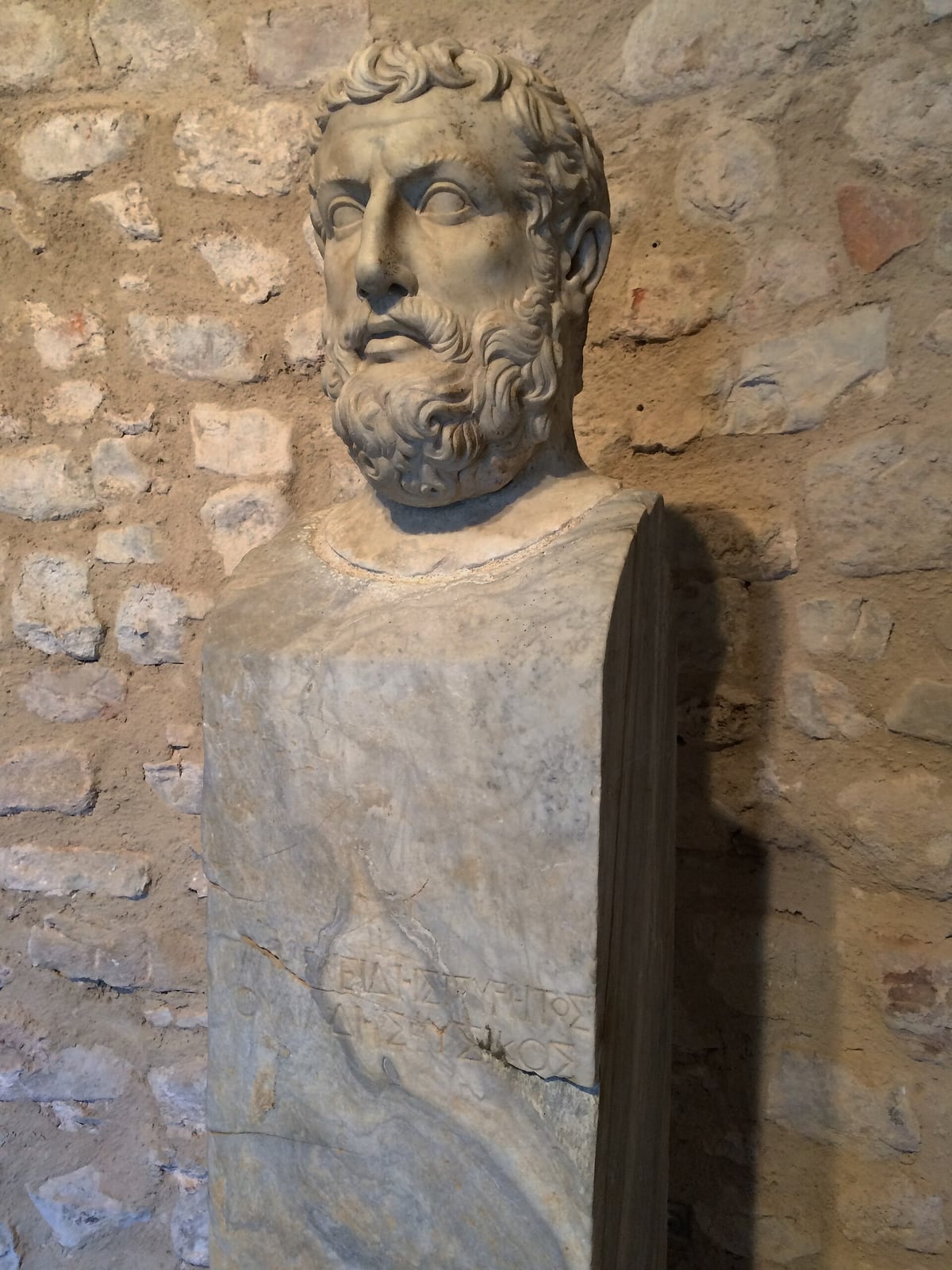
Cabeza identificada con Parménides (Velia) · CC BY-SA 4.0
उनके अपने शब्दों में
«Meet it is that thou shouldst learn all things, as well the unshaken heart of well-rounded truth, as the opinions of mortals in which is no true belief at all.»DK 28 B1.28–30, en Sexto Empírico, Contra los matemáticos VII 111, y Simplicio, Comentario al Sobre el cielo 557. Griego: Diels-Kranz; inglés: John Burnet, Early Greek Philosophy (1908); español: traducción propia.

मूल विचार
What is (to eon): The poem turns on a single word, the Greek verb *esti*, "is", often without an expressed subject.
संदर्भ में देखें
जीवनी
6 मिनट का पाठ
स्पैनिश मूल से सहायता-प्राप्त अनुवाद, मातृभाषी अनुवादक द्वारा समीक्षा लंबित।
एक ही मार्ग की कविता
पार्मेनिडीज़ ने षट्पदी छंद (हेक्सामीटर) में — होमर और हेसियड के छंद में — केवल एक कविता लिखी, जिसकी लगभग एक सौ साठ पंक्तियाँ सेक्स्टस एम्पिरिकस, सिम्प्लिसियस, प्रोक्लस, प्लूटार्क और अन्य लेखकों के उद्धरणों के कारण सुरक्षित हैं। यह यूनानी दर्शन का पहला पाठ है जो कदम-दर-कदम तर्क करता है, और पहला जो यह पूछता है कि किसी चीज़ के बारे में यह कहने का क्या अर्थ है कि वह «है»। प्लेटो ने, जिन्होंने उन्हें «पूज्य और भयावह» कहा, उन पर एक संवाद लिखा और उनके सिद्धांत से विच्छेद को «पितृहत्या» के रूप में प्रस्तुत किया; अरस्तू ने «भौतिकी» के आरंभ में उनकी स्थापनाओं की विवेचना की। एम्पेडोक्लीज़ से लेकर परमाणुवादियों तक, बाद का समूचा प्रकृति-दर्शन जन्म और मृत्यु के उनके निषेध के उत्तर के रूप में पढ़ा जा सकता है।
एलिया
एलिया — अपने संस्थापकों के लिए ह्येले, रोमनों के लिए वेलिया — तिर्रेनियन तट पर, पोसिडोनिया के दक्षिण में, एक नई बस्ती थी। हेरोडोटस के अनुसार इसे लगभग 540 ई.पू. में उन फ़ोकियाई लोगों ने बसाया था, जो आयोनिया में फ़ारसी आक्रमण से भाग रहे थे। डायोजिनीज़ लेर्शियस पार्मेनिडीज़ को एक कुलीन और धनी परिवार के पाइरेस का पुत्र बताते हैं और, अपोलोडोरस का अनुसरण करते हुए, उनकी प्रौढ़ावस्था को 69वें ओलंपियाड (504–501 ई.पू.) में रखते हैं, जिससे उनका जन्म लगभग 540 में ठहरता। इसके विपरीत, प्लेटो «पार्मेनिडीज़» संवाद में बताते हैं कि दार्शनिक लगभग पैंसठ वर्ष की आयु में एथेंस आए थे, जब सुकरात बहुत युवा थे, जिससे उनका जन्म लगभग 515 में ठहरता है। बर्नेट को संदेह था कि अपोलोडोरस ने उनकी प्रौढ़ावस्था को एलिया की स्थापना के साथ मिला दिया है; अनेक विद्वान प्लेटो वाले कालक्रम को वरीयता देते हैं, यद्यपि संवाद का दृश्य संभवतः साहित्यिक कल्पना है; बर्नेट, जो उसे ऐतिहासिक मानते थे, उसका बचाव करने वाले गिने-चुने लोगों में थे।
गुरु, शिष्य और विधान
प्राचीन लेखकों ने उन्हें कई गुरु दिए। अरस्तू बताते हैं कि उन्हें ज़ेनोफ़ेनीज़ का शिष्य कहा जाता था — वह कवि-दार्शनिक जिसने होमर के देवताओं की आलोचना की थी और जो स्वयं भी यूनानी पश्चिम में रहा; थियोफ्रेस्टस ने उन्हें एनैक्सिमैंडर से जोड़ा। सोशन अधिक ठोस थे: उनके अनुसार एक निर्धन किंतु कुलीन पाइथागोरीय, डायोकाइटस के पुत्र अमीनियस, उन्हें अध्ययन के शांत जीवन की ओर ले गए, और पार्मेनिडीज़ ने उनकी मृत्यु पर उनके लिए एक वीर-समाधि-मंदिर बनवाया। प्लेटो के भांजे स्प्यूसिपस का कहना था कि उन्होंने अपने नगर को विधान दिया, और प्लूटार्क जोड़ते हैं कि एलिया के अधिकारी हर वर्ष उनका पालन करने की शपथ लेते थे; स्ट्रैबो नगर के सुशासन का श्रेय पार्मेनिडीज़ और उनके सबसे प्रसिद्ध शिष्य ज़ेनो को देते हैं।
1962 में वेलिया की खुदाई में ईसवी पहली शताब्दी की एक शीर्षहीन हर्मीस-प्रतिमा मिली, जिस पर अभिलेख था: «पार्मेनिडीज़, पाइरेस का पुत्र, उलियादेस, प्रकृति-दार्शनिक»। उसी भवन के अन्य अभिलेख वैद्यों को उलियादेस की उपाधि से सम्मानित करते हैं, जो उपचारक अपोलो उलियोस की ओर संकेत करती है। इससे लगता है कि सदियों बाद एलिया का एक चिकित्सा-संप्रदाय स्वयं को पार्मेनिडीज़ का उत्तराधिकारी मानता था। पीटर किंग्सले ने प्रस्ताव रखा है कि उन्हें एक इयात्रोमांतिस — मंदिर-निद्रा के माध्यम से उपचार करने वाले पुरोहित — के रूप में देखा जाए और कविता को एक दिव्य-दर्शन के अनुभव के वृत्तांत के रूप में पढ़ा जाए; यह परिकल्पना विचारोत्तेजक है, पर किसी प्रत्यक्ष प्रमाण पर आधारित नहीं, और अधिकांश विद्वान इसे अटकल मानते हैं।
यात्रा
कविता एक यात्रा से आरंभ होती है। एक युवक को रथ पर बुद्धिमती घोड़ियाँ लिए जा रही हैं, जिन्हें सूर्य की पुत्रियाँ हाँक रही हैं, जो रात्रि का निवास छोड़ आई हैं; पहियों की नाभियों में धुरियाँ चरमराती हैं। वे रात्रि और दिवस के मार्गों के द्वार पर पहुँचते हैं, जिनकी कुंजियाँ प्रतिशोधिनी न्याय-देवी के पास हैं; कन्याएँ उसे मना लेती हैं और द्वार खुल जाते हैं। दूसरी ओर एक अनाम देवी युवक का दायाँ हाथ थामती है और घोषणा करती है कि उसे सब कुछ जानना होगा: «सुगोल सत्य का अकंप हृदय» भी और नश्वरों के मत भी, जिनमें कोई सच्चा विश्वास नहीं। सेक्स्टस एम्पिरिकस ने, जिन्होंने यह प्रस्तावना सुरक्षित रखी, इसे ज्ञान के रूपक के रूप में पढ़ा; वाल्टर बुर्कर्ट ने इसमें पाताल-लोक में अवतरण देखा, और अन्य विद्वानों ने दीक्षा।
सत्य का मार्ग
देवी सिखाती है कि अन्वेषण के केवल दो मार्ग सोचे जा सकते हैं: कि «है» और उसका न होना असंभव है, और कि «नहीं है» और उसका न होना अनिवार्य है। दूसरा मार्ग अगम्य है, क्योंकि जो नहीं है, उसे न जाना जा सकता है न कहा जा सकता है; «क्योंकि सोचना और होना एक ही है» (B3)। फिर भी नश्वर एक तीसरी पगडंडी पर भटकते हैं: «दोमुँहे», विवेकहीन, वे मानते हैं कि होना और न होना एक भी हैं और एक नहीं भी। लंबा खंड 8, जिसे सिम्प्लिसियस ने छठी शताब्दी में इसलिए उतार लिया कि, उनके अनुसार, पुस्तक दुर्लभ हो चुकी थी, जो है उसके «लक्षण» निकालता है: वह न जन्मा है न नष्ट होगा, क्योंकि जो नहीं है उससे वह आ नहीं सकता; वह संपूर्ण, अद्वितीय, अचल और परिपूर्ण है; «वह न था, न होगा, क्योंकि वह अभी एक साथ संपूर्ण है, एक, अविच्छिन्न»; और वह सब ओर से सीमित है, किसी सुगोल गोले के पिंड के समान।
«जो है» ठीक-ठीक क्या है, इस पर बहस आज भी जारी है। पारंपरिक व्याख्या के अनुसार पार्मेनिडीज़ संसार की बहुलता और परिवर्तन का निषेध करते हैं; जी. ई. एल. ओवेन ने इसमें हर उस चीज़ के बारे में एक स्थापना पढ़ी जो चिंतन का विषय हो सकती है; अलेक्ज़ेंडर मूरेलाटोस और चार्ल्स कान ने यूनानी क्रिया के विधेयात्मक और सत्यवाचक अर्थ पर बल दिया; जॉन पामर ने एक «उदार एकत्ववाद» का पक्ष रखा है, जिसके अनुसार पार्मेनिडीज़ उसका वर्णन करते हैं जो अनिवार्य रूप से है, यह नकारे बिना कि अन्य वस्तुएँ भी हैं।
मत का मार्ग
अपना «विश्वसनीय कथन» समाप्त करने के बाद देवी नश्वर मतों की «भ्रामक व्यवस्था» प्रस्तुत करती है: दो रूपों से बना एक संसार — प्रकाश या आकाशीय अग्नि, और घनी रात्रि — जिसकी हमारे पास कुछ ही पंक्तियाँ बची हैं। उनमें आकाशीय वलयों की बात है; एक ऐसी दिव्य शक्ति की, जो सब पर शासन करती है और जिसने सब देवताओं में सबसे पहले इरोस की रचना की; उस चंद्रमा की, जो सदा सूर्य की किरणों की ओर देखता हुआ «पराए प्रकाश» से चमकता है; भ्रूण के निर्माण की, और अंगों के मिश्रण के अनुसार विचार की। पार्मेनिडीज़ को यह पहचानने का श्रेय दिया गया कि भोर का तारा और साँझ का तारा एक ही नक्षत्र हैं और पृथ्वी गोल है, यद्यपि यही सूचनाएँ पाइथागोरस के बारे में भी मिलती हैं। एक देवी उस ब्रह्मांड-विज्ञान को विस्तार से क्यों सिखाती है जिसे वह स्वयं मिथ्या घोषित करती है, यह कविता की पहेलियों में से एक है।
एलिया की विरासत
उनके शिष्य ज़ेनो ने उन विरोधाभासों से सिद्धांत की रक्षा की, जो बहुलता और गति की असंगतियाँ दिखाते थे; सामोस के मेलिसस ने उसे गद्य में फिर से कहा। एम्पेडोक्लीज़, अनैक्सागोरस, ल्यूसिपस और डेमोक्रिटस ने स्वीकार किया कि शून्य से कुछ उत्पन्न नहीं होता और न कुछ शून्य में विलीन होता है, और परिवर्तन को अपरिवर्ती तत्त्वों के मिश्रण और पृथक्करण के रूप में समझाया। प्लेटो को «सोफ़िस्ट» में, अ-सत् को अन्यता के रूप में अर्थ देने के लिए, «पिता पार्मेनिडीज़ पर हाथ उठाने» का साहस करना पड़ा। उनकी मृत्यु के बारे में कुछ ज्ञात नहीं। उनकी कविता, पुस्तक के रूप में लुप्त होकर, नवप्लेटोवादी टीकाओं में बची रही, और आज प्राचीन काल के सबसे अधिक अध्ययन किए जाने वाले पाठों में से एक है।
स्रोत: Diógenes Laercio. Vidas y opiniones de los filósofos ilustres IX 21–23 (Parménides), 25 (Zenón) y 24 (Meliso), s. III d. C. Trad. inglesa de C. D. Yonge, Bohn, Londres, 1853 (Project Gutenberg n.º 57342); trad. inglesa de R. D. Hicks, Loeb, 1925 (Wikisource). · Diels, Hermann y Kranz, Walther. Die Fragmente der Vorsokratiker, 6.ª ed. Weidmann, Berlín, 1951–1952, cap. 28 (Parmenides), A (testimonios) y B 1–19. Texto griego consultado en la transcripción de Wikisource en griego («Περί φύσεως (Παρμενίδης)»). · Kirk, G. S., Raven, J. E. y Schofield, M. The Presocratic Philosophers, 2.ª ed. Cambridge University Press, 1983, cap. VIII (Parmenides of Elea). Trad. esp. de Jesús García Fernández, Gredos, 1987. · Burnet, John. Early Greek Philosophy, 2.ª ed. A. and C. Black, Londres, 1908, cap. IV (Parmenides of Elea), §§ 84–97 (Project Gutenberg n.º 67097). · Coxon, A. H. The Fragments of Parmenides: A Critical Text with Introduction and Translation, the Ancient Testimonia and a Commentary. Van Gorcum, Assen, 1986; ed. revisada por Richard McKirahan, Parmenides Publishing, Las Vegas, 2009.
कालक्रम
जीवन, वर्ष-दर-वर्ष
प्रत्येक बिंदु एक प्रमाणित घटना है। उसे स्रोत और निश्चितता के स्तर सहित पढ़ने के लिए क्लिक करें।
लगभग 540 ई.पू.Elea (Hyele), Campania
Foundation of Elea
Phocaeans fleeing the Persian advance found Hyele on the Tyrrhenian coast after the battle of Alalia (Herodotus I 163–167). Years BCE are expressed as negative numbers.
संभावितHeródoto. Historias I 163–167 (los focenses y la fundación de Hyele/Elea), s. V a. C. Trad. inglesa de G. C. Macaulay, Macmillan, Londres, 1890 (Project Gutenberg n.º 2707).
लगभग 540 ई.पू.
Foundation of Elea
Phocaeans fleeing the Persian advance found Hyele on the Tyrrhenian coast after the battle of Alalia (Herodotus I 163–167). Years BCE are expressed as negative numbers.
संभावित
लगभग 515 ई.पू. · 0 वर्ष
Birth
Born in Elea, son of Pyres, of a noble and wealthy family. The date is inferred from Plato (Parmenides 127b); Apollodorus' chronology would place his birth around 540.
संभावित
लगभग 504 ई.पू.
Floruit according to Apollodorus
Diogenes Laertius (IX 23) places his prime in the 69th Olympiad (504–501 BCE), the same as Heraclitus'.
परंपरा
लगभग 490 ई.पू.
Ameinias and the contemplative life
According to Sotion (in Diogenes Laertius IX 21), the Pythagorean Ameinias turns him to the life of study; at his death Parmenides dedicates a hero-shrine to him. Date unknown.
परंपरा
लगभग 480 ई.पू.
Composition of the poem
He composes his hexameter poem, traditionally called On Nature. The date is an estimate; the poem seems to respond to Heraclitus and precedes Empedocles and Zeno.
विवादित
लगभग 470 ई.पू.
Lawgiver of Elea
Speusippus (in Diogenes Laertius IX 23) and Plutarch (Against Colotes 1126a) credit him with Elea's laws, which magistrates swore each year to obey. Date unknown.
परंपरा
लगभग 450 ई.पू. · 65 वर्ष
Visit to Athens with Zeno
According to Plato's Parmenides (127a–c), he attends the Great Panathenaea with Zeno, stays in the Ceramicus and converses with a very young Socrates. The meeting is probably a literary fiction; Athenaeus (XI 505f) already doubted it.
विवादित
लगभग 370 ई.पू.
Plato writes the Parmenides and the Sophist
Plato makes Parmenides the protagonist of a dialogue and, in the Sophist (241d), presents the critique of his thesis on not-being as "parricide".
संभावित
लगभग 530
Simplicius copies fragment 8
In his commentary on Aristotle's Physics, Simplicius transcribes long passages of the poem "because of the rarity of the book" (In Phys. 144.25). Without him the way of truth would be unknown.
प्रमाणित
1897
Diels's Parmenides Lehrgedicht
Hermann Diels publishes the critical edition of the poem with German translation, the basis of the DK 28 numbering.
प्रमाणित
1962
Discovery of the Velia herm
Excavations bring to light a headless herm of the 1st century CE inscribed «Παρμενείδης Πύρητος Οὐλιάδης φυσικός», alongside others dedicated to Ouliad physicians.
प्रमाणित
1965
Tarán's edition
Leonardo Tarán publishes Parmenides: A Text with Translation, Commentary and Critical Essays, one of the standard twentieth-century editions.
प्रमाणित
कृतियाँ
आवश्यक कृतियाँ
वे कृतियाँ जिनके बिना उनकी विरासत को समझा नहीं जा सकता।
लिखित कृति · लगभग 480 ई.पू.
On Nature (poem)
Περὶ φύσεως (título convencional)
A didactic poem in dactylic hexameters, divided into a proem and two parts. In the proem (B1) a youth travels by chariot to the gates of Night and Day and is received by a goddess who promises to teach him the truth and the opinions of mortals. The way of truth (B2–B8.49) argues that only "what is" can be thought and said, and deduces that it is unborn, imperishable, one, continuous, unmoving and like a sphere. The way of opinion (B8.50–B19) sets out a cosmology of two principles, light and night, with theories of the stars, the moon, generation and thought. It is the founding text of Western ontology.
18 संस्करण · amazon.es
लिखित कृति · लगभग 480 ई.पू.
Way of Truth (B2–B8.49)
Ἀλήθεια (DK 28 B2–B8.49)
The goddess's central teaching. It presents two ways of inquiry—"is" and "is not"—, rules out the second because what is not can be neither thought nor said, and censures the "two-headed" mortals who confuse being and not-being. In B8 it deduces the properties of what is: unborn and imperishable, whole and single, unmoving, without past or future, continuous, bounded and like a well-rounded sphere. It is the first extended deductive argument in Greek philosophy.
4 संस्करण
वचन
किसी निश्चित कृति में स्थित वचन। प्रत्येक के साथ उसका स्रोत और विश्वसनीयता का स्तर है।
Meet it is that thou shouldst learn all things, as well the unshaken heart of well-rounded truth, as the opinions of mortals in which is no true belief at all.χρεὼ δέ σε πάντα πυθέσθαι / ἠμὲν Ἀληθείης εὐκυκλέος ἀτρεμὲς ἦτορ / ἠδὲ βροτῶν δόξας, ταῖς οὐκ ἔνι πίστις ἀληθής.
सत्यापितDK 28 B1.28–30, en Sexto Empírico, Contra los matemáticos VII 111, y Simplicio, Comentario al Sobre el cielo 557. Griego: Diels-Kranz; inglés: John Burnet, Early Greek Philosophy (1908); español: traducción propia.
अप्रामाणिक या विवादित आरोपण वाले उद्धरण (4)
«Nothing comes from nothing (ex nihilo nihil fit).»
The idea is in B8.7–10, but the Latin formula is not his: it comes from Lucretius (I 150, "nil posse creari de nilo") and scholasticism. It is ascribed to him through textbook summary.
«Being is and non-being is not.»
A textbook formula condensing B2 and B6, but not found as such in the poem. Parmenides says "is" with no expressed subject, and the nominalised "Being" is a later interpretation.
«Change is an illusion.»
A modern paraphrase. The poem says that coming to be, perishing, changing place and colour are "names" mortals have given believing them true (B8.38–41); it does not speak of illusion.
«If the one is not, nothing is.»
The conclusion of Plato's dialogue Parmenides (166c), spoken by the character Parmenides. It is a Platonic construction, not a quotation from the historical philosopher.
अंतिम शब्द
उनके अंतिम शब्दों का कोई सत्यापन-योग्य अभिलेख उपलब्ध नहीं है।
No record of his last words or of the circumstances of his death survives.
पूछें
उनकी कृतियाँ क्या उत्तर देती हैं
मानवता के बारह महान प्रश्न और उनके ग्रंथ उनका जो उत्तर देने देते हैं, संदर्भों सहित। हम कभी उनके मुख में अपने शब्द नहीं रखते।
परम सत्य क्या है? क्या ईश्वर है?
What is: one, ungenerated, imperishable and complete like a sphere
निराकार परम सत्ताउनके सिद्धांत से निष्कर्षित
Parmenides does not speak of God in the Way of Truth. What his poem presents as ultimate is “what is”: that which cannot not be, which is neither born nor perishes, which is all at once, one and continuous, and complete on every side like the bulk of a well-rounded sphere. It is held within its limits by Justice and Necessity, divine figures that in the poem function almost as names of logical law. The revelation itself is spoken by a nameless goddess who welcomes the youth in the proem. What the text allows us to affirm is an absolute without personal features, accessible only to thought, from which all genesis, change and plurality are excluded.
इस प्रश्न की अन्य गुरुओं से तुलना करेंमैं कौन हूँ? क्या कोई सच्चा आत्म है?
The poem does not treat the self: only being and thinking
इस पर कुछ नहीं कहा
The surviving fragments of Parmenides contain no doctrine of the self or of the individual soul. The Way of Truth deals with “what is” and its relation to thought — the same is thinking and being, says B3 — but this thinking is not presented as the consciousness of a subject. In the Way of Opinion, B16 explains that the mind of humans depends on the mixture of their limbs at each moment, a physical psychology the goddess herself has labelled the opinion of mortals. The figure of the youth brought before the goddess in the proem is narrative. Readings that see in B3 an identity between consciousness and being belong to the later tradition.
इस प्रश्न की अन्य गुरुओं से तुलना करेंहम दुःख क्यों भोगते हैं?
The poem deals with mortals' error, not their pain
इस पर कुछ नहीं कहा
Parmenides does not ask why we suffer. What his poem diagnoses is something else: the straying of “two-headed” mortals, who know nothing, wander deaf and blind, and take being and not-being as the same and not the same (B6). That error is cognitive, not moral or existential, and the remedy the goddess offers is to judge by reason and not be carried along by the habit of the senses (B7). Neither the Way of Truth nor the remains of the Way of Opinion, devoted to cosmology and physiology, treat human pain as a problem. Attributing a doctrine of suffering to him would be inventing it.
इस प्रश्न की अन्य गुरुओं से तुलना करेंमृत्यु के बाद क्या होता है?
What is is neither born nor dies; the poem ignores the individual
इस पर कुछ नहीं कहा
The fragments of Parmenides do not deal with what happens to the person after death. The Way of Truth holds that what is is ungenerated and imperishable, because from what is not nothing can come and into it nothing can go; Justice does not loosen her fetters to let it be born or perish. But that argument concerns being as such, not the individual soul, and applying it to the soul would be an extrapolation. The Way of Opinion, which contains the cosmology, mentions a divinity that governs birth and the union of the sexes, but the surviving remains say nothing of a destiny after death.
इस प्रश्न की अन्य गुरुओं से तुलना करेंमुक्ति या उद्धार कैसे प्राप्त होता है?
A journey from night to light to learn well-rounded truth
प्रत्यक्ष ज्ञान सेउनके सिद्धांत से निष्कर्षित
Parmenides' proem narrates a journey: mares carry the youth, “the man who knows”, along the road of the goddess; the daughters of the Sun leave the halls of Night and open for him the gates guarded by Justice. There the goddess promises to teach him everything: both the unshaken heart of well-rounded truth and the opinions of mortals, in which there is no true belief. The rest of the poem is that teaching, and its condition is to judge by reason and not by the unseeing eye or the echoing ear. If one can speak of liberation in Parmenides, it is that of thought leaving the path of mortals.
इस प्रश्न की अन्य गुरुओं से तुलना करेंक्या गुरु आवश्यक है?
A goddess teaches, but asks that her proof be judged by reason
सहायक, पर अनिवार्य नहींउनके सिद्धांत से निष्कर्षित
Parmenides' poem takes the form of teaching: a nameless goddess welcomes the youth, takes his right hand and promises to teach him the truth and the opinions of mortals. It might seem a revelation accepted on authority. Yet the goddess asks for no faith: she urges him not to be carried by the habit of the senses and to judge by reason the much-contested refutation she sets before him (B7). The divine guide opens the way, but assent depends on the disciple's reasoning. The fragments say nothing of human teachers; tradition makes Parmenides a pupil of Xenophanes and of the Pythagorean Ameinias, and teacher of Zeno of Elea.
इस प्रश्न की अन्य गुरुओं से तुलना करेंक्या संसार वास्तविक है?
Only what is is; the world of mortals is name and opinion
एक सत्य पर आभासस्पष्ट रूप से कहा है
The Way of Truth proves that what is can neither come to be nor perish, nor move, nor be divided, because that would mean admitting what is not. It follows that the world the senses perceive — birth, death, change of place, alteration of colour — consists of names mortals have laid down trusting them to be true. Yet the goddess does not simply dismiss that world: in the second part of the poem she sets out a complete cosmology, based on light and night, so that no mortal may outstrip him in knowledge, although she warns that its arrangement is deceptive. The world has the consistency of appearance; only what is is fully real.
इस प्रश्न की अन्य गुरुओं से तुलना करेंप्रेम क्या है?
Eros appears only in the cosmogony, as the first of the gods
इस पर कुछ नहीं कहा
Parmenides does not treat love as a human experience or as a path. In the Way of Opinion, devoted to the cosmology of mortals, a divinity who governs all things drives the union of female and male (B12), and of her it is said that she devised Eros, first of all the gods (B13), a line Plato quotes in the Symposium. It is a cosmogonic force explaining generation, not a doctrine of love as a bond between persons or as longing for the divine. Moreover, the goddess presents that whole section of the poem as the opinion of mortals. On love in an ethical or mystical sense, Parmenides is silent.
इस प्रश्न की अन्य गुरुओं से तुलना करेंक्या हम स्वतंत्र हैं, या सब कुछ पूर्वनिर्धारित है?
Necessity binds being, but the poem says nothing of human action
इस पर कुछ नहीं कहा
In Parmenides' poem Necessity and Justice appear often, but not as forces governing human life. In the Way of Truth mighty Necessity holds what is in the bonds of the limit, and Justice does not loosen her fetters to let it come to be or perish: they are figures of the immutability of being. In the cosmology, Necessity binds the heaven to hold the limits of the stars (B10). None of the fragments asks whether humans choose their acts or whether everything is determined. Ancient tradition made Parmenides lawgiver of Elea, but his laws do not survive. On this question he is silent.
इस प्रश्न की अन्य गुरुओं से तुलना करेंध्यान या प्रार्थना क्यों करें?
The proem's journey is no method of prayer or meditation
इस पर कुछ नहीं कहा
The fragments of Parmenides contain no teachings on prayer or meditative practices. The proem narrates a chariot journey to a goddess and is full of religious imagery — the daughters of the Sun, Justice holding the keys, the gates of the paths of Night and Day —, but its function in the poem is to introduce a teaching that must be judged by reason. A recent line of interpretation, represented by Peter Kingsley, has linked Parmenides with Apollo's healer-priests at Elea and with incubation practices; it rests on inscriptions found at Velia, not on the poem. Attributing a doctrine of prayer to him would go beyond the texts.
इस प्रश्न की अन्य गुरुओं से तुलना करेंक्या बुद्धि परम को जान सकती है?
A goddess reveals the truth, but demands it be judged by reason alone
श्रद्धा और तर्क एक-दूसरे के सहायकउनके सिद्धांत से निष्कर्षित
Parmenides is at once the thinker of revelation and the founder of deductive argument. His poem puts the truth in the mouth of a goddess, reached by a journey far from the paths of men; but what the goddess teaches is rigorous reasoning, and her watchword is not to be carried by the habit of the senses but to judge by reason the refutation she proposes. For Parmenides thought does reach the ultimate: thinking and being are the same, and what is not cannot be thought or said. Divine revelation and reason do not compete: the first provides the frame, the second the proof; the senses are relegated to opinion.
इस प्रश्न की अन्य गुरुओं से तुलना करेंसंसार से हटें या उसे बदलें?
The poem does not treat social life; tradition made him a lawgiver
इस पर कुछ नहीं कहा
The fragments of Parmenides' poem contain no reflection on how to live among humans, whether to withdraw or act in the city. The proem's journey takes the youth far from the paths of men, but that distance is one of knowledge, not a programme of life. Reports of his public life come from other sources: Speusippus, according to Diogenes Laertius, said he gave laws to his fellow citizens of Elea, and Plutarch adds that magistrates swore each year to observe them. If so, Parmenides would have been an active citizen; but his laws do not survive and cannot be connected with his doctrine. On this question his work is silent.
इस प्रश्न की अन्य गुरुओं से तुलना करें
निकटता और तनाव
निकटता और तनाव
उनके मतों के आधार पर प्रश्न-दर-प्रश्न आकलित। प्रत्येक सहमति या टकराव का कारण क्लिक करने पर।
इनसे मिलता-जुलता सोचते हैं
Leo Tolstoy
इन पर सहमत: परम सत्य क्या है? क्या ईश्वर है? · क्या गुरु आवश्यक है? · क्या बुद्धि परम को जान सकती है?
Ramana Maharshi
इन पर सहमत: परम सत्य क्या है? क्या ईश्वर है? · मुक्ति या उद्धार कैसे प्राप्त होता है? · क्या संसार वास्तविक है?
Adi Shankara
इन पर सहमत: परम सत्य क्या है? क्या ईश्वर है? · मुक्ति या उद्धार कैसे प्राप्त होता है? · क्या संसार वास्तविक है?
- BKByron Katie
Byron Katie
इन पर सहमत: परम सत्य क्या है? क्या ईश्वर है? · मुक्ति या उद्धार कैसे प्राप्त होता है? · क्या संसार वास्तविक है?

प्रसंग और वृत्तांत
प्रसंग और वृत्तांत
विवादितc. 500–490 a. C. (incierto)
Ameinias' shrine
वृत्तांत का स्रोत: Diogenes Laertius IX 21, quoting Sotion of Alexandria (2nd century BCE). There is no other source. Burnet (Early Greek Philosophy, § 84) considers it plausible.
साक्ष्यs. V a. C.
The magistrates' oath
वृत्तांत का स्रोत: Speusippus in Diogenes Laertius IX 23; Plutarch, Against Colotes 1126a–b; Strabo VI 1.1. The three sources are independent of one another, though none is contemporary.
स्रोत: Plutarco. Contra Colotes 1126a–b; Estrabón, Geografía VI 1.1; Espeusipo citado por Diógenes Laercio IX 23.
विवादितc. 450 a. C.
The meeting with the young Socrates
वृत्तांत का स्रोत: Plato, Parmenides 127a–c; Theaetetus 183e; Sophist 217c. Athenaeus, Deipnosophists XI 505f, considers it anachronistic. It is a literary testimony without independent confirmation.
प्रमाणितs. I d. C. (inscripción); 1962 (hallazgo)
"Parmenides, son of Pyres, Ouliades, natural philosopher"
वृत्तांत का स्रोत: Packard Humanities Institute, inscription no. 301222 (Apollo 2, 1962, 125–136; SEG 38.1020). Reading "Ouliades" as the title of a medical school is the most widespread interpretation; Peter Kingsley developed it into his hypothesis of Parmenides the healer.
विवादितs. V a. C.
The evening star and the morning star
वृत्तांत का स्रोत: Diogenes Laertius IX 21 and 23 (Theophrastus, Favorinus); VIII 14 and 48 ascribe the same to Pythagoras. Fragments B14 and B15 are transmitted by Plutarch.
प्रमाणितc. 530 d. C.
Simplicius and the rarity of the book
वृत्तांत का स्रोत: Simplicius, Commentary on Aristotle's Physics 144.25–28 (ed. Diels, 1882). The commentator himself states his motive.
स्रोत: Simplicio. In Aristotelis Physicorum libros commentaria, ed. Hermann Diels, Commentaria in Aristotelem Graeca IX, Reimer, Berlín, 1882, pp. 144–146 (transcripción de B8 «por la rareza del libro»).
शिक्षाएँ
शिक्षाएँ
वे अवधारणाएँ जो उनके चिंतन को रूप देती हैं, उनके संदर्भ में समझाई गई।
What is (to eon)lo-que-es
The core of the way of truth (B2, B6, B8).
The two ways of inquirylas-dos-vias
Fragments B2, B6, B7 and B8.1–2.
स्रोत: Mourelatos, Alexander P. D. The Route of Parmenides. Yale University Press, New Haven, 1970 (ed. revisada, Parmenides Publishing, 2008); y Palmer, John, Parmenides and Presocratic Philosophy, Oxford University Press, 2009.
Thinking and beingpensar-y-ser
Fragments B3 and B8.34–36; reception in Plotinus (Enneads V 1, 8).
Truth (aletheia) and opinion (doxa)verdad-y-opinion
Fragments B1.28–32, B8.50–61, B9–B19.
स्रोत: Kirk, G. S., Raven, J. E. y Schofield, M. The Presocratic Philosophers, 2.ª ed. Cambridge University Press, 1983, cap. VIII (Parmenides of Elea). Trad. esp. de Jesús García Fernández, Gredos, 1987.
The well-rounded sphereesfera
Fragment B8.42–49.
The journey of the proemel-viaje-del-proemio
Fragment B1; testimony of Sextus Empiricus (Against the Mathematicians VII 111–114).
स्रोत: Sexto Empírico. Contra los matemáticos VII 111–114 (cita y alegoría del proemio, B1.1–30). Trad. inglesa de R. G. Bury, Loeb Classical Library, 1935.
वीडियो
वीडियो
रिकॉर्डिंग, साक्षात्कार और वृत्तचित्र। वीडियो YouTube से चलते हैं; वे यहाँ संग्रहीत नहीं हैं।
Parmenides: Pre-Socratic Philosophy
व्याख्यान· EN· 2022· 47 min
Philosophy Overdose
The Eleatic Monists (Parmenides & Zeno)
व्याख्यान· EN· 2017· 73 min
Adam Rosenfeldआधिकारिक चैनल
Parmenides of Elea | Being and Non-Being | Philosophy Core Concepts
विश्लेषण· EN· 2019· 14 min
Gregory B. Sadler - That Philosophy Guyआधिकारिक चैनल
4. All is One: Parmenides & Zeno on Being and Nothingness
व्याख्यान· EN· 2014· 46 min
Mark Thorsbyआधिकारिक चैनल
Parmenides of Elea
व्याख्यान· EN· 2021· 30 min
Michael Wiitalaआधिकारिक चैनल
Gadamer on Parmenides & the Birth of Philosophy
साक्षात्कार· DE· 2021· 8 min
Philosophy Overdose
Parménides de Elea
वृत्तचित्र· ES· 2017· 28 min
UNEDआधिकारिक चैनल
Conferencia José Luis Díaz Arroyo "Parménides"
व्याख्यान· ES· 2018· 135 min
Hercritia-Cátedra de Hermenéutica Críticaआधिकारिक चैनल
Parménides | Historia de la filosofía (6/61)
व्याख्यान· ES· 2017· 80 min
Ernesto Castroआधिकारिक चैनल
Filosofía más allá de la academia. Ciclo de filosofía antigua. Parménides y Heráclito
व्याख्यान· ES· 2022· 88 min
Universidad Nacional Abierta y a Distancia UNADआधिकारिक चैनल
Le Parménide historique et le «Parménide» de Platon — Francesco Fronterotta
व्याख्यान· FR· 2019· 94 min
Andrea Cirla
Parménide avec Lambros Couloubaritsis
साक्षात्कार· FR· 2016· 44 min
Résonance[s]
चित्रशाला
चित्रशाला
सत्यापित लाइसेंस वाले चित्र। प्रत्येक में उसके रचयिता और श्रेय का उल्लेख सुरक्षित है।
संबंध
संबंध
प्रभाव, शिष्यत्व और वैचारिक निकटता। प्रमाणित संबंध को विश्लेषण से पहचानी गई समानता से अलग दर्शाया गया है।
इनके शिष्य
Jenófanes
Aristotle (Metaphysics A 5) records that he "is said" to have been his pupil, and Diogenes Laertius states it; the relationship is traditional and disputed.
विश्लेषण से पहचानी गई समानता
इनसे प्रभावित
According to Sotion, it was the Pythagorean Ameinias who led him to the life of study; the link with Pythagoreanism is indirect.
विश्लेषण से पहचानी गई समानता
इनके समकालीन
Contemporaries; many read in B6 ("two-headed mortals… for whom the path of all things turns back on itself") a polemical allusion to Heraclitus.
विश्लेषण से पहचानी गई समानता
इनके गुरु
Zenón de Elea
His pupil and, according to Plato, his beloved; he defended his doctrine with the paradoxes against plurality and motion.
प्रमाणित संबंध
इनके गुरु
Meliso de Samos
Diogenes Laertius (IX 24) makes him a pupil of Parmenides; he reformulated the Eleatic thesis in prose, with what is as infinite.
प्रमाणित संबंध
इन्हें प्रभावित किया
Theophrastus, quoted by Diogenes Laertius (VIII 55), calls him an "emulator and imitator" of Parmenides in his poems; Empedocles accepts that nothing comes to be or perishes.
प्रमाणित संबंध
इनसे भेंट
Plato narrates a meeting in Athens around 450 BCE (Parmenides 127a–c; Theaetetus 183e; Sophist 217c); many consider it fictitious, though Burnet accepted it as historical.
विश्लेषण से पहचानी गई समानता
इन्हें प्रभावित किया
He devotes the dialogue Parmenides to him and, in the Sophist, presents his own theory of not-being as "parricide" against him.
प्रमाणित संबंध
इन्हें प्रभावित किया
He discusses the Eleatic thesis at the start of the Physics (I 2–3) and in the Metaphysics (A 5), and explains the pluralists as a response to it.
प्रमाणित संबंध
इन्हें प्रभावित किया
In the Enneads (V 1, 8) he quotes B3 and presents Parmenides as a forerunner of the identity of Intellect and being.
प्रमाणित संबंध
इनसे मिलते-जुलते विचार
The affirmation of a single reality, unborn and unchanging, against apparent multiplicity has led to comparisons between the way of truth and Advaita Vedanta; there is no historical contact.
विश्लेषण से पहचानी गई समानता
स्रोत
स्रोत
इस प्रविष्टि के लिए देखे गए ग्रंथ-सूची और सूचीपत्र।
- Wikidata, entidad Q125551 «Parmenides» (112 enlaces entre wikis; P31=Q5). Registra nacimiento en 515 a. C. y muerte en 470 a. C. (esta última incompatible con la cronología platónica) y Elea como lugar de nacimiento.
- Diógenes Laercio. Vidas y opiniones de los filósofos ilustres IX 21–23 (Parménides), 25 (Zenón) y 24 (Meliso), s. III d. C. Trad. inglesa de C. D. Yonge, Bohn, Londres, 1853 (Project Gutenberg n.º 57342); trad. inglesa de R. D. Hicks, Loeb, 1925 (Wikisource).
- Diels, Hermann y Kranz, Walther. Die Fragmente der Vorsokratiker, 6.ª ed. Weidmann, Berlín, 1951–1952, cap. 28 (Parmenides), A (testimonios) y B 1–19. Texto griego consultado en la transcripción de Wikisource en griego («Περί φύσεως (Παρμενίδης)»).
- Kirk, G. S., Raven, J. E. y Schofield, M. The Presocratic Philosophers, 2.ª ed. Cambridge University Press, 1983, cap. VIII (Parmenides of Elea). Trad. esp. de Jesús García Fernández, Gredos, 1987.
- Palmer, John. «Parmenides». The Stanford Encyclopedia of Philosophy, ed. Edward N. Zalta y Uri Nodelman; primera publicación el 8 de febrero de 2008, revisión sustancial del 4 de marzo de 2025.
- Burnet, John. Early Greek Philosophy, 2.ª ed. A. and C. Black, Londres, 1908, cap. IV (Parmenides of Elea), §§ 84–97 (Project Gutenberg n.º 67097).
- Coxon, A. H. The Fragments of Parmenides: A Critical Text with Introduction and Translation, the Ancient Testimonia and a Commentary. Van Gorcum, Assen, 1986; ed. revisada por Richard McKirahan, Parmenides Publishing, Las Vegas, 2009.
- Laks, André y Most, Glenn W. (eds. y trads.). Early Greek Philosophy, vol. V: Western Greek Thinkers, Part 2. Loeb Classical Library 528, Harvard University Press, 2016.
- Graham, Daniel W. (ed. y trad.). The Texts of Early Greek Philosophy, 2 vols. Cambridge University Press, 2010.
- Eggers Lan, Conrado y otros (introd., trad. y notas). Los filósofos presocráticos I. Biblioteca Clásica Gredos 12, Gredos, Madrid, 1978.
- Platón. Parménides 127a–128b; Teeteto 183e–184a; Sofista 237a, 241d–242a; Banquete 178b. Trad. inglesa de Benjamin Jowett, The Dialogues of Plato, 3.ª ed., Clarendon Press, Oxford, 1892 (Project Gutenberg n.º 1687, Parmenides).
- Aristóteles. Metafísica A 5, 986b18–987a2; Física I 2–3, 184b–187a; Sobre la generación y la corrupción I 8, 325a. Trad. inglesa de W. D. Ross y R. P. Hardie (Internet Classics Archive, MIT).
- Simplicio. In Aristotelis Physicorum libros commentaria, ed. Hermann Diels, Commentaria in Aristotelem Graeca IX, Reimer, Berlín, 1882, pp. 144–146 (transcripción de B8 «por la rareza del libro»).
- Sexto Empírico. Contra los matemáticos VII 111–114 (cita y alegoría del proemio, B1.1–30). Trad. inglesa de R. G. Bury, Loeb Classical Library, 1935.
- Packard Humanities Institute, Searchable Greek Inscriptions, n.º 301222: herma acéfala de mármol blanco de Velia, s. I d. C., «Παρμενείδης Πύρητος Οὐλιάδης φυσικός»; primera publicación en Apollo 2 (1962) 125–136; SEG 38.1020 y 53.1114.
- Kingsley, Peter. In the Dark Places of Wisdom. Golden Sufi Center, Inverness (California), 1999.
- Plutarco. Contra Colotes 1126a–b; Estrabón, Geografía VI 1.1; Espeusipo citado por Diógenes Laercio IX 23.
- Cordero, Néstor Luis. Siendo, se es. La tesis de Parménides. Biblos, Buenos Aires, 2005.
- Tarán, Leonardo. Parmenides: A Text with Translation, Commentary and Critical Essays. Princeton University Press, Princeton, 1965.
- Gallop, David. Parmenides of Elea: Fragments. A Text and Translation with an Introduction. University of Toronto Press (Phoenix, suppl. vol. 18), Toronto, 1984.
- Davidson, Thomas. «The Fragments of Parmenides». Journal of Speculative Philosophy, 4 (1870); separata, E. P. Gray, St. Louis, 1869 (Wikisource).
- Fairbanks, Arthur (ed. y trad.). The First Philosophers of Greece. Kegan Paul, Trench, Trübner, Londres, 1898 (Project Gutenberg n.º 78670).
- «Parmenides», Wikipedia en inglés, y «Parménides», Wikipedia en español (consultadas para contrastar datos y bibliografía; texto propio).
- Open Library (Internet Archive): ediciones del poema de Parménides verificadas por ISBN.
- Heródoto. Historias I 163–167 (los focenses y la fundación de Hyele/Elea), s. V a. C. Trad. inglesa de G. C. Macaulay, Macmillan, Londres, 1890 (Project Gutenberg n.º 2707).
- Bernabé, Alberto (ed. y trad.) y Pérez de Tudela, Jorge (introd., notas y comentarios). Parménides. Poema. Fragmentos y tradición textual, epílogo de Néstor-Luis Cordero. Istmo (Fundamentos), Madrid, 2007.
- Mourelatos, Alexander P. D. The Route of Parmenides. Yale University Press, New Haven, 1970 (ed. revisada, Parmenides Publishing, 2008); y Palmer, John, Parmenides and Presocratic Philosophy, Oxford University Press, 2009.
- Owen, G. E. L. «Eleatic Questions». The Classical Quarterly, 10 (1960), pp. 84–102.
- Plotino. Enéadas V 1, 8 (Parménides y la identidad de pensar y ser). Trad. inglesa de Stephen MacKenna, 1917–1930.
- अधिकार-धारक
- Textos antiguos en dominio público; cada traducción y edición crítica pertenece a su traductor o editorial
पुष्टि की प्रतीक्षा में
जो यह प्रविष्टि अभी तक निश्चित नहीं कर सकी है। हम उसे भर देने के बजाय कह देना बेहतर समझते हैं।
- Muerte: no hay ningún dato antiguo sobre su fecha o lugar; Wikidata da 470 a. C., incompatible con la visita a Atenas a los 65 años que narra Platón. Se deja como «unknown».
- Nacimiento: se adopta c. 515 a. C. (Platón, Parménides 127b; Wikidata); la cronología de Apolodoro (madurez en 504–501) lo situaría hacia el 540.
- Edición de Akal (Básica de Bolsillo, 2008): traductor no verificado en catálogo. Tarán (Princeton, 1965): ISBN no verificado.
- Traducción española de dominio público del poema: no localizada en línea con URL estable.
- Manuscritos: el poema depende de los códices de Simplicio y Sexto Empírico; falta identificar signaturas y digitalizaciones fiables.
- Programas de afiliación: ninguno verificado. Lista vacía.
- Año de los vídeos: el de la grabación cuando la descripción lo indica y, si no, el de publicación en YouTube.
2026-10-25 को शोधित