Christentum · Christliche Mystik · Protestantismus · Hermetik
Jakob Böhme
Jacob Böhme
1575 – 1624Historisch belegte Person
Schuhmacher aus Görlitz (1575–1624) und einer der großen spekulativen Mystiker des Abendlandes. Ohne Studium und ohne Latein schrieb er nach einer Erleuchtung um 1600 die Morgenröte im Aufgang (1612), die ihm ein Schreibverbot eintrug, und zwischen 1618 und 1624 ein gewaltiges Werk: die Drei Prinzipien, das Dreifache Leben, die Vierzig Fragen von der Seele, De signatura rerum, das Mysterium Magnum und den Weg zu Christo, das einzige zu Lebzeiten gedruckte Buch. Seine Theosophie des Ungrunds, der Sophia und des Ursprungs des Bösen prägte Pietismus, deutschen Idealismus, Romantik und russische Religionsphilosophie.
- Werke
- 32Werke
- Ausgaben
- 63Ausgaben
- Zitate
- 5Zitate
- Videos
- 15Videos
- Bilder
- 9Bilder
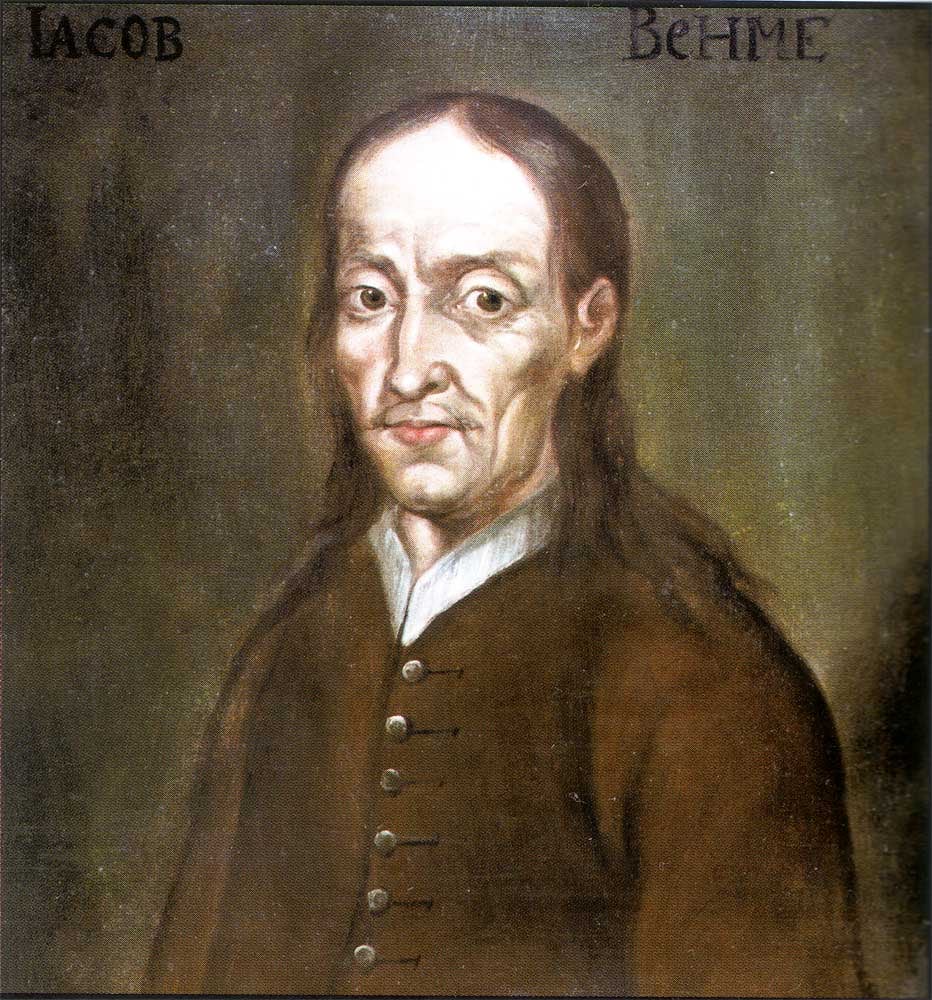
Retrato póstumo de Jakob Böhme · Public domain
In eigenen Worten
«Als ich aber in meinem angesetzten Eifer also hart wider Gott und aller Höllen Porten stürmete, als wären meiner Kräften noch mehr vorhanden, in willens, das Leben daran zu setzen – welches freilich nicht mein Vermögen wäre gewesen ohne des Geistes Gottes Beistand – alsbald nach etlichen harten Stürmen ist mein Geist durch der Höllen Porten durchgebrochen bis in die innerste Geburt der Gottheit und allda mit Liebe umfangen worden, wie ein Bräutigam seine liebe Braut umfähet.»Morgenröte im Aufgang (Aurora), cap. 19, § 11 (texto de la ed. de Friburgo, 1977, en Zeno.org)

Der zentrale Gedanke
Ungrund (the groundless): Ungrund is the word with which Böhme names what lies 'before' God as revealed God: a bottomless abyss, without nature or determination, which is neither good nor evil, neither light nor darkness, but pure will that does not yet will anything.
Im Zusammenhang sehen
Biografie
5 Min. Lesezeit
Unterstützte Übersetzung aus dem spanischen Original, Durchsicht durch einen muttersprachlichen Übersetzer ausstehend.
Der Hirtenjunge von Alt Seidenberg
Jakob Böhme wurde 1575 in Alt Seidenberg geboren, einem Dorf in der Oberlausitz wenige Kilometer von Görlitz, in den Ländern der Böhmischen Krone; der 24. April, den manche Nachschlagewerke angeben, ist urkundlich nicht sicher belegt. Er war das vierte Kind einer lutherischen Bauernfamilie von einigem Vermögen; sein Vater versah zudem das Amt des Kirchvaters und war Schöffe im örtlichen Gericht. Zu schwach für die Feldarbeit, hütete er als Kind das Vieh und kam mit etwa vierzehn Jahren zu einem Schuhmacher in die Lehre. Das Wenige, was wir über diese Jahre wissen, stammt aus der Lebensbeschreibung, die sein Schüler Abraham von Franckenberg 1651 verfasste und die der erbaulichen Erzählung näher steht als der Chronik: der Schatz, den er in einer Felsspalte der Landeskrone erblickte, der Fremde, der ihm verkündete, er werde groß werden.
Nach seinen Wanderjahren als Geselle ließ er sich in Görlitz nieder. Am 24. April 1599 erwarb er das Bürgerrecht und wurde Schuhmachermeister, kaufte eine der Schuhbänke am Untermarkt und heiratete im selben Jahr Katharina Kuntzschmann, die Tochter eines Görlitzer Fleischers; aus der Ehe gingen mindestens vier Söhne hervor. Böhme verkehrte in dem frommen Kreis, der sich um den früheren Oberpfarrer Martin Moller gebildet hatte, einer mystisch geprägten Frömmigkeit innerhalb des Luthertums, und las die Bibel mit einer Inbrunst, die der Schultheologie seiner Zeit kaum bekannt war.
Eine Viertelstunde
Um 1600 hatte er das Erlebnis, das seinem Leben die Richtung gab. Franckenberg verbindet es mit dem Widerschein der Sonne auf einem Zinngefäß, in dem Böhme plötzlich den Grund aller Dinge geschaut habe. Er selbst erzählte es zwanzig Jahre später, ohne jedes Gefäß, in einem Brief an Caspar Lindner, den Zolleinnehmer in Beuthen: Nach langer Schwermut und hartnäckigem Ringen mit Gott sei »die Pforte eröffnet« worden, und in einer Viertelstunde habe er mehr gesehen und gewusst, als wenn er viele Jahre auf hohen Schulen gewesen wäre: das Wesen aller Wesen, den Grund und Ungrund, die Geburt der Dreifaltigkeit, den Ursprung dieser Welt und aller Kreaturen. Zwölf Jahre lang schrieb er nichts; die Überlieferung setzt um 1610 eine Erneuerung jenes Lichts an.
Die Morgenröte und Pfarrer Richter
1612 begann er, für sich allein, die Morgenröte im Aufgang zu schreiben, das Buch, das seine Freunde Aurora nennen sollten: eine unvollendete Abhandlung über Gott, die Engel, den Fall Luzifers und die Natur, in deren neunzehntem Kapitel er erzählt, wie sein Geist die Pforten der Hölle durchbrach bis zur innersten Geburt der Gottheit und dort umfangen wurde, »wie ein Bräutigam seine liebe Braut umfähet«. Der Edelmann Karl von Ender sah das Manuskript und ließ es abschreiben; eine Abschrift gelangte an den Görlitzer Oberpfarrer Gregor Richter, der es von der Kanzel herab anprangerte. Im Juli 1613 ließ der Rat Böhme kurzzeitig festsetzen, beschlagnahmte das Original und verbot ihm das Schreiben. Er gehorchte mehr als fünf Jahre lang; er verkaufte seine Schuhbank und verlegte sich auf den Handel mit Garn und Handschuhen, der ihn häufig nach Prag führte.
Sechs Jahre des Schreibens
1618 griff er, von Freunden ermutigt — Ärzten, schlesischen Adligen, Lesern des Paracelsus —, wieder zur Feder und errichtete in sechs Jahren ein Werk von Tausenden von Seiten. 1619 vollendete er die Beschreibung der drei Prinzipien göttlichen Wesens; 1620 Vom dreifachen Leben des Menschen, die Vierzig Fragen von der Seele — Antwort auf die Fragen, die ihm der Arzt Balthasar Walther gestellt hatte, ein Orientreisender, der ihm kabbalistische und alchemistische Begriffe vermittelte —, Von der Menschwerdung Jesu Christi, die Sechs theosophischen Punkte und das Mysterium pansophicum. Es folgten die Erwiderungen auf seine Kritiker Balthasar Tilke und Esaias Stiefel, De signatura rerum (1622), eine Reihe kurzer Erbauungsschriften über Buße, Gelassenheit und übersinnliches Leben und 1623 sein großer Kommentar zur Genesis, das Mysterium Magnum, dazu Von der Gnadenwahl und Von Christi Testamenten. Alles kursierte in handschriftlichen Abschriften; seine Briefe, von denen mehr als sechzig erhalten sind, bleiben der beste Zugang zu seinem Denken.
Böhme konnte kein Latein und hatte nie eine Universität betreten. Er schrieb im Deutsch der Lausitz, mischte den Wortschatz der Lutherbibel mit dem des Paracelsus und der Alchemie und schmiedete Wörter für das, was keinen Namen hatte: den Ungrund, das Grundlose vor aller Bestimmung; die Quellgeister, die die ewige Natur gebären; die Sophia, die Jungfrau der Weisheit, die Gottes Spiegel ist. Seine beständige Frage ist der Ursprung des Bösen: wie ein Gott, der Liebe ist, in seiner ewigen Natur ein finsteres Feuer birgt, und wie der Mensch, zwischen Zorn und Liebe gestellt, neu geboren werden kann. Hegel, der ihn mit Bewunderung und zugleich mit Ungeduld gegenüber seiner Sprache las, nannte ihn den ersten deutschen Philosophen.
Der Weg zu Christo und das Ende
Anfang 1624 ließen Freunde in Görlitz, nach seiner eigenen Aussage vor dem Rat ohne seine Erlaubnis, einen kleinen Band seiner Erbauungsschriften drucken: Der Weg zu Christo, das einzige seiner Bücher, das er gedruckt sah. Richter antwortete mit einer Schmähschrift, die ihn der Ketzerei und der Trunksucht bezichtigte, und Böhme erwiderte mit einer Schutzschrift. Am 26. März legte ihm der Rat nahe, die Stadt zu verlassen. Im Mai reiste er nach Dresden, wo er im Haus des Hofarztes wohnte und mit Theologen und Räten des Kurfürsten sprach; er kehrte unverurteilt zurück und verbrachte den Sommer bei adligen Freunden in Schlesien, wo er die Hundertsiebenundsiebzig theosophischen Fragen begann. Richter starb im August. Von Fieber und einem Darmleiden geschwächt, kehrte Böhme Anfang November nach Görlitz zurück; die neue Geistlichkeit unterzog ihn einem Verhör, bevor sie ihm das Abendmahl reichte. Er starb am 17. November 1624. Sein Begräbnis setzte der Rat gegen den Willen des Pfarrers durch, und sein Grab wurde bald darauf geschändet.
Nachwirkung
Seine Schriften wurden durch seine Schüler gerettet und vor allem durch die Niederlande: Johann Georg Gichtel veröffentlichte 1682 in Amsterdam die erste Gesamtausgabe, und 1730 erschien die Theosophia revelata. In England übersetzten ihn John Sparrow, John Ellistone und Humphrey Blunden zwischen 1645 und 1662; die »Behmenisten« wirkten auf Quäker und Philadelphier, und im 18. Jahrhundert betrachtete William Law ihn als seinen Meister, so sehr, dass die englische Ausgabe von 1764–1781 unter seinem Namen bekannt ist. Über Oetinger gelangte er zum schwäbischen Pietismus und zu Schelling, über Saint-Martin nach Frankreich, über Novalis in die Romantik. Im 20. Jahrhundert lasen ihn Berdjajew, der im Ungrund die Ahnung einer dem Sein vorausliegenden Freiheit sah, und Jung, der die philosophische Kugel aus den Vierzig Fragen als Mandala abbildete. Seit 2020 bereitet die Universität Stuttgart die erste historisch-kritische Ausgabe seiner Werke vor.
Quellen: Franckenberg, Abraham von. Gründlich und wahrhafftiger Bericht von dem Leben und Abschied des in Gott selig-ruhenden Jacob Böhmens (1651). En: Des gottseeligen hocherleuchteten Jacob Böhmens Teutonici Philosophi Alle Theosophische Wercken, Ámsterdam, 1682, vol. [1]; reimpr. en Theosophia revelata, 1730. Trad. inglesa en The Works of Jacob Behmen, Londres, 1764, vol. I. · Weeks, Andrew. Boehme: An Intellectual Biography of the Seventeenth-Century Philosopher and Mystic. Albany: State University of New York Press, 1991. · Hessayon, Ariel, y Sarah Apetrei (eds.). An Introduction to Jacob Boehme: Four Centuries of Thought and Reception. Nueva York y Londres: Routledge, 2014. · Martensen, Hans Lassen. Jacob Boehme: His Life and Teaching. Trad. T. Rhys Evans. Londres: Hodder and Stoughton, 1885. · Böhme, Jacob. Concerning the Three Principles of the Divine Essence. Trad. John Sparrow (1648); reed. C. J. Barker, con introducción de Paul Deussen (incluye las actas del concejo de Görlitz de 1613 y 1624 y la cronología de los últimos meses). Londres: John M. Watkins, 1910.
Zeitleiste
Das Leben, Jahr für Jahr
Jeder Punkt ist ein belegtes Ereignis. Klicken Sie, um es mit Quelle und Grad der Gewissheit zu lesen.
15750 JahreAlt Seidenberg (Stary Zawidów)
Birth
Born at Alt Seidenberg, fourth child of a Lutheran peasant family. The year is secure; the day (24 April) given by some reference works is undocumented.
WahrscheinlichFranckenberg, Abraham von. Gründlich und wahrhafftiger Bericht von dem Leben und Abschied des in Gott selig-ruhenden Jacob Böhmens (1651). En: Des gottseeligen hocherleuchteten Jacob Böhmens Teutonici Philosophi Alle Theosophische Wercken, Ámsterdam, 1682, vol. [1]; reimpr. en Theosophia revelata, 1730. Trad. inglesa en The Works of Jacob Behmen, Londres, 1764, vol. I.
Nach dem Tod
- 1682First complete edition (Amsterdam)
- 1730Theosophia revelata
- 1764 – 1781The 'William Law' English edition
- 2020Historical-critical edition
1575 · 0 Jahre
Birth
Born at Alt Seidenberg, fourth child of a Lutheran peasant family. The year is secure; the day (24 April) given by some reference works is undocumented.
Wahrscheinlich
um 1589 · 14 Jahre
Shoemaker's apprentice
After herding cattle as a boy, and owing to his frail constitution, he is apprenticed to a shoemaker at Seidenberg at about fourteen.
Wahrscheinlich
24. April 1599 · 24 Jahre
Citizen and master in Görlitz; marriage
On 24 April he is enrolled as a citizen of Görlitz, buys a shoe stall on the Untermarkt and that year marries Katharina Kuntzschmann.
Belegt
um 1600 · 25 Jahre
The illumination
An experience he himself describes in his letter to Caspar Lindner: in a quarter of an hour he saw 'the Being of all beings'. Franckenberg ties it to sunlight reflected in a pewter vessel.
Belegt
1610 · 35 Jahre
Second illumination
The biographical tradition places a renewal of the vision and the awareness of a vocation in this year.
Überlieferung
1612 · 37 Jahre
Aurora
He writes Morgenröte im Aufgang for himself; it remains unfinished. The nobleman Karl von Ender has it copied and it circulates.
Belegt
Juli 1613 · 38 Jahre
Council condemnation and ban on writing
Denounced by the chief pastor Gregor Richter, the council briefly detains him, confiscates the manuscript and forbids him to write. He sells his stall and takes up the trade in yarn and gloves.
Belegt
1618 · 43 Jahre
He writes again
Encouraged by friends, he breaks his silence. He begins The Three Principles of the Divine Essence, completed in 1619.
Belegt
1620 · 45 Jahre
The year of the great treatises
He writes The Threefold Life of Man, the Forty Questions of the Soul (for Balthasar Walther), The Incarnation of Jesus Christ, the Six Theosophic Points, the Six Mystical Points and the Mysterium pansophicum.
Belegt
1622 · 47 Jahre
De signatura rerum and the devotional treatises
He composes De signatura rerum and the short treatises on repentance, resignation and the supersensual life that will form Der Weg zu Christo.
Belegt
1623 · 48 Jahre
Mysterium Magnum
He completes his commentary on Genesis, Mysterium Magnum, and writes The Election of Grace and Of Christ's Testaments.
Belegt
Januar 1624 · 48 Jahre
Der Weg zu Christo printed
At the beginning of the year his friends print Der Weg zu Christo in Görlitz, the only book of his published in his lifetime. Richter attacks it in a lampoon; Böhme answers with his Apology.
Belegt
26. März 1624 · 48 Jahre
The council invites him to leave
Summoned on 26 March, he declares that a nobleman printed the book without his involvement; the council warns him to leave the town.
Belegt
Mai 1624 · 49 Jahre
Stay in Dresden
From May he lives in Dresden at the house of the court physician; he converses with theologians and counsellors of the Elector of Saxony and returns uncondemned.
Belegt
17. November 1624 · 49 Jahre
Death
Ill since his stay in Silesia, he returns to Görlitz and dies on 17 November. The new clergy had examined him before giving him communion; the burial is imposed by the council.
Belegt
1682
First complete edition (Amsterdam)
Johann Georg Gichtel publishes the complete works in Amsterdam in fifteen parts, with Franckenberg's biography.
Belegt
1730
Theosophia revelata
Johann Wilhelm Ueberfeld's edition appears, the basis of most later editions and of Peuckert's facsimile.
Belegt
1764 – 1781
The 'William Law' English edition
The Works of Jacob Behmen appear in London (1764–1781) in four volumes, based on the seventeenth-century translations and associated with the name of William Law.
Belegt
2020
Historical-critical edition
The University of Stuttgart and Frommann-Holzboog begin the Historisch-kritische Gesamtausgabe, directed by Günther Bonheim.
Belegt
Werke
Grundlegende Werke
Die Werke, ohne die sich das Vermächtnis nicht verstehen lässt.
Schriftliches Werk · 1612
Morgenröte im Aufgang (Aurora)
His first book, written for himself in 1612 and never finished. Subtitled 'the root or mother of philosophy, astrology and theology', it covers the Trinity, the creation of the angels, the fall of Lucifer and the seven 'source-spirits' of divine nature, and comments on the first days of creation. In chapter nineteen Böhme narrates his own illumination. Copied without his permission, it provoked Pastor Richter's denunciation and the 1613 ban on writing; the manuscript remained in the authorities' hands. It already contains his whole thought in germ, in a language still groping and impassioned.
6 Ausgaben · amazon.de

Schriftliches Werk · 1622
De signatura rerum, oder Von der Geburt und Bezeichnung aller Wesen
His treatise on the 'signature': everything visible bears inscribed in its form, colour and sound the inner quality that generated it, and whoever can read those marks reads the being of all beings. Böhme combines the Paracelsian doctrine of signatures with an alchemical-type process (the seven properties, the death and resurrection of matter) which he applies at once to metals, plants and the rebirth of the soul. It was one of his most widely read books in England and among the German Romantics.
5 Ausgaben · amazon.de

Spätere Zusammenstellung · 1624
Der Weg zu Christo (Christosophia)
The only book of Böhme's printed in his lifetime (Görlitz, early 1624), at his friends' initiative. It gathers the devotional treatises on repentance, resignation and the supersensual life; later editions expanded it to nine 'little books' with the new birth, prayer, the dialogue of the two souls and divine contemplation. It is the most accessible way into his spirituality and the immediate cause of Richter's last persecution.
5 Ausgaben · amazon.de

Schriftliches Werk · 1623
Mysterium Magnum, oder Erklärung über das erste Buch Mosis
His longest work: a chapter-by-chapter commentary on Genesis, from creation to the death of Joseph, read as the history of God's revelation in nature and in the soul. Creation, the fall, Cain and Abel, Noah, Babel, Abraham, Isaac, Jacob and Joseph become figures of inner processes and of the struggle between wrath and love. It contains his most mature exposition of the Ungrund, Sophia and the 'language of nature'. Berdyaev considered it his chief work.
6 Ausgaben · amazon.com
Das gesamte Werk (32)

Beschreibung der drei Principien göttlichen Wesens (De tribus principiis)
1619

Hohe und tiefe Gründe von dem dreifachen Leben des Menschen (De triplici vita hominis)
1620

Viertzig Fragen von der Seelen (Psychologia vera)
1620
Jakob Böhme
Von der Menschwerdung Jesu Christi (De incarnatione verbi)
The Conscious LibraryVon der Menschwerdung Jesu Christi (De incarnatione verbi)
1620

Von sechs theosophischen Puncten (Sex puncta theosophica)
1620

Kurze Erklärung von sechs mystischen Puncten (Sex puncta mystica)
1620
Jakob Böhme
Mysterium pansophicum, oder Gründlicher Bericht vom irdischen und himmlischen Mysterio
The Conscious LibraryMysterium pansophicum, oder Gründlicher Bericht vom irdischen und himmlischen Mysterio
1620
Jakob Böhme
Informatorium novissimorum, oder Unterricht von den letzten Zeiten an P. Kaym
The Conscious LibraryInformatorium novissimorum, oder Unterricht von den letzten Zeiten an P. Kaym
1620
Jakob Böhme
Trostschrift von vier Complexionen
The Conscious LibraryTrostschrift von vier Complexionen
1624
Jakob Böhme
Libri apologetici: Schutzschriften wider Balthasar Tilken
The Conscious LibraryLibri apologetici: Schutzschriften wider Balthasar Tilken
1621
Jakob Böhme
Antistifelius: Bedenken über Esaias Stiefels Büchlein von dreierlei Zustand des Menschen
The Conscious LibraryAntistifelius: Bedenken über Esaias Stiefels Büchlein von dreierlei Zustand des Menschen
1621
Jakob Böhme
Vom Irrtum der Sekten Esaiä Stiefels und Ezechiel Meths
The Conscious LibraryVom Irrtum der Sekten Esaiä Stiefels und Ezechiel Meths
1622

Von wahrer Buße
1622

Von wahrer Gelassenheit
1622

Vom übersinnlichen Leben (Gespräch eines Meisters und Jüngers)
1622
Jakob Böhme
Von der neuen Wiedergeburt
The Conscious LibraryVon der neuen Wiedergeburt
1622
Jakob Böhme
Theoscopia, oder Von göttlicher Beschaulichkeit
The Conscious LibraryTheoscopia, oder Von göttlicher Beschaulichkeit
1622

De electione gratiae, oder Von der Gnadenwahl
1623
Jakob Böhme
De testamentis Christi, oder Von Christi Testamenten
The Conscious LibraryDe testamentis Christi, oder Von Christi Testamenten
1623
Jakob Böhme
Vom heiligen Gebet (De precatione)
The Conscious LibraryVom heiligen Gebet (De precatione)
1624
Jakob Böhme
Gespräch einer erleuchteten und unerleuchteten Seele
The Conscious LibraryGespräch einer erleuchteten und unerleuchteten Seele
1624
Jakob Böhme
Apologia contra Gregorium Richter (Schutzrede wider Gregor Richter)
The Conscious LibraryApologia contra Gregorium Richter (Schutzrede wider Gregor Richter)
1624
Jakob Böhme
Libellus apologeticus (Schriftliche Verantwortung an E. E. Rat zu Görlitz)
The Conscious LibraryLibellus apologeticus (Schriftliche Verantwortung an E. E. Rat zu Görlitz)
1624
Quaestiones theosophicae, oder Betrachtung göttlicher Offenbarung (177 Fragen)
1624
Zitate
Zitate, die in einem bestimmten Werk nachgewiesen sind. Jedes trägt seine Herkunft und seinen Grad an Verlässlichkeit.
Als ich aber in meinem angesetzten Eifer also hart wider Gott und aller Höllen Porten stürmete, als wären meiner Kräften noch mehr vorhanden, in willens, das Leben daran zu setzen – welches freilich nicht mein Vermögen wäre gewesen ohne des Geistes Gottes Beistand – alsbald nach etlichen harten Stürmen ist mein Geist durch der Höllen Porten durchgebrochen bis in die innerste Geburt der Gottheit und allda mit Liebe umfangen worden, wie ein Bräutigam seine liebe Braut umfähet.GeprüftMorgenröte im Aufgang (Aurora), cap. 19, § 11 (texto de la ed. de Friburgo, 1977, en Zeno.org)
Apokryphe Zitate oder Zitate umstrittener Zuschreibung (1)
«He to whom time is as eternity and eternity as time is free from all strife.»
A verse circulating in German ('Wem Zeit wie Ewigkeit / und Ewigkeit wie Zeit, / der ist befreit / von allem Streit') as Böhme's motto. It is traditionally attributed to him as an album inscription, but has not been located in the 1682 or 1730 editions; it is recorded as a traditional attribution without a verified source.
Letzte Worte
Späterer Bericht von Zeugen
«Nun fahre ich hin ins Paradeis.»Nun fahre ich hin ins Paradeis.
Transmitted by Abraham von Franckenberg in his Bericht (1651), which relies on the account of those present, in particular the physician Tobias Kober, who attended Böhme in his last illness. According to that account, in the early hours of 17 November 1624 Böhme asked his son Tobias whether he did not hear a most sweet music and asked for the door to be opened so that it might be heard better; at about six in the morning he took leave of his wife and son, spoke these words and died. The sentence belongs to a devout narrative written by a disciple, not to an official record.
Quelle: Franckenberg, Abraham von. Gründlich und wahrhafftiger Bericht von dem Leben und Abschied des in Gott selig-ruhenden Jacob Böhmens (1651). En: Des gottseeligen hocherleuchteten Jacob Böhmens Teutonici Philosophi Alle Theosophische Wercken, Ámsterdam, 1682, vol. [1]; reimpr. en Theosophia revelata, 1730. Trad. inglesa en The Works of Jacob Behmen, Londres, 1764, vol. I.
Fragen
Was das Werk beantwortet
Zwölf große Fragen der Menschheit und was sich aus den Texten darauf antworten lässt, mit Belegen. Wir legen niemandem Worte in den Mund.
Was ist das Absolute? Gibt es Gott?
From the will-less Unground the self-revealing God is born
Persönlich und unpersönlich zugleichAusdrücklich gesagt
Jakob Böhme places at the origin the Ungrund, the Unground: an eternal nothing, free of all determination, neither good nor evil as yet. In that abyss arises a will that longs to know itself and, to do so, gives itself a ground: thus the Trinity is begotten and, from it, eternal nature with its dark and luminous forces. The God who reveals himself is fully personal —Father, Son and Spirit, love and light overcoming wrath— but proceeds from a ground prior to all form. Böhme claims to have seen in his illumination of 1600 the ground and the Unground and the birth of the Trinity. Both aspects are true: the hidden deity and the manifested God.
Diese Frage mit anderen Meistern vergleichenWer bin ich? Gibt es ein wahres Selbst?
The soul is an eternal fire that must be reborn into light
Eine geschaffene, unsterbliche SeeleAusdrücklich gesagt
Jakob Böhme devoted his Forty Questions on the Soul (1620) to the subject. The soul proceeds from God's eternal nature: it is a spark of fire, a centre of will with the same dark and luminous forces that exist at the origin, and is therefore an image of the whole. After the fall, the human being lives in three principles: the dark fire of wrath, the light of love and the outer world of the elements. The self-will, the will closed upon itself, is what burns in wrath; the true self is the soul that abandons its own will and is reborn in Christ, in the light. The soul does not die: it remains in the principle in which it has fixed itself.
Diese Frage mit anderen Meistern vergleichenWarum leiden wir?
The will that closes on itself suffers, burning in wrath
Die Trennung von GottAusdrücklich gesagt
Jakob Böhme looks for the origin of evil in eternal nature itself. In God there is a first dark principle, of fire and wrath, which in the deity is always overcome by the light of love. Lucifer, and later the human being, wanted to live in that fire by themselves, with a will of their own, and thus separated themselves from the light: hell is not an added place, but the wrath in which the will that turns from love locks itself. Suffering is the torment of that self-will. Hence the remedy is surrender (Gelassenheit): where self-love dies, God's will takes up the same space in the soul.
Diese Frage mit anderen Meistern vergleichenWas geschieht nach dem Tod?
At death the soul remains in the principle it has chosen
Ewiges Leben und AuferstehungAusdrücklich gesagt
Jakob Böhme treats the soul's destiny in the Forty Questions on the Soul. When the outer body, made of the elements, dissolves, the soul remains in the principle in which it has fixed its will: if it has been reborn in Christ, in the light of love; if it has shut itself up in itself, in the dark fire of wrath, which is hell. This is not a place to which one is sent, but the manifestation of what the soul already was. Böhme keeps the Christian hope of resurrection and of the heavenly body, which the reborn person already begins to bear in this life as an inner spiritual substance.
Diese Frage mit anderen Meistern vergleichenWie erlangt man Befreiung oder Erlösung?
Rebirth: die to self-will so that Christ is born within
Durch Gnade und LiebeAusdrücklich gesagt
For Jakob Böhme, salvation is an inner new birth. The Way to Christ, his only book printed in his lifetime (1624), gathers treatises on true repentance, surrender and the supersensual life. The process begins with the conversion of the will: the soul recognises that it lives in the wrath of its self-will and turns toward God's mercy. Then comes Gelassenheit, self-abandonment, in which the will ceases to will on its own account. Then Christ is born in the soul as light and renews it. Böhme criticises reliance on a merely outward justification: without this rebirth, faith remains history and titles.
Diese Frage mit anderen Meistern vergleichenBraucht es einen Lehrer?
A quarter-hour of light teaches more than years at university
Der Lehrer ist innenAusdrücklich gesagt
Jakob Böhme, a shoemaker of Görlitz without university studies, recounts that after an inner struggle the gate was opened to him and in a quarter of an hour he saw and knew more than if he had spent many years at a university. His authority comes from no teacher and no school, but from the Spirit who teaches within. Hence his constant criticism of professional theologians and the «stone church», who know the history of Christ without having seen him born in themselves. Yet his Theosophical Letters show that he ended up acting as a guide for a circle of readers and friends, whom he always referred to their own experience of inner rebirth.
Diese Frage mit anderen Meistern vergleichenIst die Welt wirklich?
Each thing bears the signature of what it is within
Offenbarung des GöttlichenAusdrücklich gesagt
For Jakob Böhme, the visible world is the outward manifestation of the inner, eternal world. In De signatura rerum he maintains that every thing has a signature: its form, colour, taste and sound express the inner quality that formed it, as a person's face and voice reveal their mood. The outer world proceeds from the mingling of the two eternal principles, the dark and the luminous, and therefore good and evil are intertwined in it. It is real, but not ultimate: it is God's language, which the illuminated can read. The Mysterium magnum comments on Genesis as an account of that divine self-revelation.
Diese Frage mit anderen Meistern vergleichenWas ist Liebe?
Where self-love is banished, the love of God dwells
Was erscheint, wenn das Ich aufhörtAusdrücklich gesagt
In the dialogue Of the Supersensual Life, the master explains to the disciple that the love of God and self-love exclude one another: where self-love is banished, there the love of God dwells, and as much of the self-will as has died, so much space does the divine will, which is love, occupy in the soul. Böhme further describes love as something that, in a sense, is nothing: it appropriates nothing, and therefore it is above all things and contains them. Whoever finds it finds it in the nothingness of their own will. Love is not a virtue the self cultivates, but what appears when the self-will surrenders.
Diese Frage mit anderen Meistern vergleichenSind wir frei, oder ist alles vorherbestimmt?
Freedom is rooted in the eternal Unground
Echter freier WilleAusdrücklich gesagt
Jakob Böhme gives freedom a metaphysical foundation. The Ungrund, the Unground from which everything proceeds, is pure freedom, will without determination; and the human soul, born from eternal nature, retains something of that original freedom: it can turn toward the light of love or shut itself up in the fire of wrath. That is why in On the Election of Grace (1623) he combats the Calvinist doctrine of a predestination that would condemn some before they choose: God wills no one's evil, and each soul decides for the principle in which it wishes to live. Freedom is real and terrible: on it depends which fire the soul opens to.
Diese Frage mit anderen Meistern vergleichenWozu meditieren oder beten?
Cease for a moment from thinking and willing to hear God
Gegenwärtig seinAusdrücklich gesagt
In the dialogue Of the Supersensual Life, the disciple asks how to come to see God and hear him speak. The master answers that if he can cease for a moment from all his thinking and willing, he will hear the unspeakable words of God. The obstacle is one's own thinking and willing, which shuts the soul up in its self-image and in the noise of outward things; when that movement stops, even for an instant, the space opens where God speaks. Böhme also composed a prayer book, On Holy Prayer, for each day of the week, in which vocal prayer is a path toward that stillness of the will.
Diese Frage mit anderen Meistern vergleichenKann die Vernunft das Letzte erkennen?
The Spirit's light reveals the ground of all beings
Esoterisches WissenAusdrücklich gesagt
Jakob Böhme claims a knowledge that comes not from books or school reason, but from illumination. In Aurora (1612) he recounts that, after assailing God with zeal, his spirit broke through the gates of hell to the innermost generation of the deity; in a letter of 1621 he adds that he saw and knew the being of all beings, the ground and the Unground, the birth of the Trinity and the origin of the world. That knowledge, which he calls theosophy, is expressed in a language of its own made of qualities, principles and signatures. Böhme insists that it is verifiable: whoever is reborn of the Spirit can see it for himself. Outer reason, without that rebirth, knows only the husk.
Diese Frage mit anderen Meistern vergleichenSich von der Welt zurückziehen oder sie verwandeln?
The outer man works; the inner man remains in God
Kontemplation im HandelnAusdrücklich gesagt
Jakob Böhme was neither monk nor cleric: he was a shoemaker, later a trader in gloves and wool, married and a family man in Görlitz, and wrote in the time his trade left him. His doctrine does not demand withdrawal from the world. In the dialogues of The Way to Christ, the master teaches the disciple that he may remain in his station and work with his hands and outer senses, while his will, surrendered to God, abides in the supersensual. What he rejects is outward religion of titles, disputes and the «stone church», and the confessional wars of his time. The change that matters is the inner new birth, lived in the midst of ordinary life.
Diese Frage mit anderen Meistern vergleichen
Affinitäten und Spannungen
Affinitäten und Spannungen
Frage für Frage aus den Positionen berechnet. Den Grund jeder Übereinstimmung und jedes Widerspruchs zeigt ein Klick.
Denkt ähnlich wie
Augustine of Hippo
Übereinstimmung bei: Wer bin ich? Gibt es ein wahres Selbst? · Warum leiden wir? · Was geschieht nach dem Tod?
Vladimir Solovyov
Übereinstimmung bei: Was ist das Absolute? Gibt es Gott? · Wer bin ich? Gibt es ein wahres Selbst? · Warum leiden wir?
Hafez
Übereinstimmung bei: Wer bin ich? Gibt es ein wahres Selbst? · Warum leiden wir? · Was geschieht nach dem Tod?
Nikolai Berdyaev
Übereinstimmung bei: Was ist das Absolute? Gibt es Gott? · Wer bin ich? Gibt es ein wahres Selbst? · Warum leiden wir?
Denkt anders als

Patañjali
Widerspruch bei: Wer bin ich? Gibt es ein wahres Selbst? · Was geschieht nach dem Tod?

Pema Chödrön
Widerspruch bei: Wer bin ich? Gibt es ein wahres Selbst? · Was geschieht nach dem Tod?
Bodhidharma
Widerspruch bei: Wer bin ich? Gibt es ein wahres Selbst? · Was geschieht nach dem Tod?

Nāgārjuna
Widerspruch bei: Wer bin ich? Gibt es ein wahres Selbst? · Was geschieht nach dem Tod?
Anekdoten und Erzählungen
Anekdoten und Erzählungen
Hagiographische Erzählungc. 1585
The treasure of the Landeskrone
Herkunft der Erzählung: Abraham von Franckenberg, Bericht von dem Leben und Abschied Jacob Böhmens (1651); repeated by all later biographies.
Hagiographische Erzählungc. 1590
The stranger at the workshop
Herkunft der Erzählung: Franckenberg, Bericht (1651). There is no independent testimony; the story belongs to the genre of the prophecy of vocation.
Umstrittenc. 1600
The pewter vessel
Herkunft der Erzählung: Franckenberg, Bericht (1651); compare Böhme's letter to Caspar Lindner (1621), §§ 6–8, which describes the experience without that detail.
Mündliche Überlieferung1613–1624
Pastor Richter's slipper
Herkunft der Erzählung: Caption of the engraving in the 1686 series (Rijksmuseum RP-P-OB-2363; Van Eeghen 501-4, catalogue of the work of Jan and Casper Luyken; Wikipedia attributes it to Joseph Mulder) for the 1686 Amsterdam edition; Richter's hostility, in the 1613 and 1624 records published by Deussen (1910).
Quelle: Hessayon, Ariel, y Sarah Apetrei (eds.). An Introduction to Jacob Boehme: Four Centuries of Thought and Reception. Nueva York y Londres: Routledge, 2014.
Belegt1624
'It smells of shoemaker's pitch'
Herkunft der Erzählung: Richter's lampoon and Böhme's letter of 2 April 1624, quoted by Paul Deussen in the introduction to Concerning the Three Principles (1910), pp. xlviii–xlix, and by Martensen (1885), p. 13.
Zeugnis1624
The music of the last night
Herkunft der Erzählung: Franckenberg, Bericht (1651), based on the testimony of the physician Tobias Kober; the doctrinal examination and the resistance to the burial are also recorded in the sources gathered by Deussen (1910).
Lehren
Lehren
Die Begriffe, die das Denken gliedern, in ihrem Zusammenhang erklärt.
Ungrund (the groundless)ungrund
Mysterium pansophicum, Six Theosophic Points, Mysterium Magnum (ch. 1–3) and Clavis; reception in German Idealism and Russian religious philosophy.
Quelle: O'Regan, Cyril. Gnostic Apocalypse: Jacob Boehme's Haunted Narrative. Albany: State University of New York Press, 2002.
The three principlesdrei-prinzipien
Systematic exposition in De tribus principiis (1619) and De triplici vita (1620); synoptic tables in the Tabulae principiorum (1624).
The seven source-spirits (Quellgeister)quellgeister
Aurora, ch. 8–11; Clavis; De signatura rerum.
Sophia, the virgin of wisdomsophia
Of the Incarnation of Jesus Christ, The Threefold Life, Mysterium Magnum; reception in English Behmenism and Russian sophiology.
Quelle: Berdyaev, Nicolas. «Unground and Freedom», ensayo introductorio a Jacob Boehme, Six Theosophic Points and Other Writings, trad. John Rolleston Earle. Ann Arbor: University of Michigan Press, 1958. Y «Из этюдов о Я. Беме. Этюд I: Учение об Ungrund и свободе; Этюд II: Учение о Софии и андрогине Я. Беме и русские софиологические течения», Путь (Put'), París, 1930, n.os 20–21.
The signature of things and the language of naturesignatura-rerum
De signatura rerum (1622), Mysterium Magnum (ch. 35–36), Aurora; Paracelsian tradition.
Quelle: Weeks, Andrew. Boehme: An Intellectual Biography of the Seventeenth-Century Philosopher and Mystic. Albany: State University of New York Press, 1991.
New birth and Gelassenheitwiedergeburt
Der Weg zu Christo and its treatises (repentance, resignation, supersensual life, new birth); continuity with Eckhart, Tauler and the Theologia Deutsch.
Videos
Videos
Aufnahmen, Gespräche und Dokumentarfilme. Die Videos werden von YouTube wiedergegeben; sie werden nicht hier gespeichert.
How is Jacob Böhme relevant today? Lecture by Scott Brown
Vortrag· EN· 39 min
Embassy of the Free MindOffizieller Kanal
7 Most Important Themes in Jacob Böhme's Philosophy | Curator's Guided Tour
Dokumentarfilm· EN· 20 min
Embassy of the Free MindOffizieller Kanal
Infinite Fire Webinar VI - Prof. Dr. Wouter J. Hanegraaff on The Theosophical System of Jakob Böhme
Vortrag· DE· 61 min
Embassy of the Free MindOffizieller Kanal
Jacob Böhme in Amsterdam | Curator's Guided Tour
Dokumentarfilm· EN· 25 min
Embassy of the Free MindOffizieller Kanal
Sophia and Sophiology: From Boehme to Schelling
Vortrag· EN· 90 min
Harvard Divinity SchoolOffizieller Kanal
An Introduction to the Philosophical System of Jacob Boehme
Vortrag· EN· 77 min
Ephrata CloisterOffizieller Kanal
ALLES IN ALLEM. Die Gedankenwelt des mystischen Philosophen Jacob Böhme
Dokumentarfilm· DE· 5 min
Staatliche Kunstsammlungen DresdenOffizieller Kanal
"Men Who've Walked With God #12: Jacob Boehme" a sermon by Howard Thurman (July 12, 1953)
Originalaufnahme· EN· 1953· 34 min
American Museum of Paramusicology
How Theosophy Created Spiritual Alchemy - The Alchemy of Jakob Böhme
Analyse· EN· 41 min
ESOTERICA
The Mysticism of Jacob Boehme with Aaron French
Gespräch· EN· 68 min
Hermitix Podcast
Trailer for "The Life and Legacy of Jacob Boehme"
Dokumentarfilm· EN· 3 min
BoehmeFilm / meandriaOffizieller Kanal
Jakob Böhme Tagung, Görlitz 2014: Ralf Gleide
Vortrag· DE· 77 min
Oberlausitz Leben
Jakob Böhme: El místico que atravesó el Misterio | Entrevista a Paco Martínez Albarracín (Boehme)
Gespräch· ES· 78 min
Psicología y Espiritualidad
Mysterium Magnum: Jakob Böhme y la dialéctica del Abismo, con Isidoro Reguera
Gespräch· ES· 46 min
La Taberna de Rudolf Steiner
Francisco Martínez Albarracín: Sophia en la visión cosmoteándrica de Jacob Boehme.
Vortrag· ES· 67 min
MIAS Latina
Galerie
Galerie
Bilder mit geprüfter Lizenz. Jedes bewahrt seine Urheberschaft und seinen Herkunftsnachweis.
Beziehungen
Beziehungen
Einflüsse, Schülerschaften und Verwandtschaften. Die belegte Beziehung wird von der durch Analyse ermittelten Ähnlichkeit unterschieden.
Beeinflusste
Berdyaev made Böhme's Ungrund the basis of his philosophy of uncreated freedom; he devoted two studies to him in Put' (1930) and the essay 'Unground and Freedom' (1958).
Belegte Beziehung
Beeinflusste
Solovyov read Böhme in his formative years, particularly in London in 1875; Böhme's Sophia is one of the acknowledged sources of his sophiology.
Belegte Beziehung
Verwandte Gedanken mit
In 1930 Berdyaev compared Böhme's Sophia with that of Russian sophiology, from Solovyov to Florensky and Bulgakov, and noted their differences.
Belegte Beziehung
Verwandte Gedanken mit
Böhme's Ungrund and Eckhart's 'ground' (grunt), and the Gelassenheit of both, belong to the same family of German mysticism; there is no evidence that Böhme read Eckhart directly, though the tradition reached him through Tauler, the Theologia Deutsch and Weigel.
Durch Analyse ermittelte Ähnlichkeit
Verwandte Gedanken mit
Near contemporaries without theological schooling, both wrote down under inner command an experience that their church authorities examined with suspicion. Teresa describes the soul's itinerary; Böhme, the genesis of God and the world. There was no contact.
Durch Analyse ermittelte Ähnlichkeit
Beeinflusste
Blavatsky quoted him with admiration and gave him an entry in the Theosophical Glossary (1892), where she calls him 'a mystic and great philosopher', one of the most prominent theosophists; his terminology reached the Theosophical Society through Franz Hartmann.
Belegte Beziehung
Beeinflusste
Jung reproduced and discussed the philosophical sphere of the Forty Questions as a mandala in 'A Study in the Process of Individuation' and cited Böhme in his works on alchemy as a witness to the union of opposites.
Belegte Beziehung
Beeinflusste
Steiner devoted a chapter to him in Mystics of the Renaissance (1901), placing him among the forerunners of a modern consciousness of spirit.
Belegte Beziehung
Verwandte Gedanken mit
Two Protestant visionaries who described spiritual worlds and a correspondence between the visible and the invisible; Oetinger set them side by side in the eighteenth century. Swedenborg acknowledged no debt to Böhme and his method is very different.
Durch Analyse ermittelte Ähnlichkeit
Verwandte Gedanken mit
The devotional treatises of The Way to Christ share with The Imitation of Christ the renunciation of self-will and the distrust of knowledge that does not transform; Böhme adds a cosmology the Imitation ignores.
Durch Analyse ermittelte Ähnlichkeit
Von anderen Einträgen aus verknüpft
Quellen
Quellen
Für diesen Eintrag herangezogene Bibliografie und Kataloge.
- Wikidata, Q77017 «Jakob Böhme» (P31=Q5; 59 enlaces entre wikis; P19 Alt Seidenberg; P20 Görlitz; P570 1624-11-17).
- Franckenberg, Abraham von. Gründlich und wahrhafftiger Bericht von dem Leben und Abschied des in Gott selig-ruhenden Jacob Böhmens (1651). En: Des gottseeligen hocherleuchteten Jacob Böhmens Teutonici Philosophi Alle Theosophische Wercken, Ámsterdam, 1682, vol. [1]; reimpr. en Theosophia revelata, 1730. Trad. inglesa en The Works of Jacob Behmen, Londres, 1764, vol. I.
- Weeks, Andrew. Boehme: An Intellectual Biography of the Seventeenth-Century Philosopher and Mystic. Albany: State University of New York Press, 1991.
- Hessayon, Ariel, y Sarah Apetrei (eds.). An Introduction to Jacob Boehme: Four Centuries of Thought and Reception. Nueva York y Londres: Routledge, 2014.
- Martensen, Hans Lassen. Jacob Boehme: His Life and Teaching. Trad. T. Rhys Evans. Londres: Hodder and Stoughton, 1885.
- Böhme, Jacob. Concerning the Three Principles of the Divine Essence. Trad. John Sparrow (1648); reed. C. J. Barker, con introducción de Paul Deussen (incluye las actas del concejo de Görlitz de 1613 y 1624 y la cronología de los últimos meses). Londres: John M. Watkins, 1910.
- Böhme, Jacob. The Epistles of Jacob Boehme. Trad. John Ellistone (1649). Reimpr. Glasgow, 1886. Carta segunda, a Caspar Lindner, aduanero de Beuthen (corresponde a la 12.ª de los Theosophische Sendbriefe, 1621).
- Böhme, Jakob. Aurora oder Morgenröte im Aufgang. Freiburg i. Br.: Aurum, 1977 (texto electrónico en Zeno.org, cap. 19, §§ 10–12).
- Böhme, Jacob. Dialogues on the Supersensual Life. Trad. William Law y otros; ed. Bernard Holland. Londres: Methuen, 1901 (Project Gutenberg n.º 33742).
- Böhme, Jacob. Sämtliche Schriften. Faksimile-Neudruck der Ausgabe von 1730. Ed. Will-Erich Peuckert. 11 vols. Stuttgart-Bad Cannstatt: Frommann-Holzboog, 1955–1989.
- Buddecke, Werner. Die Jakob Böhme-Ausgaben: Ein beschreibendes Verzeichnis. 2 vols. Gotinga, 1937–1957 (vol. 1: ediciones en alemán; vol. 2: traducciones).
- Hegel, G. W. F. Vorlesungen über die Geschichte der Philosophie, III, «Bacon und Böhme. B. Jakob Böhme». En Werke in zwanzig Bänden, vol. 20. Fráncfort: Suhrkamp, 1971.
- Berdyaev, Nicolas. «Unground and Freedom», ensayo introductorio a Jacob Boehme, Six Theosophic Points and Other Writings, trad. John Rolleston Earle. Ann Arbor: University of Michigan Press, 1958. Y «Из этюдов о Я. Беме. Этюд I: Учение об Ungrund и свободе; Этюд II: Учение о Софии и андрогине Я. Беме и русские софиологические течения», Путь (Put'), París, 1930, n.os 20–21.
- Jung, C. G. «A Study in the Process of Individuation» (1934, rev. 1950). En The Archetypes and the Collective Unconscious, Collected Works 9/I. Princeton: Princeton University Press, 1959 (reproduce y comenta la figura de las Cuarenta preguntas como mandala).
- Blavatsky, H. P. The Theosophical Glossary. Londres: Theosophical Publishing Society, 1892, s. v. «Boehme (Jacob)».
- Internationale Jacob-Böhme-Gesellschaft. «Lebens-Chronik» (cronología documentada de la vida de Böhme).
- Open Library (Internet Archive): registros consultados por autor, título e ISBN para las ediciones listadas.
- Wikimedia Commons: metadatos de licencia (extmetadata) de cada fichero, leídos por la API imageinfo el 2026-10-25.
- Marcial Pons Librero: fichas de Aurora (Siruela, 2012), Mysterium Magnum (Atalanta, 2024) y Sobre la vida espiritual (Olañeta, 2007), con ISBN, editorial y fecha.
- Steiner, Rudolf. Die Mystik im Aufgange des neuzeitlichen Geisteslebens und ihr Verhältnis zur modernen Weltanschauung. Berlín, 1901 (trad. inglesa Mystics of the Renaissance, Project Gutenberg n.º 75994).
- O'Regan, Cyril. Gnostic Apocalypse: Jacob Boehme's Haunted Narrative. Albany: State University of New York Press, 2002.
- Penman, Leigh T. I. «A Second Christian Rosencreuz? Jakob Böhme's Disciple Balthasar Walther (1558–c. 1630) and the Kabbalah». En Tore Ahlbäck (ed.), Western Esotericism (Scripta Instituti Donneriani Aboensis 20). Åbo, 2008, pp. 154–172.
- Brink, Claudia, y Lucinda Martin (eds.). Alles in Allem: Die Gedankenwelt des mystischen Philosophen Jacob Böhme. Catálogo de la exposición de las Staatliche Kunstsammlungen Dresden. Dresde: Sandstein, 2017.
- Koyré, Alexandre. La philosophie de Jacob Boehme. París: Vrin, 1929.
- Jacob-Böhme-Forschungsstelle, Stuttgart Research Center for Text Studies (Universität Stuttgart): Historisch-kritische Gesamtausgabe, ed. Günther Bonheim, Stuttgart-Bad Cannstatt: Frommann-Holzboog, 2020 ss.
- Embassy of the Free Mind (Bibliotheca Philosophica Hermetica, Ámsterdam): fondo y exposiciones sobre Böhme y su recepción neerlandesa.
- Kornblatt, Judith Deutsch (ed. y trad.). Divine Sophia: The Wisdom Writings of Vladimir Solovyov. Ithaca: Cornell University Press, 2009 (sobre las lecturas de Böhme y Swedenborg en Londres, 1875).
- Rijksmuseum, Ámsterdam: fichas de los grabados RP-P-OB-2353, RP-P-OB-2361, RP-P-OB-2362 y RP-P-OB-2363 (retrato y escenas de la vida de Böhme, 1686), dominio público (CC0).
- Rechteinhaber
- Dominio público (Böhme murió en 1624). Las traducciones del siglo XVII (Sparrow, Ellistone, Blunden) y la edición inglesa de 1764–1781 son de dominio público; las ediciones modernas (Frommann-Holzboog, Deutscher Klassiker Verlag, Siruela, Atalanta, Olañeta, Paulist Press, James Clarke/Lutterworth) están sujetas a los derechos de sus editores y traductores.
- Offizielle Website
- www.jacob-boehme.org/
Bestätigung ausstehend
Was dieser Eintrag noch nicht klären konnte. Wir sagen es lieber, als es aufzufüllen.
- Localizar el texto alemán de la carta a Caspar Lindner (Theosophische Sendbriefe, 12) para dar las dos citas en su lengua original; hoy se citan en la traducción inglesa de Ellistone.
- Verificar la fecha de muerte de C. J. Barker, editor de las reediciones inglesas de 1909–1924 (Watkins), para confirmar el dominio público en la UE y España de esos volúmenes.
- Separar el texto de 1656/1654 de la introducción moderna en las ediciones electrónicas de D. S. Hehner (Aurora, Mysterium Magnum) o localizar escaneos limpios de las ediciones de Watkins de 1914 y 1924; hasta entonces van con caution.
- Sala de lectura: no se ha localizado texto limpio (OCR de calidad) de De signatura rerum (Ellistone, 1651), De la encarnación, Seis puntos teosóficos (trad. Earle, fecha de muerte del traductor no verificada) ni del alemán de 1730 (Fraktur con OCR deficiente). La transcripción EEBO-TCP de Signatura rerum (Oxford Text Archive, A28534) no respondió.
- Confirmar el traductor de la Aurora de Siruela (2012) y el contenido exacto de Sobre la vida espiritual (Olañeta, 2007), que se asigna por su título a Vom übersinnlichen Leben.
- Confirmar la autoría de la serie de grabados de la edición neerlandesa de 1686 (catálogo Van Eeghen de Jan y Casper Luyken frente a la atribución a Joseph Mulder).
- Fijar el lugar de custodia actual de los autógrafos (Die Urschriften, ed. Buddecke) para registrar manuscritos.
- Ediciones en español de De signatura rerum, El camino a Cristo, Los tres principios y De la triple vida: no localizadas en catálogo.
- Programas de afiliación: ninguno verificado; lista vacía.
Recherchiert am 2026-10-25