Buddhismus · Mahayana · Zen / Chan
Bodhidharma
菩提達摩 · 菩提達磨 · 達磨 · 달마
Historizität umstritten
Indischer oder zentralasiatischer Mönch des späten 5. und frühen 6. Jahrhunderts, den die Traditionen des Chan, Zen und Seon als ihren Begründer und ersten chinesischen Patriarchen verehren. Zwei alte Quellen bestätigen, dass ein Meditationsmeister dieses Namens im Norden Chinas lebte und Huike und Daoyu die „Wandbetrachtung“ lehrte; fast alles Übrige – Kaiser Wu, die neun Jahre vor der Wand von Shaolin, Huikes Arm, das Kung-Fu – ist Legende, die zwischen dem 8. und dem 17. Jahrhundert entstand.
- Werke
- 10Werke
- Ausgaben
- 9Ausgaben
- Zitate
- 5Zitate
- Videos
- 12Videos
- Bilder
- 7Bilder
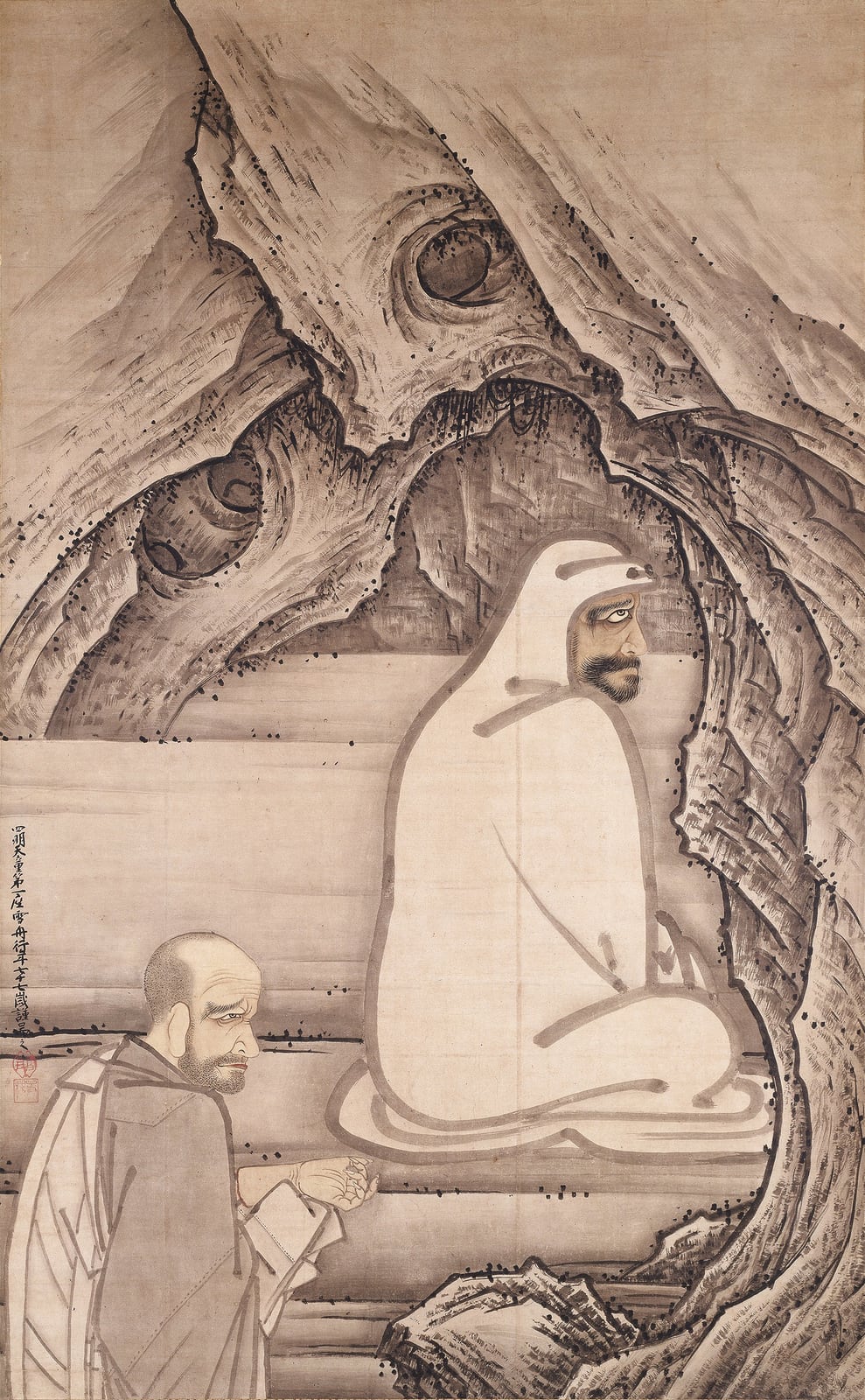
Huike ofrece su brazo a Bodhidharma, de Sesshū Tōyō (1496) · Public domain
In eigenen Worten
«There are many paths for entering the Way, but in essence they are no more than two: entrance by principle and entrance by practice.»Tratado de las dos entradas y las cuatro prácticas, inicio (texto del Xinzuan Xu zangjing en Wikisource; traducción del investigador)

Der zentrale Gedanke
Wall contemplation (biguan): Biguan (壁觀) is the name Tanlin and Daoxuan give to the 'method of pacifying the mind' that Bodhidharma taught, and it is the oldest term associated with his meditation.
Im Zusammenhang sehen
Biografie
5 Min. Lesezeit
Unterstützte Übersetzung aus dem spanischen Original, Durchsicht durch einen muttersprachlichen Übersetzer ausstehend.
Ein Fremder vor der Pagode
Zum ersten Mal taucht der Name Bodhidharma nicht in einem Zen-Text auf, sondern in einem wehmütigen Führer durch die Klöster von Luoyang, der Hauptstadt der Nördlichen Wei, den der Beamte Yang Xuanzhi 547 verfasste, als die Stadt bereits in Trümmern lag. Bei der Beschreibung der großen Pagode des Klosters Yongning, 516 errichtet und 534 durch einen Brand zerstört, vermerkt Yang, ein Mönch aus den westlichen Regionen namens Bodhidharma, „ein Barbar aus Persien“, habe ihre goldenen Glöckchen bestaunt und erklärt, er habe in seinen hundertfünfzig Jahren und auf seinen Reisen durch alle Länder nie dergleichen gesehen; tagelang sei er mit aneinandergelegten Handflächen vor ihr verharrt und habe „namo“ rezitiert. Es ist ein fast zeitgenössisches Zeugnis, doch es sagt nichts über Meditation oder Schüler.
Der Meister der Wandbetrachtung
Die zweite Quelle stammt aus seinem eigenen Kreis. Ein Schüler namens Tanlin schrieb ein kurzes Vorwort zum Traktat über die zwei Zugänge und die vier Übungen, und 645 übernahm der Mönchshistoriker Daoxuan es nahezu wörtlich in seine Lebensbeschreibung Bodhidharmas in der Fortsetzung der Biographien hervorragender Mönche. Diesen Texten zufolge war Bodhidharma ein Brahmane aus Südindien – Tanlin nennt ihn den dritten Sohn eines Königs –, der, „über Berge und Meere“ gekommen, das Gebiet der Song-Dynastie im Süden Chinas erreichte und später in den Norden, in das Reich der Wei, weiterzog, wo er Meditation lehrte. Die damals tonangebenden Lehrmeister der Doktrin kritisierten ihn; nur zwei junge Mönche, Daoyu und Huike, folgten ihm vier oder fünf Jahre lang.
Was er sie lehrte, war laut Daoxuan eine „Methode, den Geist zu befrieden“: die „Wandbetrachtung“ (biguan), deren genauer Sinn umstritten ist – ein Geist, fest wie eine Wand, oder eine Meditation vor der Wand –, und die zwei Zugänge, den des Prinzips und den der Übung. Auch soll er ihnen das Laṅkāvatāra-Sūtra in seiner Fassung von vier Rollen anvertraut haben, mit den Worten: „Ich habe das Land der Han betrachtet, und es gibt nur dieses Sūtra; wenn ihr es übt, werdet ihr gerettet.“ Daoxuan fügt hinzu, Bodhidharma habe behauptet, über hundertfünfzig Jahre alt zu sein, und niemand wisse, wie er endete; in der Biographie Huikes vermerkt er jedoch, er sei am Ufer des Luo gestorben.
Die Erfindung eines Patriarchen
Über ein Jahrhundert lang wies niemand diesem Meister eine besondere Rolle zu. Erst zwischen dem Ende des 7. und dem Beginn des 8. Jahrhunderts zogen die Schüler Hongrens und Shenxius, bestrebt, ihrer Meditationsschule eine ebenso edle Genealogie zu geben, wie sie die Lehrschulen besaßen, eine Übertragungslinie, die bei Bodhidharma begann und über Huike, Sengcan, Daoxin und Hongren verlief. Die Chroniken jener Zeit, etwa die Aufzeichnungen über die Weitergabe des Dharma-Juwels, machen ihn zum „ersten Patriarchen“; die Aufzeichnungen über die Meister und Schüler des Laṅkā stellen ihm allerdings Guṇabhadra, den Übersetzer des Sūtra, voran. Danach passten Shenhuis Polemik gegen die Nördliche Schule und das Sūtra vom Podest des sechsten Patriarchen Huineng die Linie ihren eigenen Interessen an, und das Baolin zhuan (801) verlängerte sie rückwärts, bis Bodhidharma zum achtundzwanzigsten indischen Patriarchen seit dem Buddha wurde.
Mit der Linie kamen die Episoden. Ab dem 8. Jahrhundert erscheint das Gespräch mit Kaiser Wu von Liang, der ihn fragt, wie viel Verdienst er sich durch den Bau von Tempeln erworben habe, und ein „keines“ erhält, und der auf die Frage, wen er vor sich habe, ein „ich weiß es nicht“ hört. Die Aufzeichnungen über die Weitergabe der Leuchte aus der Ära Jingde (1004) legten die kanonische Fassung fest: die Überquerung des Yangtse auf einem Schilfrohr, die neun Jahre der Meditation vor der Wand einer Höhle nahe Shaolin, Huike, der im Schnee wartet und sich den Arm abschneidet, um seine Aufrichtigkeit zu beweisen, der Dialog, in dem der Meister ihm „den Geist befriedet“, die Übergabe von Robe und Schale, die sechs Vergiftungsversuche, das Grab auf dem Berg Xiong'er und der Reisende Song Yun, der ihm im Pamir begegnet, eine einzelne Sandale in der Hand, als man ihn längst begraben glaubte.
Keine dieser Erzählungen hat eine Grundlage in den alten Quellen, und manche widersprechen ihnen: Laut Daoxuan verlor Huike den Arm durch Räuber und ertrug die Wunde klaglos. Wie Bernard Faure gezeigt hat, fungierte die Gestalt Bodhidharmas als „textuelles Paradigma“: ein leerer Ort, in den jede Generation der Schule einschrieb, was sie über sich selbst sagen musste.
Die Texte
Von dem ihm zugeschriebenen Werk hat allein der Traktat über die zwei Zugänge und die vier Übungen eine Überlieferung, die bis in seinen Kreis zurückreicht. Die Handschriften von Dunhuang stellen ihn an die Spitze einer größeren Sammlung, der sogenannten „Langen Rolle“, mit Aussprüchen von Meistern des 7. Jahrhunderts. Die Predigten, die heute unter seinem Namen kursieren – die über die Blutlinie, über das Erwachen, über das Durchbrechen der Formen –, sind spätere Chan-Werke; die letzte ist in Wirklichkeit Shenxius Traktat über die Betrachtung des Geistes. Die Sammlung, die sie vereint, die Sechs Tore von Shaoshi, stammt aus der Song-Zeit oder später. Noch jünger ist sein Ruf als Begründer des Kung-Fu: Der Klassiker der Sehnenwandlung, der ihn als Lehrer körperlicher Übungen darstellt, wurde zu Beginn des 17. Jahrhunderts von einem Daoisten verfasst.
Vom Mönch zur Ikone
Das Ergebnis ist eine der meistabgebildeten Gestalten der asiatischen Kunst. In Japan, wo man ihn Daruma nennt, malten ihn die Zen-Maler von Sesshū bis Hakuin mit hervorquellenden Augen und Barbarenbart; die Pappmaché-Puppen ohne Arme und Beine, die an seine Jahre reglosen Sitzens erinnern, sind zu Glücksbringern der Beharrlichkeit geworden. Die Schulen des Chan, Zen, Seon und Thiền berufen sich auf ihn als Ursprung der „besonderen Überlieferung außerhalb der Schriften“, die nach einer Formel der Song-Zeit „sich nicht auf Worte stützt, unmittelbar auf den Geist weist und die eigene Natur schauen lässt, um Buddha zu werden“. Was die Geschichte zu sagen erlaubt, ist weit weniger: dass um das Jahr 500 ein fremder Mönch im Norden Chinas eine strenge, auf das Laṅkāvatāra gestützte Meditation an eine Handvoll Schüler weitergab und dass aus dieser Handvoll, auf Wegen, die er sich nicht hätte vorstellen können, die Tradition des Zen hervorging.
Quellen: Yang Xuanzhi. Luoyang qielan ji (Memoria de los monasterios budistas de Luoyang), 547, cap. 1, «Monasterio de Yongning». Texto chino en Wikisource; trad. inglesa: Yi-t'ung Wang, A Record of Buddhist Monasteries in Lo-yang, Princeton University Press, 1984 (ISBN 9780691054032). · Daoxuan. Xu gaoseng zhuan (Continuación de las biografías de monjes eminentes), 645 (ampliada hasta 667), cap. 16: biografías de Bodhidharma y de Huike (Taishō 2060). Texto chino en Wikisource. · Tanlin (atrib.). Prefacio al «Tratado de las dos entradas y las cuatro prácticas» (菩提達磨大師略辨大乘入道四行觀), según el Xinzuan Xu zangjing. Texto chino en Wikisource. · Broughton, Jeffrey L. The Bodhidharma Anthology: The Earliest Records of Zen. Berkeley: University of California Press, 1999. ISBN 9780520219724. · McRae, John R. Seeing Through Zen: Encounter, Transformation, and Genealogy in Chinese Chan Buddhism. Berkeley: University of California Press, 2003. ISBN 9780520237988.
Zeitleiste
Das Leben, Jahr für Jahr
Jeder Punkt ist ein belegtes Ereignis. Klicken Sie, um es mit Quelle und Grad der Gewissheit zu lesen.
470er JahreChina meridional (territorio de los Song)
Arrival in China
According to Daoxuan he first reached the territory of the Song dynasty (420–479) in the south and later went north. Late tradition places it in 527, in Canton.
ÜberlieferungDaoxuan. Xu gaoseng zhuan (Continuación de las biografías de monjes eminentes), 645 (ampliada hasta 667), cap. 16: biografías de Bodhidharma y de Huike (Taishō 2060). Texto chino en Wikisource.
470er Jahre
Arrival in China
According to Daoxuan he first reached the territory of the Song dynasty (420–479) in the south and later went north. Late tradition places it in 527, in Canton.
Überlieferung
um 520
Before the Yongning pagoda
Yang Xuanzhi describes him admiring the Yongning pagoda (built 516, burned 534) and claiming to be a hundred and fifty years old.
Belegt
um 520
Teaching Daoyu and Huike
He teaches wall contemplation and the two entrances to his two disciples for four or five years and gives Huike the Laṅkāvatāra.
Wahrscheinlich
527
Interview with Emperor Wu (legend)
The date tradition gives for the dialogue on merit with Emperor Wu of the Liang; the episode appears in the eighth century.
Überlieferung
um 528
Nine years facing the wall (legend)
Late tradition places him meditating for nine years facing the wall of a cave near Shaolin.
Überlieferung
536
Death (traditional date)
Daoxuan only says that he died by the Luo river and that no one knew how he ended; 536 is the most widespread traditional date.
Überlieferung
547
First written mention
Yang Xuanzhi completes the Record of the Buddhist Monasteries of Luoyang, with the notice on Bodhidharma.
Belegt
645
Daoxuan's biography
Daoxuan includes his biography and Huike's in the Continued Biographies of Eminent Monks.
Belegt
um 716
First patriarch
The chronicles of the meditation school (Chuan fabao ji, Lengqie shizi ji) make him the first patriarch of a line of transmission.
Belegt
801
Twenty-eighth Indian patriarch
The Baolin zhuan extends the genealogy back to the Buddha and makes him the twenty-eighth Indian patriarch.
Belegt
1004
The Transmission of the Lamp
The Jingde chuandeng lu fixes the canonical version of his legend.
Belegt
1496
Sesshū paints Huike and Bodhidharma
Sesshū Tōyō paints the scene of Huike offering his arm.
Belegt
1624
The Yijin jing
Date of the preface of the Sinew-Changing Classic, falsely attributed to Bodhidharma, the origin of his fame as founder of Shaolin kung fu.
Belegt
Werke
Grundlegende Werke
Die Werke, ohne die sich das Vermächtnis nicht verstehen lässt.
Aufgezeichnete mündliche Lehre
Treatise on the Two Entrances and the Four Practices
二入四行論 (菩提達磨大師略辨大乘入道四行觀)
A short teaching that sums up the path in two 'entrances': entrance by principle (理入), which consists in deep faith that all beings share one true nature, hidden by the dust of thoughts, and in 'abiding firmly in wall contemplation'; and entrance by practice (行入), unfolded in four practices: accepting suffering as the fruit of past deeds, adapting to circumstances, seeking nothing, and acting in accord with the Dharma. It is the core of what can be attributed to Bodhidharma with any plausibility.
3 Ausgaben · amazon.com
Traditionelle Zuschreibung · XI. Jahrhundert
The Bloodstream Sermon (Xuemai lun)
達磨大師血脈論
A question-and-answer dialogue that opens by stating that buddhas are transmitted 'from mind to mind, without relying on written words' and holds that seeking the buddha outside one's own nature is useless: 'whoever wishes to see the buddha must see his nature'. It already sets out the mature Chan doctrine of sudden awakening and the critique of external practices.
1 Ausgabe · amazon.com
Traditionelle Zuschreibung · XI. Jahrhundert
The Wake-up Sermon (Wuxing lun)
達磨大師悟性論
A short treatise on awakening to one's own nature: enlightenment is reached not by accumulating merit or by study but by seeing that the mind itself is empty and free. Included in the Shaoshi liumen, it is among the texts most widely read in the West as 'words of Bodhidharma', thanks to Red Pine's translation.
1 Ausgabe · amazon.com
Das gesamte Werk (10)
The 'Long Scroll': Dunhuang Compilation around the Two Entrances
700
The Breakthrough Sermon (Poxiang lun)
700
Bodhidharma
The Dharma Gate of Pacifying the Mind (Anxin famen)
The Conscious LibraryThe Dharma Gate of Pacifying the Mind (Anxin famen)
Bodhidharma
Verses on the Heart Sūtra (Xinjing song)
The Conscious LibraryVerses on the Heart Sūtra (Xinjing song)
Bodhidharma
The Six Gates of Shaoshi (Shaoshi liumen)
The Conscious LibraryThe Six Gates of Shaoshi (Shaoshi liumen)
Bodhidharma
Sinew-Changing Classic (Yijin jing)
The Conscious LibrarySinew-Changing Classic (Yijin jing)
1624
Bodhidharma
Marrow-Washing Classic (Xisui jing)
The Conscious LibraryMarrow-Washing Classic (Xisui jing)
1650
Zitate
Zitate, die in einem bestimmten Werk nachgewiesen sind. Jedes trägt seine Herkunft und seinen Grad an Verlässlichkeit.
There are many paths for entering the Way, but in essence they are no more than two: entrance by principle and entrance by practice.夫入道多途,要而言之,不出二種:一是理入、二是行入。
WahrscheinlichTratado de las dos entradas y las cuatro prácticas, inicio (texto del Xinzuan Xu zangjing en Wikisource; traducción del investigador)
Apokryphe Zitate oder Zitate umstrittener Zuschreibung (3)
«A special transmission outside the scriptures, not relying on words and letters, pointing directly to the human mind, seeing one's nature and becoming a buddha.»
A four-line formula (教外別傳,不立文字,直指人心,見性成佛) that tradition attributes to Bodhidharma. Its elements appear in Chan texts of the ninth and tenth centuries and the complete formula took shape in the Song period (eleventh–twelfth centuries); it is found in no sixth- or seventh-century source.
«The three realms arise together and return to a single mind. Buddhas before and after transmit from mind to mind, without relying on writing.»
Opening of the 'Bloodstream Sermon' (三界混起,同歸一心,前佛後佛,以心傳心,不立文字), a late-attributed text with ninth- and tenth-century Chan vocabulary; it was circulating by 1153.
«Vast emptiness, nothing holy.»
The reply (廓然無聖) legend puts in his mouth before Emperor Wu when the latter asks about the highest meaning of the holy truth. The dialogue appears in the eighth century and is fixed in the Jingde chuandeng lu (1004) and the Biyan lu (case 1); it has no support in the early sources.
Letzte Worte
Traditionelle Zuschreibung
«I came to this land originally to transmit the Dharma and save the deluded. One flower will open five petals, and the fruit will ripen of itself.»吾本來茲土,傳法救迷情。一華開五葉,結果自然成。
A transmission verse that the Jingde chuandeng lu (1004) attributes to Bodhidharma on taking leave of his disciples: after asking them what they had understood and telling them they had obtained his skin, his flesh, his bones and, in Huike's case, his marrow, he gives Huike the robe and the Laṅkāvatāra and recites these lines. The 'five petals' were read as a prophecy of the following five patriarchs or of the five houses of Chan. It is a composition of the late tradition; the early sources (Daoxuan) say no one knew how he ended.
Quelle: Daoyuan. Jingde chuandeng lu (Registro de la transmisión de la lámpara de la era Jingde), 1004, cap. 3 (Taishō 2076). CBETA.
Fragen
Was das Werk beantwortet
Zwölf große Fragen der Menschheit und was sich aus den Texten darauf antworten lässt, mit Belegen. Wir legen niemandem Worte in den Mund.
Was ist das Absolute? Gibt es Gott?
One and the same true nature in all beings, hidden by dust
Ein unpersönliches AbsolutesAus der Lehre abgeleitet
The only work with any chance of being his, the Treatise on the Two Entrances and Four Practices, does not speak of God. It speaks of a «principle» (li) and of a «true nature» that all living beings share and that is hidden only by the adventitious dust of deluded thoughts. Entering by principle means returning from the false to the true through wall contemplation, until silently according with it, without self or other, the ordinary person and the sage being equal. That nature is not someone: it does not know, will or relate to the creature. It is the common, formless ground that Chinese Buddhism called buddha-nature. The closest key is that of an impersonal Absolute, with the proviso that the text never calls it so.
Diese Frage mit anderen Meistern vergleichenWer bin ich? Gibt es ein wahres Selbst?
Beneath deluded thoughts, a shared true nature, without self or other
Das Selbst ist das AbsoluteAus der Lehre abgeleitet
The Treatise on the Two Entrances, the only work that can be traced to Bodhidharma's circle, does not speak of the self as a soul or a person. It speaks of a true nature that all living beings share and that the adventitious dust of deluded thoughts covers. Whoever abandons the false and returns to the true, steadfast in wall contemplation, is left «without self or other»: the ordinary person and the sage are equal. The text thus joins two statements that seem opposed. The particular self, with its gains and losses, is not what we are; what we are is that common nature, which belongs to no one. The fourth practice, in accord with the Dharma, adds that in the Dharma there is no self, because it is free of the stain of self.
Diese Frage mit anderen Meistern vergleichenWarum leiden wir?
To seek is to suffer; to seek nothing is peace
Begehren und AnhaftenAusdrücklich gesagt
The Treatise on the Two Entrances and Four Practices answers soberly. The third practice, «seeking nothing», starts from the fact that dwelling long in the three worlds is like living in a burning house: all that has a body suffers. Worldly people, deluded, attach themselves to one thing after another and call this seeking; the sage understands that all seeking brings suffering and that ceasing to seek brings joy. The first practice adds a karmic reading: present pain is the fruit of past deeds, committed over countless lives, and must be accepted without resentment. The second asks one to adapt to circumstances: gain and loss depend on them, and the mind that is not moved by the wind of joy silently accords with the Way.
Diese Frage mit anderen Meistern vergleichenWas geschieht nach dem Tod?
Present pain comes from past lives: it is accepted without resentment
Wiedergeburt nach dem KarmaAus der Lehre abgeleitet
The Treatise on the Two Entrances and Four Practices does not speak of what happens at death, but it takes rebirth for granted. The first practice, that of «requiting injury», asks the sufferer to consider that, over countless aeons, he has abandoned the essential for the incidental and wandered through all forms of existence, causing hatred and harm; what he suffers now is the ripened fruit of those deeds, not something imposed by heaven or men. This awareness of previous lives serves to accept pain without resentment. The third practice presents the three worlds as a burning house from which only ceasing to seek frees one. The framework is the common Buddhist one; the text adds no doctrine of its own about death.
Diese Frage mit anderen Meistern vergleichenWie erlangt man Befreiung oder Erlösung?
Two entrances: by principle, contemplating the wall, and by four practices
Durch disziplinierte ÜbungAusdrücklich gesagt
The Treatise on the Two Entrances and Four Practices sums up the path in its first sentence: many are the ways, but in essence they are two, entrance by principle and entrance by practice. The first consists in trusting deeply that all beings share a true nature and remaining steadfast in wall contemplation until silently according with it. The second unfolds in four practices: accepting suffering as the fruit of past deeds, adapting to circumstances without letting gain or loss move the mind, seeking nothing, and acting in accord with the Dharma, practising the perfections without attachment. It is a sober programme, joining a vision and a daily discipline of the mind.
Diese Frage mit anderen Meistern vergleichenBraucht es einen Lehrer?
He hands over a sūtra and a practice: «you yourselves will be saved»
Hilfreich, aber nicht unverzichtbarAus der Lehre abgeleitet
The oldest sources present Bodhidharma as a master with few disciples, Huike and Daoyu among them, according to Tanlin's preface. But what they transmit of him is not the idea of dependence on the master. According to Daoxuan's biography of Huike, when he handed him the four-fascicle Laṅkāvatāra he told him that in the land of the Han there was only this sūtra and that, if they practised it, they themselves would be saved. The Treatise on the Two Entrances adds that, steadfast in wall contemplation, one no longer follows the letter of the teachings: access is inward. The master guides and hands over a text and a method; the work belongs to the disciple. The image of the patriarch transmitting awakening from mind to mind is later.
Diese Frage mit anderen Meistern vergleichenIst die Welt wirklich?
Gain and loss depend on circumstances; forms are empty
Ein Geflecht von Ursachen ohne SubstanzAus der Lehre abgeleitet
The Treatise on the Two Entrances sets out no cosmology, but it shows how it looks at the world. The second practice states that beings have no self and that all that happens to them, gain or loss, honour or disgrace, depends on circumstances: when these are exhausted, it disappears, and there is no reason to rejoice or grieve. The fourth practice calls Dharma the principle of the purity of nature, and says that in it all forms are empty, without stain or attachment, without this or that. The third adds the existential side: the three worlds are a burning house. The world thus appears as a web of conditions without substance, before which the practitioner remains unmoved, neither rejecting nor pursuing it.
Diese Frage mit anderen Meistern vergleichenWas ist Liebe?
He does not define love; he practises the perfections for his own and others' benefit
Nicht geäußert
The Treatise on the Two Entrances and Four Practices contains no reflection on love. The closest thing is in the fourth practice, acting in accord with the Dharma: whoever understands that in pure nature there is neither self nor other practises generosity without avarice towards one's body, life or goods, and offers it without attachment, to eliminate delusion, benefiting oneself and others. The other perfections are practised in the same way. The text presupposes the bodhisattva ideal of Chinese Buddhism, in which compassion is central, but its emphasis lies on purifying one's own mind and on equanimity in circumstances, not on the affective bond. Attributing a doctrine of love to it would be forcing it.
Diese Frage mit anderen Meistern vergleichenSind wir frei, oder ist alles vorherbestimmt?
What one suffers is the fruit of the past; how one receives it, a present decision
Karma und WahlAusdrücklich gesagt
The first two practices of the Treatise on the Two Entrances formulate a very concrete ethics of karma. The first asks that, in the face of suffering, one consider it the ripened fruit of deeds committed in past lives, not something imposed by heaven or men, and accept it without complaint or resentment. The second adds that beings have no self and that everything, gain or loss, honour or disgrace, depends on circumstances, so that when these are exhausted it disappears. The past determines what comes; what remains in the practitioner's hands is not to be moved: the mind neither grows nor wanes, the wind of joy does not move it, and so it silently accords with the Way. Freedom lies in the response, not in the event.
Diese Frage mit anderen Meistern vergleichenWozu meditieren oder beten?
Contemplating the wall: returning from the false to the true nature
Zur Quelle des Ich zurückkehrenAus der Lehre abgeleitet
The meditation associated with Bodhidharma in the oldest sources is wall contemplation (biguan), which Tanlin and Daoxuan present as his method for pacifying the mind. The Treatise on the Two Entrances places it within entrance by principle: whoever trusts that all beings share a true nature, hidden by deluded thoughts, abandons the false, returns to the true and remains steadfast, unmoving, without self or other, until silently according with the principle. The exact meaning of «wall» is debated: it may be the mind firm as a wall or literally sitting before one. What is clear is the direction: not observing phenomena one by one, but returning to the source that thoughts cover.
Diese Frage mit anderen Meistern vergleichenKann die Vernunft das Letzte erkennen?
Steadfast before the wall, one no longer follows the letter of the teachings
Das Letzte liegt jenseits des VerstandesAusdrücklich gesagt
The Treatise on the Two Entrances does not belittle the scriptures: entrance by principle begins by relying on them to trust in the true nature common to all beings. But the decisive step goes beyond them. Whoever remains steadfast in wall contemplation, without self or other, no longer follows the letter of the teachings, and silently accords with the principle. Ultimate understanding is neither conceptual nor discursive: it is a silent conformity. According to Daoxuan, Bodhidharma handed Huike a sūtra, the Laṅkāvatāra, as sufficient guidance for China, which shows that the written word had its place. Reason and text prepare; the ultimate is realised directly, in the silence of a mind that has stopped moving.
Diese Frage mit anderen Meistern vergleichenSich von der Welt zurückziehen oder sie verwandeln?
Seek nothing in a burning house; steadfast before the wall
Sich zurückziehen, um zu findenAus der Lehre abgeleitet
The Treatise on the Two Entrances proposes an attitude of distance towards the world. The third practice, seeking nothing, starts from the fact that the three worlds are a burning house in which all that has a body suffers; the sage, unlike deluded people, stops pursuing and clings to nothing. Wall contemplation requires remaining steadfast and unmoving. But the second practice qualifies this: it is not a matter of fleeing circumstances but of adapting to them without letting gain or loss move the mind, and the fourth asks one to practise generosity for one's own and others' benefit. Withdrawal is inward before it is geographical: detachment in the midst of what happens, rather than abandonment of the world.
Diese Frage mit anderen Meistern vergleichen
Affinitäten und Spannungen
Affinitäten und Spannungen
Frage für Frage aus den Positionen berechnet. Den Grund jeder Übereinstimmung und jedes Widerspruchs zeigt ein Klick.
Denkt ähnlich wie

Siddhartha Gautama, the Buddha
Übereinstimmung bei: Warum leiden wir? · Was geschieht nach dem Tod? · Wie erlangt man Befreiung oder Erlösung?
Sadhguru
Übereinstimmung bei: Was ist das Absolute? Gibt es Gott? · Wer bin ich? Gibt es ein wahres Selbst? · Was geschieht nach dem Tod?
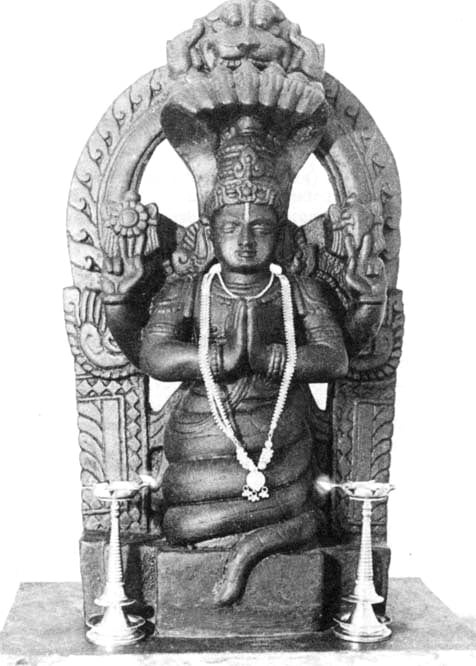
Patañjali
Übereinstimmung bei: Wer bin ich? Gibt es ein wahres Selbst? · Was geschieht nach dem Tod? · Wie erlangt man Befreiung oder Erlösung?
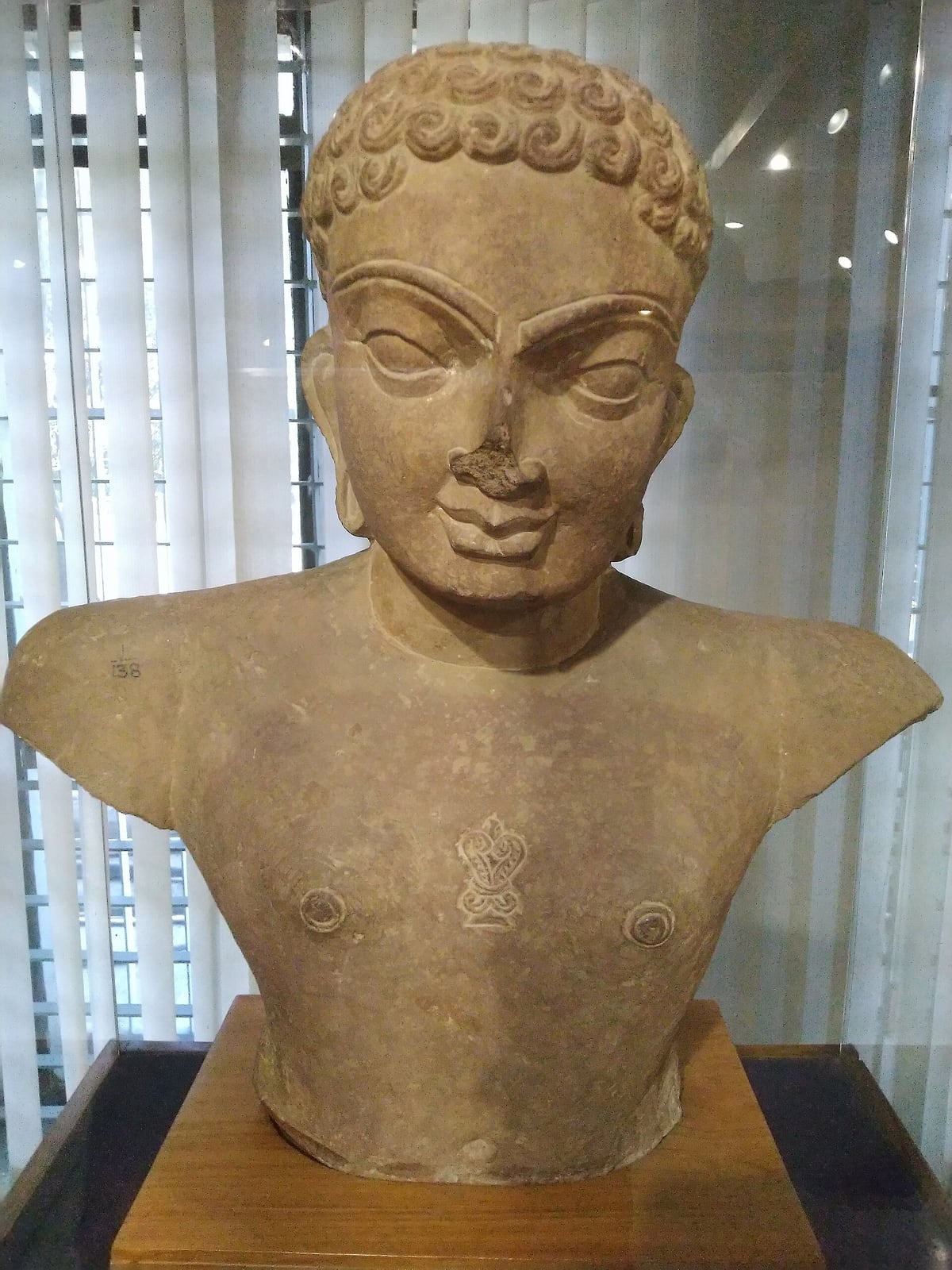
Mahāvīra
Übereinstimmung bei: Was geschieht nach dem Tod? · Wie erlangt man Befreiung oder Erlösung? · Braucht es einen Lehrer?
Denkt anders als

Francis of Assisi
Widerspruch bei: Wer bin ich? Gibt es ein wahres Selbst? · Was geschieht nach dem Tod?

Chaitanya Mahaprabhu
Widerspruch bei: Wer bin ich? Gibt es ein wahres Selbst? · Was geschieht nach dem Tod?

Emanuel Swedenborg
Widerspruch bei: Wer bin ich? Gibt es ein wahres Selbst? · Was geschieht nach dem Tod?

Theophan the Recluse
Widerspruch bei: Wer bin ich? Gibt es ein wahres Selbst? · Was geschieht nach dem Tod?
Anekdoten und Erzählungen
Anekdoten und Erzählungen
Belegtc. 516–534
The monk who admired the pagoda
Herkunft der Erzählung: Yang Xuanzhi, Luoyang qielan ji (547), ch. 1, entry on Yongning monastery (Chinese text on Wikisource). Some scholars doubt that the 'Persian' monk is the same Bodhidharma as Daoxuan's; most accept it.
Hagiographische Erzählung527 (fecha tradicional)
'I do not know'
Herkunft der Erzählung: Earliest versions in texts from Shenhui's circle and in the Platform Sūtra (eighth century); canonical form in the Jingde chuandeng lu (1004), ch. 3, and the Biyan lu (1125), case 1. McRae and Faure analyse it as a creation of the school.
Umstrittens. VI (narrado en el s. VIII y fijado en 1004)
Huike's arm
Herkunft der Erzählung: Daoxuan, Xu gaoseng zhuan (645), ch. 16, biography of Huike: '遭賊斫臂' (bandits cut off his arm). The self-sacrifice version: eighth-century Chan texts and the Jingde chuandeng lu (1004), ch. 3.
Hagiographische Erzählungs. VI (narrado desde el s. VIII)
Pacifying the mind
Herkunft der Erzählung: Jingde chuandeng lu (1004), ch. 3; Wumen guan (1228), case 41. The term 安心 comes from Tanlin and Daoxuan.
Hagiographische Erzählungs. VI (narrado desde el s. VIII)
The sandal of the Pamirs
Herkunft der Erzählung: Jingde chuandeng lu (1004), ch. 3, and earlier Chan sources; the account of Song Yun's journey survives in the Luoyang qielan ji itself (ch. 5), with no mention of Bodhidharma. Faure (1986) analyses the borrowing of the Daoist motif.
Nicht überprüfbarleyenda formada desde 1624
The founder of kung fu
Herkunft der Erzählung: Shahar, The Shaolin Monastery (2008), chapter on the Yijin jing. The attribution to Bodhidharma has no basis before the seventeenth century; today it circulates mostly through martial-arts cinema.
Quelle: Shahar, Meir. The Shaolin Monastery: History, Religion, and the Chinese Martial Arts. Honolulu: University of Hawai'i Press, 2008.
Lehren
Lehren
Die Begriffe, die das Denken gliedern, in ihrem Zusammenhang erklärt.
Wall contemplation (biguan)biguan
Early Chan meditation; reinterpreted in the Sōtō tradition (Dōgen).
The two entrances and the four practicesdos-entradas
Sixth-century Chinese Mahāyāna; buddha-nature (tathāgatagarbha) doctrine.
The Laṅkāvatāra Sūtralankavatara
Yogācāra and tathāgatagarbha; the earliest Chan school.
The lineage of patriarchslinaje-patriarcal
Chan historiography (Chuan fabao ji, Lengqie shizi ji, Baolin zhuan, Jingde chuandeng lu).
Quelle: McRae, John R. Seeing Through Zen: Encounter, Transformation, and Genealogy in Chinese Chan Buddhism. Berkeley: University of California Press, 2003. ISBN 9780520237988.
Transmission outside the scripturestransmision-fuera-escrituras
Song-period Chan; Japanese Zen.
Quelle: McRae, John R. Seeing Through Zen: Encounter, Transformation, and Genealogy in Chinese Chan Buddhism. Berkeley: University of California Press, 2003. ISBN 9780520237988.
Videos
Videos
Aufnahmen, Gespräche und Dokumentarfilme. Die Videos werden von YouTube wiedergegeben; sie werden nicht hier gespeichert.
[Prof. Mario Poceski - Lecture 1] "The Story of Chan: History, Literature, Teachings and Practices"
Vortrag· EN· 121 min
HKUCBSOffizieller Kanal
CHAN BUDDHISM IN THE TANG DYNASTY / Dr. Alan Cole
Vortrag· EN· 51 min
UArizona Center for Buddhist StudiesOffizieller Kanal
Bodhidharma by Prof Charles Willemen
Vortrag· EN· 60 min
Boon Litsavanh
A Monk I Bodhidharma I Documentary
Dokumentarfilm· EN· 62 min
Doordarshan NationalOffizieller Kanal
Bodhidharma: Founder of Zen, from India to Shaolin
Dokumentarfilm· EN· 21 min
Biographics
What is Zen Buddhism?
Analyse· EN· 45 min
Let's Talk Religion
Red Pine: Travels, Hermits and Zen (Full Version)
Dokumentarfilm· EN· 77 min
John Blofeld Documentary Project
Bodhidharma and the Two Entrances
Vortrag· EN· 20 min
Thousand Harbours Zen
La Historia de Bodhidharma ~Sommer
Aufnahme Dritter· ES· 21 min
·SOMMER·
El Sermón del Despertar del Primer Patriarca Zen - Bodhidharma | Budismo Zen
Aufnahme Dritter· ES· 56 min
KarunaPura
Bodhidharma Sermones sobre el Zen
Aufnahme Dritter· ES· 87 min
Cosas del Zen
高僧傳奇 達摩祖師 第001集
Aufnahme Dritter· ZH· 23 min
十方法界基金會
Galerie
Galerie
Bilder mit geprüfter Lizenz. Jedes bewahrt seine Urheberschaft und seinen Herkunftsnachweis.
Handschriften
Handschriften
Handschriftliche Zeugen und alte Texte, mit ihrer verwahrenden Einrichtung und ihren Einsichtsbedingungen.
ZH · Chino · Siglos VII–VIII
二入四行論長卷子 (manuscritos de Dunhuang)
- Erhaltener Textzeuge
- Varios manuscritos de Dunhuang, entre ellos copias de la colección Stein (British Library) y Pelliot (BnF), editados por Yanagida Seizan y traducidos por Broughton
- Verwahrende Einrichtung
- British Library (colección Stein) y Bibliothèque nationale de France (colección Pelliot)
Beziehungen
Beziehungen
Einflüsse, Schülerschaften und Verwandtschaften. Die belegte Beziehung wird von der durch Analyse ermittelten Ähnlichkeit unterschieden.
Begegnete
Emperador Wu de los Liang (r. 502–549)
A legendary meeting, attested only from the eighth century.
Durch Analyse ermittelte Ähnlichkeit
Verwandte Gedanken mit
Shenxiu (m. 706)
The Breakthrough Sermon attributed to Bodhidharma is in fact Shenxiu's Guanxin lun.
Durch Analyse ermittelte Ähnlichkeit
Beeinflusst von
Siddhartha Gautama, the Buddha
According to the Chan genealogy fixed in the Baolin zhuan (801), twenty-eighth patriarch in the 'mind-to-mind' transmission begun by the Buddha; a legendary filiation.
Belegte Beziehung
Beeinflusst von
In the Chan list of twenty-eight Indian patriarchs Nāgārjuna is the fourteenth; the filiation is a genealogical construction of the eighth and ninth centuries, not a historical relationship.
Belegte Beziehung
Beeinflusste
The Platform Sūtra presents Huineng as sixth patriarch of the line beginning with Bodhidharma and attributes to him the dialogue with Emperor Wu on merit.
Belegte Beziehung
Beeinflusste
Dōgen (1200–1253), founder of Japanese Sōtō Zen, placed himself in the line of transmission going back to Bodhidharma and wrote about him in the Shōbōgenzō; the Sōtō practice of sitting facing the wall recalls the legend of the nine years before the wall.
Belegte Beziehung
Verwandte Gedanken mit
A parallel identified by the researcher: two masters of Indian origin, recognised founders of foreign traditions (Chan and Nyingma), whose biography is mostly later legend. In eighth-century Tibet Chan and Great Perfection teachings coexisted, as the Dunhuang manuscripts show.
Durch Analyse ermittelte Ähnlichkeit
Lehrer von
Dazu Huike (487–593)
His principal disciple according to Tanlin and Daoxuan, to whom he is said to have given the Laṅkāvatāra; second patriarch of Chan.
Belegte Beziehung
Lehrer von
Daoyu
The other disciple mentioned by Tanlin and Daoxuan.
Belegte Beziehung
Lehrer von
Tanlin
Author of the preface to the Treatise on the Two Entrances, in which he presents himself as a disciple.
Belegte Beziehung
Quellen
Quellen
Für diesen Eintrag herangezogene Bibliografie und Kataloge.
- Wikidata, «Bodhidharma», QID Q187172 (VIAF 29565694; LCCN n79095450).
- Yang Xuanzhi. Luoyang qielan ji (Memoria de los monasterios budistas de Luoyang), 547, cap. 1, «Monasterio de Yongning». Texto chino en Wikisource; trad. inglesa: Yi-t'ung Wang, A Record of Buddhist Monasteries in Lo-yang, Princeton University Press, 1984 (ISBN 9780691054032).
- Daoxuan. Xu gaoseng zhuan (Continuación de las biografías de monjes eminentes), 645 (ampliada hasta 667), cap. 16: biografías de Bodhidharma y de Huike (Taishō 2060). Texto chino en Wikisource.
- Tanlin (atrib.). Prefacio al «Tratado de las dos entradas y las cuatro prácticas» (菩提達磨大師略辨大乘入道四行觀), según el Xinzuan Xu zangjing. Texto chino en Wikisource.
- Broughton, Jeffrey L. The Bodhidharma Anthology: The Earliest Records of Zen. Berkeley: University of California Press, 1999. ISBN 9780520219724.
- McRae, John R. Seeing Through Zen: Encounter, Transformation, and Genealogy in Chinese Chan Buddhism. Berkeley: University of California Press, 2003. ISBN 9780520237988.
- Faure, Bernard. «Bodhidharma as Textual and Religious Paradigm». History of Religions 25.3 (1986): 187–198.
- Red Pine (Bill Porter), trad. The Zen Teaching of Bodhidharma. San Francisco: North Point Press, 1989 (1.ª ed. Empty Bowl, 1987). ISBN 9780865473997.
- Wikipedia (en). «Bodhidharma». Usada como índice de fuentes y bibliografía secundaria; contrastada con b2–b7.
- Dumoulin, Heinrich. Zen Buddhism: A History. Vol. 1: India and China. Nueva York: Macmillan, 1988; reed. Bloomington: World Wisdom, 2005.
- Daoyuan. Jingde chuandeng lu (Registro de la transmisión de la lámpara de la era Jingde), 1004, cap. 3 (Taishō 2076). CBETA.
- Yampolsky, Philip B. (trad.). The Platform Sutra of the Sixth Patriarch. Nueva York: Columbia University Press, 1967.
- Shahar, Meir. The Shaolin Monastery: History, Religion, and the Chinese Martial Arts. Honolulu: University of Hawai'i Press, 2008.
- CBETA. Shaoshi liumen (少室六門), Taishō vol. 48, n.º 2009.
- Wikimedia Commons, API imageinfo (licencia, autor, fecha y descripción de cada fichero de images[]).
- Open Library (Internet Archive). Registros de ISBN de cada edición citada en works[].
- YouTube: conferencias y documentales verificados por oEmbed el 2026-10-25 (detalle en videos[]).
- Ren Zhe. Prefacio al «Sermón de la línea de sangre» (達磨血脈論序), fechado en 1153 (紹興癸酉). Texto chino en Wikisource.
- Rechteinhaber
- Los textos chinos (siglos VI–XVII) son de dominio público. Las traducciones tienen derechos propios: Red Pine / Farrar, Straus & Giroux (North Point Press), University of California Press (Broughton; McRae), Kier (versión española de Broughton), Princeton University Press (Yang Xuanzhi, trad. Wang).
Bestätigung ausstehend
Was dieser Eintrag noch nicht klären konnte. Wir sagen es lieber, als es aufzufüllen.
- Sala de lectura: los textos chinos están en Wikisource (cuatro registrados). No se ha encontrado una traducción inglesa o española de dominio público en los tres territorios: la de D. T. Suzuki (Manual of Zen Buddhism, 1935; m. 1966) y las posteriores tienen derechos. El Sermón del despertar (悟性論) no tiene página propia en Wikisource; solo está dentro del Shaoshi liumen.
- Ediciones españolas: solo se ha verificado con ISBN la Antología del Bodhidharma (Kier, 2003). Existen otras versiones españolas de los sermones (a partir de Red Pine) que no se han podido confirmar en catálogo.
- Fechas: ni el nacimiento ni la muerte tienen base documental; 536 es la fecha tradicional. Wikidata da 483 o 440 para el nacimiento y 540 para la muerte, sin fundamento en las fuentes antiguas.
- Las fuentes del siglo VIII (Chuan fabao ji, Lengqie shizi ji, textos de Shenhui) se citan a través de McRae (b6) y Faure (b7), no por lectura directa.
- Identidad del «monje persa» de Yang Xuanzhi con el Bodhidharma de Daoxuan: aceptada por la mayoría de los estudiosos, discutida por algunos.
- Manuscritos: no se han identificado las signaturas concretas de los manuscritos de Dunhuang del «Rollo largo» (Broughton las da en su introducción).
- Relación con Tsongkhapa: solo indirecta (crítica tibetana del «chan súbito» de Heshang Moheyan); se registra en la ficha de Tsongkhapa, no aquí.
Recherchiert am 2026-10-25