Buddhismus · Mahayana · Zen / Chan
Huineng
惠能 / 慧能 · 六祖大鑒禪師 · 慧能 (Enō)
638 – 713Historizität umstritten
Chinesischer Mönch der Tang-Dynastie, verehrt als sechster Patriarch des Chan und Gründer der Schule des „plötzlichen Erwachens“. Die Überlieferung stellt ihn als analphabetischen Holzfäller dar, der mit einem Gedicht den ersten Schüler seines Meisters übertraf und das Gewand Bodhidharmas empfing; die moderne Kritik hat gezeigt, dass diese Lebensgeschichte von seinem Anhänger Shenhui geschaffen wurde. Das ihm zugeschriebene Plattform-Sutra ist das Gründungswerk des Chan und des Zen.
- Werke
- 11Werke
- Ausgaben
- 25Ausgaben
- Zitate
- 8Zitate
- Videos
- 12Videos
- Bilder
- 5Bilder
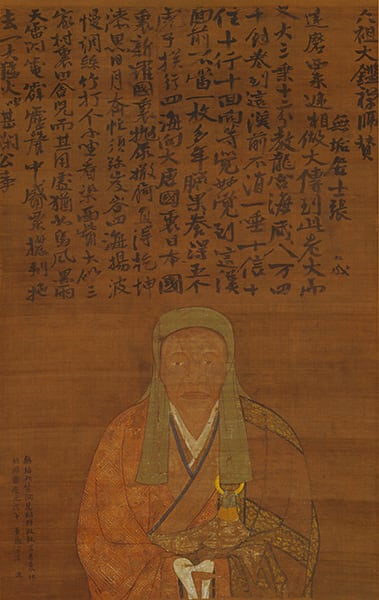
Daikan Zenji (Huineng), templo Shōfukuji · Public domain
In eigenen Worten
«Among people there are northerners and southerners; in buddha-nature there is neither north nor south. A barbarian's body is not like Your Reverence's, but what difference is there in buddha-nature?»Sūtra de la plataforma, versión de Dunhuang, respuesta a Hongren (§3 de Yampolsky). Traducción propia del chino clásico.

Der zentrale Gedanke
Buddha-nature is equally present in everyone, regardless of origin, culture or learning: awakening is not a conquest but the recognition of what one already is.
Im Zusammenhang sehen
Biografie
5 Min. Lesezeit
Unterstützte Übersetzung aus dem spanischen Original, Durchsicht durch einen muttersprachlichen Übersetzer ausstehend.
Der Patriarch, den man erfinden musste
Wenige Gestalten des Buddhismus sind so berühmt und zugleich so ungewiss wie Huineng, der „sechste Patriarch“ des Chan. Die Überlieferung weiß fast alles über ihn: dass er ein analphabetischer Holzfäller aus Südchina war, dass er beim Hören eines Verses aus dem Diamant-Sutra erwachte, dass er mit einem Gedicht den ersten Schüler seines Meisters übertraf und nachts das Gewand Bodhidharmas empfing. Die Geschichte dagegen weiß sehr wenig: dass es einen Mönch namens Huineng gab, Schüler des fünften Patriarchen Hongren, dass er in Caoxi im Norden Guangdongs lehrte und dass er 713 mit einem eher regionalen Ruf starb. Alles Weitere wurde später geschrieben, und zu einem guten Teil aus Notwendigkeit: aus der einer Schule, die einen Gründer suchte, der zu ihrer Lehre passte.
Das Leben, wie das Sutra es erzählt
Der kanonische Bericht ist die Autobiographie, mit der das Plattform-Sutra beginnt. Huineng, mit Familiennamen Lu, wurde 638 in Xinzhou im heutigen Guangdong geboren; sein Vater, ein Beamter aus Fanyang, der degradiert und in den Süden verbannt worden war, starb früh, und der Junge ernährte seine Mutter, indem er auf dem Markt von Nanhai Brennholz verkaufte. Als er eines Tages ein Bündel in einer Herberge ablieferte, hörte er einen Gast das Diamant-Sutra rezitieren, und sein Geist „öffnete sich“. So erfuhr er, dass in Huangmei Hongren lehrte, reiste zu ihm und antwortete, als der Meister ihn als „Barbaren aus dem Süden“ abtat, die Menschen seien wohl aus dem Norden oder aus dem Süden, die Buddha-Natur aber nicht. Hongren schickte ihn zum Reisschälen in die Mühle, fern der Meditationshalle, und dort verbrachte er acht Monate.
Die Gedichte an der Wand
Die zentrale Episode ist ein Wettstreit. Hongren verlangt von seinen Schülern ein Gedicht, das ihr Verständnis zeigt, und verspricht das Gewand dem, der es besitzt. Shenxiu, der angesehenste Mönch, schreibt nachts an die Wand des Korridors: Der Körper ist der Baum des Erwachens, der Geist ein Spiegel auf seinem Ständer; man muss ihn unablässig wischen, damit sich kein Staub darauf legt. Huineng, der nicht lesen kann, lässt es sich vorlesen und diktiert seine Antwort. In der Abschrift aus Dunhuang sind es zwei Strophen, deren erste besagt, das Erwachen habe keinen Baum, der Spiegel keinen Ständer, und da die Buddha-Natur stets rein sei, gebe es keinen Ort, an dem sich Staub niederlassen könnte. Erst die Ausgaben des 10. bis 13. Jahrhunderts legen ihm den Vers in den Mund, den alle Welt kennt: „Von Anfang an gibt es kein einziges Ding.“ Der Unterschied ist nicht gering: Die meistzitierte Formel des Zen ist nicht die älteste.
Das Gewand und die Flucht
Hongren, so der Bericht, wischt das Gedicht weg, um seinen Verfasser zu schützen, geht nachts in die Mühle, erklärt ihm das Diamant-Sutra und übergibt ihm Gewand und Schale, die Zeichen der Übertragung. Er begleitet ihn bis zum Fluss und rät ihm zu fliehen. Am Dayu-Pass holt ihn ein ehemaliger General, Huiming, ein, der ihm das Gewand entreißen will und es nicht vom Boden heben kann; die späte Fassung fügt hinzu, Huineng habe ihn nach seinem ursprünglichen Gesicht gefragt, bevor er an Gut und Böse denke. Die späteren Ausgaben lassen ihn fünfzehn Jahre unter Jägern versteckt leben, wo er Gemüse aß, das in ihren Fleischtöpfen gekocht war, bevor er im Faxing-Tempel in Kanton erschien, wo zwei Mönche stritten, ob sich die Fahne bewege oder der Wind: „Weder der Wind noch die Fahne; was sich bewegt, ist euer Geist.“ Der Meister des Tempels, Yinzong, soll ihn daraufhin ordiniert haben.
Die Predigt im Dafan-Tempel
Der Text, der ihn berühmt machte, gibt sich als Mitschrift einer Predigt im Dafan-Tempel von Shaozhou vor dem Präfekten Wei Qu, vor Mönchen, Gelehrten und mehr als tausend Zuhörern, aufgezeichnet von seinem Schüler Fahai. Er lehrt, das Erwachen sei plötzlich, weil die eigene Natur bereits rein sei, Meditation und Weisheit seien eins – wie die Lampe und ihr Licht –, und die Methode lasse sich zusammenfassen als Nicht-Denken, Nicht-Form und Nicht-Verweilen: die Gedanken nicht unterdrücken, sondern sich nicht in ihnen verfangen. Er erteilt zudem „formlose Gebote“ und kritisiert ein Sitzen in Meditation, das sich darauf beschränkt, sich nicht zu bewegen. Huineng starb 713 im Guoen-Tempel seiner Heimatstadt, nach dem Sutra im Alter von sechsundsiebzig Jahren, und sein Leichnam wurde nach Caoxi gebracht; den Körper, der im Nanhua-Tempel als seine Mumie verehrt wird, sah bereits der Jesuit Matteo Ricci im Jahr 1589.
Shenhui und die Werkstatt des sechsten Patriarchen
Die moderne Kritik begann um 1930, als der Philosoph Hu Shi unter den Handschriften aus Dunhuang die Werke Shenhuis (684–758) fand, eines Mönchs, der sich als Schüler Huinengs ausgab. 732 beschuldigte Shenhui auf einer öffentlichen Versammlung in Huatai die Schule Shenxius – die mächtigste der Hauptstadt –, die Nachfolge usurpiert zu haben: Der wahre Erbe Hongrens sei sein eigener Meister, der Unbekannte aus dem Süden, und die wahre Lehre sei die plötzliche, nicht die allmähliche. Hu Shi folgerte, das Plattform-Sutra selbst sei ein Werk Shenhuis oder seines Kreises; die Abschrift aus Dunhuang enthält sogar eine Prophezeiung, wonach zwanzig Jahre nach dem Tod des Meisters jemand sein Leben wagen werde, um dessen Lehre zu verteidigen – genau das, was Shenhui tat. Philip Yampolsky, der 1967 den Dunhuang-Text herausgab und übersetzte, relativierte die These: Das Sutra sei um 780 aus Material unterschiedlicher Herkunft entstanden; Yanagida Seizan vermutete, sein Kompilator habe der Ochsenkopf-Schule angehört, eine Annahme, die John McRae übernahm. McRae zeigte in seinen Studien zur Nordschule und in Seeing through Zen, dass der Gegensatz von plötzlich und allmählich vor allem eine polemische Waffe war, und formulierte die Regel, nach der man Huineng heute liest: Es ist nicht wahr, und deshalb ist es umso wichtiger.
Drei Fassungen eines Buches
Das Plattform-Sutra ist der einzige chinesische Text eines Meisters, der den Titel jing, „Sutra“, erhielt, welcher dem Wort des Buddha vorbehalten ist, und es wuchs unaufhörlich weiter. Die älteste erhaltene Abschrift, in Dunhuang gefunden und heute in der British Library, stammt aus der Mitte des 9. Jahrhunderts und umfasst rund zwölftausend Schriftzeichen; in China werden weitere Abschriften aus Dunhuang aufbewahrt. 967 ordnete der Mönch Huixin den Text in zwei Faszikel und elf Abschnitte neu, eine Fassung, die sich in Japan erhalten hat; 1056 erstellte Qisong eine weitere, die verloren ist; und 1291 veröffentlichte Zongbao diejenige, die kanonisch werden sollte, mit mehr als zwanzigtausend Zeichen in zehn Kapiteln und mit den Episoden von den Jägern, der Fahne und dem ursprünglichen Gesicht. Morten Schlütter hat gezeigt, dass diese Erweiterungen den Auseinandersetzungen der Chan-Schulen der Song-Zeit entsprachen. Im 13. Jahrhundert verwarf Dōgen das Werk als apokryph; die Linie des Linji, aus der das Zen Hakuins hervorgeht, und die des Caodong, aus der das Zen Dōgens und Shunryu Suzukis stammt, erkennen in Huineng bis heute ihre gemeinsame Wurzel.
Quellen: Yampolsky, Philip B. (ed. y trad.). The Platform Sutra of the Sixth Patriarch: The Text of the Tun-huang Manuscript. Nueva York: Columbia University Press, 1967; reed. 2012 (ISBN 9780231159562). · McRae, John R. Seeing through Zen: Encounter, Transformation, and Genealogy in Chinese Chan Buddhism. Berkeley: University of California Press, 2003. ISBN 0520237986. · McRae, John R. (trad.). The Platform Sutra of the Sixth Patriarch, translated from the Chinese of Tsung-pao. Berkeley: Numata Center for Buddhist Translation and Research, 2000. ISBN 1886439133. · McRae, John R. The Northern School and the Formation of Early Ch'an Buddhism. Honolulu: University of Hawai'i Press (Kuroda Institute), 1986. · Schlütter, Morten y Stephen F. Teiser (eds.). Readings of the Platform Sūtra. Nueva York: Columbia University Press, 2012. ISBN 9780231158206.
Zeitleiste
Das Leben, Jahr für Jahr
Jeder Punkt ist ein belegtes Ereignis. Klicken Sie, um es mit Quelle und Grad der Gewissheit zu lesen.
6380 JahreXinzhou (Xinxing, Guangdong)
Birth in Xinzhou
Born in Xinzhou (Guangdong) into the Lu family; his father, an official from Fanyang, had been demoted and banished to the south.
ÜberlieferungWikisource en chino: 南宗頓教最上大乘摩訶般若波羅蜜經六祖惠能大師於韶州大梵寺施法壇經 (texto de la copia de Dunhuang, compilado por Fahai).
Nach dem Tod
- 732Shenhui at Huatai
- um 780Compilation of the Platform Sūtra
- 796The court recognises the Southern line
- um 816Posthumous title Dajian
- 967Huixin's version
- 1291Zongbao's version
- 1589Matteo Ricci at the Nanhua temple
- 1930Hu Shi and modern criticism
- 1967Yampolsky's edition
638 · 0 Jahre
Birth in Xinzhou
Born in Xinzhou (Guangdong) into the Lu family; his father, an official from Fanyang, had been demoted and banished to the south.
Überlieferung
um 661
Reaches Huangmei and meets Hongren
After hearing the Diamond Sūtra he travels to Mount Huangmei; Hongren sends him to the mill. Date inferred from traditional chronology.
Überlieferung
um 661
Poem contest and transmission of the robe
He answers Shenxiu's poem, receives the robe at night and flees south.
Überlieferung
um 676
Ordination at the Faxing temple
After years in hiding he appears in Canton during the wind-and-banner dispute and is ordained by Yinzong; Wang Wei's stele already mentions Yinzong.
Überlieferung
um 677
Teaches at Caoxi
He settles at the Baolin temple (now Nanhua) at Caoxi, near Shaozhou, where he will teach until his death.
Wahrscheinlich
um 700
The sermon at the Dafan temple
According to the sūtra, he preaches before prefect Wei Qu and over a thousand listeners; Fahai records the sermon. Date unknown.
Überlieferung
713 · 76 Jahre
Death at the Guoen temple
He dies on the third day of the eighth month of the second Xiantian year, aged seventy-six according to the sūtra; his body is taken to Caoxi.
Belegt
732
Shenhui at Huatai
At a public assembly Shenhui proclaims Huineng sixth patriarch and attacks Shenxiu's school; the construction of the figure begins.
Belegt
um 780
Compilation of the Platform Sūtra
Date proposed by Yampolsky for the composition of the text preserved at Dunhuang.
Wahrscheinlich
796
The court recognises the Southern line
According to Zongmi, an imperial commission recognises the Southern school as the orthodox transmission and Shenhui as seventh patriarch.
Wahrscheinlich
um 816
Posthumous title Dajian
Emperor Xianzong grants him the title Chan Master Dajian, “Great Mirror”; Liu Zongyuan composes the stele.
Wahrscheinlich
967
Huixin's version
Huixin reorganises the sūtra into two fascicles and eleven sections.
Belegt
1291
Zongbao's version
Zongbao publishes the edition that will enter the Ming canon and become canonical.
Belegt
1589
Matteo Ricci at the Nanhua temple
The Jesuit sees the mummified body venerated as Huineng's and describes it in his journals.
Belegt
1930
Hu Shi and modern criticism
Hu Shi publishes Shenhui's works found at Dunhuang and attributes the Platform Sūtra to his circle.
Belegt
1967
Yampolsky's edition
Philip Yampolsky publishes the Dunhuang text with translation and study; the same year Yanagida Seizan's study of early Chan histories appears.
Belegt
Werke
Grundlegende Werke
Die Werke, ohne die sich das Vermächtnis nicht verstehen lässt.
Spätere Zusammenstellung · um 780
The Platform Sūtra of the Sixth Patriarch
六祖壇經 (Liuzu tanjing) · 六祖大師法寶壇經 (Liuzu dashi fabao tanjing) · título de Dunhuang: 南宗頓教最上大乘摩訶般若波羅蜜經六祖惠能大師於韶州大梵寺施法壇經
The master's autobiography (the woodcutter, the poem contest, the transmission of the robe), a sermon on wisdom (prajñā), the formless precepts, the unity of meditation and wisdom and the triple principle of no-thought, no-form and no-abiding, followed by dialogues with disciples and the account of his death. It is the only text by a Chinese master to bear the title of sūtra and the founding work of all later Chan and Zen.
13 Ausgaben · amazon.com

Handschrift · um 780
Platform Sūtra: the Dunhuang version
南宗頓教最上大乘摩訶般若波羅蜜經六祖惠能大師於韶州大梵寺施法壇經一卷 (copia Stein 5475 y otras de Dunhuang)
Some twelve thousand characters in a single fascicle, without chapters (Suzuki and Yampolsky divided it into 57 sections). Huineng answers Shenxiu with two stanzas, not with the famous “from the beginning there is not a single thing”; the episodes of the hunters, the banner and the original face are missing. Its language is full of copying errors that scholars have had to correct.
3 Ausgaben · amazon.com
Huineng
Platform Sūtra: the Zongbao version (1291)
Kritische Ausgabe · 1291
Platform Sūtra: the Zongbao version (1291)
六祖大師法寶壇經 (versión de Zongbao 宗寶, 1291; Taishō n.º 2008)
Ten chapters and over twenty thousand characters: it adds the fifteen years among hunters, the wind-and-banner episode, the question to Huiming about his original face and many dialogues with disciples. It is the basis of the first English translation (Wong Mou-lam, 1930) and of McRae's (2000).
3 Ausgaben · amazon.com
Das gesamte Werk (11)
Huineng
Platform Sūtra: the Huixin version (967)
The Conscious LibraryPlatform Sūtra: the Huixin version (967)
967
Huineng
Platform Sūtra: the Qisong version (1056, lost)
The Conscious LibraryPlatform Sūtra: the Qisong version (1056, lost)
1056
Huineng
Commentary on the Diamond Sūtra (attributed)
The Conscious LibraryCommentary on the Diamond Sūtra (attributed)
Huineng
Treatise Determining the True and False about the Southern School (Shenhui)
The Conscious LibraryTreatise Determining the True and False about the Southern School (Shenhui)
732
Huineng
Stele for Chan Master Neng (Wang Wei)
The Conscious LibraryStele for Chan Master Neng (Wang Wei)
750

Seeing through Zen (John McRae)
2003

Inventing Hui-neng (John Jorgensen)
2005
Huineng
Readings of the Platform Sūtra (Schlütter and Teiser, eds.)
The Conscious LibraryReadings of the Platform Sūtra (Schlütter and Teiser, eds.)
2012
Zitate
Zitate, die in einem bestimmten Werk nachgewiesen sind. Jedes trägt seine Herkunft und seinen Grad an Verlässlichkeit.
Among people there are northerners and southerners; in buddha-nature there is neither north nor south. A barbarian's body is not like Your Reverence's, but what difference is there in buddha-nature?人即有南北,佛性即無南北;獵獠身與和尚不同,佛性有何差別?
GeprüftSūtra de la plataforma, versión de Dunhuang, respuesta a Hongren (§3 de Yampolsky). Traducción propia del chino clásico.
Wesentliche Gedanken (redaktionelle Zusammenfassung)
Aus Achtung vor dem Urheberrecht werden diese Gedanken mit eigenen Worten zusammengefasst und nicht als wörtliche Zitate dargestellt.
- Buddha-nature is equally present in everyone, regardless of origin, culture or learning: awakening is not a conquest but the recognition of what one already is.
- Awakening is sudden because there is nothing to build: what gradual practice tries to polish is already pure; the degrees lie in people, not in the truth.
- Meditating is not blanking the mind nor staying motionless: it is not being caught in thoughts while thinking, not stopping at any form while perceiving.
- Meditation and wisdom are not two stages but the substance and function of the same thing, like the lamp and its light.
- The Pure Land, the Buddha and the precepts are not outside: if the mind is pure, the place where one stands is the Pure Land.
Apokryphe Zitate oder Zitate umstrittener Zuschreibung (1)
«From the beginning there is not a single thing.»
Huineng's most famous line does not appear in the oldest copy of the Platform Sūtra (Dunhuang, ninth century), where the third line says that buddha-nature is always pure; it appears in the Huixin (967) and Zongbao (1291) versions. It is not false as a text of the tradition, but it cannot safely be attributed to the historical Huineng.
Letzte Worte
Traditionelle Zuschreibung
«Stay well; now I take leave of you. When I am gone, do not weep after the fashion of the world… When I am gone, simply practise according to the Dharma and it will be as when I was alive; if I remained in the world and you disobeyed the teaching, there would be no use in my staying.»汝等好住,今共汝別。吾去以後,莫作世情悲泣……吾去以後,但依法修行,共吾在日一種;吾若在世,汝違教法,吾住無益。
Final words that the Dunhuang copy of the Platform Sūtra attributes to Huineng at the Guoen temple in Xinzhou, in the eighth month of the second Xiantian year (713), after reciting the “verse of true liberation in seeing the buddha of one's own nature”; the text adds that he died in the third watch of the night, aged seventy-six. It is an account composed decades later; the Zongbao version expands it. Translation by the researcher from the Chinese.
Quelle: Wikisource en chino: 南宗頓教最上大乘摩訶般若波羅蜜經六祖惠能大師於韶州大梵寺施法壇經 (texto de la copia de Dunhuang, compilado por Fahai).
Fragen
Was das Werk beantwortet
Zwölf große Fragen der Menschheit und was sich aus den Texten darauf antworten lässt, mit Belegen. Wir legen niemandem Worte in den Mund.
Was ist das Absolute? Gibt es Gott?
The buddha is in one's own nature, ever pure, not outside
Ein unpersönliches AbsolutesAusdrücklich gesagt
The Platform Sūtra, which presents itself as Huineng's sermon recorded by his disciple Fahai but is a later compilation, locates the ultimate in each person's «own nature» (zixing). In the Dunhuang version it invites listeners to take refuge in the three bodies of the buddha within their own body: the buddha is not outside but in one's own nature, which is ever pure. No creator god appears, nor any being who governs the world; nor an Absolute that could be spoken of as an object, since one's own nature is seen, not defined. The most famous verse, in Zongbao's late version, sums it up by saying that from the beginning there is not a single thing.
Diese Frage mit anderen Meistern vergleichenWer bin ich? Gibt es ein wahres Selbst?
Seeing one's own nature is buddhahood: the original face, prior to good and evil
Das Selbst ist das AbsoluteAusdrücklich gesagt
The Platform Sūtra turns on one formula: seeing one's own nature (jianxing) and attaining buddhahood. That nature does not distinguish between north and south, between a barbarian and an abbot, as Huineng answers Hongren in the Dunhuang version; it is complete in each person and ever pure. What is taken for the self, the one that clings to thoughts and forms, is the confusion that hides it: when one is confused, the buddha is a living being; when one awakens, the living being is buddha. Zongbao's late version condenses the question in the scene at the Dayu pass: without thinking of good or evil, at this very moment, what is your original face? The true self is not the ego but that awakened nature.
Diese Frage mit anderen Meistern vergleichenWarum leiden wir?
Confused, we are suffering beings; awakened, we are buddhas
Unwissenheit über das, was wir sindAus der Lehre abgeleitet
The Platform Sūtra does not develop a theory of suffering: it locates it in confusion (mi) about one's own nature. In the Dunhuang version, the difference between the ordinary being and the buddha is only one of confusion and awakening; one confused thought suffices to be an ordinary being and one awakened thought to be a buddha. Confusion consists in being caught in thoughts, in stopping at forms and in seeking outside what is within: a buddha, a Pure Land, merit. Hence the method is summed up in no-thought, no-form and no-abiding. We suffer because we do not know what we are and identify with what passes through the mind, not because there is anything to purify in a nature that is already pure.
Diese Frage mit anderen Meistern vergleichenWas geschieht nach dem Tod?
One's own nature is neither born nor dies; there is no reason to weep
Was ich bin, wird nie geboren und stirbt nieAusdrücklich gesagt
The Platform Sūtra narrates Huineng's farewell at its end. When he announces his death and some disciples weep, he rebukes them: if they knew where he was going, they would not weep; the nature of the Dharma has neither birth nor extinction, neither going nor coming. He leaves them a verse and asks that after his departure they hold no lamentations and wear no mourning, since that is not in accord with the teaching. Zongbao's version places the same theme at the beginning: on hearing the Diamond Sūtra, Huineng exclaims that one's own nature is pure from the origin and neither arises nor perishes. Death affects what is composed and dissolves; what the sermon invites one to see never began. The text does not dwell on rebirth, which it takes for granted for those who remain confused.
Diese Frage mit anderen Meistern vergleichenWie erlangt man Befreiung oder Erlösung?
Sudden awakening: seeing one's own nature, with no degrees in the truth
Durch unmittelbare ErkenntnisAusdrücklich gesagt
The Platform Sūtra defends sudden awakening against gradual practice. In the verse contest that opens the story, Shenxiu compares the mind to a mirror that must be cleaned ceaselessly, and Huineng answers that buddha-nature is always pure: there is no dust to remove. What liberates is seeing one's own nature, and that happens all at once, because there is nothing to build; the degrees, says the sermon, lie in people, not in the teaching. Meditation and wisdom are one body: meditation is the substance of wisdom and wisdom the function of meditation. It is not a matter of emptying the mind, but of not being caught in thoughts while thinking.
Diese Frage mit anderen Meistern vergleichenBraucht es einen Lehrer?
Confused, the master ferries us across; awakened, we cross alone
Der Lehrer ist innenAusdrücklich gesagt
The Platform Sūtra acknowledges the role of the good spiritual friend and at the same time relativises it. The sermon explains that wisdom is in each person from the beginning; if someone cannot awaken by themselves, they should seek a great friend to show them the way to see their nature, but that friend only points to what is already within. Zongbao's version condenses this in the boat scene: when Hongren offers to row him across, Huineng replies that when one is in error the master ferries us to the other shore, and once awakened we cross alone. The story is also a legitimation: Huineng receives Hongren's robe, despite being an illiterate woodcutter, because he has seen his nature.
Diese Frage mit anderen Meistern vergleichenIst die Welt wirklich?
The myriad phenomena are in one's own nature: not the wind, it is the mind
Offenbarung des GöttlichenAusdrücklich gesagt
The Platform Sūtra states that the myriad phenomena are in one's own nature, as the sky contains the sun, moon and stars: the nature of mind is vast as space and embraces everything, good and bad, without clinging to anything. The world is not rejected or considered a deception; it is seen from the nature that contains it. Zongbao's version adds the scene at the Faxing temple, where two monks argue whether the wind or the banner is moving, and Huineng tells them that what moves is their mind. What we call the world depends on how the mind looks at it: confused, it scatters into things; awakened, it sees them arise from its own nature without stopping at them.
Diese Frage mit anderen Meistern vergleichenWas ist Liebe?
Saving the countless beings of one's own mind: the vow is made within
Grenzenloses MitgefühlAus der Lehre abgeleitet
The Platform Sūtra incorporates the four great bodhisattva vows, the first of which is to save all beings, but gives them a characteristic twist. In the Dunhuang version, Huineng asks the assembly to make the vow to save the countless beings of one's own mind: confused, deceitful, evil or jealous ideas are the beings to be liberated, and each must be liberated by means of one's own nature. Compassion does not disappear, but becomes inseparable from awakening: whoever sees their nature also liberates others. Zongbao's version goes so far as to say that compassion is Avalokiteśvara and generous joy is Mahāsthāmaprāpta: the bodhisattvas are qualities of the mind, not external figures.
Diese Frage mit anderen Meistern vergleichenSind wir frei, oder ist alles vorherbestimmt?
He does not debate free will: confusion and awakening are decided in each thought
Nicht geäußert
The Platform Sūtra does not raise the question of free will or determinism, and hardly deals with karma. What it says nearby is something else: the difference between confusion and awakening is decided in each thought. A confused thought makes one an ordinary being; the next, awakened, makes one a buddha. The practice of no-thought does not consist in suppressing thinking but in not being caught in any thought, so that the mind is not swept along by what arises. From this one can infer a form of freedom that is not choosing between alternatives but not being carried away. But it would be forcing the text to attribute to it a doctrine of will or destiny.
Diese Frage mit anderen Meistern vergleichenWozu meditieren oder beten?
Sitting motionless is not meditation: not stopping at any thought is
Meditation ist keine TechnikAusdrücklich gesagt
The Platform Sūtra criticises those who believe that meditating is sitting without moving and emptying the mind. According to the sermon, this practice turns meditation into one more form of attachment, and it recalls that Vimalakīrti rebuked Śāriputra for sitting in repose in the forest. Huineng redefines the terms: «sitting» means that no thoughts arise before any external object, and «meditation» means seeing one's own nature within without agitation. Meditation and wisdom are one body, like the lamp and its light. Practice is not a technique repeated to reach another state, but not being caught in thoughts while thinking, in any activity. External prayer does not save either: the Pure Land is in the pure mind.
Diese Frage mit anderen Meistern vergleichenKann die Vernunft das Letzte erkennen?
An illiterate woodcutter sees his nature: truth does not depend on letters
Das Letzte liegt jenseits des VerstandesAusdrücklich gesagt
The Platform Sūtra's story is itself an answer: Huineng, a woodcutter from the south who cannot read, hears the Diamond Sūtra recited and awakens; later he dictates his verse because he cannot write it, and surpasses the scholar Shenxiu. The sermon explains that wisdom is in each person from the beginning and that the sūtras are in one's own nature: whoever does not see it, though they recite, does not understand. Zongbao's version formulates it in the dialogue with the nun Wujinzang: the subtle meaning of the buddhas has nothing to do with letters. This does not mean rejecting the scriptures, which the sermon itself comments on; it means that understanding is a direct seeing, not a conclusion of thought.
Diese Frage mit anderen Meistern vergleichenSich von der Welt zurückziehen oder sie verwandeln?
One can practise at home: there is no need to be in a monastery
Kontemplation im HandelnAusdrücklich gesagt
The Platform Sūtra, preached according to the story before an assembly of monks, officials and laypeople, states that whoever wishes to practise can do so at home: it does not depend on being in a monastery. If one practises at home with an upright mind, one is like the people of the east who do good; if one is in the monastery without practising, one is like the people of the west with a crooked heart. The formless verse Huineng teaches the laity translates the path into ordinary life: gratitude to parents, respect between superiors and inferiors, patience, correction of one's own faults. The practice of no-thought is exercised in the midst of things, without stopping at them. Awakening does not require leaving the world but not being caught in it.
Diese Frage mit anderen Meistern vergleichen
Affinitäten und Spannungen
Affinitäten und Spannungen
Frage für Frage aus den Positionen berechnet. Den Grund jeder Übereinstimmung und jedes Widerspruchs zeigt ein Klick.
Denkt ähnlich wie
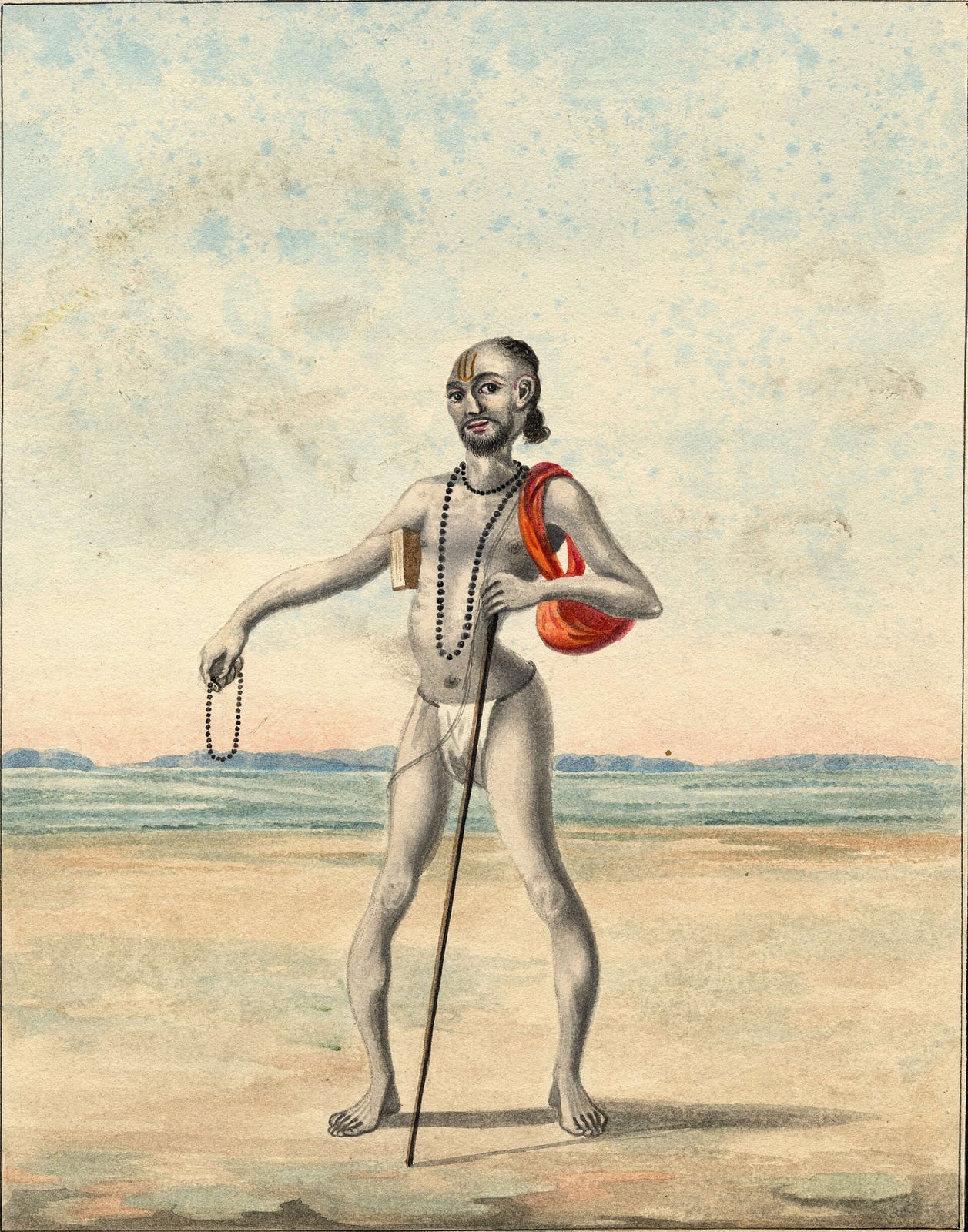
Ashtavakra
Übereinstimmung bei: Was ist das Absolute? Gibt es Gott? · Wer bin ich? Gibt es ein wahres Selbst? · Warum leiden wir?
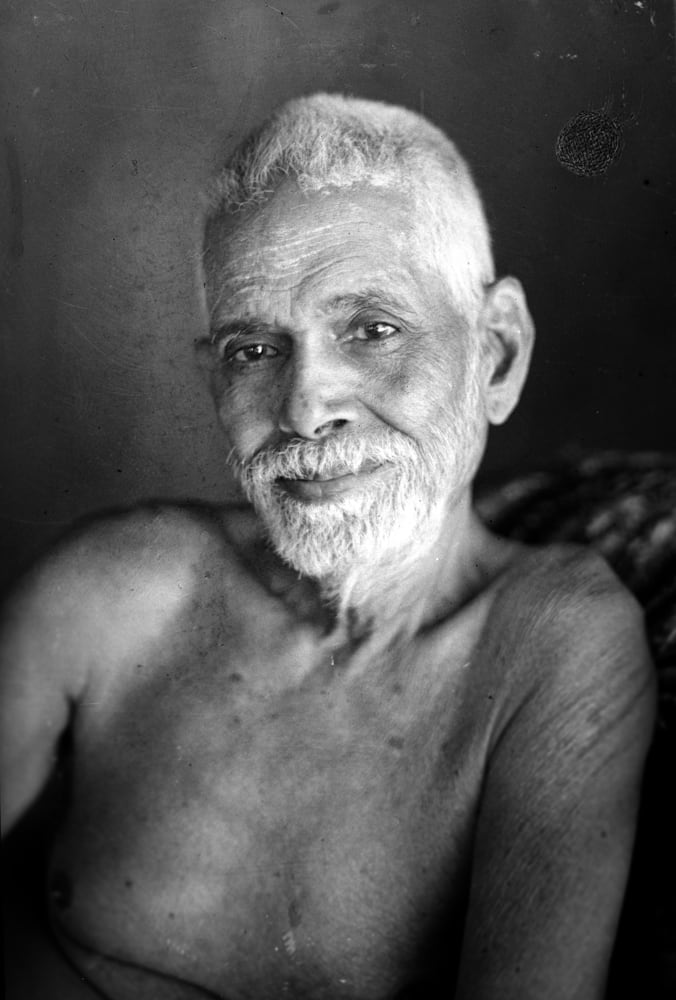
Ramana Maharshi
Übereinstimmung bei: Was ist das Absolute? Gibt es Gott? · Wer bin ich? Gibt es ein wahres Selbst? · Warum leiden wir?
Uddalaka Aruni
Übereinstimmung bei: Was ist das Absolute? Gibt es Gott? · Wer bin ich? Gibt es ein wahres Selbst? · Was geschieht nach dem Tod?
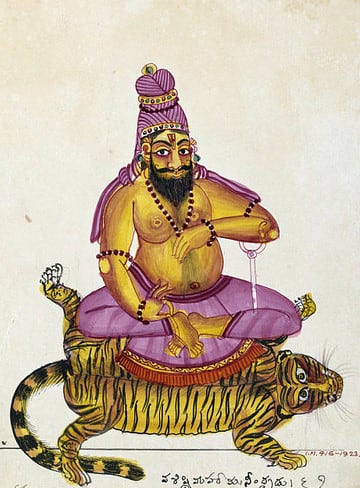
Vasishtha
Übereinstimmung bei: Was ist das Absolute? Gibt es Gott? · Wer bin ich? Gibt es ein wahres Selbst? · Warum leiden wir?
Denkt anders als


Anekdoten und Erzählungen
Anekdoten und Erzählungen
Hagiographische Erzählungc. 660
The woodcutter who heard the Diamond Sūtra
Herkunft der Erzählung: Autobiography in the Platform Sūtra, already in the Dunhuang copy (ninth century); there is no independent testimony.
Hagiographische Erzählungc. 661
The poem contest
Herkunft der Erzählung: Autobiography in the Platform Sūtra, already in the Dunhuang copy (ninth century); there is no independent testimony.
Quelle: McRae, John R. Seeing through Zen: Encounter, Transformation, and Genealogy in Chinese Chan Buddhism. Berkeley: University of California Press, 2003. ISBN 0520237986.
Hagiographische Erzählungc. 661
Three knocks on the mortar
Herkunft der Erzählung: Only in the late versions of the Platform Sūtra (Huixin 967 and above all Zongbao 1291) and in Song-period case collections (Wumenguan, 1228); absent from the Dunhuang copy.
Quelle: Wikisource en chino: 六祖大師法寶壇經 (versión de Zongbao, 1291), con una página por capítulo.
Hagiographische Erzählungc. 661
Huiming's original face
Herkunft der Erzählung: Only in the late versions of the Platform Sūtra (Huixin 967 and above all Zongbao 1291) and in Song-period case collections (Wumenguan, 1228); absent from the Dunhuang copy.
Quelle: Wikisource en chino: 六祖大師法寶壇經 (versión de Zongbao, 1291), con una página por capítulo.
Hagiographische Erzählung676 (según la tradición)
The wind and the banner
Herkunft der Erzählung: Only in the late versions of the Platform Sūtra (Huixin 967 and above all Zongbao 1291) and in Song-period case collections (Wumenguan, 1228); absent from the Dunhuang copy.
Quelle: Wikisource en chino: 六祖大師法寶壇經 (versión de Zongbao, 1291), con una página por capítulo.
Hagiographische Erzählungc. 700
The three blows to Shenhui
Herkunft der Erzählung: Dunhuang copy of the Platform Sūtra (§48–49 in Yampolsky); interpretation by Hu Shi (1930) and Yampolsky (1967).
Zeugnis1589
Matteo Ricci before the sixth patriarch's body
Herkunft der Erzählung: Ricci's journals, published in Latin by Nicolas Trigault (1615) and translated by Gallagher (1953); study by Jorgensen (2005).
Quelle: Ricci, Matteo y Nicolas Trigault. China in the Sixteenth Century: The Journals of Matthew Ricci, 1583–1610. Trad. Louis J. Gallagher. Nueva York: Random House, 1953.
Lehren
Lehren
Die Begriffe, die das Denken gliedern, in ihrem Zusammenhang erklärt.
Sudden awakening (dunwu)dunwu
Controversy between the Northern and Southern schools (eighth century).
Quelle: McRae, John R. Seeing through Zen: Encounter, Transformation, and Genealogy in Chinese Chan Buddhism. Berkeley: University of California Press, 2003. ISBN 0520237986.
No-thought, no-form, no-abidingwunian
Platform Sūtra, section 17 of the Dunhuang copy.
Quelle: Yampolsky, Philip B. (ed. y trad.). The Platform Sutra of the Sixth Patriarch: The Text of the Tun-huang Manuscript. Nueva York: Columbia University Press, 1967; reed. 2012 (ISBN 9780231159562).
Unity of meditation and wisdom (dinghui)dinghui
A Chinese reinterpretation of the discipline-meditation-wisdom triad.
Seeing one's nature (jianxing)jianxing
Doctrine of buddha-nature (foxing) in Chan.
Quelle: Dōgen. Shōbōgenzō, fascículo «Shizen biku» (四禪比丘), en la recensión de doce fascículos; trad. inglesa en Nishijima, Gudo y Chodo Cross, Master Dogen's Shobogenzo, vol. 4, Windbell, 1999.
Formless precepts (wuxiang jie)wuxiang-jie
Mass lay ordinations in eighth- and ninth-century Chan.
Quelle: Yampolsky, Philip B. (ed. y trad.). The Platform Sutra of the Sixth Patriarch: The Text of the Tun-huang Manuscript. Nueva York: Columbia University Press, 1967; reed. 2012 (ISBN 9780231159562).
Transmission of the robe and patriarchal lineagechuanyi
Chan historiography (eighth to eleventh centuries).
Quelle: McRae, John R. Seeing through Zen: Encounter, Transformation, and Genealogy in Chinese Chan Buddhism. Berkeley: University of California Press, 2003. ISBN 0520237986.
Videos
Videos
Aufnahmen, Gespräche und Dokumentarfilme. Die Videos werden von YouTube wiedergegeben; sie werden nicht hier gespeichert.
The Platform Sutra of Chan Buddhism - Jun Wang
Vortrag· EN· 2018
Debashish Banerji
Sixth Patriarch's Dharma Jewel Platform Sutra (1) by Rev. Heng Sure from BRF2018
Vortrag· EN· 2019
DharmaRealmLiveOffizieller Kanal
Reflections from the Platform Sutra of the Sixth Patriarch - Ven. Dr Juewei
Vortrag· EN· 2020
Buddhist Library
The Platform Sutra of the Sixth Patriarch L1
Vortrag· EN
Khenpo Sodargye's TeachingsOffizieller Kanal
SBZC with Bill Powell "The Platform Sutra" class #1
Vortrag· EN· 2021
Santa Barbara Zen CenterOffizieller Kanal
Class on the Platform Sutra
Vortrag· EN
kansaszencenterOffizieller Kanal
The Mind Has No Stand: Zen, Huineng, Teaching & Text
Analyse· EN· 2021
Eric Gerlach
Huineng - The 6th Chinese Ancestor of Zen Buddhism
Vortrag· EN
Great Mountain Zen CenterOffizieller Kanal
【六祖壇經的生活實踐】 主講:慧知法師
Vortrag· ZH
VIBPS 溫哥華佛光山 Vancouver IBPSOffizieller Kanal
慧知法師紐約佛學講座-《六祖壇經》的生活智慧
Vortrag· ZH
FGS IBPS New YorkOffizieller Kanal
佛教紀錄片:六祖惠能的最後一年 (智慧東方)
Dokumentarfilm· ZH· 2017
佛弟子
¿Quién fue Hui Neng?
Aufnahme Dritter· ES
Cosas del Zen
Galerie
Galerie
Bilder mit geprüfter Lizenz. Jedes bewahrt seine Urheberschaft und seinen Herkunftsnachweis.
Handschriften
Handschriften
Handschriftliche Zeugen und alte Texte, mit ihrer verwahrenden Einrichtung und ihren Einsichtsbedingungen.
ZH · Chino (escritura regular, copia manuscrita) · c. 780
南宗頓教最上大乘摩訶般若波羅蜜經六祖惠能大師於韶州大梵寺施法壇經
- Erhaltener Textzeuge
- Copia de hacia 830–860, la más antigua conocida, en formato de cuadernillo
- Verwahrende Einrichtung
- British Library (Londres) · Or.8210/S.5475
- Digitalisierung
- idp.bl.uk/…
ZH · Chino · c. 780
六祖壇經 (copia de Dunhuang)
- Erhaltener Textzeuge
- Segunda copia completa de Dunhuang, de mejor calidad textual
- Verwahrende Einrichtung
- Museo de Dunhuang · Dunbo 077
Beziehungen
Beziehungen
Einflüsse, Schülerschaften und Verwandtschaften. Die belegte Beziehung wird von der durch Analyse ermittelten Ähnlichkeit unterschieden.
Beeinflusst von
The sūtra presents him as the sixth link of the lineage beginning with Bodhidharma and records his transmission verse.
Belegte Beziehung
Schüler von
Hongren (601–674), quinto patriarca
His teacher at Huangmei, according to all sources, including Wang Wei's stele.
Belegte Beziehung
Zeitgenosse von
Shenxiu (c. 606–706)
Hongren's chief disciple and figure of the Northern school; the poem contest pitting them against each other is legendary.
Belegte Beziehung
Lehrer von
Shenhui (684–758)
He proclaimed himself his disciple and was the architect of his fame; the Dunhuang copy includes him among his ten disciples.
Belegte Beziehung
Beeinflusste
Heir of a Caodong lineage going back to Huineng; in the Shōbōgenzō (“Shizen biku”) he rejected the Platform Sūtra as apocryphal.
Belegte Beziehung
Beeinflusste
His Rinzai lineage goes back to Huineng through Linji; the kenshō Hakuin demands is the sūtra's “seeing the nature”.
Durch Analyse ermittelte Ähnlichkeit
Beeinflusste
A Sōtō master, of Dōgen's lineage which goes back to Huineng.
Durch Analyse ermittelte Ähnlichkeit
Beeinflusste
His Vietnamese Lâm Tế (Linji) lineage goes back to Huineng.
Durch Analyse ermittelte Ähnlichkeit
Beeinflusst von
The sūtra's logic of emptiness—denying tree and mirror—extends the prajñāpāramitā and Madhyamaka; tradition counts Nāgārjuna among the Indian patriarchs.
Durch Analyse ermittelte Ähnlichkeit
Zeitgenosse von
Rough contemporaries at the two ends of Asia, both centred on the nature of mind and the wisdom of emptiness.
Durch Analyse ermittelte Ähnlichkeit
Verwandte Gedanken mit
The sūtra's valuing of flow, non-fixation and immediacy recalls Daoist themes; the influence is debated.
Durch Analyse ermittelte Ähnlichkeit
Quellen
Quellen
Für diesen Eintrag herangezogene Bibliografie und Kataloge.
- Wikidata, «Huineng», QID Q345012 (VIAF 32007548; LCCN n50078883).
- Yampolsky, Philip B. (ed. y trad.). The Platform Sutra of the Sixth Patriarch: The Text of the Tun-huang Manuscript. Nueva York: Columbia University Press, 1967; reed. 2012 (ISBN 9780231159562).
- McRae, John R. Seeing through Zen: Encounter, Transformation, and Genealogy in Chinese Chan Buddhism. Berkeley: University of California Press, 2003. ISBN 0520237986.
- McRae, John R. (trad.). The Platform Sutra of the Sixth Patriarch, translated from the Chinese of Tsung-pao. Berkeley: Numata Center for Buddhist Translation and Research, 2000. ISBN 1886439133.
- McRae, John R. The Northern School and the Formation of Early Ch'an Buddhism. Honolulu: University of Hawai'i Press (Kuroda Institute), 1986.
- Schlütter, Morten y Stephen F. Teiser (eds.). Readings of the Platform Sūtra. Nueva York: Columbia University Press, 2012. ISBN 9780231158206.
- Jorgensen, John. Inventing Hui-neng, the Sixth Patriarch: Hagiography and Biography in Early Ch'an. Leiden: Brill (Sinica Leidensia 68), 2005. ISBN 9004145087.
- Thompson, John M. «Huineng (Hui-neng) (638–713)». Internet Encyclopedia of Philosophy.
- Hu Shi 胡適 (ed.). Shenhui heshang yiji 神會和尚遺集 (Obras conservadas del monje Shenhui). Shanghái: Yadong tushuguan, 1930.
- Wang Wei 王維. «Neng chanshi bei» 能禪師碑 (Estela del maestro de chan Neng), mediados del siglo VIII, recogida en el Quan Tang wen; inscripción encargada por Shenhui.
- Schlütter, Morten. «A Study in the Genealogy of the Platform Sūtra». Studies in Central and East Asian Religions 2 (1989): 53–114.
- Wong Mou-lam (trad.). Sutra Spoken by the Sixth Patriarch, Wei Lang, on the High Seat of the Gem of Law. Shanghái: Yu Ching Press, 1930.
- Wikisource en chino: 南宗頓教最上大乘摩訶般若波羅蜜經六祖惠能大師於韶州大梵寺施法壇經 (texto de la copia de Dunhuang, compilado por Fahai).
- Wikisource en chino: 六祖大師法寶壇經 (versión de Zongbao, 1291), con una página por capítulo.
- Huineng (atrib.), Fahai (comp.). 六祖壇經 (Liuzu tanjing), edición de la dinastía Ming colacionada por Deqing. Project Gutenberg, e-book n.º 23844, 2007.
- Ricci, Matteo y Nicolas Trigault. China in the Sixteenth Century: The Journals of Matthew Ricci, 1583–1610. Trad. Louis J. Gallagher. Nueva York: Random House, 1953.
- Dumoulin, Heinrich. Zen Buddhism: A History. Vol. 1: India and China. Nueva York: Macmillan, 1988.
- Red Pine (Bill Porter) (trad.). The Platform Sutra: The Zen Teaching of Hui-neng. Emeryville (CA): Shoemaker & Hoard, 2006. ISBN 9781593760861.
- Dōgen. Shōbōgenzō, fascículo «Shizen biku» (四禪比丘), en la recensión de doce fascículos; trad. inglesa en Nishijima, Gudo y Chodo Cross, Master Dogen's Shobogenzo, vol. 4, Windbell, 1999.
- Yanagida Seizan 柳田聖山. Shoki zenshū shisho no kenkyū 初期禅宗史書の研究. Kioto: Hōzōkan, 1967.
- Yanagida Seizan (ed.). Rokuso dangyō shohon shūsei 六祖壇經諸本集成. Kioto: Chūbun shuppansha, 1976.
- Chan, Wing-tsit (trad.). The Platform Scripture. Nueva York: St. John's University Press, 1963.
- Rechteinhaber
- Texto chino original en dominio público. Traducciones modernas con derechos: Columbia University Press (Yampolsky), Numata Center/BDK (McRae), Counterpoint (Red Pine), Shambhala (Cleary; Price y Wong), Editorial Kairós (Laureano Ramírez), Edaf.
Bestätigung ausstehend
Was dieser Eintrag noch nicht klären konnte. Wir sagen es lieber, als es aufzufüllen.
- Traducción inglesa de Wong Mou-lam (Shanghái, Yu Ching Press, 1930): es de dominio público en EE. UU. (publicada en 1930, libre desde el 1 de enero de 2026), en la UE y en España (Wong Mou-lam, 1886–1934), pero no se ha localizado un escaneo con OCR limpio de la edición de 1930; las de Luzac (1944, 1953) y Shambhala llevan la revisión de Christmas Humphreys (m. 1983), protegida. Buscar en Internet Archive o HathiTrust la edición de 1930.
- Versión base de la traducción española de Laureano Ramírez (Kairós, 2010; hay ediciones anteriores) — comprobar si es la de Dunhuang o la de Zongbao.
- Signatura y digitalización de la copia del Museo de Dunhuang (Dunbo 077) y de la de Lüshun; no verificadas en un catálogo accesible.
- Fecha y circunstancias exactas del título póstumo (815/816) y de las estelas de Liu Zongyuan y Liu Yuxi: se han tomado de la bibliografía secundaria (Dumoulin), no de las fuentes.
- Vídeos en español: solo se ha encontrado material divulgativo breve; no hay conferencias académicas en español con canal solvente.
- Las ediciones francesas, alemanas e italianas del sūtra no se han cotejado en catálogo.
Recherchiert am 2026-10-25