Christentum · Christliche Mystik · Katholizismus
Hildegard of Bingen
Hildegardis Bingensis
1098 – 1179Historisch belegte Person
Rheinische Benediktineräbtissin (1098–1179), Seherin, Komponistin, Naturkundige und Ratgeberin von Päpsten und Kaisern. Seit ihrer Kindheit beim Kloster Disibodenberg eingeschlossen, erhielt sie mit zweiundvierzig Jahren den Befehl, ihre Visionen aufzuschreiben: So entstanden Scivias, der Liber vitae meritorum und der Liber divinorum operum. Sie gründete Rupertsberg und Eibingen, schrieb zwei medizinische Abhandlungen, siebenundsiebzig Gesänge, das Drama Ordo Virtutum, eine erfundene Sprache und rund vierhundert Briefe und predigte öffentlich. Seit 2012 Kirchenlehrerin.
- Werke
- 19Werke
- Ausgaben
- 48Ausgaben
- Zitate
- 7Zitate
- Videos
- 12Videos
- Bilder
- 8Bilder
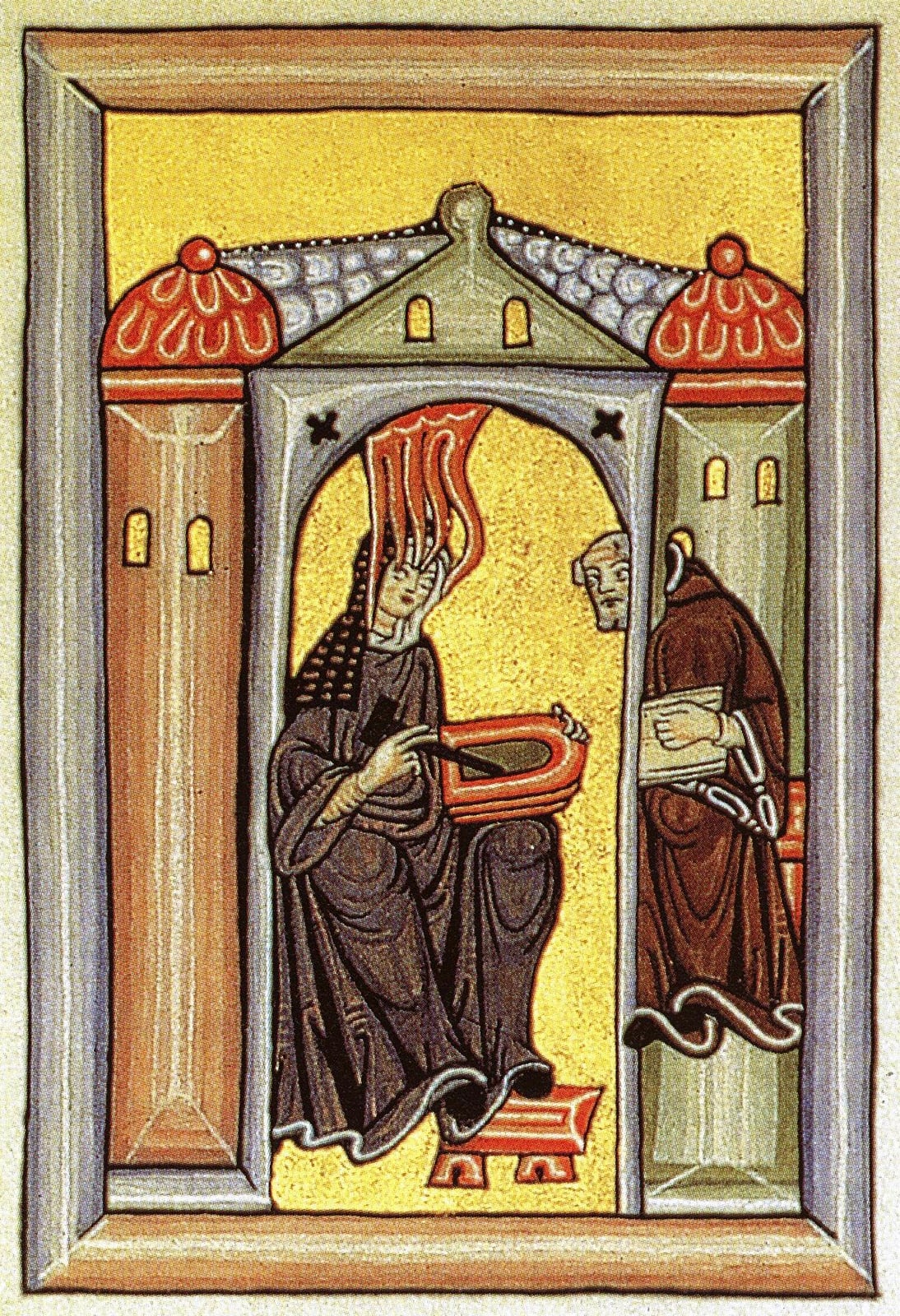
Hildegarda recibe la visión y la dicta a Volmar (Scivias de Rupertsberg) · Public domain
In eigenen Worten
«It happened in the year 1141 of the incarnation of the Son of God, Jesus Christ, when I was forty-two years and seven months old, that a fiery light of the greatest brilliance, coming from the open heaven, poured through my whole brain.»Scivias, Protestificatio (declaración preliminar)

Der zentrale Gedanke
Viriditas (greenness): Viriditas, 'greenness', is the word Hildegard uses most freely and in the most registers.
Im Zusammenhang sehen
Biografie
6 Min. Lesezeit
Unterstützte Übersetzung aus dem spanischen Original, Durchsicht durch einen muttersprachlichen Übersetzer ausstehend.
Ein Kind, als Zehnt dargebracht
Hildegard wurde 1098 geboren, wahrscheinlich in Bermersheim bei Alzey, im Rheinland, das damals das Herz des Reiches war. Ihre Eltern, Hildebert und Mechthild, gehörten dem kleinen edelfreien Adel an, der den Grafen von Sponheim lehnspflichtig war. Die kurz nach ihrem Tod verfasste Vita berichtet, sie sei das zehnte Kind gewesen und ihre Eltern hätten sie Gott dargebracht; die Überlieferung hat darin einen Zehnten gesehen. Schon als ganz kleines Kind, so wird sie selbst mit sechzig Jahren erzählen, sah sie „ein so großes Licht, dass meine Seele erbebte“, und sie lernte bald, darüber zu schweigen: Eine Magd, der sie die Farbe eines noch ungeborenen Kalbes vorhergesagt hatte, sah sie entsetzt an.
Um 1106, achtjährig, wurde sie Jutta von Sponheim anvertraut, einer jungen Adligen, die beschlossen hatte, als Reklusin zu leben. Die ältesten Quellen – die 1992 entdeckte Vita Juttae – zeigen, dass die förmliche Inklusion Juttas, Hildegards und eines dritten Mädchens beim Benediktinerkloster Disibodenberg am 1. November 1112 gefeiert wurde, nach dem Ritus der Totenliturgie: Man mauerte sie ein. Was eine Zelle sein sollte, wurde mit den Jahren zu einer kleinen Frauengemeinschaft; Jutta lehrte Hildegard, den lateinischen Psalter zu lesen und das Stundengebet zu singen. Von einem Mönch des Hauses, Volmar, erhielt sie, was die Vita eine „einfache“ Bildung nennt; er sollte dreißig Jahre lang ihr Sekretär sein.
Der Befehl zu schreiben
Nach Juttas Tod am 22. Dezember 1136 wählten die Nonnen Hildegard zur magistra. Sie war achtunddreißig Jahre alt und behielt ihre Visionen noch immer für sich. 1141, „als ich zweiundvierzig Jahre und sieben Monate alt war“, durchdrang ein feuriges Licht ihr Gehirn und ihre Brust, und eine Stimme befahl ihr, zu sagen und aufzuschreiben, was sie sah. Sie sträubte sich, wurde krank – die Krankheit ist in ihrer Erzählung stets die Gestalt, die der Ungehorsam annimmt – und genas erst, als sie Volmar zu diktieren begann. So entstand Scivias („Wisse die Wege“): zehn Jahre Arbeit und sechsundzwanzig Visionen über Schöpfung, Erlösung und Heilsgeschichte, jede zuerst als Bild beschrieben und dann von der himmlischen Stimme ausgelegt.
Was sie von anderen Visionären unterscheidet, ist die Umsicht, mit der sie Rückhalt suchte. Sie schrieb an Bernhard von Clairvaux, der ihr mit einem kurzen, freundlichen Brief antwortete. Auf der Synode von Trier (November 1147 – Februar 1148) legte Abt Kuno vom Disibodenberg das unvollendete Manuskript Papst Eugen III. vor, einem Zisterzienser und Schüler Bernhards; der Vita zufolge las der Papst vor den versammelten Prälaten daraus vor und ermächtigte sie brieflich, weiterzuschreiben. Die päpstliche Erlaubnis machte aus einer rheinischen Nonne eine Autorität, die Bischöfe, Äbte und Könige um Rat fragten.
Rupertsberg
Um 1150 übersiedelte Hildegard gegen den Willen Abt Kunos – der dadurch die Mitgiften der Nonnen und das Ansehen der Seherin verlor – mit ihren etwa zwanzig Schwestern auf einen Hügel über der Nahe, gegenüber von Bingen, wo der heilige Rupert begraben sein sollte. Um den Widerstand des Abtes zu brechen, wurde sie abermals krank und lag reglos im Bett, bis Kuno, so die Vita, feststellte, dass nicht einmal er sie aufheben konnte. Die Kirche auf dem Rupertsberg wurde 1152 vom Mainzer Erzbischof geweiht; 1158 erlangte das Kloster die wirtschaftliche Unabhängigkeit vom Disibodenberg. Dort schuf Hildegard fast alles: zwei weitere Visionsbücher, zwei medizinische Abhandlungen, siebenundsiebzig Gesänge, ein liturgisches Drama, eine erfundene Sprache und rund vierhundert Briefe.
Der menschliche Preis des Umzugs hatte einen Namen: Richardis von Stade, die junge Nonne aus hohem Adel, die ihr beim Scivias geholfen hatte und die ihre Familie 1151 zur Äbtissin von Bassum machen ließ. Hildegard schrieb an den Erzbischof von Bremen, an den Papst und an Richardis selbst Briefe von entwaffnender Offenheit – „warum verlässt du mich wie eine Waise?“ –; Richardis starb im Oktober 1152, wie es scheint, voller Reue.
Ärztin, Komponistin, Predigerin
Zwischen 1151 und 1158 verfasste Hildegard zwei naturkundliche Werke ohne Visionen und ohne himmlische Stimme: die Physica, einen Katalog von Pflanzen, Bäumen, Steinen, Fischen, Vögeln und Tieren mit ihren Heilkräften, und Causae et curae, über den Kosmos, den menschlichen Körper, die Zeugung, die Säfte und die Heilmittel. Ihre Medizin ist die der Klöster, gestützt auf Galen und die rheinische Volksüberlieferung, doch mit eigenen Beobachtungen über die weibliche Sexualität und die Melancholie, die in ihrem Jahrhundert ohne Parallele sind. Zwischen 1158 und 1163 schrieb sie den Liber vitae meritorum (Buch der Lebensverdienste) über die Tugenden und Laster im Zwiegespräch, und zwischen 1163 und 1173 den Liber divinorum operum (Buch der göttlichen Werke), ihr ehrgeizigstes Werk: die Kosmologie des Menschen als Mikrokosmos, mit den berühmten Miniaturen, die ein Kodex in Lucca bewahrt.
Die Musik war für sie kein Schmuck. Die siebenundsiebzig Gesänge der Symphonia armonie celestium revelationum – Antiphonen, Responsorien, Sequenzen, Hymnen – haben einen erweiterten Tonumfang und Melismen, die den Choral ihrer Zeit sprengen, und der Ordo Virtutum, in dem die Tugenden mit dem Teufel (der einzigen Figur, die nicht singt) um eine Seele ringen, ist das älteste erhaltene musikalische Drama mit Autorennamen. Als 1178 die Mainzer Prälaten das Interdikt über ihr Kloster verhängten, weil dort ein exkommunizierter Adliger bestattet worden war, und ihr verboten, das Offizium zu singen, schrieb Hildegard ihnen, die Musik sei die Erinnerung an das Paradies, und wer sie ohne schwerwiegenden Grund verstummen lasse, laufe Gefahr, seinen Platz unter den Chören der Engel zu verlieren. Das Interdikt wurde im März 1179 aufgehoben.
Zwischen 1158 und 1171 unternahm sie vier Predigtreisen – Mainz, Würzburg, Bamberg, Trier, Köln, Werden, Maulbronn, Zwiefalten – und predigte öffentlich vor Klerus und Volk, was für eine Frau ohne Beispiel war, gegen die Verderbnis des Klerus und gegen die Katharer. Kaiser Friedrich Barbarossa wies sie brieflich zurecht, als er Gegenpäpste unterstützte, und zwar mit einer Schärfe, die er hinnahm: 1163 hatte er dem Rupertsberg einen Schutzbrief gewährt. 1165 gründete sie ein zweites Haus in Eibingen, auf der anderen Rheinseite.
Sprache, Briefe und Ende
Hildegard erfand eine lingua ignota von etwa tausend Wörtern mit eigenem Alphabet, den litterae ignotae, deren Zweck bis heute umstritten ist: Spiel, Geheimsprache der Gemeinschaft oder Versuch, eine Sprache vor Babel wiederzugewinnen. Ihr Briefwechsel, zum Teil im Wiesbadener Riesencodex überliefert – dem fünfzehn Kilo schweren Kodex, der ihre Werke vereint und kurz nach ihrem Tod auf dem Rupertsberg zusammengestellt wurde –, zeigt eine Ratgeberin von Päpsten, Kaisern, Äbten und namenlosen Frauen, die ihr schrieben und sie um ihr Gebet baten.
Volmar starb 1173; 1177 kam der wallonische Mönch Wibert von Gembloux als Sekretär, dem Hildegard die genaueste Beschreibung ihrer Art zu sehen schrieb: ein Licht, „das nicht örtlich ist“, heller als eine Wolke, die die Sonne trägt, das sie „Schatten des lebendigen Lichts“ nennt und in dem sie zugleich sieht, hört und weiß – wach und ohne Ekstase. Sie starb am 17. September 1179 im Alter von einundachtzig Jahren. Die Heiligsprechungsversuche des 13. Jahrhunderts (1227–1243) verliefen im Sande der Bürokratie; ihre Verehrung lebte fort. Benedikt XVI. nahm ihren Namen am 10. Mai 2012 in den allgemeinen Kalender auf und erhob sie am 7. Oktober desselben Jahres zur Kirchenlehrerin.
Was bleibt
Von Hildegard bleibt zunächst ein gewaltiges lateinisches Werk, das die moderne Philologie im Corpus Christianorum kritisch ediert hat, und eine Musik, die seit den 1980er Jahren – Sequentia, Gothic Voices – wieder gesungen wird. Es bleibt die Frage nach ihren Visionen, die der Neurologe Oliver Sacks mit der Migräne mit Aura in Verbindung brachte und die Historiker lieber als literarische Gattung mit eigenen Regeln lesen. Es bleibt eine Theologie der viriditas, der Grünkraft, jener Lebensenergie, die die Schöpfung durchdringt und die das ökologische Denken zu seinem Sinnbild gemacht hat. Und es bleibt vor allem eine Frau des 12. Jahrhunderts, die Päpste und Kaiser dazu brachte, ihr zuzuhören, während sie sich selbst ein „armseliges weibliches Geschöpf“ und eine „vom Wind getragene Feder“ nannte – mit einer Ironie, die sich nur eine große Autorität leisten kann. Die illuminierte Handschrift des Scivias, unter ihren Augen auf dem Rupertsberg entstanden, verschwand 1945 in Dresden: Wir kennen sie durch eine Abschrift von Hand, die die Nonnen von Eibingen 1933 vollendeten – als hätte die Geschichte uns lehren wollen, woraus Überlieferung gemacht ist.
Quellen: Gottfried de Disibodenberg y Theoderich de Echternach. Vita sanctae Hildegardis. Ed. Monika Klaes. Corpus Christianorum Continuatio Mediaevalis 126. Turnhout: Brepols, 1993. Trad. inglesa en Anna Silvas, Jutta and Hildegard: The Biographical Sources. Turnhout: Brepols, 1998 (University Park: Penn State Press, 1999). · Hildegardis Bingensis. Scivias. Ed. Adelgundis Führkötter y Angela Carlevaris. CCCM 43–43A. Turnhout: Brepols, 1978. Trad. inglesa: Columba Hart y Jane Bishop, Hildegard of Bingen: Scivias (Classics of Western Spirituality). Nueva York: Paulist Press, 1990. Trad. española: Scivias: Conoce los caminos, trad. Antonio Castro Zafra y Mónica Castro. Madrid: Trotta, 1999. · Hildegardis Bingensis. Liber divinorum operum. Ed. Albert Derolez y Peter Dronke. CCCM 92. Turnhout: Brepols, 1996. Trad. inglesa: Nathaniel M. Campbell, The Book of Divine Works. Washington: Catholic University of America Press, 2018. · Hildegardis Bingensis. Liber vite meritorum. Ed. Angela Carlevaris. CCCM 90. Turnhout: Brepols, 1995. Trad. inglesa: Bruce W. Hozeski, The Book of the Rewards of Life. Nueva York: Oxford University Press, 1997. · Hildegardis Bingensis. Epistolarium. Ed. Lieven Van Acker (vols. I–II) y Monika Klaes-Hachmöller (vol. III). CCCM 91, 91A, 91B. Turnhout: Brepols, 1991–2001.
Zeitleiste
Das Leben, Jahr für Jahr
Jeder Punkt ist ein belegtes Ereignis. Klicken Sie, um es mit Quelle und Grad der Gewissheit zu lesen.
10980 JahreBermersheim vor der Höhe (Renania-Palatinado), según la tradición
Birth
Born into a family of the lesser free nobility, daughter of Hildebert and Mechthild. The place (Bermersheim) is that accepted by most scholars; the year is inferred from her own dating of the 1141 vision.
WahrscheinlichGottfried de Disibodenberg y Theoderich de Echternach. Vita sanctae Hildegardis. Ed. Monika Klaes. Corpus Christianorum Continuatio Mediaevalis 126. Turnhout: Brepols, 1993. Trad. inglesa en Anna Silvas, Jutta and Hildegard: The Biographical Sources. Turnhout: Brepols, 1998 (University Park: Penn State Press, 1999).
Nach dem Tod
- 1227 – 1243Unfinished canonisation process
- Februar 1945Loss of the Rupertsberg Scivias
- 7. Oktober 2012Doctor of the Church
1098 · 0 Jahre
Birth
Born into a family of the lesser free nobility, daughter of Hildebert and Mechthild. The place (Bermersheim) is that accepted by most scholars; the year is inferred from her own dating of the 1141 vision.
Wahrscheinlich
um 1106 · 8 Jahre
Entrusted to Jutta of Sponheim
At eight her parents entrust her to the young noblewoman Jutta of Sponheim for religious life.
Belegt
1. November 1112 · 14 Jahre
Enclosure at Disibodenberg
Jutta, Hildegard and another girl are enclosed beside the Benedictine monastery of Disibodenberg, according to the Vita Juttae. Hildegard makes her Benedictine profession in the following years.
Wahrscheinlich
22. Dezember 1136 · 38 Jahre
Jutta dies; Hildegard elected magistra
On Jutta's death, the women's community at Disibodenberg elects Hildegard as superior.
Belegt
1141 · 42 Jahre
The command to write
'In the forty-second year and seventh month' of her life she receives the vision of the fiery light and the command to write what she sees. She begins Scivias with the help of Volmar and Richardis of Stade.
Belegt
November 1147 – 1148 · 49 Jahre
Pope Eugene III approves her work
At the synod of Trier (Nov. 1147 – Feb. 1148) the pope reads passages of the unfinished Scivias and authorises her by letter to continue writing. Bernard of Clairvaux had already encouraged her by letter.
Belegt
um 1150 · 52 Jahre
Move to Rupertsberg
Against Abbot Kuno's opposition she moves her community to Rupertsberg, near Bingen. The church is consecrated in 1152.
Belegt
1151 · 53 Jahre
Scivias completed; Richardis departs
She completes Scivias. Richardis of Stade is appointed abbess of Bassum and leaves Rupertsberg despite Hildegard's letters; she dies in 1152.
Belegt
um 1151 – 1158 · 53 Jahre
Physica and Causae et curae
Between c. 1151 and 1158 she composes her two works of natural science and medicine, together with the Ordo Virtutum and much of the Symphonia.
Wahrscheinlich
1158 – 1171 · 60 Jahre
First preaching journey
She begins the first of four preaching journeys (1158–1171) along the Main, Moselle, Rhine and into Swabia, preaching publicly to clergy and people. That year she begins the Liber vitae meritorum.
Belegt
1163 · 65 Jahre
Imperial privilege and start of the Liber divinorum operum
Frederick Barbarossa grants a privilege of protection to Rupertsberg. Hildegard begins the Liber divinorum operum, completed around 1173–1174.
Belegt
1165 · 67 Jahre
Foundation of Eibingen
She founds a second community at Eibingen, on the right bank of the Rhine, which she visits regularly.
Belegt
1173 · 75 Jahre
Death of Volmar
Volmar, her secretary for three decades, dies. He is succeeded by Gottfried of Disibodenberg (1174–1176), who begins the Vita, and Guibert of Gembloux (from 1177).
Belegt
1178 – 1179 · 80 Jahre
The Mainz interdict
For burying an excommunicated nobleman, the prelates of Mainz forbid the sung office at Rupertsberg. Hildegard refuses to exhume him and writes her letter on music. The interdict is lifted in March 1179.
Belegt
17. September 1179 · 81 Jahre
Death
She dies at Rupertsberg aged eighty-one. The Vita relates that two luminous arcs appeared in the sky above the monastery.
Belegt
1227 – 1243
Unfinished canonisation process
Gregory IX opens the process (1227–1233); Innocent IV revives it (1243). The incomplete acts lead to no bull. Her cult nonetheless continues and her name enters the Roman Martyrology.
Belegt
Februar 1945
Loss of the Rupertsberg Scivias
The illuminated Scivias codex (Wiesbaden, Hs. 1), evacuated to Dresden for safekeeping, vanishes after the bombings; it is known from black-and-white photographs of 1927 and from the hand-painted copy by the nuns of Eibingen (1927–1933).
Belegt
7. Oktober 2012
Doctor of the Church
Benedict XVI, after extending her cult to the universal Church on 10 May 2012 (equivalent canonisation), proclaims her a Doctor of the Church together with John of Ávila.
Belegt
Werke
Grundlegende Werke
Die Werke, ohne die sich das Vermächtnis nicht verstehen lässt.
Schriftliches Werk · 1151
Scivias (Know the Ways)
Scivias (Sci vias Domini)
Her first and most widely read visionary work: twenty-six visions in three books (six, seven and thirteen) traversing creation and the fall, redemption through Christ and the Church as bride, and the history of salvation to the end of time, closing with the songs and the drama of the Virtues. Each vision is first presented as an image (the iron mountain, the cosmic egg, Synagogue, the building of salvation) and then explained by a heavenly voice, with a dense exegesis of Scripture. The illuminated manuscript made at Rupertsberg under her supervision was lost in 1945; its thirty-five miniatures are known from photographs and from the Eibingen copy.
6 Ausgaben · amazon.de

Schriftliches Werk · um 1174
The Book of Divine Works
Liber divinorum operum (De operatione Dei)
Her cosmological synthesis. Ten visions in three parts: Charity as the fiery force animating the universe; man at the centre of the cosmic spheres, with winds, stars and humours corresponding to his limbs (the figure of the 'universal man' immortalised by the Lucca codex); an extended commentary on the prologue of John's Gospel and on Genesis; and, in the third part, the city of God and history up to the Antichrist. It is the work in which the theology of viriditas and the microcosm-macrocosm relation reach their fullest formulation.
4 Ausgaben · amazon.com

Schriftliches Werk · um 1158
Physica (Book of the Subtleties of Creatures)
Physica (Liber subtilitatum diversarum naturarum creaturarum)
Nine books describing plants, elements, trees, stones, fish, birds, animals, reptiles and metals, with their qualities (hot, cold, moist, dry), their 'subtlety' and medicinal uses, often giving the German name of the plant beside the Latin. It blends Galenic learning, monastic tradition and Rhenish observation; its posterity is modern 'Hildegard medicine', which the work supports only in part.
3 Ausgaben · amazon.de

Schriftliches Werk · um 1158
Symphony of the Harmony of Celestial Revelations
Symphonia armonie celestium revelationum
Antiphons, responsories, sequences and hymns for the Virgin, the Holy Spirit, the saints of her land (Rupert, Disibod), the virgins and, above all, Saint Ursula. The poetry is free, without rhyme or regular metre, full of images of greenness, light and water ('O nobilissima viriditas', 'O vis aeternitatis', 'Caritas abundat in omnia'); the music, of wide range and long melismas, is the largest collection of monophonic chant by an identified author in the Middle Ages. Since the recordings by Sequentia (1982) and Gothic Voices (1982) it has been part of the repertoire.
2 Ausgaben · amazon.com
Das gesamte Werk (19)

The Book of Life's Merits (The Book of the Rewards of Life)
1163
Hildegard of Bingen
Causes and Cures
The Conscious LibraryCauses and Cures
1158

Ordo Virtutum (The Play of the Virtues)
1151

Unknown Language and Unknown Letters
1158

Letters
1179
Hildegard of Bingen
Homilies on the Gospels
The Conscious LibraryHomilies on the Gospels
1170
Hildegard of Bingen
Minor Works
The Conscious LibraryMinor Works
1170

Life of Saint Hildegard
1187

Life of Saint Disibod
1170
Life of Saint Rupert
1170

Explanation of the Rule of Benedict
Hildegard of Bingen
An Explanation of the Athanasian Creed
The Conscious LibraryAn Explanation of the Athanasian Creed
Solutions to Thirty-Eight Questions
1176
On the Excellence of Saint Martin
Hildegard of Bingen
Pentachronon, or Mirror of Future Times
The Conscious LibraryPentachronon, or Mirror of Future Times
1220
Zitate
Zitate, die in einem bestimmten Werk nachgewiesen sind. Jedes trägt seine Herkunft und seinen Grad an Verlässlichkeit.
It happened in the year 1141 of the incarnation of the Son of God, Jesus Christ, when I was forty-two years and seven months old, that a fiery light of the greatest brilliance, coming from the open heaven, poured through my whole brain.Factum est in millesimo centesimo quadragesimo primo Filii Dei Iesu Christi incarnationis anno, cum quadraginta duorum annorum septemque mensium essem, maximae coruscationis igneum lumen aperto caelo veniens totum cerebrum meum transfudit.
GeprüftScivias, Protestificatio (declaración preliminar)
Apokryphe Zitate oder Zitate umstrittener Zuschreibung (2)
«I am a feather on the breath of God.»
A popularised version (title of a 1982 Gothic Voices album) of a genuine image: in several letters Hildegard calls herself a 'feather' (penna) moved by the wind of the Spirit. The exact first-person sentence does not appear in that form in her works.
«Everything that is in the heavens, on earth and under the earth is penetrated with connectedness.»
A modern paraphrase circulating in anthologies of ecological spirituality, with no literal counterpart in the Latin corpus; it sums up ideas of the Liber divinorum operum but is not a quotation.
Letzte Worte
Es gibt keine überprüfbaren Aufzeichnungen der letzten Worte.
There is no reliable record of last words. The Vita (book III, Theoderich of Echternach) relates that Hildegard announced to her sisters the nearness of her death, that she died on 17 September 1179 and that two luminous arcs appeared in the sky above the monastery, but transmits no final sentence; nor do Guibert of Gembloux or the acts of the 1233 process.
Quelle: Gottfried de Disibodenberg y Theoderich de Echternach. Vita sanctae Hildegardis. Ed. Monika Klaes. Corpus Christianorum Continuatio Mediaevalis 126. Turnhout: Brepols, 1993. Trad. inglesa en Anna Silvas, Jutta and Hildegard: The Biographical Sources. Turnhout: Brepols, 1998 (University Park: Penn State Press, 1999).
Fragen
Was das Werk beantwortet
Zwölf große Fragen der Menschheit und was sich aus den Texten darauf antworten lässt, mit Belegen. Wir legen niemandem Worte in den Mund.
Was ist das Absolute? Gibt es Gott?
God is the Living Light who speaks, creates and loves the creation
Ein persönlicher GottAusdrücklich gesagt
Hildegard of Bingen writes within twelfth-century Benedictine theology and presents her visions as dictated by a heavenly voice that commands her to write what she sees. In Scivias, God appears as a most serene light and burning fire, and in the second vision of Book II the Trinity is shown to her as a sapphire-coloured human figure surrounded by light and flame: three in one, Father, Son and Spirit. In the Liber divinorum operum the first vision presents divine Love as a fiery power that sustains and quickens all creation. Her God is creator, judge and lover of the creation; He speaks and answers. The vital force she calls viriditas, greenness, is not an autonomous impersonal principle but the continuous action of that personal God in the world.
Diese Frage mit anderen Meistern vergleichenWer bin ich? Gibt es ein wahres Selbst?
The soul is a fiery sphere that God sends into the body
Eine geschaffene, unsterbliche SeeleAusdrücklich gesagt
Hildegard of Bingen treats the soul in detail in the fourth vision of Book I of Scivias: she sees a fiery sphere descend into the body of the child in the womb and quicken it, and then that pilgrim soul besieged by temptations, asking about its origin and exile. The soul is created by God, immortal and rational; the body is its tabernacle, and between them there is both cooperation and tension. In Causae et curae she adds a medical anthropology: the soul acts in the body as sap in a tree, and health depends on its harmony with the humours. The human being is for her a microcosm, an image of the universe, and its identity is that of a singular creature, distinct from God, called to recover in Christ the harmony lost in the Fall.
Diese Frage mit anderen Meistern vergleichenWarum leiden wir?
Sin broke the harmony of body and cosmos; hence illness
Soziale und moralische UnordnungAusdrücklich gesagt
Hildegard of Bingen places the origin of suffering in Adam's fall, but describes it as a rupture of harmony affecting body, soul and the whole world. In Causae et curae she explains that when Adam disobeyed, melancholy curdled in his blood, and since then human humours have been unbalanced: hence sadness, despair and many illnesses. In her cosmic vision the human being is bound to the elements and the stars, so that moral disorder affects nature, and nature in turn affects the person. In the Liber vitae meritorum the vices appear as misshapen figures and the virtues answer them, each with its remedy and penance. Suffering arises from the loss of measure and greenness (viriditas); healing means restoring the lost order, in body and in soul.
Diese Frage mit anderen Meistern vergleichenWas geschieht nach dem Tod?
Bodies will rise and the whole cosmos will be renewed on the last day
Ewiges Leben und AuferstehungAusdrücklich gesagt
Hildegard of Bingen shares the Christian eschatology of her time, but sets it out in visions of great cosmic scope. The last vision of the Scivias shows the end of time: the elements are stirred, the dead rise with their bodies whole, Christ judges and, after the judgement, the world is transformed into a new heaven and a new earth, without night or corruption. For her the person is not dissolved: the soul, which quickens the body as sap quickens a tree, survives death and recovers its glorified body. In the Liber vitae meritorum she describes in detail the purgatorial pains that correspond to each vice and the joy of the blessed, so that the life to come prolongs and completes the moral measure of this one. Death is a passage: the final destiny is the restored harmony of body, soul and cosmos before God.
Diese Frage mit anderen Meistern vergleichenWie erlangt man Befreiung oder Erlösung?
Salvation through Christ and the Church, with an active struggle of virtues against vices
Durch Gnade und LiebeAusdrücklich gesagt
Hildegard of Bingen thinks of salvation within Christian sacred history: Adam's fall broke the harmony of creation and Christ's incarnation restores it. The second book of Scivias traces that redemptive work and its continuation in the Church and the sacraments, the ordinary channel of grace. Yet Hildegard does not conceive the believer as a passive recipient. In the Book of the Rewards of Life she stages thirty-five pairs of vices and virtues in dialogue, and in the Ordo Virtutum the straying soul returns through penance. Salvation is God's gift and, at the same time, a moral combat: the person must recover her spiritual «greenness» (viriditas) by cooperating with grace through penance and the virtues.
Diese Frage mit anderen Meistern vergleichenBraucht es einen Lehrer?
Teaching comes through the Church and the rule; her own light, without human teacher
Gemeinschaft und TraditionAusdrücklich gesagt
Hildegard of Bingen was formed in Benedictine life, alongside the recluse Jutta of Sponheim, and always lived within a community governed by the Rule of Saint Benedict, in which the abbot or abbess teaches and the Church's tradition is the norm. She herself was magistra of her community. Yet in the declaration that opens Scivias she states that she understood the meaning of the psalms, the gospels and the other books without having received human instruction in interpreting them, through the light that visited her. She did not thereby dispense with authority: she sought the approval of Bernard of Clairvaux and Pope Eugene III. Her position combines direct illumination and submission to the community that validates it.
Diese Frage mit anderen Meistern vergleichenIst die Welt wirklich?
An ordered, greening cosmos, God's work, mirrored in the human being
Eine gute und wirkliche SchöpfungAusdrücklich gesagt
For Hildegard of Bingen the world is God's creation and is pervaded by His life force, which she calls viriditas, the greenness that makes all creatures germinate and sustains them. In Scivias she describes the universe in the shape of an egg with layers of fire, air and water, and in the Book of Divine Works she presents it as a wheel at whose centre stands the human being, a microcosm reproducing the structure of the macrocosm. In the first vision of this work Charity speaks as the supreme and fiery force that kindles all living sparks. The world is neither illusion nor divinity: it is a real, ordered and good work, whose harmony sin disturbs and Christ restores.
Diese Frage mit anderen Meistern vergleichenWas ist Liebe?
Charity is the fiery power that kindles and orders all creation
Liebe zu Gott und zum NächstenAusdrücklich gesagt
Hildegard of Bingen conceives love above all as Caritas, a divine power that sustains the universe. In the first vision of the Liber divinorum operum a figure of fire appears and presents itself as the supreme power that kindled every living spark; the tradition and the work itself identify it with divine Charity, the origin and bond of what is created. In the antiphon Caritas abundat in omnia she sings that Charity abounds in all things, from the depths to beyond the stars, and gave the supreme King the kiss of peace. That love is not a feeling but the living order uniting God, cosmos and human being. On the moral plane it takes the form of the virtues that the Liber vitae meritorum sets against the vices, and in community life, the concrete charity of the Benedictine rule.
Diese Frage mit anderen Meistern vergleichenSind wir frei, oder ist alles vorherbestimmt?
The rational creature chooses between vices and virtues and answers for it
Echter freier WilleAusdrücklich gesagt
For Hildegard the human being is the rational creature par excellence, and rationality includes the capacity to choose good or evil. The *Liber vitae meritorum* is built as a debate: thirty-five vices speak and thirty-five virtues answer them, and the soul must decide which to heed; then the penalties and purification belonging to each fault are described. In *Scivias* Adam's fall appears as a real choice that disorders the whole cosmos. Divine foreknowledge, which she celebrates in the *Symphonia*, does not abolish that choice: God knows every creature beforehand, yet merit and guilt remain human. Hers is the position of twelfth-century monastic theology, expressed in visions rather than scholastic argument.
Diese Frage mit anderen Meistern vergleichenWozu meditieren oder beten?
Singing the divine office restores the voice humanity had in paradise
Ritual und SelbstkultivierungAusdrücklich gesagt
Hildegard's prayer is first of all that of a Benedictine nun: the divine office sung seven times a day and the mass. Her most explicit reflection on the meaning of that practice is in the letter she wrote around 1178 to the prelates of Mainz, when her community was placed under an interdict forbidding it to sing. There she holds that Adam, before the fall, had a voice like that of the angels, that the prophets devised chants and instruments to recall that lost harmony, and that whoever silences praise in the Church deprives God of his glory. Her musical work, the *Symphonia* and the *Ordo Virtutum*, springs from that conviction: liturgy is not ornament but human participation in the harmony of the cosmos.
Diese Frage mit anderen Meistern vergleichenKann die Vernunft das Letzte erkennen?
The living light teaches what study cannot; reason sets it in order
Glaube und Vernunft helfen einanderAusdrücklich gesagt
In the declaration that opens *Scivias*, Hildegard recounts that in 1141 a fiery light pierced her brain and that suddenly she understood the meaning of the psalms, the gospels and the other books of Scripture, without being able to analyse their words or grammar. In the letter to Guibert of Gembloux she describes that light as not local, brighter than a cloud carrying the sun, and calls it the shadow of the living light. Her knowledge of the ultimate thus comes from revelation, not study. But she does not set the two against each other: in her work the human being is a rational creature, *rationalitas* is a divine gift, and her visions are set out and explained in rigorous doctrinal order, which she herself submitted to ecclesiastical approval.
Diese Frage mit anderen Meistern vergleichenSich von der Welt zurückziehen oder sie verwandeln?
A visionary abbess who preached, healed and admonished popes and emperors
Kontemplation im HandelnAus der Lehre abgeleitet
Hildegard of Bingen was a Benedictine nun from childhood and lived by a rule that unites prayer and work. Her life, however, overflows the cloister. She founded two communities, Rupertsberg and Eibingen, defending their autonomy against the monks of Disibodenberg; she kept up a correspondence of several hundred letters with popes, emperors such as Frederick Barbarossa, bishops, abbots and lay people, whom she advised and rebuked; and in her maturity she made several preaching tours through the Rhineland, something exceptional for a woman of her time, in which she denounced the corruption of the clergy. She also wrote treatises on medicine and natural science intended for healing. For her, vision does not remove one from the world: it obliges one to speak within it. What is contemplated must be translated into reform of the Church, care of the body and the order of Christian society.
Diese Frage mit anderen Meistern vergleichen
Affinitäten und Spannungen
Affinitäten und Spannungen
Frage für Frage aus den Positionen berechnet. Den Grund jeder Übereinstimmung und jedes Widerspruchs zeigt ein Klick.
Denkt ähnlich wie

Francis of Assisi
Übereinstimmung bei: Was ist das Absolute? Gibt es Gott? · Wer bin ich? Gibt es ein wahres Selbst? · Was geschieht nach dem Tod?
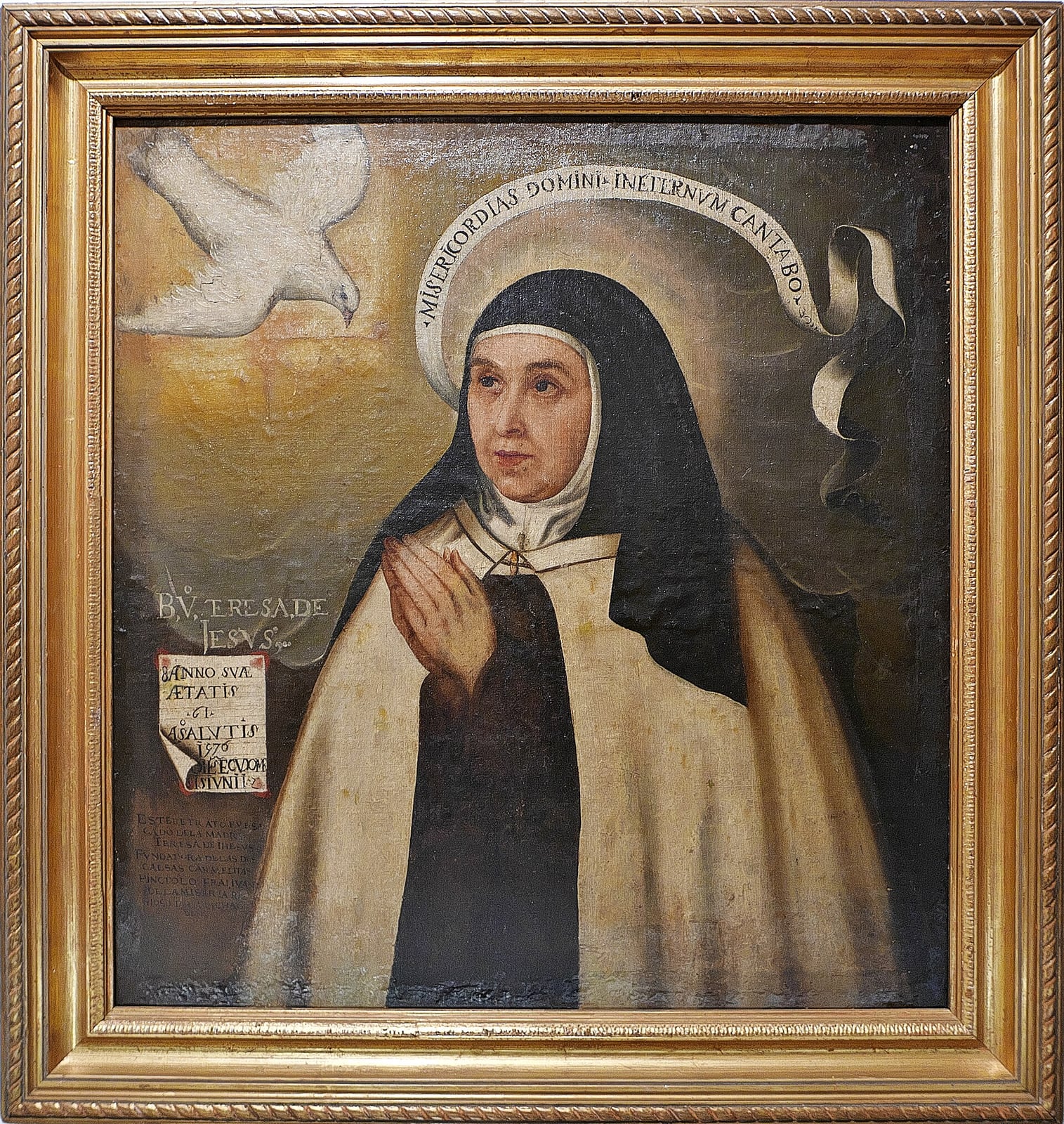
Teresa of Ávila
Übereinstimmung bei: Was ist das Absolute? Gibt es Gott? · Wer bin ich? Gibt es ein wahres Selbst? · Was geschieht nach dem Tod?
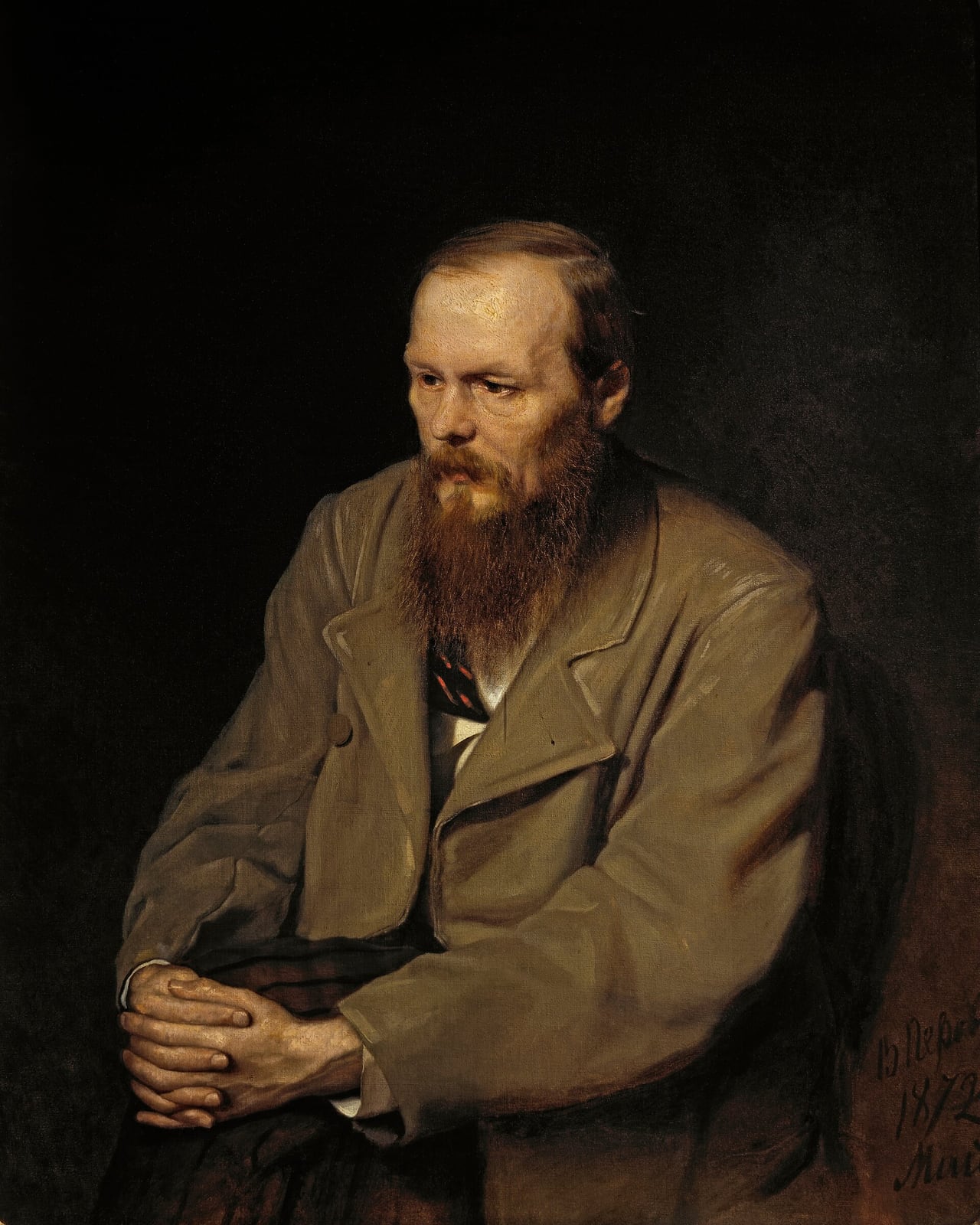
Fyodor Dostoevsky
Übereinstimmung bei: Was ist das Absolute? Gibt es Gott? · Wer bin ich? Gibt es ein wahres Selbst? · Was geschieht nach dem Tod?
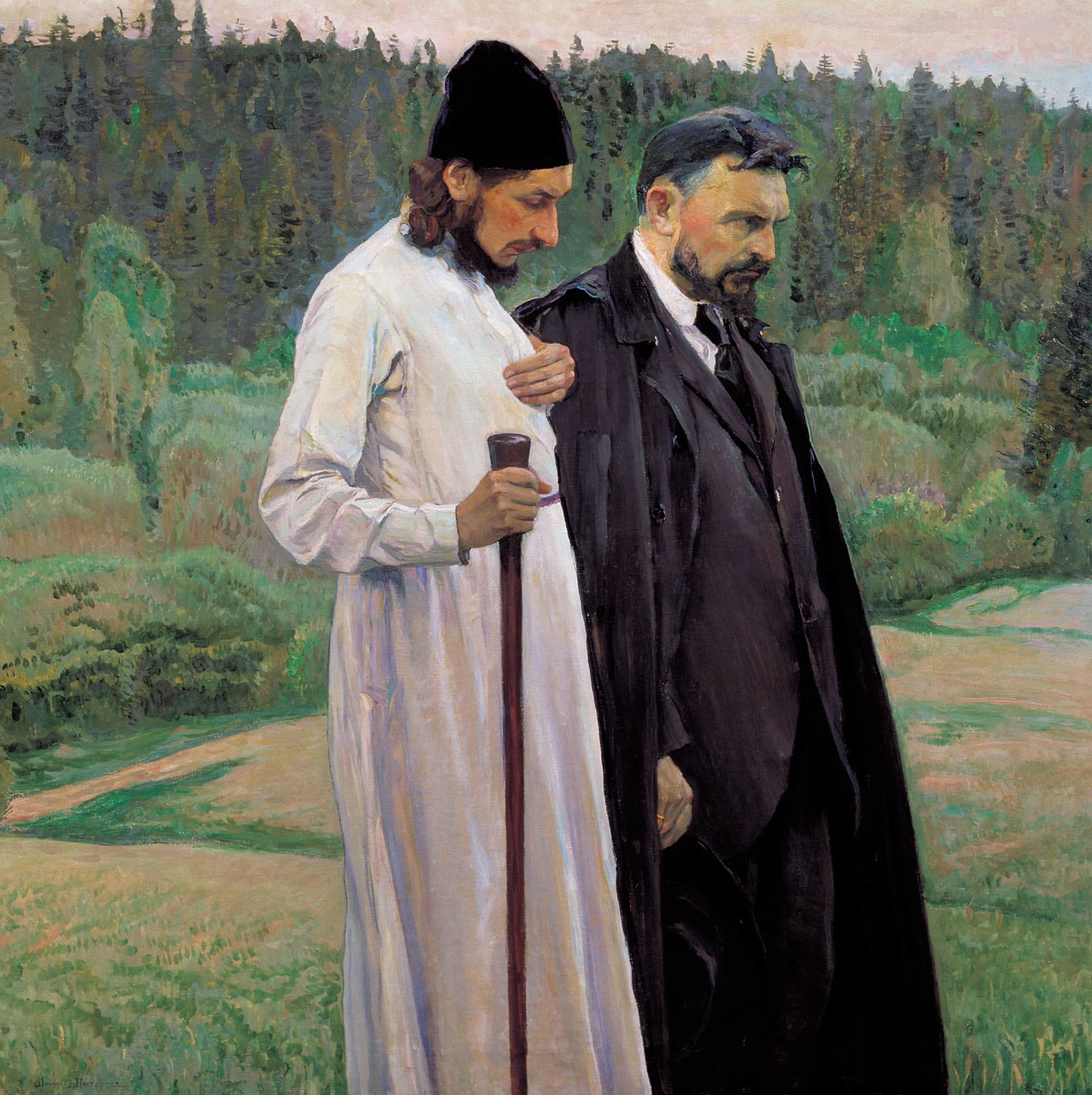
Pavel Florensky
Übereinstimmung bei: Was ist das Absolute? Gibt es Gott? · Was geschieht nach dem Tod? · Wie erlangt man Befreiung oder Erlösung?
Denkt anders als

Patañjali
Widerspruch bei: Was ist das Absolute? Gibt es Gott? · Wer bin ich? Gibt es ein wahres Selbst? · Was geschieht nach dem Tod?

Pema Chödrön
Widerspruch bei: Was ist das Absolute? Gibt es Gott? · Wer bin ich? Gibt es ein wahres Selbst? · Was geschieht nach dem Tod?

Nāgārjuna
Widerspruch bei: Was ist das Absolute? Gibt es Gott? · Wer bin ich? Gibt es ein wahres Selbst? · Was geschieht nach dem Tod?

Dōgen
Widerspruch bei: Was ist das Absolute? Gibt es Gott? · Wer bin ich? Gibt es ein wahres Selbst? · Was geschieht nach dem Tod?
Übereinstimmung bei
Hildegard of Bingen · Rumi
Love as the fire that moves the cosmos, and music as memory of the origin
Warum: There was no contact between the twelfth-century Rhineland abbess and the thirteenth-century poet of Konya, but they share a distant inheritance: the idea of a harmonious cosmos, Pythagorean and Neoplatonic in origin, which Latin Christianity and Persian Sufism received by different routes. Both also write in a symbolic and poetic register, not a scholastic one, where the image teaches more than the concept. The difference lies in emphasis: Hildegard sings love as the order that sustains a good creation and as the liturgy of the community; Rumi, as the wound and longing of the separated soul. In her love orders; in him, it consumes.
Übereinstimmung bei
Hildegard of Bingen · Confucius
Ritual and music as the form of the soul: the master of Lu and the abbess of the Rhine
Warum: The affinity is purely comparative and rests on a shared ancient intuition: music and ritual do not adorn moral life, they constitute it, because body and voice are educated before ideas. The Confucian tradition joined ritual and music very early as instruments of government and self-cultivation; Benedictine liturgy made the singing of psalms the axis of the monastic day. The difference is theological: Confucian ritual looks to human conduct and keeps the spirits at a distance, whereas Hildegard's chant is addressed to a personal God and is participation in the praise of the angels. They agree on pedagogy, not on the addressee.
Übereinstimmung bei
Hildegard of Bingen · Ibn Arabi
The human being as mirror of the cosmos and of the divine
Warum: There was no contact between the German abbess and the Andalusian mystic, contemporaries for only a few years. The affinity stems from a common inheritance: the ancient idea of the human being as microcosm, Greek and Neoplatonic in origin, which circulated both in Latin Europe and in the Islamic world, and a reading of creation as the language of God. The differences are substantive. Hildegard sharply maintains the distinction between Creator and creature and thinks of the harmony lost through sin and restored in Christ; Ibn Arabi says the world is He and not He, within a metaphysics of the single existence. She contemplates visions; he builds a theory of the Names.
Anekdoten und Erzählungen
Anekdoten und Erzählungen
Belegt1141
The illness of disobedience
Herkunft der Erzählung: First-person account in the Protestificatio of Scivias, confirmed by the autobiographical fragments in the Vita (book II).
Quelle: Hildegardis Bingensis. Scivias. Ed. Adelgundis Führkötter y Angela Carlevaris. CCCM 43–43A. Turnhout: Brepols, 1978. Trad. inglesa: Columba Hart y Jane Bishop, Hildegard of Bingen: Scivias (Classics of Western Spirituality). Nueva York: Paulist Press, 1990. Trad. española: Scivias: Conoce los caminos, trad. Antonio Castro Zafra y Mónica Castro. Madrid: Trotta, 1999.
Zeugnis1147–1148
A pope reads aloud
Herkunft der Erzählung: Vita, book I, ch. 4 (Gottfried of Disibodenberg); Bernard's (Ep. 1r) and Eugene III's (Ep. 4) letters survive in the Epistolarium. The public reading at the synod is transmitted only by the Vita.
Quelle: Gottfried de Disibodenberg y Theoderich de Echternach. Vita sanctae Hildegardis. Ed. Monika Klaes. Corpus Christianorum Continuatio Mediaevalis 126. Turnhout: Brepols, 1993. Trad. inglesa en Anna Silvas, Jutta and Hildegard: The Biographical Sources. Turnhout: Brepols, 1998 (University Park: Penn State Press, 1999).
Hagiographische Erzählungc. 1148–1150
The abbot who could not lift her
Herkunft der Erzählung: Vita, book II, ch. 5 (autobiographical fragment) and book I, ch. 5. Hildegard's letter to Abbot Kuno and the endowment charter of 1158 are in the Epistolarium (Baird–Ehrman, vol. 1).
Quelle: Gottfried de Disibodenberg y Theoderich de Echternach. Vita sanctae Hildegardis. Ed. Monika Klaes. Corpus Christianorum Continuatio Mediaevalis 126. Turnhout: Brepols, 1993. Trad. inglesa en Anna Silvas, Jutta and Hildegard: The Biographical Sources. Turnhout: Brepols, 1998 (University Park: Penn State Press, 1999).
Belegt1151–1152
Richardis
Herkunft der Erzählung: Letters 4, 12, 13, 64 and 64r of the Epistolarium (ed. Van Acker; trans. Baird–Ehrman, vol. 1); Vita, book II. The episode has been analysed by Dronke (1984) and Newman (1987).
Quelle: Hildegard of Bingen. The Letters of Hildegard of Bingen. Trad. Joseph L. Baird y Radd K. Ehrman. 3 vols. Nueva York: Oxford University Press, 1994, 1998, 2004.
Belegt1178–1179
The interdict and music
Herkunft der Erzählung: Letter to the prelates of Mainz (Epistolarium, Ep. 23, ed. Van Acker; Baird–Ehrman, vol. 1, Letter 23) and letters 24 and 24r to Archbishop Christian. Also narrated in the Vita, book III.
Quelle: Hildegard of Bingen. The Letters of Hildegard of Bingen. Trad. Joseph L. Baird y Radd K. Ehrman. 3 vols. Nueva York: Oxford University Press, 1994, 1998, 2004.
Belegt1927–1948
The codex that vanished in Dresden
Herkunft der Erzählung: Bain (2018) reconstructs the story from the Wiesbaden archives; Führkötter and Carlevaris's introduction to the critical edition (CCCM 43) describes the loss and the sources for reproduction.
Belegt1158–1171
A nun preaches to the cities
Herkunft der Erzählung: Vita, book III, ch. 17 (list of places); sermon-letters to the clergy of Cologne (Ep. 15r) and Trier (Ep. 223r) in the Epistolarium (Baird–Ehrman, vols. 1 and 3).
Quelle: Gottfried de Disibodenberg y Theoderich de Echternach. Vita sanctae Hildegardis. Ed. Monika Klaes. Corpus Christianorum Continuatio Mediaevalis 126. Turnhout: Brepols, 1993. Trad. inglesa en Anna Silvas, Jutta and Hildegard: The Biographical Sources. Turnhout: Brepols, 1998 (University Park: Penn State Press, 1999).
Lehren
Lehren
Die Begriffe, die das Denken gliedern, in ihrem Zusammenhang erklärt.
Viriditas (greenness)viriditas
Twelfth-century cosmology (school of Chartres, the tradition of Isidore and Bede) read from monastic experience and the observation of Rhenish nature.
Quelle: Newman, Barbara. Sister of Wisdom: St. Hildegard's Theology of the Feminine. Berkeley: University of California Press, 1987 (2.ª ed., 1997).
The shadow of the living light (the mode of vision)umbra-viventis-lucis
The Augustinian theory of the three kinds of vision (corporeal, spiritual, intellectual) and the modern debate on the phenomenology of visionary experience.
Quelle: Hildegard of Bingen. The Letters of Hildegard of Bingen. Trad. Joseph L. Baird y Radd K. Ehrman. 3 vols. Nueva York: Oxford University Press, 1994, 1998, 2004.
Music as memory of paradisesymphonia-memoria-paraiso
The Boethian tradition of musica mundana, humana and instrumentalis, and the monastic theology of the divine office as participation in the heavenly liturgy.
Quelle: Hildegard of Bingen. Symphonia: A Critical Edition of the Symphonia armonie celestium revelationum. Ed. y trad. Barbara Newman. Ithaca: Cornell University Press, 1988 (2.ª ed., 1998).
Man as microcosm (opus Dei)homo-microcosmos
Twelfth-century Christian Platonism (Bernard Silvestris, William of Conches, Honorius of Autun) and the patristic tradition of man as compendium of creation.
Quelle: Hildegardis Bingensis. Liber divinorum operum. Ed. Albert Derolez y Peter Dronke. CCCM 92. Turnhout: Brepols, 1996. Trad. inglesa: Nathaniel M. Campbell, The Book of Divine Works. Washington: Catholic University of America Press, 2018.
The Virtues as living forcesvirtudes-personificadas
The tradition of Prudentius's Psychomachia and of monastic catalogues of virtues and vices.
Quelle: Newman, Barbara. Sister of Wisdom: St. Hildegard's Theology of the Feminine. Berkeley: University of California Press, 1987 (2.ª ed., 1997).
Sapientia, Caritas, Ecclesia: the feminine figures of the divinesapientia-caritas
Biblical wisdom literature (Proverbs 8, Wisdom), exegesis of the Song of Songs and the tradition of personified Ecclesia.
Quelle: Newman, Barbara. Sister of Wisdom: St. Hildegard's Theology of the Feminine. Berkeley: University of California Press, 1987 (2.ª ed., 1997).
Retreats
Retreats und Zentren
Orte und Begegnungen, die mit dieser Lehre verbunden sind. Wir stellen den Kontakt zu den Veranstaltern her.
Odernheim am Glan, Renania-Palatinado · Alemania
Disibodenberg: Hildegard's first monastery
Disibodenberger Scivias-Stiftung
On the Disibodenberg, above the confluence of the Nahe and the Glan, stand the ruins of the monastery Hildegard entered as a child and where she lived until she founded her own community on the Rupertsberg near Bingen. It was there that she began to write down her visions. A foundation cares for the ruins, open all year, and a small museum, and organises pilgrimage walks. The site is one of the stages of the Hildegard von Bingen Pilgerwanderweg, the trail of about 137 kilometres through the Nahe valley between Idar-Oberstein and Bingen, with meditation panels on her work.
Rüdesheim am Rhein (Eibingen), Hesse · Alemania
Abbey of St. Hildegard, Eibingen
Benediktinerinnenabtei St. Hildegard
The Benedictine Abbey of St. Hildegard, above the vineyards of the Rheingau, is the direct heir of the community the saint founded at Eibingen in the twelfth century. A community of nuns lives by the Rule of St. Benedict, with five times of prayer a day, and keeps its patroness's tradition alive. The abbey has a guest house and organises courses, lectures, concerts and seminars, along with a Hildegard study circle and training for speakers on her work. Its church, decorated in the Beuronese style, can be visited on guided tours, and its music recordings carry her chants.
Bingen am Rhein, Renania-Palatinado · Alemania
Hildegard Forum, Rochusberg (Bingen)
Hildegard Forum der Kreuzschwestern (St. Hildegardishaus gGmbH)
The Hildegard Forum stands on the Rochusberg in Bingen, beside the mother house of the Sisters of the Cross, overlooking the Rhine and the area where Hildegard had her Rupertsberg monastery. It describes itself as a place committed to conveying Hildegard's message: it brings together a medicinal herb garden inspired by her writings on nature, a restaurant, a shop, meeting rooms and guest rooms. Since 2004 it has been run by a non-profit social organisation as an inclusive employment enterprise. It is a good starting point for visiting the Hildegard sites of the region along the Rhine and the Nahe.
Videos
Videos
Aufnahmen, Gespräche und Dokumentarfilme. Die Videos werden von YouTube wiedergegeben; sie werden nicht hier gespeichert.
ORDO VIRTUTUM by Hildegard von Bingen – Ensemble Vocatrix
Originalaufnahme· LA· 70 min
Ensemble Vocatrix
Ordo Virtutum [1/3] Prologue and Part II – Hildegard von Bingen (Score – Manuscript)
Originalaufnahme· LA· 19 min
Roc Vela
O vis aeternitatis – Benedictine Nuns of the Abbey of St. Hildegard, Eibingen
Originalaufnahme· LA· 6 min
Benedictine Nuns of the Abbey of St. Hildegard Eibingen – Topic
O vis eternitatis – Sequentia
Originalaufnahme· LA· 8 min
Sequentia – Topic
Die Deutschen: Hildegard von Bingen | Ganze Folge Terra X
Dokumentarfilm· DE· 2008· 42 min
Terra X History (ZDF)Offizieller Kanal
Hildegard von Bingen – phoenix
Dokumentarfilm· DE· 44 min
phoenix (ARD/ZDF)Offizieller Kanal
Hildegard of Bingen (1994) – James Runcie, con Patricia Routledge
Dokumentarfilm· EN· 1994· 47 min
Vision VideoOffizieller Kanal
Pioneers of the Spirit: Hildegard of Bingen
Dokumentarfilm· EN· 23 min
Vision VideoOffizieller Kanal
The Unruly Mystic: Saint Hildegard
Dokumentarfilm· EN· 64 min
The Unruly MysticsOffizieller Kanal
Vision – From the Life of Hildegard von Bingen – official U.S. trailer
Aufnahme Dritter· EN· 2009· 2 min
Zeitgeist FilmsOffizieller Kanal
Hildegard von Bingen: iluminación y visión. Conferencia de Victoria Cirlot
Vortrag· ES· 98 min
Universidad de la Mística (CITeS, Ávila)Offizieller Kanal
De Hildegard von Bingen a Max Ernst, por Victoria Cirlot
Vortrag· ES· 60 min
Fundación CajaCanariasOffizieller Kanal
Galerie
Galerie
Bilder mit geprüfter Lizenz. Jedes bewahrt seine Urheberschaft und seinen Herkunftsnachweis.
Handschriften
Handschriften
Handschriftliche Zeugen und alte Texte, mit ihrer verwahrenden Einrichtung und ihren Einsichtsbedingungen.
LA · Carolina tardía / protogótica · 1141–1151 (texto); c. 1165 (códice)
Scivias (códice iluminado de Rupertsberg)
- Erhaltener Textzeuge
- Códice iluminado con 35 miniaturas; PERDIDO desde 1945
- Verwahrende Einrichtung
- Perdido. Facsímil pintado a mano (1927–1933) en la Abtei St. Hildegard, Eibingen; fotografías en blanco y negro (1927) en la Hochschul- und Landesbibliothek RheinMain, Wiesbaden · Wiesbaden, Hs. 1 (signatura histórica)
LA · Protogótica, con notación neumática alemana · c. 1175–1190, compilado en Rupertsberg
Riesencodex (Wiesbadener Codex, «códice gigante»)
- Erhaltener Textzeuge
- Códice de 481 folios, 46 × 30 cm, c. 15 kg, con cadena original
- Verwahrende Einrichtung
- Hochschul- und Landesbibliothek RheinMain, Wiesbaden · Hs. 2
- Digitalisierung
- hlbrm.digitale-sammlungen.hebis.de/…
LA · Gótica · 1163–1174 (texto); primer cuarto del s. XIII (códice)
Liber divinorum operum (códice de Lucca)
- Erhaltener Textzeuge
- Único testimonio iluminado de la obra, con diez miniaturas a toda página
- Verwahrende Einrichtung
- Biblioteca Statale di Lucca · Ms. 1942
- Digitalisierung
- www.loc.gov/resource/gdcwdl.wdl_21658/…
LA · Protogótica · c. 1170–1175
Liber divinorum operum (códice de Gante)
- Erhaltener Textzeuge
- Testimonio más antiguo y autorizado del texto, base de la edición crítica (Derolez)
- Verwahrende Einrichtung
- Universiteitsbibliotheek Gent · Ms. 241
LA · Protogótica · c. 1200
Scivias (códice de Salem)
- Erhaltener Textzeuge
- Copia completa con retrato de la autora
- Verwahrende Einrichtung
- Universitätsbibliothek Heidelberg · Cod. Sal. X 16
- Digitalisierung
- digi.ub.uni-heidelberg.de/diglit/salX16…
LA · Protogótica, con notación neumática · c. 1175
Symphonia (códice de Dendermonde)
- Erhaltener Textzeuge
- Testimonio más antiguo de la Symphonia (57 cantos) y del Liber vitae meritorum; faltan folios
- Verwahrende Einrichtung
- Sint-Pieters-en-Paulusabdij, Dendermonde (Bélgica); según información de 2023, en depósito en la Maurits Sabbebibliotheek de la KU Leuven · Cod. 9
Beziehungen
Beziehungen
Einflüsse, Schülerschaften und Verwandtschaften. Die belegte Beziehung wird von der durch Analyse ermittelten Ähnlichkeit unterschieden.
Verwandte Gedanken mit
Two women who wrote under command, legitimised their word by experience and were proclaimed Doctors of the Church. Hildegard is visionary and cosmological; Teresa, introspective and psychological. No contact or documented reading.
Durch Analyse ermittelte Ähnlichkeit
Verwandte Gedanken mit
Both Rhinelanders and theologians of creation as divine overflow; but Eckhart (14th c.) is speculative and apophatic where Hildegard is visionary and imaginal. There is no evidence Eckhart read her.
Durch Analyse ermittelte Ähnlichkeit
Verwandte Gedanken mit
Hildegard's theology of creation (viriditas) and the Canticle of the Creatures share a fraternal gaze on nature; Francis was born two years after Hildegard's death.
Durch Analyse ermittelte Ähnlichkeit
Von anderen Einträgen aus verknüpft
Quellen
Quellen
Für diesen Eintrag herangezogene Bibliografie und Kataloge.
- Wikidata, Q70991 «Hildegarda de Bingen / Hildegard of Bingen» (P31=Q5; 114 enlaces entre wikis; P570 1179-09-17).
- Gottfried de Disibodenberg y Theoderich de Echternach. Vita sanctae Hildegardis. Ed. Monika Klaes. Corpus Christianorum Continuatio Mediaevalis 126. Turnhout: Brepols, 1993. Trad. inglesa en Anna Silvas, Jutta and Hildegard: The Biographical Sources. Turnhout: Brepols, 1998 (University Park: Penn State Press, 1999).
- Hildegardis Bingensis. Scivias. Ed. Adelgundis Führkötter y Angela Carlevaris. CCCM 43–43A. Turnhout: Brepols, 1978. Trad. inglesa: Columba Hart y Jane Bishop, Hildegard of Bingen: Scivias (Classics of Western Spirituality). Nueva York: Paulist Press, 1990. Trad. española: Scivias: Conoce los caminos, trad. Antonio Castro Zafra y Mónica Castro. Madrid: Trotta, 1999.
- Hildegardis Bingensis. Liber divinorum operum. Ed. Albert Derolez y Peter Dronke. CCCM 92. Turnhout: Brepols, 1996. Trad. inglesa: Nathaniel M. Campbell, The Book of Divine Works. Washington: Catholic University of America Press, 2018.
- Hildegardis Bingensis. Liber vite meritorum. Ed. Angela Carlevaris. CCCM 90. Turnhout: Brepols, 1995. Trad. inglesa: Bruce W. Hozeski, The Book of the Rewards of Life. Nueva York: Oxford University Press, 1997.
- Hildegardis Bingensis. Epistolarium. Ed. Lieven Van Acker (vols. I–II) y Monika Klaes-Hachmöller (vol. III). CCCM 91, 91A, 91B. Turnhout: Brepols, 1991–2001.
- Hildegard of Bingen. The Letters of Hildegard of Bingen. Trad. Joseph L. Baird y Radd K. Ehrman. 3 vols. Nueva York: Oxford University Press, 1994, 1998, 2004.
- Newman, Barbara. Sister of Wisdom: St. Hildegard's Theology of the Feminine. Berkeley: University of California Press, 1987 (2.ª ed., 1997).
- Newman, Barbara (ed.). Voice of the Living Light: Hildegard of Bingen and Her World. Berkeley: University of California Press, 1998.
- Hildegard of Bingen. Symphonia: A Critical Edition of the Symphonia armonie celestium revelationum. Ed. y trad. Barbara Newman. Ithaca: Cornell University Press, 1988 (2.ª ed., 1998).
- Dronke, Peter. Women Writers of the Middle Ages: A Critical Study of Texts from Perpetua (†203) to Marguerite Porete (†1310). Cambridge: Cambridge University Press, 1984 (cap. 6, «Hildegard of Bingen»).
- Flanagan, Sabina. Hildegard of Bingen, 1098–1179: A Visionary Life. Londres: Routledge, 1989 (2.ª ed., 1998).
- Benedicto XVI. Carta apostólica por la que se proclama a Santa Hildegarda de Bingen, monja profesa de la Orden de San Benito, doctora de la Iglesia universal, 7 de octubre de 2012. Y Audiencias generales del 1 y 8 de septiembre de 2010.
- Cirlot, Victoria. Hildegard von Bingen y la tradición visionaria de Occidente. Barcelona: Herder, 2005. Y Vida y visiones de Hildegard von Bingen (ed. y trad.). Madrid: Siruela, 1997 (reed. 2001, 2009).
- Bain, Jennifer. «History of a Book: Hildegard of Bingen's 'Riesencodex' and World War II». Plainsong and Medieval Music 27/2 (2018), pp. 143–170.
- Hochschul- und Landesbibliothek RheinMain (Wiesbaden). «The Wiesbaden ('Giant') Codex», Hs. 2: descripción del códice y de su historia.
- Universitätsbibliothek Heidelberg. Cod. Sal. X 16 («Salemer Scivias», c. 1200), digitalización completa.
- Open Library (Internet Archive): registros bibliográficos consultados por autor, título e ISBN para las ediciones listadas.
- Wikimedia Commons: metadatos de licencia (extmetadata) de cada fichero, leídos por la API imageinfo el 2026-10-22.
- International Society of Hildegard von Bingen Studies: bibliografía, lista de manuscritos y recursos académicos.
- Abtei St. Hildegard, Eibingen (Rüdesheim am Rhein): comunidad benedictina heredera de Rupertsberg; custodia del facsímil pintado del Scivias y de las reliquias.
- Higley, Sarah L. Hildegard of Bingen's Unknown Language: An Edition, Translation, and Discussion. Nueva York: Palgrave Macmillan, 2007.
- Sacks, Oliver. Migraine. Londres: Faber & Faber, 1970; ed. revisada y ampliada, Berkeley: University of California Press, 1992 (apartado sobre las visiones de Hildegarda como aura migrañosa).
- Hayton, Magda. «Publishing Hildegard: The Creation and Circulation of the Pentachronon in the Thirteenth Century». Seminario, Pontifical Institute of Mediaeval Studies, Toronto, 8 de marzo de 2017 (resumen publicado).
- Migne, J.-P. (ed.). Patrologiae cursus completus. Series latina, vol. 197: S. Hildegardis abbatissae opera omnia. París, 1855 (ejemplar digitalizado en Internet Archive).
- Pitra, Jean-Baptiste (ed.). Analecta Sanctae Hildegardis opera spicilegio Solesmensi parata (Analecta sacra, vol. 8). Montecassino: Typis Sacri Montis Casinensis, 1882 (ejemplar de la Universidad de Oxford digitalizado en Internet Archive).
- Brepols Publishers. Hildegardis Bingensis, Opera minora II, ed. Christopher P. Evans, Jeroen Deploige, Sara Moens, Michael Embach y Kurt Gärtner. Corpus Christianorum Continuatio Mediaevalis 226A. Turnhout: Brepols, 2016. ISBN 9782503548371 (ficha editorial con el índice del volumen).
- Rechteinhaber
- Dominio público (obra del siglo XII). Las ediciones críticas (Brepols, Corpus Christianorum), traducciones (Trotta, Herder, Siruela, Paulist Press, Catholic University of America Press, Oxford, Cornell…) y grabaciones musicales están sujetas a los derechos de sus editores. La abadía de Santa Hildegarda de Eibingen custodia reliquias, facsímil y tradición.
- Offizielle Website
- www.abtei-st-hildegard.de/
Bestätigung ausstehend
Was dieser Eintrag noch nicht klären konnte. Wir sagen es lieber, als es aufzufüllen.
- Confirmar el enlace directo (handle) de la digitalización del Riesencodex (Hs. 2) en el portal hlbrm.digitale-sammlungen.hebis.de: el buscador del portal no devolvió resultados por consulta automatizada; se enlaza el portal, no el ítem.
- Verificar si el Ms. 241 de Gante está digitalizado en lib.ugent.be (la ficha existe; el catálogo es una aplicación dinámica que no se pudo leer).
- Comprobar manualmente el enlace de la Library of Congress / World Digital Library al códice de Lucca (Ms. 1942): el servidor devuelve 403 a las comprobaciones automatizadas.
- Localizar ISBN en catálogo para las ediciones del Corpus Christianorum (CCCM 43–43A, 90, 91–91B, 92, 126) y para el Libro de las obras divinas de Herder (Barcelona, 2009): no aparecen en Open Library y Google Books devuelve cuota 0 sin clave.
- Confirmar el estado actual de custodia del códice de Dendermonde (abadía o depósito en KU Leuven).
- Ediciones en italiano (Il libro delle opere divine, Mondadori; Scivias, ed. italiana), ruso y árabe: no localizadas con ISBN en Open Library.
- Fijar en la edición crítica (CCCM 91) la numeración de las cartas citadas (Guiberto: 103r; Maguncia: 23; Ricardis: 12–13, 64): se ha seguido la numeración de Van Acker / Baird–Ehrman de memoria bibliográfica y conviene cotejarla.
- Programas de afiliación: ninguno verificado para las editoriales listadas; se deja la lista vacía.
- No se ha localizado ninguna traducción española ni inglesa de dominio público con texto completo de las obras de Hildegarda (las versiones inglesas y españolas disponibles son posteriores a 1950 y están protegidas); la sala de lectura queda con el latín (PL 197, Pitra, Kaiser, Wikisource) y la traducción alemana de las cartas (1854).
- Pentachronon de Gebenón de Eberbach: no se ha localizado en catálogo una edición moderna con ISBN; se registra sin ediciones.
- Fechar con las introducciones de CCCM 226 y 226A la Explicación de la Regla de san Benito y la Explicación del Símbolo atanasiano (se dejan sin año).
Recherchiert am 2026-10-22