Islam · Sufismo
Hafez
خواجه شمسالدین محمد حافظ شیرازی · حافظ
ca. 1315 – ca. 1390Persona storicamente documentata
Poeta lirico persiano del XIV secolo (Shiraz, c. 1315-1390), considerato il vertice del ghazal. Visse sotto gli Injuidi e i Muzaffaridi, ai cui principi dedicò poesie, e il suo Divan, compilato dopo la morte, riunisce circa cinquecento ghazal (495 nell'edizione di Qazvini e Ghani) in cui l'amore, il vino e la satira della falsa devozione si fondono in un'ambiguità deliberata. In Iran lo si apre a caso per chiedergli un responso. Le poesie di Daniel Ladinsky che circolano con il suo nome non sono traduzioni delle sue.
- opere
- 8opere
- edizioni
- 25edizioni
- citazioni
- 9citazioni
- video
- 14video
- immagini
- 9immagini
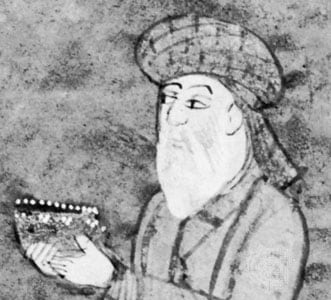
Hafez en una miniatura del siglo XVIII · Public domain
Con le sue parole
«Arise, oh Cup-bearer, rise! and bring / To lips that are thirsting the bowl they praise, / For it seemed that love was an easy thing, / But my feet have fallen on difficult ways.»Diván, gazal 1, v. 1 (Qazvini-Ghani; texto persa según Ganjoor); trad. inglesa de Gertrude Bell (1897), poema I; trad. española propia. El primer hemistiquio es árabe.

La sua idea centrale
The rend (sincere libertine): In ordinary Persian a *rend* was a scoundrel, a brawler of ill repute.
Vederlo nel contesto
Biografia
6 min di lettura
Traduzione assistita dall'originale spagnolo, in attesa di revisione da parte di un traduttore madrelingua.
Un poeta senza biografia
Khwaja Shams al-Din Muhammad, che l'intero mondo persiano conosce con il nome poetico di Hafez, è il caso estremo di un classico la cui vita si lascia appena intravedere. I repertori di poeti (tazkira) che parlano di lui sono tardi e, nelle parole dell'Encyclopaedia Iranica, spesso poco affidabili o del tutto fittizi. Il documento più antico è la prefazione al suo Divan, scritta da un contemporaneo che forse si chiamava Muhammad Golandam, e persino su quel testo gli specialisti discutono. Le fonti concordano sul nome e sul senso del soprannome: hafez è chi conosce il Corano a memoria, ed egli stesso si vanta in un ghazal di recitarlo «in quattordici letture». L'epiteto di Lisan al-ghayb, «Lingua dell'Invisibile», nacque prima per designare il libro e solo in seguito l'uomo.
Nacque a Shiraz tra il 1315 e il 1325: Qasem Ghani propose il 717 dell'egira (1317) e Mohammad Moin il 715 (1315). Del padre vi sono solo notizie tarde e contraddittorie – un Baha al-Din di Isfahan, un Kamal al-Din di Tuyserkan –, e l'immagine del ragazzo che consegnava il pane di un forno appartiene alla leggenda. Alcune poesie elegiache, in particolare un ghazal per la «luce degli occhi» e una qit'a su una lapide, lasciano intendere che perse un figlio. Seguì il curricolo del suo tempo, scienze coraniche e arabo, e in una poesia celebra i cinque notabili che rendevano prospera la provincia del Fars, tra cui il teologo Adud al-Din Iji, morto nel 1355.
Shiraz tra le dinastie
Hafez visse nel turbolento intervallo che separa Gengis Khan da Tamerlano, quando piccole dinastie si contendevano il sud dell'Iran. Il suo primo grande protettore fu Abu Ishaq Inju, signore di Shiraz, mecenate splendido e governante temerario, giustiziato nel 1357 dal muzaffaride Mubariz al-Din Muhammad. Il poeta gli dedicò una qasida e un ghazal elegiaco, «Ricordo quando abitavo in fondo alla tua via», che la tradizione legge come un lamento per quel breve regno. Il vincitore era un devoto rigorista, tanto severo che il suo stesso figlio lo chiamò il muhtasib, l'ispettore della morale pubblica, e Hafez consiglia in un verso di bere di nascosto perché il muhtasib ha l'orecchio fino.
Nel 1358 Shah Shuja depose e accecò il padre, e la maggior parte della vita poetica di Hafez trascorse sotto il suo regno. Ghani calcolò che trentanove delle settanta allusioni a sovrani contenute nel Divan si riferiscono a lui. Era un principe colto e poeta; secondo l'Habib al-siyar, fu il primo critico a rimproverare a Hafez la mancanza di unità dei suoi ghazal, che saltano dal vino al sufismo e dal sufismo all'amato. Hafez cantò anche visir, Shah Mansur e i Jalayridi di Baghdad. Le fonti tarde parlano di inviti dall'India, di una deludente visita a Yazd e di un viaggio a Ormuz terminato prima dell'imbarco; di quasi nulla di tutto ciò esiste prova documentaria.
Tamerlano, la morte e la tomba
Tamerlano prese Shiraz nel 1387. Il celebre incontro in cui il conquistatore rimprovera al poeta di aver regalato Samarcanda e Bukhara per il neo di una fanciulla turca compare per la prima volta nell'Anis al-nas di Shuja Shirazi (1426) e fu abbellito da Dawlatshah di Samarcanda nel 1486: è un aneddoto letterario, non un fatto. Anche la data della morte oscilla. Jami e Khwafi indicano il 792 dell'egira (1390), seguiti da Qazvini e dalla maggior parte dei moderni; l'iscrizione della tomba, mediante un cronogramma, dà il 791 (1389). Fu sepolto nel giardino di Musalla, che tante volte aveva cantato. Il primo mausoleo fu eretto nel 1451-1452; l'edificio attuale fu progettato da André Godard negli anni Trenta del Novecento.
Un libro che nessuno fissò
Non risulta che Hafez abbia raccolto la propria opera. Secondo la prefazione di Golandam, fu compilata dopo la sua morte, e il testo è giunto in centinaia di manoscritti che differiscono per numero di poesie, ordine dei versi e lezioni. I testimoni più antichi sono del XV secolo, come una copia di Taškent datata 803 (1401) o il manoscritto del 827 (1424) pubblicato da Khalkhali nel 1927. Su questo e su altre diciassette copie Mohammad Qazvini e Qasem Ghani pubblicarono nel 1941 l'edizione che resta il riferimento comune, con 495 ghazal; quella di Parviz Natel Khanlari (1959; riveduta nel 1983), basata su quattordici manoscritti antichi, ne ammette 486, e altre edizioni critiche scendono sotto i 450. Il nucleo autentico si aggira dunque sui cinquecento ghazal; le qasida, le qit'a, il Saqi-nama e un breve masnavi completano un Divan di dimensioni modeste, mentre l'autenticità delle quartine che gli si attribuiscono è assai più debole.
La forma e l'ironia
Il ghazal di Hafez conta di solito da sette a nove distici uniti da un metro e da una rima, talvolta da un ritornello (radif). Ogni distico si regge da sé, e il poeta gioca con l'iham, la parola che significa due cose insieme. I suoi motivi sono quelli della lirica persiana – l'amato sfuggente, il coppiere, l'usignolo e la rosa, la taverna –, ma Ehsan Yarshater sottolinea un tema che non è lirico e che lo ossessiona: l'ipocrisia dell'asceta di facciata, del predicatore, del mufti, del muhtasib e anche del sufi dal saio rattoppato. Questa satira compare in circa 170 dei 486 ghazal dell'edizione Khanlari, e a essa egli contrappone, con provocazione deliberata, il rend, il libertino sincero, e il vecchio dei magi che gestisce la taverna.
Se Hafez sia stato un mistico è la domanda che divide i suoi lettori. William Jones lo lesse come un Petrarca persiano; Wilberforce Clarke come un sufi il cui vino è sempre metafora; Yarshater sostiene che non appartenne ad alcuna scuola sufi e che molti versi ammettono soltanto una lettura mondana; Leonard Lewisohn, al contrario, lo inscrive nella «religione dell'amore» della mistica persiana. La lingua poetica del Trecento era così satura di vocabolario spirituale che l'ambiguità non è un difetto dell'interpretazione, ma la materia stessa della poesia.
La vita postuma di un oracolo
Poche opere hanno avuto una vita sociale paragonabile. Il Divan si usa per la divinazione, il fal-e Hafez: lo si apre a caso e il ghazal che compare si legge come una risposta. Un manoscritto passato per la corte moghul conserva note di Humayun e di Jahangir sui loro auspici, e nelle case iraniane l'usanza resta viva nella notte di Yalda e a Nowruz. La tradizione racconta perfino che, quando si discusse se un poeta di fama tanto dubbia meritasse le onoranze funebri, si aprì il libro e uscì il verso che chiede di non negare il passo al corteo di Hafez, perché, pur sommerso nel peccato, va in paradiso.
L'Europa lo scoprì per tappe: la versione latina di Thomas Hyde intorno al 1690, la «Canzone persiana» di William Jones nel 1771 e, soprattutto, la traduzione tedesca integrale di Joseph von Hammer-Purgstall (1812-1813), che ispirò a Goethe il Divano occidentale-orientale (1819). In inglese, Parvin Loloi considera le versioni di Gertrude Bell (1897) le più lucide e musicali tra quelle in rima, e quella di Clarke (1891) completa ma appesantita da una lettura sufi dogmatica.
L'Hafez che Hafez non scrisse
Dal 1996 lo statunitense Daniel Ladinsky pubblica libri di enorme diffusione – I Heard God Laughing, The Subject Tonight Is Love, The Gift – presentati come «versioni» di Hafez. Ladinsky non legge il persiano, ha lavorato sulla traduzione di Clarke e ha riconosciuto che non si tratta di traduzioni; specialisti come Christopher Shackle, Aria Fani e Omid Safi hanno dimostrato che quelle poesie non corrispondono ad alcun originale. Molte delle «citazioni di Hafez» che circolano oggi, come quella del sole che non dice mai alla terra «sei in debito con me», sono di Ladinsky. Questa scheda le registra a parte, come apocrife, perché il lettore distingua il poeta di Shiraz dalla sua eco contemporanea.
Fonti: Bell, Gertrude Lowthian (trad.). Poems from the Divan of Hafiz. Londres: William Heinemann, 1897 (introducción biográfica y notas). Project Gutenberg n.º 74883. · Clarke, H. Wilberforce (trad.). The Dīvān, written in the fourteenth century by Khwāja Shamsu-d-Dīn Muḥammad-i-Ḥāfiẓ-i-Shīrāzī. 2 vols. Calcuta: Government of India Central Printing Office, 1891. · Lewisohn, Leonard (ed.). Hafiz and the Religion of Love in Classical Persian Poetry. Londres: I. B. Tauris / Iran Heritage Foundation, 2010. ISBN 9781848853393.
Cronologia
La vita, anno per anno
Ogni punto è un evento documentato. Fai clic per leggerlo, con la sua fonte e il suo grado di certezza.
ca. 1315 – 13260 anniShiraz
Birth in Shiraz
Shams al-Din Muhammad is born. Ghani proposed 717/1317 and Mo'in 715/1315; other estimates reach 1325–1326.
ProbabileKhorramshahi, Baha al-Din y EIr. «HAFEZ ii. Hafez's Life and Times». Encyclopaedia Iranica, vol. XI, fasc. 5, pp. 465–469. Publicado el 15-12-2002, actualizado el 01-03-2012.
Dopo la sua morte
- ca. 1401First dated copy of the Divan
- ca. 1451First mausoleum
- 1771First English translation
- 1791First printed edition
- 1812 – 1819Hammer-Purgstall's translation
- 1897Gertrude Bell's versions
- 1941Qazvini-Ghani edition
- 1983Khanlari's revised edition
- 1996Ladinsky's first 'renderings'
ca. 1315 – 1326 · 0 anni
Birth in Shiraz
Shams al-Din Muhammad is born. Ghani proposed 717/1317 and Mo'in 715/1315; other estimates reach 1325–1326.
Probabile
ca. 1343 – 1353
Under the patronage of Abu Ishaq Inju
Abu Ishaq Inju rules Shiraz (c. 1343–1353) and becomes the poet's first great patron, celebrated in a qasida and several ghazals.
Documentato
1355
Death of Adud al-Din Iji
Death of the theologian Adud al-Din Iji, one of the 'five notables' of Fars praised by Hafez in a qit'a.
Documentato
1357
Execution of Abu Ishaq
The Muzaffarid Mubariz al-Din Muhammad executes Abu Ishaq. Hafez writes a chronogram of his death and an elegiac ghazal; the new ruler imposes a rigorist morality the poet satirises through the figure of the *muhtasib*.
Documentato
1358 – 1384
Shah Shuja's reign begins
Shah Shuja deposes and blinds his father. Most of Hafez's poetic life is spent under his long reign (to 1384): 39 of his 70 allusions to rulers concern him.
Documentato
1366
Shah Shuja's triumphant return
Having lost Shiraz to his brother, Shah Shuja returns to the city (767/1366); several ghazals celebrate the event.
Probabile
1387
Tamerlane takes Shiraz
Tamerlane occupies Shiraz. The meeting with Hafez about 'Samarkand and Bukhara' is an anecdote first attested in 1426.
Documentato
ca. 1390
Death in Shiraz
He dies in Shiraz: 792/1390 according to Jami and Khwafi (the date Qazvini preferred), 791/1389 according to the 'Khak-e Musalla' chronogram on his tomb. He is buried in the Musalla garden.
Probabile
ca. 1401
First dated copy of the Divan
A Tashkent manuscript (Oriental Institute, no. 12770) dated by its colophon to 803/1401 contains some 407 ghazals; it is the oldest known copy, edited in Tehran in 2000.
Probabile
ca. 1451
First mausoleum
After the Timurid Abu'l-Qasim Babur conquers Shiraz (855/1451), his minister Muhammad Mamai raises a monument over the tomb.
Documentato
1771
First English translation
William Jones publishes the 'Persian Song', a version of the Shirazi Turk ghazal, in his *Grammar of the Persian Language*.
Documentato
1791
First printed edition
Abu Taleb Khan prepares in Calcutta, from twelve manuscripts, the first movable-type edition of the *Divan* (1,200 copies).
Documentato
1812 – 1819
Hammer-Purgstall's translation
Joseph von Hammer-Purgstall publishes the first complete German translation (1812–1813), which Goethe reads and which gives rise to the *West-östlicher Divan* (1819).
Documentato
1897
Gertrude Bell's versions
Gertrude Bell publishes *Poems from the Divan of Hafiz* in London, regarded by Parvin Loloi as the most lucid of the English verse translations.
Documentato
1941
Qazvini-Ghani edition
Mohammad Qazvini and Qasem Ghani publish in Tehran (1320 Š.) the edition of the *Divan* based on the 827/1424 manuscript and seventeen further copies: 495 ghazals. It remains the common reference.
Documentato
1983
Khanlari's revised edition
Parviz Natel Khanlari publishes the second edition of his *Divan* (fourteen manuscripts of 807–836 AH), with 486 ghazals.
Documentato
1996
Ladinsky's first 'renderings'
Daniel Ladinsky publishes *I Heard God Laughing*, the first of a series of original works presented as 'renderings' of Hafez; *The Gift* follows in 1999.
Documentato
Opere
Opere essenziali
Le opere senza le quali non si comprende la sua eredità.
Opera scritta · ca. 1390
Divan: ghazals
دیوان حافظ — غزلیات (Divan-e Hafez: gazaliyat)
The heart of Hafez's work and, by common consent, the summit of the Persian ghazal. Each poem, of seven to nine couplets on a single rhyme, links lines that stand on their own and play on double meaning (*iham*). The aloof beloved, the cupbearer, the tavern, the nightingale and the rose live alongside a constant satire of the hypocritical ascetic, the preacher and the morals inspector, and alongside lines of wisdom on transience and fate. The book opens with an Arabic line ascribed to the caliph Yazid ("O cupbearer, pass round the cup!") and its reading oscillates, never resolved, between human and divine love. It is the book of poetry most present in Iranian homes and the one consulted as an oracle.
19 edizioni · amazon.com
Tutta la sua opera (8)
Hafez
Qasidas
The Conscious LibraryQasidas
Hafez
Qit'as (fragments)
The Conscious LibraryQit'as (fragments)
Hafez
Saqi-nama (Book of the Cupbearer)
The Conscious LibrarySaqi-nama (Book of the Cupbearer)
Hafez
Masnavi of the wild gazelle
The Conscious LibraryMasnavi of the wild gazelle
Hafez
Rubaiyat (attributed quatrains)
The Conscious LibraryRubaiyat (attributed quatrains)
Hafez
Attributed poems
The Conscious LibraryAttributed poems

Daniel Ladinsky's 'renderings' (The Gift and others)
1999
Citazioni
Citazioni localizzate in un'opera precisa. Ciascuna porta con sé la sua provenienza e il suo grado di affidabilità.
Arise, oh Cup-bearer, rise! and bring / To lips that are thirsting the bowl they praise, / For it seemed that love was an easy thing, / But my feet have fallen on difficult ways.الا یا ایها الساقی ادر کأسا و ناولها / که عشق آسان نمود اول ولی افتاد مشکلها
VerificataDiván, gazal 1, v. 1 (Qazvini-Ghani; texto persa según Ganjoor); trad. inglesa de Gertrude Bell (1897), poema I; trad. española propia. El primer hemistiquio es árabe.
Citazioni apocrife o di attribuzione discussa (4)
«Even after all this time the sun never says to the earth, "You owe me." Look what happens with a love like that. It lights the whole sky.»
A poem by Daniel Ladinsky in *The Gift* (1999), circulated as Hafez's. Omid Safi cites it as an example of 'fake Hafez': it corresponds to no Persian ghazal. Text under its author's copyright; quoted briefly for identification.
«Fear is the cheapest room in the house. I would like to see you living in better conditions.»
A line by Daniel Ladinsky that Omid Safi identifies among the 'Hafez' quotes with no Persian original.
«I wish I could show you, when you are lonely or in darkness, the astonishing light of your own being.»
By Daniel Ladinsky. Safi acknowledges its quality but stresses that Hafez said nothing of the kind.
«Your heart and my heart are very very old friends.»
By Daniel Ladinsky; cited by Safi among the examples of poems falsely attributed to Hafez.
Ultime parole
Non esistono testimonianze verificabili delle sue ultime parole.
No account of his last moments survives. What tradition associates with his death is an augury: according to the story transmitted by late biographers (recorded by Gertrude Bell in 1897), when it was debated whether he deserved funeral rites the *Divan* was opened at random and out came the line 'Do not withhold your step from Hafez's bier…' (ghazal 79 in Qazvini-Ghani). These are not deathbed words of his.
Fonte: Bell, Gertrude Lowthian (trad.). Poems from the Divan of Hafiz. Londres: William Heinemann, 1897 (introducción biográfica y notas). Project Gutenberg n.º 74883.
Chiedi
Ciò a cui risponde la sua opera
Dodici grandi domande dell'umanità e ciò che i suoi testi permettono di rispondere, con riferimenti. Non gli mettiamo mai parole in bocca.
Che cos'è l'Assoluto? Dio esiste?
A Friend of grace, glimpsed behind the ambiguity of the ghazal
Un Dio personaleSi deduce dalla sua dottrina
Hafez wrote no theology, and his Divan deliberately avoids definitions: the Friend or Beloved of his ghazals may be a prince, a youth of Shiraz or God, and is often all three at once. Even so, the God glimpsed in his verses is personal. He is the Lord of the pre-eternal covenant, the day of Alast when souls answered the Qur'anic question, whose memory runs through his poetry; He is a grace hoped for rather than earned, which is why the poet trusts he will reach paradise even though drowned in sin. Before this God there is no speculation about the essence, but dealings: complaint, entreaty, irony and gratitude addressed to Someone who listens. What Hafez rejects is not God but the ostentatious religion of those who preach in His name.
Confronta questa domanda con altri maestriChi sono io? Esiste un vero sé?
A bird of the heavenly garden fallen into the world's snare
Un'anima creata e immortaleSi deduce dalla sua dottrina
Hafez does not reason about the self, but his ghazals reveal an image traditional in Persian poetry. The soul is a bird of the garden of holiness that has fallen into the snare of this world's events and does not know how to tell of its separation; it comes from above and longs to return. At the same time, the empirical self, with its vanity and calculations, is the main obstacle: in a famous verse the poet tells himself that between lover and beloved there is no veil at all, that he himself is his own veil and must step out of the way. This double view, a soul of heavenly origin and an ego that gets in the way, is that of the Sufism Shiraz breathed, expressed without system and almost always with irony.
Confronta questa domanda con altri maestriPerché soffriamo?
Love seemed easy; then came the hardships of separation
La separazione da DioSi deduce dalla sua dottrina
Hafez's Divan opens with a confession: love seemed easy at first, but then difficulties arose. The pain running through his ghazals is that of separation (firaq) from the Beloved, whether human or divine: the dark night, the fear of the waves, the wait for the messenger, the complaint before a beauty that does not answer. To this is added the pain of an unstable world, in which kingdoms pass and fortune turns, and of a society in which preachers do not practise what they preach. Hafez offers no doctrine of suffering, but an attitude: to accept grief as part of love, to seek consolation in wine, music and grace, and not to trust those who promise salvation through the appearance of piety.
Confronta questa domanda con altri maestriChe cosa accade dopo la morte?
Seize the moment; grace will bring the sinner to paradise
Vita eterna e resurrezioneSi deduce dalla sua dottrina
Hafez does not speculate about the hereafter, but neither does he deny it. His ghazals insist on the brevity of life and the fragility of kingdoms: the world is an old bride of a thousand grooms who keeps faith with none, and one should not postpone the cup or love. That urgency is not nihilism: the horizon of his verses is Islam, with its paradise and its judgement, and his wager is on grace rather than merit. In one ghazal he asks that no one refuse to follow Hafez's funeral procession, for though drowned in sin he is going to paradise. Tradition tells that when it was debated whether he deserved funeral honours, the Divan was opened at random and that very verse came out. Irony, faith in mercy and distrust of the pious mingle in his view of death.
Confronta questa domanda con altri maestriCome si raggiunge la liberazione o la salvezza?
Only love and grace save, not piety put on display
Attraverso la grazia e l'amoreLo dice espressamente
Hafez distrusts salvation by merit. His favourite target is the ascetic (zahid) and the preacher who show off in the pulpit and, alone, do something else: piety turned into spectacle leads nowhere. Against it he sets love and grace. In a famous verse he states that love will come to the poet's aid even if he recites the Qur'an by heart in its fourteen readings, as if to say that not even that feat of piety saves on its own. And he trusts that he will reach paradise even though drowned in sin. Liberation, in his Divan, is a gift awaited with humility and without hypocrisy, from the condition of the rend, the sincere libertine, who claims no virtue and therefore remains open to mercy.
Confronta questa domanda con altri maestriServe un maestro?
If the tavern elder bids it, stain the prayer rug with wine
IndispensabileSi deduce dalla sua dottrina
In the first ghazal of the Divan, Hafez advises staining the prayer rug with wine if the pir-e moghan, the elder of the Magi or of the tavern, says so, for the wayfarer is not ignorant of the customs of the stages of the path. That figure, who returns again and again in his poems, is Hafez's master: not a shaykh of an order nor a preacher, but a sage of disorderly life in the eyes of the pious, who knows the way from experience. In another verse he warns not to travel this stage without the company of Khidr, the mysterious guide of Qur'anic tradition, for there is darkness and danger of going astray. Hafez needs a guide; what he rejects is the authority of the official clergy, whose piety he considers feigned.
Confronta questa domanda con altri maestriIl mondo è reale?
The Friend's face is mirrored in the cup; the world, a faithless bride, passes
Manifestazione del divinoSi deduce dalla sua dottrina
Hafez's world has two faces. On one side it is fleeting and faithless: an old bride who has had a thousand husbands and keeps faith with none. One should not cling to its kingdoms or honours. On the other side, that same world is where beauty is reflected: in a famous verse the poet says he has seen in the cup the reflection of the Friend's face, and the cup of Jamshid, which in Persian legend showed the whole universe, becomes in his ghazals an image of the heart that sees. Hafez does not deny the reality of things; he loves them because they let something shine through that does not pass away with them.
Confronta questa domanda con altri maestriChe cos'è l'amore?
Love is the only path, even when it brings hardships
Anelito e unioneLo dice espressamente
Love is the theme of almost all of Hafez's ghazals, and its ambiguity is deliberate: the Beloved has a face, a mole and curls, and at the same time points to the divine. The Divan opens by recalling that love seemed easy at first and that difficulties then arose; another famous poem offers Samarkand and Bukhara for the dark mole of a girl from Shiraz. In both cases love is excess, detachment and risk, the opposite of the ascetic's calculation. If one seeks the Beloved's presence, the poet advises, one must not be absent from Him; and when one finds Him, one must leave the world. For Hafez only love saves, and only love allows one to see through the hypocrisy of those who boast of piety.
Confronta questa domanda con altri maestriSiamo liberi o è tutto determinato?
My lot was settled in pre-eternity: if you dislike it, change destiny
Destino e responsabilitàSi deduce dalla sua dottrina
Hafez often returns to the theme of the lot fixed in pre-eternity (azal): what each person is to drink was poured on the day of the primordial covenant, and no piety or calculation will change it. In a well-known verse he answers someone who reproaches him for his bad name that they did not let him pass through the street of good repute, and that if he dislikes it, he should change the divine decree. This fatalism is above all ironic: it serves to disarm the pride of the pious, who ascribe their virtue to their own merit, and to justify the sincere libertine who does not pretend. Hafez does not deny responsibility, but he places it before a grace and a destiny no one controls, and answers both with humility and humour.
Confronta questa domanda con altri maestriPerché meditare o pregare?
If you seek the presence, do not be absent from Him
Essere presentiLo dice espressamente
Hafez mocks prayer turned into display — the preachers who show off in the pulpit and do something else in private — and sets against it another way of praying. The first ghazal of the Divan ends with advice addressed to himself: if you seek the presence (hozur), do not be absent from Him; when you find the one you love, leave the world. Presence here is that of the heart before the Beloved, the undivided attention Sufism asks for in prayer. In his poems there appear the dawn supplication and the night vigil, often alongside the cup and the musician. What Hafez values is not the number of prayers or their outward form, but that the heart should be where it claims to be.
Confronta questa domanda con altri maestriPuò la ragione conoscere l'ultimo?
No one has solved nor will solve the riddle of the world by wisdom
L'ultimo è al di là della menteLo dice espressamente
In the same ghazal in which he offers Samarkand and Bukhara for the mole of a girl from Shiraz, Hafez advises speaking of the minstrel and the wine and seeking less the secret of time, for no one has solved nor will solve that riddle by wisdom. It is one of his most constant convictions: philosophy and speculative theology do not reach the mystery, and those who boast of knowing everything, the ascetic, the jurist, the preacher, are often the blindest. What reason does not open, love opens, or it is left open. This renunciation is not intellectual laziness: Hafez was a scholar who knew the Qur'an by heart and mastered the poetic tradition. It is the irony of one who knows learning and its limits.
Confronta questa domanda con altri maestriRitirarsi dal mondo o trasformarlo?
Neither convent nor pulpit: sincerity is lived in the tavern of the world
Contemplazione nell'azioneSi deduce dalla sua dottrina
Hafez lived in Shiraz, in the world: a court poet under several princes, a teacher of the Qur'an according to his biographers, witness to wars and dynastic changes. His ghazals often set the dervish convent (khanqah) and the mosque of hypocrites against the tavern of the Magi (kharabat), where the rend, the sincere libertine, lives without pretence. He chooses neither the ascetic's retreat, which he mocks, nor political action, which he distrusts, but a third way: to be in the world with an awake heart, to enjoy what life gives without clinging, to unmask false piety and to keep faith with the Beloved. His poetry itself, recited everywhere, was his way of intervening.
Confronta questa domanda con altri maestri
Affinità e tensioni
Affinità e tensioni
Calcolate domanda per domanda a partire dalle sue posizioni. Il perché di ogni accordo o contrasto, con un clic.
La pensa in modo simile a
Rumi
Concordano su: Che cos'è l'Assoluto? Dio esiste? · Chi sono io? Esiste un vero sé? · Perché soffriamo?
Chaitanya Mahaprabhu
Concordano su: Che cos'è l'Assoluto? Dio esiste? · Chi sono io? Esiste un vero sé? · Perché soffriamo?
Baal Shem Tov
Concordano su: Chi sono io? Esiste un vero sé? · Perché soffriamo? · Che cosa accade dopo la morte?

Francis of Assisi
Concordano su: Che cos'è l'Assoluto? Dio esiste? · Chi sono io? Esiste un vero sé? · Perché soffriamo?
La pensa diversamente da

Pema Chödrön
Si scontrano su: Che cos'è l'Assoluto? Dio esiste? · Chi sono io? Esiste un vero sé? · Che cosa accade dopo la morte?

Epicurus
Si scontrano su: Che cos'è l'Assoluto? Dio esiste? · Chi sono io? Esiste un vero sé? · Che cosa accade dopo la morte?

The 14th Dalai Lama (Tenzin Gyatso)
Si scontrano su: Che cos'è l'Assoluto? Dio esiste? · Chi sono io? Esiste un vero sé? · Che cosa accade dopo la morte?

Patañjali
Si scontrano su: Che cos'è l'Assoluto? Dio esiste? · Chi sono io? Esiste un vero sé? · Che cosa accade dopo la morte?
Aneddoti e racconti
Aneddoti e racconti
Non verificabile1387 (según el relato)
Samarkand and Bukhara for a mole
Origine del racconto: It first appears in Shuja Shirazi's *Anis al-nas* (1426), some thirty-five years after the poet's death, and was expanded by Dawlatshah Samarqandi in his *Tadhkirat al-shu'ara* (1486). The *Encyclopaedia Iranica* warns that anecdotes from these sources reflect the later image of the poet and cannot be used as facts.
Tradizione oralec. 1390
The augury at the funeral
Origine del racconto: A story transmitted by late biographers and recorded by Gertrude Bell in the introduction to *Poems from the Divan of Hafiz* (1897); it is not found in fourteenth-century sources.
Contestato1358–1384
The king who asked for unity
Origine del racconto: It comes from the *Habib al-siyar* of the historian Khwandamir (sixteenth century), more than a century later; it is recorded by Bell (1897) and the *Encyclopaedia Iranica* (Khorramshahi).
Contestatoc. 1390
Persian sugar for the parrots of India
Origine del racconto: The correspondence with the sultan of Bengal is asserted in the Indo-Persian tradition and recorded by English Wikipedia; Bell (1897, note to poem XXI) ascribes the invitation to a 'Shah Mahmud Purabi' and tells of the interrupted journey. There is no contemporary documentation.
Non verificabiles. XIV (según la leyenda)
Shakh-e Nabat and the forty-day vigil
Origine del racconto: Modern oral tradition spread in Iran and in Western anthologies; English Wikipedia presents it as legend and the *Encyclopaedia Iranica* warns against reconstructing the poet's life from literal readings of his verse.
Documentato1812–1819
Goethe finds his twin
Origine del racconto: Facts of literary history documented in the editions of Hammer-Purgstall and Goethe; see Hamid Tafazoli, 'Hafez xi. Translations of Hafez in German', *Encyclopaedia Iranica*.
Fonte: Tafazoli, Hamid. «HAFEZ xi. Translations of Hafez in German». Encyclopaedia Iranica.
Insegnamenti
Insegnamenti
Le nozioni che articolano il suo pensiero, spiegate nel loro contesto.
The rend (sincere libertine)rendi
A figure inherited from the *qalandari* poetry of Sanai and Attar, which Hafez brings to its most elaborate form.
Riya: religious hypocrisyriya
Part of the rise of fourteenth-century Persian satire, alongside Obeyd Zakani.
Iham: amphibologyiham
A figure codified by classical Persian rhetoric; in Hafez it merges with the convergence of love lyric, panegyric and mysticism.
Wine and the cupbearermay-o-saqi
Bacchic symbolism inherited from Arabic and Persian poetry (Abu Nuwas, Khayyam, Sufi lyric), to which Hafez gives its canonical form.
Fonte: Lewisohn, Leonard (ed.). Hafiz and the Religion of Love in Classical Persian Poetry. Londres: I. B. Tauris / Iran Heritage Foundation, 2010. ISBN 9781848853393.
Fal-e Hafez: the Divan as oraclefal-e-hafez
Bibliomancy comparable to the *sortes Vergilianae*; part of the Islamic tradition of *fal-namas*.
Video
Video
Registrazioni, interviste e documentari. I video vengono riprodotti da YouTube; non sono ospitati qui.
Hafiz and the Religion of Love — Lecture by L. Lewisohn
Conferenza· EN· 115 min
Golha Project Videos
Leonard Lewisohn «One Day with Hafez», Leiden University, Sep. 2012
Conferenza· EN· 2012· 4 min
Persian Dutch Network
Scholar reflects bringing medieval Persian verse to the West
Intervista· EN· 2013· 6 min
PBS NewsHourCanale ufficiale
Dick Davis reads 'I see no love in anyone'
Registrazione di terzi· EN· 2013· 2 min
PBS NewsHourCanale ufficiale
بزرگان ایرانزمین: حافظ (Grandes de Irán: Hafez)
Documentario· FA· 2012· 24 min
BBC PersianCanale ufficiale
Hafez and Persian Poetry in Song (Part One)
Conferenza· EN· 59 min
OxfordSongCanale ufficiale
Hafez and Persian Poetry in Song (Part Two)
Conferenza· EN· 65 min
OxfordSongCanale ufficiale
How to Love Like A Poet: Why Rumi, Hafez, and Saadi Shirazi Matter Today
Conferenza· EN· 2023· 80 min
Renovatio: The Journal of Zaytuna CollegeCanale ufficiale
Hafez: inmortal y magistral poeta
Conferenza· ES· 2019· 63 min
Espacio Persa
La poesía como experiencia cotidiana en Irán
Documentario· ES· 2020· 28 min
INAH TVCanale ufficiale
Hafez Commemoration — Shajarian & Pirniakan (بزرگداشت حافظ)
Registrazione di terzi· FA· 1988· 52 min
Khosousi
غزلیات حافظ با دکلمه شاملو و موسیقی فرهاد فخرالدینی
Registrazione di terzi· FA· 64 min
EngineeringMath
Hafezieh | The Timeless Shrine of Hafez in Shiraz, Iran
Documentario· EN· 3 min
Visit Iran - Official Travel Guide of IranCanale ufficiale
Poems from the Divan of Hafiz by Gertrude Bell — full audiobook
Registrazione di terzi· EN· 88 min
Best Audiobooks
Galleria
Galleria
Immagini con licenza verificata. Ciascuna conserva la sua paternità e la sua attribuzione.
Manoscritti
Manoscritti
Testimoni manoscritti e testi antichi, con il loro custode e le loro condizioni di consultazione.
FA · Perso-árabe · s. XIV
دیوان حافظ (Divan-e Hafez), copia de Taskent
- Testimone conservato
- Copia que su colofón (fol. 140a) fecha en 803/1401, con unos 407 gazales; la más antigua conocida
- Custode
- Instituto de Estudios Orientales, Taskent · n.º 12770
FA · Perso-árabe · s. XIV
Antología de Iskandar Sultán (con gazales de Hafez)
- Testimone conservato
- Antología copiada en 813–814/1410–1411 para el príncipe timúrida Iskandar Sultán
- Custode
- British Library, Londres · Add. MS 27261
FA · Perso-árabe · s. XIV
دیوان حافظ، نسخهٔ خلخالی (manuscrito de Jaljali)
- Testimone conservato
- Copia fechada en 827/1424, unos treinta y cinco años después de la muerte del poeta
- Custode
- Colección particular
FA · Nastaliq · s. XIV
دیوان حافظ، نسخهٔ شاهان مغولیه (copia real mogola)
- Testimone conservato
- Manuscrito probablemente del s. XV con inscripción de Husayn Bayqara; anotaciones de augurios de Humayun (una de 962/1554–1555) y Yahangir
- Custode
- Khuda Bakhsh Oriental Public Library, Patna
Relazioni
Relazioni
Influenze, discepolati e affinità. Si distingue la relazione documentata dalla somiglianza individuata per analisi.
Idee affini a
The two summits of the Persian ghazal, a century apart. Legend says Hafez knew Rumi's work by heart, but his ghazal derives rather from the school of Saadi and Khwaju of Kerman; the affinity lies in the mysticism of love and the language of wine and the tavern.
Somiglianza individuata per analisi
Idee affini a
The figure of the *rend* and the *qalandari* poetry that Hafez brings to its most refined form have precedents in Attar's ghazals. Farid al-Din Attar should not be confused with the shaykh Mahmud (or Zayn al-Din) Attar of Shiraz, whom tradition makes Hafez's master.
Somiglianza individuata per analisi
Idee affini a
Some critics (Lewisohn and others) read the *Divan* in the light of the 'religion of love' and the metaphysics of Ibn Arabi's school as spread in Iran; no direct dependence is documented.
Somiglianza individuata per analisi
Idee affini a
Both aim their sharpest verses at outward religion (the ascetic, the preacher, the pandit and the mullah) in the name of inner sincerity.
Somiglianza individuata per analisi
Fonti
Fonti
Bibliografia e cataloghi consultati per questa scheda.
- Wikidata, Q6240 «Hafez» (P31=Q5; 163 enlaces entre wikis; P569 1325 y 1326; P570 1389; P1559 خواجه شمسالدین محمد حافظ شیرازی).
- Khorramshahi, Baha al-Din y EIr. «HAFEZ ii. Hafez's Life and Times». Encyclopaedia Iranica, vol. XI, fasc. 5, pp. 465–469. Publicado el 15-12-2002, actualizado el 01-03-2012.
- Yarshater, Ehsan. «HAFEZ i. An Overview». Encyclopaedia Iranica, vol. XI, fasc. 5. Publicado el 15-12-2002.
- Khorramshahi, Baha al-Din y EIr. «HAFEZ vi. Printed Editions of the Divān of Hafez». Encyclopaedia Iranica. Publicado el 15-12-2002.
- Loloi, Parvin. «HAFEZ x. Translations of Hafez in English». Encyclopaedia Iranica. Publicado el 15-12-2002.
- Tafazoli, Hamid. «HAFEZ xi. Translations of Hafez in German». Encyclopaedia Iranica.
- Bell, Gertrude Lowthian (trad.). Poems from the Divan of Hafiz. Londres: William Heinemann, 1897 (introducción biográfica y notas). Project Gutenberg n.º 74883.
- Hafez. Divan, texto según la edición de Mohammad Qazvini y Qasem Ghani (Teherán, 1320 Š./1941): 495 gazales, 3 casidas, 34 qit'as, 42 rubaiyat, Saqi-nama, masnaví «Ala ey ahu-ye vahshi», prefacio del compilador y 118 poemas atribuidos. Ganjoor (biblioteca digital de poesía persa).
- Clarke, H. Wilberforce (trad.). The Dīvān, written in the fourteenth century by Khwāja Shamsu-d-Dīn Muḥammad-i-Ḥāfiẓ-i-Shīrāzī. 2 vols. Calcuta: Government of India Central Printing Office, 1891.
- Safi, Omid. «Fake Hafez: How a supreme Persian poet of love was erased». Al Jazeera, 14-06-2020.
- Fani, Aria. «Rewriting Hafez: Re-theorizing Untranslatability in Persian Poetry». Ajam Media Collective, 08-07-2014.
- «Shirazi Turk». Wikipedia en inglés (origen de la anécdota de Tamerlán: Shuja Shirazi, Anis al-nas, 1426; Dawlatshah Samarqandi, Tadhkirat al-shu'ara, 1486).
- «Daniel Ladinsky». Wikipedia en inglés (obras, método de trabajo a partir de Clarke, críticas de Christopher Shackle, Aria Fani, Murat Nemet-Nejat y Omid Safi).
- Lewisohn, Leonard (ed.). Hafiz and the Religion of Love in Classical Persian Poetry. Londres: I. B. Tauris / Iran Heritage Foundation, 2010. ISBN 9781848853393.
- «Hafez». Wikipedia en inglés (mausoleo de André Godard, día de Hafez, fal-e Hafez, correspondencia con Ghiyath al-Din Azam Shah de Bengala, traducciones modernas).
- Titolare dei diritti
- Dominio público (obra del siglo XIV). Las ediciones críticas modernas y las traducciones (Archetype, Mage, Penguin, Verdier, Gallimard, Visor…) están sujetas a los derechos de sus editores y traductores. Los libros de Daniel Ladinsky (Penguin) son obra original suya con derechos vigentes, no traducciones de Hafez.
In attesa di conferma
Ciò che questa scheda non ha ancora potuto chiarire. Preferiamo dirlo piuttosto che riempirlo.
- Localizar un ISBN de una reimpresión moderna de la edición de Qazvini y Ghani y de la 2.ª edición de Janlari (Jarazmi, 1983); Open Library las registra sin ISBN.
- Confirmar en catálogo el traductor y la naturaleza de «El despertar del amor» (Sufí, 2003) y «La canción de Saki» (Alif): no se han incluido porque Open Library no da traductor ni permite saber si traducen a Hafez o a Ladinsky.
- No se ha encontrado una traducción española de Hafez de dominio público; tampoco una alemana de Hammer-Purgstall o Rosenzweig transcrita en Wikisource (solo escaneos).
- Vídeos: los recitados de Shajarian y Shamlu proceden de canales no oficiales; buscar ediciones oficiales (Delawaz, herederos de Shamlu) y algún documental en francés o alemán de televisión pública.
- Comprobar el enlace estable de la British Library para Add. MS 27261 (antología de Iskandar Sultán) cuando se restablezca su visor de manuscritos.
- Verificar con una fuente impresa (Limbert, *Shiraz in the Age of Hafez*, 2004) la datación de la correspondencia con Ghiyath al-Din Azam Shah de Bengala.
- Precisar la autoría del retrato de la British Library (File:Mohammad Shams al-Din Hafez.jpg): Commons no indica signatura ni pintor.
Ricerca effettuata il 2026-10-25