Christianisme · Mystique chrétienne · Catholicisme
Hildegard of Bingen
Hildegardis Bingensis
1098 – 1179Personne historiquement documentée
Abbesse bénédictine rhénane (1098-1179), visionnaire, compositrice, naturaliste et conseillère de papes et d'empereurs. Recluse dès l'enfance auprès du monastère du Disibodenberg, elle reçut à quarante-deux ans l'ordre d'écrire ses visions : ainsi naquirent le Scivias, le Liber vitae meritorum et le Liber divinorum operum. Elle fonda le Rupertsberg et Eibingen, écrivit deux traités de médecine, soixante-dix-sept chants, le drame Ordo Virtutum, une langue inventée et quelque quatre cents lettres, et prêcha en public. Docteur de l'Église depuis 2012.
- œuvres
- 19œuvres
- éditions
- 48éditions
- citations
- 7citations
- vidéos
- 12vidéos
- images
- 8images
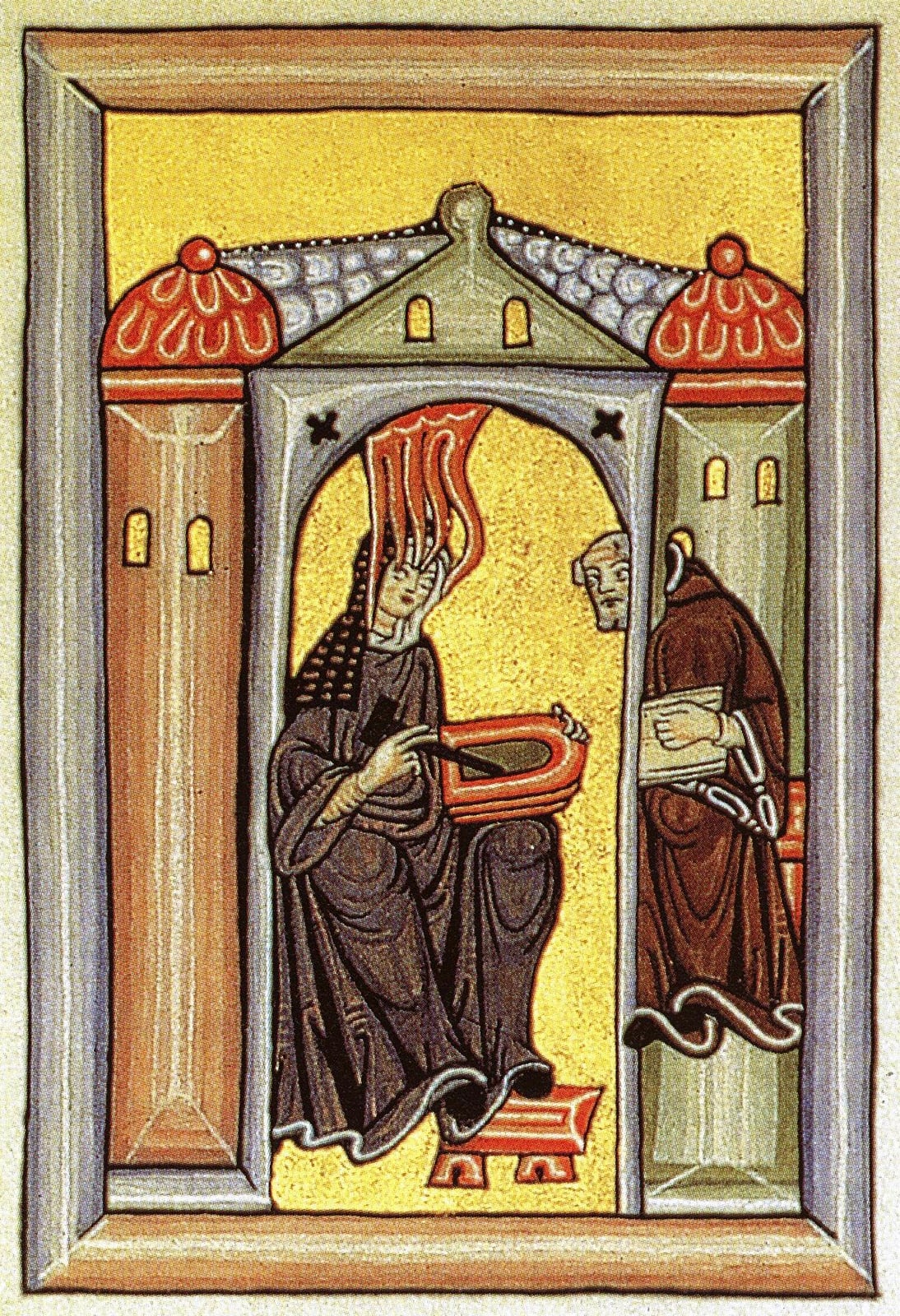
Hildegarda recibe la visión y la dicta a Volmar (Scivias de Rupertsberg) · Public domain
Dans ses propres mots
«It happened in the year 1141 of the incarnation of the Son of God, Jesus Christ, when I was forty-two years and seven months old, that a fiery light of the greatest brilliance, coming from the open heaven, poured through my whole brain.»Scivias, Protestificatio (declaración preliminar)

Son idée centrale
Viriditas (greenness): Viriditas, 'greenness', is the word Hildegard uses most freely and in the most registers.
Le voir en contexte
Biographie
7 min de lecture
Traduction assistée à partir de l'original espagnol, en attente de relecture par un traducteur natif.
Une enfant offerte comme une dîme
Hildegarde naquit en 1098, probablement à Bermersheim, près d'Alzey, dans cette Rhénanie qui était alors le cœur de l'Empire. Ses parents, Hildebert et Mechtilde, appartenaient à la petite noblesse libre vassale des comtes de Sponheim. La Vita rédigée peu après sa mort affirme qu'elle était la dixième enfant et que ses parents l'offrirent à Dieu ; la tradition y a lu une dîme. Dès sa plus petite enfance, racontera-t-elle elle-même à soixante ans, elle voyait « une lumière si grande que mon âme tremblait », et elle apprit vite à la taire : une servante à qui elle avait annoncé la couleur d'un veau encore à naître la regarda avec effroi.
Vers 1106, à huit ans, elle fut confiée à Jutta de Sponheim, une jeune noble qui avait résolu de vivre en recluse. Les sources les plus anciennes — la Vita Juttae, découverte en 1992 — indiquent que la réclusion solennelle de Jutta, d'Hildegarde et d'une troisième jeune fille auprès du monastère bénédictin du Disibodenberg fut célébrée le 1er novembre 1112, selon le rite des défunts : on les emmurait. Ce qui devait être une cellule devint, au fil des ans, une petite communauté féminine ; Jutta apprit à Hildegarde à lire le psautier en latin et à chanter l'office. D'un moine de la maison, Volmar, elle reçut ce que la Vita appelle une formation « simple » ; il serait son secrétaire pendant trente ans.
L'ordre d'écrire
À la mort de Jutta, le 22 décembre 1136, les moniales élurent Hildegarde magistra. Elle avait trente-huit ans et gardait toujours ses visions pour elle. En 1141, « à quarante-deux ans et sept mois », une lumière de feu lui traversa le cerveau et la poitrine, et une voix lui ordonna de dire et d'écrire ce qu'elle voyait. Elle résista, tomba malade — la maladie, dans son récit, est toujours la forme que prend la désobéissance — et ne guérit que lorsqu'elle commença à dicter à Volmar. Ainsi naquit le Scivias (« Connais les voies »), dix ans de travail et vingt-six visions sur la création, la rédemption et l'histoire du salut, chacune décrite d'abord comme une image, puis expliquée par la voix céleste.
Ce qui la distingue d'autres visionnaires, c'est la prudence avec laquelle elle chercha des appuis. Elle écrivit à Bernard de Clairvaux, qui lui répondit par une lettre brève et aimable. Au synode de Trèves (novembre 1147 – février 1148), l'abbé Kuno du Disibodenberg présenta le manuscrit inachevé au pape Eugène III, un cistercien disciple de Bernard ; selon la Vita, le pape en donna lecture à haute voix devant les prélats et l'autorisa par lettre à continuer d'écrire. L'autorisation pontificale fit d'une moniale rhénane une autorité consultée par des évêques, des abbés et des rois.
Le Rupertsberg
Vers 1150, contre la volonté de l'abbé Kuno — qui y perdait les dots des moniales et le prestige de la visionnaire —, Hildegarde transféra la vingtaine de sœurs qui l'entouraient sur une colline dominant la Nahe, face à Bingen, où l'on disait que saint Rupert était enseveli. Pour vaincre la résistance de l'abbé, elle tomba de nouveau malade, immobile sur son lit, jusqu'à ce que Kuno constate, dit la Vita, que lui-même ne pouvait pas la soulever. L'église du Rupertsberg fut consacrée en 1152 par l'archevêque de Mayence ; en 1158, le monastère obtint son indépendance économique à l'égard du Disibodenberg. C'est là qu'Hildegarde fit presque tout : deux autres livres de visions, deux traités de médecine, soixante-dix-sept chants, un drame liturgique, une langue inventée et quelque quatre cents lettres.
Le coût humain du départ eut un nom : Richardis de Stade, la jeune moniale de haute noblesse qui l'avait aidée à composer le Scivias et que sa famille fit nommer abbesse de Bassum en 1151. Hildegarde écrivit à l'archevêque de Brême, au pape et à Richardis elle-même des lettres d'une franchise désarmante — « pourquoi m'abandonnes-tu comme une orpheline ? » — ; Richardis mourut en octobre 1152, repentante, semble-t-il.
Médecin, compositrice, prédicatrice
Entre 1151 et 1158, Hildegarde composa deux ouvrages de science naturelle, sans visions ni voix céleste : la Physica, catalogue des plantes, des arbres, des pierres, des poissons, des oiseaux et des animaux avec leurs vertus curatives, et le Causae et curae, sur le cosmos, le corps humain, la génération, les humeurs et les remèdes. Sa médecine est celle des monastères, fondée sur Galien et sur la tradition populaire rhénane, mais avec, sur la sexualité féminine et la mélancolie, des observations personnelles sans équivalent en son siècle. Entre 1158 et 1163, elle écrivit le Liber vitae meritorum (Livre des mérites de la vie), dialogue des vertus et des vices, et, entre 1163 et 1173, le Liber divinorum operum (Livre des œuvres divines), son œuvre la plus ambitieuse : la cosmologie de l'homme-microcosme, avec les célèbres miniatures que conserve un manuscrit de Lucques.
La musique ne fut pas pour elle un ornement. Les soixante-dix-sept chants de la Symphonia armonie celestium revelationum — antiennes, répons, séquences, hymnes — ont une tessiture élargie et des mélismes qui débordent le plain-chant de son temps, et l'Ordo Virtutum, où les Vertus disputent une âme au Diable (seul personnage qui ne chante pas), est le plus ancien drame musical conservé portant un nom d'auteur. Lorsqu'en 1178 les prélats de Mayence jetèrent l'interdit sur son monastère pour y avoir enseveli un noble excommunié et lui défendirent de chanter l'office, Hildegarde leur écrivit que la musique est la mémoire du paradis et que ceux qui la font taire sans raison grave s'exposent à perdre leur place parmi les chœurs des anges. L'interdit fut levé en mars 1179.
Entre 1158 et 1171, elle entreprit quatre voyages de prédication — Mayence, Wurtzbourg, Bamberg, Trèves, Cologne, Werden, Maulbronn, Zwiefalten —, prêchant en public au clergé et au peuple, chose sans précédent pour une femme, contre la corruption du clergé et contre les cathares. Elle réprimanda par lettre l'empereur Frédéric Barberousse lorsqu'il soutint des antipapes, avec une dureté qu'il toléra : il avait accordé en 1163 au Rupertsberg un privilège de protection. En 1165, elle fonda une seconde maison à Eibingen, sur l'autre rive du Rhin.
Une langue, des lettres et la fin
Hildegarde inventa une lingua ignota d'environ mille mots, dotée de son propre alphabet, les litterae ignotae, dont la finalité reste débattue : jeu, langue secrète de la communauté ou tentative de retrouver un parler antérieur à Babel. Sa correspondance, conservée en partie dans le Riesencodex de Wiesbaden — le codex de quinze kilos qui réunit ses œuvres, compilé au Rupertsberg peu après sa mort —, montre une conseillère de papes, d'empereurs, d'abbés et de femmes anonymes qui lui écrivaient pour demander ses prières.
Volmar mourut en 1173 ; en 1177 arriva comme secrétaire le moine wallon Guibert de Gembloux, à qui Hildegarde adressa la description la plus précise de sa manière de voir : une lumière « qui n'est pas locale », plus claire qu'une nuée portant le soleil, qu'elle appelle « l'ombre de la lumière vivante », et dans laquelle elle voit, entend et sait tout à la fois, éveillée, sans extase. Elle mourut le 17 septembre 1179, à quatre-vingt-un ans. Les tentatives de canonisation du XIIIe siècle (1227-1243) se perdirent dans les méandres de la curie ; son culte se poursuivit. Benoît XVI inscrivit son nom au calendrier universel le 10 mai 2012 et la proclama docteur de l'Église le 7 octobre de la même année.
Ce qui demeure
D'Hildegarde il demeure, pour commencer, une œuvre latine considérable, que la philologie moderne a éditée de manière critique dans le Corpus Christianorum, et une musique qui, depuis les années 1980 — Sequentia, Gothic Voices —, est de nouveau chantée. Il demeure la question de ses visions, que le neurologue Oliver Sacks rapprocha de la migraine avec aura et que les historiens préfèrent lire comme un genre littéraire aux règles propres. Il demeure une théologie de la viriditas, la verdeur, force vitale qui traverse la création, dont la pensée écologique a fait un emblème. Et il demeure surtout une femme du XIIe siècle qui sut se faire écouter des papes et des empereurs en se nommant elle-même « pauvre petite forme féminine » et « plume portée par le vent », avec une ironie que seule une grande autorité peut se permettre. Le manuscrit enluminé du Scivias, exécuté sous ses yeux au Rupertsberg, disparut à Dresde en 1945 : nous le connaissons par une copie faite à la main que les moniales d'Eibingen achevèrent en 1933, comme si l'histoire avait voulu nous enseigner de quoi est faite la transmission.
Sources: Gottfried de Disibodenberg y Theoderich de Echternach. Vita sanctae Hildegardis. Ed. Monika Klaes. Corpus Christianorum Continuatio Mediaevalis 126. Turnhout: Brepols, 1993. Trad. inglesa en Anna Silvas, Jutta and Hildegard: The Biographical Sources. Turnhout: Brepols, 1998 (University Park: Penn State Press, 1999). · Hildegardis Bingensis. Scivias. Ed. Adelgundis Führkötter y Angela Carlevaris. CCCM 43–43A. Turnhout: Brepols, 1978. Trad. inglesa: Columba Hart y Jane Bishop, Hildegard of Bingen: Scivias (Classics of Western Spirituality). Nueva York: Paulist Press, 1990. Trad. española: Scivias: Conoce los caminos, trad. Antonio Castro Zafra y Mónica Castro. Madrid: Trotta, 1999. · Hildegardis Bingensis. Liber divinorum operum. Ed. Albert Derolez y Peter Dronke. CCCM 92. Turnhout: Brepols, 1996. Trad. inglesa: Nathaniel M. Campbell, The Book of Divine Works. Washington: Catholic University of America Press, 2018. · Hildegardis Bingensis. Liber vite meritorum. Ed. Angela Carlevaris. CCCM 90. Turnhout: Brepols, 1995. Trad. inglesa: Bruce W. Hozeski, The Book of the Rewards of Life. Nueva York: Oxford University Press, 1997. · Hildegardis Bingensis. Epistolarium. Ed. Lieven Van Acker (vols. I–II) y Monika Klaes-Hachmöller (vol. III). CCCM 91, 91A, 91B. Turnhout: Brepols, 1991–2001.
Chronologie
La vie, année après année
Chaque point est un événement documenté. Cliquez pour le lire, avec sa source et son degré de certitude.
10980 ansBermersheim vor der Höhe (Renania-Palatinado), según la tradición
Birth
Born into a family of the lesser free nobility, daughter of Hildebert and Mechthild. The place (Bermersheim) is that accepted by most scholars; the year is inferred from her own dating of the 1141 vision.
ProbableGottfried de Disibodenberg y Theoderich de Echternach. Vita sanctae Hildegardis. Ed. Monika Klaes. Corpus Christianorum Continuatio Mediaevalis 126. Turnhout: Brepols, 1993. Trad. inglesa en Anna Silvas, Jutta and Hildegard: The Biographical Sources. Turnhout: Brepols, 1998 (University Park: Penn State Press, 1999).
Après sa mort
- 1227 – 1243Unfinished canonisation process
- février 1945Loss of the Rupertsberg Scivias
- 7 octobre 2012Doctor of the Church
1098 · 0 ans
Birth
Born into a family of the lesser free nobility, daughter of Hildebert and Mechthild. The place (Bermersheim) is that accepted by most scholars; the year is inferred from her own dating of the 1141 vision.
Probable
v. 1106 · 8 ans
Entrusted to Jutta of Sponheim
At eight her parents entrust her to the young noblewoman Jutta of Sponheim for religious life.
Documenté
1 novembre 1112 · 14 ans
Enclosure at Disibodenberg
Jutta, Hildegard and another girl are enclosed beside the Benedictine monastery of Disibodenberg, according to the Vita Juttae. Hildegard makes her Benedictine profession in the following years.
Probable
22 décembre 1136 · 38 ans
Jutta dies; Hildegard elected magistra
On Jutta's death, the women's community at Disibodenberg elects Hildegard as superior.
Documenté
1141 · 42 ans
The command to write
'In the forty-second year and seventh month' of her life she receives the vision of the fiery light and the command to write what she sees. She begins Scivias with the help of Volmar and Richardis of Stade.
Documenté
novembre 1147 – 1148 · 49 ans
Pope Eugene III approves her work
At the synod of Trier (Nov. 1147 – Feb. 1148) the pope reads passages of the unfinished Scivias and authorises her by letter to continue writing. Bernard of Clairvaux had already encouraged her by letter.
Documenté
v. 1150 · 52 ans
Move to Rupertsberg
Against Abbot Kuno's opposition she moves her community to Rupertsberg, near Bingen. The church is consecrated in 1152.
Documenté
1151 · 53 ans
Scivias completed; Richardis departs
She completes Scivias. Richardis of Stade is appointed abbess of Bassum and leaves Rupertsberg despite Hildegard's letters; she dies in 1152.
Documenté
v. 1151 – 1158 · 53 ans
Physica and Causae et curae
Between c. 1151 and 1158 she composes her two works of natural science and medicine, together with the Ordo Virtutum and much of the Symphonia.
Probable
1158 – 1171 · 60 ans
First preaching journey
She begins the first of four preaching journeys (1158–1171) along the Main, Moselle, Rhine and into Swabia, preaching publicly to clergy and people. That year she begins the Liber vitae meritorum.
Documenté
1163 · 65 ans
Imperial privilege and start of the Liber divinorum operum
Frederick Barbarossa grants a privilege of protection to Rupertsberg. Hildegard begins the Liber divinorum operum, completed around 1173–1174.
Documenté
1165 · 67 ans
Foundation of Eibingen
She founds a second community at Eibingen, on the right bank of the Rhine, which she visits regularly.
Documenté
1173 · 75 ans
Death of Volmar
Volmar, her secretary for three decades, dies. He is succeeded by Gottfried of Disibodenberg (1174–1176), who begins the Vita, and Guibert of Gembloux (from 1177).
Documenté
1178 – 1179 · 80 ans
The Mainz interdict
For burying an excommunicated nobleman, the prelates of Mainz forbid the sung office at Rupertsberg. Hildegard refuses to exhume him and writes her letter on music. The interdict is lifted in March 1179.
Documenté
17 septembre 1179 · 81 ans
Death
She dies at Rupertsberg aged eighty-one. The Vita relates that two luminous arcs appeared in the sky above the monastery.
Documenté
1227 – 1243
Unfinished canonisation process
Gregory IX opens the process (1227–1233); Innocent IV revives it (1243). The incomplete acts lead to no bull. Her cult nonetheless continues and her name enters the Roman Martyrology.
Documenté
février 1945
Loss of the Rupertsberg Scivias
The illuminated Scivias codex (Wiesbaden, Hs. 1), evacuated to Dresden for safekeeping, vanishes after the bombings; it is known from black-and-white photographs of 1927 and from the hand-painted copy by the nuns of Eibingen (1927–1933).
Documenté
7 octobre 2012
Doctor of the Church
Benedict XVI, after extending her cult to the universal Church on 10 May 2012 (equivalent canonisation), proclaims her a Doctor of the Church together with John of Ávila.
Documenté
Œuvres
Œuvres essentielles
Les œuvres sans lesquelles on ne comprend pas son héritage.
Œuvre écrite · 1151
Scivias (Know the Ways)
Scivias (Sci vias Domini)
Her first and most widely read visionary work: twenty-six visions in three books (six, seven and thirteen) traversing creation and the fall, redemption through Christ and the Church as bride, and the history of salvation to the end of time, closing with the songs and the drama of the Virtues. Each vision is first presented as an image (the iron mountain, the cosmic egg, Synagogue, the building of salvation) and then explained by a heavenly voice, with a dense exegesis of Scripture. The illuminated manuscript made at Rupertsberg under her supervision was lost in 1945; its thirty-five miniatures are known from photographs and from the Eibingen copy.
6 éditions · amazon.fr

Œuvre écrite · v. 1174
The Book of Divine Works
Liber divinorum operum (De operatione Dei)
Her cosmological synthesis. Ten visions in three parts: Charity as the fiery force animating the universe; man at the centre of the cosmic spheres, with winds, stars and humours corresponding to his limbs (the figure of the 'universal man' immortalised by the Lucca codex); an extended commentary on the prologue of John's Gospel and on Genesis; and, in the third part, the city of God and history up to the Antichrist. It is the work in which the theology of viriditas and the microcosm-macrocosm relation reach their fullest formulation.
4 éditions · amazon.fr

Œuvre écrite · v. 1158
Physica (Book of the Subtleties of Creatures)
Physica (Liber subtilitatum diversarum naturarum creaturarum)
Nine books describing plants, elements, trees, stones, fish, birds, animals, reptiles and metals, with their qualities (hot, cold, moist, dry), their 'subtlety' and medicinal uses, often giving the German name of the plant beside the Latin. It blends Galenic learning, monastic tradition and Rhenish observation; its posterity is modern 'Hildegard medicine', which the work supports only in part.
3 éditions · amazon.com

Œuvre écrite · v. 1158
Symphony of the Harmony of Celestial Revelations
Symphonia armonie celestium revelationum
Antiphons, responsories, sequences and hymns for the Virgin, the Holy Spirit, the saints of her land (Rupert, Disibod), the virgins and, above all, Saint Ursula. The poetry is free, without rhyme or regular metre, full of images of greenness, light and water ('O nobilissima viriditas', 'O vis aeternitatis', 'Caritas abundat in omnia'); the music, of wide range and long melismas, is the largest collection of monophonic chant by an identified author in the Middle Ages. Since the recordings by Sequentia (1982) and Gothic Voices (1982) it has been part of the repertoire.
2 éditions · amazon.com
Toute son œuvre (19)

The Book of Life's Merits (The Book of the Rewards of Life)
1163
Hildegard of Bingen
Causes and Cures
The Conscious LibraryCauses and Cures
1158

Ordo Virtutum (The Play of the Virtues)
1151

Unknown Language and Unknown Letters
1158

Letters
1179
Hildegard of Bingen
Homilies on the Gospels
The Conscious LibraryHomilies on the Gospels
1170
Hildegard of Bingen
Minor Works
The Conscious LibraryMinor Works
1170

Life of Saint Hildegard
1187

Life of Saint Disibod
1170
Life of Saint Rupert
1170

Explanation of the Rule of Benedict
Hildegard of Bingen
An Explanation of the Athanasian Creed
The Conscious LibraryAn Explanation of the Athanasian Creed
Solutions to Thirty-Eight Questions
1176
On the Excellence of Saint Martin
Hildegard of Bingen
Pentachronon, or Mirror of Future Times
The Conscious LibraryPentachronon, or Mirror of Future Times
1220
Citations
Citations localisées dans une œuvre précise. Chacune porte sa provenance et son degré de fiabilité.
It happened in the year 1141 of the incarnation of the Son of God, Jesus Christ, when I was forty-two years and seven months old, that a fiery light of the greatest brilliance, coming from the open heaven, poured through my whole brain.Factum est in millesimo centesimo quadragesimo primo Filii Dei Iesu Christi incarnationis anno, cum quadraginta duorum annorum septemque mensium essem, maximae coruscationis igneum lumen aperto caelo veniens totum cerebrum meum transfudit.
VérifiéeScivias, Protestificatio (declaración preliminar)
Citations apocryphes ou d'attribution contestée (2)
«I am a feather on the breath of God.»
A popularised version (title of a 1982 Gothic Voices album) of a genuine image: in several letters Hildegard calls herself a 'feather' (penna) moved by the wind of the Spirit. The exact first-person sentence does not appear in that form in her works.
«Everything that is in the heavens, on earth and under the earth is penetrated with connectedness.»
A modern paraphrase circulating in anthologies of ecological spirituality, with no literal counterpart in the Latin corpus; it sums up ideas of the Liber divinorum operum but is not a quotation.
Dernières paroles
Il n'existe aucun témoignage vérifiable de ses dernières paroles.
There is no reliable record of last words. The Vita (book III, Theoderich of Echternach) relates that Hildegard announced to her sisters the nearness of her death, that she died on 17 September 1179 and that two luminous arcs appeared in the sky above the monastery, but transmits no final sentence; nor do Guibert of Gembloux or the acts of the 1233 process.
Source: Gottfried de Disibodenberg y Theoderich de Echternach. Vita sanctae Hildegardis. Ed. Monika Klaes. Corpus Christianorum Continuatio Mediaevalis 126. Turnhout: Brepols, 1993. Trad. inglesa en Anna Silvas, Jutta and Hildegard: The Biographical Sources. Turnhout: Brepols, 1998 (University Park: Penn State Press, 1999).
Interroger
Ce que répond son œuvre
Douze grandes questions de l'humanité et ce que ses textes permettent d'y répondre, références à l'appui. Nous ne lui prêtons jamais de paroles.
Qu'est-ce que l'Absolu ? Dieu existe-t-il ?
God is the Living Light who speaks, creates and loves the creation
Un Dieu personnelIl le dit expressément
Hildegard of Bingen writes within twelfth-century Benedictine theology and presents her visions as dictated by a heavenly voice that commands her to write what she sees. In Scivias, God appears as a most serene light and burning fire, and in the second vision of Book II the Trinity is shown to her as a sapphire-coloured human figure surrounded by light and flame: three in one, Father, Son and Spirit. In the Liber divinorum operum the first vision presents divine Love as a fiery power that sustains and quickens all creation. Her God is creator, judge and lover of the creation; He speaks and answers. The vital force she calls viriditas, greenness, is not an autonomous impersonal principle but the continuous action of that personal God in the world.
Comparer cette question avec d'autres maîtresQui suis-je ? Existe-t-il un vrai soi ?
The soul is a fiery sphere that God sends into the body
Une âme créée et immortelleIl le dit expressément
Hildegard of Bingen treats the soul in detail in the fourth vision of Book I of Scivias: she sees a fiery sphere descend into the body of the child in the womb and quicken it, and then that pilgrim soul besieged by temptations, asking about its origin and exile. The soul is created by God, immortal and rational; the body is its tabernacle, and between them there is both cooperation and tension. In Causae et curae she adds a medical anthropology: the soul acts in the body as sap in a tree, and health depends on its harmony with the humours. The human being is for her a microcosm, an image of the universe, and its identity is that of a singular creature, distinct from God, called to recover in Christ the harmony lost in the Fall.
Comparer cette question avec d'autres maîtresPourquoi souffrons-nous ?
Sin broke the harmony of body and cosmos; hence illness
Le désordre social et moralIl le dit expressément
Hildegard of Bingen places the origin of suffering in Adam's fall, but describes it as a rupture of harmony affecting body, soul and the whole world. In Causae et curae she explains that when Adam disobeyed, melancholy curdled in his blood, and since then human humours have been unbalanced: hence sadness, despair and many illnesses. In her cosmic vision the human being is bound to the elements and the stars, so that moral disorder affects nature, and nature in turn affects the person. In the Liber vitae meritorum the vices appear as misshapen figures and the virtues answer them, each with its remedy and penance. Suffering arises from the loss of measure and greenness (viriditas); healing means restoring the lost order, in body and in soul.
Comparer cette question avec d'autres maîtresQue se passe-t-il après la mort ?
Bodies will rise and the whole cosmos will be renewed on the last day
Vie éternelle et résurrectionIl le dit expressément
Hildegard of Bingen shares the Christian eschatology of her time, but sets it out in visions of great cosmic scope. The last vision of the Scivias shows the end of time: the elements are stirred, the dead rise with their bodies whole, Christ judges and, after the judgement, the world is transformed into a new heaven and a new earth, without night or corruption. For her the person is not dissolved: the soul, which quickens the body as sap quickens a tree, survives death and recovers its glorified body. In the Liber vitae meritorum she describes in detail the purgatorial pains that correspond to each vice and the joy of the blessed, so that the life to come prolongs and completes the moral measure of this one. Death is a passage: the final destiny is the restored harmony of body, soul and cosmos before God.
Comparer cette question avec d'autres maîtresComment atteint-on la libération ou le salut ?
Salvation through Christ and the Church, with an active struggle of virtues against vices
Par la grâce et l'amourIl le dit expressément
Hildegard of Bingen thinks of salvation within Christian sacred history: Adam's fall broke the harmony of creation and Christ's incarnation restores it. The second book of Scivias traces that redemptive work and its continuation in the Church and the sacraments, the ordinary channel of grace. Yet Hildegard does not conceive the believer as a passive recipient. In the Book of the Rewards of Life she stages thirty-five pairs of vices and virtues in dialogue, and in the Ordo Virtutum the straying soul returns through penance. Salvation is God's gift and, at the same time, a moral combat: the person must recover her spiritual «greenness» (viriditas) by cooperating with grace through penance and the virtues.
Comparer cette question avec d'autres maîtresFaut-il un maître ?
Teaching comes through the Church and the rule; her own light, without human teacher
La communauté et la traditionIl le dit expressément
Hildegard of Bingen was formed in Benedictine life, alongside the recluse Jutta of Sponheim, and always lived within a community governed by the Rule of Saint Benedict, in which the abbot or abbess teaches and the Church's tradition is the norm. She herself was magistra of her community. Yet in the declaration that opens Scivias she states that she understood the meaning of the psalms, the gospels and the other books without having received human instruction in interpreting them, through the light that visited her. She did not thereby dispense with authority: she sought the approval of Bernard of Clairvaux and Pope Eugene III. Her position combines direct illumination and submission to the community that validates it.
Comparer cette question avec d'autres maîtresLe monde est-il réel ?
An ordered, greening cosmos, God's work, mirrored in the human being
Une création bonne et réelleIl le dit expressément
For Hildegard of Bingen the world is God's creation and is pervaded by His life force, which she calls viriditas, the greenness that makes all creatures germinate and sustains them. In Scivias she describes the universe in the shape of an egg with layers of fire, air and water, and in the Book of Divine Works she presents it as a wheel at whose centre stands the human being, a microcosm reproducing the structure of the macrocosm. In the first vision of this work Charity speaks as the supreme and fiery force that kindles all living sparks. The world is neither illusion nor divinity: it is a real, ordered and good work, whose harmony sin disturbs and Christ restores.
Comparer cette question avec d'autres maîtresQu'est-ce que l'amour ?
Charity is the fiery power that kindles and orders all creation
L'amour de Dieu et du prochainIl le dit expressément
Hildegard of Bingen conceives love above all as Caritas, a divine power that sustains the universe. In the first vision of the Liber divinorum operum a figure of fire appears and presents itself as the supreme power that kindled every living spark; the tradition and the work itself identify it with divine Charity, the origin and bond of what is created. In the antiphon Caritas abundat in omnia she sings that Charity abounds in all things, from the depths to beyond the stars, and gave the supreme King the kiss of peace. That love is not a feeling but the living order uniting God, cosmos and human being. On the moral plane it takes the form of the virtues that the Liber vitae meritorum sets against the vices, and in community life, the concrete charity of the Benedictine rule.
Comparer cette question avec d'autres maîtresSommes-nous libres ou tout est-il déterminé ?
The rational creature chooses between vices and virtues and answers for it
Un libre arbitre réelIl le dit expressément
For Hildegard the human being is the rational creature par excellence, and rationality includes the capacity to choose good or evil. The *Liber vitae meritorum* is built as a debate: thirty-five vices speak and thirty-five virtues answer them, and the soul must decide which to heed; then the penalties and purification belonging to each fault are described. In *Scivias* Adam's fall appears as a real choice that disorders the whole cosmos. Divine foreknowledge, which she celebrates in the *Symphonia*, does not abolish that choice: God knows every creature beforehand, yet merit and guilt remain human. Hers is the position of twelfth-century monastic theology, expressed in visions rather than scholastic argument.
Comparer cette question avec d'autres maîtresPourquoi méditer ou prier ?
Singing the divine office restores the voice humanity had in paradise
Le rite et la culture de soiIl le dit expressément
Hildegard's prayer is first of all that of a Benedictine nun: the divine office sung seven times a day and the mass. Her most explicit reflection on the meaning of that practice is in the letter she wrote around 1178 to the prelates of Mainz, when her community was placed under an interdict forbidding it to sing. There she holds that Adam, before the fall, had a voice like that of the angels, that the prophets devised chants and instruments to recall that lost harmony, and that whoever silences praise in the Church deprives God of his glory. Her musical work, the *Symphonia* and the *Ordo Virtutum*, springs from that conviction: liturgy is not ornament but human participation in the harmony of the cosmos.
Comparer cette question avec d'autres maîtresLa raison peut-elle connaître l'ultime ?
The living light teaches what study cannot; reason sets it in order
La foi et la raison s'entraidentIl le dit expressément
In the declaration that opens *Scivias*, Hildegard recounts that in 1141 a fiery light pierced her brain and that suddenly she understood the meaning of the psalms, the gospels and the other books of Scripture, without being able to analyse their words or grammar. In the letter to Guibert of Gembloux she describes that light as not local, brighter than a cloud carrying the sun, and calls it the shadow of the living light. Her knowledge of the ultimate thus comes from revelation, not study. But she does not set the two against each other: in her work the human being is a rational creature, *rationalitas* is a divine gift, and her visions are set out and explained in rigorous doctrinal order, which she herself submitted to ecclesiastical approval.
Comparer cette question avec d'autres maîtresSe retirer du monde ou le transformer ?
A visionary abbess who preached, healed and admonished popes and emperors
La contemplation dans l'actionCela se déduit de sa doctrine
Hildegard of Bingen was a Benedictine nun from childhood and lived by a rule that unites prayer and work. Her life, however, overflows the cloister. She founded two communities, Rupertsberg and Eibingen, defending their autonomy against the monks of Disibodenberg; she kept up a correspondence of several hundred letters with popes, emperors such as Frederick Barbarossa, bishops, abbots and lay people, whom she advised and rebuked; and in her maturity she made several preaching tours through the Rhineland, something exceptional for a woman of her time, in which she denounced the corruption of the clergy. She also wrote treatises on medicine and natural science intended for healing. For her, vision does not remove one from the world: it obliges one to speak within it. What is contemplated must be translated into reform of the Church, care of the body and the order of Christian society.
Comparer cette question avec d'autres maîtres
Affinités et tensions
Affinités et tensions
Calculées question par question à partir de ses positions. La raison de chaque accord ou de chaque désaccord s'affiche d'un clic.
Pense comme

Francis of Assisi
Ils concordent sur: Qu'est-ce que l'Absolu ? Dieu existe-t-il ? · Qui suis-je ? Existe-t-il un vrai soi ? · Que se passe-t-il après la mort ?

Theophan the Recluse
Ils concordent sur: Qu'est-ce que l'Absolu ? Dieu existe-t-il ? · Qui suis-je ? Existe-t-il un vrai soi ? · Que se passe-t-il après la mort ?
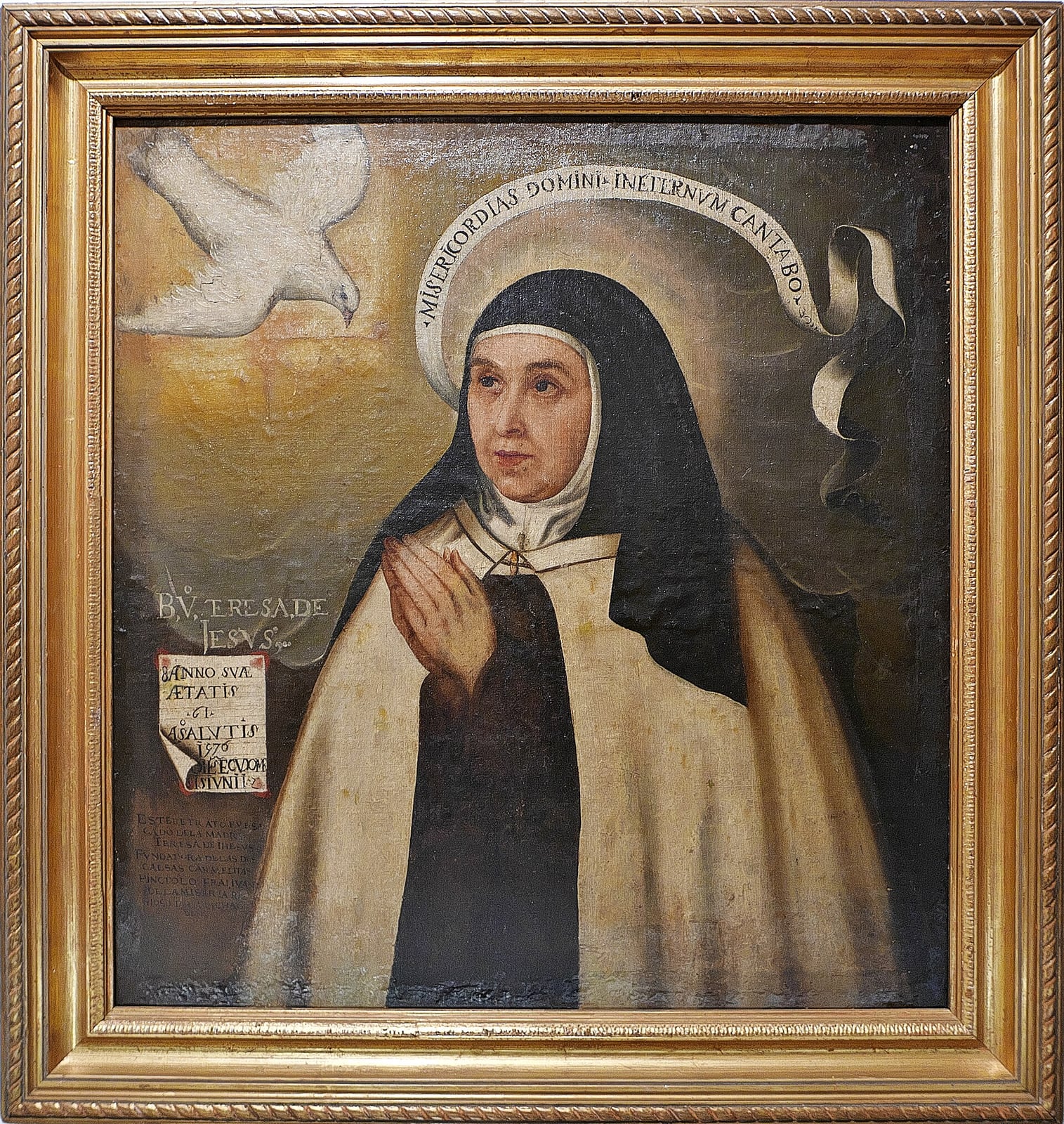
Teresa of Ávila
Ils concordent sur: Qu'est-ce que l'Absolu ? Dieu existe-t-il ? · Qui suis-je ? Existe-t-il un vrai soi ? · Que se passe-t-il après la mort ?
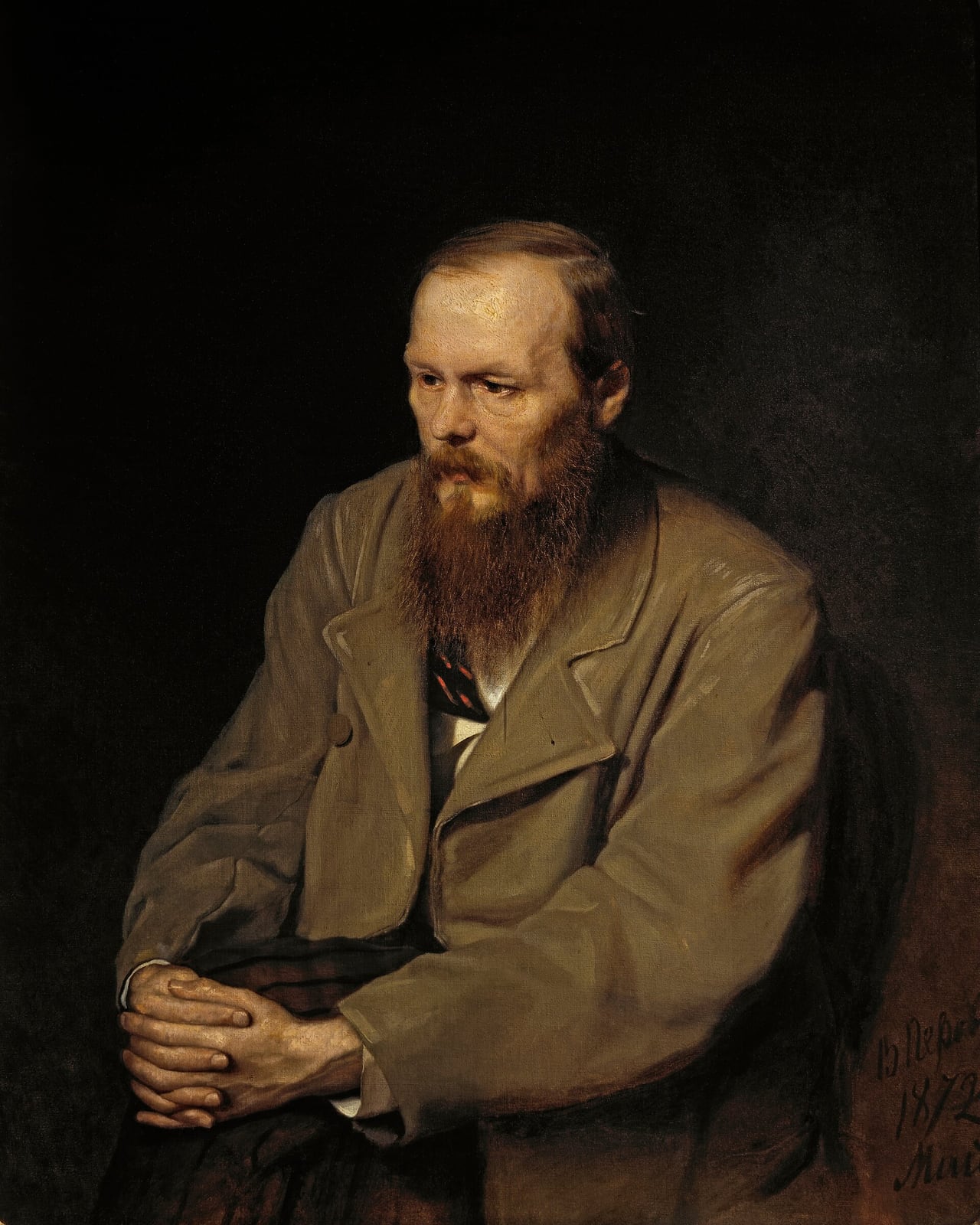
Fyodor Dostoevsky
Ils concordent sur: Qu'est-ce que l'Absolu ? Dieu existe-t-il ? · Qui suis-je ? Existe-t-il un vrai soi ? · Que se passe-t-il après la mort ?
Pense autrement que

Pema Chödrön
Ils s'opposent sur: Qu'est-ce que l'Absolu ? Dieu existe-t-il ? · Qui suis-je ? Existe-t-il un vrai soi ? · Que se passe-t-il après la mort ?

Patañjali
Ils s'opposent sur: Qu'est-ce que l'Absolu ? Dieu existe-t-il ? · Qui suis-je ? Existe-t-il un vrai soi ? · Que se passe-t-il après la mort ?

Nāgārjuna
Ils s'opposent sur: Qu'est-ce que l'Absolu ? Dieu existe-t-il ? · Qui suis-je ? Existe-t-il un vrai soi ? · Que se passe-t-il après la mort ?

Dōgen
Ils s'opposent sur: Qu'est-ce que l'Absolu ? Dieu existe-t-il ? · Qui suis-je ? Existe-t-il un vrai soi ? · Que se passe-t-il après la mort ?
Ils concordent sur
Hildegard of Bingen · Rumi
Love as the fire that moves the cosmos, and music as memory of the origin
Pourquoi: There was no contact between the twelfth-century Rhineland abbess and the thirteenth-century poet of Konya, but they share a distant inheritance: the idea of a harmonious cosmos, Pythagorean and Neoplatonic in origin, which Latin Christianity and Persian Sufism received by different routes. Both also write in a symbolic and poetic register, not a scholastic one, where the image teaches more than the concept. The difference lies in emphasis: Hildegard sings love as the order that sustains a good creation and as the liturgy of the community; Rumi, as the wound and longing of the separated soul. In her love orders; in him, it consumes.
Ils concordent sur
Hildegard of Bingen · Confucius
Ritual and music as the form of the soul: the master of Lu and the abbess of the Rhine
Pourquoi: The affinity is purely comparative and rests on a shared ancient intuition: music and ritual do not adorn moral life, they constitute it, because body and voice are educated before ideas. The Confucian tradition joined ritual and music very early as instruments of government and self-cultivation; Benedictine liturgy made the singing of psalms the axis of the monastic day. The difference is theological: Confucian ritual looks to human conduct and keeps the spirits at a distance, whereas Hildegard's chant is addressed to a personal God and is participation in the praise of the angels. They agree on pedagogy, not on the addressee.
Ils concordent sur
Hildegard of Bingen · Ibn Arabi
The human being as mirror of the cosmos and of the divine
Pourquoi: There was no contact between the German abbess and the Andalusian mystic, contemporaries for only a few years. The affinity stems from a common inheritance: the ancient idea of the human being as microcosm, Greek and Neoplatonic in origin, which circulated both in Latin Europe and in the Islamic world, and a reading of creation as the language of God. The differences are substantive. Hildegard sharply maintains the distinction between Creator and creature and thinks of the harmony lost through sin and restored in Christ; Ibn Arabi says the world is He and not He, within a metaphysics of the single existence. She contemplates visions; he builds a theory of the Names.
Anecdotes et récits
Anecdotes et récits
Documenté1141
The illness of disobedience
Origine du récit: First-person account in the Protestificatio of Scivias, confirmed by the autobiographical fragments in the Vita (book II).
Source: Hildegardis Bingensis. Scivias. Ed. Adelgundis Führkötter y Angela Carlevaris. CCCM 43–43A. Turnhout: Brepols, 1978. Trad. inglesa: Columba Hart y Jane Bishop, Hildegard of Bingen: Scivias (Classics of Western Spirituality). Nueva York: Paulist Press, 1990. Trad. española: Scivias: Conoce los caminos, trad. Antonio Castro Zafra y Mónica Castro. Madrid: Trotta, 1999.
Témoignage1147–1148
A pope reads aloud
Origine du récit: Vita, book I, ch. 4 (Gottfried of Disibodenberg); Bernard's (Ep. 1r) and Eugene III's (Ep. 4) letters survive in the Epistolarium. The public reading at the synod is transmitted only by the Vita.
Source: Gottfried de Disibodenberg y Theoderich de Echternach. Vita sanctae Hildegardis. Ed. Monika Klaes. Corpus Christianorum Continuatio Mediaevalis 126. Turnhout: Brepols, 1993. Trad. inglesa en Anna Silvas, Jutta and Hildegard: The Biographical Sources. Turnhout: Brepols, 1998 (University Park: Penn State Press, 1999).
Récit hagiographiquec. 1148–1150
The abbot who could not lift her
Origine du récit: Vita, book II, ch. 5 (autobiographical fragment) and book I, ch. 5. Hildegard's letter to Abbot Kuno and the endowment charter of 1158 are in the Epistolarium (Baird–Ehrman, vol. 1).
Source: Gottfried de Disibodenberg y Theoderich de Echternach. Vita sanctae Hildegardis. Ed. Monika Klaes. Corpus Christianorum Continuatio Mediaevalis 126. Turnhout: Brepols, 1993. Trad. inglesa en Anna Silvas, Jutta and Hildegard: The Biographical Sources. Turnhout: Brepols, 1998 (University Park: Penn State Press, 1999).
Documenté1151–1152
Richardis
Origine du récit: Letters 4, 12, 13, 64 and 64r of the Epistolarium (ed. Van Acker; trans. Baird–Ehrman, vol. 1); Vita, book II. The episode has been analysed by Dronke (1984) and Newman (1987).
Source: Hildegard of Bingen. The Letters of Hildegard of Bingen. Trad. Joseph L. Baird y Radd K. Ehrman. 3 vols. Nueva York: Oxford University Press, 1994, 1998, 2004.
Documenté1178–1179
The interdict and music
Origine du récit: Letter to the prelates of Mainz (Epistolarium, Ep. 23, ed. Van Acker; Baird–Ehrman, vol. 1, Letter 23) and letters 24 and 24r to Archbishop Christian. Also narrated in the Vita, book III.
Source: Hildegard of Bingen. The Letters of Hildegard of Bingen. Trad. Joseph L. Baird y Radd K. Ehrman. 3 vols. Nueva York: Oxford University Press, 1994, 1998, 2004.
Documenté1927–1948
The codex that vanished in Dresden
Origine du récit: Bain (2018) reconstructs the story from the Wiesbaden archives; Führkötter and Carlevaris's introduction to the critical edition (CCCM 43) describes the loss and the sources for reproduction.
Documenté1158–1171
A nun preaches to the cities
Origine du récit: Vita, book III, ch. 17 (list of places); sermon-letters to the clergy of Cologne (Ep. 15r) and Trier (Ep. 223r) in the Epistolarium (Baird–Ehrman, vols. 1 and 3).
Source: Gottfried de Disibodenberg y Theoderich de Echternach. Vita sanctae Hildegardis. Ed. Monika Klaes. Corpus Christianorum Continuatio Mediaevalis 126. Turnhout: Brepols, 1993. Trad. inglesa en Anna Silvas, Jutta and Hildegard: The Biographical Sources. Turnhout: Brepols, 1998 (University Park: Penn State Press, 1999).
Enseignements
Enseignements
Les notions qui structurent sa pensée, expliquées dans leur contexte.
Viriditas (greenness)viriditas
Twelfth-century cosmology (school of Chartres, the tradition of Isidore and Bede) read from monastic experience and the observation of Rhenish nature.
Source: Newman, Barbara. Sister of Wisdom: St. Hildegard's Theology of the Feminine. Berkeley: University of California Press, 1987 (2.ª ed., 1997).
The shadow of the living light (the mode of vision)umbra-viventis-lucis
The Augustinian theory of the three kinds of vision (corporeal, spiritual, intellectual) and the modern debate on the phenomenology of visionary experience.
Source: Hildegard of Bingen. The Letters of Hildegard of Bingen. Trad. Joseph L. Baird y Radd K. Ehrman. 3 vols. Nueva York: Oxford University Press, 1994, 1998, 2004.
Music as memory of paradisesymphonia-memoria-paraiso
The Boethian tradition of musica mundana, humana and instrumentalis, and the monastic theology of the divine office as participation in the heavenly liturgy.
Source: Hildegard of Bingen. Symphonia: A Critical Edition of the Symphonia armonie celestium revelationum. Ed. y trad. Barbara Newman. Ithaca: Cornell University Press, 1988 (2.ª ed., 1998).
Man as microcosm (opus Dei)homo-microcosmos
Twelfth-century Christian Platonism (Bernard Silvestris, William of Conches, Honorius of Autun) and the patristic tradition of man as compendium of creation.
Source: Hildegardis Bingensis. Liber divinorum operum. Ed. Albert Derolez y Peter Dronke. CCCM 92. Turnhout: Brepols, 1996. Trad. inglesa: Nathaniel M. Campbell, The Book of Divine Works. Washington: Catholic University of America Press, 2018.
The Virtues as living forcesvirtudes-personificadas
The tradition of Prudentius's Psychomachia and of monastic catalogues of virtues and vices.
Source: Newman, Barbara. Sister of Wisdom: St. Hildegard's Theology of the Feminine. Berkeley: University of California Press, 1987 (2.ª ed., 1997).
Sapientia, Caritas, Ecclesia: the feminine figures of the divinesapientia-caritas
Biblical wisdom literature (Proverbs 8, Wisdom), exegesis of the Song of Songs and the tradition of personified Ecclesia.
Source: Newman, Barbara. Sister of Wisdom: St. Hildegard's Theology of the Feminine. Berkeley: University of California Press, 1987 (2.ª ed., 1997).
Retraites
Retraites et centres
Lieux et rencontres liés à son enseignement. Nous vous mettons en relation avec ceux qui les organisent.
Odernheim am Glan, Renania-Palatinado · Alemania
Disibodenberg: Hildegard's first monastery
Disibodenberger Scivias-Stiftung
On the Disibodenberg, above the confluence of the Nahe and the Glan, stand the ruins of the monastery Hildegard entered as a child and where she lived until she founded her own community on the Rupertsberg near Bingen. It was there that she began to write down her visions. A foundation cares for the ruins, open all year, and a small museum, and organises pilgrimage walks. The site is one of the stages of the Hildegard von Bingen Pilgerwanderweg, the trail of about 137 kilometres through the Nahe valley between Idar-Oberstein and Bingen, with meditation panels on her work.
Rüdesheim am Rhein (Eibingen), Hesse · Alemania
Abbey of St. Hildegard, Eibingen
Benediktinerinnenabtei St. Hildegard
The Benedictine Abbey of St. Hildegard, above the vineyards of the Rheingau, is the direct heir of the community the saint founded at Eibingen in the twelfth century. A community of nuns lives by the Rule of St. Benedict, with five times of prayer a day, and keeps its patroness's tradition alive. The abbey has a guest house and organises courses, lectures, concerts and seminars, along with a Hildegard study circle and training for speakers on her work. Its church, decorated in the Beuronese style, can be visited on guided tours, and its music recordings carry her chants.
Bingen am Rhein, Renania-Palatinado · Alemania
Hildegard Forum, Rochusberg (Bingen)
Hildegard Forum der Kreuzschwestern (St. Hildegardishaus gGmbH)
The Hildegard Forum stands on the Rochusberg in Bingen, beside the mother house of the Sisters of the Cross, overlooking the Rhine and the area where Hildegard had her Rupertsberg monastery. It describes itself as a place committed to conveying Hildegard's message: it brings together a medicinal herb garden inspired by her writings on nature, a restaurant, a shop, meeting rooms and guest rooms. Since 2004 it has been run by a non-profit social organisation as an inclusive employment enterprise. It is a good starting point for visiting the Hildegard sites of the region along the Rhine and the Nahe.
Vidéos
Vidéos
Enregistrements, entretiens et documentaires. Les vidéos sont lues depuis YouTube ; elles ne sont pas hébergées ici.
ORDO VIRTUTUM by Hildegard von Bingen – Ensemble Vocatrix
Enregistrement original· LA· 70 min
Ensemble Vocatrix
Ordo Virtutum [1/3] Prologue and Part II – Hildegard von Bingen (Score – Manuscript)
Enregistrement original· LA· 19 min
Roc Vela
O vis aeternitatis – Benedictine Nuns of the Abbey of St. Hildegard, Eibingen
Enregistrement original· LA· 6 min
Benedictine Nuns of the Abbey of St. Hildegard Eibingen – Topic
O vis eternitatis – Sequentia
Enregistrement original· LA· 8 min
Sequentia – Topic
Die Deutschen: Hildegard von Bingen | Ganze Folge Terra X
Documentaire· DE· 2008· 42 min
Terra X History (ZDF)Chaîne officielle
Hildegard von Bingen – phoenix
Documentaire· DE· 44 min
phoenix (ARD/ZDF)Chaîne officielle
Hildegard of Bingen (1994) – James Runcie, con Patricia Routledge
Documentaire· EN· 1994· 47 min
Vision VideoChaîne officielle
Pioneers of the Spirit: Hildegard of Bingen
Documentaire· EN· 23 min
Vision VideoChaîne officielle
The Unruly Mystic: Saint Hildegard
Documentaire· EN· 64 min
The Unruly MysticsChaîne officielle
Vision – From the Life of Hildegard von Bingen – official U.S. trailer
Enregistrement de tiers· EN· 2009· 2 min
Zeitgeist FilmsChaîne officielle
Hildegard von Bingen: iluminación y visión. Conferencia de Victoria Cirlot
Conférence· ES· 98 min
Universidad de la Mística (CITeS, Ávila)Chaîne officielle
De Hildegard von Bingen a Max Ernst, por Victoria Cirlot
Conférence· ES· 60 min
Fundación CajaCanariasChaîne officielle
Galerie
Galerie
Images dont la licence a été vérifiée. Chacune conserve son auteur et son attribution.
Manuscrits
Manuscrits
Témoins manuscrits et textes anciens, avec leur dépositaire et leurs conditions de consultation.
LA · Carolina tardía / protogótica · 1141–1151 (texto); c. 1165 (códice)
Scivias (códice iluminado de Rupertsberg)
- Témoin conservé
- Códice iluminado con 35 miniaturas; PERDIDO desde 1945
- Dépositaire
- Perdido. Facsímil pintado a mano (1927–1933) en la Abtei St. Hildegard, Eibingen; fotografías en blanco y negro (1927) en la Hochschul- und Landesbibliothek RheinMain, Wiesbaden · Wiesbaden, Hs. 1 (signatura histórica)
LA · Protogótica, con notación neumática alemana · c. 1175–1190, compilado en Rupertsberg
Riesencodex (Wiesbadener Codex, «códice gigante»)
- Témoin conservé
- Códice de 481 folios, 46 × 30 cm, c. 15 kg, con cadena original
- Dépositaire
- Hochschul- und Landesbibliothek RheinMain, Wiesbaden · Hs. 2
- Numérisation
- hlbrm.digitale-sammlungen.hebis.de/…
LA · Gótica · 1163–1174 (texto); primer cuarto del s. XIII (códice)
Liber divinorum operum (códice de Lucca)
- Témoin conservé
- Único testimonio iluminado de la obra, con diez miniaturas a toda página
- Dépositaire
- Biblioteca Statale di Lucca · Ms. 1942
- Numérisation
- www.loc.gov/resource/gdcwdl.wdl_21658/…
LA · Protogótica · c. 1170–1175
Liber divinorum operum (códice de Gante)
- Témoin conservé
- Testimonio más antiguo y autorizado del texto, base de la edición crítica (Derolez)
- Dépositaire
- Universiteitsbibliotheek Gent · Ms. 241
LA · Protogótica · c. 1200
Scivias (códice de Salem)
- Témoin conservé
- Copia completa con retrato de la autora
- Dépositaire
- Universitätsbibliothek Heidelberg · Cod. Sal. X 16
- Numérisation
- digi.ub.uni-heidelberg.de/diglit/salX16…
LA · Protogótica, con notación neumática · c. 1175
Symphonia (códice de Dendermonde)
- Témoin conservé
- Testimonio más antiguo de la Symphonia (57 cantos) y del Liber vitae meritorum; faltan folios
- Dépositaire
- Sint-Pieters-en-Paulusabdij, Dendermonde (Bélgica); según información de 2023, en depósito en la Maurits Sabbebibliotheek de la KU Leuven · Cod. 9
Relations
Relations
Influences, filiations et affinités. On distingue la relation documentée de la similitude identifiée par analyse.
Idées proches de
Two women who wrote under command, legitimised their word by experience and were proclaimed Doctors of the Church. Hildegard is visionary and cosmological; Teresa, introspective and psychological. No contact or documented reading.
Similitude identifiée par analyse
Idées proches de
Both Rhinelanders and theologians of creation as divine overflow; but Eckhart (14th c.) is speculative and apophatic where Hildegard is visionary and imaginal. There is no evidence Eckhart read her.
Similitude identifiée par analyse
Idées proches de
Hildegard's theology of creation (viriditas) and the Canticle of the Creatures share a fraternal gaze on nature; Francis was born two years after Hildegard's death.
Similitude identifiée par analyse
Sources
Sources
Bibliographie et catalogues consultés pour cette fiche.
- Wikidata, Q70991 «Hildegarda de Bingen / Hildegard of Bingen» (P31=Q5; 114 enlaces entre wikis; P570 1179-09-17).
- Gottfried de Disibodenberg y Theoderich de Echternach. Vita sanctae Hildegardis. Ed. Monika Klaes. Corpus Christianorum Continuatio Mediaevalis 126. Turnhout: Brepols, 1993. Trad. inglesa en Anna Silvas, Jutta and Hildegard: The Biographical Sources. Turnhout: Brepols, 1998 (University Park: Penn State Press, 1999).
- Hildegardis Bingensis. Scivias. Ed. Adelgundis Führkötter y Angela Carlevaris. CCCM 43–43A. Turnhout: Brepols, 1978. Trad. inglesa: Columba Hart y Jane Bishop, Hildegard of Bingen: Scivias (Classics of Western Spirituality). Nueva York: Paulist Press, 1990. Trad. española: Scivias: Conoce los caminos, trad. Antonio Castro Zafra y Mónica Castro. Madrid: Trotta, 1999.
- Hildegardis Bingensis. Liber divinorum operum. Ed. Albert Derolez y Peter Dronke. CCCM 92. Turnhout: Brepols, 1996. Trad. inglesa: Nathaniel M. Campbell, The Book of Divine Works. Washington: Catholic University of America Press, 2018.
- Hildegardis Bingensis. Liber vite meritorum. Ed. Angela Carlevaris. CCCM 90. Turnhout: Brepols, 1995. Trad. inglesa: Bruce W. Hozeski, The Book of the Rewards of Life. Nueva York: Oxford University Press, 1997.
- Hildegardis Bingensis. Epistolarium. Ed. Lieven Van Acker (vols. I–II) y Monika Klaes-Hachmöller (vol. III). CCCM 91, 91A, 91B. Turnhout: Brepols, 1991–2001.
- Hildegard of Bingen. The Letters of Hildegard of Bingen. Trad. Joseph L. Baird y Radd K. Ehrman. 3 vols. Nueva York: Oxford University Press, 1994, 1998, 2004.
- Newman, Barbara. Sister of Wisdom: St. Hildegard's Theology of the Feminine. Berkeley: University of California Press, 1987 (2.ª ed., 1997).
- Newman, Barbara (ed.). Voice of the Living Light: Hildegard of Bingen and Her World. Berkeley: University of California Press, 1998.
- Hildegard of Bingen. Symphonia: A Critical Edition of the Symphonia armonie celestium revelationum. Ed. y trad. Barbara Newman. Ithaca: Cornell University Press, 1988 (2.ª ed., 1998).
- Dronke, Peter. Women Writers of the Middle Ages: A Critical Study of Texts from Perpetua (†203) to Marguerite Porete (†1310). Cambridge: Cambridge University Press, 1984 (cap. 6, «Hildegard of Bingen»).
- Flanagan, Sabina. Hildegard of Bingen, 1098–1179: A Visionary Life. Londres: Routledge, 1989 (2.ª ed., 1998).
- Benedicto XVI. Carta apostólica por la que se proclama a Santa Hildegarda de Bingen, monja profesa de la Orden de San Benito, doctora de la Iglesia universal, 7 de octubre de 2012. Y Audiencias generales del 1 y 8 de septiembre de 2010.
- Cirlot, Victoria. Hildegard von Bingen y la tradición visionaria de Occidente. Barcelona: Herder, 2005. Y Vida y visiones de Hildegard von Bingen (ed. y trad.). Madrid: Siruela, 1997 (reed. 2001, 2009).
- Bain, Jennifer. «History of a Book: Hildegard of Bingen's 'Riesencodex' and World War II». Plainsong and Medieval Music 27/2 (2018), pp. 143–170.
- Hochschul- und Landesbibliothek RheinMain (Wiesbaden). «The Wiesbaden ('Giant') Codex», Hs. 2: descripción del códice y de su historia.
- Universitätsbibliothek Heidelberg. Cod. Sal. X 16 («Salemer Scivias», c. 1200), digitalización completa.
- Open Library (Internet Archive): registros bibliográficos consultados por autor, título e ISBN para las ediciones listadas.
- Wikimedia Commons: metadatos de licencia (extmetadata) de cada fichero, leídos por la API imageinfo el 2026-10-22.
- International Society of Hildegard von Bingen Studies: bibliografía, lista de manuscritos y recursos académicos.
- Abtei St. Hildegard, Eibingen (Rüdesheim am Rhein): comunidad benedictina heredera de Rupertsberg; custodia del facsímil pintado del Scivias y de las reliquias.
- Higley, Sarah L. Hildegard of Bingen's Unknown Language: An Edition, Translation, and Discussion. Nueva York: Palgrave Macmillan, 2007.
- Sacks, Oliver. Migraine. Londres: Faber & Faber, 1970; ed. revisada y ampliada, Berkeley: University of California Press, 1992 (apartado sobre las visiones de Hildegarda como aura migrañosa).
- Hayton, Magda. «Publishing Hildegard: The Creation and Circulation of the Pentachronon in the Thirteenth Century». Seminario, Pontifical Institute of Mediaeval Studies, Toronto, 8 de marzo de 2017 (resumen publicado).
- Migne, J.-P. (ed.). Patrologiae cursus completus. Series latina, vol. 197: S. Hildegardis abbatissae opera omnia. París, 1855 (ejemplar digitalizado en Internet Archive).
- Pitra, Jean-Baptiste (ed.). Analecta Sanctae Hildegardis opera spicilegio Solesmensi parata (Analecta sacra, vol. 8). Montecassino: Typis Sacri Montis Casinensis, 1882 (ejemplar de la Universidad de Oxford digitalizado en Internet Archive).
- Brepols Publishers. Hildegardis Bingensis, Opera minora II, ed. Christopher P. Evans, Jeroen Deploige, Sara Moens, Michael Embach y Kurt Gärtner. Corpus Christianorum Continuatio Mediaevalis 226A. Turnhout: Brepols, 2016. ISBN 9782503548371 (ficha editorial con el índice del volumen).
- Ayant droit
- Dominio público (obra del siglo XII). Las ediciones críticas (Brepols, Corpus Christianorum), traducciones (Trotta, Herder, Siruela, Paulist Press, Catholic University of America Press, Oxford, Cornell…) y grabaciones musicales están sujetas a los derechos de sus editores. La abadía de Santa Hildegarda de Eibingen custodia reliquias, facsímil y tradición.
- Site officiel
- www.abtei-st-hildegard.de/
En attente de confirmation
Ce que cette fiche n'a pas encore pu établir. Nous préférons le dire plutôt que de combler.
- Confirmar el enlace directo (handle) de la digitalización del Riesencodex (Hs. 2) en el portal hlbrm.digitale-sammlungen.hebis.de: el buscador del portal no devolvió resultados por consulta automatizada; se enlaza el portal, no el ítem.
- Verificar si el Ms. 241 de Gante está digitalizado en lib.ugent.be (la ficha existe; el catálogo es una aplicación dinámica que no se pudo leer).
- Comprobar manualmente el enlace de la Library of Congress / World Digital Library al códice de Lucca (Ms. 1942): el servidor devuelve 403 a las comprobaciones automatizadas.
- Localizar ISBN en catálogo para las ediciones del Corpus Christianorum (CCCM 43–43A, 90, 91–91B, 92, 126) y para el Libro de las obras divinas de Herder (Barcelona, 2009): no aparecen en Open Library y Google Books devuelve cuota 0 sin clave.
- Confirmar el estado actual de custodia del códice de Dendermonde (abadía o depósito en KU Leuven).
- Ediciones en italiano (Il libro delle opere divine, Mondadori; Scivias, ed. italiana), ruso y árabe: no localizadas con ISBN en Open Library.
- Fijar en la edición crítica (CCCM 91) la numeración de las cartas citadas (Guiberto: 103r; Maguncia: 23; Ricardis: 12–13, 64): se ha seguido la numeración de Van Acker / Baird–Ehrman de memoria bibliográfica y conviene cotejarla.
- Programas de afiliación: ninguno verificado para las editoriales listadas; se deja la lista vacía.
- No se ha localizado ninguna traducción española ni inglesa de dominio público con texto completo de las obras de Hildegarda (las versiones inglesas y españolas disponibles son posteriores a 1950 y están protegidas); la sala de lectura queda con el latín (PL 197, Pitra, Kaiser, Wikisource) y la traducción alemana de las cartas (1854).
- Pentachronon de Gebenón de Eberbach: no se ha localizado en catálogo una edición moderna con ISBN; se registra sin ediciones.
- Fechar con las introducciones de CCCM 226 y 226A la Explicación de la Regla de san Benito y la Explicación del Símbolo atanasiano (se dejan sin año).
Recherche effectuée le 2026-10-22