Hindouisme · Advaita Vedanta
Gaudapada
गौडपाद
Personne historiquement documentée
Philosophe indien, auteur de la Māṇḍūkya Kārikā ou Āgama Śāstra, le plus ancien traité systématique d'Advaita Vedānta qui nous soit parvenu, composé vers les VIe–VIIe siècles. En quatre chapitres, il commente la Māṇḍūkya Upaniṣad, assimile la veille au rêve et défend la non-origine (ajātivāda) : rien n'est jamais né. La tradition fait de lui le maître du maître de Śaṅkara ; la critique discute sa dette envers le bouddhisme Madhyamaka et Yogācāra. Sa vie est inconnue.
- œuvres
- 10œuvres
- éditions
- 19éditions
- citations
- 11citations
- vidéos
- 14vidéos
- images
- 7images
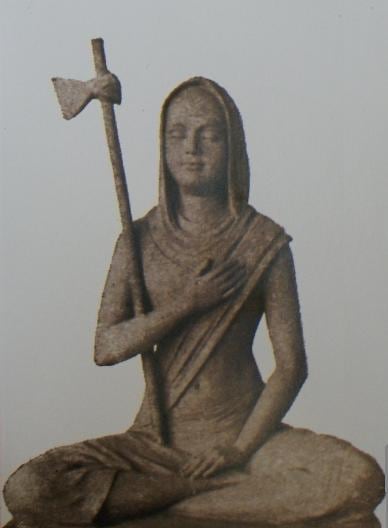
Estatua de Gauḍapāda · Public domain
Dans ses propres mots
«There is no dissolution and no origination, no one bound and no one striving, no seeker of liberation and no one liberated: this is the highest truth.»Māṇḍūkya Kārikā 2.32 (traducción propia); la estrofa reaparece en la Amṛtabindu y la Brahmabindu Upaniṣad

Son idée centrale
Ajātivāda (the doctrine of non-origination): The central thesis of the Kārikā: in truth nothing is born.
Le voir en contexte
Biographie
5 min de lecture
Traduction assistée à partir de l'original espagnol, en attente de relecture par un traducteur natif.
Un auteur, enfin
À la différence des sages védiques que la tradition place à ses côtés, Gauḍapāda est un auteur historique : le nom que la tradition inscrit au bas d'un traité en 215 strophes, la Māṇḍūkya Kārikā, appelée aussi Āgama Śāstra ou Gauḍapādīya Kārikā. C'est le plus ancien traité systématique d'Advaita Vedānta qui nous soit parvenu. De sa vie, pourtant, on ne sait presque rien : ni le lieu de sa naissance, ni ses dates, ni le nom de son maître. Le nom lui-même est une énigme ; on a proposé que « le vénérable du Gauḍa » renvoie au Bengale, mais ce n'est qu'une conjecture. Ce que nous savons de lui provient de son œuvre, des citations d'autres auteurs et de la tradition des monastères advaita.
Daté par ses lecteurs
Les dates se déduisent d'indices. La Kārikā connaît les doctrines du Madhyamaka de Nāgārjuna et du Yogācāra, l'école bouddhique du « rien que conscience » systématisée au IVe siècle ; elle leur est donc postérieure. À l'inverse, le penseur bouddhiste Bhāvaviveka, au VIe siècle, en cite des strophes dans son Madhyamakahṛdaya lorsqu'il expose la doctrine védântique, et Śāntarakṣita et Kamalaśīla le font au VIIIe siècle. Karl Potter le situe pour cette raison vers l'an 500 ; d'autres auteurs préfèrent le VIe ou le VIIe siècle, et ceux qui prennent au pied de la lettre sa parenté spirituelle avec Śaṅkara, que la tradition date de 788–820, le repoussent jusqu'au VIIIe siècle. Hajime Nakamura a soutenu que les quatre chapitres ne furent pas composés en même temps et que le premier et le troisième recueillent des idées plus anciennes que le quatrième.
Quatre chapitres
Le premier chapitre, Āgama, commente la Māṇḍūkya Upaniṣad, dont il transmet les douze phrases en prose avec les strophes : l'ātman a quatre « quarts », les trois états de veille, de rêve et de sommeil profond, et un quatrième, turīya, qui n'est pas un état mais ce en quoi les autres apparaissent, et que la syllabe Om exprime par ses trois sons et son silence. Le deuxième, Vaitathya, « irréalité », soutient que les objets de la veille sont aussi irréels que ceux du rêve, car ce qui n'existe ni au commencement ni à la fin n'existe pas non plus au milieu. Le troisième, Advaita, explique la relation entre l'ātman et les individus par l'image de l'espace enclos dans les jarres, et décrit un « yoga du non-contact » (asparśa-yoga) que même les yogis redoutent. Le quatrième, Alātaśānti, « l'extinction du tison », compare le monde aux figures que trace dans l'air un tison qu'on agite, et démonte l'une après l'autre les théories de la causalité.
Rien n'est jamais né
La doctrine la plus radicale de Gauḍapāda est celle de la non-origine, l'ajātivāda. Si l'effet était identique à sa cause, rien de nouveau ne naîtrait ; s'il en était distinct, on ne comprendrait pas comment il en surgit ; et ce qui n'existe pas ne peut naître, pas plus que ne naît le fils d'une femme stérile. La conclusion se condense dans une strophe que la tradition ultérieure reprit dans plusieurs Upaniṣad tardives : « Il n'y a ni dissolution ni origine, personne de lié ni personne qui s'efforce, personne qui cherche la libération ni personne de libéré : telle est la vérité suprême. » La libération n'est pas un changement, mais la reconnaissance que l'ātman n'est jamais né et n'a jamais été lié. Michael Comans a montré comment cette méthode, qui part des états de conscience, fut héritée et transformée par Śaṅkara et ses disciples.
L'ombre du Bouddha
Le quatrième chapitre pose le problème le plus débattu. Il s'ouvre sur un hommage au « meilleur des bipèdes », qui s'est « éveillé » (saṃbuddha) à la nature des phénomènes ; il emploie le vocabulaire technique du bouddhisme — dharma, saṃvṛti, « vibration de la conscience » — et s'achève en disant que « cela, le Bouddha ne l'a pas enseigné ». Vidhushekhara Bhattacharya, dans son édition de 1943, conclut que Gauḍapāda avait profondément assimilé le Madhyamaka et le Yogācāra, et alla jusqu'à suggérer que la Māṇḍūkya Upaniṣad elle-même dérivait des strophes. R. D. Karmarkar lui répondit en 1953 en défendant une lecture pleinement védântique. T. R. V. Murti vit dans la Kārikā une tentative d'interpréter le Vedānta à la lumière du bouddhisme sans renoncer à l'ātman, que le bouddhisme nie, et Richard King, en 1995, replaça l'œuvre dans son contexte mahāyāna et jugea possible que le quatrième chapitre ait une autre origine, puisque les auteurs védântiques postérieurs ne le citent guère.
Le maître du maître de Śaṅkara
La tradition advaita fait de Gauḍapāda le maître de Govinda Bhagavatpāda, lui-même maître de Śaṅkara, et l'inscrit dans une lignée qui remonte à Vyāsa et à son fils Śuka. Śaṅkara cite ses strophes dans son commentaire aux Brahmasūtra en les attribuant aux « maîtres qui connaissent la tradition du Vedānta », et le commentaire de la Kārikā qui lui est attribué — dont l'authenticité est discutée — se clôt sur un hommage à son « maître suprême » (paramaguru). Sureśvara, disciple de Śaṅkara, cite lui aussi la Kārikā et évoque avec vénération « les Gauḍa ». Les hagiographies tardives de Śaṅkara racontent une rencontre entre les deux dans l'Himalaya, que la chronologie rend improbable.
Ce qu'on lui attribue
Sous son nom circulent d'autres œuvres d'authenticité douteuse. La plus connue est un commentaire à la Sāṃkhya Kārikā d'Īśvarakṛṣṇa, traduit en anglais par Colebrooke et Wilson en 1837 ; Gerald Larson et Karl Potter jugent improbable qu'il soit du même auteur, en raison de son style et de sa proximité avec d'autres commentaires du Sāṃkhya. On lui attribue aussi un commentaire à l'Uttara Gītā, des œuvres de la tradition tantrique de la Śrīvidyā — l'hymne Subhagodaya et le Śrīvidyāratnasūtra — ainsi que des commentaires au Devīmāhātmya et à d'autres Upaniṣad, sans preuves qui permettent de les accepter.
Héritage
La Kārikā fut respectée même par les écoles védântiques rivales : Madhva et la tradition du Viśiṣṭādvaita tinrent pour révélée une partie des strophes du premier chapitre. À Goa, le monastère de Kavale, le plus ancien de la communauté gauḍa sārasvata, maintient une lignée de pontifes qui portent le titre de Gauḍapādācārya. La première traduction anglaise, due à Manilal Dvivedi, parut en 1894, et depuis lors la doctrine de la non-origine est devenue une référence du non-dualisme contemporain, qui la présente comme l'enseignement ultime du Vedānta.
Sources: Bhattacharya, Vidhushekhara (ed. y trad.). The Āgamaśāstra of Gauḍapāda. Calcuta: University of Calcutta, 1943. Reimpr. Delhi: Motilal Banarsidass, 1989, con prólogo de Christian Lindtner. · King, Richard. Early Advaita Vedānta and Buddhism: The Mahāyāna Context of the Gauḍapādīya-kārikā. Albany: State University of New York Press, 1995. · Karmarkar, Raghunath Damodar (ed. y trad.). Gauḍapāda-Kārikā. Poona: Bhandarkar Oriental Research Institute, 1953 (Government Oriental Series, B 9). · Nakamura, Hajime. A History of Early Vedānta Philosophy, Part Two. Trad. de Trevor Leggett et al. Delhi: Motilal Banarsidass, 2004 (original japonés, 1950–1956). · Potter, Karl H. (ed.). Encyclopedia of Indian Philosophies, vol. III: Advaita Vedānta up to Śaṃkara and His Pupils. Princeton: Princeton University Press / Delhi: Motilal Banarsidass, 1981 (sección sobre Gauḍapāda).
Chronologie
La vie, année après année
Chaque point est un événement documenté. Cliquez pour le lire, avec sa source et son degré de certitude.
IVe siècle
Background: Madhyamaka and Yogācāra
The Kārikā presupposes the doctrines of Nāgārjuna (second–third centuries) and of the Yogācāra of Asaṅga and Vasubandhu (fourth century); it is therefore later than them.
ProbableKing, Richard. Early Advaita Vedānta and Buddhism: The Mahāyāna Context of the Gauḍapādīya-kārikā. Albany: State University of New York Press, 1995.
IVe siècle
Background: Madhyamaka and Yogācāra
The Kārikā presupposes the doctrines of Nāgārjuna (second–third centuries) and of the Yogācāra of Asaṅga and Vasubandhu (fourth century); it is therefore later than them.
Probable
Ve siècle – 600
Composition of the Māṇḍūkya Kārikā
Potter places Gauḍapāda around 500; others in the sixth or seventh century. Nakamura believes the chapters took shape at different times.
Probable
VIe siècle
Bhāvaviveka quotes the Kārikā
The Mādhyamika Bhāvaviveka records verses from the work when setting out Vedānta in his Madhyamakahṛdaya: this is the date before which it must have been composed.
Probable
VIIe siècle
Teacher of Govinda Bhagavatpāda (according to tradition)
The Advaita genealogy makes Gauḍapāda the teacher of Govinda, Śaṅkara's teacher. It may be a relation of lineage rather than a direct one.
Tradition
VIIIe siècle
Śaṅkara calls him "supreme teacher"
Śaṅkara quotes the Kārikā in his Brahmasūtra commentary; the commentary on the Kārikā attributed to him pays homage to Gauḍapāda as paramaguru. Śaṅkara's date is debated (seventh–ninth centuries).
Probable
1837
The Sāṃkhya Kārikā commentary in English
Colebrooke and Wilson publish the Sāṃkhya Kārikā with the bhāṣya attributed to Gauḍapāda.
Documenté
1894
First English translation of the Kārikā
Manilal N. Dvivedi translates the Māṇḍūkya Upaniṣad with Gauḍapāda's verses and Śaṅkara's commentary.
Documenté
1943
Bhattacharya's edition
Vidhushekhara Bhattacharya publishes The Āgamaśāstra of Gauḍapāda and opens the modern debate on Buddhist influence.
Documenté
1953
Karmarkar's reply
R. D. Karmarkar publishes his edition and translation with a Vedāntic interpretation that disputes Bhattacharya's.
Documenté
1995
Richard King's study
Early Advaita Vedānta and Buddhism places the Kārikā in its Mahāyāna context.
Documenté
Œuvres
Œuvres essentielles
Les œuvres sans lesquelles on ne comprend pas son héritage.
Œuvre écrite · VIe siècle
Māṇḍūkya Kārikā (Āgama Śāstra, Gauḍapāda's Verses)
माण्डूक्यकारिका / आगमशास्त्र / गौडपादीयकारिका
A treatise in 215 verses divided into four chapters (prakaraṇa): Āgama (29), Vaitathya (38), Advaita (48) and Alātaśānti (100). It comments on the Māṇḍūkya Upaniṣad — whose twelve prose paragraphs it transmits interspersed in the first chapter — and develops from it a complete philosophy: the four states of the ātman and the syllable Om, the unreality of the waking world compared with dream, the non-duality of the ātman and individuals, the "yoga of no contact" and the doctrine of non-origination (ajātivāda). It is the oldest systematic text of Advaita Vedānta and the only one earlier than Śaṅkara to survive complete.
12 éditions
Toute son œuvre (10)
Gaudapada
Āgama Prakaraṇa (chapter I: the revealed tradition)
The Conscious LibraryĀgama Prakaraṇa (chapter I: the revealed tradition)
550
Gaudapada
Vaitathya Prakaraṇa (chapter II: unreality)
The Conscious LibraryVaitathya Prakaraṇa (chapter II: unreality)
550
Gaudapada
Advaita Prakaraṇa (chapter III: non-duality)
The Conscious LibraryAdvaita Prakaraṇa (chapter III: non-duality)
550
Gaudapada
Alātaśānti Prakaraṇa (chapter IV: the quenching of the firebrand)
The Conscious LibraryAlātaśānti Prakaraṇa (chapter IV: the quenching of the firebrand)
575
Gaudapada
Commentary on the Sāṃkhya Kārikā (Gauḍapāda-bhāṣya)
The Conscious LibraryCommentary on the Sāṃkhya Kārikā (Gauḍapāda-bhāṣya)
Gaudapada
Commentary on the Uttara Gītā
The Conscious LibraryCommentary on the Uttara Gītā
Gaudapada
Subhagodaya (hymn of the Śrīvidyā tradition)
The Conscious LibrarySubhagodaya (hymn of the Śrīvidyā tradition)
Gaudapada
Śrīvidyāratnasūtra
The Conscious LibraryŚrīvidyāratnasūtra
Gaudapada
Other attributed commentaries (Devīmāhātmya, Nṛsiṃha-uttara-tāpanīya, Anugītā, Bṛhadāraṇyaka)
The Conscious LibraryOther attributed commentaries (Devīmāhātmya, Nṛsiṃha-uttara-tāpanīya, Anugītā, Bṛhadāraṇyaka)
Citations
Citations localisées dans une œuvre précise. Chacune porte sa provenance et son degré de fiabilité.
There is no dissolution and no origination, no one bound and no one striving, no seeker of liberation and no one liberated: this is the highest truth.न निरोधो न चोत्पत्तिर्न बद्धो न च साधकः । न मुमुक्षुर्न वै मुक्त इत्येषा परमार्थता ॥
VérifiéeMāṇḍūkya Kārikā 2.32 (traducción propia); la estrofa reaparece en la Amṛtabindu y la Brahmabindu Upaniṣad
Dernières paroles
Il n'existe aucun témoignage vérifiable de ses dernières paroles.
There is no record of his death or of his last words. Śaṅkara's much later hagiographies present him alive at Badarikāśrama in the Himalayas, without narrating his end.
Source: Potter, Karl H. (ed.). Encyclopedia of Indian Philosophies, vol. III: Advaita Vedānta up to Śaṃkara and His Pupils. Princeton: Princeton University Press / Delhi: Motilal Banarsidass, 1981 (sección sobre Gauḍapāda).
Interroger
Ce que répond son œuvre
Douze grandes questions de l'humanité et ce que ses textes permettent d'y répondre, références à l'appui. Nous ne lui prêtons jamais de paroles.
Qu'est-ce que l'Absolu ? Dieu existe-t-il ?
The only reality is the fourth, turīya: non-dual, unborn, without mark
Un Absolu impersonnelIl le dit expressément
In the Māṇḍūkya Kārikā Gauḍapāda identifies the Absolute with the ātman in its «fourth» state, turīya, which is neither waking, nor dream, nor deep sleep, but the non-dual ground in which all three appear. He calls it the lord who puts an end to all suffering, immutable and all-pervading (1.10), but this language does not designate a creator: the first chapter reviews the theories of creation and sets them aside, and the third explains that the Upaniṣadic accounts of the world's origin are only a teaching device (3.15). Since the Absolute admits no attributes, the Kārikā points to it by negation, following the formula «not this, not this» (3.26). What has never been born has no prior source and no separate world to govern.
Comparer cette question avec d'autres maîtresQui suis-je ? Existe-t-il un vrai soi ?
Individuals are the one ātman, like the space inside jars
Le Soi est l'AbsoluIl le dit expressément
For Gauḍapāda the true self is not a part of the Absolute but the Absolute itself. He explains it with the image of space and jars, developed in the third chapter of the Kārikā: space seems to be divided inside each vessel, with its shape, size and name, and if one jar fills with smoke the others are not soiled; but space was not born of them nor really divided, and when they break it goes nowhere (3.3–3.7). So individuals are the ātman apparently limited by bodies. What we call «I», with its states of waking, dream and deep sleep, appears on that non-dual ground, the fourth or turīya, which never ceases to be what it is.
Comparer cette question avec d'autres maîtresPourquoi souffrons-nous ?
We suffer asleep in a beginningless illusion that imagines duality
L'ignorance de ce que nous sommesIl le dit expressément
For Gauḍapāda suffering is born of an imagining: the agitated mind sees itself as subject and object, like the firebrand that, when moved, seems to trace lines and circles (4.47). The individual is asleep in a beginningless illusion and, until he wakes, lives waking life as one more dream, full of births, losses and fears; when he wakes he knows the unborn, without sleep or dream, non-dual (1.16). The fourth state, turīya, is therefore «the lord who puts an end to all suffering» (1.10). The Kārikā dwells on fear: even yogis fear the yoga of non-contact, seeing danger where there is none (3.39). Pain is not removed by improving the dreamt world, but by ceasing to imagine that it exists apart.
Comparer cette question avec d'autres maîtresQue se passe-t-il après la mort ?
Nothing whatsoever is born; therefore nothing dies
Ce que je suis ne naît ni ne meurtIl le dit expressément
Gauḍapāda's answer is the most radical possible: the question presupposes a birth that has not in truth taken place. His doctrine of non-origination (ajātivāda) holds that no living being is born and that there is no cause of its birth: that is the supreme truth (3.48, repeated in 4.71). The existent cannot be born because it already exists, nor can the non-existent, just as the son of a barren woman is not born. If there is no birth, death and passage to another life belong to the same dream as waking: what does not exist at the beginning or at the end does not exist in the present either (2.6). Gauḍapāda does not deny that, in ordinary experience, people speak of being born and dying, but he treats it as an appearance, like the figures of the whirling firebrand.
Comparer cette question avec d'autres maîtresComment atteint-on la libération ou le salut ?
Waking to the unborn, and finding that no one was ever bound
Par la connaissance directeIl le dit expressément
Gauḍapāda proposes liberation through knowledge, but takes it to its paradoxical conclusion. When the individual, asleep in a beginningless illusion, wakes, he knows the unborn and non-dual (1.16); when, through understanding the truth of the ātman, the mind ceases to imagine, it reaches the state of no-mind (3.32). That stillness is the yoga of non-contact (asparśa), which demands patient effort, like emptying the ocean drop by drop with a blade of grass (3.41). But from the ultimate standpoint there is no liberation to achieve: there is no dissolution and no origin, no one bound and no one striving, no one seeking liberation and no one liberated; that is the supreme truth (2.32). The path serves to stop believing in bondage, not to escape from it.
Comparer cette question avec d'autres maîtresFaut-il un maître ?
He does not discuss the teacher: he relies on revelation and reasoning
Ne s'est pas prononcé
The Māṇḍūkya Kārikā devotes no passage to the need for a teacher. Its authority comes from two sources it names expressly: revelation (āgama), which gives the first chapter its title, and reasoning (upapatti), by which the following chapters demonstrate the unreality of duality and non-origination. It does mention the sages free from passion, fear and anger, versed in the Veda, who have seen this truth (2.35), and it opens the fourth chapter with a salutation to the «best of bipeds», who awoke to phenomena like the sky (4.1). Advaita tradition later made him a link in its lineage, as the teacher of Śaṅkara's teacher, but that genealogy is later and says nothing about what he taught concerning the guru.
Comparer cette question avec d'autres maîtresLe monde est-il réel ?
Waking is like dreaming: a city of gandharvas in the sky
Apparence sur l'unique réalitéIl le dit expressément
Gauḍapāda holds the strongest thesis in Vedānta on the unreality of the world. The second chapter of the Kārikā, titled precisely «Unreality», equates waking with dreaming: in both objects are perceived, in both they seem effective, and both vanish; what does not exist at the beginning or at the end does not exist in the present either (2.6). As a dream, a magic show or a city of gandharvas in the sky are seen, so the wise see this universe (2.31). The fourth chapter adds the image of the firebrand: agitated consciousness seems to produce subject and object, and appearances neither come out of it nor enter it (4.47–4.52). And since nothing has been born, the world is not even a real effect of Brahman, but an appearance without origin.
Comparer cette question avec d'autres maîtresQu'est-ce que l'amour ?
He does not treat love; his yoga is offered for the good of all beings
Ne s'est pas prononcé
The Māṇḍūkya Kārikā is a metaphysical treatise on the states of consciousness, the unreality of duality and non-origination, and it says nothing about love, human or divine. The closest it comes are two features of tone. At the start of the fourth chapter it salutes the yoga of non-contact as a teaching that brings happiness and good to all beings, without dispute and without contradiction (4.2). And in the third it holds that non-duality is not in conflict with the dualists, who quarrel among themselves, because it includes them all (3.17–3.18). From this a benevolence without enemies may be inferred, but not a doctrine of love. Devotion (upāsanā) appears in the Kārikā as the path of those who still think that Brahman has been born (3.1).
Comparer cette question avec d'autres maîtresSommes-nous libres ou tout est-il déterminé ?
No one bound, no one striving: the agent belongs to the dream
Il n'y a pas d'agentCela se déduit de sa doctrine
Gauḍapāda does not frame the problem in terms of freedom and determinism, because from his standpoint both assumptions fail. If nothing has been born, there is no agent who chooses and no causal chain that determines him: the Kārikā examines causation and concludes that the effect can be neither identical with nor different from its cause, so that the cause-effect relation is as imaginary as birth (ch. IV). Hence the formula of 2.32: there is no one bound, no one striving, no one seeking liberation and no one liberated. The experience of choosing and suffering consequences belongs to waking, which the Kārikā equates with dreaming; within it, talk of action makes sense, but not in the light of the unborn.
Comparer cette question avec d'autres maîtresPourquoi méditer ou prier ?
Om leads to turīya; once the truth is understood, the mind stops imagining
Voir la réalité telle qu'elle estIl le dit expressément
The Kārikā proposes two practices that culminate in an understanding. In the first chapter it asks one to fix the mind on the syllable Om, whose parts correspond to waking, dream and deep sleep, and whose final silence is turīya: Om is fearless Brahman, and whoever meditates on it thus fears nothing (1.24–1.29). In the third it describes the yoga of non-contact (asparśa): when, through understanding the truth of the ātman, the mind ceases to imagine objects, it reaches no-mind (3.32). Gauḍapāda carefully distinguishes that state from deep sleep and from the enjoyment of absorption (rasāsvāda), which is to be avoided (3.44–3.45). Meditation does not seek an experience, but to see that nothing has been born; devotion that worships a born Brahman seems to him a path of narrow minds (3.1).
Comparer cette question avec d'autres maîtresLa raison peut-elle connaître l'ultime ?
Revelation teaches it and reasoning demonstrates it
L'Écriture et le raisonnementIl le dit expressément
Gauḍapāda trusts reason more than almost any other author in Vedānta. The Kārikā is built on two pillars: the first chapter comments on revelation, the Māṇḍūkya Upaniṣad, and the following three argue. The second demonstrates the unreality of the world by comparing waking with dream; the third announces that non-duality will be established by scripture and by reasoning, and the fourth dialectically examines every theory of causation until it concludes that nothing can be born. Reason, however, does not grasp the ultimate as an object: it clears the way, removing what is imagined, and turīya is pointed to by negation, «not this, not this» (3.26). To reason well is, for the Kārikā, to show that duality does not survive examination.
Comparer cette question avec d'autres maîtresSe retirer du monde ou le transformer ?
The sage, without praise or rites, lives homeless on whatever comes
Se retirer pour trouverIl le dit expressément
In a single verse the Kārikā sketches the way of life that follows from its doctrine: whoever has understood non-duality should live without praise, without ritual salutations and without offerings to the ancestors, with body and ātman as his only dwellings, and be content with whatever comes (2.37). It is the ideal of the wandering renouncer, who remains faithful to the truth without being drawn towards the external (2.36, 2.38). Gauḍapāda does not propose transforming the world: if the world is like a dream and nothing has been born, improving it cannot be the goal. Nor, however, does he preach hostility towards others: the teaching of non-contact is offered for the good of all beings, without dispute (4.2).
Comparer cette question avec d'autres maîtres
Affinités et tensions
Affinités et tensions
Calculées question par question à partir de ses positions. La raison de chaque accord ou de chaque désaccord s'affiche d'un clic.
Pense comme
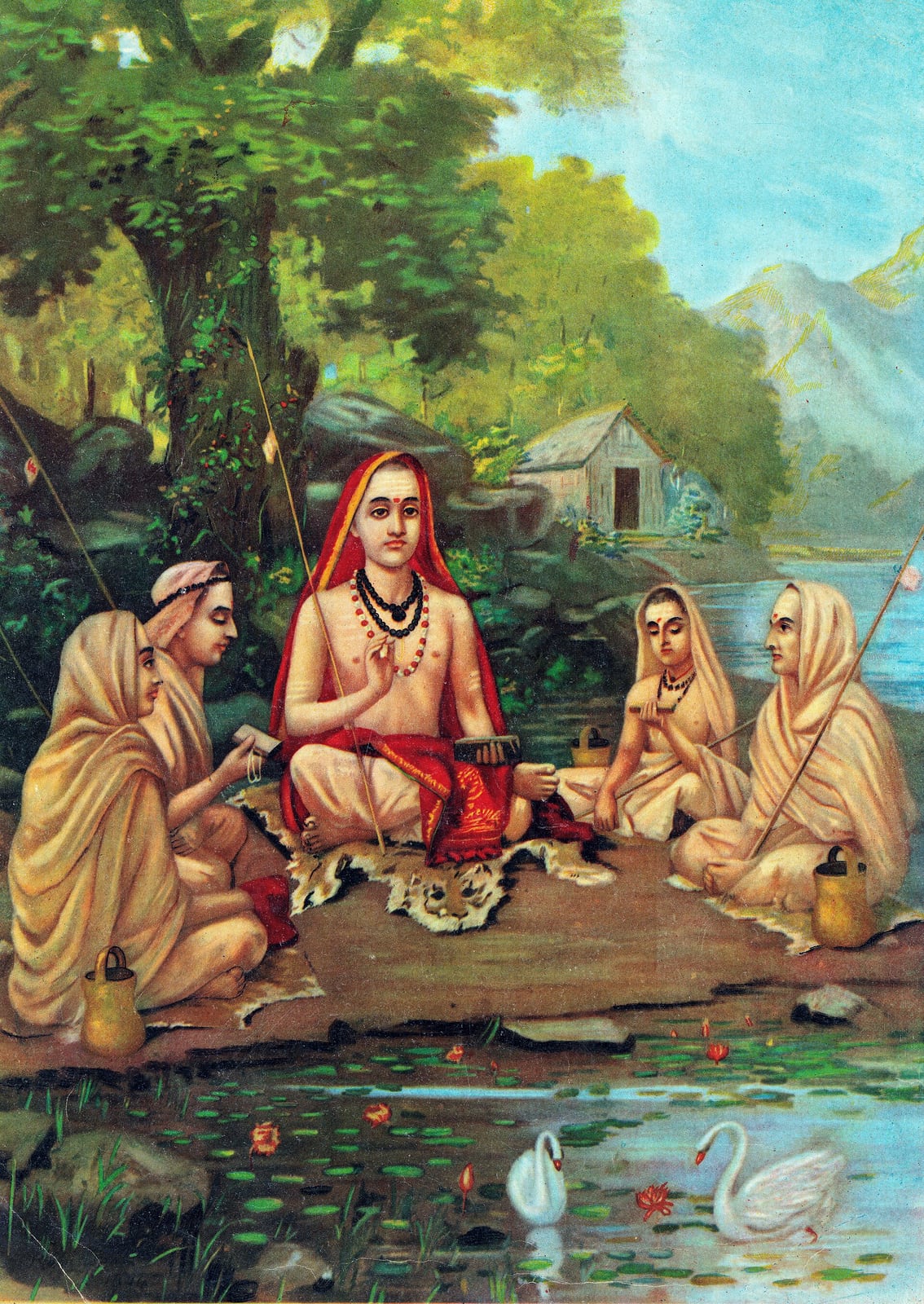
Adi Shankara
Ils concordent sur: Qu'est-ce que l'Absolu ? Dieu existe-t-il ? · Qui suis-je ? Existe-t-il un vrai soi ? · Pourquoi souffrons-nous ?
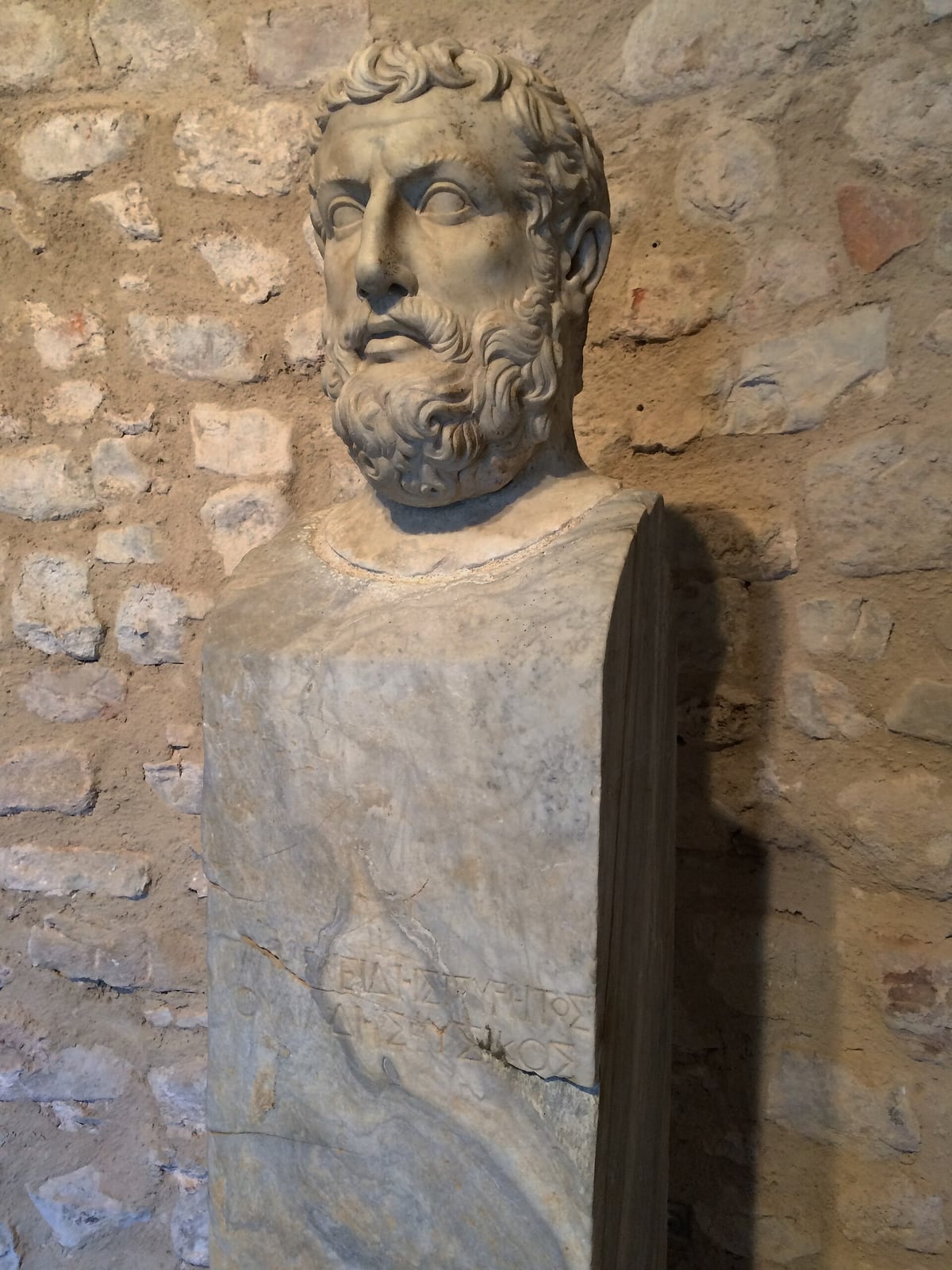
Parmenides
Ils concordent sur: Qu'est-ce que l'Absolu ? Dieu existe-t-il ? · Comment atteint-on la libération ou le salut ? · Le monde est-il réel ?
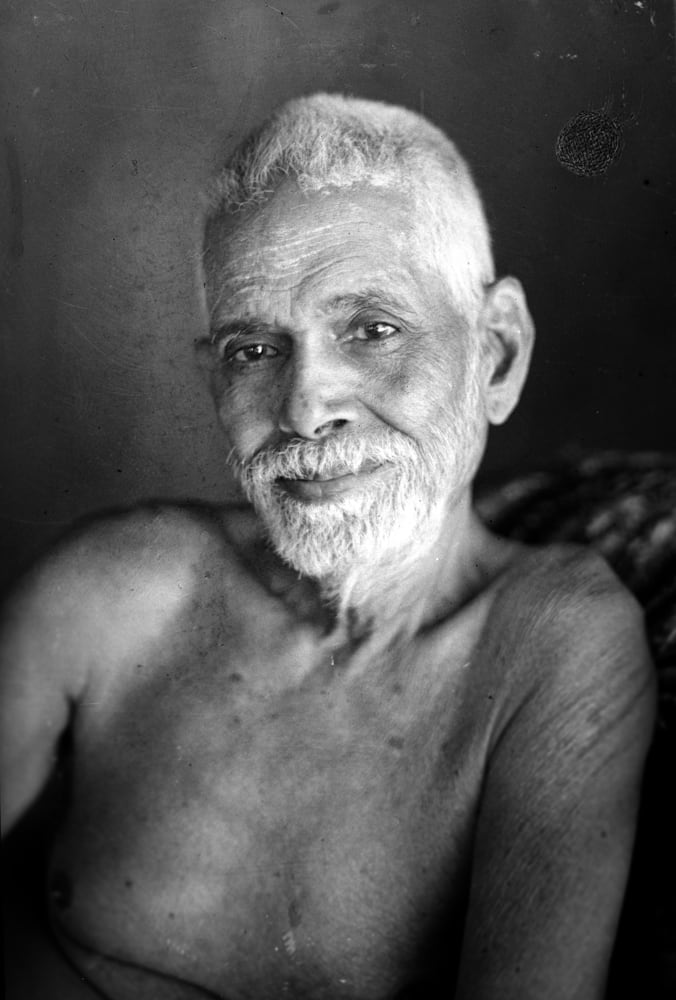
Ramana Maharshi
Ils concordent sur: Qu'est-ce que l'Absolu ? Dieu existe-t-il ? · Le monde est-il réel ? · Qui suis-je ? Existe-t-il un vrai soi ?
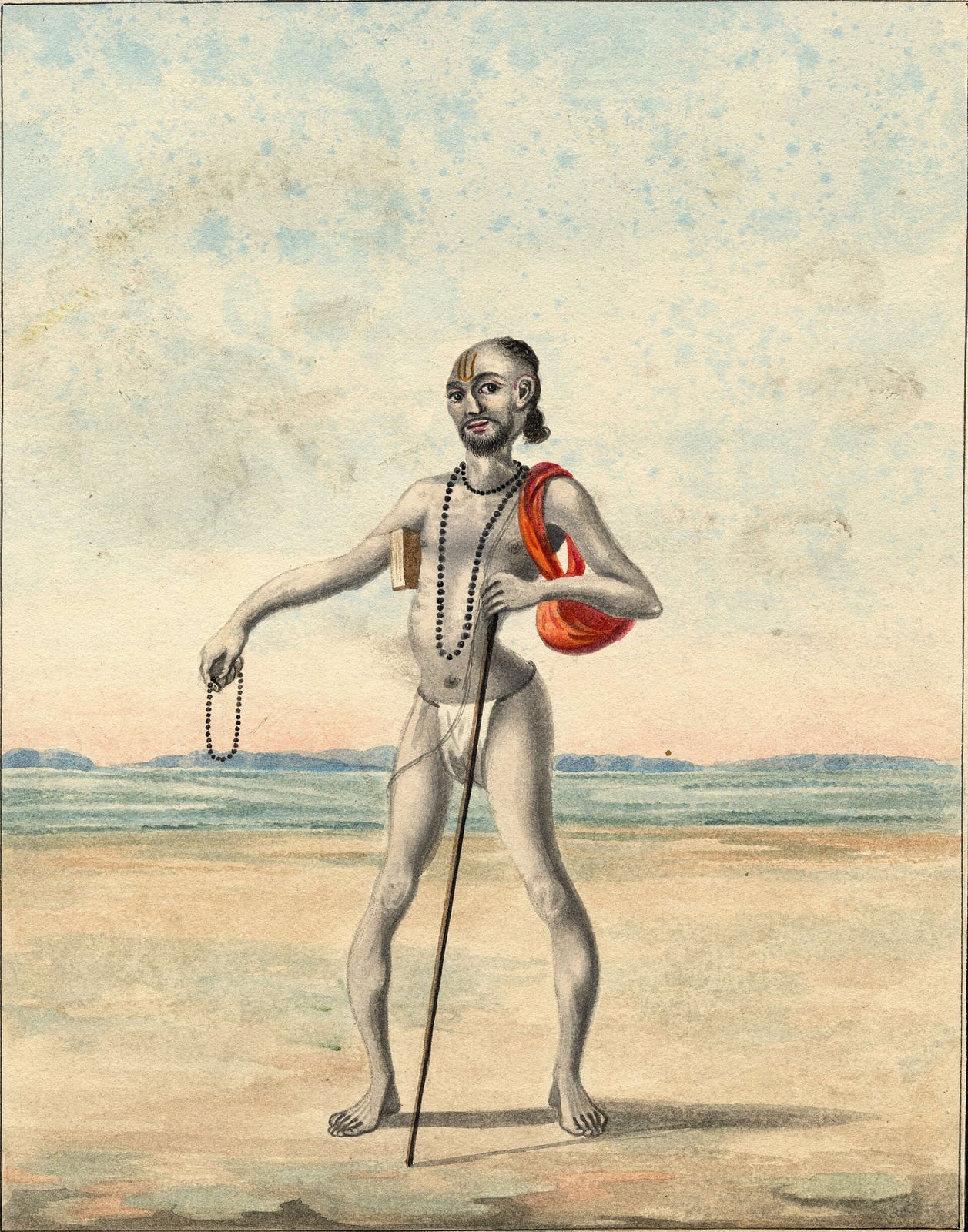
Ashtavakra
Ils concordent sur: Qu'est-ce que l'Absolu ? Dieu existe-t-il ? · Qui suis-je ? Existe-t-il un vrai soi ? · Pourquoi souffrons-nous ?
Pense autrement que

Francis of Assisi
Ils s'opposent sur: Qui suis-je ? Existe-t-il un vrai soi ? · Le monde est-il réel ?
Fyodor Dostoevsky
Ils s'opposent sur: Qui suis-je ? Existe-t-il un vrai soi ? · Le monde est-il réel ?
Guru Nanak
Ils s'opposent sur: Qui suis-je ? Existe-t-il un vrai soi ? · Le monde est-il réel ?
Ignatius of Loyola
Ils s'opposent sur: Qui suis-je ? Existe-t-il un vrai soi ? · Le monde est-il réel ?
Anecdotes et récits
Anecdotes et récits
Documentéss. VI–VII
The whirling firebrand
Origine du récit: Māṇḍūkya Kārikā 4.47–52. It is classified as "documented" because it is an image from the text itself, not an event of his life.
Source: King, Richard. Early Advaita Vedānta and Buddhism: The Mahāyāna Context of the Gauḍapādīya-kārikā. Albany: State University of New York Press, 1995.
Contestéss. VII–VIII
The teacher's teacher
Origine du récit: Closing verses of the Māṇḍūkya-kārikā-bhāṣya ascribed to Śaṅkara; Potter's interpretation (1981). Comans (2000) argues for the Kārikā's direct influence on Śaṅkara from the number of quotations.
Source: Potter, Karl H. (ed.). Encyclopedia of Indian Philosophies, vol. III: Advaita Vedānta up to Śaṃkara and His Pupils. Princeton: Princeton University Press / Delhi: Motilal Banarsidass, 1981 (sección sobre Gauḍapāda).
Récit hagiographiquerelato de las hagiografías de Śaṅkara (ss. XIV–XVII)
The meeting at Badarī
Origine du récit: A tradition recorded in the Śaṅkaradigvijayas; the exact canto has not been located (see "pending"). Swami Nikhilananda, in the introduction to his translation, summarizes the tradition of his retreat at Badarikāśrama.
Documentéss. VI–VIII
Verses in a Buddhist book
Origine du récit: Potter (1981), Nakamura and King (1995). The exact extent of the overlap with Bhāvaviveka (literal quotation or common source) is debated.
Source: Potter, Karl H. (ed.). Encyclopedia of Indian Philosophies, vol. III: Advaita Vedānta up to Śaṃkara and His Pupils. Princeton: Princeton University Press / Delhi: Motilal Banarsidass, 1981 (sección sobre Gauḍapāda).
Enseignements
Enseignements
Les notions qui structurent sa pensée, expliquées dans leur contexte.
Ajātivāda (the doctrine of non-origination)ajativada
Māṇḍūkya Kārikā 2.32, 3.15, 3.48, 4.3–4.23.
Source: Wood, Thomas E. The Māṇḍūkya Upaniṣad and the Āgama Śāstra: An Investigation into the Meaning of the Vedānta. Honolulu: University of Hawaii Press, 1990 (Monographs of the Society for Asian and Comparative Philosophy, 8).
Turīya (the fourth)turiya
Māṇḍūkya Upaniṣad 7; Kārikā 1.10–1.29.
Asparśa-yoga (the yoga of no contact)asparsa-yoga
Māṇḍūkya Kārikā 3.31–3.46.
Source: Bhattacharya, Vidhushekhara (ed. y trad.). The Āgamaśāstra of Gauḍapāda. Calcuta: University of Calcutta, 1943. Reimpr. Delhi: Motilal Banarsidass, 1989, con prólogo de Christian Lindtner.
Ghaṭākāśa (the space in the jar)ghatakasa
Māṇḍūkya Kārikā 3.3–3.9.
Alāta (the firebrand and the vibration of consciousness)alata-cakra
Māṇḍūkya Kārikā 4.45–4.52; Bhattacharya 1943; King 1995.
Source: King, Richard. Early Advaita Vedānta and Buddhism: The Mahāyāna Context of the Gauḍapādīya-kārikā. Albany: State University of New York Press, 1995.
Vidéos
Vidéos
Enregistrements, entretiens et documentaires. Les vidéos sont lues depuis YouTube ; elles ne sont pas hébergées ici.
The Essence of All Vedanta (Based on Mandukya Karika - Part One) - Swami Sarvapriyananda
Conférence· EN· 2021· 74 min
Vedanta Video
The Ultimate Truth (Based on Mandukya Karika - Part Two) - Swami Sarvapriyananda
Conférence· EN· 2021· 71 min
Vedanta Video
5. Mandukya Upanishad | Chapter 1 Karika 1-5 | Swami Sarvapriyananda
Conférence· EN· 2020· 97 min
Vedanta Society of New York - ArchivesChaîne officielle
16. Mandukya Upanishad | Chapter 1 Karika 24-29 | Swami Sarvapriyananda
Conférence· EN· 2020· 116 min
Vedanta Society of New York - ArchivesChaîne officielle
24. Mandukya Upanishad | Chapter 2 Karika 16-18 | Swami Sarvapriyananda
Conférence· EN· 2020· 93 min
Vedanta Society of New York - ArchivesChaîne officielle
Swami Sarvapriyananda | Mandukya Upanishad, 1 of 6 | Sivananda Ashram
Conférence· EN· 2020· 56 min
Vivekananda Samiti, IIT Kanpur
"Turiya - Based on Mandukya Upanishad" - 1 - Swami Sarvapriyananda
Conférence· EN· 2026· 123 min
Ramakrishna Vedanta Ashrama PittsburghChaîne officielle
Gaudapada - Shankaracharya's Guru's Guru | Swami Samarpanananda
Conférence· EN· 2021· 10 min
Amrit Setu
The doctrine Alatashanti in Gaudapadacarya's Mandukya Karika by Swamini Brahmaprakasananda
Conférence· EN· 2022· 83 min
Advaita Academy
Māṇḍūkya Upaniṣad and Kārikā (Āgama Prakaraṇa)
Conférence· EN· 2024· 16 min
Svatantra Institute
Mandukya-Karikas | Swami Paramarthananda
Conférence· EN· 2020· 48 min
Swami Paramarthananda - Topic
The Shortest Path to the Self | Mandukya Upanishad & Gaudapada Karika – Introduction [#1]
Conférence· EN· 2026· 18 min
Yes Vedanta - Andre Vas
Mandukya Upanishad pravachan मांडूक्योपनिषद आगम प्रकरण। by Akhandananda Saraswati ji maharaj
Conférence· HI· 2023· 42 min
Divya Aadhyatmik Gyan
4 - MANDUKYA - CAMINO A LA REALIZACIÓN
Analyse· ES· 2022· 13 min
Vedanta en Español
Galerie
Galerie
Images dont la licence a été vérifiée. Chacune conserve son auteur et son attribution.
Manuscrits
Manuscrits
Témoins manuscrits et textes anciens, avec leur dépositaire et leurs conditions de consultation.
SA · Devanagari · c. ss. VI–VII
गौडपादकारिका
- Témoin conservé
- Manuscrito en papel sin fecha publicada
- Numérisation
- commons.wikimedia.org/wiki/File:Gaudapada_Manduk…
Relations
Relations
Influences, filiations et affinités. On distingue la relation documentée de la similitude identifiée par analyse.
Maître de
Govinda Bhagavatpāda
According to the Advaita genealogy, Gauḍapāda was the teacher of Govinda, Śaṅkara's teacher. Potter and Comans warn that this may be a relation of lineage rather than a direct one.
Similitude identifiée par analyse
A influencé
Śaṅkara quotes the Kārikā in his Brahmasūtra commentary (e.g. 1.16 at 2.1.9) as the work of "the teachers who know the tradition of Vedānta"; the commentary on the Kārikā ascribed to him calls him "supreme teacher".
Relation documentée
A reçu l'influence de
Bhattacharya, Murti and King show the Kārikā's debt, especially in the fourth chapter, to Madhyamaka dialectic (non-origination, conventional and ultimate truth).
Relation documentée
A reçu l'influence de
The Kārikā (3.26) quotes the Bṛhadāraṇyaka's "neti neti" and relies on its analysis of the states of consciousness.
Relation documentée
A reçu l'influence de
The Kārikā (3.15) reinterprets the clay and iron examples of Chāndogya 6.1 as teaching devices for introducing non-duality.
Relation documentée
A reçu l'influence de
The traditional Advaita genealogy (Nārāyaṇa, Brahmā, Vasiṣṭha, Śakti, Parāśara, Vyāsa, Śuka, Gauḍapāda, Govinda, Śaṅkara) makes him a disciple of Śuka, Vyāsa's son. It is a devotional, not historical, lineage.
Similitude identifiée par analyse
A reçu l'influence de
Vasiṣṭha appears in the same traditional Advaita genealogy that ends with Gauḍapāda and Śaṅkara.
Similitude identifiée par analyse
En désaccord avec
The fourth chapter of the Kārikā (4.11–4.13) refutes the Sāṃkhya theory of causation, according to which the cause is transformed into the effect. The commentary on the Sāṃkhya Kārikā circulating under Gauḍapāda's name is probably by a namesake.
Relation documentée
Idées proches de
The Avadhūta Gītā and the Avadhūta Upaniṣad, linked to Dattātreya, share the language of non-origination; verse 2.32 of the Kārikā reappears in texts of this milieu.
Similitude identifiée par analyse
Idées proches de
The Aṣṭāvakra Gītā expresses a radical non-duality, without bondage or liberation, close to that of the Kārikā.
Similitude identifiée par analyse
Idées proches de
Ramana often presented non-origination (ajātivāda) as the ultimate truth, in terms very close to Gauḍapāda's.
Similitude identifiée par analyse
Idées proches de
His insistence that one has never been born recalls the doctrine of non-origination.
Similitude identifiée par analyse
Sources
Sources
Bibliographie et catalogues consultés pour cette fiche.
- Wikidata, «Gaudapada», QID Q1771062.
- Bhattacharya, Vidhushekhara (ed. y trad.). The Āgamaśāstra of Gauḍapāda. Calcuta: University of Calcutta, 1943. Reimpr. Delhi: Motilal Banarsidass, 1989, con prólogo de Christian Lindtner.
- King, Richard. Early Advaita Vedānta and Buddhism: The Mahāyāna Context of the Gauḍapādīya-kārikā. Albany: State University of New York Press, 1995.
- Karmarkar, Raghunath Damodar (ed. y trad.). Gauḍapāda-Kārikā. Poona: Bhandarkar Oriental Research Institute, 1953 (Government Oriental Series, B 9).
- Nakamura, Hajime. A History of Early Vedānta Philosophy, Part Two. Trad. de Trevor Leggett et al. Delhi: Motilal Banarsidass, 2004 (original japonés, 1950–1956).
- Potter, Karl H. (ed.). Encyclopedia of Indian Philosophies, vol. III: Advaita Vedānta up to Śaṃkara and His Pupils. Princeton: Princeton University Press / Delhi: Motilal Banarsidass, 1981 (sección sobre Gauḍapāda).
- Wood, Thomas E. The Māṇḍūkya Upaniṣad and the Āgama Śāstra: An Investigation into the Meaning of the Vedānta. Honolulu: University of Hawaii Press, 1990 (Monographs of the Society for Asian and Comparative Philosophy, 8).
- Comans, Michael. The Method of Early Advaita Vedānta: A Study of Gauḍapāda, Śaṅkara, Sureśvara and Padmapāda. Delhi: Motilal Banarsidass, 2000.
- Dvivedi, Manilal Nabhubhai (trad.). The Māṇḍūkyopanishad with Gauḍapāda's Kārikās and the Bhāshya of Śaṅkara. Bombay: Tookaram Tatya (Bombay Theosophical Publication Fund), 1894.
- Colebrooke, Henry Thomas, y Horace Hayman Wilson (trads.). The Sánkhya Káriká, or Memorial Verses on the Sánkhya Philosophy, by Íswara Krishńa; also the Bháshya or Commentary of Gaurapáda. Oxford: Oriental Translation Fund, 1837 (reimpr. Bombay, 1887).
- Larson, Gerald James, y Ram Shankar Bhattacharya (eds.). Encyclopedia of Indian Philosophies, vol. IV: Sāṃkhya. A Dualist Tradition in Indian Philosophy. Princeton: Princeton University Press / Delhi: Motilal Banarsidass, 1987 (sobre el Gauḍapāda-bhāṣya).
- Murti, T. R. V. The Central Philosophy of Buddhism: A Study of the Mādhyamika System. Londres: George Allen and Unwin, 1955.
- Wikipedia (en inglés), «Gaudapada», consultada el 26 de octubre de 2026 (obras atribuidas, recepción en Dvaita y Viśiṣṭādvaita, Kavale maṭha, opiniones de Mayeda y Nikhilananda).
- Wikisource en sánscrito, «गौडपादकारिका», texto por prakaraṇa (प्रथमप्रकरणम् – चतुर्थप्रकरणम्), con numeración de estrofas.
- Bouy, Christian (ed. y trad.). Gauḍapāda, L'Āgamaśāstra: un traité vedāntique en quatre chapitres. París: Collège de France, Institut de civilisation indienne, 2000.
- Dalal, Neil. «Śaṅkara». En Edward N. Zalta (ed.), The Stanford Encyclopedia of Philosophy, 2021.
- Wikimedia Commons, ficheros y metadatos de licencia consultados mediante la API (imageinfo/extmetadata).
- Wikidata, «Shri Gaudapadacharya Math» (Kavale maṭha, Goa), QID Q13479755.
- Jones, Richard H. Gauḍapāda: Advaita Vedānta's First Philosopher. Nueva York: Jackson Square Books, 2014.
- Raphael (trad. y coment.). Māṇḍūkyakārikā: The Metaphysical Path of Vedānta. Nueva York: Aurea Vidyā Foundation, 2002.
- Ayant droit
- El texto sánscrito es de dominio público. Las traducciones modernas tienen derechos propios: Advaita Ashrama (Nikhilananda), Motilal Banarsidass (Bhattacharya), University of Hawaii Press (Wood), Aurea Vidyā (Raphael), Central Chinmaya Mission Trust, Biblioteca Nueva, Collège de France (Bouy), E. Richter. Las de Dvivedi (1894) y de Colebrooke y Wilson (1837) son de dominio público.
En attente de confirmation
Ce que cette fiche n'a pas encore pu établir. Nous préférons le dire plutôt que de combler.
- Śaṅkaradigvijaya: localizar el canto exacto en que se narra el encuentro de Śaṅkara con Gauḍapāda (edición de Mādhava/Vidyāraṇya) y otras hagiografías que lo recogen.
- Sureśvara: comprobar en la Naiṣkarmyasiddhi (4.41–4.44) las citas de la Kārikā y la mención de «los gauḍa».
- Bhāvaviveka: precisar qué estrofas de la Kārikā coinciden con el capítulo 8 del Madhyamakahṛdaya y si se trata de cita literal o de fuente común (Lindtner, Nakamura, King).
- Edición española de Biblioteca Nueva (ISBN 9788497423670): identificar traductor y comentarista.
- Karmarkar (1953): confirmar la fecha de muerte de R. D. Karmarkar para resolver los derechos de la transcripción de Wikisource.
- Ediciones: buscar ISBN de traducciones al italiano (edición original de Raphael, Āśram Vidyā), ruso e hindi; buscar una traducción española con ISBN además de la de Biblioteca Nueva.
- Relación con Ramana Maharshi: localizar en los Talks o en otras obras documentadas la cita exacta en la que Ramana habla del ajātivāda o de la estrofa 2.32.
- Relaciones: el slug govinda-bhagavatpada no existe todavía en el Atlas (lo usa también adi-shankara).
- Vídeos: no se ha encontrado una clase universitaria ni un documental de televisión pública sobre Gauḍapāda; tampoco una conferencia monográfica en español de una institución solvente.
Recherche effectuée le 2026-10-26