Индуизм · Йога
Sri Yukteswar
শ্রীযুক্তেশ্বর গিরি · श्रीयुक्तेश्वर गिरि
1855 – 1936Исторически документированная личность
Шри Юктешвар Гири (1855–1936), урождённый Прия Натх Карар, родился в Серампуре; ученик Лахири Махасаи, учитель крия-йоги и гуру Парамахансы Йогананды. Написал «Кайвалья даршанам» («Святая наука», 1894) — книгу, которая ищет единство индийской санкхьи и Нового Завета и предлагает хронологию юг с циклом в 24 000 лет. Астролог, просветитель и основатель обителей в Серампуре и Пури, он известен нам прежде всего по «Автобиографии йога».
- трудов
- 8трудов
- изданий
- 18изданий
- цитат
- 10цитат
- видео
- 12видео
- изображений
- 7изображений
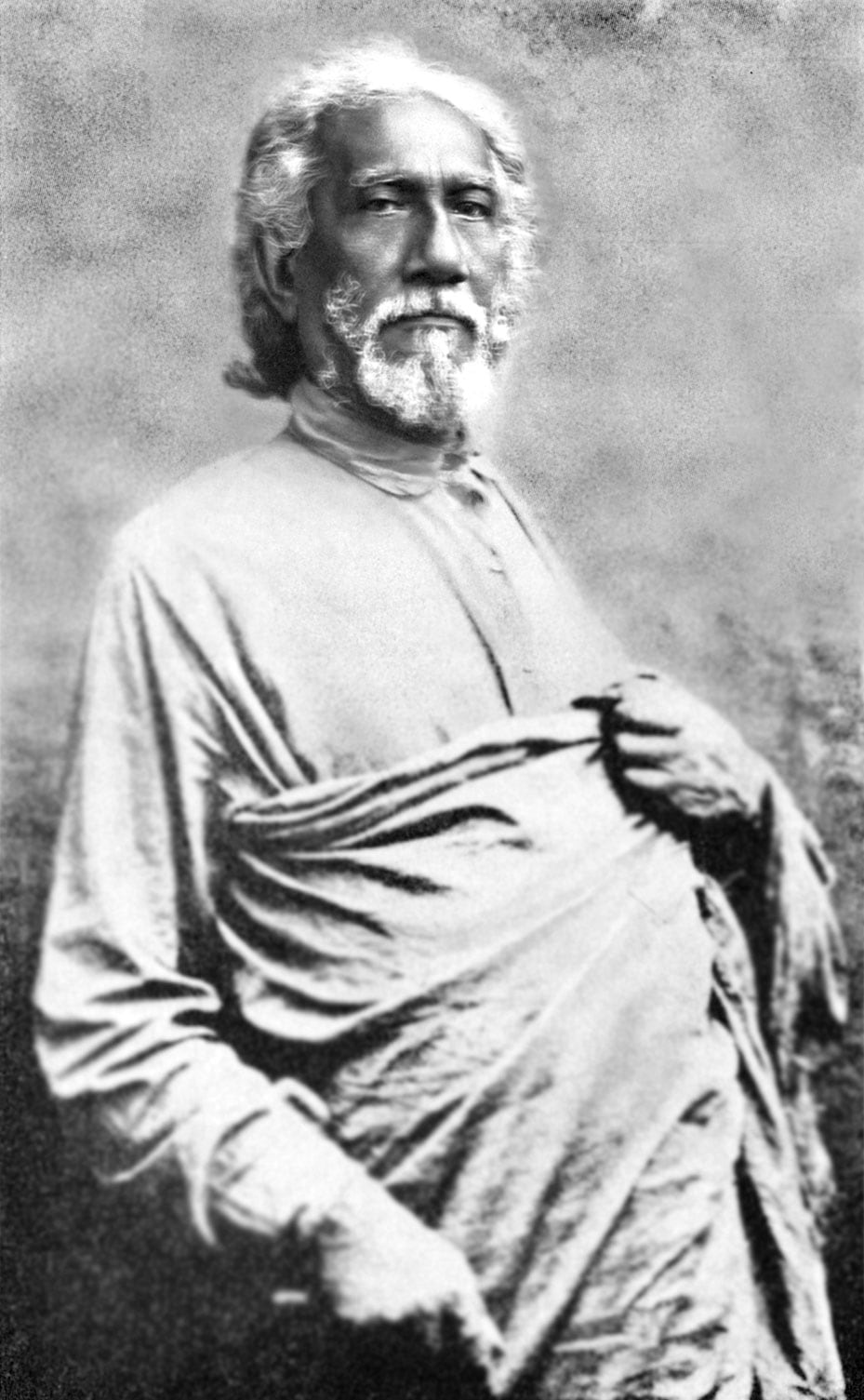
Sri Yukteswar, retrato de la primera edición de la Autobiografía · Public domain
Своими словами
«The purpose of this book is to show as clearly as possible that there is an essential unity in all religions; that there is no difference in the truths inculcated by the various faiths; that there is but one method by which the world, both external and internal, has evolved; and that there is but one Goal admitted by all scriptures.»The Holy Science, ed. SRF 1972 (texto de 1894), Introducción

Для начала — одна книга
Kaivalya Darsanam: The Holy ScienceГлавная мысль
The 24,000-year cycle of the yugas: In the introduction to *The Holy Science*, Sri Yukteswar holds that the Sun, with its planets, revolves around a companion star in a period of about 24,000 years, and that nearness to or distance from a 'grand centre' of divine magnetism determines the development of human intelligence.
В контексте
Биография
4 мин чтения
Перевод с испанского оригинала, выполненный с помощью ИИ; ожидает проверки носителем языка.
Сын землевладельцев из Серампура
Прия Натх Карар родился 10 мая 1855 года в Серампуре, бывшей датской колонии на берегу Хугли, примерно в двадцати километрах от Калькутты. Его родители, Кшетранатх Карар и Кадамбини, происходили из семьи сельских землевладельцев; отец умер рано, и юноше пришлось взять на себя управление семейными землями. Он учился в городском христианском миссионерском колледже, где сжился с Библией так, что уже никогда с ней не расставался, и почти два года изучал медицину в Калькутте, не получив диплома. Он женился, у него родилась дочь, и через несколько лет он овдовел. Это наименее документированная часть его жизни: всё, что мы о ней знаем, восходит к бенгальской биографии, написанной его учеником Свами Сатьянандой Гири, и к страницам, которые посвятил ему Парамаханса Йогананда, — то есть к текстам, вышедшим из-под пера почитателей.
Лахири Махасая и крия-йога
В 1884 году в Бенаресе он познакомился с Шьямой Чараном Лахири, которого последователи называли Лахири Махасаей, — бухгалтером британской администрации, обучавшим домохозяев технике медитации, основанной на управлении дыханием, — крия-йоге. Прия Натх получил от него посвящение и в последующие годы часто его навещал. Предание линии сохранило, что учитель ласково звал его «Прия» — «любимый». От Лахири он унаследовал две черты, определившие его учение: убеждённость в том, что медитативную практику можно вести, не уходя от мира, и прочтение священных писаний как карт внутренних состояний.
Аллахабад, 1894: «Святая наука»
В январе 1894 года, во время Кумбха-мелы в Аллахабаде, по его собственному свидетельству, некий незнакомец позвал его на берег Ганга и привёл к Бабаджи, учителю Лахири Махасаи, — фигуре, о которой не существует независимых исторических свидетельств. В этой беседе, опять-таки по рассказу автора, Бабаджи попросил его написать небольшую книгу, которая показала бы согласие между христианскими и индуистскими писаниями, и даровал ему титул свами. Книга «Кайвалья даршанам» («Изложение высшей истины») на первой же странице объявляет себя сочинением «Прия Натха Свами», написанным по просьбе Бабаджи в 194 году Двапара-юги. Главы впервые появились в его журнале «Садхусамбад»; в 1920 году его ученик Атул Чандра Чоудхури издал их отдельной книгой, а в 1949 году Self-Realization Fellowship опубликовало переработанную версию под названием The Holy Science («Святая наука»).
Книга состоит из четырёх глав — «Евангелие», «Цель», «Метод» и «Откровение», — выстроенных из санскритских афоризмов, сочинённых самим автором и прокомментированных по-английски, с обильными цитатами из Нового Завета и прежде всего из Апокалипсиса. Её остов — космология санкхьи; её тезис — у всех религий одна цель. Во введении содержится самая знаменитая и самая спорная часть: хронология юг, которая заменяет сотни тысяч лет пуранической традиции циклом в 24 000 лет, связанным с предполагаемым обращением Солнца вокруг звезды-спутника, и помещает человечество не в Кали-югу, а в восходящую Двапара-югу, начавшуюся в 1699 году. Академическая астрономия гипотезу двойной звезды не подтверждает; хронология же получила долгую жизнь в духовной литературе.
Две обители и суровая дисциплина
Приняв формальное посвящение в орден свами от настоятеля в Бодх-Гае, в ветви Гири, он превратил семейный дом в Серампуре в обитель, а в 1903 году основал вторую — в Пури, на берегу Бенгальского залива: Карар-ашрам, открытие которого, по преданию обители, приурочил к весеннему равноденствию. Год он проводил попеременно то в одной, то в другой. Он основал общество Садху Сабха, чтобы объединить подвижников разных течений; составил школьные программы по физике, физиологии, географии и астрономии, учебник английского языка и хинди для бенгальцев и начальный трактат по астрологии, интересовался образованием женщин. Он занимался джйотишей — индийской астрологией — и предписывал ученикам браслеты из металлов и драгоценных камней, убеждённый, что наука о светилах может служить кратким путём, пока душа не обрела свободу.
Постоянных учеников у него было немного. Йогананда объяснял это методом, который «нельзя назвать иначе как суровым»: он отчитывал при всех, требовал порядка в быту и не терпел самодовольства. Антрополог и тибетолог У. Й. Эванс-Венц, навестивший его в Серампуре, вспоминал о нём как о человеке высоком, статном, с мягким голосом и безмятежным присутствием.
Учитель Йогананды
В 1910 году на одной из улиц Бенареса он встретил Мукунду Лала Гхоша, семнадцатилетнего юношу, бежавшего из дома в поисках учителя. Целое десятилетие он воспитывал его в Серампуре и Пури; в июле 1915 года посвятил его в свами под именем Йогананда, а в 1920 году побудил принять приглашение на религиозный конгресс в Бостоне. Когда в 1935 году Йогананда вернулся в Индию, Шри Юктешвар даровал ему титул парамахансы и назначил своим преемником во главе Садху Сабхи и своих обителей. Другие его ученики — Свами Сатьянанда Гири, Шайлендра Беджой Дасгупта, Свами Харихарананда — впоследствии основали параллельные линии крия-йоги, которые расставляют в его образе иные акценты, чем Self-Realization Fellowship.
Смерть в Пури и рождение предания
Он умер в Карар-ашраме в Пури в семь часов вечера 9 марта 1936 года после недолгой лихорадки — по словам тех, кто нашёл его тело, сидя в позе лотоса. Йогананда, находившийся в Калькутте, прибыл на следующий день и руководил погребением в саду обители, согласно обычаю свами, которых не кремируют. Калькуттская газета Amrita Bazar Patrika простилась с ним как с одним из великих толкователей «Бхагавадгиты». В «Автобиографии йога» (1946) Йогананда добавил главу, где рассказывает, как 19 июня 1936 года увидел его во плоти в бомбейской гостинице и получил от него пространное описание астрального мира. Это свидетельство веры ученика, а не проверяемый факт, и читать его следует именно так.
Наследие
Образ Шри Юктешвара, который распространился по миру, во многом создан Йоганандой: джнянаватар, «воплощение мудрости», требовательный и любящий, астролог и читатель Библии. Его лицо есть среди лиц на обложке альбома Sgt. Pepper's Lonely Hearts Club Band (1967), а «Святая наука» по-прежнему издаётся на дюжине языков. Его бенгальский комментарий к «Гите», переведённый на английский в 2004 году Yoga Niketan, и биография, написанная Сатьянандой, показывают автора более технического и менее легендарного, которого стоит читать вместе с портретом из «Автобиографии».
Источники: Yogananda, Paramhansa. Autobiography of a Yogi. Nueva York: The Philosophical Library, 1946 (1.ª ed.), caps. 10, 12, 14-16, 36, 42 y 43; prefacio de W. Y. Evans-Wentz. Texto en Wikisource y Project Gutenberg #7452. · Yukteswar Giri, Swami Sri. The Holy Science (Kaivalya Darsanam). Los Ángeles: Self-Realization Fellowship, 7.ª ed. 1972, 3.ª reimpr. 1977 (texto de 1894; copyright de la revisión, 1949). Consultado en Internet Archive. · Satyananda Giri, Swami. «Swami Sri Yuktesvar Giri Maharaj: A Biography», en A Collection of Biographies of 4 Kriya Yoga Gurus. Trad. Yoga Niketan. Lincoln (Nebraska): iUniverse, 2006. ISBN 9780595386758. · Selbie, Joseph, y David Steinmetz. The Yugas: Keys to Understanding Our Hidden Past, Emerging Present and Future Enlightenment. Nevada City: Crystal Clarity Publishers, 2010. ISBN 9781565892538. · Dasgupta, Sailendra Bejoy. Kriya Yoga and Swami Sriyukteshvar. Calcuta: S. B. Dasgupta, 1979.
Хронология
Жизнь год за годом
Каждая точка — документированное событие. Нажмите, чтобы прочитать о нём, с источником и степенью достоверности.
10 мая 1855 г.0 летSerampore
Birth of Priya Nath Karar
Born into a family of Bengali landowners, son of Kshetranath Karar and Kadambini.
ДокументированоYogoda Satsanga Society of India, «Swami Sri Yukteswar».
После смерти
- декабрь 1946 г.*Autobiography of a Yogi* spreads his figure
- 1949Revised Self-Realization Fellowship edition
- июнь 1967 г.On the cover of *Sgt. Pepper*
10 мая 1855 г. · 0 лет
Birth of Priya Nath Karar
Born into a family of Bengali landowners, son of Kshetranath Karar and Kadambini.
Документировано
ок. 1875
Studies at the missionary college and the medical college
Studies at the Christian missionary college of Serampore, where he becomes interested in the Bible, and spends about two years at medical college in Calcutta. Approximate dates.
Вероятно
ок. 1880
Marriage, a daughter and widowhood
After his father's death he marries at his mother's wish; he has a daughter and is widowed a few years later.
Вероятно
1884 · 29 лет
Initiation into kriya yoga by Lahiri Mahasaya
Meets Lahiri Mahasaya, who initiates him into kriya yoga; he will visit him often in the following years.
Документировано
январь 1894 г. · 38 лет
Meeting with Babaji at the Kumbha Mela
By his own account in the introduction to *Kaivalya Darsanam*, Babaji asks him for a book on the harmony of Christian and Hindu scriptures and gives him the title of swami. Babaji has no independent historical documentation.
Предание
1894 · 39 лет
Writes *Kaivalya Darsanam*
Writes the work in a short time, dated to the 194th year of the Dvapara Yuga; the chapters first appear in his journal *Sadhusambad*.
Документировано
22 марта 1903 г. · 47 лет
Founding of the Karar Ashram
Founds his seaside hermitage in Puri; his lineage's tradition dates the opening to the spring equinox, chosen for astrological reasons.
Предание
1910 · 55 лет
Meeting with Mukunda Lal Ghosh
Meets the future Paramahansa Yogananda, who will spend ten years training in his hermitages.
Документировано
июль 1915 г. · 60 лет
Ordains Yogananda a swami
Gives Mukunda the vows of the Swami order, Giri branch, with the name Yogananda.
Документировано
1920 · 65 лет
First book edition of *Kaivalya Darsanam*
His disciple Atul Chandra Chowdhury, secretary of the Sadhu Sabha, privately prints the book.
Документировано
1935 · 80 лет
Confers on Yogananda the title of paramahansa
During Yogananda's visit to India he grants him the monastic title of paramahansa and charges him with continuing his work.
Документировано
9 марта 1936 г. · 80 лет
Death at the Karar Ashram
Dies at about seven in the evening after a brief fever; he is buried on 10 March in the hermitage garden. The funeral bhandara is held on 21 March.
Документировано
декабрь 1946 г.
*Autobiography of a Yogi* spreads his figure
Yogananda devotes several chapters of his autobiography to him, including the account of his appearance after death, which builds his international image.
Документировано
1949
Revised Self-Realization Fellowship edition
SRF publishes *The Holy Science* with a foreword by Yogananda and changes to terminology and grammar; in 1963 an English translation of the Sanskrit sutras is added.
Документировано
июнь 1967 г.
On the cover of *Sgt. Pepper*
His portrait appears among the figures on the cover of the Beatles' album.
Документировано
Труды
Главные труды
Труды, без которых не понять это наследие.
Письменный труд · 1894
Kaivalya Darsanam: The Holy Science
Kaivalya Darsanam (The Holy Science)
A treatise in four chapters—the Gospel, the Goal, the Procedure and the Revelation—that sets out Samkhya cosmology and yogic practice through commented Sanskrit aphorisms and places them alongside passages from the New Testament and Revelation. It argues that all religions share a single goal and describes five states of the heart through which the seeker advances, guided by the 'heart's natural love'. Its introduction proposes a 24,000-year cycle of yugas, tied to a hypothetical companion star of the Sun, and places humanity in an ascending Dvapara: the most famous and most disputed part of the book.
15 изданий

Письменный труд
Spiritual commentary on the Bhagavad Gita
Srimad Bhagavad Gita (comentario espiritual, bengalí)
A reading of the *Bhagavad Gita* as an allegory of kriya yoga practice, in the line begun by Lahiri Mahasaya: the poem's characters and battles are interpreted as forces and states of the practitioner's consciousness. It is the text that best shows the technical Sri Yukteswar, the meditation teacher, as against the literary character of *Autobiography of a Yogi*. Yogananda said his master encouraged him to give his own interpretation of the *Gita*, the distant origin of *God Talks with Arjuna*.
1 издание
Все труды (8)
Sri Yukteswar
First Book (English and Hindi primer)
The Conscious LibraryFirst Book (English and Hindi primer)
Sri Yukteswar
Elementary treatise on astrology
The Conscious LibraryElementary treatise on astrology
Sri Yukteswar
School science syllabi
The Conscious LibrarySchool science syllabi
Sri Yukteswar
Sadhusambad (journal)
The Conscious LibrarySadhusambad (journal)

Biography of Sri Yukteswar by Swami Satyananda Giri
Sri Yukteswar
Kriya Yoga and Swami Sriyukteshvar (S. B. Dasgupta)
The Conscious LibraryKriya Yoga and Swami Sriyukteshvar (S. B. Dasgupta)
1979
Изречения
Изречения, найденные в конкретном труде. Каждое сопровождается указанием происхождения и степени надёжности.
The purpose of this book is to show as clearly as possible that there is an essential unity in all religions; that there is no difference in the truths inculcated by the various faiths; that there is but one method by which the world, both external and internal, has evolved; and that there is but one Goal admitted by all scriptures.ПровереноThe Holy Science, ed. SRF 1972 (texto de 1894), Introducción
Последние слова
Проверяемых записей о последних словах не существует.
No reliable record of his last words is known. Yogananda, his main biographer, was not present (he was in Calcutta and reached Puri the next day) and says so explicitly in a note to the *Autobiography*. The words 'My task on earth is now finished; you must carry on', addressed to Yogananda when conferring the title of paramahansa in 1935, are sometimes quoted as a farewell, but they precede his death by months.
Источник: Yogananda, Paramhansa. Autobiography of a Yogi. Nueva York: The Philosophical Library, 1946 (1.ª ed.), caps. 10, 12, 14-16, 36, 42 y 43; prefacio de W. Y. Evans-Wentz. Texto en Wikisource y Project Gutenberg #7452.
Спросить
На что отвечают эти труды
Двенадцать великих вопросов человечества и то, что позволяют на них ответить эти тексты, со ссылками. Мы никогда не вкладываем слова в чужие уста.
Что такое Абсолют? Существует ли Бог?
Parambrahma, the one eternal substance, manifests as Father, Son and Om
Безличный АбсолютСказано прямо
In the Kaivalya Darsanam Sri Yukteswar opens with the statement that Parambrahma, Spirit, is the only real substance, eternal, complete and without beginning or end. From it he explains creation with a scheme meant to show the unity of Hinduism and Christianity: God the Father (Sat) is beyond creation; his manifestation as vibration, the Word or Om, is the Holy Ghost; and his conscious reflection in creation is the Son (Tat), the Christ consciousness. The ultimate is therefore not a person who acts but a substance of love and consciousness that expresses itself through vibration and maya. The personal figures of Father and Son are ways of naming those aspects, not beings distinct from the Absolute.
Сравнить этот вопрос с другими учителямиКто я? Существует ли истинное «я»?
Man is a son of God wrapped in five sheaths
Самость есть АбсолютСказано прямо
In the Kaivalya Darsanam Sri Yukteswar describes the human being as a reflection of Spirit, the ‘son of God’, covered by five sheaths (koshas) ranging from the subtlest to the physical. Out of ignorance man identifies with those sheaths and with the body, and forgets his divine nature. Wisdom consists in progressively withdrawing consciousness from these layers until one recognises that the true self is one with the eternal Father, beyond creation. To describe that return he uses both the vocabulary of Samkhya and that of the Gospel: the prodigal son coming home is the soul recovering its unity with Spirit. Kaivalya, oneness, is the name of that goal.
Сравнить этот вопрос с другими учителямиПочему мы страдаем?
Ignorance makes man think himself the body and exiles him from the inner Eden
Незнание того, кто мы естьСказано прямо
In the Kaivalya Darsanam Sri Yukteswar explains that man suffers because, through avidya, ignorance, he identifies with the material body and its desires and forgets that he is a reflection of Spirit. From that identification arise attachment, aversion and fear, which he sets out in the vocabulary of yoga’s afflictions. Yogananda, in his Autobiography, attributes to him a biblical image of the same idea: outward longings drive us from the inner Eden and offer false pleasures that supplant the soul’s happiness, and the lost paradise is regained through meditation. Suffering is thus an exile from one’s own nature, and the way back is the heart’s natural love disciplined by yoga.
Сравнить этот вопрос с другими учителямиЧто происходит после смерти?
The soul passes to subtle worlds and returns according to its karma
Перерождение согласно кармеСледует из учения
Sri Yukteswar taught within the framework of reincarnation: as long as the soul is not freed from desires and karma it is born again, and his astrology presupposes that each birth matches that individual karma. In the Kaivalya Darsanam he describes creation as a series of spheres (lokas) of decreasing density between the physical world and Spirit, through which the soul descends and ascends. The best-known description of his teaching on the afterlife is not his own: in Autobiography of a Yogi Yogananda relates a posthumous appearance of his master in which he describes the astral and causal worlds where souls live between one incarnation and the next.
Сравнить этот вопрос с другими учителямиКак достигается освобождение или спасение?
Kriya yoga, discipline and the heart’s natural love
Через дисциплинированную практикуСказано прямо
Sri Yukteswar, a disciple of Lahiri Mahasaya, transmitted Kriya Yoga as a precise method for withdrawing consciousness from the body and directing it towards Spirit. In the Kaivalya Darsanam he makes the heart’s natural love the main requirement and defines faith (sraddha) as its intensification; from there he sets out the steps of yoga: ethical discipline, breath control, interiorisation and meditation on the vibration of Om. His teaching combines method with moral demand: according to Yogananda he was a stern master who corrected without indulgence. Liberation is a gradual process the disciple travels by his own effort, guided by a true master, until he recognises himself one with the Father.
Сравнить этот вопрос с другими учителямиНужен ли учитель?
The true master, the sadguru, is the disciple’s saviour
НезаменимСказано прямо
In the Kaivalya Darsanam Sri Yukteswar describes the meeting with the sadguru, the true master, as the decisive step: the heart’s natural love leads the seeker into the company of the saints, and from there to the master who initiates him into practice and guides him to the goal. He himself lived that relationship with Lahiri Mahasaya and exercised it with his disciples. Yogananda describes in his Autobiography the strict discipline of the Serampore ashram, where the master corrected each of the disciple’s faults so that he could receive the teaching. For Sri Yukteswar the guru does not replace the disciple’s effort, but without his transmission and guidance practice bears no fruit.
Сравнить этот вопрос с другими учителямиРеален ли мир?
Creation is the vibration of Om in fourteen spheres
Планы бытияСказано прямо
In the Kaivalya Darsanam Sri Yukteswar explains creation as the manifestation of Spirit through the vibration of Om, which gives rise to maya, the illusion of separateness, and to a series of spheres of increasing density. He describes seven worlds (lokas), from the subtlest, close to Spirit, to the material, together with their corresponding regions of darkness, forming a hierarchical creation. To that scheme he adds a cyclical theory of time, that of the yugas, which he adjusts to his own astronomical calculations. The physical world is not false, but it is the densest plane of a stratified reality, and the human being is called to climb back through those planes to their source.
Сравнить этот вопрос с другими учителямиЧто такое любовь?
The heart’s natural love is the gateway to the holy life
Тоска и соединениеСказано прямо
In the Kaivalya Darsanam Sri Yukteswar places love at the start of the path: the heart’s natural love is the main requirement for a holy life, and faith (sraddha) is its intensification. That love is the soul’s attraction to its source, Spirit, and when rightly directed it leads to the company of saints and to the master. Yogananda attributes to him in his Autobiography a clear distinction: ordinary love is selfish, rooted in desires and gratifications, whereas divine love has no condition, no limit and no change. Sri Yukteswar, known for his severity, understood the demanding correction of the disciple as a form of that unconditional love.
Сравнить этот вопрос с другими учителямиСвободны ли мы или всё предопределено?
The stars reflect karma, but spiritual effort overcomes it
Карма и выборСказано прямо
Sri Yukteswar was an astrologer and defended astrology as a science, but not as fatalism. According to Yogananda’s account in Autobiography of a Yogi, he taught that a child is born at the moment when the celestial rays are in mathematical harmony with its individual karma: the horoscope does not cause destiny, it reflects it. And that karma can be changed. The same account attributes to him the exhortation to forget the past, since human conduct is uncertain until anchored in the divine, and all will improve if spiritual effort is made now. He even recommended astrological remedies, but insisted that wisdom and the practice of yoga are the real means of freeing oneself from such influences.
Сравнить этот вопрос с другими учителямиЗачем медитировать или молиться?
Reverse the current inward and regain the inner Eden
Возвращение к источнику «я»Сказано прямо
For Sri Yukteswar meditation is the return of consciousness to its source. In the Kaivalya Darsanam he describes how, through regulation of the breath and interiorisation, the yogi withdraws attention from the senses, perceives the light and sound of Om and climbs back through the sheaths that separate him from Spirit. This is the logic of the Kriya Yoga he received from Lahiri Mahasaya: not a prayer addressed to an external God but a technique for reversing the life current that flows outward. Yogananda attributes to him the image of the lost paradise quickly regained through divine meditation. To meditate is to return home, to where the soul knows itself one with the Father.
Сравнить этот вопрос с другими учителямиМожет ли разум познать предельное?
A holy science that reconciles scriptures and is verified within oneself
Эзотерическое знаниеСказано прямо
Sri Yukteswar wrote the Kaivalya Darsanam, translated as The Holy Science, with a purpose stated in its opening: to show as clearly as possible the essential unity of all religions. To that end he compares passages of the Bible and Hindu texts with reasoned arguments and presents his system as a science. But that science is not merely intellectual: it rests on a technique transmitted from master to disciple, Kriya Yoga, and on a cosmic chronology, that of the yugas, which he regards as recovered knowledge. Yogananda attributes to him the warning not to confuse understanding with a larger vocabulary: wisdom is assimilated not with the eyes but with the atoms.
Сравнить этот вопрос с другими учителямиУйти от мира или преобразить его?
From home to ashram: inner discipline does not require flight
Созерцание в действииСледует из учения
Sri Yukteswar lived most of his life as a householder and property owner in Serampore, and only after being widowed did he take monastic vows in the Giri order. His master, Lahiri Mahasaya, was the model of the yogi who attains realisation without leaving work or family, and Kriya Yoga was transmitted precisely as a practice compatible with life in the world. Sri Yukteswar took an interest in education, astronomy and medicine, wrote science syllabuses for schools and guided his disciples with practical rigour. For him what mattered was not where one lives but inner discipline and the heart’s love directed towards Spirit.
Сравнить этот вопрос с другими учителями
Созвучия и противоречия
Созвучия и противоречия
Рассчитаны вопрос за вопросом на основе позиций. Причина каждого совпадения или расхождения — по нажатию.
Ближе всего к
Helena Blavatsky
Совпадают в вопросах: Свободны ли мы или всё предопределено? · Что такое Абсолют? Существует ли Бог? · Что происходит после смерти?
Sadhguru
Совпадают в вопросах: Как достигается освобождение или спасение? · Что такое Абсолют? Существует ли Бог? · Кто я? Существует ли истинное «я»?
Paramahansa Yogananda
Совпадают в вопросах: Что происходит после смерти? · Как достигается освобождение или спасение? · Реален ли мир?
Helena Roerich
Совпадают в вопросах: Что такое Абсолют? Существует ли Бог? · Что происходит после смерти? · Нужен ли учитель?
Дальше всего от

Nikolai Berdyaev
Расходятся в вопросах: Кто я? Существует ли истинное «я»? · Что происходит после смерти? · Нужен ли учитель?
Julian of Norwich
Расходятся в вопросах: Кто я? Существует ли истинное «я»? · Что происходит после смерти?
Seraphim of Sarov
Расходятся в вопросах: Кто я? Существует ли истинное «я»? · Что происходит после смерти?
Catherine of Siena
Расходятся в вопросах: Кто я? Существует ли истинное «я»? · Что происходит после смерти?
Предания и рассказы
Предания и рассказы
Свидетельство1910
'How many years I have waited for you!'
Происхождение рассказа: Yogananda's account in *Autobiography of a Yogi* (1946), ch. 10, written thirty-five years later. There are no independent witnesses.
Свидетельствоc. 1910-1915
The cauliflower robbery
Происхождение рассказа: *Autobiography of a Yogi* (1946), ch. 15, 'The Cauliflower Robbery'. Sole source; the element of clairvoyance is the narrator's interpretation.
Свидетельствоc. 1910-1911
A tap on the chest
Происхождение рассказа: *Autobiography of a Yogi* (1946), ch. 14, 'An Experience in Cosmic Consciousness'. A subjective experience narrated by the one who lived it.
Свидетельство1894
The commission at Allahabad
Происхождение рассказа: Two sources from the protagonist himself: the introduction to *Kaivalya Darsanam* (1894) and his account recorded by Yogananda in *Autobiography of a Yogi*, ch. 36. Babaji's historical existence is not documented outside his lineage.
Житийное повествование1936
The appearance in the Bombay hotel
Происхождение рассказа: *Autobiography of a Yogi* (1946), ch. 43. A vision narrated by a single witness, Yogananda himself, beyond verification; the Kriya Yoga International lineage relates similar appearances to Swami Hariharananda.
Свидетельствоc. 1915
The bangle against the stars
Происхождение рассказа: *Autobiography of a Yogi* (1946), ch. 16, 'Outwitting the Stars'. The prediction and its fulfilment are recorded only in the disciple's account.
Учение
Учение
Понятия, на которых строится мысль учителя, объяснённые в их контексте.
The 24,000-year cycle of the yugasciclo-de-los-yugas
A reinterpretation of the Puranic doctrine of the four ages (*caturyuga*) with nineteenth-century astronomical arguments.
The essential unity of religionsunidad-de-las-religiones
A commission attributed to Babaji in 1894; inherited by Self-Realization Fellowship as a founding principle.
The heart's natural love (sraddha)amor-natural-del-corazon
Aphorisms 5-6 of chapter 3; takes up the notion of *śraddhā* from the *Yoga Sutras* (I.20).
Kriya yogakriya-yoga
Lineage Babaji – Lahiri Mahasaya – Sri Yukteswar – Yogananda.
The guru as guide, not saviourguru
The conception of the guru in the kriya yoga lineage.
Astrology as a science of karmaastrologia-como-ciencia
The Indian astrological tradition (*jyotisha*) read in a yogic key.
Видео
Видео
Записи, интервью и документальные фильмы. Видео воспроизводятся с YouTube; здесь они не хранятся.
Sri Yukteshwar video 2
Оригинальная запись· UND· 1 min
Avatarsandyogis
Sri Yukteshwar video 1
Оригинальная запись· UND· 1 min
Avatarsandyogis
Paramahansa Yogananda & Swami Sri Yukteswar
Оригинальная запись· UND· 1 min
Fred McCabe (cgny69)
The Yugas and Spiritual Awakening: The Revolutionary Wisdom of Swami Sri Yukteswar
Лекция· EN· 58 min
Ananda Sangha WorldwideОфициальный канал
Swami Sri Yukteswar: Inspiration from the "Holy Science"
Лекция· EN· 44 min
Ananda Sangha WorldwideОфициальный канал
Sri Yukteswar's Advice on How to Develop the Natural Love of the Heart
Лекция· EN· 51 min
Ananda Sangha WorldwideОфициальный канал
"What are the Yugas?" with Joseph Selbie, co-author of "The Yugas"
Интервью· EN· 6 min
Ananda Sangha WorldwideОфициальный канал
Puri - with the Kriya Yoga Ashram founded by Sri Yukteswar, India 1977
Документальный фильм· EN· 1977· 34 min
Kriya Yoga Masters of Kriya Yoga InternationalОфициальный канал
Online Class on The Holy Science by Sri Yukteswar April & May 2020
Лекция· EN· 2020· 12 min
Kriya Yoga Online with Ryan Kurczak
The Spiritual Guidance of Swami Sri Yukteswar: Navigating Life's Challenges
Лекция· EN· 51 min
Yogacharya Ellen Grace O'Brian
Swami Sri Yukteswar Giri: O Leão da Bengala | Grandes Mestres Ep. 6
Разбор· PT· 32 min
Guilherme Romano
Home of Swami Sri Yukteshwar ji, Ananda Lok & Babaji's Banyan Tree | Serampore
Документальный фильм· HI· 12 min
Connect with Thyself - Ruchi Shukla
Галерея
Галерея
Изображения с проверенной лицензией. Каждое сохраняет своё авторство и атрибуцию.
Связи
Связи
Влияния, ученичество и близость взглядов. Документированная связь отличается от сходства, выявленного путём анализа.
Ученик
Lahiri Mahasaya
His guru; initiated him into kriya yoga in 1884.
Документированная связь
Встречался с
Mahavatar Babaji
A meeting the author himself relates in his book's introduction (Allahabad, 1894); Babaji's historical existence is not documented outside the lineage.
Документированная связь
Учитель
His best-known disciple (1910-1936); ordained him swami in 1915 and gave him the title of paramahansa in 1935.
Документированная связь
Учитель
Swami Satyananda Giri
Disciple and biographer; ran the Ranchi school.
Документированная связь
Учитель
Paramahamsa Hariharananda
Disciple who spread kriya yoga from the Karar Ashram and founded Kriya Yoga International.
Документированная связь
Испытал влияние
Comments on the words of Jesus and Revelation in *Kaivalya Darsanam* as expressions of the same truths as the Vedas.
Документированная связь
Испытал влияние
The practice and the notion of *śraddhā* in his third chapter closely follow the *Yoga Sutras*.
Сходство, выявленное путём анализа
Встречался с
W. Y. Evans-Wentz
The scholar visited him at Serampore and described him in the preface to the *Autobiography*.
Документированная связь
Современник
A Bengali contemporary who, like him, presented yoga to the West as a universal science of religion.
Сходство, выявленное путём анализа
Современник
A contemporary from the Calcutta region; both defended the convergence of religions, by different paths.
Сходство, выявленное путём анализа
Упоминается в других статьях
Источники
Источники
Библиография и каталоги, использованные для этой статьи.
- Yogananda, Paramhansa. Autobiography of a Yogi. Nueva York: The Philosophical Library, 1946 (1.ª ed.), caps. 10, 12, 14-16, 36, 42 y 43; prefacio de W. Y. Evans-Wentz. Texto en Wikisource y Project Gutenberg #7452.
- Yukteswar Giri, Swami Sri. The Holy Science (Kaivalya Darsanam). Los Ángeles: Self-Realization Fellowship, 7.ª ed. 1972, 3.ª reimpr. 1977 (texto de 1894; copyright de la revisión, 1949). Consultado en Internet Archive.
- Satyananda Giri, Swami. «Swami Sri Yuktesvar Giri Maharaj: A Biography», en A Collection of Biographies of 4 Kriya Yoga Gurus. Trad. Yoga Niketan. Lincoln (Nebraska): iUniverse, 2006. ISBN 9780595386758.
- Wikidata, «Yukteswar Giri» (Q380790).
- Wikipedia (en), «Swami Sri Yukteswar Giri» (apoyada en la biografía de Satyananda y en la Autobiografía).
- «The Holy Science – 1920 Original Edition: Introduction and Study». Yogananda Harmony (estudio de la historia editorial: Sadhusambad, edición de Atul Chandra Chowdhury de 1920, revisiones de SRF de 1949, 1963 y 1972).
- Yogoda Satsanga Society of India, «Swami Sri Yukteswar».
- Kriya Yoga International (linaje de Paramahamsa Hariharananda), «Swami Shriyukteshwar Giri».
- Yoga Niketan, «Scriptural Commentaries» (Srimad Bhagavad Gita, Spiritual Commentary by Swami Sriyukteshvar Giri).
- Open Library, ediciones de The Holy Science y del comentario a la Gita (ISBN 9780876120514, 9780876120569, 9780595665211, 9788189955038, etc.).
- Selbie, Joseph, y David Steinmetz. The Yugas: Keys to Understanding Our Hidden Past, Emerging Present and Future Enlightenment. Nevada City: Crystal Clarity Publishers, 2010. ISBN 9781565892538.
- Dasgupta, Sailendra Bejoy. Kriya Yoga and Swami Sriyukteshvar. Calcuta: S. B. Dasgupta, 1979.
- Правообладатель
- El texto original de 1894/1920 es de dominio público (autor fallecido en 1936). Self-Realization Fellowship (Los Ángeles) y Yogoda Satsanga Society of India son titulares de la edición revisada de 1949 y de sus traducciones; Yoga Niketan, de la traducción inglesa del comentario a la Gita.
- Официальный сайт
- yssofindia.org/about/swami-sri-yukteswar
Ожидает подтверждения
То, что в этой статье пока не удалось установить. Мы предпочитаем сказать об этом, а не заполнять пробел.
- Localizar un facsímil o transcripción con OCR limpio de la edición de 1920 de Kaivalya Darsanam (dominio público en EE. UU., UE y España): las copias de Internet Archive son de la edición revisada de SRF (copyright 1949) y no sirven para la sala de lectura.
- Confirmar fechas y alcance del comentario bengalí a la Bhagavad Gita (¿primeros capítulos?) y la fecha de su primera edición en Bengala.
- Identificar título y ejemplares del tratado de astrología y del «First Book», conocidos solo por la biografía de Satyananda.
- Consultar directamente la biografía de Satyananda (iUniverse, 2006) para fijar las fechas de los estudios, el matrimonio y la ordenación en Bodh Gaya.
- Vídeos: no se encontró material serio en español sobre él; las filmaciones históricas están subidas por terceros sin datos de procedencia (posiblemente la película de C. Richard Wright de 1935-1936).
- Imágenes: la serie «Sri-Yukteswar-1» a «-8» de Commons tiene metadatos inverosímiles (fechas inventadas, el propio Yukteswar como autor); no se ha usado.
- Relaciones con slugs fuera del catálogo (lahiri-mahasaya, mahavatar-babaji, swami-satyananda-giri, swami-hariharananda, w-y-evans-wentz): la ficha de Yogananda usa «sri-yukteswar-giri» como slug de esta persona; conviene unificarlo con «sri-yukteswar».
Исследовано 2026-10-25