Индуизм · Йога · Ведическая традиция · Санкхья
Kapila
कपिल
Легендарная фигура
Мудрец индийской традиции, которому приписывают основание санкхьи — строгого дуализма сознания (пуруши) и природы (пракрити), служащего метафизической основой йоги. Ни одно его сочинение не сохранилось: древнейший дошедший до нас текст школы — «Санкхья-карика» Ишваракришны (IV–V вв.), а носящие его имя «Санкхья-сутры» относятся лишь к XIV–XV векам. Пураны сделали его воплощением Вишну и наставником его матери Девахути, а эпос — грозным аскетом, испепелившим шестьдесят тысяч сыновей царя Сагары.
- трудов
- 13трудов
- изданий
- 22изданий
- цитат
- 6цитат
- видео
- 14видео
- изображений
- 5изображений
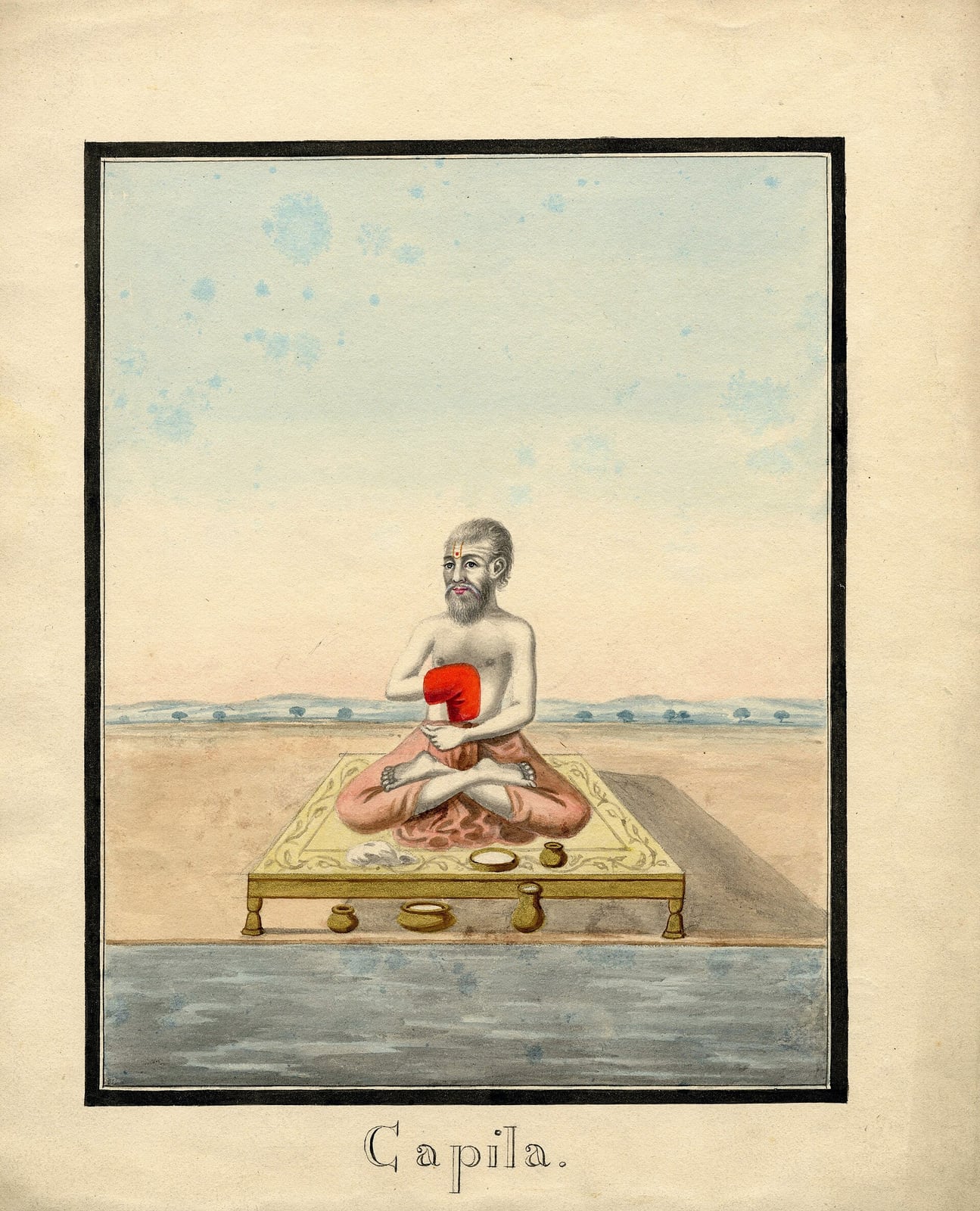
Kapila, sabio védico (pintura de la Company School) · Public domain
Своими словами
«Well, the complete cessation of pain, [which is] of three kinds, is the complete end of man.»Sāṃkhya Sūtra I.1 (obra atribuida, s. XIV–XV); trad. inglesa de Ballantyne (1885, dominio público); versión española del investigador.

Главная мысль
Puruṣa (witnessing consciousness): In Sāṃkhya, puruṣa is pure consciousness: it does not act, change or produce anything and has no qualities; it merely witnesses.
В контексте
Биография
4 мин чтения
Перевод с испанского оригинала, выполненный с помощью ИИ; ожидает проверки носителем языка.
Имя на пороге философии
Немного найдётся имён Древней Индии, которые несут столь большой вес при столь скудной биографии. Для традиции Капила — «первый мудрец» (ādividvān), открывший санкхью, древнейшую из брахманских философских школ, сложившихся в систему; для критической истории он прежде всего авторитет, на который ссылаются тексты, созданные много позже него. Ни одного сочинения нельзя с уверенностью приписать ему, у его жизни нет даты, у смерти — места, а само имя, означающее на санскрите «рыжеватый», «красно-бурый», носят в индийской литературе несколько разных персонажей. Рассказать о нём можно поэтому лишь историю памяти: как школа, культ и сакральная география постепенно облекли имя плотью.
Первые следы
Древнейшее место, на которое обычно ссылаются, — стих «Шветашватара-упанишады» (5.2), говорящий о «рыжем провидце» (ṛṣiṃ prasūtaṃ kapilam), рождённом в начале и вскормленном знаниями. Современная филология сомневается, что речь идёт о человеке: Ларсон и Бхаттачарья видят здесь эпитет космического начала Хираньягарбхи, а уже в VIII веке Шанкара замечал, что текст упоминает «одно лишь имя», не уточняя, о каком Капиле идёт речь. «Махабхарата», напротив, высказывается недвусмысленно: в «Мокшадхарме», разделе «Шантипарвы», посвящённом освобождению, Капила — высший мудрец, провозгласивший санкхью, как Хираньягарбха — йогу; там же он спорит с аскетом Сьюмарашми о ценности ведийского жертвоприношения в сравнении с отречением и ненасилием.
Учитель Асури
Линия преемственности, которую школа признала своей, закреплена в «Санкхья-карике» Ишваракришны, составленной около IV–V веков и являющейся, строго говоря, древнейшим сохранившимся текстом классической санкхьи. Её заключительные строфы гласят, что мудрец из сострадания передал это очищающее учение Асури, Асури преподал его Панчашикхе, а тот широко его распространил, пока Ишваракришна не изложил его сжато в строфах размером арья. Комментарий к «Йога-сутрам» («Йога-бхашья») приводит приписываемый Панчашикхе фрагмент, где Капила — «Первый Знающий», который, из сострадания приняв сотворённый ум, возвестил учение жаждавшему знания Асури. В этой формуле уже заключена двойственность, которая будет сопровождать Капилу всегда: он и учитель-человек, и космическая фигура, наставляющая в начале мирового цикла.
Чему учила санкхья
Приписываемая ему система — строгий дуализм. С одной стороны — пуруша, чистое сознание, множественное, бездеятельное, лишь свидетель; с другой — пракрити, первичная природа, единая и динамичная, сотканная из трёх качеств (гун) — саттвы, раджаса и тамаса, — чьё равновесие, нарушаясь, путём эволюции развёртывает начала (таттвы) мира: интеллект, чувство «я», ум, органы чувств, тонкие и грубые элементы. Страдание рождается из смешения свидетеля с тем, что он созерцает; освобождение (кайвалья, «обособленность») приходит вместе с различающим знанием, разделяющим их. Первая сутра «Санкхья-сутр» выражает это с почти врачебной трезвостью: полное прекращение трёх видов страдания есть высшая цель человека. На этом основании была построена йога Патанджали, чья метафизическая рамка в главном совпадает с санкхьей.
Поздняя книга под его именем
Тексты, носящие сегодня имя Капилы, намного моложе любой разумной даты его жизни. «Санкхья-сутры», называемые также «Санкхья-правачана-сутрой», — немногим более пятисот афоризмов в шести книгах — отсутствуют в изложении санкхьи, которое Мадхава составил в XIV веке на основе «Карики», а первые их известные комментаторы — Анируддха и Виджнянабхикшу, последний — второй половины XVI века. Уже Гарбе считал их очень поздними, а Ларсон и Бхаттачарья относят их примерно к XIV–XV векам. Менее определённа датировка «Таттва-самасы», кратчайшего перечня начал, который Макс Мюллер считал очень древним и который позднейшая критика также признаёт поздним в дошедшем до нас виде. Ни одно из этих сочинений нельзя читать как слово Капилы: это школьная память об учении, которое ему приписывали.
Аватара и мать
В литературе бхакти Капила стал одним из образов Вишну. «Бхагавата-пурана» причисляет его к воплощениям бога — пятым, владыкой совершенных, который преподал Асури утраченную со временем санкхью, — и посвящает ему в третьей книге пространный рассказ: сын мудреца Кардамы и Девахути, дочери Ману, Капила, после того как её муж удалился к отшельнической жизни, наставляет мать в теистической санкхье, где познание начал завершается преданностью Богу. Это особый пласт традиции, сложившийся, вероятно, около IX–X веков и превративший философа дуализма в учителя бхакти. «Бхагавад-гита» предвосхитила это освящение: среди совершенных, говорит Кришна, он — мудрец Капила.
Мудрец, испепеливший сыновей Сагары
Иное повествовательное течение, эпическое, сделало Капилу грозным аскетом. Согласно «Рамаяне» и «Махабхарате», шестьдесят тысяч сыновей царя Сагары, разыскивая коня, предназначенного для жертвоприношения, перекопали землю и нашли его рядом с Капилой, которого приняли за вора; мудрец обратил их в пепел, и лишь нисхождение Ганги, вымоленное много поколений спустя подвижничеством Бхагиратхи, очистило их останки. Из этого сказания родилось паломничество в Гангасагар, к устью Ганга, где храм Капилы каждый январь принимает огромные толпы. Шанкара воспользовался этой двойственностью, чтобы отказать санкхье в ведийском авторитете: традиция, писал он, знает «другого Капилу» — того, что испепелил сыновей Сагары.
Капилавасту и иное наследие
Буддийская традиция связывает название Капилавасту, города шакьев, где вырос Сиддхартха Гаутама, с обителью мудреца Капилы: так повествует Ашвагхоша в первой песни «Саундарананды». Это народная этимология сомнительной исторической ценности, которая говорит больше о престиже имени, чем о древней географии. Знает своего Капилу и джайнизм — автора «Стихов Капилы» в «Уттарадхьяяне», — но это уже другой персонаж. Это изобилие тёзок, несовместимых родословных — сын Брахмы, Кардамы, Кашьяпы — и святых мест и есть самая характерная черта его посмертной судьбы.
Авторитет без текста
Остаётся авторитет без сочинения. Вивекананда назвал его в 1897 году, быть может, величайшим именем в истории Индии в области психологии и философии, а современные исследователи, более сдержанные, видят в санкхье первую великую индийскую попытку помыслить природу как причинный процесс, не нуждающийся в боге-творце: сами «Сутры» отказываются допустить Владыку, «ибо он не доказан». Капила — имя, которое Индия дала истоку этой попытки; всё прочее — его слова, его век, его лицо — принадлежит легенде или молчанию.
Источники: Larson, Gerald James y Ram Shankar Bhattacharya (eds.). Sāṃkhya: A Dualist Tradition in Indian Philosophy. Encyclopedia of Indian Philosophies, vol. IV. Princeton: Princeton University Press / Delhi: Motilal Banarsidass, 1987. · Larson, Gerald James. Classical Sāṃkhya: An Interpretation of its History and Meaning. Delhi: Motilal Banarsidass, 1969; 2.ª ed. revisada, 1979 (ISBN 9788120805033). · Jacobsen, Knut A. Kapila, Founder of Sāṃkhya and Avatāra of Viṣṇu: With a Translation of Kapilāsurisaṃvāda. Nueva Delhi: Munshiram Manoharlal, 2008 (ISBN 9788121511940). · Ballantyne, James Robert (trad.). The Sánkhya Aphorisms of Kapila, with Illustrative Extracts from the Commentaries. 3.ª ed., ed. Fitzedward Hall. Londres: Trübner & Co., 1885 (Trübner's Oriental Series). Texto consultado en el OCR de Internet Archive. · Colebrooke, Henry Thomas (trad.) y Horace Hayman Wilson (trad. y coment.). The Sánkhya Káriká, or Memorial Verses on the Sánkhya Philosophy, by Íswara Krishna; also the Bháshya or Commentary of Gaurapáda. Oxford: Oriental Translation Fund, 1837. Estrofas LXIX–LXXI y comentario de Wilson, pp. 188–191.
Хронология
Жизнь год за годом
Каждая точка — документированное событие. Нажмите, чтобы прочитать о нём, с источником и степенью достоверности.
IV век до н. э.
A “reddish seer” in the Śvetāśvatara Upaniṣad
Verse 5.2 mentions a ṛṣi kapila begotten in the beginning. The Upaniṣad’s date is uncertain (last centuries BCE) and scholars doubt that the word names a person rather than an epithet of Hiraṇyagarbha.
ОспариваетсяLarson, Gerald James y Ram Shankar Bhattacharya (eds.). Sāṃkhya: A Dualist Tradition in Indian Philosophy. Encyclopedia of Indian Philosophies, vol. IV. Princeton: Princeton University Press / Delhi: Motilal Banarsidass, 1987.
IV век до н. э.
A “reddish seer” in the Śvetāśvatara Upaniṣad
Verse 5.2 mentions a ṛṣi kapila begotten in the beginning. The Upaniṣad’s date is uncertain (last centuries BCE) and scholars doubt that the word names a person rather than an epithet of Hiraṇyagarbha.
Оспаривается
ок. 200 до н. э. – 400
Kapila, proclaimer of Sāṃkhya in the Mahābhārata
The Mokṣadharma of the Śāntiparvan presents him as the supreme sage who taught Sāṃkhya and records his dialogues with Āsuri and Syūmaraśmi. The epic took shape between c. 300 BCE and 400 CE; the dating of these sections is approximate.
Вероятно
I век
Kapilavastu, city of the sage Kapila
Aśvaghoṣa relates in the Saundarananda (canto I) that the Śākya princes founded their city beside the hermitage of Kapila Gautama and named it Kapilavastu. It is a folk etymology.
Предание
ок. 350 – 450
The Sāṃkhya Kārikā fixes the line Kapila–Āsuri–Pañcaśikha
Īśvarakṛṣṇa composes the oldest surviving text of classical Sāṃkhya; stanzas 69–71 ascribe the doctrine to the “sage” who taught it to Āsuri. Before 569 Paramārtha translated it into Chinese with a commentary.
Вероятно
ок. 400
The “First Knower” in the Yoga-bhāṣya
The commentary on the Yogasūtra (I.25) quotes a fragment of Pañcaśikha: the First Knower, assuming a created mind out of compassion, declared the doctrine to Āsuri.
Вероятно
VIII век
Śaṅkara distinguishes “another Kapila”
In the Brahmasūtra-bhāṣya (II.1.1) Śaṅkara denies Vedic authority to Kapila’s smṛti and recalls that tradition knows another Kapila, the one who burned the sons of Sagara.
Документировано
ок. 900
Kapila, avatar of Viṣṇu and teacher of Devahūti
The Bhāgavata Purāṇa (I.3.10 and III.24–33) counts him as Viṣṇu’s fifth incarnation and narrates his teaching of a devotional Sāṃkhya to his mother. The Purāṇa’s date is debated (c. 9th–10th centuries).
Оспаривается
ок. 1400 – 1500
The Sāṃkhya Sūtra
The aphorisms that tradition calls the “sūtras of Kapila” are fixed. Larson and Bhattacharya place them around the 14th–15th centuries; their earliest known commentator is Aniruddha.
Вероятно
1837
First European translation of the Kārikā
Colebrooke and Wilson publish the Sāṃkhya Kārikā with Gauḍapāda’s commentary in Oxford; Wilson summarises the traditions about Kapila.
Документировано
1852
Ballantyne translates the Sāṃkhya Sūtra
James R. Ballantyne publishes in India his English version of the aphorisms with extracts from the commentaries; the third edition, revised by Fitzedward Hall, appears in London in 1885.
Документировано
1897
Vivekananda praises Kapila
In a lecture in Calcutta he calls him perhaps the greatest name in Indian history in psychology and philosophy.
Документировано
Труды
Главные труды
Труды, без которых не понять это наследие.
Традиционная атрибуция · ок. 1400
Sāṃkhya Sūtra (Sāṃkhya-pravacana Sūtra)
सांख्यसूत्र (साङ्ख्यप्रवचनसूत्र)
Some five hundred aphorisms (527 in the Wikisource numbering; editions vary by one or two) in six books: the first sets out the doctrine and the theory of knowledge, the second and third the evolution of nature and the means of liberation, the fourth a series of illustrative parables, the fifth refutes rival schools and the sixth recapitulates. It defends the dualism of puruṣa and prakṛti, the pre-existence of the effect in its cause and the impossibility of proving the existence of a Lord (I.92). It was commented on by Aniruddha (c. 1500), Vijñānabhikṣu (second half of the 16th century), who read it in a theistic and Vedāntic key, and Mahādeva Vedāntin.
6 изданий

Традиционная атрибуция · ок. 900
Kapila’s teaching to Devahūti (Kapila-gītā, Bhāgavata Purāṇa III.25–33)
कपिलगीता (भागवतपुराण ३.२५–३३)
Nine chapters in which Kapila, presented as an incarnation of Viṣṇu, answers his mother Devahūti, who asks him to free her from attachment to the body and to “mine”. He expounds the Sāṃkhya principles, nature and puruṣa, the practice of yoga and meditation on the divine form, the kinds of devotion according to the three qualities, the cycle of transmigration and the fate of those who live for pleasure. Its thesis is that the mind bound to the qualities enslaves and the mind fixed on God liberates. It ends with Devahūti’s liberation.
4 издания
Kapila
Tattva Samāsa
Традиционная атрибуция
Tattva Samāsa
तत्त्वसमास (तत्त्वसमाससूत्र)
A very brief list of some twenty-two to twenty-five statements that enumerates, without argument, the categories of the system: the eight “producers” (nature, intellect, the sense of self and the five subtle elements), the sixteen modifications, puruṣa, the three qualities, the processes of manifestation and dissolution, the dispositions of the intellect, the forms of error and of perfection, and liberation. It works as a mnemonic index of the doctrine, and its meaning depends entirely on the accompanying commentary.
3 издания
Все труды (13)

Dialogue of Kapila and Āsuri (Kapilāsurisaṃvāda)
Kapila
Dialogue of Kapila and Syūmaraśmi (Gokapilīya)
The Conscious LibraryDialogue of Kapila and Syūmaraśmi (Gokapilīya)
Kapila
Ṣaṣṭitantra (“Treatise of Sixty Topics”)
The Conscious LibraryṢaṣṭitantra (“Treatise of Sixty Topics”)

Sāṃkhya Kārikā (a work by Īśvarakṛṣṇa, not by Kapila)
350
Kapila
Kapila Purāṇa
The Conscious LibraryKapila Purāṇa
Kapila
Kapila Saṃhitā
The Conscious LibraryKapila Saṃhitā
Kapila
Kapila Smṛti
The Conscious LibraryKapila Smṛti
Kapila
Kapila Pañcarātra
The Conscious LibraryKapila Pañcarātra
Kapila, Founder of Sāṃkhya and Avatāra of Viṣṇu (Knut A. Jacobsen)
2008

Classical Sāṃkhya (Gerald James Larson)
1969
Изречения
Изречения, найденные в конкретном труде. Каждое сопровождается указанием происхождения и степени надёжности.
Well, the complete cessation of pain, [which is] of three kinds, is the complete end of man.atha trividhaduḥkhātyantanivṛttir atyantapuruṣārthaḥ
ПровереноSāṃkhya Sūtra I.1 (obra atribuida, s. XIV–XV); trad. inglesa de Ballantyne (1885, dominio público); versión española del investigador.
Последние слова
Проверяемых записей о последних словах не существует.
There is no record of Kapila’s last words: he is a legendary figure without a documented biography, and the traditional sources do not narrate his death.
Спросить
На что отвечают эти труды
Двенадцать великих вопросов человечества и то, что позволяют на них ответить эти тексты, со ссылками. Мы никогда не вкладываем слова в чужие уста.
Что такое Абсолют? Существует ли Бог?
The existence of a Lord is not proven: there are consciousnesses and nature
Нет Бога-творцаСказано прямо
The Sāṃkhya tradition that goes back to Kapila explains reality by two uncreated principles: consciousness (puruṣa), plural, inactive and witnessing, and primordial nature (prakṛti), single, unconscious and active, from which everything else proceeds. It needs no creator God: nature unfolds by itself for the sake of the consciousnesses, as milk flows for the calf. The Sāṃkhya Sūtras that bear his name dismiss the theistic objection with a terse formula, «because the existence of a Lord is not proven» (1.92), and in book V they examine and reject the arguments for a governor of the world. The ultimate is not a being to be worshipped but pure consciousness, which has never been mixed with what it beholds.
Сравнить этот вопрос с другими учителямиКто я? Существует ли истинное «я»?
The «I» is a product of nature; the witnessing consciousness is not
Эго — конструкция мыслиСказано прямо
In Sāṃkhya, everything we usually call «I» —thinking, deciding, feeling, saying «this is mine»— belongs to nature (prakṛti). The sense of I (ahaṃkāra) is one of its products: it arises from the intellect and gives rise to the mind and the senses. The true self is something else: puruṣa, pure consciousness that does not act or change and merely witnesses, illumining these processes without mixing with them. The fundamental illusion is to ascribe the states of the mind to oneself, and liberating knowledge is formulated as a triple negation: «I am not, nothing is mine, there is no I» (Sāṃkhya Kārikā, verse 64). Unlike non-dual Vedānta, the puruṣas are many, one for each conscious being, and none merges into a common Absolute.
Сравнить этот вопрос с другими учителямиПочему мы страдаем?
The threefold pain arises from not distinguishing consciousness from nature
Незнание того, кто мы естьСказано прямо
Sāṃkhya begins with pain. The Sāṃkhya Sūtras open by declaring that the complete cessation of pain, which is of three kinds, is the complete end of man (1.1): the pain that arises from oneself, that which comes from other beings and that which proceeds from supernatural forces. Neither ordinary remedies nor Vedic rites remove it, because their effect is temporary. Its cause is lack of discrimination (aviveka): consciousness, which merely witnesses, ascribes to itself the states of nature, in which the quality rajas is activity and pain. As long as puruṣa believes itself the one who suffers, suffering belongs to it; when it recognises that it was never mind or body, nature ceases to act with respect to it.
Сравнить этот вопрос с другими учителямиЧто происходит после смерти?
The subtle body transmigrates, not consciousness, until discrimination
Перерождение согласно кармеСказано прямо
The Sāṃkhya tradition accepts rebirth, but explains it with technical precision. What passes from one body to another is the subtle body (liṅga), made up of intellect, the sense of I, mind, senses and subtle elements, which carries acquired dispositions as an actor changes roles (Kārikā, verses 40–42). Consciousness, puruṣa, never transmigrates: strictly speaking, says verse 62, no puruṣa is bound, liberated or wanders from life to life; it is nature that transmigrates, is bound and is freed. When discriminating knowledge matures, the body continues for a time by inertia, like the potter's wheel that keeps turning after the hand is withdrawn (verse 67), and at its fall comes final isolation (kaivalya).
Сравнить этот вопрос с другими учителямиКак достигается освобождение или спасение?
Through discrimination between consciousness and nature, which leaves the witness alone
Через прямое знаниеСказано прямо
Sāṃkhya is above all a path of knowledge. Since neither ordinary remedies nor Vedic rites end the threefold pain, only discriminating knowledge (viveka) achieves it: understanding that puruṣa is not nature nor any of its products. The Kārikā sums it up in the formula «I am not, nothing is mine, there is no I» (verse 64). The Sāṃkhya Sūtras illustrate it with the parable of the king's son raised among hunters, who knows himself a prince only when someone tells him: discrimination arises from teaching about the truth (4.1). Its purpose fulfilled, nature withdraws like the dancer who has finished her dance (3.69), and consciousness remains in kaivalya, isolated and free from all experience.
Сравнить этот вопрос с другими учителямиНужен ли учитель?
Discrimination arises from teaching, like the prince unaware he is one
Полезен, но не обязателенСледует из учения
Sāṃkhya grants teaching a decisive role but does not turn it into submission to a person. The Sāṃkhya Sūtras open their fourth book with the parable of the king's son, raised among humble people, who knows himself a prince only when someone reveals his origin: likewise, discrimination between consciousness and nature arises from teaching about the truth (4.1). The school also preserves a lineage of transmission: the Sāṃkhya Kārikā relates that the sage Kapila compassionately imparted this doctrine to Āsuri, he to Pañcaśikha, and from him it spread (verse 70). But taught knowledge must become one's own discernment, and Kapila himself is for the tradition the «first knower», born already with wisdom.
Сравнить этот вопрос с другими учителямиРеален ли мир?
The world is real: nature unfolding from three qualities
Природный порядок в измененииСказано прямо
For Sāṃkhya the world is neither an illusion nor a divine creation, but the real transformation of primordial nature (prakṛti). Its theory of causation holds that the effect pre-exists in the cause —the oil in the sesame seed, the pot in the clay— so that nothing arises from nothing: the universe is the manifestation of what was latent, and dissolution is its return to that state (Kārikā, verse 9). Nature unfolds in twenty-four principles, from intellect to the gross elements, and its diversity is explained by the varying proportion of three qualities: sattva, rajas and tamas. Unconscious yet ordered, it acts with a purpose: to offer consciousness experience and, afterwards, the discrimination that frees it.
Сравнить этот вопрос с другими учителямиЧто такое любовь?
Sāṃkhya is silent; the Bhāgavata's Kapila makes attachment to saints a door
Не высказывался
The Sāṃkhya tradition has no doctrine of love. Its theme is the separation of consciousness from nature, and affection appears in it as one more modification of the mind, which belongs to prakṛti and binds as long as consciousness ascribes it to itself. It is otherwise with the Kapila of the Bhāgavata Purāṇa, an avatar of Viṣṇu, who in his teaching to his mother Devahūti says that the mind is the cause of bondage and liberation: attached to the qualities it binds, enamoured of the supreme Person it frees (3.25.15); and that attachment, the unageing chain of the soul, when placed in the saints is the open door to liberation (3.25.20). But that is the voice of a later devotional figure, not of Sāṃkhya.
Сравнить этот вопрос с другими учителямиСвободны ли мы или всё предопределено?
Nature acts; consciousness only seems an agent through proximity
Нет делающегоСказано прямо
In Sāṃkhya action is real, but it does not belong to whom we think. All doing —deciding, desiring, moving the body— is the activity of nature, of its three qualities and of the instruments it produces: intellect, sense of I, mind and senses. Consciousness (puruṣa) is by essence inactive, witnessing and indifferent; through its union with nature, says the Kārikā, the unconscious seems conscious and, although the agent is nature, consciousness seems to be the one who acts (verse 20). The merits, demerits and dispositions that condition each new life reside in the intellect, not in puruṣa. To be liberated is not to conquer free will, but to recognise that the witness was never the author of anything.
Сравнить этот вопрос с другими учителямиЗачем медитировать или молиться?
Meditating in order to discern: seeing that consciousness is not the mind
Видеть реальность такой, как она естьСказано прямо
The Sāṃkhya tradition knows no prayer, since there is no Lord to address, but it does know meditation. The Sāṃkhya Sūtras, in their third book, define it as the means that removes attachment and list a stable and comfortable posture and the performance of one's own duties among its conditions; Patañjali's Yoga, which adopts Sāṃkhya metaphysics, develops these techniques in detail. But in Sāṃkhya meditation serves a knowledge: the discernment (viveka) that puruṣa is not nature nor any of its products. The Kārikā says that through the repeated practice of the true principles there arises a complete, pure and unerring knowledge: «I am not, nothing is mine, there is no I» (verse 64).
Сравнить этот вопрос с другими учителямиМожет ли разум познать предельное?
Perception, inference and testimony: reason reaches the unmanifest
Писание и рассуждениеСказано прямо
Sāṃkhya is probably the most rationalist of the classical Indian schools. It admits three means of knowledge: perception, inference and reliable testimony, which includes revelation (Kārikā, verses 4–6). But it gives inference a decisive role: what is not perceived —unmanifest nature, consciousness— is known by reasoning, and the existence of puruṣa is proven because every aggregate exists for another and someone must experience. With the same tool the Sāṃkhya Sūtras deny that a Lord is proven (1.92). Revelation is accepted, but its ritual part is criticised, which the Kārikā judges impure and ineffective (verse 2). The ultimate, liberating discrimination, is a knowledge that ripens with practice, not a leap beyond reason.
Сравнить этот вопрос с другими учителямиУйти от мира или преобразить его?
Detachment and isolation: the goal is for nature to cease acting
Уйти, чтобы найтиСледует из учения
Sāṃkhya offers no programme for the world, because its goal is the isolation (kaivalya) of consciousness from nature. The path runs through detachment (vairāgya) and renunciation: the Sāṃkhya Sūtras illustrate in their fourth book, with a series of parables, the wisdom of living without hopes, without distracting company and without accumulating, like the courtesan Piṅgalā, who was happy once she stopped expecting. The Kārikā warns that not even the Vedic rites, which promise better worlds, free from pain (verse 2). Life in the world is not condemned, but it is regarded as a field of experiences that consciousness, once satisfied, leaves behind, like the spectator who has already seen the dance (verse 59).
Сравнить этот вопрос с другими учителями
Созвучия и противоречия
Созвучия и противоречия
Рассчитаны вопрос за вопросом на основе позиций. Причина каждого совпадения или расхождения — по нажатию.
Ближе всего к

Patañjali
Совпадают в вопросах: Что такое Абсолют? Существует ли Бог? · Почему мы страдаем? · Что происходит после смерти?
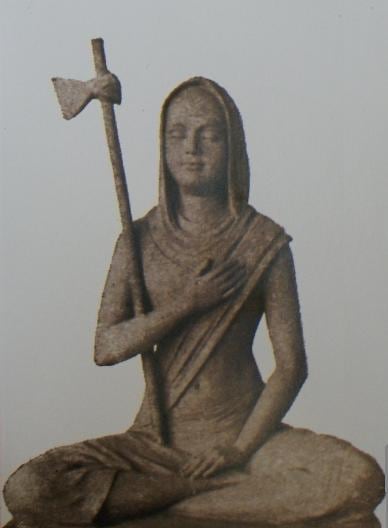
Gaudapada
Совпадают в вопросах: Почему мы страдаем? · Как достигается освобождение или спасение? · Свободны ли мы или всё предопределено?

Nāgārjuna
Совпадают в вопросах: Как достигается освобождение или спасение? · Что такое Абсолют? Существует ли Бог? · Что происходит после смерти?
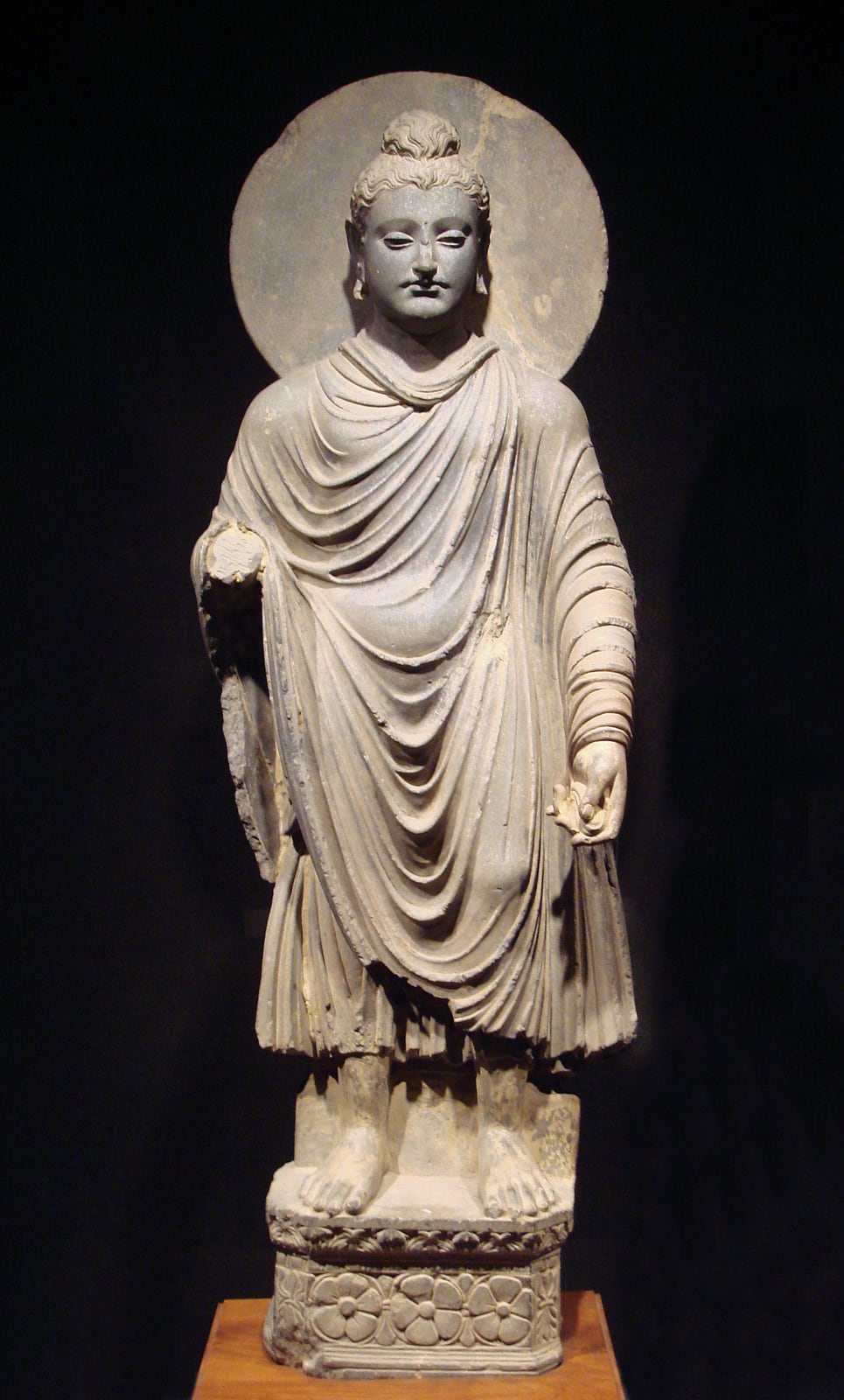
Siddhartha Gautama, the Buddha
Совпадают в вопросах: Что такое Абсолют? Существует ли Бог? · Что происходит после смерти? · Нужен ли учитель?
Дальше всего от

Francis of Assisi
Расходятся в вопросах: Что такое Абсолют? Существует ли Бог? · Что происходит после смерти?
Hafez
Расходятся в вопросах: Что такое Абсолют? Существует ли Бог? · Что происходит после смерти?
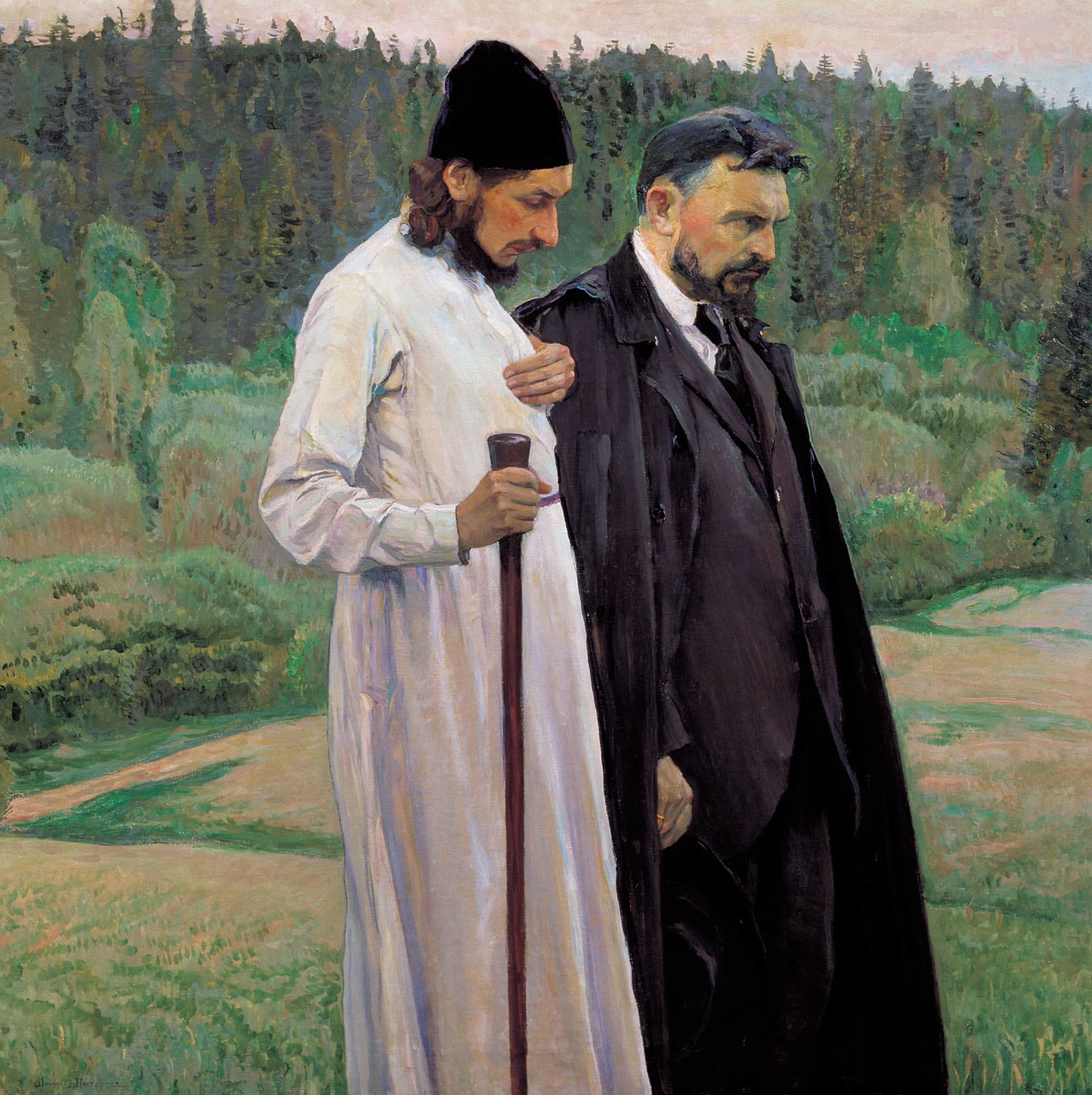
Pavel Florensky
Расходятся в вопросах: Что такое Абсолют? Существует ли Бог? · Что происходит после смерти?
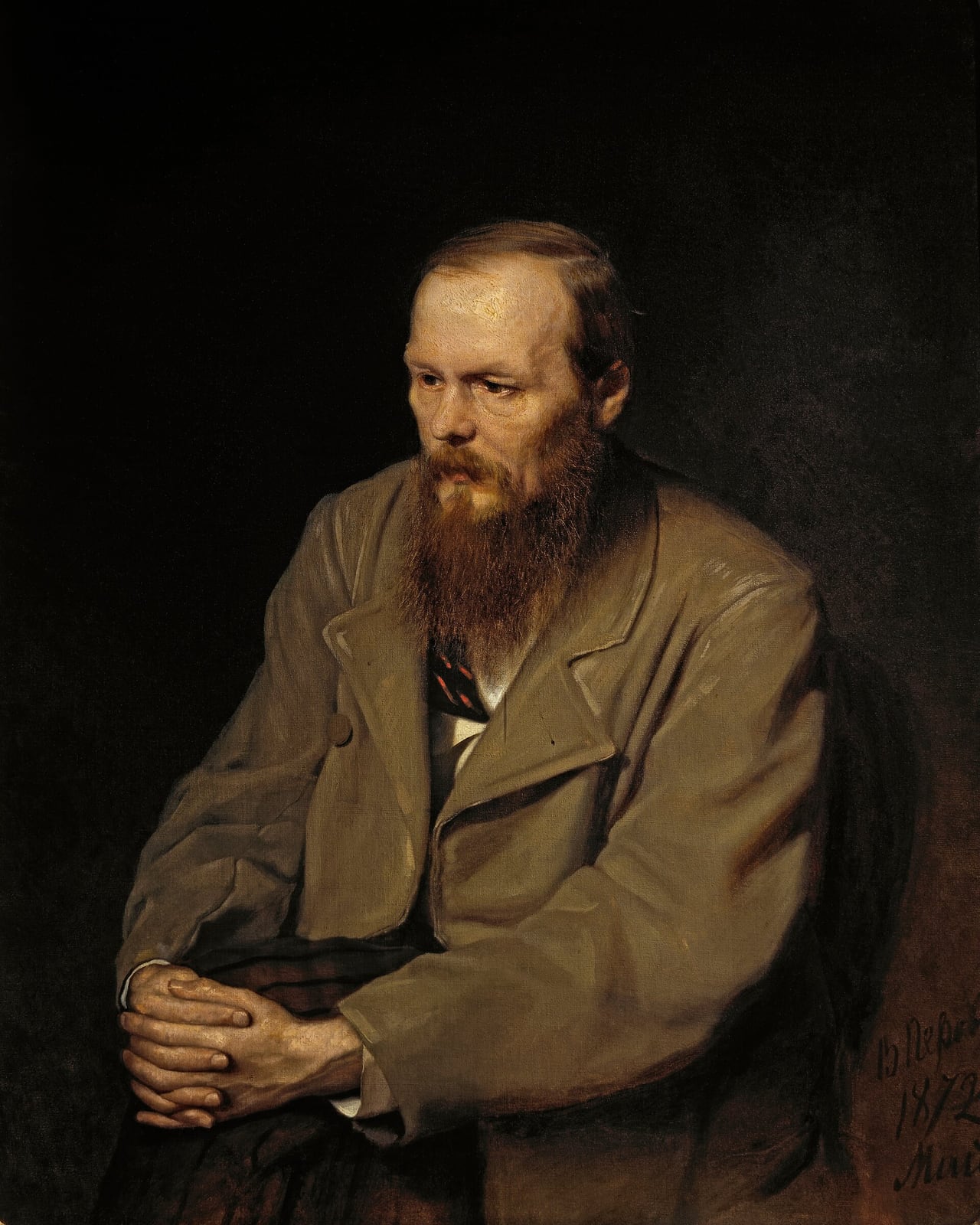
Fyodor Dostoevsky
Расходятся в вопросах: Что такое Абсолют? Существует ли Бог? · Что происходит после смерти?
Предания и рассказы
Предания и рассказы
Житийное повествованиеtiempo mítico
The sixty thousand sons of Sagara
Происхождение рассказа: An epic narrative of the Rāmāyaṇa (Bālakāṇḍa) and the Mahābhārata (Āraṇyakaparvan), taken up by the Bhāgavata Purāṇa (IX.8). Wilson (1837) already noted that the Rāmāyaṇa identifies this Kapila with Vāsudeva; Śaṅkara (8th c.) distinguished him from the founder of Sāṃkhya. The link with Gaṅgāsāgar is a pilgrimage tradition studied by Jacobsen (2013).
Житийное повествованиеtiempo mítico
The mother who asked to be set free
Происхождение рассказа: Bhāgavata Purāṇa III.21–33, a devotional text of debated date (c. 9th–10th centuries). Burnouf (1840) already noted that this story is not found elsewhere and turns Kapila into a form of Bhagavat. The identification with Siddhpur is a pilgrimage tradition studied by Jacobsen (2013).
Устная традицияtiempo épico
The sage and the sacrificial cow
Происхождение рассказа: Mahābhārata, Śāntiparvan (Mokṣadharma), the episode called Gokapilīya in the Poona critical edition. It is a didactic epic narrative, not a historical testimony. Kapila’s exact exclamation varies among translations; the content is summarised here without quoting it.
Источник: The Mahābhārata. Edición crítica, vols. 13–16: Śāntiparvan, ed. S. K. Belvalkar. Poona: Bhandarkar Oriental Research Institute, 1949–1966 (Mokṣadharma; diálogos de Kapila con Syūmaraśmi y con Āsuri; XII.337.60 sobre Kapila como proclamador del Sāṃkhya).
Устная традицияs. XIV–XVI (texto y comentario)
The prince raised by a forester
Происхождение рассказа: Sāṃkhya Sūtra IV.1 (a text ascribed to Kapila, 14th–15th c.) and Vijñānabhikṣu’s commentary (16th c.), in Ballantyne’s translation (1885), pp. 284–285. It is a didactic parable, not an episode in Kapila’s life.
Документированоs. VIII
Śaṅkara and “the other Kapila”
Происхождение рассказа: Brahmasūtra-bhāṣya II.1.1, in Thibaut’s translation (SBE 34, 1890), checked against the OCR of the volume. Śaṅkara’s date (c. 8th century) is the usual scholarly one.
Житийное повествованиеtiempo legendario (texto del s. I–II)
Kapilavastu, the city beside the hermitage
Происхождение рассказа: Aśvaghoṣa, Saundarananda, canto I (1st–2nd c. CE), ed. and trans. E. H. Johnston. An aetiological story; the Pali tradition preserves other versions of the origin of the Śākyas.
Источник: Johnston, E. H. (ed. y trad.). The Saundarananda of Aśvaghoṣa. Oxford University Press / Panjab University, 1928 (texto) y 1932 (traducción). Canto I, sobre la fundación de Kapilavastu junto a la ermita del sabio Kapila Gautama.
Житийное повествованиеépoca de Prasenajit (s. VI–V a. C., según el relato)
The other Kapila: two gold coins
Происхождение рассказа: Jain commentary on Uttarādhyayana VIII, summarised by Hermann Jacobi in his translation (SBE 45, 1895, p. 31, note 1); verse 17 is the one the story places in Kapila’s mouth before the king. It is included to dispel the homonymy: this is another Kapila.
Учение
Учение
Понятия, на которых строится мысль учителя, объяснённые в их контексте.
Puruṣa (witnessing consciousness)purusha
It is one of the two irreducible principles of Sāṃkhya and the point at which it diverges most from Vedānta, which affirms a single consciousness. Patañjali’s Yoga inherits the notion (as draṣṭṛ, “the seer”).
Источник: Larson, Gerald James. Classical Sāṃkhya: An Interpretation of its History and Meaning. Delhi: Motilal Banarsidass, 1969; 2.ª ed. revisada, 1979 (ISBN 9788120805033).
Prakṛti (primordial nature)prakriti
The theory of prakṛti was adopted by Yoga, by much of Purāṇic cosmology and by Āyurvedic medicine, although Vedānta reinterpreted it as the power (māyā) of a single Brahman.
Источник: Larson, Gerald James. Classical Sāṃkhya: An Interpretation of its History and Meaning. Delhi: Motilal Banarsidass, 1969; 2.ª ed. revisada, 1979 (ISBN 9788120805033).
The three qualities (guṇa)gunas
The guṇas already appear in the epic and are systematised in the Kārikā (stanzas 12–13). They are one of the notions most widely shared among Indian schools.
The twenty-five principles (tattva)tattvas
The list of twenty-five principles is the classical form fixed in the Kārikā; in the epic there are different counts (twenty-six or seventeen), a sign of a doctrine still in formation. The Tattva Samāsa is essentially an index of these categories.
Источник: Larson, Gerald James y Ram Shankar Bhattacharya (eds.). Sāṃkhya: A Dualist Tradition in Indian Philosophy. Encyclopedia of Indian Philosophies, vol. IV. Princeton: Princeton University Press / Delhi: Motilal Banarsidass, 1987.
Satkāryavāda (the effect pre-exists in the cause)satkaryavada
It is one of the logical pillars of the system and the reason why Sāṃkhya can dispense with a creator god. The Sāṃkhya Sūtra defend it in book I.
Viveka and kaivalya (discrimination and isolation)kaivalya
The term kaivalya passed into Patañjali’s Yoga, which names its fourth chapter after it (Kaivalya-pāda). The devotional version of the Bhāgavata replaces isolation with loving union with God.
Видео
Видео
Записи, интервью и документальные фильмы. Видео воспроизводятся с YouTube; здесь они не хранятся.
Kapila of Sāṃkhya: Manifestations and interpretations by Prof. Knut Axel Jacobsen
Лекция· EN· 93 min
Bhaktivedanta Research Center
Sāṃkhya philosophy and Yoga practice: how are they related? - Dr Mikel Burley
Лекция· EN· 76 min
SOAS Centre Of Yoga StudiesОфициальный канал
Samkhya Karikas (Part 1) - Edwin Bryant
Лекция· EN· 139 min
Edwin Bryant OfficialОфициальный канал
Hindu Philosophy Introduction 7: Yoga and Sāṃkhya - Edwin Bryant
Лекция· EN· 60 min
Edwin Bryant OfficialОфициальный канал
“Concept of Mind in Yoga and Sankhya Philosophy" Lecture with Dr. N. Ganesh Rao
Лекция· EN· 75 min
Loyola Marymount University, BCLA Yoga StudiesОфициальный канал
Revisiting Sāṃkhya Kārikās 25-31: The Determinative Nature of the Guṇas
Лекция· EN· 49 min
Loyola Marymount University, BCLA Yoga StudiesОфициальный канал
Saga of the Soul 065 - Samkhya Darshan (Kapila School Of Philosophy)
Лекция· EN· 64 min
Chicago VedantaОфициальный канал
Swami Purnananda explains the 24 elements of the Sankhya philosophy and verses from Katha Upanishad
Лекция· EN· 60 min
Éire Vedanta SocietyОфициальный канал
Know our Shastras: Essentials of Sankhya Philosophy
Лекция· EN· 84 min
MIT IIKS
Samkhya-Sutra, El hilo de oro del Indo, por Ibn Asad y Fernando Sánchez Dragó (1ª Parte - Ponencia)
Лекция· ES· 56 min
LaDanzaFinaldeKali
Introducción a la filosofía Samkhya. Yogacharya Emiliano Crivellari
Лекция· ES· 37 min
Emiliano CrivellariОфициальный канал
कपिल अवतार और सांख्य शास्त्र के प्रवर्तक कपिल मुनि अलग थे
Разбор· HI· 2 min
Govardhan Math, PuriОфициальный канал
सांख्य दर्शन SANKHYA DARSHAN की सरल और व्यावहारिक व्याख्या - DR HIMMAT SINGH SINHA
Лекция· HI· 14 min
The Quest
সাগরের জল স্পর্শ করে, কপিল মুনির আশীর্বাদের আশা, এর পেছনে পৌরাণিক ঘটনা, শুনব| ABP Ananda
Документальный фильм· BN· 2 min
ABP ANANDAОфициальный канал
Галерея
Галерея
Изображения с проверенной лицензией. Каждое сохраняет своё авторство и атрибуцию.
Связи
Связи
Влияния, ученичество и близость взглядов. Документированная связь отличается от сходства, выявленного путём анализа.
Расходился во взглядах с
Śaṅkara refuted Sāṃkhya in his Brahmasūtra-bhāṣya (II.1.1 and II.2) and denied Vedic authority to “Kapila’s smṛti”, also distinguishing “another Kapila”, the one who burned the sons of Sagara.
Документированная связь
Повлиял на
Patañjali’s Yoga adopts the metaphysical framework of Sāṃkhya (puruṣa, prakṛti, guṇa, kaivalya), and its commentary (Yoga-bhāṣya I.25) quotes the Pañcaśikha fragment presenting Kapila as the “First Knower”.
Документированная связь
Повлиял на
The Yoga-bhāṣya, traditionally ascribed to Vyāsa, quotes Kapila’s teaching to Āsuri; the Bhagavad Gītā, in the Mahābhārata ascribed to Vyāsa, names Kapila among the perfected. A textual, not historical, relation.
Документированная связь
Повлиял на
A commentary on the Sāṃkhya Kārikā bears Gauḍapāda’s name and quotes a verse counting Kapila among the sons of Brahmā. Whether its author is the Gauḍapāda of the Māṇḍūkya-kārikā is doubtful.
Документированная связь
Повлиял на
In 1897 he called him “perhaps the greatest name in the history of India in psychological and philosophical lines” and devoted several lectures to Sāṃkhya.
Документированная связь
Идеи, близкие к
Siddhartha Gautama, the Buddha
Buddhist tradition associates Kapilavastu, the Buddha’s city, with the hermitage of a sage Kapila (a folk etymology). Since Max Müller the Sāṃkhya and Buddhist diagnoses of suffering have been compared, though their paths differ.
Сходство, выявленное путём анализа
Идеи, близкие к
The Bhagavad Gītā (10.26) has Kṛṣṇa say in the same verse that among divine sages he is Nārada and among the perfected, Kapila; the Mahābhārata presents Nārada as versed in Sāṃkhya.
Сходство, выявленное путём анализа
Идеи, близкие к
Uddālaka’s teaching in the Chāndogya Upaniṣad (VI), with its analysis of effects as modifications of one substance (clay and its pots), anticipates themes of Sāṃkhya’s satkāryavāda.
Сходство, выявленное путём анализа
Идеи, близкие к
The figure of the witness that cannot be seen, in Yājñavalkya’s teachings in the Bṛhadāraṇyaka Upaniṣad, is one of the Upaniṣadic antecedents of the notion of puruṣa.
Сходство, выявленное путём анализа
Идеи, близкие к
The Gauḍīya tradition founded by Caitanya reads Kapila’s teaching to Devahūti as a devotional Sāṃkhya; Bhaktivedanta Swami’s commentary (Teachings of Lord Kapila) comes from it.
Сходство, выявленное путём анализа
Источники
Источники
Библиография и каталоги, использованные для этой статьи.
- Wikidata, «Kapila» (sabio védico de la tradición hindú), QID Q574355; LCCN n50059441; GND 119244233; BnF 11909405v; VIAF 9848428.
- Larson, Gerald James y Ram Shankar Bhattacharya (eds.). Sāṃkhya: A Dualist Tradition in Indian Philosophy. Encyclopedia of Indian Philosophies, vol. IV. Princeton: Princeton University Press / Delhi: Motilal Banarsidass, 1987.
- Larson, Gerald James. Classical Sāṃkhya: An Interpretation of its History and Meaning. Delhi: Motilal Banarsidass, 1969; 2.ª ed. revisada, 1979 (ISBN 9788120805033).
- Jacobsen, Knut A. Kapila, Founder of Sāṃkhya and Avatāra of Viṣṇu: With a Translation of Kapilāsurisaṃvāda. Nueva Delhi: Munshiram Manoharlal, 2008 (ISBN 9788121511940).
- Ballantyne, James Robert (trad.). The Sánkhya Aphorisms of Kapila, with Illustrative Extracts from the Commentaries. 3.ª ed., ed. Fitzedward Hall. Londres: Trübner & Co., 1885 (Trübner's Oriental Series). Texto consultado en el OCR de Internet Archive.
- Colebrooke, Henry Thomas (trad.) y Horace Hayman Wilson (trad. y coment.). The Sánkhya Káriká, or Memorial Verses on the Sánkhya Philosophy, by Íswara Krishna; also the Bháshya or Commentary of Gaurapáda. Oxford: Oriental Translation Fund, 1837. Estrofas LXIX–LXXI y comentario de Wilson, pp. 188–191.
- Woods, James Haughton (trad.). The Yoga-System of Patañjali. Cambridge (Mass.): Harvard University Press, 1914 (Harvard Oriental Series 17). Yoga-bhāṣya I.25, con la cita de Pañcaśikha sobre el «Primer Conocedor».
- Thibaut, George (trad.). The Vedânta-Sûtras with the Commentary by Sankarâkârya, parte I. Oxford: Clarendon Press, 1890 (Sacred Books of the East 34). Brahmasūtra-bhāṣya II.1.1, sobre la «smṛti de Kapila».
- Jacobi, Hermann (trad.). Gaina Sûtras, parte II: The Uttarâdhyayana Sûtra, The Sûtrakritâṅga Sûtra. Oxford: Clarendon Press, 1895 (Sacred Books of the East 45). Lección VIII, «Kapila's Verses», con la nota sobre el relato del comentario.
- Burnouf, Eugène (trad.). Le Bhâgavata Purâna, ou Histoire poétique de Krĭchṇa, tome premier. París: Imprimerie royale, 1840. Libros I–III; prefacio sobre el relato de Kapila y Devahūti; I.3.10 (Kapila, quinta encarnación).
- Wikisource en sánscrito: «साङ्ख्यसूत्राणि» (Sāṃkhya Sūtra, 527 aforismos numerados) y «श्रीमद्भागवतपुराणम्/स्कन्धः ३/अध्यायः २५» (Bhāgavata Purāṇa III.25).
- Arnold, Edwin (trad.). The Song Celestial, or Bhagavad-Gîtâ. Londres: Trübner, 1885. Capítulo X (verso 26: «Kapila of Munis»). Project Gutenberg n.º 2388.
- Vivekananda, Swami. «The Vedanta in all its phases» (Calcuta, 1897), en Lectures from Colombo to Almora; The Complete Works of Swami Vivekananda, vol. 3. Texto en Wikisource.
- Ballantyne, James Robert. A Lecture on the Sánkhya Philosophy, embracing the Text of the Tattwa Samása. Mirzapur: Orphan School Press, 1850.
- Sinha, Nandalal (trad.). The Sāmkhya Philosophy: containing Sāmkhya-pravachana Sūtram, with the Vritti of Aniruddha and the Bhāsya of Vijñāna Bhiksu…; Tattva Samāsa; Sāmkhya Kārikā; Panchaśikha Sūtram. Allahabad: Pāṇini Office, 1915 (Sacred Books of the Hindus 11).
- Johnston, E. H. (ed. y trad.). The Saundarananda of Aśvaghoṣa. Oxford University Press / Panjab University, 1928 (texto) y 1932 (traducción). Canto I, sobre la fundación de Kapilavastu junto a la ermita del sabio Kapila Gautama.
- Garbe, Richard. Die Sâṃkhya-Philosophie: eine Darstellung des indischen Rationalismus. Leipzig: H. Haessel, 1894 (2.ª ed. 1917).
- The Mahābhārata. Edición crítica, vols. 13–16: Śāntiparvan, ed. S. K. Belvalkar. Poona: Bhandarkar Oriental Research Institute, 1949–1966 (Mokṣadharma; diálogos de Kapila con Syūmaraśmi y con Āsuri; XII.337.60 sobre Kapila como proclamador del Sāṃkhya).
- Müller, F. Max. The Six Systems of Indian Philosophy. Londres: Longmans, Green & Co., 1899. Capítulo sobre el Sāṃkhya y el Tattva-samāsa.
- Jacobsen, Knut A. Pilgrimage in the Hindu Tradition: Salvific Space. Londres y Nueva York: Routledge, 2013 (lugares de Kapila, entre ellos Gaṅgāsāgar).
- Wikipedia en inglés, «Kapila» (consultada para la lista de obras menores atribuidas y las genealogías purāṇicas; contrastada con Larson y Bhattacharya, 1987).
- Правообладатель
- Textos sánscritos en dominio público. Las traducciones de Ballantyne (1852, 1885), Colebrooke y Wilson (1837), Burnouf (1840) y Woods (1914) son de dominio público; las ediciones modernas (Routledge, Munshiram Manoharlal, Motilal Banarsidass, Bhaktivedanta Book Trust, Agamat) tienen derechos propios.
Ожидает подтверждения
То, что в этой статье пока не удалось установить. Мы предпочитаем сказать об этом, а не заполнять пробел.
- Ediciones en español con ISBN de los Sāṃkhya Sūtra, de la Sāṃkhya Kārikā y del canto III del Bhāgavata (Bhaktivedanta Book Trust): no localizadas en Open Library; Google Books devolvió error 429 durante la investigación.
- Verificar la numeración exacta (edición crítica de Poona) del Gokapilīya y del Kapilāsurisaṃvāda en el Śāntiparvan, y la cita del Mokṣadharma (XII.337.60) sobre Kapila como proclamador del Sāṃkhya.
- Comprobar la fecha de muerte de Nandalal Sinha para decidir el dominio público de su traducción de 1915 en la UE y España.
- Confirmar en Jacobsen (2008, 2013) los datos sobre Siddhpur (Bindu Sarovar) y Gaṅgāsāgar.
- Localizar manuscritos digitalizados de los Sāṃkhya Sūtra con signatura (campo manuscripts vacío).
- Los vídeos no traen año de publicación en oEmbed; se dejó year en null.
Исследовано 2026-10-26